Sunday, June 25, 2023

Palestinian Authority Blames Netanyahu for Persisting Settler Terrorism in West Bank


2023-June-25 

TEHRAN (FNA)- The Palestinian Authority (PA) held Israeli Prime Minister Benjamin Netanyahu fully responsible for rising settler attacks against Palestinians across the occupied West Bank, saying the ongoing violence is fueled by far-right ministers Bezalel Smotrich and Itamar Ben-Gvir.

The Palestinian Foreign Ministry said in a statement on Saturday that the rise in Israeli crimes “reflects a policy adopted by the far-right Netanyahu administration, and is also a direct reflection of the campaigns of incitement to murder Palestinians, especially by extremist racists like Ben-Gvir and his followers”, presstv reported.

“The ruling Israeli coalition systematically undermines any regional and international efforts to restore the political horizon to resolve the conflict and creates more escalation in an attempt to impose the logic of military occupation,” the statement added.

The ministry also called on the international community to stop its double standards in dealing with international principles, resolutions and agreements signed under the auspices of world bodies.

More than 600,000 Israelis live in over 230 settlements built since the 1967 Israeli occupation of Palestinian territories of the West Bank and East Al-Quds.

All the settlements are illegal under international law. The UN Security Council has condemned Israel’s settlement activities in the occupied territories in several resolutions.

According to human rights groups, acts of violence by Israeli settlers against Palestinians and their property are a daily occurrence throughout the occupied West Bank.

Earlier on Saturday, several houses and vehicles were set on fire by extremist Israeli settlers in the village of Umm Safa, North of Ramallah.

The official Palestinian news agency WAFA, citing local sources, reported that scores of Israeli settlers, some armed with rifles and guarded by Israeli army forces, stormed the village and fired indiscriminately at everything they came across, including homes and vehicles.

The shooting attack also caused damage to an ambulance. A paramedic was slightly injured by a gunshot while moving a patient in urgent condition to a hospital.

Israeli soldiers and settlers have been escalating their attacks against Palestinian civilians in the occupied territories, in an attempt to forcibly expel Palestinians from their lands and make way for expanding illegal Jewish-only settlements.

Meanwhil, the official Palestinian news agency reported that a Palestinian man succumbed to his wounds a day after being shot by Israeli forces during a raid in the Northern part of the occupied West Bank.

WAFA, citing the Palestinian Ministry of Health, announced the death of 39-year-old Tareq Mousa Idris on Saturday.

The ministry said Mousa was shot in the stomach as Israeli troops stormed Askar refugee camp, located on the outskirts of the city of Nablus, on Friday morning.

Following his injury, the Palestinian man was moved to Specialized Arab Hospital in Nablus, where he underwent operations and stayed in a critical condition until he was pronounced dead.

The development comes a few hours after a Palestinian teenager was left bleeding to death after a shooting attack at Qalandia military checkpoint.

Ishaq Hamdi Ajlouni, 17, was shot and killed by Israeli forces after he opened fire at the checkpoint on Saturday, lightly wounding a security guard, WAFA reported.

The Al-Aqsa Martyrs' Brigades, the armed wing of the Fatah movement, said in a statement that Aljouni was its member.

“Our heroic fighters … were able to directly target occupation [Israeli] soldiers at Qalandia checkpoint,” the brigades said in a statement.

Israel said the young gunman, from the Kafr ‘Aqab neighborhood just North of the checkpoint, used an M-16 rifle to carry out the purported shooting.

Meanwhile, doctors at An-Najah National University Hospital in Nablus had to remove an eye of five-year-old Khaled Akram Malalha, who was injured on Friday during confrontations that erupted near the village of Bizzariya, located 13.3 kilometers (8.2 miles) Northwest of Nablus.

The Palestinian child was shot in the eye while he was in his father's vehicle.

Israeli forces have killed at least 180 Palestinians, including 26 children, so far this year, according to the Palestinian Health Ministry.

The death toll includes 36 Palestinians who lost their lives during a four-day Israeli onslaught on the besieged Gaza Strip between May 9 and 13.

Will the IDF really treat settler violence as ‘terrorism’?
Senior analyst Haviv Rettig Gur on bureaucratic reasons why life is more difficult for the Palestinians; military correspondent Emanuel Fabian on five days of vigilante attacks
Today, 
Welcome to The Times of Israel’s Daily Briefing, 


Senior analyst Haviv Rettig Gur and military correspondent Emanuel Fabian join host Amanda Borschel-Dan.


Yesterday, during Shabbat, several dozen settler vigilantes rampaged for the fifth consecutive day following Tuesday’s fatal Palestinian terror shooting, this time through the Palestinian West Bank village of Umm Safa, setting fire to vehicles and homes. What else do we know about this attack and where was the IDF?

Rettig Gur speaks at length about how Israel is failing to follow through on “managing” or “shrinking” the Israeli-Palestinian conflict. What are some “boring” bureaucratic ways in which Palestinians are being blocked from basic necessities such as electricity and sewage?


Israel’s police minister Ben-Gvir rebukes forces over ‘punishment’ of settlers


Israel’s National Security Minister Itamar Ben-Gvir arrives at the scene of a suspected Palestinian shooting attack that killed four people near the Jewish settlement of Eli, in the Israeli-occupied West Bank, on June 20, 2023. (Reuters)

Reuters, Jerusalem
Published: 25 June ,2023: 

Israel’s far-right police minister rebuked the force on Sunday for what he called “collective punishment” of Jewish settlers, as cracks widened between the security services and the government over sectarian violence in the occupied West Bank.

Settler rampages in Palestinian towns and villages after the killing of four Israelis in a Hamas gun ambush have drawn international condemnation and US statements of concern.

US-brokered peace talks aimed at founding a Palestinian state in the West Bank, East Jerusalem, and Gaza collapsed in 2014. Most countries deem the settlements Israel built on land it seized in the 1967 war as illegal, a view Israel disputes.

Israel’s military, police, and domestic security service chiefs said in a statement on Saturday that the settlers’ actions over the last week amounted to “nationalist terrorism,” which they pledged to fight.

The terminology upset far-right members of Prime Minister Benjamin Netanyahu’s coalition government, who in the past have rejected comparisons between Jewish and Palestinian militants.

One of them, National Security Minister Itamar Ben-Gvir, said on Sunday he had demanded police explain why they had blocked the gates to the settlement of Ateret to screen those coming and going and “tased a person who was standing nearby”.

Ben-Gvir told the police chief that “he opposes any violation of the law” but cannot accept “collective punishment” of settlers, a statement from the minister’s party said.

Police spokespeople did not immediately respond for comment.

The military said it detained a soldier suspected of taking part in a “violent confrontation” in Umm Safa village, where bystander video showed two men aiming rifles in the direction of a Palestinian shouting at them in Arabic. Gunshots can be heard.

Netanyahu has sought to calm Western concern about his ultranationalist partners, saying he would steer policy. But the veteran politician has raised US, hackles with settlement building.

Last week he issued a general censure of rioting in the West Bank. Asked if Netanyahu agreed with the security chiefs’
designation of the rampages as “terrorism,” his office referred Reuters to that statement and declined further comment.

At least two cabinet ministers from Netanyahu’s conservative Likud party shied from the term.

“I think the (rampages) are actions, nationalist actions -- as they have been designated -- taken against a nationalist backdrop, and that’s something that shouldn’t be permitted,” Likud’s Energy Minister Israel Katz told Army Radio.

“Terrorism is something different.”

Israel settlers shoot at journalists, attack ambulance in West Bank

The New Arab Staff
24 June, 2023

Settlers stormed the Palestinian village of Umm Safa near Ramallah, shooting at homes, said local mayor Marwan Sabbah.
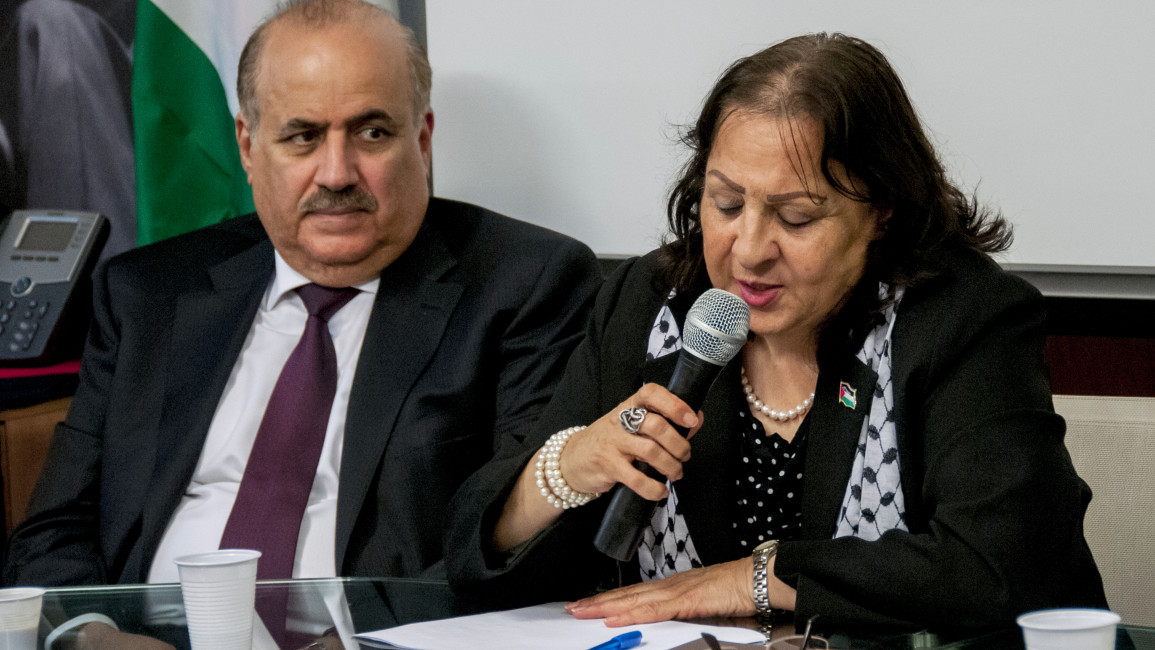

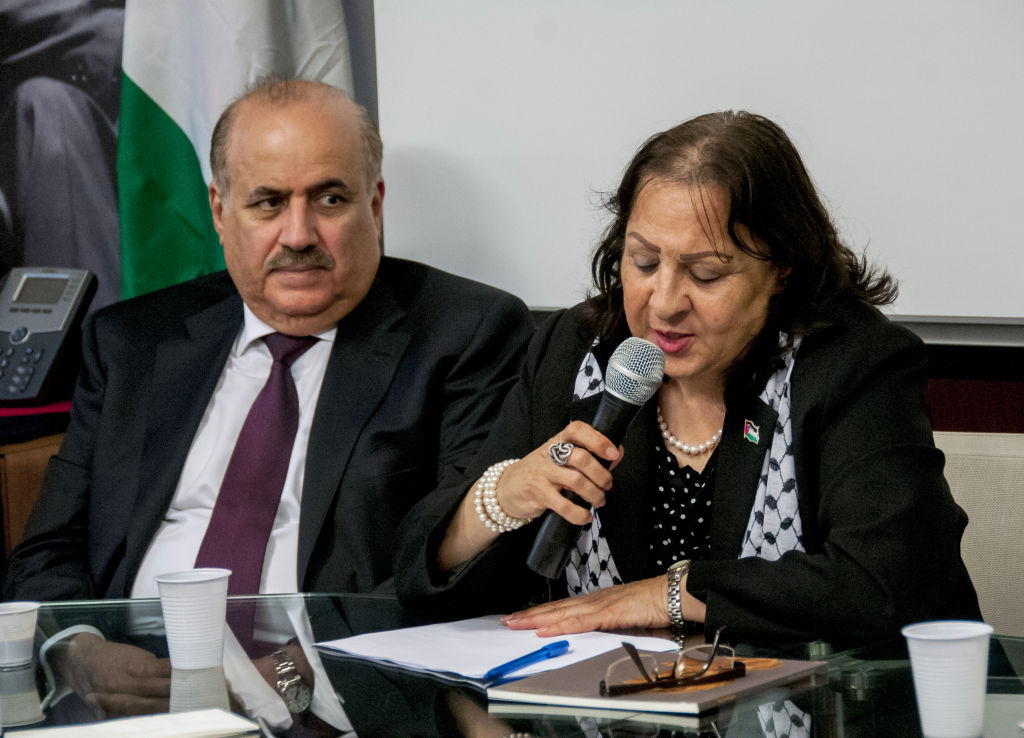
Palestinian Health Minister Mai Al-Kaila (right) condemned an Israeli settler attack on an ambulance [Patrizia Cortellessa/Pacific Press/LightRocket/Getty-archive]

Israeli settlers shot at journalists and homes and attacked an ambulance on Saturday amid a period of heightened violence against Palestinians in the occupied West Bank.

Settlers stormed the Palestinian village of Umm Safa near Ramallah, shooting at homes, said local mayor Marwan Sabbah.
A horse was killed and some homes partly caught alight, he was cited as saying by the official Palestinian news agency Wafa.

An ambulance and other vehicles were damaged, with a paramedic shot and mildly wounded while transporting someone to a hospital.

Wafa said the ambulance was shot. There were reportedly dozens of settlers who stormed Umm Safa.

The Palestinian health ministry issued a statement on the messaging app Telegram saying an ambulance with a patient on board had been attacked near Umm Safa.

RELATED
MENA
Sam Hamad

Health Minister Mai Al-Kaila, who condemned the attack, said settlers threw stones at the vehicle, with the driver left injured.

The patient was not hurt, she said, urging the international community to protect medical staff and Palestinians from ongoing Israeli settler terrorism.

It was unclear why the details of the incident differed between Wafa and the health ministry's accounts.

It did not appear that two different ambulances were attacked as photos published by the two organisations seemed to be of the same vehicle.

A cameraman for the official Palestine TV, Mohammad Radi, said settlers shot at him and his colleague while they reported on the assault against Umm Safa. Their camera was damaged by a bullet, Radi said.

Separately, settlers attacked Palestinians and destroyed six tents in Al-Mughayyir, a village in Ramallah and Al-Bireh province.

Settlers attacked Bedouins camping in the village, witnesses said. An 80-year-old was taken to hospital after being hurt in the violence.

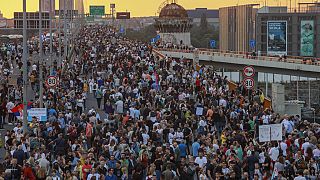

Calls for President Vučić to resign as protests enter eighth week in Serbia


By Euronews with EFE • Updated: 25/06/2023 

People are angry with President Vučić's government and his close ties with the tabloid media they claim incites hatred and promotes violence.

Thousands of people gathered on Saturday in the centre of Belgrade for the 'Serbia against violence' march.

It was the eighth week of protests in a row in the country's capital and this time extended to 20 other cities.

These included Serbia's next largest cities of Novi Sad and Kragujevac, and in the smaller towns of Kraljevo, Subotica, Vranje, Sabac and Leskovac.

The demonstrators, including members of some opposition parties are calling for the resignation of President Aleksandar Vučić, and also top representatives in media, the police force, and security services.

Critics of the president accuse him of authoritarianism and say the tabloid media his government is close to incites hatred and promotes violence. Protestors also want an end to reality TV shows.

What happened in May?

A growing number of cities are joining the demonstrations, triggered by a wave of outrage following two shootings in early May that left 19 people dead.

On 3 May, a 13-year-old student at a Belgrade school shot dead nine classmates and a security guard. Less than 48 hours later, a 21-year-old killed nine people in a central Serbian town.


Protesters are calling for government accountability and the resignation of the Minister of the Interior and the director of the Information and Security Agency.

The opposition has rejected an offer of dialogue from Vučić as well as early elections.
Ukraine war: 24 hours of chaos ends with Belarus-sponsored deal to settle abortive Wagner Group insurrection

Published: June 22, 2023  Updated: June 25, 2023 

Even in such a fast-moving war, still some events have the ability to surprise. The decision by Wagner Group leader, Yevgeny Prigozhin, to launch an apparent coup attempt, leading his troops into Russia, where he occupied the military HQ in Rostov and was heading towards Moscow, appeared to have left the Kremlin floundering.

Then, with his troops reportedly only 200 miles from the Russian capital, Prigozhin announced they would make an about turn and return to their bases to avoid shedding Russian blood.


Under the terms of the deal, which was apparently brokered by the president of Belarus, Alexander Lukashenko, Prigozhin will go to Belarus and will not face prosecution. Nor will any of his troops who took part in the abortive uprising.

But the episode clearly unnerved the Russian president, Vladimir Putin, who had appeared on state TV on Saturday morning describing his former close associate’s move as “equivalent to armed mutiny”.

Get news that’s free, independent and based on evidence.Sign up for newsletter

The Wagner Group have borne the brunt of much of the fiercest fighting, especially during the bloody battle for Bakhmut.

Read more: Ukraine war: Yevgeny Prigozhin and the 'warrior constituency' that could threaten Putin from the right

The reasons for Prigozhin’s apparent mutiny are not yet clear. But Prigozhin’s statements have explicitly been aimed against Russia’s military leadership and the ministry of defence. According to the Institute for the Study of War, the Wagner Group boss claimed that the Wagner Commanders’ Council made the decision to stop “the evil brought by the military leadership” who neglected and destroyed the lives of tens of thousands of Russian soldiers. This appears to be a direct reference to his claims during the Bakhmut campaign that his units were being deliberately starved of ammunition.

In the past few weeks ministry of defence – apparently with Putin’s backing – announced it would bring the Wagner Group and other irregular forces and militias under its direct control. The announcement was seen as an indication of Russia’s desperate need for manpower and the Kremlin’s desire to avoid full-scale mobilisation of the population.

It was also taken as evidence of the growing animosity between Prigozhin and defence minister, Sergei Shoigu. Prigozhin flatly refused to sign a contract, but the Akhmat group of Chechen forces became one of the first to sign up.
Changing the law

Deputy Defence Minister Nikolai Pankov’s announcement is significant. It wasn’t until Putin signed changes to defence regulations in November 2022 that the inclusion of “volunteer formations” was legalised for the first time.

Previously, Article 13 of the constitution of the Russian Federation had explicitly banned “the creation and activities of public associations, the goals and actions of which are aimed at creating armed formations”.

Article 71 of the constitution also states that issues of defence and security, war and peace, foreign policy,and international relations are the prerogative of the state, and therefore private companies cannot be involved.

The criminal code also identifies mercenary activity as a crime, including the “recruitment, financing or other material support of a mercenary” as well as the use or participation of mercenaries in armed conflict.

Putin’s amendments to the Law on Defence appear to change this. The amendments were implemented by Shoigu’s order of 15 February 2023, which set out the procedure for providing volunteer formations with weapons, military equipment and logistics as well as setting out conditions of service.

There have been signs of increasing prominence and acceptance of private forces within Russia. In April 2023, the deputy governor of Novosibirsk announced that employees of private military companies would be able to use the rehabilitation certificate issued to state military veterans of the Ukraine war to access a range of services.

There have also been reports in the Russian media that Wagner recruitment centres have opened in 42 cities across the country (the Wagner Group notoriously recruited heavily from Russian prisons.

There are a range of irregular forces operating in Ukraine, including Ramzan Kadyrov’s Chechen forces, the Kadyrovtsy, which officially come under the command of the Russian National Guard (Rosgvardiya), alongside private forces such as Wagner, Redut, Patriot and Potok.

These volunteer formations offer a more flexible force than conventional military forces which operate under a notoriously rigid chain of command.

They also provide a convenient “cut-out” for the Russian state: private groups and individuals bear the human, financial and political costs that would otherwise be borne by the government. And the Kremlin can fudge the list of official military casualties, otherwise a source of considerable public anxiety directed at the government and its leader.
A force at war with itself

But the increasing visibility of these groups in Ukraine and the public infighting between the ministry of defence and the groups’ leadership is a reminder of the system of patronage and fealty that characterises political culture in today’s Russia.

Turf wars are common, as rivals compete for resources, influence and, of course, the ear of Vladimir Putin himself. You only have to look at the insults hurled at each other by Prigozhin and Shoigu.
Fighting talk: Wagner Group boss Yevgeny Prigozhin, has openly criticised Russia’s military leadership for its conduct of the war. 
Press service of Prigozhin/ Credit: UPI/Alamy Live News

Prigozhin has been very vocal in his criticism of Shoigu and the Russian generals running the war, frequently accusing them of incompetence and corruption. The long-running acrimony between the pair reportedly stems from the defence minister cutting off Prigozhin’s access to profitable defence contracts.

This rivalry serves Putin’s interests to a certain extent. As long as any potential challengers are busy fighting each other, they pose little threat to his position. But it also hinders the country’s combat effectiveness as the fragmentation of forces makes command and control difficult, and means there is little unity of effort.

The move by the Russian defence ministry to bring “volunteer formations” under its control must be understood against this backdrop of fragmentation and in-fighting, as well as the ongoing conscription round. The current conscription window, which opened on April 1, closes on July 15, has a stated goal of recruiting 147,000 soldiers.

But Prigozhin’s revolt against Russia’s military leadership and his seeming open defiance of his formerly close ally Vladimir Putin will also have significant implications for Russia’s ability to react to Ukraine’s counteroffensive which will become clearer in the days and weeks ahead.

This article has been updated on June 25 to reflect the most recent events concerning Yevgeny Prigozhin and the Wagner Group.

Author
Tracey German
Professor of Conflict and Security, King's College London
Disclosure statement
Tracey German is affiliated with RUSI.


Prigozhin Rising ‘Deadly for Putin’s Reputation’ among Russians, Pastukhov Says

            Staunton, June 25 – Prigozhin and his forces may not have reached Moscow but they have achieved one goal: they have destroyed Putin’s reputation as a strongman capable of handling any situation, Vladimir Pastukhov says; and that may prove more fateful to the current regime than anything else

            In the course of 24 hours, the London-based Russian analyst says, “tragedy turned into comedy:” but that is not going to be for long and “the consequences will be serious. The next attempted coup is coming, and the regime will respond by becoming increasingly repressive (kasparov.ru/material.php?id=649761104F68E).

            In this situation, Pastukhov argues, “Putin looks like a fool” and there is nothing either he or anyone else can do about it.

            The last 24 hours have been “a day of disgrace for the authorities and Putin personally,” he continues. “The helplessness of the police and the National Guard, Putin’s initial silence and then dubious speech about what he described as a rebellion, cities surrendering without a fight, planes carrying the elite without clear destinations, and propagandists left without guidance.”

            All these things have been “deadly for the reputation of Putin and his regime, and they will remain stuck in the public consciousness forever … Now everyone knows that the king has no clothes and is a figure of fun. Prigozhin, himself a jester succeeded in casting the entire Putin regime in a jester’s light.”

            According to Pastukhov, “there will be less fear, and the time will come when there will be those who will want to repeat” the last day but this time “not as a joke but as something serious” – and that is what Putin, his regime, the Russian people and the world are going to be living with in the coming days, weeks or months.

Report: US Knew of Wagner Coup Plans in Advance


2023-June-25 

TEHRAN (FNA)- US intelligence agencies strongly suspected that Evgeny Prigozhin was planning a major move against the Russian government, days before the Wagner chief ordered his troops to march on Moscow, The New York Times reported on Saturday, citing sources.

According to unnamed US officials interviewed by the paper, the administration of US President Joe Biden and military commanders were briefed on the Wagner preparations as early as Wednesday. As additional details came in, another briefing attended by a narrow group of congressional leaders was reportedly held on Thursday.

The situation escalated only on Friday night, when Prigozhin accused the Russian Defense Ministry of launching a deadly missile strike on a Wagner camp, and vowed retaliation. The ministry denied the allegation, accusing him of an “informational provocation”.

In the following hours, Wagner troops captured military facilities in the Southern Russian city of Rostov-on-Don, while Prigozhin announced that his forces were beginning a “march for justice” with a plan to reach Moscow.

On Saturday, the Wagner boss agreed to halt his advance and withdraw his forces in exchange for “security guarantees”, as part of a deal brokered by Belarusian President Aleksandr Lukashenko.

According to NYT sources, prior to the uprising, Washington officials were in no hurry to alert Russian President Vladimir Putin of an impending threat, as they feared that Moscow could accuse them of orchestrating a coup. Moreover, the US “had little interest” in helping Putin amid the Ukraine conflict and Russia’s stand-off with the West, the article says.

Still, US officials were reportedly alarmed by a possible conflict between Prigozhin and Moscow, as they worried that Russia’s descent into chaos could create considerable nuclear risks.

The NYT report was echoed by CNN, which claimed on Saturday that US officials had believed Prigozhin was planning to challenge the Russian military “for quite some time”, but did not know what his ultimate goal was.

According to CNN sources, Western officials had prior knowledge of Prigozhin’s preparations, including his efforts to accumulate weapons and ammunition. However, the outlet’s source noted that “it all happened very quickly”, and it was difficult to say whether the Wagner chief was serious about delivering on his threats to the Russian military.

On Saturday, when the Wagner insurrection was still in full swing, the Russian Foreign Ministry warned the West that any its attempts to use the unrest “to achieve their Russophobic goals” would be futile. Meanwhile, former Russian President Dmitry Medvedev noted that a coup in a major nuclear power could result in catastrophic consequences, and Moscow would never allow this to happen.
ZIMBABWE
Two Women Apply For Hangman Job
Sun, 25 Jun 2023 


A number of people, including two women, have applied for the hangman post.

The applicants may, however, have to wait a little longer to find out if they will get the job as the Government is considering abolishing the death penalty.

The recruitment process has been shelved, for now.


The Ministry of Justice, Legal and Parliamentary Affairs conducted nationwide consultations with the public and various stakeholders on a proposed move to abolish the death penalty.

Justice, Legal and Parliamentary Affairs Permanent Secretary Virginia Mabiza told The Sunday Mail they are now awaiting funds from Treasury to complete the exercise. She said:

I am told that consultations were done in all provinces, but they managed to carry them out in three districts per province.

They then intend to go back to the Government with their findings.

We are going to make a summary and recommendations to Cabinet.

Once Treasury provides the funds, we will start the process by July and expect to complete it by, say, September. By year-end, all will be done.

President Emmerson Mnangagwa, who reportedly avoided the hangman’s noose during the liberation struggle on a technicality, has called for the abolition of the death sentence.


Section 48 of the Constitution allows the execution of convicts aged between 21 and 70, but women are spared from the death penalty.


Supporters of the death penalty argue that the prospect of facing the ultimate punishment may discourage potential offenders from committing certain crimes.

Another argument is that the death penalty provides a sense of justice for victims and their families.

However, those who are against capital punishment believe that there is a risk of executing innocent people.

More: Pindula News
ZIMBABWE
Teachers' Union Leader Suspended Over ZANU PF Links

Sun, 25 Jun 2023 


The Amalgamated Rural Teachers Union of Zimbabwe (ARTUZ) has suspended one of its members in Masvingo over suspected links to ZANU PF-linked groups.

ARTUZ Masvingo provincial spokesperson Kudakwashe Runeso was suspended for allegedly participating in activities organised by ZANU PF’s shadowy groups.

Several ZANU PF-linked groups such as Teachers4ED and the Forever Associate Zimbabwe (FAZ) have sprouted to push for President Emmerson Mnangagwa’s re-election.

A suspension letter addressed to Runesu seen by The Standard showed that the union leader was being removed from his post with immediate effect pending further investigations. Part of the letter reads:

Having received a report from Masvingo provincial leadership on your involvement in working with retrogressive groupings created by the state to thwart and undermine unions, a decision of you being suspended from being an ARTUZ member and from your current position as the Masvingo provincial spokesperson has been adopted.

This suspension is with immediate effect and you shall be served with dates and all relevant material to prepare for your disciplinary hearing.

ARTUZ president Obert Masaraure confirmed Runesu’s suspension. He said:

I am told by our secretary general (Robson Chere) that they received a recommendation to suspend the member from Masvingo province.

It is alleged that the member was engaging in conduct that is inimical to the values of the union.

Investigations are ongoing and a disciplinary hearing will be conducted.

ARTUZ was founded in 2002 and advocates for the rights and welfare of rural teachers and promotes quality education for all children in Zimbabwe.

More: Pindula News
Zimbabwe As A Country Has Moved To South Africa - ANC

Sun, 25 Jun 2023 


A senior official of South Africa’s ruling party, the African National Congress (ANC), has blamed the United States and the United Kingdom for the mass exodus of Zimbabweans from their country to South Africa.

Speaking at the party’s Western Cape elective conference on Saturday, 24 June, ANC secretary-general Fikile Mbalula said it looks as if all Zimbabweans have migrated to South Africa.

Mbalula said Zimbabweans are everywhere, from Gugulethu to Khayelitsha

Gugulethu is a township in the Western Cape Province and is 15 km from Cape Town, while Khayelitsha is located on the Cape Flats in the City of Cape Town.

Mbalula claimed that Zimbabwe’s economic challenges that have resulted in mass emigration were caused by the U.S. and Britain. He said:

Zimbabwe as a country has moved to South Africa. From Gugulethu to Khayelitsha, there is Zimbabwe there.

The whole country of Zimbabwe has moved to South Africa. And then we say to the Americans… the British, give Zimbabwe what they deserve.

Because you agreed in Lancaster that you will give them £40 billion for the land reform and redistribution programme.

There have been clashes between South Africans and immigrants from other African countries.

Zimbabwean national Mbodazwe Elvis Nyathi was killed in a Xenophobic attack in Diepsloot Ext 1, northern Johannesburg on the night of 6 April 2022.

He was killed by a mob who were going around the neighbourhood demanding to see identity documents.

On Wednesday, 07 June, South Africa’s Home Affairs Minister Aaron Motsoaledi extended the validity of the Zimbabwe Exemption Permit (ZEP) dispensation.

He said the holder of a ZEP permit will be allowed to enter and exit South Africa, provided they comply with all entry or exit requirements.

ZEP holders would not be required to present an exemption permit or authorisation letter to remain in the country during the extension period.
Meta goes 'nuclear' over Canadian online news act that ignores root of journalism crisis

Jessica Corbett, Common Dreams
June 24, 2023

Mark Zuckerberg (AFP)

While Meta is under fire for planning to yank journalistic content off Facebook and Instagram in Canada over the Online News Act, some policy experts are criticizing Canadian lawmakers for passing the legislation, arguing that the backlash was predictable plus the law won't adequately address issues with Big Tech or the media industry.

Free Press senior director of strategy and communications Tim Karr on Friday warned of the "real world impacts" of Meta's plans for Canadian users, pointing out that "there are forest fires now raging across parts of Canada," so "having access to news and information could be a matter of life or death for a lot of people."

Karr is also critical of legislation like the new Canadian law, also known as Bill C-18. The optics are "very good for lawmakers," he told Common Dreams in an interview, "but the hard reality is that while it may look good in the papers for them... it does very little to actually get at the root of the problem of the crisis in journalism."

"There are things that Big Tech does that deserve to be punished, but the real goal here is not punishing Big Tech... It is helping save public interest news and information."
The video player is currently playing an ad. You can skip the ad in 5 sec with a mouse or keyboard

After Bill C-18 received royal assent on Thursday, Minister of Canadian Heritage Pablo Rodriguez said in a statement that "a free and independent press is fundamental to our democracy. Thanks to the Online News Act, newsrooms across the country will now be able to negotiate fairly for compensation when their work appears on the biggest digital platforms."

"It levels the playing field by putting the power of Big Tech in check and ensuring that even our smallest news business can benefit through this regime and receive fair compensation for their work," added Rodriguez, who leads the Department of Canadian Heritage—which must now draft regulations related to the law, a process that could take six months or longer.

The department's statement highlighted how the global journalism funding crisis has impacted Canada, noting that 474 outlets have closed in 335 Canadian communities since 2008, a third of industry jobs disappeared across the country from 2010-16, and overall revenue for broadcast television, radio, newspapers, and magazines fell by nearly $6 billion from 2008-20.

Building on a model enacted in Australia two years ago, Bill C-18 is designed to inject money into the news media sector through agreements under which dominant digital platforms—such as Alphabet-owned Google and Meta's Facebook and Instagram—compensate Canadian journalistic outlets for their content. Smaller news outlets will be able to collectively bargain for deals.

When Australia's News Media Bargaining Code took effect in early 2021, Facebook—which changed its parent company name to Meta later that year—initially blocked the content of Australian news outlets, which Amnesty International campaigner Tim O'Connor at the time called an "extremely concerning" decision that "demonstrates why allowing one company to exert such dominant power over our information ecosystem threatens human rights."

The tech giant reversed course within a week—and despite Wall Street Journal reporting last June that "Facebook is reexamining its commitment to paying for news," the voluntary agreements in Australia have so far held up. According to a December report from the Australian government, Meta and Google have inked more than 30 deals with the nation's news outlets.

"At least some of these agreements have enabled news businesses to, in particular, employ additional journalists and make other valuable investments to assist their operations," says the Australian report. "While views on the success or otherwise of the code will invariably differ, we consider it is reasonable to conclude that the code has been a success to date."

Whether such deals will materialize in Canada remains to be seen, but the technology companies have fiercely opposed Bill C-18. The Toronto Starnoted that "earlier this year, Google quietly launched a test designed to filter out news content on its search engine for a small percentage of its Canadian users. Meta followed suit in June, conducting a test that is still ongoing and limits news sharing for some of its users."

Google spokesperson Jenn Crider said Thursday that "we're doing everything we can to avoid an outcome that no one wants. Every step of the way, we've proposed thoughtful and pragmatic solutions that would have improved the bill and cleared the path for us to increase our already significant investments in the Canadian news ecosystem. So far, none of our concerns have been addressed. Bill C-18 is about to become law and remains unworkable. We are continuing to urgently seek to work with the government on a path forward."


Meta, meanwhile, chose what Karr—a critic of both the bargaining code model and Big Tech—called the "nuclear option," and confirmed Thursday that "news availability will be ended on Facebook and Instagram for all users in Canada" before the law takes effect.

Rodriguez responded that "Facebook knows very well that they have no obligations under the act right now. Following royal assent of Bill C-18, the government will engage in a regulatory and implementation process. If the government can't stand up for Canadians against tech giants, who will?"

The American Economic Liberties Project tweeted Friday that "Meta's back on its blackmail routine, but Canadian lawmakers know better," echoing Erik Peinert, the group's research manager and editor, who had similarly praised the country's policymakers a day earlier.

"Canadian lawmakers stepped up today to save news outlets that are being eaten alive by Big Tech's business model of monetizing their content with no compensation," Peinert said in a Thursday statement. "Similar legislation has already restored Australia's news landscape, injecting millions into the industry to support a new generation of journalists and strengthen democracy."

Rather than applauding Canadian lawmakers, critics like Karr and professor Michael Geist, the Canada research chair in internet and e-commerce law at the University of Ottawa, suggested that they "have made an epic miscalculation."

Meta's move "was both predictable and entirely avoidable," considering that the company "never strayed from the position that the bill rendered Canadian news uneconomic on its platforms and that it would stop news sharing in response," according to Geist.

As he wrote Friday on Substack:

News is not a significant part of Facebook feeds (the company says about 3%) and it is highly substitutable (users spend the same amount of time on the platform whether presented with news links or photos of friends). But it is important to many news outlets, who told the Senate studying the bill that it provides between 17-30% of their traffic. This is particularly true for small, independent, and digital-first outlets that often rely on social media to develop readership and establish community. Losing those free referral links will have a damaging effect on those news outlets and undermine competition, leading to reduced traffic, less ad revenue, and fewer subscribers. Indeed, the publishers know the value of Facebook since they are the ones that post the majority of links to their own articles. Tough talk from Rodriguez will be cold comfort for those who have lost those links and lost revenues due to government policy.

"Had the government listened to anyone other than media lobbyists, it would have considered alternatives such as a fund model that would have avoided payments for links, concerns about press independence, as well as risks to trade and copyright obligations," Geist added. "But in a process that initially even tried to exclude Meta from appearing before committee, there was no room for dissenting views. And now there will be no room for Canadian news on the world's leading social media platform as part of the government's made-in-Canada internet."


This week's developments in Canada could inform debates about such bills elsewhere, including in the United States. Peinert on Thursday urged U.S. lawmakers considering the Journalism Competition and Preservation Act (JCPA), sponsored by Sen. Amy Klobuchar (D-Minn.), to "follow Australia and Canada's lead." Anti-monopoly campaigners have also welcomed a similar bill by California state lawmakers.

Karr has warned against measures like the JCPA and the new Canadian law. He noted Friday that "Free Press is no fan of big social media companies and we spend a good portion of our time advocating against a lot of the things that companies like Facebook, Twitter, and Google do."

"But it feels to me oftentimes that the impetus of the support for the bargaining code bills in Australia, Canada, and the United States is merely to punish Big Tech—and, of course, there are things that Big Tech does that deserve to be punished, but the real goal here is not punishing Big Tech," he stressed. "It is helping save public interest news and information... creating a model that subsidizes the type of news production, local news in particular, accountability journalism, that has gone missing as a result of the implosion of the news industry."

It is no longer "economically viable for local newspapers to operate on the model that they've been operating on for the last century," Karr told Common Dreams. "Unless we take a serious look at the shifting economics of news production and create legislation meant to address that, we're going to just be kind of bailing water out of a sinking ship." However, he argued, advocates of bargaining bills "aren't really giving a great deal of thought to what the future of journalism requires."

With the Australian code, "there isn't a lot of transparency" regarding negotiations, because it's not legally mandated, and "Google and Facebook initially struck deals with some of the consolidated outlets there," he explained. The approach pursued by Australia and Canada "favors large and often very profitable news organizations while disadvantaging smaller news organizations that might be serving minority communities or other niche populations."


It also creates "this kind of clickbait gold rush where you have outlets just trying to put items in social media that generate a lot of clicks and a lot of traffic so that they can go back to these platforms and ask for a lot of money," he warned.

Australia and Canada's laws advanced in part because "legacy media outlets have been very aggressive in lobbying... because they know it just lines their pockets," Karr said. "That's been our main complaint about the JCPA and other bargaining code bills, is that they're the wrong solution... to the crisis in journalism. In fact, they kind of ignore the crisis."

Passing such policies not only fails to address problems such as news deserts, "it actually sets us back because... lawmakers have limited bandwidth for all of the issues that they have to deal with," he argued. Because "there is a political desire to do something about these very powerful tech companies," these measures allow lawmakers "to check that box while at the same time saying that they're doing something to help save journalism."

One alternative is creating an independent fund for public interest journalism. For the United States specifically, "Free Press has proposed an ad tax that would be levied on online advertising revenues," Karr detailed Thursday at Tech Policy Press. "A 1% tax would generate around $2 billion annually—which would fund a public interest media endowment that would place a premium on funding civic engagement and accountability journalism over clickbait and disinformation."

"Unlike the JCPA, it wouldn't rely on a convoluted bargaining code that's built on a false understanding of the news business," he wrote. "Instead, this approach recognizes the actual economics of news, treats journalism as a public good, and creates a structure through which funds actually support the production and distribution of news and information that are needed most."
As Canada's wildfires intensify, recruiting firefighters is tougher


By Nia Williams
2023/06/25

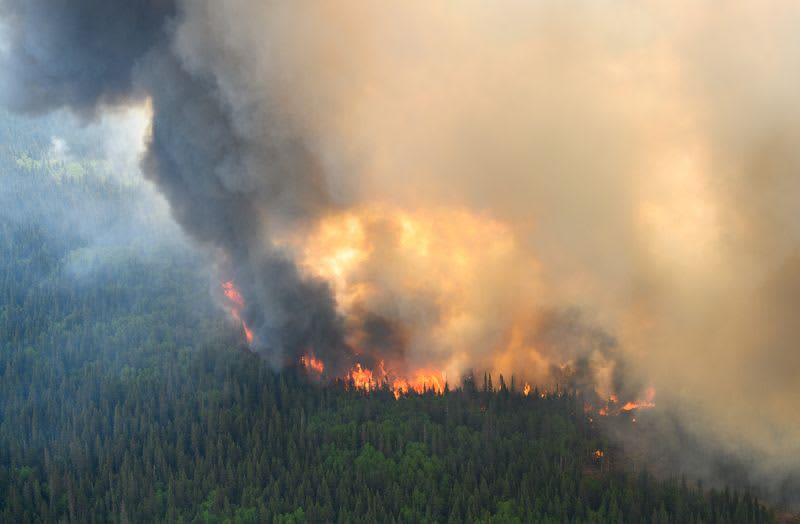
BRITISH COLUMBIA (Reuters) - Canada is wrestling with its worst-ever start to wildfire season, but recruiting firefighters is becoming increasingly difficult due to tight labor markets and the tough nature of the job, provincial officials say.

Limited resources could threaten Canada's ability to douse fires, which are expected to get bigger and fiercer in future as a result of fossil fuel-driven climate change, risking more damage to communities and disrupting the country's oil and gas, mining and lumber industries.

A Reuters survey of all 13 provinces and territories showed Canada employs around 5,500 wildland firefighters, not including the remote Yukon territory, which did not respond to requests for information.

That's roughly 2,500 firefighters short of what is needed, said Mike Flannigan, a professor at Thompson Rivers University in British Columbia and wildfire specialist.

"It's hard work, it's hot work, it's smoky work, and there are real issues with health impacts longer-term," Flannigan said. "It's getting harder to recruit and retain people."

This year Ontario extended its application period, boosted marketing efforts and started covering training costs to secure more recruits. Applications were down in British Columbia and Nova Scotia, and Alberta had to do several rounds of recruitment to fill its ranks, officials said.

Canada's provinces and territories share crews and equipment as required and call on international partners and the military in times of extreme need. But this year record-breaking blazes flared up simultaneously in the east and west, sparking competition for firefighters and aircraft.

"This was the worst-case scenario that everyone dreads - multiple areas of the country burning at the same time," said Scott Tingley, forest protection manager for Nova Scotia.

Wildfire crews work 12-14 hour days, up to two weeks at a time, in smoke-filled, high-stress environments, often in remote wilderness areas.

The seasonal work, longer fire seasons and uncompetitive basic pay - ranging from C$30 an hour in British Columbia to C$18 an hour in Manitoba - also deter people.

"We're in competition with a whole bunch of other labour markets. It's demanding physical work and it's mentally taxing," said Rob Schweitzer, executive director of BC Wildfire Service.

A week of cooler weather and rain eased some fires across Canada but 6.5 million hectares (16 million acres), an area the size of Lithuania, have already burned this year and unusually hot weather is expected to return.

FILLING THE GAPS

This year record fires have resulted in Canada deploying around 550 armed forces personnel and more than 1,700 international firefighters, paid for by the provinces, to beef up its stretched crews. As more wildfires threaten communities, provincial agencies are also increasingly leaning on structural firefighters to help protect homes.

But of the 126,000 structural firefighters in Canada, 90,000 are volunteers, according to the Canadian Association of Fire Chiefs, who are bearing the strain of protecting their own communities while also holding down day jobs.

At the height of the fires in May and June some provinces appealed for extra wildfire recruits. Alberta deployed 157 people who answered a government call-out, Nova Scotia sent out its first 30-person crew of volunteers last week and Quebec trained up an extra 300 volunteers and forestry workers who are not usually part of its wildfire service.

The extra manpower is not cheap. Annual national wildfire protection costs topped C$1 billion for six of the last 10 years, according to federal government data and have risen about C$150 million per decade since 1970.

Most experts expect them to keep climbing.

The federal government is spending C$38 million towards hiring, training and retaining firefighters and C$256 million over five years into an equipment fund, and working on a pilot project training structural firefighters. An Emergency Preparedness ministry spokesperson said the government recognizes the need for more investment.

"The men and women that fight wildland fires are doing a tremendous job but the fact is there's not enough of them," said Ken McMullen, president of the Canadian Association of Fire Chiefs.

(This story has been corrected to fix Manitoba's wage rate to C$18 per hour, not C$.74 per hour, in paragraph 10)

(Additional reporting by David Ljunggren and Ismail Shakil in Ottawa; Editing by Denny Thomas and Aurora Ellis)

© Reuters
DEMOCRAT FOSSIL FOOL
Tim Ryan: 'Race against the clock.' Natural gas can break world’s addiction to coal.


Tim Ryan
Sat, June 24, 2023 
Tim Ryan served ten terms in the U.S. House of Representatives from 2003 to 2023. He serves as a co-chair of the Natural Allies for a Clean Energy Future Leadership Council.

Climate change is real, and it’s a global problem that demands the utmost urgency.

As we race against the clock, the argument shouldn’t just be over fuels, but what achieves our climate reduction goals as quickly as possible. Natural gas has proven it can be deployed quickly to break the world’s addiction to coal and drive down global emissions.

The United States is doing its part to meet our climate goals — over the last 15 years, U.S. power-sector carbon emissions have dropped 36 percent, with 58 percent of those savings coming from switching coal power plants to natural gas. Working alongside renewables, natural gas has proven to be a secure, reliable, and affordable energy source powering American families and businesses.
- ADVERTISEMENT -


Troy Balderson: Wind, solar are unreliable. Natural gas green, clean and abundant under our feet

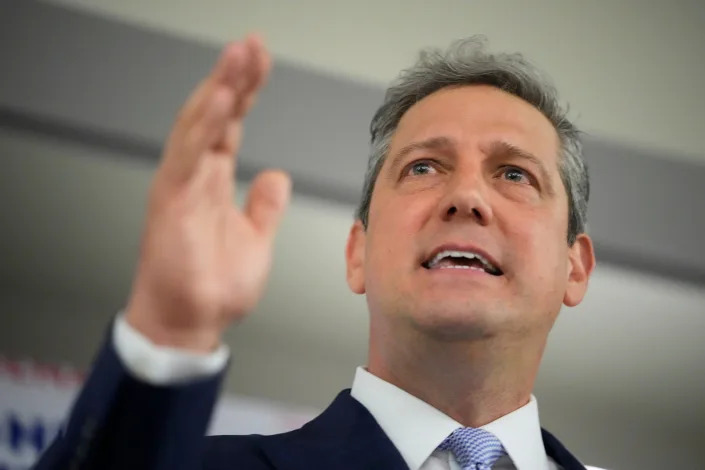
May 3, 2022; Columbus, Ohio, USA; U.S. Rep. Tim Ryan, a Democrat running for an Ohio U.S. Senate seat, speaks at the Firefighters Local 67 in Columbus after the polls closed on primary election day. Mandatory Credit: Adam Cairns-The Columbus Dispatch

Although China is the world’s leader when it comes to producing renewable energy, when the wind isn’t blowing and the sun isn’t shining, it’s burning more coal than the rest of the world combined. And it’s about to get worse.

U.S. Climate Envoy John Kerry said there’s nothing any one country can do to stop a 1.5-degree Celsius rise in global temperatures, until China curbs its appetite for burning coal. Yet, China’s newest coal plant additions would be larger than any nation’s existing coal fleet.

Why? Because China has no other clean, abundant, and secure energy like natural gas to support its renewable power sources. The picture is the same across many developing countries throughout Asia.

A recent analysis by Obama Administration Energy Secretary Ernie Moniz said energy security and climate are intertwined, and that natural gas is the practical solution for a low carbon world for decades to come. This is particularly true of emerging economies in Asia, who rely on coal as their secure energy source. That must change, and America can help.

One recent study found converting the top 5 percent of the world’s dirtiest coal plants to natural gas cuts global carbon emissions by 30 percent. That requires ramping up abundant natural gas production and reforming permitting in the U.S. to move those supplies where they are needed for the long-term.

And while we must also be scaling up renewables to decarbonize our grid, we must be realistic about how quickly that can happen.

Some demand a renewable-only energy strategy without natural gas, but that surrenders our energy security to China, which controls 80 percent of rare earth mineral production needed to produce the batteries, solar panels, and windmills we’d need to do it. That’s what they want.

As a longtime Midwestern Congressman who saw NAFTA send our middle-class jobs overseas, becoming energy dependent on hostile nations isn’t in America’s long-term national security interest. Investing in more domestic energy sources like natural gas means long-term economic stability, driven by many union jobs that pay good salaries. This is a complement to the renewable and electric-vehicle future we want. In Congress, I fought for the Voltage Valley - more charging stations, more electric vehicles, and new battery production. But natural gas must be part of that equation to meet the expected electricity demand and keep costs affordable.

A renewable-only pathway also requires a costly and time-consuming expansion of our current electric grid – a 60 percent increase according to a Princeton University study. More transmission lines from new windmills and solar farms require time to organize investor capital, site, permit, and construct across neighborhoods, forests, wetlands and more – all prone to local opposition.

One of the biggest technical challenges remains on how to store the energy to meet our 24/7 energy needs, especially against warnings of lithium battery shortages in the near term. Ninety percent of the battery supply chain to achieve desired emission reductions isn’t even built yet, according to one electric car maker.

More: 15-acre rechargeable battery storage system proposed for Licking County

America is at a critical turning point as the clock is ticking on climate change. We can either get serious about expanding a proven emission reduction strategy at home and around the world with natural gas or hope an unproven all-in electric strategy can be delivered quickly, affordably, and reliably – with fewer carbon emissions.

Natural gas, working with renewables, provides that pathway.

Tim Ryan served ten terms in the U.S. House of Representatives from 2003 to 2023. He serves as a co-chair of the Natural Allies for a Clean Energy Future Leadership Council.

This article originally appeared on The Columbus Dispatch: Tim Ryan: All-in electric strategy unproven. Natural gas can break world’s coal addiction

Gas Is Here to Stay for Decades, Say Fossil Fuel Heavyweights


Stephen Stapczynski
Fri, June 23, 2023


(Bloomberg) -- The biggest fossil fuel players are making the message clear: the transition to a green future will require much more natural gas.

From Shell Plc to Chevron Corp., the world’s top producers plan to accelerate investments in the fuel. China keeps signing deals to buy liquefied natural gas past 2050, with European importers not far behind. The US is forging ahead with new projects that will make it the world’s top LNG exporter for the foreseeable future.

This momentum marks a turning point for gas. The “cleanest” fossil fuel was seen as a short-term bridge to greener energy sources, and environmentalists have sought to phase it out amid worries that gas is far dirtier than advertised. Now, the idea that gas demand will peak anytime soon is disappearing.

“LNG sellers look around this market and feel pretty confident that gas demand will be with us for decades to come,” said Ben Cahill, senior fellow with the Center for Strategic and International Studies, a Washington think tank.

Russia’s invasion of Ukraine, and the subsequent energy crisis and record-breaking price surge, has changed the long-term prospects for natural gas. Europe is rushing to replace Russian fuel while emerging nations are signing long-term deals to avoid future shortages.

China signed a 27-year agreement with Qatar on Tuesday to safeguard its energy security, and a German importer on Thursday inked a landmark contract to buy LNG from the US through 2046 — even though Germany aims to be carbon neutral a year before that.

About 60 billion cubic meters of new gas production capacity has been approved since Russia invaded Ukraine, nearly double the rate compared with the past decade, according to the International Energy Agency.

Doubling down on gas also makes sense for shareholders, said Saul Kavonic, a Sydney-based energy analyst at Credit Suisse Group AG. The fuel has been profitable over the last few years while the pursuit of green energy targets has been more of a struggle, he said.

Gas has been the main earnings driver for energy companies including Shell and BP Plc over the past few years. Producers had plunged into the lower-margin renewable power business years before, but are now rethinking those investments due to lackluster returns.

“Liquefied natural gas will play an even bigger role in the energy system of the future than it plays today,” Shell’s Chief Executive Officer Wael Sawan told investors this month as he outlined a strategy shift following his promotion to the role in January. “LNG can be easily transported to places where it is needed most. And what’s more, on average, natural gas emits about 50% less carbon emissions than coal when used to produce electricity.”

Shell plans to increase natural gas investments by about 25% this year to a record $5 billion and keep spending at that level through 2025. Last year, the London-based company joined Exxon Mobil Corp. and ConocoPhillips to invest in Qatar’s $30 billion LNG expansion, the biggest ever in the industry.

Gas is also key to Italian energy group Eni SpA’s growth plans — that was a big motivation behind Friday’s $4.9 billion deal to buy Neptune Energy Group Ltd. Elsewhere, Romania’s two biggest natural gas producers agreed this week to invest as much as €4 billion ($4.4 billion) in a Black Sea gas project after decades of debate. Chevron and Exxon are adding more staff to build up their gas trading activities in London and Singapore.

In the US, the development of new LNG plants is being underpinned as buyers in countries including Germany and Japan — both of which have ambitious green goals — sign long-term contracts with exporters. TotalEnergies SE gave a boost this month to plans to build a US export terminal, agreeing to buy stakes in the project and its developer. The French company is also in discussions with Saudi Arabia to invest in its massive natural gas project.

Still, there is a debate over how much gas and investment will be needed, with demand likely to hinge on how successful nations are in reducing emissions.

The IEA says gas demand needs to fall dramatically by the end of the decade in order to keep the world on track for net zero by 2050. The agency in 2021 calculated that all new developments of oil, gas and coal fields need to be stopped to meet that scenario.

Producers and financial institutions need to “commit to end financing and investment in exploration for new oil and gas fields, and expansion of oil and gas reserves,” United Nations Secretary-General Antonio Guterres told reporters this month in New York. “We are hurtling towards disaster, eyes wide open.”

One of the biggest arguments against natural gas is methane emissions, a byproduct of gas production that traps more than 80 times more heat than carbon dioxide in its first two decades in the atmosphere. Gas leakage of more than about 3% makes the fuel worse for the climate than coal, according to a study published by the National Academy of Sciences, undermining industry claims that it is a cleaner fossil fuel.

In order to market natural gas as a clean alternative to coal, energy majors are working to cut methane releases. Shell, Exxon Mobil and more than a dozen other producers aim to achieve “near-zero” methane emissions by 2030 as part of an initiative launched last year.

“By finally taking the reduction of methane emissions seriously, the majors believe they can thread the needle of making a positive contribution to climate change and keeping their assets commercially relevant,” said Ira Joseph, a global fellow at the Center on Global Energy Policy at Columbia University.

--With assistance from David Stringer, Rachel Morison, William Mathis and Aaron Clark.
Teamsters reject UPS’ first economic counterproposal

Mark Solomon
FreightWaves.
Fri, June 23, 2023 

UPS Teamsters reject company's first economic counter-proposal. (Photo: Jim Allen/FreightWaves)

Call it a game of contract cat and mouse or not, but the Teamsters union strongly attacked UPS Inc.’s economic counterproposal as negotiations resumed in Washington to hammer out a new master contract.

The company’s counterproposal “included minimal raises and overall wage cuts to workers’ cost-of-living adjustments,” the union said Thursday. The Teamsters National Negotiating Committee unanimously rejected what the union called a “disrespectful” package.

The committee told UPS (NYSE: UPS) it will not meet again until the company makes a “realistic and respectful economic offer.” The union on Wednesday presented its initial economic proposal, which it called the “biggest, most lucrative financial proposal ever presented by a labor union.”

It includes wage increases for each year of the five-year contract, additional holidays and more paid time off, pension increases, and the end of a two-tier wage system that the union says penalizes those who lack seniority even though they are performing the same work as their senior counterparts.

“We are not accepting whatever crumbs these executives might throw our way. UPS has made plenty of money,” said Teamsters General Secretary Fred Zuckerman. “Our members have sacrificed everything to make them rich. We are demanding a real offer right now.”

“If UPS wants to negotiate a contract for 1997 working conditions,” said General President Sean M. O’Brien, referring to the year the Teamsters struck UPS for 15 days. “They’re going to get 1997 consequences.”

In a statement, UPS said that “as in any negotiations, reaching consensus on economic proposals requires serious and detailed discussion, as well as give-and-take from both sides. UPS is proud to provide the best pay and benefits package in the industry, and we plan to keep it that way. Both the Teamsters and UPS have publicly acknowledged the strong progress made to date, including the agreements reached on all non-economic topics. These negotiations affect our people, businesses and consumers across the country, which is a responsibility we take seriously.”

Earlier, the Teamsters had announced that it and UPS had agreed to 55 non-economic contractual issues.