Saturday, July 29, 2023

COLD WAR 2.0

What’s at the center of the U.S.-China power struggle? Crypto


BY ADAM ZARAZINSKI
July 29, 2023
FORTUNE
COMMENTARY ·CRYPTOCURRENCY

China is pulling ahead of the U.S. when it comes to cryptocurrency.
PRASIT PHOTO VIA GETTY IMAGES

While a great global power struggle between the U.S. and China continues to escalate, many may not realize crypto is a battlefront.

Chinese spy balloons in America and naval provocations in the Taiwan Strait create exciting and dramatic headlines, but just last year Chinese President Xi Jinping himself argued that “technological innovation has become the main battleground of the global playing field, and competition for tech dominance will grow unprecedentedly fierce.”

Whether U.S. policymakers like it or not, cryptocurrency and blockchain technology are a primary battleground in America’s contest with China—and the U.S. is dramatically falling behind.

Forefront in China

Chinese-affiliated cryptocurrency exchanges account for the vast majority of global trading. The Chinese Communist Party has already established bilateral agreements and deployed its central bank digital currency, the e-Yuan, beyond its own borders in places such as in Ecuador, Peru, and other major port locations across South America. And, last year, the Digital Currency Research Institute of the People’s Bank of China and the Central Bank of the United Arab Emirates joined the Multiple CBDC, or m-CBDC, Bridge, a project to build a system for real-time cross-border forex payments.

In parallel, criminal networks operating out of China and its neighbors have stolen and laundered billions of dollars in digital assets globally—including in the U.S. Chinese intermediaries, for example, that helped North Korean hackers launder hundreds of millions in stolen crypto. And it’s an unknown Chinese transnational criminal network behind the multibillion-dollar crypto scam called “Pig Butchering” that’s plagued everyday Americans looking to enter crypto markets for nearly a decade. “Pig Butchering” victims typically are new to crypto and unknowingly send their savings to these scammers. More robust markets in the U.S., with safe investment options from both crypto-native firms and traditional financial institutions, would reduce the scale and effectiveness of these operations.

Retreat in the U.S.


Of the top 15 cryptocurrency exchanges by volume, only three are American companies. While China banned cryptocurrency exchange operations in 2017 and transactions in 2021, the other 12 top exchanges by volume all have affiliations with China or Hong Kong, which China has used as an avenue for access to global markets broadly in the past and reportedly now as a testing ground for crypto markets. That amounts to over $10 billion in daily trading volume that’s outside U.S. jurisdiction.

At the same time, and particularly of late with the current regulatory landscape, some of the largest American market makers and exchanges are moving offshore. Jane Street and Jump Crypto, for example, have both scaled back operations in the U.S., and many others are searching for new headquarters in Dubai, Singapore, Hong Kong, and other jurisdictions that have established clear regulatory frameworks. Coinbase, the U.S.-based publicly traded exchange that was recently sued by the SEC, is considering setting up an international hub in the United Arab Emirates, and Galaxy Digital, a crypto investment company, is moving more of its operations offshore. Coinbase and Gemini, another U.S.-based exchange, also both recently launched derivatives platforms for non-U.S. users.


This industry is not going away—just shifting offshore—and America is losing what little influence it has over its trajectory.

What’s next?


A future where China owns the crypto forefront means less financial freedom for those who adopt its system, less creative influence, more opportunity for hidden financial crimes, a limited ability in the U.S. to impose sanctions and other financial penalties globally, and a diminished reliance on U.S. financial firms and the U.S. dollar.

America needs something more thoughtful and strategic than simply cracking down on exchanges. Despite the recent challenges cryptocurrency markets have faced—frauds, scams, hacks, and a bear market—decentralized finance has proven its value proposition and will rebound to continue to play a growing role in our global markets.

When China announced that a digital Yuan would be piloted in May of 2020, Mu Changchun, the head of the Digital Currency Research Institute of the PBoC, told a forum in Hong Kong about the nation’s “horse race approach” to cryptocurrency, and that “the front-runner will take the whole market—who is more efficient, who can provide a better service to the public—they can survive in the future.”

America must respond. The way the U.S. can win is the way it always has, with what’s fundamental to America: an open society with bold thinkers and entrepreneurs pushing the limits of the system with responsible technological innovation. We must foster innovation in decentralized finance because it’s the only way U.S. interests can win this “horse race.” Our national security depends on it.

Adam Zarazinski is the founder of the digital asset data analytics company Inca Digital and a major in the Air Force Reserve JAG Corps. The opinions expressed in Fortune.com commentary pieces are solely the views of their authors and do not necessarily reflect the opinions and beliefs of Fortune.
OUTLAW HORSERACING
Two horses die at California's Del Mar Racetrack, first deaths of summer racing season
SPORT OF ARISTOCRATS
The first death was followed by another just one day later

By Renee Schmiedeberg • Published 2 hours ago •

Just one week into the summer 2023 racing season at the Del Mar Racetrack, two horses have been euthanized following injuries.


Two horses were euthanized in two days after suffering injuries at the Del Mar Racetrack one week into the 2023 summer racing season, Mac McBride from the Del Mar Thoroughbred Club told NBC San Diego on Saturday.

A 5-year-old mare who came in third during last Saturday's Osunitas Stakes at the Del Mar Racetrack has died after being injured on Friday.

Nevisian Sunrise's death was the first of the 2023 summer season, which started on July 21.

Nevisian Sunrise got loose, ran off and collided with a stationary object. The attending veterinary team found her injuries inoperable and euthanized her, according to McBride.

On Saturday, a 4-year-old filly (a young female horse) named Ghostem suffered a non-operable musculoskeletal injury to her front right leg during a workout on the main track. The veterinarian team made the decision to euthanize her, McBride told NBC San Diego.

Both bodies of the horses are undergoing necropsies. The results will be reported to the California Horse Racing Board.
CANADA TOO

Cities Are Grappling With “Forever Chemicals” in Drinking Water

In Vancouver, BC, a fix could take years and cost more than $170 million.

SARAH TRENT
July 27, 2023

Cole Benak collects a water sample. 
Kaveer Rai/High Country News

This story was originally published by High Country News and is reproduced here as part of the Climate Desk collaboration.

Just inside the rolled-up door of a pumphouse garage, Cole Benak pulled on a pair of black Nitrile gloves. Outside, morning sunshine warmed the quiet wooded hillside. From the room next door, three massive water pumps whined, pushing thousands of gallons per minute of Vancouver, Washington’s drinking water toward a reservoir another mile uphill. Benak, a city engineering technician, checked his watch and marked the time on a plastic water sampling flask.

He turned and knelt behind a four-foot-wide panel fitted with gauges and valves and four tall, narrow cylinders—like a miniature pipe organ of plastic, each tube filled with water and a different type of filtering material. The water that enters these cylinders, like nearly all of Vancouver’s water, is contaminated with common but dangerous chemicals called PFAS—perfluoroalkyl and polyfluoroalkyl substances. What flows out will help city officials determine which material is best at removing them. Benak opened the valve below one of the filter tubes, letting water first stream onto the concrete, then into the flask.

Tje Environmental Working Group estimates that the drinking water of at least two-thirds of all US residents is contaminated.

Vancouver officials first learned about PFAS contamination here in 2020, and they’re still sorting out how to address it. “I have so many questions,” said City Councilmember Sarah Fox. “What things do we need to consider? What are the drawbacks? Who needs to be at the table making some of these decisions?”

Benak screwed the lid onto the bottle and prepared another. His weekly samples are one step in a process that will transform Vancouver’s water system, which serves 270,000 people. But it will come at a high price—at least $170 million, likely far more—and take years to complete. Research showing the health effects of PFAS has evolved far faster than the state and federal regulations that govern water systems, and communities are trying to catch up. The U.S. Environmental Protection Agency’s most recent guidance is that no amount of PFAS contamination is safe, though it is still weighing the first-ever federal standards to regulate them. Achieving zero contamination may not be possible. As the EPA ramps up testing, officials here—and in communities across the U.S.—are grappling with exactly what must be done to keep their water safe.

PFAS are a set of more than 9,000 man-made chemicals prized for being slippery and waterproof. But the qualities that make them useful in clothing, food packaging, factories and firefighting foam make them especially dangerous to human health: Nearly indestructible, they accumulate in the body and have been linked with serious health conditions—cancers, thyroid and liver disorders, weakened immune systems, developmental problems—even at extremely low levels. They leach into the environment wherever they’re used and have been found in blood samples, breast milk, wild animals and rainwater worldwide. The nonprofit Environmental Working Group estimates that the drinking water of at least two-thirds of all US residents is contaminated.

When the Washington State Board of Health began to consider regulating PFAS in drinking water around 2017—as numerous states have done in the absence of EPA rules—Vancouver’s water manager, Tyler Clary, thought his system had nothing to worry about. He’d tested for PFAS in 2013, and found none. Then, in 2020, “we tested new samples and came back with these hits all over the place,” he said. Testing sensitivity had improved, he learned: Retesting old samples revealed that at least two of the city’s aquifers had been contaminated at low levels all along—and that many wells had levels near or above what the state later recommended as safe.

Shifting standards and evolving science have put city officials in a tricky position, as far as planning and communicating risk to residents.


Washington’s standards, implemented in 2021, set limits for several of the most common types of PFAS, including PFOA and PFOS, which were used in products like Teflon and Scotchgard until companies started phasing them out in the early 2000s. The state limits PFOA at 10 parts per trillion (ppt) and PFOS at 15 ppt, both less than a single drop in an Olympic-sized swimming pool.

The EPA’s newest guidelines go further: Newer science shows that no amount is safe. But current test technology can only reliably detect PFOA and PFOS down to about 4 ppt—and so this year, the agency proposed that threshold as the new federal limit, which could take effect by 2026.

This March, Clary’s team sampled water stations again. Most tested between 5 and 22 ppt for PFOA or PFOS. State rules recommend—but don’t require—that water at six of the city’s nine water stations be treated. If the EPA’s proposed standards are enacted, every station but one would need an upgrade.

The shifting standards and evolving science put Clary and city officials in a tricky position, as far as planning and communicating risk to residents. Some Washington cities, including Airway Heights near Spokane, have water so contaminated—often by military use of firefighting foam—that officials immediately shut down wells and brought in other water. In Vancouver, levels are low but so widespread that about half the city’s water falls into a regulatory gray area: Not worrisome by state rules, but exceeding the pending federal standard. And the culprit has not yet been identified, so there is no single polluter to stop or hold accountable.

It’s also difficult to tell residents how much is reaching their homes: Like many municipal systems, water from every station is mixed, and the amount drawn from any one well shifts to meet demand. When demand is low, Clary has been able to decrease use of the most contaminated wells. During peak summer use, he needs to turn that flow up again.

There is good news, though: Filtering PFAS to meet state or federal limits isn’t complicated, and the city has been through a similar process before. Near the pumphouse where Benak takes samples every Tuesday stand two white towers the size of upended school buses that have filtered tetrachloroethylene (PCE), a neurotoxic dry-cleaning chemical, since the ’90s.

Benak’s miniature pilot tanks are measuring how many months it takes before each filter becomes too saturated to work well. The longer a filter lasts, the cheaper the system will be to maintain. A preliminary engineering report suggested media replacement alone could cost Vancouver more than $1 million per year.

Each of the filters has other costs and benefits to consider, too. One of Benak’s test cylinders stands nearly twice as tall as the rest: Filled with granular activated carbon, it’s the media most often used to filter PFOA and PFOS, which cling to the black carbon flakes like nails to a magnet. Activated carbon removes many other contaminants, too, likely including some that aren’t known or regulated yet. Still, it may not be as good at catching newer, smaller types of PFAS that have been widely used to replace PFOA and PFOS but that similarly accumulate to dangerous levels. Activated carbon systems also require a lot of real estate. This single station could require 16 towers, each filled with 60,000 pounds of carbon, that would displace the dog park next door.

Engineers say filter systems that could satisfy British Columbia’s PFAS limits would take at least six years to complete.

The other three cylinders Benak is testing contain unique formulas of resin microbeads—a shiny golden sand-like plastic used for a filtration method called ion exchange. These filters use a reaction similar to static cling: The negative ions of a PFAS molecule stick to the positively charged beads. This process is often better at catching short-chain PFAS, and the towers take up less space: Here, they’d need two-thirds the footprint of a carbon system. But they don’t filter as many other contaminants and are harder to maintain.

Which media works best will also come down to the local water chemistry: Sediments, minerals and other compounds can interfere. Benak and Clary expect that by early next year, they’ll have an idea of which will last the longest. Then, they can develop long-term construction plans and ask the state, federal government and city council for funds.

From there, engineers say systems to meet state limits would take at least six years to complete. The EPA’s pending rules would add time and millions more in costs—though a recent state lawsuit to make PFAS manufacturers pay for water treatment may help.

Councilmembers and the county health department are just starting to consider how to keep residents safe until then. Officials, including Fox, hope that the council or county will seek grant dollars to buy home filters for vulnerable low-income residents. The state already recommends that breastfeeding parents avoid tap water that’s over the state limit, and suggests mixing infant formula with adequately filtered water.

After an hour of pulling samples from all four test cylinders, Benak shut off the last valve. The systems he’s helping to assess aren’t complicated or scary, he said—just really, really big. Packing up the flasks, vials and paperwork, he stepped through the puddle spread across the concrete—Vancouver water, free of detectable PFAS—then set off in his SUV toward the lab.


In an astounding achievement, Bhutan tiger numbers grow by 27%

© DoFPS
DATE: July 29, 2023
AUTHOR :Alison Henry

As a result of a longstanding and steadfast commitment to conservation, Bhutan has increased the number of tigers within its borders by 27% since 2015—an astounding achievement. There are now an estimated 131 tigers in this eastern Himalayan country, according to the most recent survey conducted in 2021 and 2022.

A collective effort among the Royal Government of Bhutan, local partners, and non-governmental organizations such as WWF-Bhutan serve as the foundation for this success. The Bhutan Tiger Center led efforts to monitor and research the country’s tiger population and worked with local communities to radio-collar tigers to study their movements and conduct surveys.
© DoFPS
A tiger recorded on a camera trap in Bhutan during the 2021-2022 national tiger survey.


“Bhutan's conservation efforts continue to inspire hope for the recovery of many threatened species. The recent news of increasing tiger numbers in Bhutan serves as a clear testament to what can be achieved when nations and their people demonstrate selfless dedication to conservation for the good of humanity and the planet.”Dechen Dorji
Senior Director, Asian Wildlife


A fruitful journey

Bhutan’s journey to achieving the tiger numbers we see today began more than a decade ago when the country joined a global effort to double the number of tigers in the wild by 2022. This effort went hand-in-hand with Bhutan’s promise to preserve over half of its land under forest cover—a decision that ties cultural connection with nature.

In the years since, Bhutan has implemented a suite of strategies to increase wild tiger populations, from adopting a global conservation tool that sets best practices and standards to manage wild tiger sites to equipping rangers with improved monitoring and reporting technology to make them more effective in stopping wildlife crime. And a cross-border tiger conservation program with India in the Transboundary Manas Conservation Area (TRAMCA) proved so successful that data from the most recent survey conducted in 2018 estimates that these big cats doubled in number on both sides of the political border since 2010.

The 2021-2022 national tiger survey also unlocked new insights into the growing population of tigers in the country. Regions not previously known to have tigers reported sightings, and breeding tigers were recorded at high elevations, supporting the popular theory that Bhutan is a source site for tigers in the region.

Tiger conservation starts with community partnership
Local communities are essential to protecting wild tigers. Like in many places, when human populations and demand for space grow, people and wildlife are increasingly interacting and competing for resources, which can lead to increased human-wildlife conflict. But despite tigers killing a high number of livestock in Bhutan, retaliatory killings of these big cats have been very low. This tolerance is derived, in part, from the value and compassion Buddhism encourages towards nature. Still, the situation is complex, and WWF-Bhutan has been working with communities in the Trongsa District—an area of northeast Bhutan that lies within Jigme Singye Wangchuck National Park—to address the damage human-tiger conflict has on livelihoods.

© Emmanuel Rondeau / WWF-UK


Government rangers at Jigme Singye Wangchuck National Park head office study images of tigers captured by camera traps in the area.

Shutterstock / Ondrej Prosicky / WWF-Sweden

CELEBRATE GLOBAL TIGER DAY!

You can protect wildlife and nature worldwide today.

SYMBOLICALLY ADOPT A TIGER
© Tashi Phuntsho / WWF-Bhutan

WWF-Bhutan carried out surveys across Trongsa District, capturing thoughts from a number of different community voices.


A recent survey of 610 households in the region showed that most of the communities’ livelihoods depend on livestock and many people felt concerned about an increase in tigers in the area because of the socio-economic impact. Sharing space with big cats also took a psychological toll, according to the survey. And though WWF-Bhutan has yet to conduct similar research across the country, it’s likely that other communities facing increased human-tiger conflict feel the same.

WWF-Bhutan has been a long-time supporter of work in the Trongsa District, focusing on how better protected area management can improve livelihoods and safeguard both people and tigers. In 2022, Bhutan’s government worked with local communities in Trongsa to establish six Gewog (sub district) Tiger Conservation Tshogpa (committee)—community-led tiger conservation groups that encourage stewardship of tigers, manage human-tiger conflict, and provide livestock insurance. They’re located in human-tiger conflict hotspots and include four communities in Trongsa. WWF-Bhutan is helping create an additional conservation group in Trongsa and will provide financial support to its members and help build capacity to sustain and succeed. In addition, we will be working with local communities in Trongsa to better understand their tolerance for living alongside tigers and implement a holistic conflict management system that will work toward human-tiger coexistence.
© DoFP
Tigers recorded on camera trap in Bhutan during the 2021-2022 national tiger survey.


A bright future for people and tigers

Bhutan has shown that with government support, the right conservation interventions, a robust ranger workforce, and community partnerships, tiger populations can recover—and even flourish. While the national tiger survey tallied many big cats, it also took a snapshot of the abundance of wildlife that lives alongside the iconic big cat, proving that when we protect tigers, we protect so much more.

WWF congratulates Bhutan on its success in increasing the country’s tiger population while recognizing that even in the diverse and vast forests of this amazing country, tiger conservation progress is fragile. Bhutan is evidence of why we need robust and measurable goals focusing on living with tigers to ensure a promising future for these iconic big cats and people alike.
Biden jokes about getting impeached for easing inflation: ‘Maybe they’ll decide to impeach me because it’s coming down.’

Published: July 28, 2023
By Victor Reklaitis

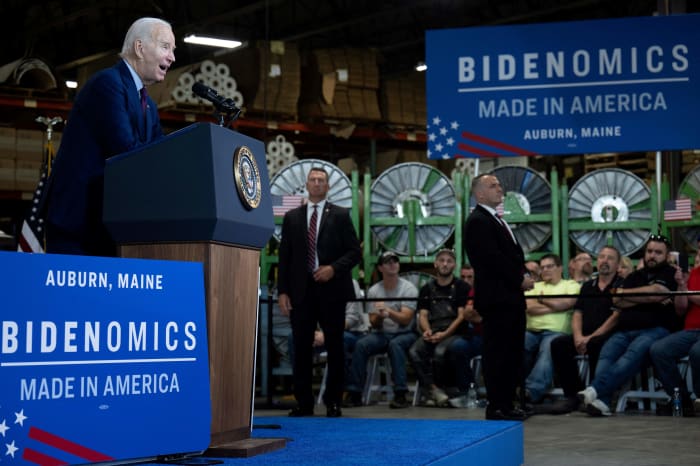
President visits Maine to talk up ‘Invent It Here, Make It Here’ executive order


US President Joe Biden speaks Friday about his economic priorities at Auburn Manufacturing Inc. in Maine. 
AFP VIA GETTY IMAGES

President Joe Biden on Friday joked about getting impeached over easing inflation, with the remark coming as he touted his new “Invent It Here, Make It Here” executive order during an event in Maine.

“Earlier this week, the Washington Post suggested Republicans may have to find something else to criticize me for, now that inflation is coming down,” the president said as he gave a speech at Auburn Manufacturing Inc., a textile company in Auburn, Maine.

“Maybe they’ll decide to impeach me because it’s coming down. I don’t know. I love that one,” he joked.

On Monday, House Speaker Kevin McCarthy, a California Republican, offered his strongest public remarks so far about his party’s probes into the Biden family’s financial affairs, saying they are “going to rise to an impeachment inquiry.”

Meanwhile, Republicans have in fact continued to criticize Biden over increased prices.

“Families in Maine and across the country simply cannot afford Bidenomics,” Republican National Committee Chair Ronna McDaniel said in a statement Friday.

“Real wages are in fact down, costs are indeed up, and voters are counting down the days until they can send Biden back to Delaware for good,” she added.

Biden is continuing to play up his policies for the manufacturing sector and other parts of the U.S. economy as 2024 political campaigns ramp up.

The new executive order, which the president signed on Friday, aims to encourage companies to manufacture their new inventions in the U.S., in particular when those inventions are developed using money from federal agencies.

“This executive order dictates that those agencies have to prioritize domestic manufacturing when it comes time to bring those inventions to market. They can’t go abroad. They have to look here — who can do it here,” Biden said.

Now read: U.S. inflation eases again, PCE shows
US military commanders lose power to probe sexual abuse cases as President Biden signs order

The order follows two decades of pressure from lawmakers and advocates of sexual assault victims, who argued that victims in the military were too often denied justice

Michael D. Shear 
Washington 
Published 29.07.23


President Joe Biden gave final approval on Friday to the biggest reshaping in generations of the country’s Uniform Code of Military Justice, stripping commanders of their authority over cases of sexual assault, rape and murder to ensure prosecutions that are independent of the chain of command.

By signing a far-reaching executive order, Biden ushered in the most significant changes to the modern military legal system since it was created in 1950. The order follows two decades of pressure from lawmakers and advocates of sexual assault victims, who argued that victims in the military were too often denied justice, culminating in a bipartisan law mandating changes.

In a statement, the White House called the changes to the military justice system “a turning point for survivors of gender-based violence in the military” and said they kept promises Biden made as a candidate.

“He’s made clear that our one truly sacred obligation as a nation is to prepare and equip those we send into harm’s way, and to care for them and their families both while they are deployed and when they return home,” the statement said. “The reforms implemented through today’s executive order do just that.”

The changes had for years been opposed by military commanders. But they were finally embraced by the Pentagon in 2021 and mandated by a law spearheaded by senator Kirsten Gillibrand, Democrat of New York. Biden signed the landmark legislation into law two days after Christmas that year.

The law set up a two-year process for the defence department to create a cadre of special prosecutors to handle sexual assault and a handful of other high-profile crimes. The Offices of Special Trial Counsel, as they will be called, will be staffed by experienced military prosecutors who will report to the civilian leaders of the military’s branches.

The final step needed to change the Uniform Code of Military Justice under the law was a presidential executive order. Lawmakers directed Biden to issue it by December 2023. White House officials said Biden would do so on Friday, more than five months ahead of the deadline.

Under the rules established by Biden’s order, commanders in the military will no longer have the authority to decide whether to pursue charges in cases of sexual abuse and a handful of other serious crimes. Instead, that decision will fall to the new, specialised lawyers, White House officials said.

The decisions by those special prosecutors will be final and binding, and cannot be overridden by military commanders.

New York Times News Service
Legal bid to stop Ulez expansion quashed as Khan vows to do ‘everything possible’ to help drivers


Councillor Simon Fawthrop speaking to the media outside the Royal Courts of Justice, central London, after five Conservative-led councils lost their High Court challenge against Mayor of London Sadiq Khan's plans to expand the capital's ultra low emission zone (Ulez), July 28, 2023

ULEZ will be expanded across London a month from Saturday after the High Court today dismissed a legal bid to stop it by five Tory-led councils.

Mayor of London Sadiq Khan said he will “do everything possible” to mitigate concerns over costs to drivers following the scheme’s expansion.

The case to prevent extending the scheme beyond the North and South Circular roads was brought by the outer London boroughs of Bexley, Bromley, Harrow and Hillingdon and Surrey County Council.

Dismissing it today, Mr Justice Swift said he is satisfied the extension is within the mayor’s powers.

The AA urged Mr Khan to give people “more time to react” to the change while the RAC called on him to give “additional support” to key workers.

App Drivers and Couriers Union general secretary James Farrar said that while they welcome efforts to improve air quality, Mr Khan has “undermined his own policy by facilitating runaway growth of on-demand apps like Uber, Bolt and Addison Lee.”

“If the mayor is to secure his environmental legacy then he must have the courage to tackle the terrible social and environmental impact of the gig economy and commit to a just transition to sustainable transport in London where workers are not burdened with the cost of consumer waste,” he told the Star.

Kev Ashby, a regional officer at the United Road Transport Union (Urtu), said: “It is unfortunate that our members, once again, find themselves having to deal with the practical difficulties that arise from the Tories ideological aversion to maintaining the infrastructure of the country in a manner that would benefit the citizens and the economy.

"Urtu fully endorses the London Mayor’s decision to expand the ‘Ultra Low Emission Zone’ and supports the Court’s decision.”

Nader Awaad, chair of the United Private Hire Drivers branch of the Independent Workers’ union of Great Britain (IWGB), said: “We need urgent action, but it shouldn’t fall on working people to foot the bill.

“Rather than tax the poor, the government should shift the financial burden of ULEZ towards the gig economy giants who profit from this environmentally damaging work.

“We can and must clean our air without forcing already precarious private hire drivers further into poverty."

Transport for London (TfL) said that nine out of 10 cars seen driving in outer London on an average day comply with the Ulez standards and will not be charged the £12.50 daily fee for entering its zone.

From Monday, access to the scheme providing grants supporting the scrapping of non-compliant vehicles in London will be extended to include all families in receipt of child benefit and small businesses.
‘Desperate nonsense’: London Mayor Sadiq Khan clashes with Prime Minister Rishi Sunak over housing crisis

UK Prime Minister Rishi Sunak earlier blamed London Mayor Sadiq Khan for the housing crisis, claiming he had failed to deliver enough homes.

Rishi Sunak has placed the blame on London Mayor Sadiq Khan for failing to deliver the required number of homes


London's housing crisis has become a matter of intense focus as UK Prime Minister Rishi Sunak announced plans to address the sky-high property prices in the capital. In his announcement, he placed the blame on Sadiq Khan, the Mayor of London, for failing to deliver the required number of homes, making it increasingly difficult for Londoners to own their own properties.

“Labour’s Sadiq Khan has failed to deliver the homes London needs, driving up prices and making it harder for families to get on the housing ladder. So I’m stepping in to boost house building and make home ownership a reality again for Londoners," Sunak said.

In response to Sunak's criticism, City Hall, led by Mayor Sadiq Khan, countered that the Tories were attempting to distract from their inaction on the mortgage crisis. Khan argued that his administration had surpassed the government's own affordable housing targets, with a record number of council-built homes being initiated.

“Are you the same guy who dropped his house building targets? Because I’m the guy who started building more council homes than the rest of England combined, exceeded your affordable homes targets & built more homes of any kind than since the 1930s. This is desperate nonsense," Khan replied.

London Councils also presented data suggesting that 143,000 new homes could be built in the city if certain "viability challenges" were overcome, such as additional grant funding and improved coordination across the government, the Evening Standard reported.

Meanwhile, Sunak's London Plan includes directing £150 million ( ₹1,578 crore) of funding directly to boroughs to prepare brownfield sites for housing, including infrastructure improvements. Additionally, £53 million ( ₹557 crore) has been allocated to the Old Oak West project in west London, with a goal of creating over 9,000 new homes and supporting 12,000 jobs, the publication added.

Furthermore, rules on the use of £1 billion for affordable housing will be relaxed, allowing it to be utilised for the regeneration of old social housing estates. To create more homes in various boroughs like Thamesmead, Becton, and Silvertown, a new development called Docklands 2.0 will be initiated, promising beautiful, well-connected homes surrounded by landscaped parkland.
UK
Refugee charity hits out at Home Secretary’s ‘cruel’ proposal to house asylum seekers in tents

The Home Secretary has purchased marquees in recent days to accommodate migrants by the end of August, according to a Whitehall source.


 by Joseph Connor
2023-07-28


A proposal to house asylum seekers in tents on disused military sites has been described as “cruel” by a refugee charity.

The Home Secretary is working on contingency plans to erect marquees to house asylum seekers, ahead of an expected increase in the number of people arriving via small boats across the English Channel over the next few months.

The plan is reportedly part of Suella Braverman’s plans to avoid using hotels to accommodate asylum seekers.

The Home Secretary has purchased the marquees in recent days to accommodate migrants by the end of August, according to a Whitehall source.

The Times, which first reported the tent purchases, cited Government sources saying a similar proposal was rejected last year because of warnings it would trigger legal challenges based on inhumane treatment of asylum seekers.


Some in Government compared the idea with concentration camps, according to the paper.


Labour said it was in part an admission that the Government is not expecting its own policies to reduce the numbers crossing the Channel on small boats to actually work.

Chief executive of Refugee Action, Tim Naor Hilton, said: “It’s staggering the Home Secretary plans to use what a Government source compared to a concentration camp to house people seeking asylum, in the same week courts ruled she broke the law three times with her inhumane treatment of refugees.

“The winners from this cruel plan will be the Home Office’s asylum housing contractors, who trouser tens of millions of pounds in taxpayer-subsidised profits as standards continue to plummet.

“This is yet another way the Government has developed to demonise people seeking asylum, which is rooted in its deeply racist approach to refugee protection.

“It really shouldn’t be too much to ask that people who have fled violence, torture and persecution have their claims assessed quickly and justly and are housed in safe homes in our communities.”

Shadow home secretary Yvette Cooper said the idea was an example that the Home Office is “flailing around”.

The Labour MP said: “We’ve had all sorts of different things. Hotel use is still going up, we’ve still got the barges, bases, tents, all sorts of different things.

“I think this is in part an admission that their own legislation that they promised would stop boat crossings, they promised would end all of the chaos, in fact they are not expecting it to work.

“I think at the heart of this, the Government is just failing to go after the criminal gangs that are driving and organising border crossings.”

She said Labour has set out plans for a “new cross-border police unit” and a new organised crime strategy across the UK.

But Ms Cooper, when challenged on Times Radio, did not rule out her own party taking such measures if it was in government, saying not enough was known about the Government’s plans.

“We don’t know what these proposals are so we’d need to see,” she said, before being interrupted.

When put to her that a rough idea of the plans is known, she added: “We don’t.”

Speaking to LBC earlier, she said: “We need grip, not gimmicks.”

Shadow environment secretary Jim McMahon, responding to reports about the Government’s plans on Twitter, said: “Panic measure after panic measure.”

A Home Secretary spokesman said: “We have been clear that the use of hotels to house asylum seekers is unacceptable, there are currently more than 51,000 asylum seekers in hotels costing the UK taxpayer £6 million a day.

“We continue to work across Government and with local authorities to look at a range of accommodation options.

“Accommodation offered to asylum seekers, on a no-choice basis, meets our legal and contractual requirements.”


Most of the 100 million people who signed up for Threads stopped using it

"We're seeing more people coming back daily than I'd expected," Zuckerberg said.


JON BRODKIN - 7/28/2023


Meta's new Twitter competitor, Threads, is looking for ways to keep users interested after more than half of the people who signed up for the text-based platform stopped actively using the app, Meta CEO Mark Zuckerberg reportedly told employees in a company town hall yesterday. Threads launched on July 5 and signed up over 100 million users in less than five days, buoyed by user frustration with Elon Musk-owned Twitter.

"Obviously, if you have more than 100 million people sign up, ideally it would be awesome if all of them or even half of them stuck around. We're not there yet," Zuckerberg told employees yesterday, according to Reuters, which listened to audio of the event.

Third-party data suggests that Threads may have lost many more than half of its active users. Daily active users for Threads on Android dropped from 49 million on July 7 to 23.6 million on July 14, and then to 12.6 million on July 23, web analytics company SimilarWeb reported.

"We don't yet have daily numbers for iOS, but we suspect the boom-and-bust pattern is similar," SimilarWeb wrote. "Threads took off like a rocket, with its close linkage to Instagram as the booster. However, the developers of Threads will need to fill in missing features and add some new and unique ones if they want to make checking the app a daily habit for users."

Although losing over half of the initial users in a short period might sound discouraging, the Reuters article said Zuckerberg told employees that user retention was better than Meta executives expected. "Zuckerberg said he considered the drop-off 'normal' and expected retention to grow as the company adds more features to the app, including a desktop version and search functionality," Reuters wrote.

Chief Product Officer Chris Cox also spoke at the company event, reportedly saying that Meta is considering "retention-driving hooks" such as "making sure people who are on the Instagram app can see important Threads." Threads is part of Meta's Instagram platform, so users can create a Threads profile as part of their Instagram account.Advertisement

Zuck: Threads still needs “basic functionality”


When contacted by Ars today, a Meta spokesperson pointed to Zuckerberg's comments from Wednesday's earnings call. Zuckerberg said:

On Threads, briefly, I'm quite optimistic about our trajectory. We saw unprecedented growth out of the gate and more importantly we're seeing more people coming back daily than I'd expected. And now, we're focused on retention and improving the basics. And then after that, we'll focus on growing the community to the scale we think is possible. Only after that will we work on monetization. We've run this playbook many times before—with Facebook, Instagram, WhatsApp, Stories, Reels, and more—and this is as good of a start as we could have hoped for, so I'm really happy with the path we're on here.

Zuckerberg also told investors that "Threads has been dramatically more than we expected in terms of the adoption and the rate of that... we had a small team working on [it] for a while, but it really kind of blew up and created a big opportunity immediately."

Zuckerberg said "there's still a lot of basic functionality to build" for Threads and talked briefly about the challenge of attracting users to new standalone apps. "We've tried a bunch of standalone experiences over time, and in general, we haven't had a lot of success with building kind of standalone apps," he said.

Threads could succeed in part because of user backlash to Musk's changes at Twitter, now officially called "X," Zuckerberg seemed to suggest. "It could just be that this is such an idiosyncratic case because of all of the factors that are happening around Twitter or X, I guess, it's called now," he said.

Threads is available in about 100 countries, including the US and UK, but is not in the European Union yet because of concerns over compliance with EU regulations. Threads has drawn privacy-related criticisms because of the amount of personal data collected by the app.


Mark Zuckerberg Admits More Than Half Of Users Have Left Threads

Tom Jowitt, July 28, 2023


Honeymoon for Twitter rival Threads is over, but Meta Platforms plans “retention-driving hooks” for the messaging app

Meta Platforms plans to make its recently launched Twitter rival, Threads, much more ‘sticky’ to help retain its shrinking user base.

Reuters said it had listened into an internal town hall meeting between Meta CEO and founder Mark Zuckerberg and staff, in which he admitted the honeymoon phase of Threads was now over.

Earlier this month Meta Platforms had launched its long awaited Threads app, to much fanfare from disgruntled Twitter users unhappy at Elon Musk’s controversial ownership of the platform.


Threads usage

Indeed, Threads witnessed surging user demand soon after its launch, and it quickly grew its users to 112 million .

The app has also recently been updated.

But now Mark Zuckerberg during the conference call with staff on Thursday, said the app lost more than half of its users in the weeks following its launch, Reuters reported.

That said, retention of users on the text-based app was better than executives had expected, though it was “not perfect,” Zuckerberg reportedly said.

“Obviously, if you have more than 100 million people sign up, ideally it would be awesome if all of them or even half of them stuck around. We’re not there yet,” he said.

Zuckerberg reportedly said he considered the drop-off “normal” and expected retention to grow as the company adds more features to the app, including a desktop version and search functionality.

Meanwhile Chief Product Officer Chris Cox was quoted as saying that Meta is looking at adding more “retention-driving hooks” to entice users to return to the app, like “making sure people who are on the Instagram app can see important Threads.”

Zuckerberg also told employees on the call that he believed the company’s work on the augmented and virtual reality tech that would power the metaverse was “not massively ahead of schedule, but on track.”

The comments came a day after Meta pleased investors with a rosy revenue growth forecast, as well as a bump in advertising spend.


Elon Musk fight


During the call with staff, Zuckerberg reportedly responded to a question on the proposed “cage match” against Elon Musk, who had challenged him to a public fight which Zuckerberg accepted.

Image credit: Elon Musk

Zuckerberg said he was “not sure if it’s going to come together.”

Certainly the bad blood between Elon Musk and Mark Zuckerberg is notable.

X Corp’s (owner of Twitter) lawyer Alex Spiro recently threatened to sue Meta in a letter to Zuckerberg, accusing Meta of the “wilful” misappropriation of trade secrets.

In the letter, Spiro alleged that Meta’s Threads was built by former Twitter employees “deliberately assigned” to develop a “copycat” app.

However Meta has been developing Threads since August 2019, but it does have its work cut out for it, if it seeks to topple Twitter (now known as X).

Twitter was known to have 229 million monthly active users as of May 2022 – the last time the firm publicly disclosed such a figure.

But last November Elon Musk tweeted that Twitter had around 260 million monetisable daily active users.

Mastodon meanwhile is said to have 1.7 million monthly active users, while Bluesky has surpassed 1 million downloads.