Thursday, August 24, 2023

Study reveals how much carbon damage would cost corporations if they paid for their emissions

Thu, August 24, 2023 


The world’s corporations produce so much climate change pollution, it could eat up about 44% of their profits if they had to pay damages for it, according to a study by economists of nearly 15,000 public companies.

The “corporate carbon damages” from those publicly owned companies analyzed — a fraction of all the corporations — probably runs in the trillions of dollars globally and in the hundreds of billions for American firms, one of the study authors estimated in figures that were not part of the published research. That's based on the cost of carbon dioxide pollution that the United States government has proposed.

Nearly 90% of that calculated damage comes from four industries: energy, utilities, transportation and manufacturing of materials such as steel. The study in Thursday’s journal Science by a team of economists and finance professors looks at what new government efforts to get companies to report their emissions of heat-trapping gases would mean, both to the firm’s bottom lines and the world’s ecological health.

Earlier this year, the European Union enacted rules that would eventually require firms to disclose carbon emissions and the United States Securities and Exchange Commission and the state of California are looking at similar regulations.

Study co-author Christian Leuz, a finance and accounting professor at the University of Chicago, said the idea “of shining the light on corporate activities that have costs to society is very powerful, but it is not enough to save the planet.” An earlier study of his found that after fracking firms disclosed their pollution rates, those contamination levels dropped 10% to 15%, he said.

The idea is consumers and stockholders would see the damage and pressure firms to be cleaner, Leuz said.

Outside economists agreed.

Leuz and his colleagues used a private analysis firm that finds or estimates carbon emissions of some publicly owned companies and analyzed the carbon pollution from 14,879 firms. Then they compared them to company revenues and profits.

That calculation shows “which activities are particularly costly to society from a climate perspective,” Leuz said. Still, he cautioned that “it would not be correct to just blame the companies. It is not possible to divide responsibility for these damages between the firms that make the products and consumers who buy them.”

The calculations are for only a fraction of the world’s corporations, with many public companies not included and private firms not listed at all, Leuz said.

The economists didn’t identify or tease out single companies but instead grouped firms by industry and by country. And they only used direct emissions, not what happens downstream. So the gas in a person's car does not count toward an oil company's emissions or corporate carbon damages.

The calculations use the U.S. Environmental Protection Agency’s $190 cost per ton for carbon dioxide emissions and the study doesn't give a bottom line number in dollars, just in percent of profit and revenues. Only when asked by The Associated Press did Leuz estimate it in the trillions of dollars.

At $190 a ton, the utility industry averaged damages more than twice its profits. Materials manufacturing, energy and transportation industries all had average damages that exceeded their profits.

On the opposite end, the banking and insurance industries averaged climate damages that were less than 1% of their profits.

When looking at companies based on countries, Russia and Indonesia were the top for corporate climate damages, while the United Kingdom and the United States were the lowest. Leuz said that reflects the age and efficiency of the companies and which type of industries were based in countries.

Several outside experts said the study made sense within certain limits, while a few found faults with some of the choices of what to count, saying not counting downstream emissions is a problem. Because it doesn’t count those it “does not provide an incentive to reduce these to the level needed,” said Bill Hare, CEO of Climate Analytics, which studies global emissions and reduction efforts.

“The results are important but perhaps not that surprising,” said Stanford University economist Marshall Burke. “The bigger take-home is the number of caveats that are needed to do this analysis, indicating what a mess our emissions accounting systems currently are.”

Appalachian State University’s Gregg Marland, who helps track global emissions by country, said “good numbers do allow us to know who is producing the products that consumers want with the least contribution to climate change.”

Nobel prize winning economist Paul Romer, formerly of the World Bank and now at Boston College, said the damage estimates are useful but need to be interpreted accurately, “without the moralistic framing and induced urge to punish.”

Romer used the example of his move from New York to Boston. The initial move would go under the moving company’s corporate carbon damage, but when he took some books from his home they would not. Misusing corporate carbon damage figures could put the moving company out of business and he’d drive his stuff instead, so total carbon emissions would not be changed. Shifting to zero carbon fuel makes more sense, he said.

___

Follow AP’s climate and environment coverage at https://apnews.com/hub/climate-and-environment

___

Follow Seth Borenstein on Twitter at @borenbears
Rail union wants new rules to improve conductor training in the wake of 2 trainee deaths

Story by The Canadian Press •


Rail union wants new rules to improve conductor training in the wake of 2 trainee deaths© Provided by The Canadian Press

OMAHA, Neb. (AP) — The nation's largest railroad union wants federal regulators to do more to ensure conductors are properly trained in the wake of two recent trainee deaths.

The Transportation Division of the International Association of Sheet Metal, Air, Rail and Transportation Workers union that represents conductors wants the Federal Railroad Administration to establish clear standards for how long new employees are trained and who mentors them to teach them the craft after they finish their formal training.

The union said the recent deaths of two CSX trainees on different occasions in Maryland over the past two months highlight the need for better training. The FRA did put out a safety advisory earlier this month about conductor training after the latest death, but the union wants regulators to take firm action. Earlier this year, a third conductor — this time one with 18 years experience on Norfolk Southern — was killed in an accident at a steel plant in Ohio.

FRA officials didn't immediately respond to the union's statement Wednesday, but the head of the agency sent a letter to all the CEOs of the major freight railroads earlier this week expressing similar concerns. Administrator Amit Bose is urging the railroads to improve their training but the agency isn't requiring changes with formal rules.

“FRA believes that correcting the underlying deficiencies in railroads' training, qualification and operational testing programs is critical to reducing the risk associated with the conduct of certain tasks,” Bose wrote.

In the most recent death, Travis Bradley died Aug. 6 after he was crushed between the train he was riding on the side of several parked locomotives. Earlier this summer, Derek Scott “D.S.” Little died in late June after he fell off a railcar and was struck by a train. Both deaths happened in railyards.

Congress and regulators called for reforms after that derailment and railroads announced some plans to improve safety. But little has changed in the industry and a bill requiring railroads to make changes has stalled in the Senate.

The SMART-TD union said the trainings issues are especially important now because the major freight railroads have been hiring new conductors as quick as possible and rushing them out to work on the rails. And generally there is little training for the experienced conductors who serve as mentors.

“In a work environment as dangerous as our country’s railroads have proven to be historically, it is unthinkable that there is not a program in place to train the trainers. It is in most scenarios still the luck of the draw,” the union said.

CSX and Norfolk Southern both announced agreements with SMART-TD last month to enhance conductor training. CSX said it planned to extend its classroom training by a week to five weeks while Norfolk Southern announced a more comprehensive list of reforms.

A CSX spokesperson said the safety of the railroad's workers is a priority, and CSX responded to the recent deaths with intensive training about safety rules and the hazards of riding on trains as well as extending training for new hires.

“CSX continues to mourn the loss of Travis and Derek, and our thoughts are with their family and loved ones. At CSX, our goal is zero accidents and injuries, and we remain vigilant in working toward that effort,” the spokesperson said.

Norfolk Southern didn't immediately respond to the union's concerns Wednesday, but when it announced its training changes CEO Alan Shaw said the moves were meant to “make sure our newest employees — our conductor trainees — have the skills and knowledge to get the job done as safely as possible.”

Josh Funk, The Associated Press
Caribou butts and wolf cameos: How motion-activated cameras may reveal the secrets of a healthy Manitoba herd


CBC
Thu, August 24, 2023 

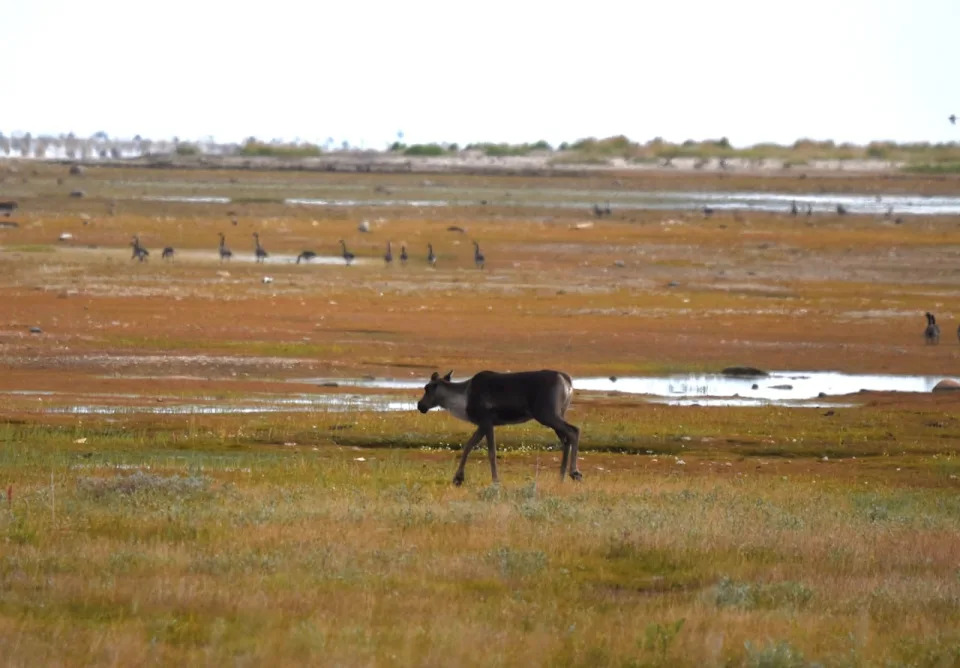
A lone caibou crosses a fen in Wapusk National Park in northern Manitoba. The Cape Churchill herd, one of the most stable populations of caribou in Canada, is estimated to be comprised of 1,000 to 3,000 animals. (Matthew Van Egmond/Parks Canada - image credit)

Wildlife scientists from two provinces are using motion-activated cameras to try to discern why one caribou population in northern Manitoba appears to be stable while herds are dwindling almost everywhere else in Canada.

Since 2022, researchers from Parks Canada, the University of Saskatchewan and the Manitoba Métis Federation have been collecting images from 92 motion-activated wildlife cameras placed in and around Wapusk National Park, a protected area in northern Manitoba along the coast of Hudson Bay.

The park protects about 99 per cent of the summer calving range of the Cape Churchill caribou herd, whose population has been estimated at somewhere between 1,000 and 3,000 animals for decades.

Wapusk also protects part of the herd's spring and fall migratory routes, while their wintering grounds lie outside the park in relatively pristine forests.

Russell Turner, an ecosystems scientist for the park, said Parks Canada and its research partners are hoping to collect enough data to establish a link between habitat protection and population health.

"Almost every other caribou population in Canada is declining, and so it's unfortunate that we don't know why these caribou are stable, but it could be because of the national park and they're protected," Russell said in an interview outside Churchill, Man., earlier this month.

While the connection between protection and population may sound logical, Turner said the Cape Churchill herd is unusual. It winters in the boreal forest and summers on the tundra, rather than spending all year in one ecological zone or another.

"We have a unique type that utilizes both the woodland and barren ground," Turner said. "It's a relatively small herd in Manitoba and relatively understudied, so we know very little information about it."

Remote cameras


A caribou walks along a fen in Wapusk National Park in August 2022. This image was captured by a motion-activated wildlife camera. Researchers with Parks Canada, the University of Saskatchewan and the Manitoba Metis Federation are trying to discern migration patterns of the Cape Churchill caribou herd.

A caribou walks along a fen in Wapusk National Park in August 2022. This image was captured by a motion-activated wildlife camera. Researchers with Parks Canada, the University of Saskatchewan and the Manitoba Metis Federation are trying to discern migration patterns of the Cape Churchill caribou herd. (Ryan Brook/University of Saskatchewan)

Gathering that information is not easy. Trail cameras are not easy to install in and around Wapusk, which is bitterly cold and snowy during the winter, soggy in the summer and has no road access any time of year.

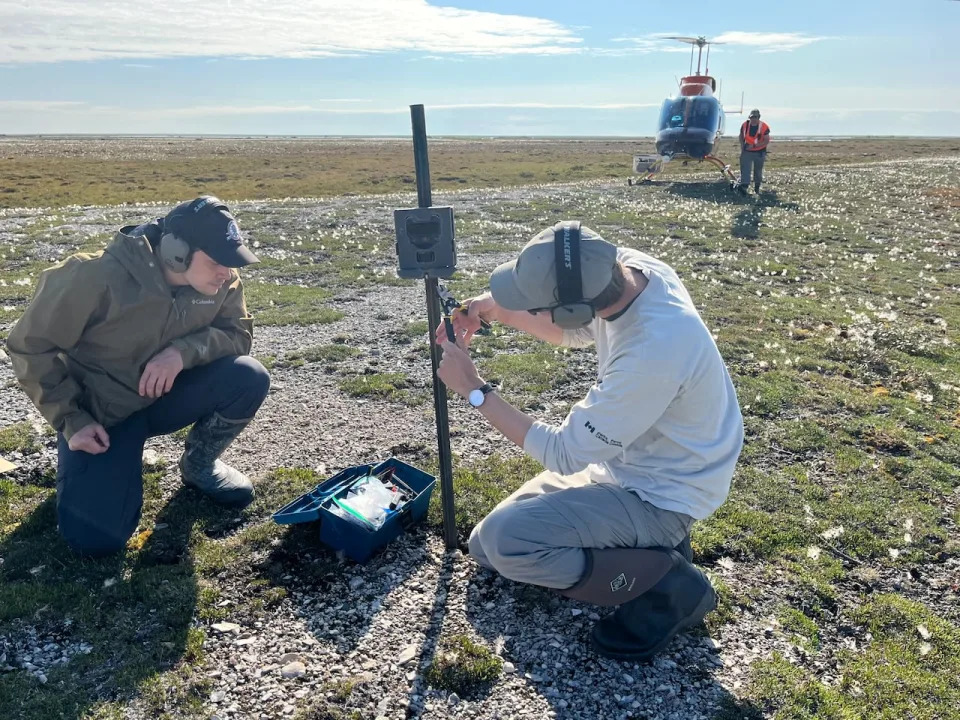
Parks Canada and its partners at the Métis Federation and the University of Saskatchewan collect images from 92 cameras mounted on posts, walking on foot to swap out batteries and memory cards at locations close to a Wapusk research camp called Nester One.

Other cameras are serviced by helicopter. Those include locations close to Cape Churchill, which is home to a sandbar dubbed "the lounge" where some of the largest male polar bears in the park congregate.

Polar bears destroyed six of the cameras in 2022. Turner knows this because the ursine offenders were caught on camera.


Riley Bartel of the Manitoba Metis Federation, left, and Parks Canada's Matthew Van Egmond replace the batteries and data card on a wildlife camera placed in Wapusk National Park while Parks Canada ecosystem scientist Russell Turner watches for polar bears. This team replaced the batteries and cards on 28 cameras in one day, flying between sites by helicopter to both speed the process and minimize the chance of a polar-bear encounter.More

Riley Bartel of the Manitoba Metis Federation, left, and Parks Canada's Matthew Van Egmond replace the batteries and data card on a wildlife camera placed in Wapusk National Park while Parks Canada ecosystem scientist Russell Turner watches for polar bears. This team replaced the batteries and cards on 28 cameras in one day, flying between sites by helicopter to both speed the process and minimize the chance of a polar-bear encounter. (Bartley Kives/CBC News)

The cameras have also captured images of grizzly bears, Arctic foxes, 25 species of birds and errant scientists who walked in front of the motion sensors. But the vast majority of the roughly 68,000 images collected during the first year of the project involved caribou.

"One of the interesting patterns that we can kind of see is that there's really not much utilizing the park or moving much in the winter. You kind of see all species showing up in May and June, and really only some wolves and foxes in the winter," Turner said.

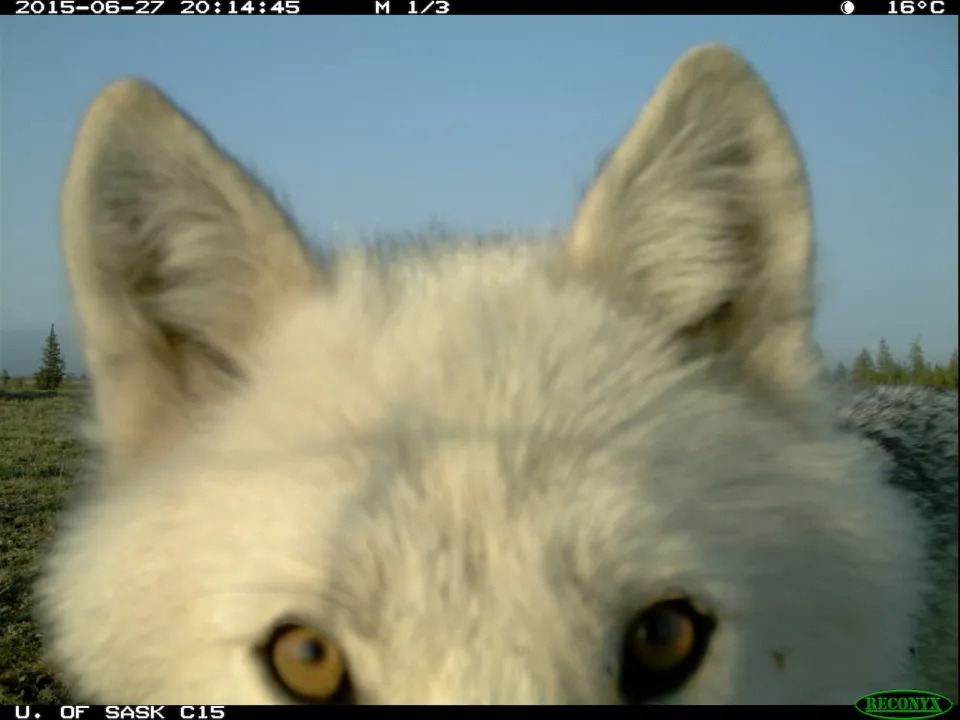
The cameras also end up with closeups from animals that inspect the cameras as well as posterior views,

"We definitely get a lot of butt photos, a lot of caribou walking away from the camera," Turner quipped.

The motion-activated cameras also capture images of other animals, including foxes, polar bears and this wolf.

The motion-activated cameras also capture images of other animals, including foxes, polar bears and this wolf. (Ryan Brook/University of Saskatchewan)

The researchers are also hoping to use the cameras to demonstrate what traditional knowledge has maintained for years: That caribou prefer to migrate along dry beach ridges rather than slog it out on soggy fens.

"We're trying to use these cameras to learn when they're at different locations, what habitat they're using, and hopefully also be able to learn about their their predators and some of their activity in the environment as well," Turner said.

Ryan Brook, a wildlife ecologist at the University of Saskatchewan, said it's interesting to see where timber wolves are relative to their caribou prey.

"They den mostly in the forested areas to the south end of the park, but they they will make daily or or longer-term trips further north where the caribou are," he said at Nester One.

The motion sensor on this wildlife camera bears puncture marks from a polar bear. This camera, which was placed at Cape Churchill - a summer gathering place for adult male polar bears - had to be replaced.

The motion sensor on this wildlife camera bears puncture marks from a polar bear. This camera, which was placed at Cape Churchill — a summer gathering place for adult male polar bears — had to be replaced. (Bartley Kives/CBC)

Riley Bartel, conservation coordinator for the Manitoba Métis Federation, said his organization hopes to use data from the cameras to support the creation of an Indigenous protected area for for the Cape Churchill caribou herd southwest of Wapusk.

Such a move would require provincial co-operation, but Parks Canada is already on board.

"Their summer grounds are protected, but if the wintering grounds could also be protected that that just helps preserve this species even more," said Bartel, also speaking at Nester One.

Ultimately, Turner hopes to demonstrate habitat protection is directly connected to the health of the caribou population, a seemingly obvious link that nonetheless has yet to be demonstrated by science.

"I think that would be a huge benefit for potentially new protected parks," he said.

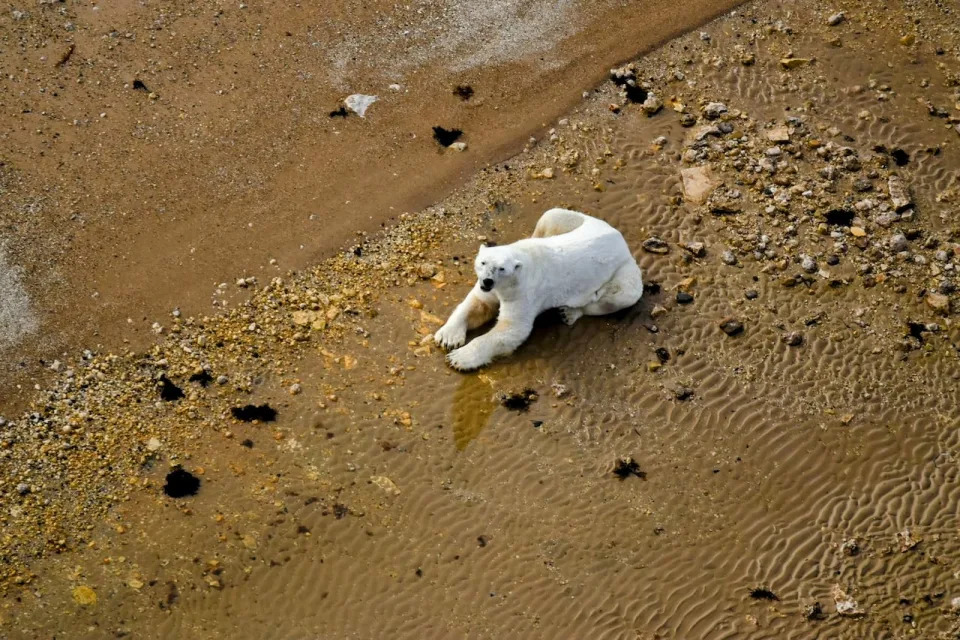
A polar bear rests on the coast of Wapusk. It was one of 15 bears spotted from the air during one day of wildlife-camera servicing by Parks Canada staff.

A polar bear rests on the coast of Wapusk. It was one of 15 bears spotted from the air during one day of wildlife-camera servicing by Parks Canada staff. (Matthew Van Egmond/Parks Canada)
WAR IS RAPE
Scores of women and girls were sexually assaulted after peace deal in Ethiopia's Tigray, study shows

The Canadian Press
Thu, August 24, 2023 


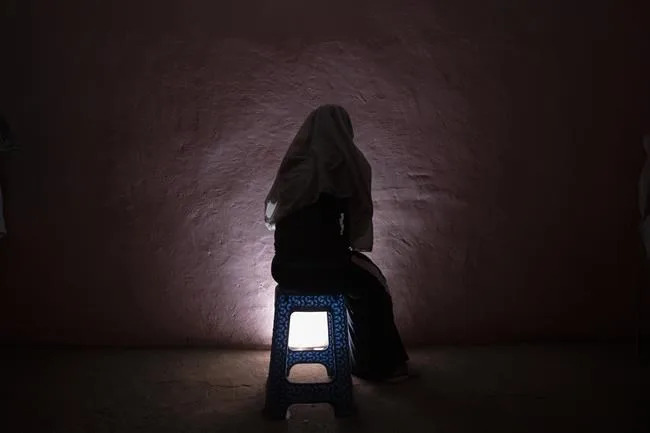
NAIROBI, Kenya (AP) — Scores of women and girls in Ethiopia’s northern Tigray region were sexually assaulted, often by multiple men alleged to be combatants, after a peace agreement last year ended the conflict there, according to a new study of medical records released on Thursday.

The youngest girl raped was 8 years old.

The Tigray conflict killed hundreds of thousands of people and left untold thousands of women and girls with the trauma of sexual assault.

At least 128 sexual assaults occurred after the peace agreement was signed last November, according to the study, which looked at records from the start of the conflict in November 2020 through June.

With most health facilities destroyed or looted as Ethiopian forces battled Tigray fighters, many women and girls were left without treatment for months. Some now have HIV or are raising the children of their rapists. Others live with incontinence or chronic pain, along with the cultural stigma around such attacks.

The study by Physicians for Human Rights and the Organization for Justice and Accountability in the Horn of Africa, along with a commentary in The Lancet medical journal, looked at more than 300 randomly selected medical records from Tigray health centers focused on helping survivors of sexual violence.

It is just a “small glimpse” of the toll, the authors say, and they fear the chance for justice will be lost if independent accountability efforts by the United Nations and others are shut down.

“All the community is a victim of sexual violence,” a Tigray-based researcher into conflict-related sexual violence told The Associated Press. A collaborator on the study, he has spoken with hundreds of women and girls and said not one feels healed.

“Rape survivors, they are suffering the most,” he said. Like many Tigrayans, he spoke on condition of anonymity for fear of retaliation from Ethiopian authorities.

At least 128 sexual assaults occurred after the peace agreement was signed last November, according to the study, which looked at records from the start of the conflict in November 2020 through this June.

Overall, 76% of the 304 women and girls whose cases were reviewed were sexually assaulted by multiple people, often three or more. One was assaulted by 19 men.

In 94% of all cases, no condom was used. Many perpetrators also wielded guns, sticks or knives. Some women and girls were abducted for repeated assaults.

“They took her to their camp and raped her for six months,” one medical record cited by the study says.

Almost all the women and girls said their attackers appeared to be members of a military group, often from neighboring Eritrea, whose soldiers fought alongside Ethiopian forces against Tigray fighters and allegedly remain in parts of western and northern Tigray.

The findings suggest that “these acts were neither isolated nor random but a systematic use of rape as a weapon of war,” the study’s authors write in The Lancet commentary.

Spokesmen for Ethiopia’s and Eritrea’s governments did not respond to requests for comment.

“It is absolutely horrifying and devastating to even read the narratives of the patients,” Ranit Mishori, a senior medical adviser with Physicians for Human Rights, said in an interview. “The brutality didn’t skip the children. Many were also raped by multiple perpetrators.”

Mishori and her colleague, senior program officer Lindsey Green, expressed concern that independent efforts to understand the conflict’s toll and bring accountability to the perpetrators are being weakened or shut down under pressure from authorities.

“Most disturbing to me is the lack of focus on these crimes,” Green said.

Ethiopia’s government is keen to re-engage with key partners such as the United States, the European Union and global financial institutions after the conflict. On Thursday, Ethiopia was announced as an incoming member of the BRICS economic bloc.

But Ethiopia has sharply criticized outside efforts to promote justice and accountability. An African Union human rights inquiry was quietly terminated earlier this year.

Now Ethiopia wants a United Nations inquiry ended, too, human rights experts say.

After a conflict marked by the blockade of the Tigray region of more than 5 million people, with internet and phone links severed and human rights researchers and journalists barred, the lack of independent inquiry means that the civilian toll could remain largely in the shadows as Ethiopia’s government moves on.

“The world has accountability mechanisms, but almost everything is in the hands of diplomats and politicians, which is a recipe for failure,” said Martin Witteveen, an international criminal law expert who worked with the government-created Ethiopian Human Rights Commission until early 2022. He says Ethiopia alone can hardly ensure accountability when its forces and allies committed most of the crimes.

Even now, the study says, survivors of sexual violence in Tigray are still coming forward, but others will never be known.

Cara Anna, The Associated Press


Archive.org

https://archive.org/details/againstourwillme00brow

Feb 1, 2010 ... 14 day loan required to access EPUB and PDF files. IN COLLECTIONS. Texts to Borrow Books for People with Print Disabilities Internet Archive ...

SEXUAL ASSAULT
FIFA opens case against Spanish soccer official who kissed a player on the lips at Women's World Cup


Thu, August 24, 2023 


GENEVA (AP) — FIFA opened a disciplinary case Thursday against the Spanish soccer official who kissed a player on the lips while celebrating the team's victory in the Women’s World Cup final.

The governing body's disciplinary committee will weigh if Spanish soccer federation president Luis Rubiales violated its code relating to "the basic rules of decent conduct” and “behaving in a way that brings the sport of football and/or FIFA into disrepute.”

Rubiales kissed player Jenni Hermoso on the lips during the trophy and medal ceremony on Sunday after Spain’s 1-0 victory over England in Sydney, Australia.

Minutes earlier, Rubiales grabbed his crotch as a victory gesture in the exclusive section of seats with Queen Letizia of Spain and 16-year-old Princess Sofía standing nearby.

Hermoso has said she did not like the kiss and the national players’ union representing her — which the 46-year-old Rubiales once led — called Wednesday for his conduct to not go unpunished.

FIFA responded Thursday.

“FIFA reiterates its unwavering commitment to respecting the integrity of all individuals and strongly condemns any behavior to the contrary,” the soccer body said without specifying which acts by Rubiales are under investigation.

Víctor Francos, Spain’s secretary of state for sports, said Wednesday that “the gesture of grabbing his testicles in the tribune is a gesture that no one can defend.”

FIFA gave no timetable for a ruling. The body's disciplinary judges can impose sanctions on individuals ranging from warnings and fines to suspensions from the sport.

The FIFA disciplinary panel is chaired by Colombian lawyer Jorge Palacio, a former labor court judge and member of the state constitutional court.

The case likely will be judged by three of the 16 panel members. Three of the 16 are women, from England, Mexico and Thailand.

Rubiales is a vice president of UEFA, a role which pays 250,000 euros ($270,000) each year plus expenses, and was the European soccer body's most senior representative at the biggest game in women’s soccer.

UEFA president Aleksander Čeferin has yet to comment on the conduct of Rubiales, who is due to host the European soccer body's next annual congress in Madrid in February.

The Spanish soccer federation, which Rubiales has led for five years, has an emergency meeting Friday in Madrid where the agenda allows questions on the controversy.

It is unclear if the meeting will shore up support for Rubiales or respond to widespread pressure from Spanish government and soccer officials to remove him.

Rubiales, who led the Spanish players’ union for eight years before taking over as federation president in 2018, is currently heading the UEFA-backed bid to host the men’s World Cup in 2030. Spain is bidding with neighboring Portugal and Morocco, and also possibly Ukraine.

Francos said Rubiales has damaged the country’s image as it tries to win support for hosting the World Cup.

FIFA delayed launching the 2030 bid contest in June but has targeted late next year for a decision.

The Spain-led bid is currently favored over a four-nation South American plan teaming Argentina, Chile, Paraguay and inaugural 1930 World Cup host Uruguay. Despite speculation about a possible bid from Saudi Arabia, the 2034 edition is seen as a more likely goal for the oil-rich kingdom.

___

AP Women’s World Cup coverage: https://apnews.com/hub/fifa-womens-world-cup

Graham Dunbar, The Associated Press

MAKE BIG BUCKS CUT JOBS
RBC reports $3.9Bn profit, says ramping up job cuts ahead of economic slowdown

The Canadian Press
Thu, August 24, 2023


TORONTO — Royal Bank of Canada is ramping up job cuts as it works to reduce costs ahead of an expected economic slowdown.

The bank, which reported a rise in third-quarter profits Thursday that beat analyst expectations, said it planned to cut one to two per cent of its full-time equivalent employees next quarter on top of the one per cent it trimmed in the last one.

The cuts come as heightened interest rates put pressure on expected economic activity despite resilient consumer spending.

"Our base case forecasts a softer economic outlook," chief executive Dave McKay told a conference call with investors and financial analysts.

"We expect slowing growth and lower inflation due to the lagging impact of monetary policy combined with a slowdown in China and elevated climate and geopolitical risks."

Given the outlook, the bank has heightened its focus on expense control, said McKay, including slower discretionary spending and moderating hiring.

Early job reductions were done largely through natural attrition, but cuts will ramp up this quarter now that the bank has regulatory approvals in place to move forward, he said.

The cuts come after McKay said last quarter that the bank had over hired by the thousands. The bank added about 6,100 full-time equivalent employees in 2022 over the year before, and 3,000 the first two quarters of this year.

In the third quarter the company reduced its employee base by about 2,400, though some two-thirds of that was the result of a partial sale of its RBC Investor Services, leaving RBC with 93,753 full-time equivalent employees in its most recent quarter.

Despite the cuts, the overall higher employee numbers, along with rising pay, meant costs were up 17 per cent, chief financial officer Nadine Ahn said.

She said the bank has had nearly $70 million in severance costs over the last two quarters with more expected in the next one, before RBC starts to see expense benefits from the cuts next year.

The focus on costs come as the bank reported expenses were up 23 per cent in the quarter from last year, about 10 per cent of which was related to acquisitions and foreign exchange. Leaving that aside, non-interest expenses were up 13 per cent, driven by higher staff-related costs and professional fees.

Despite the higher costs, the bank reported a net income of $3.87 billion or $2.73 per diluted share for the quarter ended July 31, up from $3.58 billion or $2.51 per diluted share in the same quarter last year.

Revenue totalled $14.49 billion, up from $12.13 billion a year earlier.

Provisions for credit losses amounted to $616 million, up from $340 million in the same quarter last year.

On an adjusted basis, RBC says it earned $2.84 per diluted share in its latest quarter, up from $2.55 a year earlier.

The average analyst estimate had been for a profit of $2.71 per share, according to figures compiled by financial markets data firm Refinitiv.

The bank beat expectations based in part thanks to lower-than-expected credit loss provisions, as well as a lower tax rate, Scotiabank analyst Meny Grauman wrote in a note to clients.

He said efforts to cut expenses, including through fewer full-time equivalent employees, should help bank performance.

"Operating leverage remains an issue at this bank, but we certainly are seeing tangible proof that RY is working to address this by lowering FTE.”

The bank also benefited from a slight rise in net interest margins in Canadian banking, as the client flow into term deposits like guaranteed investment certificates slowed.

Banks have seen their margins squeezed as customers move more money into the term products that are more expensive for banks, but RBC has long touted its low-cost deposit base to help offset the trend. The bank said that last quarter its margins also benefited from strong growth in credit card balances.

RBC's net interest margin rise of 0.03 percentage points to 2.68 per cent for Canadian banking surprised to the upside compared to consensus expectations of a 0.02 per dip, said Grauman.

“That is something that we and the Street have been looking to see for a while as RY’s strong domestic deposit franchise appears to finally be shinning through.”

This report by The Canadian Press was first published Aug. 24, 2023.

Companies in this story: (TSX:RY)

Ian Bickis, The Canadian Press
Alberta's budding energy-storage industry is set to bloom. The renewables pause has cast a chill

Story by Robson Fletcher • CBC

Alberta's renewable-energy moratorium has put a spotlight on the future of wind and solar projects in the province, but there is another, related industry that has also been caught up in the province's sudden and controversial decision.

Energy storage.


The industry is nascent in Alberta — with just five small facilities totalling 90 megawatts of capacity connected to the power grid — but industry watchers believe it could be on the cusp of a major surge.

Companies have submitted dozens of applications to the Alberta Electric System Operator (AESO) for new projects, potentially representing thousands of megawatts' worth of industrial-scale battery storage that could come online in the next few years.

Many of those projects are in an early stage. Not all will necessarily end up getting built. Others, however, are nearing completion and due to be connected to the grid later this year.

At the heart of the boom in business interest are a few key factors: the declining cost of large-scale batteries, the increasing costs (both financial and environmental) of carbon emissions, and the rapid growth in renewable energy, which goes hand-in-hand with energy storage — both technologically and economically.

Prior to the provincial government's pause on renewables, the energy-storage industry had been working with AESO on modernizing Alberta's power purchasing and distribution rules to better fit with the role that large-scale batteries and other forms of energy storage could play on the grid.

That work continues, and the industry remains optimistic about future growth. But, at the same time, uncertainty surrounding the Alberta government's stance on renewable energy has spilled over into this sector.
What is energy storage, exactly?

Energy storage is a relatively new concept when it comes to Alberta's electricity grid, but it's something we're all familiar in our day-to-day lives.

Whether it's cellphones, laptops, or electric cars, we routinely charge up our devices when we're not using them so the electricity can be deployed when we want, later on. The idea of warehousing electricity so we can access it on demand is a pretty common concept, in that respect. But when it comes to the electric system, itself, this is a relatively new thing.

Right now, Alberta's electric grid includes only a tiny amount battery storage — five relatively small facilities, totalling 90 MW of capacity. (For context, total demand on the grid routinely exceeds 10,000 MW.)

Four of those five facilities belong to Enfinite, a Calgary-based company that has been the largest early entrant into Alberta's energy-storage market.


Enfinite CEO Jason White speaks to CBC News in an interview. (Google Meet/Screenshot)© Provided by cbc.ca

"Energy storage as a whole is becoming increasingly popular," said Jason White, Enfinite's chief executive officer.

"As we think about the intermittence of renewable energy, having some storage on the grid to back up that gap, let's call it, is valuable and I think a lot of companies are seeing that."

The business interest isn't limited to Alberta. There have been major energy-storage undertakings recently in Ontario, the United States and around the world.

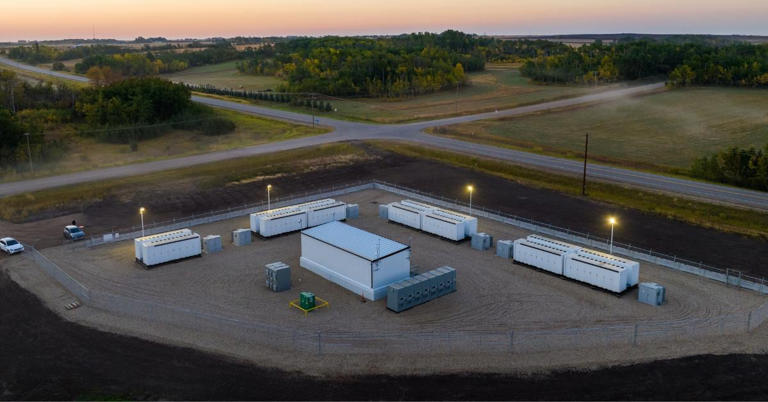
So far in this province, Enfinite has limited its projects to a modest scale. If you're out driving on a rural road, you might whiz past one of the company's 20-MW storage facilities and not notice. The nondescript industrial facilities typically take up a small amount of space — just an acre or two — on an underused piece of rural land.

Stationed behind the chain-link fences, however, is some cutting-edge technology. Banks of high-capacity, lithium-ion batteries manufactured by Tesla are connected to a control system that is connected to Alberta's power grid.

In addition to its four 20-MW facilities connected to the grid right now, Enfinite expects five more to be connected by the end of the year, totalling 180 MW of battery-storage capacity.


Enfinite's eReserve3 facility, located in the Hamlet of Clairmont in County of Grande Prairie. (Submitted by Enfinite)© Provided by cbc.ca

Looking a little longer-term, Enfinite has also made applications for a 400-MW battery storage facility near High River and a 500-MW facility near Medicine Hat. Those applications are in Stage 2 (assessment) of AESO's six-stage grid-connection process.

"They're a lot bigger in scale, obviously," White said of the longer-term projects, noting the company wanted to start with smaller-scale operations before taking on the risk of a larger facility.

"We're getting a lot more comfortable with all the opportunities that energy storage can play in the market and I think that we're a lot more comfortable with the overall technology," he said.

"We think now is the right time for those bigger projects."

Enfinite's projects are unlike a lot of other energy-storage operations, however.
Standalone vs. generation-connected

The facilities Enfinite has built in Alberta are standalone batteries with no generation capacity of their own. They simply take power from the grid, store it, and then send it back at a later time.

Other battery-storage projects are attached to a generating station so they can be charged directly and then pass the power along to the grid later.

TransAlta's WindCharger, for instance, stores power from nearby wind turbines in the Pincher Creek area. The 10-MW facility has been in operation since late 2020.

For new energy-storage projects attached to wind or solar generation, however, Alberta's pause on new renewables poses a problem.


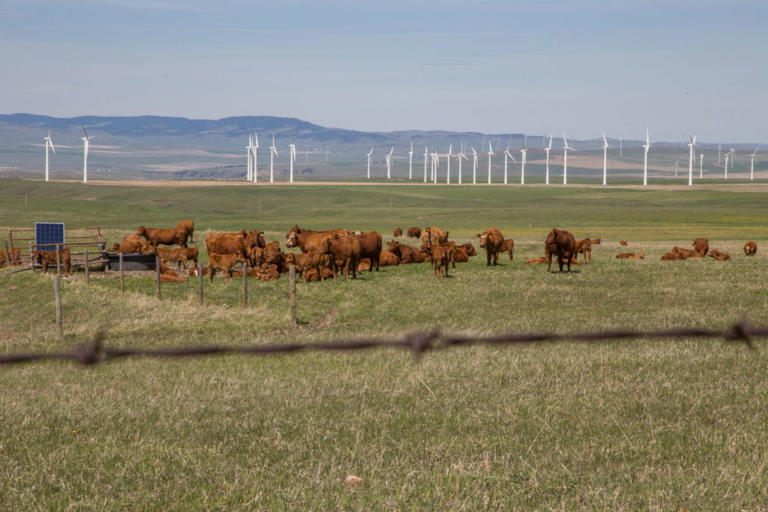
Cattle graze in front of a bank of wind turbines near Pincher Creek, Alta., in this file photo. (Robson Fletcher/CBC)© Provided by cbc.ca

"Our understanding is that, where storage is directly connected to a renewable facility, it's paused with the rest of the renewable facility," said Robert Tremblay with Energy Storage Canada, an industry advocacy group.

Standalone-battery facilities aren't affected in the same way, he said, but the pause has nonetheless cast a chill on the sector more broadly.

"I think this has shaken up the confidence of the industry a little bit," Tremblay said. "Just because batteries aren't paused now doesn't mean the industry necessarily feels comfortable."
Proposals and probabilities

While there are dozens of active entries on AESO's list of energy-storage proposals, there are also many projects that have been proposed and either cancelled or put on hold.

The status of projects changes all the time for all sorts of reasons such as financing, business viability, permitting, and so on. Just because a project has been proposed doesn't mean it will actually come to fruition.

The provincial government's pause on renewable energy has also prompted some companies to rethink their plans for energy storage in Alberta, said Jorden Dye, acting director of the Business Renewables Centre, a Calgary-based organization that helps match developers and buyers in the renewable sector.

Companies behind at least four Alberta projects that included both renewable generation and energy storage have hit the brakes on their plans, Dye told CBC News.

He stressed those companies have not cancelled the projects but are taking a "wait and see" approach as the industry seeks more clarity on the direction of the provincial policy.

The map below shows energy-storage proposals that were active with AESO, as of August.

How many of these proposals are likely to become reality?

That depends on whom you ask.

Forecasting the future

Predicting exactly what Alberta's deregulated energy market will look like in the future is an inexact science; it's impossible to say for certain which projects will come to fruition — and when.

The Pembina Institute, a renewable energy think tank, put together some educated guesses in a report that analysts started researching in 2022.

By the time it was published a year later, they realized their forecasts may already be out of date.

One model in that report was called the "High Storage Scenario," which assumed various incentives to encourage the development of more energy storage in Alberta. But when they looked at the most recent list of energy-storage applications to AESO, they realized even that scenario may have underestimated the amount of storage that may soon come online.

"We just put this report out in June and we were quite surprised to see this," said Jason Wang, a senior electricity analyst with the Pembina Institute.

Under the "High Storage Scenario," the Pembina report expected nearly 1,000 MW of energy-storage capacity by 2030.

But when looking at all the project applications currently at AESO's Stage 3 (regulatory preparation), Wang said the growth could actually come even faster than that, with roughly 900 MW by as early as 2026, if all those projects come through on schedule.

AESO, for its part, takes a more conservative view.

It wouldn't speculate about future energy-storage capacity in response to questions from CBC News, but the Pembina Institute noted that, in some preliminary modelling AESO presented to industry stakeholders earlier this year, it foresaw capacity growing steadily to about 500 MW by 2027 and plateauing from there.

Wang said actual growth in renewable energy has outpaced numerous past forecasts — not just from AESO, but a variety of sources — and he believes energy storage could do the same.

"This is a sector that's growing rapidly and our projections are probably going to be wrong again," he said.

"In the end, we're probably gonna see it grow even faster than we expected."
Beyond batteries

Batteries like those used by Enfinite are a common type of energy storage, but not the only one.

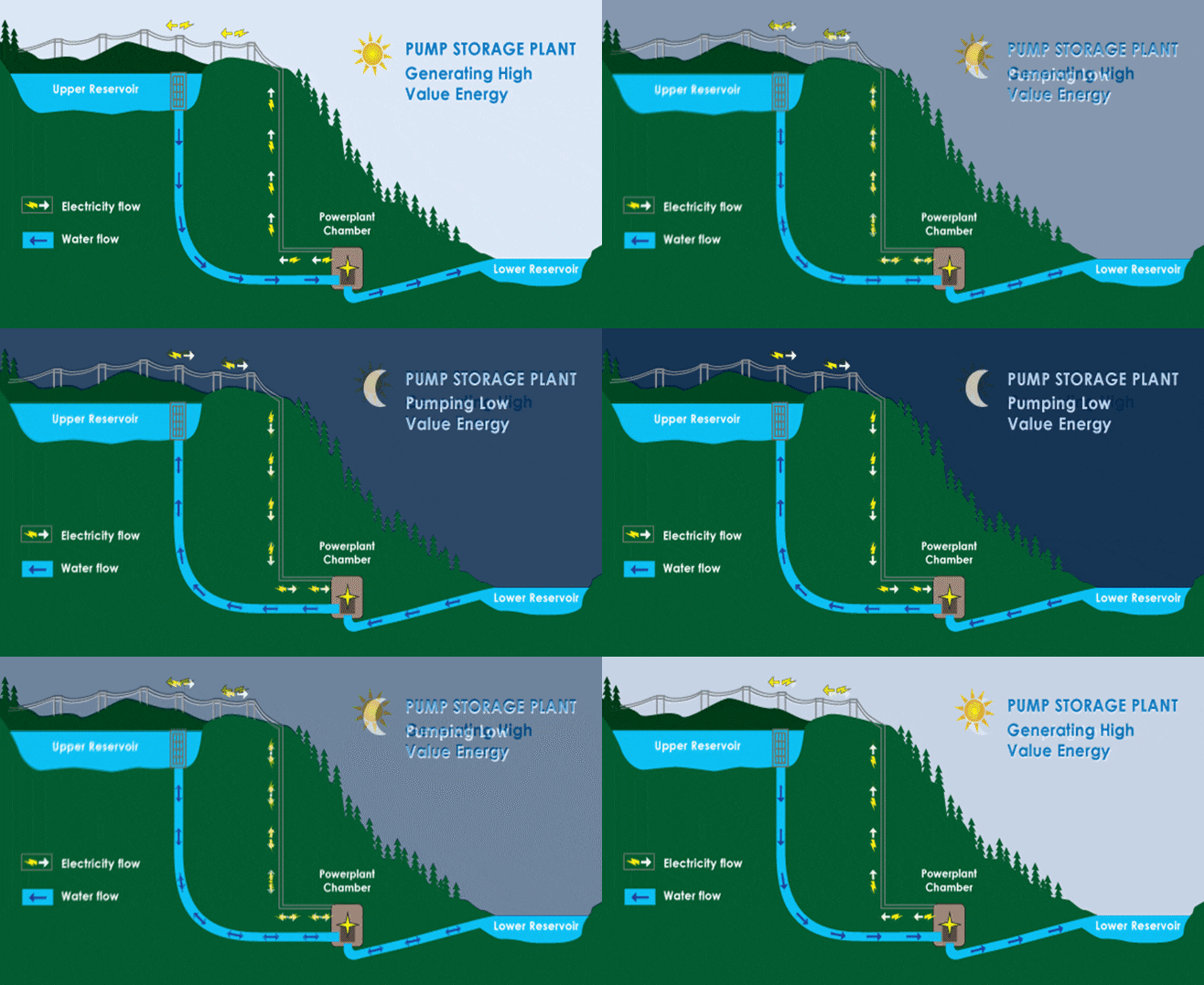
Pumped hydro is another commonly used method to defer the deployment of electricity to more favourable times.

In essence, this technology uses power during low-demand periods to pump water from a lower reservoir to a higher-altitude reservoir. Then, when energy demand is high, the water is released and gravity pulls it back down to the lower reservoir, spinning hydroelectric turbines along the way.

TC Energy is building a facility like this near Hinton, Alta., named the Canyon Creek Pumped Hydro Energy Storage Project, which is set to add 75 MW of "on-demand, flexible, clean energy" to the province's grid.


Animated image showing the proposed flow of water and electricity at the Canyon Creek Pumped Hydro Energy Storage Project during periods of low demand and high demand. (TC Energy)© Provided by cbc.ca

Other countries have built much larger facilities, such as Switzerland's Nant de Drance, which is capable of putting out 900 MW of electricity at any given moment and storing 20,000 MW-hours of energy in total — the equivalent of roughly 400,000 electric-car batteries.

Here in Alberta, hydro power is also being considered in conjunction with traditional batteries.

TransAlta aims to add 180 MW of batteries to its existing Ghost hydroelectric facility near Cochrane in a project dubbed WaterCharger that the company hopes to deploy by 2024.

And one other method of storing energy is also being considered in the province: compressed air.

Calgary-based Federation Engineering has proposed a 320-MW facility near Cold Lake that would store energy by compressing air in underground salt caverns, then release that energy by letting the air decompress through turbines to produce electricity.
Tariff troubles

As we've heard, new storage projects attached to renewable generation may be caught up in Alberta's pause on renewable energy.

But the standalone-battery projects also face a hurdle related to the fees they pay for buying power from the grid.

"Basically, it's tricky to do that just because of the way the electricity tariff applies to storage projects," said Tremblay, with Energy Storage Canada.

In essence, he said, when batteries draw power from the grid, the fees they pay are the same as if they were a load on the system, which the industry believes isn't fair and ultimately makes standalone battery storage less economically viable.

"We're not consuming electricity, in general," Tremblay said. "We're taking it in, saving it for later and then giving it back. So we're more a part of the system than we are a consumer hooked up to the system."

The industry has been working with AESO on adjusting the tariff system to better accommodate standalone batteries.

"If those [tariffs] were to be changed or made to be more favourable for energy storage, I think more projects would get built," said White, the CEO of Enfinite.

Industry watchers say there are other reasons for optimism about the future of energy storage in Alberta.
Economic and technical advantages

Part of the reason electricity prices have been so high in Alberta lately is that a small number of companies control a large chunk of the generation, allowing them to raise their offer prices during periods of high demand.

If a new fee structure is indeed approved, Tremblay said energy storage projects would become more economically viable in the province.

Standalone batteries would then be better positioned to buy and store cheap power during periods of low demand and provide it back to the grid later on, introducing more competition to the market during periods of high demand.

"Bridging that gap between low prices and high prices lowers prices, overall, for consumers," Tremblay said.

Energy storage also offers some technical advantages, especially as more and more renewable energy has come online. One reason the Alberta government cited for its renewable-energy pause was the intermittent nature of wind and solar power, which has created concerns over grid reliability.

In addition to providing raw power to the grid, battery storage is also well positioned to provide ancillary services, which help the transmission system adjust, maintaining the correct voltage and frequency, especially when there are sudden changes in supply or demand.


Jason Wang is a senior electricity analyst with the Pembina Institute. (Google Meet/Screenshot)© Provided by cbc.ca

"The main thing is that batteries are really quick to deploy," said Wang with the Pembina Institute.

"You have to have assets that can react in milliseconds, at times, and batteries are able to do that really well."

Storage can also reduce the cost of transmission infrastructure, Wang added, because it allows for more power to flow from intermittent sources on a given line by spreading out the load.

For White, the advantages of the sector outweigh the challenges and he expects "an influx of energy storage across Canada for the next long while."

"We're really excited about the space and think there's a lot of value," he said.

"There's a lot of ways to deploy it. It can do a lot of things. And I think that it's valuable for all of the stakeholders, whether it be the grid operators or the people that pay the bills. You know: you, me."
UCP CUTTING NOSE TO SPITE FACE
Renewables pause in Alberta affecting 118 projects worth $33 billion, think tank says

The Canadian Press
Thu, August 24, 2023 


EDMONTON — After two decades in the oilpatch, Shawn Hubbard was tired of layoffs and uncertainty about the future.

"I was pretty much done with that after 20 years," he said. "Getting the rug pulled out from under you gets tiresome."

Hubbard, 50, took a short, free course on installing solar panels in 2021 and was working in the field by the next summer.

"I liked it a lot more," he said. "The hours were similar but the pay was better.

"There's plenty of work in renewables."

Plus, as oil and gas continues to shed jobs, renewables seemed like tomorrow.

"Renewables seemed like a natural progression for energy generation," he said. "It always felt like the future for me."

Hubbard now works for the City of Medicine Hat to keep close to his family. But he fears the United Conservative government's six-month pause on renewable energy approvals, announced earlier this month, will stifle an industry that presents a real alternative for workers like him.

"I was angry," he said. "That's a lot of work, a lot of jobs, that are going to be put in limbo.

"What are they doing?"

Hubbard's fears were underscored in a report released Thursday by the Pembina Institute, a clean-energy think tank, about the scale of solar, wind and geothermal projects affected by the renewables moratorium.

The report said the pause affects 118 projects worth $33 billion. It said those projects would create enough jobs to keep 24,000 people working for a year and represent what could be $263 million in local taxes and leases for landowners in 27 municipalities.

Those figures come from the Alberta Electrical System Operator and Natural Resources Canada, said report author Jason Wang. They represent projects in various stages of development, from formal proposals to initial construction.

"Probably not all these projects will be built," Wang said.

"But all these projects have investors talking about (building). We do see tremendous interest in Alberta."

Several companies have already said they're considering taking their money elsewhere.

The commission has said it would keep accepting applications and move them through the regulatory process, which Wang called the "least bad" approach. But it won't issue any approvals until after it completes an inquiry into issues of land use and reclamation for renewables.

In an emailed statement, Minister of Affordability and Utilities Nathan Neudorf said no projects are being cancelled and only 13 projects before the Alberta Utilities Commission are directly affected by the pause.

"There are 105 projects inaccurately listed by interest groups that are months, maybe years, away from even getting before the (commission)," Neudorf wrote. "The next construction season will be available for approved projects."

But Wang said the vast majority of projects in the queue had planned to hook up to the grid by 2025, meaning the delay and uncertainty stemming from the inquiry will directly affect them.

New Democrat Opposition energy critic Nagwan Al-Guneid, who worked for years in both fossil fuels and renewables, said there are already reclamation provisions in existing legislation. Consultations on land use were already ongoing, she said.

"You can still be open for business while going ahead with these consultations," she said. "A moratorium is not a solution."

Al-Guneid pointed out the International Energy Agency says investment in renewable energy this year is projected to reach $2.3 trillion worldwide, with solar investment outpacing fossil fuels for the first time.

Having to wait until February for a report that might contain unknown new costs and regulations is not attracting any of that money to Alberta, she said.

"The reality is that there is a global transformation," Al-Guneid said. "A responsible government needs to plan for all scenarios."

Meanwhile, Alberta Premier Danielle Smith was in Banff, Alta., on Thursday speaking to the Canadian Energy Executive Association.

She said Alberta producers are reducing the amount of greenhouse gases they emit during production, although she didn't mention that production only represents about 20 per cent of the carbon released by a barrel of oil.

"We don't need a just transition in Alberta because we don't intend to transition away from oil and gas," Smith said.

That's exactly what Shawn Hubbard, the renewables worker, is afraid of.

"In the world, everybody's moving forward.

"(Smith) is not taking our province into the future. Or even into the present."

This report by The Canadian Press was first published Aug. 24, 2003.

Bob Weber, The Canadian Press

$33 billion in renewable energy investments stalled as Smith champions oil and gas


Local Journalism Initiative
Thu, August 24, 2023 at 3:28 p.m. MDT·6 min read

Alberta Premier Danielle Smith doubled down on her support for the oil and gas industry, just as a report showing her government’s pause on renewable energy development could jeopardize investments worth billions.

“We don’t need a just transition because we don’t intend to transition away from oil and natural gas,” Smith said this week at the Canadian Energy Executive Association conference in Banff. The industry is working to reduce greenhouse gas emissions, but will not transition “away from production,” she noted.

On Aug. 3, Danielle Smith’s United Conservative Party government kneecapped Alberta’s clean energy industry with a surprise announcement on approvals of all new renewable energy projects over one megawatt.

A report released Thursday shows Alberta's seven-month moratorium on renewable energy development has stalled 118 projects representing $33 billion in investments.

Pembina Institute combed through public data to figure out how many projects are affected by the seven-month moratorium and what this means for investments, revenues and jobs in Alberta.

The 118 projects identified are comprised of 5.3 GW of wind, 12.7 GW of solar and 1.5 GW of battery energy storage for solar projects.

The total investments supporting these projects are estimated at a little over $33 billion from projects proposed by 64 companies or partnerships. Pembina Institute also calculated another $263 million per year in revenue from municipal taxes and land leases spanning 27 different municipalities that won’t be realized until the projects move forward. According to the analysis, the planning, development and construction phase would create, over the span of several years, the equivalent of one year of 24,000 full-time jobs.

The province is well-positioned to become Canada’s “renewable energy capital,” the new analysis points out. Last year, Alberta led Canada for renewable energy growth, accounting for 77 per cent of the 1.8 gigawatts of solar and wind generation capacity that came online that year, according to data from the Canadian Renewable Energy Association.

When he announced the pause, Nathan Neudorf, Alberta’s Minister of Affordability and Utilities, said the move was a direct response to concerns raised by rural municipalities about land use considerations and end of life plans for renewable projects. Abandoned industrial projects are a pain point because many municipalities have been left with the mess from defunct oil and gas wells and are still owed millions in taxes by oil and gas companies: the Rural Municipalities of Alberta says its members are collectively owed $268 million in unpaid property taxes by oil and gas companies, and that number continues to grow.

During the renewables pause, the Alberta Utilities Commission will review policies and procedures for the development of renewable electricity generation, according to the province.

Rural Municipalities of Alberta president Paul McLauchlin said they did not ask the government to pause project approvals, only raised concerns, but he applauded the decision nonetheless.

Aside from end of life plans, another one of Rural Municipalities of Alberta members’ main concerns is that highly productive farmland will be sacrificed to accommodate large renewable projects. “We want to make sure that projects that are industrial at that scale are compatible with adjacent land uses, or at least those questions are being asked in the decision-making process,” McLauchlin told Canada’s National Observer the same day the moratorium was announced.

McLauchlin emphasized that municipalities are not against renewable energy development — they just want to see it done right.

The revenues being brought in by these projects are “life-changing” for municipalities, said McLauchlin, pointing in particular to Vulcan County, home to Canada's largest solar project and one of the largest wind farms.

Several large renewable energy projects have injected the county with much-needed revenues after years of being stiffed by oil and gas companies.

About a decade ago, the decline of oil and gas decimated Vulcan County’s budget by almost 50 per cent, Jason Schneider, the elected reeve of Vulcan County, told Canada’s National Observer in an interview earlier this month

“We're out about $13 million of unpaid oil and gas taxes,” said Schneider. That's from companies who either just decided not to pay their taxes or companies that disappeared in the middle of the night or went bankrupt, he said.

“Unfortunately, the way the whole industry, the way it was all set up is, you know, these companies were able to walk away and we really had no recourse,” said Schneider.

“$13 million to a small municipality like ours is a big chunk … If you wanted to extrapolate that and compare it to a city … I mean, any city, if you have to cut your budget by 30 per cent, I don't think many municipalities could do it.”

“In the last 10 years, wind and solar has surpassed oil and gas at its peak in Vulcan County,” said Schneider, adding “we're we're able to do things that we weren't able to do 10 years ago, even five years ago,” namely infrastructure investments “thanks to the additional revenues the projects have brought online.”

He doesn’t want this issue to repeat with the rapidly expanding renewables industry. Renewable energy companies make deals with individual landowners, so it's up to landowners to ensure the contract includes a plan to decommission and remediate the site when its operating life is over. Municipalities are left in the dark because the deals are typically confidential.

During the application process, the Alberta Utilities Commission requires companies to show how they will ensure there is enough money to cover the costs of decommissioning the project and restoring the land to its former state.

Pembina Institute’s analysis found that, on average, a 100 megawatt renewable energy project generates between $125 and $175 million in project development and construction investments, about 300 full-time jobs during construction and $1.5 million in long-term, annual municipal revenues.

For example, multiple projects proposed in the Medicine Hat area would generate up to $44 million in annual tax and land lease revenues, according to the analysis. There is just one project — a 160 megawatt wind project — proposed in the Municipal District of Smoky River, in northwestern Alberta. That one project would result in an estimated $1.9 million in tax and land lease revenues per year.

The authors of the analysis point to the Alberta Utilities Commission’s existing requirements for decommissioning and reclamation plans, writing that while improvements can be made to those current measures, the moratorium is unnecessary and hampers stakeholders eager to invest in projects.

This article was updated at 2:46 p.m. on Aug. 24 to include comments made by Alberta Premier Danielle Smith, and to provide additional clarity on job creation numbers

Natasha Bulowski, Local Journalism Initiative Reporter, Canada's National Observer

Protesters hoped to 'overwhelm' RCMP wildfire blockade in B.C. Shuswap region: police

The Canadian Press
Thu, August 24, 2023 


RCMP say protesters hoped to "overwhelm" a wildfire blockade on the Trans-Canada Highway in British Columbia's Shuswap region, confronting officers late Wednesday amid some residents' refusal to obey evacuation orders.

The tensions over the evacuation orders that cover thousands of people in the region come as the directives elsewhere in B.C.'s Interior are expected to ease, with firefighters reporting good progress thanks to rain and other favourable weather.

Kelowna Fire Chief Travis Whiting told a briefing the goal was for all evacuation orders in that city to be lifted Thursday, although they're set to remain in place in West Kelowna and other communities on the other side of Lake Okanagan.

In the Shuswap, to the north of Kelowna, police say in a statement that protesters challenged officers Wednesday evening, while "threats of violence" against emergency workers had prompted the Mounties to increase their presence there.

Videos posted to social media show about 20 protesters at a blockade of police cars in an evacuation zone near the lakeside community of Sorrento.

The protesters tell officers they do not believe politicians have the right to prevent them from using the road, and that it is illegal for the RCMP to block it.

The group, which organized itself on Facebook, had hoped to rally enough support to push through the blockade to enter the evacuation zone, saying they planned to support those who have chosen to remain inside to protect their property.

"This is a warning to all you Canadians out there, this is what's coming," one man says after confronting police in a video of the incident, referring to the RCMP blockade at the intersection of Blind Bay Road.

The group dispersed after about an hour. The RCMP statement says officers de-escalated the situation safely, without incident, adding no one was arrested and no charges are expected to stem from the confrontation.

The Mounties have stepped up their presence "in response to ongoing efforts by some individuals who have undermined BC Wildfire Service fire suppression work through the movement of vital equipment, and have (compromised) emergency personnel safety through threats of violence," the police statement says.

The area under evacuation order is not safe due to active wildfire, as well as damage to power lines and unstable trees and structures, it says.

“While we understand and sympathize with the residents of the North Shuswap, there is a process in place through the local emergency operations centre that needs to be followed," spokesperson Cpl. James Grandy says in the statement.

“When the (centre) deems it safe to do so, they can issue passes into the area to support a resupply."

Tensions have been mounting in the Shuswap, which is one of the hardest-hit areas in the province's wildfire fight. BC Wildfire Service crews are fighting the 410-square-kilometre Bush Creek East fire that has destroyed an unknown number of properties and triggered evacuation orders covering about 11,000 people.

About 370 fires were burning across B.C. Thursday, including 14 "wildfires of note" that are highly visible or pose a threat to people or property. South of the Shuswap, fires around Lake Okanagan have destroyed or damaged about 200 homes.

Wildfire service information officer Forrest Tower said Wednesday anyone who chooses to remain behind must stay on private property, and he asked those who remain in evacuation zones to communicate with emergency authorities.

There are ways they can potentially "work together," he said, such as hiring residents as emergency firefighters if they have a "base level" of training and safety certifications.

"We have gone as far as that, and it works very well," Tower told a news conference.

"There's the option to just be more involved in our operational activities. It just comes back to communication and the willingness at some level to take direction from someone in BC Wildfire."

Tower said the Bush Creek East fire in the Shuswap region remains the province's top-priority blaze, and up to 150 more firefighters were scheduled to arrive on site Wednesday and today to further contain it.

B.C. Emergency Management Minister Bowinn Ma said Wednesday the BC Wildfire Service had "opened a dialogue" to understand why some are defying the orders, but the directives carry legal weight and defiance of them must end.

She said some local residents with skills to help battle fires are being recruited now to join the wildfire fight, but others must leave.

Firefighting efforts in the region have been aided by ample rain that fell Tuesday and Wednesday over the Okanagan and Shuswap regions.

Brad Litke, a BC Wildfire Service senior operations officer, said Thursday there had been "significant progress" in the battle against the complex fires that have been threatening communities around Lake Okanagan.

Up to seven millimetres of rainfall Wednesday had helped firefighters, he said.

Whiting said a list of Kelowna neighbourhoods where evacuation orders are to be lifted would be posted on the Central Okanagan Regional District's emergency website Thursday.

"We couldn't be more excited to see this happen," he told a briefing.

— With files from CHNL

This report by The Canadian Press was first published Aug. 24, 2023.

Brieanna Charlebois, Darryl Greer and Ashley Joannou, The Canadian Press
Evacuation defiance threatens B.C. wildfire fight, minister says, as rain raises hope

Story by The Canadian Press •22h


British Columbia's emergency management minister is calling for unity in the fight against the province's wildfires, as she decried people defying evacuation orders to try to defend their properties.

Doing so puts at risk the "unified strategy" for battling the worst wildfire season in the province's history, Bowinn Ma said Wednesday.

"I know that some people want to stay and fight," she said at a news conference. "I understand that, but it is also my duty to be clear about the risks to people and emergency crews. Let me be clear, our collective fight is with the wildfire. But in order to do this, our efforts need to be united."

The dispute around the handling of the fires in the Shuswap came amid progress on other fronts of B.C.'s fire fight that has forced the evacuation of more than 25,000 people.

Fire chiefs in the embattled Okanagan said Wednesday that overnight rain helped soak wildfires in West Kelowna, Kelowna and the Lake Country, raising optimism even as a clearer picture emerged of the destruction over recent days. Drenching rain was also forecast for other hard-hit areas, with up to 80 millimetres expected in some places.


But the divisions to the north in the Columbia Shuswap Regional District in the B.C. Interior were weighing on officials Wednesday.

Some residents there have been refusing to leave their properties in the face of the 410-square-kilometre Bush Creek East wildfire, which has ravaged the Shuswap, destroying buildings including the firehall at Scotch Creek.

The BC Wildfire Service said 120 wildland firefighters and 105 structural firefighters are deployed to the blaze, with helicopters flying throughout the area.

Some 11,000 people are under evacuation order in the Shuswap, including North Shuswap resident Kyle Boppre.

But Boppre said he wasn't going anywhere. He said he and others in his community have defied an evacuation order because they believed provincial wildfire crews weren’t coming to save them.

He said he used scuba diving equipment he usually uses in Shuswap Lake to help him survive as he drove near his home.

“Both sides of the road were burning and the smoke was so bad,” said Boppre. “Don't get me wrong, it was scary as hell.”

He said waiting for firefighters wasn’t an option with his home and marine business at stake, so banding together with others who stayed to fight the fires was the only option.

“It was basically, I guess what they call a firestorm," Boppre said. "We had like a fire tornado roll through our little area there on Garland Road."

Ma said the BC Wildfire Service had "opened a dialogue" to understand why some are defying the orders, but the directives carry legal weight and defiance of them must end.

She said some local residents with skills to help battle fires are being recruited now to join the wildfire fight, but others must leave.

"We have to be working together on this," said Ma. "People can't be doing their own thing. Areas under evacuation order are not safe places and when you are asked to leave you must leave immediately."

BC Wildfire Service officials, Premier David Eby and Ma have said firefighting equipment, including sprinklers and hoses, have been moved or tampered with.


Related video: Video Shows Kelowna Wildfires Burning In British Columbia (Newsweek)  Duration 0:21   View on Watch


Ma said that much of southern B.C. had been "lucky to receive some rain," but "we are still in a hazardous situation for wildfires throughout B.C."

"I'm happy to report in the north we've received rain, and a lot of it," said Chief Ross Kotscherofski of the North Westside fire rescue department at a different briefing on Wednesday. "This, with lower temperatures, is going to really help with mopping up this fire."

Brad Litke, a BC Wildfire Service senior operations officer, said the rain was a boon to the more than 500 firefighters battling the blazes around Lake Okanagan.

"The rain is clearly helpful," he said. "What that tends to do is help extinguish some minor spot fires. It really makes an impact on the fine fuels, that's the surface litter. That's the primary driver for spot fires."

Wednesday's forecast for the Interior included warnings of potential localized flooding and "debris flows" as rains hit the scorched landscape.

Environment Canada issued a severe thunderstorm watch late Tuesday for the Shuswap and there was heavy rain in the region Tuesday night, with Salmon Arm recording 12 millimetres of rain yesterday -- the biggest single-day total all year in the drought-parched area.

Rainfall warnings have gone into effect for the South Peace River and Upper Fraser regions, with the forests ministry saying in a high streamflow advisory that rivers are expected to "respond rapidly" and rise quickly.

It said wildfire activity "may exacerbate localized run-off" and increase the risk of debris flows in areas burned by fires, although widespread flooding isn't expected.

West Kelowna Fire Chief Jason Brolund said Wednesday that a total of 84 properties were partially or totally damaged in West Kelowna and the Westbank First Nation.

Kotscherofski said 90 properties in his firefighting region were damaged or destroyed, although some, including the Lake Okanagan Resort, consist of multiple structures.

The total of 174 is in the ballpark of Tuesday's estimate of up to 200 properties. Wednesday's tally did not include the handful of homes thought to have been damaged or destroyed in Kelowna.

"I'm feeling some optimism based on the weather," said Brolund. "My priority now becomes returning people to their homes. I ask for your continued patience."

He said that with the clearing of smoke over Lake Okanagan, a clearer picture of the destruction in West Kelowna has become visible.

"It does look pretty shocking,” he said.

He said overnight firefighting was "sporadic and spotty" and no more properties were damaged.

A website was due to be launched Wednesday to let homeowners in West Kelowna, Westbank First Nation and the Central Okanagan Regional District learn if their properties have been damaged or destroyed, municipal officials said at the briefing.

"In a perfect world our preference, without question, would be to personally call every single homeowner and be with them when they receive what is probably the worst news they have ever received," said Sally Ginter, Central Okanagan Regional District chief administrative officer.

"But today we live in a day of social media and photos and information that is flying around faster than we can ever begin to think we can manage," she said.

The Columbia Shuswap Regional District has meanwhile been warning of misinformation being spread online.

It said Tuesday it had been made aware of emails and social media posts that said people do not need a permit to go into evacuation order areas, but clarified that this information is "completely false" and a permit is required.

This comes after federal and provincial officials publicly urged social media company Meta to reinstate access to Canadian news on its platforms, including Facebook and Instagram, so residents have easy access to accurate and up-to-date information amid the province's ongoing wildfire crisis.

The BC Wildfire Service website said there are 379 fires burning across the province, including 155 that are out of control and 14 "wildfires of note" that are highly visible or pose a threat to people or property. It says seven new fires were detected in the past 24 hours.

Ma said there are now 25,000 people under evacuation order in B.C. and 37,000 people on evacuation alert.

— with files from Darryl Greer

This report by The Canadian Press was first published Aug. 23, 2023.

Dirk Meissner, The Canadian Press