Tuesday, October 03, 2023


The Surprising Link Between Piracy and COVID-19

Poverty, institutional incapacity and budget cuts fueled a surge in pandemic piracy
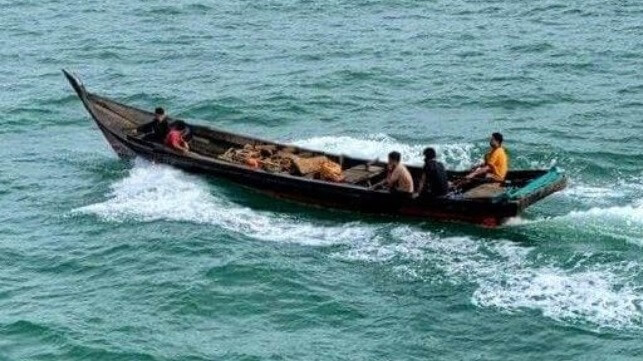
Suspected robbers under way in the Singapore Strait (Singapore IFC)

PUBLISHED OCT 1, 2023 10:22 AM BY THE MARITIME EXECUTIVE


By Jade Lindley and Dhiyaul Aulia Huda]

The Singapore Strait is experiencing a spike in maritime piracy attacks, with the incidence increasing from 12 attacks in 2019 to 38 in 2022, and an upwards trend continuing into 2023.

Southeast Asian waters are of geostrategic importance to global shipping routes, maritime trade, and networks of port hubs that are vital for state economics. The region’s archipelagic states, extensive coastlines, and congested chokepoints create ideal conditions for piracy.

What created the conditions for a surge in Singapore Strait piracy? Coinciding with the 2020–22 timeframe is of course the Covid-19 pandemic – a global health and economic crisis that triggered national restrictions affecting coastal and fishing communities in Southeast Asia. Further investigation into the link between the pandemic and increased piracy revealed heightened motivation to offend and decreased efforts to prevent attacks in known piracy hotspots.

Socio-economic pressures and poor economic conditions in coastal communities can motivate unemployed shipyard workers, seafarers and fishers into piracy. Similar to the 1997 Asian financial crisis and the 2008 global financial crisis, the Covid-19 pandemic included a shutdown of operations that caused a decrease in global trade and supply chain disruptions that led to Asia’s first regional economic contraction in decades. Among coastal communities, poverty, economic inequality, unemployment and commodity prices increased while households turned to crime, including piracy, to supplement their income.

Throughout the pandemic, the maritime sector was impacted by lockdowns, which increased financial vulnerability. The fishing sector experienced a decline in employment hours and decreased consumer demand. The economic welfare of fishers was damaged by decreased income opportunities due to fish market closures, including a decline in seafood exports by as much as 70 per cent during the early days of Covid-19. As such, approximately 2.7 million Indonesian fishers fell below the national poverty line.

Covid-19 also disrupted the operation of ports in Indonesia and Singapore, with governments adopting lockdown measures, travel restrictions and mandatory quarantine orders that reduced supply and restricted operations. Seafaring was particularly affected. The Seafarers Happiness Index for Q2 and Q3 of 2020 indicated that fatigue and financial woes impacted those both aboard vessels and ashore.

Why did the Singapore Strait experience a six-year high as a piracy hotspot in comparison to other parts of Southeast Asia, such as Indonesia? Our analysis found that the rise of piracy in the Singapore Strait can be attributed to three main causes. 

First, institutional capacity was weakened throughout Covid-19 due to the reallocation of resources from maritime security to healthcare and social security. This resulted in regional navies, coast guards and other maritime law enforcement agencies responsible for maritime security and surveillance operating with decreased funding, hampering regional maritime security efforts. Singapore reduced its defense budget in 2020, noting a 2.4 per cent reallocation of defense funds in part to deal with the pandemic.

Second, the Singapore Strait has a decentralized maritime security framework, as it is composed of the territorial waters of Singapore, Indonesia and Malaysia. The Singapore Strait’s maritime security architecture and surveillance, therefore, relies on cooperative mechanisms between the littoral states, which can result in sovereignty concerns and ambiguity over laws for the “right of hot pursuit”. Regime complexity in the governance of waters can result in regulatory gaps that hinder transnational approaches to combat piracy.

A final consideration is the geopolitical conditions that can result in the absence of capable guardianship. There was a decrease in maritime patrols in the Singapore Strait from December 2019, as the Indonesian navy was deployed to the South China Sea to advance Indonesia’s claim to the Natuna Sea against China’s assertions, creating an absence of maritime surveillance and increased opportunities for piracy in the Singapore Strait. Coastal surveillance was deprioritized as budget reallocations to combat Covid-19 resulted in decreased administrative capacity, causing weaknesses in law enforcement at sea. 

Examining Southeast Asia’s maritime piracy spike during Covid-19 helps shed light on how the pandemic contributed to piracy trends. Lessons learned can usefully inform future industry disruptions, such as supporting the livelihoods of fishing industry workers and maintaining capable guardianship to prevent future piracy surges.

This article is part of the ‘Blue Security’ project led by La Trobe Asia, University of Western Australia Defence and Security Institute, Griffith Asia Institute, UNSW Canberra and the Asia-Pacific Development, Diplomacy and Defence Dialogue (AP4D). Views expressed are solely of its author/s and not representative of the Maritime Exchange, the Australian Government, or any collaboration partner country government.

For more on the subject, see: Dhiyaul Aulia Huda and Jade Lindley, (2023) ‘The Impact of Covid-19 on Maritime Piracy in the Singapore Strait: A Routine Activity Theory Analysis’, Blue Security.

This article appears courtesy of The Lowy Interpreter and may be found in its original form here

The opinions expressed herein are the author's and not necessarily those of The Maritime Executive.

 

Australia Funds New Hydrogen Hub Project at Port Bonython

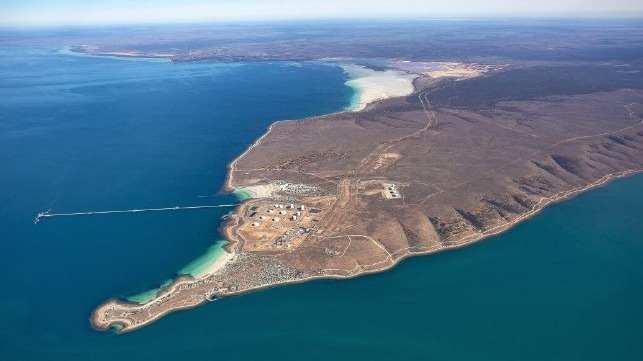
Port Bonython
Port Bonython (South Australian Government Financing Authority)

PUBLISHED SEP 27, 2023 2:53 PM BY THE MARITIME EXECUTIVE


The government of Australia and the state of South Australia have finalized a grant of US$64 million to fund the development of a hydrogen hub at Port Bonython, South Australia.

This hub could become Australia's first large-scale export terminal for hydrogen, and has the potential to draw on renewables and on natural gas for H2 supplies

“The global shift to clean energy and decarbonized economies is a huge economic opportunity for Australia,” said Prime Minister Anthony Albanese. “We are determined to grasp this opportunity and are investing half a billion dollars into regional hydrogen hubs all around Australia.” 

Port Bonython has an existing deep-water liquid fuel terminal, which could be used to facilitate large-scale exports of hydrogen, along with 1,700 hectares of developable land and world-class wind and solar resources. The plans to transform the current facility into a hydrogen hub include a 200 MW hydrogen power plant, an electrolyzer, and a storage facility. 

In addition to the grant, US$25 million will be contributed by the private sector. The redeveloped port hopes to host projects worth up to $8.3 billion and could generate as much as 1.8 million tonnes of hydrogen by 2030. 

The grant agreement comes after the South Australian government introduced a bill to streamline and coordinate development of hydrogen and renewable energy projects. The bill was designed to give investors confidence and to ensure that projects are implemented in a way that protects the environment, the interests of communities, landholders, and native title holders. 

Apart from Port Bonython, Australia is investing in future hydrogen hubs in Pilbara, Kwinana, Gladstone, Townsville, the Hunter Valley, Bell Bay, and Upper Spencer Gulf. 

Australia believes that the hydrogen industry will generate US$32 billion in economic activity and create over 16,000 jobs. “We’re working closely with industry to maximize this opportunity to grow a new industry, which has potential to create thousands of jobs and improve the standard of living for South Australians for generations to come,” said Peter Malinauskas, premier of South Australia.


Mercy Ships Announces New Volunteer Crew Partnership with Seapeak

This first official partnership between the ship-based healthcare charity and one of the world’s largest independent owner-operator of energy transport ships will shape and change the lives of the volunteers from the maritime sector while bringing hope an

Mercy Ships

PUBLISHED OCT 2, 2023 2:27 PM BY THE MARITIME EXECUTIVE


[By: Mercy Ships]

Seafarers from shipping company Seapeak have joined forces with Mercy Ships to give their employees the opportunity to share their skills with the international charity’s two hospital ships as they travel the world giving free, life-saving surgeries and medical care.

This, the first partnership between the healthcare charity and a ship owner, will give seafarers the opportunity to be part of the charitable community by volunteering their skills, something that is often difficult for seafarers based at sea.

Mercy Ships operates hospital ships that deliver free, safe surgeries and life-changing healthcare to women, men, and children in sub-Saharan Africa. An international faith-based charity, Mercy Ships has partnered with African nations and local organisations over the past three decades, to provide training to local healthcare professionals and support the construction of medical infrastructure.

Each year, more than 3,000 volunteers from over 60 countries serve on board the world’s two largest civilian hospital ships, the Africa Mercy, and the Global Mercy. Professionals ranging from medical to maritime officers, teachers to technicians, cooks to accountants and engineers to admin staff all dedicate their time and skills to run the ships as they accelerate access to safe surgical, obstetric, and anaesthetic care. One third of the crew are seafarers who operate the ship safely so that doctors can smoothly perform lifesaving and life-changing operations.

Together, Seapeak and Mercy Ships are working to select candidates from Seapeak’s amazing Talent Community of active seafarers to come onboard and serve with Mercy Ships as volunteer crew.

Joanne Balaam, Mercy Ships UK CEO, said: “Mercy Ships has had ship support in the past, but this new committed form of support is life-changing for us as a charity.

“With two ships, the Africa Mercy, and the Global Mercy, working in partnership with Africa to deliver free surgery and provide additional medical training, we need 3,000 skilled volunteers a year. Seafarers are critical members of our team, and we are delighted that this new partnership will give us access to Seapeak’s skilled team.” She said that the partnership would help many more patients like Ousseynou and Assane who developed identical conditions that made their legs curve outward at the knee. Their parents could find no way to help their children until they heard of Mercy Ships.

Chris McDade, Vice President of Operations at Seapeak said: “At Seapeak, we are thrilled to announce our meaningful partnership with Mercy Ships, a charity providing vital healthcare to developing nations. As a shipping company, we recognise the unique position we hold to offer tangible support by deploying our skilled and experienced seafarers to collaborate with Mercy Ships and contribute to their mission.

“Corporate Social Responsibility (CSR) efforts often tend to be shore-focused, but through our alliance with Mercy Ships, we are breaking barriers and extending the opportunity to give our valued seafarers an opportunity to give back. By actively engaging them in this noble cause, we empower our sea staff to make a profound difference by working hand-in-hand with Mercy Ships' dedicated team to deliver life-changing healthcare services.

“This partnership embodies our core values of compassion, solidarity, and commitment to social impact. Together, with Mercy Ships, we are paving a transformative path where maritime expertise converges with humanity, leaving a legacy of positive change in the regions we touch.”

The products and services herein described in this press release are not endorsed by The Maritime Executive.


ThPA S.A: First Underwater Cleaning at the Port of Thessaloniki

Port of Thessaloniki

PUBLISHED OCT 2, 2023 2:40 PM BY THE MARITIME EXECUTIVE


[By: Port of Thessaloniki]

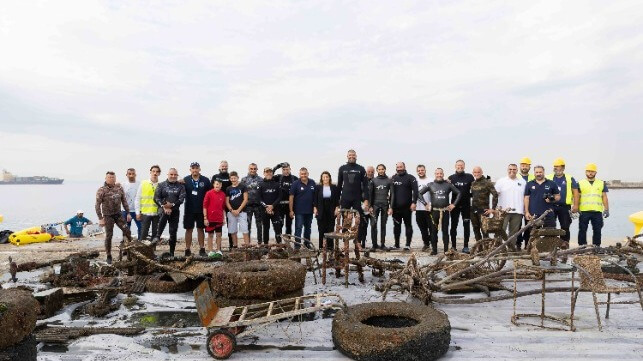
In the framework of its initiatives for the protection of the marine environment and the advancement of sustainable development, ThPA S.A. organized an Underwater Cleaning Action at the Port of Thessaloniki today. The action was implemented in cooperation with the Hellenic Marine Environment Protection Association (HELMEPA), Antipollution of V Group, Hellenic Environmental Center S.A. (HEC) and MEPP Environmental and under the auspices of the Region of Central Macedonia and the Municipality of Thessaloniki.

With the participation of 16 divers, the seabed around Pier 1 of the Port of Thessaloniki was cleaned of objects that have no place in the marine environment. The objects that were located were lifted by specialized divers, with the aim of subsequently recording, separating, and reusing or properly managing them.

At the same time, more than 250 high school students in Thessaloniki had the opportunity to experience an experiential educational journey and to be informed about significant issues concerning environmental and marine protection.

Among other things, the students observed up close and safely the process of cleaning and retrieving the findings. At the same time, they received information from HELMEPA and participating bodies on matters related to the protection of the marine ecosystem and sustainable development (circular economy, blue economy, etc.)

The Executive Chairman of the BoD of ThPA S.A., Thanos Liagkos, stated: "At ThPA S.A. we are proud of the underwater cleaning action implemented today at Pier 1 of the Port for the first time. The protection of the sea, as well as educating the public and raising awareness about this major challenge, is vital for the protection of the environment and the advancement of sustainable development. As a company, we are committed to integrating sustainable development practices across the whole range of our activities. In this direction, we continue to strive for reducing the environmental footprint of our operations, develop synergies and implement actions to protect the environment and the seas aiming to create added value for society. I would like to warmly thank the Region of Central Macedonia and the Municipality of Thessaloniki for endorsing this initiative through the provision of their auspices, all the participating bodies, the Secretary General of Shipping and Ports, Evangelos Kyriazopoulos and all the students who embraced the Underwater Cleaning Action."

The products and services herein described in this press release are not endorsed by The Maritime Executive.


McKee Administration Releases Plan Recommendations for Offshore Wind Jobs

Rhode Island Commerce
DETAILS ON the development of Rhode Island’s strategic plan to develop the state’s offshore wind supply chain were released Monday by Gov. Daniel J. Mckee’s office./ASSOCIATED PRESS / DAVID GOLDMAN

PUBLISHED OCT 2, 2023 6:01 PM BY THE MARITIME EXECUTIVE


[By: Rhode Island Commerce]

Building on more than a decade of leadership in the fast-growing offshore wind industry, the McKee Administration today released details on the development of Rhode Island’s strategic plan to further develop the state’s offshore wind supply chain. 

Prepared by Providence-based consulting firm OSWind Partners in conjunction with the Rhode Island Commerce Corporation (Commerce), Rhode Island’s “Strategic Plan for Offshore Wind Jobs and Investment” was developed following an extensive review of global industry demands and current and upcoming U.S. offshore wind projects, as well as an audit of Rhode Island’s existing offshore wind supply chain, physical assets, workforce development programs and more. The goal of this strategic plan is to integrate stakeholders at every level of the industry to create opportunities for Rhode Island companies and workers to significantly contribute on offshore wind projects in development along the east coast.  

“Rhode Island has proudly served at the forefront of this exciting, job-creating sector for more than a decade, and we have the tools, infrastructure, and workforce we need to build on this momentum in the future,” said Rhode Island Governor Dan McKee. “This strategic plan provides a path to amplify the deep Rhode Island offshore wind resources and coordinate groups across the state to provide industry solutions throughout the wind farm lifecycle.” 

The release of the early, core recommendations of this strategic plan comes as Rhode Island Energy, the state’s leading energy utility, prepares to issue a Request for Proposals to solicit approximately 1,200 megawatts of new offshore wind power to strengthen New England’s regional grid and help Rhode Island advance its clean energy goals.  

“Developing clean energy sources is of paramount importance, not only for environmental reasons, but for economic and social reasons as we work towards a more sustainable and prosperous future,” said Rhode Island Commerce Secretary Liz Tanner. “We look forward to continuing to work with our colleagues and partners across the offshore wind industry as we implement this strategic plan in a way that creates jobs and opportunities for Rhode Islanders.”    

The strategic plan includes six core recommendations: 

  1. Cluster Development: Aim to amplify the state’s industry strengths and create connections between locally based businesses, specifically targeting companies specializing in Permitting and Ocean Science, Logistics, Operations & Maintenance, and Precision Manufacturing.
  2. Education Awareness: Take proactive steps to engage local companies that have the capability and capacity to contribute to the offshore wind supply chain and connect them with opportunities up and down the east coast.
  3. Coordination: Ensure that all developers, manufacturers and top-tier offshore wind companies are aware of and can easily access Rhode Island’s assets, resources and talent as they embark on new projects and look for best in class solutions and partnerships.
  4. Opportunity Awareness System: Invest in a new, web-based portal through which contractors can easily find, evaluate and engage with Rhode Island companies to support project workflows at all phases of a wind farm life cycle.
  5. Regional Leadership: Work with neighboring states to share resources and best practices to create efficiency and cost savings as new projects are approved and constructed.
  6. Communications: Clearly communicate Rhode Island’s offshore wind strengths both internally and externally to build the state’s ecosystem and respond to the changing demands of the industry.  

An executive summary of Rhode Island’s Strategic Plan for Offshore Wind Jobs and Investment is available online by clicking here. Commerce is planning regular meetings with industry stakeholders with the goal of finalizing an implementation timeline in the coming months. 

The products and services herein described in this press release are not endorsed by The Maritime Executive.


Defects Delay Startup of Japan’s First Floating Offshore Wind Farm

Goto
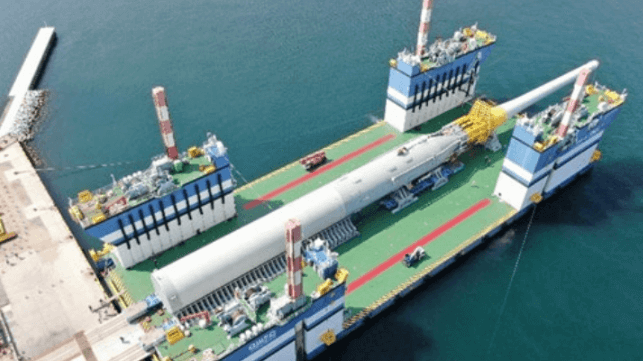
A spar for the Goto floating wind farm (Inpex)

PUBLISHED SEP 24, 2023 4:11 PM BY THE MARITIME EXECUTIVE


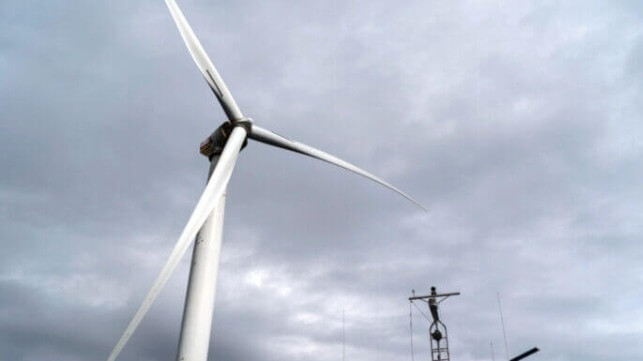
The Japanese consortium Goto Wind Farm LLC has temporarily delayed commissioning of the Goto offshore wind farm in Southwest Japan. The project is Japan’s first floating wind farm and was initially scheduled for January 2024.

However, discovery of defects in a floating structure has necessitated rescheduling for January 2026, according Toda Corporation, which is leading the project’s construction operations.

“An application was filed to revise the project’s public occupancy plan, which was approved by the national government (Ministry of Economy, Trade and Industry and Ministry of Land& Infrastructure) on September 22, 2023,” said Toda in a press statement.

Toda first discovered the defects back in May in two floating structures while under construction at an onshore yard. Subsequent investigations confirmed the structural problems and corrective measures are ongoing.

Additionally, Toda has also promised it will conduct inspections of a floating structure already installed off the coast of Sakiyama to verify the existence of defects. One of the three floating structures installed off the coast of Sakiyama will be landed on the yard in Fukue Port where the integrity of the floating structure will be verified. Based on the results, Toda plans to decide whether to inspect the remaining two floating structures.

Goto floating offshore wind farm is expected to have a 16.8 MW generation capacity. It will feature eight Hitachi 2.1 MW wind turbines installed on spar-type, three-point mooring floating foundations. (Norwegian oil company Equinor has transitioned away from a proprietary spar-type foundations in favor of a triangular platform design, which has less complexity.)

The Goto Floating Wind Farm LLC Consortium was awarded the tender for the project in June 2021. It happened during Japan’s first offshore wind auction since the country’s Renewable Sea Area Utilization Law came into power in 2019.

According to the Japan Wind Power Association, Japan has potential to generate around 90 GW of offshore wind energy. Most of this offshore wind capacity would have to come from floating wind farms, as Japan’s vast coastline is characterized by deep coastal waters.


New Floating Wind Platform Leverages Offshore O&G Construction Methods

Principle Power
Courtesy Principle Power

PUBLISHED SEP 27, 2023 6:51 PM BY THE MARITIME EXECUTIVE


The California-based offshore wind tech firm Principle Power has come up with a new design for a floating offshore wind platform, and this one draws more than ever before on the methods of the offshore oil and gas industry. 

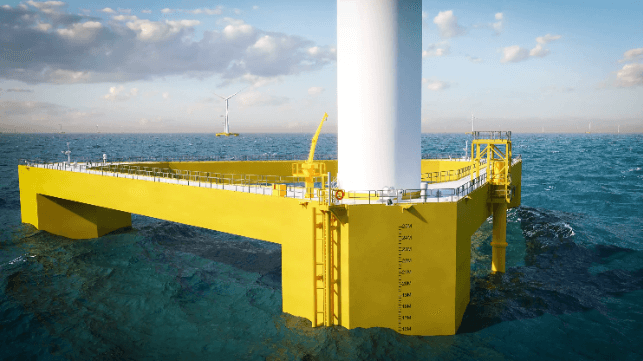
Most floating offshore wind systems have roughly the same layout: a triangular steel base with cylindrical sections at the corners, reinforced with diagonal steel pipe sections in between. Principle Power's initial designs were emblematic of this layout and have been installed at four sites around the world. But drawing on lessons-learned from these projects, Principle Power has redesigned its platform base for easier mass production and deployment.

The new "Windfloat F" design has pontoons and hexagonal columns, like a modern semisubmersible drill rig. It is built out of flat panel sections, which are easier to make on automated fabrication lines, and designed with block subcomponent construction in mind. This is within the capability of second-tier shipyards, and much of the fabrication can be done indoors, year-round. These construction methods are also familiar to offshore shipbuilders, who have used the same techniques for decades for building offshore oil and gas infrastructure. 

Operationally, the new design also has benefits during deployment. The pontoons add enough buoyancy that the columns can be designed with a smaller diameter, opening up different options for building, moving and assembling them. 

The design also reduces the water depth required alongside the pier during wind turbine integration. With pontoons, the Windfloat F only draws 30 feet when loaded, allowing developers to consider a broader range of seaports to support the initial construction and installation phase of the windfarm. 

"The new product portfolio, together with our industrialization strategy, is an entirely new way of thinking about efficiency and scale. It’s our vision for a planet powered by floating wind," said Aaron Smith, Chief Commercial Officer for Principle Power. 


Green Fuels in Shipping Face Major Challenges for 2050 Net Zero Target

green
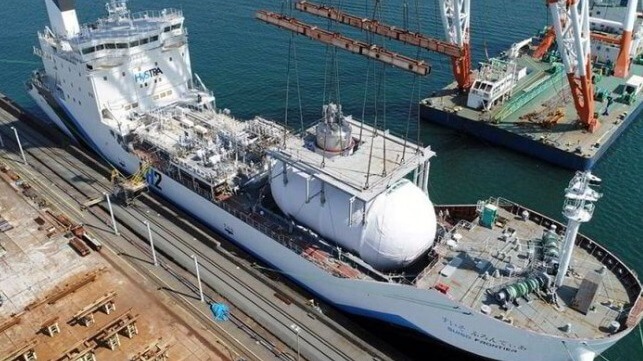
World's first and only liquid hydrogen carrier, Suiso Frontier (HYSTRA / Kawasaki)

PUBLISHED SEP 29, 2023 9:18 PM BY GOKCAY BALCI AND EBRU SURUCU-BALCI


Ships carry around 90% of traded goods and emit about 3% of global CO?. The International Maritime Organization (IMO), the UN agency responsible for regulating shipping, recently set out plans for this industry to reach net zero emissions by 2050.

Like their ancient forebears, modern vessels can be partially propelled by wind. Indeed, a British cargo ship recently took its maiden voyage using sails made from the same material as wind turbines.

This can reduce a ship’s lifetime emissions, but wind’s ability to power the global shipping fleet is limited by propeller systems, which only provide up to 30% of the energy vessels need to navigate – and even less in poor weather. Wind propellers might assist cargo ships but are unlikely to fully replace fuel engines. What the shipping industry needs is to swap oil for alternative green fuels.

The shipping industry faces great challenges in making this shift to fuels such as ammonia, hydrogen and methanol. While a few companies like Maersk have begun to test them, converting the entire industry will require ramping up renewable energy, creating new globe-spanning fuel distribution networks, overhauling regulatory frameworks and building ship engines that can burn green fuels.

Some of these steps are underway, yet much more remains to be done.

What makes shipping fuel green?

Green hydrogen is produced by splitting water into hydrogen and oxygen using electricity generated by wind, solar or other renewable sources. Green ammonia is formed by combining nitrogen from the air and green hydrogen through a process called Haber-Bosch.

Green methanol is either generated by heating plant or other organic waste to create a gas that can then be converted into bio-methanol, or by combining green hydrogen and captured CO? to make e-methanol.

When assessing how green a fuel really is, not only are the emissions created by burning it in the ship’s engine important, but also, the emissions from extracting, producing, transporting and storing it.

This lifecycle assessment of emissions is called “well-to-wake”. In the same way an electric car is not zero-carbon if its power is generated using fossil fuels, nor is a ship using ammonia or methanol produced by burning natural gas.

This assessment demands that the three fuels be generated using only renewable energy. That alone will require enormous investment. According to a study undertaken by the International Chamber of Shipping in 2022, the shipping industry will require up to 3,000 terawatt-hours (TWh) of renewable electricity a year, which almost equals the current global total of wind and solar electricity output (about 3,444 TWh).

This output must be ramped up as other industries, such as steel and cement, will also need zero-emission energy by 2050. In fact, up to US$1.9 trillion (£1.5 trillion) must be invested to fully decarbonise shipping, with over half of that needed to make green hydrogen, which is also essential for producing green methanol and ammonia.

Ships with compatible engines needed…

Vessels that run on oil and diesel cannot simply switch to burning green fuels. The world’s fleet of around 61,000 ships will need to be upgraded or replaced before 2050.

Retrofitting can allow existing vessels to run on methanol and ammonia, but it costs between US$5 million and US$15 million a ship depending on the fuel. Older vessels are likely to reach the end of their service before this investment is paid off and the onerous cost is the same even for smaller ships.

Ships capable of burning both methanol and methane are already being ordered by container shipping lines such as Maersk, Evergreen, CMA CGM and COSCO. Maersk has received its first dual-fuel vessel which burns green methanol and fuel oil, and sailed from South Korea to Denmark with cargo in August 2023.

The first ammonia-ready vessel, Kriti Future, is already sailing the ocean, though it isn’t burning ammonia yet. Vessels powered by hydrogen fuel cells lag behind the other two fuels, yet MSC cruises have ordered two hydrogen-ready vessels for 2028.

While these vessel orders inspire a sense of optimism about decarbonisation, they only account for a very small percentage of the global fleet.

…and so are safety regulations

A lack of safety regulations is partly responsible for the slow uptake of alternative fuels.

Although the International Energy Agency predicts green ammonia will be the most widely used fuel in 2050, shipping companies have placed more orders for vessels powered by methanol and methane. This is partly because the IMO has issued safety regulations for methanol as fuel, but not ammonia and hydrogen, which has cast doubt on their future among shipowners.

For green fuels to be widely adopted they must be at ports worldwide, but none are widely available. There are about 120 ports capable of storing and delivering methanol, but not enough green methanol. Where this fuel is available it’s often secured by private arrangements between a few large shipowners and methanol producers.

According to the Green Methanol Institute, about 0.7 million tonnes of green methanol could be produced globally by the end of 2023. Production capacity is projected to reach 8 million tonnes a year by 2027. But the global shipping industry requires 550 million tonnes by 2050 to replace oil.

There may not be enough farm and food waste to decarbonise all sectors of the global economy. And so the production of fuels from renewable electricity must increase.

Lots to build

Rolling out green fuels will also require building pipelines, storage tanks and port refuelling stations. Green hydrogen in particular, the key ingredient for other fuels, will need a large investment as it must be stored in special containers at around −253°C.

The shipping industry has not decided on its fuel of the future. But more than one is necessary considering the limited supply of renewable energy.

The good news is that decarbonising international shipping will benefit more than this vital industry by expediting renewable energy investments and helping sun-rich emerging economies flourish with the chance to make lots of cost-effective green hydrogen.

Gokcay Balci is Assistant Professor in Logistics and Supply Chain at University of Bradford.

Ebru Surucu-Balci is Assistant Professor in Circular Supply Chains at University of Bradford.

This article appears courtesy of The Conversation and may be found in its original form here

The Conversation

The opinions expressed herein are the author's and not necessarily those of The Maritime Executive.

 

Sri Lanka's Compensation for X-Press Pearl Disaster Rises to $8M

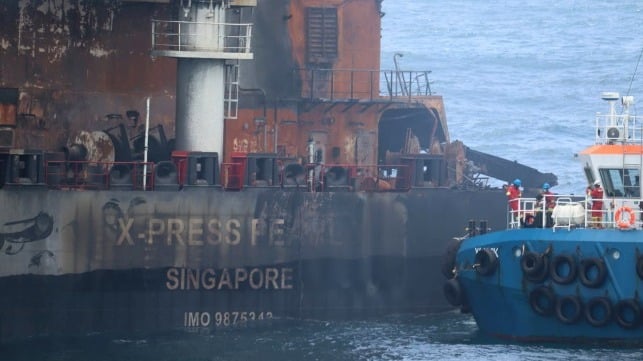
X-Press Pearl burned out off Colombo
Sri Lankan Navy file image

PUBLISHED OCT 1, 2023 11:49 PM BY THE MARITIME EXECUTIVE


Sri Lanka has confirmed receiving further compensation for pollution from the lost container ship X-Press Pearl, which burned and sunk off Colombo in 2021. Speaking to local media over the weekend, Sri Lankan Minister of Justice Wijeyadasa Rajapakshe said the interim payment made by the vessel’s insurers would help to cover beach cleanup activities and compensate fishermen affected by the disaster.

“Sri Lanka Treasury has received $890,000 and 16 million Sri Lankan rupees (around $49,200 dollars) as interim payment for costs incurred by the Maritime Environment Protection Authority (MEPA) and for the affected fisherfolks,” the Minister said.

Since the disaster happened, Sri Lanka has received payments totaling $7.85 million. Its government received the first payment of $3.6 million in July 2021. Another $1.75 million followed in January 2022, and a third payment of $2.5 million arrived in September.

Sri Lanka initially filed for a compensation claim of $40 million shortly after the vessel sank off Colombo in June 2021. However, a 40-member expert committee convened by MEPA put the price of the environmental disaster at $6.4 billion in an interim report early this year.

On April 25, Sri Lanka announced that it had formally filed legal action before Singapore’s International Commercial Courts (SICC) to claim compensation for the massive environmental damage. At the time of the disaster, X-Press Pearl was registered in Singapore and operated by the container line X-Press Feeders.

The choice of filing suit in Singapore was controversial, as a Singaporean court could limit the total liability of the shipowner to the value of the vessel, about $14 million. If the suit had been filed in Sri Lankan courts, national environmental-protection laws would have applied, and the potential damage claim could have been higher.

In July, a nine-member Sri Lankan delegation led by the Attorney General held meetings in Singapore with lawyers representing X-Press Pearl’s owners and insurers. The discussions centered on compensation claims and expedient removal of the fore section of the vessel’s wreck, which is still submerged offshore Sri Lanka.

X-Press Pearl was carrying 1,486 containers when it caught fire, with eighty-one of those containers labeled hazardous. Some of the cargo included nitric acid, which is blamed as a possible factor for the fire. Over 50 billion plastic pellets that were also onboard leaked, contributing to what has come to be known as the worst marine plastic pollution event in the world.


Salvage of Fire-Damaged Fremantle Highway Car Carrier Moves to Rotterdam

Fremantle Highway
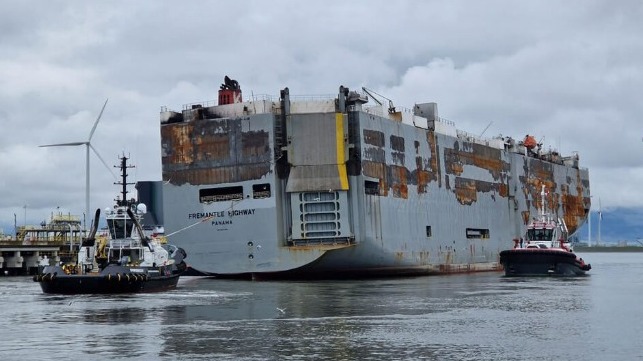
Fremantle Highway escorted by the tug En Avant 25 arriving in Rotterdam for the second phase of the salvage operation (MULLER Dordrecht photos)

PUBLISHED OCT 2, 2023 2:02 PM BY THE MARITIME EXECUTIVE


The next phase of the salvage operation for the fire-damaged car carrier Fremantle Highway is now underway. Regulators are continuing their investigation to determine the cause of the fire that destroyed or damaged as many as 2,800 vehicles and the top decks of the vessel while a plan for her salvage is also being prepared.

In a rather unusual move, KOOLE Contractors, an international industrial and maritime service company based in the Netherlands that specializes in industrial demolition, remediation, wreck removal, and maritime construction, has taken control of the Fremantle Highway. KOOLE also gained visibility recently as the company carried out the salvage and removal of the wreck of the OS 35 bulker that sunk off Gibraltar. They recently completed the transfer of the two sections of the wreck from Gibraltar to the Netherlands where it will undergo green recycling.

KOOLE reportedly made an agreement with the Japanese owners of the Fremantle Highway taking ownership and overseeing the second stage of the salvage efforts. They have formed a team that is carrying out structural inspections to determine which sections of the ship need to be removed and replaced due to the fire. Reports are that sections of the structure from decks 5 to 12 were weakened by the extreme heat of the fire but that the lower decks and machinery spaces were undamaged. 

As part of developing the plan for the Fremantle Highway, the team from KOOLE also plans to further inspect the tanks to determine what remains aboard the ship. Media reports from the Netherlands indicate that the teams are also surveying the remaining damaged vehicles and they expect to make a plan to continue to remove debris from the vessel. 


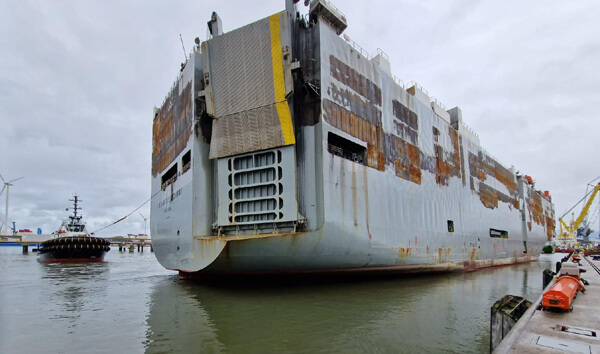
(MULLER Dordrecht photo)


After the hulk was towed into Eemshaven as a port of refuge as designated by the Ministry of Infrastructure and Water Management, SMIT and Multraship undertook the initial salvage operation. They removed as many as 1,000 undamaged cars from the lower decks as well as vehicles that had experienced fire damage but were structurally intact. Additional debris in the form of cars that melted into the upper decks remains aboard the ship. The companies reported at the beginning of September that they had handed the ship back to its owners.

Shoei Kisen Kaisha, a subsidiary of the Japanese shipyard Imabari, which built the ship in 2013, was the commercial manager of the Fremantle Highway. The ship was operated under charter by K-Line, while Wallem Shipmanagement was the technical manager. Under the agreement. KOOLE is preparing the salvage plan which will likely remove the damaged portions of the superstructure and prepare the ship for the next phase. KOOLE will handle the resale of the vessel with the new owners undertaking any reconstruction.

KOOLE has rented a dock from Damen Shiprepair in Rotterdam where the next phase of the survey work is underway. The vessel was towed from Eemshaven on September 21 by three tugs and arrived two days later in Rotterdam. The vessel needed to be moved from the pier in Eemshaven which has been rented as of mid-October to a cruise ship.

Teams from the Port of Rotterdam and DCMR Environmental Service Rijnmond, the environmental service of the province of South Holland and thirteen municipalities in the Rijnmond region, boarded the vessel to undertake an initial inspection after it reached Rotterdam. They have given environmental clearance and a plan is now being developed for the next phase of the salvage operation. KOOLE will submit its plans to the Dutch regulators for approval and media reports are that the vessel could enter a dry dock at Damen Shipyards Botlek in early October.