Tuesday, October 03, 2023

Why religious believers are so desperate for the atheist seal of approval


Greta Christina
September 14, 2023

If you hang around the online atheist world long enough, you'll notice an interesting pattern. Many religious and spiritual believers who engage with atheists seem very intent on getting atheists' approval for their beliefs.

Typically, these believers acknowledge that many religions are profoundly troubling. They share atheists' revulsion against religious hatreds and sectarian wars. They share our repugnance with religious fraud, the charlatans who abuse people's trust to swindle them out of money and sex and more. They share our disgust with willful religious ignorance, the flat denials of overwhelming scientific evidence that contradicts people's beliefs. They can totally see why many atheists are so incredulous, even outraged, about the world of religion.

But they think their religion is an exception. They think their religion is harmless, a kinder, gentler faith. They think their religion is philosophically consistent, supported by reason and evidence -- or at least, not flatly contradicted by it.

And they want atheists to agree.

They really, really want atheists to agree. They want atheists to say, "No, of course, your beliefs aren't like all those others -- those other beliefs are crazy, but yours make sense." Or they want atheists to say, "Wow, I hadn't heard that one before -- how fascinating and well thought-out!" Of course they understand why atheists object to all those other bad religions. They just don't understand why we object to theirs. They get very hurt when we object to theirs. And they will spend a significant amount of time and energy trying to persuade us to stop objecting.

Why?

Why do they care what atheists think?

I've been getting into these debates with religious believers for many years now. I've seen how they start out, and where they end up. I've seen many, many theists desperately try to get the Atheist Seal of Approval for their religion. And I've reached two conclusions about why they're doing it. They think atheists have higher standards than most believers, so our approval will mean more. And they don't want to think their religion has anything in common with those other sucky religions... and getting atheists' approval would let them keep on thinking that.

The Gold Standard

Believers seeking the Atheist Seal of Approval for their beliefs seem to see atheists as the gold standard. They know that most atheists have rejected religion for a reason: they know we take religion seriously, and that we've examined it carefully and thoughtfully before rejecting it. They know that we're more familiar with the tenets and traditions of religion than most believers: that we not only know more about religion in general than most believers do, but that we know more about specific religious beliefs than the people who actually adhere to those beliefs. They see that, as Julia Sweeney so eloquently put it, we take religion too seriously to believe in it. They see how passionately we value the truth -- and they respect that.

So if they can get us to give their religion a thumbs-up... that would really mean something. They understand that religious believers -- other believers, that is, not themselves of course -- often don't have very good reasons for their beliefs. They sincerely care about the truth, I think (this is definitely not the case for all believers, but it is for these folks), and they want to test their faith against the harshest critics they can think of. They want their cognitive dissonance resolved -- the tension between the religious faith they hold to be true, and the evidence and arguments showing that the case for their faith is crap -- and they understand enough about the communal reinforcement and other cognitive errors to know that Other People Who Already Agree With Them isn't the most rigorous way to resolve that dissonance. If they could get some atheists to tell them their belief is okay, that would resolve that annoying dissonance in a heartbeat.


And they seem genuinely surprised when this approval isn't forthcoming. It seems to have genuinely never occurred to them that, since atheists have carefully and thoughtfully examined religion before rejecting it, this examination probably includes their religion as well.

The Not-So-Special Snowflake


Which brings me to my second point:

Many believers don't want to acknowledge how ordinary their religion is.


They don't want to acknowledge everything that their religion has in common with every other religion. They feel the same revulsion and bafflement that atheists do at religious hatred and fraud and willful ignorance... and they don't want to be identified with it. They think their religion is a special snowflake -- and they really, really want atheists to recognize its beautiful and unique crystalline structure.

So when atheists say, "Nope, sorry, your snowflake looks like all the other snowflakes"... these believers get very upset. They get very upset when we point out the striking similarities between their religion and the hateful, fraudulent, willfully ignorant religions they so rightly reject. They get very upset when we point out that their beliefs are just as inconsistent with evidence, their arguments just as weak, their goalposts just as slippery, their assumptions just as unfalsifiable. They get very upset when we point out that we have, in fact, heard of their version of religion before, or at least ones very much like it. They get very upset when we say, "Yes, I've heard that argument before, about 100 times, I could refute it in my sleep, here's exactly why it doesn't hold up, in fact here are links to a dozen other atheist writers who have also pointed out exactly why it doesn't hold up."

And they get very upset indeed when we point out that their version of religion is far from harmless. They get very upset when we point out that their version of religion, just like every religion, encourages people to believe things for which there is no good evidence, ideas that by their very nature can have no reality check... and that this, by itself, does harm. They get very upset when we point out that disabling reality checks leaves people vulnerable to oppression, fraud, and abuse: that it armors beliefs against criticism, questioning, and self- correction, and thus armors them against anything that might stop them from spinning into extreme absurdity, extreme denial of reality... and extreme, grotesque immorality. And they get very upset when we argue that their kinder, gentler form of religion gives credibility to the harsher, uglier forms... by giving credibility to the idea that disabling our reality checks is not only acceptable, but a positive virtue, and that it's perfectly reasonable to believe things for no good reason, just because we want to.

They don't just get upset. They get hurt... and they blame atheists for their hurt feelings. They often get hostile... and lash out at atheists for the appalling intolerance of arguing that they're wrong. (In an argument that they sought out. I know. It doesn't make sense to me, either.) And they get intensely surprised. They come seeking approval for their religion from the very people who, by definition, are the least likely to give it... and they get genuinely surprised when that approval isn't forthcoming.


The Bad News


So if you're hoping for the Atheist Seal of Approval for your religious beliefs, I've got some bad news:

It isn't going to happen.

We think your religion is philosophically inconsistent. We think your religion is completely unsupported by either evidence or reason. And many of us -- probably most of us -- think your religion fucks people up.


I'll stop here for a Fairness Moment. Yes, most atheists understand that different religions are, you know, different. And I'm one of them. We get that some religions do more harm than others; that some religions are more out of touch with reality than others; that some religions are more grossly contradicted by hard evidence than others. (We understand, for instance, that theistic evolution, while having no good reason whatsoever to believe it and in fact being flatly contradicted by a mountain of evidence, isn't quite as outlandishly bonkers as young-earth creationism.)

Some of us -- and again, I'm among them -- will even say that, if the only religions in the world were the tolerant, ecumenical, moderate and progressive forms of religion, we wouldn't care all that much about it. We'd see it about the way we see urban legends about alligators in the sewers and whatnot: just another silly mistaken idea that some people are mysteriously attached to. We'd still disagree with it, we'd still argue against it if you asked our opinion... but we wouldn't be devoting time and energy to building a community of people who don't believe it, or to persuading people who do believe it out of their beliefs.

And, of course, we think you have the right to your beliefs. Absolutely, passionately, without question. We think your beliefs are full of beans... and if anyone tries to use force or violence or law to stop you from believing it, we'll sock them right in the jaw. Or at least vote to get them out of office.

But for majority of atheists, that's the most you're going to get out of us.

We don't believe in God.Any god. Not Pat Robertson's, not Osama bin Laden's -- and not yours. That's what it means to be an atheist. If we were impressed by your religion and thought it had real merit, we wouldn't be atheists anymore. Asking us which religion is the least harmful or the least out of touch with reality or the least contradicted by reason and evidence... it's like asking which of the Bee Gees is the least annoying. They're all annoying. And all religions are harmful, out of touch with reality, and contradicted by reason and evidence.

And... okay, this next bit is going to sound a bit harsh. But frankly, we don't think your religion is even all that interesting. We've seen it before. You may have an odd little twist on it that we're not familiar with, and we might be somewhat curious about it. But the apologetics and theodicies and defenses are all depressingly familiar. I've been blogging about atheism for many years now, and it's been a very long time indeed since I've seen a defense of religion that I've never seen before. (The Argument From Tigers was the last one. And it didn't exactly provoke serious searching of my non-existent soul. Mostly it provoked months of gut-blasting hilarity.)

In fact, in the years that I've been writing about atheism and debating with religious believers, I've actually become more confident in my atheism. I've become more confident because I see the same bad arguments for religion over and over and over again. And over. And over. And over yet again. Sometimes I think that if I see the argument from design one more time, or the God of the gaps, or "different ways of knowing," or "you can't disprove it with 100-percent certainty, therefore it's reasonable to believe it," or Pascal's freaking wager, I'm going to have an aneurysm. Whenever I see someone make an argument for religion, I still have moments of wondering, "Is this going to be the argument that convinces me?"... but those moments are becoming shorter and shorter every day, to the point where I'm measuring them in nanoseconds, and every day my hope that I'll see something surprising dwindles just a little bit more.

The Good News


Don't get me wrong. We can work with you as allies. We don't have to agree about everything to work together on issues we do agree on. We can work together on separation of church and state, stopping religiously inspired oppression and violence, etc. Many of us -- heck, probably most of us -- are even willing to temporarily set aside our differences while we work together on the stuff we have in common.

But if you ask us what we think of your religion... we're going to tell you. If you visit our blogs to see what we think of your religion... you're going to find out.

We think you're mistaken. And if you're honest, you need to acknowledge that you think we're mistaken. Yes, it's true, every time an atheist says, "I don't believe in God," we're implying that people who do believe in God are wrong. But every time you say that you do believe in God, you're implying that people who don't are wrong.

That's fine. You can think we're wrong, and we can think you're wrong. We can have that conversation, or we can put it on the back burner and talk about something else. We can be allies, friends, families, with people we disagree with.

But that's not going to work if that alliance or friendship depends on us giving you our seal of approval for beliefs we think are flatly mistaken.

After all -- you're not giving us yours.


PRIEST: Then in the short space you have left, profit from such timely remorse to ask that you be given general absolution of your sins, believing that only ...
FBI interviewed individuals who accuse Amy Coney Barrett faith group of abuse

Revealed: individuals contacted by agency gave detailed accounts of abusive behavior they allegedly experienced or witnessed


Stephanie Kirchgaessner in Washington
THE GUARDIAN
@skirchyTue 3 Oct 2023 

The FBI has interviewed several individuals who have alleged they were abused by members of the People of Praise (PoP), a secretive Christian sect that counts conservative supreme court justice Amy Coney Barrett as a lifelong member, according to sources familiar with the matter.

The individuals were contacted following a years-long effort by a group called PoP Survivors, who have called for the South Bend-based sect to be investigated for leaders’ handling of sexual abuse allegations. The body, which has 54 members, has alleged that abuse claims were routinely mishandled or covered up for decades in order to protect the close-knit faith group.

It is not clear whether the FBI has launched a formal investigation into the PoP.

The Guardian has confirmed that at least five individuals were contacted by the FBI and four gave detailed accounts to agents of abusive behavior they allegedly experienced or witnessed. Individuals spoke to the Guardian on the condition of anonymity and said they believed the FBI interviews were part of an initial inquiry.

One woman who was interviewed by agents from Minneapolis, Minnesota, said she received an update last week and was told by agents that the investigation into her own claims, which involved allegations of sexual abuse by a teacher, had been closed. The woman told the Guardian that news had left her disappointed and defeated, and full of “a lot of questions”, because the agents had seemed interested in pursuing the matter.

A spokesperson for PoP Survivors said: “We urge the FBI to use their power to unearth the long-standing pattern of child sexual abuse and coverup in the People of Praise. All perpetrators and their enablers must finally be held accountable. We must ensure that no child is victimized and silenced by a People of Praise member ever again.”

The FBI did not respond to a request for comment. A spokesperson for the PoP did not respond to a request for comment.

The PoP was founded in the 1970s as part of a Christian charismatic movement. The group is led exclusively by men. Like other charismatic communities, it blends Catholicism and Protestant Pentecostalism – its members are mostly Catholic but include some Protestants. In meetings, members are encouraged to share prophecies and speak in tongues. One former member said adherents believe God can speak through members to deliver messages, sometimes about their future.

A PoP handbook states that members are expected to be obedient to male authorities, or group heads, and are expected to give 5% of their earnings to the group. Heads are influential decision-makers in members’ lives, weighing in on issues ranging from dating to marriage, and determining where members should live.

After a waiting period, members agree to a covenant – a lifelong vow – to support each other “financially and materially and spiritually”.

The group has been criticized for endorsing discriminatory practices. Members who engage in gay sex are expelled, and private schools closely affiliated with the group – the Trinity Schools – have admission policies that in effect ban the children of gay parents from attending.

Single members are encouraged to live with other members of the community, including families with children, a practice that former members and adults who grew up in the sect say created opportunities for sexual abuse.

Justice Barrett’s membership in PoP was first widely publicized in a 2017 New York Times report, which noted that Barrett’s membership in the “tightly knit Christian group” never came up in a Senate hearing to confirm her as an appeals court judge.

In 2020, following Barrett’s nomination to the supreme court by then president Donald Trump, the Guardian and other media outlets delved deeper into PoP, including reports about how some former members, and some children who grew up in the group, had been abused by other members of the sect.

Some but not all members who have since been critical of the PoP believe it is a cult, given the amount of control the group exerts over people’s lives.

Barrett’s membership in the group was not raised in her confirmation hearing for the high court, but media outlets reported on her role as a handmaid and that PoP had erased all mentions and photos of Barrett from its website. The Guardian also reported that Barrett and her husband, Jesse Barrett, had lived together in the home of a key PoP founder, Kevin Ranaghan, before they were married.

It was around this time that a Facebook group of PoP survivors was established, as former members of the sect, and adults who had been raised in it, began sharing stories about their experiences of alleged abuse, and how those abuse claims were allegedly mishandled. Multiple members have said that PoP’s prominence in the news triggered their desire to share stories, but that they were not seeking to target Barrett in raising their experiences.

One member, Pete Smith, told the Guardian the survivor group first contacted the FBI in 2022 through a tip line, offering a list of witnesses to the group’s alleged “crimes”. Smith said members were confused about why the FBI had not responded to reports in the press that had begun to emerge about sexual assault and other claims that victims said were swept under the carpet.

Those media reports prompted PoP to hire lawyers at Quinn Emanuel Urquhart & Sullivan, who said they would investigate the claims. No report was ever publicly released.

The letter to the FBI, which was seen by the Guardian, alleged that PoP had engaged in a “widespread and ongoing conspiracy to cover-up the abuse of children within its families and the schools it operates”. It said members had experienced sexual abuse from non-family members of their household, from their parents, and teachers.

The letter also alleged that the PoP’s alleged culture of secrecy “in any matter that would embarrass” the group had contributed to alleged coverups, which included transferring offenders to other cities. The letter said members of the group were prepared to offer sworn testimony, documents, photographs and “our collective expertise”.

Smith said he solicited the help of his senators in Oregon, where he lives, when the FBI was not responsive. The FBI ultimately responded after Ron Wyden, a Democratic senator from Oregon, raised the matter on his constituent’s behalf. In a statement, a spokesperson for the senator said Wyden had contacted the FBI “not to advocate for any particular outcome, but to make sure they were aware of the claim”.

While some individuals have already come forward publicly with allegations of abuse, the Guardian interviewed one woman who grew up in a PoP household and spoke to the FBI last summer and has never shared her story publicly.

The woman, who declined to be named in order to protect her privacy, said she had been sexually and physically abused from age three to 16 by a male member of her family. When she came forward and told her mother about the abuse, the male member was forced to leave her home, but remained in the PoP community, including at one point being housed with another family that had a six-year-old child.

When her mother talked to leaders of the community, she was told it was best to not press charges.

“They were a big influence on her,” the woman said.

She later reported the abuse so that the name of her abuser was on record, though it was too late for her to press charges.

Moms for Liberty: ‘Joyful warriors’ or anti-government conspiracists?

Image via screengrab.

The Conversation
September 19, 2023

Motherhood language and symbolism have been part of every U.S. social movement, from the American Revolution to Prohibition and the fight against drunk drivers. Half of Americans are women, most become mothers, and many are conservative.

The U.S. is also a nation of organizing, so conservative moms – like all moms – often band together.

Lately, the mothers group dominating media attention is Moms for Liberty, self-described “joyful warriors … stok[ing] the fires of liberty” with the slogan “We Don’t Co-Parent with the Government.”

Others see them as well-organized, publicity-savvy anti-government conspiracists.

The rambunctious two-year-old group was founded in Brevard County, Florida, to resist COVID-19 mask mandates. It quickly expanded into the Southeast, now claiming 120,000 members in 285 chapters nationwide. Their mission is to “figh[t] for the survival of America by unifying, educating and empowering parents to defend their parental rights at all levels of government.”

By “parental rights” they mean limiting certain content in schools and having local councils and boards run only by “liberty-minded individuals” – which sounds like rhetoric from the American Revolution.

There’s historical precedent in this. Change the clothes and hairdos and these ladies could look like the conservative white women who opposed busing in 1970s Boston, supported McCarty anti-communism or blocked integration in Southern schools. Those women also formed mom-based groups to protest what they saw as government overreach into their families’ way of life.

But as a scholar of American politics with a focus on gender and race, I also see differences.

21st century conservatism


Moms for Liberty skillfully leverages social media, drawing on a population activated by the 2009-2010 rise of the Tea Party followed by the Trumpian MAGA movement. Mask mandates were the trigger for the group’s formation, but opposition to gender fluidity and queerness has become its bread and butter – more 21st century than 20th.

How racial equality is talked about animates its work also, in a distinctly new way. The conservative position on race and government’s role in the past century has pivoted from enforcement of segregation and hierarchy to a kind of social “laissez-faire” – hands off – position to match the Reaganite view that government is bad.

The extreme, hyper-male form of this anti-government, pro-traditional gender-roles ideology took shape as the Proud Boys, a number of whose leaders are now under indictment and sentence for their part in the Jan. 6 Capitol attacks. Moms for Liberty, while not going this far, shares similar beliefs and apparently has ties to the Proud Boys organization and leaders. They don’t march with guns, but their actions undermine and impede local government.

‘One minute you’re making peanut butter and jelly, and the next minute the FBI is calling you,’ said Moms for Liberty co-founder Tiffany Justice, testifying in the U.S. House of Representatives about government investigation of her group.

New kids in town making themselves heard

The group’s roots stretch back to a heated 2020 school board election in Brevard County. Incumbent school board member Tina Descovich, a local conservative activist mom, was challenged by progressive newcomer Jenifer Jenkins. When Jenkins won, the conservative board majority ended.

Having lost electorally, Descovich – and the corps of like-minded moms she now represents – began to shift the conversation from the outside. They joined with moms in many red states angered by what seemed fast-moving changes involving race, gender and sexuality, like the increasing numbers of people identifying as trans, queer or nonbinary, even at young ages, the vast changes in marital laws and family structure, and changing ideas about whiteness, inclusion and equity.

Moms for Liberty soon found success with disruptive tactics a VICE News investigation called a “pattern of harassment” of opponents that include online and in-person targeting of school board members, parents or even students who disagree with the group.

Members in many chapters generate ill will by turning up to school board and other meetings – sometimes to the homes of public officials or teachers – yelling insults like “pedophile” and “groomer” at opponents.

For a newcomer, Moms for Liberty has had real victories. It has disrupted countless meetings, forcing local governance bodies to focus on topics important to the group such as lifting mask mandates and, more recently, removing curricular content that they deem controversial, such as texts on gender identity and racial oppression.

The group’s success in getting talked about is perhaps its greatest strength so far, moving it from outside disruptor to political player, at least locally. It has successfully supported many local candidates and book bans.

Specific examples of banned books include “Push,” which inspired the award-winning movie “Precious,” and “Me, Earl, and the Dying Girl,” also made into a movie.

Disciplining members

Despite its many chapters, Moms for Liberty is untried nationally, its total membership is still relatively small, and Federal Election Commission filings show it raising and spending little money. The group lacks control over members, who have publicly embarrassed it. In one case, the Hamilton County, Indiana, chapter quoted Hitler in a newsletter – later apologizing.

At another point, an Arkansas member avoided criminal charges for saying, in a discussion about a librarian, “I’m telling you, if I had any mental issues, they would all be plowed down by a freaking gun right now.”

These incidents mark the group not only as green, but also as part of the new right wing. Republican-leaning groups used to take a top-down approach to setting agendas and managing people, while Democratic organizations historically cited democracy and equality as both tools and goals, even if it meant disorganization and failure.

In the traditional top-down Republican party of yesteryear, Moms for Liberty would likely be marginal. In today’s disorganized, divided, hyperpolarized GOP, it may do quite well – which is not good news for democracy.
Out of step, but useful


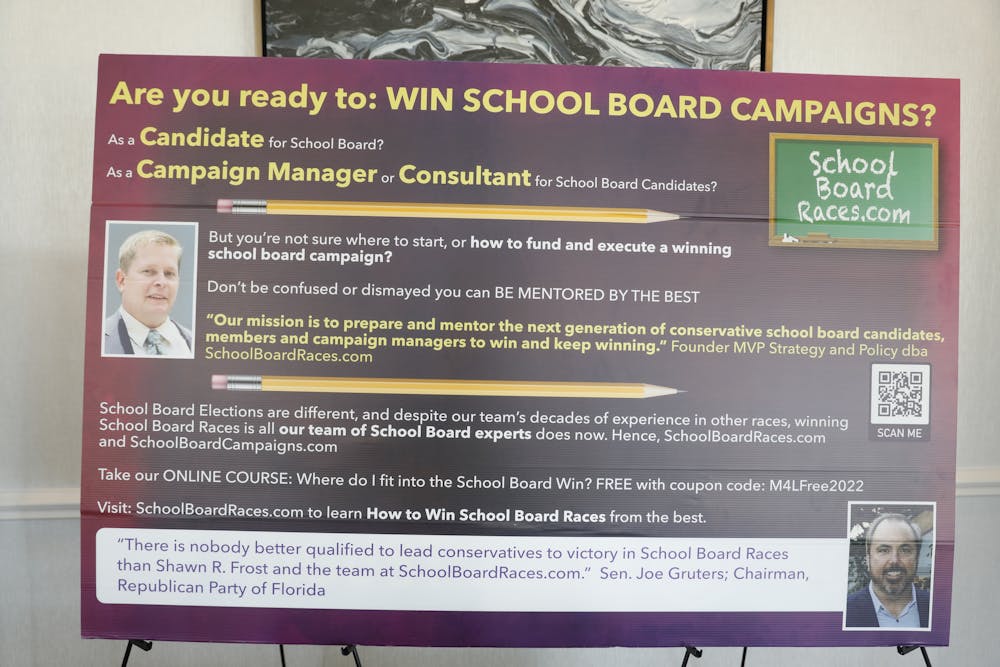
A poster helping those who want to run for a school board position is seen in the hallway during the inaugural Moms For Liberty Summit on July 15, 2022, in Tampa, Fla.
Octavio Jones/Getty Images)

Pro-mom language is sometimes, in the old idiom, the velvet glove hiding the iron fist.

The Southern Poverty Law Center, which tracks organized hate activity, labeled Moms for Liberty “extremist.” Its empirical evaluation concluded that the group’s chapters “reflect views and actions that are antigovernment and conspiracy propagandist.”

Moms for Liberty is ideologically out of step with the country and more anti-government than most Republicans. The majority of Americans are not in support of lifting mask mandates in the middle of a pandemic or banning books.

Among Republicans, there is disagreement over the teaching of controversial topics like racial justice, but book bans find low support. Despite the current bitter political climate, most in the U.S. appreciate government and want it to work.

Yet, some media refer to Moms for Liberty as a “power player” – and no wonder, when Donald Trump and Ron DeSantis show up to court the group. Moms for Liberty may be fringe, but its members could be of use to presidential hopefuls.

Why? The answer lies in some distinctly post-2010 electoral math. These days, only a quarter to a third of voters align with each major party, and less than a third of registered partisans turn out for primaries.

So a sixth of each party – a small fraction of the overall population – now selects the nominees. And that sixth is not representative – it is far more opinionated and angry. Moms for Liberty, having organized small, ideological voting armies in swing states, is in the envious position of representing a concentrated and potentially decisive voting bloc.

The mom rhetoric may be real, but as a political scientist, I can say confidently that the framers of the Constitution would not endorse this brand of liberty. Book bans are weapons of autocrats, and democracy ends where political figures call each other “pedophiles” in public.

Shauna Shames, Associate Professor of Political Science, Rutgers University

This article is republished from The Conversation under a Creative Commons license. Read the original article.
Here's why the Mormon Church distanced itself from anti-trafficking activist Tim Ballard

Tim Ballard in Palm Beach, Florida in July 2023 (Gage Skidmore)


September 19, 2023

In July, Operation Underground Railroad (OUR) founder Tim Ballard left his position as the anti-sex trafficking group's CEO following allegations of sexual misconduct.

Now, according to Religion New Service reporter Jana Riess, the Church of Jesus Christ of Latter-Day Saints (or Mormon Church) is now distancing himself from Ballard.

During a weekend visit to Boston, Ballard denied that the LDS is doing that — telling supporters, "I don't believe the Church did this. I really don't."

Riess, however, reports that "as the story unfolded, we got a glimpse of why the Church may have wanted to distance itself from Ballard."

"According to reports in Vice.com," Riess explains, "Ballard has been accused of sexual misconduct with at least seven different women."

Anna Merlen and Tim Marchman of Vice reported, "Sources familiar with the situation said that the self-styled anti-slavery activist, who appears to be preparing for a Senate run, invited women to act as his 'wife' on undercover overseas missions ostensibly aimed at rescuing victims of sex trafficking. He would then allegedly coerce those women into sharing a bed or showering together, claiming that it was necessary to fool traffickers."
This Christian text you’ve never heard of barely mentions Jesus − but it was a favorite of early Christians

Photo by Andrea Lightfoot on Unsplash
herd of sheep on green grass field during daytime


September 30, 2023

People usually think about the Bible as a book with a fixed number of texts within its pages: 24 books in the Jewish version of the Bible; 66 for Protestants; 73 for Catholics; 81 if you’re Ethiopian Orthodox.

Writings that didn’t make it into the Bible, on the other hand, are often called “apocrypha,” a Greek term that refers to hidden or secret things. There are hundreds of apocryphal Jewish and Christian texts that, for one reason or another, were not included in different versions of the Bible. Some simply fell out of use. Some caused theological headaches for later Jews or Christians, and some were rejected because of their author – for supposedly not having really been written by an apostle, for instance. (When used with a capital “A,” Apocrypha refers to a handful of books included in the Catholic and Orthodox versions of the Old Testament, but not most Protestant ones.

Just because a text was deemed apocryphal, however, does not mean that it was unpopular or lacked influence. Many texts that are treated as unimportant or unbiblical today were considered central at one time. As a scholar of early Christianity, some of my research centers on what was once an extremely well-read text, but one that most people today have never heard of: The Shepherd of Hermas.
Enslaved to God

The Shepherd of Hermas was written sometime between 70–140 C.E. and takes place on the road between Rome and Naples. Hermas, who is presented as the text’s author and narrator, has various encounters with two divine figures called the Church and the Shepherd, who give him commandments and visions that he is instructed to share with other believers.

The Shepherd is a sizable text – 114 chapters long – and substantial portions describe a vision of a tower under construction. The tower represents the church itself, in the sense of all Jesus’ followers, built out of stones that represent different types of believers. Some fit right in, others must be reshaped or recolored, and some are rejected altogether. For example, stones representing rich people or businessmen are urged to repent, while hospitable people are portrayed as properly shaped.


Christian art, like this Coptic piece from the third century, has long used the metaphor of the shepherd to describe Jesus and spiritual care.
CM Dixon/Heritage Images/Getty Images

Other parts of the text are focused on how believers should manage their emotions, how to act ethically in the world and how to obey God’s will. The Shepherd urges self-control and fear of God, trying to instill obedience and avoid allowing emotions like fear or doubt to overcome believers.

My own research on the Shepherd focuses on how the text depicts believers as enslaved to God, as is true of some other early Christian literature as well. The writer imagines that God’s holy spirit is able to enter loyal believers’ bodies and possess them, urging them to do what God wills.

Notably, figures like Jesus and the apostles are virtually absent from the Shepherd. Instead, readers find a story about an otherwise unknown enslaved man named Hermas experiencing visions and talking with divine beings in the Italian countryside. Hermas is portrayed as a believer who doubts his own ability to accomplish what these two divine figures, the Church and Shepherd, expect of him, lamenting throughout how difficult it is to follow God’s commandments.

‘Useful for the soul’

Given that the Shepherd is a long, rambling text that doesn’t explicitly mention Jesus, you might assume that it was only read by a small number of early Christian theologians. This, however, isn’t the case.

The Shepherd became one of the most popular texts among Christians for the first five centuries C.E. Even today, there are more surviving manuscripts of the Shepherd from antiquity than of any New Testament text except for the Gospels of Matthew and John.

The visions were translated from Greek into Latin, Coptic, Ethiopic, Arabic and Georgian. Eventually, the text spread as far west as Ireland and as far east as China.

The Shepherd is even included in what scholars consider one of the oldest and most complete Bibles in the world. Canonical Christian Bibles today end with Revelation, a dramatic book of apocalyptic visions. The Codex Sinaiticus, however, a fourth- or fifth-century manuscript now held at the British Library, ends with the Shepherd. The text’s inclusion in such an expensive, deluxe codex highlights how important the text was to many Christians, even as the contents of the New Testament were being solidified.


Pages of the Codex Sinaiticus, the world’s oldest surviving Christian Bible, shown on a laptop in Westminster Cathedral, London, in 2009.
Leon Neal/AFP via Getty Images

Many significant Christian writers from the fourth and fifth centuries comment on how the Shepherd is important instruction for new Christians, regardless of whether it was considered part of the formal Bible.

Even figures who did not include the Shepherd among New Testament texts thought it was too important to be discarded. The book was too important to ignore, but too odd to be considered biblical: part of a halfway category that biblical scholar François Bovon called “useful for the soul.”

An open Bible


As the Shepherd helps demonstrate, whether a religious text is included or excluded from the Bible is not necessarily an indicator of its popularity or significance.

While scholars often lament that the Shepherd is boring, pedantic or too long, its style likely made it ideal teaching material for early Christians. Esoteric texts that required deeper philosophical knowledge, like the Gospel of Truth or Gospel of Judas, may have been ideal for some Christians who had access to more education. But texts that make bite-sized claims – like “don’t think about another man’s wife” (Shepherd 29:1), “rid yourself of grief” (Shepherd 40:1), or “believe that God is one” (Shepherd 26:1) – are easier for readers to carry with them and apply to everyday decisions in their lives.

The word “canon,” referring to texts that get a seal of approval from authorities, comes from a Greek word for a measuring stick: which books “measure up”? In religious communities, the idea of “canonical texts” can be especially limiting, determining what believers can or can’t read or believe.

Apocryphal literature, however, allows us to see how that wasn’t always the case: Ancient Christians didn’t think they were bound to the same specific set of stories that churches focus on today. The long history of reading apocrypha shows how some Christians have always been interested in reading the “Bible with the back cover torn off” – continually exploring religious ideas.

Chance Bonar, Postdoctoral Fellow, Center for the Humanities, Tufts University

This article is republished from The Conversation under a Creative Commons license. Read the original article.
A literal witch hunt: Kansas prisons censor mail from this Topeka ministry

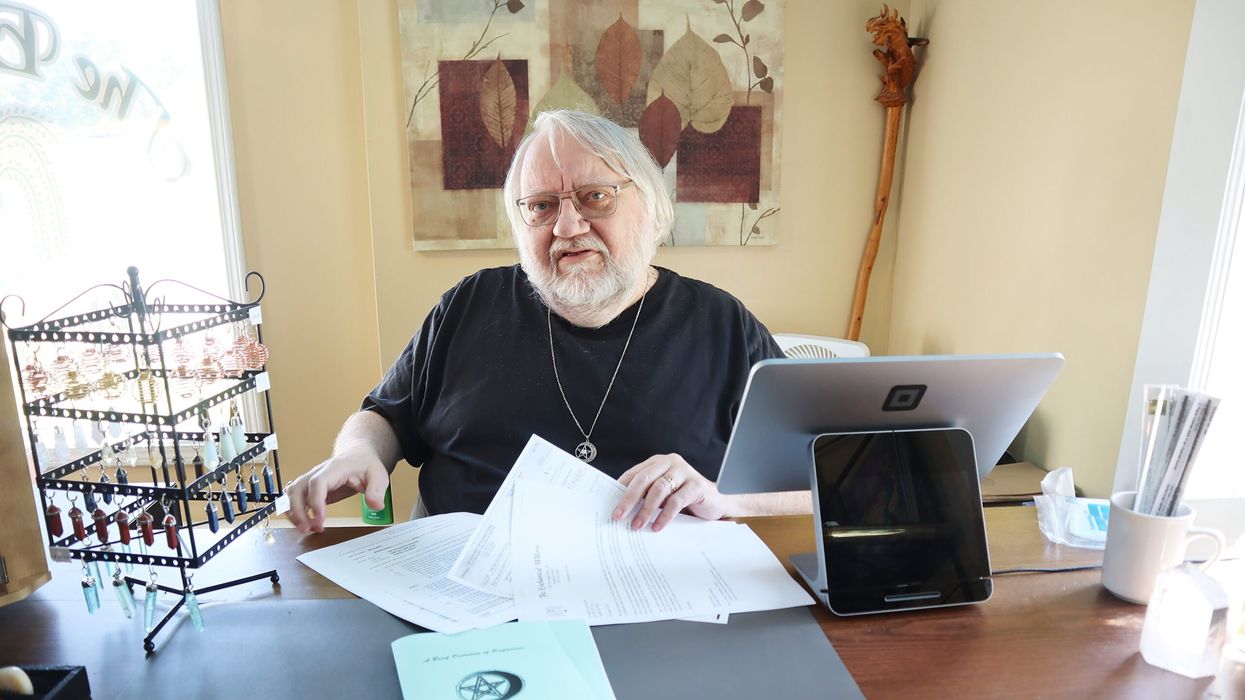
Robert Miller, in September 2023, with some of the correspondence from the Kansas Department of Corrections notifying him that mail from he and his Wiccan ministry have been banned from state prisons. 
(Max McCoy/Kansas Reflector)
October 01, 2023

When Robert Miller’s mail started coming back as censored by prisons across Kansas, he was confused. For 20 years, Miller had been operating a mail-order prison ministry providing letters of support, religious tracts, and sacred objects to inmates not just in Kansas, but in various prisons across the United States. Never once had any of his letters or pamphlets or other material been barred.

But this summer, Miller began receiving notices from the Kansas Department of Corrections that his mail to its facilities was being censored. The first notices didn’t specify a reason for the censorship and Miller was concerned for the emotional and spiritual welfare of the 47 inmates taking his ministry’s correspondence classes in eight facilities across the state. After protesting the censorship, Miller was eventually told he and his ministry were considered a “threat to institutional safety, order or security.”

What?


This is the kind of move by the state that would ordinarily result in much fist-pounding at the Statehouse. A prison ministry being barred? Just imagine the spittle that would fly if the Central Kansas Prison Ministry, which according to its website is dedicated to “bringing the gospel of Christ inside prison walls,” were banned. Those rushing to condemn such a move would be legion.

But the KDOC was crafty in betting there wouldn’t be much of an outcry in banning Miller’s ministry. Because, you see, Miller’s ministry is no mainstream evangelical operation. Miller is a pagan, a follower of Wicca, and his ministry is Moonshadow Coven, a registered Kansas nonprofit.

“It feels like KDOC has declared war on me and on our religious organization,” Miller wrote in a plea for help to Kansas Reflector. “We have been stonewalled and our students have been cut off with no explanation. “We feel religious freedom is meant for all religions (but) apparently this is not the case with KDOC. As a religious advisor, it seems basic constitutional rights are being trampled on.”

A spokesman for the KDOC disputed the claim of religious discrimination.

“The residents of Kansas Correctional Facilities have a Constitutional right to practice the religion of their choice,” Randall Bowman, executive director of public affairs, told me in an email. “The (KDOC) makes every effort to support residents’ rights to practice their religion. The safety and security steps implemented by the KDOC regarding this organization do not infringe upon that right.”

Bowman declined to elaborate.

But Kansans are owed a fuller explanation than the three-sentence boilerplate offered by the KDOC. In an era when too many Kansans draw no distinction between unconventional beliefs and unadulterated evil, it’s necessary for a democracy to protect those voices in danger of being silenced. It’s also important that we don’t revisit the “satanic panic” of the 1980s, when baseless conspiracy theories about child-murdering cults swept the country.

‘We don’t believe in Satan’

Miller wants you to know that Wicca isn’t about worshiping Satan, celebrating evil, or encouraging violence or sexual misbehavior.

“It’s based on the natural world,” he said. “We follow the seasons and we revere God in duality as god and goddess. We don’t believe in Satan at all. We believe that people do occasionally make mistakes and do stupid or bad things. And that’s why we have religion to try and point people in the right direction.”

The people in prison that Miller corresponds with have often done horrible things that have put them there — especially violent crimes like murder and rape. He says he attempts to separate those actions from an individual’s capacity for growth, and he often writes encouraging letters to inmates to let them know somebody cares and that they have a chance to become better people.

He also says some inmates may be more drawn to Wicca than traditional Abrahamic religions because it is more accepting of relationship choices. Instead of lists that condemn certain behaviors, such as same-sex relationships, he said, Wicca urges an acceptance of the self.

“Our one commandment is ‘do what you will,’ which means we can do anything we want,” he said, “as long as it doesn’t harm another person or ourselves or the environment around us.”

Wood runes and an altar cloth


The right of a prisoner to send and receive mail is protected by the First Amendment. But the Supreme Court narrowed that protection in 1987’s Turner v. Safley, a decision that provided prison officials greater latitude in deciding where the line is between institutional safety and an inmate’s constitutional rights.

That latitude included the ability to restrict inmate mail in the interest of security.

The trouble with Moonshadow began after Kansas prisons went to a system that prevents inmates (or “residents”) from receiving physical mail at all. Kansas is among at least 14 states that has adopted a policy in which mail is scanned and then digital or printed copies are given to recipients. The only exception to this is “legal mail,” which is from an inmate’s attorney or the courts, and must generally be delivered unread and uncopied. But for all other correspondence — from family members, friends, ministers and strangers — the mail is read and digitized.

Prison officials claim the move is necessary to stem the flow of contraband into prisons via drug-infused paper. After a trial program at Ellsworth Correctional Facility, the state earmarked $1.1 million this year to expand mail scanning system-wide.

Critics, however, say that poorly scanned mail results in unreadable letters and poorly reproduced photographs and artwork. Because the price of postage is relatively cheap, the mail is a way many incarcerated people rely on to communicate with loved ones on the outside.

Miller said he became concerned that some of Moonshadow Coven’s instructional material was being photocopied before being passed along to inmates. Believing this was a violation of copyright, the coven protested to the KDOC. An official responded in a June 15 letter: “We do not believe you have a registered and enforceable copyright.” The best way to honor the coven’s request that photocopying not occur, the official said, was to “discontinue allowing this mail into the facility.”

After this, the notices came that personal letters from Miller and others were being censored. In addition, all merchandise from the shop Miller co-owns, the Enchanted Willow in Topeka, was barred — including items that had already been paid for by inmates.

At the shop, located in a modest building on S.W. Gage Boulevard, Miller showed me a sales receipt for $52.27 for merchandise that had been ordered by a woman at a Kansas prison. The items requested were wood runes and a velvet altar cloth. Miller has been unable to contact the woman to tell her why she hasn’t received the items.

“Some of the material (we sell) may not be appropriate for prison practice,” Miller said. “For example, we have one unit on tools and garb. We talk about some of the tools we use, such as candles and athamé, which is essentially a religious dagger. And we understand that those items are not anything that a prisoner would ever be allowed to have.”

Miller said Wicca is a religion of symbolism.


“So one thing represents another,” he said. “If you aren’t allowed to have something, you don’t really need it. You can use something else. Instead of a dagger, you can use a pencil. It’s only used to direct energy.”

‘Asking the higher power’


While the KDOC is unequivocal in its claim that Moonshadow Coven is not the target of religious discrimination, one Topeka woman is not so sure.

Kathy Slawson is a Christian and a longtime friend of Miller’s who attempted to write inmates on his behalf to provide reassurance they hadn’t been forgotten. Slawson’s correspondence was censored as well, for the same reason — she represented a threat to the institution because of her association with Miller.

“It really is a form of religious persecution,” she said. “There’s nothing else that makes any sense. I mean, he’s very good about following the rules and, and only sending and saying what he’s supposed to. He doesn’t want to be inappropriate. He’s got 70 to 80 people he writes to, and it’s their connection to the outside world.”

Slawson believes the problem is a misunderstanding of Wicca.

“People call Wiccans lovers of Satan, or worshipers,” she said, “so when somebody says something like that in front of me, I have to step in and correct that.” Many people, she said, have the sense that only “their Christianity” is legitimate.

“The people I know who are Wiccan probably are more Christian than a lot of the people I know who claim to be Christians,” she said.

Slawson has known Miller for decades and said there was nothing in his background to cause Kansas prisons to flag him as a threat. She learned about the censorship, she said, when Miller told her about it over one of their weekly breakfasts, and she volunteered to write inmates on his behalf.

Slawson said while she is not a Wiccan, she does understand its power.

“I believe in magic as much as I believe in prayer,” she said. “Because when (Miller) does magic, it’s just like a prayer service, with candles and things. But it’s asking the higher power, the higher beings, to help with the situation.”

If anybody deserves spiritual hope — whether from prayer or wooden runes — it’s the persons incarcerated in our prisons. Not only does the U.S. have the highest prison population rate in the world, each state incarcerates more people per capita than any other democracy, according to the Prison Policy Initiative. Kansas had 8,449 individuals in the state’s correction facilities in 2022, according to data from the KDOC.

That’s a lot of people in need of comfort.

“I want to thank you and your coven for reaching out to some of us that are, or were, lost and could not find a positive outlook,” one prisoner wrote Miller, in a letter he shared with me. “Thank you from the bottom of my heart for showing a better way to achieve inner peace.”

Kansas Reflector is part of States Newsroom, a network of news bureaus supported by grants and a coalition of donors as a 501c(3) public charity. Kansas Reflector maintains editorial independence. 

Contact Editor Sherman Smith for questions: info@kansasreflector.com. Follow Kansas Reflector on Facebook and Twitter.


FOREVER CHEMICALS
Dangerous chemicals found in South Carolina’s fish, crabs and oysters. Here’s what we know

2023/09/28
Oyster Landing, a part of Huntington Beach State Park gives visitors direct access to the Murrells Inlet marsh and is a popular place for fishing, crabbing and viewing wildlife. - Jason Lee/The Sun News/TNS

Chemicals that can make people sick have recently been found in fish, crabs and oysters in South Carolina as concerns grow about the threat the toxins pose to food and water across the Palmetto State.

The S.C. Department of Health and Environmental Control documented the pollutants, known as forever chemicals, in freshwater fish caught in 18 waterways from the foothills to the coast. In some cases, the pollutants were found at high levels, state data show.

All told, more than a dozen species contained forever chemicals, and many fish tested came from some of South Carolina’s most popular spots for fishing, including Lake Greenwood, the Great Pee Dee River, Lake Marion and the Wateree River, DHEC data show.

Fish with forever chemical contamination included largemouth bass, bluegill, channel catfish and black crappie, species traditionally eaten by recreational anglers and subsistence fishermen.

A little known threat for decades, forever chemicals have become a major concern in recent years as health care researchers, environmentalists and others have learned about the dangers.

In July, The State reported on hazards created by forever chemical-tainted sludge that unsuspecting farmers spread on their land in South Carolina. In August, state Attorney General Alan Wilson sued the manufacturers of forever chemicals.

DHEC’s recent testing of fish, which follows the finding of forever chemicals in rivers and drinking water, showed that one type of chemical — PFOS — was the most predominant showing up in fish tissue.

Agency tests generally found lower amounts of PFOS and other forever chemicals in blue crabs and oysters.

DHEC, which is charged with protecting public health in South Carolina, said it does not plan to issue warnings about forever chemicals in fish, oysters and crabs, even though some states have done so.

Recent DHEC testing in South Carolina was limited and not complete enough to justify issuing warnings, the agency said in an email to The State. The agency, which plans additional fish testing, also needs guidance from the federal government, the email said.

When asked if fish are safe to eat, agency officials said the levels of forever chemicals in fish “don’t appear to be high enough to substantially affect most people’s overall’’ exposure to forever chemicals.

But the department did not elaborate on how it reached that conclusion, and its position appears to be in contrast to recent studies.

In an analysis of federal fish testing data earlier this year, the Environmental Working Group concluded that eating fish with forever chemical pollution could be substantially more toxic to people than drinking water polluted by the chemicals. The Environmental Working group is a national environmental organization that has been doing research on forever chemicals across the country.

“There’s a need to get this information out,’’ the group’s David Andrews said of fish test results, explaining that many states have been slow to issue advisories for forever chemicals in fish.

“Many places do need fish advisories. A few states have done specific advisories, but in the scope of the country, it has been relatively limited. States have been kind of hesitant to take the lead and provide public health guidance. And I think that is a lost opportunity.’’

Hidden dangers

In addition to the Environmental Working Group study, a team of scientists concluded in 2019 that warnings might be needed after finding that certain fish from the Charleston area contained potentially harmful levels of forever chemicals.

PFOS levels in some fish filets exceeded cancer risk levels, the researchers said. Their study was headed by a Medical University of South Carolina scientist. The report said consumption advisories “should be considered as a prudent public health measure’’ while additional research was underway.

Forever chemicals, known formally as per and polyfluoroalkyl substances, or PFAS, are tied to an array of health problems in people exposed over time. Increased chances of kidney cancer and breast cancer are among the health threats, as are high blood pressure, suppressed immune systems and thyroid disease. The main pathways for exposure are food and water.

Thousands of per and polyfluoroalkyl substances have been used worldwide since the first were developed in the 1940s. They help prevent sticking in frying pans, repel water from clothing and limit stains on carpets. They have also proven effective as an ingredient in firefighting foam. They are called forever chemicals because they do not break down easily.

For years, 3M and DuPont, the main manufacturers and distributors of these chemicals, did not tell the public about the hazards of forever chemicals, despite in-house studies that showed their toxicity. That has sparked a flurry of lawsuits nationally, including legal action by Attorney General Wilson.

Health regulators are now being pushed to find out what sources are releasing the chemicals and to stop the discharges. That won’t help fish now contaminated by PFOS or other forever chemicals, but over time, it could make a difference, environmentalists say.

Carl Brzorad, an attorney with the Southern Environmental Law Center, said DHEC’s recent findings of PFOS in fish is reason for worry.

Brzorad said he’s wary of eating fish from certain rivers where forever chemicals have been documented until more is known. Fish have traditionally been viewed as a healthy alternative to eating red meat.

One river he’s seen firsthand that has drawn his concern is the Pocotaligo near Manning, he said. Brzorad works on forever chemical issues for the non-profit legal group.

“What we know is not good,’’ he said. “We expect DHEC to figure out where this stuff is coming from and do something to address it.’’
Where is it coming from?

At this point, nobody knows for sure where the forever chemical pollution in fish originated. DHEC has previously said farm fields fertilized with sewer sludge, industries, wastewater plants and military bases are potential sources.

The release of the fish, oyster and crab data is the result of a comprehensive department program to check for forever chemicals in the environment during the past three years.

Previous studies have identified forever-chemical contamination in virtually every river tested across South Carolina and in dozens of drinking water plants. In many cases, the contamination levels are higher than a proposed federal safe drinking water standard.

But recent tests show that PFOS levels in fish were often noticeably higher than the amounts found by DHEC in rivers or drinking water systems.

The highest PFOS level documented in South Carolina fish exceeded 700,000 parts per trillion, agency data show.

The highest levels DHEC documented in South Carolina rivers last year were only a fraction of that, records show. Drinking water levels were lower, although many slightly exceeded the proposed new standard of 4 parts per trillion.

It’s unclear why fish tissue registered substantially higher levels, but some types of pollutants, such as mercury, have been shown to build up in fish over time to higher amounts than the water they live in.

DHEC officials said they don’t know why there are differences. The agency also cautioned against comparing data from fish tissue to water.

“There isn’t a way to know at this time how or why certain species are possibly impacted by PFAS more than others and how that may be relative to the water around them,’’ the agency said in an email Thursday. “As noted previously, this is our preliminary data that we’re using to help steer our next steps, and we can expect to learn more as we continue to perform additional fish tissue sampling.’’

The highest forever chemical reading DHEC found in South Carolina fish — 732,000 parts per trillion for PFOS — came from the Broad River near Gaffney, a community southwest of Charlotte not far from the North Carolina border. Fish with the highest levels were bluegill.

The area, dotted with fields where sewage sludge is applied, also has registered some of the highest levels in drinking water in the state for certain types of forever chemicals. Drinking water comes from a reservoir and the Broad River.

There is no federal food consumption standard in which to compare the Broad River fish test results, DHEC says, but a handful of states have issued advisories against eating fish contaminated with comparable or lesser amounts.

Michigan, for instance, has warned the public not to eat fish in certain areas when contamination exceeds 300,000 parts per trillion for filets. Michigan advises against eating more than one meal a week of certain fish species that have PFOS levels much lower than 300,000 parts per trillion, according to the Environmental Working Group.

Maine, where sludge fields have polluted water with forever chemicals, warns against eating fish in areas where the fish have registered PFOS levels of 60,000 parts per trillion or more. In Massachesetts, the state Department of Public Health warns the general population not to eat fish with PFOS concentrations greater than 183,000 parts per trillion.

Hot spots in SC

In addition to the fish results from the Broad River near Gaffney, other high levels of PFOS were found in fish caught from:

\-- Lake Conestee south of Greenville. Fish from Lake Conestee, including warmouth and bluegill, had PFOS levels in excess of 400,000 parts per trillion. Previous testing by DHEC found Lake Conestee had some of the state’s highest levels of forever chemicals in the water. The lake has long accepted drainage from textile factories.

\-- The Broad River near Columbia. Fish registered PFOS levels of more than 87,000 to more than 200,000 parts per trillion in bluegill at a site near Columbia International University — just a few miles upstream from the city’s canal drinking water plant. Previous tests have shown forever chemical pollution in the plant. This section of river is downstream from a textile factory that leaked forever chemicals in Union County.

\-- The Pocotaligo River near Manning. Largemouth bass and spotted sunfish registered levels of more than 86,000 parts per trillion to 193,000 parts per trillion, respectively. The Pocotaligo, which drains into the Black River, has had some of the state’s highest overall levels of forever chemicals in water.

\-- Lake Greenwood, northwest of Columbia. Redeared sunfish, bluegill and largemouth bass showed PFOS levels of more than 46,000 parts per trillion to more than 58,000 parts per trillion, respectively.

\-- Lake Marion, southeast of Columbia. White perch and largemouth bass showed PFOS levels of more than 23,000 parts per trillion to 24,000 parts per trillion, respectively.

Lakes Greenwood and Marion are among the most popular in South Carolina for recreational fishing, according to the S.C. Department of Natural Resources. Lake Marion is the state’s largest lake and is host to national fishing tournaments.

In the Columbia area, DHEC also identified forever chemicals in some fish from Gills Creek near Bluff Road and the Congaree River near Williams-Brice Stadium.

The findings by DHEC of PFOS in fish come at a time of rising questions about the impact forever chemicals already may be having on drinking water and on crops.

Forever chemicals have shown up in the drinking water of more than 50 utilities in South Carolina at levels exceeding the proposed 4 parts per trillion federal drinking water limit, according to DHEC data.

Private wells have been affected, too.

In eastern South Carolina, farmers relied on sewer sludge containing forever chemicals from a textile plant for parts of 20 years to fertilize their crops. Now, many wells are contaminated in the area near Darlington and some people who drank the water for years have gotten sick and others have died, The State reported in July.

Concerns also have surfaced about whether crops irrigated with water in the area are sucking up forever chemicals, but no agency is known to be checking the crops for possible contamination.

“This is an extremely harmful class of toxic chemicals’’ that is proving to be pervasive in the environment, said Amy Armstrong, who heads the non-profit S.C. Environmental Law project in Pawleys Island.

Her organization has sought tighter state restrictions on forever chemicals that threaten water supplies.

Blue crabs and oysters

While the highest levels of forever chemicals were documented in fish, noticeable levels also were found in blue crabs in two locations: the Ashley and Dawho rivers near Charleston. Levels in crabs in other locations were much lower. PFOS in oysters was low across the coast.

It’s possible that PFOS is higher in fish than in crabs and oysters because fish prey on bigger animals, DHEC’s email said.

“Oysters and crabs appear to bioaccumulate less PFAS than fish because they eat much smaller organisms,’’ the agency said.

Debra Buffkin, who heads the Winyah Rivers Alliance in eastern South Carolina, said the finding of PFAS in fish tissue is particularly upsetting because the state has a large number of disadvantaged people who fish to put food on the table.

“A lot of people in communities are using fish for sustenance: they have to eat them to survive,’’ she said. “It’s really scary. We need more testing and to find out where the chemicals are coming from.’’

While South Carolina has no health advisories warning of PFAS in fish, it does issue warnings for areas where mercury and toxic PCBs have been documented.

PFOS has been found in fish in some of the same areas, but unlike mercury, the forever chemical has built up in some small fish, such as sunfish, in addition to big fish. Mercury tends to bioaccumulate in large, long-lived fish, such as catfish.

Ross Self, fisheries chief at the S.C. Department of Natural Resources, said DHEC’s findings are worth learning more about.

“This PFAS stuff is a fairly recent development, ‘’ Self said. “We’re still trying to get our heads wrapped around what this means.’’

____

© The State (Columbia, S.C.)
How monopoly was invented to demonstrate the evils of capitalism


Aeon
September 30, 2023

'Buy land – they aren't making it any more,' quipped Mark Twain. It's a maxim that would certainly serve you well in a game of Monopoly, the bestselling board game that has taught generations of children to buy up property, stack it with hotels, and charge fellow players sky-high rents for the privilege of accidentally landing there.

The game's little-known inventor, Elizabeth Magie, would no doubt have made herself go directly to jail if she'd lived to know just how influential today's twisted version of her game has turned out to be. Why? Because it encourages its players to celebrate exactly the opposite values to those she intended to champion.

Born in 1866, Magie was an outspoken rebel against the norms and politics of her times. She was unmarried into her 40s, independent and proud of it, and made her point with a publicity stunt. Taking out a newspaper advertisement, she offered herself as a 'young woman American slave' for sale to the highest bidder. Her aim, she told shocked readers, was to highlight the subordinate position of women in society. 'We are not machines,' she said. 'Girls have minds, desires, hopes and ambition.'

In addition to confronting gender politics, Magie decided to take on the capitalist system of property ownership – this time not through a publicity stunt but in the form of a board game. The inspiration began with a book that her father, the anti-monopolist politician James Magie, had handed to her. In the pages of Henry George's classic, Progressand Poverty (1879), she encountered his conviction that 'the equal right of all men to use the land is as clear as their equal right to breathe the air – it is a right proclaimed by the fact of their existence'.

Travelling around America in the 1870s, George had witnessed persistent destitution amid growing wealth, and he believed it was largely the inequity of land ownership that bound these two forces – poverty and progress – together. So instead of following Twain by encouraging his fellow citizens to buy land, he called on the state to tax it. On what grounds? Because much of land's value comes not from what is built on the plot but from nature's gift of water or minerals that might lie beneath its surface, or from the communally created value of its surroundings: nearby roads and railways; a thriving economy, a safe neighbourhood; good local schools and hospitals. And he argued that the tax receipts should be invested on behalf of all.

Determined to prove the merit of George's proposal, Magie invented and in 1904 patented what she called the Landlord's Game. Laid out on the board as a circuit (which was a novelty at the time), it was populated with streets and landmarks for sale. The key innovation of her game, however, lay in the two sets of rules that she wrote for playing it.

Under the 'Prosperity' set of rules, every player gained each time someone acquired a new property (designed to reflect George's policy of taxing the value of land), and the game was won (by all!) when the player who had started out with the least money had doubled it. Under the 'Monopolist' set of rules, in contrast, players got ahead by acquiring properties and collecting rent from all those who were unfortunate enough to land there – and whoever managed to bankrupt the rest emerged as the sole winner (sound a little familiar?).

The purpose of the dual sets of rules, said Magie, was for players to experience a 'practical demonstration of the present system of land grabbing with all its usual outcomes and consequences' and hence to understand how different approaches to property ownership can lead to vastly different social outcomes. 'It might well have been called “The Game of Life",' remarked Magie, 'as it contains all the elements of success and failure in the real world, and the object is the same as the human race in general seems to have, ie, the accumulation of wealth.'

The game was soon a hit among Left-wing intellectuals, on college campuses including the Wharton School, Harvard and Columbia, and also among Quaker communities, some of which modified the rules and redrew the board with street names from Atlantic City. Among the players of this Quaker adaptation was an unemployed man called Charles Darrow, who later sold such a modified version to the games company Parker Brothers as his own.

Once the game's true origins came to light, Parker Brothers bought up Magie's patent, but then re-launched the board game simply as Monopoly, and provided the eager public with just one set of rules: those that celebrate the triumph of one over all. Worse, they marketed it along with the claim that the game's inventor was Darrow, who they said had dreamed it up in the 1930s, sold it to Parker Brothers, and become a millionaire. It was a rags-to-riches fabrication that ironically exemplified Monopoly's implicit values: chase wealth and crush your opponents if you want to come out on top.

So next time someone invites you to join a game of Monopoly, here's a thought. As you set out piles for the Chance and Community Chest cards, establish a third pile for Land-Value Tax, to which every property owner must contribute each time they charge rent to a fellow player. How high should that land tax be? And how should the resulting tax receipts be distributed? Such questions will no doubt lead to fiery debate around the Monopoly board – but then that is exactly what Magie had always hoped for.


Kate Raworth is a senior visiting research associate at Oxford University's Environmental Change Institute and a senior associate at the Cambridge Institute for Sustainability Leadership. She is the author of Doughnut Economics: Seven Ways to Think Like a 21st-Century Economist (2017). She lives in Oxford.
Analysis

‘Red Caesarism’ is rightwing code – and some Republicans are listening

Argument for a ‘red Caesar’ to rule US may seem esoteric but conservative thinktank behind idea has connections to Trump

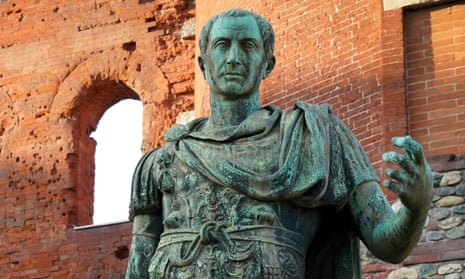
A closeup of an outdoor, oxidized bronze statue of a young Julius Caesar, wearing a cloak across his shoulders and holding up his left hand, as if at one point it held something. The statue stands before an old, very high brick wall with arch windows.For the last three years, some on the right have advocated for ‘Caesarism’. Photograph: Panther Media GmbH/Alamy

Jason Wilson
Sun 1 Oct 2023

In June, rightwing academic Kevin Slack published a book-length polemic claiming that ideas that had emerged from what he called the radical left were now so dominant that the US republic its founders envisioned was effectively at an end.

Slack, a politics professor at the conservative Hillsdale College in Michigan, made conspiratorial and extreme arguments now common on the antidemocratic right, that “transgenderism, anti-white racism, censorship, cronyism … are now the policies of an entire cosmopolitan class that includes much of the entrenched bureaucracy, the military, the media, and government-sponsored corporations”.


In a discussion of possible responses to this conspiracy theory, he wrote that the “New Right now often discusses a Red Caesar, by which it means a leader whose post-Constitutional rule will restore the strength of his people”.


Biden warns voters a second Trump presidency will threaten democracy


For the last three years, parts of the American right have advocated a theory called Caesarism as an authoritarian solution to the claimed collapse of the US republic in conference rooms, podcasts and the house organs of the extreme right, especially those associated with the Claremont Institute thinktank.

Though on the surface this discussion might seem esoteric, experts who track extremism in the US say that due to their influence on the Republican party, the rightwing intellectuals who espouse these ideas about the attractions of autocracy present a profound threat to American democracy.

Their calls for a “red Caesar” are now only growing louder as Donald Trump, whose supporters attempted to violently halt the election of Joe Biden in 2020, has assumed dominant frontrunner status in the 2024 Republican nomination race. Trump, who also faces multiple criminal indictments, has spoken openly of attacking the free press in the US and having little regard for American constitutional norms should he win the White House again.

The idea that the US might be redeemed by a Caesar – an authoritarian, rightwing leader – was first broached explicitly by Michael Anton, a Claremont senior fellow and Trump presidential adviser.

Anton has been an influential rightwing intellectual since in 2016 penning The Flight 93 Election, a rightwing essay in which he told conservatives who were squeamish about Trump “charge the cockpit or you die”, referencing one of the hijacked flights of 9/11.

He gave Caesarism a passing mention in that essay, but developed it further in his 2020 book, The Stakes, defining it as a “form of one-man rule: halfway … between monarchy and tyranny”.

The Guardian contacted Anton at his Claremont Institute email address, but received no response.

Anton and others in the Claremont milieu are not simply hypothesizing about the future: their dreams of Caesar arise from their dark view of the US.

Anton wrote the scene-setting essay in Up From Conservatism, an anthology of essays published this year and edited by the executive director of Claremont’s Center for the American Way of Life, Arthur Milikh.

Michael Anton, a former adviser to President Trump, described Caesarism as a ‘form of one-man rule: halfway … between monarchy and tyranny’. 
Photograph: Pablo Martínez Monsiváis/AP

In that essay Anton writes baldly that “the United States peaked around 1965”, and that Americans are ruled by “a network of unelected bureaucrats … corporate-tech-finance senior management, ‘experts’ who set the boundaries of acceptable opinion, and media figures who police those boundaries”.

His diagnosis of US social and cultural life unfolds under a series of subheadings that are almost comical in their disillusionment: “The universities have become evil”, “Our economy is fake”, “The people are corrupt”, “Our civilization has lost the will to live”.

Damon Linker, a senior lecturer at the University of Pennsylvania and an author of several books on the American right, was early in noticing the extreme right’s drift towards Caesarism.


Linker told the Guardian that Anton and others in the Claremont milieu “have convinced themselves thoroughly that the current order is decadent, corrupt and far removed from the proper, admirable origins of American government”.

Linker said their current view is related to a long-held position among Claremont scholars that “democracy as they understand has been supplanted by bureaucrats and entrenched executive branch departments”.

“The fact that Trump lost in 2020 has just radicalized a lot of these people – it occurred to them that they might not win a proper election again,” he said.

“That would mean that – excuse the language–they’re shit out of luck unless there’s some other path to power. That’s where Caesarism comes in.”
If Trump wins in 2024, does he listen to people like Michael Anton about the need to perhaps cancel the next election?Damon Linker

Linker said that the danger in such ideas is not that the American people will actively choose a dictatorship, but more in how they might shape the rightwing response to a future emergency

“If Trump wins in 2024, what does the opposition do, and how does he respond?” Linker speculated. “Does he send in the troops? Does that lead to bigger protests?”

“If he then declares martial law, do these ideas prepare people in the Republican party to say, ‘Well, we need law and order’?,” Linker asked.

“Does Trump then listen to people like Michael Anton and his friends about the need to perhaps cancel the next election?”

Underlining this danger is the fact that Caesarism has won converts beyond Claremont as a solution to perceived decadence and the declining electoral appeal of far-right ideas.

Charles Haywood, a former industrialist the Guardian exposed last month as the founder of a secretive fraternal lodge and a would-be warlord, wrote in 2021 that “I like, if not love, the idea of Red Caesar” since “Caesarism, and its time-legitimated successor, monarchy, is a natural, realism-based system, under which a civilization can flourish”.


US businessman is wannabe ‘warlord’ of secretive far-right men’s network

The idea has been lodged in the broader sphere of conservative debate in rightwing writer Stephen Wolfe’s book The Case for Christian Nationalism, in which he proposes a “Christian prince” whose rule would be “a measured and theocratic Caesarism”, and might perhaps be installed by “a just revolution” against secular rule.

Caesarism and other antidemocratic ideas bemuse many observers, including some with whom they might otherwise share common ground.

Thomas Merrill is a political theorist and an associate professor at American University in Washington DC, who has written critically on the Claremont Institute, but from a broadly conservative perspective.

“We’re cousins,” he said of Claremont intellectuals in a telephone conversation, “and sometimes you have to ask your cousin, what the hell are you doing?”

He said that the authoritarian drift exhibited in work like Anton’s was an example of “the Claremont guys shooting themselves in the foot”. For Merrill, while he agrees that the ideas are dangerous, he thinks they have an air of compensatory fantasy.

“They’re selling a very dark picture of the world to conservative donors without going out and doing the hard work of democratic politics.”

For Linker, the author and lecturer, a far-right dictatorship remains “a tail-end, worst-case scenario”, but one that is more realistic in the US now than it has been for many decades.

“Thirty years ago, if I told you that a bunch of billionaires and intellectuals on the right are waiting in the wings to impose a dictatorship on the United States, you would have said that I was insane,” he said.

“But it’s no longer insane. It’s now real. There are those people out there,” Linker added. “The question is: will they get their chance.”