Tuesday, October 03, 2023


Early Legacy of the Bolshevik Revolution

Shubham Sharma 

A look at how the new Soviet State dealt with issues that the West is still unable to resolve.
bolshevik

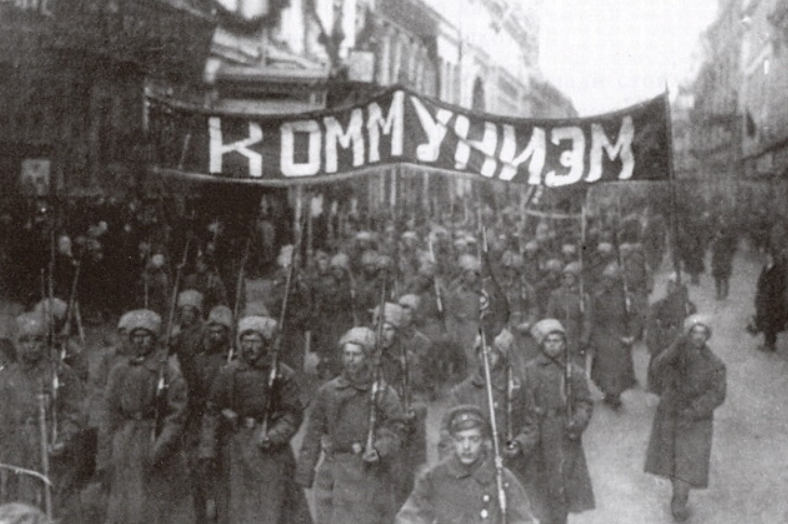
Representational use only.Image Courtesy: Flickr

In October 1917, when the Bolsheviks under the leadership of Lenin captured power in Russia the message was simple: that the meek can inherit the world. Unlike the French and English revolutions, the Bolshevik Revolution was a planned and conscious attempt to take power by the organised working class with the support of the poor peasantry.

It was the biggest political event in the 20th century, primarily because it shook all integuments of exploitation. Be it class, race, gender, or capitalist imperialism. No other event in history had such a long-ranging impact than the Bolshevik Revolution.

The French Revolution, for example, spoke of the Rights of Man but failed to give voting rights to women. It spoke of the equality of all men yet Napoleonic France continued to have slave colonies in the Caribbean. The tenacity of the French to hold on to slavery was reflected in the gruesome murder of Toussaint Louverture, the leader of the slave revolt in Haiti.

The Bolshevik Revolution, on the other hand, remained steadfast to its promises. In the absence of slavery, the worst sufferers of the Tsarist regime were Jews. The Tsars had for long pandered and promoted anti-Jewish sentiments to channelise the anger of the poor in pogroms. Lenin and the Bolsheviks understood this well.

In a lecture on the 1905 Revolution in Zurich, Lenin said: ‘‘Tsarism knew perfectly well how to play up to the most despicable prejudices of the most ignorant strata of the population against the Jews, in order to organise, if not to lead directly, the pogroms—those atrocious massacres of peaceful Jews, their wives and children, which have roused such disgust throughout the whole civilised world’’.

Every socialist and communist must remember with great pride, especially when fake anti-semitism has become a renewed weapon to attack the Left in the world, that in 1914, the Bolshevik party in the Tsarist Duma proposed a Bill that aimed to ‘‘to remove all limitations of rights placed upon the Jews, and all limitations whatsoever connected with descent from or membership of any particular nationality’’.

It was the radical progressivism of the Bolsheviks that led to a Jew becoming the second in command of the revolutionary state. Shaken and concerned by that Marxist Jew, the American Raymond Robins, depicted him as ‘‘a son of a bitch, but the greatest Jew since Jesus Christ’’. He was Leon Trotsky who went on to plan the revolutionary takeover in October 1917 and became the Commander-in-Chief of the Red Army.

Apart from Trotsky, Jews constituted a good number of senior Bolshevik party members such as Zinoviev, Kamenev, Yakov Sverdlov, Maxim Litvinov, and Moisei Uritsky.  Compare this to the United States of America wherein it took 232 years for a Black American to become President of the United States.

The Gender Question

On the question of gender, the Bolshevik party’s programme written in 1903 included the demand for ‘complete equality of rights for men and women. Nadia Krupskaya, Lenin’s wife and a long-time member of the Bolshevik Party, wrote a pamphlet in 1902 titled The Woman Worker. It recorded the abject miseries of women in the face of famines and the extremely low wages that amounted to roughly four-fifth of the male wage despite working for eleven and a half hours a day.

The pamphlet linked the emancipation of the working class as a whole to the emancipation of women. During the famous 1907 international socialist conference of the Second International, Lenin condemned the opportunist actions of the Austrian Social-Democrats who, while conducting a campaign for electoral rights for men, put off the struggle for electoral rights for women to ‘a later date’.

On the eve of the Bolshevik Revolution, Alexandra Kollontai led a march of 15,000 women, mainly the wives of the Russian soldiers fighting the First World War. Whilst the men were fighting on the front, the womenfolk joined factories in huge numbers.

Lenin officially committed the Bolshevik party to free education for girls, and their economic demands, such as workplace creches, time off for breastfeeding and paid maternity leave. Judy Cox in her essay, Out of the shadows: Female Leninists and Russian Socialism, writes that ‘‘the Bolsheviks were becoming the political home of working women who increasingly understood that opposition to the war entailed opposition to capitalism itself’’.

Within a few weeks of the revolution, medical services were made free to all women, doctors were given a state wage and all childcare institutions were brought under government control. For the first time, the right to equal pay for women along with an eight-hour workday were duly passed as legislations. The Bolshevik pledges of paid maternity leave and time off for breastfeeding were also implemented. A law of December 1917 removed all obstacles to divorce. The new Family Law of October 1918 made declared all marriages to be secular. Thus, making marriages no more an intensely sacral affair mediated by the Orthodox Church. It also provided for the economic independence and equality of women in marriage, and imposed paternal responsibility for all children, whether born in wedlock or not.

Bolshevik Russia was also the first state to decriminalise homosexuality as early as in 1917.

Abortion was legalised in November 1920 making the Soviet Union the first state to do so. Ironically, in the same year, capitalist-imperialist France enacted a law that forbade all forms of contraception. The Land Law of 1922 gave women ownership of their family's farm and allowed them to receive their share of the property even upon divorce.

All this was happening when European imperial powers, such as Britain and France, did not have universal suffrage rights for women. In the former, it came only in 1928 and the latter delayed it till 1944. Switzerland gave women the right to vote in 1971-1972, and ironically the Swiss canton of Appenzell gave voting rights to women as late as 1991—the year the Soviet Union collapsed!

Nadia Krupskaya noted that the number of women members in the Communist Party of the Soviet Union went up from 40,000 in 1922 as many as 5,00,000 by October 1932. And at the time when the 15th anniversary of the October Revolution was observed, 20-25% of the deputies of the village Soviets, district executive committees, and city Soviets were women.

Opressed Nationalities

On the question of oppressed nationalities, the legacy of the Bolshevik Revolution remains unmatched. Lenin and the Bolsheviks’ steadfastness against colonialism could be traced to the 1907 international socialist conference. Anti-communist scholarship has tried to explain Lenin’s radical position on the political emancipation of the colonies in two ways.

First, the final defeat of Alexander Kolchak and Anton Denikin, two internationally recognised leaders of the white counter-revolution allowed Lenin and the Bolsheviks to bring under control the eastern borderlands which had declared independence right after 1917. The argument goes that this allowed the Soviet Union for a much-needed contiguity with Asia thereby easing the way to draw in the agitating masses into the vortex of the Bolshevik Revolution.

Second, the rising tide of anti-colonial nationalism in the colonised nations of Asia pushed Lenin toward espousing the cause of the colonies wholesale. Both arguments could be dislodged from their perches of academic acceptance if one looks a little deep into history.

During the 1907 international socialist conference at Stuttgart, Germany, the question of the colonies was on the table. It was at this very conference that an Indian nationalist, Bhikaji Cama, hoisted the ‘Flag of Indian Independence’ with Vande Mataram emblazoned on it. Yet, the question of the colonies received lukewarm attention at best and opportunistic vacillation, at worst.

Henri Hubert Van Kol, a prominent socialist member of the Dutch Parliament, who in the past argued that ‘the moral requirement of the (imperial) government was first to care for the needs of the indigenous people, and only secondly to promote capitalist exploitation’, dominated the Colonial Commission of the congress. He framed a Draft Resolution to the effect that the Stuttgart Congress did not in principle oppose colonialism as such ‘for even under socialism, colonialism would have had a civilizing role to play.’ It was Lenin, who, along with Rosa Luxembourg and other German Left Social Democrats, defeated Van Kol’s opportunist and unprincipled Draft Resolution. 

In the very next year, Lenin wrote a pamphlet titled Inflammable Material in World Politics wherein he argued that ‘‘there can be no doubt that the age-old plunder of India by the British, and the contemporary struggle of all these ‘advanced’ Europeans against Persian and Indian democracy, will steal millions, tens of millions of proletarians in Asia to wage a struggle against their oppressors’’.

After the revolution, the Bolsheviks were the first and the only government to demand the unconditional emancipation of all colonies from the clutches of capitalist-imperialist powers. The establishment of the Communist International (COMINTERN) in 1919 was exactly to serve this purpose. In world history hitherto, no other such international organisation was ever made, either in scope, aims, vision, and radical internationalism.

Another important aspect that is often not discussed is that of the Muslim ethnic nationalities of Central Asia. Constituting about 13% population of Soviet Russia, the central Asian republics were one of the most backward regions of the world. With a legacy of the dual oppression of parasitic Khans and the Tsars, the Muslim population had suffered horrendous ordeals. The last of which was the violent repression of the 1916 rebellion against forceful conscription for the First World War wherein almost 83,000 Muslims lost their lives. This radicalised and brought the jadedi Muslims into the fold of the Bolsheviks. A declaration: To all the Muslim workers of Russia and the East, issued by the Soviet government on November 24, 1917, stated: ‘‘Muslims of Russia ... all you whose mosques and prayer houses have been destroyed, whose beliefs and customs have been trampled upon by the tsars and oppressors of Russia: your beliefs and practices, your national and cultural institutions are forever free and inviolate. Know that your rights, like those of all the peoples of Russia, are under the mighty protection of the revolution…’’.

David Crouch in his brilliant essay, The Bolsheviks and Islam, has given a glimpse into the attitudes of the time could be found in a Professor in Japan and later an advisor to the King of Afghanistan, Mohammed Barkatullah’s pamphlet Bolshevism and the Islamic Body Politic which he was distributing in Turkestan. A copy fell into the hands of the British secret service in India, who translated it from Persian.

It is worth quoting at some length: ‘‘following on the dark long nights of tsarist autocracy, the dawn of human freedom has appeared on the Russian horizon, with Lenin as the shining sun giving light and splendour to this day of human happiness...the administration of the extensive territories of Russia and Turkestan has been placed in the hands of labourers, cultivators, and soldiers. The distinction of race, religion, and class has disappeared ... But the enemy of this pure, unique republic is British imperialism, which hopes to keep Asiatic nations in a state of eternal thraldom… time has come for Muhammedans of the world and Asiatic nations to understand the noble principles of Russian socialism and to embrace it seriously and enthusiastically… They should, without loss of time, send their children to Russian schools to learn modern sciences, noble arts, practical physics, chemistry, mechanics, etc. Oh, Muhammedans! Listen to this divine cry. Respond to this call of liberty, equality, and brothership which brother Lenin and the Soviet government of Russia are offering you.’’

Trotsky in his 1923 book, Problems of Everyday Life: Creating the Foundations for a New Society in Revolutionary Russia, noted that in Turkestan and in certain other national republics, a notable percentage of communist party members, roughly 15%, were believers in Islam.

Summing up the attitudes of the Bolshevik leadership to religion he wrote: ‘‘Of course, it would be better if we had a proletariat there (in Central Asia) that had already had experience in strikes and bouts with the church, that had rejected the old prejudices and only then come to communism. That's how it is in Europe, and, to a certain degree, it has been and continues to be that way in the centre of our country. But the East is lacking all this previous schooling. There, our party is the elementary school, and it must fulfill its responsibility accordingly. We will admit into our ranks those comrades who have yet to break with religion not in order to reconcile Marxism with Islam, but rather tactfully but persistently to free the backward members' consciousnesses of superstition, which in its very essence is the mortal enemy of communism.’’

Soon, a massive programme of what would now be called affirmative action was introduced, known as ‘korenizatsiia’ or ‘indigenisation’. It started with kicking out the Russian and Cossack colonists and their ideologues in the Russian Orthodox church. The Russian language ceased to dominate, and native languages returned to schools, government, and publishing. Indigenous people were promoted to leading positions in the state and communist parties and given preference over Russians in employment. Both, primary education institutions and universities sprang up soon after the civil war ended.

Let us take the example of Tajikistan. Ruled by the Emir of Bokhara, Tajikistan became an autonomous republic in 1925 and in 1929 it entered the Union of Soviet Socialist Republics (USSR) as an independent federated republic. In colonial India, in 1911, as many as 6% of the people were reported to have been literate. In Tajikistan, before the Revolution, only one-half of 1% of the population could read and write. In 1931, the Indian figure of literacy rose by just 2% touching the 8% mark. Whereas by 1933, a good 63% of the population was literate in Tajikistan. There were only a hundred Tajik students at school in 1914. The figure in 1939 was 328,000. By 1936, the Republic had one school per 500 of the population, five higher educational institutions, and over 30 technical schools. 

The progress in public health was also phenomenal. In 1914, there were just 13 doctors in Tajikistan who would be called upon to cater only to the needs of the feudal aristocracy. In 1939, there were 440 doctors, ready for service in every home. In 1914, there were no maternity beds in the abysmally ill-equipped hospitals. In 1937, there were 240. In 1914, there was no such thing as a maternity and infant welfare centre. Twenty-three years later there were 36 such centres.

A mention must also be made of the work done by the Central Commission for Agitation and Propaganda Among Working Women (Zhenotdel). After the civil war ended Zhenotdel workers travelled to Central Asia, organising “red yurts” and “red boats” to reach out to Muslim women. In the autumn of 1918, over 1,000 women gathered for the first All-Russian Women’s Congress. After prolonged debates, congress voted for an eight-hour working day, the abolition of private landed property, confiscation without indemnity of large properties, equality of political rights for women, and an end to polygamy and purdah. The congress meant that Russia’s Muslims were the first in the world to free women from the restrictions typical of Islamic societies of that period.

To conclude, the essay has attempted to show only some emancipatory facets of the Bolshevik Revolution. A lot more can be said, and reams could be written about the glorious legacy of the Revolution. However, in the absence of time and space, the best way to celebrate the Revolution would be to plan one in India!

The writer is a research ccholar in the Department of Political Science, University of Connecticut, USA. The views are personal.

https://www.newsclick.in/


'The Immortal': Art Brings out Bhagat Singh's Spirit and Thoughts Beyond Stereotypes -- Replug


Chaman Lal 

Bhagat Singh has been turned into a stereotype in many art pieces. But a new painting sheds a rare light on the famous revolutionary.
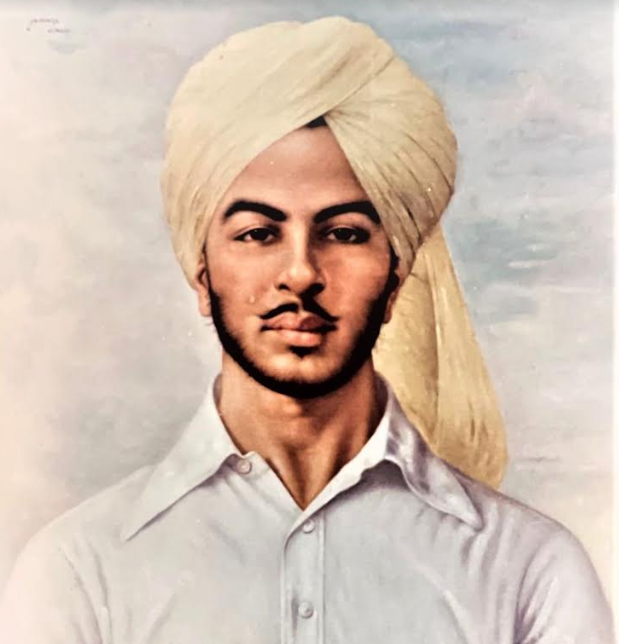
Original painting by artist Amar Singh in 1975 assigned by Punjab Govt

Original painting by artist Amar Singh in 1975 assigned by Punjab Govt

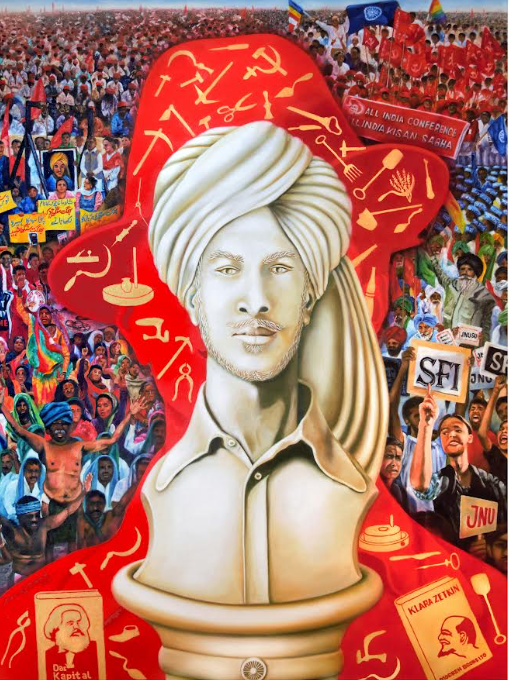
The Immortal is a multi-layered painting of Bhagat Singh by Kanwal Dhaliwal, an Indian-origin artist from London, United Kingdom. He is associated with Progressive Writers Association (PWA) London branch, which comprises members from Indian and Pakistani origins.

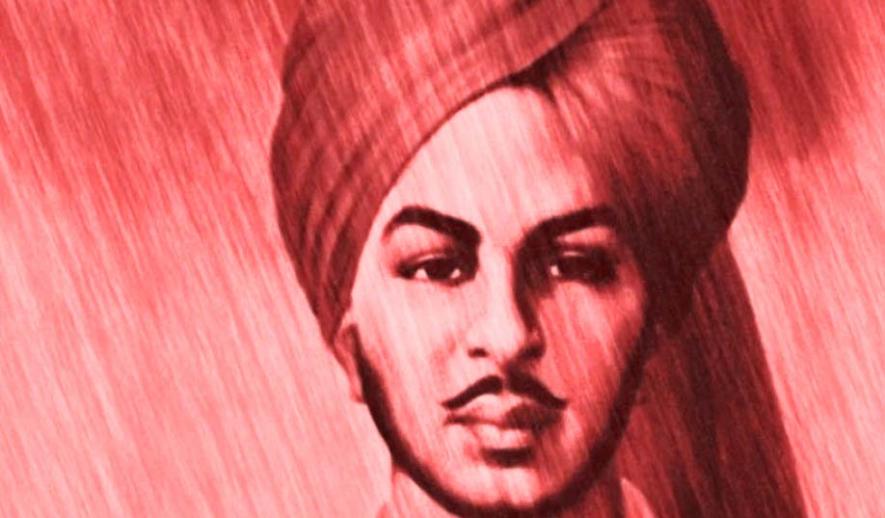
Dhaliwal has created something unprecedented with ‘The Immortal’. Hundreds of artists have imagined Bhagat Singh in their own ways over the decades. But many a time, that imagination is a very crude representation of Bhagat Singh, one of the most famous heroes of the Indian freedom struggle. 

Bhagat Singh has been turned into a stereotype in many art pieces. The iconography of Bhagat Singh started very early when he was alive and in jail. At that time, only one actual photograph of the rising hero was in the public domain and imagination. That was his April 1929 photograph clicked by Ramnath, a photographer from Kashmiri Gate, Delhi. Both Singh and Batukeshwar Dutt had specially gone to the photographer's shop on April 3, 1929, to get this photograph to be used for publicity purposes after throwing bombs in the Central Assembly in Delhi. In fact, Bhagat Singh and Dutt had not seen the photograph till it got printed in Bande Matram, an Urdu daily published in Lahore, on April 12, and then in Hindustan Times, Delhi, on April 18, 1929.

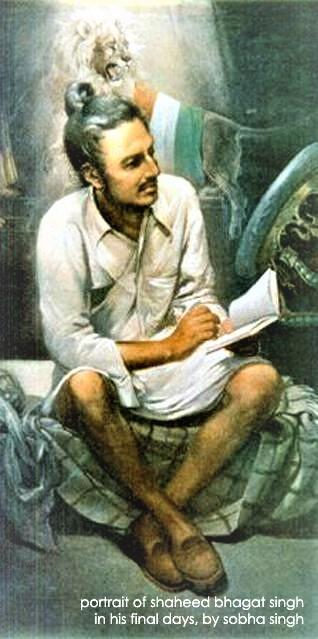
15. Bhagat Singh painting by Sobha Singh.jpg

15. Bhagat Singh painting by Sobha Singh.jpg

The photograph and its negatives were collected from the photography studio by Singh's comrades and supplied to the media. During Singh and his comrades' hunger strikes, artists started creating images of the heroes. However, after their execution on March 23 1931, there was an explosion of artistic creations. 

These paintings had imagined Bhagat Singh offering his head to Bharat Mata, or three martyrs -- Bhagat Singh, Rajguru, and Sukhdev flying to the heavens and many more such imaginations. Most of these paintings were printed as posters from Kanpur and Lahore and proscribed immediately. Yet, many journals carried these, and many homes had these as calendrers or wall posters. Even matchboxes carried these painting-cum-photos. Most of these were in black and white. The trend of colour printings and posters/calendars started after the Independence. By that time, the crudity had taken over aesthetics! The twitching moustache, gun holding Bhagat Singh looking like a terrorist as the British called him, became the norm for even statue making in many places. This was also because most of these artists did not read Bhagat Singh's writings and ideas about life and society. 

Some more known photographs of these paintings are attached here to understand how Bhagat Singh has been imagined not just by Indian, but even by international artists. One is by Amar Singh, whose painting is being used by the Punjab Chief Minister in his office. This painting was commissioned by then Punjab Chief Minister Giani Zail Singh. Another painting is by Australian painter Daniel Connell, which has been identified by London-based Punjabi poet Amarjit Chandan and used by the Indian Express in its stories without mentioning the artist name. Two more contrasting paintings by unknown painters are put up here. In one painting, Bhagat Singh is shown with gun, and in the other, with a book. So, creative art perceives the reality through artist’s own prism; for a realist artist, as per Maxim Gorky’s views about art, it is close to the reality a little enhancement through art. However, in an artist’s imagining in the tradition of art for just art’s sake, it could take any shapeand especially in visual arts like painting, it could create altogether a different picture of a man who has been painted.

The Immortal-Singh.

The Immortal-Singh.

The situation changed a bit after Bhagat Singh's writings and ideas started trickling in some poems, plays, and fiction, and also in ideological/academic debates. Few artists took a clue from this ideology-based image of Bhagat Singh and reverted to making paintings based on his original face. 

The actual photographs of Bhagat Singh are only four in number -- one was taken around when he was aged 11, another at about the age of 17, next at the age of 20, and the final photograph at the age of about 22 years. The first two photographs are white turbaned photographs, third one is in police custody with open long hair and beard, without his turban. The last one is the most iconic hat-wearing photograph, which Ramnath had clicked. Bhagat Singh never wore a yellow or saffron colour turban as the hundreds of distorted paintings would like us to believe. Photographer Ramnath had appeared in the Delhi Assembly bomb case as a prosecution witness to confirm that he had clicked Bhagat Singh and Dutt's photographs.

In all his real photographs, the face of Bhagat Singh is very soft and impressive, perhaps conveying some firmness as well. But by no stretch of imagination can that face be presented as the face of a gun-toting terrorist. Some painters tried to reimagine him like a book holding, white turbaned young man who was an intellectual or an activist! 

However, Kanwal Dhaliwal has imagined him at multiple levels. His focus is more on what was in Sing's head, his thinking or ideas, and how his thoughts are still impacting society! He also dwells on the kind of analytical thinking and reasoning Singh's sharp and receptive mind had. All these aspects of Bhagat Singh and his relations to his people come forth brilliantly through his creatively imagined painting. Singh's face is that of the college-going 17-year-old young lad with a white turban on his head -- that is one layer. But watching minutely, the red coloured hat with the tools of farmer and worker's is superimposed over the turbaned head. It gives a glimpse of the revolutionary's ideological development. He began acquiring nationalist ideas from his days in the National College in Lahore as a young man. However, by the time he went for a click to Kashmiri Gate wearing a hat, albeit for safety purposes of not getting recognised by the revolutionaries hunting British police, he had changed. But the change inside his mind was also revolutionary, which is why the imagined hat is a red one with the hammer and the sickle on that hat, which means that he had turned into a committed socialist revolutionary by the time he got that photograph taken.

Only four real photograhs of Bhagat Singh at 11, 17, 20 and 21 years-The hat one being last

Only four real photograhs of Bhagat Singh at 11, 17, 20 and 21 years-The hat one being last

The session court statement of Singh and Dutt had been published by all the major newspapers of India and some even abroad, in full. That statement was a call for a revolution by workers and peasants. Now, what is around his photograph are student activists, farmers activists from Maharashtra, Tamilnadu to Punjab. His ideas' reach is international, as Pakistani women are also there holding his photograph, demanding Shadman Chowk to be named as Bhagat Singh Chowk. Contours of the red hat meet Karl Marx's book Das Capital, which Bhagat Singh used to give to his comrades to study, and on the other side, Krupskaya reminiscences of Lenin are displayed, perhaps it was the book Bhagat Singh was reading just before leaving for gallows! Thus, it is one of the rare paintings to reveal the spirit of the iconic hero!

(Chaman Lal is a Retired Professor from JNU and Honorary Advisor of the Bhagat Singh Archives and Resource Centre, Delhi.)


The Relevance of Bhagat Singh and his Martyrdom Today


Ram Puniyani 


Many use Bhagat Singh's name to get legitimacy for themselves without following his ideological understanding. What would he have thought about that?
The Legacy of Shaheed-e-Azam

Over nine decades ago, one of the greatest revolutionaries committed to the anti-colonial struggle against the British and to socialism was hanged by the colonisers. Bhagat Singh's life is an inspiration to those committed to a society with peace and justice. 

A lot has already been written about how a young man of 23 years dedicated himself to the cause of the country, and at such a young age, wrote very profound ideological tracts. Many controversies are being built around him by those totally opposed to his life’s mission and ideology. There are still many others who use his name to get legitimacy for themselves without following his ideological understanding.

Briefly, Singh joined the Hindustan Republican Association, and struggled to insert 'Socialism' into the name of the organisation. His role in the murder of John Saunders, an Assistant Superintendent of Police, was planned as their group felt that the death of Lala Lajpat Rai during the protest against the Simon Commission was an insult to the nation. So, they planned to take revenge for this. 

The second major incident was the throwing of the bomb into the Assembly. It was not meant to kill anyone but was strategically planned to make the ‘deaf hear’. As their voice was not reaching the masses, the idea was to make detailed statements in the court, which would be picked up by the media and reach people at large!

The impression that he was for violent means to overthrow British rule has no truth. During the course of the evolution of his ideas, he did come to the conclusion that non-violent mass movement is the core for changing the system and overthrowing British rule. This was first reflected in the advice of Ram Prasad Bismil, who advocated for giving up the “desire to keep revolvers and pistols” and instead join “the open movement”. 

Bhagat Singh, by 1929, came to the conclusion that Marxism and broad-based mass movements were the right road to revolution, not individual heroic action. In 1931, addressing his comrades from jail, he presented his nuanced understanding of this strategy for action. 

This is also confirmed by the advice Bhagat Singh gave to his father. His father, Kishan Singh, had pleaded that he should apologise to the British as he had a long life ahead. Reprimanding his father, he said that he was a revolutionary and rather than apologising, he would plead for getting killed by a firing squad. 

Notably, the contrast between Bhagat Singh and Vinayak Damodar Savarkar cannot be starker. Savarkar, after an initial anti-British stance, wrote several mercy petitions and then went on to assist the British in their efforts while getting a hefty pension of Rs 60 per month (then gold was roughly around Rs 10 for 10 grams). Revolutionaries like Subhash Chandra Bose, Bhagat Sing and others were inspired by socialism, while Savarkar was inspired by Italy’s Mazzini, who became the patron saint of Fascist ideology.

There was criticism of the book ‘India’s Struggle for Independence’ (Bipan Chandra et al, Penguin) for using the phrase "revolutionary terrorism" even though Singh's group's documents referred to their path as that of revolutionary terrorism. This path was definitely abandoned by them over a period of time. The likes of Anurag Thakur and Smriti Irani criticised the book based on this. The word terrorism had a different connotation prior to 9/11 in 2001. The primary goal of the rightwing worthies in criticising the book was to undermine this book as it highlights the role of the Muslim League, Hindu Mahasabha and RSS in promoting communal politics in India and keeping away from the freedom movement. 

By word of mouth, a rumour has been made the part of ‘social common sense’, that Gandhi did not save Bhagat Singh’s life. This is far from the truth. Gandhi had written two letters to Lord Irwin to postpone or dilute the death penalty. Gandhi drafted the resolution criticising the British for hanging a nationalist in Karachi Congress in 1931. At the occasion, Bhagat Singh’s father Kishan Singh also spoke, saying, “Bhagat Singh told me not to worry. Let me be hanged… He warned me against going to the Privy Council because he said slaves had no right to complain…You must support your general (Gandhi). You must support all Congress leaders. Only then will you be able to win independence for the country.”

Gandhi wrote in Navjivan, “I had interested myself in the movement for the commutation of the death sentence of Bhagat Singh and his comrades. I have put my whole being into the task.” The other fake news relates to Congress leaders not having met Bhagat Singh and his comrades when they were in jail. This is a blatant lie.

There are reports in the Tribune about Jawaharlal Nehru visiting the jail to meet Bhagat Sing and his comrades. The reports in Tribune on August 9 and 10 of 1929 tell us about Nehru’s meeting the jailed revolutionaries and inquiring about them. Motilal Nehru had even formed a committee to demand humane treatment for the revolutionaries on fast unto death. 

In his autobiography, ‘Towards Freedom’, Nehru gives a touching account of his meeting Bhagat Singh, Jatin Das and other young men: “I happened to be in Lahore when the hunger strike was already a month old. I was given permission to visit some of the prisoners in the prison, and I availed myself of this.”

How atheist would Bhagat Singh have seen today’s scenario? The very ideas of workers’ and farmer’s rights have been given a go-bye. He criticised the misuse of religion as some people exploited it to promote blind faith, and now a plethora of corrupt godmen like Asaram Bapu and Gurmeet Ram Rahman have mushroomed. Faith-based knowledge is also being promoted by the ruling government. How would Bhagat Singh have responded to some political tendencies which eulogise him and also spend fortunes building temples and promoting sectarianism in the garb of religion? It is something to think about.

https://www.newsclick.in/


LA REVUE GAUCHE - Left Comment: Search results for Bhagat Singh 


Remembering Allende and his Project Cybersyn


Prabir Purkayastha 


During Salvador Allende’s brief term in power, a revolutionary project sought to use technology, specifically information from factories for real-time planning and interventions in the economy. What does this tell us about knowledge and the struggle over the infrastructure that produces it?
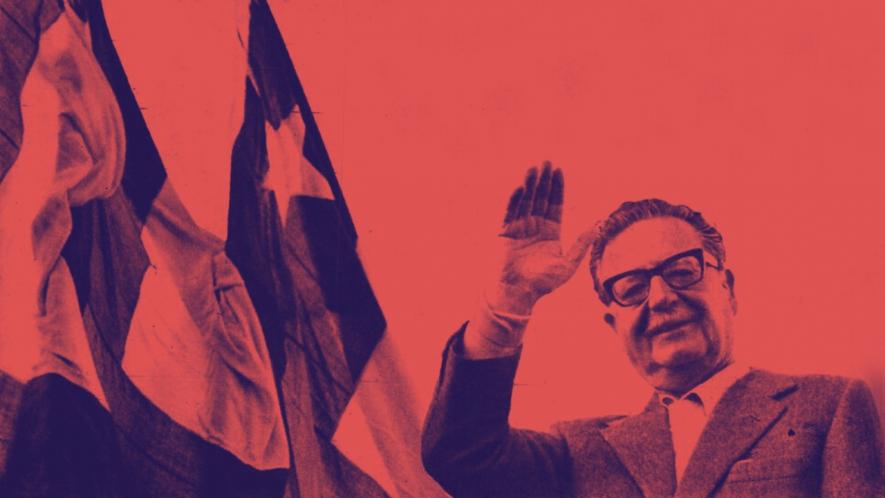
Salvador Allende

Fifty years ago, Augusto Pinochet’s coup destroyed Salvador Allende’s government and the structure of liberal democracy in Chile. Allende died with a machine gun in his hands, defending his attempt to build socialism against the combined power of the US and the forces of reaction in Chile, including the military. For people of my generation, this story is well-known, as along with liberation struggles in Vietnam and Africa, Chile was very much what brought us to the streets in solidarity. What is less known, except in more scholarly or tech circles, is the attempt by Allende and his government to use technology, specifically information from factories which Allende had nationalized, for real-time planning and interventions in the economy. This project —Cybersyn— resonates in the tech community for its vision of marrying technology to social needs, including direct feedback from workers on the factory floor. Cybersyn’s control room is iconic and a precursor to what develops later as an intuitive graphic user interface, differentiating companies such as Apple from the more clunky user interfaces of Microsoft and others.

Eden Medina and Evgeny Morozov are two authors who have explored Project Cybersyn for more than two decades. Medina’s 2011 bookCybernetic Revolutionaries: Technology and Politics in Allende’s Chilebrings together the context and the constraints of both technology and politics at that time. Morozov, who has been researching Chile and Cybersyn for a long time, recently released a nine-part podcast called The Santiago Boys. This podcast gives us not only an overview of the project but also the unequal struggle between a set of young technocrats, engineers, and economists (The Santiago Boys) along with Stafford Beer, a British information technologist on the one hand, and the might of the US forces—ITT and other US MNCs, the CIA, the Chilean Armed Forces and economists (The Chicago Boys led by Milton Friedman) on the other. He also locates the much larger context within which we must see Cybersyn — not simply as how to manage or control the economy but how to develop knowledge that underlies technology and production for the future.

Remembering Allende and his Project Cybersyn

A 3D render of the Cybersyn Operations Room (or Opsroom), a physical location where economic information was to be received, stored, and made available for speedy decision-making. Photo: By Rama, CC BY-SA 3.0 fr, https://commons.wikimedia.org/w/index.php?curid=113829425

Information, in this larger sense, is creating new knowledge and, therefore, the fight over the patent system is a fight over knowledge. The Indian patent system had undergone a huge break from its earlier colonial version of the 1911 Indian Patent Act in the 1971 Patent Act. Evgeny brings out the vision of the Santiago Boys/School, similar to what we in India had regarding self-reliance. It is not enough to do import substitution. Breaking out of dependence means creating new knowledge. That means you have to marry advances in knowledge, both scientific and technological, to industry. Patent systems reform can create conditions with which we can create knowledge, but bringing it into industry means marrying different forms of knowledge in a way that can lead to manufacturing products — from simple products that go into other products to complex ones that need to integrate a very large number of such parts.

I am not going into the details of what Morozov has covered in his podcasts or other writings. I will pick out one example of what might have been if Chile had been able to pursue its path to self-reliance. He describes how the Allende-era Chilean Production Development Corporation (Corfo) launched the National Electronics Company, tasked with building a semiconductor plant in the country’s north. This would have allowed Chile — once a mere exporter of nitrates and copper — to become a technologically sophisticated economy capable of meeting its development needs. Those who have followed these columns will remember how India built a Semiconductor Complex in Mohali, which within a few years had brought Indian chip-building capabilities within one or two generations of what then were cutting-edge chips. And how, after its mysterious burning down in 1989, it was never rebuilt. This led us to go out in the world offering huge “incentives” to set up, not chip manufacturing, but chip packaging plants. In the Chilean case, the US-inspired coup brought down the Allende government and the abandonment of self-reliance—or technological independence —as a goal. In India, a self-goal by the neoliberal forces across a spectrum of political parties — from the Congress to the BJP — led to the abandonment of self-reliance.

Morozov also brings out the eerie similarities in the information network of Project Cybersyn and the information and control infrastructure of Operation Condor, the infamous CIA project to sabotage and assassinate left forces and governments in Latin America. Both were informed and limited by the technology of their times, using telex as the primary means of communicating data and information. It is a cautionary tale for those who believe in techno-utopias and how technological advances will automatically solve all the world’s problems. Advances in technology and science have the potential to create enough for our human needs, now and for the future. But it comes up against the simple question of who owns such advances. Or, more correctly, who owns the knowledge embedded in the artifacts we produce as a society? Who owns the means of production, not simply the physical infrastructure producing these goods but also the infrastructure producing knowledge? This is where we confront the reality of class struggle, both national and international. Allende’s overthrow by the CIA, ITT (read US capital), and its feudal-military elite reminds us of the nature of this class struggle.

The other part of the story is that of information technology, still in its infancy during the Allende era. A number of people had naively believed that new digital technologies could liberate all of us: free software and the internet would by itself introduce socialism, democratising technology and, therefore, society. Norbert Wiener, the father of Cybernetics, had warned us in his books Cybernetics (1948) and Human Use of Human Beings (1950) that information in the typical American world is destined for a special future: it will turn into a commodity to be bought, sold and bargained over. This will inevitably be in conflict with human values of promoting the common good. As he wrote, “Progress imposes not only new possibilities for the future but new restrictions.” Miron Amit writes about Wiener’s vision of this conflict and how transforming information into a commodity enables its private appropriation and harms life itself. Even though the information network has changed enormously with the emergence of the internet, the politics of information and technology remains the conflict between people and capital.

https://www.newsclick.in/


Gandhi and Oxford: A Parable for Our Times

Suchintan Das 
Gandhi’s international reputation and non-violent politics can’t be appropriated so easily to create diplomatic alibi for a regime that goes about wielding the rod, persecuting a fifth of its populace.
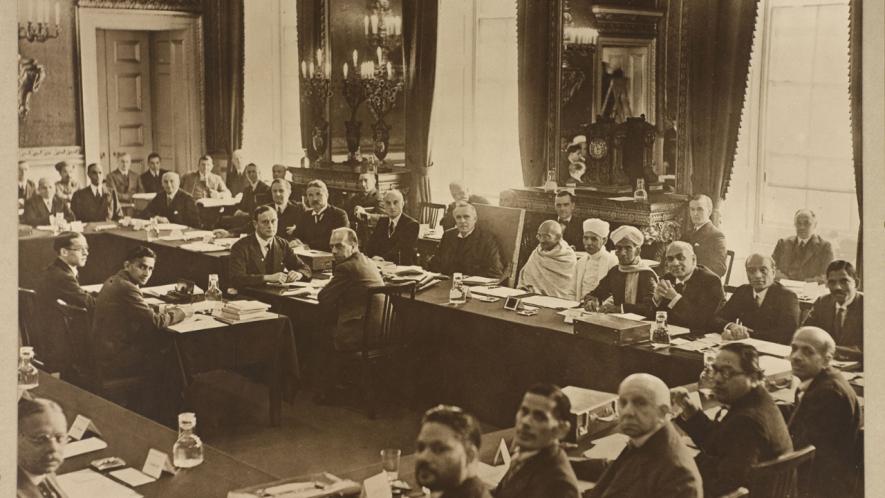
Gandhi during second round table conference

Gandhi in the Second Round Table Conference, 1931 (Image from the British Library)

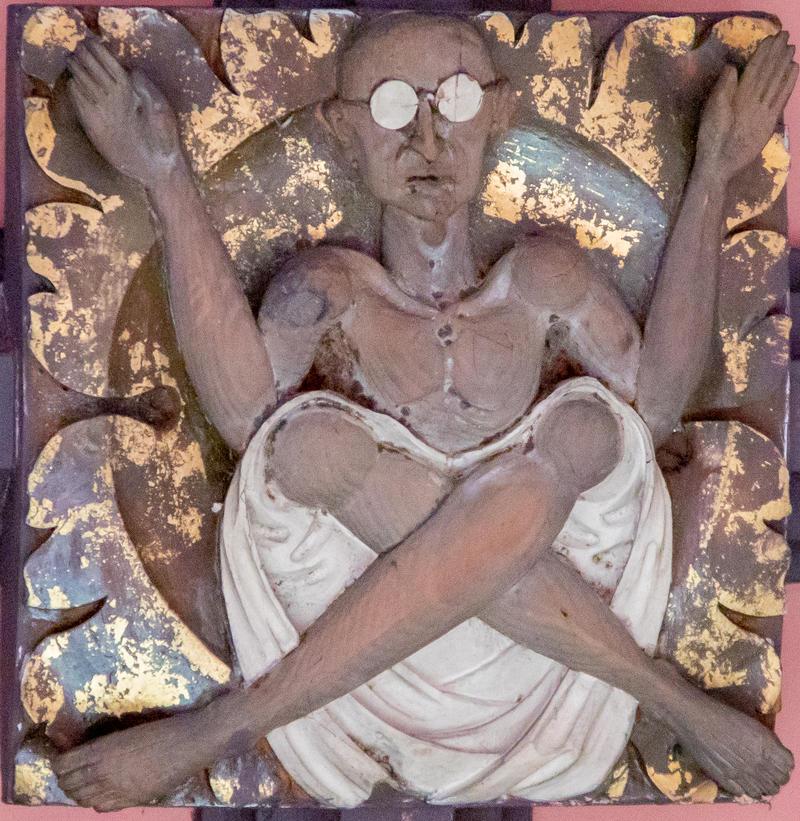
If you look up from the gallery of St. Mary’s Church in Oxford, you will find amongst depictions of mythological animals and heraldic devices, a boss on the ceiling representing Mahatma Gandhi. He sits cross-legged with both hands raised, as if to endow all with benediction, wearing only a white loincloth around his waist and featuring the signature round-framed spectacles, whose glasses are also white — appearing to be opaque. Gandhi’s slender frame in this rather strange depiction is reminiscent of the famous ascetic (or starving) Buddha sculpture renowned in the tradition of Gandhara Art. 

Emblem of Gandhi on the Ceiling of St. Mary's Church, Oxford (Image from Oxford and Empire Network)

Emblem of Gandhi on the Ceiling of St. Mary's Church, Oxford (Image from Oxford and Empire Network)

Gandhi, of course, was likened to a proto-Christian of sorts by liberal Anglicans back in the day. The boss was probably mounted on the roof of the Church at the behest of C.F. Andrews, Gandhi’s friend and an Anglican liberal himself, who identified with the cause of Indian nationalists and taught at St. Stephen’s College, Delhi, and Tagore’s Visva Bharati in Shantiniketan. This was done shortly after Gandhi’s fifth and final visit to Britain, late in 1931. He had come to attend the second of the round-table conferences — a series of unsuccessful peace talks between Indian political representatives and their British counterparts to address the constitutional question of autonomy for India. 

Gandhi had been in Britain before, as an anxious and curious student between 1888 and 1891, as an outspoken lawyer agitating to safeguard Indian interests in South Africa in 1906, as a seasoned activist campaigning against racial discrimination in 1909, and as a leader of the Indian Volunteer Corps attempting to contribute to the British war effort in 1914. All these visits were made prior to his permanent return to India and immersion in Congress politics there. 

By the time the SS Rajputana arrived at the Tilbury Docks in September 1931, Gandhi had already become a household name in Britain, having remade the Congress organisation in his own image and having imbued Indian politics with a distinct mass-character through his novel techniques of mobilisation and agitation. 

Gandhi, who was the sole representative of the Indian National Congress in the conference quickly realised its futility when it became clear to him that there would be no consensus on the question of making an actual political breakthrough. Thereafter, he decided to concentrate his efforts outside the conference as much as possible. In London, he stayed at Kingsley Hall in the East End, spoke with the common people and journalists, addressed students and postal workers, befriended street urchins, and held forth on the contrast between poverty in Britain and in India.

Gandhi travelled widely as well, meeting with clergymen in Chichester, Birmingham and Canterbury and textile workers in Lancashire, got acquainted with Bernard Shaw and Charles Chaplin, and visited university students in Cambridge, Nottingham, Birmingham, LSE, and Oxford. Even though nothing concrete came out of the Round Table Conference, Gandhi emerged triumphant in his public relations, impressing many with his charisma and candid engagement even if they remained unconvinced about his brand of politics.

He visited Oxford twice during this period, staying in the Master’s lodgings at Balliol College, accompanied by his son, Devadas, friend C.F. Andrews, principal secretary Mahadev Desai (later replaced by Pyarelal), and disciple Mirabehn (Madeleine Slade).

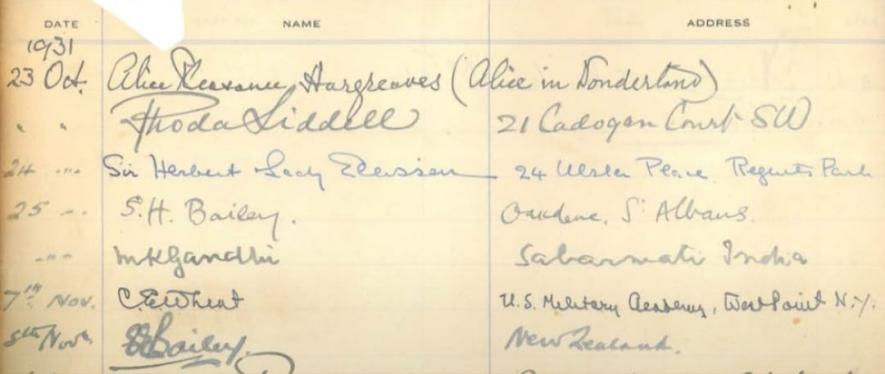
Gandhi's signature in the visitors' book of the then newly inaugurated Rhodes House, Oxford (Image from the Rhodes Trust)

Gandhi's signature in the visitors' book of the then newly inaugurated Rhodes House, Oxford (Image from the Rhodes Trust)

That Oxford wielded disproportionate influence over matters of the British Indian Empire through Viceroys who were its former fellows and civil servants who were its probationary students, was not lost on him. In a large meeting with senior members of the University at the newly inaugurated Rhodes House, he responded to Professors Gilbert Murray and Reginald Coupland’s advice on restraint and gradualism in constitutional affairs by invoking the history of the American Revolution in his own inimitable manner:

“A reformer cannot always afford to wait. If he does not put into force his belief, he is no reformer. Either he is too hasty, or too afraid, or too lazy — who is to advise him, or provide him with a barometer? You can only give yourself, with a disciplined conscience, and then run all risks with the protecting armour of truth and non-violence. A reformer could not do otherwise.”

In Oxford, Gandhi also addressed the students from India and the British Dominions (many of whom were Rhodes Scholars) at meetings organised by the Indian Majlis and the Raleigh Club. At the house of the historian and author Edward Thompson atop Boar’s Hill, he discussed the possibility of a political settlement in which autonomous provincial governments would constitute the stepping stone for an eventually autonomous central government in India with parliamentary undersecretaries like Lord Lothian and Malcolm MacDonald and friends such as Henry Polak and Horace Alexander, but to no avail.

His second visit was much less eventful. Gandhi went to Ruskin College to explain how reading Ruskin’s book, Unto this Last, had influenced him profoundly. On his way back to London, he paid a visit to Colonel Maddock, who had removed his appendix in prison as a government surgeon back in India.

The Master of Balliol, A.D. Lindsay, wrote about Gandhi’s earnestness, throughout his stay, to interact with the most distinguished politicians and academics with the same candour and humility as with ordinary students and members of the public. Throughout his stay in Oxford with Lindsay, Gandhi had impressed him and his wife deeply.

There are at least 30 countries other than India where a street or road is named after Gandhi and at least 70 which can boast of his statues. Gandhi did not visit nearly as many countries in his life. In places, such as in South Africa, his memorials are contested. His politics drew attention and criticism in India and abroad while he lived, and his legacy has been debated vociferously since his demise.

Outside India, he remains one of the most famous Indians of all times. He was assassinated by a Hindu nationalist called Nathuram Godse on January 30, 1948. Today, a Hindu nationalist party is in power in India. Its functionaries and spokespersons have time and again made their allegiances clear in public: Godse over Gandhi. And yet, Gandhi has endured as the pre-eminent international icon of India.

The ruling Bharatiya Janata Party knows this, as does its supreme leader, Narendra Modi, who spares no opportunity to share in Gandhi’s reflected glory. He repeatedly condones his party and parliamentary colleagues’ remarks which celebrate Godse’s crime and himself pays frequent homage to Godse’s ideological preceptors D.D. Upadhyaya and V.D. Savarkar in domestic politics. However, whenever he goes on a state visit to another country or receives a foreign head of state in India, Gandhi is the name that he invokes. Recently, he led an entourage of leaders from around the world to the Gandhi Memorial at Rajghat during the recently held G20 summit in Delhi.

The contradiction in Modi’s actions is a clever ploy. He is known to weaponise India’s foreign policy objectives and obligations to reap domestic political rewards without hesitation. On the other hand, he projects an image of a secular, tolerant, and peaceful country — Gandhi’s India — in front of the wide world, while Godse’s politics gain wide currency in an India that has never before been so riven by tensions — frothing with deceit and seething with violence and its persistent possibility.

Gandhi’s extraordinary international reputation was not built in a day. It was the outcome of a life lived through relentless honest dialogue with everyone. It cannot be appropriated so easily to create diplomatic alibi for a regime that is insistent on wearing its democratic and non-violent credentials on one sleeve while it goes about wielding the rod, persecuting a fifth of its populace, with the other hand. Gandhi would have had none of it. It might be timely, therefore, to remind ourselves of what he said while addressing students in London and in Oxford in October 1931:

“If India becomes free from this curse of exploitation, under which she has groaned for so many years, it would be up to India to see that there is no further exploitation…Of course you will say that free India can become a menace herself. But let us assume that she will have with herself her doctrine of non-violence, if she achieves her freedom through it, and for all her bitter experience of being a victim to exploitation.”

Sources:

1)  Collected Works of Mahatma Gandhi vol. 54 (October 13, 1931 – February 8, 1932).

2)  Faisal Devji, ‘Mahatma Gandhi in Oxford: Emblem of Gandhi on the Roof of St. Mary's Church, Oxford’, Oxford and Empire Network Blog.

3)  Richard Symonds, ‘Gandhi in Oxford’, Oxford Society Journal 48 (May 1996): 82-85.

4)  Yasmin Khan, ‘Gandhi in Britain’, History Extra: The official website for BBC History Magazine and BBC History Revealed.

The writer is a Rhodes Scholar from India, studying Global and Imperial History at the University of Oxford. The views are personal.


https://www.newsclick.in/


Indian police raid media office, homes of journalists in illegal funding probe


Reuters Published October 3, 2023


Indian police raided the office of a news portal and the homes of journalists and writers linked to it on Tuesday as part of an investigation into suspected illegal foreign funding of the media company, two government officials said.

Laptops and mobile phones were taken away as part of the investigation into the media company NewsClick, the officials and some of the journalists said.

NEWSCLICK IS A LEFT WING MEDIA SITE

“A special investigations team launched a search operation to identify all those individuals who were possibly getting funds from overseas to run a media group with the main agenda of spreading foreign propaganda,” said an official in the interior ministry overseeing the raids by the Delhi Police.

The raids were part of an investigation by the Enforcement Directorate, India’s financial crime agency, into suspected money laundering by NewsClick, the official said.

Another ministry official said the raids were conducted at more than a dozen homes of journalists and some other writers linked to NewsClick.

“We have not arrested anyone and the search operations are still underway,” the second official said.

Both of the officials declined to be identified as they are not authorised to speak to the media. A Delhi Police spokesperson said he was not in a “position to comment, as of now”.

NewsClick officials were not immediately available for comment. It says on its website says it is an independent media organisation launched in 2009 dedicated to covering news from India and elsewhere with a focus on “progressive movements”.

Officials said the investigation began after a New York Times report in August named NewsClick as part of a global network receiving funds from American billionaire Neville Roy Singham, allegedly to publish Chinese propaganda.

NewsClick founder Prabir Purkayastha said at the time the allegations were not new and the organisation would respond to them in court.


The Press Club of India said it was deeply concerned about the raids.


India has fallen to 150th in the World Press Freedom Index, an annual ranking by non-profit Reporters Without Borders, from 140th last year, its lowest ever.


Prime Minister Narendra Modi’s government rejects the group’s findings, questioning its methodology, and says India has a vibrant and free press.

Indian opposition to boycott ‘hate-filled’ cable news anchors

AFP 
Published September 15, 2023

Indian opposition parties have pledged to boycott several television news anchors they accuse of spreading hate and of partisanship towards Prime Minister Narendra Modi’s Hindu nationalist government.

Activists and rights groups have sounded the alarm on press freedoms since Modi’s Bharatiya Janata Party (BJP) took office in 2014.

Opposition politicians have accused India’s clamorous cable news shows of being in thrall to the BJP’s agenda, including polarising segments on Muslim and Christian minorities.

“We do not want to legitimise this hate-filled narrative which is corroding our society,” Congress party spokesman Pawan Khera said in a Thursday video statement.

“We will not partake in these showrooms of hate.”

Congress is in an alliance of more than two dozen parties that are hoping to provide a unified alternative to the BJP ahead of national elections next year.

Modi’s party is widely expected to win.

The opposition bloc said its members would not appear on the programmes of 14 anchors, including some of India’s most popular TV news personalities.

Raucous and combative debate programmes are a staple of Indian cable news, with sometimes a dozen or more panellists battling onscreen for a sliver of attention.

Opposition parties have long accused networks of failing to adhere to basic standards of impartiality and of unfairly casting their activities in a negative light.

Sudhir Chaudhary of broadcaster Aaj Tak, one of those named in the boycott, ridiculed the alliance for lashing out at hosts who “refused to lick their boots”.

But he also cautioned that the refusal of opposition lawmakers to face critical questions had put news outlets in a “dangerous situation”.

“Indian media should now respond to this with full force and unity,” he added.

Since Modi took office, India has slipped 21 places in the Reporters Without Borders (RSF) global press freedom ranking and is now 161st out of 180 surveyed countries.

Journalists who do report critically on the government often find themselves behind bars and hounded on social media by supporters of the BJP, which has established itself as India’s dominant political force by championing Hindu identity.


Indian tycoon Gautam Adani, a long-time associate of the prime minister, last year secured a majority stake in broadcaster NDTV, until then seen as the last major critical voice on television.

RSF described the takeover as signalling “the end of pluralism in the mainstream media”.

Amit Malviya, a politician in charge of the BJP’s social media outreach, said the boycott reflected positively on the anchors it targeted.

“They should wear it as a badge of honour,” Malviya posted on X, formerly known as Twitter.

“More power to them. “
Nepal hit by two earthquakes, injuring 11 and triggering landslide

Published October 3, 2023 
Updated about 5 hours ago

Two earthquakes rocked western Nepal on Tuesday, injuring 11 people, damaging homes and triggering a landslide that blocked a major highway, authorities said.

The landslide after the quakes of magnitude 6.3 and 5.3 in the district of Bajhang, bordering India, blocked the road to the southern plains, interior ministry official Rama Acharya told Reuters.

The quakes, centred in Talkot and Chainpur, struck at an interval of about 30 minutes.


Police official Bharat Bahadur Shah said 11 people — seven women and four men — were injured and were being treated in hospital. One woman was missing after being hit by another landslip triggered by the quake, he said.

One of the injured people was hit by a falling object, said Narayan Pandey, the top district official. Some homes in Chainpur, a town in the district, collapsed.

They tremors of the quakes felt were as far away as the Indian capital of New Delhi, where people rushed out of houses and office blocks. There were no immediate reports of damage.

The Hindustan Times reported that the earthquake lasted for more than 40 seconds and triggered panic among residents who rushed out of their houses.

The NDTV said tremors were also felt in Uttar Pradesh’s Lucknow, Hapur, and Amroha as well as parts of Uttarakhand.

In a statement, the Delhi police warned citizens against using elevators and told them to vacate buildings.


A day earlier, a Dutch research organisation had predicted a powerful earthquake in Pakistan. The Solar System Geometry Survey (SSGS) of the Netherlands, made a prediction of a powerful earthquake along the Chaman fault line, in Balochistan.

However, the claims of the Dutch institute have been refuted by scientists, seismologists and geologists