Monday, December 11, 2023


Dating Confirms New Site as Scandinavia's Oldest Known Ship Burial
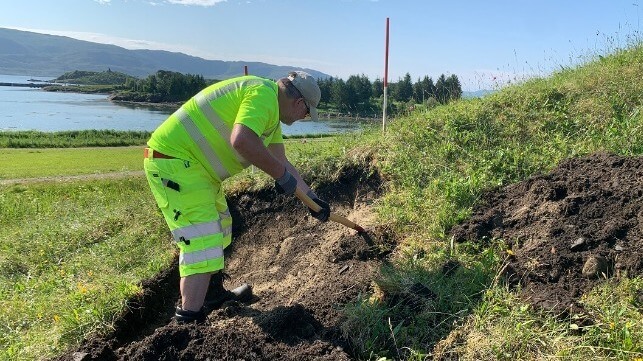
Archaeologist Lars Forseth excavating at Herlaugshaugen. Photo: Geir Grønnesby, NTNU University Museum.

PUBLISHED DEC 10, 2023 2:12 PM BY GEMINI NEWS


[By Frid Kvalpskarmo Hansen]

This summer, archaeologists and a metal detectorist conducted a small survey of Herlaugshaugen at Leka in the northern part of Trøndelag County. They found something amazing.

The goal was to date a burial mound and find out if it contained a ship. They carried out the surveys on behalf of the Norwegian Directorate for Cultural Heritage and in collaboration with Trøndelag County Authority.

The archaeologists were over the moon when they found large rivets confirming that this was indeed a ship burial, and their enthusiasm didn’t subside when the finds were recently dated.

“The mound was constructed in approximately 700 CE. This is called the Merovingian period and precedes the Viking Age. This dating is really exciting because it pushes the whole tradition of ship burials quite far back in time,” said Geir Grønnesby, an archaeologist at the NTNU University Museum.

Grønnesby was project manager for the dig. He says the date for the ship has many consequences.

You don’t build a ship of this size without having a reason for doing so.

“It tells us that people from this area were skilled seafarers – they could build big ships – much earlier than we previously thought.”

A new perspective on the Viking Age

The development of shipbuilding has played a key role in the discussion about when and why the Viking Age started. We can’t say that the Viking Age started earlier based on this dating, but Grønnesby says that you don’t build a ship of this size without having a reason for doing so.
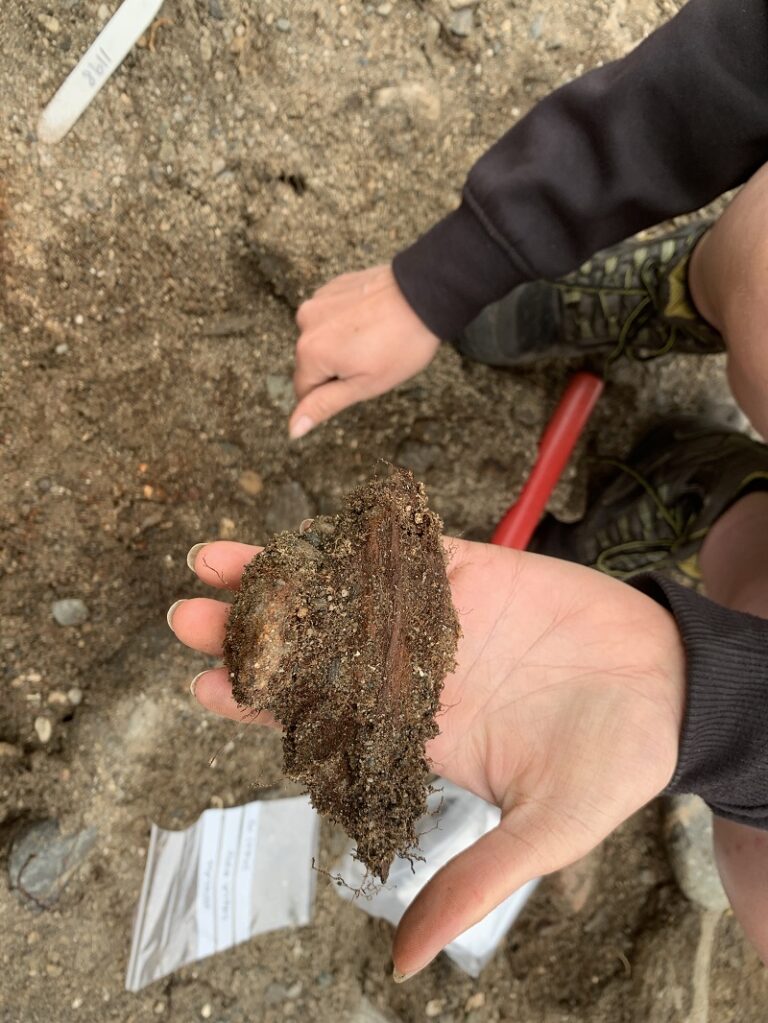
Wood corroded tightly around a nail. Photo: Geir Grønnesby, NTNU University Museum.

“The burial mound itself is also a symbol of power and wealth. A wealth that has not come from farming in Ytre Namdalen. I think people in this area have been engaged in trading goods, perhaps over great distances.”

He is supported by archaeologist Lars Forseth from Trøndelag County Authority who also participated in the surveys this summer.

“I think that the location along the shipping route plays a key role in understanding why Herlaugshaugen burial mound is located at Leka. We know that whetstones have been traded from Trøndelag to the continent from the mid-700s onwards, and goods transport along the route is key to understanding the Viking Age and developments in ship design before the Viking Age,” Forseth said.

A seated skeleton and sword in Herlaugshaugen burial mound

The Herlaugshaugen burial mound has a diameter of over 60 meters and is one of the largest burial mounds in Norway.
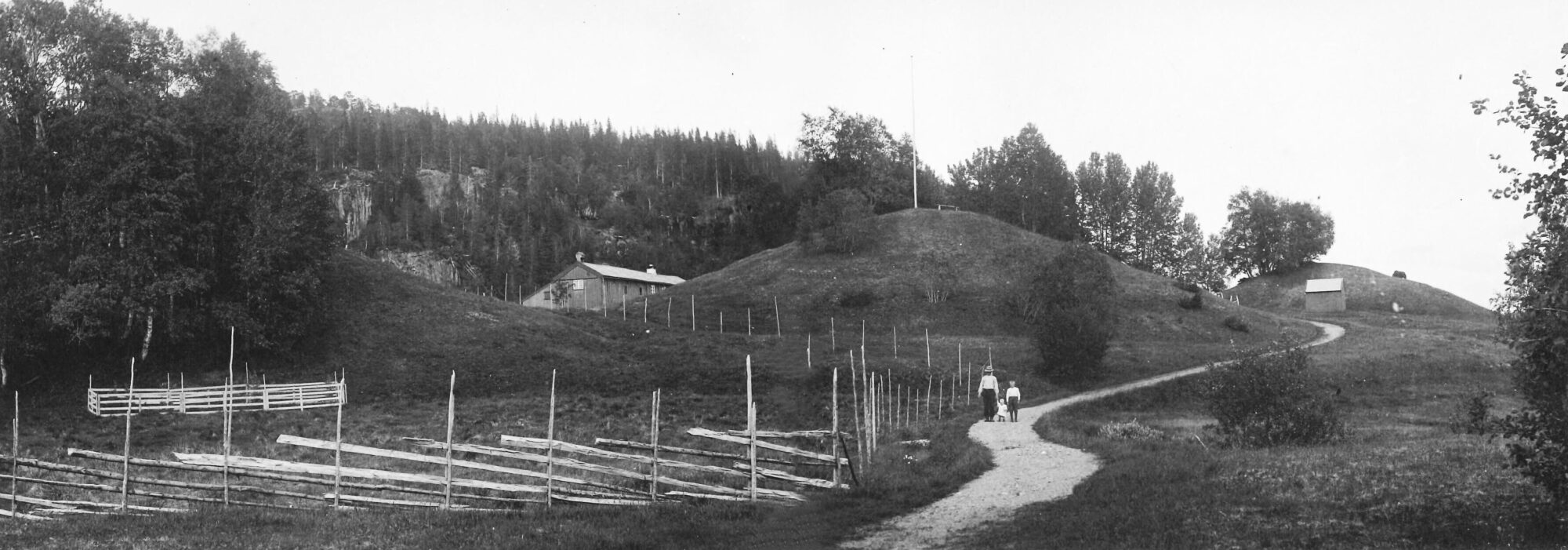
Three grave mounds photographed in Bertnem in the 1920s. Photo: Theodor Petersen.

The mound was excavated three times during the late 1700s, and according to the accounts that exist, some kind of wall, iron rivets, a bronze cauldron, animal bones and a seated skeleton with a sword were found.

The skeleton was exhibited for a while at Trondheim Cathedral School as King Herlaug, but no one knows what happened to it.

“Unfortunately, these finds disappeared in the early 1920s. The skeleton was exhibited for a while at Trondheim Cathedral School as King Herlaug, but no one knows what happened to it,” Grønnesby said.

“All the other finds have also disappeared. It is said that the bronze cauldron was melted down and made into shoe buckles,” he said.

Connections to the power elite in Sweden and England

The Herlaugshaugen burial mound has been dated to the Merovingian Period (ca. 550 to 800 CE), which is just before the Viking Age. Generally speaking, not many archaeological finds are made from this period, but the first ship burials occurred during its early stages. Among these are the spectacular ship burials at Vendel and Valsgärde in Sweden, where people were buried lying on down pillows with ornate weapons and helmets.

Could there have been a connection between the ruling class at Vendel and Valsgärde and the people who built the burial mound at Leka?

That is not an unreasonable assumption: Not far from Leka – further into Namdalen valley – there are even more large burial mounds, which archaeologists believe are from the Merovingian Period.

“In fact, about 10 percent of all the large burial mounds in Norway are found in Namdalen. These are mounds of more than 37 meters in diameter, and it is almost inexplicable that an anonymous valley in Norway appears to be a key area for large-scale burial-mound building,” says Lars Forseth.

“We don’t know what these large mounds contain because hardly any of them have been investigated. But archaeologists have wondered for a very long time whether there is a connection between Namdalen and the areas of Vendel and Valsgärde in Sweden,” Grønnesby said.
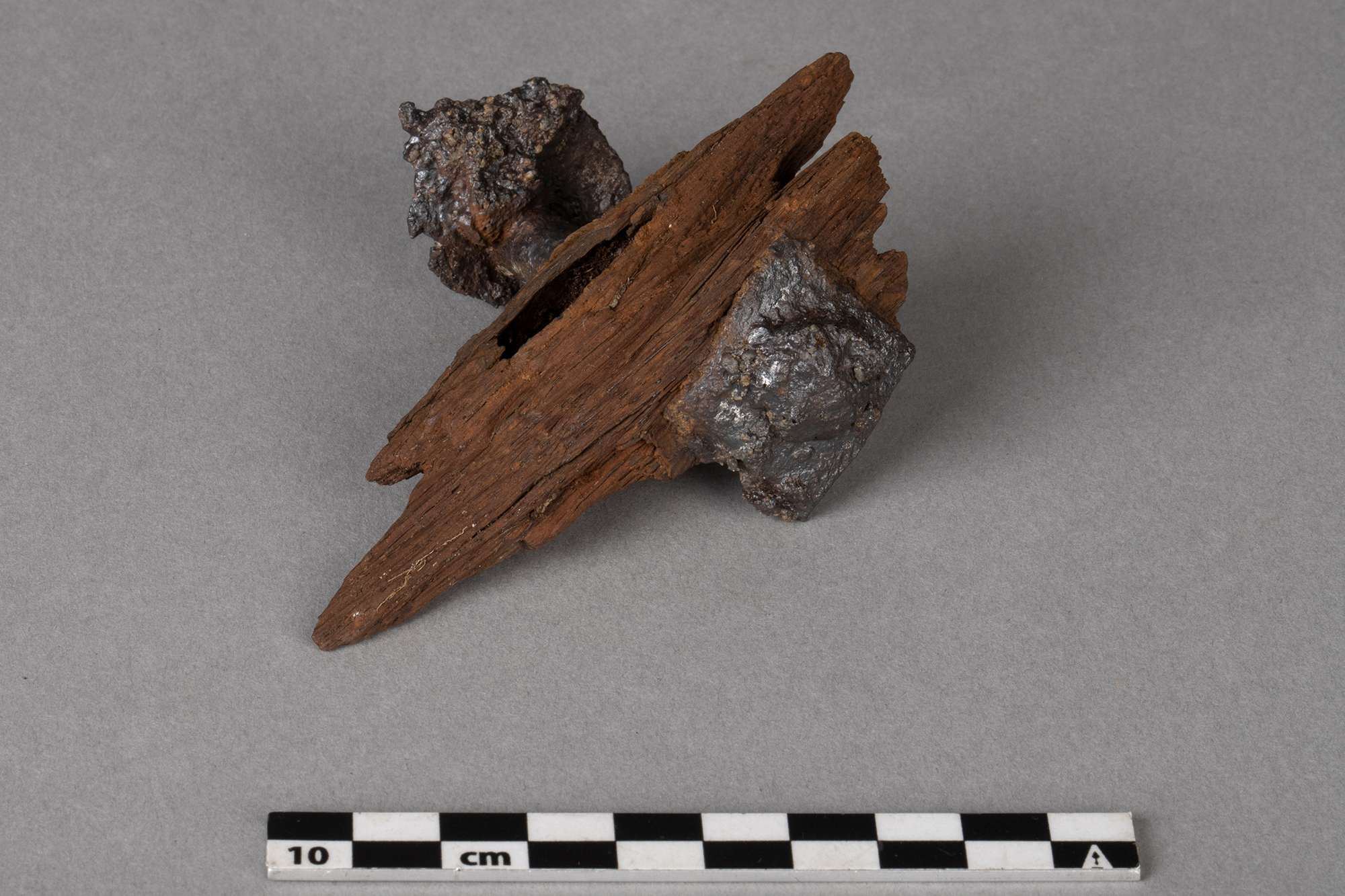
One of the ship nails after it has been cleaned up by University Museum conservators. Photo: Freia Beer, NTNU University Museum

Grønnesby adds that Vendel and Valsgärde also have similarities with the fantastically rich ship burial in Sutton Hoo in England. The Sutton Hoo burial is also dated to the Merovingian Period, and is considered the oldest monumental ship burial.

“Should the ship in Herlaugshaugen burial mound be seen in connection with the burial mounds in Namdalen, Vendel, Valsgärde and Sutton Hoo, or is it a different phenomenon? This is a very exciting question, and something we want to explore further,” says Grønnesby.

This article appears courtesy of Gemini News and may be found in its original form here

The opinions expressed herein are the author's and not necessarily those of The Maritime Executive.

 

Re-Imagining Africa’s Agency in Global Maritime Security

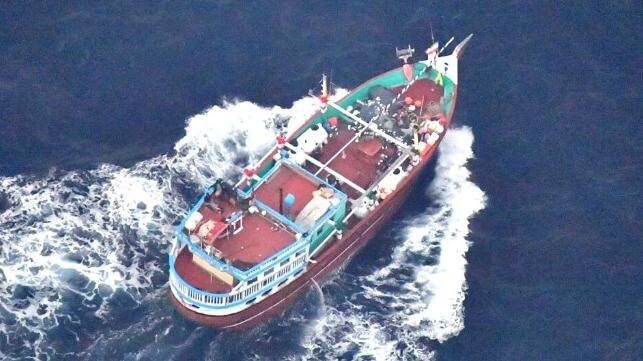
The suspected pirate vessel Almeraj 1 (EUNAVFOR)

PUBLISHED DEC 10, 2023 3:59 PM BY BRIAN GICHERU KINYUA


Over the past month, the global maritime community has woken up to the possible re-emergence of Somali piracy, following the capture of the fishing vessel Almeraj 1 off the coast of Somalia. While security agencies are still investigating the matter, some parts of the western Indian Ocean and the Gulf of Aden have recently seen a rise in the number of security incidents affecting merchant shipping.

Owing to the checkered history of maritime security along the East African coastline, these events should be concerning. The ongoing Israel-Hamas war has created suitable conditions for militant groups in the southern Red Sea and Gulf of Aden to threaten commercial shipping.

Regional stakeholders seek a long-term solution to the persistent maritime security challenges along parts of the African coastline. This was the crux of a ministerial conference organized last month by the Republic of Mauritius, in partnership with the Indian Ocean Commission (IOC). To get a sense of the conference’s resolutions, TME African Correspondent Brian Gicheru spoke with Raj Mohabeer, the head of Maritime Security at the IOC.

The IOC has established the Regional Maritime Information Fusion Centre (RMIFC) in Madagascar and the Regional Centre for Operational Coordination (RCOC) in Seychelles. What role do these two centers play?

The two centers are progressing very well, slowly but surely, and it is important to note they are complementary and constitute jointly the executive arm of the Maritime Security Architecture (MSA) of the Western Indian Ocean.

For RMIFC, it provides a mechanism for information sharing and monitoring movement of vessels within the WIO region. The aim is to detect abnormal movements and provide enhanced maritime domain awareness for countries in the region. The analysis of the RMIFC may lead to the identification of what we call as “vessel of interest” (VOI), which then is notified to the other center, the Regional Centre for Operational Cooperation (RCOC) for inspection of the said ‘VOI’.

Essentially, the RCOC pulls together naval and other necessary security assets to promote maritime safety and security in the WIO. In other words, it provides a cooperation mechanism for regional naval missions for countries party and partner to two Maritime Security Agreements signed in 2018.

In terms of progress, the centers became fully operational in September last year, just after the Covid pandemic period. So far, the MSA has led to 18 operations. Vessels carrying nearly two tons of drugs were intercepted. On other occasions we found vessels engaging in IUU and endangered species fishing, illegal migration, and have also conducted search and rescue missions. In addition, RMIFC and RCOC are in close collaboration with other partners, such as the Operation EUNAVFOR-Atalanta and the British naval forces.

There are numerous actors involved with maritime security in Western Indian Ocean. Are there synergies between these stakeholders, or does it lead to overlapping of duties?

Recently, the 21 signatory states of the IMO-led Djibouti Code of Conduct/Jeddah Agreement (DCoC/JA) have agreed to use the RMIFC and RCOC as their regional centers. This is excellent as it will avoid duplication of efforts and overlapping, while at the same time significantly improving the regional maritime capability. It will also help to create coherence between the existing maritime security mechanisms.

There is a dialogue to also link up the Contact Group on Illicit Maritime Activities (CGIMA, formerly the Contact Group on Piracy off the Coast of Somalia, CGPCS) to ensure coherency and complementarity.

The upcoming launch of the new Safe Seas Africa Programme funded by the EU includes a component which will be implemented by the IOC. This will ensure continuity of the operationalization of the MASE Security Architecture of the Western Indian Ocean, while facilitating the interconnection of existing maritime security architectures – hopefully from the Gulf of Guinea, through the Western Indian Ocean to the Western Pacific.

At the conference, the idea of the African Coast Guard Functions Forum was endorsed. Tell us more.

Initially, this idea came from Moroni Declaration signed back in June, which was part of the ,inisterial conference on Blue Economy organized under the aegis of the Comorian Chairmanship of the African Union (AU).

Ideally, the African Coastguard Functions Forum is meant to bring together African coastguards for purposes of regional collaboration and building trust among neighboring institutions having several functions in common. You find that neighboring coastal states do not have any cooperation whatsoever in addressing maritime security threats. Most countries do not have sufficient assets in their maritime domains, and a Coastguard Functions Forum would come in handy.

The Italian Coast Guard, as the chair of the Mediterranean Coast Guard Functions Forum, has already pledged to offer technical assistance needed for establishment of the African Coast Guard Forum. Kenya has also proposed to host the first African Coast Guard Functions Forum next year.


Op-Ed: US Coast Guard Must Prosecute Former Leaders Who Covered Up Abuse

USCGA cadets
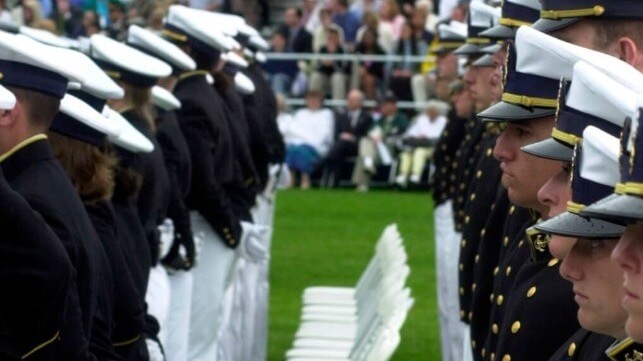
Cadets at U.S. Coast Guard Academy commencement, 2003, during the time period covered by Operation Fouled Anchor (USCG file image)

PUBLISHED DEC 10, 2023 4:06 PM BY DENISE KREPP


The Senate Homeland Security and Governmental Affairs Committee is holding a hearing this Tuesday regarding sexual harassment and sexual assault in the Coast Guard. Survivors spanning decades of service to the United States will testify about horrific crimes that occurred under the watch of countless Coast Guard leaders.  The end result must be the recall and prosecution of those leaders for failure to prosecute known crimes.

One of the Coast Guard’s antecedent agencies is the U.S. Lighthouse Service.  Hundreds of lighthouses were built along the coasts - New London Ledge Light, Mission Point Lighthouse, Bolivar Lighthouse. These sturdy structures with bright, sweeping lights warned nearby ships of danger. 

Like lighthouses, Coast Guard personnel warned service leaders of dangers, rapes and sexual harassment. Their lights were voices highlighting crimes that destroyed lives.

In 2006, a U.S. Coast Guard Academy cadet was prosecuted for assaulting six female cadets. A former Coast Guard Academy cadet shared her story with Congress, highlighting the retaliation she faced after accusing a fellow cadet of sexual assault. U.S. Representative Christoper Shays organized a panel, which included Coast Guard participants, entitled "Sexual Assault and Violence Against Women in the Military and at the Academies." The bright, loud voices warned of danger but the danger was not addressed. 

Eight years later I testified twice in January 2014 about sexual assault in the military before a Congressionally mandated panel. Later that year, the Coast Guard initiated Operation Fouled Anchor, but the danger didn’t subside.

In 2015, a former US Coast Guard Academy cadet was charged with raping a fellow student at the school in 1997. The courts ruled that the government waited too long to prosecute the alleged rapist, so the case was dismissed.

Last month, current Coast Guard leaders and personnel, survivors, and allies participated in a “healing event." Admiral Fagan shared that she was committed to ensuring a safe environment for current Coast Guard personnel. Survivors sat in stunned silence wondering why she refused to use her positional power to hold past leaders accountable for the dangerous waters that ensnared countless male and female victims.

There will be several witnesses at the Senate hearing on Tuesday. They will testify about crimes that occurred in the 1970s when women were first admitted to the US Coast Guard Academy. They’ll testify about rapes perpetrated against women in the 1990s, early 2000s and today. Their testimony will be magnified by supporting officer and enlisted accounts shared with the committee chronicling who was involved in the crimes and the cover-up.

Younger survivors are using social media like Instagram to share their stories. Last month, one shared her story of three rapes. The first by a superior. The second by a friend. The third was by an international cadet. The survivor shared “(f)or too long I’ve been kicking and screaming but only in my head. So here I stand exhausted, raped, angry, emotional, scared, but resolute in my will to kick and scream on the outside too.”

Coast Guard survivors warned leaders of the dangers, but leaders failed to address them - so it’s time for these same leaders to be recalled and prosecuted. Additional laws and policies aren’t needed. Admiral Fagan has the positional power today to do so under Article 133 of the Uniform Code of Military Justice.

It’s my recommendation as a former Coast Guard officer that Admiral Fagan use this authority, be the lighthouse that all survivors are looking to, and hold the individuals who covered up the crimes accountable.

K. Denise Rucker Krepp is a former Maritime Administration Chief Counsel and former Coast Guard officer.

The opinions expressed herein are the author's and not necessarily those of The Maritime Executive.
 

ONE Containership Requires Repairs After Suez Canal Grounding

Containership refloated in Suez Canal
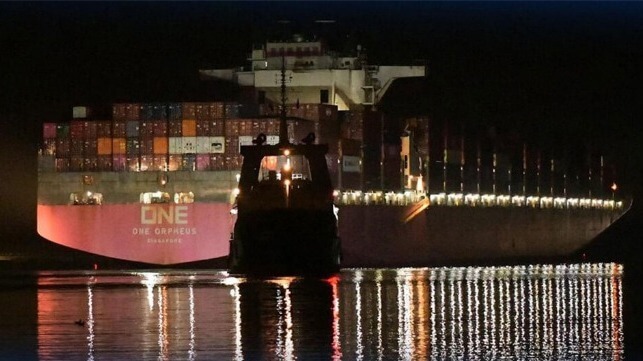
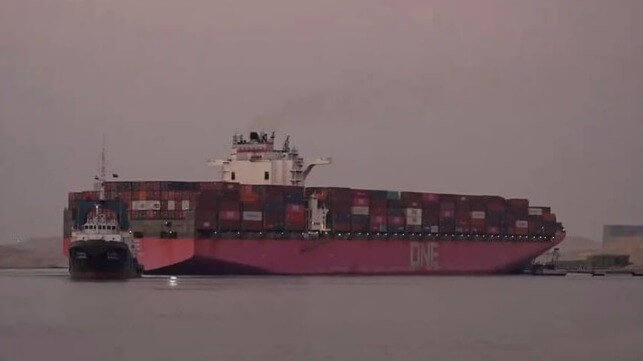
ONE Orpheus was refloated and moved out of the Suez Canal last week (SCA photo)

PUBLISHED DEC 11, 2023 1:12 PM BY THE MARITIME EXECUTIVE


Ocean Network Express (ONE) is advising customers that the ONE Orpheus which was involved in last week’s incident at the Suez Canal will require repairs before proceeding. The vessel which had been due to reach Rotterdam in the Netherlands at the end of this week has been holding in the anchorage off Port Said, Egypt since it was refloated and exited the Suez Canal early on December 7. 

According to the advisory to customers, it has been determined that the 104,525 dwt containership will “undergo temporary repair” starting today, December 11. No additional details were provided on the extent of the repairs required. The company is telling customers that it will “keep you updated on the progress and vessel’s schedule once more information will be available.”

Last week, ONE confirmed that the vessel, which has a capacity of 9,040 TEU and is 1,102 feet in length (336 meters), had grounded on December 6 after striking a floating bridge in the Suez Canal. Pictures showed the vessel diagonally across most of the northbound channel of the canal in an area north of Great Bitter Lake.

The canal authority sent four tugs to assist and after approximately nine hours the vessel was freed and able to resume the northbound journey in the canal. It reached the anchorage around 0200 local time approximately 16 hours after the incident was reported.

ONE said that underwater surveys were commencing on December 8 for a detailed assessment of the vessel’s condition. Photos from the accident showed a scrape or possibly a gash along the side of the hull from where the vessel penetrated the floating bridge. Claims consultant WK Webster in its casualty notice commented, “Reports indicate that the vessel sustained a significant breach to the starboard hull above the waterline as a result of the collision.”

No indication was given on how long the vessel might remain in Egypt. After the Even Given grounding in March 2021, the vessel was detained in Egypt for more than three months not departing till the beginning of July while negotiations were underway to settle the claims filed by Egypt for lost business during the six days the vessel was stuck in the canal and the harm caused to the canal’s reputation. That was in addition to the salvage claims. 

The Panama Maritime Administration in its investigation issued more than a year after the grounding was critical of the actions of the pilots saying they had been arguing about how to handle the vessel as it encountered strong winds and the current in the Suez Canal. They also criticized the captain of the Ever Given for not intervening in the navigation of the vessel.


ONE Containership Remains Anchored off Egypt Awaiting Inspection

containership aground in Suez Canal
ONE Orpheus was freed with the assistance of four tugs (Suez Canal Authority)

PUBLISHED DEC 8, 2023 12:23 PM BY THE MARITIME EXECUTIVE


ONE Orpheus the container vessel that disrupted northbound traffic in the Suez Canal on December 6 remains at anchor off Port Said, Egypt. Ocean Network Express (ONE) wrote to customers that it will be advising them of the vessel’s schedule once more information is available.

The vessel was set to have an underwater inspection today to assess its conditions after it was freed on Wednesday night and moved to the anchorage north of the Suez Canal. ONE reports that the vessel ran aground at approximately 1030 local time on Wednesday. The Suez Canal Authority used four tugs to help free the vessel which ONE reports was refloated after about seven hours. 

The Suez Canal Authority reported that at least six vessels in the northbound convoy behind the ONE Orpheus were also ordered to drop anchor during the incident. Included was an MSC containership as well as tankers and LPG carriers. The Authority had planned to divert the northbound traffic into the western channel after the southbound convoy had cleared the area. 

The ONE Orpheus struck a floating bridge but it is unclear if the vessel suffered any significant damage. Claims consultants WK Webster in its casualty report says, “Reports indicate that the vessel sustained a significant breach to the starboard hull above the waterline as a result of the collision, but there are currently no reports of any damage to cargo stowed on board the vessel.”

After being refloated at approximately 1930 local time, the containership was escorted north to exit the Suez Canal. By 0200 on December 7 local time, it was in the anchorage. 


At 104,525 dwt, the ONE Orpheus, built in 2008, is far from the largest container vessel to transit the Suez Canal. The vessel is 1,102 feet (336 meters) in length with a nominal capacity of 9,040 TEU. Reports indicate it is traveling with a draft of approximately 43 feet. By comparison, the newest classes of ULCVs transit the Suez Canal laden on their northbound voyages with a draft of approximately 52 to 53 feet.

The Suez Canal Authority is reporting that the vessel suffered a malfunction with its steering and its rudder causing it to hit the bridge. There has been no mention of winds on Wednesday, but questions have been raised if the vessel might have encountered a current.

Navigational issues and the management of vessels was of course a key issue that emerged during the investigations into the 2021 grounding of the Ever Given. The Panama Maritime Authority’s Marine Safety Investigation Report was critical of the Suez Canal pilots and their performance during the Ever Given’s transit and their actions leading up to the grounding.

ONE is telling customers that it regrets the inconvenience caused by the incident and will keep them apprised of future developments. The ONE Orpheus had been due to reach Rotterdam on December 15.


Ukraine Gets New Mine Countermeasures Vessels

Mine countermeasures
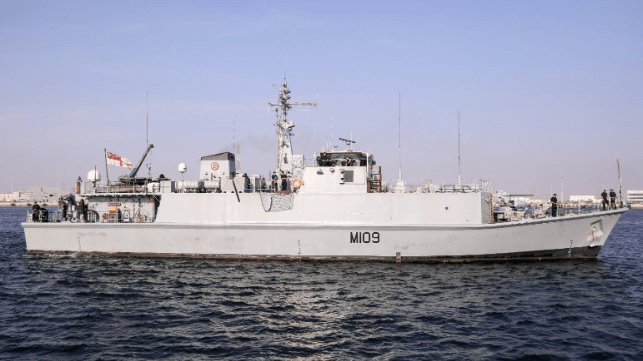
File image courtesy Royal Navy

PUBLISHED DEC 10, 2023 10:55 PM BY THE MARITIME EXECUTIVE


Ever since it ended the Black Sea Grain Initiative earlier this year, Russia has been determined to cripple Ukraine’s grain exports, and one of its tactics has been to lay sea mines targeting commercial ships. In recent months, at least three ships have been damaged by mines along the route, and Ukraine says the number could be as high as nine ships.

To counter Russia’s covert mine-planting missions, which are aimed at deterring commercial shipping from serving Ukraine's grain export trade, Ukraine is set to acquire two minehunting ships from the Royal Navy.

The transfer of the mine countermeasures vessels (MCMVs) is part of a new initiative dubbed the Maritime Capability Coalition, which has been established with the mission of helping Ukraine export its grain. The coalition, which will be led by the UK, includes Norway and is open to more members. It is designed to strengthen Ukraine’s maritime capabilities over the long term, enhancing its ability to ensure security in the northwestern Black Sea.

The UK will transfer two of its three Sandown Class mine-hunting vessels. Measuring 52 meters, the vessels come equipped with two underwater remote-controlled mine-disposal vehicles. These are fitted with a lighting system, low light level black and white camera and color camera, and are controlled via a 2,000 meter fibre-optic cable. The vessels are also fitted with high-resolution sonar.

“These minehunters will deliver vital capability to Ukraine which will help save lives at sea and open up vital export routes, which have been severely limited since Putin launched his illegal full-scale invasion,” said Grant Shapps, UK Defence Secretary.

The UK continues to be among the top supporters of Ukraine since the Russian invasion, allocating $5.7 billion in military support so far. 

Ukraine is projecting a drastic drop in exports despite a bumper harvest. Data by the Ukrainian Ministry of Agrarian Policy and Food show the country has exported around 8.7 million tonnes of grain and legumes since July 1. This is around a 30 percent reduction from the 12.3 million tonnes exported in the same time period last year.

Commercial shipping is a lifeline for Ukraine, and its government is working hard to ensure that its trade is attractive for shipowners. Last month the country partnered with UK company Marsh McLennan to launch a new ‘Unity Facility’ that will provide affordable shipping insurance for grain and other critical food supplies globally from its Black Sea ports.


Russia Insists on an Expanded Boundary in the Arctic Ocean

Russian icebreaker under way
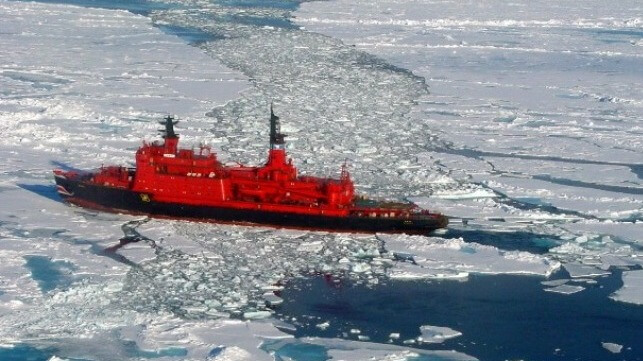
File image courtesy Rosatomflot

PUBLISHED DEC 10, 2023 12:58 PM BY THE MARITIME EXECUTIVE


Russia has reiterated its ambition for an extended continental shelf in the Arctic Ocean. During the 13th international Arctic Forum held last week in St. Petersburg, Russian Navy chief Admiral Nikolai Yevmenov delivered a speech underlining the Arctic as crucial to Russia’s national security interests.

“There is need for a full-scale expansion into the continental shelf beyond the borders of the 200-mile exclusive economic zone,” Yevmenov said.

Yevmenov observed that there has been intensifying military activity in the Arctic by the U.S and NATO, which he considered a potential conflict in the region. Further, Admiral Yevmenov stressed that virtually all countries in the region have updated their doctrinal documents defining priority national interests in the Arctic. According to him, some of the countries consider Russia’s activities in the region as the key challenge to their own interests and have plans to curb the Russian influence.

“The development of our military component in the Arctic is a forced measure to ward off threats against Russia and stem aggressive actions by other countries. The main instrument for enforcing Russia’s policy in the World Ocean and the Arctic is the Navy, which plays the role of a deterrent factor,” said Yevmenov.

Russia initially made a claim for an expanded Arctic boundary back in 2001. At the time, Moscow filed a submission to the United Nations seeking an expanded Arctic Seabed, which is believed to contain untapped reservoirs of oil and gas. However, the UN Commission on the Limits of the Continental Shelf (CLCS) rejected the submission on the basis of lacking sufficient scientific evidence. In 2015, Moscow re-submitted an updated claim followed by another one in March 2021. In all, Russia’s continental shelf as proposed would encompass almost 70 percent of the Arctic Ocean, overlapping EEZ’s of other Arctic countries such as Denmark and Canada.

Admiral Yevmenov’s strong interest in the Arctic could have stemmed from his stint as the commander of the Russian Northern Fleet between 2015- 2019. During this period, Yevmenov led the expansion of Russia’s military capacities in the Arctic, acquiring new submarines and surface combat vessels for the Northern Fleet based in the Kola Peninsula.

Yemenov pledged navy’s support for the operation of the Russia’s Northern Sea Route (NSR) as a strategic national traffic artery. At the Arctic Forum, Sergey Zybko, head of the NSR operator, announced that year-round LNG deliveries to Asia via the route would begin next year.

“Starting from January, gas carriers will move under icebreaker support, including during those months they never sailed before - March, April and May. This will mean year-round navigation,” said Zybko.

Historically, navigation along the NSR usually starts in June and is halted in December due to thick ice. During this period, Russian LNG deliveries are routed to the west, primarily for European customers.


Dark Fleet Tanker Runs Aground Near Singapore

Karimun
Courtesy KSOP Karimun

PUBLISHED DEC 7, 2023 10:27 PM BY THE MARITIME EXECUTIVE


The "dark fleet" tankers that carry oil from Russia, Venezuela and Iran are a serious inconvenience for Western sanctions enforcement, but for maritime stakeholders and coastal states, they are a serious safety and pollution risk. The average age of these vessels trends high, especially in the Venezuelan and Iranian trades, where the average ship is 20 years old - the typical retirement point for respectable tankers. Aging equipment and light regulation tend to produce accidents, and dark fleet tankers do get into trouble - like the tanker Liberty, which went aground in the Strait of Malacca last weekend. 

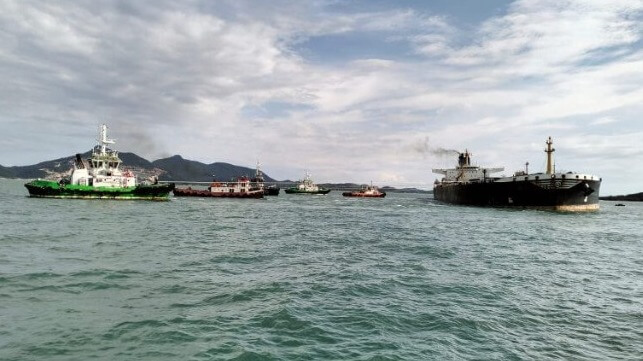
The Liberty is a Cameroon-flagged Suezmax of 23 years of age, and according to TankerTrackers.com, she is carrying a cargo of one million barrels of Venezuelan fuel oil.  AIS data confirms that Liberty has a "dark fleet" trading pattern. She  called at the Russian tank farm complex at Ust-Luga in June, then spent August, September and October driving in geometric circles off the Angolan coast. The location has been previously identified with the Venezuelan "dark fleet" trade, in which tankers fake their location in Angola in order to hide their true operations in Latin America.

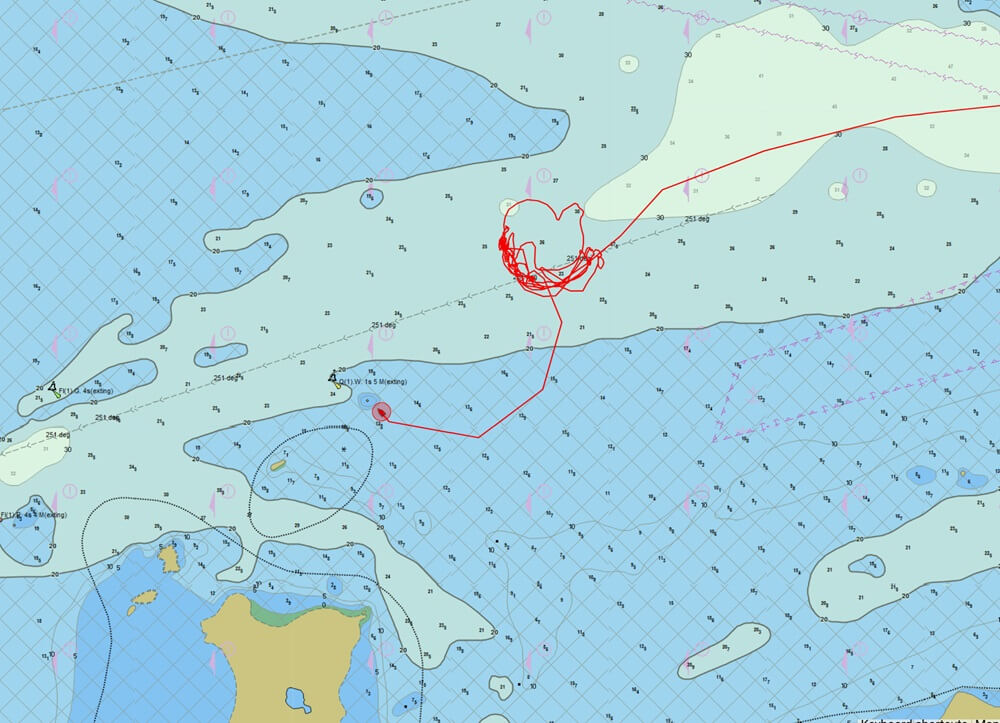
After her business in the Atlantic basin, Liberty rounded the Cape of Good Hope and crossed the Indian Ocean, arriving Singapore on November 24 and anchoring north of Karimunbesar Island. On December 2, she departed the anchorage and headed towards shore, making four knots. The tanker promptly ran aground on a charted shoal in 11 meters of water, AIS tracking appears to show. 

Liberty's final trackline from her anchorage to the shoal (Chart courtesy Pole Star)

According to regional port authority KSOP Karimun, the grounding occurred at about 1100 hours local time. Indonesian authorities said that Liberty was carrying 130,000 tonnes of fuel oil and 31 crewmembers, and had gone aground on a rocky bottom. 

Five tugboats were dispatched to the scene to assist. A spokesperson for KSOP Karimun told local media that the responders are waiting for the shipowner to transfer off some of the fuel oil to another vessel, which would reduce Liberty's draft and improve the odds of refloating her. Meanwhile, the port authority has prepared an oil containment boom as a precautionary measure. 

As of Thursday, the ship's AIS transmission still showed her in the same location. 

It is the second time in little more than a year that a dark fleet tanker has gone aground in the Straits of Malacca and Singapore. In October 2022, the 21-year-old tanker Young Yong went aground near gas pipelines off Takong Kecil in the Riau Islands. The U.S. Treasury blacklisted the Young Yong for involvement in a Venezuelan-Iranian fuel trading scheme in November 2022, adding complexity for the salvors. The vessel was refloated safely later that month. 


UK Warns of “Yemeni Authorities” Contacting Vessels in the Red Sea

Yemen
UKMTO issued an alert about calls for supposed "Yemeni authorities" (UKMTO)

PUBLISHED DEC 8, 2023 8:13 PM BY THE MARITIME EXECUTIVE


Unidentified individuals claiming to the “Yemeni authorities” appear to be attempting to commander vessels sailing in the southern Red Sea area by issuing commands over the radio. While the efforts have not been backed by any direct assault on the ships, warnings are being repeated for vessels to exercise caution while the U.S. authorities have now directly associated the attacks with the regime in Iran.

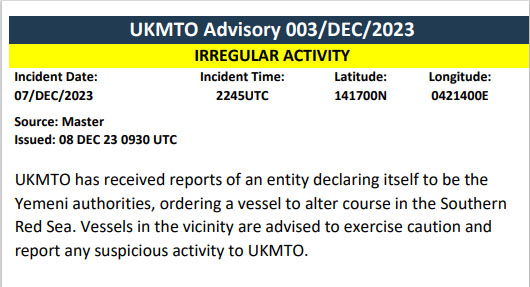
The UK Maritime Trade Organization (UKMTO) which coordinates between the Royal Navy and the commercial shipping industry, issued a new safety alert on Friday, December 8, warning of new efforts by unknown individuals in Yemen. They are advising caution while requesting reports on any suspicious activity in the region.

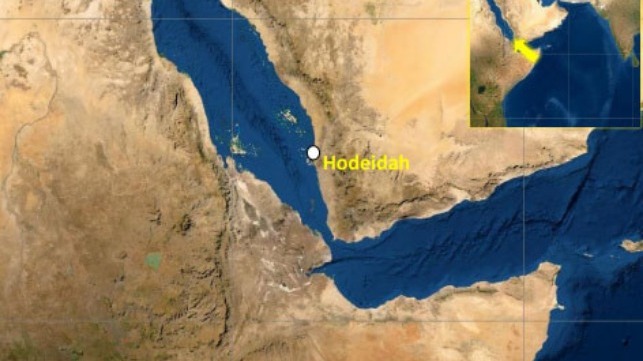
According to the alert, the latest incident took place late on December 7 when an unidentified vessel sailing in the southern Red Sea near the port of Hodeidah in Houthi-controlled regions of Yemen was contacted. Individuals declaring to be the “Yemeni authorities” reportedly ordered a vessel to “alter course.” The vessel appears to have ignored the command and proceeded without further incident, but the UK authorities are warning of this tactic.

It is not the first time this has been reported and so far, there has been no follow-up to the radioed commands. After the three merchant vessels were attacked on Sunday, December 3, there were reports that one of the vessels received a similar contact also ordering the vessel to alter course. The reports said in that instance the vessel claimed to have been dealing with damage from the attack and unable to change course. The owners of the ships that came under attack later issued statements saying that their vessels had not suffered significant damage and had been able to continue on their voyages.


U.S. authorities however did report further drone sightings including a downing of another drone that was approaching the area near a U.S. destroyer. Officials said the captain of the USS Mason decided to down the drone because of its position, but it was unclear if the drone was attempting to target the warship.

S&P Global reported today that two shipping companies, Zodiac Maritime and Eastern Pacific Shipping, both with Israeli owners, have however decided to divert their vessels. Neither company responded to S&P’s requests for information, but they believe that the companies are rerouting gas carriers away from the Red Sea.

All of this came as Reuters was reporting that United States officials had publicly stated that Iran is involved in the planning and execution of drone and missile attacks by the Houthi rebels. Security advisers to President Joe Biden would not rule out direct U.S. actions against the Houthis if the attacks on civilian shipping continued.

“The Houthis continue to receive funding and support from Iran, and the result is unsurprising: unprovoked attacks on civilian infrastructure and commercial shipping, disrupting maritime security and threatening international commercial trade,” said U.S. Under Secretary of the Treasury for Terrorism and Financial Intelligence Brian Nelson. 

On Thursday, the U.S. Department of the Treasury’s Office of Foreign Assets Control (OFAC) used counterterrorism regulations to sanction 13 individuals and entities that the U.S. said were responsible for providing tens of millions of dollars of foreign currency to the Houthis in Yemen. They accused the individuals of using a complex network of exchange houses to sell Iranian commodities and funnel money to the rebels. The U.S. vowed to continue to disrupt the financial activities that “enable these destabilizing activities.”

Discussions are also reported to be continuing about expanding the current multinational task force operating in the Persian Gulf region and the Indian Ocean to encompass more areas including the Red Sea. There are also reports that convoys have been discussed as a means of providing greater security to commercial vessels sailing in the Red Sea and transiting the Bab El Mandeb Strait off the coast of Yemen.

French Frigate Shoots Down Two Drones Over Red Sea

The destroyer USS Carney shoots down a Yemeni-launched drone over the Red Sea, Dec. 2023 (USN)

PUBLISHED DEC 10, 2023 10:25 PM BY THE MARITIME EXECUTIVE


On Saturday night, a French warship shot down two drones over the Red Sea, adding to a growing list of encounters between Western warships and UAVs launched from Yemen. 

In a statement, the French general staff reported that the frigate Languedoc identified and destroyed "two identified threats" that were "headed straight towards her." The intercepts occured several hours apart, first at 2300 hours local time and then again at 0130 hours Sunday. 

The encounter occurred about 60 nm off the coast of Hodeidah, Yemen, far from any shore. Yemen's Houthi rebel faction is known to possess Iranian-built Samad, Shahed and Ababil suicide drones, which have more than adequate range to reach across the Red Sea. These are relatively low-tech, inexpensive devices: the estimated price of a Shahed-136 is in the range of $20,000.   

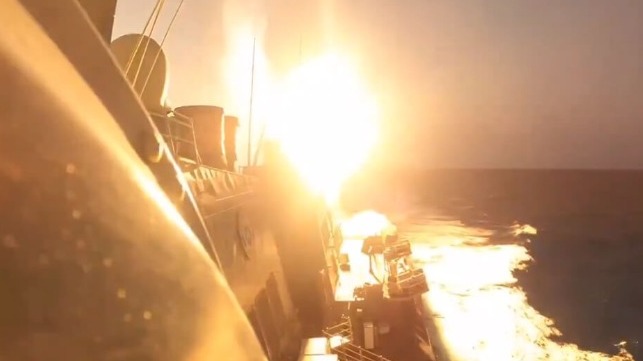
A video released by the U.S. Navy on Saturday shows that the drone shootdowns are an expensive endeavor. The video, produced by the crew of the destroyer USS Carney, shows the ship launching multiple SM-2 or Evolved Sea Sparrow missiles from its VLS cell launchers. Depending on purchase batch and missile type, these rounds are priced at about $1.0-2.1 million, about 50-100 times the price of a Shahed-136.

The White House has said that it wants to form a new coalition of international partners to assure maritime security in the region. The new group would draw on the membership of the American-led Combined Maritime Forces coalition, and White House National Security Council spokesman John Kirby said last week there have been conversations with "several key partners that are interested in coming aboard." It would be the third international maritime security partnership for the Red Sea and Gulf of Aden, in addition to the EU-led EUNAVFOR Operation Atalanta and the CMF's existing CTF-153. 

The U.S. Treasury has also announced sanctions on a network of Iranian-backed money launderers who have funneled funds to the Houthi movement. However, the White House has stopped short of re-designating the Houthi faction as a terrorist organization. The Houthi rebels were on the terrorist list until February 2021, when the Biden administration removed them. 

In a statement Saturday, a Houthi spokesperson warned that all Israel-bound ships may be subject to attacks. 

“If Gaza does not receive the food and medicines it needs, all ships in the Red Sea bound for Israeli ports, regardless of their nationality, will become a target for our armed forces,”

The Houthi group continues to hold the car carrier Galaxy Leader and its crewmembers as hostages near the port of Al Salif. Videos produced by Yemeni influencers suggest that the ship has become a tourist attraction, and even young children have been ferried out to visit the seized vessel.