Monday, December 11, 2023


Liberalism and Its Discontents

The Age of Hypocrisy

These are difficult, perilous, and frustrating times. Many cherished beliefs are coming unraveled. Many once-shared values are no longer shared. And distrust of unshakeable institutions is widespread.

Yet it was only a little more than three decades ago that North America and European intellectuals joined in acknowledging the triumph of the Western world’s “gift” to all: political and economic liberalism. For nearly half a century, Western liberalism had waged a “cold” war against the most serious challenge to its dominance. Apart from the fascist counter-revolution of the 1930s against political liberalism, no movement shook the Western liberal establishment and its self-confidence as did revolutionary socialism. Seemingly, that threat ended in 1991.

In that crowning moment, many saw the values of the European enlightenment as proven to be universal and timeless. It was Francis Fukuyama who boldly stated the unstated in 1992: history had found its dialectical resolution with the victory of capitalism and its political institutions.

If it was a victory in the minds of many, it was a victory in two respects: it proved that there were states — nested in two continents, Europe and North America — that won because they adhered to and promoted the victorious values and also that those values were, in fact, the most advanced, most righteous values of all time.

Europe’s sordid twentieth-century history of imperialism, war, and inhumanity make for a poor example of sustaining enlightenment thought, of meeting standards of equality, democracy, and social justice.

The US, on the other hand, embracing its isolation from European misanthropy, celebrating its youth, vigor, and revolutionary tradition, and whitewashing its own destruction of indigenous peoples, posed as the paragon of political and economic liberalism. Fixated on continental expansion (displacing native peoples), the US came late to the global imperialist scramble, relying more on economic coercion than military might in international affairs.

With some merit, the US points to its progress: its endurance through a great civil war to cast off the bonds of chattel slavery, its past openness to immigration, its uninterrupted history of electoral practice and enduring social and political stability. Of course, on closer inspection, none of these glories bear the weight that they carry within the national mythology.

Nonetheless, for better or worse, they have stood as the best example of the West living up to standards set by the revolutionary transition from feudal despotism, from economic backwardness, and from religious oppression. The US Declaration of Independence remains one of the most advanced ideological reflections of those moments.

Ironically, soon after the dissolution of the USSR — the ending of a great struggle for the allegiance of billions of people — that US liberal image was quickly and greatly tarnished beyond repair. With the need to show an enlightened face to the world apparently gone, the mask came off, revealing a country ruled by an intolerant, privileged, and rapacious ruling class with little regard for the long-professed values of classical liberalism.

A refreshed militarism constructed around a ludicrous war on “terrorism” shaped a destructive, bullying foreign policy. The blowback jihadist attack upon US civilians in 2001 served as the excuse for a government war on citizens’ privacy and civil liberties that was unprecedented in its sweep and its technological sophistication. Little attempt, beyond a feeble, transparent weapons-of-mass-destruction lie, was made to clothe the unprovoked 2003 invasion of Iraq. After only a few years of the twenty-first century, an Orwellian curtain had dropped on US public and private life. The myth that the US was never an aggressor was in tatters.

Both Guantanamo and Abu Ghraib destroyed another myth, the deception that the liberal icon would never torture its prisoners. Philosophical musings about the efficacy of torture were no longer hypothetical.

US pundits freely embraced imperialism, speaking openly of the Old World and ancient empires as precedents for US intervention globally and for the US role as global arbiter and enforcer. The US refused to accept international courts’ findings or democratically determined United Nations resolutions as binding. The negative findings of human rights organizations — willing, useful tools in the Cold War — were shrugged off when they were even modestly critical of US practices.

Liberalism’s promise of universality and equality before the law was shattered by an explosion of racially skewed, draconian incarcerations in the 1990s, filling the US prison system beyond capacity and making a mockery of judicial process and fairness.

The vast inequalities of wealth and income in the US — rising geometrically over the last fifty years — are like sand in the gears of the heralded liberal political mechanism: frequent, informed, and trusted elections. As more than half of the jaded citizens do not bother to register or vote, as election to most significant offices requires a campaign investment well beyond the means of most citizens, as most candidates have sold their souls to wealthy funders, as the media sensationalizes and trivializes issues, the value of “democratic” procedures diminishes sharply.

The sharpest edge of these economic inequalities strikes those minority populations historically denied full participation in civic life — the center-piece of liberalism. Racism, anti-immigrant nationalism, and intolerance rage through the former liberal bastions of Europe and North America.

The failings of economic liberalism have only added to the stresses on political liberalism. Global capitalism has endured several severe shocks since the dawn of the twenty-first century: financial crises, debt crises, and now inflation.

Contrary to Francis Fukuyama and other smug celebrants of Communism’s “demise,” the wheels began to rapidly fall off of the liberal train. By 2023, confidence in the destiny of liberalism had collapsed.

Voters have little recourse but to stay the course or to turn to a new populism with one foot in the past (“Make America Great Again!”) and one foot in the promise of a vague, shapeless future without the corruption and hypocrisy of the mainstream parties.

To be sure, hip, youth-driven new movements arose to meet the collapse of mainstream consensus, promising new, fresh wine in shiny new bottles. Movements like OCCUPY and formations like SYRIZA, PODEMOS, and FIVE STAR dazzled many with their ultra-liberal, ultra-tolerant agenda, aimed at an educated middle and upper-middle strata economically relatively secure, but pushing past older lifestyle and cultural frontiers. When these movements matured, often into politically influential parties confronting the old guard, they proved to be the same old wine, leaving their supporters with an ugly taste.

Today’s politics are at a miserable impasse, with much noise and fractiousness, but, nonetheless, still contained in the narrow vessel of classical liberalism in one flavor or another. Remarkably, the unease among the intellectual strata and the anger of the citizenry has stoked a kind of tribalism. Academics and pundits write and speak of saving “our democracy” as though anyone believes that we can have democracy when candidates, votes, and the news are bought and sold. Their right-wing-oriented counterparts celebrate the sanctity and virtues of the US Constitution, as though it were from God rather than enlightenment reason.

But left and right, in the confines of mainstream politics, are now ready to cast away the tolerance and civility of liberalism to thwart — even proscribe — their political opponents. Freedom of expression, of speech, of association, of advocacy carry little value in today’s sordid world with liberalism’s most self-righteous advocates violating liberalism’s most sacred values and supporting censorship and cancellation.

The once hallowed doctrine of rights has been stretched so far beyond human rights as to be trivial and meaningless, by including corporations, all organic creatures, and even inanimate objects. All now widely accepted to be rights-bearers.

Liberty– the cornerstone of liberal constitutions — is today divorced from its roots in liberation and reduced to personalized and individualized self-indulgence, the decadent product of corporate consumerism.

The few remaining true-believing liberals — people like Glenn Greenwald and Matt Taibbi — are roasted by all sides for their defense of free speech for everyone and “neutral” journalism. In an age of gross hypocrisy, they are true naïfs.

If Karl Marx were alive, he would not be surprised by this turn. He associated classical liberalism’s emergence with the origin and maturation of capitalism. The rise of the bourgeoisie as a class spawned its own ideology, an ideology that broke the chains of hereditary noble privilege and religious obscurantism, and spread hope for the masses consigned to an unchanging future of peasant labor and grinding poverty. That hope for working people — based on the potential of natural, universal human rights, fraternity, and universal suffrage — served to cement the alliance of the bourgeoisie with working people against the nobility and its supporters.

Bourgeois ideology, classical liberalism, challenged the foundations of Medieval privilege based on Divine Right and on fixed stations in life. In place of the old thinking, enlightenment thinkers proposed natural rights– the social counterparts to the natural laws of the emerging sciences. Like the laws of nature, social laws were to be grounded in reason and not God or birthright.

For Western societies, the new ideology was a welcome gift, broadening political participation, enhancing social mobility, freeing economic and scientific development, and creating more democratic political institutions. Accompanying these advances came a conceit that the ascendant classes had revealed universal truths, that the new economic, social, and political orders were the best that could be devised.

Bourgeois academics have been obsessed with providing a rational foundation for this conceit for centuries, but without success.

The young Karl Marx would have none of it; writing dismissively of the bourgeois fetish for natural rights in Bruno Bauer, Die Judenfrage, he said: “None of the supposed rights of man, therefore, go beyond the egoistic man… that is, an individual separated from the community, withdrawn into himself, wholly preoccupied with his private interest and acting in accord with his private caprice…”

He recognized that the bourgeois social apparatus — classical liberalism — “fit” and served, in its time, the emancipation, the liberation of the bourgeois class and to a limited degree the working class. But he also recognized that it was limited by its class perspective. With property and the sanctity of private ownership at the center of classical liberalism, the emancipation of humanity could not be completed.

In the revolutions of 1848 that rocked Europe, all three classes — the nobility, the bourgeoisie, and the proletariat — participated and forged temporary, unstable alliances to secure their diverse goals, a time beautifully captured by Marx’s Eighteenth Brumaire. But the differences between the ascending bourgeois order and a future proletarian order were tersely conveyed by the popular slogan: “Not freedom to read, but freedom to feed!”

Today, capitalism is moribund. Its decline was in plain sight in the last decades of the twentieth century, only to be lifted by its expansion in People’s China and the counter-revolution in the Soviet Union and Eastern Europe. Nonetheless, capitalism’s ability to deliver an adequate standard of living, safety, and security grows weaker with every economic crisis and war. It should come as no surprise that its political and social superstructure, inclusive of the ideologies of economic and political liberalism, would also be in crisis, showing similar signs of decline and dysfunction.

Just as political liberalism rose with the ascent of capitalism, it is falling with capitalism’s decline. The cancer of corruption and greed, the rot of political practice, and the decadence of culture and social media ensure the further demise of the institutions of classical liberalism.

What will replace them?

It is a good time to recall and consider Rosa Luxemburg’s words: “Bourgeois society stands at the crossroads, either transition to socialism or regression into barbarism.”


Greg Godels writes on current events, political economy, and the Communist movement from a Marxist-Leninist perspective. Read other articles by Greg, or visit Greg's website.

Face to Face with Hezbollah

The Many Faces of the Lebanese Shiite Organization

As part of a fact-finding mission to the Middle East in late 2007, one year after Hezbollah concluded a war with Israel, we spent a few days with Hezbollah. I knew that Hezbollah carried heavy baggage, could be threatening, and operated as a state within a state, but it never seemed, as bludgeoning reports insisted, an international terrorist organization. All of the few horrific actions involving Hezbollah have been tit-for-tat revenge attacks for Israeli murder of its cadres, such as the February 16, 1992, Israeli Apache AH64 helicopter missile attack on an automobile that killed Sheikh Abbas Musawi, the then secretary-general of Hezbollah, his wife, and five-year-old son.

Face-to-face in November 2007 revealed an organized and thoughtful Hezbollah without traces of being fanatical.


They speak English, carry I-pods, and listen to Santana and Guns and Roses. They don’t approach with anger and don’t behave overbearing. They are well-educated, mostly from Beirut’s American University, relaxed and alert to world happenings. They impress as being more secular than pious. They are spokespersons for Hezbollah – the Party of God.

Maybe they are a selected group of well-trained talkers for foreigners; a subtle means to convince the unwary that Hezbollah’s followers are just everyday guys and gals. Maybe, but observations and events were inconsistent with the media’s drastic descriptions of the militant Lebanese Shiite movement.

The Party of God has insufficient support for exercising political control of Lebanon and knows it doesn’t have the numbers or the strength to turn the Levant into an Islamic Republic. Hezbollah’s clerics don’t indicate they intend to force Shari’a upon their constituencies. More an amalgam of differing viewpoints – religious, social, political, and militant – Hezbollah is solidified by a common struggle for the dispossessed and a battle against corruption. Meetings with Hezbollah and Lebanese officials together with a trip to southern Lebanon, as a member of a Council for National Interest peace delegation, revealed much about the nature of the Party of God.

The voyage started in Beirut, at a tenement building that is indistinguishable from the adjoining buildings in the Shiite district. Hezbollah followers crowd the sidewalk to greet and lead to a simple apartment on an upper floor. Sayyid Nawaf Al-Musawi, the head of Hezbollah’s International Relations, is dressed in conventional clothes.

The only indication of religious fervor is the beads he rotates in his right hand. He sits relaxed but talks seriously and with conviction. The female translator’s minor errors and dubious translations of colloquial expressions are politely excused. The head of Hezbollah’s International Relations has a lot to say – about everything.

Region

In Iraq there is a severe humane problem – same as in Palestine. The West Bank is now a prison. The US gives no importance to the Iraqi people. US policy is based on Israeli safety and Middle East oil. America is creating chaos and the region is under its hegemony. The regime is increasing the problems rather than resolving them. Now they are talking about a new war in Iran. Iraq was weak, but Iran is strong and it will be a much harder war. A barrel of oil and a barrel of gunfire will create a catastrophe that is beyond comprehension. A disaster is happening and Americans are giving a story that is false. They were lying about WMDs in Iraq and now they are lying about nuclear issues in Iran. They told the people that the Iraqis would welcome them as liberators. This is an example of a delusion to the citizens of the US. American citizens deserve to know the truth. Colin Powell gave false information to the UN but he thought it was the truth. When someone tries to find the truth he is called a terrorist. America operates on misleading evidence.

Governing Lebanon

The one who rules must be accepted by all the others. Now the minority is ruling, but this is supported by the U.S. Why does the U.S. want this? For the benefit of the Israelis. We are a movement only against Israeli attack and Israeli occupation. We support unity. We encourage consensus. The Vatican, the Arabs want unity in Lebanon, but the American influences in Lebanon do not want this. We want a multi-ethnic nation and not as in Israel, which calls itself a Jewish country even though ¼ of its citizens are Christians and Muslims. We cannot have an election with 50% plus one because the text of the constitution is clear – there has to be a 2/3 majority. A person elected by 50% plus one is not the President and only an impostor.

Israel

Hezbollah will never recognize Israel. Israel (Palestine?) should be a democratic nation where all religions exist together and have equal freedom. In the 1919 Paris meeting, the Zionists presented a document which coveted South Lebanon and delineated four river basins they wanted to own.

Sayyid Nawaf Al-Musawi ended his conversation with prophetic expressions.

We don’t judge you on the basis of your stand on Israel. Do not judge us on that issue. There are natural ties between Shia Lebanon and Iran. They have the same source. The fifteenth century Iranian studies came from Lebanon. The geography of Lebanon enabled the Shia to stay. It is tough to conquer Southern Lebanon because of its geography.

Leaving Beirut for the South of Lebanon is similar to leaving any metropolis – traffic jams, new expressways, and roadways that cut through residential areas. The Paris of the Middle East has lost much of its charm. It is heavy until the view of the blue-green Mediterranean waters calm the atmosphere. Banana groves, similar to those that camouflaged the Hezbollah rocket carriers during the 2006 summer war, are prominent. Also prominent are posters of Rafiq Hariri, the assassinated and previous Prime Minister. After the Sunni city of Sidon, the peaceful countryside of groves and orchards is marked with newly repaired bridges that cross ready-to-be-paved roads. The war-damaged roads lead to Tyre.

The Shiite city has freshly sanded beaches and a picturesque seaside promenade. The posters have changed – they now feature Hassan Nasrallah, Hezbollah’s political leader, Tyre is the home of Sheik Nabil Kaook, Hezbollah commander of South Lebanon, who narrowly escaped death when Israeli warplanes bombed his home in the 2006 war.

In his presence, women are not greeted with handshakes, but with hands respectfully placed over the heart. The women sit veiled and separate from the men. The cleric is well-groomed and well-tailored – his white turban shows his status and his brown cloak matches the brown chair on which he sits.

Harsh and accusatory, interspersed with feelings for the dispossessed, the Hezbollah Sheik has one succinct message: “The United States took the decision to go to war and to continue the war. It treats Lebanon as just another occupation.”

Tyre is also identified with the Al-Sadr Foundation, which manages an orphanage under the control of Rabab al-Sadr, sister of disappeared Shiite cleric Sayyid Musa al-Sadr. Shi’a clerics who have the title of Sayyid claim descent from Muhammad. Sayyid Musa al-Sadr is more famous than his designation. His life, a story of dedication, success, and an eventual mystery reveal strong links between Shiites from Iran, Iraq, and Lebanon.

Born in Qom, Iran in 1928 to a Lebanese family of theologians, Musa al-Sadr studied theology in Najaf, Iraq. Being related to the father of Iraq’s Muqtada al-Sadr, Iraq was another home for him. In 1960 Musa al-Sadr moved to Tyre, his father’s birthplace. He soon became recognized as a strong advocate for the economically and politically disadvantaged Shi’ite population. His role in establishing schools and medical clinics throughout southern Lebanon led to the 1974 founding of the Movement of the Disinherited, whose armed wing became Amal, the other Shiite party in Lebanon.

While successfully improving economic and social conditions for a disenfranchised Shiite population, Sayyid Musa al-Sadr made enemies of landlords, corrupt officials, political establishment, and members of the Palestinian Liberation Organization. His eventual disassociation with, what was then, a corrupt Amal, created other groups, some of whom later coalesced into Hezbollah. On February 16, 1985, an “Open Letter to the Downtrodden in Lebanon and the World,” alerted the world to Hezbollah’s formal existence. Musa al-Sadr was not present. In 1978, when attending a conference in Libya, Musa al-Sadr mysteriously vanished. No clue to his disappearance has surfaced.

Elegant chalets grace the barren hills of southern Lebanon. Many of them are homes of expatriate Lebanese, who have always been principal contributors to Lebanon’s economy. Expatriates from Sierra Leone, the Gulf States, Dearborn, Michigan, and other U.S. cities send funds to their Lebanese relatives who purchase properties throughout Lebanon. Southern Lebanon has many retired Dearborns who have returned to their families and to a land they always cherished. But that’s not all, informed persons claim Southern Lebanon has diamond and drug smuggling that help finance Hezbollah and local communities.

The elegant chalets emphasize the destruction of villages during the 2006 summer war. Bint Jbiel, “the daughter of the mountain,” rested in the path of the invading Israeli army. Israel’s military dropped leaflets that ordered the population to leave the village. The inhabitants obeyed the order and now the old city, not the new part, is 70% destroyed; a mound of rubble that includes the 600-year-old mosque.

Homes along a nearby dirt road are pocked with shell and bullet holes, evidence of tanks having discharged random fire at empty houses for no apparent reason except they were close to the path of the tank. A total of eighteen Israeli tanks broke down, crashed, or were destroyed by Hezbollah ambushes during the Israeli invasion.

From a hill close to the mined border with Israel, the deputy mayor of Marjayoun pointed to the verdant fields of Northern Israel. He claimed that in 1948 Israel seized one kilometer of Lebanese territory and that the houses in the distance are mainly empty.

Damage-weary Lebanon is not confined to the border area. Timur Goksel, former senior advisor to the United Nations Interim Force in Lebanon (UNIFIL), who has been in Lebanon for twenty years, noted he had never witnessed so much wanton destruction. He said that Iran funds an Iranian Hezbollah that has no connections with Lebanese Hezbollah. Five hundred million dollars of these funds are being used to repair war-damaged southern Lebanon. In contrast, the U.S. is contributing 34 million dollars to repair a large bridge.

Timor Goksel refutes the March 14 majority party charge that Hezbollah is obstructionist: “The Shiites (not all Hezbollah) are 30% of the country and cannot rule on their own. They want to have a role in the government and they want to be a mainstream party.” Principal leaders in the Lebanese government support Goksel’s evaluation. Former general Michel Aoun, Christian head of the Change and Reform parliamentary bloc, wants what Hezbollah wants; a new parliament where the new majority will be accepted. Aoun’s bloc has a memorandum of understanding (MOU) with Hezbollah. He insisted the MOU is not an alliance but a strategy for integrating Hezbollah into a mutual defense of Lebanon. Former General and then Maronite President of Lebanon, Emil Lahoud, agreed with Hezbollah’s determination to follow constitutional law and only elect a president with a 2/3 quorum.

The Lebanese president describes Hezbollah as “one hundred percent Lebanese. Hezbollah takes material assistance from Iran and would take it from the devil if necessary to protect their country. They are not terrorists.” Fawsi Salloukh, Lebanon’s Minister of Foreign Affairs talked from a prepared

document that severely criticized Israel and the United States. He also wants a new election and not a litigious issue. He doesn’t believe Iran wants to dominate Hezbollah and stressed its natural for Shiites in Lebanon and Iran to establish good relations.

Forgotten amidst the rhetoric, but mentioned by Michel Aoun and Emil Lahoud are simple facts: Hezbollah has had electoral alliances with Saad Hariri’s Future Movement, Druze leader Walid Jumblatt, and Noah Berri’s Amal. In 1999, Hezbollah members of Lebanon’s engineering syndicate formed a coalition with the Phalange Party, a rightist Christian group, and the National Liberal Party, both allies of Israel during the civil war.

The Halifee restaurant in the Dahieh neighborhood is considered a popular dining place for Hezbollah followers; only two blocks from the Haret Hreil Hussineyeh mosque, whose senior cleric is Hezbollah religious leader Mohammad Hussein Fadlallah. Israeli bombers, during the July 2006 war, leveled the cleric’s home, as well as part of the surrounding area. The restaurant crowds with people enjoying the food, enjoying the elegant surroundings, enjoying the evening. There is no indication of a particular type of person; no sign of a distinctive Hezbollah character.

La Terrase is a restaurant located on Hadi Nasrallah, a street, named after leader Hasan Nassrallah’s deceased son. Huge craters from Israeli bombing remain in the adjacent neighborhood. Enter la Terrase and first have a choice of a coffee bar. Go deeper and there is a cafeteria. Further in is a small restaurant. Climb the stairs and enter a huge restaurant surrounded by couches on which linger multitudes of young couples; drinking coffee, engaged in conversations and quiet embraces – not the ordinary media images of Hezbollah life.

Innocent Americans were killed on September 11, 2001, by Al-Qaeda terrorists who considered the World Trade Center to be imperialist land – the center of the U.S. establishment. Innocent Lebanese were killed on July 15, 2006, one day of many bombardments that contributed to the vast destruction of the Dahieh district by Israeli military who considered Dahieh to be Hezbollah land – the center of the Hezbollah establishment.

The U.S. and Hezbollah establishments still exist. Many innocents died in both places. The U.S. remembers the day 9/11 as a bitter memory. Lebanon had a mid-summer nightmare of smaller 9/11’s; angry memories the residents of Dahieh will forever retain. The Western world rightfully memorializes America’s tragedy but neglects Lebanon’s equal tragedies.

It is that neglect which created Hezbollah, sustained Hezbollah, and made Hezbollah popular throughout the Arab world. Years of punishing emergencies in Lebanon — refugees from the Syrian civil war, Hezbollah’s attachment to the Syrian strife, the 4 August 2020 explosion of ammonium nitrate stored at the Port of Beirut that caused at least 218 deaths, 7,000 injuries, $15 billion in property damage, and left an estimated 300,000 people homeless, followed by economic collapse have polarized the Lebanese and may have affected contemporary Hezbollah’s operations and its acceptance by the Lebanese population.

Dan Lieberman publishes commentaries on foreign policy, economics, and politics at substack.com. He is author of the non-fiction books A Third Party Can Succeed in America, Not until They Were Gone, Think Tanks of DC, The Artistry of a Dog, and a novel: The Victory (under a pen name, David L. McWellan). Read other articles by Dan.


Genocide: The Gaze from the Abyss

Left-progressive websites don’t always get it right. Take Media Lens, for example. In October, we discussed the corporate media invention of so-called ‘disinformation experts’. We lampooned the claim that although journalists are ‘working within profit-maximising, billionaire-owned, advertiser-dependent, government-subsidised media, they are nevertheless exposing “disinformation” without the slightest trace of bias’.

Last May, the BBC unveiled just such an initiative:

BBC Verify is transparency in action – fact-checking, verifying video, countering disinformation, analysing data and explaining complex stories in the pursuit of truth.

We took it for granted that this effort to ‘Verify’ the ‘truth’ would be a clueless, clawless, Orwellian, power-friendly farce; a BBC Bellingcat. And such indeed has mostly been the case.

Imagine our surprise, then, when we saw this report from BBC Verify on the front-page of the BBC website:

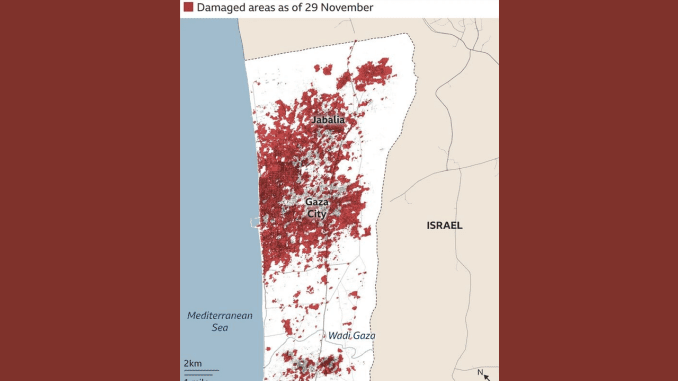
Satellite images commissioned by the BBC reveal the extent of destruction across Gaza… While northern Gaza has been the focus of the Israeli offensive and has borne the brunt of the destruction, widespread damage extends across the entire strip.

We posted a response on X, formerly known as Twitter:

To be fair, we never expected anything like this from BBC Verify; these maps are staggering:

Satellite data analysis suggests that almost 98,000 buildings across the whole Gaza Strip may have suffered damage.

Near-total annihilation.

The BBC report included a shocking photo montage showing how ‘a skyline of multi-storey buildings and a mosque was gradually reduced to rubble between 14 October and 22 November’. Note, this was not in reference to a single apartment block, but ‘a skyline of multi-storey buildings’.

This analysis genuinely helped to raise awareness of the true, appalling scale of Israel’s assault on Gaza. And the article was not heavily gaslit by the usual Israeli propaganda. Instead, there was merely this:

The BBC has approached the IDF for comment.

Contrary to the belief of some of our critics, we don’t hate to see positive examples of this kind that appear to contradict the thesis that state-corporate media function as a propaganda organ for powerful interests. In fact, we are only too pleased, because we have hoped for two main outcomes from our work. While our key aim has always been to increase public awareness and participation empowering progressive alternatives to ‘mainstream’ journalism, we have also hoped to encourage ‘mainstream’ journalists to improve their performance as far as they are able within the severe limits set by state-corporate media.

Readers sometimes commiserate with us: it must be terrible to be despised by everyone in the ‘mainstream’. In truth, they would be surprised at the number of senior journalists who have told us privately that our work made them rethink US-UK war crimes and double standards. Some have actually thanked us for our ‘guidance’. As we have documented, even former Guardian editor Alan Rusbridger and senior BBC journalist Nick Robinson have mentioned us with approval in their books on British journalism.

More broadly, it is astonishing how good people, whistleblowers defying all expectations, emerge from the unlikeliest of places.

Consider Josh Paul, former director of congressional and public affairs, who spent 11 years in the US State Department’s Bureau of Political-Military Affairs, the US government entity most responsible for the transfer and provision of arms to foreign countries. Who but cynics and sociopaths would work in such a place?

And yet, on 18 October, Paul sent a powerful letter of resignation to protest the massacre of civilians in Gaza. He wrote:

I believe to the core of my soul that the response Israel is taking, and with it the American support both for that response, and for the status quo of the occupation, will only lead to more and deeper suffering for both the Israeli and the Palestinian people – and is not in the long term American interest. This Administration’s response – and much of Congress’ as well – is an impulsive reaction built on confirmation bias, political convenience, intellectual bankruptcy, and bureaucratic inertia. That is to say, it is immensely disappointing, and entirely unsurprising. Decades of the same approach have shown that security for peace leads to neither security, nor to peace. The fact is, blind support for one side is destructive in the long term to the interests of the people on both sides. I fear we are repeating the same mistakes we have made these past decades, and I decline to be a part of it for longer.

In an interview with Democracy Now!, Paul added:

I decided to resign for three reasons, the first and most pressing of which is the very, I believe, uncontroversial fact that U.S.-provided arms should not be used to massacre civilians, should not be used to result in massive civilian casualties. And that is what we are seeing in Gaza and what we were seeing, you know, very soon after the October 7th horrific attack by Hamas. I do not believe arms should be — U.S.-provided arms should be used to kill civilians. It is that simple.

Secondly, I also believe that… there is no military solution here. And we are providing arms to Israel on a path that has not led to peace, has not led to security, neither for Palestinians nor for Israelis. It is a moribund process and a dead-end policy.

And yet, when I tried to raise both of these concerns with State Department leadership, there was no appetite for discussion, no opportunity to look at any of the potential arms sales and raise concerns about them, simply a directive to move forward as quickly as possible. And so I felt I had to resign.

Apart from a single substantive mention and a couple of smaller mentions in the Guardian, Paul’s resignation has been buried by all other UK national newspapers, with a single mention on the BBC website.

Propaganda Weathering And Erosion

As that media response suggests, it is fine to welcome positive examples, but not to morph into political Pollyannas detecting deep change where none exists.

A case in point was provided by Guardian columnist Simon Jenkins writing of Gaza:

For the first time in my adult life I cannot watch – or read – the news. Its presentation makes me profoundly upset.

Was this a rare expression of heightened dissent bucking the trend? We posted our ‘heartful thanks’ to Jenkins on X/Twitter for ‘supplying the ultimate example’ of the tendency described by Edward Herman and Noam Chomsky:

While the coverage of the worthy victim was generous with gory details and quoted expressions of outrage and demands for justice, the coverage of the unworthy victims was low-keyed, designed to keep the lid on emotions and evoking regretful and philosophical generalities on the omnipresence of violence and the inherent tragedy of human life. (Herman and Chomsky, Manufacturing Consent, Pantheon Books, 1988, p. 39)

In response, Justin Schlosberg, Professor of Media and Communications at University of Westminster, wrote to us on X/Twitter:

Actually I think this [Jenkins’s comment] is testament to the fact that broadcasters are not conforming to the propaganda model on this issue. Hence the need for liberal columnists to retreat and recoil in confused anguish.

He quickly caveated: “Should have added *on the whole*”

We suspect Professor Schlosberg’s comments are symptomatic of what we call ‘propaganda weathering and erosion’. It is easy to be overimpressed by media reporting of power-unfriendly events that can’t be ignored. It’s naturally difficult to see what isn’t there: crucial political and historical context. It’s also difficult to keep reminding oneself that the extent and tone of media coverage would be very different if the victims were ‘us’ rather than ‘them’. Imagine, for example, Western media coverage if Israel was some imaginary Megapower dwarfing the US, and Gaza was New York City, with 234,000 homes damaged, 46,000 completely destroyed, amounting to 60 per cent of the housing stock, with 1.5 million people fleeing for their lives. And then being bombed again.

Schlosberg is wrong, broadcasters are once again conforming on Gaza. But don’t take our word for it; consider the courageous testimony from a rare BBC whistleblower.

On 24 October, BBC correspondent Rami Ruhayem – a former journalist for the Associated Press, who has worked as a journalist and producer for BBC Arabic and the BBC World Service since 2005 – sent a letter to the BBC’s Director-General, Tim Davie:

Dear Tim,

I am writing to raise the gravest possible concerns about the coverage of the BBC, especially on English outlets, of the current fighting between Israel and Palestinian factions.

It appears to me that information that is highly significant and relevant is either entirely missing or not being given due prominence in coverage.

Ruhayem continued:

The nature of the Israeli response to the attack by Hamas on October 7 has prompted “over 800 scholars and practitioners of international law, conflict studies and genocide studies” to warn of ‘the possibility of genocide being perpetrated by Israeli forces against Palestinians in the Gaza Strip.

They said:

As scholars and practitioners of international law, conflict studies, and genocide studies, we are compelled to sound the alarm about the possibility of the crime of genocide being perpetrated by Israeli forces against Palestinians in the Gaza Strip. We do not do so lightly, recognizing the weight of this crime, but the gravity of the current situation demands it.

I invite you to sift through our coverage, past and present, for any trace of the above; whether in explainers, or interviews, or features, or news analysis. Is it there at all, and if so, is it given the prominence it deserves?

Ruhayem didn’t stop there:

Words like “massacre”, “slaughter”, and “atrocities” are being used—prominently—in reference to actions by Hamas, but hardly, if at all, in reference to actions by Israel.

Does this not raise the question of the possible complicity of the BBC in incitement, dehumanization, and war propaganda? How would the BBC respond to this?

He continued:

Our current coverage kicked off following the Hamas attack. Doubtless, it is major news. But that doesn’t mean history started on October 7. We should incorporate into our coverage an accurate, balanced, fair, and truthful representation of the reality leading up to that moment.

I won’t go into detail, but simply remind you of three terms: apartheid, ethnic cleansing, and settler-colonialism.

These are terms used by many experts and highly respected organizations to which the BBC usually defers. They are used to describe the nature of Israeli rule over Palestinians as well as the methods used by Israel to oppress generation after generation of Palestinians. They are based on extensive evidence.

To what extent is this reflected in our coverage? Without such context, can we claim to have adequately informed the public? Or are we withholding highly relevant and significant information without which the basics of the conflict cannot possibly be understood?

Our December 6, ProQuest media database search for “Rami Ruhayem” and “Tim Davie” found a single mention by Alessandra Scotto di Santolo on Express Online, 26 October 2023: ‘Israel Hamas: Israel preparing for ground invasion in Gaza and vows to eliminate Hamas.’ Otherwise, Ruhayem’s vital whistleblowing has been blanked by the entire UK national press and the BBC. The fact that Ruhayem has not tweeted since October 25, the day after he sent the letter, surely tells its own story.

Pro-Truth, Pro-Justice

Last month, scholar and activist Norman Finkelstein commented with his usual precision:

I don’t want to quibble over terminology, but sometimes if the terminology is wrong at the outset, then it confuses things moving forward. I’m not pro-Palestinian, I’m not pro-Israeli. I’m pro-truth and I’m pro-justice. If truth is on the Israeli side, I will support Israel. If justice is on the Israeli side, I’ll support Israel. And the same thing goes for the Palestinians.

I’ve spent the greater part of my adult life, you can say, beginning 1982 – so it’s more than four decades – researching, studying the Israel-Palestine conflict. And it’s my conclusion, at the end of that research – but already early on – that the case that Israel makes for its crimes are, in large part, fabrications, misrepresentations and distortions. And then, [on] the other hand, the Palestinian case is very strongly supported by the evidence.

We are also not pro-Palestinian – we are pro-truth and pro-justice. Because truth and justice do not exist in a soulless vacuum, we are also pro-compassion.

It is quite obvious that violence and hatred born of cruelty and injustice cannot be erased by yet greater cruelty and injustice. What results do we expect from Israel intensifying the strategy of ethnic cleansing that gave rise to Hamas in the first place?

We live in a terribly cruel and cynical time where our supposed leaders ignore clear public support for a ceasefire, just as they ignore the vital need for immediate action on climate change, just as they sacrifice Ukraine to US realpolitik, just as they mercilessly keep Julian Assange entombed for 1701 days in a high-security prison without charge. Did the Dark Ages ever really end?

Hard-boiled leftists may quiver and quail; intellectuals may shriek and cringe, but the Buddha was exactly right when he said:

Hatred can never put an end to hatred; love alone can. This is an unalterable law. (Cited, Eknath Easwaran, The Dhammapada, Arkana, 2009, p. 78)

Yes, the West can devastate its enemies, but it cannot avoid the price described by Nietzsche:

He who fights with monsters should be careful lest he thereby become a monster. And if thou gaze long into an abyss, the abyss will also gaze into thee. (Nietzsche, Beyond Good and Evil, Emmanuel, 1917, p. 87)

After a century spent ‘fighting fascism’ and ‘waging war on terror’, Nietzsche’s abyss is here, now, gazing back at us from the coldly indifferent faces of Western leaders observing the genocidal slaughter in Gaza.

And it is gazing at us from the silently, inexorably rising temperatures that will ultimately render Israel-Palestine uninhabitable to all human life.

It turns out that one consequence of fighting with monsters – of building a global military-industrial machine dedicated to killing for profit – is that we lose the capacity to fight for life.


Media Lens is a UK-based media watchdog group headed by David Edwards and David Cromwell. The most recent Media Lens book, Propaganda Blitz by David Edwards and David Cromwell, was published in 2018 by Pluto Press. Read other articles by Media Lens, or visit Media Lens's website.


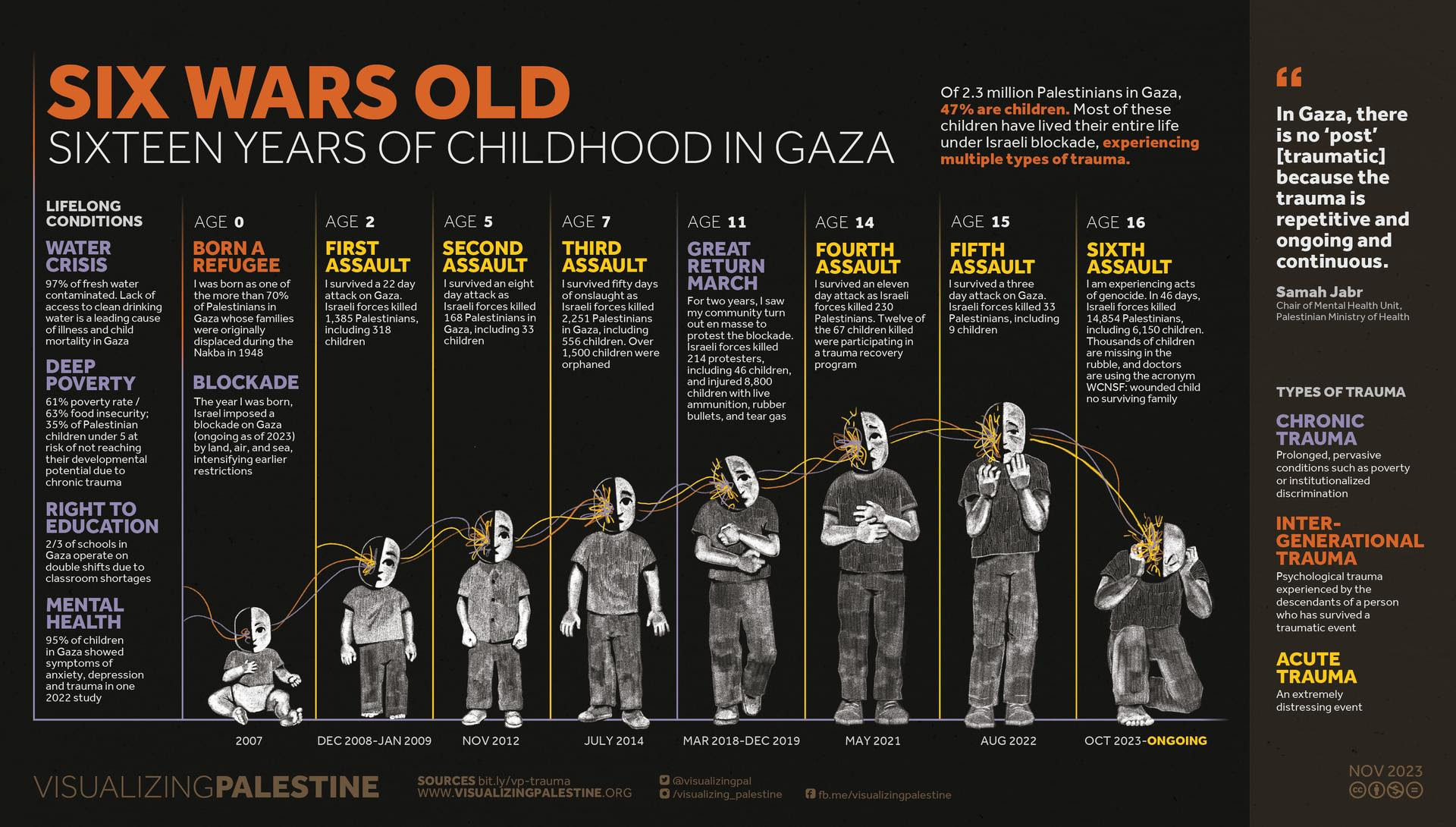
Six Wars Old

Israel’s repeated military assaults on Gaza have devastating consequences for children. Israel is not only killing Palestinian children at astonishing rates, but also killing the childhood of those who survive.


Visualizing Palestine is the intersection of communication, social sciences, technology, design and urban studies for social justice. Visualizing Palestine uses creative visuals to describe a factual rights-based narrative of Palestine/Israel. Read other articles by Visualizing Palestine, or visit Visualizing Palestine's website.


Panic-stricken Israel Lobby Shifts into Overdrive

genocide

At Westminster the other day the UK Secretary of State for Defence (Grant Shapps) made a statement on military deployments to the Middle East which included questions and answers about the situation in Gaza. It was an opportunity for Shapps with help of pro-Zionist MPs to distort the facts to ‘justify’ Israel’s appalling crimes.

The following exchanges are taken from Hansard which, for those who don’t know, is the official and “substantially verbatim” report of what is said in the UK Parliament.

Martin Docherty-Hughes (West Dunbartonshire) (SNP) commented: “It is important to repeat the denunciation of the death cult known as Hamas.”

Shapps replied: “The hon. Gentleman is right to stress the abominable, disgraceful, disgusting behaviour of Hamas.” [Shapps is Jewish]

Sir Julian Lewis (New Forest East) (Con): “Those on both Front Benches seem to agree that Hamas must not remain in control in Gaza. Is any thought being given to how, once they have been removed, they can be prevented from coming back?” [Lewis is also Jewish]

Shapps: The easiest way to bring this to an end, as I hinted earlier, would be for Hamas, a terrorist organisation, to release the hostages that they have, to stop firing rockets into Israel in a completely indiscriminate way, which I think the whole House should condemn.”

Sir Michael Ellis (Northampton North) (Con): “The Houthis, who are attacking British and American cargo ships, and Hamas are basically two sides of the same coin. They are Iranian-funded, Iranian-trained and, of course, Iranian-guided terrorist groups that are publicly committed to the destruction of Israel…. I particularly welcome the UK’s deployment of drones to help locate hostages, including British hostages. In the days after 7 October, the Defence Secretary said: ‘No nation should stand alone in the face of such evil.’ Will he repeat that crucial support today and in the difficult days ahead? I thank him for his support. [Ellis is Jewish and also a member of Conservative Friends of Israel].

Shapps: My right hon. and learned Friend is absolutely right that no nation should stand alone. It is easy to forget how this all began, when the Hamas terrorist group thought it was a plan to go into Israel to butcher men, women and children, cut off heads and rape people.

Greg Smith (Buckingham) (Con): “I applaud the decisive actions of my right hon. Friend and the Government to defend our strategic ally, Israel, against Hamas, but the grim reality on the ground right now is that Hamas continue to fire dozens of rockets at Israeli towns and cities. The Iran-backed terror group have fired more than 10,000 rockets since 7 October and show no sign of stopping their violent attacks against Israel. Will my right hon. Friend not only commit to continuing his support for Israel in defending itself against Hamas, but reassure the House that every possible step is being taken to counter Iran’s links across the region, which are causing instability?”

Shapps: “My hon. Friend makes an excellent point that the conflict would be over immediately if hostages were released and Hamas stopped firing rockets into Israel—there would not be a cause for conflict. Indeed, that is the policy Israel followed for many years, hoping that, even though rocket attacks continued, Hamas would not take advantage of their own population by using them as human shields and building infrastructure under hospitals, schools and homes…. My hon. Friend is absolutely right to identify Iran as being behind this whole evil business.”

Richard Foord (Tiverton and Honiton) (LD): “It was reassuring last week, in answer to my question, to hear the Minister for Armed Forces, the right hon. Member for Wells (James Heappey) telling us that UK surveillance flights would not involve the use of intelligence for target acquisition. I also welcome the Secretary of State talking today about how information that would be helpful to hostage recovery will be passed to the so-called appropriate authorities. We have now heard two questions about the International Criminal Court. Will the UK pass any evidence that it gathers of any breaches of international humanitarian law by combatants in Gaza to the ICC?

Shapps: “As the hon. Gentleman says, that question has been asked, and I have answered it a couple of times. The intelligence, surveillance and reconnaissance – ISR – flights are to look for British hostages and indeed other hostages. That is the information that will be gathered from those flights. Of course, if we saw anything else, we would most certainly alert our partners“. [But do they include the ICC? I think not.]

Patrick Grady (Glasgow North) (SNP): “Yesterday I asked the Under-Secretary of State for Foreign, Commonwealth and Development Affairs, the hon. Member for Aldershot (Leo Docherty), whether the UK Government were in a position to contribute to the International Criminal Court’s call for evidence in its investigation of potential breaches of international humanitarian law. He said: ‘Not at this stage, but we will continue to take note.’ Surely, if the UK Government are actively collecting drone and surveillance images of the war zone, the answer to that question should have been yes?”

Shapps: “I would have thought that the No. 1 concern would be to locate the British hostages, and that is where the surveillance work will focus.”

Jeremy Corbyn (Islington North) (Ind): “The Secretary of State needs to be very clear with the House: 15,000 people have already died in Gaza, and 1,200 have died in Israel. Israel is clearly pushing the entire population southwards, if not out of the Gaza strip altogether. Is Britain involved in the military actions that Israel has taken, either physically or by providing information in support of those military activities? I think the House needs to be told. What is the long-term aim of British military involvement in Gaza?”

Shapps: “The simple answer is no, and I hope that clears it up. I am surprised to hear the right hon. Gentleman talk just about people being killed. They were murdered. They were slaughtered. It was not just some coincidental thing. I understand and share the concerns about the requirement on Israel, on us and on everyone else to follow international humanitarian law. When Israel drops leaflets, when it drops what it calls a “knock” or a “tap” and does not bomb until afterwards, when it calls people to ask them to move, when it issues maps showing where Hamas have their tunnels and asks people to move away from them, that is a far cry from what Hamas did on 7 October, when they went after men, women and children.”

Kim Johnson (Liverpool, Riverside) (Lab): “We have seen increased bombardment in southern Gaza after the pause. We are also seeing increased violence in the West Bank, supported by extremist settler Ministers. What talks is the Secretary of State having with Israel to stop the increase in settler violence in the West Bank?

Grant Shapps: “I certainly will not be pulling my punches when I speak to my Israeli counterparts. The violence in the West Bank is unacceptable and it must be controlled—stopped, in fact. None of that, in any way, shape or form, separates us from our utter condemnation of how this whole thing was started in the first place with Hamas, but the hon. Lady is right about that settler violence.”

Alan Brown (Kilmarnock and Loudoun) (SNP): “Medical Aid for Palestinians has warned that Israel’s indiscriminate bombing and siege is making it impossible to sustain human life in Gaza. With 1.8 million civilians displaced and a lack of clean water and sanitation, it is just a matter of time before a cholera outbreak kills many thousands more. The Secretary of State has been unequivocal that the main purpose of surveillance is to help find hostages, which is fine, but for the fifth time of asking: if clear evidence is found of breaches of humanitarian law, will the UK Government share that evidence with the International Criminal Court?

Shapps: “The simple answer is that we will always follow international humanitarian law and its requirements.”

Peter Grant (Glenrothes) (SNP): “It is absolutely right that those responsible for the crimes of Hamas are held to account in international law. But why is the Secretary of State so reluctant to give a clear, simple “yes” to the question whether the Government will provide any evidence of war crimes to the International Criminal Court? Is it because he has already seen such evidence? Is it because Israel has asked him to promise not to share such evidence? What is the reason?”

Grant Shapps: “I have already said that the United Kingdom is bound by, and would always observe, international humanitarian law.

The message we are supposed to swallow from this pantomime is that it’s all the fault of Hamas and Iran who “started the whole thing” on 7 October, and that Israel’s massacres, brutal occupation using military force, cruel blockade and clear intention of establishing Jewish sovereignty “from the river to the sea” over the last 75 years have nothing to do with it. It is clear that the UK will do everything to avoid upsetting Israel’s evil plan and calling the regime’s war criminals to account despite our solemn obligations under international law to do so.

And it is pointless for the likes of Shapps to keep repeating that Israel “has to follow international humanitarian law” when Israel has been in permanent breach of nearly all aspects of law for decades and treats international norms with utter contempt. Only today the regime announced approval of 1700 more ‘settlement’ homes in East Jerusalem which is Palestinian territory. And it continues to defy international law, escalating its crimes to the most abhorrent of all – genocide – because it is given cover by the US and UK. Perhaps the rest of us should properly label Israel’s genocide in Gaza as ‘US and UK-backed’. And the UK itself ignores international law if it happens to be ‘inconvenient’.

As for the constantly repeated claim the Israel has a right to defend itself, this is blatant misinformation. Israel is an illegal military occupier and aggressor committing never-ending war crimes on someone else’s sovereign territory. Its right to self-defence is practically zero in these circumstances. UN Special Rapporteur Francesca Albanese has stated that “Israel cannot claim self-defence against a threat that emanates from the territory it occupies – from a territory that is kept under belligerent occupation”.

And notice how everything the Israelis dislike, and everything that thwarts their lust for domination, is now labeled “Iranian-backed” or “Hamas controlled”. Shapps is evidently well versed in the 116-page propaganda manual produced by The Israel Project (TIP) and written specially for those “on the front lines of fighting the media war for Israel”. Its purpose is to help the worldwide Zionist movement win the propaganda war by persuading international audiences to accept the Israeli narrative and agree that the regime’s crimes are necessary for Israel’s security and in line with “shared values” between Israel and the West.

This masterwork on deception attempts to justify Israel’s slaughter, ethnic cleansing, land-grabbing, cruelty and blatant disregard for international law and United Nations resolutions, and make it all smell sweeter with a liberal squirt of persuasive language. It also incites hatred, particularly towards Hamas and Iran, and is designed to hoodwink Americans and Europeans into believing we actually share values with the racist regime, and therefore ought to support and forgive its abominable behaviour.

Readers are instructed to “clearly differentiate between the Palestinian people and Hamas” and to drive a wedge between them. The manual features “words that work” – i.e. carefully constructed language to deflect criticism and reframe all issues and arguments in Israel’s favour. We are seeing it at work here with great success.

MPs who are Jewish are identified as such when it seems appropriate. Those, like Sir Michael Lewis mentioned above, who are signed-up Friends of Israel should, in my opinion, declare that interest in any debate on the subject. But I must emphasise that not all Jewish MPs are tools of the apartheid regime. We remember with admiration Sir Gerald Kaufman who was arguing for economic sanctions against Israel back in 2004. And during a debate on the Gaza war of 2008/9, he told the Commons: “The present Israeli government ruthlessly and cynically exploits the continuing guilt from Gentiles over the slaughter of Jews in the Holocaust as justification for their murder of Palestinians… My grandmother was ill in bed when the Nazis came to her home town of Staszow. A German soldier shot her dead in her bed. My grandmother did not die to provide cover for Israeli soldiers murdering Palestinian grandmothers in Gaza”.

He described Hamas as a “deeply nasty organisation” but said the UK Government’s boycott of Hamas had “dreadful consequences”, and he reminded the Commons that Israel had been created following acts of terrorism by the Irgun. He considered Iran a loathsome regime but, unlike Israel, “at least it keeps its totalitarian theocracy to within its own borders”.

As to why there are so many Israel lackeys in Westminster Kaufman said: “It’s Jewish money, Jewish donations to the Conservative Party. There is now a big group of Conservative members of parliament who are pro-Israel…. whatever the Israeli government does.”

Of course, it’s not just the Conservative Party. The corrupting influence of dodgy funding is also affecting Labour and the LibDems.

Remembering the victims of genocide

This week marks the 75th anniversary of the 1948 Genocide Convention. As explained on the United Nations website:

Every 9 December the Office of the Special Adviser on the Prevention of Genocide marks the adoption of the Convention on the Prevention and Punishment of the Crime of Genocide – a crucial global commitment that was made at the founding of the United Nations, immediately preceding the Universal Declaration of Human Rights. By General Assembly Resolution A/RES/69/323 of 29 September 2015, that day also became the International Day of Commemoration and Dignity of the Victims of the Crime of Genocide and of the Prevention of this Crime.

At its landmark 75th anniversary this year, the Genocide Convention remains highly relevant. The 1948 Genocide Convention codified for the first time the crime of genocide in international law. Its preamble recognizes that “at all periods of history genocide has inflicted great losses on humanity” and that international cooperation is required to “liberate humankind from such an odious scourge”. To date, 153 States have ratified the Convention. Achieving universal ratification of the Convention, as well as ensuring its full implementation, remain essential for effectively advancing genocide prevention. The Genocide Convention includes the obligation not only to punish the crime of genocide but, crucially, to prevent it. In the 75 years since its adoption, the Genocide Convention has played an important role in the development of international criminal law, in holding perpetrators of this crime accountable, galvanizing prevention efforts, and in giving a voice to the victims of genocide.

How many parliamentarians in Westminster and Washington who blindly support Israel’s attempts to exterminate the Palestinians in Gaza and turn their homeland into rubble will publicly show respect for those victims of the apartheid regime’s genocide?


Stuart Littlewood’s book Radio Free Palestine, with Foreword by Jeff Halper, can be read on the internet by visiting radiofreepalestine.org.uk. Read other articles by Stuart, or visit Stuart's website.