Saturday, September 21, 2024

GOOD NEWS


China-Japan accord on monitoring of Fukushima water releases


Friday, 20 September 2024

China looks set to start lifting its ban on the import of Japanese fishery products after reaching an agreement with Japan for the independent monitoring of the discharge of treated water from the Fukushima Daiichi nuclear power plant by China and other countries.
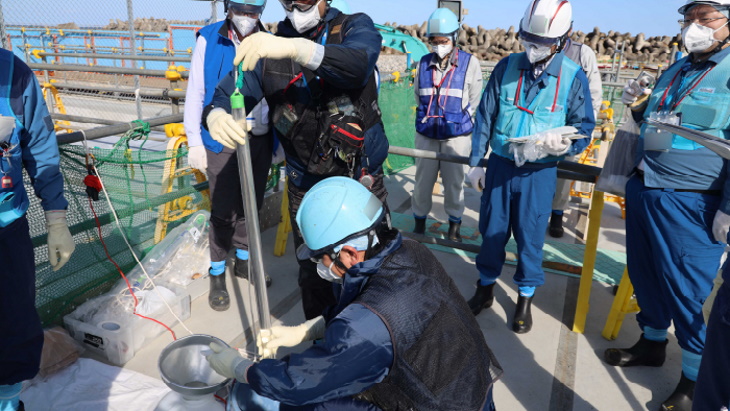
China-Japan accord on monitoring of Fukushima water releases
Workers take samples of the diluted water before the second discharge began (Image: Tepco)

At the Fukushima Daiichi site, contaminated water - in part used to cool melted nuclear fuel - is treated by the Advanced Liquid Processing System (ALPS), which removes most of the radioactive contamination, with the exception of tritium. This treated water is currently stored in tanks on site.

Japan announced in April 2021 it planned to discharge ALPS-treated water into the sea over a period of about 30 years. It started to discharge the water on 24 August last year and has so far completed the release of eight batches, a total of 62,400 cubic metres of water.

"As one of the most important stakeholders, China is firmly opposed to this irresponsible move," China's Ministry of Foreign Affairs said. "At the same time, China has urged Japan to seriously address concerns in and outside Japan, to earnestly fulfill its obligations, to give full cooperation in the establishment of an independent and effective long-term international monitoring arrangement in which stakeholders can participate substantively, and to accept independent sampling and monitoring by China."

Japan and China have now reached an agreement that allows stakeholders, including China, to conduct independent sampling, monitoring and inter-laboratory comparisons at key stages of the discharge process, which is currently being monitored by the International Atomic Energy Agency (IAEA).

"Taking into account the interests of all stakeholder countries, including China, Japan welcomes the expansion of long-term and international monitoring at key stages of the ocean release under the IAEA framework, and will ensure that all stakeholder countries, including China, effectively participate in this monitoring and that independent sampling and inter-laboratory comparisons are conducted by the participating countries," said Japan's Ministry of Foreign Affairs.

"China states that it has taken temporary emergency precautions against aquatic products of Japanese origin according to relevant Chinese laws and regulations and WTO rules," the Chinese ministry said. "After China participates substantively in the long-term international monitoring within the IAEA framework and the independent sampling and other monitoring activities by participating countries are carried out, China will begin to adjust the relevant measures based on scientific evidence and gradually resume imports of Japanese aquatic products that meet the regulation requirements and standards."

The agreement was welcomed by IAEA Director General Rafael Mariano Grossi, who said: "I wish to commend the government of Japan for its continued engagement with the IAEA, and the government of China for the constructive consultations held with the Agency in support of this bilateral process that comes to a positive conclusion today."

The agreement, Grossi said, "has built on our existing sampling and monitoring activities in compliance with the IAEA statutory functions". He said the IAEA will coordinate with Japan and other stakeholders, including China, to ensure that the additional measures are implemented appropriately under the framework of the IAEA, "maintaining the integrity of the process with full transparency to ensure that water discharge levels are, and will continue to be, in strict compliance and consistent with international safety standards".

Japan and China have agreed to "continue constructive dialogue from a scientific perspective, in a responsible manner towards the ecological environment and people's health, and to appropriately address concerns regarding the ocean release of ALPS-treated water."

IAEA experts stationed at the Fukushima Daiichi plant have taken samples from the batches of diluted water, after they were prepared for discharge. The IAEA's independent on-site analysis has confirmed that the tritium concentration in the diluted water that has so far been discharged is far below the operational limit of 1500 Bq/litre. The IAEA says it will have a presence on site for as long as the treated water is released.

China to ‘gradually resume’ seafood imports

 from Japan after Fukushima ban


By AFP
September 20, 2024

A team of experts from the International Atomic Energy Agency with scientists from China, South Korea and Canada observe baskets of fish to be taken as samples at Hisanohama Port in Iwaki, Japan's Fukushima Prefecture, in October 2023 - Copyright POOL/AFP/File Eugene Hoshiko

China said Friday that it would “gradually resume” importing seafood from Japan after imposing a blanket ban in August last year over the release of water from the disabled Fukushima nuclear plant.

“China will begin to adjust the relevant measures based on scientific evidence and gradually resume imports of Japanese aquatic products that meet the regulation requirements and standards,” a foreign ministry statement said.

Chinese and Japanese officials recently conducted “multiple rounds of consultations” on the discharge of water from the stricken Fukushima Daiichi nuclear power station, the ministry said.

It said Japan had committed to “fulfilling its obligations under international law, doing its utmost to avoid leaving (a) negative impact on human health and the environment, and conducting continuous evaluations of the impact on the marine environment and marine ecosystems”.

In 2011, three reactors at the Fukushima-Daiichi facility in northeastern Japan went into meltdown following a massive earthquake and tsunami that killed around 18,000 people.

Since then, plant operator TEPCO collected water contaminated as it cooled the wrecked reactors, along with groundwater and rain that has seeped in.


– Fierce backlash –


Japan in late August 2023 began discharging treated contaminated water from the Fukushima plant into the Pacific Ocean in an operation it insists is safe, a view backed by the UN atomic agency.

The release, however, generated a fierce backlash from China, which branded it “selfish” and banned all Japanese seafood imports.

China’s foreign ministry said in its statement Friday that Tokyo welcomed the establishment of a “long-term international monitoring arrangement within the International Atomic Energy Agency (IAEA) framework covering key stages in the discharge of the nuclear-contaminated water”.

“Both sides agree to continue to have constructive, science-based dialogue with a great sense of responsibility for the ecosystem, the environment, and human life and health,” it added.

Around the same time as the announcement, Japanese Prime Minister Fumio Kishida said Tokyo had “informed the Chinese side of its readiness to carry out additional monitoring of the… treated water, while the Chinese side has decided to… steadily restore imports of Japanese fishery products that meet certain standards”.

Despite the gradual resumption of seafood imports, a spokeswoman for Beijing’s foreign ministry said China still “resolutely opposes” Japan’s discharge of water from Fukushima.

“First of all, China resolutely opposes the Japanese side’s arbitrary discharge (of contaminated water) into the sea,” spokeswoman Mao Ning told a regular press conference, adding: “This position has not changed.”

China imported over $500 million worth of seafood from Japan in 2022, according to customs data.

10 years into Huthi rule, some Yemenis count the cost


By AFP
September 20, 2024

Demonstrators rally outside a mosque in Yemen's Huthi-held Sanaa on March 29, 2024 - Copyright AFP Yan ZHAO

With a floundering economy and growing restrictions on personal freedoms, 10 years of Huthi rule has left its mark on Yemen’s ancient capital, Sanaa, where some quietly long for how things once were.

The Huthis, a radical political-military group from Yemen’s northern mountains, have imposed strict rule over the large swathe of Yemen under their control, covering two-thirds of the population.

Since the Iran-backed rebels took power in Sanaa in 2014, after long-running protests against the government, the country has gone “back 50 years”, sighed Yahya, 39, who like many prefers not to share his full name for fear of reprisals.

“Before, we thought about how to buy a car or a house. Now we think about how to feed ourselves,” added Abu Jawad, 45.

Already the poorest country in the Arabian Peninsula, Yemen has been devastated by war since 2015, when a Saudi-led coalition launched a failed campaign to dislodge the Huthis.

Hundreds of thousands of people have died through fighting or indirect causes like hunger and disease, with much of the infrastructure in ruins.

Yemen, mired in one of the world’s worst humanitarian crises, remains divided between the Huthis and the government, now based in the port city of Aden.

The Huthis, who adhere to the Zaidi branch of Shiite Islam and claim divine right to rule, have tightened their control over many aspects of daily life.

– ‘Men, women could sit together’ –

Sanaa, despite its conservatism, once had “political parties, active civic organisations, NGOs… coffee shops where males and females can sit together”, said researcher Maysaa Shuja al-Deen, of the Sanaa Center for Strategic Studies.

“Now the social and political atmosphere has become very closed,” she added.

Men and women are segregated in public, and Huthi slogans like “Death to America!” and “Death to Israel!” are plastered everywhere, alongside photos of Huthi leaders, Deen said.

Since 2015, Amnesty International has documented numerous cases of activists, journalists and political opponents who were convicted on “trumped-up” espionage charges.

A wave of arrests in June targeted aid workers, including 13 United Nations staff who are still detained.

Majed, the director of a Yemeni non-governmental organisation, said he fled Sanaa for Aden before taking refuge with friends in Jordan, leaving behind his wife and three children.

“I made the decision without thinking too much. Leaving was a risky choice, but it was the only one,” the 45-year-old said from Amman, where he hopes to find a job.

According to Deen, a Yemeni who is also based outside the country, it is now difficult to go against the ruling authorities, or even fail to show support.

“At the very beginning, being silent was an option. Now it’s not even an option,” she said.

“You have to show that you are loyal to the Huthi ideology.”

The Huthis are adept at using social and traditional media, such as their Al-Masirah TV station, to spread propaganda, and have even revised school textbooks and changed the calendar.

The traditional holiday of September 26, which celebrated the 1962 revolution against the former imam, has been moved to September 21, the day the Huthis took power.

Some Yemenis chafe at the change. “Even if they forbid us from celebrating officially, we will celebrate it in our hearts,” said Abu Ahmed, 53, a Sanaa resident.

– ‘I dream of getting my life back’ –


However, support for the Huthis’ attacks since November against Israel and ships in the Red Sea, in solidarity with Palestinians during the Israel-Hamas war, seems to be unanimous.

“The Yemenis have always been pro-Palestinian,” said author and Yemen specialist Helen Lackner, highlighting the hundreds of thousands of people who join the Huthis’ weekly demonstrations in Sanaa.

Despite their popularity among ordinary people, the maritime attacks have halted negotiations conducted between the rebels and Saudi Arabia to end the war.

Rim, 43, who has lived with her family in neighbouring Saudi for nine years, has not been able to return to Sanaa to bury her father, or attend the weddings of her brothers and sisters.

“I dream of getting my life back,” said the 43-year-old. In the meantime, she is content to talk to her children about her country.

“I don’t want them to forget that they are Yemeni.”

Haiti, its suffering growing, in ‘race against time’: UN expert

By AFP
September 20, 2024

Vendors hauling their goods travel on a rocky, cliff-lined road to avoid gangs in the Port-au-Prince area. The perilous journey takes nearly seven hours
 - Copyright AFP/File Clarens SIFFROY

The Haitian people are suffering gravely at the hands of powerful criminal gangs, while an international security force and local police are badly lacking resources to protect them, a top UN expert said Friday.

William O’Neill, briefing reporters in Port-au-Prince at the end of a 12-day visit to the impoverished Caribbean island, described dire conditions that have left the population in an extreme state of insecurity and spreading starvation.

He visited areas in southern Haiti that, untouched by gang violence a year ago, are now struggling with “galloping inflation, lack of basic goods and flows of internally displaced people,” particularly affecting women and children.

Only 28 percent of health services are functioning normally, O’Neill said, “and almost five million people are suffering from acute food insecurity.”

In one refugee camp he met an “anemic little girl” who had not eaten in two days and not been in school in over a year.

More than half the island’s 700,000 internally displaced people are children.

The gangs are increasingly using sexual violence as a weapon to control the population, O’Neill said.

They have “trafficked children, forcibly recruited them into gangs, and often used them to carry out attacks” on police and public facilities.

The criminal gangs control more than 80 percent of Port-au-Prince, as well as key roads around the country.

The police meantime “lack the logistical and technical capacity to counter the gangs,” O’Neill said.

He said the Multinational Security Support Mission authorized nearly a year ago by the UN Security Council has so far deployed less than a quarter of its planned contingent of 2,500. At its core are 400 Kenyan officers deployed this summer.

“The equipment it has received is inadequate, and its resources are insufficient,” the UN expert said.

Police are overwhelmed. “We have to learn to walk on water,” one policeman in Jeremie told O’Neill.

Prison conditions, the UN expert said, were deplorable.

A prison in Jeremie, designed for 50 inmates, holds 470. “They sleep on floors flooded with rainwater and littered with filth,” sometimes going days without food.

“This enduring agony must stop,” O’Neill said.

He called on the Haitian authorities, appointed this year after the resignation of the unpopular government of Ariel Henry, to greatly step up efforts to combat pervasive corruption, saying, “efforts must be redoubled immediately.”

At the same time, he said, “it is crucial to stifle the gangs” by giving the international force the resources to effectively support the national police.

And with the criminals still receiving imported weapons, an international arms embargo must be tightened.

“It is a race against time,” O’Neill said.

The population “lacks everything.”

POST-FORDISM
Automotive intelligence moves forwards with ‘Liquid AI’


By Dr. Tim Sandle
September 19, 2024
DIGITAL JOURNAL

An 'Apollo Go' autonomous taxi on a street in Beijing - Copyright AFP Jade GAO

Is a new era of automotive intelligence about to begin? This is the claim of Autobrains Technologies who are working on ‘Liquid AI’, a self-driving car technology. This approach is designed to solve some of the current autonomous driving challenges.

In addition, the technology seeks to enhance vehicle autonomy by dynamically adapting to complex driving environments. This adaptability is considered as essential to achieving smarter and safer automotive solutions.

Such challenges include:

Edge Cases

An edge case is a problem or situation that occurs only at an extreme (maximum or minimum) operating parameter.

The infinite variety of unexpected driving scenarios presents conventional AIs with practically unsolvable tasks. Attempts to address this by feeding the systems more labelled images result in a loss of trackability and controllability.

Cost

Addressing real-world driving problems by expanding existing systems with more data, labelling, layers, and computational resources leads to escalating costs and power consumption.

Achieving a substantial improvement in system accuracy by a factor of 10 requires 10,000 times more computational resources.

Perception-Decision Disconnect

The missing interplay between perception and decision functions hinders effective and precise decision-making. For the AI to make optimal driving choices, it requires specific information. However, when details are missing or overly complex, precision is compromised, leading to incorrect reactions.


Liquid AI – Human Brain-Inspired


The technology combines Autobrains’ signature-based self-learning approach with a modular and adaptive architecture of specialized, scenario-based end-to-end skills.


According to Autobrains’ Founder and CEO, Igal Raichelgauz: “While current technologies perform well in handling average conventional driving tasks, they fall short when faced with unexpected real-world driving scenarios that demand greater precision. By using or implementing our Liquid AI, automotive companies can close their AI gaps”.

Autobrains draws inspiration from the human brain. As the human brain adapts its architecture based on context – such as light/weather conditions, surroundings, and relevant road users – Liquid AI has been designed to follow the same approach.

The basis of the technology includes:

Network of Specialized Narrow AI

Liquid AI comprises hundreds of thousands of specialized narrow AIs, each designed for specific tasks, making reactions very precise and tailored to the relevant driving scenario.

This specialized AI approach enables scalability, ranging from a few tens to hundreds of AIs for ADAS systems, scaling up to thousands for higher levels of automated driving, all the way to hundreds of thousands of AIs for full self-driving.

Adaptive Architecture

Unlike fixed systems, Liquid AI’s architecture adapts dynamically to the driving context, activating only relevant modules as necessary. This significantly reduces power consumption and compute requirements, not only resulting in cost savings for the System on Chip (SoC) hardware.

Efficiency and Precision

By mimicking the brain’s flexibility, Liquid AI achieves superior performance, cost-effectiveness, and safety. This includes human-like cognitive processing, which mimics human decision-making, allowing for better handling of unpredictable real-world conditions.

Efficient Resource Utilization

Lower computational power requirements make it scalable across various vehicle models without compromising performance.

These factors lead to a potentialenhancement in situational awareness and decision-making, providing a safer and more reliable driving experience.

Read more: https://www.digitaljournal.com/tech-science/automotive-intelligence-moves-forwards-with-liquid-ai/article#ixzz8mVkwNvN4
Environmental protesters block French cruise liner port


By AFP
September 21, 2024

Activists from the NGO "Stop croisieres" and "Extinction Rebellion France" hold banners while they block a cruise ship
 — © POOL/AFP/File Yuichi Yamazaki

Environmental activists blocked the cruise ship port in the southern French city of Marseille on Saturday to protest against the sea, air and climate pollution generated by these huge vessels.

About 20 members of Extinction Rebellion and Marseille-based Stop Croisieres (Stop Cruises) made a chain of canoes in the water across the entry to France’s leading port for cruise liners, an AFP correspondent reported.

The demonstration forced one ship to turn back at 7:00 am and moor further down the coast. Others had to stay in stand-by outside the port until about 9:30 am.

The port has since reopened, the maritime authorities told AFP cruise ships have docked.

“Nothing justifies the maintenance of these absurd, energy-intensive and toxic floating cities,” Stop Croisieres said on its website.

“Our air, our seas and our health are not up for negotiation,” it said.

It criticised the noxious heavy fuel oil used by the vessels, the destruction of ocean and coastal wildlife, the ships’ impact on the climate and poor working conditions for employees on board.

The protest prevented the Germany-owned Aidastella, which can carry around 2,000 people, from docking at around 7:00 am.

The Costa Smeralda and the MSC World Europa also had to wait before entering the French port.

The MSC World Europa is the sixth largest cruise liner in the world. It can carry 6,000 passengers and has more than 2,600 cabins, as well as 13 restaurants and a shopping centre.

– Pollution –

Marseille is the centre of a burgeoning cruise ship industry in France.

Between 2022 and 2023, the number of cruise passengers entering the port jumped from 1.5 million to 2.5 million, according to the Marseille tourism observatory.

Advocates of cruise liners argue they provide revenue to stopover ports.

Detractors say the ships encourage passengers to spend their money onboard, not on land, and that the industry promotes competition between reception ports to force down prices.

There have been protests in several European port cities against the damage caused by cruise liners, including in Venice and Amsterdam, which have banished them from docking in the city centre.

Stop Croisieres was set up during the Covid pandemic.

“We saw videos of nature being restored all over France, little birds in towns and other bucolic scenes.

“Yet in some parts of Marseille, the air was even more polluted than before the pandemic because of all the cruise liners forced to stay in port with their engines running,” said Andrea, who declined to give her surname for fear of prosecution.

In March 2023, residents’ associations in Marseille lodged a legal complaint over ocean traffic pollution in the port area, which regularly exceeded European Union limits.

According to a study by NGO Transport and Environment, cruise ships sailing in European waters in 2022 emitted more than eight million tonnes of carbon dioxide — the equivalent of 50,000 Paris to New York flights.


Op-Ed: Underpaid, understaffed, wage theft, and prices out of control. Happy?


By Paul Wallis
September 19, 2024
DIGITAL JOURNAL


UK nurses will stage a second unprecedented strike amid an increasingly acrimonious fight with the government for better wages
- Copyright AFP/File ISABEL INFANTES

If you search the words “underpaid, understaffed, and wage theft” you’ve given yourself a lifetime job researching them. The words mean a totally dysfunctional environment where organizational failure is unavoidable. This is global. It’s also happening with a backdrop of out-of-control prices for just about everything.

The word is “systemic”. It can’t be any sort of coincidence that these things are so common. That’s particularly the case in the ultra-cheapskate US, where “employment at will” apparently means a license to gouge workers.

It goes well with the mantras of “hate the public, hate the staff and hate the customers”, though. There’s that adorably delicate subtle ambience of sleaze and greed.

Meanwhile, in the unreal world, CEO wages have risen 1085% since 1978, where workers’ wages have risen 24%, according to one source. That’s probably a massive underestimate. Many people have asked why so few people who do so little make so much.

There’s no rational answer to that question. There’s no particular reason why a herd of deformed meeting-dwellers should get paid anything. They don’t actually do their own jobs. They delegate to lesser cretins, and that’s all they need to do.

In the days of Rent A Meaningless Degree, it’s inevitable that the talentless take over. (A degree is meaningless when given to an idiot.) As long as no competent people are involved, everything’s sweet until it all inevitably falls over. This is underperformance on a truly colossal scale.

It’s also hyper-obstructionist by intent. Cheaper tech, better time management, better productivity, better business models, you name it; they just don’t happen. For example – There’s no good cost-effective business reason for “back to the office”. Those places cost millions, and all that’s likely to happen is that diseases spread a lot faster. The upkeep of the buildings is obscene, the liabilities endless, and you’re paying for it.

If there was ever a species of serial underachievers on Earth, this is them. They have political ideologies to back them up. They’re in luck, too. In a deregulated environment, you can’t pull the plug on insane prices and unearned wages. This isn’t socialism; it’s common sense and business best practice, and you can guess how popular that is right now.

Why the cheapskate stuff, you may wonder in your palatial hollowed-out grain of rice? To create entirely fictional numbers, and maybe rip off some poor people. The appearance of success isn’t success, but it looks like it. Most of these guys can’t even make sense of their own balance sheets.

Most of the stockholders in this cartoon can’t read them either. So, everyone’s happy. They get paid for this fictional fantasy. World Com, Enron, Lehmann Bros, you live or die by the numbers. It’s more likely you create the numbers and vanish before the crash and burn kicks in.

Many businesses are going broke and being exposed to serious legal actions thanks to this culture. A lot of businesses are basically doing business for their inner parasites, not for themselves. Eventually, long afterward, it shows on the balance sheets, but you can see the problem.

Never mind the rhetoric. More outraged verbiage is hardly enough. The fact is that there are plenty of simple solutions to this mess:

All of these things are breaches of applicable laws in some form. Therefore, as a business, you have a perfect in-house excuse to sue and sack the parasites.

Fines don’t scare anyone. Therefore, you shut down the business until compliance. That’ll scare the guys who own the businesses out of these bad habits fast enough.

You create a nice bonny bouncing stack of case law and penalties to cover underpayment, understaffing, and wage theft, This is “strategic” case law for pests. At the moment you could get any number of cases for all these issues, preferably class actions.

It’s all easily fixable. Now let’s see what happens.

ANOTHER BILLIONAIRE SERIAL RAPIST

Lawyers of women alleging Al-Fayed sex abuse receive over 150 new enquiries

#METOO

London (AFP) – A legal team representing women alleging rape and sexual assault by the late Egyptian billionaire Mohamed Al-Fayed said on Saturday it received over 150 new enquiries, including from women accusing the former Harrods owner.


Issued on: 21/09/2024 -
Fayed is accused by multiple women who worked at London luxury department store Harrods of sexual assault 
© Ben STANSALL / AFP/File

The BBC released a documentary and podcast on Thursday in which Fayed is accused by multiple women who worked at the London luxury department store of sexual assault, including five accusing him of rape.

The new enquiries included a "mix of survivors and individuals with evidence" about Fayed, the legal team confirmed to AFP, after announcing it was representing 37 women accusing Fayed of sex abuse.

Comparing the scale and nature of the case to claims made against fallen figures like Jeffrey Epstein and Harvey Weinstein, lawyers said the allegations included some girls who were just 15 and 16 at the time of the alleged assault.

The team is bringing claims against Harrods for enabling the "systematic abuse" of its employees, many hired as Fayed's personal assistants and secretaries, over a period of 25 years.

The accusers say assaults took place at Fayed's apartments in London, residences in Paris, and on trips abroad from Saint-Tropez to Abu Dhabi.

The upmarket department store, which Fayed sold in 2010, said it was "utterly appalled" by the allegations and had received new enquiries as well since the BBC investigation.

The Harrods website now has a form that victims can complete, adding that it had an "established process" for those affected to claim compensation.

The legal team also said it was representing women who were employed by the Ritz hotel -- which was also owned by the mogul.

A former manager of the women's team at Fulham FC, also owned by Fayed until 2013, said the players were "protected" from Fayed.

"We were aware he liked young, blonde girls. So we just made sure that situations couldn't occur," Gaute Haugenes, who managed the team from 2001 to 2003, told the BBC on Saturday.

A Fulham FC spokesperson said the club was "deeply troubled and concerned".

"We are in the process of establishing whether anyone at the club is or has been affected," the spokesperson added.

© 2024 AFP
AI is ‘accelerating the climate crisis,’ expert warns


ByAFP
September 15, 2024

People visit a booth during the World Artificial Intelligence Conference (WAIC) in Shanghai on July 4, 2024 -
 Copyright AFP STR Mathiew LEISER

If you care about the environment, think twice about using AI.

Generative artificial intelligence uses 30 times more energy than a traditional search engine, warns researcher Sasha Luccioni, on a mission to raise awareness about the environmental impact of the hot new technology.

Recognized as one of the 100 most influential people in the world of AI by the American magazine Time in 2024, the Canadian computer scientist of Russian origin has sought for several years to quantify the emissions of programs like ChatGPT or Midjourney.

“I find it particularly disappointing that generative AI is used to search the Internet,” laments the researcher, who spoke with AFP on the sidelines of the ALL IN artificial intelligence conference, in Montreal.

The language models on which the programs are based require enormous computing capacities to train on billions of data points, necessitating powerful servers.

Then there’s the energy used to respond to each individual user’s requests.

Instead of simply extracting information, “like a search engine would do to find the capital of a country, for example,” AI programs “generate new information,” making the whole thing “much more energy-intensive,” she explains.

According to the International Energy Agency, the combined AI and the cryptocurrency sectors consumed nearly 460 terawatt hours of electricity in 2022 — two percent of total global production.

– Energy efficiency –


A leading researcher on the impact of AI on climate, Luccioni participated in 2020 in the creation of a tool for developers to quantify the carbon footprint of running a piece of code. “CodeCarbon” has since been downloaded more than a million times.

Head of the climate strategy of startup Hugging Face, a platform for sharing open-access AI models, she is now working on creating a certification system for algorithms.

Similar to the program from the US Environmental Protection Agency that awards scores based on the energy consumption of electronic devices and appliances, it would make it possible to know an AI product’s energy consumption in order to encourage users and developers to “make better decisions.”

“We don’t take into account water or rare materials,” she acknowledges, “but at least we know that for a specific task, we can measure energy efficiency and say that this model has an A+, and that model has a D,” she says.

– Transparency –


In order to develop her tool, Luccioni is experimenting with it on generative AI models that are accessible to everyone, or open source, but she would also like to do it on commercial models from Google or ChatGPT-creator OpenAI, which have been reluctant to agree.

Although Microsoft and Google have committed to achieving carbon neutrality by the end of the decade, the US tech giants saw their greenhouse gas emissions soar in 2023 because of AI: up 48 percent for Google compared to 2019 and 29 percent for Microsoft compared to 2020.

“We are accelerating the climate crisis,” says Luccioni, calling for more transparency from tech companies.

The solution, she says, could come from governments that, for the moment, are “flying blindly,” without knowing what is “in the data sets or how the algorithms are trained.”

“Once we have transparency, we can start legislating.”

– ‘Energy sobriety’ –


It is also necessary to “explain to people what generative AI can and cannot do, and at what cost,” according to Luccioni.

In her latest study, the researcher demonstrated that producing a high-definition image using artificial intelligence consumes as much energy as fully recharging the battery of your cell phone.

At a time when more and more companies want to integrate the technology further into our lives — with conversational bots and connected devices, or in online searches — Luccioni advocates “energy sobriety.”

The idea here is not to oppose AI, she emphasizes, but rather to choose the right tools — and use them judiciously.


CLIMATE CRISIS: CENTRAL EUROPE
Hungary Danube waters reach decade high after Storm Boris

Budapest (AFP) – The Danube peaked at a 10-year high in a heavily fortified Budapest on Saturday with the water reaching the steps of parliament, after deadly Storm Boris lashed Europe.

Issued on: 21/09/2024 - 
Danube waters have reached the steps of the parliament building in Budapest
 © Attila KISBENEDEK / AFP
Advertising


Torrential rains and strong winds have led to widespread flooding in central and eastern Europe since last week, killing 24 people and devastating towns and villages.

As the swollen Danube waters have moved south, Hungarian emergency workers have lugged sandbags to fortify settlements, including Budapest, where the river has flooded the embankment up to the steps of parliament.

The water came close to 2013 record levels before it began to recede on Saturday.

Just north of Budapest, water has flooded the lower levels of some houses in Szentendre town © FERENC ISZA / AFP

"The last time it was this high I was only 10 or 11," Beata Hargitai, a 22-year-old student, told AFP in downtown Budapest near the flooded area.

"To move around in the capital is a bit more tricky but manageable. I am happy to see that things seem to go pretty well, in an orderly manner," she added.

Prime Minister Viktor Orban, who has cancelled all his international travels this week and went to inspect Budapest's flood protection work on Saturday, said the focus was "on controlling the flood" with some "hard days" ahead to make sure dykes hold.

Just north of Budapest, water has flooded the lower levels of houses near the Danube with people moving around on canoes in Szentendre town.

"The lower parts of our village are under water," Vilmos Nemet, a 50-year-old cook who lives uphill in nearby Tahitotfalu village, some 25 kilometres (16 miles) north of Budapest, told AFP.

The Danube has also breached its banks in Esztergom, north-west of Budapest © - / AFP

So far, 24 people have died in Austria, the Czech Republic, Poland and Romania as the flood waters have demolished houses and fields, and heavily damaged road and rail infrastructure.

The flooding damaged or destroyed more than 18,000 buildings and facilities in Poland, according to the first estimates announced by the government on Saturday.

Swollen rivers continued to threaten several settlements in western Poland, with Prime Minister Donald Tusk promising "massive aid" to the affected regions.

European Commission President Ursula von der Leyen on Thursday announced 10 billion euros ($11 billion) in funds for EU member nations reeling from the devastation.

Experts say climate change caused by greenhouse gas emissions generated by human activities is increasing the frequency and intensity of extreme weather events such as torrential rains and floods.

© 2024 AFP

CLIMATE CRISIS & CIVIL WAR

Myanmar flood death toll jumps to 384

Yangon (AFP) – The death toll in Myanmar in the wake of Typhoon Yagi has climbed to 384, with 89 people missing, the junta said on Saturday.

INTERNATIONAL PARIAH
(EXCEPT FOR CHINA, RUSSIA AND THAILAND)

Issued on: 21/09/2024 -

NARROW GAUGE RAILROAD
The United Nations has warned that as many as 887,000 people have been affected in Myanmar in the wake of Typhoon Yagi 

Yagi swept across northern Vietnam, Laos, Thailand and Myanmar more than a week ago, triggering floods and landslides that have killed hundreds of people across the region.

In Myanmar, 384 people were dead and 89 were missing as of Saturday, the junta's information team said.

The floods have heaped more misery on a country where millions were already displaced by more than three years of conflict unleashed by the military's 2021 coup.

Last weekend, the junta issued a rare appeal for foreign aid to help cope with the disaster.

The United Nations has warned that as many as 887,000 people have been affected in Myanmar in the wake of Typhoon Yagi.

"The most severely affected areas remain in devastation, with widespread destruction to homes, household assets, water sources, and electricity infrastructure," the UN's humanitarian agency (OCHA) said Saturday.

"Roads, bridges, communication networks, schools, public service facilities, religious sites, and crops and farmlands have been severely damaged or completely collapsed," it added.

© 2024 AFP