Thursday, February 13, 2025


Trump complains about Canada — but new data shows spike in U.S. drugs and guns coming north

Quantity of drugs seized by Canadian officials at U.S. border has doubled in 2 years

A Canada Border Services Agency officer and narcotics detection dog Denver take part in a narcotics detection demonstration at the CBSA Lansdowne port of entry in Lansdowne, Ont., on Wednesday, Feb. 12, 2025.
The Canada Border Services Agency is seeing more guns and drugs seized at the southern border, according to data consulted by CBC News. (Spencer Colby/The Canadian Press)
EmaiReddi
LinkedIn

President Donald Trump claims he's targeting Canada with punishing tariffs on all our goods because he's concerned about the country's supposedly lax approach to fentanyl and migrants.

But new data from the Canada Border Services Agency (CBSA) shows Canada has a reason to worry about what's pouring in from the U.S.

There's been an influx of illegal American drugs and guns, which experts and law enforcement say are fuelling crime, death and addiction on this side of the border, too.

CBSA is seizing many more drugs, prohibited weapons and firearms than they were just two years ago, according to figures compiled by the border agency and shared with CBC News.

In fact, when looking at weight alone, Canadian officials seized more illegal drugs coming from the U.S. last year than what the Americans captured on their side of the 49th parallel.

"We live next door to the largest weapons market in the world, the largest drug market in the world. There are inherent — and significant — spillover effects," said Christian Leuprecht, a professor at the Royal Military College of Canada and an expert on border security.

In almost every category measured by CBSA, the number of illegal goods captured coming into this country is on the upswing.

Notably, there's been an eye-popping increase in Canada-bound drugs seized by border officials.

In 2022, for example, CBSA nabbed 3.8 million grams of drugs coming in from the U.S. — last year that figure climbed to 8.3 million grams. That's a 118 per cent increase in two years' time.

CBSA measures cannabis, hashish, cocaine and crack, heroin, some opioids (like opium, methadone and morphine) and drug-related precursor chemicals seized in grams.

A recent Toronto drug bust shows exactly what Canada is grappling with: police captured 835 kilograms of cocaine in January, product they say was likely manufactured by a Mexican cartel and then moved into Canada through the U.S.

Toronto Police Chief Myron Demkiw speaks to media behind a wall of seized drugs during a press conference announcing the seizure of 835 kilograms of cocaine, in Toronto on Tuesday, Jan. 21, 2025.
Toronto Police Chief Myron Demkiw speaks to media behind a wall of seized drugs during a press conference announcing the seizure of 835 kilograms of cocaine, in Toronto on Tuesday, Jan. 21, 2025. (Cole Burston/The Canadian Press)

There's also a spike in the number of drug "dosages" captured by CBSA.

In 2022, there were 112,576 dosages seized by border officials. That number more than tripled to 469,996 dosages in 2024, according to CBSA figures.

CBSA measures some opioids and other drugs and drug-related chemicals in dosages.

Leuprecht said the spike in drugs seized in Canada is likely driven, at least in part, by shifting production methods.

During the pandemic and early post-pandemic years, the transnational crime syndicates behind drug production moved some of their work from Mexico to the U.S. to get around tight COVID-related border measures, Leuprecht said.

It was then easier to move those drugs from the U.S. into Canada.

An estimated 400,000 people cross the border every day, some with little scrutiny, and there's a constant flow of vehicles that could shepherd the drugs into Canada, he said.

"Just like North American integration has worked quite well for the auto sector, agriculture and other industries, it's worked really well for transnational organized crime and the pandemic was sort of an accelerant to that integration," he said in an interview.

Leuprecht said the federal government's new $1.3-billion border security package was pitched as way to assuage Trump's concerns about drugs and migrants and get him to back off his tariff threat.

"But the real benefit is for the public safety of Canadians in terms of actually having the resources we need to interdict illicit firearms, in particular, and a host of other drugs coming north," he said.

Public safety bureaucrats have long lobbied for more money for the border but were largely ignored, Leuprecht said. "It wasn't a priority — until now," he said.

Canada's fentanyl czar Kevin Brosseau attends a tour of the Canada Border Services Agency Lansdowne port of entry in Lansdowne, Ont., on Wednesday, Feb. 12, 2025.
Canada's fentanyl czar Kevin Brosseau toured the Canada Border Services Agency Lansdowne port of entry on his first full day in the role. (Spencer Colby/The Canadian Press)

There's one area where there has been a decrease in seizures — the amount of fentanyl coming from the U.S. into Canada and intercepted by CBSA dropped from 1,070 grams two years ago to 532 grams in 2024. But the amount of fentanyl intercepted from non-U.S. countries at the Canadian border jumped from 2,812 grams to 4,403 grams in that same period.

With U.S. officials reporting 19,500 grams of fentanyl seized at the northern border last year, Canada is still not a significant source of the drug entering the U.S. Less than one per cent of all fentanyl seized in the U.S. comes from Canada, according to Canadian government data.

Former RCMP deputy commissioner Kevin Brosseau was appointed as Canada's fentanyl czar on Tuesday. He is tasked with curbing fentanyl production and distribution of that deadly drug as part of Canada's efforts to convince Trump it is taking action.

"Getting the number to zero is our goal and should be our goal. If it is one pound or 10 pounds, we all know the possibility of deaths that could represent. This is a public safety and security crisis. We should be focused on eliminating the scourge of fentanyl in this country and the United States," he said.

A Canada Border Services Agency uniform is seen at the CBSA Lansdowne port of entry in Lansdowne, Ont., on Wednesday, Feb. 12, 2025.
CBSA and CPB data consulted by CBC News shows more drugs by weight were seized entering Canada than the United States on the 49th parallel last year. (Spencer Colby/The Canadian Press)

The U.S. is a more significant purveyor of drugs that can be less deadly but still cause huge societal problems.

When looking at simply the weight of drugs captured, comparing CBSA and U.S. Customs and Protection (CBP) data reveals there was actually a greater quantity seized on the Canadian side of the 49th parallel last year than what was captured by American officials along their northern border.

The CBP seized 5,260 kilograms of drugs at the northern border in 2024 — a lot of it was cannabis — compared to the 8,300 kilograms Canadian officials intercepted coming from the U.S. in the same year, according to a CBC News review of CBP and CBSA data.

Canada seizes a lot of cannabis too but it's what CBSA calls "other drugs," including methamphetamine and precursor chemicals to make drugs like MDMA (ecstasy), that represent the single biggest category of drugs taken away, according to the border agency.

There's been a notable decline in the weight of southbound drugs the Americans have nabbed over the last two years.

The 5,260 kilograms seized last year is down from 27,260 kilograms in 2022 and 25,000 kilograms in 2023.

Firearms seizures spike

The illegal firearms picture is also troubling, police say.

In 2022, CBSA seized 581 firearms coming into Canada from the U.S. — that figure jumped to 839 last year, according to the agency's data.

The data reveals the U.S. is the primary concern when it comes to illegal firearms because, by comparison, just 93 were found by officials coming from other countries last year.

Canadian police have long warned that illegal U.S. firearms are driving gun-related crime in this country.

In 2024 in Toronto alone, the Toronto Police Service (TPS) seized 717 crime guns and a stunning 88 per cent of those were sourced to the U.S., according to TPS data shared with CBC News.

Of those firearms, 515 were handguns and 91 per cent of those were traced to the U.S.

Since 2018, anywhere from 70 to 88 per cent of guns seized by TPS have been traced to the U.S., a spokesperson for the police force said.

Firearms, illicit drugs and cash that were seized last week are displayed before a news conference at RCMP headquarters, in Surrey, B.C., on Thursday, October 31, 2024.
Firearms, illicit drugs and cash that were seized last week are displayed before a news conference at RCMP headquarters, in Surrey, B.C., last October. (Darryl Dyck/The Canadian Press)

Pressed to answer for Canada's role in the fentanyl trade in an interview with an American podcaster earlier this year, former prime minister Stephen Harper pushed back on the framing of Canada as a big cause of the U.S. drug crisis.

"There is no migrant flow happening from Canada to the United States of any significant numbers," Harper said.

"And I'm going to tell you right now, drugs, guns, crime — most of those things flow north, not south."

ABOUT THE AUTHOR

John Paul Tasker

Senior reporter

J.P. Tasker is a journalist in CBC's parliamentary bureau who reports for digital, radio and television. He is also a regular panellist on CBC News Network's Power & Politics. He covers the Conservative Party, Canada-U.S. relations, Crown-Indigenous affairs, climate change, health policy and the Senate. You can send story ideas and tips to J.P. at jp.tasker@cbc.ca

 Sudbury

New book profiles a Canadian mining pioneer who got caught up in a business scandal

Viola MacMillan became a successful mining executive when few women worked in the industry

A black and white photo of a young woman wearing snowshoes.
Viola MacMillan worked as a mining prospector, and later an executive in the industry, at a time when very few women worked in mining. (Submitted by ECW Press)

Author Tim Falconer hopes his new book will make more Canadians aware of Viola MacMillan, a mining industry pioneer who became embroiled in scandal near the end of her career.

"She was really a remarkable woman," said Falconer, whose book Windfall: Viola MacMillan and Her Notorious Mining Scandal, hits store shelves on Feb. 18.

MacMillan was born on a farm in Muskoka and became interested in mineral exploration after one of her brothers started working at a mine in the northern Ontario town of Cobalt.

She started prospecting with her husband, George MacMillan, in the 1920s, at a time when it was nearly unheard of for a woman to work in mining.

"By the late 1940s, she had her first producing mine," Falconer said. "And then in the 1950s, she was really successful and had a series of mines."

A man with grey hair wearing a leather jacket.
Tim Falconer is the author of Windfall: Viola MacMillan and Her Notorious Mining Scandal. (©Martha Fisher 2021)

Falconer says MacMillan had a knack for the business side of mining, and made millions of dollars through the mines that she and her husband owned.

In 1944, she was elected president of the Ontario Prospectors and Developers Association, and held that position for 20 years, until she became embroiled in a mining investment scandal.

The association is now known as the Prospectors and Developers Association of Canada (PDAC) and hosts one the world's largest annual mining conferences.

In the early 1960s, the Texas Gulf Sulphur Company bought a number of mining stakes in Timmins, Ont., that went on to become the Kidd Creek Mine for copper, zinc and silver. The mine is still operating today.

Falconer says they missed four stakes through an error, and the MacMillans were able to purchase those instead.

They created a company called Windfall, which traded on the Toronto Stock Exchange in 1964.

"All of a sudden, the rumours started that Windfall had something," Falconer said.

MacMillan and her husband did nothing to dispel those rumours, and the Windfall stock surged from around $0.50 to $5.70.

It later turned out their staked land didn't have anything of value, and the stock crashed. But before that crash, MacMillan made $1.5 million selling some of her shares.

Windfall: Viola MacMillan and Her Notorious Mining Scandal comes out on Feb. 18. (ECW Press)

Falconer says that led to some reforms at the Toronto Stock Exchange and Ontario Securities Commission to ensure more transparency from mining companies.

The incident also led to a royal commission.

The MacMillans were eventually acquitted of fraud, but she was found guilty of "wash trading" in another incident.

Wash trading is the practice of essentially trading a stock with yourself, or companies you own, to make it look like authentic transactions are happening, and there's genuine interest in the stock.

Viola MacMillan was sentenced to nine months in prison, but ended up serving nine weeks.

In 1978, she received a full pardon for that conviction

She was appointed to the Order of Canada in 1993, and died several months later at the age of 90.

Falconer says he hopes his book can bring more attention to her story.

"Why don't more people know about her?" he said. "She was the most successful businesswoman in Canada for many years."

ABOUT THE AUTHOR

Jonathan Migneault

Digital reporter/editor

Jonathan Migneault is a CBC digital reporter/editor based in Sudbury.


To Decarbonize Towage, Svitzer Thinks Like a Startup

Svitzer
Courtesy Svitzer

Published Feb 12, 2025 9:29 PM by The Maritime Executive


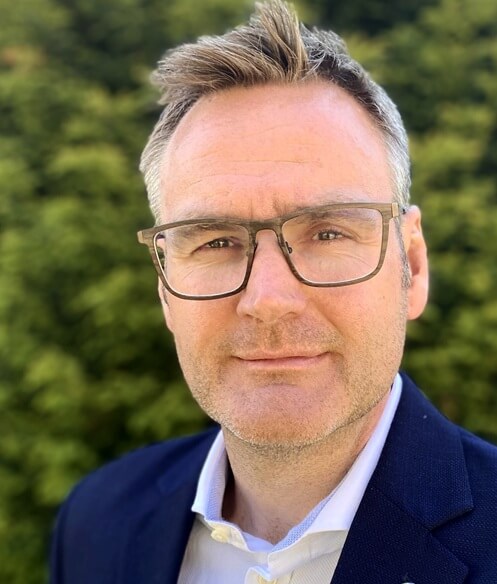
Towage provider Svitzer is known for its global scale, but it's also making a name for itself in low-carbon towing. Together with customer Hoegh Autoliners, it recently rolled out its first very-low-carbon towing service, powered by carbon insetting from biofuel consumption across Svitzer's global fleet. To find out more about the ideas that power Svitzer's green transformation, TME spoke with head of decarbonization Gareth Prowse (left). 
TME: Could you tell us about your background and how you came to work in maritime decarbonization?

I started with a marine biology degree and a PhD in organic pesticides and ecotoxicology. Following that, I ended up in the coatings industry doing environmental and human risk assessment for marine paint products, particularly anti-fouling solutions. As my career progressed and corporate social responsibility and sustainability became more important, I focused on how coatings can drive emissions reduction in vessels.

Three years ago, I was fortunate enough to join Svitzer as head of decarbonization to set the strategy and direction of travel for our tug fleet. For years I was around the industry looking in, and it's been great to be inside the industry looking out for a change.

What does it take to reduce emissions across a fleet of 450 tugs worldwide?

So I think it's a bit of a hackneyed statement these days, but it’s true that there's no silver bullet, no single solution that's really going to help you to achieve your goals when it comes to decarbonization. We need flexibility in our approach. We have to consider vessel age, equipment, operational profile, and regional limitations with respect to biofuel and shore power availability.

Our strategy operates across three key themes: behavior, equipment, and fuel. Solutions range from slower transit speeds to shortening transit distances to using drop-in biofuels. Each region has different macroeconomic drivers and regulatory frameworks, which influence available solutions. For example, biofuels are widely available in Europe but less so in Australia, so we need different solutions for different regions.

What's different about decarbonizing smaller vessels compared to large ships?

The scale is completely different. While large vessels might need hundreds or thousands of tons of fuel for a single bunkering, we might use just 40 tons of diesel every two weeks. With batteries and methanol, we might only need 100 tons of alternative fuel per year. This creates opportunities to work with suppliers who deal in smaller volumes that wouldn't be practical for large container ships.

But the challenges aren't necessarily easier - they're just different. We're caught in a gray area between large ship regulations and road transport solutions. For example, when people talk about ammonia as the future maritime fuel, that makes little sense for small vessels. We need solutions that fit our scale of operations and operational profiles. On top of that, scaling solutions across so many vessels is not without its challenges, and we don’t have a lot of space on board to accommodate some of the more cutting-edge options, like carbon capture systems.

Speaking of small-scaled solutions, can you tell us about the new Robert Allan / Svitzer TRAnsverse tug design?

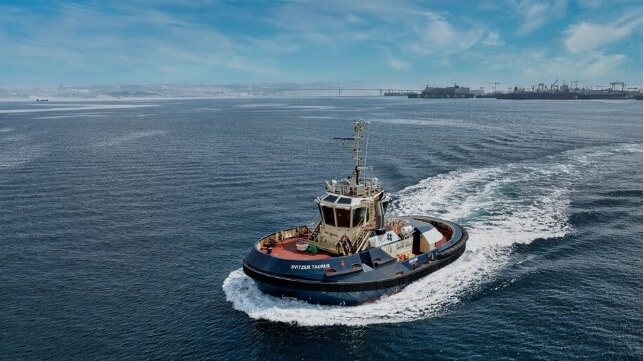
Our TRAnsverse tug design completely rethinks traditional tug operations, and will be way more efficient than the standard vessel that you can buy today. Instead of focusing on static bollard pull - the absolute power a tug can deliver when stationary - we've arranged the thrusters differently, with one at the front and one at the rear in combination with a unique tow connection, allowing the vessel to generate higher dynamic pulls while using less power. This makes the vessel more capable and more efficient than standard tug designs. Tow tank data, CFD modeling and time spent in the simulator, indicate that we get double-digit reductions in fuel consumption relative to the current fleet. We’re now seeing the same results from the real data generated by Svitzer Taurus, the first TRAnsverse vessel to go into operation.  Since the best liter of fuel is the liter you didn't use, we're super excited to see these operational results and really see what it can do.

This efficiency also makes it easier to implement battery power and other alternative fuel solutions where we may need to compromise on the energy density of the fuels we expect to use in the future. We're currently building a hybrid version, scheduled for service in Gothenburg in 2026. The vessel will be a fully electric platform, which will use battery power in combination with methanol range extenders to maximize the operational range of the vessel and ultimately the work it can carry out.

What changes are you making across the existing fleet to boost efficiency?

We're seeing benefits from several approaches. We have five vessels using the SYDRIVE systems, where we can connect both thrusters to one engine through a gearbox system, optimizing fuel consumption. We've been working with battery-enabled vessels for around 10 years now, and as we renew those batteries, we're moving from traditional lithium-ion to newer chemistries like lithium iron phosphate (LFP), which offer better energy density and discharge rates. This allows us to go from 500kw per vessel to 1.3 MW per vessel. This should have a dramatic effect on fuel used during operation and will help us to sharpen how we operate vessels with batteries to maximize fuel efficiency.ds

We see significant opportunities for battery vessels across our fleet, but it is crucial that we that we can get access to shoreside charging infrastructure. We have built significant experience working with biofuels, both HVO (Hydrotreated Vegetable Oil) and FAME (Fatty Acid Methyl Ester) at high blend levels (B80+) - that's a significant lever. And we can see methanol availability developing in the future. Essentially, it's about being ready to pull all of these levers in combination so we can make the most of them when they become available to us.

That said, we're not complacent about revisiting old challenges and old questions to see if we can do something different with available technologies, as well as the future stuff. We also need to make sure that it's sustainable in the way that we approach it, so we're always looking at the business case and which option is the lowest cost of abatement.

Charging is often a challenge for battery-electric vessels - how do you work with ports to enable charging infrastructure?

It's early days, but we're finding that partnership models are key. Many ports want to support decarbonization but face financial and infrastructure constraints of their own. What we see in some of our locations is that the local grid is poor, or there isn't much of it at all. Sometimes just getting enough shore power to keep the lights on is challenging, because the financing to develop port infrastructure isn't there.

Partnership models can help address the funding gap. We're seeing new companies emerge that will take on all the cost of installing shore-side equipment and then recover their costs through energy pricing, so everybody wins. That's one of the things that we've learned often - these things are not easy to solve on your own, but by talking with ports and figuring out what their pain points are, you can solve it together.

The challenge is that the tug sector is not as heavily regulated on emissions as larger vessels (over 5,000 gross tons), so there's less external pressure driving change. We're stuck in this gray area where the regulation doesn't drive the change, so investing comes with risk. Some of the solutions are expensive, and customers' willingness to pay for the cost difference is limited. This holds us back from progressing as fast as we may like, but we’re laying the groundwork for future opportunities when other stakeholders are ready to go.

What role does crew behavior play in reducing emissions?

Our "Aim for 8" program uses AIS tracking and machine learning to monitor vessel speeds and determine optimal speeds for different operations. While behavioral changes alone won't get us to our targets, they're crucial for change management. About 80% of our fuel is burned during the working phase, so we're particularly interested in optimizing operations during active towage. The program helps gamify fuel optimization and engages crews in finding solutions.

This engagement is especially important as we introduce new technologies like methanol-powered vessels and battery systems, which require new training and procedures. When crews understand why changes are necessary and see their role in the solution, they understand why we're asking them to do things differently.

More often than not, I find people are “on board” with decarbonization. They see it as important, and they want to drive the change. Mariners can be part of the solution. If you find a great idea and it works, we want to can scale that very quickly across 450 vessels - even if it isn’t all of them, we should be able to find enough to have an impact.  

What lessons have you learned that might help other operators?

First, everyone needs to be aligned on looking for solutions and challenging existing practices. We use a pilot-scale-policy approach: test ideas on a small scale, and if they work, expand them. If it works on one tug, does it work on 10? If it works on 10, does it work on 20? And if it works everywhere, then you can just set it as a policy. This startup-style thinking helps us validate hypotheses about what works for our operations, customers, and ports.

I think you really need to have that explorer mindset - you should never underestimate or ignore the fact that at the end of the day, you're in a competitive market and you have to serve customers. Focus on opportunities that reduce operational costs while providing environmental benefits. If you can eliminate the "green premium," it's easier to make the business case for sustainability investments, so never lose sight of the return on investment - that CO2 reduction per dollar spent is really important.

ALT. FUEL

Yara Clean Ammonia and NYK Conclude World’s First Time-Charter Agreement

Yara Clean Ammonia
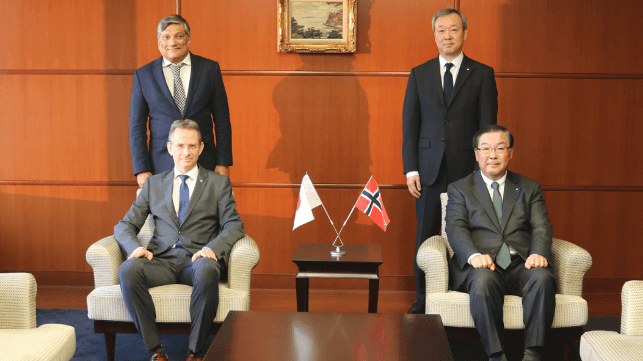
YCA and NYK Top Management Meeting

Published Feb 12, 2025 12:19 PM by The Maritime Executive


[By: Yara Clean Ammonia]

Yara Clean Ammonia, the world’s largest ammonia distributor, signed a time-charter contract with Nippon Yusen Kabushiki Kaisha (NYK) for an ammonia-fuelled medium gas carrier (AFMGC) to be delivered in November 2026.

“Our successful collaboration with NYK enables us not only to comply with future regulations related to CO2 emissions from sea-going vessels but also helps us to ensure that our customers can receive carbon-intensity compliant clean ammonia throughout our supply chain from well to wake,” says Murali Srinivasan, Senior Vice President Commercial in Yara Clean Ammonia.

Since 2021, Yara Clean Ammonia and NYK have jointly studied the practical application of an ammonia-fueled ammonia gas carrier, and the companies have now concluded the world’s first time-charter contract for an AFMGC, the most popular type of vessel for the international maritime transportation of ammonia.

“I am pleased to have concluded this charterparty which will give us great flexibility to manage carbon emissions and product carbon intensity. I look forward to a successful cooperation in operating this new technology to its best efficiency,” says Csaba Laszlo, Vice President Ammonia Trade & Shipping in Yara Clean Ammonia.

The use of an AFMGC will greatly contribute to significantly reducing GHG emissions from marine transportation and developing an ammonia supply chain by providing a more environment-friendly means of ammonia transport as demand grows for ammonia use in the power sector, for marine fuel, and the like.

“In November 2023, we released the ‘NYK Group Decarbonization Story’ declaring a target of achieving net-zero GHG emissions by 2050. We have been developing an ammonia-fueled vessel because we believe that using alternative fuels, especially ammonia, is essential to reaching the net-zero goal. We are delighted to have concluded this time-charter contract with Yara Clean Ammonia, the world’s largest ammonia player, which has highly evaluated the AFMGC we develop with our partner companies as a next-gen fueled vessel. We will continue to work with Yara on building an ammonia supply chain from various aspects, not only in the maritime transportation of ammonia,” says Hironobu Watanabe, Managing Executive Officer NYK.

Outline of vessel

Type of vessel: 40,000m³ Ammonia-Fueled Medium Gas Carrier
Delivery: November 2026
Length overall: 180.00 m
Breadth: 32.00 m
Molded depth: 18.45 m
Flag: Japan

The products and services herein described in this press release are not endorsed by The Maritime Executive.


DESANTISLAND

PortMiami Handles Record Number of Cruise Ships in a Single Day

PortMiami cruise ships
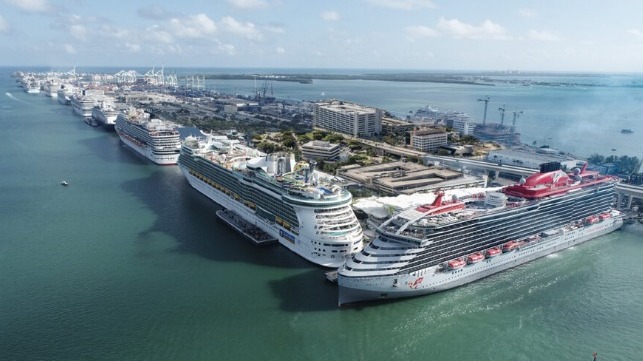
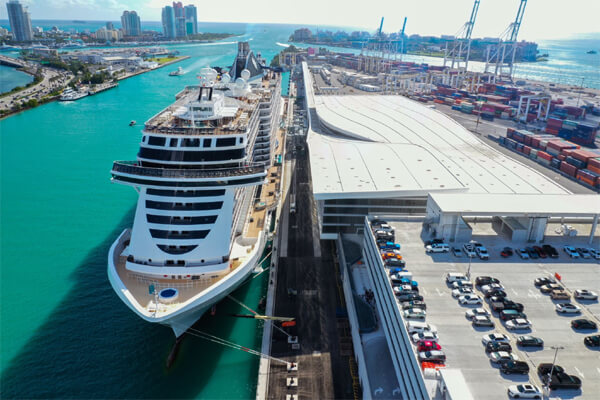
PortMiami berthed 10 cruise ships for the first time on a single day (PortMiami)

Published Feb 10, 2025 2:26 PM by The Maritime Executive


With the winter cruise season in full swing, PortMiami marked another record day as it continues its position as the largest homeport for cruise ships. Expansion of the port’s facilities is proceeding with the soft opening of MSC Cruises’ new terminal at the eastern end of Dodge Island further expanding capacity and preparing the port for the entry into service of the next mega cruise ship.

The port handled a total of 10 cruise ships on Saturday, February 8. It was the first time the port had docked that number of cruise ships in one day and it ranged from the world’s largest cruise ship, Icon of the Seas, to multiple vessels from Norwegian Cruise Line, Carnival Cruise Line, Royal Caribbean International, and other lines including Oceania Cruises, Virgin Voyages, and Holland America Line.

According to the port they were expecting close to 68,000 passengers. The 10 cruise ships (Carnival MagicCarnival SunriseZaandamMSC SeascapeNorwegian EscapeNorwegian GemSirenaIcon of the SeasIndependence of the Seas, and Scarlet Lady) have a double occupancy capacity of approximately 32,000 passengers and a total capacity of approximately 38,000 passengers (excluding crew). The port counts embarking and disembarking passengers separately for the total number of people passing through its facilities in a single day.

It comes as PortMiami roared back into first place in the cruise industry handling 8,233,056 passengers in FY2024. Miami has been the largest homeport for years but briefly was eclipsed by Port Canaveral, Florida during the restart from the pandemic. 

Previously, PortMiami had handled eight cruise ships in a day and set a passenger record at approximately 67,500 people in a day. A December 2023 day that had the potential to see 70,000 passengers was disrupted by bad weather. However, the port’s expansion continues.

“PortMiami is the departure choice for all major cruise lines,” said Miami-Dade County Mayor Daniella Levine Cava. “It is no surprise PortMiami and the cruise industry continue to break records.”


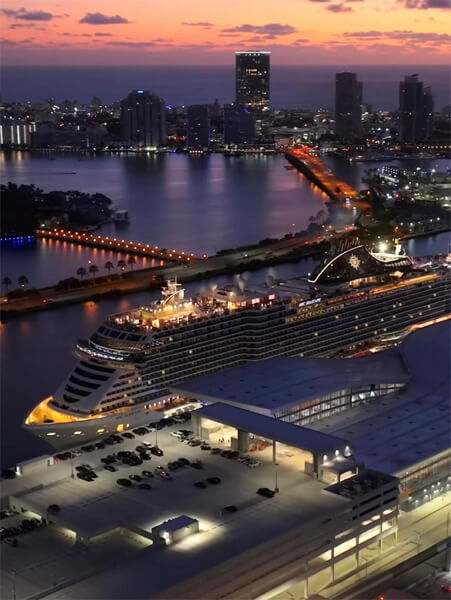
MSC Seascape was the first cruise ship to use the new $360 million Terminal AA (MSC Cruises)

The MSC Seascape became the first cruise ship to dock at the new Terminal AA this weekend with the official opening for the terminal scheduled for next month. Ceremonies are set for March 6, but the 4,500-passenger cruise ship kicked off the operation this weekend.

MSC Cruises built the terminal in cooperation with PortMiami and it included removing land and creating a new seawall to make the channel wide enough to accommodate the 135-foot-wide cruise ship at the berth. MSC first announced plans for the terminal in 2018 as part of its growth plans for the North American cruise market. Fincantieri Infrastructure, the land-side construction arm of the Italian group, began construction of the terminal in March 2022 which was reported to be costing approximately 350 million euros ($360 million). 


PortMiami removed land from the island to widen the channel to accommodate cruise ships at the new terminal (MSC Cruises)


When completed Terminal AA will have access to three berths, including handling MSC World America, the new 215,860 gross ton cruise ship with accommodations for over 6,700 passengers due to enter service in April 2025. The terminal was designed to handle up to 36,000 passengers a day. It has been billed as the largest cruise terminal in the United States.

PortMiami is also undertaking upgrades to its existing terminals to support growth. Terminal F was already rebuilt and the next step class for the overhaul and rebuilding of Terminal G for Royal Caribbean Group, including the ability to handle a 7,000 passenger Icon-class cruise ship. The revamped Terminal G is due to be available in 2027.


Contracts Awarded to Advance Plans for South Africa’s First LNG Terminal

South Africa
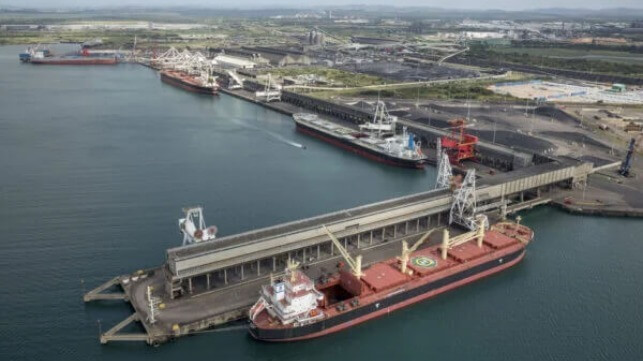
Richards Bay will be the location of South Africa's first LNG terminal with pipeline conenctions to Durban (Transnet Pipelines)

Published Feb 11, 2025 5:25 PM by The Maritime Executive


Efforts to develop the first LNG import terminal in South Africa are continuing to make progress with 2026 now targeted for a final investment decision. A terminal operator agreement was signed which provides for the design, development, construction, and operation of the terminal which would be located at the Port of Richards Bay on the Indian Ocean coast of South Africa.

Transnet Pipelines, a division of the state-owned group and that operates nearly 2,000 miles of pipelines, has formed a joint venture with Vopak Terminal Durban, part of Royal Vopak, for the planned LNG terminal. Transnet National Ports Authority appointed the joint venture known as Zululand Energy Terminal in August 2024 to develop and operate the LNG terminal. It followed the first RFP which was awarded in January 2024.

Zululand has now executed a 25-year concession for land in Richards Bay to be used for the terminal. The company has full rights to the land designated for the terminal and reports it is a key step in the process.

According to the companies, the LNG terminal is a pivotal development in South Africa’s efforts to ensure energy security as the country faces a looming “gas cliff” and the gradual decommissioning of coal-fired power stations. The terminal will support flexible power generation while fostering industrial growth in KwaZulu-Natal and beyond. 

The project calls for the development of a floating storage unit with a capacity of 135,000 to 174,000 cbm which would be supported by an onshore regasification unit. In the second phase, they plan to replace the FSU with onshore storage.

Zululand Energy Terminal reports it is in an advanced stage of its capacity allocation process, with negotiations ongoing with a select group of potential customers. It initiated an RFP in September 2024 to identify key stakeholders critical to the project’s success. With the new agreements, it reports it can proceed with binding agreements with potential customers. A final investment decision is expected in 2026, contingent on customer commitments.

Royal Vopak has been active in South Africa since 1997. It owns and operates two terminals in the country and expects to leverage its expertise to develop this new project.

Transnet in August 2024 also asked for expressions of interest from companies for a second project to support the LNG terminal. It plans to transition the existing Lilly Gas Pipeline which connects to Durban from transporting Methane Rich Gas to regasified LNG. Lilly currently transports approximately 500 cbm of MGR annually and has key offtake points along its route. The LNG project they report will benefit from the industries connected to the Lilly Pipeline.

Officials have said this LNG terminal project represents a significant milestone for South Africa. They highlight that it will provide the infrastructure necessary to meet growing energy demands, support the energy transition, and stimulate economic growth. South Africa will join a growing number of countries around the world working to develop LNG import capabilities. 


Cavotec Signs Order for Automated Mooring System for Port of Dublin

Cavotec

Published Feb 12, 2025 10:00 PM by The Maritime Executive


[By Cavotec]

Cavotec has signed a multi-million euro order for its MoorMaster™ NxG automated mooring system to be installed at Port of Dublin in Ireland.

The order, signed at the end of 2024, marks the first deployment of MoorMaster technology in Ireland. Deliveries will primarily take place in the third quarter 2026.

“The installation at this new berth will serve as a benchmark for sustainable port operations in the region, while also contributing to the adoption of MoorMaster systems across Northern Europe”, says Nicklas Vedin, Senior Vice President and Head of Ports & Maritime Division.

“This order is a key milestone for Cavotec, underscoring our leadership in the automation of critical maritime infrastructure,” comments David Pagels, Cavotec’s CEO. “It is also another important contribution to reducing climate emissions from the maritime sector.”

The MoorMaster NxG system enhances operational safety and productivity by mitigating the effects of passing vessels and ensuring uninterrupted berth operations. It eliminates the need for vessels to significantly reduce speed, enabling smoother and safer operations while minimizing downtime. The system also delivers substantial environmental benefits by reducing mooring times, allowing vessels to operate at lower speeds and shut down their main engines faster – significantly cutting carbon emissions over time.
 

The products and services herein described in this press release are not endorsed by The Maritime Executive.


LA Port Police Bust Multimillion-Dollar Trailer Theft Scheme

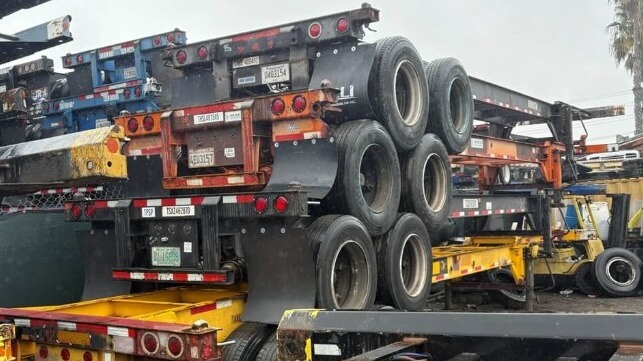
Allegedly stolen trailer chassis at a lot in Gardena, California (LA Port Police)

Published Feb 10, 2025 4:12 PM by The Maritime Executive


Trailer theft is commonplace in America, and homeowners and contractors go to great lengths to keep thieves away from their toy-haulers and cargo trailers. But the Port of LA's police department recently busted a much larger and more organized trailer theft scheme: the department uncovered a ring of local thieves who were making off with dozens of chassis from container terminals and reselling them as new, making off with millions of dollars in ill-gotten profits. 

A joint investigation by the LA Police Department and the LA Port Police revealed the existence of a large-scale trailer theft ring that had likely been working in the Port of LA since last year. Authorities believe that the criminals accessed container terminals on port grounds; stole empty chassis that were stored and awaiting use; and relocated them to a storage yard in Gardena. There, the gang allegedly removed all the identifying marks from the chassis, repainted them, put new VIN numbers and markings on them, and resold them to unwitting buyers as new chassis. 

In a raid on the 14500 block of South Avalon Boulevard in Gardena, 10 miles north of the Port of LA, police found 24 stolen chassis with a value of about $600,000. Given the scale of the scheme and the value of each chassis, the police believe that the theft ring was earning millions of dollars in revenue. 

Gardena resident Denis Fuentes, 25, was arrested at the storage lot and now faces potential charges of receiving stolen property. The investigation is still under way, and additional arrests are expected soon; the port police are gathering information and are interested in receiving any relevant tips from the public.  

“The Port of Los Angeles [is] the busiest port in the United States so stopping this theft was important for everyone involved,” said LA Port Police spokesperson Lt. Rosario Ferrara. “Our investigation into these activities continues to evolve, but we hope this arrest sends a message to other criminals targeting the Port complex.”