Saturday, February 22, 2025

(SIR) Mick Jagger Can’t Always Get What He Wants—But London Needs What He Opposes


20 February, 2025 
Left Foot Forward Opinion

Mick Jagger once told the world, “You can’t always get what you want.” He was right. The wealthy and connected shouldn’t get to block homes for the most vulnerable. It’s time for London to get what it desperately needs: housing, hope, and progress.



Mick Jagger is a legend. As frontman of the Rolling Stones, he built his career on disruption—shattering norms, challenging authority, and revelling in rebellion. But when it comes to housing, it seems Sir Mick is singing a very different tune: the anthem of the entitled elite.

His opposition to the One Battersea Bridge development—a project that will deliver 51% affordable homes, including much-needed social rent properties—reeks of hypocrisy and privilege. London’s housing crisis demands urgent solutions, and Jagger’s stance is a slap in the face to the 300,000 Londoners languishing on waiting lists.

It’s almost laughable. A man whose career celebrated excess and broke all rules is now demanding limits—on height, on profit, on progress. Let’s not forget, Jagger’s band recorded songs like “Gimme Shelter” while London families were evicted en-masse during the slum -clearances of the 1960s. Today, Jagger is using his wealth and influence to oppose housing for the very people his music once claimed to champion.

One Battersea Bridge isn’t just another high-rise; it’s a rare beacon of hope in London’s dysfunctional housing market. In the middle of a city that started just 2,300 affordable homes this year—against the backdrop of over 170,000 people stuck in temporary accommodation—this scheme offers a bold path forward.

If Labour were to propose bold policy reforms using this as a case study, it should enable all 50 per cent affordable housing developments a “brownfield planning passport” that should be approved by-right on officer recommendation, avoiding the need for committee. This would cut red tape and transform underused land into vibrant mixed communities. With 51% affordable housing on offer (all social rent), this development doesn’t just meet targets—it exceeds them. And yet, figures like Jagger oppose it on aesthetic grounds.

The Labour Party’s manifesto is clear: “The biggest boost in affordable homes for a generation.” This is the very type of development Labour should champion. A project like One Battersea Bridge exemplifies the private sector stepping up, delivering not just homes but public benefit. If approved under a streamlined “planning passport,” projects like these wouldn’t languish in endless committee debates, vulnerable to the whims of celebrity-backed objections. A planning system that listens to the 83,000 children in temporary housing—rather than multimillionaires in Chelsea—is long overdue.

The hypocrisy cuts deeper. Jagger is no stranger to profiting from disruption. Whether it was selling rebellious records or dodging tax to maximise his wealth, he has always found ways to thrive in systems he claimed to oppose. Now, the campaign he supports decries the “profit” of housing developments for “foreign” investors like One Battersea Bridge—ignoring the fact that these profits fund the affordable homes that working families so desperately need.

As long as profit and height remain development’s dirtiest words, we will never fix our housing crisis. Instead of entertaining the loudest voices in the room, Labour should bulldoze outdated planning systems and prioritise those who lack even a roof over their heads. It’s time to tune out the whining of the already-housed and start listening to the voices of the homeless and the overcrowded.

London deserves better. One Battersea Bridge shows us what better can look like: a development that prioritises affordability, maximizes brownfield land, and offers a blueprint for future schemes across the country. It’s proof that the private sector, when guided by the right incentives, can help solve our housing crisis—not exacerbate it.

Mick Jagger once told the world, “You can’t always get what you want.” He was right. The wealthy and connected shouldn’t get to block homes for the most vulnerable. It’s time for London to get what it desperately needs: housing, hope, and progress.

Let’s stop dancing to the tune of celebrity NIMBYs and start building the future our city deserves

Credit: Architect’s view


Christopher Worrall is a housing columnist for LFF. He is on the Executive Committee of the Labour Housing Group, Co-Host of the Priced Out Podcast, and Chair of the Local Government and Housing Member Policy Group of the Fabian Society.



Stop Funding Hate keeps the pressure on M&S over ads on ‘toxic’ GB News

Yesterday
Left Foot Forward

'M&S sponsors GB News. This is not just hate.'


Stop Funding Hate, which campaigns against advertising with media outlets that spread hate and division, has urged supporters to keep pressing M&S bosses to pull their ads from ‘toxic TV channel’ GB News.

This comes after the right-wing channel urged viewers to email M&S telling them they made “the right decision” by advertising on GB News.

Earlier this week, Stop Funding Hate posted on its Facebook page that “There’s a definitely-100%-authentic-grassroots Facebook page calling itself ‘Friends of GB News'”.

The group said the page has been running paid Facebook advertisements praising M&S for advertising on the channel and encouraging people to ask them to keep doing it.

GB News presenter Michelle Dewberry criticised Stop Funding Hate’s call for M&S to drop its ads, saying: “Political, hate-filled activists have constantly, negatively bombarded any brand who has advertised with GB NEWS because they believe that alternate viewpoints must be silenced”.

Stop Funding Hate shared a post on X which said: “So Marks and Spencer are now advertising with GB News, which previously aired commentary disparaging M&S for including a “mandatory” black family and an “obligatory gay couple” in their Christmas ad.”

The campaign group also pointed out that this week GB News aired commentary belittling a black actress on the BBC as a “diversity hire”, and asked “Are Marks and Spencer really comfortable to be associated with this?”.

Stop Funding Hate has emailed supporters asking them to contact M&S bosses urging them to stop advertising on GB News.

The M&S bosses’ emails are stuart.machin@marks-and-spencer.com and chairman@marks-and-spencer.com.

A graphic is circulating on social media with an image of M&S roast beef, playing on the retailer’s famous ad slogan with the caption: “M&S sponsors GB News. This is not just hate.”

In January, the pressure group launched a crowdfunder to help it fightback against right-wing channel GB News, which it says wants to bring Trump’s playbook to Britain.

It has now raised double its initial crowdfunder target. The link to the crowdfunder is here.

Olivia Barber is a reporter at Left Foot Forward
How governments distract from social injustice by creating moral panics


OPINION
Prem Sikka 
Yesterday
Left Foot Forward.


Censorship and indoctrination diminish the possibilities for emancipatory change


The right-wing coups sweeping though the UK, USA and much of Europe are diminishing possibilities of emancipatory change by subtle forms of censorship and indoctrination. Books and scientific journals are being censored to reshape people’s subjectivities and produce a docile population. People are concerned about inequalities, poverty, crumbling infrastructure, loss of social rights and rising power of corporations and wealthy elites. But governments want to make people foot-soldiers of capitalism and corporations, and entice them with possibility of riches through speculation on stock markets. None of this can deliver prosperity, happiness or social stability.
New censorships

The US President Donald Trump has ordered Pentagon-run schools to suspend books “related to gender ideology or discriminatory equity ideology topics”. This builds upon a history of banning school books that the authorities find challenging. Researchers publishing papers in peer-reviewed medical and science journals have been ordered to retract banned terms from research already accepted for publication or in the process of being revised. Those refusing risk ending their scientific careers. The President has blocked Associated Press reporters from the Oval Office briefings.

The UK isn’t an oasis of freedom either. Rather than welcoming education which enables understanding of society, ministers attack media and cultural studies degrees as they encourage critique of contemporary power structures. Books are removed from university libraries because of the grim depiction of everyday realities. There is a history of banning books by authors such as JK Rowling, James Joyce and George Orwell. In 2022, the government ordered schools in England not to use material from groups that believe that capitalism should end. So, what chances that books about the suffragettes, working class history, and the American and French revolutions, or by writers such as Charles Dickens, Mahatma Gandhi, VS Naipaul, HG Wells and Virginia Woolf would be used to stimulate discussions about social justice, inequality, power and democracy? Such literature can demystify power and show that people’s life chances are not governed by some invisible hand of fate. Rather their social condition is governed by institutions of politics, which can be changed.

The state-sponsored censorship is at odds with the need to develop education systems that encourage critical thinking and enable people to analyse the world to secure emancipatory change. Yet increasingly education is associated with the maintenance of status-quo. Those offering alternative worldviews face the prospect of being ostracised, silenced and exiled as the western world races to an inglorious past. Greek philosopher Socrates was sentenced to death for encouraging the young to think critically. Galileo was persecuted by the Catholic Church Galileo advancing the heliocentric model of the universe. Nazi Germany burnt thousands of books that it disapproved of.
Mirage of Riches

Governments are subservient to corporations and the ultra-rich. Rather than addressing the causes of social injustice, governments distract people with promises of riches and security, not through decent wages, healthcare, education and pensions but by serving capitalism and becoming speculators on stock markets.

Share ownership does not spare anyone from the ravages of capitalism. They will still face wage freezes; eroding living standards; rocketing bills for energy, food, water and other essentials, and can be hired and fired just like any employee.

Since the early 1980s, governments have privatised publicly-owned services such as telecommunications and gas. They handed discounted shares to the general public, in the belief that this would encourage share ownership. However, this has not been the case. Today, only around 10.8% of the UK quote company shares are directly held by UK-resident individuals. This is despite numerous tax incentives, such as taxing capital gains and dividends at lower rates than wages.

Undeterred, neoliberals want the state to encourage people to buy/sell shares. In February 2025, a Minister said: “The Government want to see more people taking part in capital markets and benefitting from the long-term financial security that investing can provide”. There is merit in promoting financial literacy, but urging people to speculate on the stock market casino is something entirely different. Governments are not dispelling any of the myths of share ownership.

Due to inequitable distribution of income and wealth, share ownership is beyond the reach of most people. One recent survey suggested that 34% of adults had either no savings or had less than £1,000. Another reported that 66% of adults have average savings of less than £10,000, and there are huge gender differences. Buying and selling shares isn’t a priority for most people, and there are safer investments.

To manage risks of investment, people need to hold diversified portfolios. That is difficult when resources are limited. Some may secure a measure of diversification through Stocks and Share ISAs or unit trusts but governments want to encourage direct share ownership. Financial institutions are able to extract information from company executives over lunch-table meetings, but individual investors have no power to extract or analyse information even when it is publicly available.

Governments create the image that wider share ownership will lead to more investment in the economy. That isn’t necessarily so. Most of the shares and bonds traded on stock markets are not new. Individual A buys shares/bonds from B, money is exchanged between A and B, not-a-penny goes to the company for investment in productive assets.

Contrary to the myths, shareholders do not own companies. They acquire some controlling rights but do not own the company or its assets. Directors of the company are not required obey directions given by the shareholders as individuals, and are not agents appointed by and bound to serve the shareholders as their principals. Their duty is to the company. Shareholders cannot force directors to follow a particular business strategy, disinvest or pay dividends. Their vote on remuneration is usually not binding.

Due to uncertainties, shareholders are focused on short-term returns. In the US, the average share holding duration is around 22 seconds. In the era of automated trading, can the UK be far behind? Consideration of the long-term is inevitably downgraded. Faced with share price volatility and investor pressures, companies are paying larger proportions of earnings in dividends. A Bank of England economist noted that in 1970, major UK companies paid out about £10 of each £100 of profits in dividends. By 2015 the amount was between £60 and £70, often accompanied by a squeeze on labour and investment. Water companies in England are a classic example. They have paid vast amount in dividends by borrowing money, and are now teetering on the edge of bankruptcy. No shareholder objected to vast pay-outs or dumping of sewage in rivers.

The stock market is a casino but it isn’t necessarily a source of new finance. In 2023, companies raised £953.7m by issuing new shares. This rose to £3.4bn in 2024. In 2024, UK-listed companies retuned £86.5bn in dividends to shareholders, and FTSE100 companies alone returned another £56.9bn in share buybacks. The stock market functions as a cash extraction machine. The net result is that companies rely upon retained earnings and debt to finance long-term investment in productive assets. The UK has been bottom of the G7 league for investment in 24 out of last 30 years, and is ranked 28th among 31 OECD countries.

Shareholders have the benefit of limited liability, which confers unlimited liability on others. For example, at Carillion, directors appeased shareholders by paying high dividends, mainly financed by borrowing. The company collapsed with £7bn of liabilities, including a £2.6bn pension liability. Thousands of employees lost some of their pension rights. Thousands of small businesses lost money due to them and became bankrupt. Social irresponsibility is an integral part of share ownership. Companies can pay dividends by flooding rivers with sewage, encouraging smoking and causing health hazards with processed foods, but shareholders do not bear any personal responsibility for the resulting consequences.

There is a strong case for reforming capitalism, share ownership; shareholder-centric model of corporate governance and rights and obligations of stakeholders, but that is not on the government’s agenda.

The western world is moving into a new age of propaganda. Governments rarely address causes of social injustice but manage public concerns by creating new folk-devils and moral panics. They promote the claim that gender orientations, diversity and equality are somehow damaging society rather than inequalities and the power of corporations and wealthy elites. Censorship is enacted, books are banned, and research is obstructed to discipline people, create fear and force compliance. People who struggle to make ends meet are urged to become speculators, and foot-soldiers of capitalism. This promotes a kid of individualism which has little or no regard for collective welfare of society.


Prem Sikka is an Emeritus Professor of Accounting at the University of Essex and the University of Sheffield, a Labour member of the House of Lords, and Contributing Editor at Left Foot Forward.

'Flying blind': Aviation experts sound alarm about dangers of 'senseless' Trump FAA cuts
February 21, 2025
ALTERNET

President Donald Trump and his close ally Elon Musk are insisting that the mass layoffs being pushed by Trump's administration and the Department of Government Efficiency (DOGE), which Musk heads, will not endanger public safety in any way — that their goal is cutting fat and waste from the federal government, not vital functions. But critics of Trump and Musk counter that the layoffs are being carried out in such a reckless, haphazard way that public safety is bound to suffer, from food safety to disaster responses.

Air safety is another major concern of Trump critics, who warn that draconian cuts to the Federal Aviation Administration (FAA) will make flying dangerous in the United States.

Politico addresses the worries of aviation experts in an article by reporters Oriana Pawlyk and Sam Ogozalek published on February 21 and a Politico Playbook column by journalist Zack Stanton published the same day.

Stanton notes, "Public confidence in air travel is already falling following a series of air disasters, AP polling found this week.

Jeff Guzzetti, an aviation safety consultant and former FAA official, told Politico, "I would argue that every job at the FAA right now is safety critical….. (These cuts) certainly (are) not going to improve safety — it can only increase the risk."

Similarly, an aeronautical information specialist who was laid off because of the Trump Administration/DOGE downsizing told Politico, "Air traffic controllers cannot do their work without us…. To put it frankly, without our team.... pilots would quite literally be flying blind."

The aviation expert, interviewed on condition of anonymity, argued that the Trump Administration and DOGE fail to understand the importance of the FAA jobs they are eliminating — and said the workers are being "targeted just as a senseless line item on an Excel sheet."

Pawlyk and Ogozalek report, "The first wave of White House-ordered firings at the Federal Aviation Administration included employees who play important roles in the safety of air travel — despite the Trump Administration's assurances that no 'critical' staff had been axed. More than 130 of the eliminated workers held jobs that directly or indirectly support the air traffic controllers, facilities and technologies that the FAA uses to keep planes and their passengers safe, according to the union that represents them, the Professional Aviation Safety Specialists. That alone creates reason for concern about the impact of the cuts, people familiar with the terminations said, even if the initial firings spared the air traffic controllers themselves."

Read Oriana Pawlyk and Sam Ogozalek's full article for Politico at this link and Zack Stanton's Politico Playbook column here.

'Tax Elon!' Irate crowd shouts down GOP congressman during town hall in deep-red county


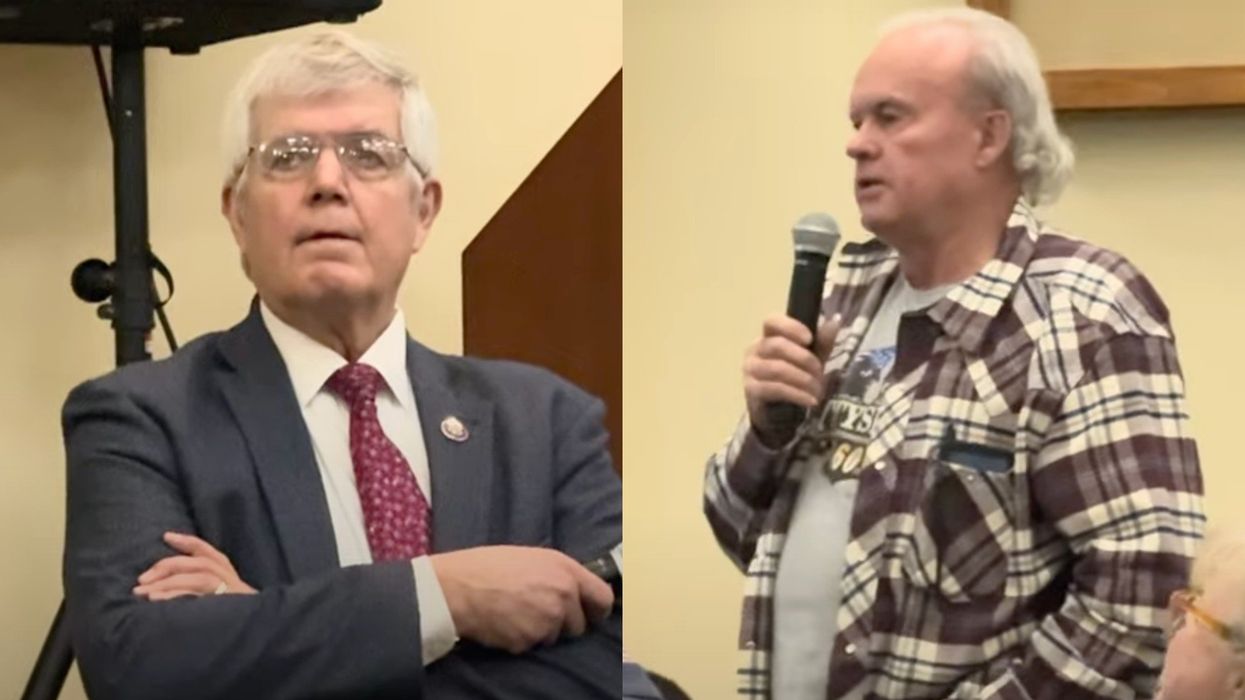
U.S. Rep. Cliff Bentz (R-Ore.) listening to a constituent's question at a town hall on February 20, 2025 (Image: Screengrab via Unsound America / YouTube)

February 22, 2025
ALTERNET

Even residents of a county President Donald Trump won by a significant margin are outraged by the Trump administration's slashing of public services — and their Republican congressman's support of the cuts.

The La Grande, Oregon-based Observer reported Friday that Rep. Cliff Bentz (R-Ore.) was recently met by an angry crowd of constituents during a town hall at Eastern Oregon University. The outlet noted that the audience of several hundred people filled nearly all 435 seats in the McKenzie Theater, and more people filled the aisles and stood along the walls to hear their congressman.

Attendees reportedly grew impatient with Bentz's presentation, yelled "we can read" while he went over PowerPoint slides and urged him to move to the question-and-answer portion of the meeting. At that point, the crowd indicated it was furious with Bentz's support of Tesla and SpaceX CEO Elon Musk's "Department of Government Efficiency," or DOGE (which is not an official federal agency authorized by Congress). Bentz has recently said he would even support firing some of his own staff in order to help DOGE.


READ MORE: 'Shame!' Angry crowd boos Georgia Republican over Trump cuts

In addition to cutting budgets for federal agencies, Bentz talked about his hopes to extend Trump's 2017 tax cut package — which could cost anywhere from $4.6 trillion to $5.5 trillion over a ten-year period. He also said he plans to vote for additional funding for border security and to increase oil and gas production.

While Bentz got back to his desire to reduce federal spending, members of the crowd reportedly shouted over him yelling, "tax Elon," "tax the wealthy," "tax the rich" and "tax the billionaires." Bentz countered that some of his colleagues weren't even holding town halls during this week's Congressional recess, saying: "You should be here to speak with me." The Observer reported that Union County, where Bentz held his town hall, went for Trump by 68%. Bentz won reelection with 64% of the vote in the ruby-red district.

"If you just came to yell, I can leave," Bentz said.

The Observer reported that members of the audience kept coming back to the "power of the purse," which is a power that Article I, Section 8 of the U.S. Constitution specifically delegates to Congress. Bentz pushed back, saying he supports Trump "doing his best to exercise his legal power" to reduce federal spending, and that the president wants to make sure the nation doesn't "go broke." Bentz — who is the lone Republican in the Oregon Congressional Delegation, confronted his own constituents just as Rep. Rich McCormick (R-Ga) had a tense town hall in his own deep-red Georgia district

Click here to read the La Grande Observer's full report.


CLUCK, CLUCK

'A lot of fear': Republicans a no show as Wisconsin farmers complain of Trump chaos
February 21, 2025

Seven western Wisconsin Republican lawmakers did not appear at an event hosted by the Wisconsin Farmers Union in Chippewa Falls Friday as farmers from the area said they were concerned about the effect that President Donald Trump’s first month in office is having on their livelihoods.

Madison-area U.S. Rep. Mark Pocan (D-Black Earth), state Sen. Jeff Smith (D-Eau Claire) and state Reps. Jodi Emerson (D-Eau Claire) and Christian Phelps (D-Eau Claire) were in attendance.

U.S. Reps. Tom Tiffany and Derrick Van Orden, state Reps. Rob Sommerfeld (R-Bloomer), Treig Pronschinske (R-Mondovi) and Clint Moses (R-Mondovi) and state Sens. Jesse James (R-Thorp) and Rob Stafsholt (R-New Richmond) were all invited but did not attend or send a staff member.

“All four of us want you to know that there are people in elected office who want to fight for you,” Phelps said. “Because I think there’s a lot of fear that comes from the fact that we’re seeing a lot of noise and action from the people who aren’t and some of the people that didn’t show up to this. So I hope that you will also ask questions of them when you get a chance.”

Multiple times during the town hall, Pocan joked that Van Orden was “on vacation.”

Emerson, whose district was recently redrawn to include many of the rural areas east of Eau Claire, told the Wisconsin Examiner she had just been at an event held by the Oneida County Economic Development Corporation where a Van Orden staff member did attend, so she didn’t understand why they couldn’t hear about how Trump’s policies are harming local farmers.

“I get that a member of Congress can’t be at every meeting all the time, all throughout their district,” Emerson said. With 19 counties in the 3rd District, “it’s a big area. But I hope that they’re hearing the stories of farmers and farm-adjacent businesses, even if they weren’t here. There’s something different to sit in this room and look out at all the farmers, and when one person’s talking, seeing the tears in everybody else’s eyes, and it wasn’t just the female farmers that were crying, the big tough guys, and I think that talks about how vulnerable they are right now, how scary it is for some of these folks.”

Carolyn Kaiser, a resident of the nearby town of Wheaton, said she’s never seen her congressional representative, Van Orden, out in the community. Despite Van Orden’s position on the House agriculture committee, Kaiser said her town needs help managing nitrates in the local water supply and financial support to rebuild crumbling rural roads that make it more difficult for farmers to transport their products.

“When people don’t come, it’s unfortunate,” Kaiser said.

Emmet Fisher, who runs a small dairy farm in Hager City, said during the town hall that he was struggling with the freeze that’s been put on federal spending, which affected grants he was set to receive through the U.S. Department of Agriculture (USDA).

Fisher told the Examiner his farm has participated in a USDA program to encourage better conservation practices on farms and that money has been frozen. He was also set to receive a rural energy assistance grant that would help him install solar panels on the farm — money that has also been held up.

The result, he said, is that he’s facing increased uncertainty in an already uncertain business.

“We get all our income from our farm, young family, young kids, a mortgage on the farm, and so, you know, things are kind of tight, and so we try to take advantage of anything that we can,” he said. “[The] uncertainty seems really unnecessary and unfortunate, and it’s very stressful. You know, basically, we have no idea what we should be planning for. The reality is just that in farming already, you can only plan for so much when the weather and ecology and biology matter so much, and now to have all of these other unknowns, it makes planning pretty much impossible.”

A number of crop farmers at the event said the looming threat of Trump imposing tariffs on Canadian imports is alarming because a large majority of potash — a nutrient mix used to fertilize crops — used in the United States comes from Canada. Les Danielson, a cash crop and dairy farmer in Cadott, said the tariffs are set to go into effect during planting season.

“How do you offer a price to a farmer? Is it gonna be $400 a ton, or is it gonna be $500 a ton?” he asked. “I’m not even thinking about the fall. I’m just thinking about the spring and the uncertainty. This isn’t cuts to the federal budget, this is just plain chaos and uncertainty that really benefits no one. And I know it’s kind of cool to think we’re just playing this big game of chicken. Everybody’s gonna blink. But when you’re a co-op, or when you’re a farmer trying to figure out how much you can buy, it’s not fine.”

A recent report by the University of Illinois found that a 25% tariff on Canadian imports — the amount proposed by Trump to go into effect in March — would increase fertilizer costs by $100 per ton for farmers.

Throughout the event, speakers said they were concerned that Trump’s efforts to deport workers who are in the United States without authorization could destroy the local farm labor force, that cuts to programs such as SNAP (commonly known as food stamps) could cause kids to go hungry and prevent farmers from finding markets to sell their products, that cuts to Medicaid could take coverage away from a population of farmers that is aging and relies on government health insurance and that because of all the disruption, an already simmering mental health crisis in Wisconsin’s agricultural community — in rural parts of the state that have seen clinics and hospitals close or consolidate — could come to a boil.

“Rural families, we tend to really need BadgerCare. We need Medicaid. We need those programs, too,” Pam Goodman, a public health nurse and daughter of a farmer, said. “So if you’re talking about the loss of your farming income, that you’re not going to have cash flow, you’re already experiencing significant concerns and issues, and we need the state resources. We need those federal resources. I’ve got families that from young to old, are experiencing significant health issues. We’re not going to be able to go to the hospital. We’re not going to go to the clinic. We already traveled really long distances. We’re talking about the health of all of us, and that is, for me, from my perspective as a nurse, one of my biggest concerns, because it’s all very interrelated.”

Near the end of the event, Phelps said it’s important for farmers in the area to continue sharing how they’re being hurt by Trump’s actions, because that’s how they build political pressure.

“Who benefits from all the chaos and confusion and cuts? Nobody, roughly, but not literally, nobody,” he said. “Because I just want to point out that dividing people and making people confused and uncertain and vulnerable is Donald Trump’s strategy to consolidate his political power.”

“And the people that can withstand the types of cuts that we’re seeing are the people so wealthy that they can withstand them. So they’re in Donald Trump’s orbit, basically,” Phelps said, adding that there are far more people who will be adversely affected by Trump’s policies than there are people who will benefit.

“And you know that we all do have differences with our neighbors, but we also have a lot of similarities with them, and being in that massive group of people that do not benefit from this kind of chaos and confusion is a pretty big similarity,” he continued. “And so hopefully these types of spaces where we’re sharing our stories and hearing from each other will help us build the kind of community that will result in the kind of political power that really does fight back against it.”

Wisconsin Examiner is part of States Newsroom, a nonprofit news network supported by grants and a coalition of donors as a 501c(3) public charity. Wisconsin Examiner maintains editorial independence. Contact Editor Ruth Conniff for questions: info@wisconsinexaminer.com.

Friday, February 21, 2025

CRIMINAL CAPITALI$M

'Revenue-generating diagnoses': DOJ investigates UnitedHealth Group for fraud


FILE PHOTO: Luigi Mangione, the suspect in the killing of UnitedHealth Group chief executive Brian Thompson, appears in Manhattan Supreme Court for his arraignment hearing in New York City, U.S., December 23, 2024. Curtis Means/Pool via REUTERS/File Photo


Naomi LaChance 
February 21, 2025
ALTERNET

The Justice Department is reportedly investigating UnitedHealth Group for fraud related to upcoding — encouraging doctors to diagnose patients with conditions they do not have for profit. The group has been the target of anger regarding the health insurance industry following the killing of UnitedHealthcare CEO Brian Thompson in December.

“The new civil fraud investigation is examining the company’s practices for recording diagnoses that trigger extra payments to its Medicare Advantage plans, including at physician groups the insurance giant owns,” the Wall Street Journal reported Friday.

UnitedHealth shares dropped by 12 percent following the Journal’s report, CNBC reported. They are also facing an antitrust investigation by the DOJ.

READ MORE: 'Boiling cauldron': Experts say CEO shooting exposes deep national rage over denied claims

A series of investigations by the Journal found that “Medicare paid UnitedHealth billions of dollars for questionable diagnoses.”

Insurers get a payment from the federal government for patients on a Medicare Advantage plan. The payments increase for certain diagnoses, “creating an incentive to diagnose more diseases,” write the Journal’s Christopher Weaver and Anna Wilde Mathews.

Thompson’s killing elicited an outpour of emotion about the health insurance industry, with patients sharing their stories on social media. The person charged with killing him, Luigi Mangione, has since gained a fawning cult following.

“Doctors said UnitedHealth, based in the Minneapolis area, trained them to document revenue-generating diagnoses, including some they felt were obscure or irrelevant. The company also used software to suggest conditions and paid bonuses for considering the suggestions, among other tactics, according to the doctors,” Weaver and Mathews write.

READ MORE: 'Unnecessary care': Leaked video shows UnitedHealth chief defending company’s denials

Three doctors who were contacted by the DOJ following the Journal’s investigations said “they were questioned about specific diagnoses UnitedHealth promoted for employees to use with patients, incentive arrangements and pressure to add the diagnoses. At least two provided documents, including a contract with a UnitedHealth unit, to the Justice Department,” according to the report.

For example, the company often suggested an obscure condition called secondary hyperaldosteronism — without lab tests. The condition, the Journal found, was “rarely diagnosed by Medicare doctors not working for UnitedHealth.”

The investigators were looking for abuse, according to nurse practitioner Valerie O’Meara, who was interviewed by DOJ attorneys in January.

Mangione is set to appear in New York state court Friday. He is facing murder and terror charges.
Taiwan bounty hunters kill invading iguanas as numbers soar

Agence France-Presse
February 16, 2025 


Asian Water Dragon (Shutterstock)

by Allison Jackson, I-Hwa Cheng and Akio Wang

The iguana population has exploded since the spikey-backed giant lizards were introduced from Central and South America more than 20 years ago as exotic petsArmed with a slingshot, Taiwanese bounty hunter Wu Cheng-hua bends sideways and aims his lethal weapon up at a green iguana, one of tens of thousands in the crosshairs of a government cull.

Taiwan's iguana population has exploded since the spikey-backed giant lizards were introduced from Central and South America more than 20 years ago as exotic pets.

Many escaped, or were dumped, and have bred rapidly in the warm climate of the island's south, invading neighbourhoods and ravaging farmers' crops.

After Wu finishes his shift at a breakfast eatery, he joins a group of hunters hired by the Pingtung County government, which pays up to NT$500 (US$15) per iguana.

"Sometimes we've been lucky and caught 300 iguanas in a day," Wu, 25, told AFP.

"Sometimes we were not so lucky and caught two, three or a dozen."


Carrying harpoon slingshots used for spearfishing and wearing rubber boots, the hunters crane their necks as they scan the thick forest for iguanas, which live in the canopy.

There are more misses than hits as the men fire their stainless steel darts at the prehistoric-looking creatures high up in the trees and shielded by leaves and branches.
AFP journalists watch as an iguana plunges several metres to the ground and runs for its life. Another is shot multiple times before it is pulled out of the tree still alive.

The men bind the legs of the captured iguanas to stop them escaping and leave them on the ground as they carry on hunting.

- 'A perfect storm' -

Taiwan began culling iguanas nearly 10 years ago and this year's target has been set at more than 100,000.

Experts and government officials say the effort is unlikely to eradicate the reptiles, which have also become pests in other countries, including the United States.
Some estimates put Taiwan's green iguana population at 200,000. A female iguana breeds once a year, laying dozens of eggs at a time.

"Climate anomalies" have fuelled iguana numbers in recent years, said Chen Tien-hsi, a wildlife expert at the National Pingtung University of Science and Technology.


A lack of seasonal rain and unusually warm winters have increased hatching and survival rates of the young, which Chen said had created "a perfect storm for explosive population growth".


Pingtung County has ramped up its iguana cull from a few hundred a year in the beginning to 48,000 last year, Agriculture Department director-general Cheng Yung-yu said.

But Cheng said more effective "removal strategies" were needed.

"Despite significant manpower and resources being spent on their removal annually, their population continues to grow almost exponentially," he said.
- 'They move very fast' -

Local farmer Cheng Hui-jung has watched iguanas decimate her family's red bean crop, even after they installed fishing nets to protect their fields from the herbivores.


The iguanas live in the dense bamboo growing between her land and a river, and come down during the day to feast on the red bean shoots.

"They move very fast and we couldn't catch them," Cheng told AFP, who worries some farmers will resort to cutting down the trees or give up planting crops altogether.

Regular people are being encouraged to get involved in the iguana cull.
Hsin Tseng-kuan said she was scared the first time she encountered an iguana on her farm and resolved to learn how to catch them.

"They're not even afraid of people," said Hsin, 58, one of more than 80 people taking part in a government training session where they are shown how to use a snare pole to lasso a soft toy iguana.

"When we first saw one, we were the ones who were scared," Hsin told AFP.

"It really looked like a small dinosaur."
- 'Minimise suffering' -

Animal rights group PETA has urged Taiwan to find "non-lethal strategies" for controlling its iguana population or, if culling was deemed necessary, to "minimise suffering" of the creatures.

Several hunters told AFP they would be able to kill more efficiently and humanely if they were allowed to use air guns, the use of which is tightly controlled in Taiwan.Wu and his colleagues end their hunt in the early evening after catching 14 iguanas in three hours.

The reptiles -- some of them alive and bloodied -- are laid on the ground before being tossed into a plastic box.

Hunters are required to euthanise the iguanas and keep them in a freezer until they can be incinerated by the government.

While hunting was physically harder than his cooking job, Wu said he liked helping farmers protect their crops.

"Otherwise, everything they grow will be eaten up," Wu said.


Trump Jr.'s hunting party faces criminal probe in Italy: report

Daniel Hampton
February 18, 2025 
RAW STORY

FILE PHOTO: Donald Trump Jr. speaks during the AmericaFest 2024 conference sponsored by conservative group Turning Point in Phoenix, Arizona, U.S. December 19, 2024. REUTERS/Cheney Orr//File Photo

Prosecutors in Venice have initiated a criminal investigation into Donald Trump Jr.'s hunting party concerning a recent duck hunting trip, as reported by a regional daily newspaper in Italy on Tuesday.

The probe revolves around whether Trump Jr. or his associates killed a protected, rare orange plumed Ruddy Shelduck in December, La Nuova Venezia reported.

Public prosecutor Daniela Moroni opened the inquiry after Venetian councilor Andrea Zanoni and various environmental groups raised the allegation based on a video of Trump Jr.'s hunting trip that circulated on social media.

In the video, a member of the group said Trump Jr. and his shooting partner killed 50 ducks.

Trump Jr.’s spokesman previously told CNN he had the necessary authorization to hunt and would cooperate with any investigation.

“Don and his group had all the proper permits and were hunting in a legally allowed area, where there were countless other hunting groups present,” Andy Surabian told CNN in a statement.

“While it’s unclear whether this single duck was unintentionally shot by someone in Don’s hunting group, another hunting group or killed in a different manner and retrieved by the group's hunting dog, Don takes following all rules, regulations and conservation on his hunts very seriously and plans on fully cooperating with any investigation,” Surabian added.

"It is very sad to see them like this."

amj/mtp/fox
IRONY

Rights groups slam Australian plan to transfer criminals to Nauru

Agence France-Presse
February 17, 2025 

A beach in Ewa on the Pacific island of Nauru where Australia plans to send three violent foreign criminals as part of a resettlement deal (Mike LEYRAL/AFP)


by Laura CHUNG

Rights groups on Monday denounced an Australian plan to send three violent foreign criminals -- including a murderer -- to live on the tiny Pacific nation of Nauru.

Canberra said Sunday it had paid an undisclosed sum to Nauru -- population about 13,000 -- in return for it issuing 30-year visas to the trio, who lost their Australian visas due to criminal activity.

"There has to be consideration of the lawfulness of banishing people offshore when they've been living as part of our community," said Jane Favero, deputy chief executive of the Asylum Seeker Resource Centre.

"It's a complete disregard of people's human rights."

Home Affairs Minister Tony Burke said the three would be held in immigration detention until they are put on a flight to Nauru or a legal challenge is lodged.

"When somebody has come and treated Australia in a way that has shown appalling character their visas do get cancelled, and when their visas are cancelled they should leave," Burke told reporters.

"All three, though, are violent offenders. One is a murderer," he said.

Once in Nauru, they would live in individual dwellings with a shared kitchen space and be allowed to work and move freely, Burke added.

Authorities have not disclosed the identities, gender or nationalities of the trio, or said whether they had served sentences for their crimes.

Nauru is one of the world's smallest countries with a mainland measuring just 20 square kilometers (around eight square miles).

Phosphate mining once made Nauru one of the world's richest countries per capita, but that boon has long dried up, leaving much of the mainland a barren moonscape and its people facing high unemployment and health issues.


Australia's government has been searching for a way to deal with migrants who have no other country to go to when their visas are cancelled.


- 'Mental damage' -


The High Court ruled in 2023 that indefinite detention was "unlawful" if deportation was not an option, leading to the release of 220 people in that situation, including the three now destined for Nauru.

Burke said any decision to transfer others to the Pacific island would depend on the Nauru government.

Refugee Council of Australia head Paul Power said the government had a duty to ensure any solution was humane and ensured people's rights and dignity.

"History has shown us the deep mental and physical damage indefinite detention on Nauru has caused," he said.


Under a hardline policy introduced in 2012, Australia sent thousands of migrants attempting to reach the country by boat to "offshore processing" centers.

They were held in two detention centers -- one on Nauru and another, since shuttered, on Papua New Guinea's Manus Island.

The scheme was gradually scaled back following 14 detainee deaths, multiple suicide attempts, and at least six referrals to the International Criminal Court.

Nauru still held 87 people as of August 31, 2024, according to latest Australian government figures.

© Agence France-Presse
Bolivia's Morales launches 4th presidential bid, defying term limit

Agence France-Presse
February 21, 2025

Evo Morales was Bolivia's first Indigenous president (AIZAR RALDES/AFP)

by Gonzalo TORRICO

Bolivian ex-president Evo Morales launched a fresh election bid Thursday ahead of polls in August, in defiance of a constitutional term limit and pending criminal charges.

"We will win," Morales told reporters in his political fiefdom of Cochabamba in central Bolivia in announcing his run.

Morales, 65, claims to be the victim of a campaign to sideline him politically, led by incumbent President Luis Arce who was once an ally but now his main rival.

Morales is the subject of an arrest warrant in an ongoing investigation into claims he had a sexual relationship with a teenage girl while in office from 2006 to 2019.

Rising from dire poverty to become Bolivia's first-ever Indigenous president, he retains a large following in the South American country.

His refusal to give up power in 2019 led to a tumultuous exit that cast a shadow over nearly 14 years of economic progress and poverty reduction.

Courts have since upheld Bolivia's constitutional two-term limit, which Morales had previously managed to evade due to a change to the rules during his first term.

He said Thursday he would seek re-election with a party other than the left-wing MAS he and Arce have both represented.

Instead, he will run on the ticket of a small leftist group named "The Front for Victory" that has no seats in parliament.

Amid the tussle between Morales and Arce -- who has not said whether he will seek reelection -- Bolivia is also battling a severe economic crisis with inflation at its highest in nearly two decades and a ballooning fiscal deficit.

With biting shortages of foreign currency, fuel, medicine and food, prices have soared, prompting numerous protests.

Morales has remained holed up in Cochabamba since a warrant was issued in December for his arrest on charges of "human trafficking involving a minor."

Last year, the ex-president's mostly Indigenous supporters barricaded highways leading to Cochabamba to prevent his threatened arrest.

© Agence France-Presse