Saturday, March 01, 2025


Elon Musk and the DOGE Boy Clown Show


 February 28, 2025
Email

Photograph Source: DonkeyHotey – CC BY 2.0

When thinking of what Elon Musk and his DOGE gang are doing it is worth remembering that the crypto coin DOGE was started as a joke. Elon Musk seems to be going back to these roots with his DOGE gang running around trying to dismantle government agencies.

To put a couple points on the table: Making government more efficient is certainly a worthwhile goal. We spend $7 trillion a year, surely there is some waste that can be eliminated.

There are also some government employees who don’t pull their weight. Take any company with a thousand or more workers. You can be certain that at least a dozen or so, or possibly quite a lot more, aren’t worth their paycheck. Given that the federal government employs more than 2.4 million workers, we can be confident that there are many who we could do without.

While these points are pretty much undeniable, it’s hard to see what Elon Musk and his chainsaw routine have to do with eliminating government waste. It seems that he and his team of “super-high IQ” DOGE boys have not made even the most minimal effort to study what the government does.

We actually have an agency, the Government Accountability Office (GAO), that regularly audits the operations of various agencies and makes recommendations for reducing waste and fraud. Musk doesn’t show any evidence that he knows of GAO’s existence, much less that he has taken any time to review any of their hundreds of reports on government waste.

Maybe Musk doesn’t think they do a very good job, but it would still be worthwhile to at least look at what they have done in recent years. Ignoring GAO’s research would be like going on tirades against vaccines without making even a minimal effort to familiarize yourself with the evidence on their effectiveness and risks.

Musk and his DOGE team might also want to have consulted with the inspector generals (IG) at the various departments and agencies, who have the job of uncovering waste, fraud, and abuse. Instead of consulting with these people, Musk and Trump had them all fired. It’s probably worth mentioning in this context that some of these IGs were investigating Musk’s companies.

If they had done minimal homework, maybe Musk and his DOGE team might have avoided repeatedly making fools of themselves, for example when he started screaming about millions of dead people getting Social Security.

This is a topic that has been extensively reviewed by GAO and others. A small number of people do continue to get Social Security checks after their death because the death is not immediately reported. The Social Security Administration gets back most of these payments. It would be great if the amount of loss can be reduced, but it’s first necessary to have a clue about what is going on. Millions of dead people getting Social Security exist only in Elon Musk’s head, not in the real world, as Mr. Arithmetic showed last week.

Instead of approaching government waste in a way that we might expect a serious person to do it, Musk sent his team of DOGE boys to various agencies to conduct mass firings. Incredibly, it seems that they often did not even take a few minutes to learn what the agencies did before the mass layoffs.

The best example here is when they did mass layoffs at the National Nuclear Security Administration, apparently without the knowledge that this agency is entrusted with keeping our stockpile of nuclear weapons secure. When they discovered this, they had to run around and try to track down and rehire the essential employees they had fired, a task made more difficult by the fact that they had deleted their government e-mail accounts.

There is a similar story elsewhere. For example, they offered across the board buyouts to government employees, giving them an incentive to quit or retire early. They apparently didn’t know that some key agencies, like the Federal Aviation Administration, which overseas air traffic, was already short-staffed.

Even their pattern of firing shows incredible incompetence. They have laid off all “probationary” employees at many government agencies. In many cases, these are young energetic people anxious to do serious work at places like the National Institutes of Health or the National Park Service. We will lose a lot of great talent as a result of these layoffs.

Even worse, many employees are classified as “probationary” after they have gotten a promotion. This means that many exceptional workers who were moving up the career ladder because of their good work, are being dumped by Elon Musk and the DOGE team for their efforts.

Then we have the DOGE boys’ dodgy accounting. It seems their “savings” of $55 billion involved more accounting errors than actual savings. Now that many of these errors have gone uncorrected, even after being called to their attention, it looks more like some of the fraud they are supposed to be combatting.

And now we are seeing the trip by Musk and Trump to Fort Knox to inspect our country’s gold stock. The rationale for this is that some loony right-wingers got in their heads that the gold has been stolen. This clown show is likely to cost at least $10 million dollars in travel and security just to humor the loony tunes. That would be roughly a year’s pay for 100 federal employees that DOGE has fired.

In spite of the ostensible commitment to transparency and eliminating waste, we know almost nothing about DOGE’s $30 million budget. Is it going to salaries? Weren’t the “super-high IQ” DOGE boys supposed to be working for free? Maybe Elon Musk is just putting the money in his pocket. That would increase his net worth by 0.007 percent. We may never know.

As we know the, DOGE coin started as a joke and it looks like Elon Musk is intent on continuing the joke. Maybe we should insist on a little truth in advertising and have a small name change to DOGI, the Department of Government Incompetence.

This first appeared on Dean Baker’s Beat the Press blog.

Dean Baker is the senior economist at the Center for Economic and Policy Research in Washington, DC. 


Musk’s Global War on Unions: Taking on


 Tesla from the Showrooms to the Plants

February 28, 2025

BlueskyEmail

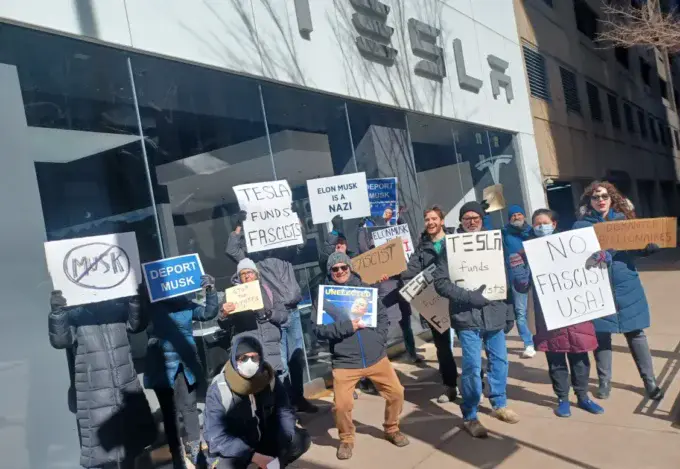
Picket at Tesla showroom, Chicago, Illinois.

Last Saturday was a cold, blustery but sunny day in Chicago, when twenty-five of us picketed Tesla’s showroom at 900 N. Rush Street. Located just west of Chicago’s famed “Magnificent Mile” shopping district, the streets on the weekends are crowded with the wealthy that live in the area and tourists from around the globe. But, there are plenty of people that work in the many retail shops and those out window shopping. It’s a perfect location for a Tesla showroom whose pricey cars are for the rich or those who want to appear to be rich.

It was the second weekend of protests targeting Tesla , whose notorious CEO is Elon Musk, the world’s richest man and best known Nazi. Sitting at the right hand of President Donald Trump, Musk has been the president’s hatchet man destroying the United States’ already ragged welfare state, savaging the Federal workforce, paralyzing agencies designated to protect unions and the environment, and the list keeps expanding daily. The wide variety of Federal workers across the country and their unions right now face the brunt of the offensive, but resistance has been building.

Protests and rallies by Federal workers have taken place and a new rank and file Federal workers network has emerged, it will take some time for workplace struggle to meet their challenge thrown at them, which is historically unprecedented. When President Ronald Reagan fired striking Federal air traffic controllers in 1981, represented by PATCO that endorsed Reagan for president the previous year, it was seen as historically unprecedented and the signal for a rollback of the U.S. trade union movement for two decades that followed.

The Trump administration’s blitzkrieg attack has caught many off-guard, despite plenty of forewarning of what was going to come if he won the election. However, Trump’s policies have not proved popular, while the conspicuous role of the super-billionaire Musk has added to their unpopularity. Republican Congressman who have held “town hall meetings” have faced the wrath of their constituents, and the milk-toast Democrats are also catching hell from theirs as well. Meanwhile, Musk and Vice-President J.D. Vance’s interventions in European politics bolstering far right and straight-up Nazi parties, like the Alternative for Germany (AfD), have also shocked many people.

Tesla takedown

Elon Musk derives much of his wealth from his stock ownership of Tesla and Space X, along with his faux reputation as a “genius inventor” and innovative “clean energy” businessman. Despite their swagger and arrogance, Musk has weak spots that we should be punching as hard as we can right now. Tesla is the prime target. Tesla’s sales have plummeted in Europe and one of the major reasons for this has been Musk’s promotion of the far right. Accordingto the New York Times:

In Germany, home to Tesla’s only factory in Europe, only 1,277 new Tesla vehicles were registered in the month, the German Federal Motor Transport Authority reported on Wednesday. German consumers turned instead to domestic and Chinese automakers for electric cars, which recorded a 54 percent increase in demand in January.

Tesla’s sales plummeted 63 percent in France in January from a year earlier, and 12 percent in Britain, where Mr. Musk riled Prime Minister Keir Starmer through inflammatory social media posts. Sweden, where a mechanics’ strike against Tesla is now in its second year, saw demand for its cars slide 44 percent last month, while sales in Norway dropped 38 percent.

Meanwhile, in the United States, the Times reported:

The decline is also noticeable in the United States, although not as steep. In California, the largest U.S. market for electric cars, Tesla’s sales have been declining for months. Registration of new Tesla vehicles fell 11.6 percent there in 2024 even as overall sales of electric cars and trucks climbed 1.2 percent, according to the California New Car Dealers Association.

We can do better here in the United States. Musk must be made into a pariah and buying his cars and pickups is socially unacceptable. Inspired by actor, director, and documentary filmmaker Alex Winter protests have taken place at Tesla showrooms all over the United States. Largely organized through social media, especially at Bluesky’s #takedowntesla, many have drawn a handful to many dozens of people. Winter explained in Rolling Stone how the call for against Tesla happened:

On Monday, Feb. 10, the fearless and brilliant sociologist Joan Donovan made a simple post on Bluesky: “Come out and participate in an international picket #TeslaTakeover locally. Stand up and be counted!” I’d met Donovan when I was touring for my documentary about the role of YouTube in the rise of the far-right, and I like the idea of Tesla store protests, so I sent her a direct message asking if I could do some organizing to help drive turnout. She said yes, and I immediately cleared time from my day and got busy. First, I reached out to organizers and allies I’ve met in the 15 years that I’ve been trying to raise the alarm about the rising power of Silicon Valley oligarchs. Next, I made a quick database and sign-up form using online tools. Then I posted it all to Bluesky. And that was it. What I assumed would be a relatively small, one day event.

The burst of activism is refreshing and exciting. Winter calculated:

There have now been protests outside of Tesla locations in over 100 cities, and the movement is picking up speed and going global. Our website has thousands of visitors a day, signing on for protests, creating their own and downloading our resources. Just as many people are showing up in front of Tesla real estate through entirely separate organizations, like Indivisible and a new formation of rank and file federal workers called the Federal Unionists Network. Another massive day of action is planned this weekend. There are reports that Tesla’s shareholders are already souring on the company’s CEO and chairperson. The stock is dipping.

Global War Against Unions

Targeting Musk and Tesla is an important development in the struggle against the second trump and Fascism in the United States. Yet, for the movement to become sustainable it has to move beyond appeals to “Sell your Tesla. Dump your stock.” Most of us will never own a Tesla or own stock in the company. One of the most important lessons we can learn from the struggle against the last, infamous Auto-magnet Fascist Henry Ford is the importance of union organization. Ford was the last of the Big Three to sign a contract with the young UAW in 1941, ending a long dark era for Ford workers.

Elon Musk is waging a global war against unions from Fremont, California to Sweden to Berlin. His promotion of the far right is part of a plan to keep his plants unorganized and his workers under his thumb. The struggle against Fascism and organizing the Tesla plants are one and the same struggle. Driving him from the White House would be a huge victory, while organizing his plants could push him into oblivion.


Trump’s Mineral Deal and Pillaging Ukraine


Normally, it is the country that defeated you in war, and not the country that defended you, that pillages you after the war. Unfortunately for Ukraine, its biggest military defender is set to pillage its resources as the two countries have now signed a minerals agreement after Trump warned that a refusal to sign would have led to “a lot of problems” for Ukraine.

Many mistakes have been made in the war over Ukraine’s minerals: Zelensky may have made a mistake in his strategy, and Trump may be mistaken in facts.

Offering Ukraine’s natural resources to the U.S. was Ukraine’s idea. As Biden yielded the White House to Trump, the Zelensky team saw Trump as less of a cold warrior and more of a transactional businessman. So, their strategy took on a new tone.

When Zelensky pitched his Ukrainian Victory Plan to the United States, he introduced a new idea: “[j]oint protection by the US and the EU of Ukraine’s critical natural resources and joint use of their economic potential.” In exchange for sustained and increased military aid, Zelensky offered the U.S and EU “an agreement… that would allow for joint investments and use of Ukraine’s natural resources, which Zelenskiy said were worth trillions of dollars.”

According to The Washington Post, Ukraine’s goal was to “convince Trump that Ukraine is not a charity case but a cost-effective economic and geostrategic opportunity that will ultimately enrich and secure the United States and its interests.”

But Zelensky’s team’s strategy was risky, and they may have miscalculated their negotiating partner. They may not have taken into consideration enough that Trump likes to be the one to come out on top of a deal or that Trump, who once called Zelensky “the greatest salesman on earth” because “[e]very time Zelensky comes to the United States he walks away with $100 billion,” never thought the U.S. should have been giving so much to Ukraine.

The strategy of buying future military aid with natural resources underwent a subtle but worrying change for Ukraine when U.S. Senator Lindsey Graham repeated the idea but changed the tense. Graham promised that the deal will “get our money back.” Where Zelensky offered Ukraine’s minerals as payment for future security needs, Graham framed it as payment for past security aid. Zelensky’s team had set its own trap.

Instead of asking for a share of Ukraine’s natural resources in exchange for future security guarantees for Ukraine, Trump demanded Ukraine’s natural resources as payment for past military aid with no offer of security guarantees. And he demanded a lot: half of Ukraine’s rare earth and other minerals until the amount of $500 billion had been paid back.

Zelensky, furious, refused. But that refusal infuriated Trump who shot back at Zelensky, calling him an ineffective dictator who had started the war. On February 24, Trump said, “I’ve been watching this man for years now, as his cities get demolished, as his people get killed, as the soldiers get decimated. I’ve been watching for years, and I’ve been watching him negotiate with no cards. He has no cards, and you get sick of it. You just get sick of it. And I’ve had it.”

The U.S. was angry with Zelensky for publicly rejecting the deal when he had privately been much more receptive. And they were angry with Zelensky for complaining publicly about the U.S. instead of “in a private discussion with American diplomats.”

But if Zelensky’s strategy was mistaken, his complaints were not. Trump is wrong that Zelensky “talked the United States of America into spending $350 Billion Dollars, to go into a War that couldn’t be won.” Ukraine was exploring a negotiated peace with Russia in the early days of the war when U.S. President Joe Biden and British Prime Minister Boris Johnson promised Zelensky whatever military and financial aid he needed for as long as he needed it if Ukraine would abandon negotiating with Russia for fighting with Russia.

Zelensky is also correct that Trump is unilaterally altering the agreement between their two countries. He argues that Ukraine should not have to offer up its natural resources to repay U.S. aid because the aid was given as grants, not as loans, and grants do not have to be repaid: “We should not recognize grants as debts. Whether anyone likes it or not. I had agreements with [former U.S. President Joe] Biden, and I had agreements with the U.S. Congress.” When criticizing Biden instead of criticizing Zelensky, Trump seems to concede this fact, complaining that “Biden just gave them money – there was no loan, there was no security, was no anything.” Refusing the U.S. deal, Zelensky promised that he “will not sign what ten generations of Ukrainians will have to pay back.”

Zelensky has also complained that Trump’s pay back figure is inflated. He says that Ukraine has received “100 billion US dollars, not 500, not 350, not 700, but 100 billion US dollars.”

The real deal breaker for Zelensky, though, seems to be that the trading of natural resources is not linked to security guarantees, which, for Ukraine, was the whole point.

In receipt of Ukraine’s rejection, the Trump administration intensified the pressure on Ukraine and told them “to tone it down and take a hard look and sign that deal.” They then returned to the table with a revised offer that was aimed at “fixing the situation” and addressing Ukraine’s concerns.

But though there was apparent progress, and Trump had said that “we’re signing an agreement, hopefully in the next fairly short period of time,” the revised draft seems to be even more onerous in terms of what Ukraine has to pay while still not offering security guarantees in return. According to The New York Times, who has seen the revised offer, it demands that Ukraine not only “relinquish to the United States half of its revenues from natural resources, including minerals, gas and oil” but also “earnings from ports and other infrastructure.” The Times confirms that new proposal “still does not provide any specific security commitments in return from the United States.”

So, for all the same reasons, though both sides say they are “in the final stages of negotiations,” Zelensky, once again, refused to sign.

Going in Zelensky chose a risky strategy, and Trump made factual errors. Trump may have made some risky calculations on the other end too.

“Who knows what rare earth is worth, you know, but at least it’s something,” Trump has said. But it may not be worth as much as he hopes.

Just how great a quantity of minerals Ukraine actually has and what it is actually worth is “hotly debated among experts.” Ukrainian Economy Minister Yulia Svyrydenko has admitted that “Ukraine needs to update its geological survey.” And Ukrainian officials say that “[m]uch exploration remains to be done to assess the true value of the country’s critical minerals.”

According to Bloomberg Opinion columnist Javier Blas, when Zelensky presented his Ukrainian Victory Plan, he “talked up – way, way up – the potential of the country’s mineral resources.” Blas says that Ukraine does not have significant rare earth minerals, and that, though they do have critical minerals, “they certainly aren’t worth Trump’s expressed $500 billion.” Of the rare earth minerals Ukraine might have, at least some of them are “relatively difficult” to mine. And “any new fields would likely take years and significant investment to develop,” according to “Ukrainian officials and energy experts” cited by The New York Times.

And there is another critical fact that the U.S. may not have adequately considered. Trump officials have granted that any thoughts of recovering Ukraine’s lost territory is “an unrealistic objective” and an “illusionary goal.” But almost half of what mineral wealth Ukraine does have is buried under land that is now controlled by Russia.

Ukraine may have felt compelled to give up half the revenues for its minerals, gas and oil as well as from earnings from ports and other infrastructure. It is hard to see how they could resist the American pressure when, according to U.S. officials, Trump was angry enough to consider “withdrawing American military support from Ukraine” and has said there will be “a lot of problems” for Ukraine if they don’t. They may also have felt it necessary to avoid a total breakdown of relations with the United States.

On February 25, Ukraine signed the American deal. Kiev could only claim victory on one item of complaint: the U.S. still demanded half of Ukraine’s revenues but dropped the impossible $500 billion demand. That is some consolation for Ukraine but not much, since the signed draft still contains no reference to U.S. security guarantees for Ukraine.

Once again, the ones who will suffer from the American pillaging of Ukraine will be the people of Ukraine. All of that revenue that will be exported out of the country is money that could now be spent on defense and later spent on rebuilding the tattered economy and reconstructing the shattered nation.

Ted Snider is a regular columnist on U.S. foreign policy and history at Antiwar.com and The Libertarian Institute. He is also a frequent contributor to Responsible Statecraft and The American Conservative as well as other outlets. To support his work or for media or virtual presentation requests, contact him at tedsnider@bell.net.


Israel’s Annexation Drive: The West Bank and Expelling Palestinian Refugees


It has the feeling of a ghastly ending, one pushed along by desperation and eagerness.  First, levelling Gaza and turning it to an uninhabitable moonscape, with the promise of a territory free of Palestinians.  Then, displacing and destroying the already precarious holdings of Palestinian residents in the West Bank, all the time subjecting them to curfews, arrests and detentions while aiding vigilante Jewish settlers, firming up the system of segregation and snuffing out any prospect of autonomy.

The campaign of rendering the Palestinian cause for sovereignty extinct has become an article of faith for Israel’s security forces, and spectators stare, glumly, at its crude, unceasing momentum.  On February 23, the IDF announced that tanks from the 188th Armoured Brigade were being deployed to Jenin as part of what it claims are “counterterrorism efforts”, a feature of an operation dubbed “Iron Wall”.  The justification for the decision lay in the planting of three bombs on empty buses in the Tel Aviv area.  These prematurely detonated on February 20.  Two further explosive devices were discovered on additional buses, but these failed to cause any casualties.

The impetus for the failed bombings, it was argued, came from the West Bank, though we are none the wiser about any further details, since a gag order was imposed on February 21, intended to last till March 12.

The move is ominous as being the first time tanks have been used in the West Bank since Operation Defensive Shield in 2002.  Defence Minister Israel Katz also issued a chilling instruction to the IDF to clear “nests of terror”, to eliminate infrastructure and destroy weapons “on an extensive scale.”  But this operation, as with others conducted by the IDF, is characteristically brutal, involving the effective expulsion of 40,000 Palestinians from refugee camps.  According to Katz, “40,000 Palestinians have so far been evacuated from the Jenin, Tulkarem and Nur Shams refugee camps, and are now empty of residents.  UNRWA [UN Relief and Works Agency for Palestine Refugees] activity in the camps has also been stopped.”

The measure taken here has the rank smell of permanent displacement, albeit dressed up as a calculated, temporary action intended to protect Israeli security.  The Palestinian Ministry of Foreign Affairs and Expatriates was in no doubt that the latest efforts perpetuated Israel’s “genocide, displacement and annexation”.  The Knesset’s Cabinet Committee for Legislation has also expressed its proprietary feelings towards the territory this month by approving a bill replacing the term “West Bank” with “Judea and Samaria”.  On January 29, the Knesset passed a preliminary reading of a bill permitting Israeli settlers to register themselves as legal owners of property in the West Bank.

The IDF, according to Katz, have been “instructed … to prepare for a long stay in the camps that were cleared, for the coming year, and not allow residents to return and the terror to return and grow.”  He spoke of not returning “to the reality that was in the past”, suggesting an even more radical targeting of Palestinian refugees, blended, as they are, in the mash of “terror centres” and “battalions and terror infrastructure” aided by “the Iranian evil axis, in an attempt to establish an eastern terror front”.

The Israeli operation has also involved raids against Kobar and Silwad north of Ramallah, the Beitunia neighbourhood of Ramallah, and Hebron.  The long term plan here is to establish corridors similar to the Netzarim Corridor in Gaza, intended for the movement of IDF personnel and equipment.  Al Jazeera reports that the IDF, in addition to conducting mass expulsions, is also engaged in destroying roads, imposing and enforcing lengthy curfews, blocking critical access points to towns, executing arrests and seizing homes for military use.

No arrangements have been put in place for the Palestinian expellees, leaving them to seek temporary and precarious shelter in community centres, event halls and mosques.  The cessation of UNRWA activity in the West Bank camps has also effectively concluded the most vital link of aid to the refugees.

The Israeli advocacy group, Physicians for Human Rights (PHR), has noted shortages in food, power and medical supplies, along with incessant IDF efforts to obstruct “Red Crescent vehicles and humanitarian services, delaying their ability to provide first aid or transport patients for … treatment”.

The blunt savagery of these latest actions, as with the broader campaign against militant groups by Israel, continues the reductive logic that celebrates force over peace, the use of weapons over considerations of diplomacy.  The direct targeting of refugee camps in the West Bank shows that the Israeli method is one distinctly hostile to the approach Winston Churchill described as “meeting jaw to jaw”.  In doing so, Israeli is fecundly engendering the next generation of fighters that will, in due course, return the deadly serve with remorseless dedication.  In the short term, there is also a serious risk that the West Bank operations will fray an already withering truce between Hamas and Israel in Gaza.  Not that this seems to bother Israel’s Prime Minister, Benjamin Netanyahu, who promises a return to full scale war in Gaza if necessary.

Binoy Kampmark was a Commonwealth Scholar at Selwyn College, Cambridge. He lectures at RMIT University, Melbourne. Email: bkampmark@gmail.comRead other articles by Binoy.