Tuesday, March 25, 2025


Chaos under Heaven: South Korea’s Deepening Political Debacle


US Elites want South Korea to be a “dictatorship for democracy”

Morse Tan, a high ranking former US State Dept. official, recently let the cat out of the bag on the US ruling elite position on South Korea’s Martial Law.  He declared that “Yoon declared Martial Law to preserve South Korea’s Democracy.”  Having previously labeled South Korea a model democracy, this is a No-Scotsman-move taken to absurdity.

Now, Tan is not a current US government official, but he is an indicator of what the US national security state is thinking, in particular, what its neocon wing is thinking.  Tan also recently claimed that “the impeachment against Yoon is an insurrection” led by opposition party leader Lee Jae Myung “who wants to turn the country over to the Chinese communists”.

As absurd and conspiratorial as these allegations sound, these are actually finely-tuned and well-honed Washington-CPAC talking points about Chinese threats and interference in Korea, and they are echoed endlessly, if histrionically by US flag-waving foot soldiers at South Korean protests and on Youtube.  These anti-China messages were also repeated in German State TV ARD’s documentary “Staatskrise im Schatten von China und Nordkorea” (State Crisis in the Shadow of China and North Korea), released to its German public television website on Feb 25th. The documentary claimed that China had hacked South Korea’s legislative election to put the opposition DP party into power, who are now taking their orders from North Korea and China to impeach YoonThere is clearly a highly convergent and disciplined campaign of anti-China propaganda around the impeachment. ARD has removed its documentary, but the damage has clearly been done.

It’s impossible not to highlight the absurdity of Tan’s statement–“Yoon declared martial law (i.e. military dictatorship) to preserve democracy”.  And as a foreign national, Tan is breaking South Korean law by directly participating in domestic Korean politics.  But the free reign he is given, and the lack of disavowal or reprimand from the State Department–if only for his own safety–is very revealing.

Tan’s position in the state department was Ambassador at Large.  These are powerful, Viceroy-type postings: they represent US policy and US interests on a (grand) strategic level. Consider other Ambassadors-at-Large: Averell Harriman, Henry Cabot Lodge,  Paul Nitze, Paul Bremer III, StrobeTalbott, Robert Gallucci. These are not individuals given to improvising and airing idiosyncratic personal opinions. As a former state Viceroy, with the enduring prestige and power of state connections, the platforms that Tan has been given to expound his views signal that he is expressing the direction of official doctrine, reflected both in Tan’s public statements, state media talking points, and the coordinated erasure of counterviewpoints.

Strategic Unambiguity: What the US wants

US policy on South Korea’s dictatorship/martial law is analogous to its policy on Taiwan: Strategic “ambiguity” in language, concrete support and escalation in actions. The “ambiguity” serves to pretextually mask war preparations against China. Of course, there is nothing ambiguous about the strategy, other than the desire for a fig leaf of plausible deniability.

What the US wants from Korea is that which is strategically most advantageous for the US: a right wing Korean client regime to do the bidding of the US: escalate and prepare for war with China. This is a war that it has been envisioning since the early 2000’s and which was institutionalized by Obama’s “Pivot to Asia”. In fact, the reason Yoon was selected, elected, and lionized as South Korea’s president is because he was a walking neocon fulfillment list for this war.

As these war preparations accelerate and intensify, a South Korean military dictatorship with the US in control of the South Korean military is the easiest and most advantageous configuration to enact these plans. The US will settle for a client-plutocratic democratic state, but dictatorship has actually been the historical norm since South Korea was created by the US.  Given the tight timelines involved, it is also possible for this configuration to be instituted again:  this project of war is urgent and time-bound–US natsec heavyweights have calendared 2025 and 2027 (“the Minihan” & “Davidson windows”) as the propitious date range to trigger war with China.

Easy-peasy political proxy

South Korea offers two key strategic advantages. First, geographically and historically, Korea has always been the on ramp and bridgehead for invasion into China. War with China has always started from the Korean peninsula or Taiwan island, usually as interlinked pairs. Second, South Korea has the world’s 3rd largest standing army–including reservists, 3.6 Million troops–,larger than the militaries of China and Russia combined. The US gets operational control over these troops immediately if there is war. War with China is thus most compatible and convenient with a South Korean dictatorship.

There is very strong circumstantial evidence that the US knew beforehand about Yoon’s Martial Law declaration, due to the length and intricacy of the preparation and the aggressive military nature of the operation-which would have required coordination and communication with US forces in Korea. At the very least, they would have been aware. And regardless, they would have benefitted, geostrategically.

Sworn testimony shows that Yoon’s gambit was to trigger war with North Korea (through drone attacks, missile attacks, shelling, false flag assassinations of opposition) to justify declaring Martial Law.  Only poor execution, North Korean forbearance, and rapid citizen mobilization prevented the seamless rollout of this military coup. Evidence has come out that Yoon was preparing repeated coups. Historically, all military coups on the southern peninsula have been greenlighted by the US.

On that point, Morse Tan is the Nancy Pelosi of Korea: he functions like a Track II US envoy–cheerleading for a right-wing South Korean military coup, with just the slightest hint of plausible deniability.

Note the dead radio silence out of Washington throughout this whole process: silence during the Martial Law declaration, silence after the rejection of Martial Law, silence after the impeachment, and silence throughout.  Not a word of critique or condemnation. Note also the deafening hush of the mainstream corporate media.

Meanwhile, the fissures in SK society are approaching civil war.

Institutional Civil War, Governmental chaos

There is already intergovernmental war: on March 22 the CIO (Corruption Investigation Office, similar to the US Inspector General) raided the Prosecutor’s Office (similar to the Attorney General) for corruption, just days after the Prosecutor’s Office raided the CIO for evidence of warrant shopping on Yoon’s impeachment. This would be like the Inspector General raiding the Attorney General after the Attorney General raided the Inspector General.

Yoon has been released from custody on a technicality (“counting hours, not days”) despite being indicted for insurrection. His co-conspirators are still incarcerated, but the ringleader is free, highlighting the absurdity of the ruling. The prosecutor’s office, ostensibly committed to prosecuting Yoon, did not even bother to file an appeal. The prosecutor’s office is considered to be Yoon’s private army–Yoon was the former prosecutor general of Korea, and he promised to create a “Republic of Prosecutors”.  That much he has been successful on.

The Return of the Zombie

Han Duck Soo, the impeached South Korean Prime minister (and former acting president) has just had his impeachment reversed yesterday, and is now acting president again.

The constitutional court found that Han had violated the constitution (by refusing to appoint already approved justices to the Constitutional Court to rule on the impeachment issue) but they reinstated him anyway.  Never mind the irony that the court could have lacked standing to try his case if he had been successful in disabling the court. Han had also been tasked with appointing an independent counsel to investigate Yoon (to avoid the conflicts of interest that have appeared with the prosecutor’s office), but he had declined, leading to the current debacle of suspect loyalties and suspicious/delayed/tampered/sabotaged legal processes. One Constitutional Court justice claimed that the current political chaos was directly related to Han’s malfeasance and non-cooperation in these matters and found for impeachment–but she was a tiny minority of one in the ruling.

The Constitutional Court’s ruling on Han Duck Soo was already problematic in that it was out of sequence. The fact that they ruled first before Yoon’s case, and ruled against impeachment is an ominous signal. Two other high officials, Kim Seong-hun, and Lee Kwang-woo (of the presidential security service), indicted for impeding Yoon’s arrest, have recently also had their arrest warrants rejected.  These are powerful figures who are now at large, with huge axes to grind. The trends are not in favor of impartial justice or peaceful resolution.

Washington’s Dirty Hand

The delayed impeachment ruling of Yoon itself is widely thought to be due to Washington’s pressure: it has been one month since the testimony was completed, but still there has been no ruling. This is abnormally long for what is an open-and-shut case: there is no doubt that Yoon declared Martial Law (he is on television declaring it!), and there is no doubt that he used extra-constitutional means–military force–to implement it and to try to prevent its rescission. But it’s widely considered that the ruling is delayed so that Lee Jae Myung’s appeal ruling (due on 3/26) will be decided before the Constitutional court’s ruling on Yoon is made public.

This is because Lee Jae Myung, the opposition DP party chair, would be the leading candidate for president if the impeachment of Yoon triggers a snap election (in 60 days). He is currently 20+ points ahead of any other potential candidate by polling. The presidency would be his to take under normal circumstances.

However, if Lee’s guilt is sustained by the appellate court, he would be stripped of all political rights for a decade, and the opposition DP would lose its strongest candidate.  Washington does not want Lee Jae Myung as president, because it’s understood that he would balance with China against the US, and de-escalate the coming war on China. Hence the delay. Opposition party representative Park Sun-won has verified that the US is exerting pressure through diplomatic channels to align the impeachment date as close to Lee Jae Myung’s sentencing as possible.

On the Brink of Explosion

South Korea is now a tinderbox on the brink.

One million protestors hit the streets over the weekend, demanding the Constitutional court deliver its verdict immediately. Some of these protestors had been previously protesting in the snow for weeks, demanding justice.  From the right, there has been open aggression by right wing counter-impeachment protesters, paid up or pumped up with “anti-communist” fervor by religious leaders and the ruling party, repeating ARD and CPAC tropes on “Chinese communist intervention”. These shock troops have destroyed and rampaged through Seoul’s Western District Courthouse, assaulted opposition party politicians, as well as attacked Chinese tourists as “spies”. The right have openly spoken of reconstituting the North West Youth league–the genocidal red-baiting death squads of the Korean war.

And so, it seems the American flag-waving beatings will continue until the anti-communist morale improves in the country.  Regardless of the rulings to come, South Korea’s destiny is precarious: more potential turbulence, more violence, even potential civil war. Certainly more twists and turns. If the constitutional court acquits Yoon, there will be mass popular protests in the millions: Yoon will be incapable of ruling and is likely to declare Martial Law again, if only to save his bacon (he is facing insurrection charges). Recent news has revealed that Yoon had plans to declare Martial Law multiple times.

On the other hand, if the constitutional court successfully impeaches Yoon, the ruling party and its followers will pull out all the stops: street violence and a Maidan-type insurrection by the right wing cannot be ruled out.  The quiet acquiescence of the right as was the case after the Park Geun Hye impeachment is unlikely, given the heated propaganda allegations and the polarized ideology.

So, South Korea is facing risky outcomes either way. The forces acting on this small country are immense. Whether Koreans get a clear diamond or spontaneous combustion from the immense pressure remains to be seen.

There is a tiny, narrow path that would relieve pressure and facilitate a more peaceful outcome. If the US removes its finger from the scale in South Korean affairs–and disavows the US-flag-waving right that it is stoking and supporting–a single word of reprimand would deflate the South Korean rightwing like a sharp pin to a blow up doll.

But that would take a geostrategic shift–a downshifting and downsizing dreams of US Hegemony, and a turn towards peace and win-win.

Is the US capable of this? Or will it continue its dangerous ways? The fate of the peninsula–and possibly the planet–lies in the balance.

K.J. Noh is a long time activist, writer, and teacher. He is a member of Veterans for Peace and works on global justice issues. He can be reached at: k.j.noh48@gmail.comRead other articles by K.J..


Kirsty Coventry, Rebranding, and the IOC


The International Olympic Committee, the sporting world’s equivalent of a white-collar crime family, has made its decision on who will succeed the outgoing president, Thomas Bach. Representatives gathered in Greece at Costa Navarino, to make their decision.

From the list of seven candidates, former Zimbabwean athlete and winner of seven medals, Kirsty Coventry, received the minimum number of votes for a first-round win: 49 of the 97 cast. She had been Bach’s preferred choice, bettering Juan Antonio Samaranch Jr. (28 votes) and Sebastian Coe (8 votes). At 41, she is the second-youngest IOC chief in history and its first woman president. From time to time, crime families will change tack.

It is clear that Coventry’s election might leave a strong impression that something is changing at the IOC. It gives the impression that a top female sporting administrator is necessarily going to improve the reputation of a body that has found escaping the orbit of habitual corruption and cynicism impossible.

The wheels of propaganda were certainly turning quickly after the vote. The Sports Examiner gave a good example of this, noting the increasing emphasis by the IOC leadership on the importance of picking athletes for top administrative positions, as opposed to the customary string of dreary businessmen, millionaires and entitled royalty. Bach’s 12 years in office had seen the elevation of both the number of athletes and women in the body of elected members, supplying “the demographic building blocks of Coventry’s 49 votes and her first-round victory.”

To stress that point was Israeli member and her country’s first Olympic medal winner, Yael Arad. “I think it’s big history for the Olympic Movement,” she declared to the same publication. “I think with great candidates with a lot of experience and two of them were Olympic champions, and I think for many of us it counts to be with a lot of skills and experience, but also really come from the bottom of the heart of the sport.”

Not merely content with this observation, Arad offered the believe-in-yourself gloss over Coventry’s victory. Here was “a great message” in both sport and “the world at large”, one for the dreamers. If you “work hard enough and you believe in yourself and people believe in you, you can make it.” If sporting administration is your thing, so be it.

The other aspect of Coventry’s campaign also tilted at Africanness, marked by rather generous references to the Ubuntu philosophy, which emphasises the collective over the individual: “I am because we are.”

Gender representation, being African, or athletic pedigree aside, much of the praise, a good deal of it needlessly cloying, says little about whether the practices of the IOC, let alone the implementation of their various policies, will dramatically alter under Coventry’s reign.

During her press conference as President-elect, Coventry gave scanty details on what would follow. She would maintain the status quo regarding the neutral flag participation of Russian and Belarussian athletes for the 2026 Winter Games, believing that “we need to do anything and everything to protect and support athletes from all conflict areas.” On transgender participation, she was stolidly bureaucratic: “I want the IOC to take a little more of a leading role. And we’re going to do that by setting up a workforce, a task force that will look and analyse everything.”

Little was given away on the more environmental or ecological aspect of the Games, which persist in altering local landscapes, redirecting and using valuable resources, and causing social disruption and hardships to local populations. Hovering in the background is the ghost of climate change in the planning of Olympic events, a point emphasised by over 400 athletes in their recent letter to IOC candidates. It asks the new president “that over the years and the course of your presidency one issue be above all others: the care of the planet.”

If Bach’s tenure is anything to go by, we will see a more cunning, slier version of planning in this regard. Having embraced an emissions reduction policy (50 per cent of direct and indirect emissions by 2030), the IOC would have you believe it’s wholeheartedly serious.

Grand claims, for instance, were made for the Beijing 2022 Winter Olympics as being “carbon neutral”. This was hard to square with the destruction of 20,000 trees in the Songshan National Nature Reserve in constructing an Olympic ski run, or the creation of artificial snow, thereby depleting invaluable water supplies.

The 2024 Paris summer games was also heralded as ecologically sound, with French Olympian Tony Estanguet promising an unsurpassed degree of sustainability. A carbon budget was generated, dividing travel at 34 per cent and operations (catering, accommodation, logistics), coming in at 33 per cent. Emphasis was placed on using existing and temporary infrastructure, in contrast to previous games such as Athens 2004. Bio-sourced materials were used, and reuse and recycling stressed.

The staging of the event suggested other things at play. Such sporting mega-events are incongruously described as sustainable despite making various omissions. The largest source of emissions arising from their staging tends to come from travel to and from the relevant location. (An estimate of 80 per cent is offered by Madeleine Orr.) The organisers of Paris 2024 also used what that keen observer of the Olympics, Jules Boykoff, called “dubious measurement instruments” marked by “processes […] too often shrouded in mystery.” The use of questionable carbon offsets was a particular feature of this.

The IOC also makes extensive use of deceptive carbon offsets in its highly misleading and exploitative Olympics Forest project. These have been made in the context of exploiting developing economies in the Global South, typified by the predatory practices of carbon credit companies prone to human rights abuses, land seizure practices and environmental degradation. Opacity is the name of the game.

Were Coventry to be truly revolutionary – and nothing so far suggests it – she would have to dissatisfy the wishes of both the administrators and the athletes. Short of the healthiest option – the abolition of the Games – would be a dramatically pared-back version marked by smaller audiences and less travel. What a different sight that would be.

Binoy Kampmark was a Commonwealth Scholar at Selwyn College, Cambridge. He lectures at RMIT University, Melbourne. Email: bkampmark@gmail.comRead other articles by Binoy.


Careless People, Meta, and Restricting the Digital Town Square


There is much talk in this age of heaving tech behemoths about the digital town square, where views can be aired with confidence, impunity and, at stages, disconcerting stupidity. Tech moguls such as Elon Musk are the loudest proponents of the view, claiming that “it is important to the future of civilization to have a common digital square”.

The guardians of this square are, however, a fickle lot, managing the distribution of licenses (they can cancel them at any point, just as quickly as they can reinstate them – take Donald Trump as an example). They can also overtly make attempts to blacklist and blacken material that exposes their various practices.

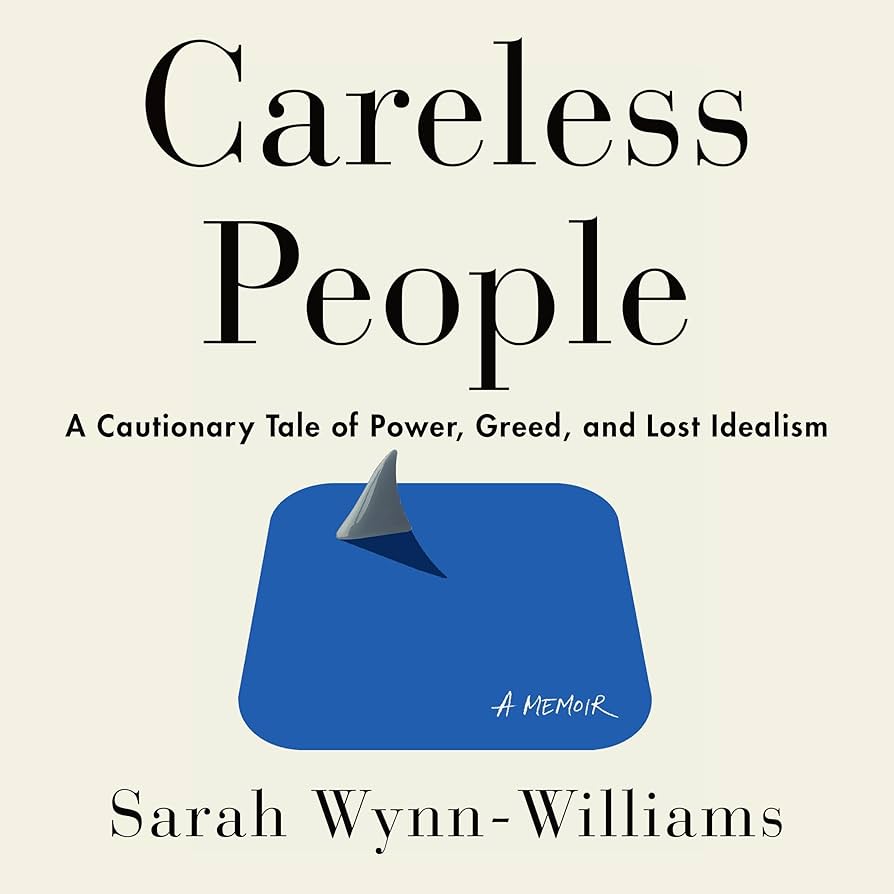
An example of the latter can be found in the response to Careless People: A Cautionary Tale of Power, Greed, and Lost Idealism, a work by Sarah Wynn-Williams who oversaw the linking of Meta’s executives with relevant leaders as director of global public policy. The portrait of Meta that emerges is disturbing, as have been the company’s efforts to silence Wynn-Williams, who has registered as a whistleblower with the US Securities and Exchanges Commission.

According to Flatiron Books, the book provides “a deeply personal account of why and how things have gone so horribly wrong in the past decade – told in a sharp, candid and utterly disarming voice.” The company also bluntly notes that Careless People “reveals the truth about the executives Mark Zuckerberg, Sheryl Sandberg, and Joel Kaplan as callously indifferent to the price others would pay for their own enrichment.”

The book savages Meta with claims of sexual harassment and inappropriate behaviour, Facebook’s role in fanning hateful speech against the Rohingya in Myanmar and efforts to placate China in its to penetrate that market.

Some of the material discussed in the book is covered terrain, the work being more a case of unsettling memoir than investigative inquiry. Wynn-Williams, however, makes the point that the executives were brazenly indifferent to the social consequences of company actions. By way of example, she produces documents revealing instructions from Meta to the Chinese government on AI and face recognition, with the requisite strategy to cope with a leaking of such tactics.

The personal dimension, however, is paramount: accounts of Sandberg’s insistence they share a bed mid-air, and the claim that produced a failed sexual harassment action against Kaplan, who allegedly grinded against her while dad dancing at a corporate function. Steven Levy, editor at large at Wirednotes these events and suggests that Wynn-Williams, while not unreliable, is likely to have succumbed to some embellishment. In doing so, she naturally excuses her own prominent role in the company, to which, for all her objections, she remained complicit in. In a true sense, she had been an initial convert keen to proselytise the merits of Facebook before becoming a critic of Zuckerberg’s project which delivered “a crap version of the internet to two-thirds of the world”.

In a bristling statement, Meta claims that the publication “is a mix of out-of-date and previously reported claims about the company and false accusations about our executives.” They insist that the author “was fired for poor performance and toxic behaviour” with an investigation finding the making of “misleading and unfounded allegations of harassment.”

The effort to stifle the author culminated in Meta seeking an award from the Emergency International Arbitral Tribunal on March 7 in reliance on a non-disparagement agreement supposedly signed by the author. The arbitrator, Nicholas Gowen, duly found for Meta, enjoining Wynn-Williams, along with people or entities “for which she controls” from making “disparaging, critical or otherwise detrimental comments” about the company, its employees, products and programs. He also ordered that promotion of the book on a book tour cease, along with its further publication or distribution, along with a retraction of the relevant “disparaging, critical or otherwise detrimental comments”. Were emergency relief not granted, the company would suffer “immediate and irreparable loss”.

This all seems, not merely disproportionate but childishly vindictive, the latter a characteristic that seems to mark emotionally stunted Big Tech oligarchs trapped in their digital ivory towers. Meta has been a company disparaged, reviled, mocked and fined, so nothing discussed in Careless People will change an already sullied image. It is hard to imagine any immediate or irreparable loss arising in any event.

Wynn-Williams refused to appear in the proceeding and shows no signs of refraining from the promotion of the work. Macmillan has also confirmed that the arbitration order will have no influence on its decisions. “However,” the publishing house responded, “we are appalled by Meta’s tactics to silence our author through the use of a non-disparagement clause in a severance agreement.”

Appalled as Macmillan might be, Meta’s effort has singularly failed to have its intended effect. Joanna Prior, CEO of Pan Macmillan, revealed that 1,000 hardbacks of the book were sold in the first three days on sale in the UK. The book is being widely discussed by the curious and the prurient.

While Meta has suppressed and will prevent discussion of the book on its platforms, it is cheering to authentic defenders of the town square that discussion about such companies takes place. Their mighty, unprincipled dominance necessitates that.

Binoy Kampmark was a Commonwealth Scholar at Selwyn College, Cambridge. He lectures at RMIT University, Melbourne. Email: bkampmark@gmail.comRead other articles by Binoy.


Revolution?


I wonder how many people reading these words know the significance of April 19 to US Americans, and others, to all of us worldwide who value democracy and justice for all.

What is April 19? It’s the 250th anniversary of the beginnings of the US American Revolution. On that day in 1775, in Concord and Lexington, Massachusetts, farmers and other working people stood their ground against redcoat British troops doing the bidding of King George III. It was the day of “the shot heard round the world” which eventually led to a victory in 1781 over the mighty British Empire after six years of war.

It also led to the expansion of European American settlement across the continent in the decades afterwards, a process which nearly wiped out the Indigenous peoples who have lived here for thousands of years. Estimates are that 90% or more were killed either by disease or violent military action to force the survivors onto reservations so that the Europeans could take the land and the resources underneath it.

Like so much else about this country, this 250th anniversary of the beginnings of what became the United States is a decidedly mixed bag.

On balance, though, I see value to connecting the political uprising against the Trumpists with the uprising by revolutionary European Americans 250 years ago. Not by coincidence the success of this revolution was followed by the French Revolution, the Haitian Revolution, the Bolivar-led South American Revolution and eventually, in the USA, the Civil War that led to the end of the legal enslavement of African people. It led to the success of the women’s suffrage movement over 100 years ago, the rise of trade unionism, the Black Freedom movement in the 60’s which forced an end to Jim Crow segregation, the rise of Indigenous resistance and societal leadership, the LGBTQ movement, an environmental protection movement and more.

Trump and his supporters want to take us backwards at least 90 years, to the time before the rise of industrial unionism and the CIO in the 30s and the existence of programs like Social Security, Medicare and Medicaid. Their agenda is truly and profoundly un-American, and the mushrooming popular resistance movement should begin saying that loudly and clearly. We, our broadly based movement of movements in all its political, racial, gender, age and other diversity, are the “next one up” in the never-ending struggle toward a more just, peaceful and ecologically-connected world.

Revolution or Reform?

As is the case with any authentic mass movement that has a chance of winning, there are differing views on a range of topics, even as we are united on many, many issues and a generally progressive worldview.

One very big one is whether what we are striving for should be viewed as defense of, as well as needed reforms to, the existing institutions of society or whether what we must be about should be viewed as revolutionary in its ambitions.

For myself it’s the latter.

A few days ago longtime progressive author and activist Michael Albert wrote about this issue of “reform or revolution.” He explored what his experiences have taught him about the difference between them. He called for a resistance movement today which had the maturity to appreciate that we need to develop a way of working so that all of us can join together in this existential battle for the future. Here’s how he summed up his main thoughts: “So, a reform and/or revolution bottom line: No to reformism. Yes to sustained reform struggles. No to mindless revolutionary posturing. Yes to wise, visionary long term commitment. As resistance grows and as views proliferate, stay together. We need each other.”

Several years ago I wrote a book with the title, 21st Century Revolution: Through Higher Love, Racial Justice and Democratic Cooperation. In it I laid out what I saw as necessary to bring about the changes needed. As I concluded the book I quoted these words of a longtime friend and fighter for justice, the late Fr. Paul Mayer: “What history is calling for is nothing less than the creation of new human being. We must literally reinvent ourselves through the alchemy of the Spirit or perish. We are being divinely summoned to climb another rung on the evolutionary ladder, to another level of human consciousness.”

In the end, it all comes down to the personal, how each one of us does the best we can, as lovingly as we can, as resolutely as we can, as clearly as we can, day after day, to help create a world for our children and grandchildren and the seven generations coming after us very different than the one we are living through right now. We cannot let them down.

Ted Glick works with Beyond Extreme Energy and is president of 350NJ-Rockland. Past writings and other information, including about Burglar for Peace and 21st Century Revolution, two books published by him in 2020 and 2021, can be found at https://tedglick.com. He can be followed on Twitter at twitter.com/jtglickRead other articles by Ted.


Ramadan 2025: Islam in Canada


Unity through diversity


Yukon Muslim Society Whitehorse

Thank you, Trump, for giving Canadians a passionate cause — our survival as a nation. But how to keep the glue fresh holding a rickety, outsized state together? Islam tells us to thank God for our blessings and work hard to keep on the ‘straight path’. We are now everywhere across Canada and eager to stay that way, faced with fearsome Islamophobia from the bully across the border. We may be the ‘mouse that roared’ but strong faith can work miracles. We are a vital key to survival of 21st century Canada.

Islam: last survivor

Since the rise of modern imperialism in the 16th century, the world has been at war.

Christian European empires at war with the world, i.e., with each other and with the indigenous people of the world. This meant enslaving countries where the other great religions – Buddhism, Hinduism and Islam – predominated. Imperialism undermined Christianity in the European societies, now the ‘collective West’, which are now largely secular, the new gods money and technology, but the fall out from all this was to populate the declining empire centers with their African and Asian victims, eager to find a place at the table. Secularism and a world order stacked in favor of the collective West has meant decadence and declining populations there, at the same time, making room at the table for industrious go-getters from the former colonies.

The infusion of this new blood suddenly puts the great religious on their own path of rivalry for ‘hearts and minds’ in opposition to the secular gods, which failed to provide a healthy moral order. Secularism resulted in ever more destructive world wars, leaving the whole world today on the brink of death not only of humans but of nature, the entire planet. While Christianity claims to have the largest following (after all, it came at gunpoint), Islam remains the main rival, despite the five centuries of war against it, growing faster than any other religion, continuing full-steam-ahead today.

Warfare waged by empire against indigens is by definition asymmetric, big shiny guns vs spears, rocks, or variations on nonviolent resistance, Gandhi’s Satyagraha, inspired by his own resistance to British empire. Buddhism has come to the West as a universal religion, popular among disaffected youth, but neither it nor Hinduism or nature worship have made any real impact on the world order. While Jews do have a major role in all this, it is not Judaism but rather empire at work so we can discount Judaism as a positive force. Christianity (with the exception of Orthodoxy1) has had influence more due to its political economic role as willing handmaiden of empire.

Islam is a different matter. It claims to act as a religion in world affairs. While Christianity claims more followers, they are mostly pacified excolonial subjects, and even they are at odds with the current secularized Christianity promoted by ‘collective West’ missionaries.

  • 50% of Canadian Muslims consider themselves very religious,
  • 77% say Islam impacts their daily life,
  • 60% always eat halal meat, and observe Ramadan strictly,
  • 41% pray at least 5x a day.

Only Islam has both escaped the secular trap which imperialism set to mold subjects to a post-imperial world order ruled by money and technology, and insists on living according to religious intent, with belief central to our lives.

Dandelions

Despite Chinese communism/capitalism’s love affair with Israel (Jews are, after all, masters of moneymaking), ordinary Chinese love the Palestinians, nicknaming them ‘dandelions’ on Tiktok, i.e., disdained but undaunted, flying through the air (as on Oct 7), landing to come alive, beautiful, natural – all miracles of God’s creation. This metaphor works in spades for Muslims today.

Canada has been a testing ground for this, where ‘Mohammetans’ trickled in, starting in the 1880s, as individuals who managed to defy the racist immigration policies intent on expanding the white empire, as if brown, black and Asian weren’t really part of humanity. It is a heartwarming story testifying to human resilience and showing a path out of the dying imperial order.

At the beginning of the imperial era, there were robust communities of Muslims throughout Eurasia, from Spain to China, and Africa, from Egypt to Ghana. Without five centuries of Christian empire and the war against Islam, most of the world would probably be followers of the Prophet Muhammad. Instead, the Muslim world, the entire world, was subjugated to nominally Christian empires, quickly losing faith to money and technology, and we are living out the consequences. While Christianity purports to be egalitarian, free of racism, its sorry imperial past, condoning slavery in the Americas and culminating to massive bloodbaths in the 20th century, is a legacy Islam does not share. On the contrary, millions of Muslims were kidnapped and sent into slavery and Muslims were victims of both Christian/secular bloodbaths.

While Islam is criticized for not promoting unrestricted technology and wealth extraction, that was never an inspiration for the faith. Our brief sojourn on Earth is not about accumulating wealth, but rather to worship, to thank God for the miracle of life, and to use our time to try to improve ourselves, to follow the ‘straight path’ of moral and ethical living. That is what all religions are about, so Christianity’s decline came when it lost that vital thread, leaving the other religious traditions less compromised. Islam is seen as the chief rival, so it has suffered the most. But suffering is at the heart of all religion, and the test of health is to turn suffering into tempering, strengthening resistance to evil. The horrors of the open genocide against Palestinians and the incredible resilience of those suffering is testament to this.

*****

Murray Hogben’s Minarts on the Horizon: Muslim Pioneers in Canada (2022) is a trip through Canadian history and across Canada’s vast lands, collecting at least a hundred stories of plucky Muslims, men and women, who came to make a life here, starting in the 1880s, invariably men who came, found their feet, then brought over a young bride from home, and raised a new generation of Canadian Muslims. But also a few plucky boys or women who did the same. None came with the idea of riches, but rather escaping persecution or wars, looking for a safe place to raise a family and keep the flame of Islam alive. They brought the spark of the ummah and kept it alive, providing enduring warm in a cold and forbidding continent.

Hogben is a convert from Presbyterianism, like most converts having fallen in love with a Muslim. His love, Alia, also a student at Carleton University, was the daughter of the Indian High Commissioner in the 1950s. Although there are no statistics on conversion, few Muslims convert to Christianity, the religion of the oppressor, and really just a less coherent version of Islam. Missionaries soon learned that and left them alone. Again, no statistics, but my sense (and personal experience) is that it is easier to convert from Protestantism to Islam, both because of the lack of religious imagery and the simplicity in both. At the same time, Protestants proved to be the most hostile to Islam, with countless anecdotes in Hogben’s history of Catholics being generous, often at life-threatening moments or where no space was available to worship, providing that space. We see how Protestantism collapsed quickly in the 20th century while Catholicism still thrives, so its hostility is understandable.

The first Muslims officially registered in Canada were James and Agnes Love of Upper Canada (Ontario) in 1851, ethnic Scots, and another family by 1871, the Simons from the US, east Europeans from Ottoman lands. Most of our first Muslims were Syrian Lebanese (Lebanon being part of Syria in Ottoman days) and Albanians, escaping the beleaguered Ottoman army, constantly threatened by Europe. They were disparaged as ‘Turks’ though anti-Turk was more like it. They are ‘white’, so more able to slip past immigration officials. Asians (targeting especially Chinese and Japanese) were kept out with a $200 landing fee from 1908 on. Interestingly, they did not think to hide their faith, calling themselves Mohametans, as was the nickname given to Muslims then. Often the hopeful immigrant depended on a nice official to get through, some turned back at the dock in Europe for ‘bad eyesight’ or illiteracy.

The early immigrants, like the large influx of Jews at the turn of the century, mostly had to peddle goods by foot to farmers, buying from Jewish wholesalers, often forced to sleep in the snow, sometimes disappearing, either murdered by hostile farmers or frozen/ starved to death. If they survived, they strived to open an ironmongers (hardware store) or haberdashery. Or became candymakers. There are no stories of rags-to-riches millionaires in Hogsen’s history, but many stories of successful entrepreneurs, teachers, bureaucrats, using their modest wealth to fund mosques, to help fellow Muslims immigrate or through crises, building the community, the ummah, examples of nurturing the faith, providing the material conditions for worship and following the ‘straight path’. At the same time, being good citizens and neighbors, welcoming interfaith dialogue, promoting Islam as a healthy way of living.

As the ethnic variety of Muslims increased, Albanians and Syrians were soon living and worshipping with Asian and African immigrants. The US has a very different history, where millions of Muslim Africans were enslaved and forced to convert to Christianity, only later rediscovering Islam in the civil rights movement post-WWII. Canada prides itself now in welcoming exslaves in the 19th century, though the Christian society was just as racist, and the new arrivals mostly fared badly and returned to the US after the civil war.

Immigration only changed after WWII, initially in 1947 when refugees from Europe came in large numbers as part of a new world order, a United Nations, promising an end to colonialsim and a new ethic rejecting racism. A Bosnian caught in Italy, not wanting to join the Yugoslav army, managed to get to Ottawa as part of the post-WWII invitation for farmers. In 1961, racial restrictions were abolished for immigrants, giving preference to education and work experience. Numbers increased from 5,800 in 1961 to 33,430 in 1971 – 6x, to 100,000 in 1981 – 3x, then doubling each decade to 2011, with over 1,000,000. Today’s 1,775,715 is 5% of the population, 5x more than Jews. When I go to Friday prayers at University of Toronto’s Koffler2 Multifaith Center, I never cease to marvel at the variety of faces in the crowded prayer hall (there are 4 services), and the fact that 400-500 Muslims are praying collectively on a university of 100,000 students — the only ones! ‘Why else are we here except to worship God and strive to follow the straight path?’ I ask myself.

British Columbia

Hogsen interviewed the Fijian president of the BCMA, Muntaz Ali. Yes, indentured Indians came to Fiji as reliable sugar cane workers, and – why not? – moved on to Canada, Ali in 1964. The most infamous attempt to immigrate via Vancouver was the refusal to allow the ship Komagata Maru, carrying 376 prospective Punjabi immigrants (mostly Sikhs but some Muslims), to land in Vancouver in 1914. It was not till 1983 that enough Muslims arrived to build the first mosque in BC, founded by Ali and immigrants from South Africa and Egypt.

Alberta

Edmonton boasts the first Canadian mosque, Al Rashid Mosque built in 1938. Peddlers could become store owners in remote fur-trading posts. One of Canada’s great women pioneers was Lebanese Hilwie Hamdon, who came to Canada in 1923 at the age of 16 to marry Ali Hamdon (41) who had established himself in Fort Chipewyan. Ali felt at home with the natives, learning Cree. Eventually they moved to Edmonton and with 22 others, built their mosque. Edmonton grew, attracting many more Muslims to Canada’s only mosque. The mosque was threatened, but Hilwie organized, fundraised, lobbied, and got the city to help move it to the Fort Edmonton Heritage Park, a 1967 Centennial project. All this paid off, producing Canada’s first Muslim (Ismaili) mayor Naheed Nenshi in 2010. Another remarkable Edmontonian who helped save the Al Rashid Mosque was Lila Fahlman (nee Ganem father Lebanese, mother Welsh), who gained her doctorate in educational psychology, and founded the World Council of Muslim Women Foundation, travelling to China to meet Muslim women in 1998.

Over and over, I read how cultured Muslim immigrants were, even if illiterate when they arrived. Education is at the heart of Islam, the command being to understand and praise God and nature, to move along the straight path, ever closer to God. The quarrels within the community attest to the diversity of traditions, yet never spilling over into violence. The original immigrants were more tolerant of differences, embracing Sunni, Shia, Ismaili, even Ahmadiyya. As the communities grew, different mosques could cater to different traditions, but the core beliefs, Ramadan, prayers, knit the fabric together. Intolerance came more from outside pressure, especially Saudi Wahhabism, and the overzealous Tabhlighi Jamaat from Pakistan, Bangladesh and southeast Asia, but Hogsen shows how the more liberal, tolerant strain endures in each community, less concerned about headscarves and dress, more about the actual beliefs.

Most immigrants ended up with small stores, barber shops, service stations, not factory workers in mass production, which is alien to Muslim traditions. Their children went/go on to be doctors, lawyers, office workers, scientists, teachers, real estate agents. The few wealthy individuals Hogsen interviewed were proud of using their wealth to help the community. No billionaire Kofflers. The unity of the ummah is not through wealth but through worship. The apartness of Muslims is solely due to refusal to make alcohol central to communication, and the rejection of mass entertainment, which is often morally compromised and eats up precious time from the more important focus on spirituality. Politically, Muslims are conservative but as anti-imperialists, anti-racists, anti-usury, concerned with social justice they often align with the NDP.

Saskatchewan

There really is a ‘little mosque on the prairies’, thanks to Muslims in Swift Current, who started a weekend Islamic school in the United Church, where the community also held Friday and Eid prayers. The minister even offered to cover the pictures of Jesus and Mary. Mohammad Afsar, from Pakistan, was moved to tears and told him the use of the facility would be enough. In 1983 they bought an unused church as the Islamic Centre of Swift, Masjid Al-Khair.

Manitoba

Ernest Abas, Lebanese, recalled that his parents married and then failed to get passage on the Titanic in 1912. he grew up on their farmstead. His parents were illiterate but taught the children their prayers and stories from the Quran. Trinidadian student Khaleel Baksh arrived in Winnipeg in 1962 and became a founder of the first mosque in 1976. As with many small communities, Muslims used friendly churches for worship, and often held their pray meetings on Sunday if necessary (not Saturday). Another common thread was/is to appeal to rich Saudi Arabia, Ghaddafi’s Libya, Zulfikar Bhutto’s Pakistan for funding.

Ontario

Ontario has the most Muslims, 7% of Ontarians, followed by 5% of Quebeckers and 5% of Albertans. Along with Syrians, early immigrants to Ontario were Albanian, though no mosque was established in Toronto till 1961. London became the hub for Muslims and is now the second largest population, with a mosque in a large brick house in 1957, since replaced by the 1964 mosque. Muslims from Toronto and Windsor would come for marriages and to settle, with Detroit providing the imam. There was a constant move back and forth to the US. Like Edmonton, the creation of the mosque was key to attract more Muslims.

Hamilton started late, with the first Pakistani student at McMaster University in 1966. Like many of the new wave of immigrants, Mohammad Afsar had lived through and survived the tragedy of the partition of India, and was an engineer. This new cohort of Muslims transformed the community, with the smarts and drive to build mosques and interact with the non-Muslim community. A small house served as the mosque in 1969 and a real mosque built in the 1970s. Summer camps and schools began to spring up, important as secular education continued to eat away at moral values.

Kingston, Windsor also developed communities, starting with a few immigrants post-WWII and growing into a mosque by the 1970s.

Toronto has the lion’s share of Muslims. 10% of Toronto’s population and 31 mosques. The first mosque was established by Albanians in a storefront in the west end in 1960 and a Presbyterian church built in 1930 was purchased in 1961 on Boustead Ave. Hogsen explains how conflicts with later immigrants often soured older mosque members. The Albanians eventually left this group and founded another mosque for themselves. The new Muslim Students Association (MSA) became a North American organization in various cities and looked to Saudi financing of mosques, which put a Wahhabi slant to worship and greater restrictions on male/ female etiquette, though never enough to prevent a modus vivendi as the ummah expanded over time.

There were Syrians in Ottawa by the beginning of the 20th century, and Pakistanis arrived starting in the late 1950s. A Pakistani Ottawan engineer managed to convincing visiting Zulfikhar Bhutto to promise him $100,000 for a mosque and he came through, the mosque opening in 1972. As is the case everywhere, a mosque becomes a lighting rod and like Toronto, 10% of Ottawans are Muslim, many Somali refugees from the 1980s.

Quebec

The preference for French immigrants to Quebec brought a continuous wave of immigrants from former French colonies Lebanon, Morocco, Algeria, Cote d’Ivoire and others, giving Quebec a uniquely colorful community. Like Toronto the first mosque came after WWII, in 1958. There are more than 90 now in Montreal alone (vs 11 synagogues). McGill’s Institute of Islamic Studies was founded in 1952, the first in Canada. Marriages were only in registered churches till Lesage’s ‘quiet revolution’, and Bill 194 in 1965 gave the Islamic Centre of Quebec civil status and the authority to conduct marriages. Similar conflicts with the new, more orthodox immigrants, the MSA and the Tablighi Jamaat caused new groups to build their own mosques, as elsewhere. There was resistance to allowing a Muslim cemetery in Montreal though it was resolved. This same resistance in Quebec City was what precipitated the worst religious mass murder in Canada in 2017, when a white extremist shot 7 Muslims at the mosque there. London Ontario also suffered this tragedy when 4 Muslims were shot in 2021.

Nova Scotia

The first Muslims were Syrian, with a Muslim cemetery founded in Truro in 1944. A Muslim organization was founded in 1966 composed of 6 doctors. A mosque was built in Dartmouth in 1971 which expanded into the Maritime Muslim Academy in 1998, with a school, their first imam Jamal Badawi, a professor at St Mary’s University. Just as few immigrants remain in the Maritimes, so Muslims came and went, mostly to London. A mosque was built in Truro and a Catholic church was refashioned as a mosque in Trenton.

There are Muslims in every province and territory. There was great excitement in 2019 when a mosque, the Yukon Muslim Society, was opened in Whitehorse, in addition to the Inuvik Masjid (Midnight Sun Mosque) and Yellowknife Shia mosque.

The organizing efforts to create a real ummah in Canada really started in the 1930s and picked up steam in the 1960s with a national organization Council of Muslim Communities of Canada, now the National Council Canadian Muslims, which is a strong lobby fighting Islamophobia in national security agencies, the CRA, policing, and education. NCCM also advocates on Canadian foreign policy related to Palestine, Afghanistan, the treatment of Uyghurs in China and the treatment of Muslims and other minorities in India. It is the only voice against Quebec’s persecution of headscarves, and sued PM Stephen Harper for calling it terrorist, forcing him to apologize. This capable advocacy in the face of continued bigotry gives Islam a presence that other religions lack. Muslims here and everywhere are the backbone of the struggle against Israel’s genocidal persecution of Palestinians.
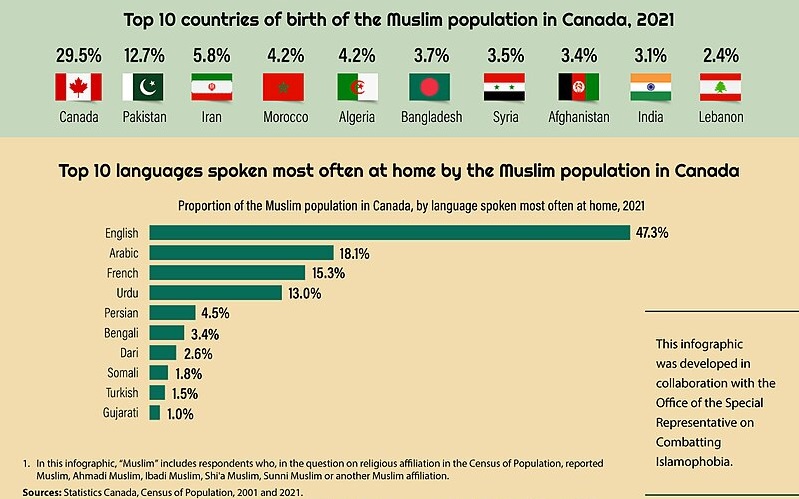
Pakistanis outnumber other Muslim immigrants (13%), with Iranians, Moroccans, Algerians, Bangladeshi, Syrians, Afghanis and Lebanese all in 3-5% range. When and how they arrived follows the vagaries of the past two centuries of upheaval, making each Muslim’s lineage a fascinating tale. I always enjoy hearing these stories, stories of unity in diversity, unique to Islam. There are Canadian Muslims from many other nations, now, more and more Africans. I’ve met Chinese Muslims, even a Boer South African, blond and blue-eyed who ‘saw the light’ and brought along his parents into the faith too. Islam is the most universal of the great religions, cutting through race and class more than any other, and the most welcoming to converts. To be able to tell Archangel Gabriel on Judgment Day that you brought someone to the faith is a hefty weight on the scale of your good actions.

New weapons

The century of groundwork laid by our hardy forefathers/mothers spawned a remarkable educational network for the 21st century. Reviving the Islamic Spirit is a yearly conference in Toronto over the Christmas break since 2001, bringing our star thinker-activists from around the world (e.g.,Tariq Ramadan, Imran Khan, Attallah Shabazz, eldest daughter of Malcolm X) and sympathetic others (e.g., Robert Risk, Eric Margolis, Karen Armstrong, even Prime Minister Trudeau). In 1997, the Muslim Association of Canada (MAC) was registered as a faith-based charity, focusing on education, community service, and volunteer engagement, with centers and schools in Calgary, Edmonton, Toronto (seven schools) and Montreal. In 2024, they opened the Canadian Islamic College in Mississauga providing an accredited Honors Bachelor of Arts. MAC also hosts yearly conferences, supplementing RIS with a more hands-on activist program.

Canada escaped the scourge of slavery, which killed millions of African Muslims to feed the greed of industrial capitalism, but American Muslims were a lifeline to the fledging Muslim movement here. Detroit, Michigan and Toledo, Ohio were important oases for Canadian Muslims in need of an imam or as waystations for future Canadian Muslims. Now, we look to many brilliant American scholars and activists who come to RIS and MAC conferences. Canadian Islamic College is modeled on Hamza Yusuf’s Zaytuna College in Berkeley, California.

Islam plays the same ‘unity in diversity’ role in the US. We take inspiration from the fact that half of US blacks have converted to Islam. From being lowly slaves to being heralds of the New World Order, not of secular globalism, but of a globalism grounded in faith, bringing all peoples of the world together in defense of peace and love of nature.

Of course, Zionist spoilers do their best to blacken these efforts, accusing us and our conferences of links with ‘terrorists’ (i.e., supporting resistance movements such as Hamas), although organizers are careful not to give the real terrorists (Israel-lovers) any rope. Islamophobia is always there, as it has been for 1400 years, in overdrive since the rise of imperialism. But history is on our side, as the other religions fail to keep the faith against secular capitalism. As any civilization declines, it is vicious in its death throes. Islam’s enduring flame is still strong in the face of genocide and the destruction of God’s creation. Our daily prayers from Canada blend with millions of others around the world 24-7, all of us facing Mecca, our focus, to beam the message up to God that not all humans are frivolous and disdainful of His majesty.

Failed gods

I came to Islam late, after a lifetime under the spell of Marx. Interestingly, Marx, for long nicknamed ‘the Moor’, started to admire Islam and the Arab world in his later years, spending his last winter seeking treatment for pleurisy in Algiers. Of course, he studied local conditions, observing the common ownership among the Arabs which the French were undoing. Colons would seize land then sell back to native for a huge profit. Colonists were more inviolable than handsome William I.

Even the poorest Moor surpasses the greatest European comedian in the art of wrapping himself in his hood and showing natural, graceful and dignified attitudes. Their social classes are mixed, some dressed pretentiously, even richly, others in rags and tatters, blouses. Such accidents, good or bad luck, do not distinguish Mohamet’s children, their absolute equality in the social intercourse is not affected; on the contrary only when demoralized, they become aware of it; as to the hatred against Christians and hope of victory over these infidels, their politicians have the same feeling of equality, not of wealth or position but of personality, a guarantee of keeping up the one, of not giving up the latter. They will go to rack and ruin without a revolutionary movement.3

He marveled at the scant presence of the state: in no town elsewhere is there such laisser faire, laisser passer; police reduced to a bare minimum; unparalleled lack of embarrassment in public. For Muslims there no such thing as subordination; they are neither subjects nor citizens. There is no authority, save in politics, something which Europeans have totally failed to understand. This self-governing and ethic of sharing was alien to the capitalism he so despised. Unlike Voltaire, Kant, Hegel, etc, Marx did not welcome the destruction of this precapitalist world, nor did he promote atheism for what he recognized as a truly devout people. Islam, even at its most stagnant, was not the dead Christianity that he lampooned and dismissed in favor of secular revolution.

Marx did not live to see the error of his atheism, how his brilliant, radical critique of the social order would spawn a soulless totalitarianism. When I finally woke up to that, like Marx, I was drawn to Islam and precapitalist social formations for a key to the way forward. I’m pretty sure Marx would look at how Islam has survived the war against it by his hated capitalism, and rout for its ability to self-regulate based on a strong faith, a true brotherhood, not the familial sibling brothers, who you don’t choose, but fellow Muslims, with whom you are glad to share whatever little you have, not to exploit and profit from them.

Islam was founded in the 7th century, when all faiths – Christianity, Judaism, Buddhism, nature worship – were alive and meant something, before science became destructive technology and before we were able to turn our greed and envy into weapons that are genocidal not just for us humans, but for Earth itself. Thank God He saw fit to provide the Quran as an antidote to the coming deluge. Noah is hands-down my favorite prophet. My sixth sense for the coming apocalypse, a prophet of nature’s revenge but with an olive branch promising another chance.

ENDNOTES:

  • 1
    Christian Orthodoxy is much less guilty of this. Though Russia was indeed imperialist, it did not aim to wipe out the indigenes, and there were no Russian colonies in Africa and Asia, imposing Orthodoxy instead of local religions. Orthodoxy did not participate in the Crusades of the 11-14th centuries. Orthodoxy is closest to the original teachings of Jesus, and Muslim worship is closest to Orthodoxy. It is a kindred spirit to Islam; however, it has not had a worldwide presence like Catholicism or Islam.
  • 2
    Jewish billionaire philanthropist founder of Consumers Drug Mart.
  • 3
    Marcello Musto, The last years of Karl Marx, 2020.

Eric Walberg is a journalist who worked in Uzbekistan and is now writing for Al-Ahram Weekly in Cairo. He is the author of From Postmodernism to Postsecularism and Postmodern Imperialism. His most recent book is Islamic Resistance to ImperialismRead other articles by Eric, or visit Eric's website.