Tuesday, March 25, 2025

Letter From a Columbia PhD Candidate, After Fleeing the United States to Canada


LIKE VIETNAM WAR DRAFT DOGERS


 March 24, 2025
FacebookTwitter

My name is Ranjani Srinivasan. I was a 5th year PhD student at the Department of Urban Planning, GSAPP. I was also a TA in the Urban Studies Department at Barnard College. 

Some of you might have heard about my case. For those who haven’t, I would like to share the details. 

On Wednesday night (March 5), my visa was revoked by the Department of State. 

While I was examining the email on Thursday morning (March 6), I received a phone survey from a private number claiming to be a third party hired by CU to administer a student opinion survey on campus conditions. At some point during the survey the person revealed they knew my exact address. I didn’t think much of it, then. 

Instead, to figure out my visa status, I immediately began attempting to contact ISSO. Some of you might know that their emergency hotline only connects to public safety. After several hours of emailing both my department and ISSO, I was put in touch with the Director of Compliance, who assured me in writing that I am in legal status and could continue my work as a TA. 

On Friday, (March 7), while on a Zoom call with an ISSO advisor who continues to reassure me that I was in legal status, ICE came knocking at my door without a warrant. If I had been alone I would have opened the door. My roommate, an American citizen, recognized the knock as that of law enforcement. Given the lack of warrant she refused to let them in and repeatedly asked them to identify themselves; something they refused to do. 

Scared and anxious, I told the advisor, who was still on Zoom, that ICE was at my door. Initially she seemed frantic, calling upper administrators but in the end she seemed amused. ISSO handed me a list of lawyers I should contact and asked me to call public safety–who said they would merely file a report and I should continue to not open the door. 

Once I realized CU would not help me, I left my house for a safer location the same day. 

On Saturday evening at 6:20 pm (March 8) ICE came to my house again. They threatened to appear everyday until they were able to put me in removal proceedings. At this point I still had legal status and they still did not have a warrant. This was the same day Mahmoud was disappeared by ICE. 

Until this point I had imagined that I just had to wait it out and the University would intervene to protect me. I was still worrying about grading my students’ assignments. I was wrong. On Sunday (March 9), ICE illegally terminated my SEVIS and Columbia arbitrarily de-enrolled me causing me to lose my legal status, worker status, and housing. This immediately made me vulnerable to detention. The Dean of Student Affairs at GSAPP, rather than helping me, entered my building hoping to confirm I was still at home and had received the letter. Until this point she has been sympathetic, although claiming that it ‘seemed like ISSO and Columbia were not in control.’ After my de-enrollment she cut all contact with me. 

My lawyers told me I had roughly two choices at this point. I could leave or I could fight my illegal termination of status but at risk spending a substantial time in detention. Therefore, on Tuesday, (March 11), I made the difficult decision to leave the US for Canada. At this point I was quite sure the University was working closely with law enforcement. And I suspected the private survey I had been administered had been ICE trying to confirm my address. 

Yet, ICE still had not realized I had vacated my home and left the country. On Thursday (March 13) my home was raided by DHS. The agents were surprised to find my empty room. 

Just the next day (March 14), I was shockingly put on blast by a DHS tweet that falsely reported that I had self deported and leveled baseless allegations at me. 

The reason why I am laying out this sequence of events is that it demonstrates not only the absolute power the Department of State has over F-1 visa holders and the few legal options before us, but also the extent to which Columbia has been cooperating with ICE, instead of protecting its students. 

Second, innocence will not protect you. I was not in the country from August 2023 to April 2024. While I received a summons on April 30, 2024, the case was dismissed by the courts and I have faced no disciplinary charges. Apart from attending a handful of low-level protests and posting on social media, I have had little contact with events on campus. So there is no explanation why I was targeted. With the rapidly escalating situation, the criminalization of free speech, and eminent travel bans, what has happened to me can happen to you. 

Therefore, we must exert maximum pressure on Columbia and other universities to protect international students from these arbitrary state actions. And we must fight for complete amnesty and reinstatement for those whom Columbia has sacrificed in the hope of reversing funding cuts. 

Now is the time to come together and demand universities do the right thing.

Ranjani Srinivasan was a 5th year PhD student at the Department of Urban Planning, GSAPP and a TA in the Urban Studies Department at Barnard College. 


US Imperial Boot on Canada’s Neck


 March 24, 2025
Facebook

Suppose a Russian or Chinese president stated (repeatedly), that he intends to “break” the USA economy, that he does not recognize its borders, and wants to annex the USA. It would immediately be taken by the USA -rightly so- as a declaration of war.

This is exactly what has happened, as the US president Trump has said:

“The US president on Tuesday reiterated his claims on Canada’s territory as he increased tariffs, threatening to bring the country’s economy to its knees…. Mr. Trump has made repeated comments about Canada becoming America’s 51st state since winning the election in November, and last month specifically told the country’s departing prime minister, Justin Trudeau, that he did not believe that the border treaty between the two nations was valid.” (“Trump Intensifies Statehood Threats in Attack on Canada”, Matina Stevis-Gridneff, 11 March 2025, New York Times)

The Canadian people and politicians certainly are not taking this lightly. Many in the USA, seem to think this is more of Trump’s irrational ravings, “crazy things Trump says and does not mean”.  But the word border is a red flag alarm in political terms as most of the world’s great wars have concerned borders.

Astoundingly, Trump is going after the US’s long-standing good neighbour, political ally and, most important and commercial partner. Adding insult to injury, he spews all sorts of lies and insults about Canada.  In his ravings he has also physically threatened Mexico, Panama and Greenland.

Canadians, taking Trump at his word, are furious. The upsurge of spontaneous boycotts of US goods and services, of cancelled trips to the US, of flag waving and assertions of nationalism, of booing US sports teams, is a phenomenon that has spread throughout this vast country. Rarely has a unity of federal, provincial and municipal governments been so solid and public in Canada.  Indeed, politicians would risk their positions if they did not respond to the passionate solidarity that voters are demanding. “Canadian observers say their outrage at Trump’s attacks have fueled unprecedented levels of unity and collective defiance.” (Washington Post, M. Powers, 20 March 2025) It has prompted the Canadian Conservative Party leader, P. Poilievre, who has been constantly emulating Trump, to do an about-face and now is trying desperately to distance himself from that toxic leader.

Until now, Canadians did not feel the need to assert their nationalism. But this has changed, and quickly with the nation’s, borders, economy, way of life, and sovereignty threatened by a US president, a compulsive liar, who incapable of empathy, has a tendency towards malice and shows astounding ignorance in his stream of pronouncements. He creates chaos quite deliberately to intimidate and dominate.

Although some in the US have spoken out in defence of Canada, the response so far has been muted. Canadians are realizing that many of those they thought were life-long friends are in fact vipers, and they feel stabbed in the back. In these past years, Canadian political elites have followed US foreign policies indiscriminately, especially in Latin America. They did the dirty work for the US especially in adventures of “regime change”. This besmirched Canada’s reputation, and it has been seen as a lapdog to US imperialism. For example, Canada’s influential deputy prime minister Chrystia Freeland led the extreme right wing, anti-democratic Group of Lima against Venezuela, a country that has done no wrong to Canada, but did it to support US attempts at regime change in Venezuela.

Canadians have woken up to the frighting prospect that the US has turned its sights on Canada.  It sees the boot of imperialism on its own neck as its sovereignty, economy, and very existence as a nation threatened by the Americans.

Canada is country that emerged from the circumstances of a people who pointedly did not want to join the United States: a combination of English settlers who were loyal to the King and the Quebecois who would not relinquish their French language and culture. Not being Americans has been a sine qua non for Canadians.

The indigenous peoples were involved in this dispute, taking part in the struggles to be separate from the emerging USA. Undoubtedly indigenous peoples on both sides of the border have withstood much hardship and injustices. However, it is rarely in dispute that the First Nations of Canada have fared better than their kin to the south. Saskatchewan First Nations Chief has said: ‘Our message is clear: our sovereignty isn’t negotiable.”  Indigenous leaders in Saskatchewan see the U.S. president’s threats to make Canada a 51st state as uninformed about Treaty agreements and First Nations’ inherent sovereignty. “(CBC. D. Patterson, 24 Feb. 2025)

Trump has surrounded himself of sycophant enablers, people short on political acumen and experience who have proceeded to dismantle key US institutions. With 13 billionaires in his cabinet plus one not even in the cabinet, the dismantling of federal government capacity follows the extreme right wing mantra of eliminating government regulations and agencies and deliberately weakening of democratic procedures, checks and balances,  all to give full reign to their power and private greed. US Congressman Bernie Saunders ceaselessly warns that the US is rapidly turning into an oligarchy “run by billionaires out to enrich themselves”. (Peter Wode Rolling Stones, Dec. 15, 2024)

Trump has also alienated other key allies such as the EU.  His gross, obscene, public humiliation of President Zelensky in the Oval Office pretty much eliminated any sort of respect that the world could give to him as a president, or to the USA as any sort of ally.

Trump’s folly arises out of the phase that capitalism finds itself in: casino capitalism, “when the winning payers begin to cash in their chips. Because the global economy no longer has any long-term prospects, one, last, mad spree of plunder is now ongoing all over the planet.” (Jonathan Cracy, “Scorched Earth”, Verso, 2022)This phase of Western capitalism has unmistakable characteristics: profound inequality, appalling ecological degradation including potentially catastrophic climate change, and the hollowing out of democratic institutions including international law. Trump’s megalomania and thirst for power fits perfectly with these features and hence his reviving of territorial imperialism for plunder. He wishes to take-over lands that have the resources needed by high-tech industries, such as Greenland and Canada which is a powerhouse of mining resources, as well as wood and water. Disdain for environmental protection is part of this thirst for plunder, hence the dismantling of his own country’s environmental protection regulations.  Trump promises to “drill baby drill” for oil and gas, mine resources anywhere, and cut trees even in national parks.

Trump’s contempt for people who are not white is as disgusting as it is relentless. His war on Diversity, Equity and Inclusion is a blatant demonstration of pure racism, an undeniable feature of fascist  white supremacy. “US government’s move to abolish diversity, equity and inclusion policies is a naked attempt to appeal to prejudice.” (The Guardian, A. Mahdawi, 13 March 2024)   The battlefield of prejudice is immigration. Every country has the right to regulate immigration, that is not in question; but the Republican Party’s mantra “blame the immigrant” (legal or illegal) for all the nation’s ills, has been taken by Trump to new heights. It is grotesque.

Only sheer racism can explain the horror of sending Latin Americans, mostly Venezuelans, to Guantanamo – the most dreaded, illegal, political prison of the USA.  These are the very same Venezuelans who were urged to migrate, to leave the nation ruled by a supposed dictator, Nicolas Maduro, and the doors of the US were opened wide for them. The US and the far-right Venezuelan extremists promoted this migration as another way of trying to destabilize the legitimate and democratic government of Venezuela.

The legal offence of not having immigration permits does not equate to mayor crimes such as murder or terrorism. Trump, in fact, increased the role and capacity of Guantanamo, this penal US national disgrace, by sending these people there. Worse was to come.  He paid $6 million to the fascist president of El Salvador to imprison 238 Venezuelans accusing them of being terrorist members of a criminal organization – Tren de Aragua- that the armed forces of Venezuela have already eradicated. Trying to make this illegal imprisonment legal, Trump’s henchmen evoked an ancient law from 1799 relating to foreign enemies of nations with which the USA is at war.  “To invoke wartime deportation powers, Trump asserted that Venezuela’s government controls the Tren de Aragua gang. A US intelligence assessment says it is not true.” (New York Times, 21 March 2025)

These prisoners, who were not tried in court, were handcuffed, beaten and sent to a country whose prisons are known for their brutality. Even the NAZI butchers got a trial a Nuremburg. And anyway, when did the USA formally declare war on Venezuela?

There are geopolitical consequences of this American descent into plutocracy and putative fascism. For most of the Western world that considered the USA as a “beacon of freedom and democracy”, it is clear they want to walk a fine line between not harming even more the global markets but, at the same time, prepare to defend themselves from predatory US  policies. One positive aspect of US madness, is that the movements and leaders of the far right in Europe and elsewhere who have taken Trump’s example as something to follow, now find themselves with a very unpopular mentor. The fascist tendencies of the US government under Trump are now quite visible and may no longer seem appealing to mainstream voters.

However, for Latin America, and particularly Venezuela, the stakes are very high indeed. Trump no longer intervenes based on the flimsy excuses of defending democracy. Now the interventions are done as punishment, where the victims are declared villains, where might is right, and where Trump’s decisions seem erratic at best. Clearly, Trump has no qualms ignoring the US’s own laws and judges, and even breaking his own “deals”.  With respect to Latin America, he has no intention of abiding by international laws of Human Rights, the UN Charter or Geneva Convention. The US has a long history of violating these international laws, but the openly shamefaced way the Trump administration is proceeding further dooms the bedrock of  rules, agreements, human rights and goodwill, on which international peace and prosperity depends.

Hopefully, Canada will take a good look at how Venezuela has coped with the illegal economic sanctions against it, and the many attempts at destabilization to overthrow its government. Venezuela – contrary to all pundits’ expectations- has not dissolved, people are fed, houses are built, and they have free health care and its increasingly self-reliant economy is far from broken (annual GDP growth of 3.1% in 2024 according to the UN Economic Commission for Latin America and the Caribbean). And more significantly, it still maintains its sovereignty.

Although the circumstances are quite different between Canada and Venezuela, Canada being one of the richest countries in the world with many more opportunities and choices, they do share one thing: the enmity of the US. A big tool of that animosity will be the lies: they will flood the press and internet with as many distortions and untruths about Canada that it can. This is how they demonized Venezuela and its president to the world. Canada should be warned and be prepared to counter this avalanche of misinformation that is already filling mainstream and social media.

There are three huge lessons Canada can take from Venezuela:

First: unity and steadfast resolve. Venezuelans defend their sovereignty passionately.

Second: move on, seek new friends, new allies and new markets. The world is big. Venezuela found out it is not alone. A common danger creates unity. Canada can link with others that are also threatened.

Third: make government more responsive to people’s needs, not just for their welfare, but also for their democratic resiliency, which is the antidote of fascism. Venezuelan communes for example, are a creative feature in participatory democracy.

Canada can do all this and with imagination, hard work and compassion and rather be crushed by the US imperial boot, emerge stronger and more successful than ever.

Canada might also take heart from these words of Pierre Elliot Trudeau, considered by many as one of Canada’s finest modern prime ministers:

The democracy which embodies and guarantees our freedom is not powerless, passive or blind, nor is it in retreat. It has no intention of giving way to the savage fantasies of its adversaries. It is not prepared to give advance blessing to its own destruction.

María Páez Victor, Ph.D. is a Venezuelan born sociologist living in Canada. 

Sudan : Towards partition

Saturday 22 March 2025, by Paul Martial

Although with little media coverage, the war in Sudan remains the most costly conflict in the world from a humanitarian point of view: 11 million people have been displaced and half the population is in a situation of food insecurity. The creation of a parallel government has broken the unity of the Taqaddum coalition led by former minister Abdallah Hamdok from the transitional government which emerged from the Sudanese revolution.

Propagation of the conflict

Initially only the Sudanese Armed Forces (SAF) led by Burhan and the Rapid Support Forces (RSF) led by Hemedti faced each other. The other forces, whether civilian or armed, observed a neutrality. This is no longer the case now. War is raging including inside the refugee camps, like Zamzam where aid workers have had to leave.

The RSF commits the worst atrocities against non- Arab communities, practices which already existed during the Darfur conflict in 2003, implemented by the Janjawid, precursors of the RSF. These crimes against humanity push civilians to self-defence. This is what happened in the town of El-¬Fasher, encircled by the forces of Hemedti for some months, where the inhabitants, including women, have taken up arms to repel RSF incursions. The consequence is that the war has slowly generalised among the people.

Inasmuch as the support from foreign countries — the United Arab Emirates and Chad for Hemedti, Egypt and Turkey for Burhan — continues, and in the absence of sanctions, the war will go on, driving the different organisations to depart from their neutrality, while the RSF and SAF try to widen their social and military bases.
Second government

This situation has led to the breakup of the Taqaddum coalition which had tried to represent an alternative to the two military forces. A part of this coalition has signed a “founding charter” for the establishment of a parallel government in the territories occupied by the RSF. Among the signatories are armed organisations such as a faction of the SPLM/N of Abdelaziz al-Hilu and of the Justice and Equality Movement (JEM) as well as the political party Oumma and members identifying with civil society. If the text of this charter affirms equal rights for all Sudanese, there are no illusions with respect to ethnic cleansing - some even speak of genocide perpetrated by the RSF.

Division of Sudan

The SAF have linked up with the ethnic militias and the partisans of the former regime of Omar el-Bashir, who are also accused of war crimes. Sudan will have two governments, one led by Hemedti for the west, integrating the regions of Darfur and North Kordof, and the other based in Port-Sudan in the east, led by Burhan. The capital, Khartoum, is still subjected to intense battles for its control. This Libyan style scenario could rapidly lead to partition of the country, indeed to fragmentation since the RSF and SAF coalitions are only aggregates of disparate elements with often opposed agendas.


Attached documentssudan-towards-partition_a8904.pdf (PDF - 904.4 KiB)
Extraction PDF [->article8904]

Sudan
Sudan: Towards peace for warlords?
Rafah and El Fasher: Genocidal War and Duty of Solidarity
In the face of war, solidarity is being organized in Sudan
Generals’ criminal game in Sudan
The noose tightens in Sudan

Paul Martial
Paul Martial is a correspondent for International Viewpoint. He is editor of Afriques en Lutte and a member of the Fourth International in France.


International Viewpoint is published under the responsibility of the Bureau of the Fourth International. Signed articles do not necessarily reflect editorial policy. Articles can be reprinted with acknowledgement, and a live link if possible.
Serbia

Chronology of the struggle

Excerpt from “Student Revolt in Serbia : Vučić’s Nemesis ?»


Sunday 23 March 2025, by Ivaylo Dinev

The scale and intensity of this movement is unprecedented in Serbia’s recent history – and in the entire history of student movements in Europe. The students have gained widespread support in academia and beyond. Around 5,000 university professors signed an online letter of solidarity, and by the end of December 2024, 85 universities – 74 per cent of the country’s universities – had joined the protests. Farmers blocked Serbia’s main highway in December, and artists, high school students, teachers , education unions, lawyers , and media associations have also expressed their support, with 73 schools suspending classes in solidarity with the students .

As part of the campaign "Zastani, Srbijo" ("Stop, Serbia"), people took to the streets in 58 cities across the country and observed 15 minutes of silence in memory of the 15 victims of the Novi Sad tragedy. On December 22, 2024, approximately 100,000 people gathered in Belgrade’s Slavija Square for the largest protest in Serbia in twenty years. Students, joined by farmers , trade unions, and opposition groups, carried banners with messages such as "Your hands are bloody," "Students are not silent," and "Corruption kills."

There is no sign of a decline in the protests since the beginning of the year. At last count, the number of cities where demonstrations took place stood at 151. On 24 January, students called a general strike, which led to nationwide protests and the suspension of classes in 68 per cent of high schools and 48 per cent of primary schools. The Serbian diaspora and celebrities have also lent their support, including tennis player Novak Djokovic, who expressed solidarity with the protesters at the Australian Open.

The student movement adopted a participatory approach, avoiding centralized leadership and the influence of political parties. In occupied universities, students held general assemblies where all participants could vote. This strategy gave the movement credibility and authenticity, helping it spread throughout Serbia.

A survey conducted by the Centre for Research, Accountability and Transparency (CRRT) in late December 2024 showed the extent of public support for the movement: 61 per cent of citizens support the protests and 58 per cent of them believe that the students’ desire for transparency on the Novi Sad tragedy Sad is sincere. Only 33 per cent consider the protests to be part of a conspiracy by “internal and external enemies” to destabilize Serbia. The survey also revealed widespread disillusionment with the Serbian leader: 52 per cent of respondents said they would vote against President Aleksandar Vučić in a referendum, while only 34 per cent expressed confidence in him.

The Centre for East European and International Studies 28 January 2025

Attached documentschronology-of-the-struggle_a8902.pdf (PDF - 899.9 KiB)
Extraction PDF [->article8902]

Serbia
Student protests in Serbia: "The movement cannot afford to stop now"
Serbia’s Mass Protests Against a Crony-Capitalist Government
The New Right Wing Triangle in the Trump-Orbán-Netanyahu Era
Fiat: Building unity between workers in Poland and Italy
A just solution requires multinational co-existence

Ivaylo Dinev


International Viewpoint is published under the responsibility of the Bureau of the Fourth International. Signed articles do not necessarily reflect editorial policy. Articles can be reprinted with acknowledgement, and a live link if possible.
Yemen on the brink

Friday 21 March 2025, by Gilbert Achcar


Our natural reaction to any US attack on any country in the Global South is to condemn it, and this is the correct position. The US attacks on Yemen are no exception, all the more since they are accompanied by the cessation of humanitarian aid to a large part of this poor and afflicted country. This is entirely consistent with the imperialist course pursued by the United States in the Arab East in particular, which has escalated sharply since the Soviet Union’s agony and subsequent collapse. Since then, we have witnessed a first war on Iraq, followed by a low-intensity war along with the strangulation of the country by way of a criminal embargo, mostly affecting the civilian population, and finally the occupation and its dire consequences, which Iraq continues to endure. This is in addition to the subsequent bombing operations that have turned Iraq, Yemen, and Syria into a shooting range for the US armed forces, which bomb whoever they want, whenever they want, and however they want with their aircraft, missiles, and drones.


All of the above falls within the nature of things, as we are talking about the behaviour of an imperialist state that is the world’s mightiest military power. For this very reason, regimes opposing this superpower must avoid anything that would give it a pretext for a military attack, even when they are subject to various abuses by it. For example, Cuba has been subject to a criminal embargo for decades, but its government is too smart to engage in actions that would give Washington a pretext for launching a military attack on the island, which would seriously exacerbate its economic crisis. Imagine, for example, if Cuba decided to bomb US ships in its maritime zone in response to Washington’s strangulation. Such behaviour would be completely legitimate from the standpoint of right, but very reckless from a practical standpoint, given the woes it would inevitably bring upon the island.

From this standpoint, the Houthis’ behaviour in bombing US ships in the Red Sea is similar to the above hypothesis. It is legitimate from a moral perspective: solidarity with the people of Gaza is not only legitimate, but a duty indeed. However, attacking the ships of a superpower in an international maritime passage is reckless behaviour in terms of its potential consequences. It is bound to bring calamities to the people of Yemen, who certainly do not need them, given all they have endured during a devastating war that began ten years ago and has yet to end, and the dire poverty and famine that are rife among them.

While the United States has not suffered any significant harm from the Houthis’ actions, and Israel has suffered only minor harm, the main victim has been Egypt, whose revenue from shipping through the Suez Canal declined by 60 percent in 2024 compared to the previous year, a loss of $7 billion – which is a huge loss for a country struggling with a worsening economic crisis. In fact, a large segment of the Yemeni people view the Houthis’ actions very differently from those who applaud their actions from abroad as if they were heroic acts. In Yemen’s other half, there are those who see the Houthis’ behaviour as a political manoeuvre by the Sana’a government in its sectarian and political conflict with them, just as it uses the opportunity to stir up the feelings of people in the north to cover up its major economic failure.

The truth is that the Houthi regime, officially known as “Ansar Allah” (Partisans of God), is of a deeply reactionary social and political nature, steeped in obscurantism, and resembling the rule of the Taliban in Afghanistan. It resulted from a reactionary coup against the legitimate democratic settlement that emerged from the popular uprising in 2011. It did so through a brief alliance with ousted President Ali Abdullah Saleh, who shared nothing with the Houthis except sectarian affiliation. The Houthi regime exploited the atmosphere of mobilization created by its actions in the Red Sea to tighten its repressive grip on society, even attacking aid organizations in a Taliban-like manner, arresting more than 100 of their members at a time when Yemen is in dire need of international aid and relief.

The escalation of US military strikes on Houthi-held areas even appears to have come at the urging of the rulers of the other half of Yemen. Washington has so far been content with limited strikes, as the Houthis’ actions have not posed a significant threat. Indeed, all Houthi attacks on US warships using ballistic missiles and drones have been thwarted due to their inferior technology (this is actually fortunate, as had the Houthis hit one of these ships and killed some of its crew, their territory would have been subjected to a far more destructive onslaught than what we have witnessed so far).

Two months ago, the London Guardian quoted Aidarous al-Zubaidi, the deputy prime minister of the internationally recognized Yemeni government and head of the Southern Transitional Council, calling on the new US president to escalate the attack on the Houthis, while criticizing the previous administration for its lack of firmness in confronting them. Al-Zubaidi also called for coordination between US strikes and ground attacks by Yemeni government forces, something we may witness soon. If this were to happen, the Houthis’ actions would have paved the way for a renewed war in Yemen, this time with direct US military intervention. This would be consistent with the Trump administration’s hostility towards Iran, the Houthis’ sponsor, which far exceeds that of the Biden administration.

When Donald Trump was first president, a Senate majority voted in 2019 to end US support for the Saudi intervention in Yemen. The resolution was initiated by Bernie Sanders. Trump overruled it with a presidential veto. When Joe Biden succeeded him in the White House, one of his first decisions was to freeze arms sales to the Saudi kingdom and the United Arab Emirates (note the difference between this and Biden’s attitude towards the Zionist state). Now that Trump has returned to the White House with far greater arrogance than during his first term, the possibility of re-escalating the war in Yemen with direct US involvement has become very real, as part of US pressure on Tehran and Trump’s threat of direct military aggression against Iran’s own territory.


Attached documentsyemen-on-the-brink_a8910.pdf (PDF - 908.3 KiB)
Extraction PDF [->article8910]


Gilbert Achcar
Gilbert Achcar grew up in Lebanon. He is currently Professor of Development Studies and International Relations at the School of Oriental and African Studies (SOAS) in London. A regular and historical contributor to the press of the Fourth International, his books include The Clash of Barbarisms. The Making of the New World Disorder (2006), The Arabs and the Holocaust: The Arab-Israeli War of Narratives (2012), The People Want: A Radical Exploration of the Arab Uprising (2022). His most recent books are The New Cold War: The United States, Russia and China, from Kosovo to Ukraine (2023) and the collection of articles Israel’s War on Gaza (2023). His next book, Gaza, A Genocide Foretold, will come out in 2025. He is a member of AntiCapitalist Resistance in Britain.


International Viewpoint is published under the responsibility of the Bureau of the Fourth International. Signed articles do not necessarily reflect editorial policy. Articles can be reprinted with acknowledgement, and a live link if possible.


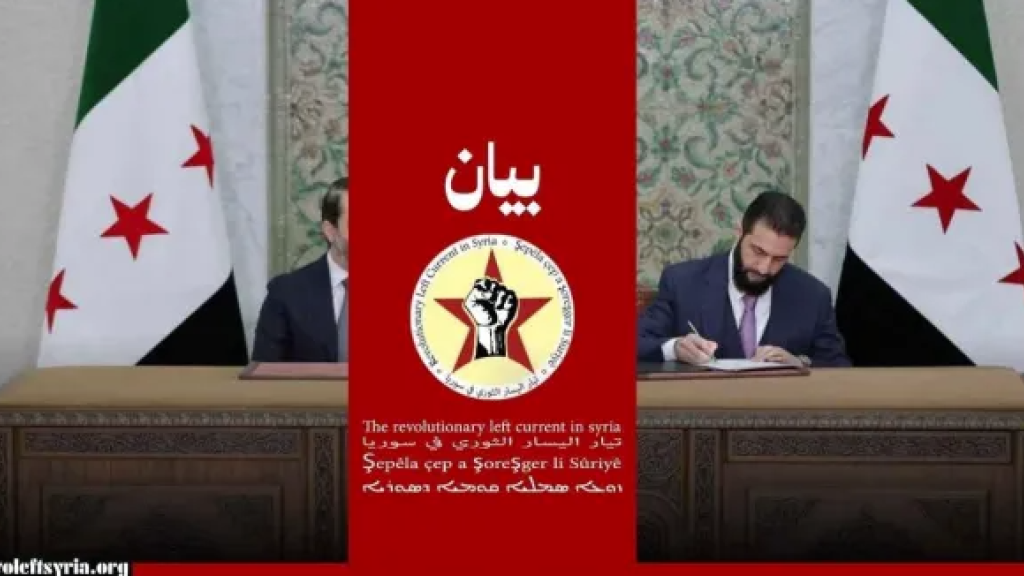
Revolutionary Left Current: Syria at a crossroads — Towards freedom or tyranny


Published 

RLC statement on transitional constitution

First published at Revolutionary Left Current

With the collapse of the former regime, the Syrian people, who had suffered under the tyranny and injustice of the Assad family’s oligarchy, were swept by feelings of joy, relief and hope for liberation. After the great popular revolution that erupted in mid-March 2011, during which the Syrian people offered tens of thousands of martyrs to achieve its goals, there was a sense of optimism. However, doubt and disappointment have now gripped large segments of the population. Their living conditions have deteriorated further, and the vertical fragmentation among Syrians has increased, exacerbated by rising ethnic and sectarian discrimination under the new authority. This authority has replaced its promises of inclusive participation in building a new Syria with top-down marginalizing measures, such as the so-called “Victory Declaration Conference” for military factions that appointed a president for the country, followed by the “National Dialogue Conference,” which lasted less than a day. This was followed by sectarian killings on the coast, culminating in a constitutional declaration devoid of any real or democratic participation.

The interim constitutional declaration issued by the new authority, both in form and content, has dashed the hopes of the masses. It has entrenched the very opposite of the goals and roots of the Syrian revolution, which were freedom, justice, and equality. This declaration has legitimized the concentration of all powers in the hands of a single individual, the president, amounting to nothing more than an attempt to reproduce the previous oligarchic system, but without Assad and under a new constitutional cover similar to its predecessor.

More importantly, this constitutional declaration lacks any popular legitimacy, as the sole source of legitimacy is the free people themselves. It does not establish such legitimacy but rather derives its authority solely from the armed apparatus of the new regime, headed by Ahmed Shar’, who appointed himself as president with absolute powers, as if we have returned to an absolute monarchy.

Thus, the issuance of this declaration renders any real guarantees for a radical democratic and social change in the structure of the collapsed political system null and void. The primary difference between the two systems is the replacement of one ruling elite with another. Moreover, it paves the way for the reproduction of the same security and media tools and methods used by the previous regime to suppress and subjugate the Syrian people.

Therefore, we warn against the conservative political path taken by the new authority, whose reactionary practices have intensified, completely contradicting the promises made by the regime. In this context, the constitutional declaration confirms this direction.

Consequently, the constitutional declaration does not address the root causes of the Syrian crisis but instead reproduces the same conditions that led to the outbreak of the revolution. The absence of real democracy, the persistence of religious and sectarian discrimination, the concentration of power in the hands of an individual or a small group, and neoliberal economic policies all contribute to the continuation of political and social conflict and instability in the country.

The Revolutionary Left Current in Syria believes that the real solution to Syria’s crisis cannot be achieved through formal constitutional declarations that do not fundamentally break with the foundations of tyranny and corruption. Instead, it requires political organization behind a clear project: 

  • Expanding the space for freedoms, political and union activities, and free and independent media, and transitioning to a real, non-sectarian democratic system with the participation of all political and popular forces through free and fair elections based on proportional representation.
  • Additionally, opposing all economic, social, and political policies that harm the interests of the broad popular sectors, and building a true democratic state based on the principle of full citizenship and equality among all Syrians, in contrast to projects that politicize identity.
  • Adopting a democratic constitution that guarantees the separation of powers and establishes a pluralistic political system that respects human rights and fundamental freedoms.
  • Achieving transitional justice by holding all criminals who committed crimes against the Syrian people accountable and compensating the victims and the families of the martyrs.
  • Rebuilding the Syrian state on new foundations that ensure social and economic justice, guarantee the Syrian people’s right to self-determination, and recognize Syria’s national, religious, and cultural diversity without discrimination. It must also preserve the full sovereignty of the people in shaping their future and the independence of their country from all occupiers.

We, the Revolutionary Left Current in Syria, affirm that we will not stop defending the interests of the popular classes and will continue to work with political and popular forces that share our commitment to achieving the goals of the revolution: freedom, dignity, and social justice.

All power and wealth to the people.