Thursday, March 27, 2025

Greenland: Vladimir Putin believes that Donald Trump's plans for the island are "serious"


Vladimir Putin on Thursday expressed his concern about Donald Trump's plans for Greenland. He considers the American president "serious" and says he fears a militarization of the Arctic. The warning comes as U.S. Vice President J.D. Vance visits the island on Friday.


Published: 28/03/2025 -
By: FRANCE 24
Russian President Vladimir Putin speaks with the governor of the Murmansk region, Andrey Chibis, on the sidelines of the International Arctic Forum in Murmansk, Russia, Thursday, March 27, 2025. © Gavriil Grigorov, AP


Russian President Vladimir Putin said on Thursday (March 27th) that his US counterpart Donald Trump's plans to take control of Greenland were "serious", saying he was worried that the Arctic could turn into a "springboard for possible conflicts". A statement that coincides with the trip of US Vice President J.D. Vance to the island on Friday.

"These are serious projects on the part of the United States regarding Greenland, projects that have ancient historical roots," Vladimir Putin said at a conference in Murmansk devoted to the Arctic.

While Vladimir Putin assured that the issue of Greenland, an autonomous territory belonging to Denmark, does not concern Russia, he said he was "concerned by the fact that NATO countries are increasingly considering the Far North as a springboard for possible conflicts".

During this conference, Vladimir Putin announced multiple measures aimed at developing the economic development of the Russian Far North, a strategically important region for Moscow, which has already modernised several military bases there in recent years that have been abandoned since Soviet times.

In particular, he ordered the renovation of the region's cities, to ensure that the transport capacity of the large city of Murmansk is tripled and that other Arctic ports are developed. He also called for better rail links between Siberia, the Urals and the Far North and for the development of raw material extraction and shipbuilding.

A "Northern Sea Route" in the Arctic

"We will increase the capacity and turnover of our Nordic ports at a faster pace. We will do this on the basis of modern environmental solutions, including automated and unmanned cargo handling technologies," Putin said.

To be readNaaja Nathanielsen says Greenland "is not a commodity to be owned or controlled"

He also said he was open to Russia's collaboration with "friendly countries" in the Arctic, and with Western countries "if they show interest".

Russia hopes to develop the Northern Sea Route in the Arctic, a trade route made possible by melting ice and which could eventually compete with the Suez Canal by taking advantage of the impact of climate change.

With AFP


Naaja Nathanielsen says Greenland "is not a commodity to be owned or controlled"

As Donald Trump increases his pressure on the autonomous Danish territory, and shortly before his Vice President J.D. Vance's visit to a US military base on Friday, Naaja Nathanielsen, Greenland's Minister of Economy and Mineral Resources, explains to France 24 the position of the island's government in the face of the United States' wishes. 


Published : 27/03/2025 - 
FRANCE24
By: Hamza HABHOUB
Greenland's Minister of Mineral Affairs and Resources, Naaja Nathanielsen, speaks during an interview with AFP in her office in Nuuk, Greenland, on March 6, 2025 (illustration). © Odd Andersen / AFP

On Wednesday 26 March, Donald Trump increased his pressure on Greenland by saying that the United States should take control of the Danish island for "international security" reasons.

"I don't like to put it like that, but we're going to have to" take possession of the immense Arctic territory, Donald Trump said, two days before Vice President J.D. Vance's visit to Greenland. "We need Greenland for international security. We need it. We need it," he added.

"It's an island that we need from a defensive and even offensive point of view," the US president continued.

J.D. Vance is due to visit the US military base in Pituffik on Friday, which is responsible for a surveillance mission in the northern hemisphere. He is going there "to be informed of issues related to Arctic security" and to meet with the troops, his office said on Tuesday.

This base "is used for missile departure detection, missile defense and space surveillance missions," the U.S. vice president said.

In an exclusive interview, Naaja Nathanielsen, Greenland's Minister of Economy and Mineral Resources, recalls the categorical refusal of the island's transitional government regarding Trump's offer. The minister says that the visit of American officials to Greenland is "hostile behavior".

See also"We need Greenland," Trump says ahead of J.D. Vance visit

Since his election, US President Donald Trump has repeatedly expressed his desire for the United States to take control of Greenland. What is your position on this issue?

I take offense at the rhetoric chosen. Greenland has always viewed the United States as an allied partner. Nevertheless, due to a series of events regarding irrational trade wars, aggressive rhetoric about Greenland and Canada, as well as the attitude toward Gaza and Ukraine, an unstable Western alliance has emerged. It is currently changing the world as we knew it. I think we are all in the Western alliance, trying to understand where our powerful ally is going. But let me clarify: Greenland is not a commodity to be owned or controlled, and we are not for sale. We expect our government, our borders, our country, and our culture to be respected by the United States.

See also  Hervé Kempf: "The United States is not the only one to covet Greenland's rare earths"

How do you intend to respond to Trump's intentions regarding Greenland?

This is a question for the new government (Editor's note: Greenland is waiting for a government after the parliamentary elections on 11 March which saw the victory of the centre-right). Currently, negotiations are taking place and I am waiting for their result. So far, the five party leaders are standing together in the face of American ambitions.

Accompanied by her husband, U.S. Vice President J.D. Vance, Usha Vance, will visit Greenland this week alongside Mike Waltz, Trump's national security adviser. How do you see this visit, which many believe has political implications?

I see it as an assault. I can't believe that the US National Security Adviser and the Secretary of the US Department of Energy [Chris Wright] would take the time, despite their busy schedules, to attend a cultural event in Greenland [Editor's note: in a video posted on Instagram on Sunday, Usha Vance claimed to have "read everything, with [her] children, about the sleigh race", which has since been cancelled in the face of an outcry] while negotiations on the new administration are underway.

See also  Greenland, the great covetousness? Let's talk about it with M. Blugeon-Mered, D. Simmonneau and J. André

Could we see a rapprochement with the European Union?

As for the possibility of submitting an application for membership of the European Union, this is not currently on the agenda, and I am not aware of it at the moment. However, we already have an excellent relationship with the European Union, and this has not changed in recent months.

How do you judge the idea of Greenland independence today, in light of Trump's statements and the concerns they have raised?

We have been working for decades for independence. This is nothing new. Independence is much more than a date, and we are taking the necessary time. It is premature to discuss a date. We are still part of the Kingdom of Denmark and will continue to work to develop our right to self-determination with the Danish government, as we have done for several years. This is not a sprint, but a marathon.

See also  Under pressure from pro-independence nationalists, Greenland in search of a coalition

With AFP

Denmark welcomes US limiting Greenland visit to military base


By AFP
March 26, 2025


Tracking stations at the US Pituffik space base in Greenland, the only place where JD Vance and his wife will now visit - Copyright AFP/File SAUL LOEB

Camille BAS-WOHLERT

Denmark welcomed on Wednesday Washington’s decision to limit a US delegation’s visit to Greenland to a US military base, after previous plans for the unexpected trip sparked criticism.

US Vice President JD Vance announced Tuesday that he would accompany his wife Usha on Friday to the Pituffik Space Base in Greenland, the Danish self-governing island coveted by President Donald Trump.

Since returning to power in January, Trump has insisted he wants to take over Greenland for national security purposes, refusing to rule out the use of force to do so.

Vance’s announcement came just hours after Danish Prime Minister Mette Frederiksen and Greenland’s outgoing Prime Minister Mute Egede harshly criticised plans by a US delegation to visit the Arctic island uninvited.

Egede had qualified the initial plans as “foreign interference”, noting that the outgoing government had not “sent out any invitations for visits, private or official”.

Following March 11 elections, Greenland has only a transitional government, with parties still in negotiations to form a new coalition government.

“We have asked all countries to respect this process,” Egede had said in a Facebook post.

Yet the White House announced Sunday that Usha Vance would travel to Greenland from Thursday to Saturday, while Egede had said US national security adviser Mike Waltz was also expected to take part.

US media had reported that Energy Secretary Chris Wright would be part of the visit as well.

Usha Vance had been scheduled to view “historical sites, learn about Greenlandic heritage and watch the Avannaata Qimussersu, Greenland’s national dogsled race,” in the southwestern town of Sisimiut, the White House had said.

Frederiksen denounced that visit as “unacceptable pressure” being put on Greenland and Denmark, and vowed “to resist”.


– ‘Very positive’ –


JD Vance said in a video statement that he and Usha would travel only to the Pituffik base to visit US Space Force members based there and “check out what’s going on with the security” of Greenland.

“I think it’s very positive that the Americans have cancelled their visit among Greenlandic society. They will only visit their own base, Pituffik, and we have nothing against that,” Danish Foreign Minister Lars Lokke Rasmussen told public broadcaster DR on Wednesday.

“The cars (from the US advance security detail) that were delivered a few days ago are in the process of being sent back home, and the wife of the US vice president and the national security adviser will not visit Greenlandic society,” Lokke Rasmussen said.

“The matter is being wound up and that’s positive,” he added.

A US Hercules plane later took off from Nuuk airport, according to flight tracking website FlightRadar24.com.

Marc Jacobsen, an associate professor at the Royal Danish Defence College, said the US change of plan was a “de-escalation” aimed at saving face after Danish and Greenlandic leaders made it clear the US officials were not welcome.

Locals in Sisimiut, Greenland’s second-biggest town of 5,500 people, had announced a protest during Usha Vance’s visit, following another anti-US protest outside the US consulate in Nuuk on March 15.

“They didn’t want to risk… photos being shown to US voters on social media,” Jacobsen told AFP.

Jacobsen also dismissed Vance’s claims in his video announcement that other countries were trying to use the territory to “threaten the United States, to threaten Canada, and, of course, to threaten the people of Greenland”.

“The only country threatening Greenland, that’s actually the US,” Jacobsen said. “If he meant China or Russia, they’re not threatening Greenland. They have no interest in attacking Greenland.”

A self-governing territory that is seeking to emancipate itself from Copenhagen, Greenland holds massive untapped mineral and oil reserves, though oil and uranium exploration are banned.

It is also strategically located between North America and Europe at a time of rising US, Chinese and Russian interest in the Arctic, where sea lanes have opened up because of climate change.

Greenland’s location also puts it on the shortest route for missiles between Russia and the United States.

Greenlandic officials have repeatedly said the territory does not want to be either Danish or American, but is “open for business” with everyone.

According to opinion polls, most Greenlanders support independence from Denmark but not annexation by Washington.

Trump says ‘we have to have’ Greenland, ahead of Vance trip


By AFP
March 26, 2025


Nuuk, the capital of Greenland -- which Donald Trump wants to be part of the United States - Copyright AFP Juliette PAVY

Asad Hashim, with Camille Bas-Wohlert in Copenhagen

US President Donald Trump ramped up his claims to Greenland on Wednesday, saying ahead of a visit by Vice President JD Vance that the United States needed to take control of the Danish island for “international security.”

Since coming to power in January, Trump has repeatedly insisted that he wants the self-governed territory to be a US possession, refusing to rule out the use of force to achieve his goal.

“We need Greenland for international safety and security. We need it. We have to have it,” Trump told podcaster Vince Coglianese. “I hate to put it that way, but we’re going to have to have it.”

Greenland, which is seeking independence from Denmark, holds massive untapped mineral and oil reserves, though oil and uranium exploration are banned.

It is also strategically located between North America and Europe at a time of rising US, Chinese and Russian interest in the Arctic, where sea lanes have opened up because of climate change.

The US president’s latest strident comments come as Vice President Vance is due to accompany his wife Usha on a visit to the US-run Pituffik Space Base in Greenland on Friday.

Danish Prime Minister Mette Frederiksen and Greenland’s outgoing Prime Minister Mute Egede had earlier harshly criticized plans by a US delegation to visit the Arctic island uninvited for what was initially a much broader visit.

Egede had qualified the initial plans as “foreign interference,” noting that the outgoing government had not “sent out any invitations for visits, private or official.”

On Wednesday, Danish Foreign Minister Lars Lokke Rasmussen welcomed the decision to limit the visit to the US space base.

“I think it’s very positive that the Americans have canceled their visit among Greenlandic society. They will only visit their own base, Pituffik, and we have nothing against that,” he told public broadcaster DR.


– ‘Respect this process’ –


Greenlandic officials have repeatedly said the territory does not want to be either Danish or American, but is “open for business” with everyone.

According to opinion polls, most Greenlanders support independence from Denmark but not annexation by Washington.

Following March 11 elections, Greenland has only a transitional government, with parties still in negotiations to form a new coalition government.

Egede has called for “all countries to respect this process.”

Marc Jacobsen, a senior lecturer at the Royal Danish Defense College, called the decision to limit the US visit “a de-escalation,” a term also used by Foreign Minister Lokke.

“The fact that the Greenlandic and Danish authorities are telling you that you’re not welcome is significant,” he told AFP.

“The risk of negative coverage in the media and social networks may have weighed even more,” he added, noting that a demonstration was announced in Sisimiut, following an initial anti-US demonstration in the capital Nuuk on March 15.
Vacation buzzkill: Canadians cancel summer trips to Trump’s America

By AFP
March 25, 2025


Revelers enjoy the beach on Las Olas Boulevard, Fort Lauderdale, Florida, during spring break weekend. Fewer Canadians are vacationing in the US - Copyright AFP GIORGIO VIERA

Mégan HARVEY

Rosalie Cote and her parents vacationed in the US state of Maine every summer for 25 years — but this year they are staying home, incensed like many Canadians by Donald Trump’s threats of annexation and tariffs.

The United States was the top destination for Canadian tourists, with 20.4 million visits reported last year by the US Travel Association, pumping some US$20.5 billion into the American economy and supporting 140,000 jobs.

But that number is expected to plummet this year as Canadians — the targets of relentless attacks by an America First president intent on wielding tariffs as a policy tool and who speaks frequently of turning their country into the 51st state — cancel their travel plans.

“We don’t want to support the United States. It’s a matter of principle,” explains Cote.

Romane Gauvreau cancelled her mountain biking trip to Vermont and a family vacation to Maine.

“We don’t want to go to a place where democracy is in danger, where people suffer great injustices, and where people are being deported,” Gauvreau told AFP.

They are not outliers. A recent Abacus Data survey found 56 percent of Canadians have changed or cancelled their travel plans to the United States.

Bookings to American destinations in February alone fell 40 percent compared to the same month last year, while 20 percent of pre-existing reservations were cancelled, according to the travel agency Flight Centre Canada.

Canadians who typically spend winters in warmer southern US states, colloquially known as “snowbirds” and whose numbers are estimated to top one million, are also rethinking their plans.

Andre Laurent, a retired civil servant, spent half of each of the past 22 years in Florida to escape Canada’s frigid winters.

But he says everything has changed and become “unpleasant” since the return of Trump to the Oval Office in January. And so, he decided to sell his Florida home.

“I no longer felt welcomed and I even felt like I was betraying my country,” he said.

Five of the six Canadians who lived in his Florida gated community also decided to leave the United States permanently.


– ‘Choose Canada’ –


Former prime minister Justin Trudeau, whose final days in office were marked by Trump slapping tariffs or threats of tariffs on many Canadian goods, urged his countrymen to consider vacationing closer to home to show their patriotism.

“Choose Canada” videos quickly spread on social media, touting Canadian destinations such as the majestic Rocky Mountains in the west or Prince Edward Island, which inspired Lucy Maud Montgomery’s best-selling novel “Anne of Green Gables,” in the east.

Travel agencies were quick to leap on the trend.

At Nuance du monde, they no longer promote trips to the United States. “We’re boycotting them in light of the current situation,” said company director Samy Hammadache, adding that the loss of tourism will have “quite a significant” impact on the US tourism sector.

Agencies are already noticing a shift in Canadian bookings to destinations such as Europe, the Caribbean, Central America, and Canada instead of the United States.

Canadian airline Flair Airlines responded to a decline in demand for flights to popular US destinations by increasing flights to Mexico, Jamaica, and the Dominican Republic.

“These decisions are based on market needs and demand,” said Kim Bowie, director of communications for the airline said.

Tourism professor Michel Archambault predicted that the trend will see Canadian “domestic tourism reach record levels this year.”

He pointed to a Leger survey that found six out of 10 Canadians plan to vacation in Canada, adding that this is quite unusual.

A recent drop in the value of the Canadian dollar also made US travel less affordable.

For Cote, however, it’s about standing up for Canada: “We must spend money at home rather than with our neighbors who play dirty tricks on us.”


The era of 'close cooperation' with Washington is over, says Canadian Prime Minister

Canadian Prime Minister Mark Carney said Thursday that the era of close cooperation with the United States was "over," saying Washington was no longer a "reliable" economic and security partner.


Published : 28/03/2025
By: FRANCE 24
Canadian Prime Minister Mark Carney speaks to the media on Parliament Hill after a meeting of the Ministerial Committee on Canada-United States Relations and National Security, in Ottawa, Thursday, March 27, 2025. © Adrian Wyld, AP

Canada's new Prime Minister Mark Carney said on Thursday (March 27th) that the time for close cooperation with the United States was "over" because the country is no longer a "reliable partner".

"The old relationship we had with the United States, based on the deep integration of our economies and close cooperation in security and defence, is over," he said at a press conference.

However, he said he is due to speak with US President Donald Trump in "a day or two" at Washington's request.

On Wednesday, the US president announced his intention to impose 25% tariffs on car imports. This measure would be in addition to the tariffs already imposed by Washington on steel and aluminum.

"I oppose any attempt to weaken Canada, to divide us so that America can possess us, that will never happen," he said, vowing to fight back.

"We will fight the U.S. tariffs with retaliatory trade actions that will have maximum impact in the United States and minimal impact here in Canada," added the new prime minister, who took office less than two weeks ago.
The importance of "respect" to make dialogue possible

The latter, who called an early election, interrupted his campaign on Wednesday afternoon following Donald Trump's new announcements to meet with the premiers of Canadian provinces.

On Thursday, he insisted on the "respect" that the American president must show for a dialogue to be possible.

"For me, there are two conditions, not necessarily for an appeal, but for a negotiation with the United States. The first is respect, respect for our sovereignty as a country," he said.

And "there has to be a comprehensive discussion between the two of us, including about our economy and our security." The two men have not had a phone call since Mark Carney took office replacing Justin Trudeau on March 14.

He promised to "build a new Canadian economy" by breaking down the customs barriers that exist between Canadian provinces.

With AFP

Canada PM Carney details fund to protect auto industry against Trump


By AFP
March 26, 2025


Canadian and American flags fly on the Canadian side of the Ambassador Bridge in Windsor, Canada on March 8, 2025 - Copyright AFP Geoff Robins

Prime Minister Mark Carney on Wednesday announced support for “all-in-Canada” auto manufacturing, escalating trade protection in response to US President Donald Trump’s threat to “shut down” the northern country’s auto industry.

Carney detailed a CAN$2 billion ($1.4 billion) fund while campaigning ahead of Canada’s April 28 election in Windsor, with the US city of Detroit visible across the river behind him.

The highly-integrated North American auto industry, and specifically the free-flow of parts between Detroit and Michigan during the manufacturing process, has been a focal point in Trump’s trade war.

Gesturing to the suspension bridge that connects the cities, Carney noted that auto parts could cross the border “six times before assembly,” but warned Canada needed to prepare for a “new world.”

“It’s not about waiting for the Americans to become more reasonable. It is about acting now,” Carney said.

“What we need to do is build more of those autos, and more of each auto, right here in Canada,” Carney said.

His proposed fund will support efforts to build more car parts in Canada while limiting the number of parts that cross the border during production, a statement from Carney’s Liberal Party said.

Trump has threatened, imposed and withdrawn various tariffs on Canada’s auto industry and his full plans for the sector remain unclear.

New levies targeting auto parts from Canada could be part of his administration’s highly-anticipated April 2 announcement on global reciprocal tariffs.

The president has charged that Canada “stole” the US auto industry and said auto-makers that want to avoid tariffs should make cars in the United States.

Industry experts argue North America’s integrated manufacturing process, which includes Mexico, has developed to maximize efficiency.

Carney, a former central banker, replaced Justin Trudeau as prime minister on March 14 and on Sunday triggered snap elections.

At the start of the year, the Liberal Party appeared headed towards a crushing electoral defeat with the Conservatives poised to retake power after a decade in opposition.

But Trump’s trade war, his repeated threats to make Canada the 51st US state, and Trudeau’s departure have upended Canadian politics.

Just over a month before the vote, pollsters are currently projecting a Liberal majority, a stunning reversal driven in part by a perception among some voters that Carney is the best leader to confront Trump.


Endangered Species Coalition Responds to Republican-led Congressional Attacks on Endangered Species Act and Gray Wolves


WASHINGTON - Today, the Republican-led House Natural Resources Subcommittee on Water, Wildlife, and Fisheries will consider legislation that would dramatically weaken the widely popular Endangered Species Act (ESA) and strip protections for gray wolves in 48 states.

The first bill — the “ESA Amendments Act of 2025” — would gut the critical protections that the ESA provides for thousands of imperiled species, upend the scientific consultation process (which has been the cornerstone of American species protection for 50 years), slow listings to a crawl while fast-tracking delistings, and allow much more exploitation of threatened species and shift their management out of federal hands to the states, even while they are still nationally listed.

The second bill — the so-called “Pet and Livestock Protection Act of 2025″ — would reissue the first Trump administration’s delisting of the gray wolf across most of the U.S. and bar judicial review of that action. In 2022, a federal court reversed this delisting, after conservation groups challenged it.

In addition to the Republican-led Congressional attacks on the ESA and gray wolves, the Trump administration recently terminated hundreds of U.S. Fish and Wildlife Service employees — nearly 5 percent of the agency’s workforce — which is already critically understaffed. Without those employees, it will be even harder for disappearing vulnerable species to receive crucial protections, and for vitally important ecosystems across the U.S. to remain intact.

In response to attempts to undermine the ESA and delist gray wolves, organizations from across the country sent a letter to HNR leadership outlining opposition to the bills. Additionally, groups from the Endangered Species Coalition issued the following statements:

“These attempts to weaken the Endangered Species Act, or to go around it by picking off species like the gray wolf, represent a fundamental disconnect between a small number of legislators and millions of Americans,” said Earthjustice legislative director for lands, wildlife, and oceans Addie Haughey. “The ESA — and the iconic species it protects — enjoys immense support across the political spectrum. If these bills move forward, Congress will be acting against popular will and ignoring science to sacrifice the wildlife we love and the ecosystems we rely on.”

“Congressman Westerman’s bill would eviscerate the Endangered Species Act and push imperiled species to extinction,” said Ellen Richmond, senior attorney at Defenders of Wildlife. “The Endangered Species Act is the backstop for our nation’s wildlife already at the brink of extinction and this bill would sanction their swift descent into nothingness. We urge our representatives in Congress to listen to the American public’s overwhelming support for the Endangered Species Act and reject this disastrous bill which does nothing to strengthen wildlife protections and instead reverses decades of conservation success.”

“We are in a biodiversity crisis, and Congress is playing with fire. These bills would accelerate extinction at a time when we can least afford it,” said Josh Osher, public policy director for Western Watersheds Project. “The Endangered Species Act isn’t just about saving wolves, grizzlies, or sea turtles—it’s about protecting the ecosystems that sustain us all. Weakening these protections pushes our planet further into collapse. Congress must open its eyes and reject these reckless attacks before it’s too late.”

“These extreme bills would gut protections for wildlife under the Endangered Species Act. They are being introduced against a backdrop of sudden and indiscriminate firings across the US Fish and Wildlife Service and the National Oceanic and Atmospheric Administration, robbing these agencies of the experts who implement these crucial protections based on the best available science,” said Susan Millward, executive director and chief executive officer for the Animal Welfare Institute. “These assaults on wildlife protections come at a time of staggering biodiversity loss, and imperiled species don’t have the luxury of waiting out these political games.”

“Extinction is forever,” says Katherine Miller, Country Director for FOUR PAWS USA. ” If we allow the protections afforded by the ESA to be weakened and undermined by legislation like this, the consequences of these decisions will reverberate for generations. The ESA protects both iconic native species like Bald eagles and non-native species like Bengal tigers. It has also protected millions of acres of habitat, ensuring a livable planet for all of us.”

“The ESA Amendments Act of 2025, introduced by Representative Westerman, is severely out of step with how most Americans view and support wildlife protection. It prioritizes big industry and special interests ahead of decades-long, science-based protections that work,” said Chris Allieri, executive director and founder, NYC Plover Project. “Radicals in Congress are fast-tracking extinction and looking to severely weaken, if not entirely remove, bedrock environmental laws like the Endangered Species Act and Marine Mammal Protection Act.”

“The Endangered Species Act is one of the country’s most popular and successful conservation laws, and Donald Trump wants to throw it in the garbage to pad the bottom lines of his corporate supporters,” said Bradley Williams, Sierra Club’s Deputy Legislative Director for Wildlife and Lands Protection. “Since Day One of his administration, Trump has shown again and again that he wants to hand over control of our public lands and waters to billionaires and corporations. Imperiled wildlife will suffer the consequences. For more than 50 years, the United States has made amazing progress bringing species back from the brink of extinction. It’s because of the ESA that species like the grizzly bear and bald eagle are living symbols of America and not just photos in a history book. If Trump and his allies in Congress get their way, that progress won’t just come to a screeching halt – it could be completely reversed.”

“For decades, the Endangered Species Act has been a critical lifeline in preventing the irreversible loss of our nation’s wildlife. Legislation like H.R. 845 and H.R. 1897 would undermine this powerful tool against extinction and jeopardize ongoing recovery efforts of our iconic native species, like the gray wolf.” said Jennifer Eskra, Director of Legislative Affairs at Humane World Action Fund “At a time of growing biodiversity loss, it is essential that legislators prioritize science over politics and stand with the millions of Americans who support the ESA.”

“The Endangered Species Act is one of America’s most respected and successful conservation laws. Unfortunately, Representative Westerman’s ESA amendments are crafted for greedy billionaires clinging to a 19th-century vision of plundering the planet,” said Endangered Species Coalition National Policy Director Jewel Tomasula. “This bill would devastate the sea turtles people love to see at the beach, the bumblebees that pollinate our food crops, and the spotted owls that indicate healthy forests. This bill would destroy wildlife and wild places, not protect them.”

“These reckless attacks on the Endangered Species Act and gray wolves are nothing more than a giveaway to industry at the expense of our nation’s most imperiled wildlife,” said Joanna Zhang, endangered species advocate at WildEarth Guardians. “Gutting protections for species on the brink of extinction is not reform—it’s a death sentence. Americans overwhelmingly support the ESA because it works, and we urge our representatives in Congress not to stand by while Trump and his allies try to dismantle one of our most effective conservation laws.”

Earthjustice is a non-profit public interest law firm dedicated to protecting the magnificent places, natural resources, and wildlife of this earth, and to defending the right of all people to a healthy environment. We bring about far-reaching change by enforcing and strengthening environmental laws on behalf of hundreds of organizations, coalitions and communities.
Senate Finance Committee Should Not Have Advanced Mehmet Oz ’s Nomination


For Immediate Release
Tuesday March, 25 2025
Public Citizen
Contact:
Katie Garcia, kgarcia@citizen.org


WASHINGTON - Following the vote by the Senate Finance Committee supporting the nomination of Mehmet Oz for the Administrator of the Centers for Medicare and Medicaid Services (CMS), Public Citizen Co-President Robert Weissman issued the following statement:

“Mehmet Oz is fundamentally unqualified for the position of Administrator of the Centers for Medicare and Medicaid Services and should never have been nominated for the position based on his conflicts of interest alone. The Senate Finance Committee should have unanimously rejected his confirmation.

“Under Oz’s watch, could strip crucial health care services through Medicare, Medicaid, and the Affordable Care Act could be stripped from hundreds of millions of Americans. As he showed in his confirmation hearing, Oz would seek to further privatize Medicare, threatening access to care for tens of millions of Americans. Privatized Medicare Advantage plans deliver inferior care and cost taxpayers nearly $100 billion annually in excess costs.

“He also refused to commit to push back on efforts to slash Medicaid, which would harm access to care for millions – especially the poor and vulnerable – just so Trump and Musk can give tax breaks to their billionaire buddies.

“We need a CMS Administrator who believes in the importance of protecting crucial health programs like Medicare and Medicaid and would put patients ahead of corporate profits.

We can only hope that sanity prevails when Oz comes for a vote before the full Senate. No Senator should be fooled by the snake oil Oz is selling.”

Click here to read Public Citizen’s analysis on the impacts of expanding Medicare Advantage.
Speaking to Career EPA Staffers Reveals What Will Be Lost if Trump Guts the Agency

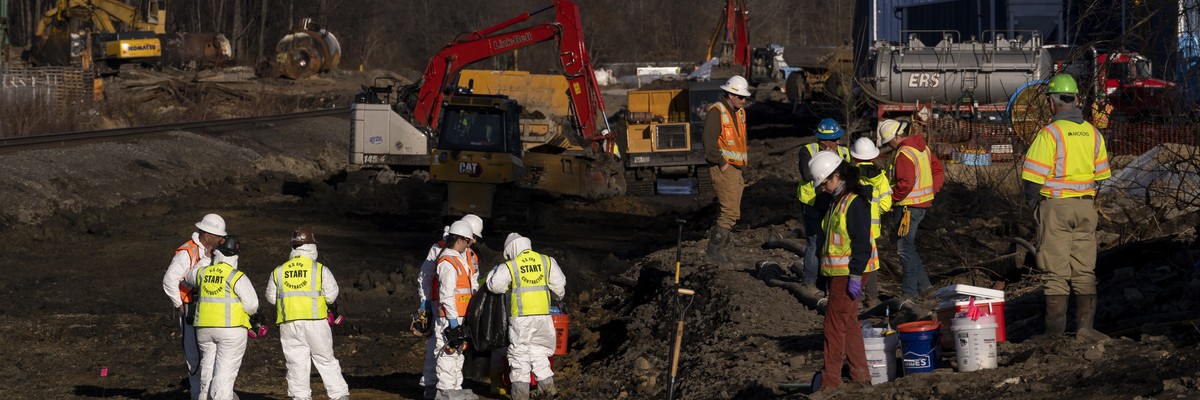
Ohio EPA and EPA contractors collect soil and air samples from the derailment site on March 9, 2023 in East Palestine, Ohio. 

(Photo: Michael Swensen/Getty Images)
If Zeldin, Musk, or Trump knew a scintilla about actual Environmental Protection Agency employees, they would dare not froth at the mouth with their toxic stereotypes about federal civil servants.


Derrick Z. Jackson
Mar 25, 2025
Union of Concerned Scientists/Blog


Neither Lee Zeldin, nor Elon Musk, nor President Donald Trump could possibly look Brian Kelly in the eye to tell him to his face that he is lazy.

They cannot tell Kayla Butler she is crooked.

They dare not accuse Luis Antonio Flores or Colin Kramer of lollygagging on the golf course.

If Zeldin, Musk, or Trump knew a scintilla about them, they would dare not froth at the mouth with their toxic stereotypes about federal civil servants. All four work in Region 5 of the Environmental Protection Agency (EPA), responsible for pollution monitoring, cleanups, community engagement, and emergency hazardous waste response for Illinois, Michigan, Ohio, Indiana, Wisconsin, and Minnesota.

A decimated EPA means less scrutiny for another Flint water crisis, less eyeballs on Superfund sites, and limited ability to investigate toxic contamination after train derailments, such as the incident two years ago in East Palestine, Ohio.

The Midwest is historically so saturated with manufacturing that just those six states generated a quarter of the nation’s hazardous waste back in the 1970s, and it is still today home to a quarter of the nation’s facilities reporting to the EPA’s Toxic Release Inventory Program. When I recently visited Region 5’s main office in Chicago, one enforcement officer, who did not give her name because of the sensitivity of her job, told me there are still toxic sites where “we show up [and] neither the state nor the EPA has ever been [there] to check.”

With irony, I visited the office the same week the Trump administration and Zeldin, President Trump’s new EPA administrator, announced they planned to cut 65% of the agency’s budget. Zeldin has since then dropped even more bombshells in a brazen attempt to gut the nation’s first line of defense against the poisoning of people, the polluting of the environment, and the proliferation of global warming gases.

Zeldin announced on March 12 more than 30 actions he plans to undertake to weaken or cripple air, water, wastewater, and chemical standards, including eliminating the Office of Environmental Justice and External Civil Rights and getting the EPA out of the business of curbing the carbon dioxide and methane gases fueling global warming. Despite record production that has the United States atop the world for oil, Zeldin said he was throttling down on regulations because they are “throttling the oil and gas industry.”

Last week, The New York Timesreported the EPA is considering firing half to three-quarters of its scientists (770 to 1,155 out of 1,540) and closing the Office of Research and Development, the agency’s scientific research office. Zeldin justifies this in part by deriding many EPA programs as “left-wing ideological projects.” He violently brags that he is “driving a dagger straight into the heart of the climate change religion.”
Impact of Cuts at EPA Felt Deeply, Broadly

Kelly, Butler, Flores, Kramer, and many others I talked with in Region 5 said all these plans are actually a bayonet ripping out the heart and soul of their mission. They all spoke to me on the condition that they were talking as members of their union, Local 704 of the American Federation of Government Employees. Nicole Cantello, union president and an EPA attorney, said the attacks on her members are unlike anything she’s seen in her more than 30 years with the agency. As much as prior conservative administrations may have criticized the agency, there’s never been one—until now—that tried to “fire everybody.”

Flores, a chemist who analyzes air, water, and soil samples for everything from lead to PCBs, said a decimated EPA means less scrutiny for another Flint water crisis, less eyeballs on Superfund sites, and limited ability to investigate toxic contamination after train derailments, such as the incident two years ago in East Palestine, Ohio. He added, “And we have a Great Lakes research vessel that tests the water across all the lakes. It’s important for drinking water, tourism, and fishing. If we get crippled, all that goes into question.”

“People will die,” he said. “There will be additional deaths if we roll back these protections.”

Butler is a community involvement coordinator who works through Superfund legislation to inform communities about remediation efforts. She was deeply concerned that urban neighborhoods and rural communities will be denied the scientific resources to tell the full story of environmental injustice. Superfund sites, the legacy of toxic chemicals used in manufacturing, military operations, mining, and landfills, are so poisonous, they can have cumulative, compound effects on affected communities, triggering many diseases. A 2023 EPA Inspector General report said the agency needed stronger policies, guidance, and performance measures to “assess and address cumulative impacts and disproportionate health effects on overburdened communities.”

Butler is deeply concerned cumulative impact assessments will not happen with cuts to the EPA, denying urban neighborhoods and rural communities the scientific resources to fully expose the horror of environmental injustice. “It’s a clear story that they’re trying to erase.” Butler said of the new administration.

For Kelly, an on-site emergency coordinator based out of Michigan, the rollbacks and the erasing of the story of environmental harms have an obvious conclusion. “People will die,” he said. “There will be additional deaths if we roll back these protections.”

What these workers also fear is the slow death of spirit amongst themselves to be civil servants.

Start with Kelly.

I actually talked to him from Chicago by telephone because he was out in Los Angeles County, deployed to assist with the cleanup of the devastating Eaton Fire that killed 17 people and destroyed more than 9,400 structures.

Between the Eaton Fire and the Palisades Fire, which took another 12 lives and destroyed another 6,800 buildings, the EPA conducted what it said was the largest wildfire hazardous materials cleanup in the history of the agency, and likely the most voluminous lithium battery removal in world history—primarily from the electric and hybrid vehicles and home battery storage people were forced to leave behind as they fled.

During a break, Kelly talked about how nimble he and his colleagues must be. He has worked cleanups of monster storms Katrina, Sandy, and Maria, and the East Palestine trail derailment. Based normally out of Michigan, he recalled a day he was working in the Upper Peninsula on a cleanup of an old abandoned mine processing site. He received a call from a state environmental emergency official asking him to drop what he was doing because 20 minutes away a gasoline tanker truck had flipped over, spilling about 6,000 gallons of gasoline onto the roads and down through the storm sewer into local waterways.

When he arrived, Kelly asked the fire chief how he could help. He was asked to set up air monitoring. But then he noticed anxious contractors who were wondering if they were going to get paid for their work. “They’re ordering supplies, they’re putting dirt down to contain this gasoline from getting any further,” Kelly said. “But they’re like, ‘Are we going to get paid for this?’”

“I found the truck driver who was talking to their insurance company. So I get on the phone with the insurance company and say, ‘Hey. This is who I am. This is what’s happening here. You need to come to terms and conditions with these contractors right now or EPA’s going to have to start taking this cleanup over!’”

The insurance was covered. Kelly said he could not have been so assertive with the insurance company without a robust EPA behind him.

“It’s one thing to be able go out and respond to these emergencies, but you have to have attorneys on your side,” Kelly said. “You’ve got to have enforcement specialists behind you. You’ve got to have people who are experts in drinking water and air. You can’t just have one person out there on an island by themselves.”
“Cruel for the Sake of Being Cruel”

Butler wonders if whole communities will become remote islands, surrounded by rising tides of pollution. The very morning of our interview, she was informed she was one of the thousands of federal workers across the nation who had their government purchase cards frozen by Elon Musk, the world’s richest human and President Trump’s destroyer of federal agencies. In launching the freeze, Musk claimed with no evidence, “A lot of shady expenditures happening.”

Butler threw shade on that, saying the purchase system is virtually foolproof with multiple layers of vetting and proof of purchase. She uses her purchase card to buy ads and place public notices in newspapers to keep communities informed about remediation of Superfund sites.

She has also used her card to piece together equipment to fit in a van for a mobile air monitor. The monitor assists with compliance, enforcement, and giving communities a read on possible toxic emissions and dust from nearby industrial operations.

Kramer wonders how many more scientists will follow in his footsteps to see that the work keeps getting done.

“I literally bought the nuts and bolts that feed into this van that allow the scientists to measure all the chemicals, all the air pollution,” Butler said. “I remember seeing the van for the first time after I bought so many things for years. And I was like ‘Wow this is real!’”

Not only was the van real, but air monitoring in general, along with soil monitoring—particularly in places like heavily polluted Southeast Chicago—has been a critical tool of environmental justice to get rid of mountains of petcoke dust and detect neurotoxic manganese dust in the air and lead in backyards.

“Air monitoring created so much momentum for the community and community members to say, ‘This is what we need,’” Butler said.

Kramer is a chemist in quality assurance, working with project planners to devise the most accurate ways of testing for toxic materials, such as for cleanups of sites covered in PFAS—aka “forever chemicals”—from fire retardants, or at old industrial sites saturated with PCBs from churning out electrical equipment, insulation, paints, plastics, or adhesives. His job is mostly behind the scenes, but he understood the meaning of his work from one visit to a site to audit the procedures of the Illinois EPA.

The site had a small local museum dedicated to the Native tribes that first occupied the land. “The curator or director told us how the sampling work was going to bring native insects back to the area and different wildlife back to the streams,” Kramer said. “It was kind of a quick offhand conversation, but it gave me a quick snapshot of the work that’s being done.”

Kramer wonders how many more scientists will follow in his footsteps to see that the work keeps getting done. He remembered a painful day recently when a directive came down that he could not talk to contractors, even those who happen to work in the same building as he does.

“I see them every day,” Kramer said. “They come say hi to me. They know my child’s name. Being told that I couldn’t respond if they came to my desk, looked me in the face, and said, ‘Good morning,’ is just such an unnecessary wrench into our system that just feels cruel for the sake of being cruel.”
Staff Stifled, Heartbroken

The culture of fear is particularly stifling for one staffer who did not want to give her name because she is a liaison to elected officials. Before Zeldin took over, she would get an email from an elected official asking if funding for a project was still on track and “30 seconds later,” as she said, the question would be answered.

Her job “is all about relationships,” keeping officials informed about projects. Now, she said just about everything she depends on to do her job has basically come to a halt. “Everyone’s afraid to say anything, answer emails, put anything in writing without getting approval. Just mass chaos all the way to the top.”

“I feel like I made a promise to them that I would be there for what they needed,” she said. “And I feel like I’ve been forced to go back on that promise.”

Relationships are being upset left and right according to other staffers. One set of my interviews was with three EPA community health workers who feel they are betraying the communities they serve because their contact with them has fluctuated in the first months of the Trump administration. They’ve had to shift from silence to delicately dancing around any conversation that mentions environmental justice or diversity, equity, and inclusion.

They did not want to be named because they did not want to jeopardize the opportunity to still find ways to serve communities historically dumped on with toxic pollution for decades because of racism and classism.

“Literally since January 20, my entire division has been on edge,” said one of the three. “We kind of feel like we’re in the hot seat. A lot of people working on climate are afraid. If you’re working with [people with] lower to moderate income or [places] more populated by people of color, you’re afraid because you don’t want to send off any flags to the administration.”

The tiptoeing is heartbreaking to them because they see firsthand the poisoning of families from chemicals the EPA has regulated. One of the health workers has painful memories of seeing the “devastated” look on mothers’ faces when giving them the results of child lead tests that were well above the hazardous limit. “I feel like I made a promise to them that I would be there for what they needed,” she said. “And I feel like I’ve been forced to go back on that promise.”
Remembering Their Mission Boosts Morale

Despite that, and despite President Trump’s baseless ranting, which included saying during the campaign that “crooked” and “dishonest” federal workers were “destroying this country,” these EPA staffers are far from caving in. Nationally, current and former EPA staff last week published an open letter to the nation that said, “We cannot stand by and allow” the assault on environmental justice programs.

Locally in Region 5, the workers’ union has been trying to keep morale from tanking with town halls, trivia nights, lunch learning sessions, and happy hours. In a day of quiet defiance, many of the 1,000 staffers wore stickers in support of the probationary employees that said, “Don’t Fire New Hires.” Several of the people I interviewed said that if Zeldin and the Trump administration really cared about waste and inefficiency, they would not try to fire tens of thousands of probationary workers across the federal system.

One of them noted how the onboarding process, just to begin her probationary year, took five months. “It wastes all this money onboarding them and then eliminating them,” she said. “That’s totally abusing taxpayer dollars if you ask me. It’s hard enough to get people to work here. We’re powered by smart people who went to school for a long time and could make a lot of money elsewhere.” Federal staffers with advanced degrees make 29% less, on average, than counterparts in the private sector, according to a report last year from the Congressional Budget Office.

“We’re supposed to be this nonpartisan force that’s working for the American people, and attacks to that is a direct attack on the American people.”

Individually, several said they maintained their morale by remembering why they came to the EPA in the first place. Flores, whose public service was embedded into him growing up in a military family, said, “I didn’t want to make the next shampoo,” with his chemistry degrees. “I didn’t want to make a better adhesive for a box… the tangible mission of human health and environmental health is very important me.”

The enforcement officer who wanted to remain anonymous talked about a case where she worked with the state to monitor lead in a fenceline community near a toxic industry. Several children were discovered to have elevated levels of lead in their blood.

“People’ lives are in my hands,” she said. “When we realized how dire the circumstance was, we were able to really speed up our process by working with the company, working with the state, and getting a settlement done quick. And now all those fixes are in place. The lead monitoring has returned back to safe levels, and we know that there aren’t going to be any more kids impacted by this facility.”

One of the community health workers I interviewed said her mission means so much to her because at nine years old she lost her mother to breast cancer after exposure to the solvent trichloroethylene (TCE). That carcinogen is used in home, furniture, and automotive cleaning products. The Biden administration banned TCE in its final weeks, but the Trump administration has delayed implementation.

“The loss of her rippled throughout our community,” the worker said of her mother. “She was active in our church, teaching immigrants in our city how to read. The loss of her had such a large impact.” She said if the EPA were gutted, so many people like her mother would be lost too soon. “We play critical roles beyond just laws and regulations,” she said. “We do serve vital functions for communities based on where the need is the most.”

The same worker worried that if an agency as critical to community health as the EPA can be slashed to a shell of itself, there is no telling what is in store next for the nation. “I know people don’t have a lot of sympathy for bureaucrats,” she said. “But I think what is happening to us is a precursor to what happens to the rest of the country. We’re supposed to be this nonpartisan force that’s working for the American people, and attacks to that is a direct attack on the American people.”

One of her co-workers seconded her by saying, “We’re fighting for the American people and we are the American people. We all began this job for a reason. We all have our ‘why.’ And that hasn’t changed just because the administration has changed, because there’s some backlash or people coming after us. Just grounding yourself with people whose ‘why’ is the same as yours helps a lot.”


© 2023 Union of Concerned Scientists


Derrick Z. Jackson is a 2018 winner from the National Society of Newspaper Columnists, a 10-time winner from the National Association of Black Journalists and a Pulitzer Prize finalist and co-author of Project Puffin: The Improbable Quest to Bring a Beloved Seabird Back to Egg Rock (2015).
Full Bio >
Serbian Students Remind Us of the Power We, as People, Hold

Amid profound shifts in power and governments across the world, they are embodying the hope and power that lies within grassroots movements and activism.


A protester faces off with a Serbian police officer showing red-painted hands symbolizing government neglect and mismanagement in Belgrade on November 3, 2024.
(Photo: Andrej Isakovic/AFP via Getty Images)


Ksenija Scahill
Mar 27, 2025
Common Dreams


On the corner of West 25th Street and Broadway, a sea of blood-stained hands gather silently amid the noises of Midtown Manhattan. As tourists and locals rush across the intersection, some attempt to decipher the demonstration. A sign in Serbian Cyrillic reads, "Love for students, the ocean divides us, the fight connects us." After 15 minutes, the crowd breaks their silence, embracing one another through a shared goal, to show support for the students of Serbia.

This demonstration is part of a larger student-led resistance sweeping Serbia over the past three months. After the deadly collapse of a canopy at a newly renovated railway station that claimed the lives of 16 people in Novi Sad, the country's second-largest city, public outrage has sparked a monumental fight against corruption. Protesters first took to the streets to demand accountability from government officials for the negligence and dishonesty that resulted in the tragedy. They staged silent protests starting at 11:52 am, the time the canopy collapsed, standing silently for 15 minutes, one minute for every life lost. After students of the Faculty of Dramatic Arts were assaulted during a peaceful protest on November 22 by pro-government thugs who may have been directed or even paid by government officials, anger over the collapse gave way to broader outrage.

The attack on the students, the lack ofaccountability from the corrupt populist government, and the deceit behind the construction of the railway station have led to a larger demand to restore justice and accountability. A bloody handprint, which has grown to be the symbol for the student movement, represents the culpability that the Serbian government has in the canopy collapse and for years of an oppressive and controlling regime. The protests are writing history, leading to the resignation of more than a dozen government officials and growing to become the largest student-run movement Serbia has seen since the 1990s and possibly the largest in Europe since 1968.

For most Serbians, a movement of this magnitude seemed unimaginable, especially from a generation with high emigration rates, yet the students have made the impossible a reality.

The Serbian Progressive Party or Srpska Napredna Stranka has been the ruling political party since 2012 when Aleksandar Vučić took office. In the years since, his government has been accused of having ties to organized crime, bribing voters, and abusing its political power to threaten opposition. His populist government, and the oligarchy it perpetuates, have threatened and dismantled civilian rights and freedoms within the country.

The renovation of the train station, which began in 2021, was the product of a larger project led by Serbia, China, and Hungary to develop a fast rail pathway between Belgrade and Budapest. Vučić's boasting about the station's upgrade and the project during his 2022 election campaign only increased suspicions following the collapse when he claimed that the canopy had not been renovated during the reconstruction. Documentation that later emerged proved this to be false and showed that at minimum some work was done on the canopy. The glorified reconstruction of the station and its ultimately deadly faulty construction is seen as an emblem of Vučić's neglect of public safety, infrastructure, and well-being to strengthen political and monetary relationships.

Rather than be intimidated by the assault on the November 22 protest, the Faculty of the Dramatic Arts students blockaded university buildings three days later, inspiring universities across the country to do the same. As protests intensified, so did the message unifying the students and protesters: Serbian citizens deserve better than a government that puts its political and financial interests above its people.

The demands set forth by the students are simple yet effective: First, they demand the release of all documents relating to the reconstruction of the Novi Sad railway station and full transparency on how such an avoidable tragedy could occur. Second, they demand accountability for those who have attacked peaceful protesters, going so far as to ram cars into crowds and injuring several people. Third, they demand that the criminal charges of those arrested during the protests be dropped. Lastly, they demand a 20% increase in the budget for higher education.

Students are demanding that the government abide by the same laws it imposes on its citizens. After students were injured by drivers who deliberately rammed cars into their peaceful protests, Vučić reacted by saying that the drivers were simply "trying to go about their way," a statement that made clear that his interests don't lie in the safety of his citizens but rather the preservation of his control. The students have developed an impressive tactic in response, shutting Vučić out and appealing directly to the judicial system, the Ministry of Education, and the Ministry of Construction.

On December 15 during a television interview, Prime Minister Milos Vučević made the abominable statement, "You can't bring down a country because of 15 people who died, nor 155, nor 1,555." This comment provided a comical victory for protesters after Vučević resigned on January 25, making him one of several officials to do so alongside the mayor of Novi Sad, Milan Đurić, and the Minister of Construction, Goran Vesić. On December 30th, Serbia's Public Prosecutorindicted 13 individuals regarding the collapse of the canopy. Vučević's resignation followed a general strike on January 24 that captured the country and increased pressure on the government. As the sun rose over Belgrade on January 25, protesters celebrated the 24-hour blockade of the city's largest road junction, Autokomanda, and the new chapter that the resignation of the prime minister brings to their movement.

Most recently the students have blocked off bridges in Novi Sad that serve as the main roadways between the city and Belgrade. In January their movement was nominated for a Nobel Peace Prize. But perhaps their biggest success has been in restoring hope across borders, professions, and generations.

Their resistance has spread beyond the protests and blockades. It's seen in communities set up by students in universities with kitchens, tents, and donation points. It's seen as high school students join them in the streets. It's seen in the songs they sing, the food they cook for one another, and the games they play as they block off one of the country's largest highway intersections. It's seen through the car horns, cheering crowds, and people running out of their homes with food and drinks for students marching 80 kilometers to join the Danube bridge blockade. It's seen when the Bar Association of Serbia goes on strike. It's seen as bikers, agricultural workers, and taxi drivers show up to support and protect students from the opposing violence. It's seen as peaceful demonstrations of support are spreading across borders and oceans to over 150 cities including New York, Los Angeles, and Las Vegas. It's seen as students marched over 100 kilometers in the cold to join a massive blockade and protest in the city of Kragujevac, tearfully cheered on by bystanders.

Despite their success, domestic and international media coverage has been essentially nonexistent since the protests began. It wasn't until the historic protest held on March 15 where hundreds of thousands gathered in Belgrade's city center to protest the Vučić regime, that the Western media started covering the students' feat.

The suppression of protests and blockades by Serbian media is a deliberate effort to silence the students' voices and demands. With Vučić's foreign policy juggling act among major international powers, the resistance in Serbia has been mistakenly painted as anti-Putin by Western media outlets. Despite Vučić's delicate balance between the West and the East, the ideological conflicts arenot the driving force for the students; rather, their activism is rooted in the pursuit of justice and accountability from their government.

For most Serbians, a movement of this magnitude seemed unimaginable, especially from a generation with high emigration rates, yet the students have made the impossible a reality. Amid profound shifts in power and governments across the world, they are embodying the hope and power that lies within grassroots movements and activism. "Turn off the TV. Tune In" is a slogan that has been used by student blockade accounts in response to the government regulation and censoring of the media. It stands as a powerful call to action for Serbian citizens and a message that can resonate with activists and changemakers globally.

When looking at the crowds of students holding the symbolic blood-stained hand over their hands, we should be reminded of the blood washing over the hands of governments internationally. At a recent solidarity demonstration in New York, a sign reading "Jedan Svet, Jedna Borba / One World, One Fight" showcased the hope that lies within global solidarity. The tenacity, resilience, and perseverance of the students in Serbia have ignited a wave of hope, serving as a reminder that true power resides in the hands of the people.


Our work is licensed under Creative Commons (CC BY-NC-ND 3.0). Feel free to republish and share widely.

Ksenija Scahill  is a Serbian-American freelance writer based in Brooklyn. She holds a bachelor's in psychology and a master's in community development and planning, both from Clark University.
Full Bio >


As Anger Over Wealth Inequality Deepens, Wall Street Bonuses Are 4 Times a US Worker's Pay

"Something is very broken and this is why people are so disenchanted," one commenter said.


Jamie Dimon, CEO of JPMorgan Chase, and Charles Scharf, CEO of Wells Fargo, left, leave the U.S. Capitol after a meeting with Republican members of the Senate Banking, Housing, and Urban Affairs Committee on February 13, 2025.
(Photo: Tom Williams/CQ-Roll Call, Inc via Getty Images)

Julia Conley
Mar 26, 2025
COMMON DREAMS

Amid growing discontent over surging economic inequality in the U.S.—and the Trump administration's elevation of unelected billionaire Elon Musk to the upper reaches of the federal government—the New York state comptroller's report on rising Wall Street bonuses was met with condemnation on Wednesday.

"Something is very broken and this is why people are so disenchanted," wrote one commenter on an article about the report at The Washington Post. "There is no American dream. Just fat cats getting fatter."

Another added that "the inequity of taxation on wealth in this country is shameful."

New York Comptroller Thomas DiNapoli lauded Wall Street's "very strong performance" in 2024 as he announced the average bonus paid to employees in the securities industry reached $244,700 last year—up 31.5% from 2023—as Wall Street's profits skyrocketed by 90%. The bonus pool reached a record $47.5 billion.

But as researcher Rob Galbraith pointed out on social media, the record-breaking take-home pay of Wall Street executives was 3.5 times the median household income for a family in Erie County, New York—leaving doubt that many workers in the state will immediately join in celebrating what DiNapoli said was "good news for New York's economy and our fiscal position" due to the bonuses' impacts on tax revenue.


"Tens of thousands of NYC families are about to lose their childcare unless we come up with another $1 billion in the state budget," said state Rep. Zohran Mamdani (D-36), who is running to be mayor of New York City, in response to the announcement.

The average bonus for Wall Street employees was about four times the salary of the median full-time U.S. worker's earnings for 2024, which came to about $62,000 or $1,200 per week.

DiNapoli's estimate was released a week after voters at a town hall in a Republican district in Nebraska shouted, "Tax the rich!" at Rep. Mike Flood (R-Neb.) when he expressed support for Musk's slashing of public spending and claimed such cuts are necessary to balance the budget.

In recent weeks, Sen. Bernie Sanders (I-Vt.) and Rep. Alexandria Ocasio-Cortez (D-N.Y.) have drawn crowds of tens of thousands of people to hear them speak on their Fighting Oligarchy tour—leading the congresswoman to proclaim, "What is happening right now is different."

"We need to be taxing the rich on the floor of the Congress," said Ocasio-Cortez in Arizona last week, drawing loud applause. "We need to be establishing guaranteed healthcare on the floor of the Congress. We need to be passing a living wage on the floor of the Congress."


However, Congress is currently controlled by Republicans working to cut federal programs that serve working people to pay for tax cuts benefiting rich individuals and corporations.
Poverty threat: US household debt surges

70% OF THE U$ ECONOMY RELIES ON WORKERS CONSUMPTION


By Dr. Tim Sandle
DIGITAL JOURNAL
March 25, 2025


Even New Yorkers lucky enough to live in rent-stabilized apartments -- approximately one million units and two million tenants, according to city data -- are not immune to the growing housing crisis in their city. — © AFP

U.S. household debt surged to $18.04 trillion in late 2024, with credit card balances reaching an all-time high of $1.21 trillion. Alongside, nearly 80 percent of US citizens are making splurge purchases last month, despite only 42 percent feeling they could afford them.

The distribution of poor spending decisions and economic woes from the spluttering US capitalist model varies state to state. This is evident from the company Socially Powerful’s research, which reveals the states with the most responsible spenders. Furthermore, the data highlighted how residents’ habits reflect a growing trend of impulsive spending and the challenges of maintaining financial responsibility.

The company created a points-based index system which analysed each state based on several metrics. The data for this analysis was gathered from a variety of reputable sources across multiple domains which can be found on the dataset, including ICSC, UpgradedPoints, WalletHub, Equifax, Bankrate, Raisin, and Wikipedia.

For this analysis, the firm focused on identifying states with the least responsible spenders based on these key variables: Average Bank Card Balance (2024), Total Interest Expense (2024), Average Credit Score (2024), Most Stressed States (2024), % People Making More Purchases Online (2024), Monthly Amazon Spending (2023), Number of Marketplaces per State (2023) – The number of marketplaces in each state was normalized by the state’s population size to allow for comparisons across states of different population sizes. This was calculated as the number of marketplaces per 10,000 people.

From this analysis, the top ten most financially responsible states were determined as:South Dakota
North Dakota
Kansas
Indiana
Minnesota
Idaho
Pennsylvania
West Virginia
Missouri
Iowa

As to what this top ten is based on, the following criteria were used:

• Debt Burden (Total Interest Expense & Credit Card Balance): States with higher credit card balances and interest expenses were assigned higher scores, as these indicate higher financial irresponsibility.


• Stress Levels: States with higher stress scores were considered more financially stressed, which could contribute to irresponsible spending behaviour. A higher stress score led to a higher score in the model.


• Online Spending Behaviour: States with a higher percentage of people making more online purchases were assigned a higher score, as increased online shopping (particularly on platforms like Amazon) often correlates with impulsive or excessive spending habits.


• Marketplace Density (Normalized Number of Marketplaces per 10,000 population): States with higher marketplace density were assigned a higher score, as they may have more opportunities for excessive or impulse buying. Higher marketplace density about population size indicates a higher opportunity for consumption, and thus a higher score.


• Other metrics were collected : Such as Median Household Income, Average Retirement Savings, and Average Bank Account Savings but were excluded from the final scoring model. While valuable for understanding financial health, they were deemed less relevant for assessing consumer spending responsibility.

As indicated above, South Dakota has the most responsible spenders with one of the lowest stress levels. South Dakota’s 914,488 residents maintain average retirement savings of $449,628, 13 percent higher than Montana’s ($390,768), and a median household income of $71,810, surpassing Kansas by 2 percent ($70,333).

With a stress score of 31.94/100, among the lowest in the nation, residents demonstrate strong debt management, reflected in total interest expense of $847 and an average credit score of 722. Retail opportunities are limited, with 1.25 marketplaces per 10,000 residents, yet monthly Amazon spending remains steady at $92.01.

North Dakota ranks second with just 1.24 shops per 10,000 residents While the average bank card balance of $5,618 is 4.5 percent higher than South Dakota’s ($5,375), the total interest expense is only $855, reflecting manageable debt levels. Residents boast the highest median household income in this group at $76,525, alongside retirement savings of $319,609. Retail options are sparse, with just 1.24 marketplaces per 10,000 residents, and e-commerce spending matches its neighbour at $92.01 per month, with a credit score of 720 and stress score of 35.35/100 highlighting financial stability.

Kansas ranks third. The state’s median household income of $70,333 is 12% higher than the neighbouring state of Oklahoma ($62,138), alongside residents boasting average retirement savings of $452,703. Kansas has strong retail density, offering 2.61 marketplaces per 10,000 residents, more than double Montana’s, and has a total interest expense of $889 and an average credit score of 712, the lowest among these states.

Montana rounds off the top ten with a score of 6.34/10. The state has an average bank card balance of $5,728, 14% lower than Virginia ($6,647), alongside a total interest expense of $968. The state has retirement savings of $390,768, and a median household income of $70,804 – 23% higher than Mississippi’s $54,203. Retail access is limited, with only 1.17 marketplaces per 10,000 residents, but e-commerce spending aligns with neighbouring states at $92.01 per month.


Jan 15, 2018 ... Debt: The First 5000 Years is a book by anthropologist David Graeber, published in 2011. It explores the historical relationship of debt ...