Saturday, March 29, 2025

Fleeing Trump: four Americans who chose Mexico

By AFP
March 28, 2025


US citizen Oscar Gomez moved to Mexico with seven suitcases and his dog - Copyright AFP Alfredo ESTRELLA

Sofia Miselem

Americans have long been lured to Mexico by its weather, culture and lower cost of living. Now some of the US citizens heading south of the border say they have another reason: Donald Trump.

Discrimination, the erosion of civil rights, government cutbacks, polarizing rhetoric and Trump’s war on “woke” are among the motivations these new expats give for not wanting to live in the United States.

Mexico is home to around a fifth of the more than five million US citizens living outside of their country, according to a 2023 estimate from the Association of Americans Resident Overseas.

Four Americans told AFP about why they feel more comfortable living in Mexico today.

– ‘I think of my parents’ –

Oscar Gomez, a 55-year-old business consultant, was already considering leaving the United States, but said Trump’s victory was a “tipping point.”

Although Trump’s anti-immigration comments were not directed at him, “I take them personally because I’m Latino…. I think of my parents,” he said.

Gomez also saw his income dwindle after Trump canceled the diversity, equity, and inclusion (DEI) programs he had contracts with.

So more than 60 years after his parents made the journey north from Mexico in search of a better life, Gomez made the reverse trip from San Francisco with seven suitcases and his dog.

“The irony is that people go to America because they think everything is possible and for me coming to Mexico, that’s what I feel,” he said.

“I think America is going to survive Trump but it’s going to change a lot — things are going to get harder.”

– ‘Going backwards’ –

After several years living in Mexico City, Tiffany Nicole was considering returning to Chicago to reunite with her family there, but Trump’s victory made her rethink her plan.

Now the 45-year-old is “looking for ways to get them out,” she said.

Nicole decided to emigrate after the police killing of George Floyd, an unarmed Black man, in 2020.

“As a Black person, you don’t feel safe,” said Nicole, a tax consultant.

Disillusioned with life back home, she has now decided to stay in Mexico.

“We’re actually going backwards in America,” Nicole said, pointing to setbacks in civil rights and medicine prices “going through the roof.”

“The American dream now is based on a capitalistic view and not on a community view,” she said.

– ‘Micro aggressions’ –

“Being Afro-Latino, being Dominican, being gay means attacks from all parts,” said Lee Jimenez, a 38-year-old yoga instructor from New York.

“The US is not the country that it was once. The American dream no longer exists,” he said.

Every time he goes back, “I see the US with clear eyes,” said Jimenez, whose parents are from the Dominican Republic.

“I see the micro aggressions, how people treat me and how the energy is,” he added, accusing Trump of “fabricating stories” and criticizing him for canceling policies and programs for the LGBT community.

– ‘More tension’ –

Jessica James, aka “J. J.,” said that Trump’s presidency had extinguished any desire to live in the United States.

“I don’t have any incentive to go back and I feel a big reason is because what’s going on in the US,” said the 40-year-old, who works for a fishing company.

James was born in San Diego to a Mexican mother, and grew up in Alaska, a conservative Republican state.

“I see a lot of change in the news, in the social media, because there is a lot more tension between people and that is amplified with him (Trump) being president,” James said.


The Venezuelans imprisoned in El Salvador

MARCH 28, 2025

President Bukele’s authoritarianism reaches new heights as he puts Venezuelan deportees from the US into El Salvador’s notorious prison system. This report is edited from the blogs of Tim Muth, who lives in the country.

The weekend of March 15th-16th saw the first implementation of Nayib Bukele’s offer to the United States to act as the offshore jailers of persons Donald Trump wants to expel from the country. During the visit of Secretary of State Marco Rubio to El Salvador in February, Bukele offered to not only to take back Salvadorans from the US, but also to accept deportees from other nations, and even to imprison US citizen criminals for a fee.

On Friday, March 14th, Trump issued a proclamation invoking the Alien Enemies Act (AEA) of 1798, asserting that gang members of the Venezuelan gang Tren de Aragua are part of an “invasion” of the US threatening its citizens. The old statute gives a president power during wartime to arrest and detain persons from a country with whom the US is at war. Of course, the US is currently not at war, although Trump is attempting to claim it.

The American Civil Liberties Union and Democracy Forward filed suit on Saturday, March 15th, and sought an immediate temporary restraining order to block Trump’s attempted use of the AEA.  The named plaintiffs in the suit were Venezuelans who had been moved to an ICE facility in south Texas and told they would be deported within hours. None were members of Tren de Aragua, according to their statements. The suit was also brought as a class action on behalf of all Venezuelans whom Trump might attempt to deport under the AEA.

District of Columbia federal district judge James E. Boasberg held a virtual hearing on Saturday, and first granted a temporary restraining order against the removal of the five named plaintiffs in the suit, and later expanded his order to all Venezuelans who could be impacted by Trump’s attempted use of the Alien Enemies Act.  While the judge was issuing the order, the Trump administration had planes full of Venezuelans taking off from Texas, and did not turn them around until they had reached El Salvador and unloaded their human cargo.

In fact it was not too late; the order was in the hands of the government before any of the planes had landed in El Salvador, and the government simply ignored the order, claiming it had no force once the planes were out of US airspace. 

Bukele’s media production team was waiting in El Salvador for the arrival of the planes Saturday night, and filmed the shackled men being hustled off to buses, surrounded by military and security forces, and then showed their delivery into the CECOT prison. Within hours, Bukele was tweeting about the arrival of the Venezuelans.

Bukele’s post states that all 238 persons on the flight were immediately sent to CECOT. However, reporting by Camilo Montoya-Galvez of CBS News indicates that only 137 were alleged Tren de Aragua gang members and the remainder were deported under “regular immigration law,” suggesting that they may have been undocumented and with final removal orders, but not necessarily persons who had been charged with, much less convicted, of any crime.   All of them have been “disappeared” into the Salvadoran prison system without any word from the US government of the identity of the Venezuelans or the individualized basis for their detention and removal.

There have been many subsequent developments regarding the US removal of 238 Venezuelans to El Salvador.  Here is a summary with links to news articles:

  • The US government admits that many of them had no criminal records. (ABC)
  • A US photo journalist was at the airport and later at the prison to see the arrival of the Venezuelan prisoners and published photos of how they were handled. (Time)
  • CBS News obtained a leaked copy of a list of the names of all the Venezuelans deported to El Salvador and imprisoned there.  (CBS)
  • Venezuelan families shared the stories of their loved ones who had actually fled from Venezuela and Tre de Aragua, rebutting than any suggestion they were part of a criminal gang. (Beyond the Border) (NPR) (BBC).
  • At least two of them were refugees who arrived in the US after extensive vetting by the government and refugee organizations. (Miami Herald)
  • Eight women on the flight were not allowed to disembark and were returned to the US because Bukele was not accepting women into CECOT. (USA Today)
  • US federal district Judge James Boasberg turned his temporary restraining order against use of the Alien Enemies Act into a preliminary injunction and one basis for his ruling was the likelihood that persons sent to Salvadoran prisons would suffer torture. (Ruling)  On March 26th, the DC Court of Appeals refused the government’s request to set aside that injunction. (Washington Post).
  • One federal appeals court judge suggested that Nazis detained under the Alien Enemies Act during World War II received more due process than the Venezuelans. (NPR)
  • A US State Department official told Congress that, despite Bukele’s cooperation, Salvadorans would continue to be deported if they were in the country illegally. (Diario El Mundo)
  • A group of Salvadoran lawyers announced they were filing habeas petitions on behalf of 30 Venezuelan prisoners with the country’s Supreme Judicial Court. Although the habeas remedy exists in the country, the high court has refused to apply it in the hundreds of petitions filed by Salvadorans caught up in the State of Exception.  (LPG)
  • The authoritarian president of Venezuela, Nicolas Maduro, has called the imprisonment of the Venezuelans a “kidnapping” and is demanding they be allowed to return to Venezuela. (CNN).

Tim Muth is a US-trained lawyer who works on matters involving civil liberties and human rights. He blogs at El Salvador Perspectives, and you can follow him on Twitter as @TimMuth.

Image: Prison guards transfer US deportees, alleged Venezuelan gang members, to El Salvador’s terrorism confinement centre. (AP pic). https://www.freemalaysiatoday.com/category/highlight/2025/03/25/nazis-got-better-treatment-judge-says-of-trump-admin-deportations/ Attribution 4.0 International CC BY 4.0 Deed

They work, pay taxes and call US home — but risk deportation


By AFP
March 29, 2025


Erik Payan, originally from Mexico, works in his tire repair shop in Cleveland, Texas, on March 25, 2025 as he did on a day in February shortly before masked and armed immigration agents came to detain him 
- Copyright AFP/File RONALDO SCHEMIDT


Moisés ÁVILA

As he has done for years, Erik Payan had just opened up his tire repair shop in the small Texas town of Cleveland on February 24 and was getting to work when armed and masked US immigration agents swooped in to arrest him and take him away.

“They’ve got me,” he told his distraught wife over the phone.

While it wasn’t an unheard of scene in the United States, such incidents have drawn the glare of scrutiny as President Donald Trump, newly returned to the White House, has lashed out at migrants with particularly violent rhetoric — raising concerns among many who lack papers that they may be swept up at random for expulsion.

– Overstayed visa –

Payan, a Mexican, has lived for 20 of his 51 years in the United States. He entered on a work visa, but stayed on after it expired, making a life with his wife and three daughters, the youngest of them US-born.

His store is licensed, he pays taxes and a mortgage, and is his family’s main breadwinner. One daughter is disabled; a granddaughter has a heart condition.

Payan goes to church on Sundays and his neighbors vouch for him. His roots are now in Texas, but he lacks the documents to stay legally.

His situation is much like many of the millions of other undocumented people living in the United States — a group estimated officially at 11 million but possibly closer to 14 million, according to a recent report from the NGO Migration Policy Institute.

– No criminal record –

Up to now, the undocumented were largely left alone, many working in some of the country’s most arduous and lowest-paid jobs. But Trump insists that their numbers include drug dealers, violent criminals and terrorists, and has vowed to deport millions of them.

Payan, who has no criminal record, was swept up in one of the hundreds of nationwide raids Trump launched immediately upon his return to the White House.

“I cried, but crying wasn’t going to help,” said his wife, 55-year-old Alejandrina Morales, who described their case on social media.

The tears quickly turned to determination.

“I’m going to fight, I’m going to defend my husband,” she recalls thinking.

Payan’s attorney Silvia Mintz said that despite Trump’s promises of mass deportation, a process must be followed.

– ‘They have options’ –

“That’s not how really the law works,” Mintz said. “Anybody who is in the United States has the right to due process, and… a judge gets to decide” whether they remain in detention or are deported.

Most importantly, she added, “They have options.”

Using documentation to prove Payan had been a law-abiding, tax-paying worker for years, Mintz managed to secure his release on bail after a 27-day detention.

Now begins a fight to legalize him.

Mintz said undocumented immigrants can fight to stay by demonstrating that they have ties to the country and family members who could be harmed by their absence.

There is also a possibility for children born in the United States — who enjoy “birthright citizenship,” though Trump is trying to end that — to legalize their parents once they turn 21.

But in the meantime, the risk of detention and deportation persists.

Mintz argues that the country desperately needs immigration reform to open a path to legal residency and citizenship.

– Billions in taxes –

The first thing Payan did upon his release was to reopen his tire store.

“We are not criminals, we’re hard-working people,” he said. “Yes, we’re not from here, but without the support of Hispanic workers, this country is nothing.”

He went on: “I’m not saying bad people haven’t come from our countries, but there are more of us good people. Let them concentrate on finding the criminals.”

In 2022, undocumented workers paid an estimated $97 billion in taxes, according to the group Americans for Tax Fairness.

Deporting millions of them, it said, could spark a devastating contraction, worse than during the 2008 financial crisis.

“They have to pay taxes… but unfortunately the law prohibits them from getting any incentive or anything back,” said Cesar Espinosa, executive director of the NGO FIEL, which works with immigrants.

He said it was important to recognize the contributions migrants make, and to push for immigration reform, “so other people can have access to the American dream.”

During Payan’s detention, he said, he sometimes slept in unheated rooms and caught a severe cold.

He’s still coughing, but now he’s home. His customers honk as they drive past his tire store, celebrating his return.

His wife Alejandrina celebrates too: “They had taken the captain of my boat,” she said, “and I was rowing alone.”

Pro-Palestine activists hold protest outside global trade conference in London


MARCH 27, 2025

The UK Secretary of Business and Trade, Jonathan Reynolds, is the focus of a demonstration calling for an end to the arms trade with Israel, report London for a Free Palestine.

This morning pro-Palestine protesters are disrupting a global trade conference over the continuation of Britain’s arms export licences to Israel. The protest was directed at the keynote speaker Jonathan Reynolds MP, Secretary of Business and Trade, who is responsible for granting the licences. 

Reynolds is planning to give an 11am keynote speech on Britain’s role in the global trade landscape’ at the establishment thinktank Chatham House. But the minister’s role in enabling genocide in Palestine means his attendance at the £500-pound-a-ticket global trade conference is being targeted by protests.

The British government last year announced the suspension of 30 arms export licences out of 350, in an admission that Israel is violating international law. However, Britain continues to grant export licenses for arms to Israel, including refusing to halt the export of parts for F-35 fighter jets, used in the ongoing genocide against the Palestinians.

Protesters were heard chanting “Reynolds, Reynolds you decide, justice or genocide?’ whilst carrying Palestine flags, placards and banners saying ‘Stop Arming Israel’, at the scene, following a wave of protests sweeping the country.

Last week, Israel resumed its genocidal violence against Palestinians, and has killed over 50,000 people since its assault began. Commenting on Israel’s blocking of vital aid into the besieged coastal enclave for a week, a London for a Free Palestine spokesperson said “It was now a case of people who were not killed by bombs, becoming at risk of death by starvation.”

The demonstration today was organised by the Campaigns Against the Arms Trade (CAAT), London for a Free Palestine (LFP) and the Palestinian Youth Movement Britain (PYM), a transnational, independent, grassroots movement of young Palestinians dedicated to the liberation of their homeland and people, who have also criticised the government’s treatment of the ‘Filton18’ protesters on trial today, and the recently announced cuts to disability support.

The Filton 18 are Palestine Action activists who targeted an Elbit Systems Israeli arms facility on the outskirts of Bristol. They have been treated like terrorists – subjected to repressive sanctions in jail as they await trial. One, Fatema Zainab Rajwani, spent six days in solitary confinement before she was moved to a regular cell in HMP Bronzefield. The 20-year-old spent two weeks behind bars before she was even allowed to speak to her mother on the phone, and three weeks before she was allowed visitors in jail – where she was routinely woken in the middle of the night to be interrogated by counter-terrorism police.

A spokesperson for LFP has said: “Business Secretary Reynolds grants licenses for continued arms export to Israel. This includes refusing to halt exports of F-35 fighter jet parts, a decision being challenged in court in May. There will be no business as usual for genocide enablers! We do this to keep the spotlight on the British state’s complicity, to stand in solidarity with Palestine and keep pressure on Jonathan Reynolds to stop arming Israel. Until he does, he will be just another war criminal.

“Right now, people are being killed in Palestine by weapons with components from Britain. Peace activists like the Filton18, who attempt to stop these exports are facing trial on trumped up terror charges, while the real criminals are giving speeches, and letting atrocities happen. The protest today is intended to send a message to the Secretary for Business and Trade that there can be no trade deal with the genocidal state of Israel.”

On the cuts to disability announced yesterday by Chancellor Rachel Reeves, CAAT’s Media Coordinator, Emily Apple, said: “It is utterly abhorrent that this government is punishing sick and disabled people whilst rewarding companies that are complicit in war crimes and the gravest violations of international law. We should be promoting welfare, not warfare, and ensuring there is real and meaningful security for the most vulnerable people in society.

“The companies that will reap the benefits of [the cuts] include those complicit in the genocide Israel is committing in Gaza. The market value of arms companies in the UK has soared over the past three years, as their shareholders profit from war. These companies should be held accountable for their appalling breaches of international law, not emboldened to profit even further from the devastation they cause.”

A student, Luis, who joined the demonstration after seeing it on social media, said: “I saw this [event] was happening, and after being at the ‘Balls to the spring budget’ protest yesterday, it struck me that all these issues are connected. Austerity, genocide and the clampdown of protesters – this government is on the wrong side of history. After this, I’ll head to the Old Bailey to show my support to the Filton 18.”

London for a Free Palestine is a London-wide activist network currently campaigning for local London council divestment from Israeli companies upholding genocide.

Turkey opposition calls mass rally in Istanbul

By AFP
March 29, 2025

Students have kept up their protests, despite a growing police crackdown
 - Copyright AFP Sai Aung MAIN

Fulya OZERKAN

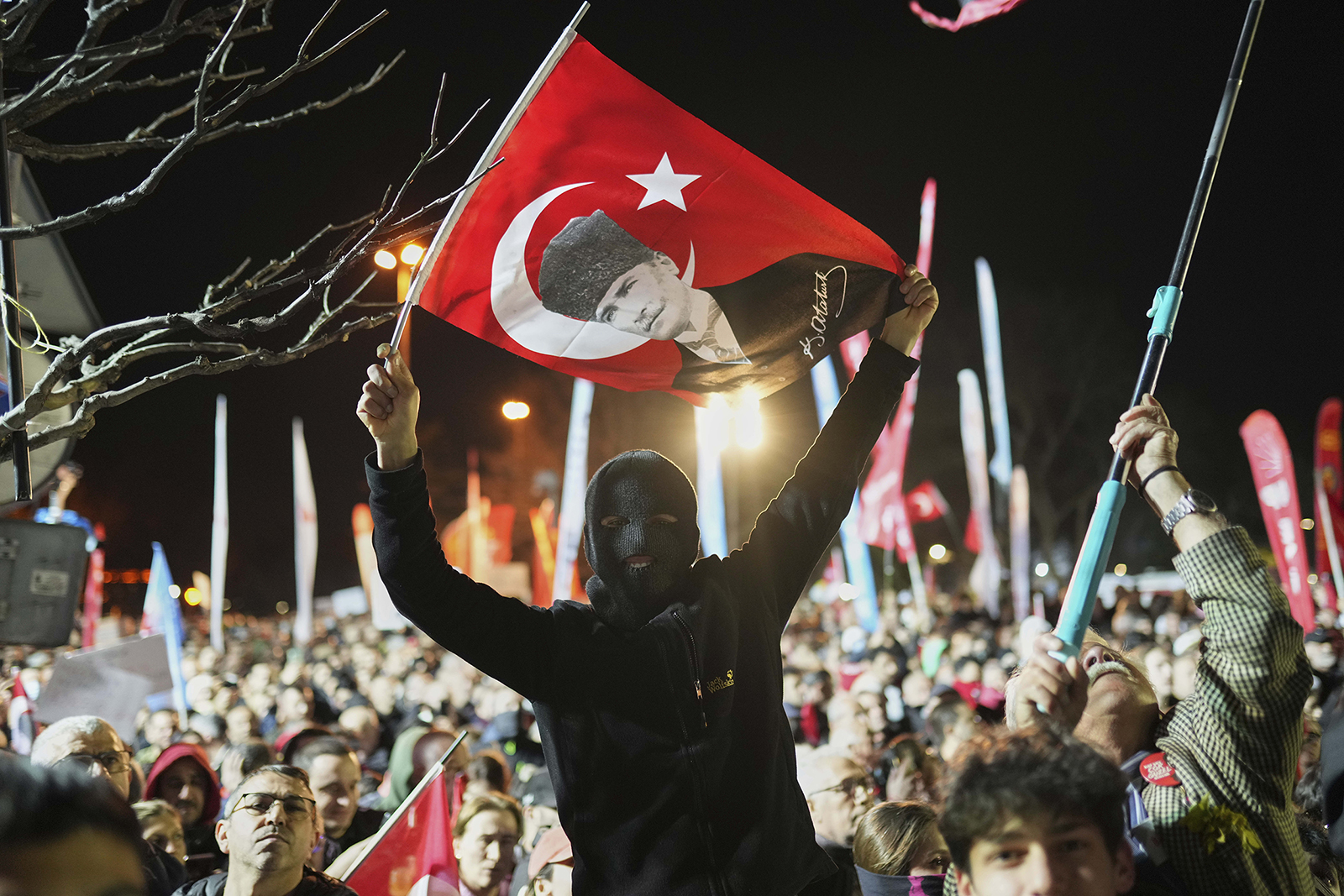
Protesters were to join a mass rally in Istanbul Saturday at the call of Turkey’s main opposition CHP over the jailing of the city’s mayor Ekrem Imamoglu, a top figure in the party whose arrest has sparked 10 days of the country’s biggest street demonstrations in a decade.

Imamoglu’s detention on March 19 has also prompted a repressive government response that has been sharply condemned by rights groups and drawn criticism from abroad.

The rally, which begins at 0900 GMT in Maltepe on the Asian side of Istanbul, is the first such CHP-led gathering since Tuesday and comes on the eve of the Eid al-Fitr celebration marking the end of Ramadan, which starts Sunday.

Widely seen as the only Turkish politician capable of challenging President Recep Tayyip Erdogan at the ballot box, Imamoglu was elected as the CHP’s candidate for the 2028 presidential race on the day he was jailed.

“Imamoglu’s candidacy for president is the beginning of a journey that will guarantee justice and the nation’s sovereignty. Let’s go to Maltepe.. and start our march to power together!” CHP leader Ozgur Ozel said on X.

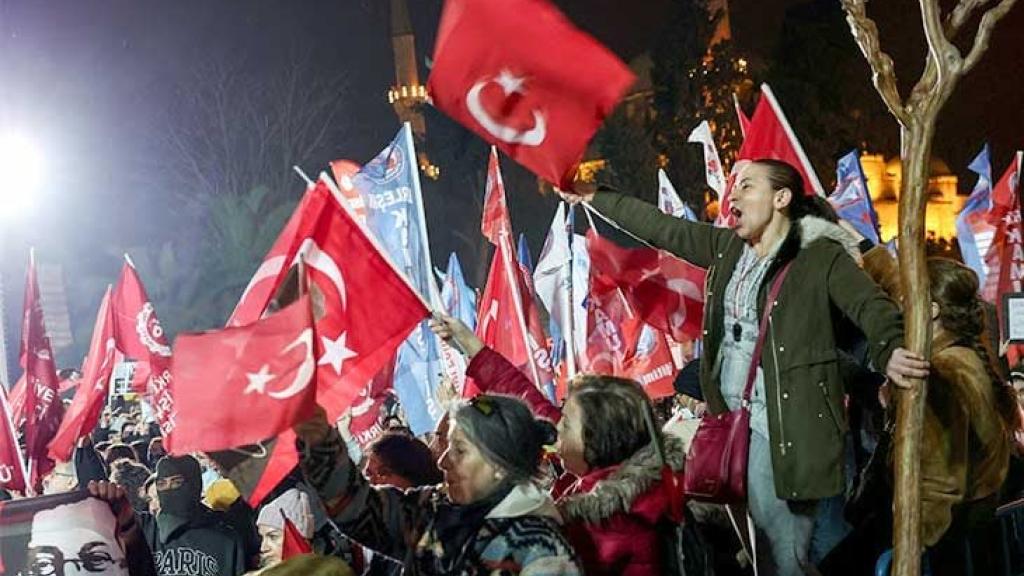
The protests over his arrest quickly spread across Turkey, with vast crowds joining mass nightly rallies outside Istanbul City Hall called by the CHP, that often degenerated into running battles with riot police.

Although the last such rally was Tuesday, student groups have kept up their own protests, most of them masked despite a police crackdown that has seen nearly 2,000 people arrested.

Among them were 20 minors who were arrested between March 22-25, of whom seven remained in custody, the Istanbul Bar Association said Friday.

In Istanbul, at least 511 students were detained, many in predawn raids, of whom 275 were jailed, lawyer Ferhat Guzel told AFP, while admitting that the number was “probably much higher”.

The authorities have also cracked down on media coverage, arresting 13 Turkish journalists in five days, deporting a BBC correspondent and arresting a Swedish reporter who flew into Istanbul to cover the unrest.

Although 11 journalists were freed Thursday, among them AFP photographer Yasin Akgul, two more were detained on Friday as was Imamoglu’s lawyer Mehmet Pehlivan, who was later granted conditional release.

Swedish journalist Joakim Medin, who flew into Turkey on Thursday to cover the demonstrations, was jailed on Friday, his employer Dagens ETC told AFP, saying it was not immediately clear what the charges were.

– ‘Accusations 100 percent false’ –


Unconfirmed reports in the Turkish media said Medin was being held for “insulting the president” and belonging to a “terror organisation”.

“I know that these accusations are false, 100 percent false,” Dagens ETC’s editor-in-chief Andreas Gustavsson wrote on X account.

In a post on social media, Swedish Foreign Minister Maria Malmer Stenergard said Stockholm was taking his arrest “seriously”.

Turkish authorities held BBC journalist Mark Lowen for 17 hours on Wednesday before deporting him on the grounds he posed “a threat to public order”, the broadcaster said.

Turkey’s communications directorate put his deportation down to “a lack of accreditation”.

Baris Altintas, co-director of MLSA, the legal NGO helping many of the detainees, told AFP the authorities “seem to be very determined on limiting coverage of the protests.

“As such, we fear that the crackdown on the press will not only continue but also increase.”

burs-hmw/ach


Opinion

Turkey's president arrested his top opponent. Here's why it matters to the beleaguered free world.

(RNS) — Erdoğan's arrest of the Istanbul mayor is aimed at quelling an increasingly vocal political opposition. But Ekrem İmamoğlu is also indispensable to the Turkish president as a symbol of religious toleration — and a foil to Erdoğan's Islamist ideal.


Demonstrators shout slogans during a protest after Istanbul's Mayor Ekrem İmamoğlu was arrested and sent to prison, in Istanbul, Turkey, Tuesday, March 25, 2025. (AP Photo/Francisco Seco)


Katherine Kelaidis
March 28, 2025

(RNS) — Earlier this month, the now-former mayor of Istanbul, Ekrem İmamoğlu, was arrested on corruption charges along with 100 other opposition leaders. The arrests have provoked massive demonstrations across the country, not least because many Turks believe the arrests are a thinly veiled crackdown by Turkish strongman President Recep Tayyip Erdoğan on the increasingly popular opposition as a 2028 general election approaches. İmamoğlu is by far the most prominent of those opposition figures.

The conflict in Turkey in many ways mirrors the domestic tensions playing out in many parts of the world, as the rising tide of authoritarianism does battle against the liberal world order. Turkey’s history and geopolitical position makes its post-postmodern struggle unique, but also of wider concern. With the fate of religious pluralism in the Balkans and (one might argue) the very survival of Christianity in the Middle East in question, the outcome of Turkey’s political conflict is important for most anyone west of Moscow.

For nearly a century after Mustafa Kemal Atatürk invented the modern Turkish state, Turkey was not just secular, but aggressively secular. One of the “six arrows” of Kemalist ideology was the stringently areligious civic life the French call laïcité. If anything Turkey’s version outdid that of France, particularly in its anti-clericalism. The Kemalist consensus began to crumble at the end of the 20th century, however, and the election of Erdoğan to the presidency in 2014 (after 11 years as prime minister) marked what many believed would be the end of its dominance in Turkey.

RELATED: Authoritarian movements depend on political religions — not least in America

This was due in part to Erdoğan’s purported moderate Islamist leanings. In fact, like many budding strongmen of our era, Erdoğan exhibits no particular ideology beyond his own power, but he did recognize the growing power of Islamist factions in the country and has curried favor with them. In 2020, for instance, he oversaw the reconversion of the Hagia Sophia into a mosque after its 85 years as a museum.

Modern Islamism and the Ottoman past have also shaped Erdoğan’s foreign policy and soft power strategy. Turkey has funded the building of mosques throughout the Balkans and eastern Mediterranean, including the new Turkish-funded Namazgah Mosque that Erdoğan personally inaugurated in Tirana, Albania, last year, and the massive Ottoman-style mosque in the disputed territory of Northern Cyprus completed in 2018. From Syria to Gaza to Kosovo, Erdoğan has sought to position Turkey as an explicitly Muslim state and himself as the leader of the Muslim world.

The effects for Turkey’s religious minority communities — most notably its significant Christian community — has been devastating. Turkey regularly appears on human rights watch lists, often for violations of religious freedom.

The opposition has seized on this human rights record. The Republican People’s Party, the oldest political party in Turkey, founded by Kemal Atatürk himself, still holds onto its founder’s radical laïcité. İmamoğlu has been so vocal in his support of Istanbul’s Greek Orthodox minority that Erdoğan attacked him in a 2019 speech as a “crypto Greek” and his supporters as Greeks “disguised as Muslims.” An Erdoğan deputy has said there are “many questions” about İmamoğlu’s ethnic and religious identity.

İmamoğlu’s response to these attacks reflect his own commitment to pluralism and the Kemalist tradition, telling The Times, “If I were of Greek origin, I wouldn’t mind to say so… I also condemn people who think they are degrading someone by calling them Greek.”

RELATED: Why are American evangelicals not backing their counterparts in Ukraine?

But the fact that such a response was even necessary highlights what is at stake for Turkey’s religious and ethnic minorities and for the future of religious freedom. Erdoğan still envisions Turkey as a place that has no room for non-Muslim Turks, precisely because his personal opportunities rest on the existence of the quintessential “other” — and for the Ottomanist, that other is still, as it has been for centuries, the Greek.

If Erdoğan is allowed to triumph in his battle against the more tolerant İmamoğlu, the fate of Turkey’s minority groups will inevitably be a darker one. Its dwindling Christian community is watching closely as Ottamanist rhetoric and Islamic policies put them directly in the crossfire. The world must wait to see if the Turkey that emerges from this conflict is Atatürk’s pluralist and secular dream or an Ottoman-inspired authoritarian and nationalist nightmare.

(Katherine Kelaidis, a research associate at the Institute of Orthodox Christian Studies in Cambridge, England, is the author of “Holy Russia? Holy War?” and the forthcoming “The Fourth Reformation.” The views expressed in this commentary do not necessarily reflect those of RNS.)

Turkey and the neofascist contagion


Published 

Turkey rally

First published in Arabic at Al-Quds al-Arabi. Translation from Gilbert Achcar's blog.

The events unfolding in Turkey since last Wednesday are extremely serious: they constitute a new and very dangerous step in the country’s slide towards the suffocation of democracy. The arrest of Ekrem Imamoglu  the popular mayor of Istanbul and candidate of his party, the Republican People’s Party (CHP), to the next presidential election scheduled for 2028  and the detention of nearly 100 of his collaborators in the municipality of Turkey’s largest city, on charges that combine corruption (the Turkish judiciary should have better investigated corruption in Erdogan’s entourage, starting with his son-in-law) and links to “terrorism”, i.e., contact with the Kurdistan Workers’ Party, PKK (at a time when the government is negotiating with this party for a peaceful settlement), is behaviour straight out of the familiar playbook of dictatorships. 

If anyone had any doubt that the charges were fabricated and that the intent was to eliminate the strongest opposition figure to the rule of Recep Tayyip Erdogan, who seems determined to rule his country for life like other autocratic rulers, Istanbul University’s decision to invalidate Imamoglu’s degree on the eve of his arrest leaves no room for doubt. A university degree is one of the requirements for running for president in Turkey, and the university’s decision was based on a completely flimsy pretext, especially since Imamoglu received his degree thirty years ago!

Almost a year ago, in the aftermath of the last municipal elections in Turkey, I recalled Erdogan’s role in establishing democracy in his country during the first decade of his rule. Despite his subsequent autocratic drift, including by dismissing those leaders of his party whom he perceived as rivals, I praised his acknowledgement of his party’s defeat in the municipal elections, which distinguished him from several neofascists who do not accept defeat, including Donald Trump who tried to overthrow the electoral process that took place in the autumn of 2020, and still refuses to acknowledge his loss, claiming that the presidency was stolen from him (“Two Valuable Lessons from the Turkish Elections”, 2 April 2024, in Arabic only). 

The moral of this story is that the same man who began his political career with a courageous struggle against a dictatorial regime, and who, during his tenure as mayor of Istanbul, suffered what is very similar to what he is now inflicting on his opponent, the current mayor  this man, who played a commendable role in establishing democracy in his country, has been led by the intoxication of power and the enjoyment of a great popularity, to desire to perpetuate this condition, even if by imposing it coercively at the expense of democracy. And yet, until last year, Erdogan did not cross the qualitative red line separating the preservation of a margin of freedom that allows democracy to survive, albeit with increasing difficulty, and encroaching upon this margin in a dictatorial manner.

This was despite the fact that Erdogan exhibits some neofascist characteristics, by relying on an “aggressive, militant mobilization of [his] popular base” on an ideological ground that incorporates some of the key components of far-right ideology, including nationalist and ethnic fanaticism against the Kurds (in particular), sexism, and hostility, in the name of religion or otherwise, to various liberal values (see “The Age of Neo-Fascism and Its Distinctive Features”, 4 February 2025). His current drift suggests that he is now completing his adherence to the ranks of neofascist regimes with regard to their stance on democracy. In the aforementioned article, I described this stance as follows: “Neofascism claims to respect the basic rules of democracy instead of establishing a naked dictatorship as its predecessor did, even when it empties democracy of its content by eroding actual political freedoms to varying degrees, depending on the true level of popularity of each neofascist ruler (and thus his need or not to rig elections) and the balance of power between him and his opponents.” 

There are two main factors behind Erdogan’s drift towards neofascism. The first is that the neofascist temptation increases whenever an authoritarian ruler faces rising opposition and fears losing power by way of democracy. Vladimir Putin provides an example of this in that his drift intensified when he faced rising popular opposition upon his return to the presidency in 2012 (after a charade of transferring to the prime ministership in compliance with the constitution, which at the time prohibited more than two consecutive presidential terms). At the same time, Putin resorted to inciting nationalist sentiment towards Ukraine (in particular), just as Erdogan later did towards the Kurds. 

The second, and crucial, factor is the rise of neofascism to power in the United States, represented by Donald Trump. This has provided a powerful incentive for the strengthening of various forms of actual or latent neofascism, as we clearly see in Israel, Hungary and Serbia, for example, and as we will increasingly witness globally. The strength of the neofascist contagion is proportional to the strength of the main neofascist pole: the fascist contagion was greatly strengthened, particularly on the European continent, when Nazi Germany’s power went on the rise in the 1930s. The neofascist contagion has become even stronger today, with the United States shifting from a role of deterrent to the erosion of democracy, albeit within obvious limits, to encouraging this erosion, directly or indirectly. The erosion is already underway and accelerating within the United States itself. 

It is thus no coincidence that Erdogan’s attack on the opposition began following a phone call between him and Trump, which Steve Witkoff, Trump’s close friend and envoy to various negotiations, described last Friday as “great” and “really transformational”. Witkoff added that “President [Trump] has a relationship with Erdogan and that’s going to be important. And there’s some good coming  just a lot of good, positive news coming out of Turkey right now as a result of that conversation. So I think you’ll see that in the reporting in the coming days.” (Witkoff’s statement was made two days after Imamoglu’s arrest, even if he was not necessarily referring to that arrest.) Moreover, Erdogan believed he has succeeded in neutralizing the Kurdish movement through recent compromises, which were blessed by his allies of the Turkish nationalist far right themselves (he was proved wrong: the Kurdish movement came out in support of the opposition and the popular protest). He also believes that the Europeans need him, and his military potential in particular, at this critical juncture for them, so that they would not exert any real pressure on him. 

What remains a source of hope in the Turkish case is that Erdogan is facing a popular backlash far beyond what he apparently anticipated. This mass backlash is far greater than what Putin faced in Russia, where the popular movement was atrophied after decades of totalitarian rule. It is far greater than what most of the pioneers of neofascism have been confronted with, including Trump, who has met only very weak opposition from the Democratic Party since his second election. Erdogan is attempting to quash the popular movement by escalating repression (the number of detainees is approaching 1,500 in a country with a prison population of 400,000, including a high percentage of political prisoners and many journalists) at the expense of Turkey’s security, stability, and economy (the Central Bank was forced to spend $14 billion to avoid a complete collapse of the Turkish lira, and the stock market has experienced a sharp decline). 

The ongoing battle in Turkey has become increasingly significant for the entire world. Either Erdogan succeeds in eliminating the opposition, which could require a bloody crackdown similar to Bashar al-Assad’s suppression of the Syrian popular uprising in 2011, thus risking the country’s slide into civil war, or the popular movement will prevail, causing him to backtrack or fall one way or another. If the Turkish popular movement wins, its victory will have a significant impact in galvanizing resistance to the rise of neofascism worldwide.


Turkey: Defend democracy and the rule of law!

MARCH 27, 2025

By Fatma Nur Yoğuran

The cancellation of the diploma of Istanbul Metropolitan Municipality Mayor Ekrem İmamoğlu and his subsequent detention have had a wide repercussion on the public and have led to widespread protests across Turkey. This has created a strong social demand that the principles of democracy and the rule of law must be protected.

Ekrem İmamoğlu is the elected Mayor of Istanbul and a key figure in Turkey’s democratic opposition, who rose to prominence after winning the 2019 municipal elections, defeating the ruling party’s candidate twice, despite significant pressure and interference.

On 19th March 2025, İmamoğlu and over 100 associates were detained by Turkish authorities. His detention is another clear sign of Erdoğan’s deepening autocracy. The Turkish government is silencing opposition voices and dismantling democratic institutions step by step. İmamoğlu represents millions who demand change, justice, and democracy. His arrest is not just about one man — it is about the right of an entire nation to be heard.

“These allegations are politically motivated and baseless,” İmamoğlu’s Legal Team have stated. Critics view the arrest as an attempt to eliminate political rivals ahead of the 2028 elections.

In light of these developments, the Republican People’s Party (CHP) has announced that it will hold a widely attended rally in Maltepe, Istanbul, on Saturday, March 29th, at 12:00. The rally aims to defend democracy, support Ekrem İmamoğlu and increase social awareness against the recent negative action. Attending this rally is a significant opportunity to demonstrate your commitment to democracy and the rule of law, strengthen social solidarity, and make your voice heard against the negativities that are being experienced. Everyone’s contribution is valuable towards Türkiye becoming a more just and democratic country.

London Protest Against Erdoğan’s Autocracy: Stand with Ekrem İmamoğlu

Join us this Saturday at 10 Downing Street at 4pm to protest the unjust arrest of Ekrem İmamoğlu.

Why does this matter?

  • Judicial independence is under threat.
  • Voters will is being silenced.
  • Democratic institutions are at risk.

The case against İmamoğlu is not just about one man—it is about the future of democracy in Turkey.

We, as members and supporters of the Republican People’s Party (CHP) and the Workers’ Party of Turkey (TİP) in the UK, invite everyone to stand in solidarity with those resisting oppression in Turkey. Let’s raise our voices together!

 Fatma Nur Yoğuran is CHP England Youth Leader.

Labour News Network report: Ismet Aslan released – Trade unionism is not a crime!

Trade unionist Ismet Aslan has been released after six months in prison. The trial will continue, but Ismet will not remain in detention.

Ismet was arrested on October 7th, 2024, along with fellow unionists Giyasettin Yiğit and Yusuf Eminoğlu, charged under Turkey’s anti-terror law, often used against unions and activists. In court, he stated, “I am not a criminal. I am a trade unionist,” explaining his actions as part of his union duties.

A LabourStart campaign helped raise global awareness, with nearly 5,000 supporters showing the power of international solidarity. The next hearing is on July 10th, 2025. We thank everyone who supported the campaign—your solidarity made a difference.

Contact your MP to condemn what has been happening in Turkiye. At a time of  creeping dictatorship internationally, demand the UK government stand up and take action in support of democracy and the rule of law globally!

Image: University students sit beside anti-riot police during a protest in Istanbul after Mayor Ekrem Imamoglu’s arrest and imprisonment. (AP pic) https://www.freemalaysiatoday.com/category/highlight/2025/03/25/crackdown-on-opposition-tips-turkey-into-financial-turbulence/ Licence: Attribution 4.0 International CC BY 4.0 Deed


Turkey: a mass movement builds against Erdogan’s power grab


Monday 24 March 2025, by Antoine LarracheUraz Aydin


Uraz Aydin answers questions from Antoine Larrache about the mobilization currently building in Turkey after the arrest of the mayor of Istanbul, who is seen as Erdogan’s main rival in the race for the next presidential election.


Can you tell us about the arrest of the mayor of Istanbul?

On the morning of March 19, Ekrem Imamoğlu, the mayor of Istanbul, was taken into custody along with around a hundred other mayoral staff on charges of “corruption” and “connection with terrorism”. The day before, his university degree (obtained 30 years ago) was arbitrarily annulled, with the obvious aim of preventing his candidacy in the next presidential election. Ekrem Imamoğlu, having twice won Istanbul’s municipal elections - in 2019 and 2024 - as a candidate for the CHP (Republican People’s Party, secular center-left), has established himself over time as Erdogan’s main opponent.

On March 23, the CHP was due to hold its “pre-elections” to decide on its candidate for the next ballot, normally scheduled for 2028 but most likely to take place earlier, to allow Erdogan to run one last time. Unless there is a constitutional change, which is also under discussion. The aim of this operation is therefore very clear: to render the main opposition candidate ineligible, criminalize his management of Istanbul’s mayoralty and perhaps even appoint an administrator in place of the elected mayor, as has been happening for several years in the municipalities of Kurdistan, in south-west Turkey.

Can you describe the mobilization in the face of this?

Today is the third day of mobilizations. Every day, the CHP calls for rallies in front of Istanbul City Hall. Tens of thousands of people are taking part. Of course, in addition to CHP members and supporters, all sectors of the opposition are mobilizing, including the radical left, against what has come to be known as the “March 19 coup”.

It’s worth remembering that the country has been living in an atmosphere of permanent repression since the Gezi revolt in 2013. The end of negotiations with the Kurdish movement, the remilitarization of the Kurdish question and the resumption of the war, the attempted coup d’état carried out by Erdogan’s former allies and the state of emergency decreed in its wake, the ban on strikes and the repression of the feminist and LGBTI+ movements are the main milestones in the development of authoritarianism articulated to the construction of an autocratic regime led by Erdogan. We are therefore in a country where mobilizations are rare, where the reflex to protest in the street has become quite unusual and risky for ordinary citizens. But despite this and the ban on rallies in Istanbul, there are major mobilizations and, above all, a spirit of protest that can be felt on the streets, in the workplace, on public transport, and so on.

On the second evening, in many parts of Istanbul and dozens of other cities, citizens came out to protest, with the main slogans “Government resign!”, “Down with the AKP dictatorship!”, “No individual liberation! All together or none of us”.

What is the scale of the mobilization among young people?

Precisely the most important and surprising element is the mobilization of university students. Universities have been depoliticized for years, radical left-wing movements are weak and their capacity for action is drastically reduced. So the current generation of students, while probably having grown up with stories of the Gezi revolt told by their parents, has almost no experience of organizing and mobilizing. This is true even of young revolutionary activists, who have not even had the opportunity to “do their job” in universities.

But despite this, through an “electric jolt” as Rosa Luxembourg1 used to say, a spontaneous radicalism is awakening in the universities. There are, of course, many social-economic (objective) and cultural-ideological (subjective) factors that come together to forge this mobilization. We’ll have to think about that later. But the fact that in a country that is becoming poorer, where it is difficult to find work, that offers no “promise of happiness” to young people, where years of study mean almost nothing on the job market, the fact that a diploma can be cancelled with a simple government pressure on the university is also an element that has probably contributed to achieving this jolt, in a sector of youth that was more or less predisposed to it.

What impact is this student radicalization having on the protests?

I think it’s shaking things up, and forcing the CHP to break out of its pre-constructed opposition patterns. As I said, CHP president Özgür Özel has called for a rally outside Istanbul town hall. But it has to be said that no serious preparations had been made to accommodate tens of thousands of people. The main objective was to call on citizens to vote in the pre-elections on March 23 and thus demonstrate Imamoğlu’s legitimacy against the regime, but also to continue the “fight” at the judicial level, by appealing, etc

Faced with this, the slogans most chanted by young people (who made up the majority of rallies in front of the mayor’s office) were “liberation is in the streets, not in the ballot box” or “resistance is in the streets, not in the ballot box”. Faced with this pressure from young people, who succeeded on several occasions in breaking down police barriers in front of universities, who marched en masse in Ankara to ODTÜ University and clashed with the CRS, who forced the police to send riot intervention vehicles to the universities (notably in Izmir), who refused to disperse at the end of official CHP rallies and wanted to march to Taksim (the historic symbolic site of resistance since the May 1st 1977 massacre to the Gezi uprising), the CHP leadership had to give in. Özgür Özel called on the people to “storm the squares”. “If obstacles are erected in front of us on the basis of an order contrary to the law, overthrow them, without hurting the police,” he added. Which is quite exceptional. Özel also agreed to install a second stand at Saraçhane, for the students.

How can we link this situation with what’s happening in Kurdistan, with the peace “process”?

It’s a very contradictory process, but one we’ve already experienced. Let’s not forget that during the Gezi uprising in 2013, when the west of the country was going up in flames, there were negotiations with Abdullah Öcalan, leader of the PKK. And of course, while the radical opposition to the regime usually came from the Kurdish regions, or from the Kurdish movement, this time their participation is naturally more limited. However, we saw that these two dynamics of contestation had converged in the candidacy of Selahattin Demirtaş, of the left-wing pro-Kurdish HDP party in the 2015 elections.

Today, while once again there is a process of “peace” according to the Kurds, of “disarmament” according to the regime (a facet of which can also be seen in the agreements initiated between Rojava and the new Syrian regime), the Turkish state is conducting a campaign of violent repression against the secular bourgeois opposition, journalists... but also against elements of the Kurdish movement. For the Kurds, the regime wants to show (above all to its own social and electoral base) that it still has its iron fist within its grasp, and that there is no question of negotiation but of “putting an end to terrorism”. As for the imprisonment of Imamoglu and other CHP mayors, if one of the charges is corruption, the other is links with or support for terrorism, since the CHP had forged an informal alliance with the Kurdish movement party in the 2024 municipal elections under the name of “urban consensus”.

Another surprising fact is that all demonstrations and gatherings in Istanbul have been banned except for Newroz, a festival celebrating the arrival of spring in the Middle East and the Caucasus, but which has acquired political-national significance for the Kurdish movement over several decades. So it could be said that Erdogan’s regime is trying to take another, decisive step in the construction of its regime, to reinforce its neo-fascist character by subduing the two biggest “chunks”, the secular bourgeois opposition represented by the CHP/Imamoglu and the Kurdish movement.

In the case of the former, by criminalizing it, imprisoning its representatives, perhaps forcing it to change its leadership and candidate, and finally destroying all legitimacy of the elections. As for the Kurdish movement, the regime will probably try to “de-radicalize” it, making it an ally at national and regional level (Syria, Iraq) in the hope that, in exchange for a few gains (of which no details are known at present), the movement will abandon its fight for the democratization of the entire country and guarantee a more peaceful existence with the regime. For the time being, the Dem Party (formerly HDP) has announced that it strongly opposes this “civil putsch” against Imamoglu and the other elected representatives, and that it is calling on the opposition forces to protest together at the Newroz rally on March 23.

Of course, we can’t anticipate the outcome of Erdogan’s two-pronged strategy, but as the Italian Marxist Antonio Gramsci once said, only the struggle can be foreseen

March 21 2025

P.S.


If you like this article or have found it useful, please consider donating towards the work of International Viewpoint. Simply follow this link: Donate then enter an amount of your choice. One-off donations are very welcome. But regular donations by standing order are also vital to our continuing functioning. See the last paragraph of this article for our bank account details and take out a standing order. Thanks.

Attached documentsturkey-a-mass-movement-builds-against-erdogan-s-power-grab_a8916.pdf (PDF - 899.5 KiB)
Extraction PDF [->article8916]

Turkey
Turkey and the Neofascist Contagion
Turkish people will not accept the death sentence for their democracy
Kurdistan: ‘Turkey must choose between the status quo, endless war and peace with the Kurds’.
The Turkish State and the Kurdish Question: Contradictions and fragilities of a new hope
Sudan: Towards peace for warlords?

Antoine Larrache

Antoine Larrache is editor of Inprecor and a member of the leadership of the Fourth International

Uraz Aydin

* Uraz Aydin is the editor of Yeniyol, the review of the Turkish section of the Fourth International, and one of many academics dismissed for having signed a petition in favour of peace with the Kurdish people, in the context of the state of emergency decreed after the attempted coup in 2016.

International Viewpoint is published under the responsibility of the Bureau of the Fourth International. Signed articles do not necessarily reflect editorial policy. Articles can be reprinted with acknowledgement, and a live link if possible.


English fuel poverty figures highlight failure to tackle energy bills crisis


MARCH 28,2025

The Government has published the latest English fuel poverty figures for 2024. They show that in 2024, there were an estimated 11.0% of households – 2.73 million – in fuel poverty in England under the Low Income Low Energy Efficiency (LILEE) metric. 

More older households in fuel poverty

Among households where the oldest resident is aged over 75, there has been a slight increase in the numbers in fuel poverty (10.1% in 2024 up from 9.7%).

The average fuel poverty gap for England in 2024 (the reduction in energy costs needed for a household to not be in fuel poverty) was estimated at £407.

The data also shows the number of households who are required to spend more than 10% of their income (after housing costs) on domestic energy.  In 2024, 36.3% of households (8.99 million) exceeded this threshold, up from 35.5% in 2023 (8.73 million). 

Jonathan Bean from Fuel Poverty Action, commented: “The latest Government fuel poverty statistics expose the complete failure of Government and Ofgem to tackle the energy affordability and fuel poverty crisis.

“A shocking 36.3% of households in England are unable to afford the inflated energy prices we are forced to pay due to a rigged energy market and obscene profits. Many of us are forced to survive the winter huddled under blankets and go without hot water.

“The Government tries to hide the extent of fuel poverty by excluding the millions of us on low incomes struggling with high energy prices based on an often flawed Energy Performance Certificate rating.  But even using its own distorted figures, the Government has failed to address fuel poverty, and is expecting it to actually rise next year.”

Simon Francis, coordinator of the End Fuel Poverty Coalition, commented: “The measure which is most sensitive to the rising cost of living is creeping up. This shows just how devastating the ongoing cost of living crisis is and what a mistake it was for the Chancellor to axe Winter Fuel Payments.

“It is now high time that the Chancellor finally commits in full to the £13.2bn Warm Homes Plan promised in the Labour Manifesto. This will ensure that millions of people can stay warm every winter. 

“But given that energy bills continue to rise – and even the Office of Budget Responsibility has said that increases in gas prices are harming the economy – the Government must go further. The Chancellor must provide help to those struggling in fuel poverty now, not continue with cuts in vital support to older and disabled people.

“We need a government willing to invest in the solutions to the cost of living crisis – and the future of the country.”

Progress has “flatlined”

Dr Matthew Scott, Senior Policy Officer at the Chartered Institute of Housing, said:
“Everyone should be able to live in a safe, warm home. However, the latest fuel poverty statistics published this morning show that progress essentially flatlined in the final years of the previous Government.

“Through its Warm Homes Plan and updated fuel poverty strategy, the new Government has an unmissable opportunity to reverse this trend. By building on its welcome investment into the Social Housing Fund and Local Grant programmes, the Government can reduce energy bills and improve the health and wellbeing of millions of people before the end of the decade.

“CIH continues to call for the government to allocate the full £13.2 billion to its Warm Homes Plan in the forthcoming spending review, utilising the expertise and experience of social housing providers as key delivery partners.”

Jonathan Bean added: “Government energy efficiency schemes are failing badly as they have only  taken only 0.2% of households out of fuel poverty, even if changes to the Warm Home Discount Scheme are included.  At this rate it will take until 2070 to hit the Government’s 2030 Fuel Poverty Target.   

“One reason for the failure of retrofit schemes is that they have not focussed on the homes with the highest fuel poverty incidence, conversion flats (18.8%).  Instead schemes are biased towards those in detached houses, who have the lowest fuel poverty incidence (7.3%).  A totally new retrofit strategy is needed if the Government is serious about tackling fuel poverty.  

“Electric-only households have double the rate (20.7%) of fuel poverty than gas (10.0%) which highlights the urgency of bringing down inflated electricity prices that are currently quadruple the price of gas.” 

Ofgem’s “cruel tariffs”

Earlier this month, the End Fuel Poverty Coalition was among the charities and consumer groups that warned that Ofgem’s proposals for standing charge reform could see many households end up worse off if they accept one of the proposed tariffs. 

In a submission to the official consultation on the issue,  the Coalition described how consumers would only need to use half of the “typical domestic consumption values” before their bills increased if on a “zero standing charge” tariff.

It argued that the proposals did not move costs away from energy bills and simply “rearranged the deckchairs”, that they presented a flawed version of rising block tariff for consideration and did not contain wider proposals for reform previously put forward.

The National Pensioners Convention also warned the Ofgem consultation on standing charges that their proposals for reform were ‘not good enough’ and that these cruel tariffs should be scrapped.

In its letter of submission before the consultation closed this month, it also told the industry regulator of its disappointment that it has made no effort to reduce energy firms’ inflated, multi-billion pound profits.

Profits up

This week, Ithaca was the latest company to announce what Warm This Winter spokesperson Caroline Simpson called “obscene profits”. She added: “What makes it worse is that Ithaca is holding the UK back by making millions in North Sea drilling while investing nothing in UK renewable energy.

Polling shows time and again UK bill payers don’t want ‘drill baby drill’ they want clean power that also gives us much needed energy security. That is why it is crucial as a country we continue to ramp up our production of homegrown, renewable energy which is abundantly available and the quickest form of power generation to get up and running. And we need to stop the oil and gas profiteers who use the UK bill payers as a cash machine.”

Image: https://www.flickr.com/photos/cj_collective/6992454230 climatejusticecollective Licence: Attribution 2.0 Generic Deed CC BY 2.0