Sunday, March 30, 2025

 SPAGYRIC HERBALISM

Studies evaluate the health effects of bioactive compounds obtained from plants


Researchers from Brazil and Germany study the mechanism of action of phytochemicals from papaya, passion fruit and medicinal plant extracts; results were presented at FAPESP Week Germany.


Meeting Announcement

Fundação de Amparo à Pesquisa do Estado de São Paulo

Studies evaluate the health effects of bioactive compounds obtained from plants 

image: 

The table was attended by Bernadette de Melo Franco, Hans-Ulrich Humpf, Ulrich Dobrint, João Paulo Fabi and Peter Eisner 

view more 

Credit: Elton Alisson/Agência FAPESP


Fruits and plant extracts contain bioactive compounds that can help treat or prevent diseases. To characterize and understand their mechanism of action, researchers from universities and research institutions in Brazil and Germany have conducted independent but complementary studies.

Some of the results were presented at a lecture session on the future of food and nutrition research on March 25th during FAPESP Week Germany at the Free University of Berlin.

According to Ulrich Dobrindt, a professor at the University of Munich in Germany, medicinal plants contain different types of phytochemicals (natural chemical substances) that neutralize bacterial infections in different ways, thereby boosting the host’s defenses. For this reason, there is growing interest in using extracts from these plants to treat and prevent urinary tract infections, one of the most common infections worldwide, which are currently treated with antibiotics.

“Although their anti-inflammatory, antipyretic and analgesic effects are well known, the active compounds of these plants – such as flavonoids, alkaloids and terpenoids – and their mechanisms of action on pathogen cells have yet to be characterized. Some are antibacterial, but many don’t have this effect,” said the researcher.

In order to further their understanding, German scientists have developed infection models to study the effects of plant extracts on the innate immune response and on the epigenetic regulation of gene expression (biochemical processes that activate and deactivate genes). In bladder cells, for example, they are studying the effect of traditional plants with urological activity, according to the German pharmacopoeia.

In collaboration with researchers at the Federal University of Minas Gerais (UFMG) in Brazil, it was found that some aqueous plant extracts (from species such as Solidago gigantea and Equiseti herba) significantly reduced the adhesion and survival of Escherichia coli in human bladder epithelial cells.

“We observed a drastic reduction in the adhesion and proliferation of this bacterium in bladder cells,” said Ulrich.

Fruit fibers

In Brazil, a group associated with the Food Research Center (FoRC) – one of FAPESP’s Research, Innovation and Dissemination Centers (RIDCs) – has focused on the technological prospection and evaluation of the biological effects on humans of non-digestible water-soluble polysaccharides (bioactive polysaccharides), such as pectins.

Found in papaya, passion fruit and citrus fruits, pectins make up a large portion of the fiber in these fruits and have been linked to a reduction in chronic non-communicable diseases.

However, some of the challenges in extracting these compounds from fruits such as papaya are that they ripen very quickly, resulting in softening of the pulp and chemical modification of the structures of its pectins, which are linked to biological effects such as modulation of the gut microbiota.

“During fruit ripening, enzymes are expressed that modify the structure of the pectins, reducing their beneficial biological effects. Passion fruit and citrus pectins, on the other hand, must be chemically modified in order to present beneficial activities in the intestine,” João Paulo Fabi, professor at the School of Pharmaceutical Sciences of the University of São Paulo (FCF-USP) and coordinator of the project, told Agência FAPESP.

To do this, the Brazilian researchers developed techniques to extract pectin from the albedo of oranges and passion fruit – the white part between the peel and the pulp that is normally discarded when the fruit is processed to make juice – and to modify it in the laboratory to reduce its molecular complexity in order to increase its biological activity.

The development resulted in a patent for the process of extracting pectin from fleshy fruits such as papaya and chayote. A second patent covering the modification of pectin from passion fruit by-products is in the process of being filed.

“We already have a prototype for extracting and modifying these pectins on a laboratory scale. The idea is to obtain a product, such as a flour rich in modified pectin, that could be consumed as a supplement or food ingredient,” said Fabi.

In partnership with other groups, the researchers conducted animal studies to demonstrate the correlation between modified pectins and increased biological activity.

“These preclinical studies can serve as a basis for the development of clinical trials [with modified pectins] as adjuvants to chemotherapy treatment of colon cancer or even as beneficial modulators of the intestinal microbiota,” the researcher said.

More information about FAPESP Week Germany can be found at: fapesp.br/week/2025/germany.


Why scientists are worried about weasels


North Carolina State University
Weasel with mouse 

image: 

A weasel stands on a log carrying a mouse at night. Weasels are notoriously difficult to capture on camera, and researchers are working to find the best way to draw them out of hiding.

view more 

Credit: Courtesy of North Carolina State University


When monitoring the health of mammal populations, scientists often use camera traps to observe the animals in their habitats.  But weasels are so sneaky they’re rarely caught on camera – leaving scientists with questions about this population of predators.

“We’re a little worried about the weasels,” says Roland Kays, a research professor at North Carolina State University and scientist at the N.C. Museum of Natural Sciences. “We don’t see them very often, but it’s difficult to tell if they’re actually gone or if they’re just so sneaky that we can’t find them. We decided that we needed to better understand the best method to detect them. There wasn’t a great consensus on that.”

That problem is the focus of a new study by Kays and a host of collaborators, which examines what kind of bait is most effective at luring weasels out of hiding.

Between 2022 and 2023, researchers placed 486 camera traps in sites across the central and eastern United States where they knew weasels lived. They baited those traps with seven types of lures to see which ones attracted the most mustelids – a diverse family of carnivores that includes weasels, ferrets and martens.

Red meat outperformed all other baits, especially when supplemented with a bit of salmon oil. Weasels in the south also had a taste for chicken, Kays said. Because red meat is also attractive to most other predators, researchers used a new double-cage system to make it harder for larger animals to reach the bait.

“There is a huge variety of scent lures available, and trappers often make their own from all kinds of ingredients,” he said. “As it turns out, however, just having a chunk of meat works the best.”

Of all the weasel species to worry about, the “least weasel” is the most worrisome. As the world’s smallest carnivore, the least weasel is notoriously difficult to track down and has only been seen in a handful of camera trap surveys. Their range extends into the North Carolina mountains, and Kays hopes to use the findings from this study to survey least weasel populations there.

“Now that we have an understanding of the best ways to lure the weasels, we can be more confident in the findings of our surveys,” he said. “When we have sites where we don’t detect them, we can be much more assured that they aren’t just in hiding, they’re really just not there at all.”

The paper, “Efficacy of baits and lures for weasel detection” is available to read in the open-source journal Wildlife Society Bulletin. The study’s corresponding author is Scott M. Bergeson of Purdue University Fort Wayne. This project was partially funded through the Federal Aid in Wildlife Restoration Act 1937.

-pitchford-

Note to editors: The abstract of the paper follows.

“Observations on weasel bait efficacy during a nationwide camera trapping survey”

Authors: Scott M Bergeson, Purdue University, Roland Kays, North Carolina State University/North Carolina Museum of Life and Science, et al.

Published: March 27, 2025 in Wildlife Society Bulletin

DOI: 10.1002/wsb.1580

Abstract: Small mustelids are difficult to survey due to their low density and cryptic nature. Population status of North American weasels (Mustela ermineaMustela nivalis, and Neogale frenata) are believed to be in decline, but there are no standardized monitoring protocols to evaluate their status. To support weasel monitoring, we compared the attractiveness of various combinations of baits and lures to weasels in sites located throughout the eastern and central USA. We baited a total of 122 clusters of 4 camera traps, across 14 states, with random combinations of 4 baits and 3 scent lures in the winters of 2022 and 2023. Cameras baited with meat were 3.5 times more likely to detect both short- and long-tailed weasels on average (mean percentage of cameras detecting weasels: 20–30%) than those with scent lures (3–11%). Red meat was twice as effective at attracting short-tailed weasels (50%) as chicken or cat food (20%; Z = 2.49, p < 0.01). While red meat marginally increased detections of long-tailed weasels (21%) compared to chicken and cat food (19%), its effectiveness was influenced by whether the bait was stolen (Z = 2.08, p = 0.04). Additionally, long-tailed weasels were detected in half the time when raw chicken was used (median days to detection: red meat = 39.5 days, raw chicken = 14.5 days). When salmon oil was added to meat bait, it increased the likelihood of detecting short-tailed weasels and reduced the time to detection for both species. A variety of non-target species stole meat bait during the survey, making the camera traps less effective. The addition of salmon oil may have allowed for continual attraction of weasels until stolen meat bait could be replenished. In summary, red meat was the best all-purpose bait for weasels, although raw chicken is similarly effective for long-tailed weasels, and the addition of salmon oil is helpful. We also recommend a specific bait enclosure design that was the most effective at minimizing theft of bait. We propose our baiting strategy can be used as a survey standard to evaluate the distribution and population status of weasels.

Rallies grow in South Korea as court weighs president’s fate

By AFP
March 29, 2025


Supporters of impeached South Korean President Yoon Suk Yeol have rallied in capital Seoul for weeks - Copyright AFP Jung Yeon-je

Hundreds of thousands of South Koreans rallied for and against impeached President Yoon Suk Yeol on Saturday as protests grow while the country’s Constitutional Court weighs whether to dismiss him.

Yoon was impeached by lawmakers over his disastrous December 3 declaration of martial law, and the court last month held weeks of tense impeachment hearings to determine whether to officially remove him from office.

The wait has only emboldened rival camps to hit the streets in greater numbers every weekend.

On Saturday main streets through central Seoul were filled with protesters for and against Yoon carrying political signs and waving flags despite the cold weather.

“The people are overwhelmed with fatigue and frustration as… the ongoing crises remain unresolved,” said Lee Han-sol, 34, who was protesting for Yoon’s dismissal.

“The ongoing delays have led to a growing sense of scepticism.”

But Yoon supporters, whose members include right-wing YouTubers and religious figures, told AFP his impeachment trial is unlawful.

“The Constitutional Court won’t be able to ignore us. Look at us, there so many of us here,” said Lee Hye-sook, 58.

The Constitutional Court was given 180 days from the time it took on Yoon’s impeachment case to issue a ruling, meaning it has until June to decide his fate.

It has typically issued rulings within weeks for past presidential impeachment cases, but it has taken longer over Yoon’s case, without providing a reason.

At least six of the court’s eight justices must vote to remove Yoon.

But the wait has also given rise to a surge in speculation, with some suggesting the justices must be experiencing tense disagreements.

The former prosecutor was detained in a dawn raid in January on insurrection charges but was released in early March on procedural grounds. He has remained defiant throughout and blamed a “malicious” opposition.

Yoon also faces a criminal trial on charges of insurrection over the martial law bid, making him the first sitting South Korean president to stand trial in a criminal case.

If the Constitutional Court decides to formally dismiss Yoon, it would trigger elections in 60 days — which opposition leader Lee Jae-myung is currently frontrunner to win.

This week an appeals court overturned an election law conviction against Lee, potentially clearing the way for him to mount a presidential campaign.

But if it is reinstated on appeal, he will be stripped of his parliamentary seat and barred from running for office for five years, including the next presidential vote.

Saturday, March 29, 2025

ANOTHER WAR ON DRUGS

Australian black market tobacco sparks firebombings, budget hole


By AFP
March 29, 2025


A packet of 25 cigarettes can cost Aus$50 or more -- including Aus$1.40 in tax on each stick - Copyright AFP DAVID GRAY

David WILLIAMS

Sky-high tobacco prices in Australia have created a lucrative black market, analysts say, sparking a violent “tobacco war” and syphoning away billions in potential tax revenue.

Faced with a pack of 25 cigarettes costing up to Aus$50 (US$32) or more — including Aus$1.40 in tax on each stick — many smokers have instead turned to readily available illicit tobacco.

At the same time, authorities have cracked down on vapes, restricting legal sales to pharmacies and opening up another illegal market for people in search of affordable nicotine.

In March, the government cut its budget forecast for tobacco tax revenue in the period to 2029 by Aus$6.9 billion.

“We’ve got a challenge here and too many people are avoiding the excise,” Treasurer Jim Chalmers conceded after revealing the figures.

He announced an extra Aus$157 million for a multi-agency force battling organised crime groups involved in the market and a string of “tobacco war” fire-bombings.

The situation was a “total disaster”, said James Martin, criminology course director at Deakin University in Melbourne.

“We have taken a public health issue, smoking, and our tobacco control policies have transformed it into a multi-fronted crisis,” he told AFP.

“It is a fiscal crisis, so we are losing billions and billions of dollars in tobacco tax excise but also, more concerning for me as a criminologist, it has turned into a major crime problem.”

Since the start of 2023, there had been more than 220 arson attacks targeting either black-market retailers or store owners who refuse to stock illicit tobacco products, Martin said.


– Extortion and intimidation –


“This is really serious organised crime, extortion and intimidation of otherwise law-abiding citizens.”

Alleged crime figures named in local media as big players include convicted heroin trafficker Kazem Hamad, who was deported to Iraq in 2023, and an infamous Melbourne crime family.

Australian Criminal Intelligence Commission chief Heather Cook said criminals fighting over the “lucrative” illegal market were associated with “violence and dangerous behaviour”.

“This is impacting communities,” she told Melbourne’s Herald Sun in February.

Law enforcement alone could not solve the problem, Martin said.

“If we just keep making nicotine harder to get to, people are going to turn to the black market.”

Australia had made two mistakes, he said: pricing legal cigarettes so high that a pack-a-day habit cost about Aus$15,000 a year and at the same time heavily restricting sales of vapes, which were predominantly sold on the black market.

“The government needs to lower the tobacco tax excise to stop the bleed to the black market, and they need to legalise consumer vaping products.”

New Zealand was the only country that had successfully introduced a similar tobacco taxation policy to Australia’s, Martin said.

“But they did it by legalising vaping back in 2020,” he added.

“So, New Zealand used to have a higher smoking rate than we did back just four years ago. It’s now substantially lower than Australia’s.”

Illicit cigarettes are flowing into Australia from China and the Middle East, with vapes predominantly being sourced from Shenzhen in China, the criminologist said.


– ‘War on nicotine’ –


And the black market still thrives despite the Australian Border Force saying it detected huge volumes of illicit tobacco in the year to June 30, 2024 — 1.8 billion cigarettes and more than 436 tonnes of loose leaf tobacco.

Daily tobacco smoking in Australia has fallen sharply over the past decades: from 24 percent of those aged over 14 in 1991 to 8.3 percent by 2023, according to a national household survey.

But monitoring of nicotine in Australian wastewater — whether from cigarettes, vapes, or nicotine replacement products — showed consumption per person had remained “relatively stable” since 2016, according to the government’s health and welfare institute.

Edward Jegasothy, senior lecturer in public health at the University of Sydney, said smoking rates in Australia fell just as fast during periods of sharp price increases as they did when prices were stable.

The black market had undermined government policy by providing a cheaper alternative, he told AFP.

To address the problem, authorities would probably need to lower taxes on tobacco and strengthen law enforcement, he said.

Broader nicotine restrictions in Australia had left people with fewer less harmful alternatives to tobacco, Jegasothy said.

People switching to vapes were going to the unregulated market where concentrations of nicotine and other adulterants were unknown, he said.

“So that’s another risk that’s unnecessarily there because of the black market.”

The high tobacco tax policy also hit people in the lowest socioeconomic groups the hardest, Jegasothy said, both because they were spending a higher proportion of their incomes on it, and because they had higher rates of smoking.

Australia’s “disproportionate” focus on cutting nicotine supply rather than reducing demand and harm echoed the “War on Drugs”, Jegasothy argued in a joint paper with Deakin University’s Martin.

“As with Australia’s broader War on Drugs, there is little evidence to suggest that our de facto War on Nicotine is an optimal strategy for reducing nicotine-related harms,” it warns.
CAPPLETALI$M

‘Something is rotten’: Apple’s AI strategy faces doubts


By AFP
March 29, 2025


Apple CEO Tim Cook in June 2024 announces plans to incorporate AI into Apple software and hardware - Copyright GETTY IMAGES NORTH AMERICA/AFP/File JUSTIN SULLIVAN


Thomas URBAIN with Alex PIGMAN in Washington

Has Apple, the biggest company in the world, bungled its generative artificial intelligence strategy?

Doubts blew out into the open when one of the company’s closest observers, tech analyst John Gruber, earlier this month gave a blistering critique in a blog post titled “Something Is Rotten in the State of Cupertino,” which is home to Apple’s headquarters.

The respected analyst and Apple enthusiast said he was furious for not being more skeptical when the company announced last June that its Siri chatbot would be getting a major generative AI (genAI) upgrade.

The technology, to be released as part of the Apple Intelligence suite of iPhone software, was to catapult the much-derided voice assistant’s capabilities beyond just giving the weather or setting a timer.

Investors hoped the upgrade would launch the iPhone on a much-needed super-cycle, in which a new feature on the smartphone proves so tantalizing that users rush to snap up the latest and most expensive models.

Apple Intelligence and its promised Siri upgrade was very much supposed to fuel that demand, starting as soon as the release of the iPhone 16, which came out in September.

Instead Apple quietly announced on March 7 that the highly personalized Siri would not be coming as early as hoped.

Adding to the pressure, Amazon in February announced a new version of its Alexa voice assistant that is powered by genAI.

“It’s going to take us longer than we thought to deliver on these features and we anticipate rolling them out in the coming year,” Apple said.


– Data privacy vs AI –


Theories vary on why Apple is having trouble seizing the AI moment.

For Marcus Collins, marketing professor at the University of Michigan, Apple’s struggles with genAI and Siri in particular may be more due to the importance the company gives to data privacy than any problem with innovating.

For AI to be personalized, it needs to consume massive amounts of personal data.

And “Apple hasn’t let up on the gas when it comes to privacy,” Collins told AFP.

But at some point, “people’s information, creations, language… are all being exploited to help grow better AI,” and squaring that circle might be harder than bargained for by Apple.

For tech analyst Avi Greengart, “The fact that Apple has advertised Apple Intelligence so heavily with the iPhone 16 is a bit of a black eye, because most of what was promised in Apple Intelligence is not in the iPhone 16.”

But he cautions that even if Google’s Gemini AI features in its Android line of phones are way ahead of anything Apple has delivered, customers may not have noticed much.

“Even the best implementation of AI on phones today doesn’t fundamentally change the way you use your phone yet,” he said.

“No one has delivered on the full vision and that gives Apple time to catch up — but it certainly needs to catch up.”

Still, Apple’s harshest critics complain that Apple rests too much on its laurels and the uber-popularity of its iPhone.

Moreover, the stumbles on AI came swiftly after lackluster reception of Vision Pro, Apple’s expensive virtual reality headset that has failed to gain traction since its release in 2024.

Despite the recent negative headlines for Apple and the fact that its share price is down 8 percent since the start of the year, it remains the world’s most valuable company and its stock is still up almost 30 percent from a year ago.

And Apple reported a whopping $124.3 billion in revenue in the year-end holiday quarter, even if sales growth fell shy of market expectations.
FacebookTwitterLinkedInEmailShare
South Korean man cleaning gravesite suspected of starting wildfires: police

LIKE CLIMATE CHANGE, WILDFIRES ARE MAN MADE

By AFP
March 29, 2025


More than a dozen fires have been fanned by high winds and dry conditions, killing 30 people, the worst of its kind recorded in South Korea
 - Copyright AFP ANTHONY WALLACE


South Korean police have launched a probe into a man suspected of accidentally igniting the country’s worst wildfires in history while cleaning his relatives’ gravesites, an investigator said Sunday.

More than a dozen fires have been fanned by high winds and dry conditions, killing 30 people and burning more than 48,000 hectares (118,610 acres) of forest, the worst of its kind recorded in South Korea, according to the interior ministry.

In North Gyeongsang province’s Uiseong — the hardest-hit region with 12,800 hectares of its woodland affected — a 56-year-old man was suspected of mistakenly starting a fire while tending to his grandparents’s gravesites on March 22, an official from the provincial police said.

“We booked him without detention for investigation on Saturday on suspicions of inadvertently starting the wildfires,” the official, who declined to be named, told AFP.

Investigators will summon him for questioning once the on-site inspection is complete, which could take more than a month, the official said.

The suspect’s daughter reportedly told investigators that her father tried to burn tree branches that were hanging over the graves with a cigarette lighter.

The flames were “carried by the wind and ended up sparking a wildfire,” the daughter was quoted as saying to the authorities, Yonhap news agency reported.

The police, who have withheld the identities of both, declined to confirm the account to AFP.

The fires have been fuelled by strong winds and ultra-dry conditions, with the area experiencing below-average rainfall for months, following South Korea’s hottest year on record in 2024.

Among the 30 dead is a helicopter pilot, who died when his aircraft crashed in a mountain mountainous area.

The blaze also destroyed several historic sites, including the Gounsa temple complex in Uiseong, which is believed to have been originally built in the 7th century.

The inferno has also laid bare South Korea’s demographic crisis and regional disparities, as rural areas are both underpopulated and disproportionately elderly.
Hamas says agrees to new Gaza truce proposal received from mediators

By AFP
March 29, 2025


A top Hamas official has said the Palestinian militant group has approved a new Gaza ceasefire proposal, as Israel continues intensive operations in the territory
 - Copyright AFP/File 

Omar AL-QATTAA


A top Hamas official said on Saturday the group approved a new Gaza ceasefire proposal put forth by mediators, urging Israel to back it but warning the Iran-backed group’s weapons were a “red line”.

Prime Minister Benjamin Netanyahu’s office confirmed it had also received a proposal from the mediators and had submitted a counter-proposal in response.

“Two days ago, we received a proposal from the mediating brothers in Egypt and Qatar. We dealt with it positively and approved it. We hope that the occupation (Israel) will not obstruct it,” Khalil al-Haya said in a televised address for the Muslim holiday of Eid al-Fitr.

“The weapons of the resistance are a red line,” he added.

Netanyahu’s office confirmed it had received a proposal from mediators.

“Prime Minister Benjamin Netanyahu, yesterday, held a series of consultations pursuant to the proposal that was received from the mediators,” his office said in a statement.

“A few hours ago, Israel conveyed to the mediators a counter-proposal in full coordination with the US,” it said without elaborating.

A day earlier, senior Hamas official Bassem Naim had said talks between the Palestinian Islamist movement and mediators over a ceasefire deal were gaining momentum as Israel continues intensive operations in Gaza.

Palestinian sources close to Hamas had told AFP that talks began Thursday evening between the militant group and mediators from Egypt and Qatar to revive a ceasefire and hostage release deal.

The fragile truce that had brought weeks of relative calm to the Gaza Strip ended on March 18 when Israel resumed its bombing campaign across the territory.

The talks in Doha started a day after Israeli Prime Minister Benjamin Netanyahu threatened to seize parts of Gaza if Hamas did not release hostages, and Hamas warned the captives would return “in coffins” if Israel did not stop bombing the Palestinian territory.
'Lives are in danger' after second 'reckless' leak from Trump admin this week: report

David McAfee
March 29, 2025
RAW STORY


Donald Trump (ALLISON ROBBERT/Pool via REUTERS/File Photo)

While all eyes are on Defense Secretary Pete Hegseth's attack plans posted on Signal, there was another dangerous leak from the Trump administration, according to a new report.

The media is largely focused on the Signal chat scandal, but according to Rolling Stone, there is another leak that should be spoken about.

"Reports that Donald Trump’s top national security officials accidentally shared their Yemen attack plans withThe Atlantic in real-time drove the news in official Washington in recent days," the report states. "But it wasn’t the only damaging leak of information held by the administration this week."

The report continues, "Two Trump administration spreadsheets — which each include what numerous advocates and government officials say is highly sensitive information on programs funded by the U.S. State Department and the U.S. Agency for International Development (USAID) — were sent to Congress and also leaked online."

The outlet further reports that, "The leak, which sent a variety of international groups and nonprofits scrambling to assess the damage and protect workers operating under repressive regimes, came after the organizations had pressed the Trump administration to keep the sensitive information private and received some assurances it would remain secret."

The report continues:

"The nonprofit leaders and others reminded State Department personnel — some of whom are career officials aghast at what Team Trump and Musk are doing, and wished to contain unnecessary damage — that various programs that the department had on file had long been marked 'sensitive,' and that their information was not meant for public consumption."

Rolling Stone reports one person saying, “Lives are in danger that did not have to be.”

Another individual, an international non-profit executive, also weighed in:

"In all our years of receiving grants from a range of governments, we have never seen the safety of government partners treated with such reckless abandon. People will lose their liberty, and possibly even more, because of this.”

Read the full post here.
Protesters denounce Musk at Tesla dealerships in US, Europe

 "Send Musk to Mars now."

Agence France-Presse
March 29, 2025 

FILE PHOTO: People protest against Tesla and Elon Musk outside of a Tesla dealership in Palo Alto, California, U.S., March 8, 2025. REUTERS/Laure Andrillon/File Photo

by Shahzad ABDUL

Demonstrators descended on Tesla dealerships across the United States and Europe on Saturday to protest company chief Elon Musk, who has amassed extraordinary power as a top advisor to US President Donald Trump
.
Waving signs with messages like "Musk is stealing our money" and "Reclaim our country," the protests took place peacefully following fiery episodes of vandalism on Teslas in recent weeks that US officials have denounced as "terrorism."

Hundreds rallied Saturday outside the Tesla dealership in New York's Manhattan.

Some blasted Musk, the world's richest man, while others demanded the shuttering of his so-called Department of Government Efficiency (DOGE), which is dramatically slashing the federal government.

Amy Neifeld, a 70-year-old psychologist who had not joined a protest since marching against the Vietnam War in the 1970s, said Musk is leading the country toward "fascism."


"I'm Jewish, so I grew up with a great awareness of fascism," she told AFP. "And it has just gotten uglier and uglier" since Trump returned to the White House.

"He acts like he's the vice president," said New York protester Eva Mueller. "He's dismantling, actively, our government, he's dismantling our democracy."

The protest was organized by the environmental activist group Planet Over Profit, which argues "stopping Musk will help save lives and protect our democracy."


In Washington's posh Georgetown neighborhood, some 150 people gathered in a festive mood on an unseasonably warm day, dancing and cheering as passing cars honked.

Protests also took place in Florida, Massachusetts and California, and in European cities such as London, Berlin and Paris.

A small group of Americans held signs outside a Tesla dealership in the French capital, including one that read "Send Musk to Mars now."

Musk and Trump "are destroying our democracy, not obeying the basic rules of our country, and firing people at agencies that do very important work," said Raf, 59, a Paris protester who did not wish to give his last name.

Asked for reaction to the protests, Tesla did not immediately respond.

Acts of vandalism against Tesla vehicles, dealerships and other facilities have spread for weeks, in protest both against Musk's ruthless job-cutting work, and what has been seen as his unwelcome interference in politics.
US Attorney General Pam Bondi has denounced the attacks on Tesla as "domestic terrorism."

sha/bbk/acb/st

© Agence France-Presse


'Big risks': How the rushed Social Security overhaul is threatening benefits for millions

Alex Henderson, AlterNet
March 29, 2025 

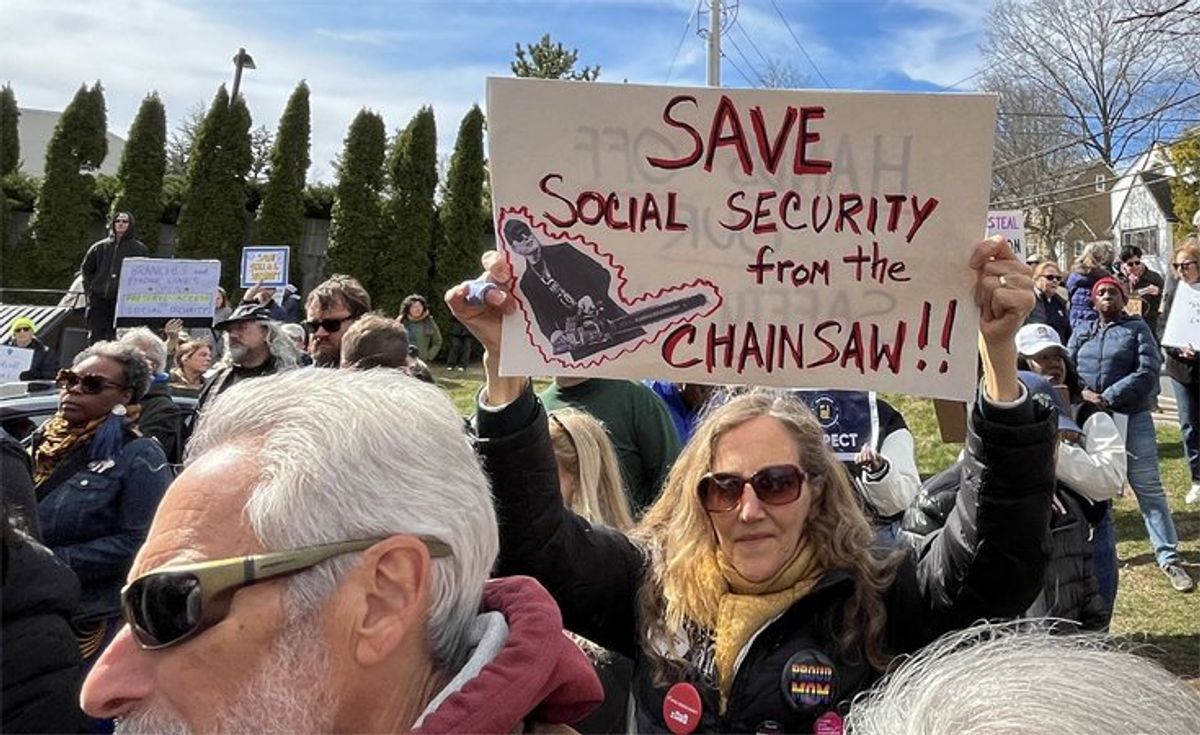
A woman holds a sign during a protest against cuts made by U.S. President Donald Trump's administration to the Social Security Administration, in White Plains, New York, U.S., March 22, 2025. REUTERS/Nathan Layne

The Trump Administration, with the help of the Elon Musk-led Department of Government Assistance (DOGE), is targeting a wide range of federal government agencies for mass layoffs — including the U.S. Social Security Administration (SSA)

The SSA was established 90 years ago when Congress passed the Social Security Act of 1935 and President Franklin Delano Roosevelt signed it into law as part of his New Deal. Social Security was one of FDR's most important accomplishments, and the programs defenders — including former SSA Commissioner/ex-Maryland Gov. Martin O'Malley — are warning that SSA layoffs could lead to delayed Social Security benefits for millions of seniors.

The Trump Administration and DOGE, O'Malley warns, are laying off so many knowledgeable SSA employees that it will be difficult for the agency to function in the months ahead.

READ MORE: 'Chaos': Social Security agency 'engulfed in crisis' as Musk cuts leave retirees in 'turmoil'

While O'Malley is warning about the SSA not having enough workers to function properly, Wired reporter Makena Kelly is sounding the alarm about another DOGE-related SSA problem: a tech problem.

In an article published on March 28, Kelly reports, "The so-called Department of Government Efficiency (DOGE) is starting to put together a team to migrate the Social Security Administration's (SSA) computer systems entirely off one of its oldest programming languages in a matter of months, potentially putting the integrity of the system — and the benefits on which tens of millions of Americans rely — at risk. The project is being organized by Elon Musk lieutenant Steve Davis, multiple sources who were not given permission to talk to the media tell Wired, and aims to migrate all SSA systems off COBOL — one of the first common business-oriented programming languages — and onto a more modern replacement like Java within a scheduled tight timeframe of a few months."

Moving from COBOL to Java or another modern program isn't necessarily problematic in and of itself, according to techies interviewed by Wired. But it needs to be done gradually and cautiously.

For SSA, Kelly stresses, the problem is trying to make the change too quickly.

"Under any circumstances," Kelly explains, "a migration of this size and scale would be a massive undertaking, experts tell Wired, but the expedited deadline runs the risk of obstructing payments to the more than 65 million people in the U.S. currently receiving Social Security benefits…. As recently as 2016, SSA's infrastructure contained more than 60 million lines of code written in COBOL, with millions more written in other legacy coding languages, the agency's Office of the Inspector General found."

An SSA tech specialist, interviewed on condition of anonymity, told Wired, "Of course, one of the big risks is not underpayment or overpayment per se; (it's also) not paying someone at all and not knowing about it. The invisible errors and omissions."


Musk’s DOGE team emerges from the shadows

By AFP
March 28, 2025


Elon Musk's DOGE team gave their first joint interview 
- Copyright POOL/AFP Jim WATSON


Danny KEMP

It has worked in the shadows for months, but Elon Musk’s Department of Government Efficiency (DOGE) has now offered the first peek behind the curtain of the government cost-cutting drive it launched on behalf of US President Donald Trump.

Musk, the Space X and Tesla tycoon, was accompanied by seven top aides in a joint interview to Fox News Channel’s Bret Baier late Thursday. They rejected criticism of their disruptive foray through the administration.

Despite mass layoffs in the US federal government, which have sparked an outcry, they said they wanted to offer an “Apple Store-like” consumer experience to Americans.

“This is a revolution,” declared Musk, the world’s richest man.

DOGE has so far kept a low public profile, amid reports of teenage computer wizards sleeping in a huge building adjoining the White House, and demanding access to government departments.

What emerged on television was a slightly different picture — a group comprised almost entirely of middle aged tech CEOs and Musk aides defending methods that have drawn widespread opposition.

They perched on chairs in two rows, with Musk flanked by two DOGE members in the front, and five on a raised platform behind.

The scene was a room in the White House complex designed for remote meetings — one that a senior Trump aide had recently dismissed as former President Biden’s “fake Oval Office” because he used it in a number of events.

Musk opened the interview, saying that DOGE aimed to finish its work by the end of May and that its goal was to be able to reduce federal spending by 15 percent, or from $7 trillion to $6 trillion.

– ‘Great user experience’ –

Then the others got their turn in the spotlight.

First up was Steve Davis, one of Musk’s top lieutenants who is effectively the chief operating officer at DOGE.

A former aeronautics engineer who has followed Musk through several companies including Space X and the social media platform X, he has long kept a low profile.

“Some people say this shouldn’t take a rocket scientist — but you are a rocket scientist,” Baier asked him.

“Used to be,” replied Davis.

The next was Joe Gebbia, co-founder of flat-sharing app Airbnb.

Gebbia who said he had been tasked to overhaul a system in which government retirement documents were kept on paper in abandoned mine in Pennsylvania.

“We really believe that the government can have an Apple store-like experience,” he said, referring to the sleek shops where the tech giant sells iPhones and other tech.

“Beautifully designed, great user experience, modern systems.”

The DOGE experience has been very different for many federal workers.

At least 113,000 federal workers have been fired so far under DOGE’s drive, according to a CNN tracker.

Musk’s team has also been tasked with slashing federal spending — and has effectively shut down the US Agency for International Development (USAID).

There have also been widespread criticisms about the process, including demands from DOGE that federal employees account for the work they have been doing in a bullet pointed memo or face the sack.

And DOGE has faced claims of causing disruption to the US social security system, and of overstating its savings.

Several recent polls indicate that most Americans disapprove of the disruption to the nationwide federal workforce.

Musk however was unrepentant, saying that the biggest complaints were coming from “fraudsters”, without giving evidence.

The tycoon also used the interview to say that Trump’s administration would crack down on people spreading “propaganda” about Tesla, after a number of incidents in which the electric vehicles have been vandalized in protest against Musk.

“Those are the real villains here, and we’re going to go after them,” said Musk, making a two-fingered shooting gesture with his hand.