Monday, March 31, 2025

Trump’s vindictiveness never ends


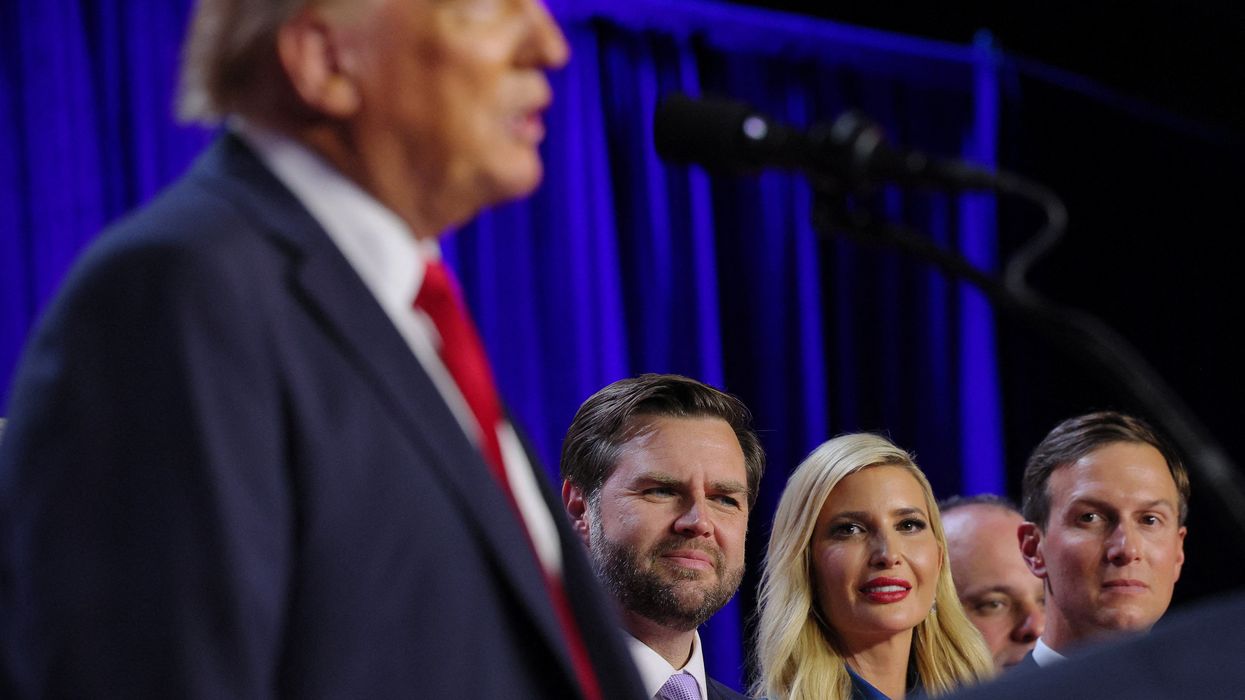
JD Vance, Ivanka Trump and her husband Jared Kushner listen as Donald Trump speaks at his election night rally at the Palm Beach County Convention Center in West Palm Beach, Florida, U.S., November 6, 2024. REUTERS/Brian Snyder
March 31, 2025

Last week I wrote to you about Trump’s crackdown on the pillars of civil society — the universities, the scientific community, the media, the legal profession, and the arts — with the clear intent of intimidating them into silence.

Today I want to take a deeper dive into what Trump’s crackdown on the legal community — especially large law firms in Washington — actually means.

Frankly, I couldn’t give a s--- about large law firms in Washington. They make boatloads of money for their partners. Even those whose partners are active Democrats push the party rightward as they round up campaign donations from corporate C-suites and Wall Street and urge Democratic members of Congress to move to the “center.”

But Trump’s bullying of Washington law firms is cutting off the litigation lifeline for nonprofit public-interest groups to challenge his policies — which is exactly why he’s doing it.

The latest example came last Tuesday in a Trump executive order aimed at the law firm Jenner & Block, stripping it and its lawyers of security clearances and access to government buildings.

What had Jenner done wrong? It once employed attorney Andrew Weissmann after he worked as a prosecutor in Robert S. Mueller III’s special counsel investigation of Trump in his first term. Weissmann left Jenner in 2021, but Trump’s vindictiveness never ends.

In announcing its executive order, the White House accused Jenner of participating in “the weaponization of the legal system against American principles and values” and called out Weissmann by name.

A federal judge termed Trump’s attempt to punish Jenner “reprehensible” and issued a temporary restraining order blocking it.

Before targeting Jenner, Trump went after lawyers at Covington & Burling. What had they done wrong? A few of their attorneys had represented former special counsel Jack Smith after he investigated Trump’s role in the January 6, 2021, attack on the U.S. Capitol.

Trump has also targeted Perkins Coie, a law firm with ties to a dossier of opposition research against Trump that circulated during the 2016 campaign.

“It sends little chills down my spine,” U.S. District Judge Beryl A. Howell said in court as she granted Perkins Coie a temporary restraining order, suggesting Trump’s order is unconstitutional. In a filing last week, Trump’s Justice Department sought to remove Judge Howell from the case, accusing her of being “insufficiently impartial.”

Trump issued a nearly identical executive order targeting law firm Paul Weiss.

Its offense? One of its former partners, Mark Pomerantz, had left the firm to join the Manhattan district attorney’s office to help investigate allegations that Trump had overstated the values of his properties to obtain bank loans.

Rather than fight, though, Paul Weiss cut a deal with Trump. After meeting with him for three hours at the White House, its chairman, Brad Karp, agreed to devote $40 million worth of pro bono work “to support the administration’s initiatives,” Trump said in a post on Truth Social. Karp also acknowledged unspecified “wrongdoing” on the part of Pomerantz. Trump then rescinded his order against the firm.

The fifth big law firm that Trump has targeted is Skadden Arps.

What had it done? A few of its lawyers had worked pro bono on behalf of plaintiffs who said Dinesh D’Souza defamed them in his documentary, falsely accusing them of ballot fraud in the 2020 election. (D’Souza has previously admitted that the movie was “flawed” and apologized to one of the plaintiffs.)

On Friday, Trump announced that Skadden had reached “a settlement,” agreeing to do $100 million of pro bono work for causes Trump supports. “We very much appreciate their coming to the table,” Trump said.

Trump’s orders (and threats of orders) against law firms violate the firms’ and their lawyers’ rights to free speech and association, as well as the right to counsel guaranteed by the Sixth Amendment.

Even worse, they send a chill across the entire American legal community along with a warning: Don’t attack Trump. Don’t let your partners or associates attack him, ever. Force them to sign agreements before they depart your firm promising not to attack or prosecute Trump ever. Don’t take cases from nonprofits or anyone else challenging Trump.

Trump’s moves come directly out of the authoritarian playbook. Leaders of other countries that have sought to undermine democratic systems and the rule of law — Russia, Turkey, and Hungary — have similarly attacked lawyers.

“The law firms have to behave themselves,” Trump said at a Cabinet meeting last Monday. “They behave very badly, very wrongly.”

“It’s scary,” said a former Biden administration official who’s been pulled into Trump-era litigation and needed a lawyer. The former official had lined up a pro bono lawyer from a major law firm that dropped his case the day after Trump issued his executive order against Perkins Coie, saying it “discovered” a conflict of interest.

Five other firms said they had conflicts, the former official said, including one where “the partner called me livid, furious, saying that he’s not sure how much longer he’s going to stay there,” said the former official, “because the leadership didn’t want to take the risk.” The person spoke on the condition of anonymity to avoid further difficulty obtaining a lawyer.

Major law firms are also refusing to take public-interest cases challenging Trump, saying they can’t risk it if Trump goes after them as a result.

Litigation against an administration often requires vast resources — experienced lawyers versed in the relevant case law and scores of paralegals doing research across thousands of pages of evidence.

Last Friday, Trump said in a memorandum that lawyers aren’t supposed to file lawsuits or engage in court action unless there is “a basis in law” that is not “frivolous.” The clear suggestion is that he and Attorney General Pam Bondi, not courts, should determine who meets the criteria.

The memorandum also directed Bondi to consider “imputing the ethical misconduct of junior attorneys to partners or the law firm when appropriate” — a clear swipe at pro bono cases in which junior attorneys take the lead to gain litigation experience.

Shame on Trump and on those who work for him.

And shame on any law firm that caves in to Trump after he has targeted them, or any firm that caves in to Trump in advance — refusing to take cases that challenge him because they fear his wrath.

By settling with Trump, two of the firms that Trump targeted — Paul Weiss and Skadden Arps — have disgraced the legal community and turned their backs on their public duty to fight tyranny.

I put them in the same category as Columbia University, which surrendered its integrity to Trump’s illegal and unconstitutional demands without putting up a fight — thereby encouraging him to go after other universities.

By contrast, kudos to the three firms — Jenner & Block, Perkins Coie, and WilmerHale — that have chosen to fight Trump rather than settle.

Jenner said in a statement that its lawsuit is intended to “stop an unconstitutional executive order that has already been declared unlawful by a federal court.”

Jenner has also created a website — Jenner Stands Firm — to publicize its filing and to highlight newspaper editorials criticizing the executive orders and comments from law school professors questioning the legality of Trump’s actions.

Democracy requires courage. It necessitates people and organizations that put principle before money.

I hope any budding lawyer seeking employment at a big Washington law firm — and every potential client in America needing legal representation in Washington — takes note of the difference between the two sets of firms, and acts accordingly.

Robert Reich is a professor of public policy at Berkeley and former secretary of labor. His writings can be found at https://robertreich.substack.com/."
Look around: The signs of a Trump recession are everywhere


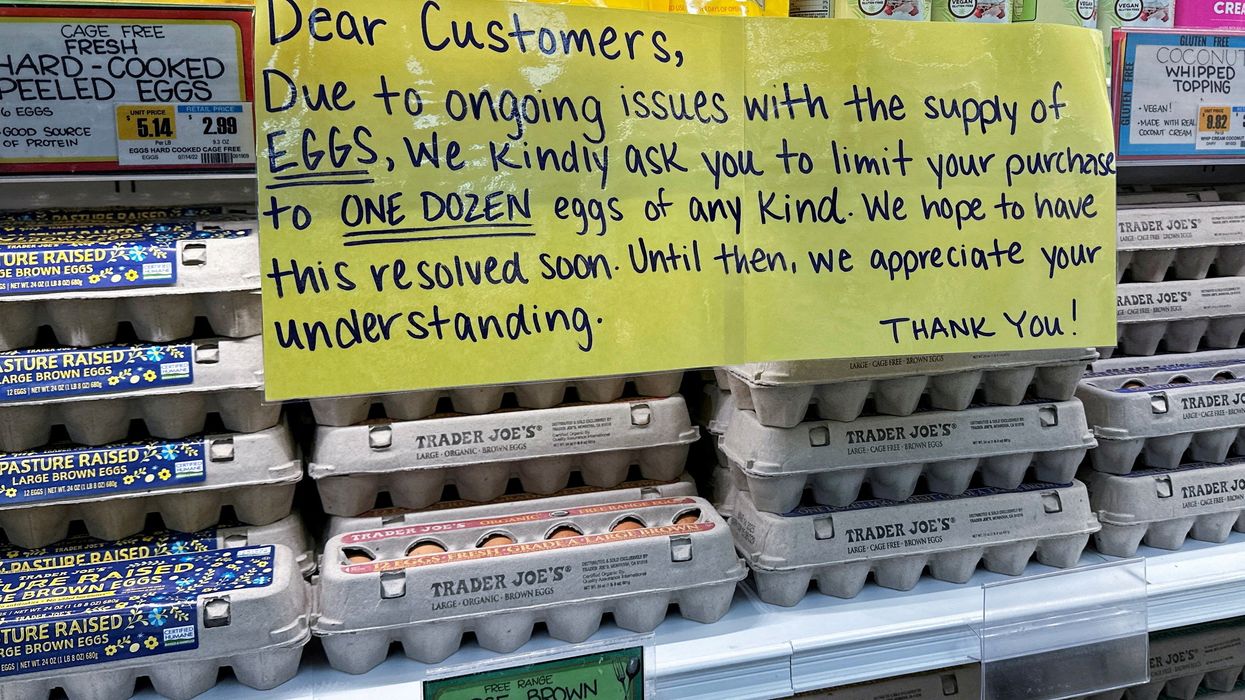
FILE PHOTO: A sign for customers shopping for eggs at Trader Joe's hangs by cartons of eggs in Merrick, New York, U.S., February 10, 2025. REUTERS/Shannon Stapleton/File Photo

David McWilliams
March 31, 2025
ALTERNET

Once you start looking, the signs of an American recession are everywhere.

The second-hand market is heating up, a classic pre-recession indicator. People are unloading luxury goods. Second-hand clothes apps, such as RealReal, Depop and Grailed, are filling up with designer handbags and sneakers bought during the la-la economy of the pandemic. This always happens before a crash.

You might remember that eBay boomed before the 2008 recession. People panic-sold designer handbags faster than you could say Anglo Promissory Note. Splurges always lead to sell-offs.

It looks like 2025 will be the year the pandemic chickens come home to roost. When the plague hit five years ago this week, governments closed down our economies and rather than impoverish workers who were forced to stay home, national treasuries opened the fiscal and monetary spigots. Government spending soared and interest rates were cut to negative territory. About $15 trillion (€13.85 trillion) of fiscal/monetary sweeties were doled out by the world’s richest governments to protect their stay-at-home electorates. (The governments had no choice; a great depression would have accompanied the plague.)

Investment and speculation took off in a splurge of credit, consumption and debt. As sure as night follows day, the credit cycle rolls and we are about to pay a terrible price for the emergency economics of Covid-19.

In tune with our always-on age, the coming American recession will be live-streamed on Instagram. Every small change in consumer confidence and business sentiment will be videoed, shared, commented on and thus amplified. We are witnessing the TikTok-isation of the business cycle, meaning the economic cycle – previously a slow-moving, deliberate phenomenon – will pick up pace, becoming fitful and immediate.

In the past, it took people time to realise that the economic backdrop was changing. Today, with social media and a US president who behaves more like a near-bankrupt day trader than a long-term investor, our collective time horizons have been slashed from years to months, weeks to minutes. The impact of a slowing economy on investment and spending will be almost instantaneous.

The latest signs from the American heartland are not encouraging. The average voter’s confidence about their economic prospects is falling quicker than at almost any other time on record. The litany of surveys pointing to recession, or more accurately a Trump-cession, not to mention the sell-off in American stock markets, suggests we are on the cusp of something enormous. The incoherence of Trump economics – with its on-and-off tariffs – is making already indebted consumers and businesses even more anxious.

Punters across all income brackets are panicking and consumer confidence is collapsing, although it is richer workers who are most worried. This probably reflects the fact that middle-class Americans are heavily invested in the stock markets, which are back to where they were in September and falling farther. Since Trump was inaugurated, the percentage of voters who are worried about their job has shot up from 30 per cent to close to 80 per cent of all those surveyed. The number of consumers worried that businesses might close has spiked up to the highest level since records began in the middle of the 1980-81 recession.

People’s confidence about where their income will be in a year has plummeted to the lowest level since 2009, right after the Great Crash. Worse still, the average American is now more worried about inflation than at any time since the beginning of the pandemic, when prices shot up because of the shutdown of industry.

This combination of a rapidly weakening economy and fear of inflation points to an old enemy not seen since the 1970s: stagflation, where unemployment and inflation rise together. In such an environment, prices rise at the same time as incomes fall. The main trigger is the broad electorate’s understanding that tariffs are a tax on spending that will raise the price of goods for working Americans.

What is going on in corporate America, the part of the economy that was supposed to be boosted by Trump? Earnings are an important leading indicator, as profit squeezes foreshadow lay-offs and investment cuts. Corporate profits surged in 2021 but have now entered a slower growth phase. By the third quarter of 2024, US corporate profits fell 0.4 per cent quarter-on-quarter, the first decline in years. By late 2024, year-on-year profit growth was 5.9 per cent, down from more than 20 per cent in 2023 – this is a huge slowdown in margins.

All the while the nonsense that is Trump’s economic plan continues to be “sane-washed” by many writers and commentators as if there is some brilliant economic rabbit about to be pulled out of a hat by the sages of Mar-a-Lago. Declaring a trade war on your four biggest trading partners – Canada, Europe, China and Mexico – will simply push up American prices, robbing US consumers.

Tariffs are a way of taking something away from somebody. Trade allows better, cheaper products to come in from abroad, putting manners on local crony businesses. Tariffs protect second-rate local businesses, allowing them to sponge off consumers, flogging second-rate goods when punters could be buying superior imported stuff. In the end, tariffs take from buyers and give money to yellow-pack local sellers who can’t compete in the international market. There’s a reason that low tariffs, which have been reduced continuously in the past 50 years, corresponded with the greatest expansion of the global economy ever seen.

Protectionism is a sign of weakness, not strength. Americans are not being “ripped off”; in fact, they are being enriched by having access to better, cheaper, superior products made by more productive people. Rather than being the beginning of a great new era of American prowess, tariffs are a sign of insecurity and fear, marking the end of the great American century that began after the end of the first World War.

The fascinating thing is that the average “Joe Six Pack” American appreciates this; otherwise, why is he so fearful about the future?
Trump's 'taking down everything Black': Fired Kennedy Center VP slams president's takeover


Photo by Nicholas Wright on Unsplash
March 31, 2025


President Donald Trump’s efforts to take over cultural institutions and attack diversity, equity and inclusion programs has centered on the Kennedy Center for the Performing Arts, the venerable arts institution in Washington, D.C. The Kennedy Center was established by Congress and has been run by a bipartisan board since it opened in 1971, but Trump upended that in February when he moved to install his loyalists in key positions and make himself chair. Last week, the Kennedy Center’s new leadership fired at least seven members of its social impact team that worked to reach more diverse audiences and artists, including the vice president and artistic director of Social Impact, Marc Bamuthi Joseph. The acclaimed artist and playwright joins Democracy Now! to discuss Trump’s changes at the Kennedy Center, which he criticizes for destroying a “sanctuary for freedom of thought and freedom of creative expression.” Joseph notes that while the Kennedy Center has not yet made drastic programming changes, the rhetoric from Trump and others “severely restricts and almost criminalizes demographic realities outside of white, straight, male Christianity.”


This is a rush transcript. Copy may not be in its final form.

AMY GOODMAN: This is Democracy Now!, democracynow.org. I’m Amy Goodman, as we turn to the Trump administration’s intensifying attacks on cultural institutions and diversity, equity and inclusion efforts, including the John F. Kennedy Center for the Performing Arts.


In February, President Trump ousted the center’s longtime chair, David Rubenstein, made himself chair of the board. Trump also fired longtime President Deborah Rutter. Last week, the Kennedy Center fired at least seven members of its Social Impact initiative, including its vice president, artistic director, the renowned artist Marc Bamuthi Joseph. The team aimed to expand the art center’s reach to diverse audiences, to commission new works by Black composers. The job terminations come weeks after President Trump took over the Kennedy Center and also appointed his allies, including his chief of staff, Susie Wiles, to the board, and her mother and second lady Usha Vance and two hosts on Fox News, Laura Ingraham and Maria Bartiromo.

Marc Bamuthi Joseph recorded this video from his office just after he was fired.
MARC BAMUTHI JOSEPH: Well, I am sitting in my office at the Kennedy Center one last time. It’s funny. I’m taking things down, like this red, black and green American flag and this extraordinary piece of artwork that my man Greg made that honors Stevie Wonder and this poster from BAM and a commemorative album that was organized by Swizz Beatz. Basically, I’m taking down everything Black in my office, just as the new leadership of the Kennedy Center is doing its best to disavow much of the literal color that has made this place special. I am grieving and angry and also ready to be rid of the moral injury that has come with being in this place. It’s hard to say goodbye, but it isn’t hard to say goodbye to an oppressive situation. So, may liberation be my liturgy. I’m proud of what we made here. We will always have an impact.


AMY GOODMAN: Marc Bamuthi Joseph, speaking after he was fired as vice president and artistic director of Social Impact at the Kennedy Center for the Performing Arts, the last time he was in his office. And this is a portion from Marc Bamuthi Joseph’s spoken word performance Friday, when he went back to Oakland for a timely production with the Oakland Symphony titled “The Forgiveness Suite,” accompanied by musician Daniel Bernard Roumain.
MARC BAMUTHI JOSEPH: Steps to grace. Face the hurt. Unthread the truth. Choose mercy. Engage your transgressors. Say I leave this pain with you. Grace requires a loosening of other people’s stuff for American-socialized Black girls who considered shame reflexively when self-love wasn’t enough. Grace is never enough when the forgiveness isn’t deserved. But here you are, facing the truth, reconciling the pain by extending grace.


AMY GOODMAN: You’ve been listening to Marc Bamuthi Joseph. He joins us right now from Virginia.


Welcome to Democracy Now!, Bamuthi. Talk about what happened last week. Talk about what’s happening to the Kennedy Center.

MARC BAMUTHI JOSEPH: Peace, Amy. Good morning to you, and good morning to everyone listening and watching.

I feel so privileged to be the child of immigrants and having lived in the state of California for a long time. Moving to D.C. infused me with a different sense of patriotism and connection to the American promise, to the plurality that makes this country truly great.

There has been, as you’ve distilled, an infusion of a kind of binary political discourse into what’s supposed to be a sanctuary for freedom of thought and freedom of creative expression. The Kennedy Center, it should be said, has not officially canceled any performances or explicitly contractually removed themselves from relationship to any artists. But as you’ve been describing so diligently and so bravely over the course of your entire career, we create atmosphere through rhetoric. The stated agenda as institutionalized in spaces like the National Endowment for the Arts, let’s say, severely restricts and almost criminalizes demographic realities outside of white, straight, male Christianity. The specific attack on gay, trans and drag performers has narrowed the cultural radius at the Kennedy Center significantly, so that artists feel like they can’t in good conscience come to the Kennedy Center. So you’re seeing artists like Issa Rae or the producers of Hamilton or the artist Rhiannon Giddens remove themselves from their relationship to the Kennedy Center.


And that, in turn, trickles down to the brave staff, who are arts professionals who care about cultural providence and have to do their very best to make it possible for artists to continue to be at their best. But against the backdrop of this oppressive regime and this politically narrow board of directors, that’s extraordinarily difficult to do.

AMY GOODMAN: I mean, you have this unbelievable moment that we just played, Jon Batiste playing “Star-Spangled Banner.” President Trump is saluting —

MARC BAMUTHI JOSEPH: Yes.

AMY GOODMAN: — at the Super Bowl, and he had just fired him from the board of trustees of the Kennedy Center —


MARC BAMUTHI JOSEPH: Yeah.

AMY GOODMAN: — along with many others. And then John F. Kennedy, you’ve got the portrait there in the John F. Kennedy Performing Arts Center.

MARC BAMUTHI JOSEPH: Yes.

AMY GOODMAN: And when he came for his board meeting, President Trump as chair, what he put up, new portraits, himself, his wife, Usha Vance and Vice President Vance.


MARC BAMUTHI JOSEPH: Yeah, you know, what you’re seeing all over government are folks who aren’t necessarily experienced in the lines or departments or vectors of action that they’re supposed to lead. And there is no formal experience in either nonprofits, arts management or the art of curation that is now present at the top of the organizational chart, beginning with the board chair. So, you know, the desire to satisfy one’s ego or the desire to be vengeful, apparently, has superseded the desire to serve this nation in terms of making a safe space for artists, particularly artists from historically marginalized communities or historically minoritized communities to thrive.

The work that we did in Social Impact — and I’m so proud of my team, my staff and all of my colleagues who supported us — you know, that work was meant to focus on the historically marginalized, but also it connected to this idea of the constitutionality of inspiration. Our belief is that you cannot be — you cannot have access to the franchise, to the American franchise, if you don’t have access to the impulse of creativity, that just like you have access to the ballot box or equal protection under the law under the 14th Amendment, you also have access and protection to inspiration. How can you be an American if you cannot hope? And who authors hope more than artists? So, this diminishment of creativity, of ideas, the diminishment of folks’ access to high-level inspired works of art is among the more un-American things, I think, that a leader would do.

AMY GOODMAN: During your time there, Marc Bamuthi Joseph, you helped launch the Culture Caucus, which offered two-year residencies with groups —

MARC BAMUTHI JOSEPH: Yes.

AMY GOODMAN: — that work with queer and trans youth, formerly incarcerated people —

MARC BAMUTHI JOSEPH: Yes.

AMY GOODMAN: — the disabled community.

MARC BAMUTHI JOSEPH: Yes.

AMY GOODMAN: You also established a national partnership —

MARC BAMUTHI JOSEPH: Yes.

AMY GOODMAN: — called Conflux, which worked with the National Arab Orchestra —

MARC BAMUTHI JOSEPH: Yes.

AMY GOODMAN: — the First Nations community and World Pride.

MARC BAMUTHI JOSEPH: Yes.

AMY GOODMAN: Your audience, mainly wealthy and white.

MARC BAMUTHI JOSEPH: Yes.

AMY GOODMAN: And can you talk about the direction that Trump is now taking the performing arts center in? We heard from, what, Steve Bannon, one of his allies, that he had spoken to Ric Grenell, the new head of the Kennedy Center, that they’re going to be bringing, what, in one of the first performances, the January 6th Choir to perform there to usher —

MARC BAMUTHI JOSEPH: Yes.

AMY GOODMAN: — in a new era of culture in the new Kennedy Center.

MARC BAMUTHI JOSEPH: Yeah, I won’t speak to the president’s curatorial tastes. They speak for themselves. I think maybe what I would point to is the list of maybe more than 200 musicians who didn’t want their music played at his rallies. That speaks to a broader environment, I think, and disconnect between the arts community and the political direction of the president of the United States.

All the work that you cited, that’s the work that we stand on and that we’re proud of. You know, your listeners and your viewers know, going out to have a date night or a family night is increasingly expensive — parking and food, and, you know, not to mention the cost of the tickets themselves, child care. A lot of the work that we did was we lowered the barrier to entry from a financial standpoint, but also from a social standpoint. You know, my folks always want to know who all gonna be there, right? Well, what we did in Social Impact was we helped usher in a culture of invitation. The Kennedy Center, historically, at its best, produces more than 2,000 events a year.

So, maybe less than focus on what happens curatorially, I think we all have to ask ourselves: How many artists are willing to come into a space with such a narrow field of cultural vision? What is the scale of the Kennedy Center going to be like six months from now or a year from now?

What happens inside the building is only as powerful as the people and the artists within it. So, you know, God bless all the curators at the Kennedy Center, but maybe more importantly, God bless the artists, who now have perhaps one less venue to share their work with the world. And then, God bless the audiences, because audiences or, you know, American citizens, folks who have less access to inspiration erode the democracy from the point of a lack of sight onto the creative horizon.

AMY GOODMAN: I wanted to also ask you, Bamuthi, about Trump’s executive order —

MARC BAMUTHI JOSEPH: Yes.

AMY GOODMAN: — signed last week, appointing the vice president, JD Vance, to eliminate, quote, “divisive, race-centered ideology,” unquote, from Smithsonian museums, research centers and the National Zoo. The order, called “Restoring Truth and Sanity to American History,” aims to remove exhibits and programs that portray U.S. history and values as “inherently harmful and oppressive,” unquote. It cites in particular the National Museum of African American History and Culture, which opened in 2016. The Smithsonian operates independently, since it was established as a public-private partnership by Congress in 1846, but roughly receives 60% of its funding from the federal government. You know, you’re an Oakland guy, but you’ve moved to Washington —

MARC BAMUTHI JOSEPH: Yeah.

AMY GOODMAN: — for your job, that you were just fired from, and I’m sure you’ve spent time at the African American museum. The significance of —

MARC BAMUTHI JOSEPH: Absolutely.

AMY GOODMAN: — putting Vance in charge of deciding what exhibits are appropriate or not, what is American or not?

MARC BAMUTHI JOSEPH: Yeah. Yeah. It is chilling. It is a harbinger. It is a signifier in the most ominous of terms.

I think about the words of John F. Kennedy inscribed on the wall at the Kennedy Center. Kennedy spoke of an America that was unafraid of grace and beauty. I think about the writers and the teachers who made me, everyone from Dr. Daniel Omotosho Black at Clark Atlanta University to the author Toni Morrison, the poet Nikki Giovanni. I think about how they all authored the story of our overcoming.

America is actually built on struggle. And, you know, it’s obviously impossible to decouple American history from a genocidal, hyper-patriarchal, hyper-capitalist frame and origin story. But the idea of democracy itself is a radical idea. The Constitution itself is a critical theory. It describes a way, a populist way, that requires participation in order to actually make the country thrive. In order to be — in order to fully participate in the democracy, you have to sublimate or suppress your apathy.

My partners at SOZO Artists and I think about the idea that the way to turn apathy into empathy is to infuse inspiration as a conversion element. These museums, these Smithsonian museums, inspire folks because they distill the story of our overcoming. You enter — even if you entered one of the Smithsonian institutions apathetic as to the idea of struggle or overcoming, you are inspired inside of that institution, and you leave a more compassionate and more empathetic human being. So, you know, this description of what the Smithsonian institutions do, particularly what we call the “Blacksonian” here locally, that description is severely un-American and disconnected from the American promise. But maybe more critically, it minimizes the opportunity to generate empathy among not only the citizens of this country, but visitors from all over the world.

AMY GOODMAN: Marc Bamuthi Joseph, I want to thank you so much for being with us, renowned artist and playwright, fired from his role as vice president and artistic director of the Kennedy Center’s Social Impact initiative.
‘Revenge is his number one motivation’: how Trump is waging war on the media


The president – who believes he has been treated unfairly by the press – is squeezing the media in different ways than his first term

Chairman James Comer speaks in front of posters of NPR headlines during a House oversight and government reform committee hearing on 26 March 2025 in Washington DC. Photograph: Andrew Harnik/Getty Images
New York
THE GUARDIAN
Sun 30 Mar 2025 

On Tuesday 4 March, Donald Trump stood in the House of Representatives to issue a speech to a joint session of Congress, the first of his second term.

Near the beginning of what was to be a marathon address, the president declared: “I have stopped all government censorship and brought back free speech in America. It’s back.”


What Trump did not mention was that less than three weeks earlier he had barred Associated Press journalists from the Oval Office, because the news agency refused to use his preferred nomenclature for the Gulf of Mexico. He did not mention that he was waging lawsuits against ABC and CBS, nor that the man he appointed chair of the Federal Communications Commission had ordered a flurry of investigations into NBC News, NPR and PBS.

The president ignored entirely what has become an all out attack on the media and other institutions, something that media experts have described as a “broad, systematic assault” on free speech, a vendetta that threatens “the essential fundamental freedoms of a democracy”.


Since that speech the situation has only got worse. The anti-media rhetoric has ramped up from Trump officials, Trump has suggested some media groups should be “illegal”, funding has been cut from organisations like Voice of America and last week the White House lambasted journalist Jeffrey Goldberg and the Atlantic magazine for breaking a scoop about national security lapses on a Signal messaging app.

“Revenge is Trump’s number one motivation for anything in this second term of office, and he believes he has been treated unfairly by the media, and he is going to strike out against those in the media who he considers his enemies,” said Bill Press, a longtime liberal political commentator and host of The Bill Press Pod.

“He’s going in the direction of really curtailing the freedom of the press, following the pattern of every autocrat ever on the planet: they need to shut down a free and independent press in order to get away with their unlimited use of power.”

Trump was critical of the media in his first term. But as Press pointed out, that was more verbal attacks: the never-ending accusations of “fake news”, the encouragement of anti-CNN chants at rallies. Two months into Trump’s second term, he has already taken it further. Associated Press, one of the world’s premier news agencies which is relied upon by thousands of news outlets, remains banned from the Oval Office and Air Force one: the president angered by the agency’s refusal to use the term “Gulf of America” to refer to the Gulf of Mexico.

Trump is suing the owner of CBS News for $10bn, alleging the channel selectively edited an interview with Kamala Harris, which the network denies, and the Des Moines Register newspaper, which he accuses of “election interference” over a poll from before the election that showed Kamala Harris leading Trump in Iowa.

The FCC investigations, led by the hardline Trump appointee and Project 2025 author Brendan Carr, are ongoing, while in February Trump ejected a HuffPost reporter from the press pool – which refers to a rotating group of reporters allowed close access to the White House – and denied reporters from the news agency Reuters access to a cabinet meeting.

At various times Trump and rightwing groups have accused each of the outlets of bias or of presenting negative coverage of his presidency. By contrast, the White House has allowed rightwing news outlets, including Real America’s Voice and Blaze Media and Newsmax, to be included in the press pool.

“It’s designed to shut down criticism, and I think that the danger of that is that there is this effort to make it look like everyone approves of the government and of the Trump administration,” said Katie Fallow, deputy litigation director at the Knight First Amendment Institute, a non-profit which seeks to preserve and advance first amendment freedom rights.

“It’s a threat to the ability of the of the press to critically cover the president, but perhaps more importantly, the function of the press is to inform the public about the workings of government, and allow the public to decide whether or not it wants to vote for these people again, or whether it approves. And so it’s more than just its effect on the media, its effect on the general public.”

In recent days the Trump administration’s attack-the-media playbook has been on show in the way senior officials have sought to discredit Goldberg, the editor in chief of the Atlantic who was invited into a secret Signal group where a coming US attack on Yemen’s Houthi militia was being discussed.

The defense secretary, Pete Hegseth, the national security adviser, Mike Waltz, and Trump himself have criticized Goldberg: Waltz described him as “the bottom scum of journalists”, while Trump called the reporting “a witch-hunt” and described the Atlantic as a “failed magazine”.

Trump has also appeared to flirt with using law enforcement to target the media, including a speech to federal law enforcement officials in March. “As the chief law enforcement officer in our country, I will insist upon and demand full and complete accountability for the wrongs and abuses that have occurred,” Trump said

He disparaged certain lawyers and non-profits, before later adding: “The Washington Post, The Wall Street Journal and MSDNC, and the fake news, CNN and ABC, CBS and NBC, they’ll write whatever they say.”

Trump continued: “It’s totally illegal what they do,” adding: “I just hope you can all watch for it, but it’s totally illegal.”

The war on free speech has not just been limited to the media. Trump’s efforts have increasingly also focussed on areas including education, law and charitable organizations, as the government seeks to bring key aspects of society into line.

“You have to look at this as part of a broad, systematic assault that the president and his administration have been waging since he returned to office on every other power center that impacts politics in any way,” said Matthew Gertz, a senior fellow at Media Matters, a watchdog group.

“All the sort of liberal, civil society institutions: big law firms, universities, the government itself, the courts and the press have come under fire, and as part of that, we have this really unprecedented multifront attack on media institutions.”

Trump has been aided in this endeavor by the owners of some media organizations. Jeff Bezos, the Amazon co-founder and owner of the Washington Post, pulled an editorial endorsing Kamala Harris during the campaign and recently overhauled the newspaper’s opinion pages.


Amazon donated a million dollars to Trump’s inauguration, and Bezos’ space company Blue Origin competes for federal government contracts. Patrick Soon-Shiong, the billionaire owner of the Los Angeles Times, also blocked the newspaper from endorsing Harris, while Mark Zuckerberg dismantled Facebook’s factchecking network after Trump won the presidency. (Like Bezos, Zuckerberg donated to, and attended, Trump’s inauguration.)

“What makes the situation so worrying is that for the last several years, Donald Trump himself and the leading lights of the rightwing media and political movement: from Tucker Carlson to Kevin Roberts at the Heritage Foundation, have cited as their exemplar Viktor Orbán of Hungary. That’s what they want to accomplish,” Gertz said.

“And what Orbán did with the press was squeeze different media corporation owners until they agreed to either make their press more palatable to him, or sell their outlets to someone who would. I think that is basically, by their own admission, what the Trump administration is trying to bring about in this country.

“I think the hope is that we have more guardrails than Hungary did to prevent that from happening. But it’s unnerving that the president of the United States is trying to follow in those footsteps.”
Book excerpt: 'Disciples of White Jesus: The Radicalization of American Boyhood'


Photo by Paul Zoetemeijer on Unsplash

March 31, 2025


The following is an excerpt from the recently published “Disciples of White Jesus.” In its description, Publisher’s Weekly says, “A shifting American culture is pushing white Christian boys toward radicalization, isolation, and violence, according to this persuasive treatise.” 

Consider buying the book at an independent Minnesota bookstore.

We cannot understand the problems of radicalization among young, white Christian boys in America, nor fully grapple with the challenges and troubles facing these boys, without understanding what’s happening in American schools. And without consulting that most underpaid and too-often scapegoated American professional, the public school teacher.

A teacher I’ll call Joe, 59, is just the kind of teacher that hard-core advocates of traditional masculinity might dream up as their ideal educator for young, white Christian boys and men — at least at first blush. Joe, who has been teaching for 36 years in total, and 33 years in the Minneapolis Public Schools, stands 6 foot, 5 inches tall. When it comes to physical education instruction, which he has led for 23 years at his current school building, Joe is no-nonsense and almost stern, cutting a strong, athletic and disciplined figure, a product of his Marine veteran father, who worked for decades in underground pipelines after leaving the military.

Joe spends his winter days at an upper elementary school in a relatively affluent neighborhood of Minneapolis, with a student body that’s more than 85% white; only to drive across the Mississippi River after school to St. Paul’s Central High School, where he works as an assistant basketball coach at a school that is 59% POC students, including 29% Black students, in a neighborhood where 18% of residents live in poverty.

It’s a fitting dual existence for Joe, who describes his childhood as a life in two worlds. His dad was a member of the Red Cliff Native American tribe, and the family lived together on the reservation near Bayfield, Wisconsin, even though Joe’s mother was white. He recalls that sometimes he was bullied on both ends, about his Indigenous ancestry by the white kids, and from the Native kids, called an “apple,” suggesting that while he was “red” on the outside, he was really “white” on the inside. Joe thought maybe that was because his teacher mom encouraged her four boys to do well in school, something that wasn’t always popular on the reservation, for myriad reasons.

Teaching PE and coaching basketball enable Joe to use parts of his skill set and personality that some advocates of gender absolutism might consider contradictory. He retains much of the “tough-love,” “old-school” military mentality that his dad instilled in him. And at the same time, Joe also saw the ways in which that hard-core masculine identity led his dad to a life of physical pain and even premature death. Joe saw the strengths and limitations of a masculinity that’s only rooted in hardness and discipline. So he brings a bit of his mom’s more nurturing side to his role as an educator and coach as well. After all, Joe says the best parts of his day are often the hours he spends in physical education with a smaller group of students with disabilities and cognitive delays. These students, who are often withdrawn or quiet or uncooperative in public settings, seem to innately trust Joe, something I saw firsthand when I served as a substitute teacher in his classroom. They know the rhythms and routines of the gymnasium; it was a place they clearly felt accepted, loved, and known — something achieved by an educator rooted in discipline and athleticism but also in emotional connection, patience, and kindness.

Given his popularity among many of his students and student athletes, and his continued commitment to athleticism even into his 59th year, you might think that Joe is supremely confident and undeterred in any school setting. But he knows that washboard abs or biceps would be no match for an AR-15 in a potential school shooting situation.

“That scares me more than anything as a teacher,” Joe told me, when we discussed the potential of a school shooter coming to our shared neighborhood. “Even who I am, there is very little I can do to stop that situation. The best thing we can do is just barricade ourselves.”

Joe says he thinks about it often, imagining himself in the shoes of fellow teachers and educators who have faced active shooters in their buildings.

“They probably thought the same things I do,” he said. “Your senses are so heightened as a teacher. You’re making sure all your doors are shut. You’re following the proper procedures for code red. What do you do? What do I do? What if I’m at prep? What if it’s happening in another area of the building? Of all the things, that’s the one that scares me the most.”

I’m struck at this moment by the seriousness and vulnerability and sadness that has come over Joe’s face. This is a man who deeply loves being a teacher. By the nature of his work with disabled students — among whom boys are overrepresented — and his role as a boys’ basketball coach, Joe does tend to spend a bit more time with boys as an educator and coach, though his office is also filled with cards from former students, divided equally between boys and girls. He’s also the father of a 20-something son, whom he watched attend school in the same district where he teaches. He says the two of them will talk about those boys who seem to fall through the cracks, the ones for whom traditionally male-dominated outlets like sports or mathematics don’t seem to fit, but who also don’t find their place in outlets like music or drama. He and his son recently together discussed the fact that two of his classmates — despite their relatively privileged backgrounds — had recently died of drug overdoses. Joe talked also of watching the boys who used to run with joy and abandon around his gym classes, pelting each other with balls, turn into sullen, withdrawn, and angry teenagers. Sometimes seeing them makes him feel sad and powerless.

“When you, as a teacher, can pinpoint those students out, you try and let them figure out a way for themselves, and also serve as advocate for them and help them find a way,” Joe says. “Sometimes they just need an ear to bend. Sometimes parents will ask me about younger kids and help them find a group, or a place to fit in.”

I realize, in talking with Joe, that it’s not his height or his athleticism or his perceived traditional masculinity that makes Joe a favorite among his students, or that has enabled him to have such longevity as a PE teacher in a challenging time for public school teachers, especially in inner-city, urban school districts. For Joe, for his students: the key is trust and relationship. He has been able to carve out a unique sense of both in his role as teacher and coach in Minneapolis. But it doesn’t escape me that even in this ideal school, Joe still faces the fear and anxiety of the violence of the wider world, the ominous threat of a school shooting.

Minnesota Reformer is part of States Newsroom, a nonprofit news network supported by grants and a coalition of donors as a 501c(3) public charity. Minnesota Reformer maintains editorial independence. Contact Editor J. Patrick Coolican for questions: info@minnesotareformer.com.


NATO: More Militarism, No Defence against US Expansionists

If you believe Donald Trump might invade, you should be calling for Canada to withdraw from NATO. The alliance won’t defend Canada, has enabled US interference, and gobbles up resources.

During a recent meeting with NATO Secretary General Mark Rutte, US President Donald Trump questioned the border and Canadian sovereignty. He said, “if you look at a map, they drew an artificial line right through it, between Canada and the U.S. … somebody did it a long time ago, many many decades ago, and (it) makes no sense.” Trump also repeatedly said Canada should be a US state, noting “to be honest with you, Canada only works as a state.”

Sitting next to the US president, Rutte stayed silent. A bit later Trump suggested Rutte might assist him in taking part of NATO member Denmark, noting “I’m sitting with a man who could be very instrumental. You know Mark, we need that for international security.” Rutte replied, “when it comes to Greenland yes or not joining the U.S. I would leave that outside for me this discussion because I don’t want to drag NATO in that.”

Rutte doesn’t seem to want to commit even rhetorically to defending alliance members’ sovereignty. Even if Rutte had interrupted Trump and told the US president his comments were inappropriate, the idea that NATO would defend Canada from a US invasion is ridiculous. Latvia and Estonia will not send troops to repel a US invasion. Nor will France or the UK.

Will Canada send troops to defend Greenland if Trump takes it from NATO member Denmark? Does anyone think that would that be a good idea?

Article 5 of the NATO Charter is not clear on what collective defence entails. It says an attack against one member “shall be considered an attack against them all.” But it doesn’t stipulate what the response should be, noting only that each member state must take “such action as it deems necessary, including the use of armed force.” Article 5 has only ever been invoked after the September 11, 2001, attacks in the US.

In the past NATO has undercut Canadian sovereignty. Unbeknownst to most Canadians, NATO was employed by Washington to topple a government in Ottawa. When Prime Minister John Diefenbaker didn’t provide unconditional support during the October 1962 Cuban Missile Crisis, US President John F. Kennedy used NATO as part of a multifaceted effort to precipitate the downfall of his minority Conservative government. On January 3, 1963, the outgoing commander of NATO, US General Lauris Norstad, came to Ottawa on an unplanned visit in which he claimed Canada would not be fulfilling her commitments to the alliance if the country did not acquire nuclear warheads. It was part of a series of moves by the Kennedy administration to weaken Diefenbaker, which led to the fall of his government. During the subsequent election campaign, Kennedy’s top pollster, Lou Harris, helped longtime external affairs official Lester Pearson defeat Diefenbaker.

NATO continues to undercut Canadian sovereignty. It’s used to justify purchasing expensive offensive kit (think F-35s and surface combatant warships) that are a drag on resources. The alliance also undermines Canadian defence since it promotes a forward military posture. In recent years, Canada has participated in NATO maritime operations in the Baltic and Black seas. In 2018, Canada took charge of NATO Mission Iraq. About 200 Canadian troops were deployed there.

For the past eight years Canada has led a NATO battlegroup in Latvia. About 700 Canadian soldiers are stationed on Russia’s border. There are also Canadian troops elsewhere in Eastern Europe as part of NATO aligned deployments.

NATO has entangled Canada in, what former UK Prime Minister Boris Johnson labelled, a “proxy war” that has devastated Ukraine. Ottawa has donated over $4 billion in military assistance and $6 billion in other types of assistance in a bid to continue the fight until the last Ukrainian. While Russian violence is condemnable, NATO provoked the war through its interventionist, antidemocratic, moves.

When NATO promoted Ukraine’s accession to the alliance in 2008, most Ukrainians opposed joining. Subsequently, NATO countries supported the ouster of elected President Viktor Yanukovych who passed legislation codifying Ukrainian neutrality. As John Mearsheimer warned in 2015, NATO was “leading Ukraine down the primrose path and the end result is that Ukraine is going to get wrecked.”

Pro-NATO commentators generally ignore the alliance’s provocations. They oppose Donald Trump’s — who often says the quiet part out loud — bid to end the conflict in Ukraine. Simultaneously they’ve been upended by Trump’s crass attacks on Canada and have suddenly become wary of US power. While they’ve begun criticizing Canada’s military dependence on the US, they continue to support militarism and imperialism.

In a sign of the crisis faced by militarists, the opinion section of last Saturday’s Globe and Mail published a long article headlined “WANTED: NEW ALLIES: Successive Canadian governments have leveraged our close relationship with Washington to get the most out of our low defence spending. This long-standing approach cannot continue.” Next to it, the paper published Thomas Homer Dixon’s “If you want peace, prepare for war” and a column by a Royal Military College professor headlined “Canada needs to develop its own nuclear program”.

The militarists/imperialists can’t see an option outside of militarism and global hierarchy. Their calls to establish a NATO without the US is an excuse for more militarism and prolonging the conflict in Ukraine. It would do little to protect Canada.

While there may be an argument for developing a guerrilla type defence structure, membership in NATO undercuts this country’s moral standing. Canada’s best defence against an invasion is making sure hundreds of millions of people in the US and elsewhere know this country is not their enemy.

Image credit: GHY International


Canada needs to support health research at home and abroad


Canadian Medical Association Journal


In the face of major changes to federal policy and funding in the United States, Canada should support Canadian researchers with adequate funding to ensure long-term research in health and science, argue authors in two articles published in CMAJ (Canadian Medical Association Journal).

“As the US stands on the brink of tearing down its exemplary system for covering the full costs of research, Canada, with its flawed federal system for indirect costs, should heed the recent commissioned science policy report and a chorus of advocacy calling for an enhanced indirect cost system,” writes Dr. William Ghali, vice-president research, University of Calgary, Calgary, Alberta https://www.cmaj.ca/lookup/doi/10.1503/cmaj.250406

This means overhauling the federal Research Support Fund, which supports indirect research costs through institutions like universities.  

In addition to shoring up funding support at home, Canada can play a key role in helping shape a new World Health Organization (WHO) in the wake of the abrupt US withdrawal, “pushing for and shaping a WHO that can function independently of any single capricious member state,” writes Dr. Kirsten Patrick, editor-in-chief, CMAJhttps://www.cmaj.ca/lookup/doi/10.1503/cmaj.250418. “Canada should also increase its contributions to the WHO and to global health aid at this time.” 

She warns that Canada needs to commit to supporting high-quality scientific research. This would include adequate funding, timely sharing of health data between provinces — deidentified at the patient level — to ensure we can share up-to-date disease trends with international partners.  

“Reliable North American health data that originate from Canada are more important than they have ever been. Now is the time to fund Canadian health researchers properly and to support them to share their work, publish in reputable journals, and collaborate internationally,” Dr. Patrick concludes.  

Liberal PM Carney takes lead four weeks before Canada votes

By AFP
March 30, 2025


Canadian Prime Minister and Liberal leader Mark Carney has taken a strong lead in polls heading into a second week of the election campaign - Copyright AFP ANDREJ IVANOV

Marion THIBAUT

Four weeks before Canadians vote in a general election where threats by US President Donald Trump have taken center stage, Mark Carney has led a Liberal resurgence to take the lead in polls over his main rival, Conservative Pierre Poilievre.

Since coming to office in January, the US leader has threatened the Canadian economy with high tariffs and repeatedly called for the country to surrender its sovereignty and become a part of the United States.

Experts agree that the main question facing Canadians when they cast their ballot on April 28 will be who — current Prime Minister Carney or Poilievre — can push back against Trump.

“The economy is the biggest issue for me in this election, including the whole free trade thing with the United States,” Ottawa voter Carol Salemi told AFP.

“We need some sort of negotiation (with the US) and we need a strong leader to do that,” she said.

Danielle Varga, 22, echoed that viewpoint, saying Canada needs “someone that’s strong against America. It feels like everyone’s on that same page, which is good.”

At the moment, former central banker and political novice Carney, who took over from Justin Trudeau as PM in mid-March, appears to fit the bill.

The 60-year-old has taken the country by storm, completely reversing the fortunes of the Liberals who under a beleaguered Trudeau were headed for an electoral wipeout.

He is now leading in the polls and, observers say, has a good chance of forming a majority government.

“This is the most important election of our lifetime,” Carney told campaign volunteers in Ottawa on Saturday. “It’s critical in redefining our relationship with the United States (and) redefining our economy on our own terms.”

Carney interrupted his campaign this week after Trump announced plans to impose 25 percent tariffs on car imports, coming on the heels of levies on steel and aluminum.

Trump said he had an “extremely productive” first call with Carney on Friday, adding that the two leaders “agree on many things.”

That was a stark change in tone from a US president whose dealings with Trudeau had been frosty, and it was immediately picked up on north of the border.


– ‘Exceptional time for Canada’ –


Conservative leader Poilievre launched his campaign with an emphasis on tax cuts, affordable housing and development of Canada’s resource riches.

The 45-year-old career politician has sought to dispel comparisons with Trump — both right-wing populists — that have dimmed his appeal in Canada.

“President Trump has said he wants the Liberals back in power. We know why, because they will keep Canada weak and keep our investment flowing out of this country, to the US,” he said at a campaign stop in Toronto on Sunday.

Other parties such as Jagmeet Singh’s leftist New Democratic Party and the separatist Bloc Quebecois led by Yves-Francois Blanchet have struggled to be heard, as voters focus on the two frontrunners in this time of crisis.

“This is truly an exceptional time for Canada,” said Ottawa University politics professor Genevieve Tellier, adding: “Canada is looking for a savior.”

In a sign of the tensions, Carney declared on Thursday after Trump’s latest tariffs announcement that the era of deep economic, security and military ties between Canada and the United States “is over.”

Tellier said Carney’s “firm tone” and explanation that “relations with the United States would never be the same again” seem to be resonating with voters.

Those remarks have “captured the current mood in Canada,” she said.

Voters are turning to Carney because “they want security and a reassuring figure in times of crisis,” added Daniel Beland of McGill University in Montreal.

In a country of 41 million people, 343 seats are at stake in this year’s snap election. The party that wins a majority will form the next government, and its leader will become prime minister.

If no party gains a clear majority, the party with the most seats will be invited to attempt to form a coalition government with the help of smaller parties.


Economy and especially Trump: Canadians’ thoughts on campaigns


By AFP
March 30, 2025


Canada's Conservative Party Leader Pierre Poilievre speaks at a rally in February 2025 in Ottawa - Copyright GETTY IMAGES NORTH AMERICA/AFP/File

 Andrej Ivanov

Canadians are going to the polls on April 28 to elect a new government at a time of unprecedented turmoil with the United States, as President Donald Trump threatens the country’s economy and sovereignty.

Here is how voters, most of whom expressed concern over the US leader, viewed the first week of campaigning between Liberal Prime Minister Mark Carney and his main rival, Conservative leader Pierre Poilievre.

– Avoid a recession –

Monika Wetzel, a health sector policy analyst, has voted for different parties in the past and has not yet made up her mind for this election.

“I’d be a happier person without Trump in my life at the moment,” said the 34-year-old from Winnipeg, Manitoba in the western Canadian Prairies region.

“Everyone is so fixated on Trump. He’s everywhere. It’s overwhelming. I just don’t want to hear anything more about him.”

At the same time, she said she wants candidates “to provide reassurance to Canadians that we’ll get through this,” as well as to keep the country united and prevent it from going into a recession.

– Economist needed, not politician –

Rob Vandertogt is an executive living just north of Toronto in Alliston, Ontario, the nation’s most populous province.

For him, the top issue in this campaign is the economy and US tariffs on Canadian products.

“The Conservatives seem completely disconnected from what’s really happening in the country. The election has been all about Donald Trump and they’re focused on everything else,” said the 62-year-old voter.

“We don’t need a politician right now to lead the country. We need someone who understands economics,” he said, and so he’s throwing his support behind Carney, who is a former central banker.

– Make ends meet –

Conservative supporter Valerie Orr, 81, is most concerned about high costs of living, and believes Trump’s dominance in the campaign is counterproductive.

“This threat from the south has diverted too much attention,” she told AFP at a Poilievre event in a Toronto suburb.

“Who ever heard of a state the size of Canada… Come on, be real,” she added, praising Poilievre for focusing on the challenges people face trying to “make it through the week.”

– ‘One-two punch’ –

Matthew Bishop, 27, usually votes for the leftist New Democratic Party, but when Carney took over from Justin Trudeau as prime minister and Liberal leader earlier this month, his plans changed.

The bar owner from Nanaimo in the westernmost province of British Columbia said he has high hopes that Carney will get the economy back on track after several years of small business closures.

“He has experience leading central banks and solving crises. I think he has a good grasp of our financial situation,” he said.

He also wants the next prime minister to “respond in kind” to US tariffs. “They put a tariff on us. We give it right back, one-two punch.”

– Too much like Trump –

Nathalie Guibert, who lives in rural Quebec, an hour and a half from Montreal, hasn’t made her choice yet.

“I think it’s good that Mark Carney went to Europe, that he’s saying the United States is no longer our ally and is seeking new trade partnerships,” said the 56-year-old housewife.

“I associate Pierre Poilievre with Trump. I don’t like his belligerent tone, his Trumpist manner.”
CANADA INVASION PLANNED

'People fight back': Military expert warns Trump vow could trigger decades-long insurgency


Brad Reed
March 31, 2025
RAW STOR7


A militia member with a rifle in an open field (Shutterstock)

President Donald Trump has repeatedly mused about making Canada into America's "51st state," which has prompted one expert to conduct a war game mapping how a U.S. invasion of Canada would play out.

The Montreal Gazette reported that Aisha Ahmad, a political scientist at the University of Toronto, said that the American military would likely easily defeat Canada were Trump to really give the green light for an invasion.

However, he also said that wouldn't be the end of the story as Canadians would not passively accept being conquered.

In fact, Ahmad believes that Canadians would wage a bloody, decades-long insurgency against the United States until the Americans left their country.

“It’s impossible to annex Canada without violence,” said Ahmad, who in the past has advised American officials at the United States Department of Defense about counter-insurgency strategies. “No one is born an insurgent or resistance fighter. This is something that happens to people when their mom is killed, or when their kids are unable to get to a hospital. People fight back because they have to.”

He said that the U.S. military would struggle to occupy Canada when hundreds of thousands of Canadians would be engaged in a concerted campaign of sabotage that they would adopt as a "secret, part-time job."

"Trump is delusional if he believes that 40 million Canadians will passively accept conquest," he emphasized.

In fact, it would only take one percent of the Canadian population working as insurgents to produce a force of 400,000 fighters, which would be ten times the number of Taliban fighters who eventually pushed the American military out of Afghanistan after a 20-year occupation.


'Why would he mess with that?' Economist bewildered as Trump threatens major advantage

Travis Gettys
March 31, 2025 
ALTERNET


U.S. President Donald Trump waves as he walks before departing for Florida from the South Lawn at the White House in Washington, D.C., U.S., March 28, 2025. REUTERS/Evelyn Hockstein

Investors have been unnerved by the first two months of Donald Trump's second presidency and have been left bewildered by many of his moves on an ascending economy, according to a report Monday.

Trump's off-and-on tariffs, sweeping cuts to government spending and immigration crackdowns have upset the predictability that Wall Street craves, and even the president has refused to rule out a recession as a result of his early policies. Influential economic consultant Julia Coronado told Politico Magazine that she's at a loss to explain where the economy was headed.

"What am I certain of? In terms of the policy outlook, I’m certain of absolutely nothing," said Coronado, a former Federal Reserve economist and co-founder of MacroPolicy Perspectives. "I’m not even certain which direction interest rates are going next. I have baseline scenarios, and ways to think about it, but we are seeing just a tremendous and intentional disruption to the status quo."

Coronado explained that investors tend to stay away from placing big bets when uncertainty is high, as it is now, and she said Wall Street is finding out that Trump isn't as sensitive to the stock market — which was on an upward trajectory when he was elected — as they thought.

"There was this sense that [his actions] wouldn’t be substantial or significant enough to disrupt what was a pretty solid growth backdrop," Cornado said. "We had a pretty great setup for Trump. Why would he mess with that?"

In addition to tariffs and spending cuts, Coronado said the breakdown in the rule of law had also spooked investors.

"This administration is aggressively taking actions that are being challenged in courts," she said. "They’re ignoring court decisions. That can affect the economy. It can affect market functioning. It’s hard to say when and exactly how, but we always talk about one of the reasons [for] U.S. exceptionalism is stability, rule of law, clarity of contract law and a stable operating environment. We’re really disrupting that right now."

Treasury Secretary Scott Bessent has said that the economy needs a “detox” from government spending, and Coronado said that should be considered an ominous sign.

"It feels like they’re laying the groundwork for things to get worse," Cornado said. "They’re trying to tell a story about how you know this near-term pain will equal longer-run gain. Maybe that’s true, maybe it will work out that way ... This is different from the narrative they were telling when they got elected. They were like, you know, 'It’s going to be amazing on Day One,' and now they’re saying: 'Well, actually, we might need to hurt a few things before you get to the good stuff.'"