Dr. Trump’s Crazy Tariff Formula
Photograph Source: The White House – Public Domain
Suppose your doctor suddenly insisted that you needed to follow a strict diet and exercise regimen. He said he realized you had a serious problem when he divided your height by your birthday, and it came out way too high. You would probably decide that you need a new doctor.
This is basically the story of Donald Trump’s new round of import taxes (tariffs) on our trading partners. Trump somehow decided that trade was bankrupting the country, even though we were creating jobs rapidly, the economy was growing at a strong pace, and inflation was slowing to normal rates when he took office.
Trump’s response is to give the country the most massive tax increase in its history, possibly exceeding $1 trillion on an annual basis, which comes to $7,000 per household. And this tax hike will primarily hit moderate and middle-income families. Trump’s taxes go easy on the rich, who spend a smaller share of their income on imported goods.
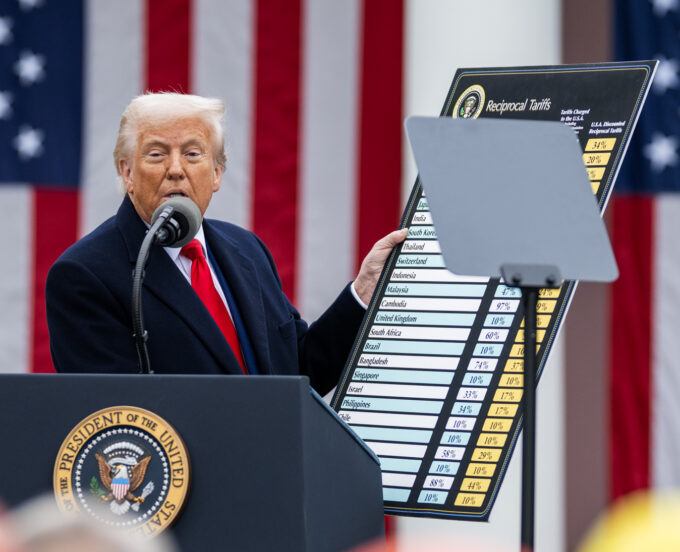
There was much that Trump said in his Rose Garden address that made little sense. He repeated his bizarre claim that the United States had its greatest period of prosperity in the 1890s. This was a time when workers put in seven days a week, unions were largely illegal, and life expectancy was less than 50.
He then attributed the Great Depression to the income tax, and had it continuing after World War II and President Roosevelt’s death. In Trump’s telling of history, the post-war Golden Age from 1945 to 1973 did not exist. This was a period when the economy was growing rapidly, the gains from growth were broadly shared, and the top income tax rate was between 70 percent and 90 percent.
Trump’s account of the present was no more based in reality than his history of the United States. He told us that our trading partners and closest allies were all ripping us off.
Canada is one of the prime villains in Trump’s story. This is based on their trade surplus with the United States, which Trump insists is $200 billion a year. In reality, Canada’s trade surplus is roughly $60 billion, and this is all due to the oil we import from them. Without our oil imports, we would have a trade surplus with Canada.
Ironically, Trump encouraged us to import more oil from Canada in his first term in office. Apparently, he has now decided that they are ripping us off by selling us the oil he wanted us to buy.
The fact that Trump’s aides have been unable to get him to correct his imaginary Canada trade surplus number is a clear warning that Trump’s big tariffs are not grounded in reality. There are certainly issues that can be raised about trade, and our policies have often not benefited the country’s workers.
The rapid expansion of trade with China and other developing countries in the first decade of this century cost us millions of manufacturing jobs. It also devastated manufacturing unions. As a result, the unionization rate in manufacturing is now barely higher than in the rest of the private sector. The historical wage premiumpaid in manufacturing has largely disappeared.
But it is a huge and absurd jump from this fact to Trump’s claim that all of our trading partners are ripping us off. In fact, in the course of his rambling address Trump gave a great example of how trade was benefitting the country.
An outbreak of Avian flu sent egg prices soaring when Trump first took office. In response to the record high prices, Trump’s Agriculture Secretary negotiated huge purchases of eggs from South Korea and Turkey, making our trade deficits with both countries larger. Nonetheless, Trump boasted about how his administration had brought egg prices down.
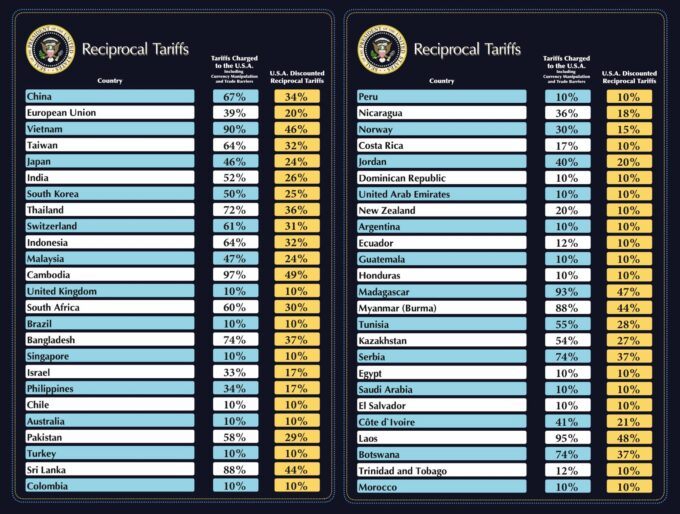
It was this sort of warped thinking that is the basis for the massive tax that Trump is imposing on the goods we import from our trading partners. Incredibly, it turns out that the tax rates Trump put in place, from 10 percent on goods from the UK to 49 percent on Cambodia, which were ostensibly “reciprocal” tariffs, bear no relationship whatsoever to the tariffs or trade barriers these countries place on our exports.
Instead, Trump’s team calculated our trade deficit with each country and divided it by their exports to the United States. Trump decided that this figure was equal to that country’s tariff on goods imported from the U.S.
Trump’s method of calculating tariffs is comparable to the doctor who assesses your proper weight by dividing your height by your birthday. Any doctor who did this is clearly batshit crazy, and unfortunately so is our president. And apparently none of his economic advisors has the courage and integrity to set him straight or to resign.
This first appeared on Dean Baker’s Beat the Press blog.
Trump’s Crazy Trade War
April 7, 2025

Image by Getty and Unsplash+.
A Scatter Gun Approach
The Trump tariff shock is going to take a bit of time to sink in, though stock markets worldwide have already sunk. Altogether, 60 countries have been slapped with at least 10 percent tariffs; those with large trade surpluses with the US will pay a much higher rate. Trump’s public argument was two-fold: force US trade partners with the highest surpluses to lower their tariffs on US imports, and encourage US and other multinational firms to move their manufacturing to the US.
Interestingly, the tariff announcement did not apply to Russia, North Korea, Cuba, and Belarus, supposedly because they don’t run a trade surplus with the US. Except that Russia does.
On the other hand, Japan, South Korea, Taiwan, Israel, Ukraine, and just about every other country, whether friend or foe, was not spared, with tariff rates ranging from 24 to 40 percent. Even Britain, whose prime minister had thought the invitation to Trump from the king for a visit would help put off a tariff increase, was not spared. Nor for that matter were several islands that are not countries and have no humans. Everyone must pay.
The formula used to determine the tariff rate makes little sense to experts. It supposedly was based on other countries’ tariffs on US goods, but in fact a Washington Post specialist determined that the White House used “a very simplistic formula: Our trade deficit with that country, divided by the country’s exports to us. That’s a measure of something, but it’s not, strictly speaking, about tariffs. It’s about a trade imbalance.”
The European Union countries and China so far are the only ones that have vowed retaliation. The French reaction was typical, with President Emmanuel Macron saying the 20 percent tariff hike should mean “not to invest in America for some time until we have clarified things.” Those EU countries most exposed actually are not France, Spain, or Italy but Ireland, Belgium, and Germany. But the EU economy makes up 22 percent of global GDP and so is in a position—which the EU Commission strongly supports—to fight back, with the US services sector the most lucrative target. Still, the EU faces problems if it decides to retaliate, especially in the energy sector, because of its reliance on US natural gas. Reports suggest that while the EU will discuss imposing some tariff hikes, it will stop short of a trade war and seek a negotiated settlement with Trump. After all, its trade surplus with the US was around $200 billion in 2024, second only to China’s surplus. The EU doesn’t want to antagonize Trump further.
Misreading China
In the first months of 2025, speculation was rife about Trump’s plans for tariffs on Chinese imports. China’s trade surplus with the US stands at nearly $300 billion. The question was: How high would he go?
The thinking in Washington, as best I can surmise, was that high tariffs would complicate China’s already serious economic situation, since Beijing depended heavily on exports. Close off the US market, as Project 2025 proposed, and Xi Jinping would not only be in political trouble at home; he would have to ponder what an invasion of Taiwan would cost.
Trump made a head-spinning prediction that China would never invade Taiwan because of the 150-200 percent tariffs he once threatened to impose—as well as his belief that Xi Jinping “respects me and he knows I’m f***ing crazy” (Wall Street Journal, October 18, 2024).
Trump imposed two 10 percent tariffs on China earlier this year. Now he has hit China with a further 34 percent reciprocal tariff. Trump also announced an end to the so-called de minimis policy that has become popular among e-commerce companies. A 30 percent import duty will apply to packages valued under $800. The de minimis policy had led to millions of cheap Chinese goods entering the US virtually duty-free.
Ordinarily, China would have the option of shifting manufacturing to Southeast Asia for shipment of goods to the US in order to avoid the high US tariffs. But Trump has made that option less attractive by imposing very high tariffs on those countries as well—such as 46 percent on Vietnam and 36 percent on Thailand. The tariffs will put a major crimp in those countries’ aspirations to become the next China. They will either have to bargain for lower rates, or, like Vietnam, abolish all tariffs on US goods and hope for a reprieve.
Strategically, the tariffs put Southeast Asia and China in the same boat, with Beijing in a position to work out a new regional trade order with itself at the center. Weakening the economies of countries friendly to the US and wary of China doesn’t jibe with Trump’s China strategy.
Some observers have speculated that Trump’s heavy tariffs on China were designed to force Xi Jinping to the bargaining table at a summit meeting, where a new trade deal favorable to the US would be worked out. But that was a sadly mistaken reading of Chinese thinking.
A Chinese foreign ministry spokesperson said last month that the Trump administration was “weaponizing trade issues to contain and go after China.” The spokesperson warned that a tariff war would “hurt the one who launched it.” Now China has followed through, imposing the same 34 percent tariff on US exports that Trump imposed on China—plus restrictions on rare earth minerals and 11 companies that will no longer be able to do business in China. Trump can forget about a summit meeting with Xi anytime soon.
An Avoidable Calamity
What is particularly noticeable about this tariff war is that the Trump people have not indicated what their goal is, or whether they have an end game. Are the tariffs the opening move in an effort to bring foreign tariffs down? If so, does the administration want to negotiate tariff rates, or is it mainly interested in punishing countries with trade deficits with the US?
Each country’s trade relationship with the US is different. Trump’s team doesn’t seem to accept that and act accordingly. Negotiating new trade deals would have been the normal way to proceed when trade deficits are believed to have become unsustainable.
Perhaps the main purpose of Trump’s tariff war is political, not economic: to show his followers how tough he is. In which case he may have committed the greatest blunder in modern international economics.
“Liberation Day” has already proven to be “Disaster Day.” Trump will not retreat, however, no matter the cost to consumers and businesses. He’ll justify the tariffs until the day he leaves office—in disgrace.