Sunday, April 20, 2025

PAKISTAN

HEALTH: BRINGING ‘DR BAHU BACK TO WORK

Hussain Dada 
Published April 20, 2025  
DAWN
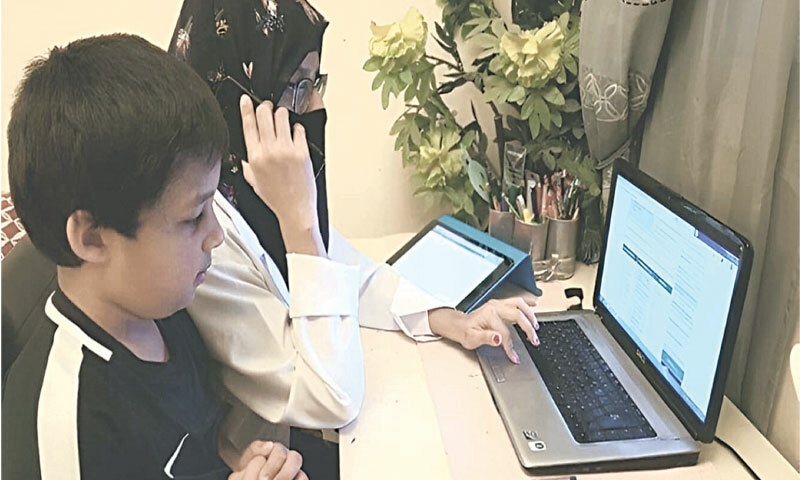
A doctor, with her child next to her, provides remote video consultation as part of the eDoctors project | Educast

Dr Adeya Ahmed comes from a family of doctors. After completing her five-year MBBS degree from the Karachi Medical and Dental College in 2011, she started her house job at a local hospital.

Two years later, she got married and, as happens with a disproportionate number of female medical graduates, Dr Adeya opted to take a break from her career to “focus on her family.”

For the majority, this break can stretch interminably. It can be for a variety of reasons, ranging from personal preferences — as was the case with Dr Adeya — to family restrictions, societal expectations of traditional gender roles and challenges within the healthcare system, such as long and odd hours without commensurate pay.

A collaborative research by Gallup Pakistan and Islamabad-based PRIDE Consultancy, based on the 2021 Labour Force Survey of the Pakistan Bureau of Statistics, found that 35 percent of the 104,974 female medical graduates in the country at the time were either unemployed or had opted out of the labour force.

Professor Jahanara Hassan, who is the pro-vice chancellor at the Dow University of Health Sciences (DUHS), echoes these findings. She tells Eos that, in a batch of 500 MBBS students, around 70 percent are women. “Of these women, roughly around a third end up not practising,” she says.

A significant number of female medical graduates end up not practising medicine, wasting educational investments and further burdening Pakistan’s fragile healthcare system. But one digital education and healthcare platform is determined to change that…

At least one third of medical students — of both genders — also aspire to practise abroad, which contributes to the healthcare crisis in Pakistan. According to one article published in The Lancet in 2013, Pakistan’s health system: performance and prospects after the 18th Constitutional Amendment, the doctor-to-patient ratio was estimated to be around 1:1,524, significantly less than WHO’s recommended ratio of 1:1,000.

THE POTENTIAL OF TELEMEDICINE

Dr Adeya is now among the roughly 1,500 female doctors who have returned to medical practice. They started as part of the eDoctors project of Educast, a Karachi-based social enterprise which started as a virtual education platform in 2016, before expanding to digital health and training.

The idea was to bring back women who had left medicine, sometimes referred to as ‘doctor bahus [daughters-in-law]’, back into the workforce, says Abdullah Butt, Educast’s founder and chairman.

Educast rolled out the eDoctors pilot programme in 2018, with the help of DUHS, and Dr Adeya was one of the applicants. “We had expected 15-20 queries, but we received 350 applications,” Butt tells Eos.

They selected 280 applicants, who went through a rigorous, albeit flexible, six-month online refresher course, designed in coordination with DUHS and sat through an exit exam.

This worked for Dr Adeya, who could keep track of her toddler at home while taking the course. This flexibility also allowed Dr Faizah Ayub — who graduated in 2000 and is now living in the Middle East with her family, including four children — to return to medicine.

Both women say that they had kept in touch with developments in the healthcare field, which facilitated their reintegration. It also helped that their families were supportive, they pointed out in separate phone interviews with Eos.

But it wasn’t all easy going.

Butt, who is in his sixties, points out that the applicants ranged from people who had graduated in the 1980s to those who had passed out only a few years ago. “Some applicants lacked the digital know-how required to take part in online sessions,” he tells Eos.

There was also the issue of clinical experience, with successful candidates paired with clinics. For doctors based abroad, Educast has to organise ‘shadowing sessions’ in Pakistan — in which the out-of-workforce doctor observes a practising doctor in person and ask questions about patient handling for hands-on experience — during the candidates’ visit to the country.

It was challenging, continues Butt, before adding that their efforts were surely bearing fruit, as their graduates started providing medical services.

Then came the pandemic.
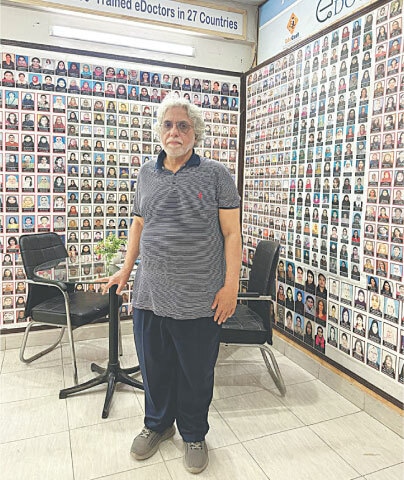
Abdullah Butt, the founder and chairman of Educast, stands before a panaflex backdrop in his office, with photos of the 1,500 reintegrated female doctors | Photo by the writer


THE COVID FILLIP

As the world went into lockdown mode in the face of an inexplicable virus, the demand for medical expertise skyrocketed.

In 2020, the Educast team volunteered its services to the Sindh government, training 450 such female doctors, who went through a Covid-19 specific course designed by the Stanford University School of Medicine. “For the next two years, these reintegrated women doctors monitored and treated Covid patients remotely, with 500,000 patients benefitting from their voluntary service,” states Butt.

Butt points out that most doctors are paid a nominal retainer. “For those working part time — which is four hours a day, four days a week — we pay at least 30,000 rupees,” he says. For those putting in more hours, the remuneration goes up substantially.

However, some of them also volunteered their services.

“I studied medicine because I wanted to help people,” says Dr Adeya. “The blessings I receive from my patients are enough,” she continues.

The investment in telehealth and developing a cohort of medical practitioners has since given Butt his just rewards.

GETTING BIGGER BY THE DAY

Also in 2020, eDoctors was selected from among 5,000 projects in a competition organised by the Islamic Development Bank (IsDB). This allowed Educast to scale up their projects, from remote consultations and interventions to rapid tests for diagnostics, and to make the remote online clinics available on doctors’ smartphones. This includes 16 types of blood and urine rapid tests, including for cholera and Covid-19.

Today, reveals Butt, their 1,500 doctors are spread across 27 countries and providing remote medical services in 11 countries, including partnering up with local organisations in sensitive or fragile states with poor health infrastructure, such as Yemen, Sudan, Somalia, Afghanistan, Syria and Palestine.

“In Yemen, we have been operating for the last three years, providing training to doctors and paramedics,” he tells Eos. In remote areas, paramedics are provided telemedicine equipment to monitor patients and gather their biomedical data, to be shared with overseas experts to provide assessments and treatment, he continues.

“We are probably the only company in the world using technology, artificial intelligence-based healthcare platforms, and robotic interventions to fetch data,” Butt adds.

Similar projects are underway in other countries, with the support of the IsDB and the Organisation of Islamic Cooperation, who were instrumental in setting up the Afghanistan Humanitarian Trust Fund.

With their support, Educast carried out a pilot project in six Afghan provinces last year. During the project, 1,000 consultations were provided, benefitting 5,000 individuals, reveals Butt. “Educast also trained 1,500 local healthcare professionals and work on setting up 20 medical education facilities is underway,” he adds.

GOING FULL CIRCLE

Butt’s latest intervention is focused on elderly care, for which his company has partnered with local universities, which require their students to undergo mandatory community service. Students of participating universities are required to spend time with elders — for now of their own families.

Butt says it has benefitted both parties, with the interaction between students and their elders — usually grandparents. “The youth learn new things about themselves, their families, and are better prepared for their future, while the senior citizens feel reinvigorated,” he says.

Butt’s drive for the elderly care project appears to come from the same place that made the eDoctors project a success: remembering the value and skills of those who are in the process of being phased out by society.

For Dr Adeya, now 38, the project served as a catalyst not only to re-enter the workforce and pursue her passion, but to also build on her skills. Last year, she completed her MCPS in Family Medicine, a postgraduate programme offered by the College of Physicians and Surgeons in Pakistan.

She aspires to achieve more in her career and is already working as a family physician. For that, some of the credit surely goes to Abdullah Butt and Educast.

*The writer is a member of staff. He can be contacted at hydada@gmail.com

Published in Dawn, EOS, April 20th, 2025
PAKISTAN

Railway traffic restored in Sindh’s Khairpur after nationalist parties block track over canals issue

Mohammad Hussain Khan 
 April 20, 2025 
DAWN

Railway traffic on a track near Sindh’s Khairpur city was restored after activists of some nationalist parties blocked a section of it on Sunday in their ongoing agitation against the much-protested plan to build six new canals on the Indus River.

Chief of the Army Staff Gen Asim Munir and Punjab Chief Minister Maryam Nawaz inaugurated the ambitious Cholistan project to irrigate south Punjab’s lands on February 15 amid public uproar and strong reservations in Sindh. The Sindh Assembly also passed a unanimous resolution against the project in March.

The past few months have seen nationwide protests from political parties, including the ruling coalition ally PPP, and residents against the proposed project.

“The track was blocked at around 11:30am today in Khairpur city area but that blockade has been lifted and normal flow of railway traffic has been restored”, Imran, a railway official in Sukkur’s chief controller office, told Dawn.com.

The blockade of the railway track was reported in the Sukkur division and not in the Karachi division’s limits, which end at Tando Adam in Sanghar district, according to Karachi deputy chief controller Shakeel Memon.

The protest on the tracks was led by Amjad Mahesar, senior vice chairman of the Jeay Sindh Qaumi Mahaz (Bashir), in response to his party’s call for a shutter-down strike in Sindh.

Mahesar told Dawn.com, “The tracks at Luqman railway crossing remained closed for around three hours by party activists under his leadership and the blockade ended after the protest.”

He termed the strike as “successful”, claiming that the Khairpur city remained “completely closed”.

The contentious $3.3 billion Green Pakistan Initiative (GPI) launched by the federal government to develop six canals to irrigate 1.2 million acres of “barren land” in south Punjab has been strongly opposed by the PPP, which is in power in Sindh, as well as farmers and other stakeholders.

Additional Attorney General Mohsin Qadir Shahwani has informed the Sindh High Court that work on the canals project had been stopped in compliance with its earlier restraining order.

On April 18, PPP Chairman Bilawal Bhutto-Zardari threatened the ruling PML-N against continuing down the path of confrontation with Sindh over the issue of new canals on the Indus River.

While addressing a large public gathering at the Hatri Bypass Ground on Friday night, he said his party would not go along with the federal government if it did not shelve the controversial project, even after acknowledging the PPP’s objections.

Finally, the federal and Sindh governments agreed today to resolve the contentious canals project issue through dialogue, after PML-N President Nawaz Sharif and Prime Minister Shehbaz Sharif ordered that talks be held over the matter.

The canals controversy has deepened with Sindh Chief Minister Murad Shah strongly criticising the Punjab government for increasing water being diverted to the TP Link Canal. The Indus River System Authority (Irsa) claimed to have taken all decisions as per the law.
Lawyers continue sit-in, block highway in Khairpur

Meanwhile, lawyers also blocked the national highway at Babarloi bypass in Khairpur district, continuing their indefinite sit-in against the canals project that they began on April 18.

The demonstration was being staged in response to the Karachi Bar Association’s (KBA) call, which was backed by the Sindh High Court Bar Association (SHCBA) and other lawyers’ bodies.

The protest was being jointly led by KBA President Aamir Nawaz Warraich, Hyderabad District Bar Association (HDBA) President Ashar Majeed Khokhar, HDBA General Secretary Masood Rasool Memon, SHCBA Hyderabad President Ayaz Tunio and other bar associations’ representatives.

SHCBA’s Tunio said the railway track was blocked by some protesters but then the protest on the track ended, allowing the railway traffic to proceed. “People requested the protesters that train passengers would suffer badly, therefore they ended the blockade”, Tunio told Dawn.com over the phone.

Also present at the protest site, HDBA’s Khokhar told Dawn.com on a phone call: “Our 10-member standing committee, of which I am also a member, will meet tomorrow to decide whether to block the railway track or resort to a boycott of court proceedings.”

He claimed that lawyers were facilitating the passage of ambulances and vehicles for women and families during the ongoing sit-in. “They are being allowed [to pass] safely. It is only trucks and other goods-carrying vehicles that are not given passage on the road”, Khokhar said.
‘Organised’ attacks on fast-food chains only harm Pakistanis, don’t help Gaza: Azma
Published April 20, 2025 

Punjab Information Minister Azma Bokhari on Sunday criticised the recent attacks on international fast-food outlets across the country, pointing out that they were carried out in an “organised” manner without providing any support to Gaza.

Her statement comes after a string of recent attacks on outlets of international fast-food chains across Sindh and Punjab — as a form of protest and boycott against Israeli atrocities in Gaza — with an incident in Sheikhupura claiming the life of a worker.

Speaking about the incidents during a press conference in Lahore, Bokhari said: “All these attacks were clearly carried out under an organised plan; it was not something that happened on the spur of the moment. That is absolutely not the case.

“It is important to note that all these attacks are taking place according to a plan in Punjab only,” she claimed. Attacks on fast-food outlets of international chains have also been reported in Sindh’s Karachi, Mirpurkhas and Larkana.

Asserting that Punjab was “making rapid progress”, the PML-N leader reiterated that an “extremist group was doing such acts with proper planning”.

The Punjab minister again warned that miscreants would be dealt with “iron hands and would not be spared”. The PML-N leader said there “may be political terrorists or inciteful people in the society who were carrying out their activities in recent days”.

Answering a question, Bokhari said the government has a “strict eye on these groups”, adding that arrests have been made and the suspects would be brought to justice.

She said the government would decide when it was appropriate to disclose details, adding that the groups “did not want Pakistan’s peace or progress and had the old habit of using religion and doing politics over bodies”.

The Punjab minister also urged courts to give the perpetrators “exemplary punishment”.

She stressed that fast-food outlets were franchises bought by Pakistanis and where Pakistanis worked.

“If the 25,000 Pakistanis who work there become unemployed, will it benefit the people of Gaza? Or will these oppressed people of Gaza benefit in some way from these attacks? It is [only] causing loss to Pakistan […] and they are trying to deface Pakistan that God-forbid businesses cannot be run here,” she said.

The PML-N leader asserted that her party’s Punjab government would not allow “anyone to take the law and order into their hands, whether it is in the name of religion, solidarity or political terrorism”.

“The kind of fire they are trying to set alight … these people are neither Pakistanis nor love Pakistan. These are those who do not like peace, investment or development in Pakistan. There could also be some foreign hand involved in this that wants to destabilise Pakistan,” she said.

The Punjab minister highlighted that Palestinians had not “taken up arms but were giving their lives” and stressed that Islam guaranteed the protection of people’s lives.

“What was his fault?” Bokhari asked, referring to the slain worker in Sheikhupura.

She called on the society and the media to discourage such attacks, highlighting that various political and religious parties were carrying out peaceful protests, on which “no one has any objections”. She added that the armed forces had also expressed their commitment to thwart the actions of terrorists or violent groups.

Sharing details of the attacks, Bokhari said a total of 149 “miscreants” had been arrested so far for their alleged involvement and 14 first information reports (FIRs) had been registered.

Giving a district-wise breakdown, she stated that 71 suspects were taken into custody over the Sheikhupura case where a worker was killed; 33 people were arrested in three cases in Rawalpindi; 11 suspects were held over three FIRs across Lahore, while another 11 were detained in a Multan case.

Moreover, eight individuals were arrested in a case in Gujranwala; seven persons were held over two cases in Bahawalpur; six people were taken into custody in Sahiwal; and two were arrested in Rahim Yar Khan, while an FIR was also registered in Faisalabad.

Responding to a query, Bokhari stressed that renowned clerics need to talk about the matter “more strongly” to create awareness among the public about the attacks causing losses and harm to the citizens.

The minister noted that the government was taking actions to help Palestinians, including the dispatching of aid for the besieged enclave.

The Israeli offensive on Gaza, which began in response to Hamas’s unprecedented attack on Oct 7, 2023, has killed more than 50,000 Palestinians and destroyed much of the housing and hospital infrastructure in the enclave. The death toll is feared to be much higher due to thousands still missing under the rubble.
Attacks on outlets

At least three restaurants in Karachi were attacked between April 7 and April 9, with another one being foiled on April 10. The police said they had booked and arrested 10 activists of the religio-political party Tehreek-i-Labbaik Pakistan (TLP) for one of the incidents.

Other parts of Sindh also witnessed such attacks as miscreants set a restaurant on fire in Mirpurkhas and pelted stones at a KFC outlet in Larkana the next day.

In Lahore, 11 TLP activists were held for pelting stones at and damaging an outlet of a fast-food chain in the city’s Defence Housing Authority.

After an April 14 attack on a restaurant in Rawalpindi, the police said the vandals involved had been traced through closed-circuit television (CCTV) cameras. The next day, the Islamabad police said they had detained five people who were involved in vandalising a restaurant in the capital’s E-11 sector.

However, an incident in Punjab’s Sheikhupura turned deadly as an employee present at the outlet was killed as armed men opened fire at it on April 14, the same day the TLP had called for an anti-Israel protest.
PAKISTAN


JI strongly condemns Israel for its ongoing onslaught in Gaza, announces countrywide strike on April 26

Published April 20, 2025 
DAWN
Jamaat-i-Islami Central Ameer Hafiz Naeemur Rehman addresses the ‘Palestine Solidarity March’ in Islamabad on April 20. — DawnNewsTV

Strongly condemning Israel for its ongoing military onslaught in Gaza, the Jamaat-i-Islami (JI) on Sunday announced a nationwide strike on April 26, urging to boycott products that financially support Israel.

The strike was announced by JI Central Ameer Hafiz Naeemur Rehman, as he delivered a fiery speech to the party’s ‘Palestine Solidarity March’ in Islamabad. The demonstration protested Israeli atrocities in Gaza and took place on the Islamabad Expressway.

The Israeli offensive, which began in response to Hamas’s unprecedented attack on October 7, 2023, has killed more than 51,000 Palestinians and destroyed much of the housing and hospital infrastructure in the enclave. The death toll is feared to be much higher due to thousands still missing under the rubble.

Addressing the demonstrators, the JI chief announced a nationwide strike on April 26.


“From Chitral to Karachi … we will hold a full strike,” he said. “We will go from shop to shop and tell them to keep business activities suspended on April 26. We will wage a jihad (holy war) through boycotts, strikes, and social media [campaigns].”

He urged JI supporters to avoid using products that financially support Israel.


Supporters of the Jamaat-i-Islaami (JI) party hold a poster as they gather in solidarity with Palestinians during a protest in Islamabad on April 20. — AFP

Rehman also urged people to stand up for Palestine and “fight for the Palestinian cause”.

“Regardless of whether you have a gun or political power, if you face Israel, you will be destroyed,” he said. “Stand up and fight for the Palestinian cause. Stand up and condemn Israel. Stand up to America.”

He asked his supporters to send a message to the US, saying: “We are not your slaves, as the Prophet’s [PBUH] servants do not recognise the US or Israel’s slavery.”

The JI chief also demanded that Pakistan formally recognise Hamas and open an office for them.

“We demand that a Hamas office be opened in Pakistan and that they be formally recognised,” Rehman said. “They are a legitimate power and registered movement, and an army according to the UN Charter.

“They are also a democratic force; they won elections in 2006,” he said. “America did not accept the results … they are an enemy of democracy, and now a genocide is taking place in Gaza before their eyes.”

Rehman also accused both the government and the opposition of not doing enough to support Palestinians.

“The opposition does nothing unless it furthers their own aims,” Rehman said. “They do not raise their voices for Palestine and do not condemn America. Whether it is the government or the opposition, they will continue to bow to America. Whatever they have will be erased.”


Supporters of the Jamaat-i-Islaami (JI) party hold Palestinian flags during a protest in Islamabad on April 20. — AFP

The JI chief said that this is not only a matter of humanity, but of faith.

“People tell us to speak about humanity, but our humanity is grounded in our religion,” Rehman said. “Gaza is a pile of rubble, children are being targeted, but the [Israeli] hostages are being protected by Hamas.”

Rehman said that unlike Hamas’ treatment of captives, Israel’s treatment of Palestinians in jails was “disrespectful”.

“Children have been imprisoned for 20 years, that is Israel,” he said, adding that Hamas was “showing true humanity” and “acting following Islam”.

Earlier, the party said it would march towards the high-security Red Zone, but later negotiated with the Islamabad administration and decided to march to the alternate venue to maintain the law and order situation.

The Margalla Gate, however, was left open for the public, but a heavy contingent of police was deployed there, as JI supporters advanced towards the capital in solidarity with Palestinians amid Israel’s bloody military campaign in Gaza.

JI Islamabad Information Secretary Amir Baloch said today that the party will march on the Islamabad Expressway as “matters have been settled between JI and the Islamabad Administration.”

“The JI has decided not to march towards the Red Zone and will march for Gaza on the Islamabad Expressway,” Baloch said in a statement. “We’ll march near Zero Point and a stage will be set up on H8 Overhead Bridge, while our central leaders, including Jamaat-i-Islami Pakistan Emir Hafiz Naeemur Rehman, will address the rally.”

According to a Dawn.com correspondent at the scene, demonstrators were allowed to enter the expressway via Double Road and IJP Road. The correspondent reported that containers have been moved, but added that in case of an emergency or deteriorating security, they will be placed again.


Pakistani and Palestinian flags are hoisted at D-Chowk in Islamabad amid the Jamaat-i-Islami’s ‘Palestine Solidarity March’ on April 20. — Umar Bacha

Additionally, police had increased security in the capital for the arrival of a “foreign guest”.

“Due to the arrival of a foreign guest in Islamabad on 20 April 2025, from 7pm to 9pm, extraordinary security arrangements have been made at various times at Karal Chowk, Express Highway, Khanna Pul, Faizabad, Club Road, and Radio Pakistan Chowk,” the Islamabad Police wrote on X.

“Due to the route, there will be some temporary disruptions in traffic flow on the Express Highway. Traffic will experience slowdowns,” the statement added.

Citizens were advised to use the service road connected to the Express Highway and to leave for their destination 20 minutes early.

Separately, the Foreign Office announced the arrival of the Deputy Prime Minister of the United Arab Emirates on Sunday evening.

A statement said that Sheikh Abdullah bin Zayed Al Nahyan would visit Islamabad to hold talks with his counterpart Ishaq Dar on “the entire spectrum of bilateral relations, with particular focus on trade and investment, energy cooperation, regional security and people-to-people linkages”.

The JI had originally scheduled the protest for Sunday at 3pm outside the US Embassy within the Red Zone. However, in response to the lockdown, JI General Secretary Amirul Azeem announced an alternative protest location in a video message. He urged participants to head toward Zero Point, at the Srinagar Highway exit near Faizabad.

Due to the roadblocks and heavy rain, only a small group of protesters had reached Zero Point by around 3:45pm. They began chanting slogans against Israel and the United States. The larger contingent of protesters had yet to arrive at the new protest site.

Last week, thousands of Karachi residents gathered on the city’s main roads for Gaza solidarity marches organised by two religio-political parties, where the participants expressed solidarity with Palestinians in Gaza amid Israel’s bloody military offensive.

According to the JI’s press release, people from all walks of life attended the demonstration, called by party chief Hafiz Naeemur Rehman, including representative bodies of lawyers, teachers, traders, doctors and other professionals.
Capital police issues traffic plan

According to a traffic advisory issued by the Islamabad Police, “due to law and order, the entry and exit routes of the Red Zone, including Serena [Hotel], Nadra, Marriott and Express Chowk” would be temporarily closed until further notice.

The advisory urged citizens going to the Secretariat and the Red Zone to use Margalla Road, while citizens heading to Faizabad and Rawalpindi from Rawal Dam Chowk should use Kashmir Chowk, Srinagar Highway, 9th Avenue or Double Road.

“Citizens going to Rawalpindi from Karaal via Express Chowk should use Old Airport Road, Rawal Dam Road and 9th Avenue Double Road,” the advisory added. “From Ojri Loop, use Express Highway Dhok Kala Khan Service Road. Zero Point is closed for Faizabad.”

Motorists in Islamabad encounter shipping containers on their route amid the Jamaat-i-Islami’s ‘Palestine Solidarity March’ on April 20. — Umar Bacha

For citizens heading to Karaal via Faisal Avenue, Rawalpindi Murree Road and Srinagar Highway, the police recommended they use the 9th New Double Road, Rawal Road and Old Airport Karaal Chowk to reach their destination.

Citizens coming from Murree to Islamabad from Faizabad via Rawal Dam Chowk were urged to turn left to Karaal Chowk, and travel to the old airport, from Karaal Chowk, Rawal Road Rawalpindi, Murree Road and double road.

“Citizens going from [the] New Airport to Murree/Bahara Kahu can use Peshawar Sadar Road,” the police added.

“From Kashmir Highway, use the 9th Avenue Double Road from Rawal Road to the old airport, up to Latrar Road, then Park Road, Rawal Team Kashmir Chowk to Murree/Bahara Kahu.”

Citizens leaving Islamabad were urged to use the 9th Avenue double road to go to Rawalpindi via Faisal Avenue, while those coming from Muzaffargarh were instructed to use the Ambassador Hotel 7th Avenue or G-6.

“From GPO Chowk, use 7th Avenue or Fazal Haq Road Jinnah Avenue,” the advisory added.
SMOKERS’ CORNER: THE DEATH OF FEUDALISM
Published April 20, 2025 
DAWN

Illustration by Abro

Often, when analysts and journalists stationed in Punjab and Islamabad air their views on the politics of Sindh, the one word they like to use repeatedly is ‘feudalism’. This word is also used by many Mohajirs residing in Sindh’s cosmopolitan capital, Karachi. Sindhi intellectuals see this portrayal as a political construct to project the Sindhis as mindless beings dominated by landlords.

Indeed, at the time of Pakistan’s creation, feudal elites in Sindh were politically influential. But what often gets missed is the fact that some members of the landed elites and an, albeit small, Sindhi middle class, worked together to vanquish feudalism.

When the erstwhile West Pakistan was clubbed together as a single province (‘One Unit’) in the mid-1950s, this accelerated the development of Sindhi, Pakhtun and Baloch nationalisms. According to Dr Asma Faiz in her book In Search of Glory, as Sindh’s landed elites clashed among themselves over the issue of One Unit, the main push against One Unit came from middle class Sindhi youth.

However, some of these came under the tutelage of GM Syed, an intellectual and politician who belonged to a landed family and was revered as a spiritual guide of sorts. Dr Asma wrote that, in the late 1960s, this pairing took a ‘cultural turn’, producing literature and narratives of Sindhi nationalism as we know it today.

Contrary to popular mainstream narratives, feudalism in Sindh has long been in decline as a new middle class and urban elite are reshaping the province’s political and economic landscape

During the rise of Z.A. Bhutto and his Pakistan Peoples Party (PPP) in the late 1960s, the middle class faction of Sindhi nationalism collided with Syed’s ‘spiritual’ strand. Bhutto, a member of Sindh’s landed elite, rhetorically disowned his own class. Even though he wanted to attract the rising popularity of Sindhi nationalism to his side, he consciously diluted his party’s views on Sindhi nationalism’s main ‘enemy’, the Punjabis, because he had developed an impressive vote-bank in Punjab.

Whenever he faced crowds in Sindh chanting the slogan ‘Jeeay Sindh’ [Long Live Sindh], he encouraged his supporters to quickly follow it up with a ‘Jeeay Pakistan’ [Long Live Pakistan] slogan. In 1975, Sindhi intellectuals were invited by the Bhutto regime to a conference on Sindh in Karachi. This conference went a long way in aiding the PPP to usurp the narrative of Sindhi nationalism and put it in the context of Pakistani federalism.

During a violent 1983 protest movement in Sindh against the Ziaul Haq dictatorship, G.M. Syed sided with the dictatorship. Syed’s critics claimed he did this to spite the PPP and safeguard the interests of landed elites in Sindh. Syed responded by saying that the PPP and Zia were two sides of the same coin.

Due to the mass exodus of Sindhi Hindus from Sindh during Partition, the development of (Muslim) Sindhi-speaking middle classes was slow. Political parties needed to get ‘electables’ from the landed elites. But this began to change.

In 2012, the Sindh historian Hamida Khuhro declared that “feudalism does not exist in Sindh anymore.” The same year, Dr Muzaffar A. Isani wrote in Dawn, “Let me state categorically that feudalism as a system of organising production and defining production relations does not exist in Sindh anymore…”

Already in 2000, the political economist S. Akbar Zaidi had questioned the manner in which the word feudalism is used in Pakistan. He wrote, “In the media, the term ‘feudalism’ is used for every sort of injustice, excess and misuse of power that takes place in the country…”

He then concluded that it was time to dispense with this label because a new moneyed class had risen, replacing the influence of the archetypal ‘wadera’ [feudal lord]. The new moneyed class in Sindh includes industrialists, entrepreneurs, traders and white-collar professionals etc.

In a 2024 essay, the economic journalist Farooq Tirmizi wrote that, in the mid-2000s, the value of agricultural land began to stagnate. This means that landed elites are losing their influence because the value of agricultural land hasn’t kept up with the rising value of other assets.


In Sindh, for example, on the one hand, people outside the landed elites are exploring more ‘urbane’/non-agricultural economic avenues and, on the other hand, the landed elites are diversifying by investing in urban real estate, industry etc.

So where is the PPP in all this? Its vote-bank has witnessed a manifold increase ever since 2008 and it is heading its fourth consecutive government in the province. Reports by FAFEN (Free and Fair Election Network) on the 2018 and 2024 general elections show that the party in Sindh received votes from across classes. In fact, in 2018, 51 percent of the total votes that the PPP received in Sindh were cast by Sindhi-speaking women from the middle classes and the peasant classes.

According to the researcher Sartaj Khan, the PPP manoeuvred Sindh’s rural elite and the emerging Sindhi middle classes to formulate a voting bloc which has sustained the party as Sindh’s ruling party from 2008. Sartaj wrote that, as the emerging professional and middle classes came in a position to assert political influence, the PPP recognised this shift and sidelined the traditional landed aristocracy. The party began promoting members of the rising middle classes to key positions. The traditional Sindhi feudal elites are now mostly accommodated by the anti-PPP Grand Democratic Alliance (GDA).

The image in non-Sindhi imagination of a wadera holding a gun over the heads of poor peasants and forcing them to vote for him is silly and outdated. There is now a vibrant Sindhi middle class and a nouveau riche class that has increasingly accumulated economic and political influence.

Recently, I came across a photo of an eatery in Khairpur that is mostly frequented by middle class Sindhis. On the walls of the eatery were paintings of Z.A. Bhutto and his daughter Benazir, alongside a portrait of G.M. Syed. To me, this reflected the fact that the Sindhi middle classes may have sympathies with the current lot of Sindhi nationalists, but their votes are largely cast for the PPP because their economic interests are linked to the political fate of the party.

Sindhi nationalists claim to represent middle class Sindhis, yet they end up allying with the last bastion of old-school feudalism, the GDA. They also try to pitch a Bhutto against a Bhutto. But the late-Murtaza Bhutto failed in electoral politics, his daughter Fatima stepped away after becoming a critic of her aunt Benazir, and now there is Murtaza’s son, Zulfikar Ali Bhutto Jr — who has declared he is not joining the GDA after voicing support for its struggle against the canals project.

Exhibited as ‘true Sindhis’, they eventually turn into nothing but props paraded for a media that is more interested in certain Sindhi personalities than in exploring why so many learned scholars are declaring feudalism’s death in Sindh and why the PPP continues to win there.

Published in Dawn, EOS, April 20th, 2025


BALOCHISTAN IS A COUNTRY


Highway to nowhere: How the BNP-govt standoff is choking Balochistan’s economic lifeline

The ongoing road blockades have significantly disrupted trade, particularly with Iran and Afghanistan.
Published April 15, 2025


At a cave-side along the hazardous mountainous region of Chiltan, situated on the outskirts of Quetta near the Lakpass tunnel, dozens of policemen stand guard. A significant trade route, the tunnel connects Afghanistan with Karachi and Pakistan with Iran — but the highway has been blocked for weeks.

A protest organised by former chief minister Akhtar Mengal’s Balochistan National Party (BNP) has brought business and trade to a standstill in the province. The demonstrators are demanding the release of Baloch Yakjehti Committee (BYC) chief organiser Dr Mahrang Baloch and other female activists arrested last month.

The ongoing protests and road blockade have significantly disrupted local and international trade, particularly with Iran and Afghanistan. According to traders, more than 800 containers and bowser trucks carrying liquefied petroleum gas (LPG), along with multiple containers of perishable goods such as vegetables and fruits, are stranded at the crossing. The prolonged delays are resulting in substantial financial losses, especially from accrued duty taxes, and are undermining the Federal Board of Revenue’s (FBR) targets for Balochistan.

Meanwhile, the government and BNP have been laying the blame for this at each other’s door. Shahid Rind, the Balochistan government’s spokesman, earlier told Dawn that despite being offered an alternative venue — Shahwani Stadium in the Sariab Road area of Quetta — the BNP-M leadership has refused to end the blockade and continues their sit-in at Lakpass.

On the other hand, the party’s chief held the provincial government responsible for the highway blockades, saying the administration deliberately blocked the roads to prevent the long marchers from entering Quetta, which has forced them to continue their sit-in at Lakpass.

“This is the first government that has blocked highways for its people, denying them the right to travel,” he claimed.
How did it get here?

As of today, the BNP’s protest has entered its third week. It was initially supposed to be a long march, starting from Wadh and culminating in Quetta. However, the government refused to allow the demonstrators to enter the provincial capital, imposing Section 144 in the city and resorting to tear gas. Ultimately, the BNP convoy camped at the Lakpass area of Mastung.

The long march was announced on March 25, days after the police crackdown on members of the BYC during a Quetta protest. The action drew widespread condemnation, with Amnesty International describing it as a systematic attack on Baloch rights activists.

What it also appears to have triggered is a comeback of Balochistan’s nationalist politicians onto the scene, the most prominent of them being Akhtar Mengal, who also recently distanced himself from Parliament. Announcing the long march, he said it was aimed at demanding the release of Baloch women and protesting “an attack on Baloch dignity”.

Mengal lamented that the government had arrested hundreds of his party members who participated in the protest, including minors. Due to the ongoing situation in the province, the BNP remained uncertain about participating in parliamentary politics in the near future, he added.

“It depends on the attitude of the state and the election process,” he told Dawn.com from the sit-in, adding that the state had pushed them towards the edge. “Yet, we remain committed to continuing our peaceful struggle.”

During the interview, the former chief minister expressed his desire for politics to evolve in a progressive direction. He acknowledged, however, that Baloch society remains deeply rooted in cultural norms, and women were not allowed to vote due to cultural rigidity.

Addressing a question regarding the “honour of Baloch women”, Mengal recalled how even Punjab Chief Minister Maryam Nawaz’s room being raided was widely condemned as a violation of a woman’s dignity. He pointed out the double standards: “When it happened to Maryam Nawaz, it was labeled as a violation of womanly honour.”

Mengal also condemned the arrest and alleged mistreatment of Dr Mahrang, stating, “The government is scared of her peaceful struggle for missing persons, and this fear led to her arrest and manhandling.”

When asked about the criticism surrounding the BNP’s long march, Mengal brushed off allegations about the move simply being a case of political opportunism. “If it were about opportunism, we could have gained political ground in many other ways,” he said.
Where it hit the hardest

The Lakpass Tunnel, where the BNP is holding a sit-in, is a major entry point connecting three key divisions of Balochistan: Makran, Kalat and Rakhshan.

The closure of the tunnel has therefore caused a major trade and road blockade. In a joint press conference with the district administration, the Quetta Chamber of Commerce said that the unrest was creating a mounting economic fallout.

It highlighted that the disruption was creating a ripple effect across the province, leading to supply chain breakdowns and a growing shortage of essential items, including food, poultry products and critical medicines. This has, in turn, led to price surges that are increasing hardships for local communities.

“The roadblocks aren’t just a local inconvenience, but are causing millions in losses and seriously damaging the reputation of businesses that rely on timely deliveries to meet international commitments,” said Agha Gul Khaliji, the chamber’s vice-president.

“For them (international clients), it doesn’t matter who blocked the roads or why; all they see is unreliability,” he added.

Among those bearing the brunt is Haji Shojat Ali Eassazi, a Chagai-based supplier of LPG, tiles, scrap and fresh goods imported from China, Dubai and Iran via Bandar Abbas. Speaking to Dawn.com, he said that doing business in Balochistan had become increasingly difficult.

Daily protests and roadblocks were causing heavy losses for the business community, particularly in border areas, he pointed out.

Moreover, the continuing political instability and security concerns were also affecting Afghan transit trade. According to Jalat Khan Achakzai, former president of the Chaman Chamber of Commerce and Industry, the business environment in the province was no longer conducive, despite its strategic importance owing to border connectivity.

Achakzai noted that Afghan business communities were diverting their trade routes through Iranian ports, bypassing traditional corridors in Pakistan. This shift, he warned, posed long-term risks to regional trade and the economic vitality of border areas such as Chaman and Balochistan. Similarly, it was causing losses of hundreds of thousands dollars for traders involved in the import and export business.
More than an economic blow

Not just trade, but the sit-in has also brought transport in Balochistan to a halt.

Nasir Shahwani, spokesperson for the provincial transportation union, told Dawn.com that at least 400 passenger buses and vans in Balochistan were stuck since the beginning of the protest. “This isn’t just about traffic delays — this is a serious economic blow. Hundreds of drivers, conductors, and support staff are unable to work, losing their daily income,” he said.

He added that the halted services were affecting the movement of goods, disrupting supply chains, and increasing fuel and maintenance costs.

On the other hand, roadblocks set up by government authorities — particularly at the Lakpass Tunnel — were raising serious concerns for residents of the Rakhshan division, which relies heavily on Quetta for both goods supply and medical treatment.

Abdul Nabi, a resident of Kharan district, told Dawn.com that his father was a heart patient and had to make frequent visits to the provincial capital for treatment. “But I am unable to find affordable transport to shift him to the hospital.”

Imad Baloch, 22, a law student at the Balochistan University of Information Technology and Management Sciences, also had his own ordeal to narrate. He said he had to pay Rs4,000 just to reach Quetta in time as his final term exams were approaching.

He highlighted that underprivileged students could not afford such additional expenses. “Due to the sit-in, the government has also blocked internet access, which has created serious problems for students in my hometown, Kharan.

“Many of my colleagues are preparing for competitive exams scheduled in April, and the disruption has made it very difficult for them to study,” he said.

In response to a query regarding measures to resume traffic on the highway, Rind, the Balochistan government’s spokesperson, told Dawn.com that diversions had been provided to ensure the smooth flow of traffic in the Lakpass area. He added that they were considering reopening the Lakpass Tunnel in the coming days. The spokesperson, however, refused to respond to any queries regarding the detention of BNP workers and any negotiations with the protesters.
A standoff with no clear end

The deadlock between the government and the BNP over the release of the BYC leadership continues with no end in sight. In a multi-party conference held at Lakpass on Monday, Mengal issued a joint declaration calling for the implementation of constitutional safeguards related to the 1948 Instrument of Accession of Balochistan to Pakistan and urging a national-level dialogue to resolve longstanding issues.

The leaders of political parties, during their speeches, said that adopting a “hard state policy” for resolving the issue of Balochistan would cause further unrest and worsen the situation. They said that the government should avoid adopting such a hard policy and resolve the issue of Balochistan by implementing the Constitution.

The conference was attended by leaders of Jamiat Ulema-i-Islam, both factions of National Party, Awami National Party, Jamaat-i-Islami, Pashtoon Tahaf­fuz Mov­e­ment, National Demo­cratic Movement, Majlis Wahdat-i-Muslimeen, JUI (Sherani faction), Balochistan Traders’ Association, Balochistan National Party (Awami), Jamhoori Watan Party, and various other political and tribal figures.

Speaking to Dawn.com, senior BNP leader Sana Ullah Baloch stated, “Our next course of action depends on how the government responds — and so far, its behaviour has been anti-people.” He further demanded the immediate release of activists arrested under the colonial-era Maintenance of Public Order (3MPO) law.

Header image: BNP-M chief Sardar Akhtar Mengal addresses demonstrators during a sit-in in Lakpass on April 2. — Photo via X (@sakhtarmengal)

The writer is a journalist and researcher with a particular interest in political development and security in Pakistan’s Balochistan and Iran’s Sistan-va-Baluchestan provinces. He tweets at @ImtiazBaluch


Balochistan to unveil social media policy soon: CM

The Newspaper's Staff Correspondent
Published April 20, 2025 
DAWN

QUETTA: Balochistan Chief Minister Sarfraz Bugti on Saturday said the provincial government has prepared the first-ever social media policy, which it will introduce soon.

CM Bugti disclosed this during a meeting with social media influencers. He urged the youth to play their part in portraying a positive image of Balochistan and called on the influencers to promote social harmony and national unity.

He emphasised the undeniable power of social media in the modern age and highlighted the urgent need to guide the youth in the right direction.

Influencers urged to promote social harmony, national unity

“In today’s world, the influence of social media cannot be ignored. It can either serve as a tool for progress or a weapon for misinformation,” he said.

The chief minister acknowledged that while social media provided a platform for accountability and constructive criticism, it also had the potential to mislead young minds.

“We will welcome positive criticism and use it to strengthen our reform process,” he said, adding that governance flaws pointed out on digital platforms would be addressed in a productive manner.

He assured social media influencers that their concerns as well as suggestions by other users of social media would be examined and incorporated into the upcoming social media policy. The government was committed to offer opportunities in employment, education and awareness for the youth, and aimed to use social media to amplify these efforts, he said.

“Our goal is to block the way of negative propaganda and turn social media into a tool for improvement,” CM Bugti said. He underscored the importance of policy-making that aligned with the demands of the digital era.

Published in Dawn, April 20th, 2025


BAN BLASPHEMY LAWS


Anger, frustration, disdain: The rise of mob lynching in Karachi

The port city has witnessed 55 cases of lynching in the last three years, with experts attributing the trend to a lack of trust in police, courts and the justice system.
 April 14, 2025
DAWN/PRISM


It was in the tumultuous decade of the 2000s that Karachi and I witnessed our first lynching. In the old city area of Nishtar Road, three street ‘robbers’ were apprehended, beaten and set ablaze by an enraged mob.

The incident unfolded on May 14, 2008, a Wednesday, when four men broke into an apartment, looted valuables and opened fire on the residents. As they fled, the family raised alarm, drawing the attention of neighbours. Subsequently, a chase began, ending only when the robbers were finally cornered by the crowd that had gathered by that time.

And then all hell broke loose. While one of the suspects managed to escape, the remaining three men were hit by any and everything available to the crowd — batons, iron rods, bricks, kicks and punches. They were dragged to the main road afterwards, where petrol was thrown at them and a matchstick was lit.

As the flames engulfed the robbers, police stood nearby and watched. So did the Edhi Foundation volunteers because the crowd didn’t allow them to rescue the men. It was not clear if the three men had died before they were set on fire or succumbed to it.


For me, it was difficult to comprehend what happened that day; an angry group of people played out all the roles of prosecution, jury, and judge on the street.

As a crime reporter in the metropolitan city of Karachi, I had grown acclimatised to gory blasts and bodies riddled with gunshot wounds, but lynching — where suspects were thrashed and torched in the name of justice — was an entirely new story to tell.

Little did I know that a decade down the line, such incidents would become routine, or so to say.
The rise of mob ‘justice’

According to data compiled by the Citizen Police Liaison Committee, around 100 people lost their lives while resisting incidents of robbery in Karachi in 2024. It also highlighted a notable surge in the number of gangs involved in street crimes, with their numbers rising from 20-35 to 50-60.

With rising crime, lynchings have also increased in the city. As per the Human Rights Commission of Pakistan (HRCP), 55 suspects were lynched on the streets of Karachi in the past three years; 20 each in 2023 and 2024 and 15 in 2022.

“There are a number of factors behind the escalation of this so-called mob justice,” said Dr Zoha Waseem, assistant professor of criminology at the University of Warwick, England. “The lack of trust in the police, courts, and criminal justice system at large is partly the problem.”

One incident of lynching that remains fresh in my memory is the 2010 killing of two Sialkot brothers, which left the country shocked. Mughees, 17, and Muneed, 15, were lynched by a mob in broad daylight in Buttran Wali, in full view of police officers who made no attempts to stop the murders.

The brothers were declared robbers, their bodies were dragged through the streets and hanged against a water tank. The mob was about to set them on fire when the teenagers’ family members arrived at the spot and took them home.

It was perhaps one of the rare incidents of lynching where the seven persons accused of lynching were awarded a death sentence, six years to life in prison. The policemen present at the scene were sent to jail for three years.

The incident also prompted two students of a private university to conduct a study called ‘The Psychology Behind the Sialkot Tragedy’, which was published by an international journal in 2018.

Authored by Farheen Nasir and Khadeeja Naim, social sciences graduates from the Shaheed Zulfiqar Ali Bhutto Institute of Science and Technology, the paper noted: “It seems, by and large, our society is becoming corrupt and evil and malice where people are losing self-control, feelings of empathy, trust on others and while enjoying others sufferings.”

It further highlighted that some of the most heinous actions and insidious behaviours can be attributed to the interplay of dynamics that question their morals, ignore their values and commit to performing acts they never would have thought themselves capable of.

The analysis showed that the common causes of human evil stem from deindividuation, inaction in the face of evil committed by others, propaganda to distinguish oneself from others, psychological distancing, rationalisation, semantic framing, and stereotypic labelling, which result in dehumanisation.

The research recommended that future avenues should include a focus on studies done on the nations where such gruesome acts of violence rarely happen to find out what social values they follow and the procedure to inculcate them in their nation.
Where the legal system fails

For the layperson, lynching is fair treatment and prompt justice, said Muhammad Ali Qasim, a senior advocate at the Sindh High Court.

“But for a lawman, it is a sight of disaster and sufficient enough proof that the legal system is failing somewhere, leading the public to resort to such measures,” he pointed out.

In today’s civilised world, unjust bloodshed, chaos and disorder of the primordial times have been replaced with trial court justice. The very reason behind the existence of a legal system is to curb violence and protect innocent lives. It is also meant to punish criminals according to the severity of their crimes.

“And this is what should reign supreme in the civic and civilised world, not street justice,” Qasim stressed.

For their part, police believe that lynching incidents are largely reported in less-educated areas and neighbourhoods. “The public’s tolerance has in recent years shrunk and all they need is a trigger to take out the anger,” said Zeeshan Siddiqui, a senior superintendent of Karachi’s central district.

He stressed that it was the police’s priority to avert such a situation in the first place and do their best to rescue the suspects from the mob’s clutches. Citing the example of the central district, the SSP said that not a single lynching incident had taken place in a year.

That, however, does not diminish the gravity of the problem in the city. On April 10, nine dumpers and water tankers were torched by angry mobs near the main artillery leading to 4-K Chowrangi after a heavy vehicle hit and injured a motorist in North Karachi. They were angry over the rising traffic incidents in the city. According to the police, the mob also pelted stones at fire trucks when they tried to douse the fire.

Just two days later, another water tanker was set on fire in North Nazimabad. In a statement, the police said the driver had struck a motorcyclist near Paposh Nagar and fled the scene along with the vehicle. However, a group of 10-12 people chased and intercepted him near the Five Star Chowrangi. They attacked the driver and damaged the tanker’s windows before setting it ablaze.

Separately, last month, a robber was captured and beaten up after he shot dead a trader in the Quaidabad area. He suffered serious injuries and was taken to the Jinnah Postgraduate Medical Centre (JPMC), where doctors declared him dead on arrival.

In a similar incident in November last year, another suspected robber was beaten to death in Gulistan-i-Jauhar. In May, Orangi Town police rescued a suspected robber from being burnt alive by a mob.
Restoring public confidence

Dr Waseem of Warwick University highlighted socio-economic disparity as among the chief causes behind the increase in incidents of mob justice. “People are frustrated due to inflation, class divides, and their lack of access to basic services,” she said.

This frustration, the academic continued, was increasingly amounting to anger.

“You cannot separate this country’s politico-religious landscape from socio-economic disparities and broader dysfunctions within the criminal justice system that collectively are responsible for the rise in lynch mobs and mob violence in Karachi or other cities of Pakistan,” she added.

The first time Karachi witnessed a lynching, in 2008, it triggered a ripple effect. Just a few days later, on May 18, two suspected robbers were badly beaten and set on fire by a mob in North Nazimabad. In the aftermath of the incident, then Sindh police chief Dr Shoaib Suddle admitted that people were convinced the system, which is supposed to provide justice to them, had never responded to their complaints.

In the following days, newspapers carried headlines such as “Karachi mob justice worries govt”, “Law of the jungle?” and so on. Clearly, it was a situation never seen before.

“Each such incident stands as a stark indictment of the justice system and should serve as a wakeup call for policymakers, legal professionals, political and social leaders, and civil society activists,” observed Abdul Khaliq Shaikh, former inspector general of Balochistan, who spent most of his service in Sindh and Karachi.

“Urgent reforms are needed to restore public confidence in the legal process and to cultivate a culture of tolerance and respect for the law,” the senior officer added.

Header image: Security personnel and shopkeepers gather in the electronics market area of Saddar after a lynching incident. 

— PPI


PAKISTAN

Transporters’ strike ends after four days; exporters claim heavy losses
Published April 20, 2025 
DAWN
THE transporters had gone on strike to protest the crackdown by the Karachi administration against unfit vehicles.—White Star


• 20,000-25,000 containers missed port deadlines during the strike
• Clearance of backlog expected to take up to 25 days
• $300,000-$400,000 loss feared as 400 fruit, vegetable containers stuck

KARACHI: The four-day strike by goods transporters, which ended early Saturday morning, has caused significant disruption to trade and port operations, with exporters rep­o­r­ting millions in losses due to delayed shipments and piling backlogs of imported containers.

Karachi Chamber of Commerce and Industry (KCCI) President Jawed Bilwani said traders are estimated to have incurred around Rs120 million in terminal demurrage charges on 12,000 containers stuck at various terminals during the strike.

During the protest, some 20,000 to 25,000 export containers could not reach the port. Clearing the backlog is expected to take nearly 20 to 25 days.


Mr Bilwani advised business owners to only hire goods carriers with valid driving licences and fitness certificates, adding that transporters had also doubled fares during the disruption.

Waheed Ahmed, patron-in-chief of the All Pakistan Fruit and Vegetables Merchants, Exporters and Importers Association, said that around 400 containers carrying perishable produce had remained stuck during the strike, resulting in major losses to exporters.

He also raised concern over a separate crisis, noting that 200 to 250 containers, mostly carrying potatoes for the Middle East and Far East, were stranded at the Punjab-Sindh border due to ongoing protests in parts of Sindh against canal projects. He warned of potential spoilage due to limited refrigeration capacity, estimating losses between $300,000 and $400,000.

These disruptions not only delay shipments but damage exporters’ credibility and Pakis­tan’s reputation for reliability, Mr Ahmed said, warning that international buyers may shift orders to countries like India.

Rafique Suleman, a former chairman of the Rice Exporters Association of Pakistan said rice exporters alone suffered losses of $16m over four days.

He said Pakistan exports rice worth about $4m daily — around Rs 1.12 billion — so the cumulative loss over four days could be Rs5-6 billion. He said exporters could face cancelled orders due to delays and urged the government to consider compensation.

Mr Suleman also criticised the federal, provincial and city authorities for their delayed response, which he said allowed the strike to continue and brought rice exports to a standstill.

The strike was called off following a meeting between the transporters and Karachi Commissioner Syed Hassan Naqvi. Transporters agreed to furnish weekly reports to the DIG Traffic and pledged not to operate unfit vehicles.

Mr Naqvi announced that all impounded heavy vehicles would be released immediately, except those deemed severely unfit. The release of such vehicles would only be allowed after affidavits were submitted, committing to keep them off the road until cleared by motor vehicle inspection. The transporters’ association was entirely responsible for complying with these instructions, he said.

Tariq Gujjar, president of the Transport Goods Association, said authorities had given transporters a six-month window to implement safety measures, including fitness certification, in a bid to curb rising accidents in Karachi.

He said the crackdown began prematurely on April 12, although the original implementation date was May 1, following an earlier meeting chaired by the Sindh chief secretary on April 11.

The meeting had decided to introduce safety enhancements such as installing cameras at the front, rear and driver’s cabin, along with mandatory bumpers on both sides of heavy vehicles.

Mr Gujjar noted that 300 vehicles were seized during the crackdown, prompting 10,000 to 15,000 transporters to halt operations, leading to an estimated daily loss of millions of rupees to traders and the economy.

Under the agreement, transporters will now submit monthly progress reports to authorities on the implementation of agreed safety protocols to control accidents.

Published in Dawn, April 20th, 2025Follow Dawn Business on X, LinkedIn, Instagram and Facebook for insights on business, finance and tech from Pakistan and across the world.


VR/AR could help people manage everyday stressors


Carnegie Mellon researchers put a modern spin on exposure therapy


Carnegie Mellon University

VR for stress relief 01 

image: 

Anna Fang, a graduate student in the School of Computer Science's Human-Computer Interaction Institute at Carnegie Mellon, uses a VR headset to practice stress relief strategies. 

view more 

Credit: Carnegie Mellon University


Everyday situations can sometimes feel like big stressors, whether it's delivering an important work presentation, attending a party full of strangers or confronting a partner. Talking to a friend or a therapist can help. But so can practice.

A new project from Carnegie Mellon University researchers aims to make that practice easier by studying whether virtual and augmented reality (VR/AR) can simulate stressful situations and help people practice stress-relief strategies. It's a modern spin on exposure therapy: users can put on a pair of VR/AR glasses and practice what they want to say with a digital audience.

The research team, led by Anna Fang, a graduate student in the School of Computer Science's Human-Computer Interaction Institute, will present their work at the upcoming Association for Computing Machinery Conference on Human Factors in Computing Systems (CHI 2025).

The researchers tested their stress simulation technology on a group of 19 participants, the majority of whom overwhelmingly supported it.

"For the past 10 to 20 years, virtual reality and augmented reality have taken a really big hold on the health and mental health space," said Fang, noting the many meditation apps available for download.

However, Fang noticed that these apps usually place users in a sanitized, isolated environment — like a virtual forest or beach — while they offer tips and breathing exercises for calming down, which makes it hard to transfer those skills into the real world. 

"The project comes from me wanting a practical way for people to learn these skills and apply them to their real lives," Fang said. "Can we use virtual and augmented reality to simulate an office environment, or a conflict with someone? Then you can actually practice some of those self-care skills in an environment similar to real life."

To start, Fang and her team focused on three scenarios that seem to cause people the most stress and anxiety in their daily lives, according to research: public speaking, crowded social events and interpersonal conflict.

The team built eight prototypes with different design elements for each of the three scenarios, for a total of 24 prototypes. Those prototypes took various forms — virtual reality, mixed or augmented reality, or a text-based environment without visual cues — and offered different degrees of interaction. The virtual audience could either respond or ask questions in one prototype, for example, or sit silently in another. In the interactive prototypes, the avatars in VR or AR could chat with users using dialogue powered by a large language model. Users could also hit a button on the controller to access breathing and meditation exercises if they needed them, and instructions appeared as a popup superimposed on the scene.

"For each person, we wanted to try different designs and different combinations, so users could tell us what they liked and didn't like," Fang said. "The participants generally said that it was pretty realistic."

Overall, Fang and her team found that people liked using the technology to gain more awareness about themselves. "They wanted technology that would help them learn self-sufficiency skills that they didn't feel they had," she said.

Participants also noted that they preferred being able to decide when the large language model suggested guidance instead of receiving that guidance automatically. They also wanted to take the headsets to other locations to help them become immersed in and more comfortable with the stressful setting. For example, a participant wanted to use the augmented headset in their home because that was where they planned to discuss an issue with their partner. Or, for public speaking, they wanted to go to the classroom the day before to practice in front of an avatar audience.

"We're further developing it right now. We're creating a full-fidelity deployable model that we can put on the App Store and that people can use at home," Fang said.

In this next version, the team plans to upgrade the avatars to look more realistic and to include more text-to-speech features so the avatars can speak to users more naturally.

"If you think about being stressed in a situation, someone's tone matters a lot," Fang said. "We're also giving the avatars more realistic facial expressions and movements. So if they're angry at you, we can have them furrow their brow."

The upcoming version will also offer an expanded menu of self-care strategies. While the current version contains mostly deep-breathing tips, the next iteration will implement relaxation and body-scanning techniques as well as grounding practices — like having people name objects around them — to help manage anxiety or panic attacks.

"We want to use the system not only to help people learn these skills, but also to experiment with different self-care strategies," Fang said. "They can experiment in a virtual environment that works best and feels best for them, depending on the context, and then make an informed choice on what to implement in the real world."

Anna Fang, a graduate student in the School of Computer Science's Human-Computer Interaction Institute at Carnegie Mellon, uses a VR headset to practice stress relief strategies. 

A screenshot from the VR experience showing stress-relief strategies for public speaking.