Sheheryar Khan

The term ‘resilience’ has become a mainstay in global development and climate discourse, championed as a guiding principle for policy responses to climate change. Government institutions and civil society alike present it as a catch-all solution for addressing environment and climate-induced crises.
However, in the context of Pakistan’s rapidly urbanising landscape, where environmental vulnerabilities are intertwined with socio-economic precarity, the concept of resilience requires a deeper examination. Who is expected to be resilient, and what does resilience mean for those most affected by climate and environment risks?
In a country repeatedly battered by floods, heatwaves, resource scarcity and toxic levels of air quality, the resilience of urban populations cannot be reduced to mere adaptive capacity, it must be understood in relation to systemic inequalities, governance failures and the political economy of risk.
Resilience, as conceptualised in environmental and urban studies, refers to the ability of individuals, communities or systems to withstand, recover from and adapt to external shocks. Scholars studying resilience emphasise that it is not just about enduring crises, but about how social, economic and political systems interact to shape the capacity to respond to them.
In the face of recurring environmental disasters such as floods, heatwaves, resource scarcity and toxic air, what does it mean to promote ‘resilience’? Is it truly addressing the root causes or merely applying temporary fixes?
However, in Pakistan’s development sector, resilience is often framed in terms of technical solutions, such as infrastructure projects or disaster management strategies, without addressing the deeper social and economic inequalities that make certain groups more vulnerable in the first place. In Pakistan, where informal settlements, weak infrastructure and governance challenges exacerbate climate risks, resilience cannot be examined in isolation from broader socio-political and economic factors.
VULNERABILITY, RISK AND RESILIENCE
To meaningfully engage with resilience, it is crucial to distinguish it from vulnerability and risk. Vulnerability refers to the susceptibility of individuals or communities to harm due to their socio-economic and spatial positioning.
In Pakistan’s urban areas, factors such as informal housing, lack of access to water and sanitation and socio-economic marginalisation heighten vulnerability, making certain populations more exposed to external shocks. Risk, on the other hand, is the probability of a hazard or an external shock intersecting with vulnerability to produce adverse outcomes.
In cities such as Karachi and Lahore, risk is not just an environmental issue, but also one of class, as low-income communities often live in areas that have inadequate drainage system capacities that are vulnerable to urban flooding, thereby increasing their risk.
Resilience, in this context, must go beyond survival and instead focus on transforming the conditions that produce risk and vulnerability in the first place.
LIVED REALITIES
For many urban dwellers in Pakistan, resilience is not just about bouncing back from crises, but about navigating ongoing hardship and uncertainty. In recent years, extreme weather events and environmental crises, such as urban flooding, heatwaves and poor air quality, have exposed the inadequacies of resilience-building efforts that emphasise short-term recovery, while ignoring long-standing structural issues.
Major cities including Karachi, Lahore and Islamabad experience frequent urban flooding due to poor drainage systems and unregulated urban expansion, disproportionately affecting informal settlements that remain excluded from formal planning processes.
In these spaces, resilience is often portrayed as a community-driven effort but, in reality, it is shaped by larger systemic forces that dictate who gets access to safe housing, clean water and reliable infrastructure. The burden of resilience falls disproportionately on those least equipped to bear it, such as women, daily wage labourers and marginalised communities, who are expected to adapt while the conditions that create their vulnerability remain unchanged.
THE GOVERNANCE OF RESILIENCE
In Pakistan, urban governance is characterised by fragmented institutional frameworks, weak disaster response mechanisms and a lack of inclusive planning. The air quality crisis in Punjab exhibits these shortcomings every year. The absence of long-term regulatory enforcement and weak institutional coordination mean that the air quality crisis is treated as a seasonal emergency rather than a chronic governance failure.
The burden of adapting to deteriorating air quality falls on individuals who are expected to self-protect through personal measures, such as masks and air purifiers — solutions that are financially inaccessible for many. The lack of a robust crisis response mechanism and the failure to integrate air quality management into urban resilience planning reflects these broader governance shortcomings.
A more critical and justice-oriented approach to resilience demands moving beyond adaptation to address the root causes of vulnerability. Pakistan’s urban resilience agenda must prioritise inclusive urban planning that strengthens land-use policies to prevent the marginalisation of informal settlements and which integrates low-income communities into formal city planning processes.
To that end, strong local governments are essential for fostering resilience at the community level, by creating mechanisms that allow cities to anticipate, absorb and adapt to environment-related challenges. A well-functioning local government system can implement proactive measures, such as improved urban planning, targeted social protection programmes in times of crises, and climate-responsive policies tailored to the specific needs of different urban populations.
Local governments play a crucial role in developing early warning systems, strengthening public services and ensuring equitable infrastructure development, particularly for marginalised communities. Moreover, they can facilitate participatory decision-making, engaging communities in resilience-planning and ensuring that adaptation strategies address the lived realities of vulnerable groups.
Without a decentralised and empowered local governance structure, urban resilience remains fragmented, reactive and ineffective in addressing long-term environmental risks.
The writer is a Commonwealth Scholar at the University of Bristol in the UK
Published in Dawn, EOS, April 20th, 2025
Synchronized Global Climate Breakdown
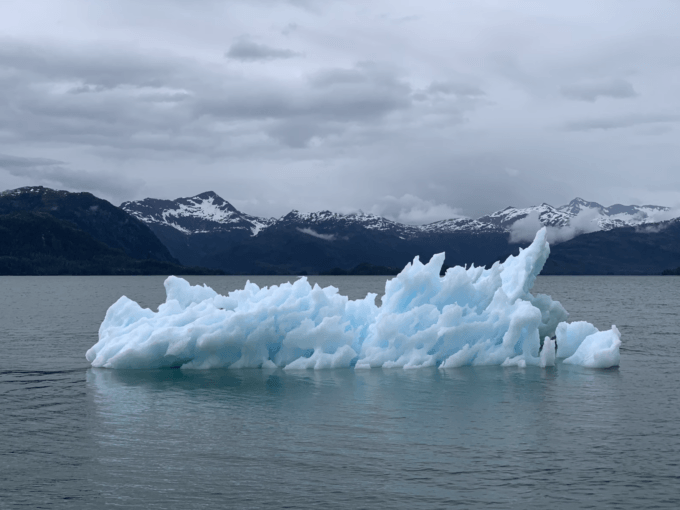
Photo by Melissa Bradley
The world has entered a new climate era that threatens the fabric of civilization because it’s the reverse of the climate system that society was built upon. As it happens, the biosphere is starting to unravel as the world’s long-standing normal climate system shows clear signs of breaking down while planetary heat throws scientists a curve ball. The normal climate system behavior 0ver the decades is gone.
According to the World Meteorological Organization (which Trump cannot cripple like NOAA) on a global basis the past year was the hottest in the 175-year observational record with record-setting ocean heat and record-setting sea-level rise. Ninety percent (90%) of global warming is hidden from society absorbed by the oceans. Remarkably, the world’s oceans broke temperature records every single day for 12-months-running. (BBC). Now it’s gotten so excessive that scientists are worried about “payback.”
Everything is on the line, major ecosystems like Antarctica and the Amazon rainforest are regurgitating years of abuse; only recently, West Antarctica was rushed to Red Alert status by freaked-out polar scientists, and large swaths of the Amazon rainforest emit CO2 in competition with cars, trains and planes for the first time in human history, as rainfall at Summit Station (10500’ elevation) has been a strange eerie twist for Greenland. This is climate breakdown in full living color.
A recent article in Science/Alert d/d April 9, 2025 is filled with examples warning of climate breakdown: ‘Exceptional’ – Ongoing Global Heat Defies Climate Predictions.
Weird stuff that never happened thoroughout human history is happening to the climate system. For example, according to Copernicus Climate Change Service, since July 2023, the world has sustained a near-unbroken streak of record-breaking temperatures by the month every month, e.g. March 2025 was the hottest March ever recorded for the European Continent. And every month for the past 21 months has exceeded the dreaded 1.5C upper limit, to wit: “March was 1.6C above pre-industrial times, extending an anomaly so unusual that scientists are still trying to fully explain it. That we’re still at 1.6 °C above preindustrial is indeed remarkable,’ said Friederike Otto of the Grantham Institute for Climate Change and the Environment at Imperial College London.” (Science/Alert)
It wasn’t so long ago when climate scientists thought exceeding global 1.5C above pre-industrial, labeled as the “danger zone” by the IPCC, would take decades. Guess what? It’s early!
Repercussions of Climate Breakdown – Worldwide
Anomalous/abnormal climate behavior is now the new normal. Extraordinary climate events from all corners of the world recently happened within a tight window of only 30 days of each other, events classified as either the worst ever or all-time record or unprecedented or once in 100 years, etc. Today, the planet is like a movie script entitled Climate Breakdown with climate disasters all happening all at the same time regardless of location or season. It’s a whacky script with people on the run, searching for a safe place.
In real life, evidence of this gonzo climate system is everywhere to be found, e.g., in March 2025 different parts of the European Continent experienced “the driest March on record” as other parts of the Continent experienced “the wettest March on record.” At the same time as Europeans didn’t know which end was up, climate change hit India, enduring record-setting scorching heat as Australia was swamped by all-time-record-smashing floods whilst Asia and South America hit new all-time records of devasting heat. This weird global climate system is off its rocker in synchronized fashion. Why is this happening? Human-generated burning of fossil fuels is at the heart of far too many concurrent global climate disasters to ignore any longer the necessity of sharp reductions in burning fossil fuels or suffer an explosive planet. Nothing is normal any longer. Get over it!
The following headlines are evidence of simultaneous, happening within 30 days of each other, record-breaking climate events across the globe (of note: not including Antarctica, which is clearly, and frighteningly, starting to breakdown in an “emergency mode” as is the world-famous Amazon rainforest and Arctic permafrost and Greenland:
Bigger Than Texas: The True Size of Australian’s Devasting Floods, The Guardian, April 4, 2025 “The extent of flood waters that have engulfed Queensland over the past fortnight is so widespread it has covered an area more than four times the size of the United Kingdom. The inundation is larger than France and Germany combined – and is even bigger than Texas.”
Dry Topsoil Across Germany Could Impact Crop Yields Following March Dry Spell, Clean Energy Wire, April 11, 2025.
Floods Batter Italy after Florence Sees a Month’s Rainfall in One Day, The Watchers, March 16, 2025. “Red alerts were in effect across Italy, including Florence and Pisa, following an extreme flooding event that triggered multiple landslides and caused widespread damage.”
Heavy Rains Hit Spain for Third Consecutive Week, Reuters, March 18, 2025. “Spaniards are still on edge after torrential rains four months ago in the eastern Valencia region led to the country’s deadliest natural disaster in decades.”
Record-breaking March Heat Reminds Us That Adaptation Cannot Wait, The Indian Express, March 20, 2025.
Record Heatwaves Hits South America: Urgent Call for Climate Action, Green.org, March 5, 2025. “This year has witnessed South America endure its hottest recorded temperatures, with some regions experiencing heat levels never seen before. Countries like Argentina, Brazil, and Uruguay are reporting temperatures soaring above 40°C (104°F). This isn’t just uncomfortable—it poses serious health risks and disrupts daily life.”
Extraordinary March Heatwave in Central Asia up to 10° C Hotter in Warming Climate, World Weather Attribution, April 4, 2025. “In March 2025, Central Asia experienced an unusually intense heatwave, with temperatures reaching record highs across the region.”
In the U.S, tornadoes in March were more than double the monthly average and three separate outbreaks produced more than 200 tornadoes. (National Centers for Environmental Information, March 2025) More to the point, from March 13th to 16th, 2025 the tornado outbreak was the largest on record for the month of March. Meanwhile, wildfires spread across southern Appalachia, exacerbated by additional fuel available from downed trees following Hurricane Helene (est. costs up to $250 billion). It’s a fact: Warmer ocean waters, a direct result of climate change, fuel stronger hurricanes with higher wind speeds, heavier rainfall, and more destructive storm surges. Hmm.
As stated in Science/Alert by Bill McGuire, climate scientist, University College London, the contrasting extremes “shows clearly how a destabilized climate means more and bigger weather extremes… As climate breakdown progresses, more broken records are only to be expected.” (Science/Alert)
Therefore, it’s fair to pose a nagging proposition of what happens when more all-time records continue to pile up one after another to what end? What is that end? And what can be done to stop the relentless pounding of harmful climate extremes. Maybe world leaders need to confront this reality by summoning climate scientists. But will Trump summon climate scientists for advice on how the US can help slow down the biggest, fiercest freight train in all human history barreling down the mountainside?
And what’s to stop this madness?
Restoring the Wild: How Reintroducing Bison Could Revive Britain’s Landscapes and Ecosystems

Photograph Source: Charles J. Sharp – CC BY-SA 4.0
Although there is no evidence that the European bison (Bison bonasus), known as wisent, ever roamed the islands of the United Kingdom, its genetic heritage suggests that it is attuned to the environment. The European bison is a hybrid that descends from the steppe bison (Bison priscus) and the aurochs (Bos primigenius), both extinct species that were once native to the UK.
Britain once hosted a broad range of great beasts. We slaughtered the bears, elk, and lynx many centuries ago. The wolves lasted the longest. Now, only the names of their crags, hills, meres, or the ubiquitous deep pits where we caught and bound them for torture recall their former existence. As with the aquamarine blue moor frogs, black storks, and night herons, humans hastened the end of them all.
Today, one in seven of England’s surviving species is also threatened with extinction. In large part, much of the landscape that appears to be so green is dead. Chemicals and pesticides in the soil have killed smaller species. The disappearance of these minute species has caused a chain reaction within the natural order, starving, poisoning, or otherwise compromising the food chain.
Gone is the food for some creatures or the cover for others. The living space that remains is highly restricted and commonly of poor quality. The absence of one pivotal creature can mean the loss of natural function upon which others depend. Even when our understanding of this is crystal clear, we respond in a reluctant, slow-motion fashion.
The Downside of Conservation
Conservation comes in many forms, and my beginning was not with the wild but with the tame. At a time when you can drive through the landscape and see so many of the old black or spotted sheep, white long-horned cattle, or brick-red pigs more or less everywhere, it’s hard to remember that these relics were nearly extinct by the 1970s. Farming at that time was already set to conquer its Everests of “improvement.”
Rivers of government cash flowed into subsidies for everything imaginable, from the import of faster-growing continental livestock to new and super-productive crops, to fertilizers that flowed from white plastic sacks rather than freely from cows’ backsides, to pesticides that killed their target species, and much more besides.
Guilds of focused advisors in drab brown overalls and tiny vans met farmers free of charge to explain how to employ this largesse. Colleges produced legions of indoctrinated students who marched out in ranks to feed the world. Research stations, laboratories, and experimental farms, all centrally funded, were established throughout the land.
Meadows full of dancing wildflowers or woodlands where spotted flycatchers dipped and weaved to catch beakfuls of insects twirling in sunlit strobes did not fit the narrative of those times. Most were plowed under or ripped free from the soil that had held them for centuries, awaiting incineration on well-prepared pyres.
Birds of all sorts died in myriads when cornfields, old pastures, and orchards were sprayed with new toxins. Frogs returned to breed in the spring to discover their ancestral ponds had vanished. Photographers produced heartbreaking black-and-white images of them sitting in massed aggregations on their drying spawn.
Breeds of livestock with their roots buried deep in Britain’s culture were discarded as well. It did not matter that they had adapted to frugal living to produce something—a little meat, milk, horn, or dung to fertilize small fields—for folk who had nothing and could offer them less.
Who cared if they had been brought by the Norse, the Romans, or the Celts? They were out of time. Small or slow-growing and difficult to handle with independent spirits, the sooner they were all gone, the better. Their qualities of disease resistance, fine wool, or superlative meat meant nothing. Any adaptation to specific environments was meaningless in a time when whole landscapes could be rearranged.
Farmers Are Not the Problem
To be clear, farmers are not the problem. The problem is the great false idol of the industrial machine that so many unblinkingly worship. In general, farmers are a well-humored bunch. The old ones with good stories are always the best, and I have spent many hours sitting in their cozy kitchens listening to their tales as small dogs snoozed next to the iron cooker and busy wives bustled to serve cakes.
There was slight Henry Cowan, who regretted until the day he died that he had allowed a passing dealer to buy his last two horses, kept long after the others had gone, for the glue works. Tall Francis Watson, a big bear of a man who, at the age of 17, had guarded the palace of the Nizams in Hyderabad and whose great joy it was to linger for no particular purchase in our village shop to converse with its Pakistani proprietors in Urdu. And Miss Bartholomew, whose old cats pissed on her house chairs and whose ancient pet pigs were turned by her stockman daily to ease their bed sores when they could no longer stand.
All of them were once characters of great color who have now passed in time. Their world was simpler, of clear rights and dark wrongs. The reapers who harvested in their golden youths are not of the sort that scythe the earth today. The prospect that the land that they had cleared of rocks, drained and deforested, and then reforested, enriched, and impoverished in the swiftest succession would ever be used again for any purpose other than farming would not have seemed plausible to them at all. The notion that some of England’s oldest beasts could be restored to accelerate nature’s gainwould have seemed absurd.
The Benefits of Bison
So why bother bringing bison back to Britain when we could be content to sit back in our slippers and reintegrate beavers into the countryside, which, in theory at least, is as easy as falling off a stationary bus? The answer, in large part, is process. If, as it seems tantalizingly tangible, we are going to move from an era of unequivocal public subsidy for farming 70 percent of the British landmass (23 million acres) to a time when public money will be employed more evenly to repair nature, then at least a few of the large creatures we hunted to extinction may be restored in a limited fashion to assist this endeavor.
Bison, for example, are not cattle. They are high forest browsers. If you reinstall them in dark, dull plantation woodlands with little biodiversity value, they will smash and debark big trees, wallow in sand soils, gouge out damp clays, provide pesticide-free blood and dung in abundance for insects, and crunch down woody scrub at random in a jagged and irregular manner.
They rip the bark from the stems of broad-leafed trees in a frozen winter by inserting the teeth of their lower palate under the surface of the tree, gripping it tightly with their upper jaw, and tugging sharply downward in order to “whip crack” the length of the stem before it tumbles away like a falling curtain to be consumed.
A single bison can eat 32 kilos of bark in a day. Multiply this by a stamping herd, hoarfrosted with steaming nostrils, and the impact of bison on woodland structure becomes obvious. Whole groves of succulent, young trees are retarded or misshapen. Their wounds leach resin or sap, which snails cluster into to exploit.
Some bare areas may scab over and scar, while others decay completely for woodpeckers to peck full of voids. Bats, martens, and birds use these cavities as nesting sites, while specialists such as willow tits make their own abodes in desiccated pockets rotted down by mycelia of many sorts. Nature loves randomness, and there is more in the simplest of forms.
The fur from a bison’s woolly coat will be gathered by birds from the grasping thorns of bramble or rose or from their backs directly when it peels in scrofulous mats in the springtime. This warm, snuggly material, which is ideal for their nests, will be filched from them by small mammals and taken underground. The repetitive wallowing of bison in dry sandbanks scours these vegetation-free features in random patches.
In their well-trampled base lie easily excavatable egg-laying areas for sand lizards, while mining insects pit any exposed standing banks with their tunnels. Over time, the fragrant possibility exists that the European bee-eater, a child-painted wonder of yellows, blues, browns, and greens, will one day grace them as sites for their nest tunnels.
Bison will, in short, do some things that cattle are incapable of doing and others that cattle don’t do very well. This, of course, is hardly surprising, given that ten thousand years of preparation for domestication has profoundly altered the shape, biology, and behavior of cattle, while bison have retained their wild being intact.
This excerpt is adapted from Derek Gow’s book Birds, Beasts and Bedlam: Turning My Farm Into a Lost Ark for Species (Chelsea Green Publishing, 2022). It is licensed under Creative Commons Attribution-NonCommercial-
The Failure of US Conservation Groups to Criticize Wolf Slaughter
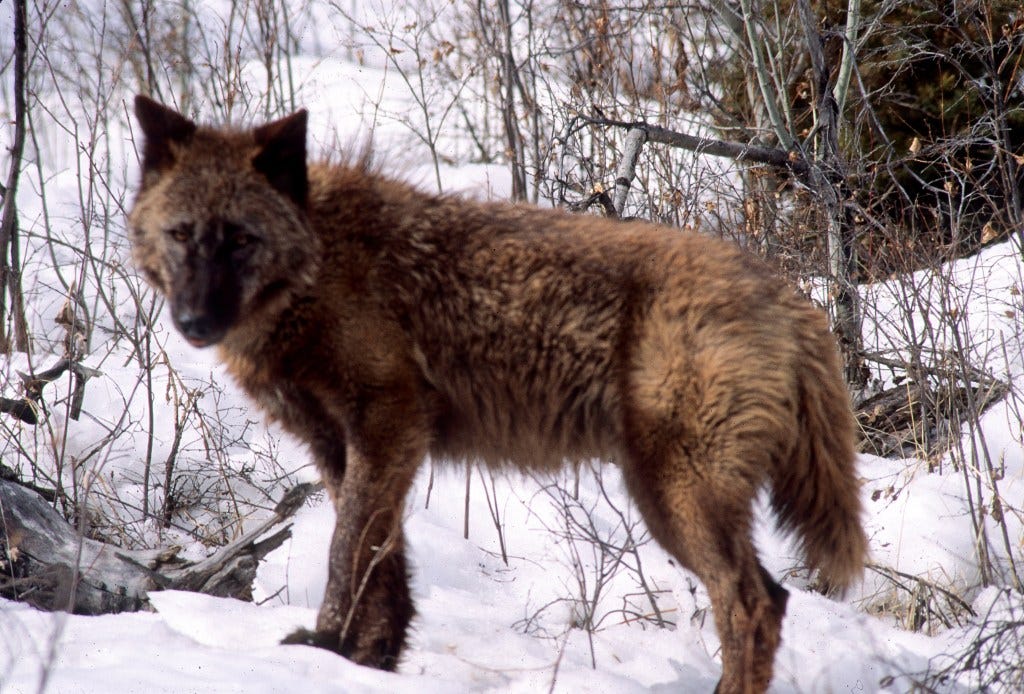
Photo: George Wuerthner.
The state of Washington recently reported that its endangered wolf population had declined for the first time in 16 years. The state confirmed that it has 230 wolves, compared to 254 wolves in the previous year.
According to figures released by the Washington Department of Fish and Wildlife, Washington’s overall wolf population in 2024 decreased by at least 9.44%, and successful breeding pairs declined by 25%.
What accounts for this decline? Well, 37 wolves are documented as mortalities. The Washington Fish and Wildlife Department killed four wolves after the animals had conflicts with livestock.
In addition, an unknown number of wolves died from suspected poaching. Two wolves died while being captured by Fish and Wildlife. One wolf was killed by a cougar, and one by other wolves. One wolf was shot attacking livestock, one was shot in self-defense, and one died after ingesting plastic, according to Fish and Wildlife.
However, the most significant source of mortality was a consequence of tribal wolf slaughter. Colville tribal members accounted for more than half of the annual wolf mortality, killing a minimum of 19 wolves.
This ongoing killing of dozens of wolves by tribal members has been occurring for years, and it is hindering the recovery of endangered wolves in Washington. For instance, in 2022, tribal members slaughtered 22 wolves.
Wolves are covered statewide under the state’s endangered species law. Killing one of the animals without authorization can carry penalties of up to a year in jail or a $5,000 fine under the state’s law.
Last summer, the Fish and Wildlife Commission narrowly voted against downlisting wolves from “endangered” to either “threatened” or “sensitive,” moves that would have led to lower penalties for poaching and slightly easier access to permits to kill wolves that attack livestock.
Due to their Endangered Species Status, it is illegal for any citizen to kill in Washington State except in special instances, such as wolf-livestock depredation. However, tribal members are exempt from hunting regulations that restrict other citizens.
Unlike wolf trapping in states like Montana and Idaho, which allow the carnage of wolves, there are still limits on the number of animals that any individual trapper or hunter can take. However, the Colville tribe permits the trapping and hunting of wolves by any tribal member without limitations.
The high mortality of wolves by tribal members is setting back wolf recovery in the state. In particular, the Colville Reservation is a critical bridge between eastern Washington, where most of the state’s wolf population is found, and the colonization of the Cascades and western Washington.
The reservation contains excellent wolf habitat, which is why the tribe continues to massacre wolves in this area. The reservation is, in effect, a mortality sink. The good habitat (prey base) attracts new wolves and leads to their death.
Wolves return to the same places as the Colville Reservation because it is a suitable habitat for prey, and more get killed.
As much as I am dismayed by the tribal slaughter of wolves, I am even more outraged by the apparent willingness of so-called conservation organizations to accept the destruction of wildlife and wildlands by tribal people that they would denounce if perpetrated by anyone else.
While a few wolf advocacy organizations clinically noted the Colville tribe’s role in hindering wolf recovery in the state, none have chosen to criticize the tribe publicly.
This lack of accountability by the conservation community is part of what I call the Indian Iron Curtain, where environmental organizations are unwilling or, in some instances, even support the destruction of wildlife or wildlands done by tribal groups, which they would otherwise condemn if done by anyone else.
Not only does this perpetuate the myth that tribal people are somehow “natural environmentalists,” but it harms the wildlands and wildlife that are impacted. The annual tribal slaughter of bison by Yellowstone National Park, which many organizations support if a tribal member does the killing, is a perfect example of this double standard.
Throughout the West, these groups raise money off the backs of wolves. If a rancher or hunter kills wolves, I will get a message telling me to donate money to them to “save” wolves from slaughter.
One lame excuse I got from the ED of a wolf advocacy group for their lack of opposition to tribal slaughter was that the tribes have a “legal” right to kill wolves without restriction. Yet the same organization has no trouble blasting the annual carnage of wolves by hunters and trappers as unacceptable in states where it is legal to kill them.
For instance, a few years ago, there was outrage from conservation groupsafter 26 wolves were killed by trappers and hunters north of Yellowstone Park. Still, the very same organizations are silent about tribal wolf killings on the Colville reservation and elsewhere (like Alaska).]
Brooks Fahy of Predator Defense is one of the few people willing to condemn the tribal killings publicly.
Fahy says:” The silence from the “conservation” community on this subject is deafening.”
Fahy quips: “The Colville Tribe has essentially created an iron curtain of traps and bullets by preventing wolves from dispersing westward into the Cascades.”
As Fahy notes: “It does not make you an anti-Native American to be angry at what some of the tribes are doing, just like it doesn’t mean you’re antisemitic if you’re outraged over what Israel is doing in Gaza. It’s time to condemn unacceptable behavior.”
Most conservation organizations are loath to criticize tribes due to historical mistreatment, but in the end, it is the wildlife that suffers today. Why should wolves (grizzlies, salmon, bison, old-growth forests, etc.) have to accept the burden of past abuse of Indian people?
The double standard for tribal groups is part of a long-term change in conservation missions. When I came of age in the environmental movement in the 1980s and 1990s, there was a movement to consider ecology, evolutionary processes, and biocentric perspectives as the priority standard in advocacy. Since then, I have seen a significant shift towards anthropocentric attitudes and values in many organizations, to the detriment of overall conservation goals.
Social justice needs to be considered, but Nature Justice should have priority, for in the end, there is no social justice on a dead planet. We need to set limits on human exploitation, no matter who is doing it.
It’s time to take down the Indian Iron Curtain and hold all people who abuse, mistreat, or exploit Nature accountable. The wolves, bears, salmon, bison, old-growth forests, and wildlands will be glad you did.


