Tuesday, April 22, 2025

Trump’s Lust for Minerals: The Latest from Oregon’s Lithium Prospect


 April 22, 2025
FacebookTwitter

A landscape with a mountain range in the background

Description automatically generated

The Trump 2.0 administration is possessed by a lust for minerals. Trump’s latest critical minerals edict, Immediate Measures to Increase American Mineral Production, appeared in mid-March. It’s part of a barrage of actions to facilitate even easier mining corporation pillage of public lands than currently exists under the US’s 1872 Mining Law.

The Center for Western Priorities statement details how this order expanded critical minerals to include “uranium, copper, potash, gold, and any other element, compound or material as determined by the Chair of the National Energy Dominance Council NEDC. NEDC was “made up by President Trump to do his bidding on energy and minerals issues and is not accountable to Congress or to the public. The EO seeks to give Burgum, at his own discretion or at Trump’s direction, the power to declare any substance to be a mineral eligible for special treatment”.

The order requires federal agencies to consort with miners, work to nix the Rosemont court ruling that limited mine waste rock dumping on federal land, give priority to mining over other uses of public lands (so much for multiple abuse), and applies the Defense Production Act to allow mineral processing on military bases.

Alarmingly, it also makes a move toward privatization of public lands:

“The EO directs the secretaries of all federal land management agencies to identify as many sites as possible that may be suitable for private commercial mineral production, and to enter into extended use leases with private companies for mineral production … This starts the process of giving away national public lands to private mining companies to exploit and profit from …”.

This would mean privatizing public land and turning it over to foreign mining corporations. Many big mines are ultimately controlled by foreign companies, who spin off US fronts to get US tax breaks, gigantic loans and other benefits like Canadian Lithium Americas Thacker Pass mine has gotten via its US arm, Lithium Nevada, and that Australian Jindalee now seeks through its US spin off Jindalee Lithium. Trump’s frenzied mining-related actions may also expand US mineral grabs and critical minerals colonialism across the globe, to obtain minerals used heavily in waging Wars.

Hot on the heels of Trump’s order, Vale Oregon BLM announced a 5-day comment period for a draft Environmental Assessment (EA) for Jindalee’s McDermitt Exploration project. This crazily short comment period jolted the public into action. BLM received 1500 comments in 5 days. Quietly, late on the 5th day, BLM extended the comment period to the usual 30 days.

The Jindalee project would tear apart a project area of 7200 acres of irreplaceable sagebrush habitat in the northern McDermitt Caldera. Jindalee seeks 30 miles of new routes, 261 drill pad sites, each with a vile drilling wastewater sump, an unspecified number of boreholes, sideways drilling, and additional disturbance zones. There are no alternatives considered other than No Action. Not even one single drill site less, or any increased controls on drilling and bulldozing damage. BLM sidesteps an EIS by pretending there won’t be significant harm inflicted.

Jindalee has already drilled 60+ sites here over the past few years under NEPA-less Notice activity. BLM’s mining regulations allow what they define as less than 5 acres of disturbance to be done without any public review. BLM documents reveal that all past Jindalee exploration boreholes have encountered groundwater at an average depth of 179 feet below the surface, with drilling occurring down to 600 ft. Now BLM proposes to astronomically increase the drilling site number and disturbance area (5 acres before, now proposed 100 acres), and would allow deeper drilling down to 800 ft, further threatening perennial water flows and riparian habitats of the area’s small and often intermittent streams.
A map of a large area with red dots

Description automatically generated

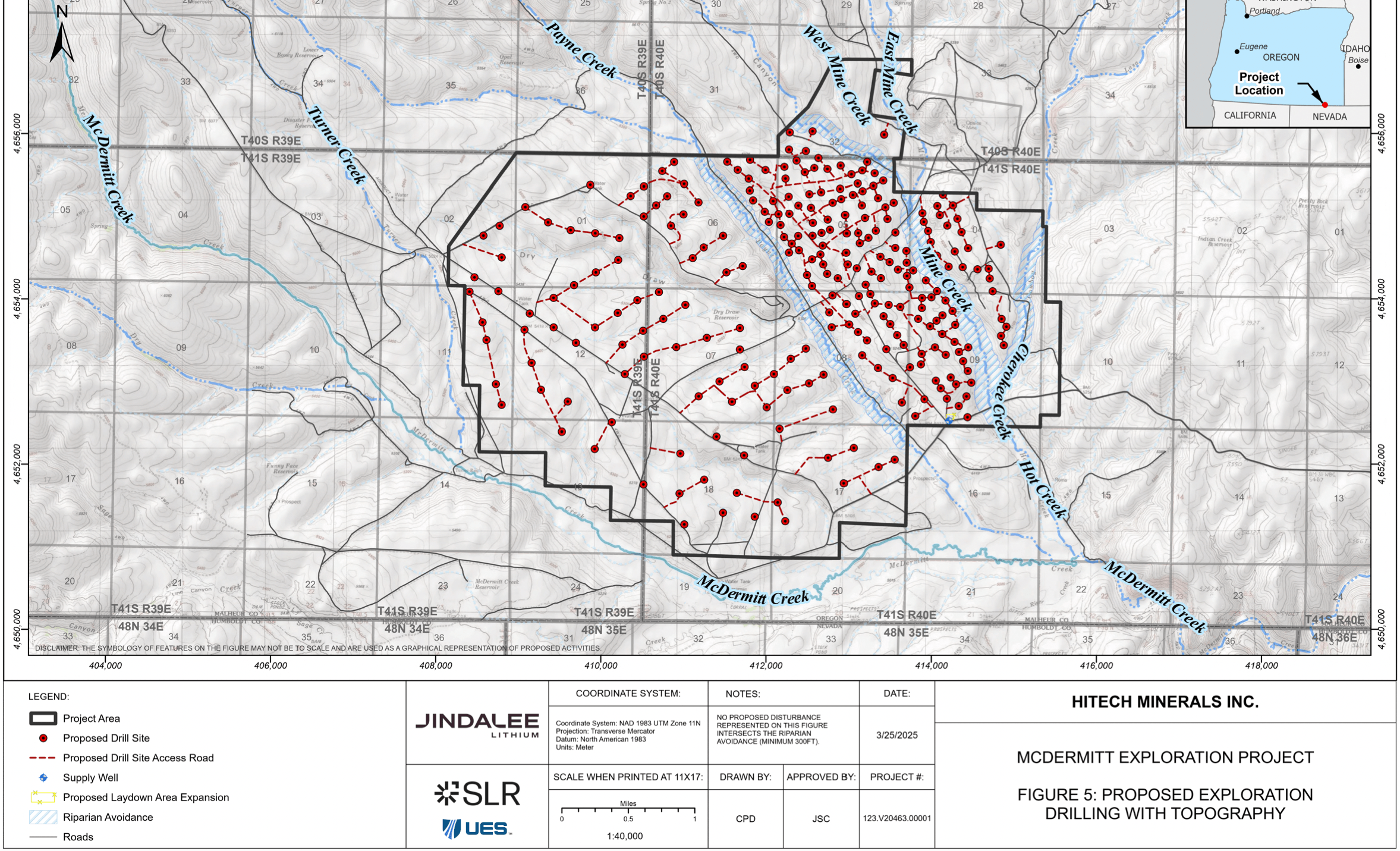
Maps show how close drill sites and routes are to streams like Mine Creek (named for an old mercury mine with a pollution legacy) and Payne Creek. The mainstem of McDermitt Creek, a stream system targeted for Lahontan Cutthroat Trout recovery, is only a mile from several drill sites. The Jindalee project is less than a mile from the Nevada state line.
A hole in the dirt with a fence around itDescription automatically generated

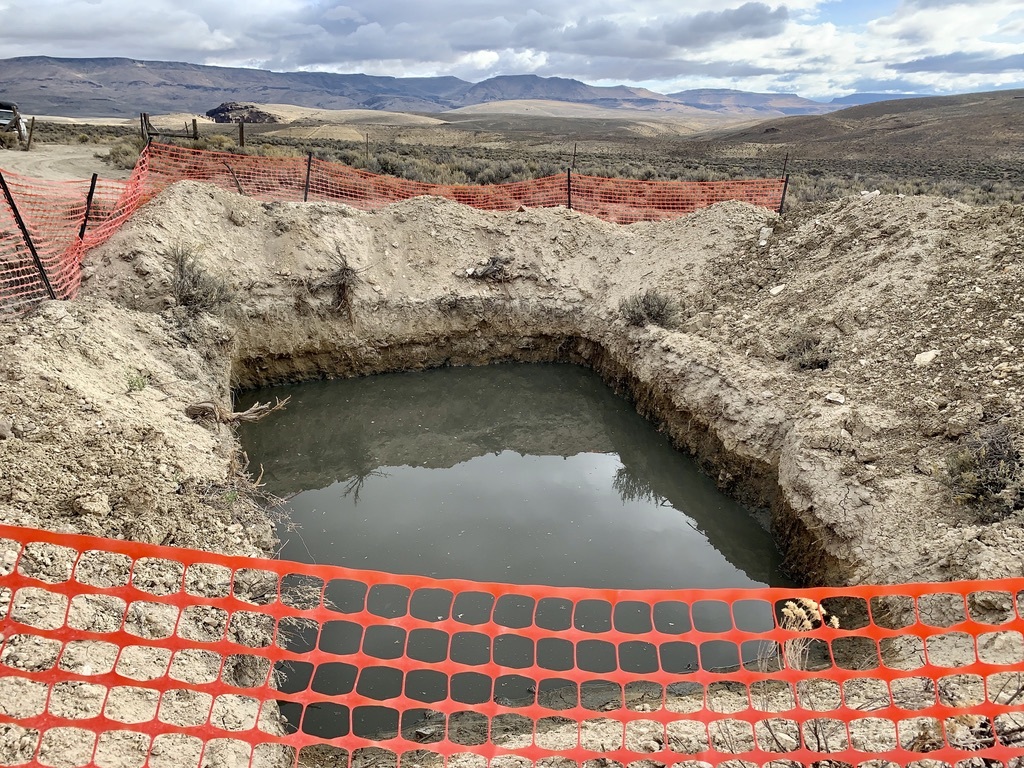
A Jindalee 2022 sump, with drilling waste water left to pollute the earth.

Exploration drilling can significantly damage shallow aquifer areas, or even dry up perennial surface water flows in springs and streams. A large amount of past exploration drilling around Thacker Pass in the southern Caldera is believed to be a cause of springs drying up pushing the King’s River Pyrg, an endemic mollusk, towards extinction. It sure seems to me (admittedly not a geologist) that developing a full-blown lithium mine – which of course is where this major Oregon exploration project is leading – would have serious effects to the region’s already stressed waters. This is a headwater area of the Quinn system. The Quinn basin in Nevada is already over-allocated and faces new strain from Thacker Pass water use and groundwater impacts.

Jindalee’s previous NEPA-less drilling has already ripped up some sagebrush areas, fragmented habitat, and spread of weeds like cheatgrass and halogeton that are increasing over time. “Reclamation” under BLM’s pathetic recovery standards greatly fails to protect the vulnerable sagebrush ecosystem. After mining companies degrade habitats and depauperate populations of animals and plants with dense drilling, and weeds proliferate, they then turn around and claim the habitat is sub-par if they move to develop a full-blown mine.
A dog standing in a fieldDescription automatically generated

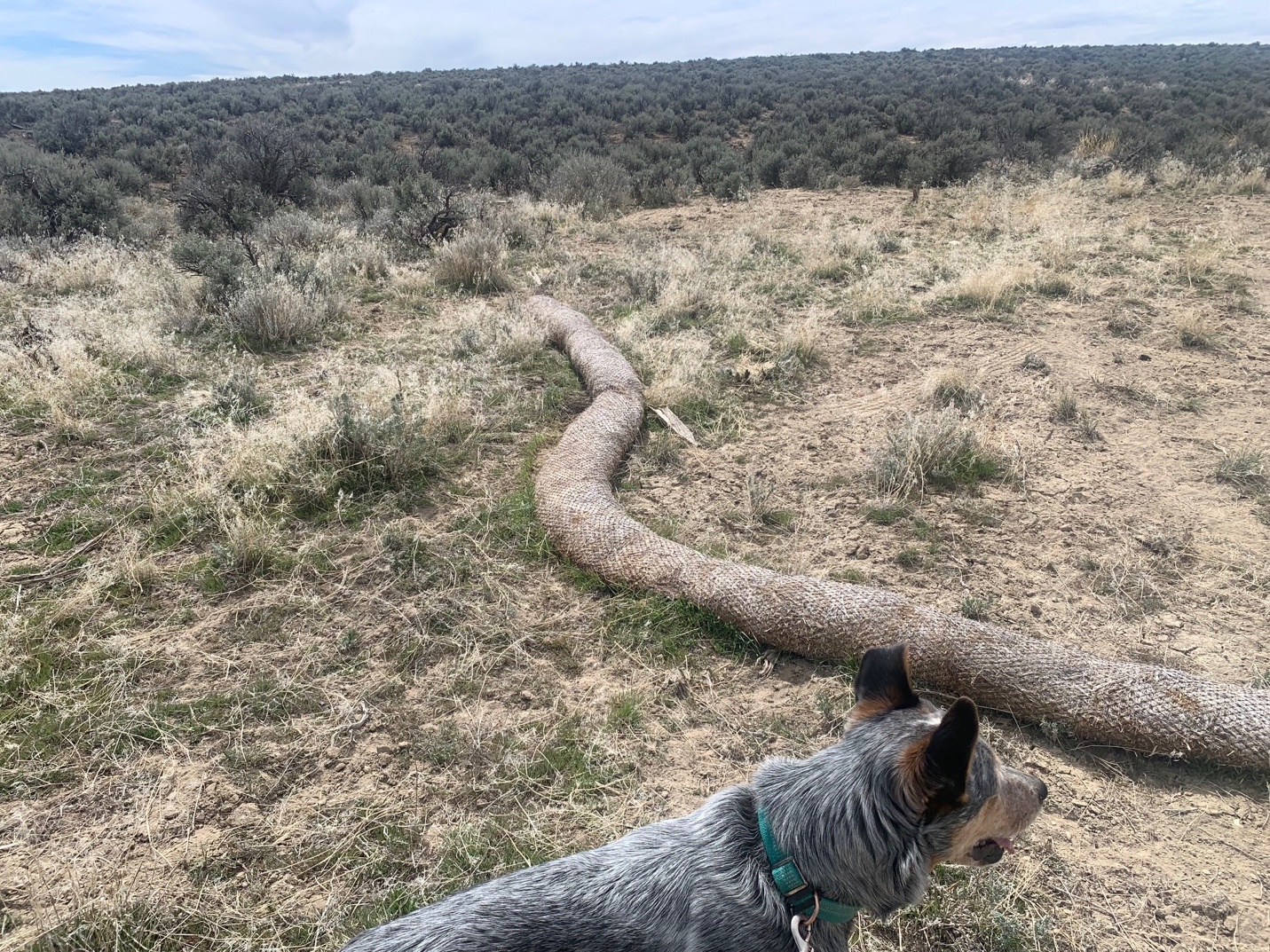
Cheatgrass at an older Jindalee drill site. There’s an abrupt transition between many bulldozed drilling sites and surrounding undisturbed sagebrush where weeds are absent.

Jindalee Project Bludgeons Caldera Biodiversity

All the project site, and nearly the entire McDermitt Caldera, were slated to be withdrawn from mineral entry under the 2015 Sage-grouse plans. The Caldera sagebrush habitat was identified as part of the “best of the best” remaining in the West. The promise of Interior Department withdrawal of this region was one of the excuses given by Interior Secretary Sally Jewell for not listing Sage-grouse under the ESA. This was initially derailed by litigation, then by Trump 1.0, then by 4 years of Biden BLM foot-dragging. The EA reveals the great significance of the Jindalee site, which is unburned mature sagebrush in a big basin-like setting surrounded by leks:

“There are 2 occupied, active leks within the Project Area, and 20 occupied leks (12 active, 8 inactive), 5 pending leks (2 active, 3 inactive), and 9 unoccupied (inactive) leks within 4 miles of the Project Area”.
A nest with eggs in itDescription automatically generated

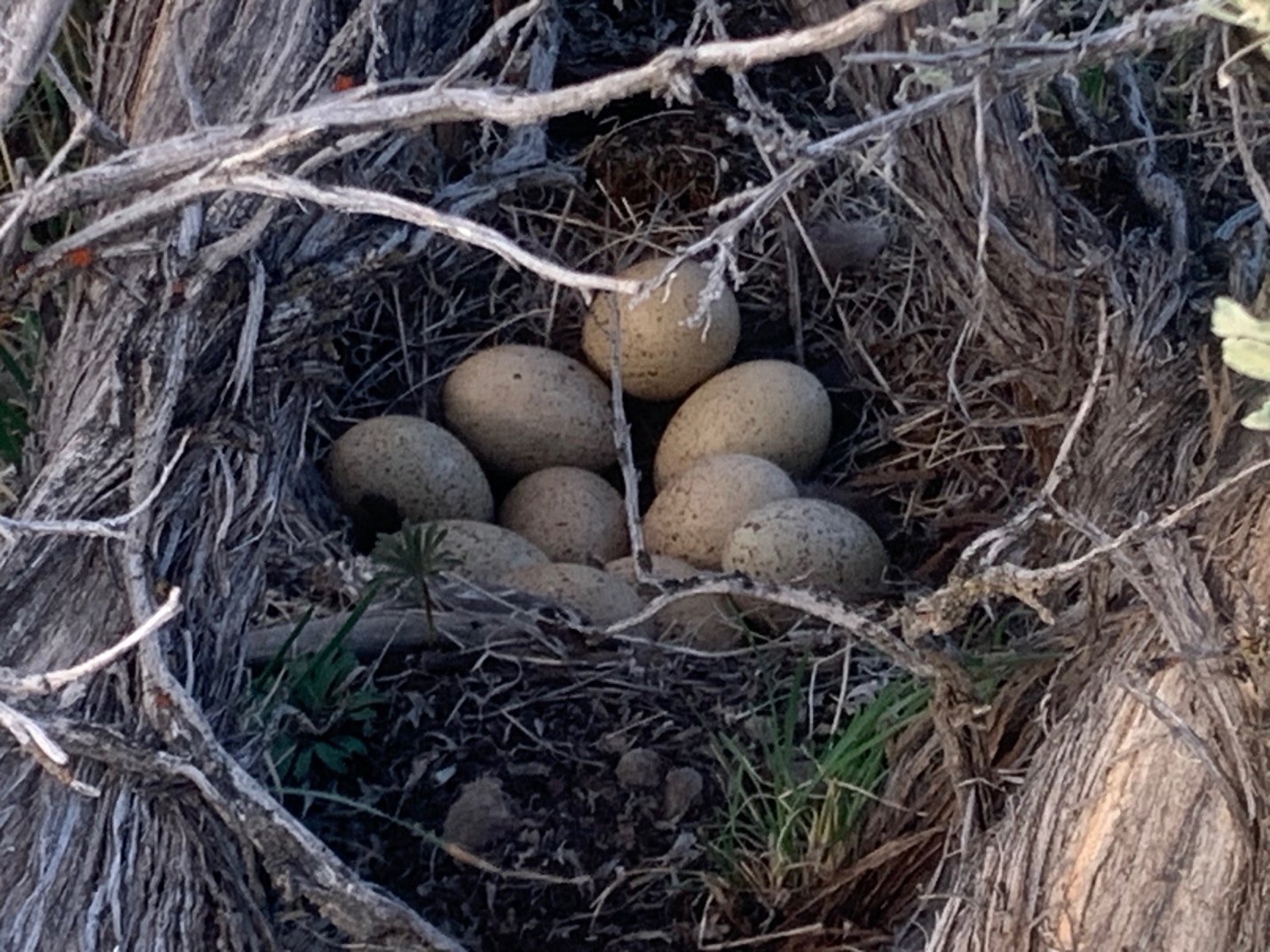
2025 Sage-grouse nest in Jindalee project area within ¼ mile of project area lek. It’s concealed in unfragmented dense, old growth big sagebrush as shown in first photo in this article.

Development of a mine here would be a severe blow to the Sage-grouse population. The project area lies in a big basin or bowl. Non-stop mining noise and visual intrusion would have a major Sage-grouse habitat disturbance footprint extending several miles outward. Much of the surrounding landscape burned in a 2012 fire, so the block of mature sagebrush within the project area is critically important to the birds. It’s their nesting, brood rearing and wintering habitat. It’s also home to Pygmy Rabbits, nesting territories for declining songbirds sensitive to habitat fragmentation, and vital Mule Deer and Pronghorn range. All these values are detailed in a Caldera-wide Area of Critical Environmental Concern proposal WildLands Defense submitted to BLM in 2023. BLM never acted on it. Last week I got a letter saying they received it, after I again submitted it during the 5-day commenting blur.

Rare Plant Habitat Will Be Wrecked

The drilling project will be disastrous for several Oregon rare plants. BLM admits “approximately 145 occurrences (16 percent) of BLM Sensitive plant species within the Project Area would be directly impacted by being removed or disturbed. Many of these areas are the highest density and highest quality rare plant populations. Other impacts to their habitats include “fugitive dust, physical disturbance during construction, trampling from vehicles and equipment, competition or loss of habitat due to weed encroachment, and compaction of soils, which may indirectly inhibit water and nutrient availability for native vegetation”.

A yellow flowers in a desert

Description automatically generated

A landscape with a mountain and flowersDescription automatically generated

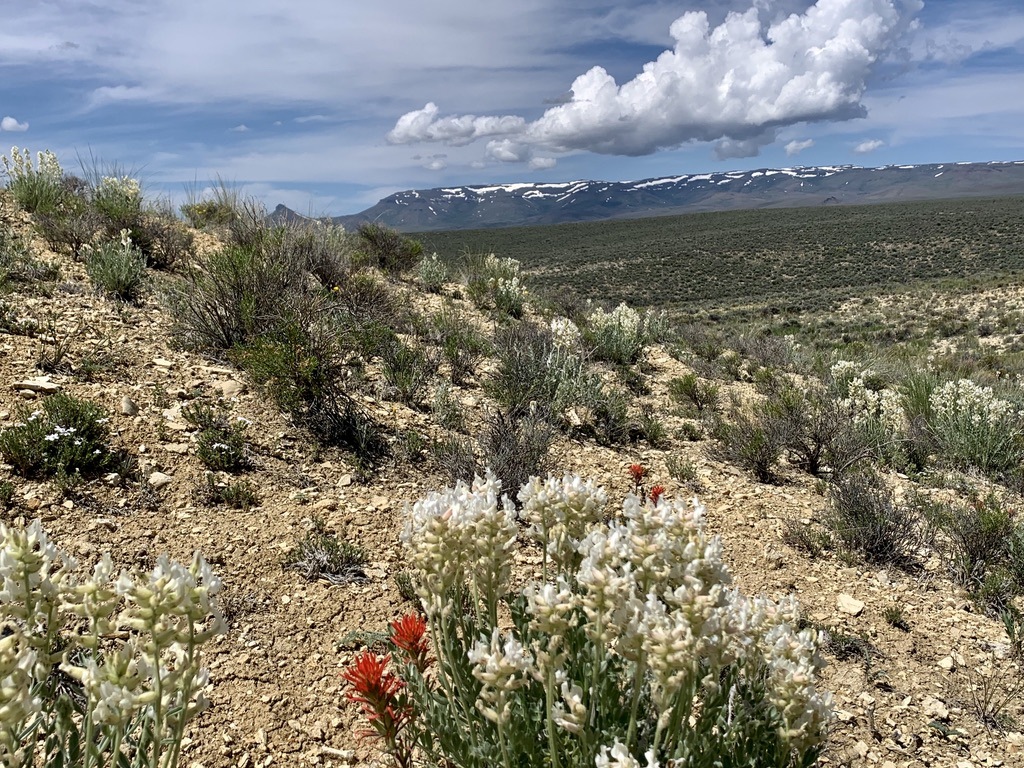
Ridgeslope clay soil rare plant habitats, the areas of highest density, are greatly targeted by the Jindalee drilling scheme.
A plant growing out of the groundDescription automatically generated

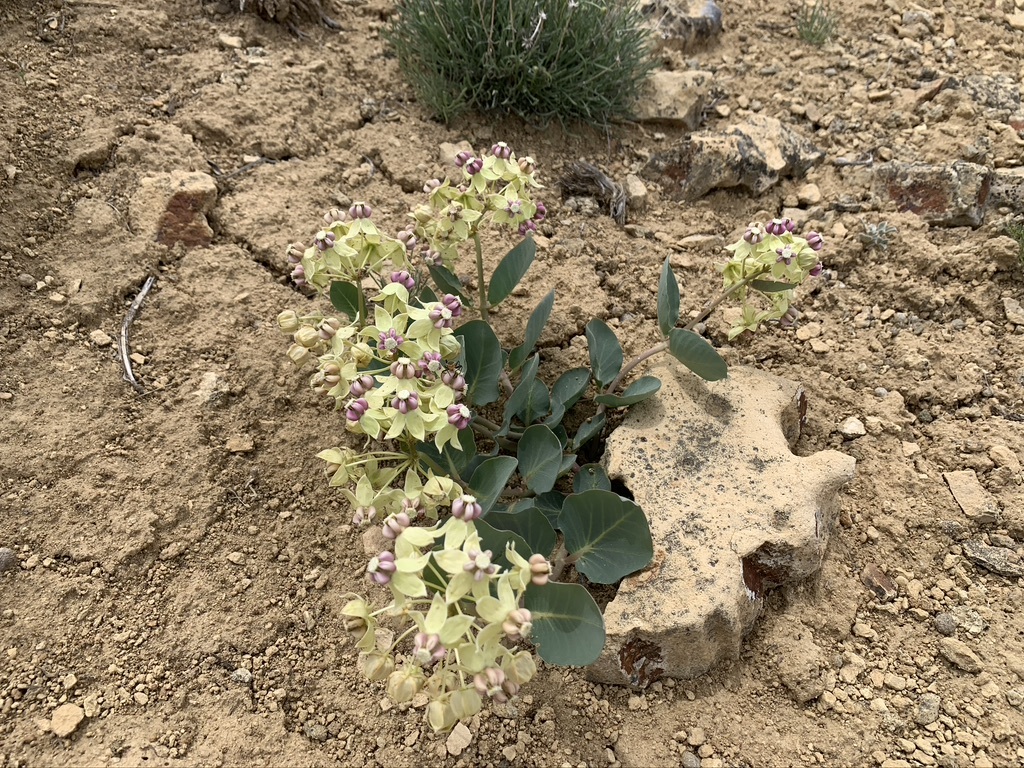
Humboldt Mountains Milkweed.

BLM mapping shows a significant amount of Monarch Butterfly habitat. Humboldt Mountain Milkweed inhabits the arid clay soils These beautiful plants face drilling-caused weeds that then spread outward far beyond the exploration sites. There are many culturally significant food and medicinal plant niches found here.

Where Are Oregon’s Senators?

After Trump axed a Biden administration mineral withdrawal by the Boundary Waters Canoe Area, Minnesota Senator Tina Smith promptly introduced Congressional legislation to withdraw lands there threatened by copper-nickel sulfide mining.

Why aren’t Oregon Senators pushing back on the lithium (and also uranium) mining boom onslaught threatening the McDermitt Creek watershed? Both have talked big about saving Sage-grouse. The imminent mining destruction of some of the last best habitat in this unique Oregon landscape is impossible to mitigate – no matter how many lies BLM and state agencies may come up with. Are the people of McDermitt and the Fort McDermitt Reservation who are facing community upheaval, mining pollution and cultural site desecration from Oregon projects considered expendable because they live just across the state line in Nevada, or are far away from Portland?

I’ve been told that Ron Wyden required the lithium and uranium mining-threatened Caldera area lands be left out of protections in his much-promoted Malheur land use bill that failed to pass in the last session of Congress. He appears to be actively working to facilitate the mining destruction of the Caldera, and has been praised by Jindalee for help getting a US DOE lithium research CRADA grant.

What’s Jeff Merkley’s excuse? Is it the mindless “lithium’s green” mantra that several Big Green groups have hidden behind to stay silent on Caldera mining for 5 years now, despite the Sage-grouse, cultural and other values at stake? If that’s it, I suggest he visit Thacker Pass to see how green lithium mining is. Merkley’s staffer attended a rather explosive June 2023 McDermitt BLM meeting and field trip where the ecological values at stake in Oregon, and the controversy and conflicts over lithium exploitation, were plainly laid out.

The Aurora Energy Metals lithium and uranium claims area is east of the Jindalee site. Aurora’s plan is to strip mine off the lithium, and extract uranium ore underneath. The uranium part is now under an agreement with another entity, Eagle Energy Metals. Their website shows the proposed uranium processing site a few miles west of McDermitt. This would make the local people very close by downwinders. The scheme is to shunt uranium quarried in Oregon across the state line to avoid Oregon regulations and process it on private land in the mining Wild West of Nevada. Constituents might ask Oregon’s Senators if they support the Aurora scheme including uranium processing, and Jindalee’s major proposed Sage-grouse habitat destruction.

Conversion of Thacker Pass to a Lithium Wasteland

Lithium Americas is now proclaiming that there’s so much lithium around, they’re going to need more phases of mine development and expanded processing facilities. The Nevada Independent recently reported“… the company’s announcement of three potential additional phases, is causing alarm in Orovada, an unincorporated town of roughly 150 people … that serves as the gateway to the project … This came as a huge shock to the communities of Orovada and Kings River, as Lithium Americas had assured us many times that they had no intention to expand the footprint of the mine to the area now proposed …”.

The news article references a report that seems to indicate the additional lithium is within the Thacker site, but now there’s talk of lithium out on the flats by the Quinn River bridge. Also, way back in 2016, a Lithium America report map showing their extensive claims in the Montana Mountains was labeled with specific development phases.
A landscape with a factory and mountainsDescription automatically generated with medium confidence

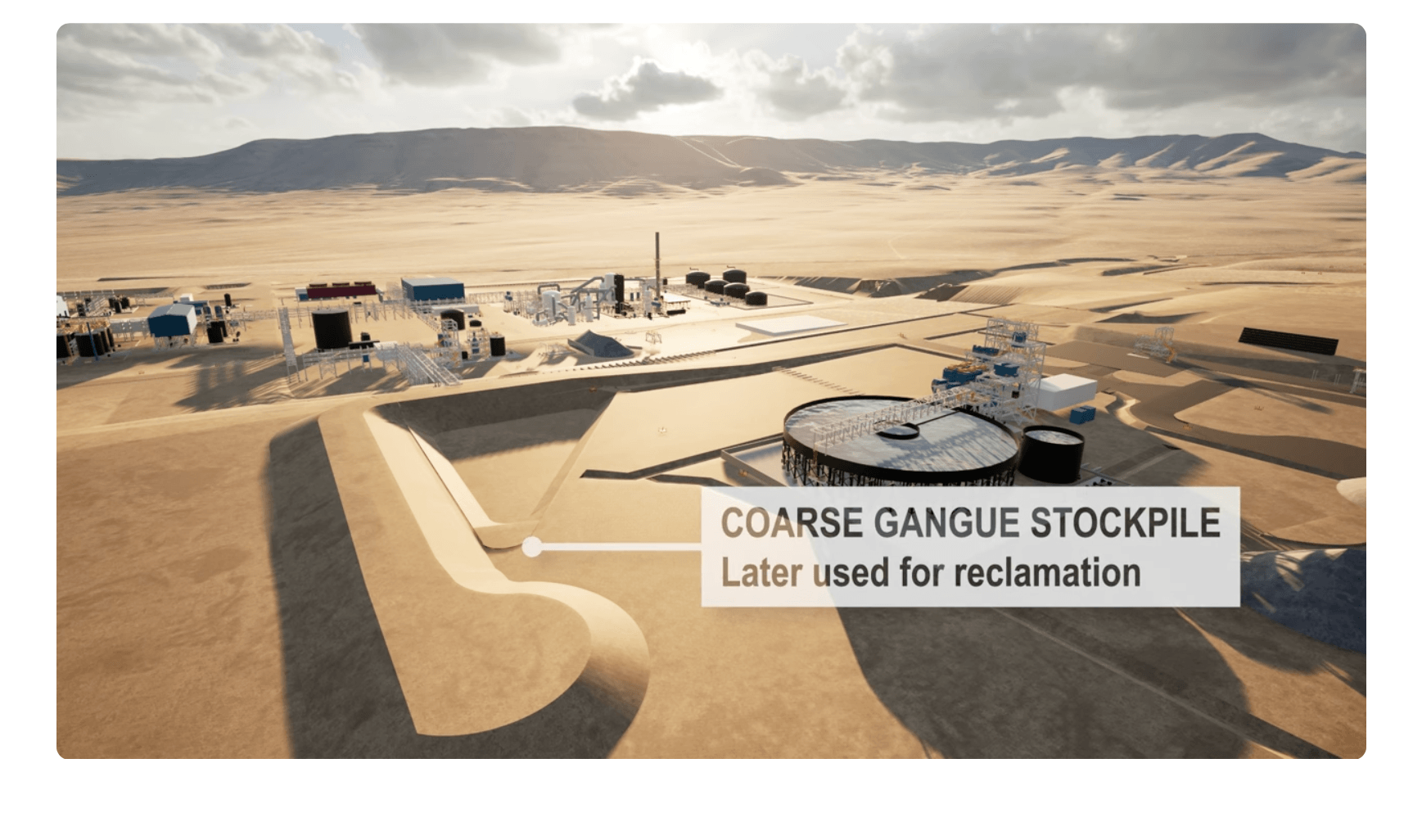
Bechtel video screenshot.

Construction company Bechtel (of bloated Iraq War contracts and never-ending Hanford nuclear waste clean-up fame) is the contractor building the Thacker Pass lithium processing facilities. They’ve generated a video with illustrations of the post-apocalyptic hell zone Thacker Pass is being turned in to.

The Bechtel video makes questionable assertions about the projected economic impact of Thacker Pass mine operation, apparently referring to a UNR report with inflated multiplier effect estimates. It also contains images of the Man Camp “worker hub” where 2000 temporary construction workers are to live down by Winnemucca. Rumor has it that because mine development lagged far behind schedule, the housing units sat unoccupied for months wrapped in plastic, developing black mold that needed to be cleaned up.

Nevada has become the welfare mining capital of the country, with Lithium Nevada’s Thacker Pass ($2.26 billion loan) and Ioneer’s Rhyolite Ridge ($1 billion loan) having gotten huge DOE handouts. The state’s politicians are now fretting about the possibility of the bonanza of mining subsidies possibly being reduced.

A Nevada land protection from the Biden administration has been slashed. Under the banner of removing “burdensome regulations”, Trump stripped an oil and gas drilling, mineral and geothermal withdrawal in the Ruby Mountains. Even mine-crazed Nevada Senator Catherine Cortez-Masto had supported that withdrawal.

In a legal case that’s received minimal media attention, Lithium Americas has embraced the brass knuckle tactics of the fossil fuel industry. The green Thacker lithium miners are pursuing a SLAPP suit to crack down on mine protests and silence opponents. People being prosecuted include a descendant of Ox Sam and several other activists. Ox Sam escaped a US cavalry massacre during the Snake War of Extermination. He fled towards Disaster Peak, a prominent landmark that looks down on the Jindalee site. Its power magnetically captures the visual field over vast areas and draws your eyes towards it. Tribal members consider this landscape to be sacred.

The ACLU and Human Rights Watch have released a new report about the injustice of Thacker Pass, The Land of our People, Forever United States Human Rights Violations against the Numu/Nuwu and Newe in the Rush for Lithium.

“Bands of northern Paiutes, western Shoshones and Bannocks have a history with the United States Government,” said Gary Mckinney, spokesperson for People of Red Mountain, an Indigenous rights organization. “That history includes mining, broken treaties, and Indian reservations which were established to assist in unwarranted land degradation caused by mining and livestock grazing on ancestral Paiute, Shoshone and Bannock hunting and gathering landscapes.”

Where will this all end up? The mining industry is rife with speculation and boom and bust cycles. Right now, lithium prices have tanked. Hard rock mining, and processing of lithium bound in clay like the Caldera deposits, costs more than exploiting brine deposits. Alternative battery types are being developed. Who knows what the Trump tariff mania will bring about. It would be a tragic loss of biodiversity if the Jindalee project moves forward, and the sagebrush sea of the Oregon McDermitt Caldera lands gets turned into the wasteland depicted in Bechtel’s Thacker Pass video.

As I was writing this, Interior Secretary Burgum, citing permitting gridlock, added the Jindalee project to a FAST-41 list intended to speed up federal approval. Today he’s madly claiming there’s been a War on Mining in the US, and we’re gonna “Mine, Baby, Mine”. Just wait – I’m betting that mining projects rammed through under urgent assertions of “USA, USA” today will end up exporting US-mined minerals to foreign shores as soon as it becomes expedient, or the price is right.

Please help get many more comments on the McDermitt Lithium Project e-mailed to Vale BLM at BLM_OR_VL_LithiumHiTech@blm.gov by April 25You can also submit a comment here.

A bird perched on a plant

Description automatically generated


Katie Fite is a biologist and Public Lands Director with WildLands Defense.


Blowing Smoke: Trump’s Energy Plan


 April 22, 2025
Facebook

Image by 열음 최.

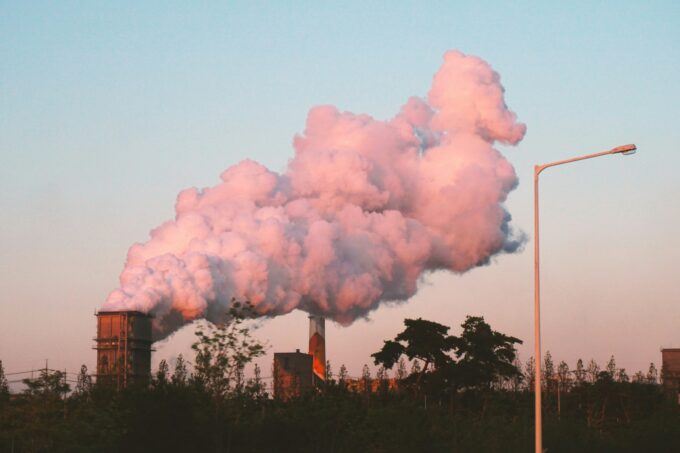
The administration of Donald Trump is making an unbridled push to block renewable energy projects—including last week halting the placement of 54 wind turbines in the ocean south of Long Island, New York—and is pushing fossil fuels, among them coal. The burning of fossil fuels is the leading cause of climate change. Trump has repeatedly called climate change a “hoax.”

Meanwhile, a Long Island resident, Lee Zeldin of Shirley, who Trump named administrator of the U.S. Environmental Protection Agency, is cancelling on a sweeping basis environmental regulations, discharging EPA employees and, last week, stopping the collection of greenhouse gas emission data.

Further, on April 8th Trump issued an executive order directing the U.S. attorney general to identify “illegal” state and local climate, energy and environmental justice laws that “impede” domestic energy production and use and “take all appropriate action to stop” their enforcement. The order is titled: “Protecting American Energy From State Overreach.” It opens: “My Administration is committed to unleashing American energy.”

Reacting, “New York State leaders say environmental protects and policies will remain on track” despite Trump’s order “attempting to undo state climate laws,” began a piece in the Long Island newspaper Newsday headlined: “NY Won’t Alter Renewable Energy Policy.” It said: “State Attorney General Letitia James, Gov. Kathy Hochul and other state leaders pushed back, saying efforts will continue including…and building out renewable energy sources, as the state aims to get all electricity from emission-free sources by 2040 and reduce economywide emissions by 85% from 1990 levels by 2050.”

Also, Hochul and the governor of New Mexico, Michelle Lujan Grisham, the co-chairs of the U.S. Climate Alliance, a bipartisan coalition of 24 governors, issued a statement saying: “The federal government cannot unilaterally strip states’ independent constitutional authority. We are a nation of states—and laws—and we will not be deterred. We will keep advancing solutions to the climate crisis that safeguard Americans’ fundamental right to clean air and water, create good-paying jobs, grow the clean energy economy, and make our future healthier and safer.”

New York Attorney General James declared: “The Trump administration cannot punish states that protect their residents” and “we’re not going to back down.”

Also on April 8th, Trump issued an order “to allow some older coal-fired power plants set for retirement to keep producing electricity” and to “lift barriers to coal mining and prioritize coal leasing on U.S. lands,” the Associated Press reported. It quoted Trump at the signing ceremony saying: “I call it beautiful, clean coal. I told my people, never use the word coal unless you put beautiful, clean before it.” Zeldin was present as Trump signed the order at the White House.

The Trump administration last week halted the building of the Empire Wind project 15 to 30 miles in the Atlantic south of the line between the Long Island counties of Nassau and Suffolk counties, and 14 miles southeast of Manhattan. Its builder, Norway-based Equinor, says on its website that is devoted to the project, that “the Empire Wind Project will be the first offshore wind project to deliver power directly to New York City” and “potentially” provide electricity to 500,000 New York City homes.

“Just as construction was starting on a massive wind farm off the coast of Long Island, the Trump administration ordered an immediate halt,” said The New York Times. It noted that the Empire Wind project had “received all of the permits it needed to get underway.”

Hochul said she would “fight this decision every step of the way.”

On his first day in office Trump issued an executive order removing the U.S. from the Paris Climate Agreement, the principal international treaty on climate change. As for wind turbines, he has insisted that noise from them causes cancer, despite the American Cancer Society saying this is untrue.

Zeldin on April 11th speaking at a Long Island Association event in Woodbury, Long Island said: “The president has made it crystal clear…he is not approving new wind permits.”

Zeldin at the event boosted instead new gas pipelines including for New York State one carrying fracked natural gas from Pennsylvania to a hub in Albany. He noted that there is “a ban in New York” on fracking, but pointed to Pennsylvania where “all parties work together and they tap into the extraction of natural gas.”

Zeldin is a former Republican member of the U.S. House of Representatives with a district that included much of eastern and central Long Island. He left the post to run unsuccessfully against Democrat Hochul for New York governor.

There long was a major push to allow fracking in New York State drawing from the same Marcellus Shale formation that extends from Pennsylvania. Adding to the challenge to fracking—a term for hydraulic fracturing which uses fluids under high pressure and 600 chemicals to extract oil and gas from deep underground rock formations—were journalistic investigations, most prominently two HBO TV documentaries, “Gasland,” by Josh Fox.

They found how fracking regularly leads to gas and oil migrating into water. In “Gasland,” there are many scenes of people turning on water faucets, holding a lighter to what’s coming out, and flames erupting because of fracking. In New York State, fracking was banned in 2014.

The burning of coal emits carbon the worst, followed by combustion of oil and gas—including fracked gas, extreme in methane.

ProPublica, the nonprofit news platform, last week disclosed that the EPA “is planning to eliminate long-standing requirements for polluters to collect and report their emissions of the heat-trapping gases that cause climate change. The move, ordered by a Trump appointee [Zeldin], would affect thousands of industrial facilities across the country, including oil refineries, power plants and coal mines as well as those that make petrochemicals, cement, glass, iron and steel, according to documents reviewed by ProPublica.”

“The Greenhouse Gas Reporting program documents the amount of carbon dioxide, methane and other climate-warming gases emitted by individual facilities. The data…guides policy decisions….Losing the data will make it harder to know how much climate-warming gas an economic sector or factory is emitting and to track those emissions over time,” said ProPublica.

It quoted Professor Edward Maibach of George Mason University in Virginia saying it was “like unplugging the equipment that monitors the vital signs of a patient that is critically ill. How in the world can we possibly manage this incredible threat to America’s well-being and humanity’s well-being if we’re not actually monitoring what we’re doing to exacerbate the problem.”

The Guardian newspaper in January cited an analysis by the group Climate Power as key to Trump pro-fossil fuel policies. The Guardian reported: “Big oil spent a stunning $445 million through the last election cycle to influence Donald Trump and Congress, a new analysis has found” and which projected that the “investments” are “likely to pay dividends.”

Karl Grossman, professor of journalism at State University of New York/College at Old Westbury, and is the author of the book, The Wrong Stuff: The Space’s Program’s Nuclear Threat to Our Planet, and the Beyond Nuclear handbook, The U.S. Space Force and the dangers of nuclear power and nuclear war in space. Grossman is an associate of the media watch group Fairness and Accuracy in Reporting (FAIR). He is a contributor to Hopeless: Barack Obama and the Politics of Illusion.

‘Well dug, old mole!": Mass resistance in Turkey

Tuesday 22 April 2025, by Uraz Aydin


Erdogan’s attempt to eliminate his likely rival in the upcoming presidential elections by arbitrarily placing him under detention has sparked mobilizations of rare magnitude. Faced with what could be a major turning point in the construction of Erdogan’s neo-fascist autocratic regime, millions of citizens, including a newly radicalized generation of youth, have taken to the streets once again.

The arrest of an elected representative is, of course, nothing new in Turkey. In recent years, in the majority of Kurdish municipalities in the south-east of the country, the pro-Kurdish party has won elections with a large majority (50-80% of the vote). But the state systematically accuses their elected representatives of supporting terrorism and imprisoned them, replacing the elected mayors with administrators appointed by the government. Similarly, dozens of MPs from the pro-Kurdish DEM Party (formerly HDP), as well as one MP from the TIP/Workers’ Party of Turkey (where our comrades from the Fourth International are active) are still behind bars.

Now, the same scenario is repeating itself in the country’s largest city, Istanbul. The state is seeking to gradually stifle the CHP, even though it is a very moderate opposition party.
Radicalization of youth

The new element in these mobilizations is the participation of university and high school students. After years of depoliticization and repression, particularly in the universities, such a mobilization was unexpected. But the old mole had continued to dig, very deeply. The commodification of education – the opening of hundreds of private universities, rendering degrees obsolete – combined with a disastrous economic crisis, has meant that young people no longer have any hope for the future. It was therefore largely this discontent that encouraged such a mobilization of young people, bringing along the CHP, which was aiming for a more legal or symbolic opposition, and paved the way for wider demonstrations.

Although the scale of the protests was not enough to prevent the arrest of Istanbul mayor Ekrem Imamoglu, the fact that the regime has – for now – backed down, particularly on the issue of appointing an administrator (kayyum) to head the municipality, is an important victory. After the Ramadan holidays, the student movement seems to have resumed, with demands for the release of several hundred young people who are still in prison awaiting trial.
Political heterogeneity

The Gezi Park uprising in 2013, which was also a mass resistance movement against the Erdogan regime, seems to be an important reference point for today’s protests. However, one important difference is that the revolutionary left, despite all the political diversity present in Gezi, managed to establish its hegemony there. This is no longer the case today, after years of repression of the left. The figure of Mustafa Kemal Atatürk, founder of the Turkish Republic, is obviously very present as a symbol – mythical, of course – of the aspiration for a return to a secular and democratic republic. But beyond that, we are seeing the development of ultra-nationalist currents that favour a secular nationalism (unrelated to the Ottoman Islamic-Turkish imaginary) but also an ethnic, racist and sexist nationalism.

Fortunately, these currents are not dominant, but they do exist and are growing among young people. Our goal must therefore be to introduce left-wing values into this movement to prevent it from drifting towards extreme nationalism, sexism or racism. This is particularly important in the current context, where the Erdogan regime is negotiating with the imprisoned leader of the Kurdish movement, Abdullah Öcalan, with the aim of dissolving the PKK and creating a ‘Turkey without terrorism’, in the words of the regime. The Kurdish movement is therefore seen by ultra-nationalist sectors as an ally of Erdogan, which further reinforces the ethnic nationalism of these factions.
A double boycott

Although the nine-day Ramadan holiday brought the protests to a halt (with a final mass rally attended by two million people), a double boycott took over. On the one hand, there is a permanent boycott of around 20 brands openly affiliated with the regime, initiated by the CHP. On the other, there is a weekly boycott initiated by students on Wednesdays, inspired by the Serbian example, where all consumption is boycotted but which also allows for the creation of an atmosphere of solidarity and sharing, notably with ‘boycott cafés’ (on the initiative of the TIP), where everyone brings and distributes their own drinks. Both boycotts were widely followed in the first few weeks, and several well-known figures and actors were taken into custody for calling for the boycott, which the regime considered ‘economic sabotage.’

It should also be noted that the trade unions have played virtually no role in the protest movement that is building in response to Imamoglu’s arrest. Of course, the idea of a general strike has been widely discussed (as has the slogan ‘General strike, general resistance’). But for the moment, it is difficult to say that the working class identifies with this movement. A significant section is still receptive to Erdogan’s propaganda. Left-wing trade union confederations such as DISK and KESK have called for symbolic work stoppages. However, very little effort has been made to explain that the democratic question and the social question are closely linked. This is also one of the most important tasks facing the radical left in order to steer this extraordinary protest movement towards a revolutionary break.

19 March 2025

Translated by International Viewpoint.


Attached documentswell-dug-old-mole-mass-resistance-in-turkey_a8956.pdf (PDF - 908.1 KiB)
Extraction PDF [->article8956]

Turkey
Kurdistan/Turkey: A Newroz of hope against a backdrop of coup d’état
Türkiye: Political Crisis and Democratic Movement
Turkey and the Neofascist Contagion
Turkey: a mass movement builds against Erdogan’s power grab
Turkish people will not accept the death sentence for their democracy

Uraz Aydin
* Uraz Aydin is the editor of Yeniyol, the review of the Turkish section of the Fourth International, and one of many academics dismissed for having signed a petition in favour of peace with the Kurdish people, in the context of the state of emergency decreed after the attempted coup in 2016.


International Viewpoint is published under the responsibility of the Bureau of the Fourth International. Signed articles do not necessarily reflect editorial policy. Articles can be reprinted with acknowledgement, and a live link if possible.


US Trade Wars and Military Globalization Spark Complex Alignments

Thanks to President Trump’s new round of international tariffs, global economy is now at the risk of unraveling. This is not just the result of plunging world trade and investment, but of soaring US military expenditures.

 Posted on

President Trump’s new round of reciprocal and universal tariffs will escalate trade tensions, lower investment, hit market pricing, distort trade flows, disrupt supply chains, and undermine consumer, business and investor confidence. It will certainly penalize global economic prospects.

As fears of a recession mount and mass protests in the US have begun, the loss of over $6 trillion on Wall Street in only two days is just a prelude of what’s to come. Along with China, the large trading economies in Europe, Japan and South Korea, India and Brazil and the rest of the world are positioned to counter the Trump tariffs.

Days before Trump’s new tariffs, China declared its trade minister had agreed with Japan and South Korea, Washington’s two treaty allies in Asia, on a common response to Trump’s actions. In Seoul and Tokyo, the statement was seen as overstated. Nonetheless, after the impeachment of former President Yoon Suk Yeol, the divided South Korea must cope with trade war amid a constitutional crisis, whereas Japan’s PM Shigeru Ishiba has declared it a “national crisis.” In South and Southeast Asia, Latin America and sub-Saharan Africa, developing economies coping with natural disasters and external destabilization efforts are targeted by Trump tariffs as well.

As Washington is decoupling the old linkages between trade and defense policies, it has opened the Pandora’s box for multi-dimensional alignments.

“National security” as pretext for global fragmentation

Taken at face value, the Trump reciprocal tariffs indicate that contemporary America’s greatest threats would be Saint Pierre and Miquelon, Lesotho and Cambodia; that is, a few tiny French islands close to Canada and two poor and small developing countries in Africa and Southeast Asia, respectively.

Ostensibly, the new international tariffs are legitimized by “national security.” In practice, they foster new volatility and uncertainty.

In the past, US military allies were trade partners and vice versa. Now military allies are trade adversaries. In the past, disagreements were resolved while tariffs were reduced; today the reverse applies.

The new protectionism is reminiscent of the Smoot-Hawley and reciprocal tariffs in the 1930s that went hand in hand with assertive nationalism, xenophobia and massive military rearmament paving the way to World War II, the Holocaust, and Hiroshima and Nagasaki. It is thus odd that the military dimension has been largely ignored in recent globalization/deglobalization surveys.

In 1945, the United States accounted for almost half of the global economy. It was the world’s manufacturing giant and greatest debtor. US dollar monopolized cross-border transactions. Today, the relative share of the US in the world economy has halved. It’s the world’s de-industrial giant and greatest borrower. And the global dominance of the US dollar in world transactions has likely been halved, too.

Military power is an entirely different story, however. It is the muscle that the Biden administration used covertly and the Trump White House likes to tout overtly. It is this brute military primacy that is systematically exploited as the White House seeks to hammer the world into its image.

Military globalization        

Global economic integration is often measured by world trade and investment. Thanks to the Trump administration’s mix of reciprocal and universal tariffs, both have been plunging particularly hard since 2017. Ironically, that’s when the world economy was actually positioned for a recovery, but due to the new protectionism, it was missed – and has been missed ever since then.

Though ignored by standard indicators, military expenditures and exports have escalated in two phases since the end of the Cold War which, like World War I initially, was supposed to “bring an end to all wars.” After a brief lull in the 1990s, military expenditures escalated in the 2000s, thanks to the US-led post-9/11 wars, which basically doubled the defense spending while costing the US alone over $8 trillion and almost 1 million deaths in target countries. Following the Obama era, another period of military expansion ensued with the first Trump administration (“Trump 1.0”), escalating dramatically in the Biden years.

In the process, world military expenditure climbed to a total of $2.4 trillion in 2024. The 6.8% increase in 2023 was the steepest year-on-year rise since 2009. As a result, global spending is now at the highest level ever recorded by SIPRI, the leading research firm in the field. The rise in global military spending can be attributed mainly to the proxy wars in Ukraine and Russia, both armed and financed particularly by the United States, and escalating geopolitical tensions in Asia Pacific, following the US military pivot into the region over a decade ago.

World Military Expenditures (in US$ billions)\

US military primacy          

As percentage of world GDP, world trade during “Trump 1.0” fell back to the level where it had been over 15 years before. With reciprocal and universal tariffs, the plunge is likely to prove deeper and more lethal. World investment reflects similar pattern. As a percentage of GDP, foreign investment inflows, following Trump 1.0, reached a level in 2020 that was first reached already 30 years ago.

By contrast, military expenditure does not reflect such trends at all. It has soared. US military spending was $916 billion in 2023. Washington remains by far the largest spender in the world, allocating 3.1 times more to the military than the second largest spender, China. Since the population of China is 4.2 times larger than that of the US, the actual difference is far greater. On a per capita basis, Washington spends 12 times more than Beijing in military expenditure.

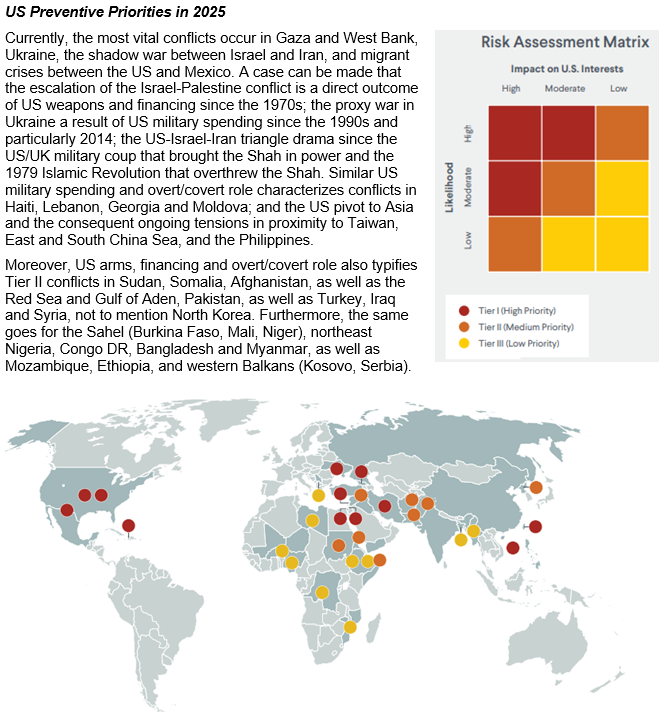
In the Preventive Priorities Survey 2025, US policymaker experts of the Council for Foreign Affairs keep track of priority conflicts, from the perspective of U.S. interests. Yet, most, if not all, of these conflicts originate from and/or have been aggravated by decades of post-Cold War military spending, arms transfers, “advisors” and covert operations by the United States.

Source: CFR, author

Who are the beneficiaries of US military globalization?

Typically, US arms exports grew by 21% between 2015–19 and 2020–24. Meanwhile, its share of global arms exports went from 35% to 43%, which is almost as much as the next eight largest exporters combined. The US supplied major arms to 107 states in 2020–24. US arms exports to European states more than tripled (+233%). States in Asia and Oceania – Japan, Australia, South Korea and Taiwan – received 28% of US arms exports in 2020–24.

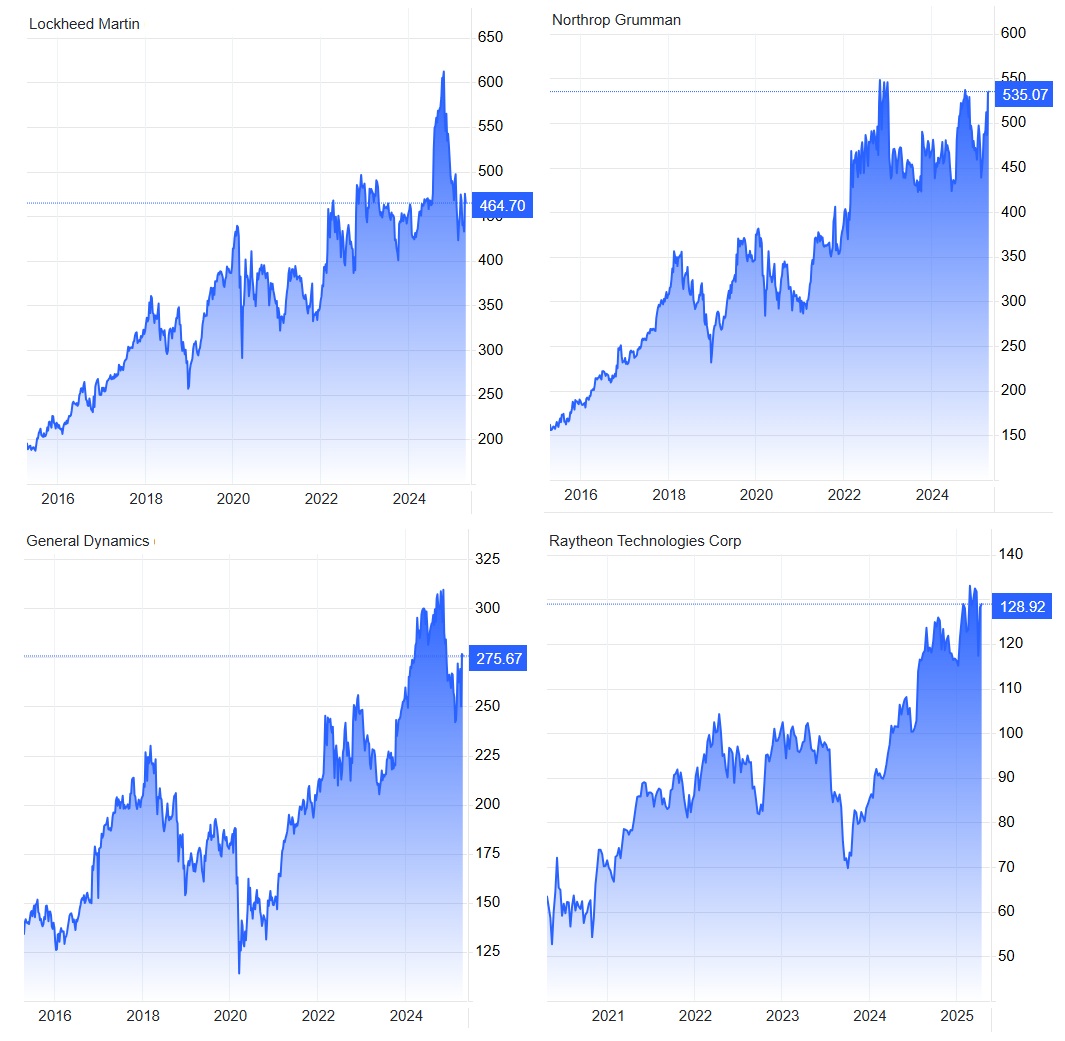
US military primacy has meant windfall profits to a handful gigantic US defense contractors. The Big Defense has been the prime beneficiary, from the proxy war in Ukraine to its counterpart in Gaza and the greater Middle East, and new hot spots emerging from sub-Saharan Africa to Asia. As evidenced by stock prices, the Big Defense has enjoyed colossal profits, particularly in the past half a decade.  Notice the highs fueled by profit-friendly conflicts (esp. Ukraine 2014 and 2022, 2024-5). To avoid lows, new conflicts are now in great demand – hence the pivot to Asia.

US Big Defense: A Decade of Soaring Stock Prices

For all practical purposes, the ongoing rearmament in Asia Pacific is geared to contain China, even at the expense of Asian economic development, which today accounts for more than 60% of global growth prospects.

Combined, US military primacy and the illicit reciprocal and universal tariffs have potential to undermine global economic prospects for years to come. In particular, they could undermine developing economies for decades to come and undermine large emerging economies, which in turn could disrupt global economic growth.

We are amid the most dangerous moment in history since 1933.

Dr. Dan Steinbock is an internationally recognized strategist of the multipolar world and the founder of Difference Group. He has served at the India, China and America Institute (US), Shanghai Institutes for International Studies (China) and the EU Center (Singapore). For more, see https://www.differencegroup.net 

The original commentary was published by China-US Focus on April 15, 2025