Saturday, May 03, 2025

Chile, Argentina order evacuations over post-quake tsunami threat


By AFP
May 2, 2025


View of Puerto Williams, Chile in January 2024 - Copyright AFP Oli SCARFF
Pedro SCHWARZE with Nicolas BIEDERMAN in Buenos Aires

Chilean authorities issued a tsunami warning for the country’s southernmost region Friday morning and both Chile and Argentina ordered evacuations after a major 7.5-magnitude earthquake struck off the coast of South America.

The US Geological Survey (USGS) said the quake struck in the Drake Passage at a shallow depth of 10 kilometers (6.2 miles), 219 kilometers from the city of Ushuaia in Argentina and a similar distance from the Chilean town of Puerto Williams.

It placed the magnitude at 7.4, slightly below the 7.5 reported by Chile’s National Seismological Center.

It struck at 9:58 am local time (1258 GMT), and several smaller aftershocks were also recorded.

“ATTENTION! #SENAPRED, due to the threat of a tsunami, requests the evacuation of the sector of the coastline of the # Magallanes Region,” Chile’s emergency agency SENAPRED wrote on its social media account.

President Gabriel Boric echoed the call for the “evacuation of the coastline throughout the Magallanes region” on his X account.

Authorities in Argentina’s far-south Tierra del Fuego province, said the quake was felt mainly in Ushuaia and called for residents to evacuate a nearby village on the Beagle Channel.

Authorities in both Tierra del Fuego and Magallanes in Chile said there had been no reports of damage or injuries so far.

Chile is one of the countries most affected by earthquakes.

Three tectonic plates converge within its territory: the Nazca, the South American, and the Antarctic plates.

The wave train generated by Friday’s earthquake is expected to reach the coasts of the Antarctic Peninsula and the southern tip of South America in the coming hours, with estimated heights of between 0.3 meters and 1 meter, according to the Chilean Navy.

The first places these waves could reach are the Chilean military bases Bernardo O’Higgins and Arturo Prat, in Antarctica, it added.

Situated at the southern tip of South America, the Magallanes region is Chile’s second largest but is sparsely populated, and lies adjacent to Argentina’s Tierra del Fuego Province.

The governor’s office of Tierra del Fuego in Argentina said “the earthquake was felt primarily in the city of Ushuaia and, to a lesser extent, in other towns throughout the province.”

While urging calm, it called on residents in and around the town of Puerto Almanza, about 75 kilometers east of Ushuaia on the Beagle Channel, “to preventively evacuate the area and move to higher, safer ground.”


– Evacuations going smoothly –


On X, several videos showed Chileans evacuating their homes in Puerto Williams, the town closest to the quake’s epicenter.

Chile’s police on its X account showed an officer pushing a person in a wheelchair up a hill in the town of 2,800 inhabitants.

Other videos shared on X showed people in the town walking up a hill, under sunny skies.

“The preventive evacuation was carried out well, with no incidents so far reported,” Juan Carlos Andrade, director of SENAPRED in Magallanes, told reporters.

In 1960, the southern Chilean city of Valdivia was devastated by a magnitude 9.5 earthquake, considered the most powerful ever recorded, which killed 9,500 people.

In 2010, an 8.8 magnitude quake off the coast of central Chile, which triggered a tsunami, left more than 520 dead.
Activists say drones attacked aid boat bound for Gaza


By AFP
May 2, 2025


This handout picture released by the Malta Government press office shows a Malta Vessel Traffic Services providing assistance at sea to the Conscience - Copyright AFP LOIC VENANCE

Lama Taha

A group of activists organising an aid boat for Gaza said it was attacked on Friday by drones in international waters off Malta as it headed towards the Palestinian territory.

The Maltese government and Cypriot rescuers said they had responded to a distress call from the vessel, while Malta said all crew members were safe and made no mention of an alleged attack.

The activists said they suspected Israel could be behind the incident, and Cyprus’s rescue agency said it had been informed by the island’s foreign ministry of an Israeli drone strike.

The Israeli military did not provide an immediate response when contacted by AFP.

“At 00:23 Maltese time (2223 GMT on Thursday), the Conscience, a Freedom Flotilla Coalition ship came under direct attack in international waters,” the activist group said in a statement.

“Armed drones attacked the front of an unarmed civilian vessel twice, causing a fire and a substantial breach in the hull,” it added.

“Israeli ambassadors must be summoned and answer to violations of international law, including the ongoing blockade and the bombing of our civilian vessel in international waters.”

Asked whether the group believed Israel was behind the attack, a spokesperson told AFP they “suspected” that was the case.

“While we can not confirm 100%, we suspect it’s Israel,” Hay Sha Wiya said, calling the country “the primary entity interested in keep us and any aid out of Gaza.”

Israel is known for conducting intelligence operations beyond its borders, including several during the Gaza war that it only acknowledged later.

The activists said the strike appeared to target the boat’s generator.

Following the distress call, the Malta Vessel Traffic Services body dispatched a tugboat and offered support.

“The tug arrived on scene and began firefighting operations. By 0128 hrs, the fire was reported under control,” the Maltese statement said.


– ‘Desperately needed aid’ –


Cyprus also dispatched a vessel following the distress call.

“The Larnaca Joint Rescue Coordination Centre (JRCC) has been informed by the Ministry of Foreign Affairs of the Republic of Cyprus that a vessel possibly transporting humanitarian aid to Gaza came under missile attack by an Israeli Unmanned Aerial Vehicle (UAV) while sailing within the Search and Rescue (SAR) Region of Malta,” the Cypriot rescue body said.

It said a Cypriot-owned vessel in the area “participated in firefighting operations”.

The activists were on what they called a “mission to challenge Israel’s illegal and deadly siege of Gaza, and to deliver desperately needed, life-saving aid”.

Israel has since March 2 blocked all aid deliveries to Gaza, and resumed intense military operations in the territory in mid-March, with a two-month ceasefire in the Israel-Hamas war in tatters.

The International Committee of the Red Cross warned Friday that the humanitarian response in Gaza was on the “verge of total collapse” after two months of Israel blocking aid to the territory.

A previous “Freedom Flotilla” sailed from southern Turkey in 2010 but ended in bloodshed when Israeli forces stormed the Mavi Marmara vessel, killing 10 people and wounding 28.

Hamas’s attack on Israel in October 2023, which sparked the Gaza war, resulted in the deaths of 1,218 people, mostly civilians, according to an AFP tally based on official figures.

The health ministry in Hamas-run Gaza said on Thursday that at least 2,326 people have been killed since Israel resumed strikes, bringing the overall death toll since the war broke out to 52,418.

Both Hamas and the Palestine Liberation Organization, which Palestinian president Mahmud Abbas leads, issued statements condemning the incident off Malta.

Hamas said it showed Israel’s “blatant disregard for the will of humanity and justice”.


Will the World Speak up Against Israel’s Likely Attack on Humanitarian Activists?

The Conscience was carrying no weapons. It posed no threat. Its only crime was daring to challenge a brutal siege and slaughter that the United Nations itself has condemned as illegal and inhumane.
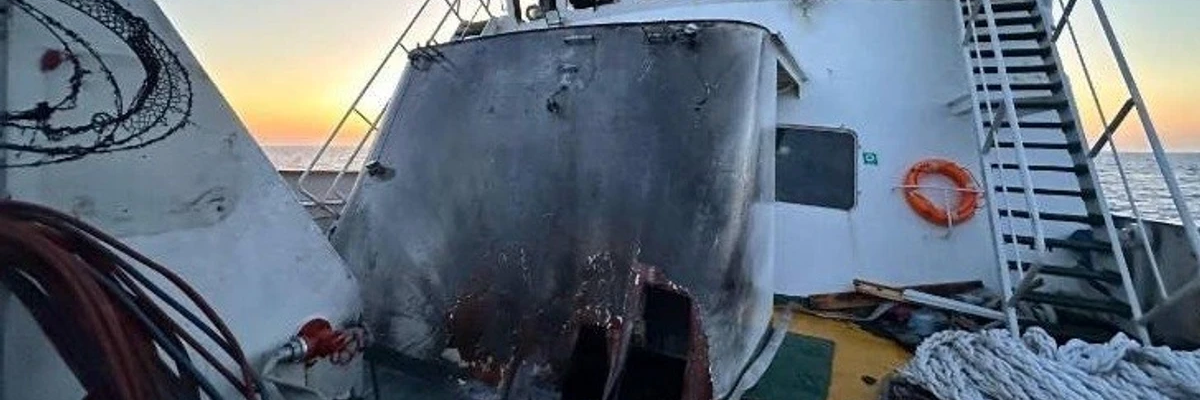

A Freedom Flotilla vessel was damaged by a reported drone strike in international waters off the coast of Malta on May 2, 2025.
(Photo: Freedom Flotilla Coalition)

Medea Benjamin
May 02, 2025
Common Dreams

In the early hours of May 2, the quiet of night was shattered aboard the Conscience, a civilian vessel anchored in international waters, 17 kilometers off the coast of Malta. Aboard were 18 crew members and passengers, jolted from sleep by the sound of two explosions. Flames and smoke filled the air. The ship had just been struck—by what the crew members say were drone attacks.

The very day of the attack, more passengers from 21 countries were waiting in Malta to be ferried out to join the Conscience. Among those slated to join the ship were world-renowned environmentalist Greta Thunberg, retired U.S. Army Colonel Ann Wright, and longtime CODEPINK activist Tighe Barry.

The Conscience is part of the Freedom Flotilla Coalition, a network of international activists that has been challenging Israel’s maritime blockade of Gaza since 2008.

“The U.S. condemns the Houthis for stopping ships carrying weapons to Israel—and bombs Yemen mercilessly for it. But will they condemn Israel for attacking a peaceful ship on a humanitarian mission to Gaza?”

The group alleges that the attack came from Israel—an allegation bolstered by a CNN investigation. According to CNN, flight-tracking data from ADS-B Exchange showed that an Israeli Air Force C-130 Hercules aircraft departed from Israel early Thursday afternoon and flew at low altitude over eastern Malta for an extended period. While the Hercules did not land, its path brought it in proximity to the area where the Conscience was later attacked. The plane returned to Israel approximately seven hours later. The Israel Defense Forces (IDF) declined to comment on the flight data.

The ship suffered significant damage, but fortunately, no one was hurt. That was not the case when the Freedom Flotilla was attacked in 2010. This May 2 attack comes just weeks before the 15th anniversary of the infamous raid on the Mavi Marmara, the Turkish ship that led a previous flotilla to Gaza in 2010. On May 31 of that year, Israeli naval commandos stormed the ship in international waters, killing 10 people and injuring dozens. The Mavi Marmara had been carrying over 500 activists and humanitarian supplies. That attack drew condemnation from around the world and calls for an international investigation—calls that Israel dismissed.

One of this year’s flotilla organizers, Ismail Behesti, is the son of a man killed in the 2010 raid. In videos circulating after the recent strike, Behesti is seen walking through the damaged interior of the Conscience, his voice resolute as he condemns what he believes was another Israeli act of aggression against civilians on a humanitarian mission.

“People are asking how Israel can get away with attacking a civilian ship in international waters,” said Tighe Barry, speaking from the port in Malta. “But since October 8, 2024, Israel has shown complete disregard for international law—from bombing civilian neighborhoods to using starvation as a weapon by blocking food from entering Gaza. This is just one more example of its impunity.”

“Where is the outrage?” Barry continued. “The U.S. condemns the Houthis for stopping ships carrying weapons to Israel—and bombs Yemen mercilessly for it. But will they condemn Israel for attacking a peaceful ship on a humanitarian mission to Gaza?”

The Freedom Flotilla Coalition and activist groups such as CODEPINK are calling on governments and international bodies to speak out and take action.

The Conscience was carrying no weapons. It posed no threat. Its only crime was daring to challenge a brutal siege and slaughter that the United Nations itself has condemned as illegal and inhumane. That’s the real threat Israel fears—not the ship itself, but the global solidarity it represents.

So, will the world speak up about Israel’s latest outrage? Or will this, too, be quietly buried beneath the waves?

Top UN court wraps a week of hearings on humanitarian aid to Gaza

MOLLY QUELL
Fri, May 2, 2025 
AP


A Palestinian flag flies outside the International Court of Justice, rear, which opened hearings into a United Nations request for an advisory opinion on Israel's obligations to allow humanitarian assistance in Gaza and the West Bank, in The Hague, Netherlands, Monday, April 28, 2025. (AP Photo/Peter Dejong)More


THE HAGUE, Netherlands (AP) — The top United Nations court on Friday wraps a week of hearings on what Israel must do to ensure desperately needed humanitarian aid reaches Palestinians in Gaza and the occupied West Bank.

Last year, the U.N. General Assembly asked the International Court of Justice to give an advisory opinion on Israel’s legal obligations after the country effectively banned the U.N. agency for Palestinian refugees, the main provider of aid to Gaza, from operating.

Experts say the case could have broader ramifications for the United Nations and its missions worldwide.

The hearings are taking place as the humanitarian aid system in Gaza is nearing collapse and ceasefire efforts remain deadlocked. Israel has blocked the entry of food, fuel, medicine and other humanitarian supplies since March 2. It renewed its bombardment on March 18, breaking a ceasefire, and seized large parts of the territory, saying it aims to push Hamas to release more hostages.

Israel denies deliberately targeting civilians and aid staff as part of its war with Hamas and did not attend the hearing. The country did provide a 38-page written submission for the court to consider.

What is at stake?

The hearings focused on provision of aid to the Palestinians, but the U.N. court's 15 judges could use their advisory opinion to give legal guidance on the powers of the world body.

“The court has the opportunity to clarify and address questions about the legal immunities of the United Nations,” Mike Becker, an expert on international human rights law at Trinity College Dublin, told The Associated Press.

Advisory opinions issued by the U.N. court are described as “nonbinding” as there are no direct penalties attached to ignoring them. However, the treaty that covers the protections that countries must give to United Nations personnel says that disputes should be resolved through an advisory opinion at the ICJ and the opinion “shall be accepted as decisive by the parties.”

“The oddity of this particular process,” Becker said, “is a clear response to any argument that the opinion is nonbinding.”

What has the ICJ been tasked with answering?

The resolution, sponsored by Norway, seeks the ICJ’s guidance on “obligations of Israel … in relation to the presence and activities of the United Nations … to ensure and facilitate the unhindered provision of urgently needed supplies essential to the survival of the Palestinian civilian population.” The United States, Israel’s closest ally, voted against it.

Israel’s ban on the agency, known as UNRWA, which provides aid to Gaza, came into effect in January. The organization has faced increased criticism from Prime Minister Benjamin Netanyahu and his far-right allies, who claim the group is deeply infiltrated by Hamas. UNRWA rejects that claim.

“We cannot let states pick and choose where the U.N. is going to do its work. This advisory opinion is a very important opportunity to reinforce that,” Becker said.

Do these proceedings matter for countries other than Israel?

Whatever the judges decide will have an impact beyond the current situation in Gaza, according to Juliette McIntyre, an expert on international law at the University of South Australia. “Are these immunities absolute or is there wiggle room? This is useful for where United Nations personnel are working in other places,” McIntyre told AP.

An authoritative answer from the World Court can have influence beyond judicial proceedings as well. “Every time a norm is breached, the norm gets weaker. The advisory opinion in this case could push the norm back,” said McIntyre.

In separate proceedings last year, the court issued an unprecedented and sweeping condemnation of Israel’s rule over the occupied Palestinian territories, finding Israel’s presence unlawful and calling for it to end. The ICJ said Israel had no right to sovereignty in the territories, was violating international laws against acquiring territory by force and was impeding Palestinians’ right to self-determination.

According to McIntyre, the arguments presented this week reflect the opinion handed down just nine months ago. “Now the starting premise is that Israel is illegally occupying all of Palestine,” McIntyre said.

What did the Palestinians and Israelis say?

On Monday, the Palestinian delegation accused Israel of breaching international law in the occupied territories and applauded the move to bring more proceedings to the court. “Our journey with the international institutions, be it Security Council, the General Assembly or the ICJ, is we are building things block on top of another block while we are marching towards the accomplishment of the inalienable rights of the Palestinian people, including our right to self-determination, statehood, and the right of the refugees,” Palestinian U.N. envoy Riyad Mansour told reporters.

Israel has denied it is in violation of international law and said the proceedings are biased. Israeli Foreign Minister Gideon Saar hit back at the case during a news conference in Jerusalem on Monday. “I accuse UNRWA, I accuse the U.N., I accuse the secretary-general and I accuse all those that weaponized international law and its institutions in order to deprive the most attacked country in the world, Israel, of its most basic right to defend itself,” he said.

The court is expected to take months to deliver its opinion.


US backs Israel's ban on UNRWA Gaza aid operations at World Court

Reuters
Wed, April 30, 2025 


Palestinians receive aid from UNRWA in Khan Younis in the southern Gaza Strip

FILE PHOTO: ICJ holds hearing in the ongoing case regarding Israel's occupation of Palestinian territories, in The Hague


AMSTERDAM (Reuters) - Israel cannot be forced to allow the U.N. Palestinian refugee agency UNRWA to operate in Gaza, the United States said on Wednesday at a World Court hearing in The Hague.

Israel last year passed a law that banned UNRWA from operating in the country, as it said the organisation had employed members of Hamas who took part in the attacks on Israel on October 7, 2023.

The U.N. said in August that nine UNRWA staff may have been involved in the assault and had been fired. Another Hamas commander, confirmed by UNRWA as one of its employees, was killed in Gaza in October, according to Israel.


Advertisement


The United Nations General Assembly in December asked the U.N.'s top court to give an advisory opinion on Israel's obligations to facilitate aid to Palestinians that is delivered by states and international groups, including the United Nations.

At the third day of hearings on the matter, the U.S. said Israel had the right to determine which organisations could provide basic needs to the population of the occupied Palestinian territories.

"An occupational power retains a margin of appreciation concerning which relief schemes to permit," U.S. State Department legal adviser Joshua Simmons said.

"Even if an organisation offering relief is an impartial humanitarian organisation, and even if it is a major actor, occupation law does not compel an occupational power to allow and facilitate that specific actor's relief operations."

Simmons also stressed the "serious concerns" Israel has about UNRWA's impartiality.

U.N. and Palestinian representatives at the opening of hearings on Monday had accused Israel of breaking international law by refusing to let aid into Gaza.

Since March 2, Israel has completely cut off all supplies to the 2.3 million residents of the Gaza Strip, and food stockpiled during a ceasefire at the start of the year has all but run out.

Israeli Foreign Minister Gideon Saar said in Jerusalem on Monday that Israel had submitted its position in writing to the hearings, which he described as a "circus".

(Reporting by Bart Meijer; Editing by Alex Richardson)

Israel releases Palestinian medic who was detained during IDF attack on emergency convoy

Kareem Khadder and Catherine Nicholls, CNN
Wed, April 30, 2025 


The Palestine Red Crescent Society released images of Assad al-Nsasrah being examined at Al-Amal Hospital in Khan Younis after his release. - Palestine Red Crescent Society

A Palestinian medic who was detained during a deadly Israeli military attack on an emergency convoy last month was released on Tuesday, according to the Palestine Red Crescent Society (PRCS).

Assad Al-Nsasrah went missing after the Israel Defense Forces (IDF) attacked a convoy of emergency vehicles in Gaza on March 23. He was part of a crew who were trying to find a missing PRCS ambulance in Rafah, southern Gaza, which was later discovered to also have been targeted by the IDF.

The IDF attacks killed 15 people in three separate shootings, including 8 PRCS medics. Their vehicles were clearly marked with the PRCS insignia. The IDF buried the bodies of those killed in a mass grave, along with the vehicles they had been traveling in.

According to PRCS medic Munther Abed – who was sitting in the back of the ambulance en route to the scene – the crew was suddenly targeted with heavy, direct gunfire by Israeli forces. He told CNN that he witnessed the IDF’s burial of the bodies and vehicles, seeing bulldozers dig a large pit, crush the vehicles and pile them into the hole.

Photos and videos of the grave’s excavation reviewed by CNN showed some of the PRCS paramedics pictured in photos were buried in their uniforms emblazoned with the group’s emblem and reflective stripes. Others were still wearing their blue latex gloves, indicating that they were on duty and prepared to respond to distress calls.

It took the PRCS three weeks to learn that Al-Nsasrah had been detained by the IDF. Prior to this, his fate had been unknown since the attack.

On Tuesday, the PRCS posted a video to X of the medic reuniting with his colleagues, wiping away tears as he hugged them one by one.

“Today, the Israeli occupation forces released our colleague Asaad (Al-Nsasrah), a survivor of the massacre targeting medical teams in Rafah,” the PRCS wrote in a separate X post.

“He had been detained for 37 days and arrived in poor health at Al-Amal Hospital, affiliated with the association in Khan Younis, where he underwent the necessary medical examinations,” the humanitarian organization continued.

Though the Israeli military had initially claimed without evidence that some of the vehicles it targeted were moving suspiciously, and that some of those killed were Hamas members, it later said “professional failures” led to the killings.

According to the IDF, troops opened fire on what they believed to be a “tangible threat” amid what the military called an “operational misunderstanding.”

Videos showed that the convoy of marked ambulances were driving with headlights and flashing emergency lights on. Aid agencies also denied that any Hamas militants were among those killed.

“The IDF regrets the harm caused to uninvolved civilians,” the IDF said in a statement published earlier this month. CNN has reached out to the military for comment on Al-Nsasrah’s release.

Israeli forces detain prominent Palestinian journalist in early morning West Bank raid

Kareem Khadder and Abeer Salman, CNN
Tue, April 29, 2025 


Ali Samoudi next to a photo of slain American-Palestinian journalist Shireen Abu Akleh, outside the entrance of Jenin Camp, in Jenin, West Bank in 2022 - Abeer Salman/CNN

Israeli forces detained prominent Palestinian journalist Ali Samoudi in an early morning raid on his son’s home in the occupied West Bank.

The raid occurred in the city of Jenin, where Samoudi’s son told CNN the Israeli military came in at 5 a.m. and took the 58-year-old journalist to an undisclosed location.

Samoudi “underwent a field interrogation” by Israeli forces for 30 minutes, Mohammad Samoudi told CNN, saying they had searched the house and destroyed some of its contents.

In addition to writing for the Palestinian Al-Quds newspaper, Samoudi routinely worked with international news outlets, including CNN, Al-Jazeera, Reuters, and others.

In May 2022, Samoudi was working near the entrance to the Jenin refugee camp when Israeli forces shot and killed Palestinian-American journalist Shireen Abu Akleh. Samoudi was shot and injured in the gunfire.

The Palestinian Journalists Syndicate condemned the raid and Samoudi’s arrest.

The Israel Defense Forces (IDF) said Samoudi was “identified with the Islamic Jihad terrorist organization” and suspect of transferring funds to the group, but did not provide any evidence to support its claim.

One of the most well-known Palestinian journalists in the West Bank, Samoudi has worked with international news organizations for decades as a local producer and fixer. In his long career as a journalist, he had never previously faced such an accusation, including when he became a witness to the high-profile killing of his colleague, Abu Akleh.

The IDF said Samoudi has been transferred to Israeli security forces “for further treatment.”

Friday, May 02, 2025

The New START Treaty at 15: A Crossroads for Nuclear Disarmament

Rather than turning back from the brink of nuclear war, nuclear armed states are accelerating nuclear weapons spending. We must change course.


Anti-nuclear weapons activists demonstrate outside of the the Kluczynski Federal Building in Chicago, Illinois.
(Photo by Scott Olson/Getty Images)

Danny Hall
May 03, 2025
Common Dreams

On April 8, 2010, the United States and Russia signed the New Strategic Arms Reduction Treaty (New START), a landmark achievement that capped and reduced deployed nuclear arsenals, symbolizing hope for a safer, more stable world. Now, 15 years later, as the expiration of New START approaches in February 2026, the risks of a renewed nuclear arms race loom large. Over the past four years, repeated Russian threats to use nuclear weapons in the war in Ukraine have dramatically weakened the “nuclear taboo.” The risk of a potentially civilization-ending nuclear war has risen to levels some experts say is at least has high as during the Cuban Missile Crisis. Rather than turning back from the brink of nuclear war, nuclear armed states are accelerating nuclear weapons spending. The U.S. alone is estimated to spend $756 billion on nuclear weapons in the next ten years.

Amid this urgent landscape, the just introduced McGovern-Tokuda resolution -H.Res.317 provides a transformative framework to confront these challenges, offering a comprehensive roadmap toward a world free of nuclear weapons as a national security imperative. Reps. McGovern and Tokuda understand that the story of nuclear weapons will have an ending. It will either be the end of nuclear weapons or the end of human civilization. We have been incredibly fortunate throughout the nuclear weapons era. As Robert McNamara famously declared after the Cuban Missile Crisis, “We lucked out. It was luck that prevented nuclear war.”

Hoping for good luck is not an acceptable security policy and, sooner or later, our luck will run out.

The policies of the nuclear weapons states are essentially a hope that this luck will continue. But hoping for good luck is not an acceptable security policy and, sooner or later, our luck will run out. As William Perry has warned: “nuclear weapons no longer provide for our security, they endanger it.”

Comprehensive Roadmap Toward a World Free of Nuclear Weapons


House Resolution 317 is not merely a legislative initiative; it is a bold declaration of humanity's collective determination to eliminate nuclear weapons and secure a future without weapons that risk the end of human civilization. This resolution encapsulates the vision ofBack from the Brink, a grassroots movement unwavering in its mission to abolish the global nuclear threat. Building upon its steadfast advocacy, the coalition sees this legislation as a step forward in the fight for global disarmament and an unequivocal commitment to a nuclear-free future. Back from the Brink has supported initiatives to reduce nuclear risks, including the prior version of this resolution during the 118th Congress. Now leading efforts to rally support for the new resolution, the coalition recognizes this legislation as a vital step toward global disarmament.

The resolution complements the Foster resolution,H.Res.100, by calling for arms control negotiations with Russia and China while maintaining a focus on broader disarmament efforts. It explicitly opposes nuclear testing, supports theRadiation Exposure Compensation Act (RECA), to address the legacy of harm caused by nuclear weapons, and prioritizes a just economic transition for the nuclear labor force. Denise Duffield of Back from the Brink encapsulates the resolution’s importance: “The McGovern-Tokuda resolution is more than a statement—it’s a detailed, actionable roadmap to nuclear disarmament. It provides a clear strategy for reducing nuclear risks, ending outdated policies, championing justice for impacted communities, and advancing a future free from the threat of nuclear war.”

 Call for Leadership and Cooperation

TheArms Control Association and theCouncil for a Livable World are among the notable organizations supporting the McGovern-Tokuda resolution. Their endorsements underscore the resolution’s potential to restore U.S. leadership in reducing nuclear dangers. Daryl Kimball, Executive Director of the Arms Control Association, emphasizes, “This timely resolution outlines a practical plan for action to restore U.S. leadership to lead the world back from the nuclear brink and build a safer world for our children and generations to come.”

John Tierney, Executive Director of the Council for a Livable World, points out the pragmatic benefits of the resolution, stating, “We cannot risk letting nuclear threats increase. That is why Council for a Livable World supports Congressman McGovern’s H.Res.317 to lower nuclear risks and promote diplomacy to work toward a world free from nuclear threats.”

Addressing the Legacy of Harm

The resolution goes beyond arms control and disarmament negotiations—it addresses the devastating legacy of economic harm caused by nuclear weapons, both past and present. Today, the United States spends billions annually on nuclear weapons programs, diverting critical resources away from urgent human and community needs. According to this year'snuclear spending tax calculator, the U.S. allocated over $94 billion to nuclear weapons programs in FY 2024 alone. These funds could have been used to fund the Children’s Health Insurance Program for seven years or fund HUD’s mandatory affordable housing programs for nine years. Instead, this spending perpetuates environmental contamination, denies justice to impacted communities, and undermines investments in education, healthcare, and sustainable development. The McGovern-Tokuda resolution offers a path to redirect these resources toward building a safer, more equitable future.

The United States spends billions annually on nuclear weapons programs, diverting critical resources away from urgent human and community needs.

It also addresses the devastating legacy of radiological impacts. From environmental contamination to human exposure, the communities and workers affected by nuclear weapons production and testing deserve justice, healthcare, and full remediation. Martha Dina Argüello of Physicians for Social Responsibility-Los Angeles describes the resolution as “a truly comprehensive nuclear disarmament framework—one that addresses the past and current harm caused by nuclear weapons and the need to care for and provide a just economic transition for the people and communities whose livelihoods depend on nuclear weapons.”

The Time to Act Is Now

The 15th anniversary of New START is a powerful reminder of what can be achieved through bold leadership and collective action. As the treaty’s expiration looms and the threat of nuclear catastrophe grows, the stakes could not be higher. The McGovern-Tokuda resolution provides a clear and actionable path to eliminate these risks, but success depends on all of us. Now is the time to take a stand. Join theBack from the Brink campaign to amplify this critical call for nuclear disarmament. Get involved, raise your voice, and rally your community to support this transformative resolution. Together, we can build a future free of nuclear weapons—one that saves the world and imbues our lives with profound hope and meaning. Take action today—the world is counting on you.


Our work is licensed under Creative Commons (CC BY-NC-ND 3.0). Feel free to republish and share widely.


Danny Hall Director of Public Affairs for Soka Gakkai International-USA (SGI-USA) and a Back from the Brink Steering Committee Member, reflects on the courageous actions faith leaders have taken in recent months to build international solidarity and urge political leaders to take tangible steps toward disarmament. He argues that Congress must listen to these leaders and pass H. Res. 77, which supports the goals and provisions of the Treaty on the Prohibition of Nuclear Weapons.
Full Bio >
World’s military spending rises at highest rate in nearly four decades, report says

Brad Lendon, CNN
Tue, April 29, 2025 


The F-35 fighter jet program accounted for more than $60 billion of US military spending in 2024, according to a new report from the Stockholm International Peace Research Institute. - Clement Mahoudeau/AFP/Getty ImagesMore


The world is arming itself at the fastest rate since near the end of the Cold War, according to a new report, as major wars rage in Ukraine and Gaza and military tensions spike from Europe to Asia.

The 9.4% year-on-year rise to $2.718 trillion in global military spending in 2024 is the highest figure ever recorded by the authoritative Stockholm International Peace Research Institute (SIPRI) in its annual report – which warned there’s no end in sight to the spiraling global arms race. That is the highest rise since 1988, the year before the Berlin Wall fell.

“Many countries have also committed to raising military spending, which will lead to further global increases in the coming years,” the report said.

The United States remains by far the world’s biggest military spender – almost a trillion dollars in 2024, the report said.

Big ticket items in the US budget included F-35 stealth fighters and their combat systems ($61.1 billion), new ships for the US Navy ($48.1 billion), modernizing the US nuclear arsenal ($37.7 billion) and missile defense ($29.8 billion).

The US budget included $48.4 billion in aid for Ukraine, almost three-quarters of Kyiv’s own defense budget of $64.8 billion.

China followed the US in overall military spending with an estimated $314 billion, just under a third of the US total, the report said.

It did not break down Beijing’s spending by weapons or command, but noted China “unveiled several improved capabilities in 2024, including new stealth combat aircraft, uncrewed aerial vehicles (UAVs) and uncrewed underwater vehicles.”

“China also continued to rapidly expand its nuclear arsenal in 2024,” the report said.

Together, Washington and Beijing accounted for almost half of the world’s military spending in 2024, the report said.

But countries involved in – or wary of – regional conflicts showed the biggest increases in spending year over year.

Israel, which launched an invasion of the Palestinian territory of Gaza in 2023, showed a whopping 65% increase in military spending in 2024.


Heavy bombs from the US arrive in Port Ashdod, Israel, on February 16, 2025. The US provided Israel with $10.6 billion in supplemental military aid in 2024, the Stockholm International Peace Research Institute says. - Israeli Ministry of DefenseMore

Meanwhile, Russia, which invaded Ukraine in 2022, showed an estimated increase of at least 38%, but the SIPRI noted that figure was likely higher as Moscow augments military coffers with money from regional and other sources.

The more than three-year-long conflict in Ukraine has seen NATO countries significantly boost their military budgets in response to Russia’s belligerence and as US President Donald Trump presses Europe and the US-led alliance to be more responsible for their defense, saying they’ve been taking advantage of the United States for too long.

Germany, with the world’s fourth-largest defense budget, upped its spending by 28%. Romania (43%), the Netherlands (35%), Sweden (34%), the Czech Republic (32%), Poland (31%), Denmark (20%), Norway (17%), Finland (16%), Turkey (12%) and Greece (11%), were the other NATO members among the top 40 defense spenders worldwide who showed double-digit increases in 2024.

“The rapid spending increases among European NATO members were driven mainly by the ongoing Russian threat and concerns about possible US disengagement within the alliance,’ said Jade Guiberteau Ricard, researcher with the SIPRI Military Expenditure and Arms Production Programme.

But analysts said it may take more than money for US allies in Europe to become militarily self-sufficient.

“It is worth saying that boosting spending alone will not necessarily translate into significantly greater military capability or independence from the USA. Those are far more complex tasks,” Guiberteau Ricard said in a press release.

In the Indo-Pacific, the SIPRI said China’s 7% increase in 2024 marked the 30th consecutive year-over-year rise in spending for the People’s Liberation Army, “the largest unbroken streak recorded” in the institute’s database, the report said.

“China’s military build-up has also influenced the military policies of its neighbors, prompting many of them to increase spending,” it said.

Japan’s military budget rose 21% in 2024 – Tokyo’s largest increase since 1952. That brought military spending to 1.4% of gross domestic product, the biggest chunk of Japan’s economy devoted to the military since 1958.

The Philippines, embroiled with China in territorial disputes in the South China Sea, increased its defense spending 19%.


Philippine marines board a ship during a joint visit, board and seizure exercise with their US and South Korean counterparts with members of Japan's Self-Defense Forces as observers, during training in Ternate town, Cavite province, west of Manila, on October 22, 2024. - Ted Aljibe/AFP/Getty ImagesMore

And though spending in South Korea went up only 1.4% in 2024, Seoul has the “highest military burden in East Asia,” at 2.6% of GDP, the institute said.

Taiwan, an island democracy of some 23 million people that the Chinese Communist Party claims as its own and has vowed to seize by force if necessary, increased its defense budget by only 1.8% last year, but Taipei’s military spending is up 48% since 2015, the report said.

India, meanwhile, had the world’s fifth-largest defense budget ($86.1 billion) in 2024. New Delhi’s increase over 2023 was only 1.6%, but the country’s defense spending is up 42% over the past decade, indicative of a troubling trend, researchers said.

“Major military spenders in the Asia–Pacific region are investing increasing resources into advanced military capabilities,” Nan Tian, director of the SIPRI Military Expenditure and Arms Production Programme, said. “With several unresolved disputes and mounting tensions, these investments risk sending the region into a dangerous arms-race spiral.”

Also in Asia, Myanmar, which has seen internal conflict since a military coup in 2021, increased spending by 66% in 2024. At 6.8% of its GDP, Myanmar maintains the largest military burden in the Asia-Pacific, the report said.

Military expenditures in Africa were up 3% overall in 2024. Algeria is the continent’s biggest spender, while ranking 20th worldwide.

In the Americas, Mexico showed a 39% surge in military spending in 2024, “reflecting the government’s increasingly militarized response to organized crime,” the report said.

CNN.com


Europe Is Racing to Build Its Own Version of the U.S. Military-Industrial Complex

Jon Sindreu
Thu, May 1, 2025 
WALL STREET JOURNAL


Spotters take pictures of a Dutch Air Force Lockheed Martin F-35 Lightning II jet fighter. - JOHN THYS/AFP/GETTY IMAGES


America’s vast military-industrial complex has many critics. For Europe, it is now something to aspire to.

This week, Germany asked the European Union to invoke an emergency clause exempting defense investment from spending rules, as part of the bloc’s five-year rearmament plan. Global defense expenditure experienced the highest year-over-year rise since at least the end of the Cold War in 2024, Stockholm International Peace Research Institute data showed this week, with Europe as the main contributor. Analysts estimate NATO members could add €700 billion ($798 billion) to €2 trillion in extra military spending by 2030.


Of course, much of the windfall will flow to prime U.S. contractors such as Lockheed Martin, Northrop Grumman and General Dynamics. But Brussels wants at least 50% of European military procurement to go to domestic firms. Achieving that requires major industrial reform—something investors are eager to capitalize on as the U.S. growth story loses its shine.

Because European countries slashed military budgets a lot more than the U.S. after the Cold War, their domestic defense suppliers became niche, low-volume producers with high unit costs. Airbus’s military arm was the highest-grossing one in 2024 with €12 billion in revenue—barring BAE Systems, which gets half its sales from the U.S. By contrast, Lockheed grossed $71 billion.

This has created a negative feedback loop, with NATO members increasingly channeling off-the-shelf purchases toward American contractors, which remain capable of large-scale production. Following Russia’s invasion of Ukraine, only 22% of the EU’s procurement boost remained in Europe, according to the European Commission.

The clear, first step to fix this is producing more of what Europe already makes: ammunition. After the EU failed to deliver one million artillery shells to Ukraine by March 2023—it took until November—officials in the bloc allocated €500 million to scale output. A quarter went to Rheinmetall, which targets output of 1.1 million 155mm shells a year by 2027, and tripling annual revenue to €30 billion by 2030.

Rheinmetall wants to evolve into an American-style, all-purpose contractor. It recently acquired U.S. vehicle maker Loc Performance, ammo recovery firm Stascheit, and software developer blackned, and bid for Thyssenkrupp’s warship arm, which was rejected in favor of a spinoff.

However, investor enthusiasm has pushed its forward price-earnings ratio to 43, from 17 six months ago. Such extreme valuations argue for diversification, but it is hard to spot other clear winners in an industrial base wastefully fragmented across national lines.

Germany is a leading manufacturer of tanks but, where the U.S. fields the Abrams main battle tank, the Bradley infantry vehicle and the Stryker personnel carrier, Europe has several competing models for each tank class. Ditto for frigates, submarines and planes.

In jet fighters, the Eurofighter Typhoon, backed by Germany, Italy, Spain and the U.K., competes with France’s Rafale and Sweden’s Gripen. But the most popular choice among European NATO members is the F-35, which boasts stealth capabilities and triple the production rate. This locks countries into U.S. systems for two decades. Next-generation fighter development is split too, between a Dassault-Airbus program and a BAE Systems-Leonardo-Mitsubishi team.


Ideally, these firms would merge into two giants, each bidding for a unified contract, with only one aircraft ultimately developed, just as Boeing and Lockheed did with the U.S. Air Force’s F-47 project.

In practice, top-tier mergers remain unlikely. National governments retain stakes in most defense firms and are reluctant to cede control.

A more realistic model is missile maker MBDA. Jointly owned by Airbus, BAE and Leonardo, it functions as one company while retaining national subsidiaries. This allowed simplification: The Aster missile family—Europe’s closest equivalent to the U.S. PAC-3 MSE, used in the Patriot systems that have proven vital in Ukraine—has replaced legacy systems such as the Crotale, Masurca, Spada, Aspide and Sea Dart. MBDA plans to double production this year from 2023.

Eurofighter Typhoon jet fighters are backed by Germany, Italy, Spain and the U.K. - JOHN THYS/AFP/Getty Images

This model could extend to other sectors. Rheinmetall is developing the Panther KF51 tank, aimed at replacing the Leopard 2, and has now joined forces with Leonardo to build a variant for Italy. Naval capabilities could be consolidated across BAE, France’s Naval Group, Germany’s Thyssenkrupp, Italy’s Fincantieri and the Netherlands’s Damen.


Investors could spread bets across listed players, hoping to reap the benefits of their networks of specialized subsidiaries.

Still, the MBDA blueprint remains vulnerable to national divergence. MBDA Germany and France, for example, make competing land-attack cruise missiles: The Taurus KEPD 350, now restarting production after a five-year pause, and the SCALP EG. This reflects premerger legacies, but highlights the challenge of scaling with stale, legacy lines. University of Oslo’s Fabian Hoffmann estimates combined annual capacity is just 100 units, which is far below Lockheed’s 700 JASSM-ERs.

Meanwhile, Europe lacks a high-altitude missile defense like the U.S. THAAD or Israel’s Arrow 3, which can take 20 years to build. It also depends on the U.S. for software and satellite intelligence.

Lockheed Martin jet fighters being manufactured in West Fort Worth. - Fort Worth Star-Telegram/Getty Images

“It is best to first fix the procurement system, then have these companies compete with each other and then see which winners are emerging and drive consolidation. It is what happened with Rheinmetall,” said Hoffmann.

Indeed, the EU seeks to replicate the Pentagon’s power as a centralized buyer. It will make €150 billion in loans available for joint defense procurement and has set up a target for 40% of purchases to be collaborative by 2030. That may not be enough.

With many countries still reluctant to spend even under the auspices of Brussels, though, there will still be a lot of capital stepping in to finance smaller defense deals, usually involving assets owned by unlisted companies.

Private-equity firms such as London-based Tikehau Capital and Paris-based Weinberg Capital Partners are now focusing on security-related small and medium companies, and larger players such as CVC Capital Partners are perfectly positioned to do even more.

Then there is venture capital, which should help address some of the “capability gaps” that EU officials have identified, including drones, artificial intelligence and cyberwarfare. The models are the many Silicon Valley upstarts currently vying for Pentagon contracts, such as Anduril Industries, Palantir and Shield AI.

According to a recent report by NATO Innovation Fund, a €1 billion vehicle launched by NATO in 2023 to provide early support to strategic military technology, European VC funding in this area was at a record high last year. The success of Ukrainian producers of small drones, sprouted out of necessity, have also pointed the way.

There is another straightforward way to play the trend: The top European investment banks, such as BNP Paribas and Deutsche Bank, are set to receive a fee windfall in the form of advisory services for mergers and restructurings, as well as equity and debt issuance to fund expansions.

The European military-industrial complex won’t rival the U.S.’s anytime soon, but there is money to be made as it wakes up from a long slumber.


'No Legal Basis,' Says Harvard After Trump Declares Tax-Exempt Status Will Be Taken Away

"Such an unprecedented action would endanger our ability to carry out our educational mission," said a spokesperson for the Ivy League school.


Eloise Goldsmith
May 02, 2025
COMMON DREAMS

Harvard University pushed back forcefully Friday after President Donald Trump declared in a social media post that "we are going to be taking away Harvard Tax Exempt Status," adding that is "what they deserve."

Trump's comment came just hours after Democratic senators sent a letter demanding a probe into whether the administration is acting illegally by trying to compel the U.S. Internal Revenue Service to yank the university's tax exemption.

Trump's post did not specify whether the IRS, the entity that has the power to remove an organization's tax-exempt status, is opting to remove Harvard's designation. Multiple outlets noted they got no immediate response from the IRS when they asked the agency for comment.

"There is no legal basis to rescind Harvard's tax-exempt status," a university spokesperson said in a statement, according toPolitico. "Such an unprecedented action would endanger our ability to carry out our educational mission."

It is illegal for the president, vice president, or other top officials to request, indirectly or directly, that the IRS audit a particular taxpayer.

Senate Minority Leader Chuck Schumer (D-N.Y.) and multiple other Democratic senators on Friday asked the Acting Treasury Inspector General for Tax Administration (TIGTA) to probe whether the IRS has received illegal pressure from the administration when it comes to Harvard, and to provide information about whether the agency is looking into other entities at the direction of the president or other top officials.

"It is both illegal and unconstitutional for the IRS to take direction from the president to target schools, hospitals, churches, or any other tax-exempt entities as retribution for using their free speech rights," the senators wrote in a letter dated Friday to the Acting TIGTA Heather Hill.

"It is further unconscionable that the IRS would become a weapon of the Trump administration to extort its perceived enemies, but the actions of the president and his operatives have now made this fear a reality. We request that you review whether the president or his allies have taken any step to direct or pressure the IRS to take politically-motivated actions regarding the tax-exempt status of the president's political targets," they continued.

Loss of tax-exempt status, something that would only typically occur after an audit process that allows the university opportunity to defend itself and appeal, would be extremely significant for the university. Tax-exempt status means the school does not pay federal income tax on charitable contributions to the school and other income. It also means that donations to the school are tax-exempt for those who make them.

Trump mused publicly on April 16 that Harvard should lose its tax-exempt status, after the university's president said the institution would not comply with a list of policy demands from the president, that included, according to the Harvard Crimson, derecognizing pro-Palestine student groups and auditing academic programs for viewpoint diversity. The pushback from Harvard prompted the administration to freeze over $2 billion in federal funding for the school.

That same week, it was reported that the IRS was making plans to revoke Harvard's tax-exempt status.

In response to Trump's bullying tactics, Harvard sued the administration, calling the freeze on funding unlawful and asking the court to restore it.

The tangling between Harvard and the Trump administration is part of a broader wave of scrutiny by the White House on higher education.

Trump says he’s ‘taking away’ Harvard’s tax-exempt status. That would be an unpopular move, according to a new poll


The Yahoo News/YouGov survey finds that more Americans disapprove (49%) than approve (35%) of the president's pressure campaign against the elite university.

Andrew Romano
·Reporter
Updated Fri, May 2, 2025 


"Veritas" on a wall at Harvard University. (David L. Ryan/The Boston Globe via Getty Images)


President Trump said Friday that he would be "taking away" Harvard University's tax-exempt status, a move that would upend the school's finances and escalate his pressure campaign against some of America's most elite universities.

"It’s what they deserve!" Trump wrote on social media.

But in the ongoing battle between Trump and Harvard, significantly more Americans side with Harvard, according to a new Yahoo News/YouGov poll.

The survey of 1,597 U.S. adults was conducted from April 25 to 28, just days after Harvard sued the Trump administration in federal court. On April 11, the administration sent Harvard a letter saying it would lose billions of dollars in government funding unless it changed its hiring practices, admissions criteria and classroom priorities to make the campus “viewpoint diverse.” When Harvard refused, the Trump administration froze more than $2 billion in federal research grants to the university and threatened its tax-exempt status.


Federal law prohibits the president from using the Internal Revenue Service as a political tool, and if IRS employees receive an order from the White House to conduct a tax investigation, they're required to report it to an inspector general. The first time Trump said he would strip Harvard of its status, White House officials insisted the IRS would act independently and come to its own conclusion.

“There is no legal basis to rescind Harvard’s tax-exempt status,” a Harvard spokesperson said Friday. “Such an unprecedented action would endanger our ability to carry out our educational mission. It would result in diminished financial aid for students, abandonment of critical medical research programs, and lost opportunities for innovation.”

Like other nonprofit educational institutions, Harvard is exempt from paying most federal taxes under Section 501(c)(3) of the Internal Revenue Code of 1986. Donors can also write off gifts to the school on their personal tax returns. Forcing Harvard's to pay taxes would drain it of funds currently used for education, research and aid; it could also cause donations to dry up.

Is Trump's pressure campaign popular?

Citing concerns about Gaza War protests and diversity, equity and inclusion (DEI) programs, Trump has moved to impose his ideological preferences on other prestigious universities as well, using government money as leverage. But Harvard was the first to forcefully push back.


The public largely supports the school’s decision. According to the new Yahoo News/YouGov poll, a plurality of Americans (48%) approve of Harvard rejecting Trump’s demands; just 31% disapprove. (The rest — 21% — are not sure).

Likewise, 49% of Americans disapprove of the Trump administration’s response (i.e., freezing Harvard’s research grants and threatening its tax-exempt status); only 35% approve.

Finally, far more Americans agree with an anonymous statement summarizing Harvard’s side of the argument than with an anonymous statement summarizing Trump’s:

49% agree that “no government — regardless of which party is in power — should dictate what private universities can teach, whom they can admit and hire, and which areas of study and inquiry they can pursue" (Harvard President Alan Garber).


35% agree that "the gravy train of federal assistance to institutions like Harvard is coming to an end” because “taxpayer funds are a privilege, and Harvard fails to meet the basic conditions required to access that privilege" (White House spokesperson Harrison Fields).


The politics of Trump vs. Harvard

Since World War II, the U.S. government has sought to innovate and compete globally by funding scientific research at private universities — an arrangement that Trump and other Republicans have called into question by accusing these schools of discriminating against white and Jewish students, allowing transgender athletes to compete in women’s sports and harboring liberal, even anti-American, biases.


Some concessions have already been made. In March, Columbia University agreed to overhaul its protest policies, security practices and Middle Eastern studies department in an effort to claw back $400 million in federal funds. On Monday, Harvard changed the name of its Office for Equity, Diversity, Inclusion and Belonging to “Community and Campus Life”; the following day, it released twin reports detailing how the war in Gaza had inflamed campus antisemitism and Islamophobia.

Yet while most Americans agree with Trump and his allies that the politics of U.S. universities are "mostly liberal" (42%) rather than "mostly conservative" (6%) — or "neither liberal nor conservative" (25%) — they still approve of the federal government funding scientific research at such universities by a wide margin, 57% to 17%. Most Americans also see U.S. universities favorably (57%) rather than unfavorably (29%) — and the same goes for Harvard itself (52% favorable to 29% unfavorable).

Trump’s favorable rating, in comparison, is just 43%; his unfavorable rating is 10 percentage points higher (53%).

Democratic support for Harvard’s position is more uniform than Republican opposition: A full 73% of Democrats approve of Harvard's refusal to comply with Trump’s demands, while just 51% of Republicans disapprove.

GOP approval for the administration’s response — i.e., freezing billions in federal grants — is higher, at 73%, but that support is concentrated among Republicans who say their most-watched cable network is Fox News (82%). There is less support for Trump’s response among Republicans who don’t watch any cable news (69%) or prefer CNN, MSNBC or some other network (59%).


__________________

The Yahoo News survey was conducted by YouGov using a nationally representative sample of 1,597 U.S. adults interviewed online from April 25 to 28, 2025. The sample was weighted according to gender, age, race, education, 2024 election turnout and presidential vote, party identification and current voter registration status. Demographic weighting targets come from the 2019 American Community Survey. Party identification is weighted to the estimated distribution at the time of the election (31% Democratic, 32% Republican). Respondents were selected from YouGov’s opt-in panel to be representative of all U.S. adults. The margin of error is approximately 2.9%.
US weather forecasting is more crippled than previously known as hurricane season nears

Andrew Freedman, CNN
Fri, May 2, 2025 


Hurricane Harvey is seen over Texas on August 26, 2017.
- Randy Bresnik/NASA/AP

The National Weather Service is in worse shape than previously known, according to interviews with current and former meteorologists, due to a combination of layoffs, early retirements and preexisting vacancies.

The nation’s forecasting agency is in tatters as what could be a destructive hurricane season nears. Several current and former agency meteorologists told CNN they are concerned forecasts and life-saving warnings are not going to be issued in time.

Responsible for protecting life and property from severe weather impacts, the National Weather Service is headed into hurricane season with 30 of its 122 weather forecast offices lacking their most experienced official, known as the meteorologist-in-charge.

These include offices that cover major population centers such as New York City, Cleveland, Houston and Tampa.

There is not a single manager in place at the hurricane-prone Houston-Galveston forecast office, according to a NOAA staff member who requested anonymity for fear of reprisal.

That office was the main source of information during Hurricane Harvey, which killed at least 68 people, dumped a record 60.58 inches of rain and flooded large parts of the Houston metro area in 2017.

Already, multiple offices have reduced or eliminated daily weather balloon launches and more are likely to follow suit following a wave of early retirements taking place this week, the NOAA employee said. The balloons provide critical data for computer models that forecasters use to predict the weather, raising the likelihood that projections will be more unreliable.

One NWS forecast office, in Goodland, Kansas, is no longer operating 24/7, with about a dozen more likely to shift to non-24-hour operations if action isn’t taken this month. These offices include several in the Plains states and stretch into the Pacific Northwest.

Such a change is virtually unheard of in the absence of an extreme weather event, such as a hurricane or tornado, that either threatens the lives of the forecasters themselves or knocks them offline.

There are also more than 90 vacancies among the staff responsible for repairing NWS Doppler radars and automated surface weather observation stations, the NOAA staff member said, greatly raising the likelihood of prolonged equipment outages that could affect air travel. Weather stations provide pilots and controllers with crucial data on wind direction and speed at airports to determine how to take off and land safely, among other parameters.

Radar outages during tornado and hurricane seasons could cause forecasters to miss hazardous conditions till after they strike.

The NWS has lost more than 550 people all told, since the start of Trump’s second term, according to tallies kept by sources inside and outside of the agency. That’s about the same number as the agency lost in the 15 years between 2010 and 2025, according to Tom Fahy of Capitol Meteorologics.
‘The critical linchpin’

Of the hundreds of vacancies, the 30 open meteorologist-in-charge roles are particularly worrying, current and former NWS meteorologists told CNN.

Meteorologists-in-charge serve as the captain of a team of forecasters and other specialized staff members. Their decades of experience often comes into play during high-impact weather situations, an active-duty NWS meteorologist told CNN. They also requested anonymity for fear of reprisal.

“They’re usually the glue that holds it together,” the NOAA staff member said of these chief meteorologists.

These leaders work forecast shifts when needed, interpret guidance coming from NWS headquarters, and help push their forecasters to adopt new technology, forecast and warning techniques, said a weather service employee who also requested anonymity because they were not authorized to speak to the press.

“The MICs are the critical linchpin in the operation of our weather forecast offices,” said former NOAA administrator Rick Spinrad, using the acronym for these managers. “They ensure the forecasters have all they need to be most effective, and they are the direct link to NWS HQ for safe and timely communications during weather events,” Spinrad, who led NOAA during the Biden administration, told CNN.

“Not having a permanent MIC in place is like having a substitute pilot on the airplane.”

Importantly, these most experienced members of a local forecast office are well known to local media as well as the emergency management community. When there is no one in that role, those external relationships can suffer.

Gary Szatkowski, who was the meteorologist-in-charge of the NWS Mt. Holly, N.J. office when Hurricane Sandy struck in 2012, said briefing the media and emergency managers is a crucial function of the role. He said he spent 10 days straight at the office in the runup to and aftermath of that storm due to the forecast and briefing needs associated with the region, which included the cities of Philadelphia and Atlantic City.

With such positions missing for long periods, he worries those emergency management connections will fray.

“It’s like driving down the road with bald tires. You might get 1,000 miles. You might get 10 miles. To some extent, you don’t know. You’re just engaging in a risky behavior.”

With FEMA limping into hurricane season with staff vacancies of their own, the state and local emergency management interactions that meteorologists in charge typically have may be even more important during the coming months.

“They too are meteorologists and often fill shifts when folks are sick or on vacation or there are vacancies,” the NWS employee said, and their absence makes it harder to fill those shifts and keep the lights on.

Further cuts to NOAA are in the works, though the NWS may not suffer the brunt of that next round.

Hurricane season begins on June 1.
This has been the deadliest flu season for US children in 15 years, CDC reports

216 children have died in the 2024-25 season, the most since the swine flu pandemic.

Mike Bebernes
Reporter
Fri, May 2, 2025 


Photo: Getty Images

The United States is currently experiencing the deadliest flu season for children in the last 15 years, according to a report released by the Centers for Disease Control and Prevention released Friday.

A total of 216 children have died of the flu during the 2024-25 season, the highest number since the swine flu pandemic in 2009-10. The previous high was set a year ago, when there were 207 childhood flu deaths. This latest flu season saw the highest number of childhood deaths in a nonpandemic season on record since the agency began cataloging flu deaths by age two decades ago. There have also been more than 48,000 children hospitalized with the flu so far this season.

The peak of flu season is, thankfully, over, but the final death toll for this season is likely to continue to grow in the coming months. The final pediatric death of the 2023-24 season wasn’t recorded until last fall.

One factor likely contributing to the rise in flu-related deaths is the plummeting vaccination rate for seasonal flu among children. Rates steadily climbed in the years following swine flu, which killed 288 children, but began to drop quickly in the wake of the COVID-19 pandemic. Five years ago, 64% of kids had gotten their seasonal flu shot, compared to just 49% today.

Flu shots don’t necessarily prevent someone from contracting the virus and the variance in flu strains can mean their effectiveness fluctuates from year to year. But vaccines have been shown to be highly effective at fending off severe infections and deaths. The CDC estimates that vaccines prevented nearly 10 million cases of the flu, 120,000 hospitalizations and 7,900 deaths during the 2023-24 flu season.

That season was classified as “moderate” by government health officials. The one we’re currently experiencing has been categorized as “high severity.” So far there have been more than 610,000 flu-related hospitalizations and 26,000 deaths this season, nearly as many deaths as there were in the entirety of the 2023-24 season.

The worst of the 2024-25 flu season may be over, but experts see reason to be concerned about what’s coming in the future as well. It’s unclear whether childhood vaccination rates will continue to fall. The process for deciding how next season’s flu shots should be formulated was also disrupted.

Typically, the Food and Drug Administration’s vaccine advisory board holds a meeting with independent experts from around the world to choose the composition of that year’s vaccine. That meeting was abruptly cancelled this year. The FDA did release its recommended vaccine formulation on schedule in March, though it did so without the input of the outside experts. While there were some concerns that the meeting’s cancellation might delay production of this year’s vaccine, the agency said it “does not anticipate any impact on timing or availability of vaccines for the American public.”
Russia's Medvedev says Ukraine minerals deal means Trump has forced Kyiv to pay for US aid

SPEAKING TRUTH TO POWER

Reuters
Thu, May 1, 2025 


FILE PHOTO: Russia's Security Council deputy head Medvedev meets military personnel in Ulyanovsk region


MOSCOW (Reuters) - Senior Russian security official Dmitry Medvedev said on Thursday that the signing of a minerals deal between Ukraine and the United States meant U.S. President Donald Trump had forced Kyiv to pay for future U.S. military aid.

The deal, signed in Washington on Wednesday, will give the United States preferential access to new Ukrainian minerals deals and fund investment in Ukraine's reconstruction.

The Kyiv Post, citing diplomatic sources, said the Trump administration had also told Congress on Wednesday of its intention to green-light the export of defence-related products to Ukraine through direct commercial sales of $50 million or more, the first step of its kind since Trump's White House return.


Advertisement


Reuters could not immediately confirm that.

"Trump has broken the Kyiv regime to the point where they will have to pay for U.S. aid with mineral resources," Medvedev, a former Russian president who is now deputy chairman of Russia's Security Council, wrote on Telegram.

"Now they (Ukrainians) will have to pay for military supplies with the national wealth of a disappearing country," he said.

Medvedev, who was president from 2008-2012, once projected the image of a liberal pro-Western moderniser, but has emerged as one of the most outspoken anti-Western hawks since the start of Russia's war in Ukraine in 2022.


Advertisement


The minerals agreement was reached at a time when the U.S. says it is growing increasingly frustrated by the failure of Moscow and Kyiv to come to the table for peace talks.

Moscow says it is ready for direct talks with Ukraine and is open to a long-lasting peace settlement, but that the issues at stake are so complex that the process cannot be rushed.

Kyiv says it advocates an immediate unconditional ceasefire for at least 30 days. Russian President Vladimir Putin has said he agrees in principle, but that there are many issues that need to be clarified before that can happen.

Putin has announced a three-day ceasefire for May 8-10, when Russia will hold celebrations to mark the 80th anniversary of victory over Nazi Germany in World War Two.

The Kremlin has said that Russia has enormous mineral wealth itself and has held out the prospect of potential cooperation deals with the U.S. in the Arctic and elsewhere. It has yet to comment on the Ukrainian minerals deal.

Sergei Markov, a former Kremlin adviser, said he thought the deal between Washington and Kyiv would make it harder for Russia to achieve its goals in Ukraine through peace talks because Trump had set up a mechanism to "justify" new spending on the war.

"The U.S. is beginning to see itself as a sort of co-owner of Ukraine. Therefore, it will take a position that it considers pro-Ukrainian," Markov forecast.

(Reporting by Reuters; Writing by Andrew Osborn; Editing by Mark Trevelyan)