Wednesday, May 21, 2025


Khamenei’s Corrupt Dictatorship Fuels Six Devastating Crises Pushing Iranians To The Brink – OpEd

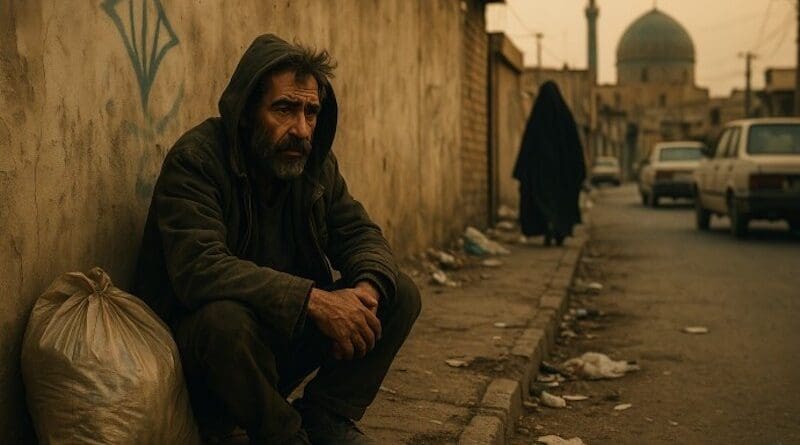
Poverty in Iran. Photo Credit: PMOI

By 

The corrupt and plundering dictatorship of Iranian regime has plunged Iran into poverty, misery, and anger. Inflation, water and power outages, and meager wages have pushed millions of Iranians to their limits, and the deafening alarms of “dire conditions” and the prospect of “great turmoil” by regime officials are sounding louder than ever within the regime.


A mere glance at six major socio-economic crises reveals the extent of this “dire” situation and the explosive conditions:

Food Inflation:

Food inflation has devastated the people and turned life into a nightmare. The World Bank has reported that food inflation has surpassed 40%, and in the first eight months of regime president Masoud Pezeshkian’s administration, it reached 168%. The price of a single bean has soared to 1,750 rials, and meat and dairy products have become a dream for many. The state-run Khabar Online has warned that “the alarm bells for the return of triple-digit inflation” are ringing, fueling public anger.

Housing Inflation and Homelessness Crisis:

Housing inflation has shattered even the dream of homeownership. The price per square meter of housing in Tehran reached 1.1 billion rials in March 2025, and the waiting period to buy a home has soared to “over 580 years” (according to Asr Iran, a state-affiliated media outlet). The Majlis Research Center, the research arm of the Iranian parliament, has reported the “prevalence of eight models of homelessness: rooftop sleeping, boiler-room sleeping, car sleeping, grave sleeping, cohabitation out of necessity, nomadism, multi-family households, and slum dwelling.” This calamity results from the plundering by the housing mafia under the direct supervision of regime supreme leader Ali Khamenei.

Medicine Inflation and Pharmaceutical Crisis:

The high cost of medicine has taken people’s lives hostage and turned patients’ hope into despair. The price of medications for patients with special conditions has increased by up to 400%, depriving many of treatment. Painful reports cry out that “expensive prescriptions are pushing patients towards death” and “the shock of high medicine prices; sometimes, 3 out of every 10 pharmacy customers decide against purchasing after seeing the price” (according to IRNA, the official state news agency).

Power Outage Crisis:

Power outages have paralyzed people’s lives and pushed social anger to its peak. In May 2025, Pezeshkian’s government increased power outages from 2 hours to 4 hours daily, and reports warn that “in the summer, outages will severely increase.” Simultaneously, public protests over power outages and the destruction of work and livelihoods have exponentially grown, with angry videos from citizens being posted on social media daily. This crisis is fundamentally caused by the extensive electricity plundering by large-scale cryptocurrency mining farms operated by the Islamic Revolutionary Guard Corps (IRGC).


Water Shortage Crisis:

The water crisis has turned people’s lives into hell and ignited social anger. In April 2025, widespread water outages in Tehran and other cities disrupted life, and the Baluch people are resorting to dangerous lagoons for a single glass of water. The catastrophe is so immense that state-affiliated media, such as Tasnim News Agency, are reporting on the “hell of summer 2025.”

Extreme Poverty and Wages Far Below the Poverty Line:

The poverty line has reached “470 to 500 million rials” per month, and “it can be said that 90% of the Iranian people are poor,” and “more than 45 million Iranians with minimum wage are 4 times below the poverty line,” according to Andisheh No, a regime-affiliated publication. The workers’ wage of 100 to 120 million rials is astronomically distant from the poverty line, and the gap between wages and expenses “has turned the wage issue in the country into a national crisis.”

The sum of these crises has turned Iranian society into a powder keg of anger, but each of these calamities alone could be the spark to ignite this keg. Due to structural corruption, Khamenei is not only incapable of mitigating these crises, but his regime’s actions continuously exacerbate them. Therefore, it can be predicted that a massive social explosion is undoubtedly imminent. Especially as the rebellious youth, with their fiery operations and revolutionary practices, channel the anger of this explosive society towards uprising and conflagration, and show this society, which has been pushed to its absolute limit, that: the only path to liberation is the eradication of the mullahs’ regime, this epitome of corruption and plunder.


Sadegh Pashm-Foroush writes for PMOI/MEK

301st Birthday Of The Great Poet Magtymguly Pyragi – OpEd

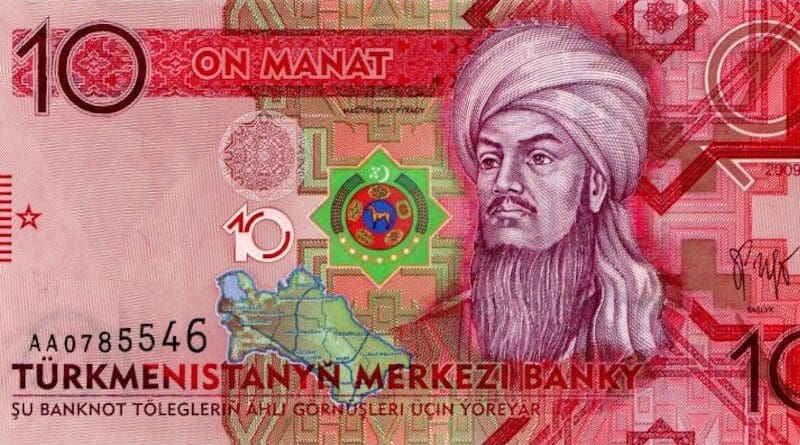
10 manat banknote of Turkmenistan with the image of Magtymguly Pyragi (2009). Credit: Wikipedia Commons

Magtymguly Pyragy (1724-1807) was an 18th-century Turkmen thinker and poet who holds a crucial place in the history of world poetry. He began his poetic career at a very young age.


Nuryadyyeva, G (2023) writes about Magtymguly Pyragy, stating that “he is a great thinker and poet whose name reigns in the world of poetry with the power and miracle of words.” Magtymguly’s poems have been translated into several languages (Gulgeldiyeva, 2023). Ataniyazova & Jeyhunov (2024) write that he is a key figure of national identity and education. Philosophers assess Magtymguly’s role as a “model school” for educating the young generation and a “spiritual doctor” who provides guidance on life’s important questions.

He was a poet who held a golden place in the history of Turkmen literature. On this subject, Orazdurdiyevna, Vepayevna & Maksadovna (2023) write that “Magtymguly is the greatest representative of Turkmen literature, credited with the creation of Turkmen written literature, and whose literary form became a powerful symbol of the historical and incipient national consciousness of the Turkmen people.

The main themes of this poet cover courage, patriotism, purity of spirit, love of nature, mercy, respect, kindness, wisdom, humanism, etc. (Nuryadyyeva, 2023). He recited his poems in public and urged people to be the best they can be, to be heroic and honorable. Given that he elevated the Turkmen language to the highest level, he was a very important symbol during Turkmenistan’s independence. Indeed, this poet called for the unity of the Turkmens. According to Müftiler (2023), the poet, who addressed the people in simple Turkmen language, reflected the life, lifestyle, traditions, and customs of the people like a mirror and guided them. He raised his voice against the existing rules and foreign domination and did not bow down to any oppression. In this way, he reached an exalted position in the eyes of his people. Love for the homeland, unity and solidarity, loyalty, hard work, love and respect, preservation of identity/self have been the main themes of the poet’s works.

Turkmen President Serdar Berdimuhamedov said: “Magtymguly Pyragy, the great thinker and sage of the East, has taken an eternal place in the hearts of people with his deep wise verses. Pyragy’s works, promoting humanism, honesty and unity, are invaluable values for all mankind. The creativity of Magtymguly Pyragy, the great master of words, is a valuable spiritual and moral school for all times.

He is an important author for Turkmen patriotism as shown in his poems “Türkmeniň,” “Türkmen binasy,” “Depe nedir, düz nedir,” “Gerekdir,” “Ýigide,” “Ykrarsyz ärden”… His poems describe how courageous, fearless, brave, and loyal the Turkmen are. For example, in the poem “Türkmeniň”:


Süleýman, Rüstem-u Zal, Jemşit oňa bolmuş geda,
Günde ýüz müň salsa leşger, degmez şanyň belasy.”

Here, he describes how invincible the Turkmen army is. In reality, Magtymguly loved his homeland and tried to elevate it to the highest levels. That is why the poet’s wish was always to encourage Turkmens to love their Motherland as much as possible and to protect it faithfully. In his poem “Aýrylma,” he urged Turkmens never to leave their homeland under any circumstances:

Mestana ýörinçäň gaýry ýurdunda,

Önüp-ösen öz ýurduňdan aýrylma.
Magrur käkilik deý nebsiň ugrunda
Dama düşüp, ganatyňdan aýrylma.

This poet has always called for the unity of the Turkmen homeland, as can be read in the following lines from the poem “Türkmeniň”:

Bir suprada taýýar kylynsa aşlar,
Göteriler ol ykbaly türkmeniň…

“If the dishes are ready on a single tray, it will elevate the destiny of the Turkmens.” The single tray here indicates the need for Turkmen unity through the metaphor of table preparation. He wants the Turkmen state to be eternal, as shown in the lines:

“Hor galmasyn puştdan-puştum
Berkarar döwlet istärin.”

This translates to “May my lineage not be humiliated, I wish for an eternal state.”

Outside of Turkmenistan, he is an important poet for the Turkic world and also Russia. Indeed, TURKSOY declared 2024 the year of commemoration of the thinker, philosopher, and poet Magtymguly Pyragy (Turksoy, 2024). In this context, various events will be organized in the name of Magtymguly Pyragy throughout the Turkic world, especially in Turkmenistan and Turkiye, as well as in cultural, artistic, and political centers around the world. After the 18th century, Turkmen became a written language thanks to the poems of Magtymguly. Although the Turkmen poets who lived before him wrote in Chagatai Turkic, and he himself knew Chagatai Turkic very well, Magtymguly was a poet who used the dialectal characteristics of his tribe and helped Turkmen rise to the status of a written language. This is why he occupies such an important place in the Turkic world. Müftiler (2023) writes that Magtymguly is an important poet who made great contributions to the Turkmen people, language and literature with his works and left deep traces both in his lifetime and in the period after him, and whose influence still continues today. He has been the pinnacle of Turkmen poetry and literature both with his ideas and emotions and his way of looking at life. His works have influenced not only Turkmen literature, but also the literature of all the peoples of the Turkic world.

Moreover, on March 25, 2024, a commemorative event for Magtymguly Pyragy was organized at the United Nations headquarters in New York, USA. The event was organized by TURKSOY and the Permanent Mission of Turkmenistan to the United Nations in cooperation with UNESCO. The event was called “Magtumguly Pyragy’s Path of Peace on the 300th anniversary of his birth.”

Magtymguly holds a crucial place in philosophy. Indeed, he is a wise poet who developed the philosophical ideas not only of the Turkmen people but also of the world, enlightened the artistic mind, and artistically reflected secular life.

He also placed importance on women, especially mothers. For him, in the family, the role of the mother in the education of the daughter is important. He wanted to encourage people to empower women so they can set a good example for children and maintain family unity.

He considered the child to be the crowning glory of the head of the family and the joy of their eyes. He aimed to instill noble qualities in children, such as respect for elders, respect for the younger, and the establishment of friendship and brotherhood.

Magtymguly Pyragy’s poems are also given great attention in Western Europe. The oldest translation of Magtymguly’s poems into a Western language was made by the orientalist H. Wamberi (1832-1913) in 1879, and the first English translation by Yusuf Azemu was published in 1995. A German translation of 41 poems by the Hungarian orientalist H. Wamberi (1832-1913) was published in 1879 in the “Journal of the German Oriental Society” in Leipzig. Some of his poems were also translated first into Spanish, then into German (Gulgeldiyeva, 2023).

This thinker created a model school for the education of the younger generation with his inspiring poems. He is a classic poet of the Turkmen people. The role of the wise poet in the history of world culture was described by the famous orientalist academician V.W. Bartold, saying that “Among the Turkic peoples, only Turkmens have national poets like Magtymguly,” as quoted by (Ataniyazova & Jeyhunov, 2024).

Magtymguly Pyragy is a popular poet. His poems were passed down to his people. This poet is particularly important in the cultural history of Central Asia. In fact, Magtymguly can be considered a Turkmen spiritual leader, philosophical poet, and a leader in Turkish-language literature. Indeed, Magtymguly was one of the first Turkmen poets to introduce the use of classical Chagatai, the court language of the Central Asian Khans, as a literary language, incorporating numerous Turkmen linguistic features. His poetry illustrates a trend towards increased use of Turkish languages rather than Persian. This is why he is an important figure in the history of Turkic literature from Central Asia to Turkey. Certainly, the concepts of good and evil, which the poet meticulously focuses on, have made him an exemplary figure for the world.

In summary, Magtymguly’s poems are distinguished by their versatility, variety, richness of meaning, and artistic talent. In his poems, the poet dealt with all kinds of issues related to human beings. For this reason, Magtymguly’s poems are a guide especially for the Turkmen people. In general, the universal nature of the messages he gives in his poems has made him a poet recognized worldwide. In the poet’s work, education and women are also important. Ataniyazova & Jeyhunov (2024) write that “an illiterate man without science lives one year, but a literate man lives one thousand years.” This is why Magtymguly Pyragy holds a crucial place in world history, whether in literature, philosophy, or humanity. The poet’s attitude in this regard: “Bir ýaman söz ýürek bular, Ýagşyny älem arzuwlar.” The poet’s attitude in this regard: “A bad word troubles the heart, everyone aspires to goodness.” When he says, “Magtymguly, özüň düzetgil, Özüňi sen özgelere göz etgil,” translated: “First of all, Magtymguly, correct yourself, make yourself an example for others,” he urges people to be the best they can be. The message in this verse is an invitation to self-criticism and the improvement of each person’s soul. Thus, according to the author, personal responsibility and correction are the foundations for improving society and the nation.

BIBLIOGRAPHY

  • Abdyllayev, O. (2024). Mahtumkulu’nun şiirlerinde iyi ve kötü kavramları. Folklor Akademi Dergisi7(Özel), 100-107.
  • Ataniyazova, B., & Jeyhunov, A. J. (2024). EDUCATIONAL IMPORTANCE OF MORAL VALUES IN THE WORKS OF MAGTYMGULY PYRAGY. Вопросы науки и образования, (4 (176)), 63-68.
  • Bugrayeva, O., & Geldiyeva, A. (2024). THE IDEA OF PATRIOTISMIN THE POEMS OF MAGTYMGULY PYRAGY. Вестник науки2(4 (73)), 449-452.
  • Delice, T. B. (2017). MAHTUMKULU’NU ŞİİRLERİYLE TANIMAK. Bartın Üniversitesi Edebiyat Fakültesi Dergisi2(1), 81-102.
  • Dinç, S. (2021). Mahtumkulu’nun şiirlerinde çağatayca unsurlar. O ‘ZBEKIST, 28.
  • Gulgeldiyeva, G. A. (2023). MAGTYMGULY PYRAGY–A PERSON OF WORLD IMPORTANCE!. Инновационная наука, (12-2), 240-241.
  • Müftiler, B. (2023). NORMAN FAİRCLOUGH’UN ELEŞTİREL SÖYLEM ÇÖZÜMLEME MODELİNE GÖRE MAHTUMKULU DİVANI’NIN İDEOLOJİ VE GÜÇ/İKTİDAR TEMELİNDE DEĞERLENDİRİLMESİ. Folklor Akademi Dergisi6(1), 74-94.
  • Myradova, K., & Nuryagdyyeva, D. (2023). MAGTYMGULY PYRAGY-A PROUD OF TURKMEN PEOPLE. Символ науки, (4-2), 215-217.
  • Nuryadyyeva, G. (2023). THE UNQUENCHABLE CREATIVITY OF MAGTYMGULY PYRAGY. Символ науки, (5-1), 170-172.
  • Омирова, Л. (2023). Универсальная философия Махтумкули Фраги:(The secular philosophy of Magtymguly Pyragy). Müqayisəli Ədəbiyyatşünaslıq/Comparative Literature, (1).
  • Orazdurdiyevna, N. K., Vepayevna, M. G., & Maksadovna, O. A. (2023). IMPROVING STUDENTS’COMMUNICATION SKILLS THROUGH MAGTYMGULY FIRAGI’S POEMS. НАУЧНЫЙ ЖУРНАЛ «IN SITU», 75.

Osmanli, I. (2020). Magtymguly Pyragy and Alishir Navoi. Müqayisəli Ədəbiyyatşünaslıq/Comparative Literature, (01).

Purtaş, F. (2017). Cultural diplomacy initiatives of Turkic republics. Perceptions: Journal of International Affairs22(1), 91-114


Derya Soysal

Derya Soysal is a Central Asia Expert and from the Université libre de Bruxelles.


Study Reveals Impact Of Sewage Overflows On Chicago River Ecosystem

A boat travels down the Chicago River, an urban ecosystem in the heart of Chicago. CREDIT: Shedd Aquarium


By 

A new study published in Knowledge and Management of Aquatic Ecosystems showcases how untreated wastewater released into the Chicago River during extreme rain events significantly altered the freshwater ecosystem. Shedd Aquarium researchers found some zooplankton populations disappeared while others dramatically increased, which could have cascading effects on the entire food web.


Chicago, like many cities across the country, utilizes a combined sewer system where both wastewater and stormwater flow through the same pipes. When heavy rainfall overwhelms the system, pumping stations might redirect the untreated wastewater and stormwater directly into the Chicago River to prevent flooding – an event called a combined sewage overflow (CSO).

During a few days of heavy rainfall in July 2023, 12.3 billion liters of untreated wastewater and stormwater was pumped into the Chicago River. Bubbly Creek, in the South Branch of the Chicago River, received the highest concentration of untreated water with 9.1 billion liters during the CSO event. Throughout the summer months, Shedd Aquarium researchers collected water samples from different sites along the river to monitor zooplankton populations and other variables. This data enables Shedd to analyze how certain events, like the July 2023 CSO in particular, affect the aquatic ecosystem.

Using this data, Shedd researchers found that the CSO event caused one type of zooplankton, Chydoridae, to nearly disappear from the Bubbly Creek area. Two other types of zooplankton, Cyclopoida and Moinidae, significantly increased in Bubbly Creek after the CSO event.

“It’s alarming any time a human-caused disturbance alters the natural ecosystem,” said Dr. Austin Happel, research biologist at Shedd Aquarium and lead author of the paper. “This study reveals another piece of the puzzle in understanding how CSOs affect the Chicago River, which provides a home to hundreds of different animal and plant species.”

Zooplankton are an often-overlooked indicator of an aquatic ecosystem’s health and resilience. These tiny animals drift in the water currents and feed on tiny plants and algae called phytoplankton. Both phytoplankton and zooplankton form the base of most aquatic food webs, providing food to many fish species. Thus, changes in zooplankton populations can indicate changes in the health of an ecosystem as whole. In the case of CSOs, sudden zooplankton blooms have the potential to infuse harmful chemicals into the food web and shift the balance of nutrients in the water.


Shedd researchers also noted that the July 2023 CSO event altered the water quality of Bubbly Creek for weeks after the untreated wastewater initially entered the river. Oxygen levels dropped to nearly zero and nitrogen levels increased. As a result, fish fled the area and stayed away for weeks before returning, as observed by Shedd’s ongoing acoustic telemetry project to track fish movements.

“In the midst of an urban environment, the Chicago River is a biodiversity hotspot teeming with life, and it’s everyone’s job to protect this critical habitat,” said Dr. Happel. “As climate change increases the frequency and severity of extreme weather, this research on CSOs helps us understand and prepare for the threats facing our freshwater ecosystem.”

Chicago residents can sign up for Overflow Action Alerts sent out by the Metropolitan Water Reclamation District of Greater Chicago to help conserve water on days of heavy rainfall by limiting showers, delaying running the dishwasher and avoiding doing laundry. The City of Chicago also encourages homeowners to disconnect their downspouts from the sewer system and direct the water instead to their yards or gardens.

Shedd Aquarium is also committed to working with partner organizations to help rewild and reimagine the South Branch of the Chicago River. This includes expanding environmental education programs, encouraging community members to recreate on the river and building floating wetlands to provide habitat for wildlife.


Eurasia Review

Eurasia Review is an independent Journal that provides a venue for analysts and experts to disseminate content on a wide-range of subjects that are often overlooked or under-represented by Western dominated media.


Too Big To Turn?: Moody’s Credit Rating Downgrade – OpEd

large boat ship cruise iceberg grok


By 

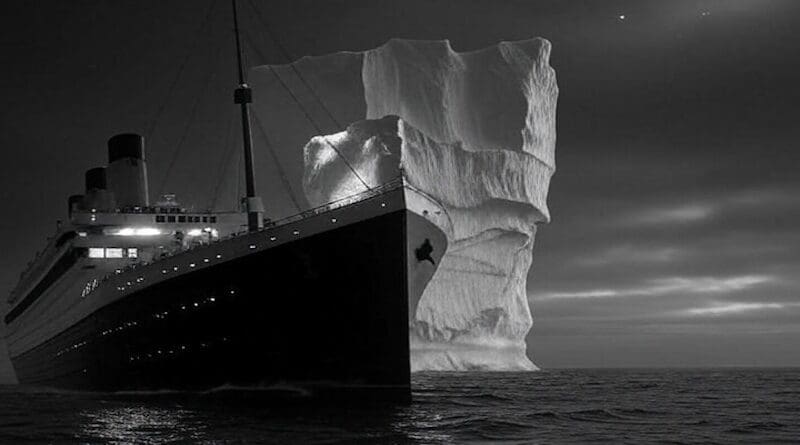
Imagine that you are the captain of a huge boat, like a modern container ship or even the legendary Titanic. You’re sailing forward at full throttle when an iceberg is sighted dead ahead. You need to change course because the damage will sink your ship if you hit the iceberg.


You turn the wheel as hard to starboard as you can, but almost nothing happens despite your emergency maneuver. That’s because the ship you’re trying to steer to avoid a collision is so massive and has so much inertia that it simply cannot turn as fast as you need it to. It is starting to turn, but it is turning so slowly that your action might not be enough to avoid disaster.

The U.S. government’s spending during its 2025 fiscal year is much like that.

From Full Throttle Spending to Emergency Maneuvers

The Biden-Harris administration cranked up federal government spending to the fastest it’s ever been in its final months in office as it lost its hold on power. From October 2024 through January 2025, the U.S. government spent more money faster than it ever had at the start of any fiscal year in history.

Although the incoming Trump administration acted quickly to change the government’s fiscal course, the U.S. government’s fiscal trajectory has remained largely unchanged.

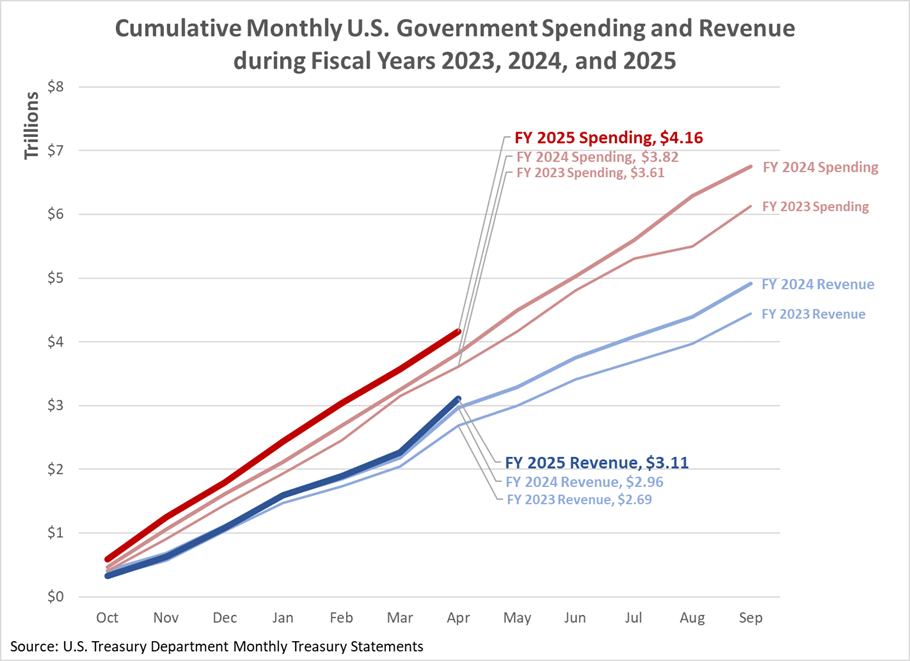
But it is changing. The April 2025 Monthly Treasury Statement provides solid evidence the nation’s fiscal trajectory has begun to change direction. The chart below shows how the U.S. government’s spending for FY 2025 compares with its previous two fiscal years through April 2025.


Cumulative Monthly U.S. Government Spending and Revenue during Fiscal Years 2023, 2024, and 2025 (through April 2025)

The most visible change has taken place in the U.S. government’s revenues. Through the end of April 2025, the U.S. government has collected $3.11 trillion during FY 2025, about $150 billion more than it did through the same point of time in FY 2024. Politico reports a large portion of that increase came from President Trump’s newly enacted tariffs.

Slowing U.S. Government Spending

Less visible is a change in the rate of U.S. government spending since January 2025. Under the outgoing Biden-Harris administration, the U.S. government spent an average of almost $610 billion per month from October 2024 through January 2025.

Under the Trump administration, that spending has slowed to an average of about $570 billion per month from January through April 2025. As a result, the U.S. government’s total spendingthrough April 2025 is $100 billion lower than if it had kept going at the rate set by the Biden-Harris administration.

Not Enough to Avoid Danger of Hitting Fiscal Iceberg

In November 2023, Moody’s Investor Service downgraded its outlook for the U.S. government’s credit rating to negative. That announcement put the federal government’s last AAA credit rating in jeopardy.

It also put the Biden-Harris administration on notice. Unless they acted to correct the government’s fiscal course, Moody’s would cut the U.S. government’s credit rating.

That never happened. Instead, the Biden-Harris administration pushed the spending throttle forward to full speed in their final months, with officials even bragging they were tossing gold bars off the Titanic ship of state.

Even with the Trump administration’s attempted course correction, it wasn’t enough to avoid the consequences of that foolish fiscal policy. Moody’s cut the U.S. government’s credit rating on Friday, May 16, 2025. In doing so, Moody’s became the third of the three major credit rating agencies to reduce the U.S. government’s credit rating below their top AAA rating.

Whether the U.S. Government strikes the fiscal iceberg now dead ahead depends on the actions of the members of the U.S. Congress. That’s scary because about half of the members of this body don’t think their excessive spending rate is a problem. That is, of course, the real problem.


Craig Eyermann

Craig Eyermann is a Research Fellow at the Independent Institute. He is also the creator of MyGovCost.org: Government Cost Calculator. He received his M.S. in mechanical engineering from New Mexico State University and M.B.A. from the University of Phoenix, having received a B.S. in both mechanical and aerospace engineering from the Missouri University of Science and Technology.