Thursday, May 29, 2025

Visa application pause 'will be felt in every corner' of US
DW
29/05/2025 


Even a short-term pause on new student visa interview appointments could have major economic consequences and leave many uncertain about pursuing studies or careers in the United States.

International students aspiring to attend one of the world's top universities may be reconsidering after the Trump administration made changes to student visas
Image: Steven Senne/AP/picture alliance


The US State Department has put student visa processing on hold following orders from Secretary of State Marco Rubio — the latest in a series of measures by the Trump administration aimed at tightening immigration screening.

The decision, which requires US diplomatic missions to pause interview appointments for new student and exchange visa applications, comes amid ongoing tensions between the Trump administration and higher-education institutions, in particular Harvard University.

"The Department is conducting a review of existing operations and processes for screening and vetting of student and exchange visitor (F, M, J) visa applicants, and based on that review, plans to issue guidance on expanded social media vetting for all such applicants," said the cable, first reported by Politico.

The State Department's approach is consistent with broader efforts to tighten screening of individuals entering the US.


Since Donald Trump's inauguration in January, the administration has implemented sweeping measures to detain and deport migrants, and to deny entry to some travelers — including tourists — prompting several countries to update their travel advisories.

The move follows efforts by the government to identify and potentially arrest or deport students engaging in university campus activism, particularly protests against Israel's ongoing military campaign in Gaza. Attempts by educational institutions to push back against the Trump administration's measures have been met with grant freezes and funding cuts.

In March, the US government revoked more than 300 visas, with Rubio saying students had engaged in "activities that are counter to our national interest, to our foreign policy."
International students are major economic drivers

More than 1.1 million international students came to the United States in the 2023-24 academic year, with students from India accounting for about 30% of arrivals and those from China around 25%.

But it is also the major financial contribution that students make to the US economy that could potentially be impacted by the pause on interviews.

According to NAFSA, the Association of International Educators, international students injected $43.8 billion (€42.8 billion) into the national economy in 2023-24.

In a statement, NAFSA's executive director and CEO Fanta Aw called the pause "another misguided and deeply troubling attack against international students — adding to a long list that includes arrests, visa revocations, SEVIS [Student and Exchange Visitor Information System] terminations, and threatening their very ability to enroll in certain US institutions."

Previous visa crackdowns left international students concerned employment or education opportunities in the US may no longer be worth the risk.

Michael Clemens, a migration economist at George Mason University, in the US state of Virginia, said even a short-lived pause on student visa applications could have major knock-on effects across the country.

"The pause is tremendously damaging," Clemens told DW. "[It] creates a climate of extreme uncertainty for students considering making the enormous investment to come study in the United States."

"In many states, the ... university system is either the largest employer, such as in the state of Alabama, or one of the largest."

He warned that a decline in international student numbers could undercut the potential for new startup ventures and stifle American innovation.

"Fifteen percent of the high-growth, venture capital-financed startup companies in America — with all of the job creation, investment and technological change they foster — depend on foreign students," he said.

A pause in student visas could also hit local economies hard. Whether providing summer employment or supporting local jobs and small business, Clemens is concerned the wider effort to reduce international student numbers will cripple small-town America.

"The lasting effects of losing America's status — for generations now — as the top destination for the world's talent will be felt in every corner of every rural and urban community in America. They are at the heart of dynamism and economic growth in the United States, and nobody will escape those consequences."

Pause means uncertainty, loss of confidence in US education

Clemens' warning about the lasting impact on America's standing as the top destination for higher education is already being felt.

Rouham Manzoor, who studied in the US, is now the managing director of MACES, an educational consulting firm in Bangladesh that advises prospective students on study options around the world.

"I had a wonderful time there; I consider the US as where I found myself. I have a very strong affinity for US education, I think it's one of the best in the world," Manzoor said. "It's heartbreaking to see this happening."

"Fewer numbers of students are now coming to us and saying, 'Hey, I want to go to the US.' That number has gone down significantly, and with this, definitely many, many more students will shy away from applying to the US," he said.


Others see uncertainty ahead for those deciding where to pursue their careers. Ashish Mailk is one of the millions of international students who benefited from studying in the US, having previously traveled there on a J-1 visa — typically issued to students visiting the US on exchange programs such as fellowships.

Now a fellow at the University of Edinburgh, Malik told DW the move would leave many international students uncertain about what the US could offer them.

"If you think of those who are planning to come for studies or work, their future is at stake," he said.

He added that the broader efforts of the Trump administration to cut back on research grants would also leave international students who rely on visas unsure of their longer-term prospects within the US.

"Many of my peers [and] colleagues aren't sure if their grants will be extended," Malik said.

For Clemens, as a professor working at a US university, he hopes the Trump administration reconsiders its policies before lasting damage is done to international education.

"The enormous trust of international students and top talent from across the world, in the United States, is in the process of being systematically shattered," he said. "Until the US government starts trying to repair that trust, it would be hard for me to, in good conscience, advise students to continue to come to the United States. And that's just indescribably sad for me."


Edited by: Cathrin Schaer


Matthew Ward Agius Journalist reporting on politics, health, history, science, climate and environment.

SPACE/COSMOS

China launches mission to get asteroid samples

AFP, Reuters
29/05/2025 

If the mission succeeds, it will make China the third country to fetch the asteroid rocks.


Tianwen-2 is going to collect samples from the near-Earth asteroid 2016HO3
Image: CHINA DAILY/ REUTERS

China on Thursday launched its first space mission to retrieve samples from a nearby asteroid and conduct research back home, the Xinhua state news agency reported.

A successful completion of the mission could make China, a fast-growing space power, the third nation to get hold of the pristine asteroid rocks.
What do we know about the mission?

The mission began with a Long March-3B rocket carrying the Tianwen-2 probe blasting off from the Xichang launch site in southwestern Sichuan province at 1:31 a.m. local time (1731 GMT/UTC).

It took 18 minutes for the Tianwen-2 spacecraft to enter a transfer orbit for asteroid 2016HO3, the China National Space Administration (CNSA) said, according to Xinhua.

"The spacecraft unfolded its solar panels smoothly, and the CNSA declared the launch a success," the news agency wrote.

Tianwen-2 is scheduled to arrive at the asteroid in July 2026 and shoot a capsule packed with rocks back to Earth for a landing in November 2027.

The asteroid was discovered in 2016 by scientists in Hawaii and is roughly 40 to 100 metres (130-330 feet) in diameter and revolves relatively close to Earth.

The Tianmen-2 spacecraft is also tasked with exploring the comet 311P, according to the country's space agency.

China's 'space dream'


China has swiftly made its mark with its expanding space program.

In the past few years, it has poured billions of dollars into its space program to achieve what President Xi Jinping describes as the country's "space dream."

China already has its own space station, and in recent years, it has managed to send robots to the far side of the moon. It is now planning to send humans to the lunar surface by 2030.

What is driving China's space ambitions?  05:22


Edited by: Farah Bahgat

Midhat Fatimah Writer and reporter based in New Delhi


MISTRAL, a wind of change in the SRT observations


Istituto Nazionale di Astrofisica
Orion Nebula 

image: 

The left panel shows the image of the nebula M42 taken at 90 GHz with the MISTRAL receiver. On the right, an overlay of the MISTRAL image with a wider-field image obtained by the Hubble Space Telescope

view more 

Credit: MISTRAL commissioning team; NASA, ESA, and The Hubble Heritage Team (STScI/AURA)


MISTRAL is a new generation receiver installed on the Sardinia Radio Telescope (SRT) and built by the Sapienza University of Rome for the National Institute for Astrophysics (INAF) as part of the upgrade of the radio telescope for the study of the Universe at high frequencies, funded by a PON (National Operational Program) project, concluded in 2023 and now providing its first significant scientific results. MISTRAL stands for “MIllimetric Sardinia radio Telescope Receiver based on Array of Lumped elements kids”.

MISTRAL is an innovative receiver in many ways. Radio astronomy receivers are typically "mono-pixel", i.e. sensitive to radiation coming from a single direction. Creating panoramic images of the area of the sky of interest requires long scans with the telescope. One way to overcome this limitation is to build "multi-pixel" receivers, i.e. sensitive to radiation coming from multiple directions simultaneously. MISTRAL takes this concept to the extreme. It contains an ultra-cold core composed of a matrix of 415 Kinetic Inductance Detectors (KIDs), developed in collaboration with CNR-IFN in Rome, and cooled to just a fraction of a degree above the temperature of absolute zero, or -273.15 degrees Celsius. "It is precisely this high number of detectors, combined with a specifically developed optical system, that makes MISTRAL an extremely effective and fast instrument for wide-field imaging of weak and extended sources", comments Paolo de Bernardis, Scientific Coordinator of the receiver for Sapienza University of Rome. MISTRAL was installed in May 2023 in the Gregorian focus, located at the center of the large 64-meter diameter SRT dish. Commissioning of the receiver began soon after and consisted of an intensive series of technical and observational tests aimed at integrating the receiver into the telescope system. A team of researchers from INAF and Sapienza have been working side by side with the aim of bringing MISTRAL to its maximum performance, and making it available to the scientific community for regular observations. “Commissioning”, explains Matteo Murgia, Scientific Manager of the receiver for INAF, “is normally a routine phase in the installation of new instrumentation. However, it becomes a real challenge in the case of a millimeter-wave receiver like MISTRAL, which requires the telescope’s performance to be pushed to the limit in every respect”.

“Initially, we faced and overcame several obstacles related to the truly exceptional cryogenics of the receiver, finally obtaining the temperature necessary for the activation of the KIDs, that is, just 0.2 degrees above absolute zero”, says Elia Battistelli, Project Manager of the receiver for Sapienza University of Rome.

Starting in September 2024, the improvement in the performance of the SRT active surface allowed us to reach the sensitivity required to calibrate the instrument. It was then possible to proceed with the optimization of the alignment between the MISTRAL optics and those of SRT.

The commissioning team also worked tirelessly to develop the procedures and software needed for pointing and focusing. At the same time, INAF and Sapienza developed the calibration and imaging procedures. MISTRAL was finally ready for “first light” observations of extended radio sources. Three iconic celestial objects were observed in succession: the Orion Nebula, the radio galaxy M87, and the supernova remnant Cassiopeia A. These observations highlighted MISTRAL’s remarkable versatility and confirmed its ability to produce highly detailed images of celestial objects in extremely diverse astrophysical contexts.

“The milestone achieved with the first light images of SRT at 90 GHz,” commented Isabella Pagano, Scientific Director of INAF, “marks an important step in broadening the scientific horizons of this radio telescope, thus demonstrating its ability to operate successfully at the high radio frequencies for which it was designed.” With the “first light” obtained by observing these fascinating cosmic objects, this first phase of technical tests is concluded and a no less important phase of scientific validation begins, aimed at verifying the performance of MISTRAL with increasingly weak sources, to ensure that it is ready for the numerous scientific challenges for which it was designed. MISTRAL will address a wide range of scientific questions, from cosmology and the physics of galaxy clusters, to the study of active galactic nuclei, the structure of molecular clouds and their relationship with star formation in nearby galaxies and the Milky Way, and the study of celestial bodies in our Solar System. The commissioning team's activities therefore continue, with the aim of verifying MISTRAL's performance in each of these scientific cases and making the receiver available to the scientific community as soon as possible.

Image of the supernova remnant Cassiopeia A taken at 90 GHz with the MISTRAL receiver.


Credit

MISTRAL commissioning team


The first images acquired by MISTRAL


In December 2024, MISTRAL was pointed at the famous Orion Nebula (also known as M42) in the center of the Orion constellation. Located about 1350 light-years from Earth, M42 is one of the closest active star-forming regions and is characterized by ionized hydrogen excited by a group of massive stars known as the Trapezium. M42 is part of a vast complex of molecular clouds that extends over 30 degrees across the sky, and MISTRAL observed its central part at an angular resolution of 12 arcseconds. The Orion Bar is clearly visible in the image to the south, marking a sharp boundary between the region of ionized hydrogen and the molecular cloud below. Emission peaks can also be seen near the stars of the Trapezium and the Kleinmann–Low Nebula, a dense star-forming molecular cloud that hosts a star cluster which underwent an explosive event in the past. The emission from M42 visible at 90 GHz is an almost equal mixture of radiation from ionized hydrogen and that from cold dust contained in the underlying molecular cloud complex.


In February 2025, MISTRAL observed the radio galaxy M87 in the constellation Virgo, whose active nucleus contains a now famous supermassive black hole, directly imaged thanks to the historic observation of the Event Horizon Telescope in 2019. The radio source surrounding M87 has a complex structure, made up of internal lobes measuring about thirty thousand light years (just over the distance that separates us from the center of the Milky Way) surrounded by an external plasma bubble on a larger scale. These structures are the result of the activity of the central black hole over the past several million years. The internal radio lobes are visible in MISTRAL's image – the most recent structures still powered by a pair of relativistic radio jets propagating from the central black hole. Observing these structures at such high frequencies provides new and valuable insights into the physical mechanisms powering the radio-emitting particles inside the source.


Finally, in the April 2025 session, MISTRAL observed – through two cross-scans of about half an hour each – the supernova remnant Cassiopeia A (Cas-A), one of the most intense radio sources in the sky, with an angular size of about 5 arcminutes (about one-sixth the apparent diameter of the full Moon). The expanding gas shell is visible in its entirety and, thanks to the angular resolution of SRT at these wavelengths, it is possible to appreciate the details and brightness variations of the filamentary structure.


Behind the scenes on launch day for Biomass, ESA's latest mission | Euronews Tech Talks

Behind the scenes on launch day for Biomass, ESA's latest mission | Euronews Tech Talks
Copyright ESA-CNES-ARIANESPACE/Optique vidéo du CSG–S. Martin

By Alice Carnevali
Published on 

What happens on a satellite's launch day? What are the thoughts and emotions of those behind the mission? Follow along with a special Euronews Tech Talks episode from Kourou.

In the early morning of April 29, people in Kourou, French Guiana, were woken up by the roar of the Vega-C rocket as it carried Biomass, the latest satellite from the European Space Agency (ESA), successfully into space.

The Biomass mission not only represents a leap forward in the scientific understanding of tropical forests, but its launch also marked a major step toward securing Europe’s independent access to space.

Euronews Tech Talks was on site in Kourou for the launch, and with this second special episode on Biomass, we bring you behind the scenes of the launch preparations.

A long journey

The operations on the day of the launch of a satellite, also referred to as D-Day, are just the tip of the iceberg in a long process to get it into space.

In the case of Biomass, the project started more than a decade ago and involved several professionals who dedicated their competencies to building the satellite, developing the rocket, and coordinating every step up to and after April 29. 

Launch preparations began as early as March 7, when Biomass arrived in French Guiana after a two-week voyage across the Atlantic Ocean. 

Upon arrival in Kourou, the satellite was transported to the spaceport, removed from its shipping container, and thoroughly inspected for any potential damage. 

Next, Biomass was fuelled and attached to the adapter that would connect it to the Vega-C rocket, enabling its journey into orbit. 


ESA’s Biomass satellite arrives in Kourou, French Guiana. ESA

On April 14, Biomass was placed inside the fairing, the top part of the rocket, then transferred to the launch pad at the Tangara site. 

There, the fairing containing the satellite was placed on the Vega C launcher, followed by more checks and a practice run known as the dress rehearsal. 

With all checks completed, it was time for the first weather forecast, a crucial step in the process.

"We need good weather conditions to authorise the launch," explained Jean Frédéric Alasa, launch range operations director at CNES, the French Space Agency. 

"The rain is not a major constraint, it’s more about the wind. If the launcher were to explode, we want to make sure the debris falls far from the populated areas," he continued. 

Luckily, on April 29, the wind was very mild, and the satellite launch was authorised.

A sun-synchronous satellite

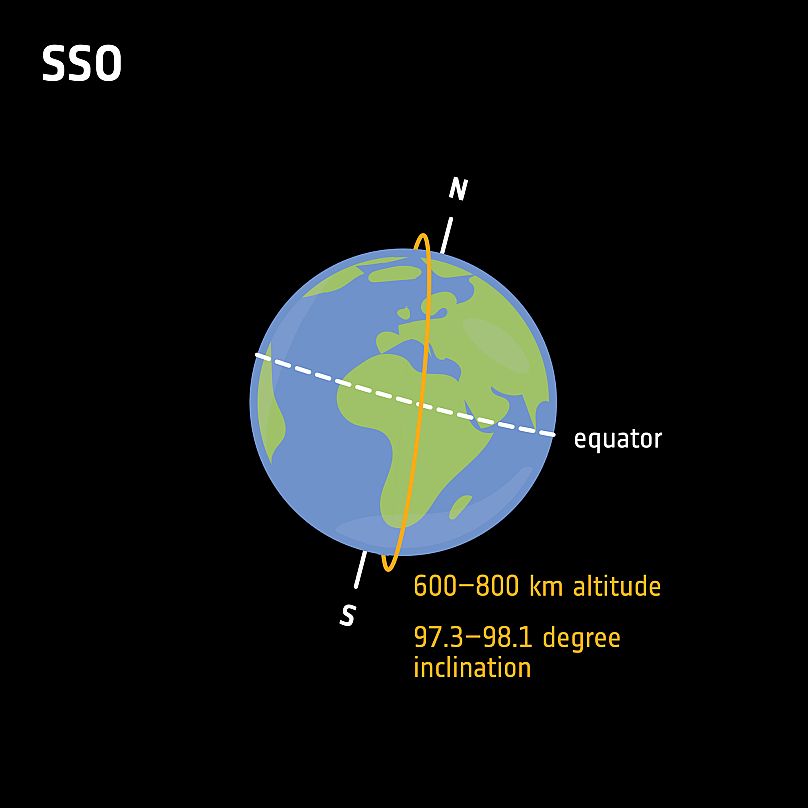
Vega C lifted off at 6:15:52 AM local time in Kourou. This time was precisely calculated and had to be respected to bring the satellite into the correct orbit. 

"For all the SSO missions, there is no launch window, but just one time at which the satellite can be lifted off," Fabrizio Fabiani, head of the Vega programme at Arianespace, explained.

"Each day could be a good day, but at the same instant". 


Polar and Sun-synchronous orbitESA

SSO stands for sun-synchronous orbit, a special type of orbit where the satellite maintains the same position relative to the Sun. Essentially, Biomass passes over the same location on Earth at the same time every day.

This orbit is ideal for monitoring changes over time, which is why it is commonly used for several Earth observation satellites.

An emotional moment

Biomass’s launch was successful and greeted with great excitement by those who worked on it for years.

When the satellite and rocket fully separated, the team erupted into cheers, celebrating the mission’s success.


"I've indeed been working for 12 years on that mission and now, at the end of it, I would say the predominant sentiment is that I'm super grateful and humbled that I was allowed to do that job," Michael Fehringer, ESA’s Biomass project manager, told Euronews. 

"I feel relieved... that’s all we could ask for, that’s the best result we could have," Justin Byrne, Airbus head of science and Mars programmes, shared with us. 

But while most celebrated, one team remained focused on the mission. Which team was it, and why?

Listen to Euronews Tech Talks to find out the answer.

Rising Canada star Mboko credits family for keeping her grounded

Paris (AFP) – Canadian Victoria Mboko said her tight-knit family have ensured her feet stay on the ground as she continues her ascent to tennis' upper echelons after reaching the third round of her debut Grand Slam appearance at Roland Garros on Wednesday.


Issued on: 28/05/2025 - 16:49Modified: 28/05/2025 - 16:47
Victoria Mboko in action during her second-round victory over Eva Lys © JULIEN DE ROSA / AFP

The 18-year-old qualifier defeated German world number 59 Eva Lys 6-4, 6-4 in the last 64 of the French Open to set up a third-round meeting with Olympic champion Zheng Qinwen.

Cheering 120th-ranked Mboko on from the stands in Paris were her father and two of her older siblings -- both of whom are tennis players.

"Here with me it's my father, my sister, and my brother," she told her post-match press conference.

"My two siblings are older than me, a lot older than me. So I feel like they have had a lot more experience in tennis than I have, even though I have played I think a higher level than them.

"Yeah, they are all very so supportive of me, and they're so positive every single day in all the matches I play... I feel like my family has been doing a good job of keeping me really, like, I guess, isolated from it all. I have just been enjoying the moment."

Mboko was born in the United States to parents fleeing political turmoil in the Democratic Republic of Congo, before settling in Toronto.

"My father, I feel like he's made a lot of sacrifices for me, so I'm grateful that he's here, as well," she added.

"He's retired now, but, you know, when I was training a lot, he was working night shifts so he could be at every single one of my practices, especially when I was a junior.

"He was very, I guess, like, strict with my tennis, I could say. Yeah, I mean, he's done so much to help me develop and try to bring me to really great trainings and coaches.

"Many of this wouldn't have been possible without him."

Mboko has enjoyed a meteoric rise in the rankings this season and made her WTA 1000 event debut as a wildcard at the Miami Open in March. She then qualified for the Italian Open earlier in May.

She fell in both tournaments at the second-round stage to top-15 opponents in the shape of Paula Badosa and then Coco Gauff.

Now in her maiden major appearance, the teenager has bettered that record by gliding into the third round without dropping a set, but once again faces a top opponent when she will take on eighth seed Zheng.

But Mboko said she is ready for the challenge.

"I mean, she's top 10, you know. So that's, like, already a big thing overall," she said.

"She's beaten so many great players. She's also an incredible athlete.

"I'm expecting a big fight. I'm going to bring out a big fight against her... It's going to be a very hard battle."

© 2025 AFP
Portugal far-right party becomes second biggest in parliament

Lisbon (AFP) – Portugal's far-right Chega party won second place in the country's snap elections last week, according to final results published on Wednesday.


Issued on: 29/05/2025 - 

CHEGA far-right party leader Andre Ventura speaks to journalists in Lisbon on May 20, 2025 © FILIPE AMORIM / AFP


Chega, which means "Enough", and the left-wing Socialists had been level on 58 seats after the provisional results from the May 18 poll, but the far-right party won two of the previously unannounced four overseas constituencies, taking its tally to 60.

The results make Chega the official opposition just six years after its creation.

The centre-right Democratic Alliance claimed the other two overseas seats taking its total to 91, still far from the 116 seats needed to form a majority government. The Social Democratic Party of outgoing prime minister Luis Montenegro is the main part of the alliance.

"It is a big victory," said Chega founder and leader Andre Ventura, claiming that it "marks a profound change in the Portuguese political system".

The anti-immigration party had 50 seats in the last parliament.

Montenegro is expected to try to form a minority government after the latest election and he has said he will not deal with Chega. But Ventura called on Montenegro to "break" with the Socialists.

President Marcelo Rebelo de Sousa was to hold new talks with the leaders of the three main parties on Thursday and could name a new prime minister during the day.

"Portugal is moving in line with the European trend" for a "protest vote", said Paula Espirito Santo at Lisbon University's Higher Institute of Social and Political Sciences.

© 2025 AFP
PRICE GOUGING

US firms plan to pass Trump tariff costs to consumers: Fed minutes


Washington (AFP) – US firms have warned the Federal Reserve that the cost of President Donald Trump's tariffs will likely be borne by consumers, according to minutes of the bank's most recent rate decision.


Issued on: 28/05/2025 - 

US firms reported to Fed members that the costs of US President Donald Trump's tariffs would likely be passed on to consumers © ANGELA WEISS / AFP

Since returning to office in January, Trump has embarked on a stop-start tariff rollout that has unnerved investors and shaken global financial markets.

The Fed's meeting on May 6 and 7 took place after Trump had announced a 90-day pause on the most severe levies he had threatened against dozens of trading partners, and shortly before the White House unveiled trade deals with China and Britain, helping to soothe some market concerns.

At that meeting, policymakers voted to hold the US central bank's benchmark lending rate between 4.25 and 4.50 percent as they continued to fight inflation, which remains above the Fed's long-term target of two percent.

"Many participants remarked that reports from their business contacts or surveys indicated that firms generally were planning to either partially or fully pass on tariff-related cost increases to consumers," the Fed said in its minutes of the meeting, published Wednesday.

Participants also "noted that the Committee might face difficult tradeoffs if inflation proves to be more persistent while the outlooks for growth and employment weaken," the Fed warned in its minutes.

The Fed has a dual mandate to act independently to tackle both inflation and unemployment.

The views of Fed officials chime with the opinions of many economists, who see Trump's levies as inflationary and bad for growth.

Trump and his allies insist that tariffs are one part of a wider policy mix, and that the US president's overall package of economic plans -- including tax cuts and deregulation -- should boost economic growth.

Given the high tariff-related uncertainty, Fed officials decided that it was prudent to keep rates where they were.

"Participants agreed that with economic growth and the labor market still solid and current monetary policy moderately restrictive, the Committee was well positioned to wait for more clarity on the outlooks for inflation and economic activity," the Fed said.

© 2025 AFP
CRIMES AGAINST NATURE

Loggers fell old, native forests on Australian island

LONNAVALE (Australia) (AFP) – On the edge of a dense forest on a rugged Australian island, an enormous stump rises from the ground -- all that remains of a eucalyptus tree that towered into the canopy for centuries.


Issued on: 29/05/2025 -

A partially logged section of a forest in the Grove of Giants in Huon Valley, Tasmania, where cutting down native trees is legal, despite its impact on wildlife and the environment © Gregory PLESSE / AFP


As wide as two dining tables, and standing above head height, it is the by-product of a logging industry carving its way through swaths of native forest in the island state of Tasmania.

"We're standing on a stump that's 500 years old. That tree was so, so old," said Jenny Weber, campaign manager at the Bob Brown Foundation environmental group.

"The tragedy of this one right in front of us is that it was cut down, and then it was too big to cut up into pieces and put on a log truck," Weber said in Huon Valley's Grove of Giants, west of Hobart.

Cutting down the tree was "shocking, just absolutely shocking", she said.

In Tasmania, cutting down native trees is legal, despite its impact on wildlife and the environment.

With half of its 68,000 square kilometres (26,000 square miles) blanketed in forest, the island is an exception in the dry continent of Australia.

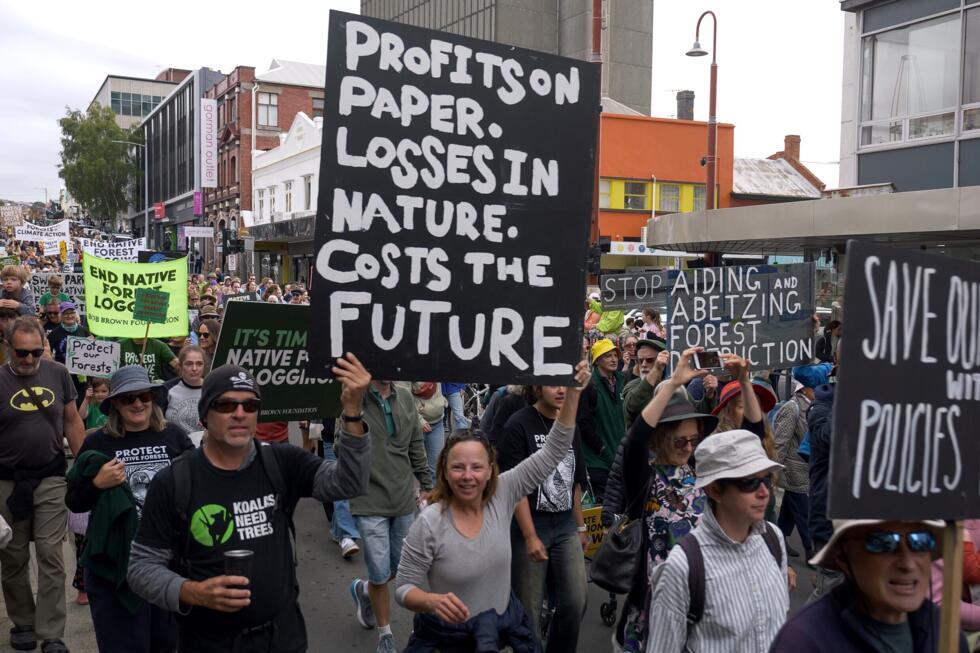
Protesters rally in March 2025 against the logging of native trees in Hobart, Tasmania 
© Gregory PLESSE / AFP/File

It is also the state that fells the highest share of native trees -- 18.5 percent in the year to June 30, 2023, compared to a national average of 10 percent, according to government figures.

South Australia has protected native forests since the late 19th century, while Victoria and Western Australia have banned the logging of native trees since 2024.
'The species disappears'

In Tasmania, there are calls for the state to stop cutting down native forest too.

More than 4,000 people marched through the streets of the state capital Hobart in March, demanding an end to the practice.

In the crowd of protesters, some dressed as endangered animals, like the Tasmanian devil, an endangered marsupial, or the even scarcer swift parrot.

The broad-tailed parrot is classified as critically endangered by the International Union for Conservation of Nature, which cites the clearance of eucalyptus trees that provide its breeding habitat in Tasmania.

"These birds need the hollows formed in old trees to breed. If there are no hollows, there's no nest, so no chicks, and finally the species disappears," said Charley Gros, a French ecologist and scientific adviser to the Bob Brown Foundation.

Sustainable Timber Tasmania is the state-owned organisation responsible for managing 812,000 hectares (2 million acres) of public production forest.

It aims to harvest timber while "balancing conservation and responsible land management", an official at the state forest manager told AFP.

Its latest annual report says it harvests "around 6,000 hectares of native forest -- less than 1 percent of our total managed land" annually.

Suzette Weeding, the firm's general manager for conservation and land management, said it runs a programme to monitor endangered swift parrots.

This "comprehensive approach" allows "adaptive forest management," Weeding told AFP, "minimising potential disturbance to the species and its habitat"
.

Shooting marsupials

Sustainable Timber Tasmania's report said it sowed 149 million seeds across 5,000 hectares to "regenerate native forest" in the year to June 30, 2024.

In the same period, official data show more than 70 percent of the native trees felled in Tasmania were turned into wood chips -- much of it for export to China and Japan for production of paper, cardboard or toilet paper.

The environmental cost does not figure, however, in the logging industry's balance sheet.

According to government figures, the value of native hardwood harvested in Tasmania in 2022-2023 was Aus$80 million (US$51 million). Census data showed fewer than 1,000 people employed in the state's forest industry in 2021.

Weber is not convinced of Sustainable Timber Tasmania's environmental credentials, pointing to a recently felled area of forest where only charred stumps remain.

To clean the area before replanting, the loggers drop incendiaries from helicopters, producing toxic fumes, she said.

Once new tree seeds sprout, marsupials such as wallabies, possums and pademelons seek out the shoots for food, Weber said.

"Forestry has people to shoot those animals and kill them so they don't actually eat the baby shoots of the trees that they want to grow for more logging in the future."

Only eucalyptus trees are replanted, she added, without the other native species such as myrtles and sassafras that once grew under the canopy.

"Eucalyptus are Australian but eucalyptus can't live to their full life by themselves in a tree farm."

© 2025 AFP

Kazakhstan to allow hunting once endangered antelopes


Astana (Kazakhstan) (AFP) – Kazakhstan said Wednesday it will authorise the hunting of saiga antelopes, once an endangered species that the government says is now threatening farming in the vast Central Asian country.


Issued on: 28/05/2025 -

Saiga antelopes graze on a prairie outside Almaty 
© Abduaziz MADYAROV / AFP


The country previously backtracked on lifting a hunting ban on the species, recognisable by their long, trunk-like rounded snout.

President Kassym-Jomart Tokayev had called the antelopes "sacred animals for the Kazakh people". The saiga was massively poached in the 1990s.

State media cited Kazakhstan's deputy minister of ecology as saying the decision to hunt them was "necessary due to the rapid growth of their population" and "complaints from farmers".

A spokeswoman for Kazakhstan's ecology ministry told AFP Wednesday that "according to scientific research, it is possible to eliminate up to 20 percent of the total population without harming the species".

The exact number of animals allowed to be culled and the start date of the hunt are yet to be determined, she added.

Farmers complain that saigas have stomped thousands of square kilometres of farms, where crops are also threatened by climate change.

According to the latest estimates, there are 4.1 million saigas in the former Soviet republic, representing almost the entire global population, a number that could rise to five million by the end of the year.

An attempt to lift the ban was met with opposition in 2023, a rare occurrence in Kazakhstan, where freedom of expression is limited. The authorities reversed the decision a few months later.

Poaching of the antelopes exploded after the collapse of the Soviet Union, particularly as their horns are used in traditional medicine.

Water shortages and disease had also endangered the species before the Kazakh authorities introduced a policy to protect them.

© 2025 AFP
UK records sunniest spring in over a century

London (AFP) – The UK had its sunniest spring since records began, the Met Office said on Wednesday after weeks of above-average temperatures and dry weather in the country known for its rainy days.


Issued on: 28/05/2025

A person swims in the Sky Pool, a transparent acrylic swimming pool bridge in London, as the Met Office reports the UK has had its sunniest spring since records began with 630 hours of sunshine between March 1 and May 27 © Ben STANSALL / AFP

With 630 hours of sunshine between March 1 and May 27, 2025 was the sunniest spring since 1910, the Met office said.

It beat the previous record set in 2020 by four hours -- with four days of the season still remaining.

"It has indeed been an extremely sunny and dry spring for the majority," said Met Office scientist Emily Carlisle.

"But with a few days left of the season and more unsettled weather this week, it's too early to say what will happen with other records."

Other statistics, including for rainfall, are due to be published next week.

It has been a spring of records, as Britain logged its hottest ever May Day with temperatures soaring to 29.3 degrees Celsius (84.7 degrees Fahrenheit), after recording its sunniest ever April.

England also saw its driest start to spring in 69 years according to the government's environment agency, raising fears of drought and stunted crops among farmers.

Earlier this month, the Environment Agency called a meeting of its national drought group after it said levels in reservoirs were "exceptionally low".

Seven out of the 10 sunniest springs on record in the UK took place after 2000, according to the Met Office.

However in the spring of 2024, the country saw just 377 hours of sunshine, making it one of the dreariest on record.

Scientists warn that extreme and fluctuating weather events are becoming increasingly common as planet-heating fossil fuel emissions keep rising.

© 2025 AFP
Political protests paralyse Bangladesh daily life

Dhaka (AFP) – Protests have become part of daily life in Bangladesh's capital, with residents either taking part as political parties jostle for power after an uprising last year -- or avoiding them.


Issued on: 28/05/2025 -

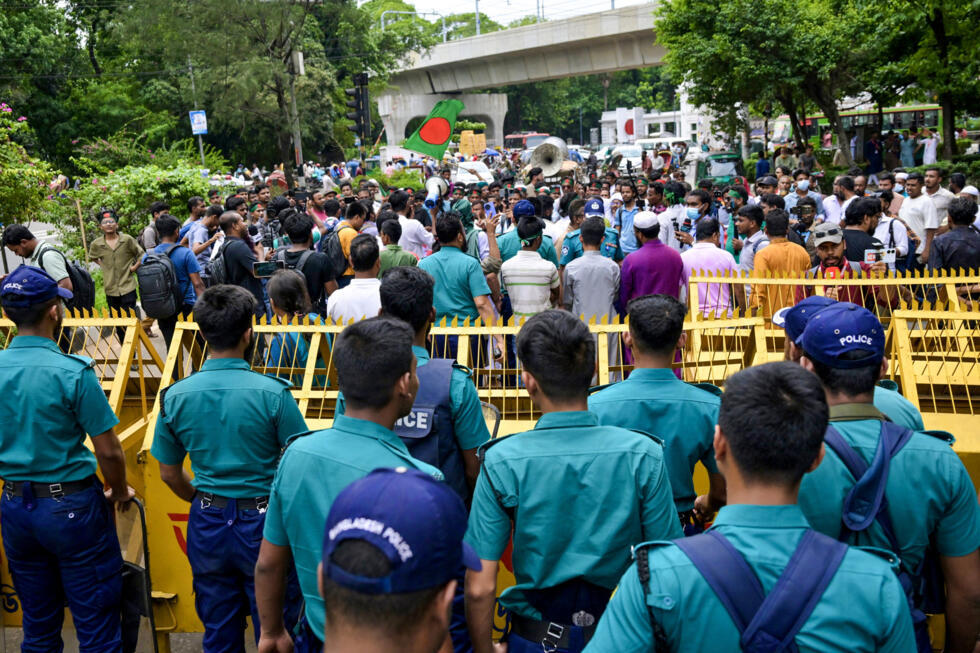
Protests have become part of daily life in Bangladesh's capital, with residents either taking part -- or avoiding them © MUNIR UZ ZAMAN / AFP


The South Asian nation of around 170 million people has been in political turmoil since former prime minister Sheikh Hasina was ousted in August 2024, fleeing by helicopter as crowds stormed her palace.

Hasina's 15-year-long authoritarian rule contained protests like a pressure cooker, until the student-led movement spearheaded a revolt that toppled her from power.

On Wednesday, at least half a dozen demonstrations were held in the sprawling megacity of Dhaka, home to more than 20 million people.

This was a typical day, with the demonstrations ranging from political rallies and counter-protests, to worker strikes and celebrations at the release of an Islamist leader from death row.

Bangladesh's Jamaat-e-Islami leader A.T.M. Azharul Islam (C) was released from prison in Dhaka on Wednesday © MUNIR UZ ZAMAN / AFP

"I got released this morning after being imprisoned for 14 years," A.T.M. Azharul Islam said, waving at thousands of supporters of the country's main Islamist party, Jamaat-e-Islami.

The tight-packed crowd cheered as the senior leader was released from a prison hospital in central Dhaka, a day after the Supreme Court overturned his death sentence and acquitted him of war crimes.

"There was no justice in the past... we expect the court will ensure that the people get justice in the coming days," Islam said.

Leftist parties say they will demonstrate in opposition to his release.

Across Ramna Park in the neighbourhood of Naya Paltan, thousands choked the streets as part of a rally in support of the Bangladesh National Party (BNP).

Political parties are readying for hugely anticipated elections which the interim government has vowed will take place by June 2026 at the latest.
'Unpredictable'

While tens of thousands gather at major intersections across Dhaka with their demands, others spend hours navigating their way through traffic-snarled streets.

"All the major roads are blocked during the day," chicken seller Zakir Hossain said Wednesday.

While tens of thousands gather at major intersections across Dhaka with their demands, others spend hours navigating their way through traffic-snarled streets © MUNIR UZ ZAMAN / AFP

"We've had to shift our schedules. I start work at midnight now, even though the law and order situation is worsening every day, and muggings have become common."

It worries many, remembering the violence last year when police tried -- and failed -- to crush the protests that toppled Hasina.

"The situation is unpredictable -- the protests can turn violent at any moment," said a 43-year-old housewife, asking not to be identified as her husband is a government employee.

"I never used to call my husband much, but now I do. If he is even a little late coming home from the office, all sorts of bad thoughts come to my mind."

Bangladesh's interim leader Muhammad Yunus, the 84-year-old Nobel Peace Prize winner who is leading the caretaker government as its chief adviser until elections are held, has called for parties to build unity and calm intense political power struggles.

The government warned on Saturday that "unreasonable demands" and obstruction had been "continuously obstructing" its work.
'A balance'

Yunus has said polls could be held as early as December but that having them later would give the government more time for reform.

The frequest protests are a worry to many, remembering the violence last year when police tried -- and failed -- to crush the uprising that toppled Hasina © MUNIR UZ ZAMAN / AFP

Rallies organised by the powerful BNP are calling for the government to set an election date, as well as a raft of other demands, including the sacking of multiple members of Yunus's cabinet.

In other protests, tax authority workers, angered at an overhaul of the body that would place it under the finance ministry's control, held a two-week partial strike.

That escalated on Sunday when security forces surrounded the national tax headquarters, before the government later backtracked on its reform.

Civil servants this week also demonstrated at the main government ministry complex to rally against orders changing employment rules -- which the government then said it will reconsider.

On the streets, the protests continue.

"Customers rarely come to the bank when they see the roads blocked," said bank manager Muhammed Sazzad.

While he supported the right to assemble, he suggested the government "could designate a specific area for protests".

Rakib Hasan Anik, a lecturer at the Bangladesh University of Professionals, said that "academic discipline is suffering", with students stuck in traffic and missing class.

"There needs to be a balance," he said. "We can only hope all sides reach a consensus that prioritises the public."

© 2025 AFP
Lee Jae-myung's rise from poverty to brink of South Korean presidency

Seoul (AFP) – Lawsuits, scandals, armed troops and a knife-wielding attacker all failed to deter Lee Jae-myung's ascendancy from sweatshop worker to the cusp of South Korea's presidency.

Issued on: 29/05/2025 -

With his rags-to-riches narrative, Lee Jae-myung has cultivated a loyal support base
 © Pedro Pardo / AFP


After losing by a gossamer thin margin in 2022, the Democratic Party candidate has returned to the ballot, and is now poised to replace the political rival he was instrumental in unseating.

Opponents decry Lee, 60, for his populist style. But his rags-to-riches personal story sets him apart from many of South Korea's political elite.

After dropping out of school to work at a factory to support his family, he suffered a disabling elbow injury in an industrial accident.

He earned a scholarship to study law and passed the bar to become an attorney.

Lee has used this origin story to cultivate a loyal support base and frame himself as understanding the struggles of the underprivileged.

"You can worry about people outside shivering in the cold while you sit in your warm living room," Lee told AFP in a 2022 interview.

"But you can never really understand their pain."

Polls suggest the margin between Lee and his closest challenger, conservative Kim Moon-soo of the People Power Party, has narrowed in recent days, with some showing a single-digit margin.

But Lee has consistently maintained his lead since the race was triggered by the impeachment of former president Yoon Suk Yeol over his brief declaration of martial law in December.
Live-streaming a crisis

South Korea has experienced a leadership vacuum since lawmakers suspended Yoon for deploying armed troops to parliament in his failed attempt to suspend civilian rule.

During the tense minutes following that move, Lee live-streamed his frantic scramble over the perimeter fence as he and other lawmakers rushed to vote down the martial law decree.

"It was a race against time," he recalled in an interview with AFP.

Lee previously served as mayor of Seongnam, south of Seoul, for eight years.

In that role, he helped shut down what had been the country's largest dog meat market -- ending a trade that had once involved 80,000 canines a year.

He later served as governor of Gyeonggi Province -- the country's most-populous region surrounding the capital -- for more than three years.

Lee lost his 2022 bid for the presidency to Yoon by one of the smallest margins in South Korean history.

And in 2024 he was stabbed in the neck by a man posing as a supporter and was airlifted to hospital for emergency surgery.

The attacker later confessed that his intention was to kill Lee to prevent him from becoming president.

If elected next week, Lee has vowed, among other things, to boost South Korea's artificial intelligence industry, with the goal of making the country one of the top three global leaders in the field.

He has also called for holding those involved in the martial law attempt accountable -- promising to "bring insurrection elements to justice".

During his early days in politics, Lee drew criticism for his confrontational attacks on political opponents.

But Kim Hye-kyung, his wife of 34 years with whom he shares two children, insists Lee speaks with "deliberation".

"He's someone who's come up from the margins, from the very bottom," she said in a 2017 interview.

"Just like how a flea has to jump to be noticed, I hope people can understand and view him in that context."
Legal troubles

Lee has been dogged by legal troubles of his own, including allegations of corruption tied to a real estate development and violations of election law through the dissemination of false information.

He has denied any wrongdoing, insisting the charges are politically motivated.

In early May, Seoul's Supreme Court overturned a lower court's acquittal of Lee on election law charges and ordered a retrial.

But with the election looming, the Seoul High Court postponed the proceedings until after the June 3 vote.

If Lee wins, legal experts say the proceedings would be suspended due to presidential immunity, and would only resume after his single five-year term ends in 2030.

Lee's opponents argue the charges are serious enough to disqualify him from running.

"With these kinds of corruption allegations, how can you seek public office?" Kim Moon-soo, his main opponent in next week's vote, said during a televised debate on Friday.

© 2025 AFP
NAKBA 2.0

Israel announces creation of 22  ILLEGAL settlements in West Bank

Jerusalem (AFP) – Israel announced on Thursday the creation of 22 new settlements in the occupied West Bank, risking further strain on relations with the international community already taxed by the war in Gaza.

Issued on: 29/05/2025 

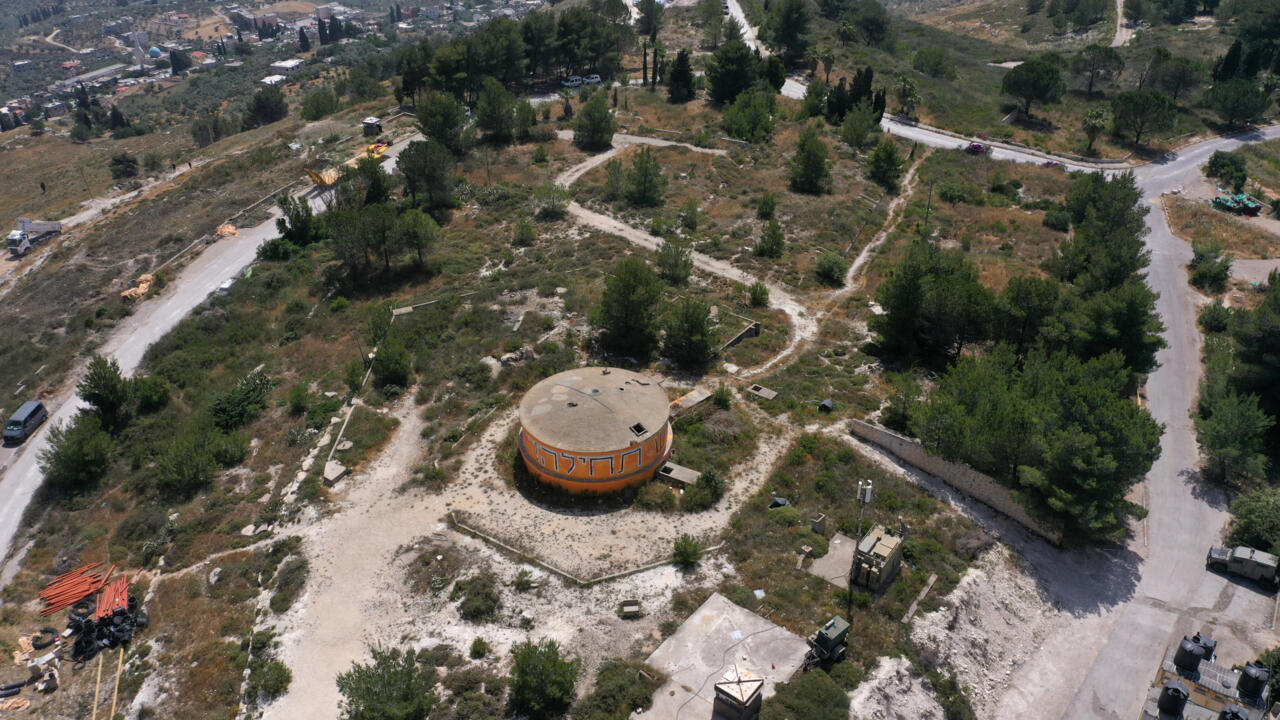
Among the new settlements in the occupied West Bank approved by Israel was the former settlement of Homesh, evacuated by Israel in 2005 alongside its evacuation of settlers from Gaza. © Menahem KAHANA / AFP/File


Israeli settlements in the West Bank are regularly condemned by the United Nations as illegal under international law, and are seen as one of the main obstacles to a lasting peace between Israelis and Palestinians.

The decision to establish more, taken by the country's security cabinet, was announced by far-right Finance Minister Bezalel Smotrich, himself a settler, and Defence Minister Israel Katz, who is in charge of managing the communities.

"We have made a historic decision for the development of settlements: 22 new communities in Judea and Samaria, renewing settlement in the north of Samaria, and reinforcing the eastern axis of the State of Israel," Smotrich said on X, using the Israeli terms for the southern and northern West Bank, which it has occupied since 1967.

"Next step: sovereignty!" he added.

Katz said the initiative "changes the face of the region and shapes the future of settlement for years to come".

In a statement, Hamas condemned the move as "further confirmation that the criminal Zionist occupation continues to impose facts on the ground by accelerating steps to Judaize Palestinian land within a clear annexation project".

"This is a blatant defiance of the international will and a grave violation of international law and United Nations resolutions," said the Palestinian militant group which rules Gaza.

Western ally Jordan too condemned the Israeli move, calling it a "flagrant violation of international law" that "undermines prospects for peace by entrenching the occupation".

The Jordanian foreign ministry warned that "such unilateral actions further erode the viability of a two-state solution by impeding the establishment of a sovereign Palestinian state".

In a statement on Telegram, the right-wing Likud party of Prime Minister Benjamin Netanyahu called the move a "once-in-a-generation decision", saying the initiative had been led by Smotrich and Katz.

"The decision also includes the establishment of four communities along the eastern border with Jordan, as part of strengthening Israel's eastern backbone, national security and strategic grip on the area," it said.

The party published a map showing the 22 sites spread across the territory.

'Heritage of our ancestors'


Two of the settlements, Homesh and Sa-Nur are particularly symbolic. Located in the north of the West Bank, they are actually resettlements, having been evacuated in 2005 as part of Israel's disengagement from Gaza, promoted by then-prime minister Ariel Sharon.

Current Prime Minister Benjamin Netanyahu's government, formed in December 2022 with the support of far-right and ultra-Orthodox parties, is the most right-wing in Israel's history.

Human rights groups and anti-settlement NGOs say a slide towards at least de facto annexation of the occupied West Bank has gathered pace, particularly since the start of the Gaza war triggered by Hamas's October 2023 attack on Israel.

"The Israeli government no longer pretends otherwise: the annexation of the occupied territories and expansion of settlements is its central goal," the Peace Now group said in a statement, adding the move "will dramatically reshape the West Bank and further entrench the occupation".

Israel's far-right Finance Minister Bezalel Smotrich, who is himself a West Bank settler, has long been an outspoken advocate of settlement expansion. © GIL COHEN-MAGEN / AFP/File

In his announcement, Smotrich offered a preemptive defence of the move, saying: "We have not taken a foreign land, but the heritage of our ancestors."

Some European governments have moved to sanction individual settlers, as did the United States under former president Joe Biden, though those measures were lifted by current President Donald Trump.

Thursday's announcement comes ahead of an international conference to be led by France and Saudi Arabia at UN headquarters in New York next month, which is meant to resurrect the idea of a two-state solution to the Israeli-Palestinian conflict.

Supporters of the blueprint, which was the basis of successive rounds of Israeli-Palestinian peace talks, say the prospects for a viable, contiguous Palestinian state alongside Israel are being undermined by the proliferation of settlements.

The announcement also comes after US envoy Steve Witkoff said Wednesday he had "very good feelings" about the prospects for a Gaza ceasefire between Israel and Hamas, adding that he expected to send out a new proposal imminently.

© 2025 AFP

Dua Lipa, public figures urge UK to end Israel arms sales

London (AFP) – Pop star Dua Lipa joined some 300 UK celebrities in signing an open letter Thursday urging Britain to halt arms sales to Israel, after similar pleas from lawyers and writers.


Issued on: 29/05/2025 -

Popstar Dua Lipa lends her voice to calls urging Britain to halt arms sales to Israel © Dia Dipasupil / GETTY IMAGES NORTH AMERICA/AFP

Actors, musicians, activists and other public figures wrote the letter calling on Prime Minister Keir Starmer to "end the UK's complicity in the horrors in Gaza".

British-Albanian pop sensation Dua Lipa has been vocal about the war in Gaza and last year criticised Israel's offensive as a "genocide".

Israel has repeatedly denied allegations of genocide and says its campaign intends to crush Hamas following the deadly October 2023 attack by the Palestinian militants.

Other signatories include actors Benedict Cumberbatch, Tilda Swinton and Riz Ahmed, and musicians Paloma Faith, Annie Lennox and Massive Attack.

"You can't call it 'intolerable' and keep sending arms," read the letter to Labour leader Starmer organised by Choose Love, a UK-based humanitarian aid and refugee advocacy charity.

Sports broadcaster Gary Lineker, who stepped down from his role at the BBC after a social media post that contained anti-Semitic imagery, also signed the letter.

Signatories urged the UK to ensure "full humanitarian access across Gaza", broker an "immediate and permanent ceasefire", and "immediately suspend" all arms sales to Israel.

"The children of Gaza cannot wait another minute. Prime Minister, what will you choose? Complicity in war crimes, or the courage to act?", the letter continued.

Earlier this month, Starmer slammed Israel's "egregious" renewed military offensive in Gaza and promised to take "further concrete actions" if it did not stop -- without detailing what the actions could be.

Last September the UK government suspended 30 out of 350 arms export licenses to Israel, saying there was a "clear risk" they could be used to breach humanitarian law.

Global outrage has grown after Israel ended a ceasefire in March and stepped up military operations this month, killing thousands of people in a span of two months according to figures by the Hamas-run health ministry.

The humanitarian situation has also sparked alarm and fears of starvation after a two-month blockade on aid entering the devastated territory.

Over 800 UK lawyers including Supreme Court justices, and some 380 British and Irish writers warned of Israel committing a "genocide" in Gaza in open letters this week.

Hamas killed 1,218 people, mostly civilians, in their October 2023 attack on Israel, according to an AFP tally based on official figures.

Militants also took 251 hostages, 57 of whom remain in Gaza, including 34 who the Israeli military says are dead.

Israel's military offensive launched in response has killed 54,084, mostly civilians, in Gaza according to its health ministry, displaced nearly the entire population and ravaged swathes of the besieged strip.

© 2025 AFP