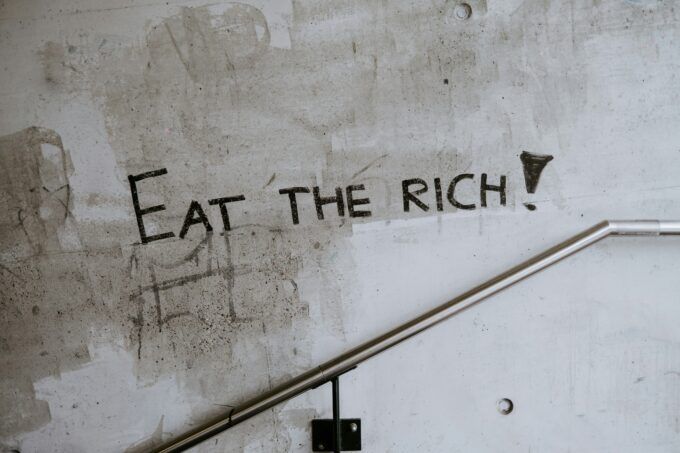
Image by Claudio Schwarz.
According to research from the Economic Policy Institute (EPI), “The Productivity-Pay Gap”, May 15, 2025, a majority of Americans’ financial affairs have reached a crisis level. Their standard of living has steadily declined over the past fifty years (1975-2025). The evidence is the gap that has been increasing between economic productivity (GDP) and worker compensation (wages). From 1975-2025 economic productivity (GDP) increased at 69% while worker compensation (wages) decreased disproportionately at 11%. Compare this GDP-Wage gap disparity from 1945-1975, where economic productivity (GDP) was at a high of 108%, while worker compensation (wages) increased proportionately at 93%.
The Social Security Administration reports that more than half of United States citizens make less than $30,000 per year and that more than half of U.S. families have virtually no savings. Gopi Shah Goda, in Facing the Social Security Shortfall, May 26, 2025, argues that most Americans would need to assume significant debt or sell investments such as a home to cover an emergency expense. Approximately two-thirds of U.S. citizens have less than $1,000 in their savings and the number of families spending more than half their incomes on rent has increased by a stunning 50% in ten years.
In another study from the Ludwig Institute for Shared Economic Prosperity (LISEP), most Americans do not earn enough to afford basic costs of living. In their report, Philip Cornell, Santiago Dassen, and Shannon Meyer, “Minimum Quality of Life Index – Methodology”, May 2025, the researchers argue that the “minimum quality of life” index reveals that most Americans have barely enough income to make ends meet, let alone face a catastrophic illness.
Research conducted by Peter Temin, Professor Emeritus of Economics at MIT, and Lynn Paramore of Stanford University argues that the ongoing death of “middle America” has sparked the emergence of two countries within one, the disparaging hallmark of developing nations. In The Vanishing Middle Class: Prejudice and Power in a Dual Economy, 2018, and “U.S. Has Regressed to a Third-World Nation for Most of Its Citizens,”Temin and Paramore paint a bleak picture in which one sector of the economy in the United States, 8 has a massive surplus of wealth and power, while middle America struggles on a routine basis with basic needs, such as, housing, healthcare, transportation, food, education and massive student debt, etc. Both researchers claim that the dogmatic adherence to the absolute nature of neoliberal economics is destroying the very system of capitalism to which Americans depend upon for basic goods and services. The manifestation of this disaster is that the minority rich (oligarchs) have expanded their wealth exponentially, while the majority of middle-class Americans are in financial decline. Suffice it to say, the poor are faring much worse.
The methodology Temin applies, and also reflected in Paramore’s research, is based on W. Arthur Lewis’s “dual economy model”, designed to analyze the economic and financial workings of developing countries. The model identifies the low-wage sectors and how these sectors maintain subsistence level wages with ever increasing outputs within agricultural and industrial employment. The high-wage sector, usually a fractional number of individuals in high finance, real estate, and capital investment, seek ever-increasing margins of profit from the agricultural and industrial labor. Temin argues that this economic division of labor predetermines economic “winners and losers” with very little or no upward economic mobility for agricultural and industrial labor.
To counter this trend, Temin argues for a domestic “Marshall Plan” in the United States, a concept typically prescribed for developing countries by progressive policymakers. Within this plan, the first order of business would be to avoid austerity measures, or Structural Adjustments Programs (SAPs), since this has proven to be counterproductive in developing countries. Secondly, supporting investment in universal education, investing in public infrastructure and transportation, forgiving unpayable student loan debt, clearing the books on odious debt, forgiving negative credit reports on foreclosures and short sales, providing housing and food subsidies, universal healthcare, and creating aggregate demand in the economy though living wage employment … perhaps supplementing minimum wage employment with a Universal Basic Income (UBI) … are some of the concrete policies that would salvage the economic demise of Americans.
Until the current course is changed, Temin warns, the middle class will continue to decline financially, and America’s increasing decline into a third world economy will continue.
Other economists, such as Thomas Piketty in his Capital in the Twenty-First Century, 2014, argues that capitalism’s profit margin design, will always undermine labor. For example, the average workers’ wages in the US have fallen sizably during the past forty years. In the same period, over 90% of all new income went to the top 1% while pushing 46 million Americans into poverty. As a result, the gap between corporate profits and workers’ wages has never been greater. Piketty’s conclusion is that capitalism, if left unchecked, generates a concentration of wealth among a minority. This is because capitalism, in its present form, necessitates spending. And if laborers have less money to spend, the economy is less efficient. With no plan for addressing this contradiction, the future of neoliberal capitalism presages potential disaster for the American polity. Piketty argues thusly that the “neoliberal” capitalists are destroying the capitalist system itself.
According to Piketty, the first line of defense for capitalists is “denial”, along with the contention that government involvement in the economy only undermines market productivity. Capitalist dogma asserts that the market left to its own devices will nevertheless reward the meritorious and provide sufficient wealth, and in doing so, provide economic well-being for the common good. Piketty’s counterclaim, however, is that forty years of empirical evidence prove otherwise, and by examining China’s long-term planning, the economic policy strategies of the Chinese Communist Party (CCP) have certainly provided a positive example of a “planned” economic model which has now surpassed the economy of the United States.
The key point for Temin, Paramore, and Piketty is that the economic struggles in the United States may lead to austerity programs, which could manifest in the divestment and eventual abolition of welfare policies such as Medicaid, Medicare, Supplemental Security Income, and Social Security. The rich, without a doubt, would be exempt from these austerity measures since their wealth would allow these life-saving programs to become simple commodities.
In addition to the capitalist class and their destruction of capitalism itself, democratic governance has also been in decline. Elected representatives in the United States have become subservient to corporate financial interests. Corporate interests, in turn, reward elected representatives with financial contributions for their campaigns when these politicians vote for corporate policies. For these “favors,” politicians are rewarded handsomely for their efforts. This has become, and perhaps always been, the modus operandi of the power elite in the United States. Yet what is clear is that a vast majority of Americans, as a result, have little say in the policies which govern them. Corporate America and the “rich” maintain dominance over the majority of Americans in public policy legislation. This is more than a generalization; it is a demonstrable thesis based on comprehensive empirical research by Martin Gilens and Benjamin Page. See their September 2014 research in Political Perspectives, “Testing Theories of American Politics: Elites, Interest Groups, and Average Citizens”.
In C. Wright Mills’ The Power Elite, 1956, and Mancur Olson’s The Logic of Collective Action, 1965, both men argue that the unlikelihood of a broader distribution of decision-making power is unlikely. Interest group liberalism, as Ted Lowi argues in The End of Liberalism, 1969, is itself a factor in undermining democratic governance. But what is of most concern is that over the past forty years, starting with the Reagan Revolution, the rich, middle class, and the poor are increasingly alienated from each other while democratic self-determination seems to be on perilous footing. Mills, Olson, and Lowi, argue that the struggle for democracy is severely limited by special interests and corporate domination. Their work has been predominantly conceptual, based on argumentation and intuitive links to structures of power in society. However, with Gilens and Page, the conceptual frameworks are now grounded in factual data and evidence.
All of this is a harbinger of difficult times ahead regarding civil society and civil liberties. And can society then coexist with millionaires and billionaires and their Wall Street elites?
With the emerging authoritarian trend of the Trump administration, the likelihood of a fascist coup may be on the horizon. There are some who argue that the takeover is already here. Timothy Snyder, On Tyranny: Twenty Lessons from the Twentieth Century, 2025; Ruth Ben-Ghiat, Strongmen: From Mussolini to the Present, 2020; and Jason Stanley, How Fascism Works: The Politics of Us and Them, 2020, are examples. Their analyses draw attention to economic preconditions in which economic struggle feeds the fascist setting for a right-wing coup. This clearly parallels American society today. Economist Clara Mattei, in The Capital Order: How Economists Invented Austerity and Paved the Way to Fascism, 2022, shows how poverty and inequality provide an entre for fascist leaders to manipulate the masses into believing their best interests can salvaged with an authoritarian leader and repressive social policies. She argues that austerity programs and the class warfare accompanying such programs pave the way for fascism. And the hidden motives behind such austerity programs: the protection of capital and the ideological sanctity of capitalism as a dogma and the scheme to avert attention away from the restless underclass to alternative economic models such as socialism.
In The Capital Order, Mattei argues that governments over the past century have resorted to austerity models for economic policies when confronted with financial crises. These not only include cuts to welfare policies in human services such as health and income support, but wages, public fiscal spending, public benefits in education, etc. This is the economic policy strategy aimed at regaining fiscal solvency. While these policies have appealed to creditors such as banks and other lending institutions (World Bank and International Monetary Fund), the effects have been draconian on the public. While the austerity model remains popular in developing countries, it may become a reality for the United States under its current economic decline into a dual economy. But Mattei poses a vexing question to her readers: what if solvency was never the goal of austerity?
Mattei revisits the austerity programs of England and Italy, demonstrating how the threat of working-class activism following World War I led to several top-down policies that favored capitalists, marginalized labor, and established a strict economic hierarchy throughout their societies. These policies succeeded on behalf of the rich corporate capitalists and foreign investment who gained economic leverage and financial advantage over labor. Mattei concludes that the real strategy behind austerity was to solidify the entrenched privilege of the capitalist class and eliminate any alternative to the capitalist system. Thus, contemporary political economy caters to the elites of society in its exercise of political power. The fascist takeover is set, and public policy is held captive by its clientele. Democratic self-determination, in contrast, is often labeled subversive.
The destruction of capitalism by the capitalist class and the introduction of economic austerity as a fiscal remedy is the segue for a fascist state. So far, the connections are more than intuitive and the setting for a fascist takeover and death of democracy in the United States is alive and well. Dean Baker argues in “The Productivity – Pay Gap and Phony Debates”, Center for Economic Policy and Research (CEPR), June 8, 2024, that it is the structural nature of capitalism to continually perpetuate the clash between economic productivity and labor and not simply political leverage exercised by elites who distribute wealth to their advantage. Crisis is built into the very structure of neoliberal capitalism. This implies revisiting a return to New Deal and Great Society programs or some form of market socialism. This would be the rational policy … a return to “big government” to save ourselves from maniacal capitalists.
With the anticipated passing of Congresses draconian One Big Beautiful Bill, 2025, the country may be pushed over the edge of a political cliff that could have been avoided if only the democrats had gone on the attack for the cause of social and economic justice. To date, as a collective entity, they have no heart and soul to fight for justice. But let’s see what happens with the Gen X, Y (Millennials), and Z politicians who are starting to take political leadership. And with the mayoral race in the capital of capitalism, New York City may very well prove to be where a reconning needs to take place in the ongoing class struggle.
A young Muslim socialist, immigrant to the US, Zohran Mamdani, and his political momentum may save the economy and democracy. Five months from now we shall see who can save us from siege capitalism.