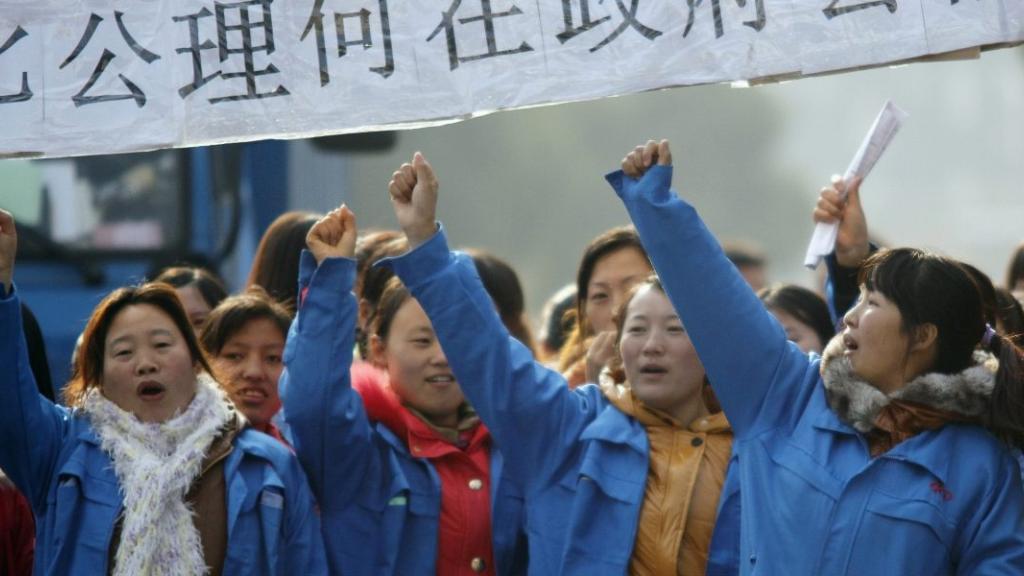
China’s labour movement is of strategic importance for the global working class. Yet little data is available about its struggles due to government restrictions on the media and labour-focused organisations.
Manfred Elfstrom is a political scientist and professor at the University of British Columbia, whose research focuses on labour protests in China, the state’s authoritarian responses and how struggle from below has shaped government policy. He is the author of Workers and Change in China: Resistance, Repression, Responsiveness.
Elfstrom spoke with Serhii Shlyapnikov for LINKS International Journal of Socialist Renewal to discuss recent labour struggles in China and what they tell us about prospects for change under an authoritarian regime.
How did you decide on the focus of your book, Workers and Change in China?
Before I returned to academia, I worked for a non-profit group, China Labor Watch, and the International Labor Rights Forum (now Global Labor Justice). I ran some of their China programs, helping grassroots workers’ centres and labour law clinics in Chinese law schools.
The book grew out of an interest in what all this activity accomplished.
Could you tell us about your work in China Labor Watch? In countries such as mine (Russia), NGOs are often seen as foreign agents and treated with suspicion by the state.
I worked with China Labor Watch and the International Labor Rights Forum in the late 2000s and early 2010s. At that time, the Chinese government was suspicious of foreign and domestic civil society groups active on labour issues. But it did not take as hard a line as today. It was a period of relative openness — one marked by an extraordinary wave of labour activism.
You may recall some of the big strikes back then, such as the 2010 Honda plant strike, which captured the world's attention. Workers were not just asking for unpaid wages or injury compensation. They were asking for pay rises — what I refer to as offensive labour demands.
For that reason, the Chinese government saw value in exchanges with foreign labour experts to help them figure out how to absorb and manage these growing conflicts, as well as set up a legal infrastructure for dealing with industrial disputes.
About 15 years ago, US sociologist Beverly Silver forecasted that China would become a global epicentre of labour unrest. Looking back, do you think that turned out correct?
When Silver wrote that, China was a major centre of global labour unrest. Strikes, protests and riots occurred at an extraordinary level, even taking China’s big population into account.
Looking back, it seems there was a peak in the early- to mid-2010s, followed by a gradual decline. I say “seems” because the data is extremely patchy. Those of us studying strikes in China rely on social media accounts and limited state media coverage of labour disputes. Under [Chinese president] Xi Jinping, both social media and state media coverage of labour conflicts has been sharply curtailed.
The other factor is the COVID-19 pandemic. China featured lockdowns of a sort that we did not experience here in Canada. People were restricted to their homes, and mandatory testing was conducted on a regular basis. This significantly curtailed all kinds of activity.
But with China lifting COVID restrictions, strikes appear to have picked up again to some extent. Right after the change of policy, there were strikes by people directly affected by the pandemic, such as delivery drivers, who became a vital lifeline for people under lockdown in Shanghai, or people manufacturing personal protective equipment.
I do not think the level of activity is the same as in the early 2010s, but it is hard to say much more due to the lack of data.
Could you tell us about some of the more important strikes by Chinese workers in the past decades?
The Honda strike is worth dwelling on. It was dramatic because it involved young workers making ambitious demands for high pay raises. And Honda’s just-in-time manufacturing process meant shutting down the auto parts plant had ripple effects all along the supply chain, leading to copycat strikes in other auto plants.
At first, the official trade union did not acquit itself very well, but when the municipal trade union got involved, it became broadly supportive of the bargaining process and did not rush to restore order, which is what trade unions often do in China. The head of the municipal trade union was a reform-minded official. So, a lot of different things came together at once.
The strike also occurred against the backdrop of many other disputes and discussions regarding new legislation for strikes, which never materialised. And it came not long after a wave of new labour laws were pushed through in 2008. These included the Labour Contract Law, the Employment Promotion Law, and the Labour Dispute Mediation and Arbitration Law. In short, it occurred under rather exceptional circumstances.
The Honda strikes received a lot of attention, but several other noteworthy strikes occurred afterward. Only a few years later, a major strike broke out at a shoe factory in Dongguan. It is considered one of the largest strikes in modern Chinese history.
Other notable strikes involved truck drivers, as well as a strike by port-based crane operators. Notably, these strikes were coordinated nationally. Typically, strikes in China are contained to a single workplace, and occasionally they spread across workplaces. But they do not usually spread across regions in a coordinated way.
The last one I would mention — it’s not really a strike, but a protest movement — was the Jasic electronics factory protests in 2018. Activists had been expelled from the factory in Shenzhen. Students from different universities — mainly from leftist student groups — came to Shenzhen and protested on behalf of the workers.
With the movement spilling beyond normal social boundaries, the government cracked down hard: students were detained, student organisations were shut down, people were shoved into vans on their campuses. Around this time, the government launched a big campaign against labour NGOs and detained several prominent labour NGO leaders.
Could you tell me about the dataset on Chinese strikes that you maintain?
I started compiling my dataset in 2010, covering the period 2003-12, which spans the full Hu Jintao-Wen Jiabao administration. I gathered information through searches of labour organisations and dissident websites, and a reporting form on my own site. I then cross-checked my data with the strike map of China Labour Bulletin from the year 2010 onward, adding missed incidents.
The dataset was needed because local official media coverage of labour activism is minimal, and usually limited to construction disputes and taxi strikes that are seen as less threatening. Reports from state outlets tend to follow a familiar structure, confirming what is already known and reporting on how the government resolved the issue. Large incidents may appear in local and national media, but these reports focus on problem-solving rather than criticising the government.
[US political scientist] Maria Repnikova has compared Russian and Chinese media, noting that while critical journalists in Russia view themselves as part of the opposition, critical journalists in China act as constructive insiders, focusing on resolving issues rather than exposing failures. The media frames labour conflicts as tricky issues that the government can resolve.
The best resource on strikes for the decade after my dataset ends is China Labor Bulletin and their strike map. I just saw the really sad news that the organisation is shutting down.That represents a significant loss — both in terms of data on labour activism in China and in terms of their being an important voice on Chinese labour issues.
In your book, you compare labour unrest in two deltas, the Yangtze River Delta and the Pearl River Delta. Why did you choose those two regions?
I chose them because they are similar in a lot of respects. Both are wealthy, export-oriented areas. Both have a lot of migrant workers employed in factories and construction sites. However, they also differ significantly in terms of labour unrest. They especially differed during the period I studied. Since then, the two regions have somewhat converged.
My argument was that the difference in labour unrest was both quantitative — with more strikes and protests occurring in the Pearl River Delta than in the Yangtze River Delta — and qualitative — in that workers in the Pearl River Delta made more ambitious demands and developed more sophisticated organisations.
This difference in turn led to differences in local governments.
Could you explain these differences in more detail?
There are structural differences between the two regions that account for the differences in labour activism. Guangdong [in the Pearl River Delta region] integrated into the global market earlier. As a result, there was more time for activism to mature. Also, the region generally specialised in lighter, lower value-added industries, whereas the Yangtze River Delta had a more high-tech industrial base.
Another factor was that workers in Guangdong tended to come from further away, whereas in the Yangtze River Delta, they came from closer by or from other places in the province of Jiangsu or Anhui. This contributed to more worker militancy in the Pearl River Delta than the Yangtze River Delta.
But my argument — contested by some — is that the crucial difference was not these structural factors, but rather the actions taken by workers themselves. Local authorities did not have to manage workplaces so differently simply because workers came from nearby or far away, or because factories were more or less high tech; they managed them differently due to the levels of labour unrest.
Electronic workers seem to be at the centre of strategic tech sectors and exports. However, many are subcontracted. Could you tell us more about these workers and whether they do play a strategic role?
Some electronic workers can be said to be strategically located. But many are doing really basic and repetitive assembly jobs, such as assembling iPhones or computers for foreign multinationals. Whether their location grants them unique leverage, however, is hard to say.
In a certain sense, they do have leverage, though, as many foreign multinationals have structured their supply chains around China and a limited number of key suppliers. For example, much of the iPhone production is centered on Foxconn — a major Taiwanese company that operates huge worksites in China employing about 200,000 workers. It is not easy for Apple to uproot and find a new supplier.
At the same time, these workers are fairly replaceable compared to workers in more high-tech manufacturing. Even some garment workers have developed skills that are more difficult to replace.
Subcontracting is both a widespread phenomenon and a broader structural problem across the Chinese economy. In fact, even state-owned enterprises (SOE) — which were whittled down in the late 1990s and early 2000s — now only offer secure benefits and stable employment to a relatively small group.
Instead, they increasingly rely on subcontractors. They have an older, permanent workforce that enjoys benefits typically associated with SOE. Alongside them are newer, more precarious workers, hired through labour contract companies.
You also see this with construction. This has significantly exacerbated conflict, as large construction firms — both private and state-owned — often manage huge projects. They subcontract different parts, and those people subcontract work to others who go to the countryside and scout for workers, often from their hometowns.
If someone along the subcontracting chain goes bankrupt or comes up short on money, workers at the bottom of the chain often go unpaid. This is especially severe for construction because workers in that sector traditionally receive only minimal payments throughout the year.
Most of their wages are paid at the end of the year — just before they return home for the Spring Festival, one of the most important holidays in the Chinese calendar. Often, at that time, money will go missing and workers will be left in really difficult positions. The situation may have improved somewhat in recent years, but it is still a problem.
Your book focuses on how ordinary people can impact the state. Could you say a bit about this?
There is an assumption that authoritarian states are less responsive to their citizens than democracies. That assumption holds some truth, and likely applies more strongly to certain authoritarian regimes than others.
In some contexts, however, precisely because there are no pressure release valves such as elections, and because every protest is treated as a serious problem, repertoires of resistance — whether protests, strikes, or riots — can achieve more than in more open societies.
So, for instance, in Canada or the United States, there are often protests over polluting chemical plants or something similar. In China, there are also protests against these plants, and some have led to multi-million dollar projects being cancelled in really short order. Just the fact that lots of residents in a city showed up was seen as enough of a big deal that local authorities had to shut the problem down.
More broadly, the my book examines how labour unrest — particularly labour activism — might be reshaping the Chinese state and its capacities. It arrives at a mixed conclusion. In some respects, I provide evidence that activism is leading the state to be more responsive to workers.
In regions with higher levels of unrest — more strikes, protests and riots — courts tend to rule more often in favour of workers, or deliver split decisions in formally adjudicated employment disputes. There are also signs of hesitant reforms in the official trade union federation. That is all on the positive side of the ledger from workers’ perspective.
But the conclusion is mixed because, in those same regions, the state has also significantly increased its repressive capacity. It spends more on security services.
I provide statistics on increased spending on something called the People’s Armed Police, which is a paramilitary force that gained elevated status after the Tiananmen Square crackdown in 1989 as part of the state’s response to domestic unrest. The idea was that it would take on the role of maintaining domestic order in place of the military. The People's Armed Police gets promoted in places where there is more unrest.
Qualitatively, one can also examine how people in power respond to individual disputes. In the Pearl River Delta, strikes and protests have become normalised and the government no longer feels it must get involved in every case — at least not as much as before. However, it comes down hard on organisers in high-profile incidents, and in recent years it has gone after civil and labour societies in the region.
My broader argument is that workers are reshaping governance in China, but they are doing so in two opposing directions at the same time.
What lessons can we learn from the Chinese labour experience, given how difficult it is to build grassroots organisations when strikes are shut down and activists jailed?
Yes, it is hard, especially when you try to build something and it fails. When I wrote my book, labour NGOs in China were already under pressure. Since then, most of that vibrant world, especially in the southeast, has been eliminated. Leaders of these organisations were either detained or warned off activism. Most left the field entirely, while some shifted to less politically charged work, like helping migrant workers’ children.
Labour organising has been shut down, which is a real loss. These groups had begun to move away from legalistic work toward a more movement-oriented approach.
This is not the first time labour and civil society in China has faced repression: similar crackdowns happened in the late 1990s and early 2000s. But the current wave has been especially devastating for independent labour organising.
Could you discuss the current state of Chinese labour organisations, NGOs and leftist groups?
Many labour NGOs in China were aligned with international industrial relations and rule-of-law networks, and sought to create collective bargaining systems similar to those in Europe or North America. Some had a strong leftist commitment, while others focused more on rights protection from a more liberal perspective.
Young people became involved in labour activism, especially around 2018, and participated in Marxist reading groups. This movement, however, was heavily suppressed.
In the 1990s, the New Left emerged, which was distinct from Chinese liberals and critical of market reforms. Some supported the populist program of a party leader in Chongqing, which included migrant workers’ housing and a new land policy.
Under Xi, parts of the left embraced his statist approach, including the emphasis on the state sector and “common prosperity”. However, others remain skeptical.
To my mind, Xi's “common prosperity” agenda seems largely symbolic and lacking in substantial welfare reforms or labour law changes. Xi has cracked down on workplace activists, and his policies appear more focused on encouraging corporate donations than real structural change.
How have the new generation of workers created and shaped their own worker cultures and solidarity movements, when compared to earlier generations?
In the 1990s and early 2000s, there were arguably two distinct worker cultures in China. One was the culture of SOE workers concentrated in the northeast and interior regions, where heavy industry formed the backbone of the state sector. The other was the culture of migrant workers from the countryside, who moved temporarily to work in light manufacturing along the southeast coast.These two cultures were very different.
SOE workers often used explicitly class-based language inherited from the Mao era. Migrant workers, by contrast, tended to frame their demands in more legalistic and rights-based terms. An influential book, Against the Law: Labor Protests in China’s Rustbelt and Sunbelt by Ching Kwan Lee, draws this contrast. Over time, however, these boundaries began to blur.
Both groups started to organise ambitious strikes with similar demands. Labour NGOs made a concerted effort to foster a culture of self-respect and empowerment among migrant workers. Among other initiatives, they encouraged workers to view themselves as “new workers” or “new urbanites” rather than rural migrants.
There are generational differences within these groups of workers, too. For example, several generations of rural migrants have moved to coastal cities for factory work.
Also, many accounts suggest that the older generation focused heavily on sending remittances back to their rural homes, while younger generations are more settled in the cities where they work and feel less connected to rural life. They have created organic subcultures in factory zones, expressing themselves through things such as bold hairstyles and fashion. They also gather and socialise in new ways within these industrial environments.
One form of worker culture — especially among migrant workers — is poetry.There are some powerful collections of poems written by migrant workers. A decade or more ago, a few of these workers gained broader recognition for their writing. Their poems often portray the harsh realities of life in export boomtowns and the toll on their bodies.
There is also an important gaming and online culture among white-collar workers. We have seen a wave of pushback against extreme workloads in Chinese tech companies, with people organising on platforms such as GitHub and other forums to protest or vent.
Could you share more about how you plan to compare protests in Appalachia in the United States, and north China in your upcoming book?
I am still at the early stages of that research. Appalachia is a major source of US coal, while north China is China’s equivalent coal-producing region. Both regions have dramatic histories of popular protest.
In Appalachia, there were huge battles between union organisers, company thugs and local authorities in the early 20th century. The biggest of these, in 1921 at Blair Mountain, involved about 8000 armed miners marching through the forest to liberate an anti-union county in the south.
They were attacked by sheriff's deputies with machine guns and even bombed from airplanes secured by sheriffs and mine owners. It was essentially a small-scale civil war. The scale and violence of the conflict was extraordinary. In more recent decades, there has been activism around mountaintop removal mining.
In north China, large protests also occurred in the early 20th century. Mines in Shanxi province, for example, were operated by foreigners, specifically the British. A significant movement emerged to bring these mines under Chinese control. In more recent years, north China has not seen much mine-related activism. Instead, activism has been more focused on farmers, agricultural taxes and similar issues.
Both regions have faced difficulties diversifying their economies. My interest lies in comparing the tactics used in these settings and evaluating what has proven effective or ineffective for activists. Natural resource conflicts are distinct because resource companies wield immense local power.
These conflicts can sometimes carry significant political consequences, as seen in past events in Russia and Ukraine, or in Britain and elsewhere. The goal is to highlight some shared patterns. People often regard China as a unique case, but it can be valuable to situate it within a broader context.
Сould you recommend some readings for activists about the Chinese labour movement?
There is a recent book that provides a good summary of the current dynamics in China for a general audience. It is called China in Global Capitalism: Building International Solidarity Against Imperial Rivalry, and was written by Eli Friedman, Kevin Lin, Rosa Liu and Ashley Smith.
Another book is The Communist Road to Capitalism: How Social Unrest and Containment Have Pushed China's (R)evolution since 1949 by Ralph Ruckus. It explains China’s trajectory over the past few decades.
Both books are very accessible and aim to engage a broader audience in discussions about where China stands today and how the left should interpret that.
Ching-Kwan Lee’s Against the Law offers a strong comparison between SOE workers and migrant worker organising. William Hurst’s The Chinese Worker After Socialism explores protests among SOE workers and is also worth reading.
Eli Friedman has other useful books, such as Insurgency Trap: Labor Politics in Postsocialist China, which applies a Polanyian perspective to how the Chinese state reacts — or fails to react — to labour activism.
Most of these scholars are based in Hong Kong, Britain, the US or Australia, but there are also important scholars within China, especially in the area of industrial relations. Unfortunately, their works are not always translated.