Wednesday, July 16, 2025

A fight to save a Hindu temple for the 'unheard and unseen'

NEW YORK (RNS) — Since 2008, Shri Shakti Mariammaa has been a safe haven for women and members of the LGBTQ community. But the temple risks closure if it cannot make costly improvements.
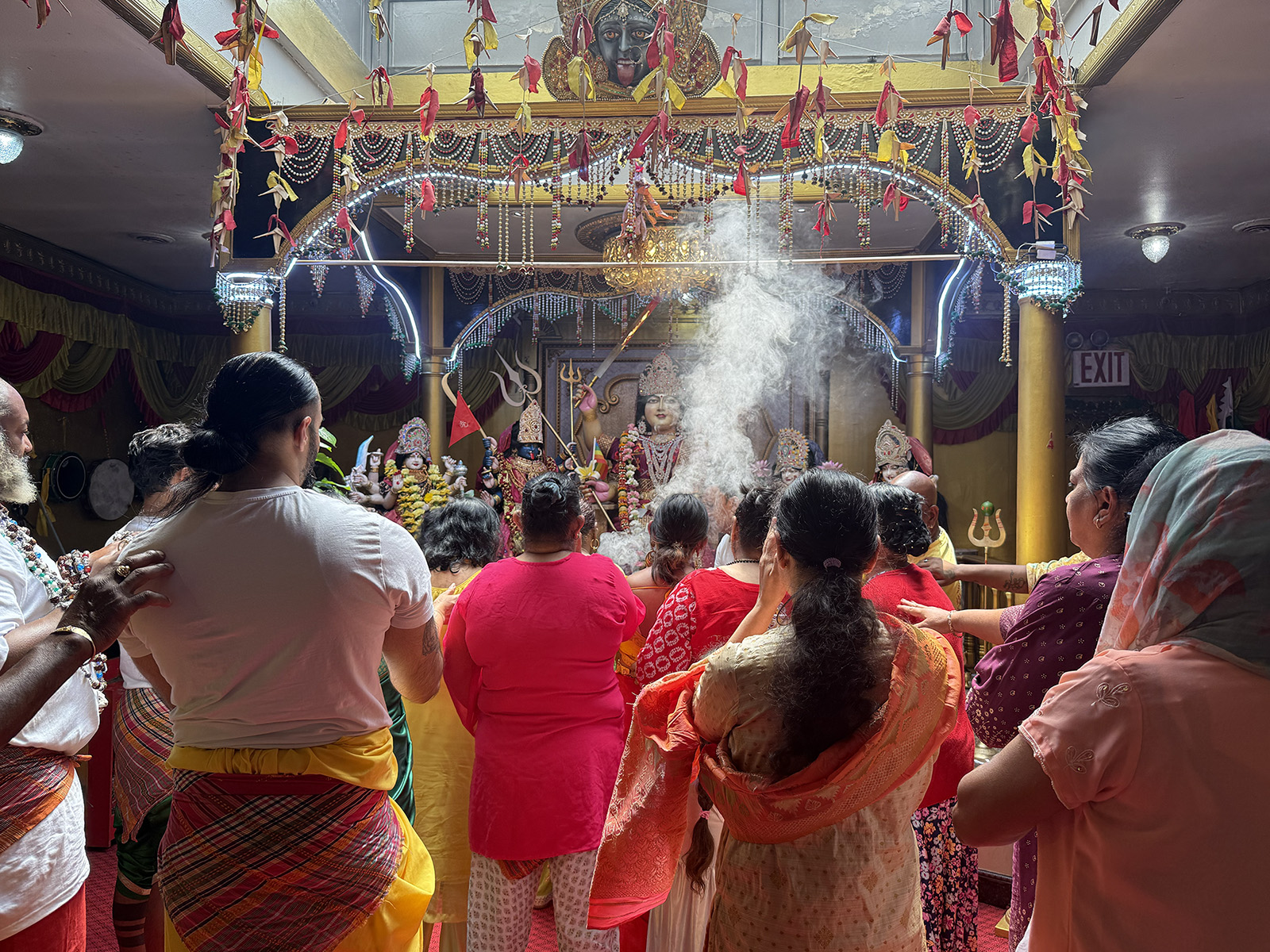

Congregants perform a devotional ritual to Mariamman, represented by the idol at center, passing the Divine energy through one another, during a worship service at the Shri Shakti Mariammaa temple, July 13, 2025, in the Queens borough of New York. (RNS photo/Richa Karmarkar)

Richa Karmarkar
July 16, 2025


NEW YORK (RNS) — Illuminated by a skylight at the center of a small factory-turned-Hindu temple in Queens sits a murti of the Divine Mother — a 1-ton, 6-foot-tall icon of the South Indian village goddess Mariamman, an incarnation of Kali, the deity of time and death. Smoke from cigarettes and incense fills the room, and bottles of rum sit next to fruit at the altar.

“Our religion is very rural, very villagelike,” said Chandni Kalu, 31, a priestess at the Richmond Hill temple. “It’s very raw.”

Even other Hindus might find Sunday worship services at the Shri Shakti Mariammaa temple unfamiliar. The mostly Indo-Caribbean congregants worship goddess Kali, who also represents transcendental knowledge that can manifest within, or spiritually possess, her followers. At a recent service, a young male pujari, or lay priest, shook and danced vigorously through the crowd, entranced with Shakti, the feminine energy that inhabits someone possessed by Kali.


“We are a healing temple,” said Sharda Ramsami, one of the original members of the temple when it was founded in 2008. “Whether it’s something physical or something spiritual, we are always the last resort, and when people come here, they’re desperate for help. I think that’s what’s most powerful: that desperation, and then here’s the answer that no one else could provide for them. Mother knows.”

But the temple is also known as one that is open to all. Its clergy have married same-sex couples after they were shunned or rejected from other Hindu temples in the area, and, uniquely, those clergy, the temple staff and congregants are mostly women. Women come to seek refuge at the temple, Ramsami explained, sometimes to escape dire situations. They have been quietly offered money from temple staff or even given the keys to the building to stay there.
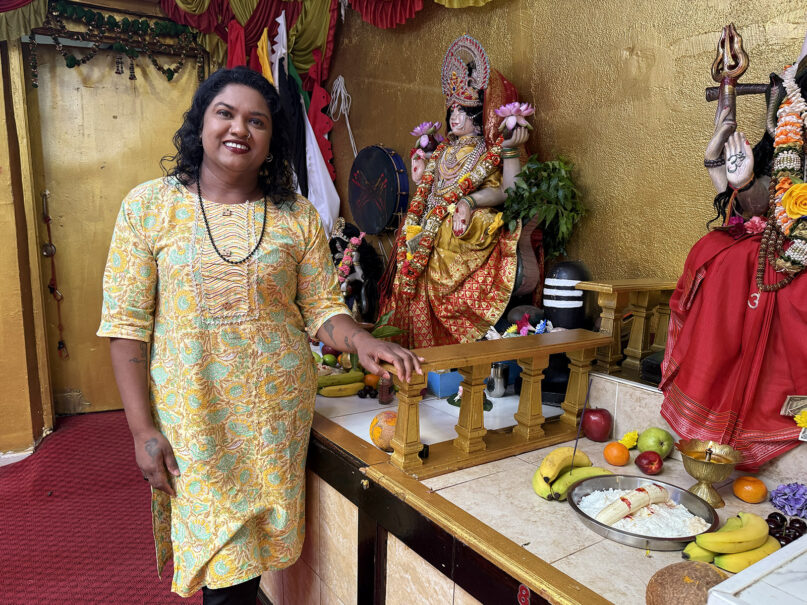
Sharda Ramsami at the Shri Shakti Mariammaa temple, July 13, 2025, in New York’s Queens borough. (RNS photo/Richa Karmarkar)

Other temples, Ramsami said, would throw women out for menstruating or not allow women to approach the altar. “That’s just not something we believe in,” she said. “We worship a woman.”

“Even in mainstream Hinduism,” Kalu said, “there’s so much patriarchy. Women aren’t really given roles, and whenever they are, it’s just mediocre roles in the kitchen making prasadam (offerings). I was really given a platform here to become a priestess.”

Now, the temple is in danger of closing. Without more than $150,000 in necessary upgrades to the space, the landlord and the city will move to push the temple out.

“I think Mother had a plan for us all to be here, because our lives changed so much and in so many ways,” said Hilda Thamen, Ramsami’s aunt and another founder of the temple. “She did so much for us. So now what’s going on here is really sad. It’s really hurting us.”

Back in 2018, a noise complaint from a neighbor led to intervention from the city’s Department of Buildings, resulting in a small fine. In 2024, after another noise complaint by the same neighbor, the city determined the temple needed to legally register as a community space. To do so, said Ramsami, the building needs several costly improvements to electricity, plumbing, fire safety and accessibility.
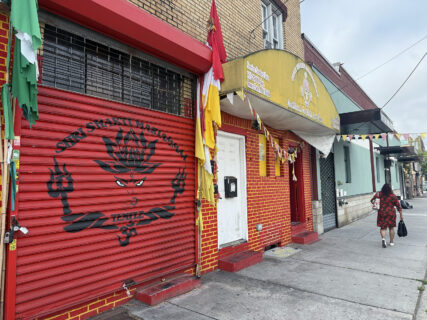
The Shri Shakti Mariammaa temple in Queens, N.Y. (RNS photo/Richa Karmarkar)

But it is unclear whether these changes are viable in a building intended for manufacturing, not worship. Though renting another location for more money may eventually be possible, “if we move somewhere further, we lose some of our congregants,” said Ramsami. “A lot of older folks come here, and the bus stop is right down the block, so it’s just easy for them to walk here.”

The neighbor, who lives in a single-family home behind the temple, heard the loud bhajans, or devotional songs, and drums nine nights in a row during the holiday of Navratri, an homage to the goddess Durga. At the time, he told congregants he would “rather there be a bar” than a temple so close to his windows. The neighbor has denied the temple’s request to build an exit in the back, and has constructed a 12-foot fence in between them.

“He came once and he saw our logo painted on the gate and he said, ‘Oh, Diablo, Diablo meaning the devil,'” said Ramsami. “So it definitely stems from fear.”
RELATED: For New York’s Indo-Caribbean Hindus, Diwali is a fusion of East and West

Most Kali temples in the area are tucked away in basements or backyards. “If you look at the murti or an image of Ma Kali, she’s so different from other mothers,” said Kalu. “She’s dark, she’s disheveled, she’s naked. She has blood dripping from her tongue. And I think all of that makes people uncomfortable. Blood is kind of deemed inauspicious, and I think from fear it became so taboo.”

Even in Guyana, said Thamen, “you were afraid to say you go to a Kali temple, because people look at you different.”
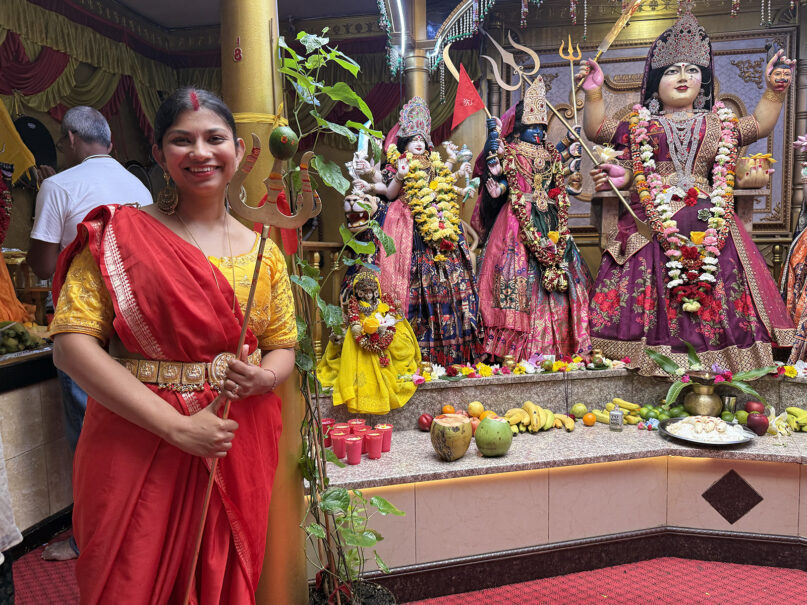


Chandni Kalu is a priestess at the Shri Shakti Mariammaa temple in Queens, N.Y. (RNS photo/Richa Karmarkar)

In the 19th century, the British brought scores of indentured Indians to Trinidad, Guyana and Suriname in the Caribbean. Many came from southern India and brought their animistic and folk religions with them. Caribbean Shaktism was thus born, with rituals passed down in a “broken” version of Tamil by word of mouth to the mostly English-speaking Indo-Caribbean population, with no Scriptures to consult and no book of mantras.

Yet the tradition still thrives thanks to the Queens temple’s founders, some of whose parents were priests in Shakti temples back in Guyana. A small group of second-generation New Yorkers gutted out the factory, built a kitchen and redid the roof, all while holding day jobs in commercial and residential cleaning, catering and nutrition school.

The mission of Shri Shakti Mariammaa was clear, said Dave Kutaiyah, the temple’s chairman. “This is not only a place for religion or a place where you come to pray on Sunday,” he said. “This is a place where you come and you see people who look like you, people who are familiar to you.

“That’s one of the things we instill in our temple: Treat everyone the same, whether you work for city government and you’re the right-hand person to the mayor, or you’re working at Dunkin’ Donuts on the 12 a.m. shift. People need to be loved and respected, and that’s what we try to bring here.”


The temple has survived through individual donations from families wanting a particular puja, or ritual, to be performed. But Kutaiyah and his team, even during the current financial struggle, have never asked for money from the congregation, or passed out a tithing plate.

“We believe worship should be free, health should be free, and we shouldn’t gain financially from that,” said Ramsami.
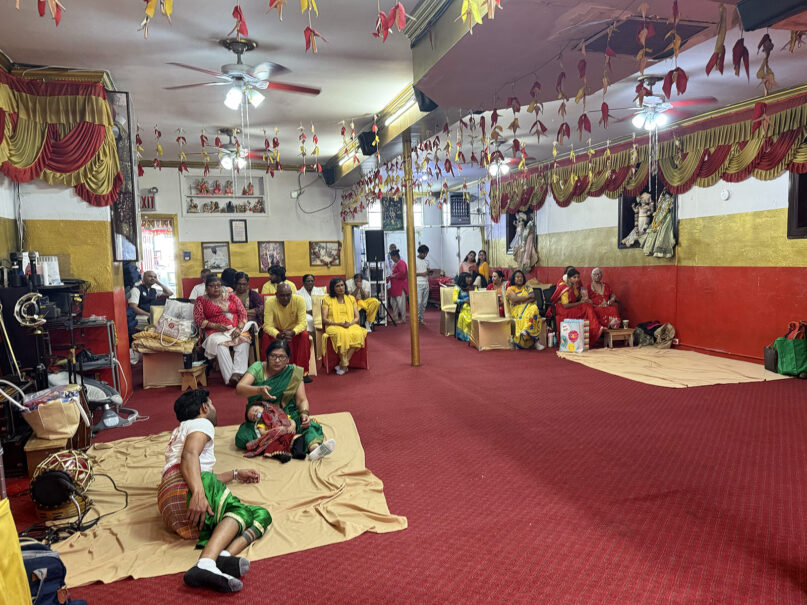

Congregants attend a worship service at the Shri Shakti Mariammaa temple, July 13, 2025, in Queens, N.Y. (RNS photo/Richa Karmarkar)

“I think 90% of people who attend here will tell you they work in a department store, factory or at JFK (International Airport), so we don’t have a lot of white-collar professionals that have a lot of disposable income to donate,” added Kutaiyah, who works in human resources. “I always tell people, use your pension money to pay your bills first, and then think about God. God will not be upset with you if you can’t give anything.”

A GoFundMe campaign, co-signed by a number of organizations that have used the temple’s space for meetings, such as Jahajee: Indo-Caribbeans for Gender Justice and the Caribbean Equality Project, has been circulating since June. In November, at a court date to pay an outstanding fine, the temple will ask the city for an extension to figure out its next steps.

Rohan Narine, NYC organizer with the national organization Hindus for Human Rights, one of the supporters of the GoFundMe campaign, has a personal stake in the temple’s success. A Queens native, Narine has been hosting Om Night open mics at the temple for years.
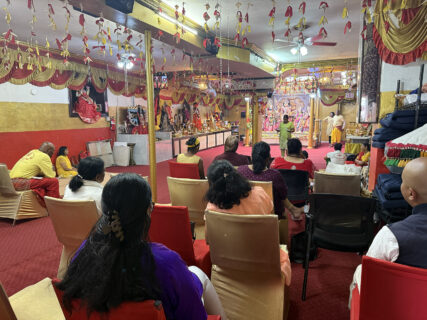


Congregants attend a worship service at the Shri Shakti Mariammaa temple, July 13, 2025, in Queens, N.Y. (RNS photo/Richa Karmarkar)
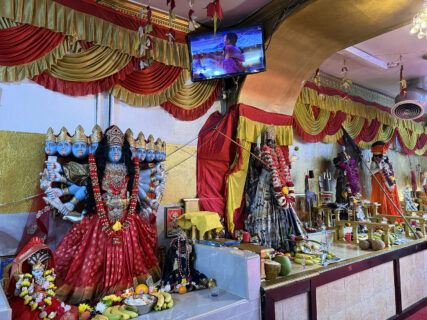
Icons of different incarnations of the Divine Mother at the Shri Shakti Mariammaa temple, July 13, 2025, in Queens, N.Y. (RNS photo/Richa Karmarkar)

Narine considers himself an “orthodox Hindu” and was surprised on his first visit to see worshippers throwing menthol cubes of fire into their mouths and dousing themselves in rose water. But despite theological differences, “I felt that beauty and that raw spiritual energy that you don’t feel in other temples,” he said. “It’s not like sitting down at an ashram, offering prasad, do a little aarti (lamp ritual) and you eat and go home. Here, it’s very involved. It’s almost like being part of a live interactive performance.”

In Indo-Caribbean spaces in Queens, according to Narine, the temple’s style of worship is becoming more mainstream. More people are coming to the temple not just for curiosity’s sake, but to worship alongside the Shakti community.

“I think the entire expanse of Hinduism should be represented,” said Narine. “All of the Hindu pantheon should have the ability to practice their faith freely. We as Hindus, and especially Indo-Caribbean in America, are very comfortable with the more simplistic way of worship, and Shakti worship might be more complex. But we can’t shy away from that. I think we should be more open to that.”
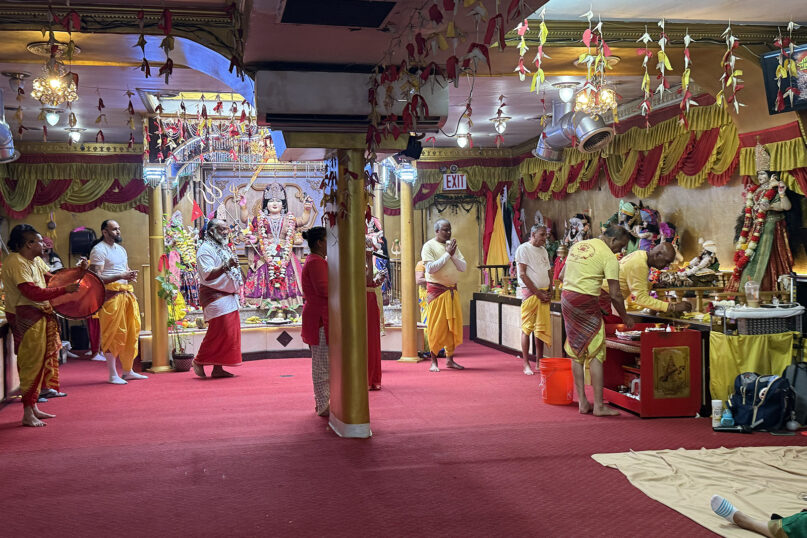

Congregants perform devotional rituals during a worship service at the Shri Shakti Mariammaa temple, July 13, 2025, in the Queens borough of New York. (RNS photo/Richa Karmarkar)


Inside Colorado’s psychedelic church: ‘What makes this place magical is not the mushrooms’

(RNS and NPR) — As psychedelics are decriminalized in Colorado, one unconventional church is building community in the basement of a suburban home.


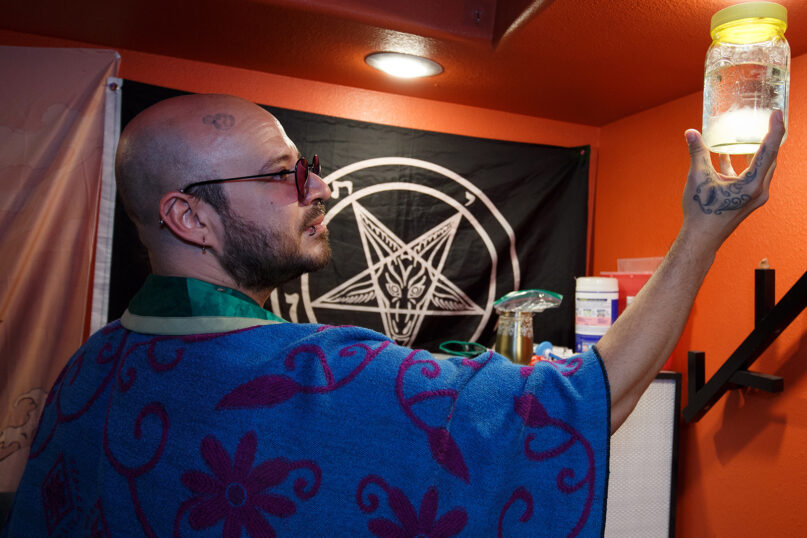
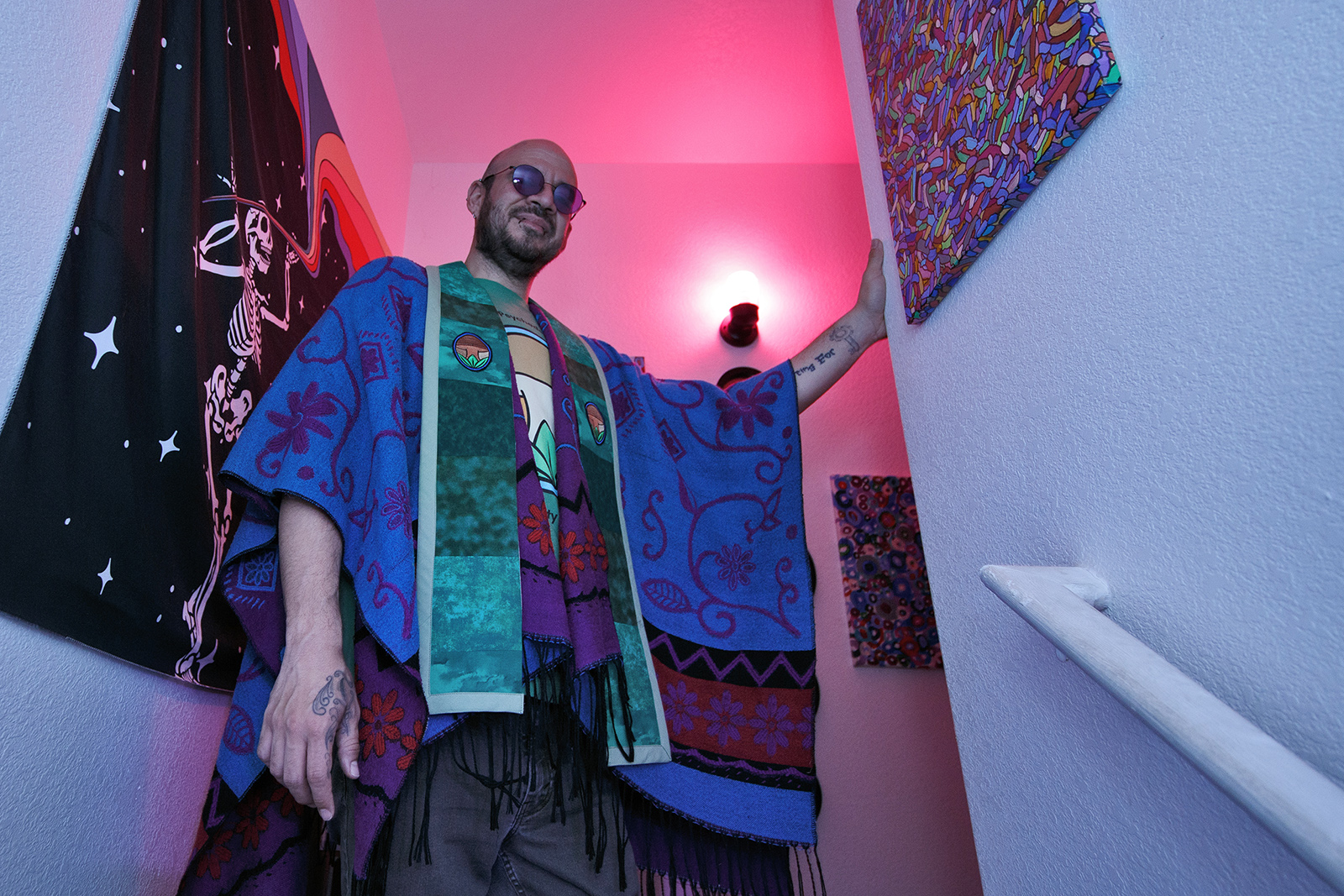
Benji Dezaval poses for a portrait, Friday May 30, 2025, in Colorado Springs, Colo. 
(Photo by Jeremy Sparig, for CPR News)


Hayley Sanchez
July 7, 2025

COLORADO SPRINGS (RNS and NPR) — The door to the Colorado Psychedelic Church doesn’t look like much — a walkout basement to a home in an eastern Colorado Springs neighborhood.

Faux foliage dangles from the walls, a tabletop fountain trickles nearby, and on a recent Tuesday in May, about 20 people were seated on couches under dim green lighting, while soft meditative music filled the air.

At the front of the room sat Benji “Dez” Dezaval the church’s founder.

“Hey y’all,” said Dezaval, welcoming people inside with a big laugh, purple-tinted glasses and a shawl draped around his shoulders. “I’m glad we waited.”

This weekly guidance — one of many community events the church hosts in a given week — is not unlike a regular book club or Bible study. The evening’s conversation centers on this month’s theme: what it means to be maternal, timed to Mother’s Day.

A typical Tuesday meetup like this one might begin with some socializing over shared snacks brought by a congregant. Then the group settles in for a sermon, or lecture, followed by a conversation with reflections on the day’s topic. The meeting closes with an optional offering of psychedelics.


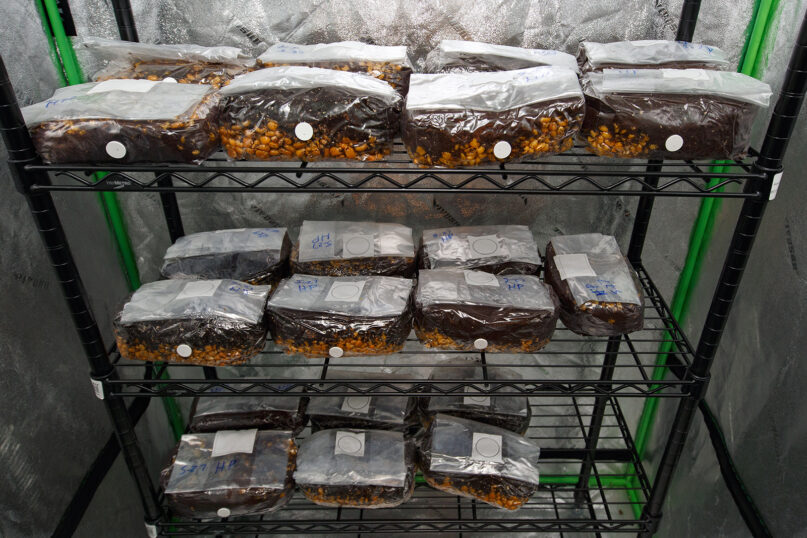
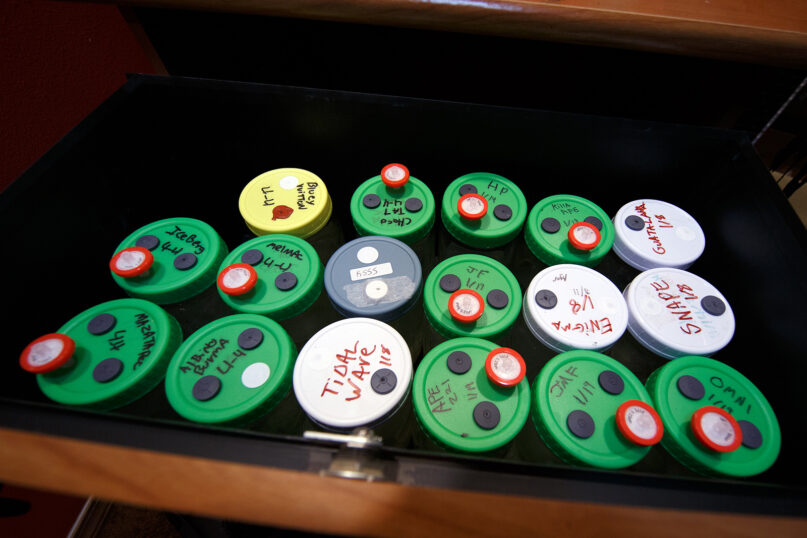
Multiple strains of psilocybin spores sit ready for cultivation at the Colorado Psychedelic Church, Friday May 30, 2025, in Colorado Springs, Colo. (Photo by Jeremy Sparig, for CPR News)

On this particular Tuesday, it was one puff of DMT, or dimethyltryptamine, a compound found naturally in some plants and animals, known for its short-yet-intense effects.

About a quarter of the group raised their hands, some regulars and others first-timers. Once everyone’s church membership card was checked — issued after completing a safety screening — a facilitator pulled out a small device resembling a vape pen.

The facilitator explained the instructions and said smoking DMT was different from cannabis. He held the pen to each person’s mouth to take a puff, pausing and counting to four before they exhaled, wiping the mouthpiece off with a cloth in between each congregant.

After everyone had received their gift, the facilitator thanked the group for sharing the time together. And for the next few minutes, in the quiet pattering of the rain outside, participants seemed to go inward, not speaking, some closing their eyes, while the congregants who chose not to participate chatted quietly with each other.

Lee Mead, 43, attends the church events regularly. He works in a nonprofit and moved to Colorado Springs from Houston last August, not knowing anyone. And within a week, he discovered the Psychedelic Church on the app Meetup and decided to show up

“It’s not just a bunch of people doing drugs in some guy’s dingy basement,” said Mead. “It is nice down here. And it is more about the community than the substances.”


Lee Mead, left, and Benji Dezaval talk at the Colorado Psychedelic Church, Friday, May 30, 2025, in Colorado Springs, Colo. (Photo by Jeremy Sparig, for CPR News)

One night after taking psilocybin, the drug found in magic mushrooms, during what congregants call “revelry” — or an altered state of consciousness — Mead had a panic attack as he was coming back to reality. The stress of his job and a deeper unhappiness came rushing to the surface, he said.

And that’s when strangers stepped in and stayed with him.

“People that had just seen me maybe three times here at the church carried me through that,” Mead said. “Which of course made it even worse because I was receiving love that I didn’t feel I was worthy of.”


Mead didn’t touch psychedelics for months after that experience, but he never stopped showing up to the church gatherings.

“I hadn’t felt that level of care and level of love for a long time,” Mead said.

The Colorado Psychedelic Church, founded in 2024, describes itself as a spiritual community that uses psychedelics in communal settings. The church offers a range of gatherings throughout the week, including one for women, for men and for queer folks, plus a weekly lounge night for all in the community. The church also hosts classes and occasional themed gatherings. People gather in Dezaval’s basement, and they can choose whether to partake in the psychedelics. They see these substances not as recreational drugs but as a form of medicine that provides spiritual or emotional healing.


The Colorado Psychedelic Church, Friday May 30, 2025 in Colorado Springs, Colo. (Photo by Jeremy Sparig, for CPR News)

“There’s revere the self, and that’s the first universal truth. And we do that primarily through self care, making sure we’re actually actively maintaining ourselves. The use of natural medicine is a large part of that,” Dezaval said, explaining one of the church’s values.

“The second one is to embrace the communal experience to come together,” Dezaval said. “And the last, that the universe provides.”

Counseling is provided before, during and after revelry by Dezaval and other facilitators to help individuals make sense of their experience. Some facilitators and congregants also have medical training, according to Dezaval.

Before taking a dose at the church, people go through a safety screening, Dezaval added, ensuring they are over 21 and don’t take any medications that could interact dangerously with psychedelics, like some antidepressants. They also are required to complete training that explains the effects of the psychedelics and how to navigate the experience.


Benji Dezaval examines psilocybin spores at the Colorado Psychedelic Church, Friday, May 30, 2025, in Colorado Springs, Colo. (Photo by Jeremy Sparig, for CPR News)

Although DMT is illegal under federal law, Colorado decriminalized certain psychedelics in 2022. Since then, therapy clinics have popped up across the state.

The state’s regulated program requires licensed facilitators in a therapeutic setting, for instance, to oversee preparation, facilitation and integration after. But informal settings, like the psychedelic church, are not regulated.

Under Colorado’s Proposition 122, adults 21 and over may legally grow, possess, consume and gift naturally occurring psychedelics for personal use without requiring a license so long as no money is exchanged.

The congregation is funded through donations, according to Dezaval.

Don Lattin, a veteran reporter and author of “God on Psychedelics,” told RNS that federal scrutiny often focuses on whether a group has ongoing membership, screens out recreational users and upholds spiritual practices.

“The laws on this are vague and subject to the whims of the DEA,” Lattin said via email, but regulators have historically been more accepting of churches that “attempt to select only those who are serious” and “turn away would-be recreational users or thrill seekers.”


Pslocybin mushroom cultivation kits are stored at the Colorado Psychedelic Church, Friday May 30, 2025 in Colorado Springs. (Photo by Jeremy Sparig, for CPR News)

One way to distinguish a legitimate psychedelic church from a dispensary, Lattin said, is by looking at intention, structure and consistency.

“One of them, Sacred Garden Church, appeared to me after months of participatory reporting to be a sincere attempt to explore the spiritual dimensions of the psychedelic experience in a responsible group setting,” Lattin said. “The more notorious Zide Door Church of Entheogenic Plants seemed like a thinly veiled mushroom dispensary.”

Dezaval, the Colorado Springs church leader, maintains that his goal is to help people through the healing power of psychedelics. “If I was doing anything illegal, if this was all about the drugs and this is all about the money, why would I have any of these conversations?

“I understand the skepticism and I invite people in, so I can say like, ‘Let me show you every nook and cranny so you can see there is no secret,’” Dezaval said.

Congregants must partake of the DMT onsite, but they can take psilocybin home with them, and Dezaval acknowledges they may end up sharing the substance with friends who are not part of the community and have not gone through the training or safety screening.

“That’s gonna happen,” he said, adding that he tells congregants, “Don’t give them this without the information to make it safe.”

“Because without safety information, these tools are weapons and that weapon can only hurt somebody,” he said. “It’s not, ‘I gave you this — godspeed.’ No. I gave you this, I gave you the tools to do it right. So I want to make sure that you can heal, not get hurt.”

Nearly 700 people have attended at least one gathering of the church, Dezaval said, adding that they plan to expand into a second home in the neighborhood.

“There (are) a lot of people … who are looking so hard to find a place to belong,” Dezaval said

That held for congregant Sara Snapp, a stay-at-home mom with a background in religious studies. She grew up Catholic but said she spent much of her life feeling alone. She said she had lived with depression for most of her life but wasn’t diagnosed until after the birth of her daughter.

Last year, she tried psilocybin in a therapeutic setting, and something shifted. And then, Snapp said, things continued improving after she joined the church.


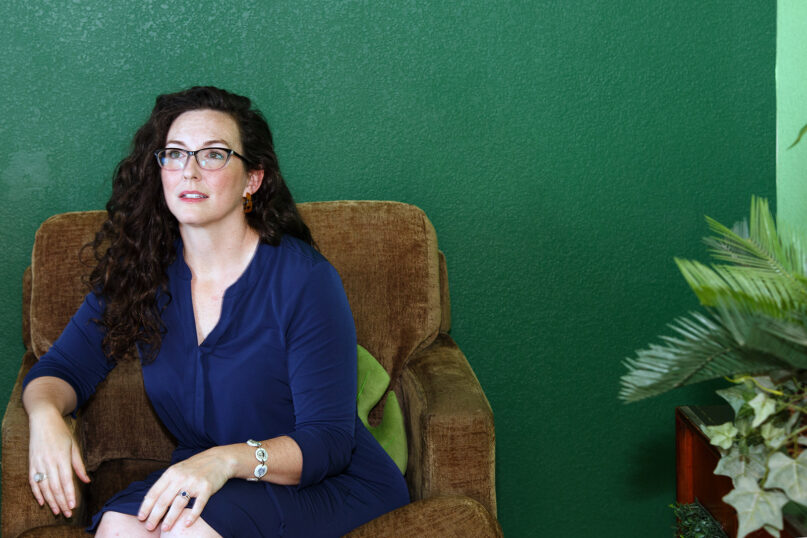
Sara Snapp listens at the Colorado Psychedelic Church, Friday, May 30, 2025, in Colorado Springs, Colo. (Photo by Jeremy Sparig, for CPR News)

“I found exactly what I needed here,” Snapp said. “I found the community that I was searching for. I found people who wanted to know the real me.”

For congregants like Snapp and Mead, Colorado Psychedelic Church doesn’t fit neatly into a box; it’s part support group, part spiritual sanctuary, part experiment.

“What makes this place magical is not the mushrooms,” Snapp said. “It’s that when you walk in that door, your armor falls off. And it’s in that softness and vulnerability that we … build these relationships.”

As one more weekly guidance session comes to a close, the sound of laughter and chatter fill the room.

“This is my family here,” said Mead, the Colorado transplant. “This is truly my third place.”

This story was produced through a collaboration between NPR and RNS. Listen to the radio version of the story.


GOING TO HELL IN A HANDBASKET

Jimmy Swaggart’s rise and fall shaped the landscape of American televangelism
(The Conversation) — Swaggart’s calls for a return to conservative Christian norms live on in today’s world of tradwives, limited access to abortion and calls to repeal gay marriage, writes a scholar of religion.
Rev. Jimmy Swaggart preaches at the Los Angeles Memorial Sports Arena on March 29, 1987. (AP Photo/Mark Avery, file)

(The Conversation) — Jimmy Swaggart, one of the most popular and enduring of the 1980s televangelists, died on July 1, 2025, but his legacy lives.

Along with Jerry Falwell and Pat Robertson, he drew an audience in the millionsamassed a personal fortune and introduced a new generation of Americans to a potent mix of religion and politics.

Swaggart was an old-time evangelist whose focus was “saving souls.” But he also preached on conservative social issues, warning followers about the evils of abortion, homosexuality and godless communism.


Swaggart also denounced what he called “false cults,” including Catholicism, Judaism and Mormonism. In fact, his denunciations of other religions, as well as his attacks on rival preachers, made him a more polarizing figure than his politicized brethren.

As a reporter, I covered Swaggart in the 1980s. Now, as a scholar of American religion, I argue that while Swaggart did not build institutions like Falwell’s Moral Majority or Robertson’s 700 Club, he helped to spread right-wing positions on social issues, such as sexual orientation and abortion, and to shape the image of televangelists in popular culture.

Swaggart’s cousins

Born into a hardscrabble life in a small Louisiana town, Swaggart grew up alongside his cousins Jerry Lee Lewis, the future rockabilly pioneer, and future country singer Mickey Gilley.

All three loved music and singing. They polished their playing on an uncle’s piano and sneaked into African American nightclubs to hear the jazz and blues forbidden by their parents.

Jimmy Swaggart delivering a sermon at the Flora Blanca Stadium in El Salvador.
Cindy Karp/Getty Images

While Gilley and Lewis turned their musical talent into recording and performing careers, Swaggart felt called to the ministry. He dropped out of high school, married at 17, began preaching at 20 and was ordained at 26.


He was licensed by the Assemblies of God, a Pentecostal denomination that believes the Holy Spirit endows believers with spiritual gifts that include speaking in tongues and faith healing.

The glory years

Pentecostals were nicknamed Holy Rollers because of their tendency to shake, quake and roll on the floor when feeling the Holy Spirit. Their preachers excelled at rousing audiences’ ardor, and Swaggart commanded the stage better than most. He paced, pounced and poured forth sweat while begging listeners to turn from sin and accept Jesus.

Starting small, he drew crowds while preaching on a flatbed trailer throughout the South. His following grew, and in 1969 he opened the Family Worship Center in Baton Rouge.

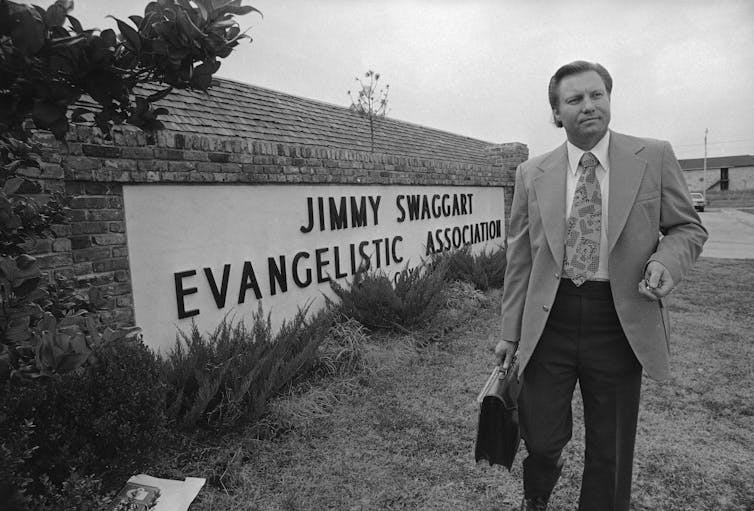
Evangelist Jimmy Swaggart leaves his office complex in Baton Rouge, La., on Jan. 7, 1977.
AP Photo

At capacity, the church held 10,000 worshippers, who represented a broad swath of America: young girls and grannies, white and Black, bankers and farmers. His sermons began calmly but built to a fever pitch. CBS newsman Dan Rather once called him the “country’s greatest speaker.”

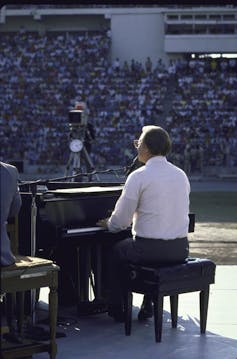
During services, Swaggart also sang and played piano. In 1982, Newsweek magazine noted his musical chops, naming him the “King of Honky Tonk Heaven.” His music crossed gospel, country and honky-tonk – songs with a strong rhythmic beat – and he sold 17 million albums over his lifetime.


By 1975, Swaggart’s on-stage charisma powered the launch of a television ministry that would reach millions within a decade. Viewers were captivated by his soulful tunes and fire-and-brimstone sermons. At its height, Swaggart’s show was televised in 140 countries, including Peru, the Philippines and South Africa.

His ministry also became the largest mail-order business in Louisiana, selling books, tapes, T-shirts and biblical memorabilia. Thanks to the US$150 million raised annually from donations and sales, Swaggart lived in an opulent mansion, possessed a private jet previously owned by the Rockefellers, sported a yellow gold vintage Rolex and drove a Jaguar.

The downfall

Swaggart disliked competition and had a history of humiliating rival preachers. Wary of the Rev. Marvin Gorman, a Pentecostal minister whose church also was in Louisiana, Swaggart accused the man of adultery. Gorman admitted his infidelity and was defrocked.

Gorman had heard rumors about Swaggart’s own indiscretions, and he and his son decided to tail the famed evangelist. In 1988, they caught Swaggart at a motel with a prostitute, and Gorman reported the incident to Swaggart’s denomination. He also gave news outlets photos of Swaggart and the prostitute. In a tearful, televised apology, Swaggart pleaded for a second chance.

While his fans were willing, the Assemblies of God had conditions: Swaggart received the standard two-year suspension for sexual immorality. Defying the ruling, Swaggart went back to work after three months, and the denomination defrocked him.

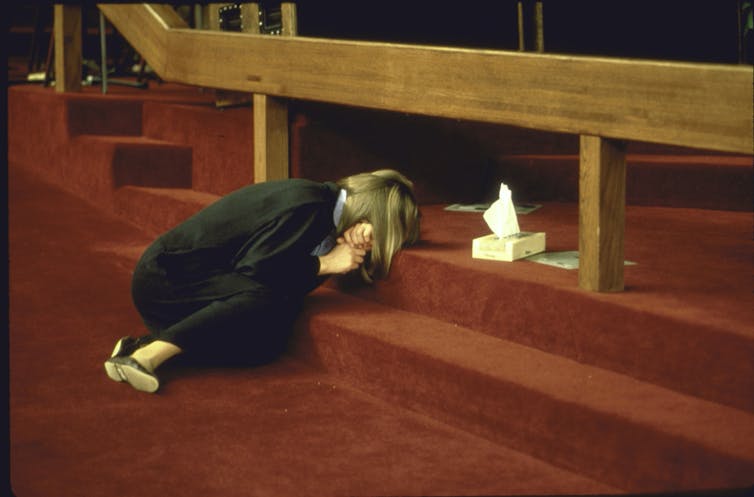
A parishioner overcome with grief lies on steps to the altar after Jimmy Swaggart’s confession of sexual indiscretions.
Thomas S. England/Getty Images

Swaggart might have succeeded as an independent minister, but in 1991 the police stopped his car for driving on the wrong side of the road. Inside they found the preacher with a prostitute. This time, Swaggart did not ask for forgiveness. Instead, he informed his congregation, “The Lord told me it’s flat none of your business.”

Afterward, Swaggart never regained his former standing. His mail-order business dried up, donations fell, and attendance at services cratered. But up until his death, he kept on, in his own words, as an “old-fashioned, Holy Ghost-filled, shouting, weeping, soul-winning, Gospel-preaching preacher.”

Swaggart’s legacy

Swaggart, like other 1980s televangelists, brought right-wing politics into American homes. But unlike Jerry Falwell and Pat Robertson, Swaggart was less interested in winning elections than saving souls. In fact, when Robertson considered a presidential run in 1988, Swaggart initially tried to dissuade him – then changed his mind and supported him.

Swaggart’s calls for a return to conservative Christian norms live on – not just in Sunday sermons but also in today’s world of tradwives, abortion restrictions and calls to repeal gay marriage. His music lives on, too. The day before he died, the Southern Gospel Music Association Hall of Fame inducted him as a member.

But his legacy also survives in popular culture. In recent years, both reality television and scripted series have starred preachers shaped in the image of Swaggart and his peers. Most exaggerate his worst characteristics for shock and comedic effect.

Preachers of L.A.,” a 2013 reality show that profiled six Los Angeles pastors, featured blinged-out ministers whose sermons mixed hip-hop with the Bible. The fictional “Greenleaf” followed the scandals of an extended family’s Memphis megachurch, while “The Righteous Gemstones,” a dark spoof of Southern preachers, turned a family ministry into a site for sex, murder and moneymaking.

But these imitations can’t match the reality. Swaggart was a larger-than-life minister whose story – from small-town wannabe to disgraced pastor, to preaching to those who would listen – had it all: sex, politics, music and religion.

For those who want a taste of the real thing, The King of Honky Tonk Heaven lives on. You can see his old services and Bible studies streaming daily on his network.

(Diane Winston, Professor and Knight Center Chair in Media & Religion, USC Annenberg School for Communication and Journalism. The views expressed in this commentary do not necessarily reflect those of Religion News Service.)

The Conversation

The Conversation religion coverage receives support through
 the AP’s collaboration with The Conversation US, with funding from
 Lilly Endowment Inc.  The Conversation is solely responsible for this content.