Sunday, July 20, 2025


Spring Valley gold project in Nevada gets federal approval


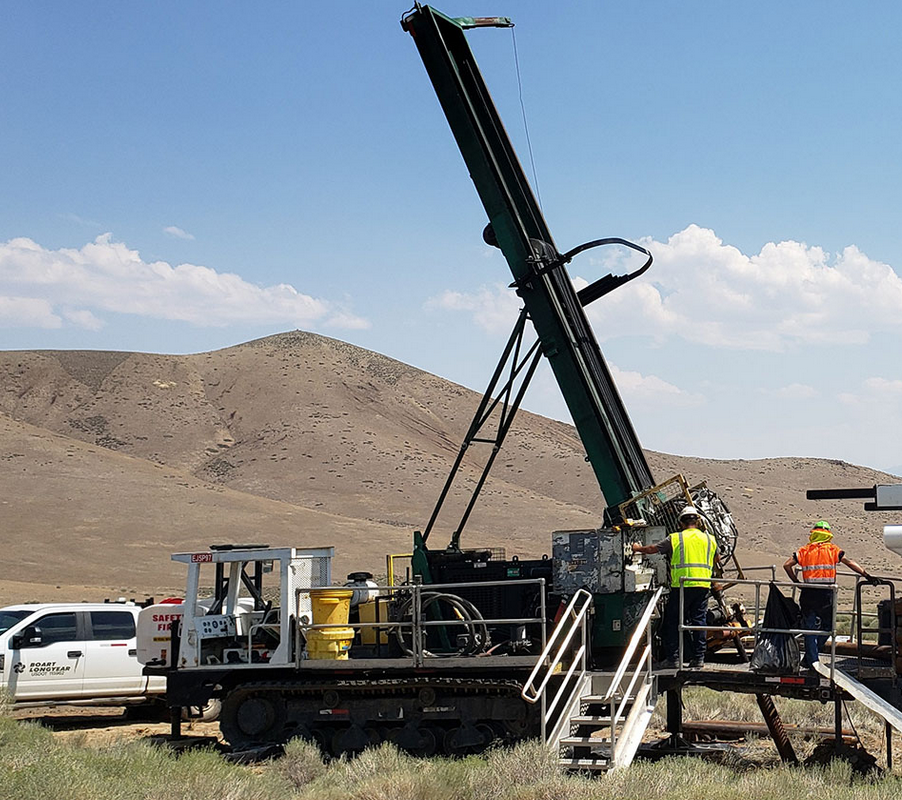
Spring Valley gold project in Nevada. Image from Solidus Resources.

Waterton Mining announced this week that its subsidiary Solidus Resources has received the record of decision (ROD) from the US Bureau of Land Management (BLM) approving its Spring Valley project in Nevada.

The BLM decision marks the first US federal approval of a domestic gold mine project in over a decade, the company said, adding that Spring Valley will be the largest independent gold mine in the country.

Solidus, which is 100% owned by the privately-held Waterton, is focused on advancing its gold deposit containing 3.8 million oz. in mineral reserves through permitting, construction and into operations. The project is located in Pershing County, within the Spring Valley district.

The Spring Valley mining district was discovered in 1868 and had previously produced gold, silver, lead, mercury, copper, antimony and pinite.

Modern exploration at Spring Valley began in 1996 by Kennecott Minerals Company, which searched for the source of gold in the Spring Valley placer deposits, according to the company’s website. Subsequent programs were carried out by Echo Bay, Midway and Barrick.

In 2015, Solidus continued with additional exploration and study-related activities, which included completion of 232 holes, metallurgical testwork campaigns, geotechnical and hydrological modeling, as well as a pre-feasibility study in 2018, when it began the permitting process.

2025 feasibility study

Earlier this year, the company released a feasibility study outlining a 10-plus-year heap-leach gold mine averaging over 300,000 ounces of production annually, including 348,000 ounces over the first five years.

The project is highlighted by all-in sustaining costs of $1,103/oz. gold, an after-tax net present value (at 5% discount) of $1.5 billion and a 36% internal rate of return. Its initial capital cost was pegged at $823 million, with a payback period of two years. The project economics were based on a consensus gold price of $2,400/oz. in 2028 and $2,200/oz. from 2029 onwards.

The Spring Valley feasibility incorporated the latest resource estimate (inclusive of reserves) of 4.4 million oz. gold and 600,000 oz. gold in the indicated and inferred categories, respectively, calculated using a gold price of $1,700/oz. and cut-off grade 0.004 oz/ton.

“The Spring Valley project will be Nevada’s next long-life heap leach gold mine,” Waterton CEO Isser Elishis said in a news release. “The significance of this project will be far-reaching, boosting domestic non-fuel mineral production, creating thousands of high-paying jobs, increasing both local wages and tax revenues significantly, and enhancing US mining competitiveness.” 

In May, Solidus received a letter of interest from the Export-Import Bank of the United States (EXIM) regarding the potential financing of up to $835,000 for the Spring Valley project. The funding is being considered under EXIM’s Make More in America initiative, as well as the bank’s China and Transformational Exports Program.

Elishis said the project “supports the onshoring of strategic mineral production, encouraging US-based sourcing of mining technology, and boosting exports of American-manufactured equipment and services.”


BHP delays Jansen potash mine, blows budget by 30%


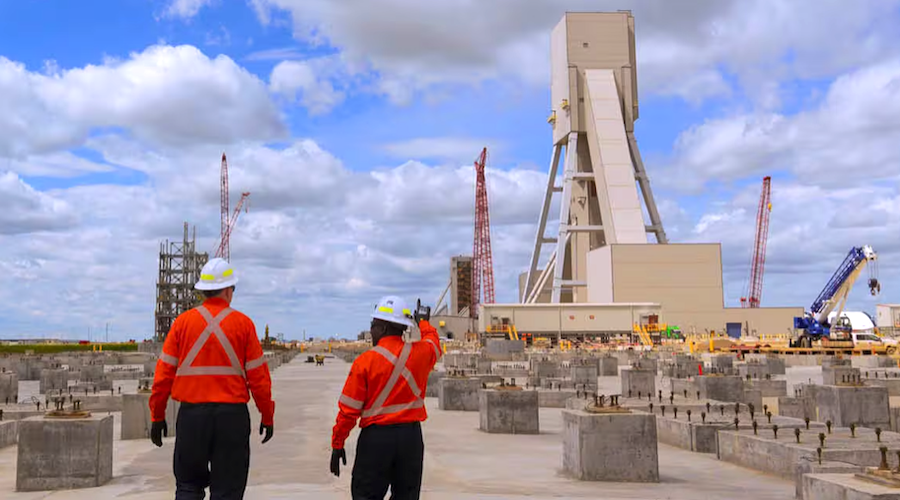
Construction at the Jansen potash project. (Image courtesy of BHP.)

BHP (ASX, LON, NYSE: BHP) revealed on Friday that the first stage of its Jansen potash mine in the Western Canadian province of Saskatchewan will cost up to 30% more and come online a year later than originally planned.

The world’s largest listed miner now expects to spend between $7 billion and $7.4 billion on the first phase, up from the original $5.7 billion estimate. First production has been pushed to 2027, a full year behind schedule.

BHP cited “design and scope changes”, along with inflationary pressures and lower productivity, as the main reasons for the cost and schedule overruns.

The miner also revealed that the second stage of the Jansen project will now begin production in 2031, two years later than previously planned. BMO analyst Alexander Pearce said the delay of this key expansion, intended to double production capacity and boost returns, was “likely good for potash prices”. He warned that it also may add pressure on total project capital expenditure. 

BHP has paused the planned $4.9 billion investment in the second stage and withdrawn its cost estimate, pending further study.

The delay stems from what BHP described as the “potential for additional potash supply” coming to the market in the medium term, as well as a regular review of capital project sequencing under its investment framework.

Potash, used in fertilizer and crop nutrients, is central to BHP’s long-term diversification strategy. The company expects global demand to rise alongside population growth and pressure to improve farming yields given limited land supply. 

A decade in the making

BHP’s push into the potash market began in 2006 under then-chief executive Chip Goodyear, who secured the company’s first tenements in Saskatchewan. 

Successive CEOs kept the momentum. In 2010, Marius Kloppers launched a failed $38.6 billion bid for the company now known as Nutrien. Andrew Mackenzie later committed $2.6 billion to early development work at Jansen. In 2021, with current CEO Mike Henry in charge, BHP signed off on the $5.7 billion investment needed to build the potash mine.

The blowouts at Jansen are significant by industry standards and mirror recent challenges at other large-scale projects. Rio Tinto’s underground expansion of the Oyu Tolgoi copper mine in Mongolia, ran nearly $1.8 billion over budget.

BHP itself has faced similar issues outside its core Australian iron ore business, such as the $670 million overrun during its $2.5 billion upgrade of the Spence copper mine in Chile.


EU Adopts New Sanctions That Lower Oil Price Cap and Hit Shadow Tankers

tanker
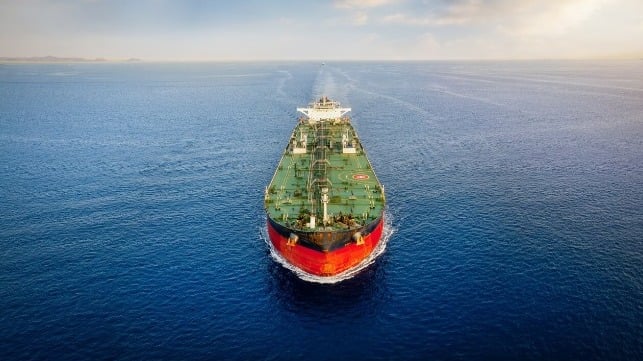
EU will have now listed 444 shadow fleet tankers (iStock)

Published Jul 18, 2025 12:53 PM by The Maritime Executive


The European Union approved its 18th package of sanctions against Russia related to the war in Ukraine, expanding its targeting of the energy, banking, and military sectors. The package, which is being called one of the strongest sanction packages against Russia, was approved after Slovakia dropped its opposition, but without the U.S. joining in on key elements.

The European Commission adopted steps to further reduce Russia’s energy income, which it highlights continues to provide a third of the Russian government’s revenues. Last month, Russia averaged production of nearly 9.2 million barrels of oil per day, according to the International Energy Agency. 

The new package adopted a move that had been gaining momentum across Europe to lower the price cap on Russian oil. Critically, it also builds in an automatic and dynamic mechanism to modify the oil price cap to ensure it is effective.

Earlier this year, the price of oil fell below the $60 a barrel price cap, which had increased the flow of oil from Russia. The price cap was introduced in December 2022, banning access to transport, insurance, and reinsurance services for oil purchased and transported above the cap. It is seen as a driving factor in the growth of the shadow fleet.

To counteract the growth in shipments, the cap is being lowered to $47.60 per barrel, which the EU says aligns with the current global price of oil. It is almost 30 percent lower than today’s $67.60 per barrel benchmark price. The UK government quickly announced that it was following the EU and also lowering the price cap to the same level.

Media reports are indicating there had been a stronger push by some countries, and they had hoped the G7 and especially the United States would join in the efforts, to lower the price cap. The U.S. has remained largely on the sidelines, not increasing its sanctions against the shadow fleet. Earlier this week, Donald Trump announced he was giving Russia and Vladimir Putin 50 days to accept a ceasefire, or he said the U.S. would launch secondary sanctions against the buyers of Russian oil. At the same time, the U.S. announced an agreement with NATO and the Europeans for the purchase of additional weapons, which will be supplied to Ukraine.

President of the EU Commission Ursula von der Leyen responded to the adoption of the new package, saying, “The pressure is on. It will stay on until Putin ends this war.”

The EU is imposing further sanctions “across the shadow fleet value chain.” The new package directly lists 105 additional tankers banned from port entry and services. In total, the EU will have sanctioned 444 vessels.

The targeting of the shadow fleet goes further with the EU also for the first time listing an individual captain of a shadow fleet tanker and a “private operator of an international flag registry.” International companies managing and assisting the shadow fleet are also included, as is one entity in the Russian LNG sector.

The EU is also listing a refinery in India where Russia’s Rosneft is the main shareholder. It is also imposing a ban on the import of refined oil products made from Russian oil coming from third countries, except Canada, Norway, Switzerland, the UK, and the U.S. The EU says this closes a key backdoor. 

The Nord Stream pipeline is also targeted with a full transaction ban, including for the provisioning of goods or services for completion or maintenance. 

Despite the wide-reaching nature of today’s package, Russia scoffed at the package. Kremlin spokesman Dmitry Peskov told reporters that Russia “has built up an immunity to Western sanctions and adapted to them.” He predicted that the new moves would create negative consequences for countries that back them.

WAIT, WHAT?!

Spanish Police Stop Ship as Drug Cartel Attempts to Steal Cocaine Shipment

Spanish police search containership
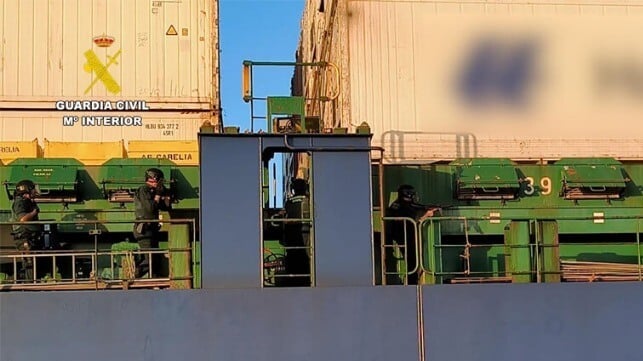
Spanish forces searching the containership after discovering that nine people had boarded the ship to offload the cocaine (Guardia Civil)

Published Jul 18, 2025 11:28 AM by The Maritime Executive


Spain’s Guardia Civil is working to sort out the details of one of its more unusual cocaine busts. They moved to stop and inspect a suspect inbound containership only to find it had already been boarded by nine individuals who appear to have been attempting to steal the cocaine from a rival gang.

The police reported they were tracking the unnamed vessel as it was traveling from Vigo to Malaga and had a suspicion that there could be smuggled cocaine aboard. Media reports are saying the vessel was coming from Guayaquil, Ecuador. It was located while it was 40 miles off the Bay of Cadiz.

The vessel was directed into the port of Cadiz, where a full search was launched. When the forces boarded the vessel, they discovered that nine individuals had already boarded the ship and had removed cocaine bales from the containers. A total of 38 bales of cocaine were found near the containers, with a total weight of approximately 1,300 kilos.


The police released video of their armed forces searching the vessel for additional individuals. The reports said that due to the size of the vessel, it was taking time to complete the search. The police suspected there could be additional cocaine aboard the vessel that had yet to be discovered.

Media reports indicate that the nine individuals were also taken into custody and are being interrogated. The indication is that they were from a rival cartel and were attempting to offload the cocaine bales onto a small boat while the containership was at sea.


Port of Barcelona Reduces Cruise Terminals to Limit Overtourism

Barcelona
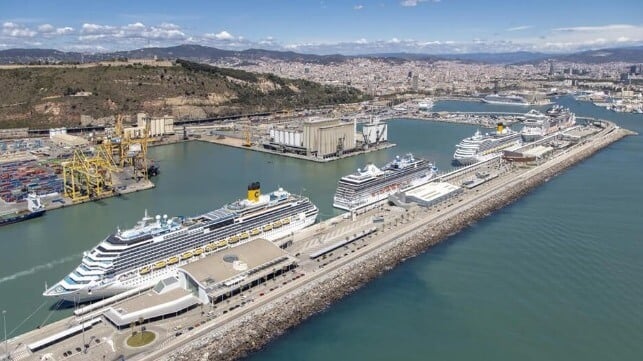
Barcelona plans to reorganize its port to increase sustainability and reduce the number of daily cruise passengers (Port of Barcelona)

Published Jul 18, 2025 3:15 PM by The Maritime Executive


The city of Barcelona is taking action to address the growing complaints of overcrowding and overtourism that critics say is linked to the cruise ships. The city, which claims to be the largest cruise port in Europe unveiling plans to redevelop its seaport, a move intended to increase the sustainability of the port while also reducing the number of tourists arriving at the popular destination.

After recording a 20 percent increase in the number of cruise ship passengers between 2018 and 2024, Barcelona now wants to put a limit on the growth of cruise tourism. The city recorded 3.65 million passengers last year, and reports a 21 percent increase in calls and a 20 percent increase in passengers to 1.2 million in the first five months of 2025.

Barcelona Mayor Jaume Collboni, a member of the Catalan Socialist party and who has openly been pushing for limiting cruise ship overtourism, including proposing the raising of tourist tax for passengers, is spearheading the push for the redevelopment of the terminals. This comes after the Barcelona City Council and the Port of Barcelona signed a new agreement designed to reduce the number of cruise ship terminals from seven to five by 2030. The net effect will be reducing Barcelona's maximum cruise capacity by 16 percent from 37,000 to 31,000 passengers per day.

“For the first time in history, a limit is being placed on the growth of cruises in the city,” said Collboni, who went ahead to express gratitude to the Port of Barcelona for “its effort in understanding and empathy” in recognizing that the growth of cruise ship tourism cannot be infinite and needed to be reduced. “The current management of tourism involves setting limits and managing better.”

Following the signing of the agreement, a total of €185 million ($215 million) will be invested in undertaking an overhaul of cruise terminals at the port and investment in other infrastructural projects whose ultimate goal is to reorganize cruise activity to make it more sustainable.

The hallmark of the agreement involves reducing the number of cruise terminals from seven to five by demolishing current terminals A, B, and C at the Adossat wharf, and building a new terminal on the site of terminal C. The new terminal will be Barcelona’s only public cruise terminal with a capacity to serve 7,000 passengers and will prioritize home port cruises and small vessels. The port will have five cruise terminals, four of which will be privately owned and one of which will be public.

Apart from the terminals, the Port of Barcelona will also invest €50 million ($58 million) to fully overhaul the 610-metre-long section of wharf that currently houses terminals A and B. Barcelona highlights that the three terminals which will be demolished were nearing the end of their useful life and that its critical to build new facilities that are better suited to the current requirements of the cruise industry.  

The wharf overhaul will facilitate the installation of the onshore power supply systems to enable cruise ships to plug in to the electrical grid while at berth, ultimately cutting down on emissions. Barcelona has been cited as one of Europe’s biggest ports that has been slow in onshore power investments, something that could see the port fail to meet the European Union’s 2030 deadline for shore power provision.

Work on the projects is expected to commence next year and is slated for completion in 2030 when Terminal C will be fully operational.

“The signed protocol culminates the modernization plan for the Adossat Wharf, which began a few years ago with the goal of upgrading port infrastructure and strengthening the competitiveness of the Port of Barcelona,” said José Alberto Carbonell, Port of Barcelona President.

Despite the cruise industry being one of the key economic sectors in Barcelona, generating €1 billion ($1.1 billion) annually and contributing €562 million ($653 million) directly to Catalonia's gross domestic product, the city contends that a more orderly and efficient maritime tourism model is necessary to make the sector sustainable. The city will also seek to encourage cruise passengers to extend their stay onshore.


New Zealand Forces Coordinate with Tanker for Challenging Nighttime Rescue

at sea rescue
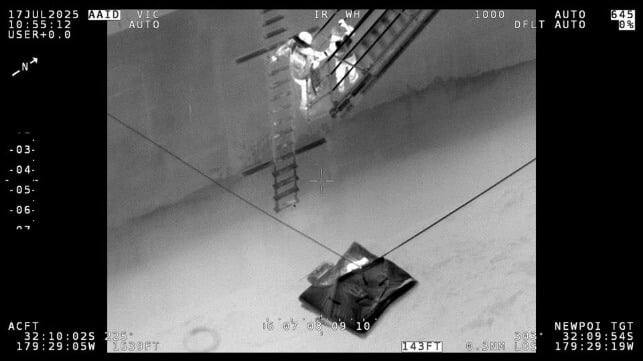
Three people were rescued from a lift raft by a tanker with the aid of New Zealand's Defence Force (Maritime NZ)

Published Jul 18, 2025 4:24 PM by The Maritime Executive


Maritime New Zealand is recounting the details of a high-seas nighttime rescue. The operation was successful due to the coordination of the Rescue Coordination Center along with the New Zealand Defence Force and a Good Samaritan commercial tanker.

The incident began on the afternoon of July 17, when at around 2:30 p.m. local time the center received a Mayday call from a small private vessel it described as a launch. Three people were aboard sailing from New Zealand to Tonga. They were approximately 350 nautical miles northeast of New Zealand, south of the Kermadec Islands, in a remote location far from assistance. 

The people reported their vessel had experienced problems in this remote location, and they were planning on abandoning ship. They took life jackets and other essential equipment and entered a life raft. They activated an emergency beacon (EPIRB), and the center was able to determine a location.

 Search and Rescue Officer at RCCNZ, Taylor Monaghan, says this was a high-stakes search and rescue operation.

“After getting their emergency position-indicating radio beacon (EPIRB) coordinates following its activation, it was clear they were a long way from help,” said Monaghan.

The Maritime Operations Center issued a call for assistance for any vessel within a 200 nautical mile radius, and the only response was from a tanker. The vessel accepted the request to help and began re-routing to the location of the distress signal.

The Maritime Center also requested the assistance of New Zealand Defense, which dispatched its P-8 reconnaissance airplane. Six hours after the initial request for assistance, the P8 arrived on screen and was able to locate the raft. It monitored the raft and coordinated with the tanker to direct it to the location of the raft.

“This was done at night, in trying conditions as well,” explains Monaghan.

The crew of the tanker had also developed a rescue plan for how to get the individuals aboard. 

“Getting onboard a large vessel on the open ocean from a life raft is not an easy task,” says Monaghan. “The tanker needed to use multiple ladders to have enough length to reach the life raft, as well carefully maneuvering alongside the much smaller life raft.”

At about 11:00 pm New Zealand time, RCCNZ was notified that the crew had successfully been picked up by the merchant ship.

“I am immensely proud of the work of the search and rescue officers involved, as well as the crews of the NZDF P8 and the merchant oil tanker,” said RCCNZ General Manager, Justin Allan. “This was a complex rescue, and very good result to get the three safely off the life raft and onto the merchant vessel.” 


China Pushes the Envelope, Rolling Out 17MW Floating Wind Turbine

large floating wind turbine
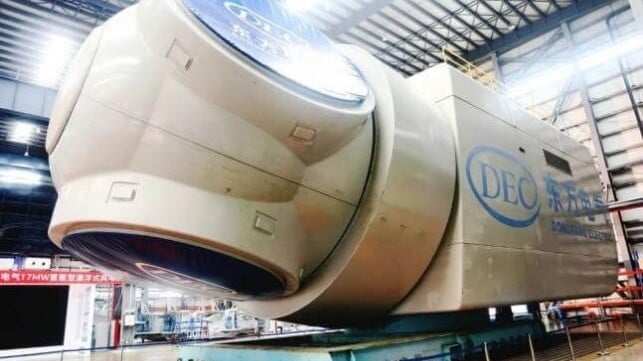
China rolled out the largest direct-drive floating wind turbine for demonstration and vertification testing (Dongfang Electric)

Published Jul 18, 2025 5:05 PM by The Maritime Executive


China’s offshore wind industry continues to push the limits for offshore wind turbines, looking to increase the capacity and durability of its units. In the latest development, it reports completing the development of a prototype, which is the world’s largest direct-drive floating offshore wind turbine.

Developed by China Huaneng Group in partnership with Dongfang Electric, the unit is rated for 17 MW and is being reported as having the highest single-unit capacity and largest rotor diameter. The first prototype was unveiled on July 10. It is being prepared for the next steps, which include demonstration and verification in the waters of Guangdong.

The turbine features an impeller diameter of 262 meters (approximately 860 feet). The rotor sweep area is 53,000 square meters, which they report is equivalent to 7.5 standard football fields. The hub stands about 152 meters (nearly 500 feet) above the water. According to the companies, once operational, the unit will provide 68 million kWh per year, equivalent to the power needed for 40,000 homes.

The design process had to overcome multiple challenges and develop a unit that is strong enough to sustain heavy conditions. They report developing a unique low-speed permanent magnet direct-drive motor to achieve both high capacity and reliability. All the key components, including the large-diameter main shaft bearings, blades, generators, converts, and transformers, were domestically produced.

The unit is reported to be able to withstand ultra-high waves over 24 meters (nearly 80 feet). It can also resist super typhoon conditions up to level 17 (winds of approximately 125 to 135 mph).

The development of floating turbines is critical for China’s continued advancement. It already reportedly has over 40 GW of offshore wind power feeding into its grid. Recently, it reported starting operation of its furthest at sea wind farm located more than 50 miles from shore. The field, which consists of 98 turbines and three substations, will provide 800 MW for operator China Three Gorges Corporation.

Dongfang highlights that it has been in the wind turbine business for 20 years developed both models for onshore and offshore. Its commercial offshore line is currently between 4.5 to 13 MW, with the largest unit commercially introduced in 2022. 

The company also recently announced it had begun testing a massive 26 MW unit. It has a hub height of 185 meters (606 feet) and is nearly a third larger than the installed record holder of 18 MW. The turbine blades are approximately 150 meters (nearly 500 feet in length). 

As China continues to “push the envelope” for turbine capacity, Sany Renewable Energy reported that it has developed a test rig for turbines of up to 35 MW. A new entrant into the offshore sector, it won its first orders this spring to expand from onshore installations and reports it has already tested its 15 MW units. The company is also moving into the international market, reporting in November 2024, it had signed wind turbine sales contracts totaling 1,324 MW with three subsidiaries of India’s JSW Group, along with an additional 300 MW contract with the Indian subsidiary of Sembcorp Industries.


Matson Suspends Shipping EVs Citing Hazards of Lithium-ion Batteries

Matson containership
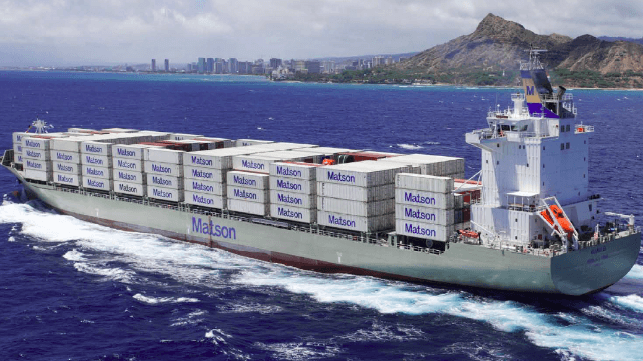
Matson suspended shipments of EVs and hybrids citing the fire danger from their batteries (Matson file photo)

Published Jul 18, 2025 6:44 PM by The Maritime Executive


Matson surprised customers this week with an announcement that, effective immediately, it would suspend transporting battery-powered electric or plug-in hybrid electric vehicles due to the hazardous material classification of their lithium-ion batteries. The ability to ship cars between the mainland of the United States, Hawaii, Guam, and Alaska was an important service both for individuals and car dealers.

In a letter sent to customers, the company writes, “Due to increasing concern for the safety of transporting vehicles powered by large lithium-ion batteries, Matson is suspending acceptance of used or new electric vehicles (EVs) and plug-in hybrid vehicles for transport aboard its vessels. Effective immediately, we have ceased accepting new bookings for these shipments to/from all trades.”

The Hawaii Electric Vehicle Association reports there are currently more than 37,000 electric vehicles registered in the state. No figures were reported for Guam, but dealers who spoke with the local media said they regretted the decision, highlighting that EVs are well-suited for driving on the island.

Matson had reported in the past that it had developed a collaborative team approach to tackle the complexities of carrying lithium batteries. It established an Electric Vehicle Safe Carriage Working Group, and said it was participating in external working groups on electric vehicles and lithium batteries. 
 
Shoreside, it said, Lithium Battery Handling Procedure included a review process and a used battery shipment checklist, while for vessels, it developed procedures on how to fight lithium fires and how to prevent them from occurring. This included proper stowage, the use of new tools like thermal imaging cameras to see temperature spikes, and the deployment of the Viking HydroPen, a firefighting tool that replaces the traditional water mist lance and is designed to drill into containers and extinguish fires.

In the letter to customers, it writes, “Matson continues to support industry efforts to develop comprehensive standards and procedures to address fire risk posed by lithium-ion batteries at sea and plans to resume acceptance of them when appropriate safety solutions that meet our requirements can be implemented.”

Reports are citing the recent fire aboard the Morning Midas off the Aleutians and the loss of the vessel, which was carrying EVs and hybrids. It was at least the third major casualty that was linked to EV fires after the fire aboard the Fremantle Highway in 2023 and the loss of the Felicity Ace in 2022. The industry has worked to develop new standards for the transport of EVs and lithium-ion batteries, but in Matson’s case, it has the added danger of container fires because it transports cars placed into boxes, limiting the ability to monitor the vehicles versus car carriers, where they are loaded in large garage-type spaces.

Matson continues to transport conventional cars. It offers the service both trans-ocean and also moves the containers interisland in Hawaii as part of its barge service.


Test of Onboard Carbon Capture on HMM Feeder Proves System Feasibility

vessel with onboard carbon capture
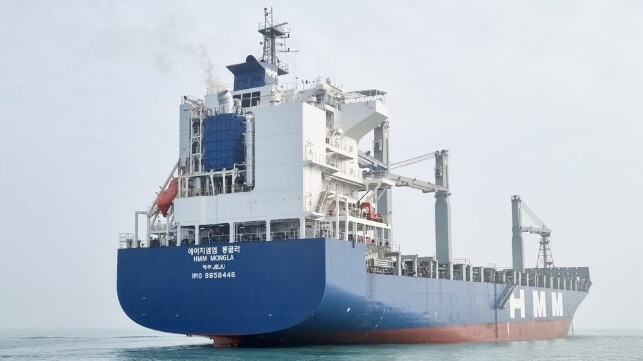
A decade's old vessel, HMM Mongla was fitted with the cabon capture system for the trial (SHI)

Published Jul 18, 2025 7:50 PM by The Maritime Executive


A year of testing has proven the effectiveness and commercialization potential of onboard carbon capture and storage systems (OCCS), reports Samsung Heavy Industries. In partnership with HMM, Panasia, and the Korean Register of Shipping, they have been conducting tests aboard an HMM feeder vessel operating in Asia.

Samsung Heavy Industries installed an amine absorption-based capture system aboard the HMM Mongla. The vessel, which was built in 2014 and acquired by HMM in 2023, is a 25,000-dwt feeder with a capacity for 2,200 TEU. Measuring 186 meters (610 feet), the vessel was built in China with conventional propulsion and retrofitted with the OCCS system. It operates a feeder loop calling at Ningbo and Shanghai in China, Chattogram in Bangladesh, Port Klang in Malaysia, and Singapore.

According to Samsung, the demonstration attempted to produce results that could verify the effectiveness and commercial potential of the system. In January of this year and again in May, they were able to offload liquified CO2 with a purity of over 99.9 percent. It was used as a raw material for the process of making eco-friendly methanol that could be used as marine fuel. They report it demonstrated a meaningful case of carbon utilization beyond underground storage of the liquified CO2.

“OCCS will play an important role in the net-zero of ships in the future as it is used as an energy source to produce eco-friendly fuel,” said Lee Dong-yeon, Vice President and Director of Samsung Heavy Industries Shipbuilding & Marine Research Institute. “We will work to ensure that the shipbuilding, shipping, and equipment industries can take the lead in the OCCS market through collaboration.”

Panasia, a Korea-based marine parts manufacturer, worked with HMM in the first phase of the program, starting in late 2022, to conduct a feasibility study along with an economic analysis and risk assessment, and explore the handling process for captured CO2. Panasia and Samsung Heavy Industries also provided engineering support for the test.

It is the latest in a series of projects testing the application of onboard carbon capture. Once thought to be a less likely option for vessels, it has shown potential as a means to address the challenges for the industry. It can also be used, as in this case, for retrofitting to extend the commercial life of in-service vessels.

Samsung highlights that the industry is raising the opinion that in order to promote the commercialization of OCCS, it is urgent to establish related laws and systems. It notes the need to develop infrastructure, such as building on-shore systems for processing the CO2, and the rules governing the implementation of the systems on ships.


Fear, Pride or Miscalculation Could Start a War in the Pacific

Why it’s reckless to assume that wars only erupt by deliberate design.

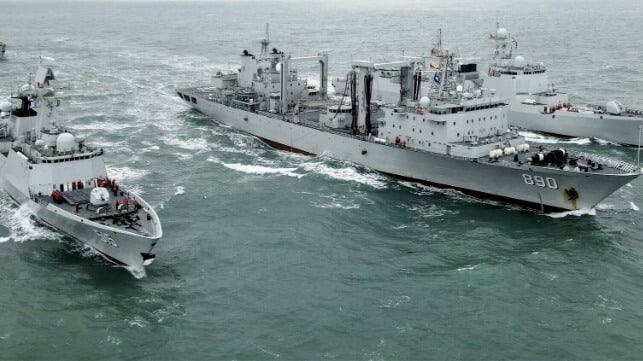
PLA Navy warships practice underway replenishment, 2024 (PLA Navy)

Published Jul 20, 2025 3:56 PM by The Lowy Interpreter


[By Henry Yep]

Thucydides famously observed that nations go to war for reasons of fear, honor, and interest. In today’s Indo-Pacific, rational interests often dominate strategic analysis.

A US Marine Corps War College war game – distinct from a scenario recently featured in The Interpreter – suggests that fear, national honor, and miscalculation could be more decisive triggers for conflict than calculated interest. Studies likewise caution that it is reckless to assume wars only erupt by deliberate design. The War College simulation – which portrayed a fast-escalating crisis with China – revealed how easily each side’s fears and pride might spiral into an unintended war. It also underscored critical lessons about managing escalation, alliance coordination, and the fragility of national will.

In the simulation, initial moves and counter-moves were driven by mutual fear and the impulse to seize any perceived advantage. Both the United States and China felt compelled to respond forcefully to each other’s military posturing and ambiguous signals. Lacking clear diplomatic off-ramps, each side feared that any restraint would invite aggression. This cycle of insecurity led to rapid escalation – even early talk of nuclear options – illustrating how quickly a US–China clash could cross red lines and see dangerous signals misread.

The lesson is stark: without pre-planned de-escalation channels and credible crisis communication, fear can push rivals into a corner where they see escalation as the only recourse.

US allies in the region also hesitated out of fear of Chinese retaliation. Aside from a few close partners, most limited their roles to logistical support or other low-risk tasks to avoid becoming targets. This disunity sent mixed signals about allied resolve and forced Washington to shoulder an outsized burden – a dynamic that could embolden Beijing to test the coalition’s commitments. If an ally in peril sensed US hesitation, American credibility (honour) would likewise suffer. In short, when partners have inconsistent risk appetites, it creates fertile ground for misjudgment by all sides.

Status and reputation emerged as volatile factors. In the war game, certain Chinese responses were driven less by immediate military advantage and more by their symbolic value. For example, after suffering a high-profile naval loss, China retaliated in dramatic but strategically questionable fashion – a move aimed at avoiding humiliation domestically and internationally. Such symbolic escalations can be dangerously misinterpreted. What one side views as an act of honour or a necessary show of resolve, the other may see as aggressive provocation, prompting an outsized counter-response. Planners must account for the possibility that actors like China will prioritise saving face and showing resolve, even at high cost. Understanding these emotional and domestic drivers is as important as analyzing capabilities; it requires looking beyond cold calculations to the narratives and historical grievances that motivate state behavior.

Perhaps the most sobering lesson is how quickly miscalculation can take over when emotion eclipses strategy. In the war game, critical signals were consistently misread. The US team assumed that certain bold moves including a covert and deadly strike on a Chinese naval asset off South Africa’s coast – more than 10,000 kilometers from Taiwan – would deter Beijing. The China team interpreted those actions, and others, as unambiguous escalation. Caught off guard, China retaliated in ways Washington did not anticipate. Even other seemingly minor US and allied activities at sea or in the air were perceived by the China team as deliberate provocations, with each side assuming the worst of the other’s intentions. At one stage, a fragile ceasefire briefly held, only to unravel when one side attempted to exploit the pause for tactical advantage.

Efforts by outside parties to de-escalate were largely ineffective, as mutual suspicion and the fear of losing face overshadowed diplomatic appeals. This paranoia fuelled a cascade of tit-for-tat moves that neither side initially sought, yet each felt compelled to answer in kind – propelling them deeper into violence.

The simulation also showed how fragile national will can be in a high-intensity war. Cyberattacks on critical infrastructure and high casualties from initial clashes had outsized effects on morale. Leaders quickly faced pressure to either escalate further or seek a quick peace to avoid domestic backlash. On the Chinese side, the leadership felt compelled to show strength to maintain legitimacy. Misjudging one’s own or the adversary’s resolve under such stress could lead to fatal errors beyond what any war plan anticipated.

A real-world replay of these war game missteps remains a credible danger unless governments act now. Washington, Beijing, and key regional players should establish clearer crisis hotlines and pre-agreed “off-ramps” to defuse incidents before fear turns into shooting. Likewise, the United States and its allies must better align their strategies and risk thresholds through combined exercises and frank dialogue – presenting a unified front that leaves no room for Beijing to doubt their collective resolve. Red team simulations must also move beyond rehearsing military options. They must stress-test how China’s leadership might react to crises shaped not only by strategic calculations, but by nationalism, historical grievances, and fears of humiliation. Without that discipline, the Indo-Pacific risks stumbling into a conflict that no side truly intends – one driven less by strategy than by misperception, pride, and mounting pressure.

The views expressed in this article are those of the author and do not reflect the official position of the US Department of Defense or the US Government.

Henry Yep is a China specialist with 19 years of experience at the Defense Intelligence Agency (DIA). In June 2025, he began serving as a branch chief in DIA’s China Mission Group (CMG), where he leads a team of civilian analysts, military officers, and contractors. Prior to this role, he was a deputy defense intelligence officer for China, responsible for orchestrating DIA support to the Secretary of Defense on China-related initiatives, engaging foreign partners and academia, contributing to wargames, and serving as a key node across the intelligence community.

This article appears courtesy of The Lowy Interpreter and may be found in its original form here

The opinions expressed herein are the author's and not necessarily those of The Maritime Executive.