Sunday, August 10, 2025

Analyst warns Trump and Putin may 'divide the world' like a former Soviet leader imagined

Robert Davis
August 10, 2025
RAW STORY
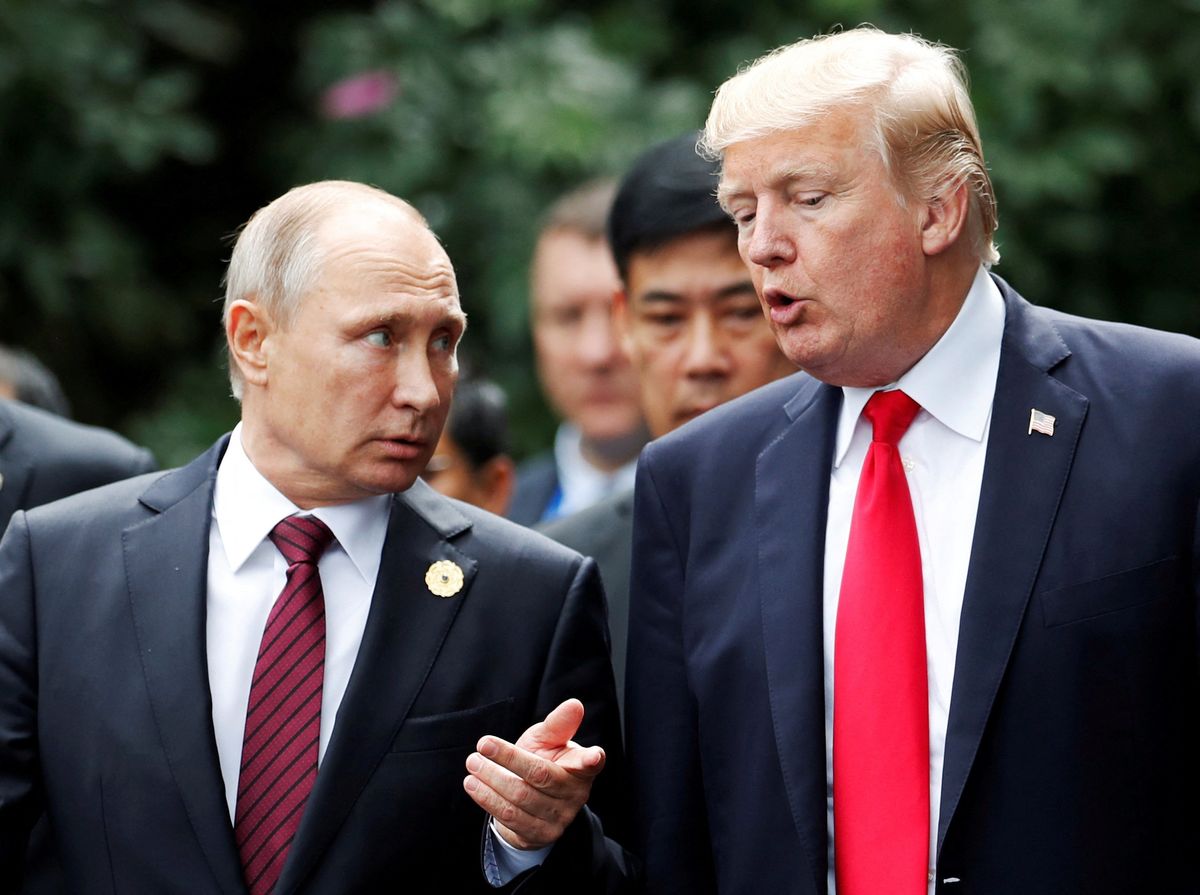

FILE PHOTO: U.S. President Donald Trump and Russia's President Vladimir Putin talk during the family photo session at the APEC Summit in Danang, Vietnam November 11, 2017. REUTERS/Jorge Silva/File Photo

President Donald Trump's meeting with Russian President Vladimir Putin this week could have major geopolitical implications, according to one analyst.

Trump and Putin plan to meet in Alaska to negotiate an end to the war in Ukraine. Ahead of the meeting, Putin announced he wanted control over a wide swath of eastern Ukraine, including land his forces do not control, according to the Institute for the Study of War. Ukrainian President Volodymyr Zelenskyy has rejected this offer, even though Trump has said Zelenskyy will need to give up some land to end the war.

This situation reminded one analyst of how former Soviet strongman Joseph Stalin viewed the world.


“Putin would like to divide the world into spheres of influence with Trump and Xi," Andrey Kolesnikov, a Russia-based political analyst, told the Financial Times. "A new Yalta and a cold war — that’s just what he wants. He is eager to claim [Joseph] Stalin’s laurels."

Ahead of the meeting with Trump, Putin invited to the Kremlin the heads of state from nine countries that Russia considers friendly. Those include China's Xi Jinping and India's national security advisor Ajit Doval.

Putin's actions ahead of the meeting also show that he is not interested in ending the conflict, according to the report.


“There is no real alternative but to freeze the conflict along the current frontline. The post-Korean war stand-off is way more likely than a lasting peace,” Kolesnikov said.

Read the entire piece by clicking here.


Ukraine Must Be Included in Trump-Putin Peace Talks, Says Sanders

The senator said the negotiations could be "a positive step forward" after three and a half years of war.


At the Alley of Heroes military cemetery,a woman waters the flowers on the grave of a Ukrainian police officer who died during artillery shelling on August 10, 2025 in Kramatorsk, Ukraine.
(Photo: Pierre Crom/Getty Images)

Julia Conley
Aug 10, 2025
CO MMON DREAMS

Echoing the concerns of Ukrainian President Volodymyr Zelenskyy and European leaders about an upcoming summit between U.S. President Donald Trump and Russian President Vladimir Putin, Sen. Bernie Sanders on Sunday said the interests of Ukrainians must be represented in any talks regarding an end to the fighting between the two countries—but expressed hope that the negotiations planned for August 15 will be "a positive step forward."

On CNN's "State of the Union," Sanders (I-Vt.) told anchor Dana Bash that Ukraine "has got to be part of the discussion" regarding a potential cease-fire between Russia and Ukraine, which Putin said last week he would agree to in exchange for major land concessions in Eastern Ukraine.

Putin reportedly proposed a deal in which Ukraine would withdraw its armed forces from the Donetsk and Luhansk regions, giving Russia full control of the two areas along with Crimea, which it annexed in 2014.

On Friday, Trump said a peace deal could include "some swapping of territories"—but did not mention potential security guarantees for Ukraine, or what territories the country might gain control of—and announced that talks had been scheduled between the White House and Putin in Alaska this coming Friday.

As Trump announced the meeting, a deadline he had set earlier for Putin to agree to a cease-fire or face "secondary sanctions" targeting countries that buy oil from Russia passed.

Zelenskyy on Saturday rejected the suggestion that Ukraine would accept any deal brokered by the U.S. and Russia without the input of his government—especially one that includes land concessions. In a video statement on the social media platform X, Zelenskyy said that "Ukraine is ready for real decisions that can bring peace."

"Any decisions that are against us, any decisions that are without Ukraine, are at the same time decisions against peace," he said. "Ukrainians will not give their land to the occupier."

Sanders on Sunday agreed that "it can't be Vladimir Putin and Donald Trump" deciding the terms of a peace deal to end the war that the United Nations says has killed more than 13,000 Ukrainian civilians since Russia began its invasion in February 2022.

"If in fact an agreement can be negotiated which does not compromise what the Ukrainians feel they need, I think that's a positive step forward. We all want to see an end to the bloodshed," said Sanders. "The people of Ukraine obviously have got to have a significant say. It is their country, so if the people of Ukraine feel it is a positive agreement, that's good. If not, that's another story."


A senior White House official told NewsNation that the president is "open to a trilateral summit with both leaders."

"Right now, the White House is planning the bilateral meeting requested by President Putin," they said.

On Saturday, Vice President JD Vance took part in talks with European Union and Ukrainian officials in the United Kingdom, where Andriy Yermak, head of the Office of the President in Ukraine, said the country's positions were made "clear: a reliable, lasting peace is only possible with Ukraine at the negotiating table, with full respect for our sovereignty and without recognizing the occupation."

European leaders pushed for the inclusion of Zelenskyy in talks in a statement Saturday, saying Ukraine's vital interests "include the need for robust and credible security guarantees that enable Ukraine to effectively defend its sovereignty and territorial integrity."

"Meaningful negotiations can only take place in the context of a cease-fire or reduction of hostilities," said the leaders, including French President Emmanuel Macron, German Cancellor Friedrich Merz, and U.K. Prime Minister Keir Starmer. "The path to peace in Ukraine cannot be decided without Ukraine. We remain committed to the principle that international borders must not be changed by force."

At the Quincy Institute for Responsible Statecraft, British journalist and analyst Anatol Lieven wrote Saturday that the talks scheduled for next week are "an essential first step" toward ending the bloodshed in Ukraine, even though they include proposed land concessions that would be "painful" for Kyiv.

If Ukraine were to ultimately agree to ceding land to Russia, said Lieven, "Russia will need drastically to scale back its demands for Ukrainian 'denazification' and 'demilitarization,' which in their extreme form would mean Ukrainian regime change and disarmament—which no government in Kyiv could or should accept."

A recent Gallup poll showed 69% of Ukrainians now favor a negotiated end to the war as soon as possible. In 2022, more than 70% believed the country should continue fighting until it achieved victory.


Democrats: Say No to Endless Killing in Ukraine and Give Peace a Chance


While some hawks still pretend that Ukraine could "win" the war with enough missiles, bombs, ammunition, and other supplies from the U.S., realists scoff at such claims.
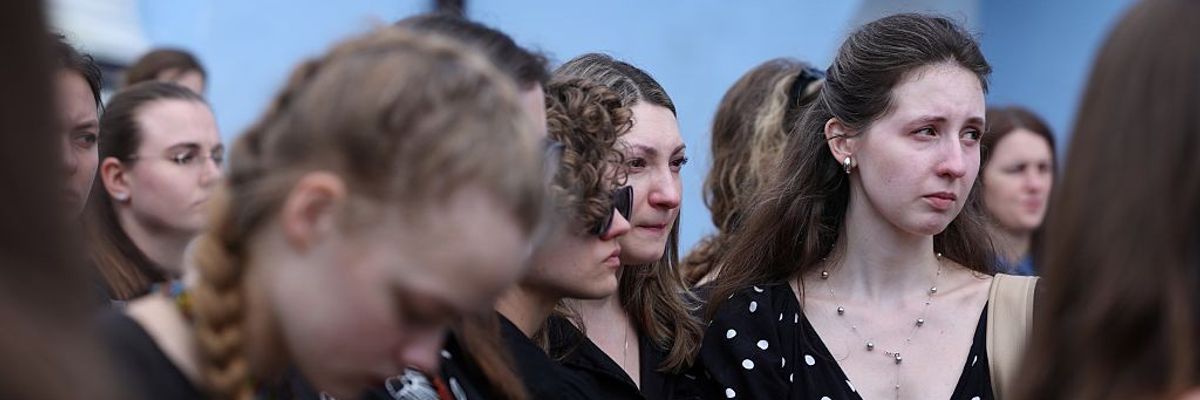


People mourn during a funeral ceremony for Ukrainian journalist Viktoriia Roshchyna, who died in Russian captivity, at St. Michael’s Golden-Domed Cathedral on August 8, 2025 in Kyiv, Ukraine.
(Photo: Yan Dobronosov/Global Images Ukraine via Getty Images)


Norman Solomon
Aug 10, 2025
The Hill

After three and a half years of carnage in Ukraine, the meeting expected soon between President Trump and Russian President Vladimir Putin is an opportunity to finally find a peaceful solution to a terrible war. Genuine diplomacy to end the bloodshed is long overdue.

Up to 100,000 Ukrainians are estimated to have been killed, many of them civilians, along with more than twice that number of deaths among Russian troops. Hundreds of thousands more have been wounded on each side, and Russian bombardment has devastated many of Ukraine’s cities and towns.

Condemnations of the Trump-Putin summit are predictable from congressional Democrats more interested in scoring political points than opening a diplomatic door for peace. While most Republican leaders will praise Trump no matter what he does, pressure from the so-called national security establishment could damage prospects for a peaceful outcome in Ukraine.

Since early 2022, the U.S. government, on a largely bipartisan basis, has provided upwards of $67 billion in military aid to Ukraine. Supporters of continuing the massive arming of Ukraine claim the highest moral ground, while others do the killing and dying. Even after it became clear that the war could go on indefinitely without any winner, the message from Washington’s elite politicians and pundits to the Ukrainian people has amounted to “let’s you and them fight.”

Last week, Sen. Lisa Murkowski (R-Alaska) and Sen. Jeanne Shaheen (D-N.H.) introduced a bill to give Ukraine $54.6 billion in aid over the next two years, with many billions going directly to arm the Ukrainian military. If the Trump-Putin summit is unsuccessful, the currently dim prospects for such legislation could brighten. This dynamic gives war enthusiasts and advocates for the military-industrial complex a motive to throw cold water on the summit.

While Murkowski now represents a minority view on Ukraine among fellow Republicans, Shaheen is decidedly in the mainstream of her Senate Democratic colleagues. Even after all the suffering and destruction in Ukraine, few seem really interested in giving peace a chance.

As for Trump, he has sometimes talked about seeking peace in Ukraine, even while greenlighting large quantities of weapons to the Kiev government. Given his mercurial approach, there is no telling what his mindset will be after meeting with Putin.

Most Democrats in Congress seem content with continuation of a war that has no end in sight. Little is being accomplished in military terms other than more killing, maiming and destruction.

During recent months, Ukrainian forces have lost ground to Russian troops. While some hawks still pretend that Ukraine could “win” the war with enough missiles, bombs, ammunition and other supplies from the U.S., realists scoff at such claims.

Unfortunately, while the war drags on, Democrats in Congress are prone to treat diplomacy as a third rail. To a large extent, their partisan template was reinforced nearly three years ago, making “diplomacy” a dirty word for the Ukraine war.

The fiasco began in late October 2022 with the release of a letter to President Biden signed by 30 House Democrats, led by Rep. Pramila Jayapal (D-Wash.), the chair of the Congressional Progressive Caucus. The letter was judicious in its tone and content, affirming support for Ukraine and appropriately condemning “Russia’s war of aggression.” But the signatories got in instant hot water because the letter balanced its support for arming Ukraine with sensibly urging steps that could stop a war without a foreseeable end.

“Given the destruction created by this war for Ukraine and the world, as well as the risk of catastrophic escalation, we also believe it is in the interests of Ukraine, the United States, and the world to avoid a prolonged conflict,” the letter stated. “For this reason, we urge you to pair the military and economic support the United States has provided to Ukraine with a proactive diplomatic push, redoubling efforts to seek a realistic framework for a ceasefire.”

Just one day later, Jayapal issued a statement declaring that “the Congressional Progressive Caucus hereby withdraws its recent letter to the White House regarding Ukraine.” For some members of the caucus, the sudden withdrawal was a jarring and embarrassing retreat from a stance for diplomacy.

Ever since then, the war train has continued to roll, unimpeded by cooler heads. And, like elected officials in Washington, voters are looking at the war through partisan lenses.

A March Gallup poll found that 79 percent of Democrats said that the U.S. was not doing enough to help Ukraine — a steep jump from 48 percent since the end of last year. During the same period, the number of surveyed Republicans with that view remained under 15 percent.

It is time for Americans and their elected representatives to set aside partisan lenses and see what’s really at stake with the Ukraine war. Endless killing is no solution at all.

Rebuilding détente between Washington and Moscow is essential — not only for the sake of Ukrainians and Russians who keep dying, but also for the entire world. The two nuclear superpowers must engage in dialogue and real diplomacy if the next generations all over the globe are to survive.


© 2023 The Hill


Norman Solomon is the national director of RootsAction.org and executive director of the Institute for Public Accuracy. The paperback edition of his latest book, War Made Invisible: How America Hides the Human Toll of Its Military Machine, includes an afterword about the Gaza war.
Full Bio >


WHITE POWER U$A

'Out of view': Trump demands Obama portrait be moved to hidden stairwell


David Edwards
August 10, 2025 
RAW STORY


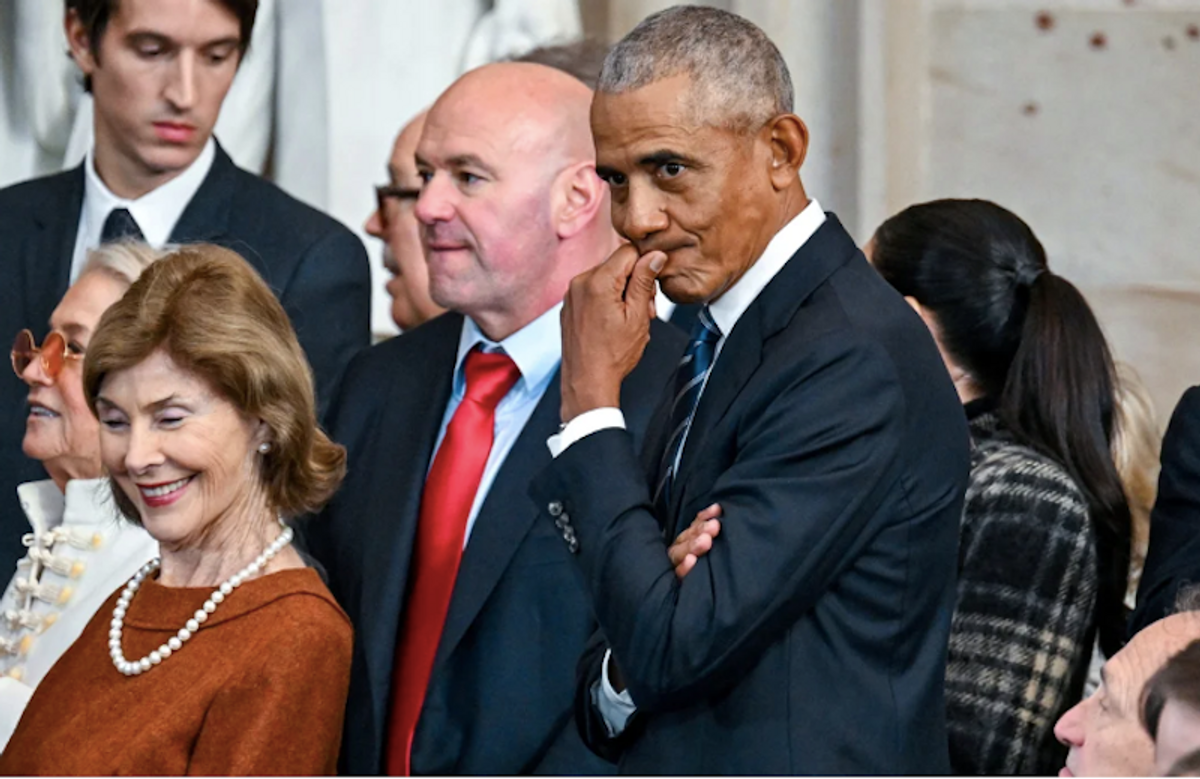
Former President Barack Obama during the inauguration of Donald Trump as the 47th president of the United States takes place inside the Capitol Rotunda of the U.S. Capitol building. Kenny Holston/Pool via REUTERS


President Donald Trump has ordered the official White House portrait of former President Barack Obama to be relocated once again — this time to a "hidden" staircase out of view of visitors.

CNN reported on Sunday that Obama's portrait was moved to the Grand Staircase, along with the portraits of former Presidents George H.W. Bush and George W. Bush.

"Multiple sources have said that the president is directly involved with nearly everything that is done to the aesthetic of the White House, big or small," CNN noted. "That area is heavily restricted to members of the first family, US Secret Service agents, and a limited number of White House and executive residence staff. It is firmly out of view for any visitor hoping to see the photorealistic Robert McCurdy painting of the former president, a source familiar with the matter confirmed."


The moves were made despite White House protocol, which calls for the portraits of recent presidents to be prominently displayed.

Earlier this year, White House staffers replaced Obama's official portrait with a painting of Trump in the aftermath of an assassination attempt in Butler, Pennsylvania. At the time, the painting of Obama was relocated to the Grand Foyer, according to reports.
'Shameful': Analysts slam Trump's warning for D.C. homeless to 'move out immediately'

Robert Davis
August 10, 2025 
RAW STORY


Analysts and advocates for people who are homeless were outraged on Sunday after President Donald Trump issued a warning to the unhoused in Washington, D.C.

Trump posted on Truth Social that people experiencing unsheltered homelessness must "move out immediately." It was issued at a time when federal data shows homelessness increased by 18% between 2023 and 2024, with more than 771,000 people who are homeless counted during the last survey.

"We will give you places to stay, but FAR from the Capital (sic). The Criminals, you don’t have to move out. We’re going to put you in jail where you belong," Trump's post reads in part.

Analysts and advocates for people who are homeless responded on social media.

"The billionaires at the Cicero Institute have their hands all over these shameful steps," Jesse Rabinowitz, an activist and spokesperson for the National Homelessness Law Center, wrote on Bluesky.

"Again, Republicans are using DC as a sandbox for their failed, racist, and backwards policies. Pay attention to what happens here, because it will soon happen everywhere," Rabinowitz added.

"I hardly see anybody on the streets in DC these days. If there are encampments, they’re hiding," Steve Berg, chief policy officer at the National Alliance to End Homelessness, wrote on LinkedIn. "Could it be somebody thinks he can prove how tough he is by threatening … people who are homeless??"

"Trump is going to traffic homeless people," Melanie D'Arrigo, executive director for the Campaign for New York Health, wrote on X. "Many won’t have ID, and will likely end up incarcerated with immigrants who are being arrested, trafficked, and detained, without due process."

"People are not criminals or dangerous, by virtue of their unhoused status," the Washington Legal Clinic for the Homeless wrote on X. People are struggling to afford rent and food in an expensive city. We should not have homelessness in our nation’s capital. But the path to ending homelessness is housing, not displacement.


'Crime is not out of control': Fox News pundit fact-checks Trump on D.C. takeover

David Edwards
August 10, 2025 4:42PM ET


Fox News contributor Ted Williams, a former member of the Washington D.C. Metropolitan Police Department, challenged President Donald Trump ahead of a possible move to federalize law enforcement in the district.

In a post to Truth Social on Sunday, Trump said that homeless people would have to move "far" away from the nation's capital and that criminals would be imprisoned.

"I found it troubling because I also practiced law in the District of Columbia is that the president of the United States would say that crime is out of control," Williams told host Jon Scott on Sunday. "I take exception to that. Crime is not out of control in the District of Columbia."

Williams said he suspected that Trump decided to take action in D.C. after the attempted carjacking of a former DOGE staffer.

"I would like to ask Mr. Trump. Where were you last month when a three-year-old child, Honesty Cheadle, was shot and killed as the result of crime in the District of Columbia?" Williams remarked. "Don't use this as a pretext to actually eradicate home rule. And that seemed to be what Mr. Trump is interested in."

Watch the video from Fox News below or by clicking here.


Trump says to move homeless people ‘far’ from Washington

By AFP
August 10, 2025


Unhoused people in the US capital Washington are being put under pressure by US President Donald Trump, who has expressed his intent to have them removed from the city - 

Sarah Meyssonnier, Ilya PITALEV

President Donald Trump said Sunday that homeless people must be moved “far” from Washington, after days of musing about taking federal control of the US capital where he has falsely suggested crime is rising.

The Republican billionaire has announced a press conference for Monday in which he is expected to reveal his plans for Washington — which is run by the locally elected government of the District of Columbia under congressional oversight.

It is an arrangement Trump has long publicly chafed at. He has threatened to federalize the city and give the White House the final say in how it is run.

“I’m going to make our Capital safer and more beautiful than it ever was before,” the president posted on his Truth Social platform Sunday.

“The Homeless have to move out, IMMEDIATELY. We will give you places to stay, but FAR from the Capital,” he continued, adding that criminals in the city would be swiftly imprisoned.

“It’s all going to happen very fast,” he said.

Washington is ranked 15th on a list of major US cities by homeless population, according to government statistics from last year.

While thousands of people spend each night in shelters or on the streets, the figure are down from pre-pandemic levels.

Earlier this week Trump also threatened to deploy the National Guard as part of a crackdown on what he falsely says is rising crime in Washington.

Violent crime in the capital fell in the first half of 2025 by 26 percent compared with a year earlier, police statistics show.

The city’s crime rates in 2024 were already their lowest in three decades, according to figures produced by the Justice Department before Trump took office.

“We are not experiencing a crime spike,” Washington Mayor Muriel Bowser said Sunday on MSNBC.

While the mayor, a Democrat, was not critical of Trump in her remarks, she said “any comparison to a war torn country is hyperbolic and false.”

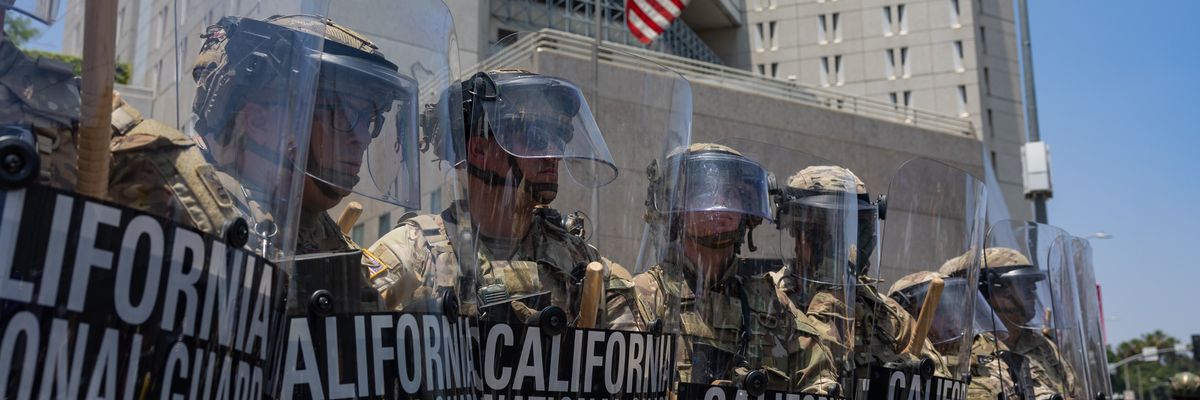
Trump’s threat to send in the National Guard comes weeks after he deployed California’s military reserve force into Los Angeles to quell protests over immigration raids, despite objections from local leaders and law enforcement.

The president has frequently mused about using the military to control America’s cities, many of which are under Democratic control and hostile to his nationalist impulses.
Inside Trump's brutal blueprint for destroying American democracy


The Conversation
August 10, 2025 


What turns a democratically elected leader into an authoritarian? The process is rarely abrupt. It unfolds gradually and is often justified as a necessary reform. It is framed as what the people wanted. All this makes it difficult for citizens to recognise what is happening until it’s too late.

Consider Viktor Orbán’s transformation in Hungary. Once celebrated as a liberal democrat who challenged communist rule, Orbán now controls 90% of the Hungarian media and has systematically packed the country’s constitutional court. His trajectory is now widely recognised as a textbook case of democratic backsliding.

Turkish president Recep Tayyip Erdoğan was initially praised for showing that democracy and Islamic governance could coexist. In early reforms, he lifted millions from poverty by challenging Turkey’s secular establishment – a feat that required exceptional confidence and a bold vision. Now, a decade on, Erdoğan has turned Turkey into what political scientists call a competitive authoritarian regime.

In the US, Donald Trump rose to power promising to “drain the swamp”. In Brazil, Jair Bolsonaro campaigned as an anti-corruption crusader who would restore the country’s moral foundations. Both have since weaponised democratic institutions to consolidate their own power.

Part of this shift is a psychological process we term the hubris arc. This sees a visionary leader become increasingly myopic once in office. Their early successes bolster their belief in their transformative capabilities, which gradually diminishes their capacity for self-criticism.

The visionary stage typically coincides with systemic failure. When established institutions prove inadequate for addressing public grievances, it provides fertile ground for leaders with exceptional self-confidence to emerge. These outsiders succeed precisely because they possess the psychological conviction that they can challenge entrenched systems and mobilise mass support through bold, unconventional approaches.

Such leaders excel at crafting compelling narratives that enable them to to transform public frustration into electoral momentum. They offer simplified solutions to complex problems, providing certainty where establishment politicians offer only incrementalism and compromise.

Losing perspective

But as visionary capacity increases, so too does myopia. Seeing a singular path with exceptional clarity necessitates narrowing one’s perceptual field.

These leaders initially succeed because their heightened focus cuts through the paralysis of nuanced thinking. But they quickly reach an inflection point where they face a fundamental choice: accept institutional constraints as necessary feedback mechanisms or redefine them as obstacles to their vision.

Those who maintain a productive vision actively build systems for honest feedback. They allow formal channels for dissent to continue and construct diverse advisory teams.

Where strong democratic institutions endure – independent media, empowered legislatures, autonomous courts – leaders must continue negotiating and compromising. This tends to keep their confidence grounded. Some leaders successfully work within these constraints, which proves that the descent into myopia is actually more a reflection of institutional weakness than psychological destiny.

Where institutions lack strength or leaders resist self-discipline, electoral success may embolden rather than restrain authoritarian tendencies. As leaders become increasingly convinced of their transformative vision, their ability to perceive alternatives diminishes.

This psychological narrowing manifests in predictable behaviours, notably eliminating dissenting voices. With every election victory, Orbán has replaced independent-minded allies with loyalists. Trump’s first presidency featured constant turnover among advisers who challenged him. His second is populated by people who can be trusted to toe the line.

Myopic decline follows when hubris reaches saturation. Once leaders systematically eliminate feedback mechanisms, they lose all capacity for self-correction. As their ability to process contradictory information deteriorates, they may increasingly conflate personal power with national interest.

This conflation appears most pronounced in cases where leaders have systematically weakened independent media and judicial oversight.

When leaders achieve complete institutional capture, this self-conception becomes institutionalised. Orbán’s declaration, “We have replaced a shipwrecked liberal democracy with a 21st-century Christian democracy,” reveals how personal vision becomes indistinguishable from national transformation.

Institutional capture occurs through different methods but serves similar purposes. Orbán’s control of the media and courts means he has created parallel institutions that exist solely to validate his vision. Erdoğan used emergency powers after a 2016 coup attempt to instigate mass purges.

In both cases, motivated reasoning becomes institutionalised: leaders come to control the institutions that usually determine what information is legitimate and enable forms of dissent.

The endpoint is a transformation in which opposition becomes an existential threat to the nation. When Orbán positions himself as defender of “illiberal democracy” against EU values, or when Erdoğan arrests his rivals, they frame dissent as treason.

Opposition is a threat not just to their power but to the nation’s essence. Maximum vision has produced maximum blindness. Institutions have been redesigned to perpetuate rather than puncture the delusion.

Resisting the decline

The robustness of democratic institutions is decisive in determining whether hubristic tendencies can be contained within democratic bounds or whether they culminate in authoritarian consolidation.

Both Orbán and Erdoğan leveraged initial electoral mandates to systematically capture state institutions. Their hubris evolved from a tool for challenging establishments into a self-reinforcing system in which the regime’s vast sway over state institutions eliminated feedback mechanisms.

Bolsonaro’s slide toward authoritarianism – denying COVID science, attacking electoral systems, attempting to overturn his 2022 defeat – triggered immediate institutional pushback. Unlike Hungary or Turkey, where courts and civil society gradually bent to executive pressure, Brazilian institutions held firm.

Bolsonaro’s trajectory from populist outsider to authoritarian to electoral defeat and institutional rejection suggests that robust federal structures and an independent judiciary can function as circuit breakers. They can prevent permanent democratic capture.

The American experience presents a third model: democratic resilience under stress. Unlike Hungary and Turkey, where institutional capture succeeded, Trump’s first presidency tested whether these patterns could emerge in a system with deeper democratic roots and stronger institutional checks.

While his efforts to pressure state election officials and weaponise federal agencies followed recognisable authoritarian scripts, American institutions proved more resistant than their Hungarian or Turkish counterparts. Courts blocked key initiatives, state officials refused to “find votes,” and congressional oversight continued despite partisan pressures.

Yet even this institutional resistance came under severe strain, suggesting that democratic durability may depend more on specific design features and timing than general democratic culture.

The Trump stress test has revealed vulnerabilities. The erosion of democratic norms – when parties prioritise loyalty over constitutional obligations – creates openings for future exploitation.

The second Trump term could systematically target the weaknesses identified during his first: expanded emergency powers, strategic appointments to undermine the administrative state, and novel statutory interpretations to bypass Congress. The critical question is whether American institutions retain sufficient strength to again disrupt Trump’s trajectory.

The hubris arc appears inherent in populist psychology, underscoring why constitutional constraints and institutional checks are indispensable. Democracies survive not by finding perfect leaders but by constraining imperfect ones.

Trang Chu, Associate Fellow, Saïd Business School, University of Oxford and Tim Morris, Emeritus Professor, Saïd Business School, University of Oxford

This article is republished from The Conversation under a Creative Commons license. Read the original article.
Floods of bad news point to the dark truth of Trump's America

Kansas Reflector
August 7, 2025 

Twenty-seven dead. Twenty-seven young women and staff from the Camp Mystic near Kerrville, Texas. Apparently, many were still asleep or just waking when the early morning flood cut loose. It was as if a bomb went off.

They slept as danger and death were imminent. This lesson speaks volumes, and not just of water. These days, bombs go off daily while we ignore the danger. They detonate in Congress, the courts, our statehouses, the White House. But we sleep on.

Sometimes, we sense subtle nudges of the danger. Our hometown of Salina lost no lives directly, but Salina’s Smoky Hill flood logjam has become a major fascination — and budget headache. A forest of logs and wood debris help flood local ballfields, now rendered momentarily unusable.

Such unexpected high waters offer us a mirror. Camp Mystic, however, is starker than any mirror.

Described as a “safe haven” and a place for spiritual solace, Camp Mystic was known for its beauty — and hosting the children of Laura Bush and granddaughters of LBJ. Lady Bird Johnson sometimes came to camp closings.

How could they not have been warned?


A well-functioning National Weather Service might have helped. But Trump had already canned 600 workers. Oblivious, he merely blamed nature.

“This is a hundred-year catastrophe,” he said. “So horrible to watch.”

This was no 100-year event. Climate chaos chickens have come home to roost. Our leaders’ response, stunningly, has only been to cut and gut.

Except for the bombs.


In Gaza, more than 59,000 Palestinians are dead, more than half of them women and children. Though the latest Texas flood numbers are shocking and sad (136 lives lost), they’re overwhelmed by the tsunami of Palestine.

Instead of ending the slaughter, U.S. leaders sent untold billions of our tax dollars to Israel for death and destruction, in short, for genocide. Hospitals, schools and residences destroyed; survivors starved; many more killed in food distribution deathtraps.


Whether these bombs are climate-related or human-engineered, their common origin is a refusal to face reality. Many U.S. citizens falsely assume “we” are protected. Those who don’t are labeled leftist radicals, woke or worse.

Otherwise good people hold such beliefs. A personal story may illustrate. On the day U.S. Sens. Jerry Moran and Roger Marshall voted to cut and gut the already appropriated $1.1 billion for NPR and PBS, I expressed my anger at the betrayal to some local coffee group friends. “Now, we have to be responsible for our representatives’ irresponsibility,” I said.

“I’m glad it was gutted,” said one older gentleman. “They’re just communist propagandists, anyway.”


I told him that wasn’t true.

He said, “Well, you’ve clearly been listening to AOC.”

I didn’t argue further. My time is valuable. And yet, how have we come to this?

A recent Nation magazine article labels us the “Dis-United States.” Kevin Willmott, well-known Kansas filmmaker and writer, reported that his 20-year-old film, Confederate States of America, envisioned what would have happened had the slave states won the Civil War. They didn’t, but in today’s United States, Willmott writes, “the Confederacy has gobbled up the Union.”

“The Trump administration’s ongoing attack on the federal bureaucracy and wholesale cancellation of government programs; the quest to remove diversity, equity, and inclusion policies; the erasure of Black history; and the reinstatement of Confederate names on military bases — all are clear attempts to revive the white supremacy of the CSA,” he writes.

“So is the clearly unconstitutional attempt to revoke birthright citizenship, as enshrined in the 14th Amendment, drawn up and ratified by the victors of the Civil War.”

At a Memphis showing of his film, an older white woman receptionist said: “The South will rise again.”

It already has.

In a flood of bad news, the only explanation for the public’s trance is the hero worship found in professional wrestling. We need not delineate all Trump’s connections to that world. But Greg Olear lays it out:

“Flabby Donald (assumes) the physique of Hulk Hogan, Rocky Balboa, and Rambo. … The guns, the fist pump. “Fight, fight, fight.”


He adds: “This is Geopolitical WrestleMania. … We should know by now what’s real and what’s fake, but fantasy and reality have blurred together, … the special effects are too good, and it’s fun — FUN! — to have heroes and heels, decisive winners and irredeemable losers.”

We have been sold down the river. Trump’s Billionaire Buyout Bill leaves miles of destruction in its wake.

If you want to avoid the flood, stay alert and get to higher ground. This is your siren call

David Norlin is a retired Cloud County Community College teacher, where he was department chairman of communications/English, specializing in media.
Trump Wants to Turn America Into a Police State

They're not even hiding it anymore.


California National Guard stands guard as protesters clash with law enforcement in downtown Los Angeles at the Metropolitan Detention Center on Sunday, June 8, 2025 in Los Angeles, California.
(Photo: Jason Armond / Los Angeles Times via Getty Images)

Thom Hartmann
Aug 10, 2025
Common Dreams

After a couple of wannabe carjackers punched out Big Balls in DC, Trump used it as an excuse to threaten to take over the city and bring in the National Guard to police it, in a clear violation of the Posse Comitatus Act. This despite the fact that crime in Washington DC is at a 30-year low and the city already has the largest police force, per capita, of any municipality in America.

None of that matters; Trump wants to turn America into a police state, just like every other dictator in the world does when they get ahold of a democracy. They steal from the people, enrich their cronies, break laws with impunity, and then use police agencies to terrorize the general populace, judges, and legislators into docility and submission when they object.

In fact, they told us this was their goal. They showed us. They planned it in writing.

You may not see it in the headlines. But if you read the memos — and watch the deployments — you’ll see it plain as day. The military is no longer on the sidelines. It’s here.

A leaked memo from inside the Department of Homeland Security reveals what many of us feared but hoped we were wrong about: that the military is no longer a last resort in American governance. It’s now a first tool. A central player. A political weapon, just like in Russia.

And they’re not even hiding it anymore.

This isn’t some vague speculation or dystopian what-if. This isn’t a shadowy plot hatched in secrecy. The document was written, circulated, and discussed at the highest levels of DHS and the Department of Defense and it spells out, in clinical, terrifying language, a plan to normalize and expand the use of the United States military within our own country, on our own soil, against our own people.

The memo, obtained by The New Republic, outlines a coordinated strategy to embed military forces into immigration enforcement not just at the border but across American cities. It calls for replicating the recent Los Angeles deployment “for years to come.” It uses phrases like “homeland defense” and paints immigration threats as akin to Al Qaeda or ISIS. It pushes for “new ideas” on how DHS and DoD can work together on “national security” threats inside the United States.

— This isn’t about law enforcement. It’s about militarization.
— This isn’t about safety. It’s about power.
— This isn’t about stopping crime. It’s about building a political machine with boots and guns that can intimidate or even subdue any opposition.

And it’s already happening. America is rapidly turning into an authoritarian police state.

Over the past two months, Trump has done what no modern president has dared. He sent 4,000 National Guard troops — federalized, not state-controlled — into Los Angeles to back up ICE raids. He followed that with 700 active-duty Marines from the 2nd Battalion, 7th Marines.

These weren’t weekend warriors. These were combat-trained infantry troops deployed to performatively surround federal buildings and “support” immigration enforcement while pro-democracy protestors filled the streets.

Marines. In American cities. In June and July. “Guarding” federal offices and intimidating demonstrators.

And now, we’ve learned that smaller units have been sent to Florida and are prepping for deployment to Texas and Louisiana. The memo wasn’t a warning. It was a blueprint. A playbook for turning the world’s most powerful military force inward and turning constitutionally protected First Amendment political dissent into a “national security threat.”

Don’t believe Trump’s PR spin or the media’s pretending this isn’t as illegal and anti-democracy as it is. Don’t let the uniforms fool you into thinking this is routine.

This is not normal.
This is not legal.
This is not American.

This memo, which Hegseth and friends didn’t intend you and I would ever be able to read:

— Urges DHS to persuade top military brass to view immigration enforcement as a “homeland defense mission.”

— Seeks to embed armed, kill-trained military personnel inside ICE and CBP to “increase information sharing” and support “nationwide operational planning.”

— Frames transnational gangs and cartels as equivalent to Al Qaeda, a dangerous, dishonest leap that pretends to justify extreme, deadly force.

— And it admits, in its own words, that due to the “sensitive nature” of the meeting it documents, “minimal written policy or background” should be preserved.

Translation: They know what they’re doing is legally and morally criminal. So they’re minimizing the paper trail.

Carrie Lee, a senior fellow at the German Marshall Fund, put it bluntly:
“This speaks to the intent to use the military within the United States at a level not seen since Japanese internment.”


I’d add, also not seen since the Civil War, when Americans turned their guns on each other and 700,000 of us died. And outlawed a decade after that war with the Posse Comitatus Act. And after the Kent State massacre, we resolved, “Never again.”

Joseph Nunn at the Brennan Center warned that this could create a permanent “domestic Forever War,” a campaign of endless militarization justified by fear and manufactured crises. Soldiers — including armed, masked ICE agents answerable only to the president — terrifying civilians on their own streets and in their own homes: a military occupation of The United States of America.

And that’s exactly the point. It’s all part of the classic dictator’s playbook.

You gin up fear about migrants and minorities. You call them invaders, terrorists, cartel assassins. You blur the line between protest and insurrection. You say cities are out of control. Then you send in the troops. Not to protect, but to occupy. And you call it “national security.”

This isn’t just Trumpism. This is textbook authoritarianism in the mold of Putin’s Russia and Orbán’s Hungary. It embodies the early stages of all the horror stories of 1930s Europe.

And let’s not forget the power grab embedded in all this. When Trump federalized the California National Guard, he did it against the will of Governor Newsom.

The state fought back in court. A federal judge ruled in California’s favor, but the administration appealed, and for now, the troops can remain under federal control.

That’s not just a skirmish over jurisdiction. That’s an open attack on the sovereignty of states, the Ninth and Tenth Amendments to the Constitution. That’s a president saying, “Your Guard is my army now.”

This moment is a test. Of our Constitution. Of our institutions. Of our will.

Because if we let this stand — if we normalize Marines in our cities, Guard troops on our streets, soldiers surveilling residential communities — then we’ve already surrendered.

What happens when the next protest erupts? What happens when a city pushes back against federal immigration policy? What happens when a journalist, a mayor, or a movement becomes “too disruptive”?

Do we really think they’ll hesitate to send in the troops again?

And what kind of soldier will say no, when DHS and DoD have spent months telling them they’re defending the “homeland” against “enemy cells” within?

The line between foreign combat and domestic suppression is being erased. On purpose. By design.

The Founders of this country were obsessed with avoiding a standing army for precisely this reason.

It’s why they wrote the Second Amendment into the Constitution requiring a “well regulated militia” at the state level and that same Constitution, in Article 1, Section 7 bars Congress from appropriating money for the Army for any period longer than two years. (“The Congress shall have Power To … raise and support Armies, but no Appropriation of Money to that Use shall be for a longer Term than two Years;”)

They had seen what happened when monarchs used soldiers to police dissent. They knew the threat; not just to liberty, but to the very idea of a democratic republic. They wanted to keep the military on a very, very short leash.

So they built guardrails. Laws. Norms. Civilian command. Posse Comitatus. State control over Guard units. Strict separation between military and police roles.

All of that is being unraveled right now.

You may not see it in the headlines. But if you read the memos — and watch the deployments — you’ll see it plain as day.

The military is no longer on the sidelines.

It’s here.

And unless we act — loudly, urgently, relentlessly — it will become a permanent force in American civic life. Not a protector of freedom, but a tool of control, just like in Orbán’s Hungary or Putin’s Russia.

We are not at war with ourselves, at least yet. But our democracy is under siege.

And the troops have already landed.


Trump fantasy for 'a time that never existed' has America on the verge of crisis: column

Robert Davis
August 10, 2025 
RAW STORY


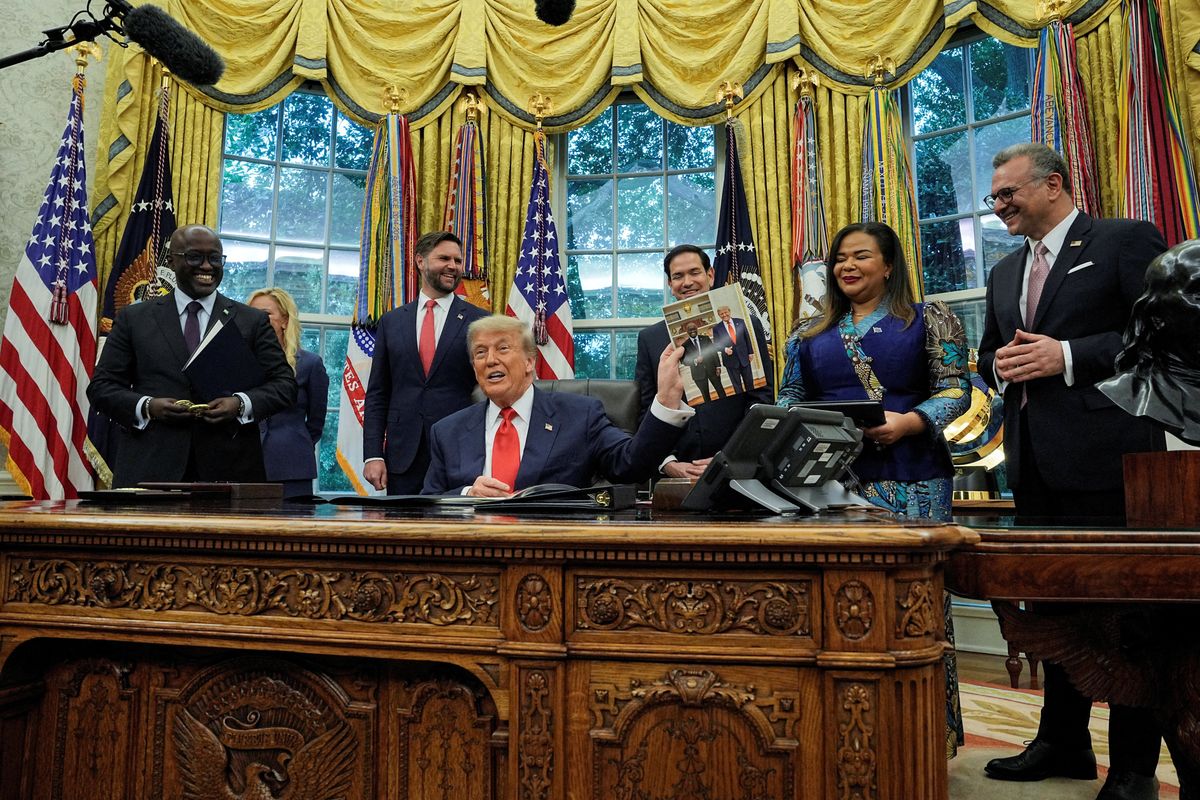
U.S. President Donald Trump holds a picture of himself with Rwanda's Foreign Minister Olivier Nduhungirehe, during a meeting with Foreign Minister Nduhungirehe and the Democratic Republic of the Congo's Foreign Minister Therese Kayikwamba Wagner in the Oval Office at the White House in Washington, D.C., June 27, 2025. REUTERS/Ken Cedeno/File Phot

President Donald Trump seems infatuated with a part of America's past that never existed, according to a new column.

Journalist Molly Jong-Fast argued in a recent essay for The New York Times that Trump world appears to be trying to create America's second Gilded Age. The Gilded Age refers to the period between the 1870s and 1890s, when many industrialists and capitalists amassed extreme wealth. That timeframe inspired novels such as "The Great Gatsby" by F. Scott Fitzgerald and "The Jungle" by Upton Sinclair.

But, as Jong-Fast argued, the version of the Gilded Age that Trump seems to be trying to recreate never existed in the first place.

"It’s important to be clear-eyed about Trump world’s nostalgia for a time that never existed," Jong-Fast wrote.

On one hand, Trump has embraced aspects of the Gilded Age, like tariffs and surrounding himself with lavishness. The last time tariffs on American imports were as high as they are under Trump was during the 1930s, when President Herbert Hoover signed the protectionist Smoot-Hawley Tariff Act to protect American farmers from foreign competition.

"So, it’s not a stretch to say that a return to the Gilded Age is a goal for Mr. Trump and his administration: They pretty much said so out loud," Jong-Fast wrote.

Similarly, Trump has slowly redecorated the White House with gold accents, most notably around the Oval Office. His plans to build a $200 million ballroom at the White House also reflect the Gilded Age, according to some analysts.

"It’s probably that version of the Gilded Age that Mr. Trump and Mr. Lutnick fantasize about, a kind of ode to hats, jewelry, seating plans, and white men who win," Jong-fast argued. "Those in the working class mostly know their place, and there is little actual poverty on view."

However, that version of the Gilded Age never existed. In fact, poverty was rampant during the Gilded Age. Part of the reason poverty was so rampant at the time was that workers had almost no legal protections, according to historians.


Trump's administration appears to be returning America to a similar state by seeking to reduce regulations on corporations, Jong-Fast argued.

"It’s not hard to see ourselves hurtling toward a crisis engendered by the anti-regulation financiers and oligarchs who make up Mr. Trump’s inner circle," Jong-Fast wrote. "They get theirs and the rest of us don’t matter much."

Read the entire column by clicking here.
Epstein victim   SURVIVOR   takes aim at Trump admin on MSNBC: 'I don't know what are they protecting'

David McAfee
August 9, 2025  
RAW STORY


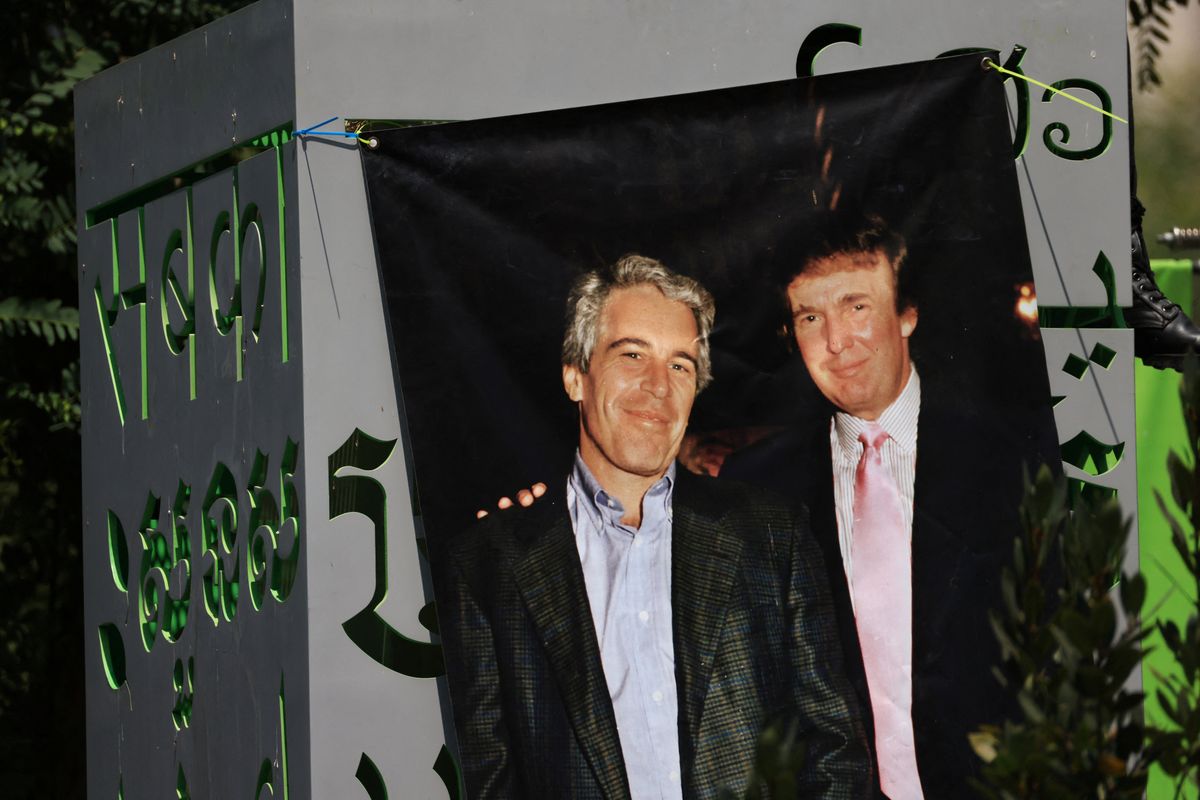
A banner of Jeffrey Epstein and President Donald Trump hangs in Grand Park during a protest against federal migration enforcement in downtown Los Angeles, California, U.S. August 2, 2025. REUTERS/David Swanson

A sexual abuse victim of Jeffrey Epstein on Saturday asked what the Trump administration is hiding as it holds back files related to the disgraced financier.

Actress Alicia Arden, who spoke out about Trump's decision not to release the Epstein files on Wednesday in a press conference with attorney Gloria Allred, appeared on MSNBC along with her lawyer over the weekend to discuss the ongoing "files" scandal.

When asked about the situation on MSNBC, Arden said, "It continues to be a very upsetting matter, and I, myself, and probably the other victims, we didn't know that this would be ongoing for so long."

She continued:

"And now why can't they just release the files? Because they keep talking about it and Pam Bondi keeps talking about it since February. So if there is files and alleged pedophiles or people in them, then why can't I see them and the other victims? And we have a right to see that."


She added, "So I don't know what they're protecting or if they don't want us to see," before saying, "It continues to be very upsetting for years later."


Ancient practice of blowing through a conch shell could help to treat dangerous snoring condition


European Respiratory Society

Dr Krishna K Sharma 

image: 

Portrait of lead researcher Dr Krishna K Sharma

view more 

Credit: Krishna K Sharma / ERJ Open Research


People who practised blowing through a conch shell regularly for six months experienced a reduction in their symptoms of obstructive sleep apnoea (OSA), according to a small randomised controlled trial published today (Monday) in ERJ Open Research [1].


OSA is a common sleep disorder where breathing repeatedly stops during the night due to a blocked airway. It leads to loud snoring, restless sleep and daytime sleepiness. It also increases the risk of high blood pressure, heart disease, and stroke.


Blowing the conch shell, or shankh blowing, has been part of Indian culture for thousands of years. The new research showed that people with moderate OSA who practised shankh blowing slept better, felt more alert during the day and had fewer breathing interruptions at night. The researchers say conch blowing is a simple, low-cost intervention that could help reduce symptoms without the need for medication or machines.


The study was led by Dr Krishna K Sharma from the Eternal Heart Care Centre and Research Institute in Jaipur, India. He said: “The standard treatment for OSA is a continuous positive airway pressure machine, or CPAP, which keeps the patient’s airway open by blowing air through a facemask throughout the night. While effective, many patients find it uncomfortable and struggle to use it consistently.


“In my clinical practice, several patients reported feeling more rested and experiencing fewer symptoms after regularly practising shankh blowing – a traditional yogic breathing exercise involving exhaling through a conch shell. These observations led us to design a scientific study to rigorously test whether this simple, ancient practice could serve as a meaningful therapy for people with OSA.”


The study included 30 people with moderate OSA, aged between 19 and 65, who were assessed at the Eternal Heart Care Centre and Research Institute between May 2022 and January 2024. They were tested with polysomnography, meaning they are monitored throughout a night’s sleep, and asked questions about the quality of their sleep and how sleepy they feel during the day.


They were randomly assigned to either be trained to practise blowing through a conch shell (16 patients) or to practise a deep breathing exercise (14 patients). Participants were provided with a traditional shankh used in yogic practices. They were trained in person at the clinic by a study team member before beginning home-based practice. Participants were encouraged to practise at home for a minimum of 15 minutes, five days per week. After six months, the patients were reassessed.


Compared to the people who practised deep breathing, the people who practised shankh blowing were 34% less sleepy during the daytime, they reported sleeping better and polysomnography revealed that they had four to five fewer apnoeas (where breathing stops during sleep) per hour on average. They also had higher levels of oxygen in their blood during the night.


Dr Sharma said: “The way the shankh is blown is quite distinctive. It involves a deep inhalation followed by a forceful, sustained exhalation through tightly pursed lips. This action creates strong vibrations and airflow resistance, which likely strengthens the muscles of the upper airway, including the throat and soft palate – areas that often collapse during sleep in people with OSA. The shankh's unique spiralling structure may also contribute to specific acoustic and mechanical effects that further stimulate and tone these muscles.


“For people living with OSA, especially those who find CPAP uncomfortable, unaffordable, or inaccessible, our findings offer a promising alternative. Shankh blowing is a simple low-cost, breathing technique that could help improve sleep and reduce symptoms without the need for machines or medication.


“This is a small study, but we are now planning a larger trial involving several hospitals. This next phase will allow us to validate and expand on our findings in a broader, more diverse population and assess how shankh blowing performs over longer periods. We also want to study how this practice affects airway muscle tone, oxygen levels and sleep in greater detail. We’re particularly interested in comparing shankh blowing with standard treatments like CPAP, and in examining its potential help in more severe forms of OSA.”


Professor Sophia Schiza, Head of the ERS group on sleep disordered breathing, based at the University of Crete, Greece, who was not involved in the research said: “Obstructive sleep apnoea is a common disease around the world. We know that OSA patients have poor quality of sleep, and higher risks of high blood pressure, strokes and heart disease. A proportion of patients experience sleepiness during the day. While CPAP and other treatments are available based on careful diagnosis of disease severity, there is still need for new treatments.


"This is an intriguing study that shows the ancient practice of shankh blowing could potentially offer an OSA treatment for selected patients by targeting muscles training. A larger study will help provide more evidence for this intervention which could be of benefit as a treatment option or in combination with other treatments in selected OSA patients."

Researcher demonstrates shankh blowing [VIDEO] 

All influencers now


Rafia Zakaria
August 9, 2025 
DAWN


WHEN you go out for a meal to a fancy restaurant, this is how matters proceed. As soon as you are seated, everyone grabs their phones and takes videos of the decor and ambience. This includes shots of the menu, the table arrangements and the general environment. Then, as soon as the food arrives, it must be photographed before it is eaten. Sizzling or smoking plates, blowtorches flaming crusts — all the dramatic touches are duly recorded. After the meal, there is another photo shoot, lipsticks are refreshed and cheeks sucked in. If there are five people, there will be as many takes of the photos, sometimes in multiple locations inside and outside the eatery.

As someone who is tired of this part of maintaining social relationships, I find this sort of thing tiresome and inauthentic. I am in a minority, however, because broadcasting where one eats, who one eats with, what one eats and what one wears when one eats has become the mainstay of social experience. If it is not promptly Instagrammed, we are forced to admit it didn’t happen, wasn’t enjoyed or had no value.

Value, in fact, is central to all of this. In the social media multiverse, our much-curated images and the record of our lives are equal to the value of our company. In other words, company is now a commodity and must be advertised and branded as one. Those who are not willing to participate in this marketplace of individual branding are increasingly outliers. If you feel strongly about your non-participation, you must let people know in advance and stand tolerantly to the side as others showcase their brand.

Influencers are to blame for this state of affairs. We all know that professional content creators engage in all this to burnish their credentials and boost reach; they imagine themselves the celebrities they almost are. Their habits, all of them designed to make us believe that they are ‘just like us’, are fed to an unthinking, scrolling public via 30-second reels or 20-minute vlogs. Influencers, we believe, are more or less benign, and the entertainment they provide is neutral in nature.


Influencer content is hardly real.

But the part that consumers miss is how the behaviour and strategies deployed by influencers are transforming the way in which we see ourselves and others. The people at the restaurant referred to earlier are not influencers. They may have a few hundred followers at most. Yet they feel pressured to use the strategies and vocabulary of influencers to present themselves as a valuable commodity. This is not to say that, prior to the advent of social media, people were not assessed based on their social capital. Indeed, they joined exclusive clubs to project just that. The difference is that in the current age of influencer domination, we have become obsessed with actions that will look good on social media.

Similar things can be said about the strategies that social media influencers use to appear ‘authentic’ or ‘relatable’. These strategies increase their viewership and earn them endorsements. They are devised by ‘algorithmic experts’, who evaluate which platforms push which content. Hence, influencers who go viral do not do so ‘accidentally’ because some of their content resonated with a large population. They go viral because they have crafted their content in a way that boosts its circulation and appears authentic to the public.

An example of this is deliberate mispronunciation. Influencers know if they mispronounce a word, many people will res­pond to their instinct to correct the in­­­f­luencer. This, in turn, will annoy others who will call out the correctors for ‘judging’. Engagement will go up and incr­e­­­­ase ‘views’ and ‘li-kes’. Another example is rage-bait. This occurs when an in­­fluencer deliberat­e­­ly does something unsightly, like wearing an ugly outfit. Once again, viewers will respond to the instinct to correct or berate, in the process earning dollars for the influencer who baited them.

Then there’s the ‘apology video’ — for instance, when an influencer does something stupid or is rude to a spouse or criticises a child. The fake controversy garners attention and criticism, only to be followed by the apology video in which fake tears are shed to pretend that influencers are just as fallible as their viewers. In the meantime, many wannabe influencers start putting up their own videos in which they end up sharing all sorts of intimate information that should never be online.

Influencer content, like so many other media, is hardly real. It is only when those who consume influencer content become aware of this truth that people will stop pretending that an untapped audience exists for their restaurant visits. Until then, wait 10 minutes before biting into that burger so it can be captured from every angle.

The writer is an attorney teaching constitutional law and political philosophy.


rafia.zakaria@gmail.com

Published in Dawn, August 9th, 2025
Italian Brainrot: the AI memes only kids know

By AFP
August 10, 2025


School-age Italian Brainrot fans can be found from Kenya to Spain and South Korea - Copyright AFP Richard A. Brooks

Katie Forster, with Dessy Sagita and Marchio Gorbiano in Jakarta

In a Japanese shop selling pocket-money trinkets, there is a rack of toys, stickers and keyrings based on a global crew of AI-generated characters that almost every child knows about — and very few adults.

A walking shark in oversized sneakers, an orange with muscular arms and a twirling “Ballerina Cappuccina” with a mug for a head are among the strange stars of the online phenomenon called Italian Brainrot.

“At first it’s not funny at all, but it kind of grows on you,” 16-year-old Yoshi Yamanaka-Nebesney from New York told AFP.

“You might use it to annoy someone and find that funny.”

The name nods to the stupefying effect of scrolling through mindless social media posts, especially over-the-top images created with artificial intelligence tools.

Shouty, crude and often nonsensical Italian voiceovers feature in many of the clips made by people in various countries that began to spread this year on platforms such as TikTok, embraced by young Gen Z and Gen Alpha members.

The dozen-plus cartoonish AI creatures have fast become memes, inspiring a stream of new content such as “Brainrot Rap,” viewed 116 million times on YouTube.

A YouTube Short titled “Learn to Draw 5 Crazy Italian Brainrot Animals” — including a cactus-elephant crossover named “Lirili Larila” — has also been watched 320 million times.

“There’s a whole bunch of phrases that all these characters have,” said Yamanaka-Nebesney, in Tokyo with his mother Chinami, who had no idea what he was talking about.

School-age Italian Brainrot fans can be found from Kenya to Spain and South Korea, while some of the most popular videos reference Indonesia’s language and culture instead.

“I went on trips with my boys to Mexico” and people would “crack jokes about it” there too, Yamanaka-Nebesney said.

– ‘Melodic language’ –


Internet trends move fast, and Italian Brainrot “hit its peak maybe two months ago or a month ago”, said Idil Galip, a University of Amsterdam lecturer in new media and digital culture.

Italian — a “melodic language that has opportunities for jokes” — has appeared in other memes before.

And “there are just so many people in Indonesia” sharing posts which have potential for global reach, Galip said.

A “multi-level marketing economy” has even emerged, with AI video-makers targeting Italian Brainrot’s huge audience through online ads or merchandise sales, she added.

Nurina, a 41-year-old Indonesian NGO worker, said her seven-year-old loves the mashed-up brainrot world.

“Sometimes when I pick him up from school, or when I’m working from home, he shouts, ‘Mommy! Bombardino Crocodilo!'” — a bomber plane character with a crocodile head.

“I know it’s fun to watch,” said Nurina, who like many Indonesians goes by one name.

“I just need to make him understand that this is not real.”

Some videos have been criticised for containing offensive messages that go over young viewers’ heads, such as rambling references in Italian to “Bombardino Crocodilo” bombing children in Gaza.

“The problem is that these characters are put into adult content” and “many parents are not tech-savvy” enough to spot the dangers, warned Oriza Sativa, a Jakarta-based clinical psychologist.

– Tung Tung Tung Sahur –

The best-known Indonesian brainrot character “Tung Tung Tung Sahur” resembles a long drum called a kentongan, which is used to wake people up for a pre-dawn meal, or sahur, during Ramadan.

Indonesia has a young, digitally active population of around 280 million, and “Tung Tung Tung Sahur” is not its only viral export.

This summer, video footage — not AI-generated — of a sunglass-wearing boy dancing on a rowboat during a race at a western Indonesian festival also became an internet sensation.

Noxa, the TikToker behind the original “Tung Tung Tung Sahur” clip, is now represented by a Paris-based collective of artists, lawyers and researchers called Mementum Lab.

“Noxa is a content creator based in Indonesia. He’s under 20,” they told AFP. “He makes fast, overstimulated, AI-assisted videos.”

“He doesn’t call himself a ‘contemporary artist’, but we think he’s already acting like one,” said Mementum Lab, which is focused on complex emerging issues around AI intellectual property, and says it is helping Noxa negotiate deals for his work.

Noxa, in comments provided by the collective, said the character was “inspired by the sound of the sahur drum I used to hear”.

“I didn’t want my character to be just another passing joke — I wanted him to have meaning,” he said.

Cultural nuances can be lost at a mass scale, however, with one 12-year-old tourist in Tokyo saying he thought “Tung Tung Tung Sahur” was a baseball bat.

And the generation gap looks set to persist.

“What’s that?!” laughed a woman as she puzzled at the row of Italian Brainrot dolls.

“It’s not cute at all!”