March 14, 2026
DW
In Instagram posts, Nazi perpetrators are glorified, while their war crimes and role in the Holocaust are omitted. Victims' organizations call it an "attack on the dignity of the survivors."
 Screenshot of an Instagram post with a photo of an SS officer sporting SS insignia
In Instagram posts, Nazi perpetrators are glorified, while their war crimes and role in the Holocaust are omitted. Victims' organizations call it an "attack on the dignity of the survivors."

Image: Instagram
Numerous accounts on the social media platform Instagram have been publishing glorifying photos of the Wehrmacht and SS officers from the period of National Socialism (NS) under Adolf Hitler. The accompanying texts highlight the individuals' bravery, courage, and strategic skill. Their participation in war crimes and in the Holocaust, the mass murder of Europe's Jews, goes unmentioned. All of this has been documented in a DW investigation.
These posts reach millions of people around the world. Many users respond to the photos of the war criminals with approval, adding heart and applause emojis. Any form of critical engagement is absent from these publications.
The dissemination of hate symbols, generally, does not seem to have motivated Meta or its platform, Instagram, to flag or remove the corresponding content and accounts.
DW's research shows that photos were repeatedly posted in which, for example, the insignia of the Schutzstaffel (SS) are visible. The SS was the central instrument of repression and terror in the Nazi state. It was chiefly responsible for the crimes committed in German concentration camps, such as Auschwitz, Majdanek and Treblinka. In the Auschwitz extermination camp alone, the Germans murdered around 1.1 to 1.5 million people — most of them Jews from across Europe, as well as Sinti and Roma, Poles, prisoners of war, political opponents and other minorities.
"I am shaken by this mass of Nazi content," Eva Berendsen told DW. Berendsen works for the Anne Frank Educational Center, which aims to raise awareness of antisemitism and racism. The institution commemorates Anne Frank, the Jewish girl murdered by the Nazis, whose world‑famous diary is one of the most significant documents on the horrors of the Nazi era.
"The photographic material is Nazi propaganda that ends up online decontextualized — meaning without any explanation of what one is actually seeing. Young users are initially left completely on their own with this content," Berendsen said.
It is particularly troubling, she said, that many Instagram users are so young that historical subjects such as National Socialism and the crimes of the Holocaust have not yet been taught in their school classes. "We have to assume that young people today are likely to have their first contact with the topics of Nazism and the Holocaust through social media," Berendsen said.
When young men are repeatedly shown images of supposedly heroic soldiers, "these posts have the potential to reinforce such images of masculinity and masculine fantasies," according to Berendsen.
Numerous accounts on the social media platform Instagram have been publishing glorifying photos of the Wehrmacht and SS officers from the period of National Socialism (NS) under Adolf Hitler. The accompanying texts highlight the individuals' bravery, courage, and strategic skill. Their participation in war crimes and in the Holocaust, the mass murder of Europe's Jews, goes unmentioned. All of this has been documented in a DW investigation.
These posts reach millions of people around the world. Many users respond to the photos of the war criminals with approval, adding heart and applause emojis. Any form of critical engagement is absent from these publications.
The dissemination of hate symbols, generally, does not seem to have motivated Meta or its platform, Instagram, to flag or remove the corresponding content and accounts.
DW's research shows that photos were repeatedly posted in which, for example, the insignia of the Schutzstaffel (SS) are visible. The SS was the central instrument of repression and terror in the Nazi state. It was chiefly responsible for the crimes committed in German concentration camps, such as Auschwitz, Majdanek and Treblinka. In the Auschwitz extermination camp alone, the Germans murdered around 1.1 to 1.5 million people — most of them Jews from across Europe, as well as Sinti and Roma, Poles, prisoners of war, political opponents and other minorities.
"I am shaken by this mass of Nazi content," Eva Berendsen told DW. Berendsen works for the Anne Frank Educational Center, which aims to raise awareness of antisemitism and racism. The institution commemorates Anne Frank, the Jewish girl murdered by the Nazis, whose world‑famous diary is one of the most significant documents on the horrors of the Nazi era.
"The photographic material is Nazi propaganda that ends up online decontextualized — meaning without any explanation of what one is actually seeing. Young users are initially left completely on their own with this content," Berendsen said.
It is particularly troubling, she said, that many Instagram users are so young that historical subjects such as National Socialism and the crimes of the Holocaust have not yet been taught in their school classes. "We have to assume that young people today are likely to have their first contact with the topics of Nazism and the Holocaust through social media," Berendsen said.
When young men are repeatedly shown images of supposedly heroic soldiers, "these posts have the potential to reinforce such images of masculinity and masculine fantasies," according to Berendsen.
Is Instagram becoming young people's first encounter with Nazism?
One example is a post featuring two photos of a mountain infantryman of the German Wehrmacht. It shows him as a young soldier in uniform and as an older man in a suit. The accompanying text reads: "A mountain infantryman who, under Otto Schury, captured the city of Chania on Crete ... For his bravery in Chania he received the Iron Cross 1st Class!"
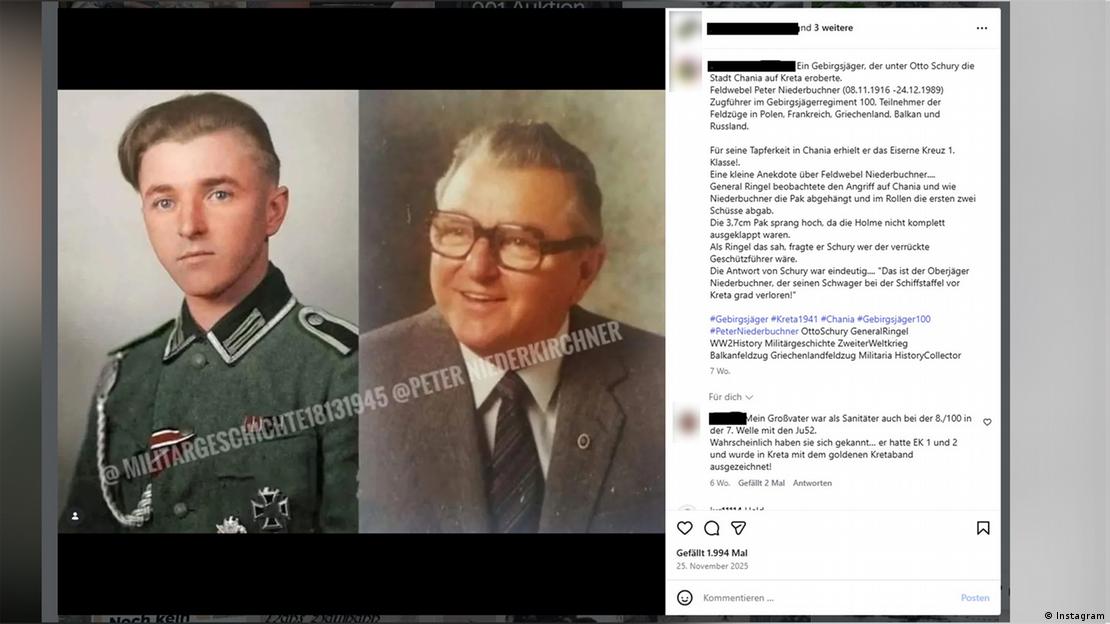
Instagram post about a Wehrmacht soldier: The accompanying text mentions his bravery – his war crimes in Crete are not mentioned
Image: Instagram
Nowhere is there a mention that the conquest of the Greek island of Crete was followed by terror against the civilian population: 300 Jewish residents of the city of Chania were deported to German concentration camps as a result of the occupation. Only four are believed to have survived.
Another post (this article's main photo) shows Waffen-SS officer Kurt Meyer in uniform with SS runes on his collar. The accompanying English text praises Meyer's supposed courage: "His classmates joked that he was as tough as a tank." The text does not mention that Kurt Meyer was a convicted war criminal. After the German invasion of Poland in 1939, he shot 50 Jews.
Who, then, are the people responsible for these accounts? DW's research could not identify a clear structure: the accounts were registered in various countries, including Germany, Pakistan, the United States, and Turkey. Some appear primarily focused on maximizing their reach on Instagram, while others seem more strongly driven by ideology.
Nowhere is there a mention that the conquest of the Greek island of Crete was followed by terror against the civilian population: 300 Jewish residents of the city of Chania were deported to German concentration camps as a result of the occupation. Only four are believed to have survived.
Another post (this article's main photo) shows Waffen-SS officer Kurt Meyer in uniform with SS runes on his collar. The accompanying English text praises Meyer's supposed courage: "His classmates joked that he was as tough as a tank." The text does not mention that Kurt Meyer was a convicted war criminal. After the German invasion of Poland in 1939, he shot 50 Jews.
Who, then, are the people responsible for these accounts? DW's research could not identify a clear structure: the accounts were registered in various countries, including Germany, Pakistan, the United States, and Turkey. Some appear primarily focused on maximizing their reach on Instagram, while others seem more strongly driven by ideology.
The fake Auschwitz images distorting Holocaust history 12:25
Historian: Unbearable distortion of history
Historian Johannes Hürter from the Institute of Contemporary History in Munich is also deeply critical of the posts.
"When convicted war criminals such as SS General Kurt Meyer ('Panzer‑Meyer') and other heavily implicated individuals are placed on a pedestal, this is, from an academic perspective, an almost unbearable distortion of history," Hürter wrote to DW. He sees it as "a relapse into a completely uncritical view of history that one had believed to be long overcome."
Hürter links the flood of Nazi glorification and trivialization on social media to the current rise of right‑wing extremist attitudes and networks: "Right‑wing extremists in all countries have always expressed their admiration for the armed forces of Hitler's Germany, and they now increasingly use this uncritical glorification of the Wehrmacht, the Waffen‑SS, their history, and their symbols as a code of self‑affirmation and communication among themselves."
The deputy chairman of the International Auschwitz Committee, Christoph Heubner, levels serious allegations against Mark Zuckerberg's Meta corporation and other tech billionaires in response to DW's findings: "I believe that many of these founder figures feel very close to the attitude reflected in such posts: elitist leaders," Heubner said in an interview with DW. He accused them of harboring an authoritarian mindset.
For the survivors of Auschwitz and for those affected by the Holocaust, the Instagram posts are a slap in the face: "They are an attack on their dignity. And they assign them a role — namely the role of the losers of history and of the victims. They are the victims who have not yet been finished off. And that is, in this sense, a murderous way of treating people, because it stigmatizes them emotionally and is simply inhumane."
Meta's evasive response to Holocaust trivialization
DW also contacted Meta about the findings of its investigation and included a list of the questionable posts.
The written response came from a PR agency in Hamburg — and it did not answer DW's questions. The staff member thanked DW for forwarding the Instagram posts: "These are currently still under review." The agency also referred to background information from Meta's Community Standards.
Four days after Meta's response, almost all of the posts DW had forwarded as examples were no longer accessible, including the photo of Kurt Meyer in an SS uniform. Why Instagram allowed them in the first place and how the company intends to deal with such content going forward remain unanswered questions.
This article was originally published in German.

Hans Pfeifer DW reporter specializing in right-wing extremism@Pfeiferha


No comments:
Post a Comment