Julian Ryall
DW
16/03/2026
Reports indicate the US is redeploying some Patriot and THAAD air defense batteries from South Korea to the Middle East. The move comes as Pyongyang continues saber rattling.

In 2017, the US began stationing more air defense systems in South Korea, like this THAAD battery
Image: Choo Sang-chul/Newsis via AP/picture alliance
North Korea fired a salvo of 10 ballistic missiles into the Sea of Japan on Saturday, highlighting the need for South Korea to retain a credible missile defense.
Unfortunately, the launch coincides with reports that the US is withdrawing some missile defense systems from South Korea to enhance its capabilities in the Middle East amid the ongoing war with Iran.
Citing US officials, The Washington Post reported on March 9 that the Pentagon was transferring Patriot and Terminal High-Altitude Area Defense (THAAD) anti-missile batteries from US Forces Korea (USFK) to the Middle East.
South Korean media have also reported on an unusually high number of flights by US military transport aircraft from Osan Air Base, although the US is remaining tight-lipped about its actions.
"The USFK may dispatch some air defense systems abroad, in accordance with its own military needs," President Lee Jae-myung said on March 10. "While we have expressed our opposition, the reality is that we cannot fully push through our position."
In an editorial on Wednesday, The Korea Herald said, "Patriot and THAAD batteries are central to the US-South Korea shield against North Korean ballistic missiles, so their withdrawal would carry serious security implications for Seoul."
North Korea fired a salvo of 10 ballistic missiles into the Sea of Japan on Saturday, highlighting the need for South Korea to retain a credible missile defense.
Unfortunately, the launch coincides with reports that the US is withdrawing some missile defense systems from South Korea to enhance its capabilities in the Middle East amid the ongoing war with Iran.
Citing US officials, The Washington Post reported on March 9 that the Pentagon was transferring Patriot and Terminal High-Altitude Area Defense (THAAD) anti-missile batteries from US Forces Korea (USFK) to the Middle East.
South Korean media have also reported on an unusually high number of flights by US military transport aircraft from Osan Air Base, although the US is remaining tight-lipped about its actions.
"The USFK may dispatch some air defense systems abroad, in accordance with its own military needs," President Lee Jae-myung said on March 10. "While we have expressed our opposition, the reality is that we cannot fully push through our position."
In an editorial on Wednesday, The Korea Herald said, "Patriot and THAAD batteries are central to the US-South Korea shield against North Korean ballistic missiles, so their withdrawal would carry serious security implications for Seoul."
Will the air defense return to South Korea?
Another concern is that these systems might not return to South Korea when the crisis in the Middle East has abated, as US President Donald Trump's administration pressures allies to shoulder more responsibility for their own defense.
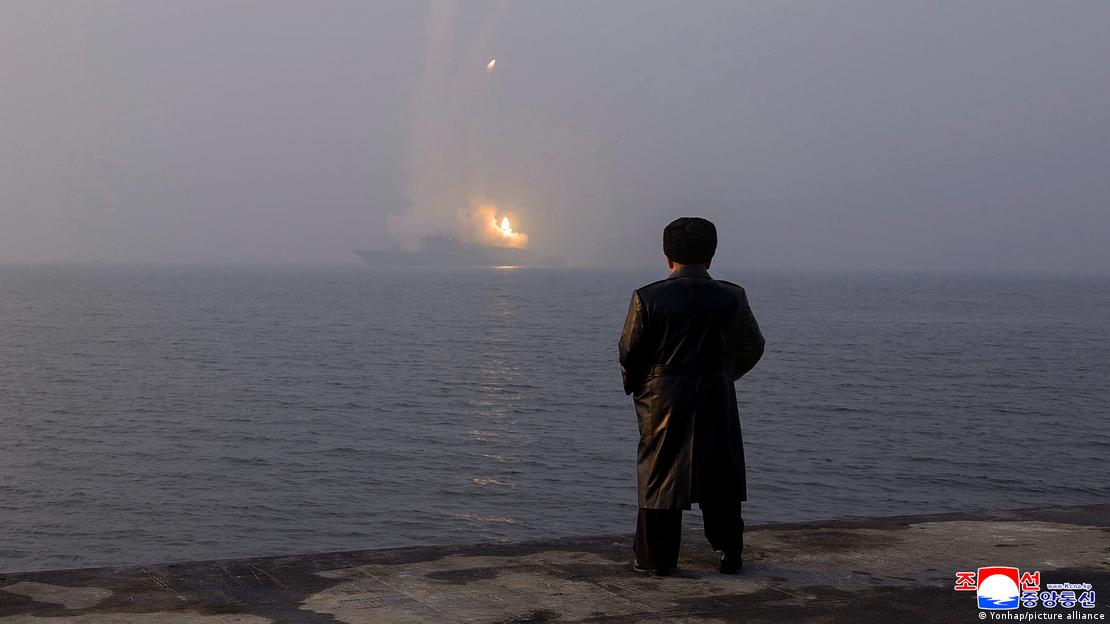
North Korean leader Kim Jong Un observed the recent missile launch off the North Korean coast
Image: Yonhap/picture alliance
The US deployed THAAD batteries to South Korea in 2017, citing the threat from the North.
"It is a problem and there seems to be little that the government can do," said Choo Jae-woo, a professor of foreign policy at Kyung Hee University in Seoul.
"In the past, we had confidence that Korea was in good hands when it came to defending ourselves against the North, but we know the North has better and more missiles and now the US defenses are gone, so people are anxious," he told DW.
With Trump's transactional tactics in mind, Choo suggested that not returning the air defenses when the Middle East crisis has passed could be used as a "pressure point" on Seoul for the White House to get its way on trade or South Korean investment in the US.
Trump asks for support in Iran
The reports of missile battery redeployment come as the conflict in the Middle East shows little sign of winding down, with Trump asking allies, including South Korea, for assistance in protecting shipping in the vital Strait of Hormuz from Iranian attack.
Despite Trump claiming that the US has "destroyed 100% of Iran's military capability," Iran can still target slow-moving tankers in the strait with drones, unmanned boats and other projectiles.
"Hopefully China, France, Japan, South Korea, the UK, and others, that are affected by this artificial constraint, will send Ships to the area so that the Hormuz Strait will no longer be a threat by a Nation that has been totally decapitated," Trump wrote on Truth Social.
The US deployed THAAD batteries to South Korea in 2017, citing the threat from the North.
"It is a problem and there seems to be little that the government can do," said Choo Jae-woo, a professor of foreign policy at Kyung Hee University in Seoul.
"In the past, we had confidence that Korea was in good hands when it came to defending ourselves against the North, but we know the North has better and more missiles and now the US defenses are gone, so people are anxious," he told DW.
With Trump's transactional tactics in mind, Choo suggested that not returning the air defenses when the Middle East crisis has passed could be used as a "pressure point" on Seoul for the White House to get its way on trade or South Korean investment in the US.
Trump asks for support in Iran
The reports of missile battery redeployment come as the conflict in the Middle East shows little sign of winding down, with Trump asking allies, including South Korea, for assistance in protecting shipping in the vital Strait of Hormuz from Iranian attack.
Despite Trump claiming that the US has "destroyed 100% of Iran's military capability," Iran can still target slow-moving tankers in the strait with drones, unmanned boats and other projectiles.
"Hopefully China, France, Japan, South Korea, the UK, and others, that are affected by this artificial constraint, will send Ships to the area so that the Hormuz Strait will no longer be a threat by a Nation that has been totally decapitated," Trump wrote on Truth Social.
Officially, South Korea's presidential office said it is "carefully deliberating" a response, but Lim Eun-jung, a professor of international studies at Kongju National University, told DW there is little appetite for Korean service personnel to be committed to the fighting.
"This request is making people very uncomfortable," she said. "Security is always a worry for us because we do not want to be engaged in somebody else's troubles."
"What is happening in the Middle East is not of no concern to us at all because we get so much of our energy from the region, but no one here wants to be dragged into this conflict," Lim added.
Defending the North Korean threat
However, Lim pointed out the South Korean military has made steps on homegrown defense against threats from the North.
This includes the domestically developed Cheongung-II air defense system that was sold to the UAE, which has performed well in intercepting inbound Iranian missiles and drones.
"The Cheongung is often described as South Korea's Patriot missile system and it has been operating with 95% accuracy for the UAE, so that gives me confidence because it is also deployed on our frontlines," she said.
However, the analyst added that US systems add important layers of defensive depth.
And while the US president is "unpredictable," Lim remains confident that the Patriot and THAAD systems will be redeployed to South Korea in the future "to ensure the balance of power in the region, to make sure that North Korea does not make a misjudged move and that China does not push too hard."
North Korea waiting and watching
Leif-Eric Easley, a professor of international studies at Ewha Womans University in Seoul, said Pyongyang will be closely watching developments in the Middle East, and will be seeking ways to drive a wedge between Seoul and Washington.
The North Korean missile launches on Saturday were attended by North Korean leader Kim Jong Un and coincide with the start of large-scale joint US-South Korean military exercises.
"North Korea is unlikely to take military action when it observes US redeployment of missile defense assets from the Korean Peninsula to the Middle East," Easley said.
"Instead, Pyongyang will aim propaganda at aggravating divisions in Seoul over the strategic flexibility of US forces and the legality of Trump's military action against Iran," he added.
"The Kim regime wants to turn South Korean domestic politics against combined defense exercises and coordinated defense procurement among US allies. That is how North Korea, with conventional forces inferior to South Korea's and nuclear forces inferior to America's, can hope to dominate the Korean Peninsula."
Edited by: Wesley Rahn

Julian Ryall Journalist based in Tokyo, focusing on political, economic and social issues in Japan and Korea

No comments:
Post a Comment