Thursday, August 14, 2025


The Forced Uyghur Labor Behind China's Fish Exports

Uyghur workers
Workers in 2023 at a seafood plant called Yantai Sanko Fisheries in Shandong Province, China, which relies on Uyghur and other labor from Xinjiang (Douyin / Outlaw Ocean Project)

Published Aug 11, 2025 9:31 PM by Marcella Boehler


On a cloudy morning in April 2023, more than eighty men and women, dressed in matching red windbreakers, stood in orderly lines in front of the train station in Xinjiang, a landlocked and subjugated region in China's far west. The people were Uyghurs, one of China’s largest ethnic minorities. They stood, with suitcases at their feet, watching a farewell ceremony held in their honor by the local government. A video of the event shows a woman wearing in traditional dress pirouetting on a stage. A banner reads, “Promote mass employment and build societal harmony.” At the end of the video, drone footage pans back to show trains waiting to take the Uyghurs away. 

The event was part of a vast labor-transfer program run by the Chinese state, which forcibly sends Uyghurs to work in industries across the country. The goal of the program is partially to subjugate a historically restive people. Uyghur separatists revolted throughout the 1990s and bombed police stations in 2008 and 2014. China began the labor transfers in the early 2000s as part of a broad system of persecution that has also included mass arrests and the use of “re-education” camps, where Uyghurs have been subjected to torture, beatings, and forced sterilization. Researchers described China’s actions against Uyghurs and other Turkic Muslims as a form of genocide.

Many of the transferred workers are involved in processing seafood that is then exported to more than twenty countries, including the U.S., Canada, and several in the E.U., according to an investigation published as episode 8 of the Outlaw Ocean Podcast’s second season

These disclosures of China’s use of state-sponsored forced labor in seafood production come as the trade war between the US and China has heightened tensions between the countries and directed new attention to the Uyghur Forced Labor Protection Act. This is an American law that prohibits the import of goods produced in Xinjiang and a cudgel that the Trump administration is likely to apply more aggressively as he ramps up pressure on Beijing.

On November 19, 2024, the European Union approved its Forced Labor Regulation, which prohibits “products made using forced labor” from entering member countries. This new regulation will likely intensify the urgency for companies and market players like the U.S. and Europe to know whether imports coming into those countries are tied to forced labor such as those identified by this investigation.

A review of internal company newsletters, local news reports, trade data, and satellite imagery revealed that ten large seafood companies in the eastern province of Shandong, China’s most important fishing and seafood processing hub, have received at least a thousand Uyghurs and other Muslim minorities from forced labor transfer programs out of Xinjiang since 2018.

Sometimes transfers were motivated by labor demands. In March 2020, for example, the Chishan Group, one of China’s largest seafood catching and processing companies, published an internal newsletter describing what it called the “huge production pressure” caused by the pandemic. That October, party officials from the local anti-terrorist detachment of China’s public security bureau and the country’s human resources and social security bureau, which handles work transfers, met twice with executives to discuss how to find the company additional labor, according to company newsletters.

Soon after, Chishan agreed to accelerate transfers to their plants. Wang Shanqiang, the deputy general manager at Chishan, said in a corporate newsletter, “The company looks forward to the migrant workers from Xinjiang arriving soon.” The Chishan Group did not respond to requests for comment.

The Chishan Group was not unique. Many seafood companies were tied to a wide variety of similar problems with forced labor. The pervasiveness of these problems is why the global seafood industry likely will have to assess how it monitors its supply chains, particularly when these supply chains route through China.

To detect forced labor, companies tend to rely on private firms that conduct “social audits,” in which inspectors visit factories to make sure they comply with international labor standards. But social audits are typically announced in advance, which allows managers to hide minority workers during inspections. Even when workers are interviewed, they are often reluctant to be candid, for fear of retribution. 

In May, 2022, social auditors from SGS, one of the top auditing firms, toured the Haibo seafood processing factory, in Shandong, and found no evidence of forced labor. But a team of investigative reporters found that more than 170 people from Xinjiang worked at Haibo in 2021, and a half-dozen Uyghur workers posted regularly to social media from Haibo throughout 2022. On the same day the auditors toured, a young Uyghur worker posted pictures of herself near the plant’s dormitories and loading bays.

This was not an isolated incident. During the investigation, reporters found other examples of Uyghurs who had posted pictures of themselves at factories within days of those plants being cleared by social audits. They also found that half of the Chinese exporters they had identified as being tied to Uyghur labor had passed audits by leading global inspection firms. 

Marcella Boehler is global publishing editor at The Outlaw Ocean Project, a non-profit journalism organization based in Washington D.C. that produces investigative stories about human rights, environment and labor concerns on the two thirds of the planet covered by water. Season Two of The Outlaw Ocean Project's podcast series may be found here


The opinions expressed herein are the author's and not necessarily those of The Maritime Executive.


CRIMINAL CAPITALI$M

Maritime Training School Owner Pleads Guilty to Defrauding the Coast Guard

Master Marine Credential
The owner of a USCG training program pleaded guilty to a felony charge of falsifying student records

Published Aug 13, 2025 6:20 PM by The Maritime Executive


The U.S. Attorney's Office for the Eastern District of Michigan reported that the operator of a maritime training program for U.S. Coast Guard certificates has pleaded guilty to a felony charge related to falsifying records connected to a course he administered. Mel Stackpoole, age 62 of Michigan, entered his guilty plea on August 12, to one count of knowingly altering and falsifying records and documents with the intent to impede the proper administration of a matter within the jurisdiction of the United States Coast Guard.

According to court records, Stackpoole was the owner and lead instructor of Great Lakes Charter Training, a marine training school that offered Coast Guard-approved training courses. The program supported mariners seeking merchant mariner credentials (MMC).  

“Mel Stackpoole has endangered the safety of everyone who uses the waterways of our Great Lakes by deliberately circumnavigating the Coast Guard’s training and certification protocols and facilitating the issuance of credentials to unskilled and unqualified mariners,” said U.S. Attorney Jerome F. Gorgon Jr. He was joined in the announcement by Captain Richard Armstrong, Commander, U.S. Coast Guard Sector Detroit, and Special Agent in Charge Josh Packer, Coast Guard Investigative Service, Central Field Office, Detroit.

In August of 2020, Stackpoole provided the students enrolled in his Master 100 Ton Captain’s Course with less than 50 hours of classroom instruction, rather than the required 80 hours.  He also instructed the students to provide false information regarding their prior sea service, medical history, and recreational drug use on their MMC applications to the Coast Guard.  

Further, Stackpoole improperly provided the students with the answers to certain examination questions; changed students’ incorrect test answers into correct answers; and inflated the students’ test scores in order to reflect passing, rather than failing, grades. Stackpoole ultimately issued course completion certificates to the students, falsely signifying their successful completion of the course to the Coast Guard.

A sentencing hearing is set for December 18, at which Stackpoole faces a statutory maximum penalty of 20 years of imprisonment and a $250,000 fine.


India’s First Offshore Wind Tenders Fall Flat and are Canceled

India Tamil Nadu
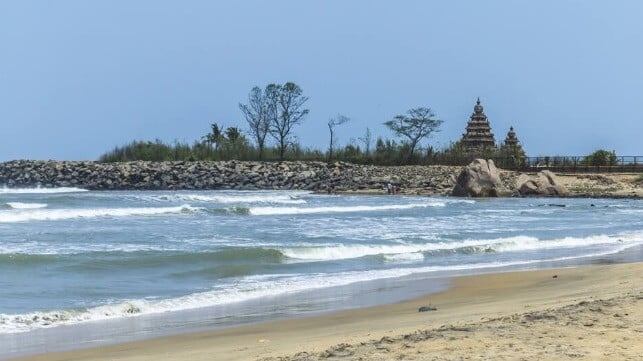
India looks to develop the Tamil Nadu region into a center for offshore wind (iStock/Kandarp Gupta photo)

Published Aug 13, 2025 7:02 PM by The Maritime Executive


The Solar Energy Corporation of India, a government entity set up to oversee the development of the country’s offshore wind energy sector, canceled its first two auctions after a year of attempting to drum up interest. Withdrawing the auctions is seen as a major setback for the country’s energy policy and the plans by Prime Minister Narendra Modi to drive industrial growth in the country.

The tenders were released in 2024 and hailed as India’s entry into the sector. Analysts are saying they were an experiment to find the correct course, but fell short of the required support to develop a new country for the industry. The government had extended the timeline for the two tenders to the end of July and early August, and reworked some of the support plans, but it was to no avail.

The reports are that they received a lack of interest from developers. One source is quoted in the Indian media saying the response was “underwhelming.” India had launched the Viability Gap Funding (VGF) program in June 2024, intended to incentivize the development of the first 1 GW of offshore wind capacity, but experts warned it was likely not enough.

SECI had staged two tenders with the jewel highlighted as the Tamil Nadu region. It was promoted as a potential major hub for offshore wind manufacturing and part of the industrial opportunities plan developed by Modi.

For Tamil Nadu, SECI proposed four 1 GW areas. Developers were to get seabed lease rights and then would be responsible for conducting the necessary seabed surveys and development activities for the projects. The areas are on the southeast coast of India on the Bay of Bengal.

A smaller 500 MW project was proposed for Gujarat, designed as a build-to-operate development. India was offering a 25-year power purchase agreement. The site is on the northwest coast of India in the Arabian Sea.

Developers in general are demanding more support to offset the increased costs and risks associated with developing offshore wind projects. They cite the problems in the supply chain and increased costs in the industry since the pandemic, and the challenges of financing the projects. Ørsted this week said financing has dried up in the United States, with banks and investors not willing to accept the risks as the Trump administration has focused on slowing or ending wind energy projects. The company is also facing large costs after it reported earlier in the year that changed finances no longer supported the development of the UK’s large Hornsea 4 project in its current form.

The Netherlands cited a lack of interest and challenging finances as it said it would scale back its offshore wind plans. Germany, also, recently reported it had not received any interest in an auction for non-subsidized offshore wind projects.

The Indian media is quoting sources saying the country is not giving up on offshore wind but will re-examine its approach. SECI has not officially said it would re-tender the sites, but sources said it is likely they will rework the plans and relaunch the tenders. No timeline was offered for how quickly the new tenders might begin, with commentators noting it is now unlikely India will have offshore wind energy ahead of its 2030 target.


Mocean Energy & SolarDuck Team Up on Integrated Offshore Renewable Power

Mocean Energy
Arnaud Ayral, Chief Commercial Officer, SolarDuck, and Cameron McNatt, Managing Director at Mocean Energy.

Published Aug 13, 2025 8:03 PM by The Maritime Executive


[By: Mocean Energy]

Scottish ocean energy pioneer Mocean Energy has signed a Memorandum of Understanding (MoU) with Netherlands-headquartered floating solar developer SolarDuck.

The strategic collaboration aims to deliver hybrid power systems that combine SolarDuck’s cutting-edge floating solar platforms with Mocean Energy’s innovative wave energy technology.
Together, the companies - which have both individually received investment from Norwegian clean-tech fund manager Katapult Ocean - will target applications for remote offshore sites in a variety of sectors, such as energy, defence and the wider Blue Economy.

Based on combined ocean energy and floating solar technologies, the pair will deliver a high-level joint concept that provides clean, reliable energy for power, communications and auxiliary systems to support remote offshore assets.

Cameron McNatt, Managing Director at Mocean Energy, said: “This MoU marks the next step in a promising business and technical collaboration between Mocean Energy and SolarDuck, focused on delivering integrated ocean energy solutions, combining wave and solar technologies for offshore applications. Particular focus is being given to providing power and communications to remote sites in challenging environments.

“Over the past few months, we’ve been sharing commercial insights and have identified a strong opportunity to conduct an internally funded technical feasibility study focused on offshore energy needs in Asia Pacific.

“Both Mocean Energy and SolarDuck are backed by Katapult Ocean, a leading Norwegian investor in clean and ocean-tech, which underscores the strategic alignment of our vision. At a broader level, this partnership reflects a growing movement toward leveraging offshore renewables to address power challenges and accelerate decarbonisation across the Blue Economy.”
Mocean Energy has already showcased the viability of its innovative wave and solar-powered technology through the successful deployment of its Blue X wave energy converter prototype.
As part of the Renewables for Subsea Power programme, this prototype, which can be seamlessly integrated with battery storage systems, has demonstrated its ability to provide consistent and reliable renewable power in offshore environments.

Building on the success of Blue X, Mocean Energy is now preparing to deploy its first commercial product, Blue Star - a next-generation wave energy device designed for long-term operation and scalability across a range of offshore applications.

During the term of the MOU, Mocean Energy and SolarDuck will also collaborate on a commercial and technical basis to identify engineering studies and commercial opportunities. As part of this the pair will share insights into each’s respective technology and requirements to more effectively approach market opportunities.

This cooperation reflects the increasing demand for resilient, sustainable and low-carbon power systems in offshore industries, as well as both parties’ commitment to driving innovation and setting new standards in offshore renewable energy deployment.

Arnaud Ayral, Chief Commercial Officer, SolarDuck, said: “This partnership aligns with SolarDuck and Mocean Energy’s shared vision to enable clean energy solutions in challenging offshore environments.

“By combining complementary technologies, we aim to unlock new capabilities and value for customers in the offshore sector. Working with Mocean Energy, we can bring robust, scalable, and sustainable power to remote offshore locations, revolutionising the way in which the industry operates.”

Anthony Bellafiore, Investment Manager, Katapult Ocean, added: “We see immense value in our portfolio companies collaborating to unlock greater technical and commercial potential. Mocean Energy and SolarDuck are taking an ambitious step to show what’s possible when pioneering offshore technologies work together to address global infrastructure needs.
“While scaling renewable offshore energy continues to have its challenges, we continue to back it because of its outsized ability to generate systemic impact and shift our blue economy from an extractive industry to a more sustainable one. With all this in mind, we are very excited to see what Mocean and Solarduck can achieve together.”

The products and services herein described in this press release are not endorsed by The Maritime Executive.

 CANADA

Bulker Grounds in St. Lawrence River Raising Water Level Questions

grounded bulker
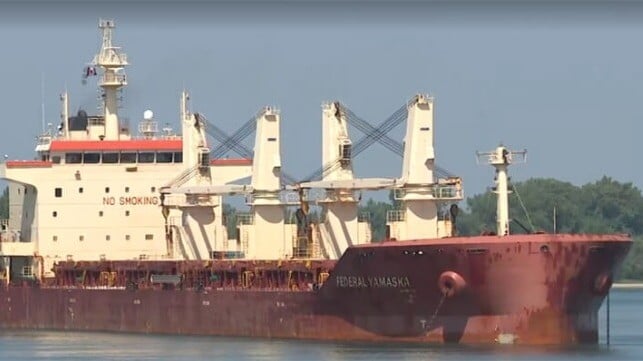
A bulker grounding on the St. Lawrence River raised more questions about water levels (CBC TV)

Published Aug 13, 2025 4:40 PM by The Maritime Executive


The Canadian Coast Guard issued a warning that a large bulker had grounded early on August 12, north of Montreal on the St. Lawrence River. While the authorities were quick to say they did not believe it was due to falling water levels, many have questioned the impact of a growing drought on shipping in the vital seaway.

The bulker Federal Yamaska reported to the Coast Guard at 5:45 a.m. local time on Tuesday that it had lost power and grounded in the river. The ship is outside the main shipping lane, but the Coast Guard has warned vessels to produce a minimum wake and requested that other ships give the grounded vessel a “wide berth” while passing. Further, they have ordered no meeting or overtaking of other vessels in the area.

Federal Yamaska, registered in the Marshall Islands, is operated by Fednav, a specialist in navigating Canadian waters, including the Arctic, Great Lakes, and the St. Lawrence Seaway. Built in 2013, the vessel is 590 feet (180 meters) in length and 37,153 dwt. 


A Coast Guard spokesperson told the Canadian Press that they were still investigating the cause of the grounded, but they did not believe it was due to low water levels in the area. They said the vessel, which was traveling to Montreal loaded with sugar, had advised that it lost power and drifted south of the shipping channel. They are reporting the vessel is in compliance with the loading regulations for that region of the river.

Many questions, however, have been raised as the Quebec area of Canada is experiencing a heatwave and has had a lack of precipitation in the southern portion of the province for nearly a month. Le Journal reported this week that the water level on the St. Lawrence River is at its lowest level in 15 years. Falling water levels had already prompted load restrictions for vessels on the river between Quebec and Montreal. 

The Coast Guard said there were no injuries or reports of pollution from the grounding. They are currently waiting for the shipping company’s plan for refloating the vessel. The expectation is that the ship will remain in this position for at least several days.

Observers, however, are noting the ship is in a similar area on the river to where another bulker grounded on December 24, 2024. Efforts to refloat the Maccoa, which was loaded with 3,000 tons of corn, were unsuccessful and required lightening the vessel. It took two weeks to remove part of the cargo and free the ship.


US Federal Court Suspends Fishing in Pacific Islands Nat'l Monument

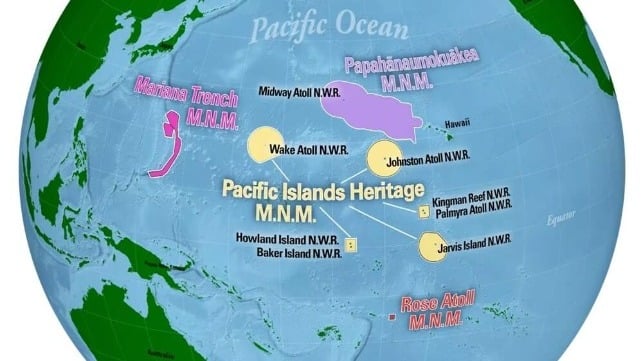
Chart courtesy US FWS

Published Aug 13, 2025 6:15 PM by The Maritime Executive


A federal district court has vacated a letter from NOAA Fisheries that told tuna boats to fish within the previously-protected Pacific Islands Heritage Marine National Monument. In a summary judgment, U.S. District Judge Micah Smith found that he had little choice but to rule that the letter was legally invalid, as NOAA didn't defend its merits in court.

In mid-April, President Donald Trump signed a proclamation to open up the Pacific Islands Heritage Marine National Monument to commercial fishing, allowing U.S.-flagged tuna boats to pursue their catch within an area covering more than 400,000 square miles of the U.S. exclusive economic zone. The area has been closed to fishing ever since the national monument was expanded by former President Barack Obama in 2014. The monument covers nearly half of the U.S. EEZ in the Pacific Islands, and the administration argued that the restrictions hurt the interests of tuna fishermen operating out of American Samoa. 

After the president's proclamation, NOAA Fisheries took swift action to implement the order. It dispatched a letter to existing U.S. tuna permit holders to inform them that in certain areas of the monument, commercial fishing was "no longer prohibited." The letter was not published in the Federal Register, and the agency did not treat it as a formal rulemaking process. Some commercial fishing operators accepted the letter, and began actively fishing within the monument. 

The Magnuson-Stevens Act and the Administrative Procedure Act require public input for federal agency rulemaking, and previous rulemakings about fishing inside the monument area had followed this process. But NOAA's letter suggested that a proclamation from the president was all that was needed to change a federal rule. A group of Hawaiian environmental and cultural groups filed a lawsuit, arguing against both the decision and the procedures NOAA used to enact it. 

On August 8, Judge Smith found that the letter was invalid because NOAA Fisheries skipped the required public input procedures for federal rulemaking, then opted not to defend that decision in court.  

"The government has chosen not to defend on the merits of notice-and-comment rule making," Smith wrote. "The court therefore is not asked to make a judgment call: the government has chosen to forfeit any argument that notice and comment procedures were unnecessary."

In vacating NOAA's letter, Smith determined that commercial fishing is still banned within the national monument - at least, until NOAA Fisheries starts over and conducts a formal rulemaking with a notice-and-comment process. The letter is no longer accessible on NOAA's website.  

"The law guarantees a process where we can advocate for protecting the generations of our children’s children who are yet to be born," said Solomon Kaho'ohalahala, a founding member of Hawaiian native cultural group Kapaa. "The Fisheries Service cannot ignore our perspectives as the native people who belong to the islands and to the ocean that surrounds us."


Houthi Forces Are Importing Drone Parts and Supplies From China

Container hoist components intercepted by Security Belt Forces (@SecurityBelt)

Published Aug 13, 2025 3:34 PM by The Maritime Executive


Houthi forces in Yemen appear determined to maintain their campaign against shipping interests with claimed links to Israeli port calls. They also spasmodically and ineffectively continue to fire drones and missiles at Israel. However, recent attacks on port infrastructure in Hodeidah, Ras Isa and Salif have complicated the importation of the materials the Houthis need to pursue their campaign.

Security Belt forces in Lahj, sponsored by the United Arab Emirates, recently intercepted a cargo of prefabricated cranes manufactured in China at a border crossing point at Al Hawtah. The hoists would have been used to unload ship containers, replacing infrastructure destroyed on the attacks on Houthi ports. The prefabricated cranes had been unloaded in Aden, and the Houthis had been attempting to smuggle the components by truck into Houthi-controlled areas. The interception took place at a control point between the two contested areas of Yemen. Further south in Abyan, Security Belt Forces also recently intercepted a large quantity of small arms ammunition which was also being smuggled northwards in a truck; such interceptions are commonplace.

Another recent cargo seizure comprised the equipment necessary to build a drone factory in the Houthi-controlled area. The equipment was intercepted on August 2 by the Counter-Terrorism Service in Aden, and had been packed into five containers declared to be holding car parts which had been unloaded from a ship arriving directly from China. Analysis of the equipment within the containers suggests that the drones which the factory, once assembled, could have manufactured would have been of short to medium range.  

Intercepted in another cargo was a Swiwin SW1200Pro turbojet, manufactured in the Baoding High-Tech Zone in China. The thrust output of such a turbojet also would be suitable for short to medium range drones. However, for longer-range drones and missiles, the Houthis still seem to be reliant on components imported from Iran; the dhow Al Sharwa intercepted in July by Tareq Saleh’s National Resistance Forces contained Iranian-manufactured components for the longer range Sayyad cruise missile, which has a 200-kilo warhead and a 500-mile range.

The Chinese maintain good relations with the internationally-recognized Yemeni government, with an embassy based in Aden. When interviewed by Asharq Al-Awsat on July 8, Chargé d'Affaires Shao Zheng claimed that China maintains strict controls over goods which could be of military value to the Houthis.  Predictably, on August 12 he described as "baseless rumors" the reports that Chinese goods had been intercepted in the port, and said that he did not know where the Chinese-manufactured turbojets had come from. 

Overland smuggling keeps supplies flowing

Traffic flows constantly across land borders between the two contested areas of Yemen, a reality exploited by Iranian arms smuggling networks. Controls are not always effective and can be circumvented with bribery. The main road from Aden, controlled by the internationally-recognized government, has recently been re-opened, and from Taiz passes through Houthi-controlled areas to Sana’a and Hodeidah. Now that use of Red Sea ports has been impeded, use of these internal smuggling routes through Yemen is likely to increase.

Increased seizures, both at sea and internally within Yemen, indicate that if the well-established “front door” smuggling routes from Iran through Hodeidah are disrupted, then the Houthis will adapt and use “back door” routes instead. The Houthis are unlikely to be able to self-manufacture all that they need to pursue their aggressive campaign. This then places additional responsibilities on shipping and logistic companies to ensure that customs and end-user declarations are accurate.

The Houthi movement is at present undergoing some internal disruptions, but pursuit of hostile acts against demonized external parties is one mechanism which the Houthis probably believe can unite their movement. So adaptive arms smuggling is going to continue, and Chinese firms will be delighted to take advantage of the commercial opportunities presented, with or without the knowledge or encouragement of the Chinese authorities.


Tropical Storm Erin to Pass North of Puerto Rico as Major Hurricane

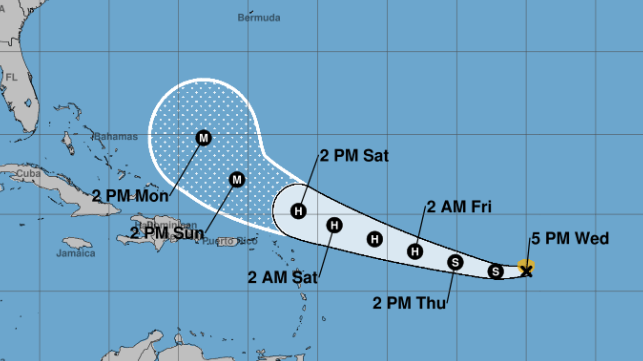
National Hurricane Center chart of Erin's trackline
Courtesy NHC

Published Aug 13, 2025 7:04 PM by The Maritime Executive


The U.S. Coast Guard has set its first precautionary warning in place for ports in Puerto Rico and the U.S. Virgin Islands for the expected effects of Tropical Storm Erin, which will likely be a hurricane by Friday and a major hurricane by the weekend. 

Erin is currently located about 1,000 nautical miles to the east of Puerto Rico and moving westward at about 15 knots, according to the National Hurricane Center. By Sunday, it will likely pass within about 200 nautical miles of Puerto Rico's north shore, bringing heavy rain, high waves and tropical storm-force winds to Puerto Rico, as well as the USVI and the northern Leeward Islands. It is expected to reach an intensity of 100 knots by Sunday, but it is tracking far enough out to sea that a landfall is not in the forecast for the next five days.  

Beyond that timeframe, weather forecasting models diverge on where Erin might go next, according to the National Hurricane Center. "There is a greater than normal uncertainty about what impacts Erin may bring to portions of the Bahamas, the east coast of the United States, and Bermuda," NHC cautioned. "As we approach the climatological peak of the hurricane season, this is an opportune time to ensure your preparedness plans are in place."

For shipping and port interests in Puerto Rico, the Coast Guard has set Port Condition Whiskey (72 hours until gale-force winds arrive). That means reviewing heavy weather response plans and getting ready for going to sea, or doubling down on lashings if the vessel must remain in port. The public is advised to remove recreational boats from the water, and mariners are reminded that ports are safest when they are as empty as possible during a storm, the Coast Guard cautioned. The captain of the port will typically order oceangoing vessels out to sea 24 hours in advance of the arrival of gale force winds (Condition Yankee), and this is the next step in the procedure. 

"Oceangoing vessels 500 gross tons and above must make plans to depart no later than the setting of Port Condition Yankee unless authorized by the Captain of the Port," COTP San Juan warned in an advisory Wednesday.   

Import Surge Drives Volume to a New Record at Port of Long Beach

Port of Long Beach file image
Courtesy Port of Long Beach

Published Aug 13, 2025 10:47 PM by The Maritime Executive


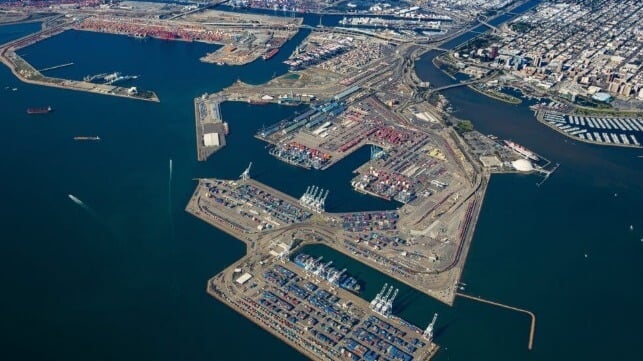
Taking advantage of a six-month window between U.S. tariff hikes, importers surged boxes from East Asia into Southern California's gateway ports in July, sending Port of Long Beach's numbers to record levels for the month. However, the port thinks that the surge was a temporary response to policy incentives and will not boost annual performance.

Long Beach's terminals handled nearly 950,000 TEU worth of cargo, including nearly 470,000 TEU in imports and about 380,000 TEU in empties. Export containers - about a tenth of the port's business - declined by 13 percent. Overall, it was the busiest July in Port of Long Beach's history. 

"Retailers are now seeing the arrival of goods that were purchased for lower costs during the temporary pause placed on tariffs and retaliatory tariffs earlier this year," said Port of Long Beach CEO Mario Cordero. "Due to the ongoing uncertainty caused by shifting trade policies, our Supply Chain Information Highway digital tracking tool forecasts that cargo will be down about 10 percent in the second half of 2025, resulting in a flat year for volume."

According to supply chain intelligence firm Descartes, U.S. container imports surged to a near-record high as ex-China cargo volume rebounded. Overall, American ports brought in 2.6 million TEU worth of foreign goods in July, up 18 percent from the prior month and almost exactly the same as the prior record, set during the late-pandemic cargo surge in 2022. 

Imports from China drove the spike in volume, according to Descartes, and accounted for 35 percent of the entire import TEU total. At present, a temporary pause in the Trump administration's tariff negotiations with China means that Chinese goods can be imported at a comparatively low 30 percent tariff rate, which will expire (unless extended) on November 10 - giving retailers an incentive to stock up now. 

China Challenges Trump's US Shipbuilding Dream

The world's largest containership, built by Hudong-Zhonghua Shipbuilding Group, in Rotterdam harbor, Netherlands, on August 12, 2022. 
Thierry Monasse/Getty Images

 Aug 13, 2025
By Micah McCartney
China News Reporter
Newsweek Is A Trust Project Member


China's top two shipbuilders are finalizing a merger that began in 2019, creating the world's biggest shipbuilding company.


The $16 billion deal is expected to further widen China's lead over the United States, as President Donald Trump pushes to revive the nation's stagnant shipbuilding industry.

Why It Matters


China has vaulted to the forefront of global shipbuilding over the past two decades. The country's largest state-owned shipbuilder, China State Shipbuilding (CSSC), delivered more commercial vessels by tonnage in 2024 than the entire U.S. shipbuilding industry has produced since the end of World War II, according to Washington, D.C., think tank the Center for Strategic and International Studies.

China's shipbuilding capacity also increasingly extends to sea power. The People's Liberation Army Navy now boasts the world's largest fleet by hull count and is producing nearly three ships for every one launched by the U.S. Navy, according to Admiral Samuel Paparo, head of the Indo-Pacific Command.

What To Know

This week, the CSSC is absorbing the country's second-largest shipbuilder, China Shipbuilding Industry Corporation, with trading in both companies' shares suspended on Tuesday.

Together, the two companies accounted for nearly 17 percent of the global market in 2024, according to data on new orders from maritime analysis firm Clarksons Research.

Originally part of the same organization, the two firms were split in 1999 under Chinese Communist Party reforms aimed at introducing limited competition among state-owned enterprises

Beijing hopes the merger will reduce costs and cushion the blow of U.S. trade actions.


State media have hailed the deal as a step to eliminate inefficiencies, optimize resource allocation, and strengthen China's prospects in the global shipbuilding market amid geopolitical tensions and competition from competitors such as South Korea and Japan.

"In recent years, the U.S. has launched crackdowns against China's shipbuilding industry, such as the so-called Section 301 action targeting China's maritime, logistics, and shipbuilding sectors, and the port fee plan," said the Global Times.

This Trump administration has begun phasing in new port fees on Chinese vessels, claiming unfair trade practices and state subsidies.

These measures appear to be having an effect. According to global trade association the Baltic and International Maritime Council, China's share of new shipbuilding orders declined to 52 percent from 72 percent in the first half of this year.
What People Are Saying

Anna Kelly, White House deputy press secretary, told Newsweek: "American shipbuilding was neglected for decades under failed presidents like Joe Biden, but President Trump is prioritizing this vital industry to strengthen our country's economic and national security— including by securing a historic $43 billion shipbuilding investment in The One, Big, Beautiful Bill."

Tom Shugart, an adjunct senior fellow at the Center for a New American Security, told Newsweek: "China's already massive shipbuilding capacity remains under a single, state-controlled enterprise.

"That scale, coupled with the integration of military and commercial production, will remain a central enabler of China's naval expansion—and a key factor in the eroding U.S.–China maritime balance."

Xu Yi, an analyst at Shanghai-based risk management firm Haitong Futures, told the South China Morning Post: "This merger marks the largest strategic restructuring in China's shipbuilding history, aimed at optimizing resource allocation and enhancing competitiveness in the global market."

President Donald Trump said in his March 6 address to Congress: "We used to make so many ships. We don't make them anymore very much, but we're going to make them very fast, very soon. It will have a huge impact."
What Happens Next

Trump has pledged to "resurrect" both commercial and military shipbuilding in the United States, lamenting that only 0.2 percent of the world's ships are built domestically compared with nearly three-quarters in China.


CSSC and CSIC Pause Trading a Shipbuilding Mega-Merger Nears Finale

CSSC shipyard
File image courtesy CSSC

Published Aug 13, 2025 3:19 PM by The Maritime Executive


China's two state shipbuilding giants are moving ahead with the maritime mega-merger of the century. CSSC and CSIC, once one entity, have halted trading in their respective shares in anticipation of becoming one combined company, CSSC. 

The much-anticipated merger has been a long time developing, and it brings CSSC full-circle. The company spun off CSIC as a separate entity in 1999, giving the newly-formed firm control of government-owned yards in northern China and creating new competition in the domestic industry. CSIC's assets include Dalian Shipyard, Bohai Shipyard, Wuchang Shipyard and a wide variety of associated support infrastructure. Its yards hold a large share of the giant PLA Navy warship construction portfolio, as well as a full docket of commercial orders. 

CSIC came under the CSSC umbrella in 2019, but it retained its separate management structure and its constellation of design, R&D, administration and supply-chain departments. This duplicated many of the same costs and functionalities found within CSSC, preventing the combined entity from realizing savings from the re-merger. 

In September 2024, CSSC announced that it would be consolidating the two groups' giant corporate structures into a single entity. Anticipated gains include cost savings, better coordination on supply ordering and production sequencing, strengthened defense shipbuilding, and reduced competition. 

To re-merge, CSSC will swap shares with CSIL shareholders in the largest absorption merger ever conducted in China's A-share listed market. CSIC will be incorporated into CSSC and will disappear as a separate brand, and CSSC will become the world's largest unified shipbuilding company by assets and revenue (it was already the world's largest shipbuilding group). 

As of the end of 2024, Chinese yards held more than 60 percent of the world's shipbuilding orders, with CSSC/CSIC accounting for the largest share. 


Yangzijiang Shipbuilding Posts Record Profit

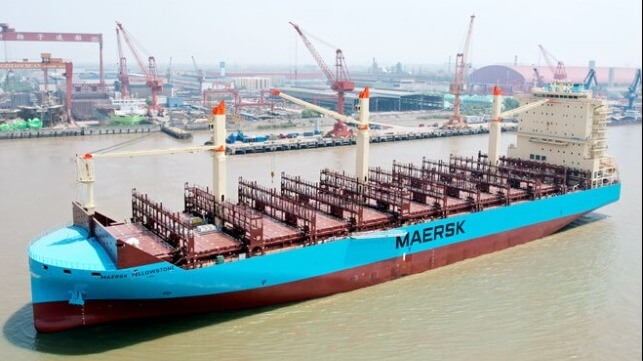
Maersk Yellowstone
File image courtesy Yangzijiang Shipbuilding

Published Aug 11, 2025 9:40 PM by The Maritime Executive


China's shipbuilding industry has grown by leaps and bounds over the last year, and so have its profits. Last week, privately-held Yangzijiang Shipbuilding reported a record-setting profit of $580 million in the first half, up by 37 percent year-on-year. 

Yangzijiang is China's largest private shipbuilder, and a bellwether for its commercial shipbuilding industry. The yard's revenue was slightly down in the first half, due to a lower share of container ships in its mix of projects during the period. This was offset in part by a higher share of dual-fuel orders in its boxship portfolio, since the technology is more expensive and yields better margins for the shipbuilder. Dual-fuel vessel orders account for about three-quarters of the yard's orderbook. 

In addition to performance at its own yards, profits were driven in part by operations at two Japanese joint ventures, Zhoushan Tsuneishi Shipbuilding and Yangzi Mitsui Shipbuilding, which contributed a combined $67 million in profits.

New orders are coming in a bit more slowly than expected this year, Yangzijiang reported. The shipbuilder received just 14 new orders worth a combined $540 million in the first half, less than a tenth of its full-year order target for 2025. However, the full-year outlook is still good, as it is holding more than $2 billion worth of letters of intent for more orders, according to ratings agency CGS International. 

This is not an immediate issue - Yangzijiang has a backlog of 236 ships worth a combined $23 billion on order, near a record high, giving it a long runway in almost any market - but the slowdown is a change compared to last year's ordering boom. The Trump administration's planned port fees on Chinese-built ships (as proposed by the U.S. Office of the Trade Representative) is giving shipowners a reason to look at alternative shipbuilders outside of China; at the same time, tariff concerns have prompted some owners to rethink their ordering plans or wait for more clarity. 

Yangzijiang broke ground on a wholly new shipyard, Yangzi Hongyuan, in February 2025. However, it has shelved a plan for a greenfield expansion yard, Jiangsu Yangzi Runze Shipbuilding, which was to be located next to the existing Yangzi Mitsui Shipbuilding JV facility, according to CGS International's latest advisory. The pause is among the few signs of any letup in the relentless growth of Chinese shipbuilding. Since 2023, the strong demand for Chinese-built ships has driven a wave of restarts at yards that were shuttered during the shipbuilding downturn of the 2010s, reviving old names under new ownership. 


Researchers use smart watches to better understand human activity


Washington State University


PULLMAN, Wash. –Researchers have long been able to use information from smartwatches to identify physical movement, such as sitting or walking, that wearers are performing in a controlled lab setting.

Now, Washington State University researchers have developed a way, using a computer algorithm and a large dataset gathered from smartwatches, to more comprehensively identify what people are doing in everyday settings, such as working, eating, doing hobbies or running errands.

The work, published in the IEEE Journal of Biomedical and Health Informatics, could someday lead to improve assessment and understanding of cognitive health, rehabilitation, disease management, or surgical recovery. In their study, the researchers were able to accurately identify activities 78% of the time.

“If we want to determine whether somebody needs caregiving assistance in their home or elsewhere and what level of assistance, then we need to know how well the person can perform critical activities,” said Diane Cook, WSU Regents Professor in WSU’s School of Electrical Engineering and Computer Science who led the work. “How well can they bathe themselves, feed themselves, handle finances, or do their own errands? These are the things that you really need to be able to accomplish to be independent.”

One of the big challenges in healthcare is trying to assess how people who are sick or elderly are managing their everyday lives. Medical professionals often need more comprehensive information about how a person performs functional activities, or higher-level, goal-directed behavior, to really assess their health. As anyone who is trying to help a distant parent with aging or health challenges knows, that information on how well a person is performing at paying their bills, running errands, or cooking meals is complex, variable, and difficult to gather — whether in a doctor’s office or with a smartwatch.

“Lack of awareness of a person’s cognitive and physical status is one of the hurdles that we face as we age, and so having an automated way to give indicators of where a person is will someday allow us to better intervene for them and to keep them not only healthy, but ideally independent,” said Cook. “This work lays the foundation for more advanced, behavior-aware applications in digital health and human-centered AI.”

For their study, the WSU researchers collected activity information over several years from several studies.

“Whenever we had a study that collected smartwatch data, we added a question to our data collection app that asked participants to self-label their current activity, and that’s how we ended up with so many participants from so many studies,” she said. “And then we just dug in to see whether we can perform activity recognition.”

The 503 study participants over eight years were asked at random times throughout the day to pick from a scroll-down list of 12 categories to describe what they were doing. The categories included things like doing errands, sleeping, traveling, working, eating, socializing, or relaxing. The researchers analyzed a variety of artificial intelligence methods for their ability to generalize across the population of study participants.

The researchers developed a large-scale dataset that includes more than 32 million labeled data points, with each point representing one minute of activity. They then trained an AI model to predict what functional activity had occurred. They were able to predict activities up to 77.7% of the time.

“A foundational step is to perform activity recognition because if we can describe a person’s behavior in terms of activity in categories that are well recognized, then we can start to talk about their behavior patterns and changes in their patterns,” said Cook. “We can use what we sense to try to approximate traditional measures of health, such as cognitive health and functional independence.”

The researchers hope to use their model in future studies in areas such as being able to automate clinical diagnoses, and to look for links between behavior, health, genetics, and environment. The methods and dataset without any identifying information are also publicly available for other researchers to use. The work was funded by the National Institutes of Health.