Nuclear News
India set to allow its private firms to mine and import uranium to help nuclear expansion
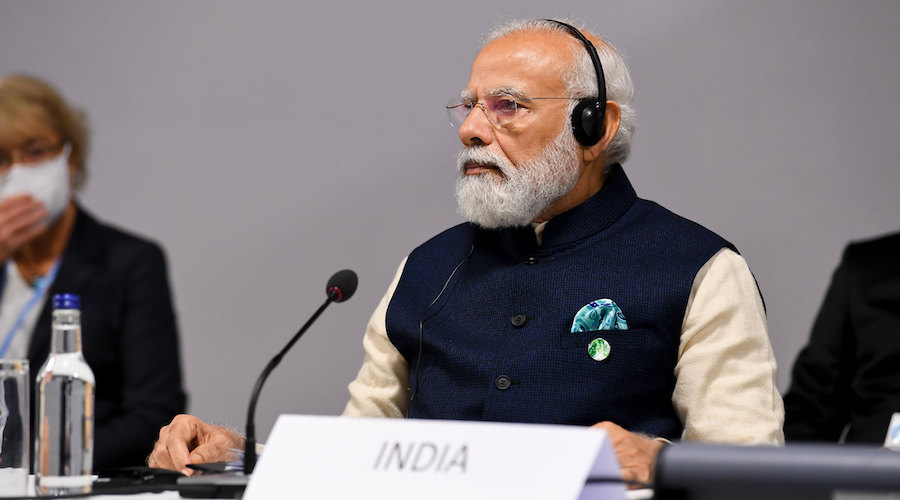
India aims to allow private firms to mine, import and process uranium as part of plans to end a decades-old state monopoly over the nuclear sector and bring in billions of dollars to boost the industry, two government sources said.

Prime Minister Narendra Modi’s government plans to expand nuclear power production capacity by 12 times by 2047 and it is also relaxing requirements to allow foreign players to take a minority stake in power plants, Reuters reported in April.
If it meets its expansion goal, nuclear will provide 5% of India’s total power needs, according to government estimates.
Until now, the state has maintained control over the mining, import and processing of uranium fuel because of concerns over the possible misuse of nuclear material, radiation safety and strategic security.
It will retain its grip on reprocessing spent uranium fuel and managing plutonium waste, in line with global practice.
But to help meet a surge in demand for nuclear fuel as it expands nuclear power production, the government plans to draw up a regulatory framework that would allow private Indian firms to mine, import and process uranium, the two government sources told Reuters.
They asked not to be named because the plans are not yet public.
The proposed policy, which the sources said was likely to be made public in the current fiscal year, will also permit private players to supply critical control system equipment for nuclear power plants, they said.
The Finance Ministry, Department of Atomic Energy and Prime Minister’s Office did not respond to Reuters‘ requests for comment.
Outside India, countries including Canada, South Africa and the United States allow private firms to mine and process uranium.
Domestic supply is not enough
India has an estimated 76,000 tonnes of uranium enough to fuel 10,000 megawatts of nuclear power for 30 years, according to government data.
But the sources said domestic resources would only be able to meet about 25% of the projected increase. The rest would have to be imported and India would need to increase its processing capacity.
In announcing its budget on February 1, the government made public its plans to open up the sector without giving details.
Some of India’s big conglomerates subsequently began drawing up investment plans.
But analysts said amending the legislation could be complex.
“It’s a major and bold initiative by the Indian government which is critical for achieving the target,” said Charudatta Palekar, independent power sector consultant.
“The challenge will be to define quickly the rules of engagement with private sector.”
New Delhi will have to change five laws, including the ones regulating mining and electricity sectors and India’s foreign direct investment policy to enable private participation in many identified activities, the sources said.
(By Sarita Chaganti Singh; Editing by Barbara Lewis)
EIL to assist in development of Indian SMR design
_43166.jpg)
The MoU was signed at Nuclear Power Corporation of India Limited's (NPCIL's) office in Mumbai on 12 August in the presence of Engineers India Limited (EIL) Chairman and Managing Director Vartika Shukla and NPCIL Chairman and Managing Director Bhuwan Chandra Pathak and other senior management officers from both organisations.
New Delhi-based EIL is a public sector undertaking under the administrative control of the Ministry of Petroleum and Natural Gas, providing industrial technology, engineering consultancy and technology licensing services.
"This partnership supports the Government of India's vision to accelerate nuclear power, enabling clean, green, and reliable energy to strengthen India's energy security and is a step towards Nuclear Energy Mission for Viksit Bharat, targeting a nuclear power capacity of 100 GW by 2047," EIL said in a statement.
In a post on LinkedIn, NPCIL said: "This occasion marks an important milestone in the journey of development of BSMR-200 jointly by NPCIL and the Bhabha Atomic Research Centre (BARC), a project that represents not only technological advancement but also a step further towards India's clean, safe and reliable nuclear power capabilities."
The 200 MWe Bharat Small Modular Reactor (referred to as BSMR-200) is a pressurised heavy water reactor that will use slightly enriched uranium fuel and will feature passive safety features. The reactor is being designed and developed by BARC and NPCIL to provide power generation for energy intensive industries such as steel, aluminium and cement; for repurposing retiring thermal power plants; and to provide electricity to remote locations without grid connectivity.
In March this year, Minister of State Jitendra Singh told parliamentarians that a 55 MW variant of the BSMR - targeted at deployment in remote locations - is also being developed, with the lead twin units to be "set up in a Department of Atomic Energy site by 2033". He added that "subsequent units are to be located at the sites of the end-user industry in case of captive power plants and at brownfields sites of retiring thermal power plants."
India's Minister of Finance Nirmala Sitharaman announced in the 2024 budget the government's intention to research and develop the BSMR. In this year's budget - announced in February - she promised federal funds to develop at least five Indian-designed SMRs to be operational by 2033, as well as amendments to Indian legislation to encourage private sector participation, as part of plans to develop at least 100 GW of nuclear energy by 2047.
Earlier this year, NPCIL issued a Request for Proposals from 'visionary Indian industries' to finance and build a proposed fleet of 220 MW BSMRs. Tata Power and the Naveen Jindal Group have already expressed interest in setting up SMRs, and in February, Minister for Railways Ashwini Vaishnaw told the Rajya Sabha - the upper house of the Indian parliament - that nuclear power is under consideration to meet the growing power needs of the country's rail sector.
Presidential ceremony as Malawi uranium mine approaches restart
_51166.jpg)
"We were honoured to welcome His Excellency, Dr Lazarus McCarthy Chakwera, President of the Republic of Malawi, to preside over the official inauguration of the commissioning and restart of the Kayelekera Uranium Mine," Lotus Managing Director Greg Bittar said. "His Excellency, the Government of Malawi, the traditional authorities of regions around Kayelekera and the local communities, have all been pivotal in this achievement. We continue to make terrific progress in commissioning the plant and increasing mill throughput, and we are on track to achieve steady state 200,000 lbs per month - 2.4M lbs per annum - production in early CY2026."
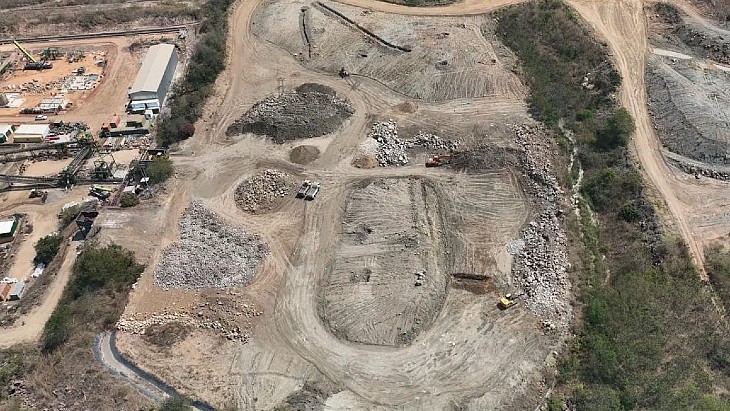
Ore stockpiles at Kayelekera (Image: Lotus Resources)
Australian-based Lotus Resources acquired Kayelekera from Paladin Energy in 2020. The mine has produced nearly 11 million pounds U3O8 (around 4,200 tU) between 2009 to 2014, but had been on care and maintenance since then. A restart study conducted by the company in 2022 determined an ore reserve of 23 million pounds U3O8.
Earlier this month, the company announced it had started processing high grade ore at Kayelekera as part of the final commissioning of the precipitation, drying, and packaging circuits, with the first uranium product expected this quarter. Stockpiled ore is being used to restart production until mining commences: the stockpile of around 300,000 tonnes represents about three months of mill feed, the company said. It anticipates switching to freshly mined ore in the last quarter of this year.
Today, the company said around 1,500 kg of uranium has been eluted, ready for precipitation, with mill feed grades of initial ore sourced from stockpiles "comfortably" meeting expectations: "With these milestones achieved, commissioning focus is now on finalising the automation of the drying and packaging circuit, which will then allow the production of the first yellowcake."
Peninsula Energy’s processing plant at Wyoming uranium project gets state approval
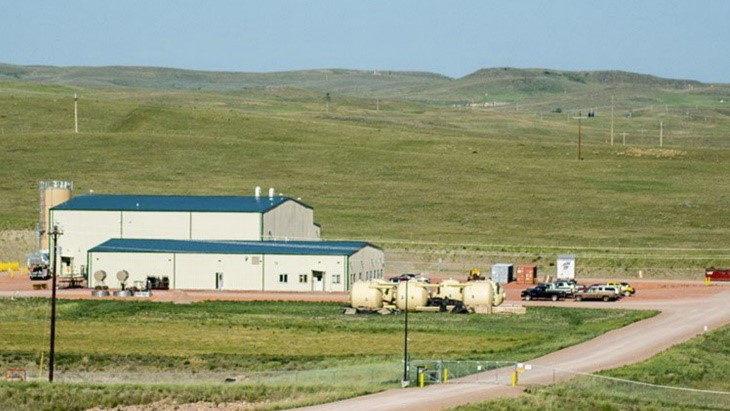
Peninsula Energy (ASX: PEN) announced that it has received approval from Wyoming’s Uranium Recovery Program (URP) to commence start-up of Phase 2 of the central processing plant (CPP) at the Lance project.
Lance represents one of the largest US uranium projects in size and scale, with a defined JORC (2012) resource of 58 million lb. of uranium oxide (U3O8). The mine restart plan envisions an initial 10-year in-situ recovery operation with a production estimate of 4.1 million lb. from the Ross area, then moving onto the Kendrick area.
The approval means that Peninsula can now progress transferring uranium on resin into Phase 2 of the CPP, utilizing recovery process solutions to operate the process circuits. No further regulatory approvals are necessary to commence commercial production in Wyoming, the company said.
On completion of Phase 2 construction, the Lance projects will be home to a 5,000 GPM uranium recovery ion-exchange process plant, with the capability to independently produce up to 2 million lb. per annum of dry yellowcake product, the company said in December.
“The approval from the Wyoming URP is another encouraging development, demonstrating the integrity and safety of what we have built at the CPP,” Peninsula Energy CEO George Bauk said in a news release.
“We look forward to start feeding uranium on resin from Phase 1 to Phase 2 of the CPP, completing the reset plan and working toward the production of dried yellowcake during this quarter,” Bauk added.
NextEra updates NRC on Duane Arnold plans
NextEra Energy has told the US nuclear regulator that it intends to submit an environmental review document for the proposed restart of the Duane Arnold nuclear power plant in October.
_44140.jpg)
The company presented an overview of the current status and its plans for the proposed restart of the shuttered plant in slides submitted to the US Nuclear Regulatory Commission (NRC) ahead of a 7 August Pre-Submittal Meeting.
The 610 MWe boiling water reactor plant, owned and operated by NextEra Energy Duane Arnold, LLC in Linn County, Iowa, commenced commercial operation in 1974. Although currently licensed for operations until 2034, the Duane Arnold plant ceased operations in 2020 and is currently "idled and in decommissioning status", but in January, the company submitted documents including a restart overview and regulatory path to reauthorisation of power operations.
Since it was shut, all the plant's used fuel has been transferred to its Independent Spent Fuel Storage Installation, and most major plant systems have been drained and deenergised. Training and administrative buildings have been removed, as have the mechanical draft cooling towers, and generator output transformer and in-scope transmission lines, but the main power block buildings remain intact.
Planned restart activities will restore the plant to its previous operating licence condition at 2020 shutdown. Planned plant modifications include new cooling towers, restoration of in-scope transmission lines, new office and warehouse buildings, and upgrades to the sewage treatment system upgrade. Plans also include dredging of the water intake from the Cedar River.
"Under NEPA [the National Environmental Policy Act], it is anticipated that NRC will prepare an Environmental Assessment (EA) for this restart," the company said in the slides. NextEra Energy Duane Arnold, LLC will coordinate with the NRC Environmental Project Manager regarding the need for an environmental review document, and the subject areas to cover; and "submit an environmental review document (tentatively in October 2025) that focuses on restart activities useful for the NRC’s NEPA review".
It anticipates that a final EA and Finding of No Significant Impact "will be issued within 12 months of acceptance of an environmental submittal".
NextEra Energy recently filed a request with the US Federal Energy Regulatory Commission seeking to reclaim interconnection rights that were previously transferred from the shut down Duane Arnold nuclear power plant in Iowa to a solar energy project: about 40 acres of the Duane Arnold site are now occupied by a solar farm.
DOE announces first selections for pilot reactor programme
_58447.jpg)
The pilot programme, announced in June, aims to expedite the testing of advanced reactor designs that will be authorised by the Department at sites located outside of the national laboratories. Part of the Reforming Nuclear Reactor Testing at the Department of Energy executive order signed by President Donald Trump in May, its goal is "to construct, operate, and achieve criticality of at least three test reactors using the DOE authorisation process by July 4, 2026."
The selected companies are: Aalo Atomics Inc; Antares Nuclear Inc; Atomic Alchemy Inc; Deep Fission Inc; Last Energy Inc; Natura Resources LLC; Oklo Inc (selected for two projects); Radiant Industries Inc; Terrestrial Energy Inc; and Valar Atomics Inc.
Each company will be responsible for all costs associated with designing, manufacturing, constructing, operating, and decommissioning their test reactors, but seeking Department of Energy (DOE) authorisation under the Atomic Energy Act will help them unlock private funding and provide a fast-tracked approach to future commercial licensing activities, the department said.
"President Trump's Reactor Pilot Program is a call to action," said Deputy Secretary of Energy James Danly. "These companies aim to all safely achieve criticality by Independence Day, and DOE will do everything we can to support their efforts."
The DOE did not specify which projects are covered, although the list of companies includes both start-ups and longer established companies representing diverse approaches to reactor technology. Aalo is developing the Aalo-1 factory-fabricated 10 MWe sodium-cooled microreactor; Antares is developing the 500-kW sodium heat pipe-cooled R1. Atomic Alchemy Inc - a subsidiary of Oklo - is developing the Versatile Isotope Production Reactor - or VIPR - 15-MWt light water reactor.
Deep Fission's Deep Fission Borehole Reactor-1 is a 15 MWe pressurised water reactor that would be located about a mile underground via a 30-inch borehole. Last Energy is developing the 20 MWe PWR-20. Natura Resources' LF-MSR is a 1 MWt molten salt research reactor. Oklo's Aurora powerhouse is a based on a fast neutron reactor that uses heat pipes to transport heat from the reactor core to a supercritical carbon dioxide power conversion system.
Radiant Industries is developing the 1 MWe Kaleidos high-temperature gas-cooled portable microreactor. Terrestrial is developing the Integral Molten Salt Reactor (IMSR). Valar is developing a reactor based on high-temperature gas reactor technology.
"The diversity of applications received shows the remarkable breath of innovation and ingenuity in American reactor developers," the DOE said.
Terrestrial Energy said its Project TETRA proposal had been selected for the pilot programme. Project TETRA includes the completion of key testing that is essential to support licensing applications for the construction and operation of commercial IMSR plants in the USA, the company said.
"We are pleased to have been selected by the DOE for this important project, which will help the US win the race to energy dominance that is now so important for competitive commercial AI and the re-shoring of US manufacturing,” Terrestrial Energy CEO Simon Irish said. "Our selection for the Nuclear Reactor Pilot Program fast-tracks key elements of IMSR design development and advances our programme of fleet scale deployment of our IMSR Plant."
Oklo co-founder and CEO Jacob DeWitte said the company was "proud" to have been selected for three projects, including the Atomic Alchemy project. “This shows that the DOE is ushering in a new era of building new nuclear in America by unleashing its unique capabilities to enable American nuclear innovators to build. The DOE is opening the door to the market so new ideas, new approaches, and new designs can be built more quickly and efficiently. American innovation is one of our strategic advantages, and the DOE’s selection of a number of projects provides a sweeping injection of urgency to meet the moment and unleash American nuclear innovation," he said.
Cutting red tape
Aalo Atomic CEO Matt Loszak explained that the projects, which were selected through a competitive Request for Applications process, would not be granted capital, but would be assigned a so-called concierge team to ensure that any red tape (for example, waiting for signatures from the DOE) which might have previously taken weeks or months, will now take days. "This means that the pressure is now on the companies selected under the RFA to deliver," he said. "The rate-limiting step is now the time it takes to complete the engineering, design, and testing work needed to build a reactor and take it to criticality.
"When announced, many folks in the nuclear industry did not think this timeline was realistic. Indeed, most nuclear companies are planning for criticality on five-year timelines, or longer. However, at Aalo, we took a close look at our progress to-date and our roadmap, and realised that with a few tweaks and the support of the DOE, this aggressive criticality timeline could be possible."
Plans for SMR plant on Svalbard progress
_63445.jpg)
In June this year, Swedish lead-cooled SMR technology developer Blykalla and Norwegian nuclear project developer Norsk Kjernekraft announced the launched of a joint project company, Svalbard Kjernekraft AS.
Longyearbyen - the administrative centre of the Svalbard archipelago - was powered by coal until 2023. Since the closure of the coal plant, temporary diesel systems have been installed, resulting in higher costs and reduced reliability. Blykalla and Norsk Kjernekraft aim to build a compact SMR that connects to the existing electricity and district heating grid, effectively replacing the old coal infrastructure.
Svalbard Kjernekraft has now submitted a planning initiative for a SEALER (Swedish Advanced Lead Reactor) lead-cooled SMR in Longyearbyen. The report describes the project, local conditions and suggests topics for further investigation. The list of topics includes, among others, the environment and biodiversity, safety, waste management, ripple effects for society and effects on local businesses and jobs. The final location for the nuclear power plant will be determined through the impact assessment.
"With the planning initiative submitted, the next stage is for the Governor of Svalbard to set the scope of the environmental impact assessment," Blykalla said. "Once that is in place, detailed studies and stakeholder consultations can begin, paving the way for the licensing process and eventual construction."
"We are proud that this Swedish technology can deliver stable, emissions-free power to Svalbard," said Blykalla co-founder and CTO Janne Wallenius. "Our lead-cooled reactors are ideal for this kind of remote application."
The company said the Longyearbyen project will "also serve as a showcase for how advanced SMR technology can help secure energy supply in places with limited energy capacity, both in the Nordics and around the world".
Norsk Kjernekraft CEO Jonny Hesthammer added: "This collaboration marks a new chapter in Norway's history as a polar nation. Reliable and affordable energy is a prerequisite for Norway's continued assertion of sovereignty in Svalbard, especially given the current geopolitical situation. Now that the coal-fired power plant in Longyearbyen has been closed, nuclear power is the only long-term solution to maintain energy security without using fossil fuels."
In February this year, a memorandum of understanding was signed between Blykalla and Norsk Kjernekraft to collaborate on the deployment of Blykalla's SEALER in Scandinavia. Under the MoU, the two companies are to assess the business case for integrating the SEALER into power plant projects currently under development by Norsk Kjernekraft, evaluating site suitability, regulatory pathways, and economic feasibility for deployment in Norway. Additionally, the agreement outlines collaboration on licensing, financing, construction, and operational aspects of Blykalla's first reactor, SEALER-One, in Sweden. The MoU also includes a commitment to explore the possibility of providing electricity to remote locations.
Blykalla - formerly called LeadCold - is a spin-off from the KTH Royal Institute of Technology in Stockholm, where lead-cooled reactor systems have been under development since 1996. The company - founded in 2013 as a joint stock company - is developing the SEALER SMR.
SEALER-One is Blykalla's first nuclear reactor and commercial venture. It will function as a demonstration of its technology, and at the same time be used for pyrolysis, whereby industrial customers can utilise its steam for, among other things, decarbonised biochar production. The company aims to achieve criticality of SEALER-One by 2029.
Cooling facility upgrades planned at Korean plants
_88544.jpg)
Rising seawater temperatures are causing some nuclear power plants to reach temperatures approaching the design seawater temperature, the Nuclear Safety and Security Commission (NSSC) said. The design sea water temperature refers to the maximum temperature of seawater at which the reactors can operate safely.
In a report to the NSSC at a meeting on 14 August, Korea Hydro & Nuclear Power (KHNP) presented its response measures to secure cooling performance of nuclear power plant equipment as seawater temperatures rise.
KHNP has gradually been raising the operating limit seawater temperature by utilising the margin within a range that does not affect safety while maintaining the cooling facilities as they are. However, going forward, the company plans to improve cooling performance through facility improvements.
According to KHNP's analysis, it is expected that Shin Wolsong 1 and 2 will reach the design sea water temperature in 2030, Hanbit 3 and 4 in 2031, and Hanbit units 1, 2, 5 and 6 in 2034, Chosun Biz reported.
KHNP said it has already completed facility improvements (by increasing the plate size of the existing heat exchanger) at units 1 and 2 of the Shin Wolsong plant, which are estimated to reach the limit seawater temperature for operation within the next ten years, and is planning to move forward with raising the limit seawater temperature for operation at those units.
At units 1-6 of the Hanbit plant, KHNP plans to replace the existing tubular heat exchanger by the first half of 2029. For its other nuclear power plants, the company plans to pursue facility improvements in the mid to long-term after conducting cooling performance evaluations.
"Based on actual seawater temperature measurements, seawater temperature rise rate research data, etc, we plan to proactively respond by evaluating the expected time when the seawater temperature limit for each nuclear power plant will be reached annually and establishing a seawater temperature prediction system," KHNP said.
At the meeting that day, members of the NSSC agreed that "more proactive efforts to improve facilities are needed, taking into full consideration the climate change situation".
"In order to prepare for accelerated global warming, we must quickly improve facilities so that we can fundamentally solve the problem, and we must do everything possible to respond immediately when high sea temperatures are observed," said NSSC Chairman Choi Won-ho. "The Nuclear Safety and Security Commission plans to conduct periodic inspections to ensure that facility improvements are implemented without a hitch."
According to the Korea Institute of Ocean Science and Technology, the average water temperature in the East Sea rose by 8.3°C between 1980 to 2010, while it rose by 1°C between 2021 and 2023.
Norwegian collaboration on floating nuclear power plants

A memorandum of understanding signed between the partners "lays the foundation for a collaboration in which the parties will investigate, develop and mature solutions that combine reliable, emission-free nuclear power with flexible maritime platforms," Norsk Kjernekraft said.
The partners will initially collaborate to investigate possible concepts, technology choices and business models. The projects will be built and operated in accordance with Norwegian legislation and regulations, and the ambition is to draw on the broad experience and expertise of Norwegian and Nordic industry.
Ocean-Power develops technology and infrastructure for sustainable power production. Its current concept is to develop floating power plants featuring combined cycle power plants (gas turbines and steam turbines). The 200-250 MW floating plants would be used to supply power to nearby platforms for the offshore version and to the grid inshore. CO2 from the exhaust gases will be captured and would then be either injected directly into a nearby geological formation, into a pipeline or liquefied and transported by vessel for usage or permanent storage.
Norsk Kjernekraft aims to build, own and operate SMR power plants in Norway in collaboration with power-intensive industry.
"We want to mobilise the Nordic supplier industry to build solutions that can become world-leading," Ocean-Power CEO Erling Ronglan said. "Nuclear power on barges provides completely new opportunities for secure, stable and climate-friendly energy supply - for industry, society and maritime operations. This can be an important part of Norway's contribution to achieving climate goals, while creating value for future generations."
"This is an important step in the right direction to ensure a long-term nuclear power investment in Norway that involves the best of Norwegian industry," said Norsk Kjernekraft CEO Jonny Hesthammer. "With reduced activity in the petroleum sector, we need new industrial adventures, and floating nuclear power can be one of them. Together with Ocean-Power, we want to explore how we can deliver stable, clean energy to industry and society – with minimal land use and maximum flexibility."
Last month, Ocean-Power and Danish nuclear technology company Copenhagen Atomics signed an MoU to jointly study the potential for producing electricity and heat in Norway using thorium-based molten salt reactors. The joint study will assess the technical and regulatory conditions for deploying thorium reactors in Norway.