Thursday, August 14, 2025


Serbia rocked by second night of violent clashes

Serbia rocked by second night of violent clashes
/ X/ Gavrilo Andrić
By bne IntelliNews August 14, 2025

Clashes erupted across Serbia for a second consecutive night on August 13, as anti-government demonstrators and supporters of the ruling Serbian Progressive Party (SNS) confronted one another in several cities, deepening a political crisis that has simmered for months.

The unrest follows more than nine months of largely peaceful protests against President Aleksandar Vucic and his administration, with tensions boiling over after violence broke out between government loyalists and protesters in the northern towns of Vrbas and Backa Palanka late on August 12.

Student-led demonstrations, under the banner “Serbia, Wake Up”, were held in over 30 towns and cities on August 13-14, including Belgrade, Novi Sad, Nis and Kragujevac. Organisers are calling for an end to police violence and early parliamentary elections.

In Novi Sad, Serbia’s second-largest city, the situation quickly escalated when SNS supporters launched fireworks and flares at demonstrators outside party headquarters. Protesters responded by smashing windows and confronting riot police, who deployed tear gas to disperse the crowd.

The Ministry of Defence said that seven members of the Serbian Armed Forces were injured in the clashes, four of them seriously. Lieutenant General Duro Jovanic, head of the Military Security Agency, said the soldiers were caught in the unrest while attempting to manage the situation.

Interior Minister Ivica Dacic said that an armed man pictured at the scene, later identified as Serbian Army ensign Vladimir Brkusanin, was acting in an official capacity by holding his gun in the air. Dacic denied accusations that SNS supporters had drawn weapons, stating that the soldier was protecting a “designated person” and had used his service pistol lawfully.

Violence also flared in Belgrade, where riot police deployed tear gas and attempted to contain demonstrators near SNS offices in New Belgrade. Protesters clashed with officers, some throwing objects and pushing past police lines. N1 television reported that officers were occasionally forced to retreat.

Journalists covering the protests were also injured. Nikola Bilic of Novi Sad’s 192 portal was beaten, while Razglas reporter Zarko Bogosavljevic was struck in the head with a baton.

Footage shared on social media showed Andrej Vucic, the president’s brother, leading a group of SNS activists through Pioneers’ Park in central Belgrade. The park has become a symbol of the contra-protest movement, hosting a tent encampment maintained by party supporters.

Opposition figures accused the government of encouraging violence through selective enforcement and the use of convicted criminals to intimidate demonstrators. Critics can point to a string of controversial pardons by President Vucic, including the August 1 release of Milica Stojanovic, who had faced attempted murder charges for driving into a crowd of protesters in January.

In another instance, Vucic granted clemency to four SNS activists convicted of assaulting a protester earlier this year in Novi Sad.

Interior Minister Dacic has called for the "return of law and order", while President Vucic described the demonstrators as “thugs”, echoing past government rhetoric labelling protesters as “terrorists”.

The protests were initially triggered by a deadly infrastructure collapse in November 2024, when a train station canopy in Novi Sad collapsed, killing 16 people. The tragedy prompted allegations of corruption and mismanagement in state-run projects.

Since then, university students have spearheaded a wave of civil disobedience and public gatherings demanding accountability and democratic reforms. Protesters are now pressing for early parliamentary elections.

President Vucic has indicated snap elections could be held before the scheduled 2027 deadline, but has yet to commit to a specific timeline. On August 13 the president confirmed he would not stand for re-election at the end of his term, allaying fears he might attempt to change the Constitution to extend his rule.

As violence escalates, pressure is mounting on the government to de-escalate tensions. Without calling early elections, Serbia risks sliding further into authoritarianism and civil unrest.

New clashes in Serbia as political crisis escalates

Belgrade (AFP) – Clashes between rival groups of protesters in Serbia flared again late Thursday, police said, as months of anti-government demonstrations boiled over into street violence this week.


Issued on: 15/08/2025 - FRANCE24

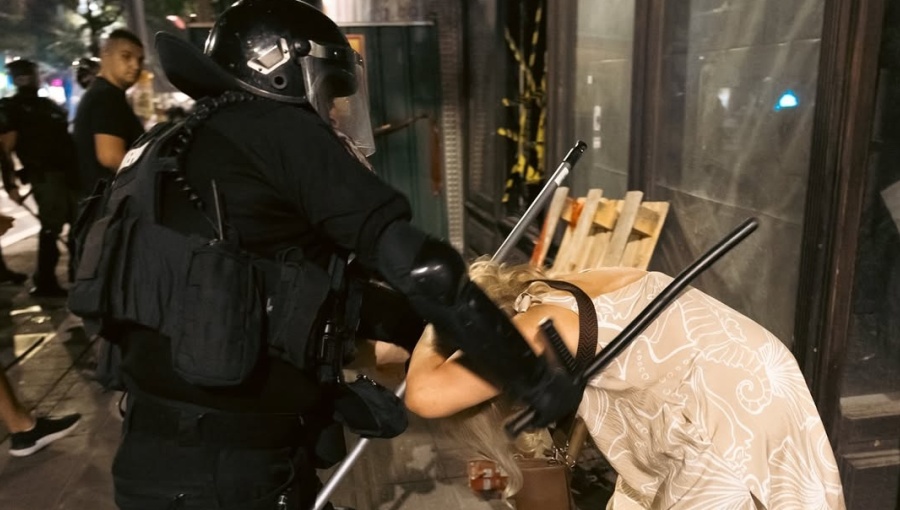
Serbian riot police clashed with anti-government protesters in Belgrade as anti-corruption demos turned violent © Marko Djokovic / AFP

A wave of anti-corruption protests has gripped Serbia since November, when the collapse of the Novi Sad railway station roof killed 16 people, a disaster widely blamed on entrenched corruption.

Anti-graft protesters again gathered in several cities across Serbia late Thursday.

That was mainly in response to a previous attack by governing party supporters on demonstrators Tuesday in the town of Vrbas, about 160 kilometres (100 miles) north of the capital Belgrade.

Large groups of pro-government supporters, most wearing masks, confronted protesters on Wednesday, and the two groups hurled bottles, stones and fireworks at each other.

Police had arrested nearly 50 people across the country on Wednesday, and around 30 riot police were injured.

On Thursday, protestors vandalised the Novi Sad headquarters of the ruling Serbian Progressive Party (SNS) and two other SNS offices in the city, RTS television reported, during protests spread across Serbia.

In the capital Belgrade, protestors massed in front of government buildings and the army headquarters, before heading toward nearby SNS offices.

But a heavy riot police deployment kept them from reaching the offices using teargas.

"These are no longer peaceful student protests but people who want to provoke violence... This is an attack on the state," Interior Minister Ivica Dacic told a news conference.

At least five police officers were injured on Thursday evening and 14 protesters were arrested, the ministry said.

-'Intensifying crackdown'-


Frustrated with government inaction, protesters have demanded an investigation into the Novi Sad tragedy and piled pressure on right-wing President Aleksandar Vucic to call early elections.

Over the past nine months, thousands of mostly peaceful, student-led demonstrations have been held, some attracting hundreds of thousands.
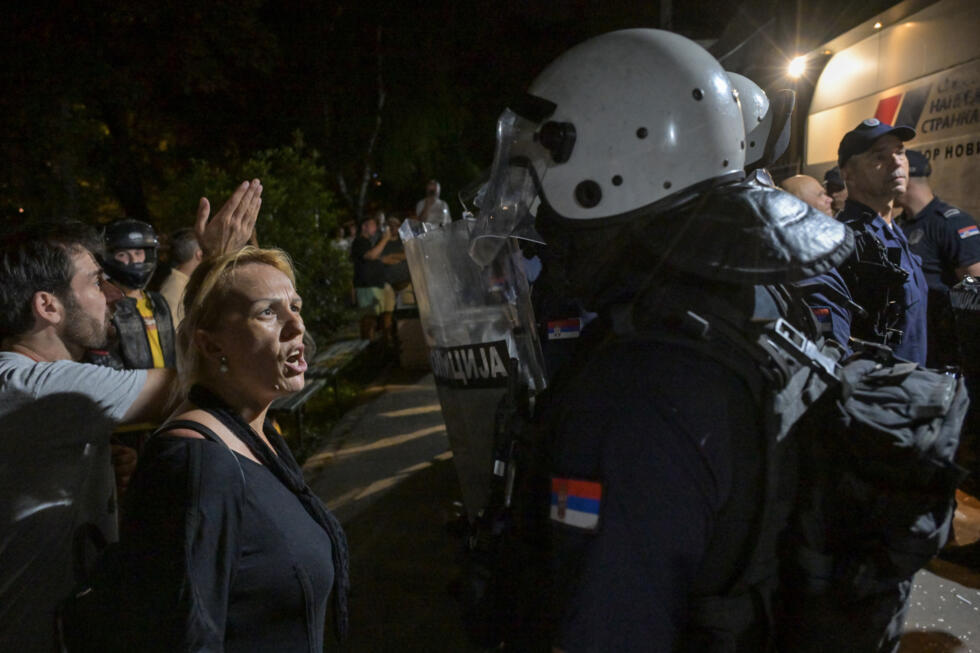
Frustrated with government inaction, protesters have been pushing hard for early elections © OLIVER BUNIC / AFP


But this week's violence marks a significant escalation and indicates the increasing strain on Vucic's populist government, in power for 13 years.

Since June 28, when around 140,000 demonstrators gathered in Belgrade, the government has responded with an "intensifying crackdown" on activists, according to a statement by UN human rights experts released earlier this month.

Protesters and those linked to the movement have faced a "troubling pattern of repression" including excessive police force, intimidation and arbitrary arrest, the experts said.

Vucic has remained defiant, repeatedly rejecting calls for early elections and denouncing the demonstrations as part of a foreign plot to overthrow him.

Student protesters have accused the police of protecting pro-government supporters while doing little to stop the attacks on their own gatherings.

"The authorities tried to provoke a civil war last night," the students wrote on their official Instagram page.

Vucic, who had visited pro-government encampments overnight Wednesday, denied his supporters had started the violence.

"No one attacked them anywhere," he said of the anti-government protesters, speaking at a late-night press conference.

"They went everywhere to attack those who think differently," he added.

While the protests have so far led to the resignation of the prime minister and the collapse of his cabinet, Vucic remains at the helm of a reshuffled government.

© 2025 AFP

Serbia's police intervene as ruling party supporters face off against anti-government protesters


Months of protests in Serbia reached a new intensity Wednesday night as riot police intervened to separate rival demonstrations of anti-government protesters and supporters of President Aleksandar Vucic. The president once again accused unnamed foreign powers of orchestrating the protests, which first began after the deadly collapse of a subway station sparked accusations of widespread government corruption.


Issued on: 14/08/2025 - 
By: FRANCE 24
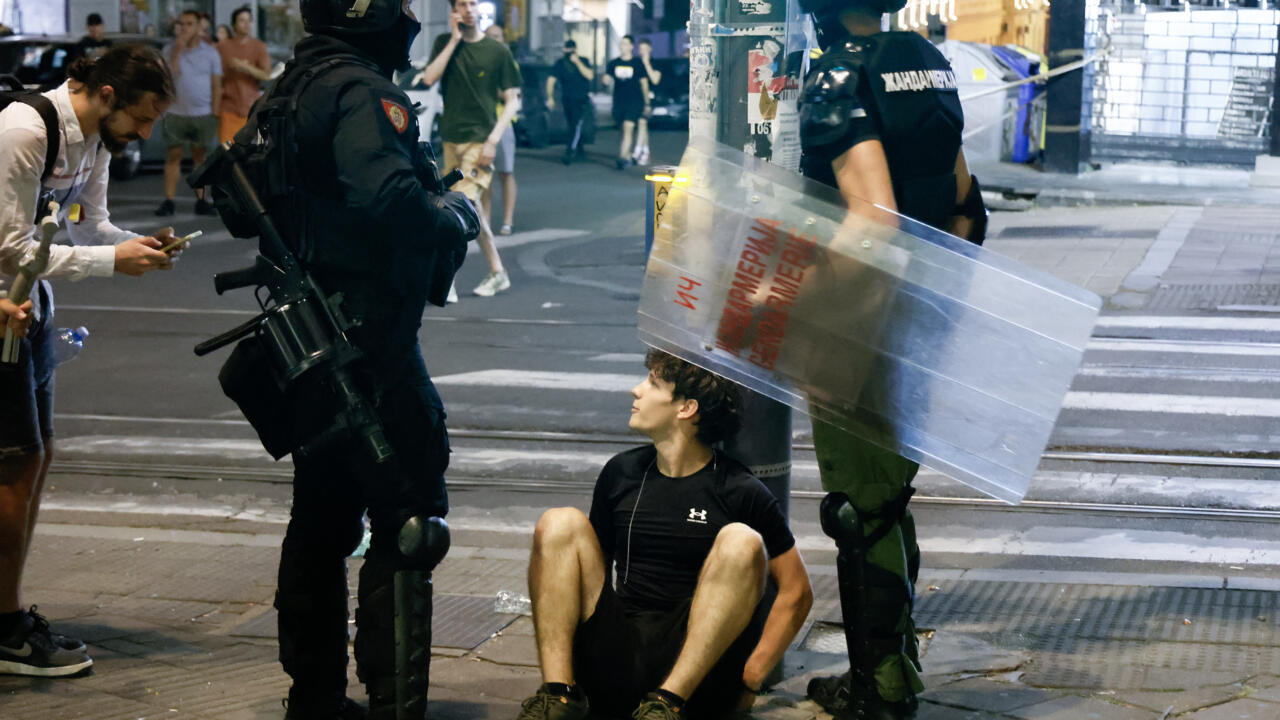
Serbian riot police clash with an anti-government protester in Belgrade on August 13, 2025. © Marko Djokovic, AFP
01:38


Supporters of the ruling Serbian Progressive Party (SNS) threw flares and firecrackers at anti-government protesters in Novi Sad on Wednesday evening, prompting police to intervene to end the standoff, a major escalation of nine-month-long protests in Serbia.

The student-led protests in Serbia first started in November after a train station canopy collapsed in Novi Sad, killing 16 people and triggering accusations of corruption in state infrastructure projects.

Protests have since drawn hundreds of thousands of people, shaking President Aleksandar Vucic’s firm grip on power. His supporters have recently started organising counter-demonstrations, fuelling fears of possible violence.

At a news conference late on Wednesday, Vucic, flanked by Interior Minister Ivica Dacic, said 16 police officers and around 60 SNS backers have been injured in Novi Sad. He also accused unidentified foreign powers of orchestrating riots and pledged arrests.

"Persons who violated the law will be apprehended ... Tonight, we have averted a catastrophic scenario planned by someone from abroad," he said.

Vucic did not provide evidence to substantiate his allegations.

Footage by private N1 TV showed flares and firecrackers being thrown at protesters in Novi Sad from the direction of the SNS offices. It also showed anti-government protesters, some with bloody faces, saying Vucic's backers used sticks and truncheons to attack them.

Protesters then smashed office windows as riot police were deployed outside to guard the building.

Opposition Move-Change movement said Vucic's loyalists have been responsible for the clashes.

"Attacks on people with pyrotechnic devices violate their right to life and protest," it said in a statement.


Tens of thousands of protesters rally against populist Serbian government

Protesters demanding early elections clash with police in Belgrade on June 28, 2025. © OLIVER BUNIC / AFP
01:42

In the capital city of Belgrade, police in full riot gear blocked anti-government protesters from approaching the area in a park near the parliament building where Vucic's supporters have been camping since March.

Elsewhere in Belgrade, anti-government protesters clashed with police who prevented them from approaching local SNS offices.

The protesters have blamed corruption for the Novi Sad railway roof collapse and have demanded early elections that they hope would remove Vucic and his party from power after 13 years.

Students, opposition, and anti-corruption watchdogs have accused Vucic and his allies of ties to organised crime, violence against rivals and curbing media freedoms, something they deny.

On Wednesday evening, students who are leading the protests called supporters to protest in front of SNS offices in major cities in Serbia, including Belgrade, Novi Sad, Kragujevac, Cacak and Nis, after several protesters were injured in clashes with SNS in the town of Vrbas on Tuesday evening.

(FRANCE 24 with Reuters and AP)


Requests for EU solidarity to battle wildfires at same level already as entire 2024 fire season

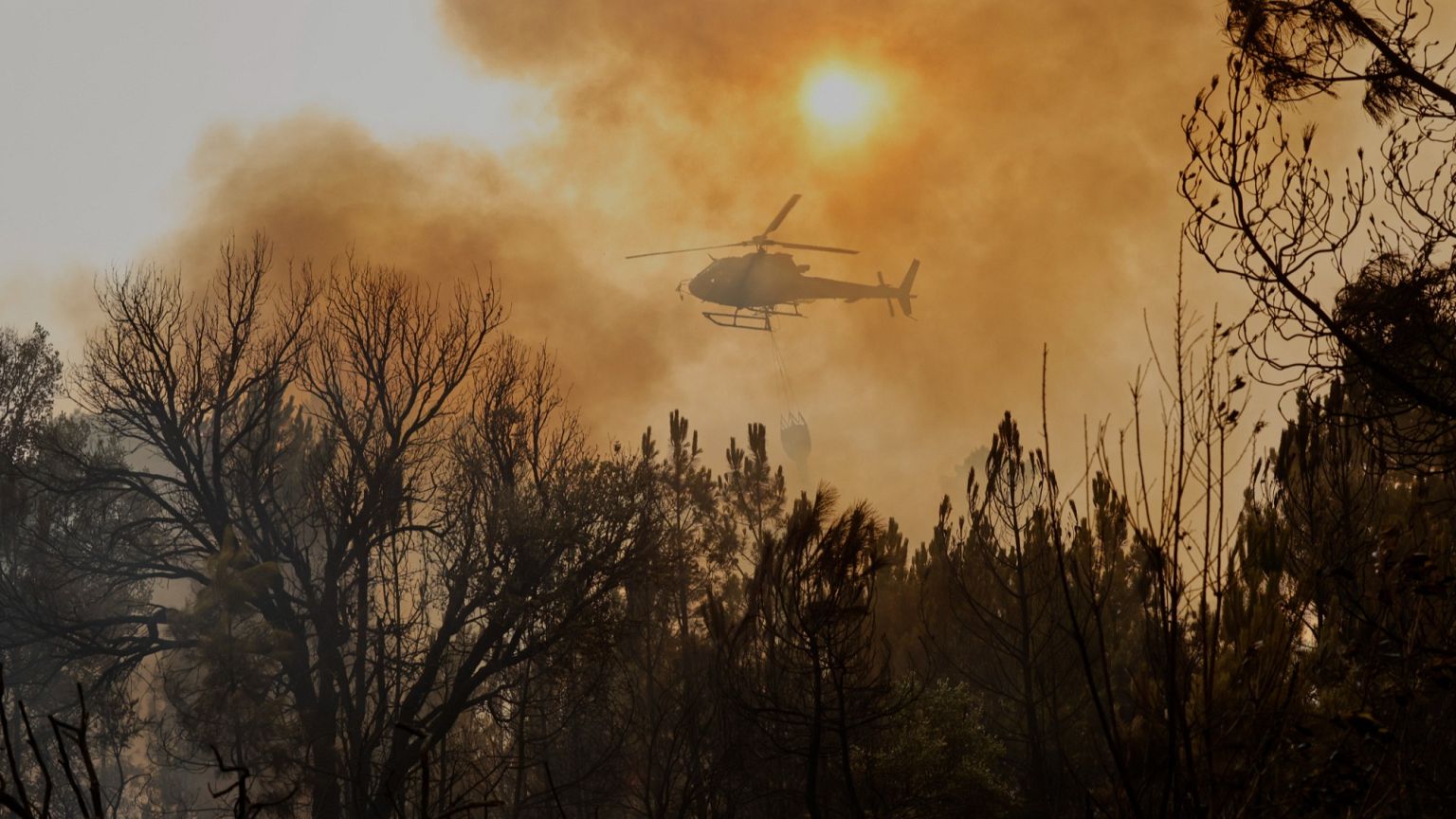
A helicopter drops water on a wildfire in Larouco, northwestern Spain, on 13 Aug, 2025.
Copyright AP Photo/Lalo R. Villar


By Alice Tidey
Published on 

Spain made its first-ever request for European assistance to tackle wildfires on Wednesday.

The number of requests for European solidarity to help tackle wildfires this week reached the same tally as for the entire 2024 fire season, the European Commission announced on Thursday.

"Overall, the mechanism has been activated 16 times during the current season and we are in mid-August," European Commission spokesperson Eva Hrncirova told reporters on Thursday. "This is already equal to the total amount of activations during the whole summer season last year."

Spain became the latest country on Wednesday to turn to the mechanism, making its first-ever request for European solidarity against wildfires.

At least three people have died in Spain, including a volunteer firefighter, as wildfires sweep through the north-western Léon province.

Two planes from the rescEU strategic reserve, currently stationed in France, were expected to be deployed to Spain on Thursday

Bulgaria, Montenegro, Albania and Greece also asked for assistance this week.

Spain and Greece, which are traditionally heavily affected by wildfires, are among the EU member states that have had foreign firefighters pre-positioned on their soil since July.

A total of 650 firefighters from 14 European countries were pre-deployed in high-risk areas - the highest number since the scheme was launched in 2022 - with France and Portugal also welcoming foreign teams.

Among the other European countries that have activated the mechanism specifically for wildfires this year are Cyprus, Bosnia and Herzegovina, and North Macedonia. Israel and Syria have also requested assistance.

The way it works is that a country needing assistance tells the EU's Emergency Response Coordination Centre (ERCC) what they need and other states that are part of the mechanism can then individually contribute by volunteering equipment and manpower. The EU's Civil Protection mechanism then coordinates the deployment of the various contributions and foots the bill.

France, which battled its largest wildires in decade earlier this month in the southern coastal département of Aude, did not ask for further European assistance.

"It's a decision of the member state to ask for assistance or not. Big countries usually have big capacities and they have increased their capacities in the past due to the effect of the global warming and more often wildfires," European Commission spokesperson Hrncirova explained on Thursday.

"You can see that very often it's useful for smaller countries. We often have requests from Western Balkans, Albania, Montenegro. Macedonia. So for these countries, the assistance can be really crucial," she added.

More than 511,000 hectares had been turned to ashes across the EU by 12 August according to the European Forest Fire Information System (EFFIS), more than double the average tallied at the same time over the 2006-2024 period.

The number of fires observed since the beginning of the year has reached over 1,600, a jump from the average of 717 seen by the same date over the past 20 years.


Spain seeks EU help as wildfires kill three


and force thousands to flee

Spain has asked for European Union help to fight forest fires in the northwest that have killed three people and forced more than 8,000 to flee their homes.


Issued on: 14/08/2025 - RFI


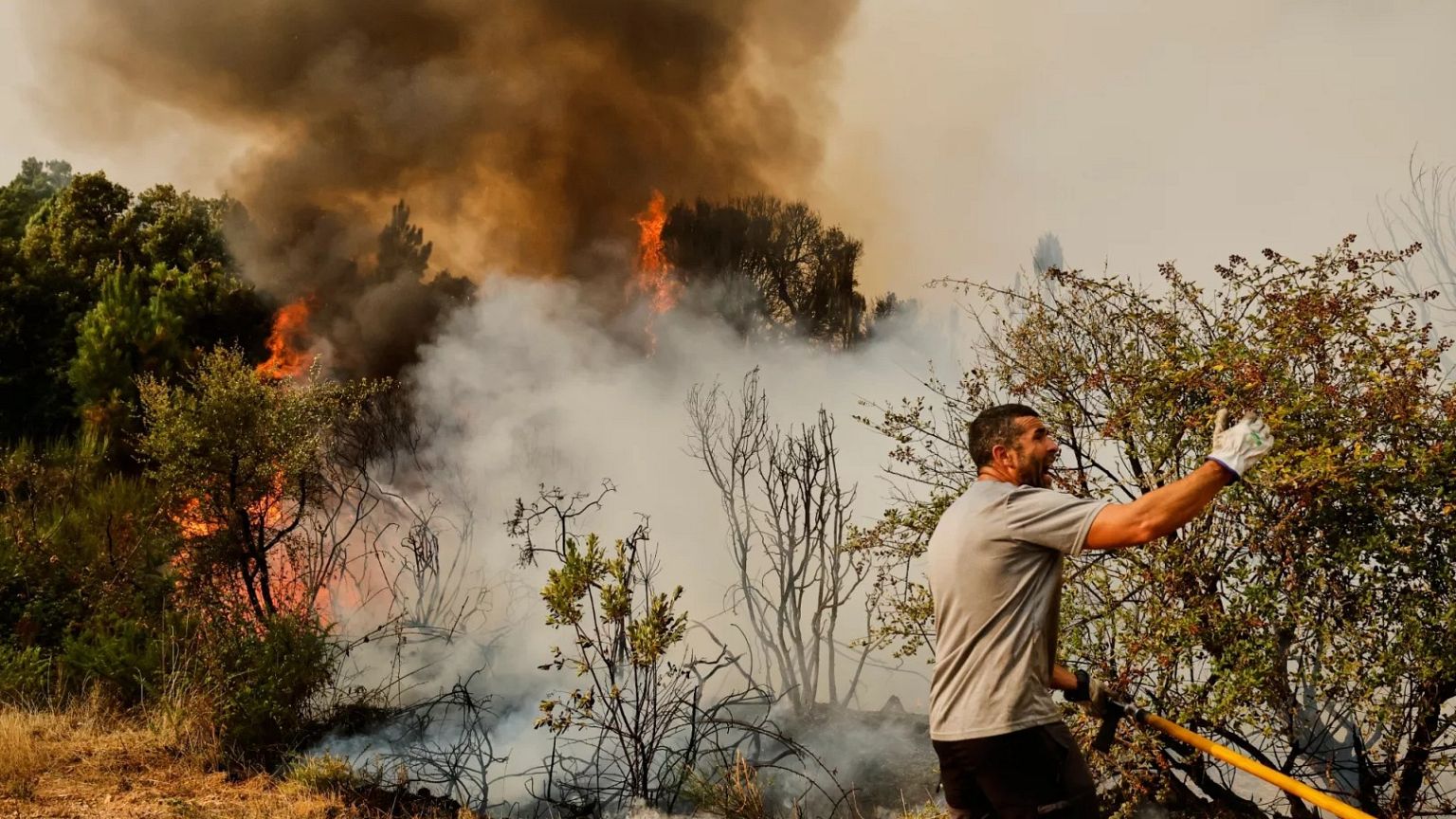
A firefighter changes position during operations to fight a wildfire in the village of Parafita in the Galicia region of Spain, 12 August 12 2025. © Violeta Santos Moura/Reuters

Interior Minister Fernando Grande-Marlaska said on Wednesday that Spain has called on the EU’s assistance mechanism to help battle at least 14 fires across the country.

Spain has requested two Canadair firefighting aircraft and is ready to seek more help, including extra firefighters, if needed.

The EU assistance system, set up in 2001, allows the 27 member states and 10 other countries to support each other during emergencies.

Fires, fuelled by extreme temperatures and strong winds, have destroyed thousands of hectares in several regions of Spain, as they have elsewhere in Europe, notably in France and Portugal.

A person fighting the fire in Castile and León was killed on Thursday, bringing the death toll to three. Seven people were taken to hospital on Wednesday.

More than 8,000 people have been evacuated from their homes in Spain's León and Zamora provinces.

Galicia’s regional president Alfonso Rueda said 30 fires are being extinguished every day.

In Ourense province, firefighters have been unable to contain a large blaze in Chandrexa de Queixa. About 11,500 hectares have been burned there.

Thousands displaced in Greece, Spain and Portugal as wildfires continue to rage


Copyright Thanassis Stavrakis/Copyright 2025 The AP. All rights reserved

By Euronews
Published on 14/08/2025 - 


At least three have been killed as the European Commission said requests to help tackle wildfires this week reached the same count as for the entirety of 2024.

Thousands have been displaced after record temperatures sparked wildfires across southern Europe and triggered an unprecedented level of assistance from the European Commission.

Greece, Spain and Portugal have ordered mass evacuations after fires threatened to scorch towns and villages across all three countries.

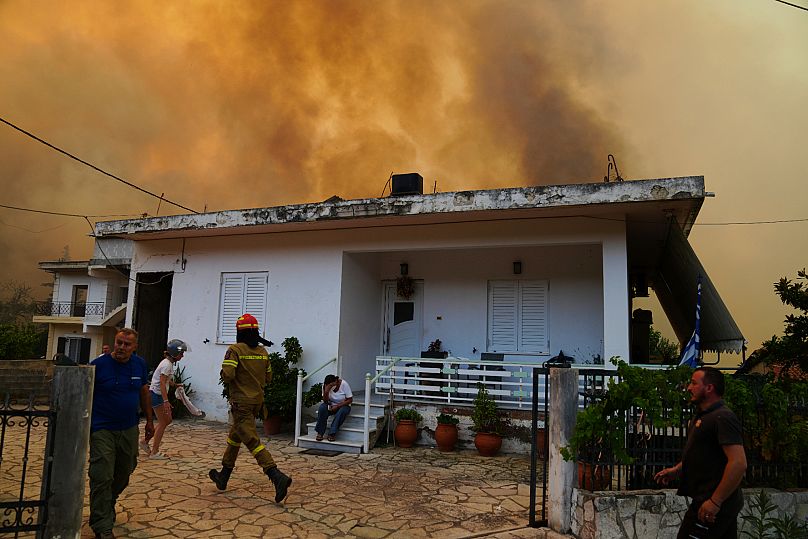
In the Greek port city of Patras, firefighters struggled to protect homes and farms from flames that tore through pine forests and olive groves.

"Today is another very difficult day with the level of fire risk remaining very high across many parts of the country," fire fervice spokesperson Vassilis Vathrakoyiannis said.

At least 15 firefighters have been hospitalised or received medical attention for burns, smoke inhalation or exhaustion, he added.

Local media reported that two young men were arrested for arson late Wednesday evening on charges of setting the fire that first broke out on Tuesday in the Syhena district of Patras.

A firefighter runs at a house as a fire approaching a house during a wildfire in Vounteni, on the outskirts of Patras, western Greece, Wednesday, Aug. 13, 2025. AP Photo


The flames, fuelled by strong winds, have damaged an unknown number of homes, businesses and two monasteries.

Firefighting resources in multiple countries have been stretched thin as they battle simultaneous fire outbreaks in scorching temperatures.

Aircraft forces in Greece rotated between blazes on the western mainland, the Patras area and the island of Zakynthos.

Athens has also sent reinforcements to neighbouring Albania, which is struggling to contain dozens of wildfires. An elderly man has died in one fire south of Tirana, officials said on Wednesday.

Spain reports catastrophic wildfire season

In Spain, Prime Minister Pedro Sánchez expressed condolences after the death of a volunteer firefighter in the Castile and León region north of the capital, Madrid, where more than 8,000 residents have been ordered to evacuate from at least thirty towns.

Authorities said that fires in León have burned through around 38,000 hectares of land. They confirmed the death of a 37-year-old man and at least 12 injuries between the municipalities of Zamora and León.

"The wildfire situation remains serious, and taking extra precautions is essential," Sánchez wrote in an online post.

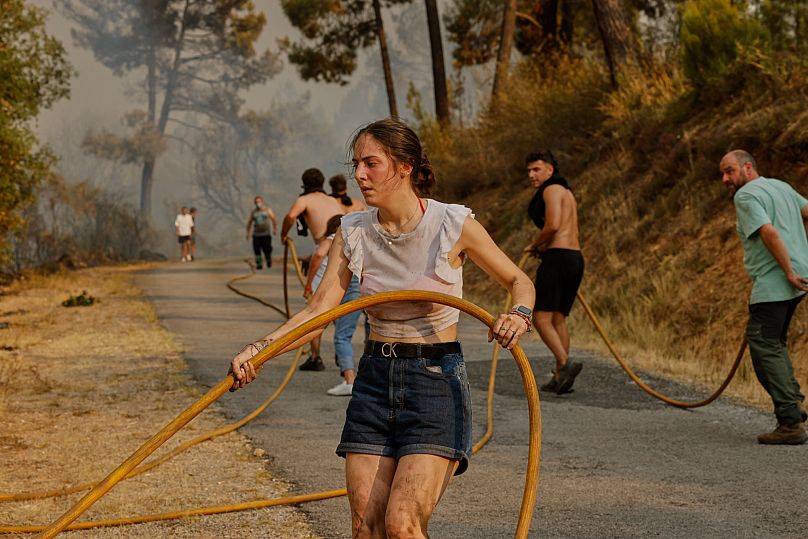
Local residents and volunteers try to put out a wildfire in Larouco, northwestern Spain, Wednesday, Aug. 13, 2025. AP Photo


Evacuation centres in central Spain were filled to capacity, with some spending the night outdoors on folding beds. The most severe fires in the country pushed northward into rural areas.

Officials in Valencia declared a level two emergency after a fire reportedly triggered by a bout of lightening forced the preventative evacuation of several districts, whilst in seven fires remain active in the north-western city of Ourense.

Thousands of firefighters deployed in Portugal

In Portugal, authorities have deployed thousands of firefighting crews to combat fires that have been ongoing for several weeks.

Wildfires are particularly intense in the town of Arganil, where more than 900 firefighters combat a "very unfavourable" situation, authorities said on Thursday. At least three other fires are burning in Sátão and Cinfães, Cinfães and Trancoso.

Portuguese President Marcelo Rebelo de Sousa said weather conditions looked "particularly worrying" and could lead to the "worsening" of the flames.

Despite ongoing fires that have led to a record amount of burned land compared to last year, Portuguese Prime Minister Luís Montenegro said he has not yet activated international aid mechanisms, but did not rule out doing so in the future.


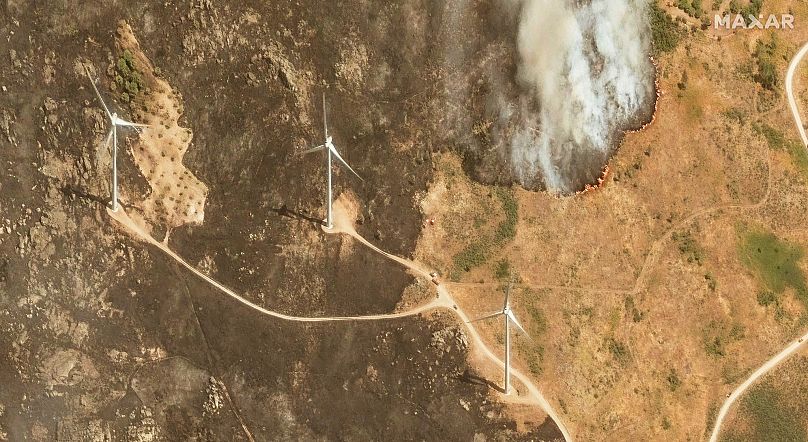
Satellite image by Maxar Technologies shows active fire line for a wildfire in Trancoso, Portugal, Aug. 12, 2025. AP/Satellite image ©2025 Maxar Technologies

"When necessary, when circumstances motivate it, we will do it. This obeys criteria that are of a technical and operational nature, which will have to be met," Montenegro told CNN Portugal.

The European Union has rushed aid to countries hit hard by the fires, including non-member states. European Commission President Ursula von der Leyen said that much efforts were focused on Montenegro where fires burned near the capital of Podgorica.

In a post on X, von der Leyen wrote: "We're mobilising support for Greece following their request for assistance. And prepositioned firefighters are already helping in Spain."

"This is European solidarity in action," she added.


Interview


Researchers race to predict wildfire behaviour as France battles biggest blaze in decades

A fire that raged through France’s southern Aude region and devastated an area larger than Paris had been brought under control late Thursday, authorities said. As large-scale wildfires become a bigger threat due to climate change, researchers in France are now working to model their behaviour in order to more effectively combat them.


Issued on: 07/08/2025 - 
By: Cyrielle CABOT

An Airbus H225 helicopter belonging to the French Civil Security Service drops water on a forest fire in Saint-Laurent-de-la-Cabrerisse in southwestern France, August 6, 2025. © Idriss Bigou-Gilles, AFP

Firefighters on Thursday battled for a third day to contain the biggest wildfire in France since 1949 raging in the southern Aude region, where more than 17,000 hectares (42,000 acres) have been blackened by flames. A 65-year-old woman was found dead in her scorched house and more than a dozen other people have been injured, two of them seriously.

The authorities mobilised 2,500 firefighters and significant air support to combat the flames.

Prime Minister François Bayrou, who visited the area on Wednesday, called the blaze “a catastrophe on an unprecedented scale” and warned that there could be more such disasters in the coming decades as a result of global warming.

Researchers are trying to better understand wildfires to learn how to prepare for them more effectively. Mélanie Rochoux, a researcher at the European Centre for Research and Advanced Training in Scientific Computing (Cerfacs) in Toulouse, has spent years studying the behaviour of forest fires and how weather and vegetation impact them. She provided some insights into the research currently under way.


FRANCE 24: The rapid spread of flames in the Aude region seems to have taken authorities by surprise. Are we able to predict how a fire will evolve once it starts?

Mélanie Rochoux: That is precisely the subject of my work with colleagues from Météo-France (France's national weather monitor) and the University of Corsica. At present, there is no operational tool deployed across France that can predict the behaviour of a fire in advance and determine precisely how it will spread, at what speed and in what direction.

The answer will depend on meteorological factors – temperature, wind, humidity – and environmental factors, such as the topography of the area and the vegetation.

Vegetation arranges itself into vertical strata, with a lower layer consisting of ground cover, a middle layer consisting of shrubs and an upper layer at the treetops.

Anything close to the ground – mainly dead vegetation such as twigs, leaves or pine needles – is particularly sensitive to changes in weather conditions. When the air humidity is low, this vegetation dries out quickly and becomes highly flammable. When a fire starts, it is this vegetation that will help it spread, depending on the wind.

But in some cases, trees can catch fire and burn all the way to the top, like torches. This is called a "crown fire", which greatly accelerates the spread of the flames.

In a given geographical area, the specifics of a fire will depend on a combination of these factors. Currently, all our work consists of carrying out simulations to better understand the role of these different factors and modelling scenarios based on data from previous fires.

However, we are still at the research stage, and we need more data to strengthen our models. In recent weeks, a fire observation campaign has been conducted in the south of France using an aircraft from the CNRS (France's National Centre for Scientific Research) and Météo-France. The aim was to fly over the forest fires, taking multiple readings on their nature, their spread across the ground and the components of the smoke in affected areas. Over the next two years, this aircraft will fly to Spain and Portugal to gather more data on fires in southern Europe as part of the EUBURN research programme (on wildfire risks).

Read moreAs France battles wildfires, experts call for a rethink of forest management

Is the scale of the fire in the Aude region something that was foreseeable?

In the Aude region, all the conditions were in place for a large-scale fire: strong winds with gusts of over 50 km/h, high temperatures of over 30°C and very low humidity in a heavily wooded area.

However, the situation was also exacerbated by a wet spring, which promotes the growth of vegetation. This was followed by a very hot and dry June, resulting in severe drought. We therefore ended up with abundant but very dry vegetation – the perfect fuel.

This explosive combination of heat and drought is what we call “concurrent extreme weather events”. And it's a recipe for large fires.

Météo France had accurately predicted this in its forest weather forecast. On Tuesday, the Aude department was placed on red alert, meaning a very high fire risk. But it is important to remember that there can be no fire without a spark. In France, nine out of 10 fires are caused by humans.


© France 24
04:13


Given the scale of the disaster, can we see this as a sign of climate change?

An attribution study will determine the extent to which climate change made this fire more likely. But what is certain is that with global warming, fires like this are likely to become more frequent.

As we know, climate change is making extreme events such as heatwaves and droughts more frequent and more intense. The combination of heat and drought that we are seeing in the Aude region is therefore more likely to occur in the future.

But climate change is also altering the geography of fires. For a long time, fires in France were confined to the Mediterranean region. But increasingly, they can affect any part of the country, as long as the weather conditions are right. We saw this in 2022 with fires in Gironde (in the southwest) but also in Finistère (on the northwestern Atlantic coast)

When a wildfire occurs, the current strategy is to act quickly to bring it under control. Does the new reality, with more intense and frequent fires, undermine this policy?

Firefighters in France try to get to a fire as quickly as possible to bring it under control. So far, this strategy has proven successful.

But the new reality increases the risk of multiple large fires occurring at once in several places across France, making that strategy difficult. This was one of the things firefighters feared in 2022 during the major fires in the Gironde region. If fires had broken out at the same time across the Mediterranean region, the situation would have been very difficult to manage.

Technical and logistical resources remain limited and cannot be expanded indefinitely. In the long term, this early-attack strategy could be difficult to apply systematically, especially since fires are not just an issue for France but for Europe.

There is a united European mechanism for fighting fires, but if a major fire breaks out in France at the same time as in Greece or Portugal, we would not be able to benefit as much from European reinforcements.

Would better anticipating fires allow for a better use of resources?

Better anticipation enables us to better identify which fires to tackle as a priority, for example, by identifying those that are most likely to reach populated areas or escalate into mega-fires. We could then pre-position aerial and human resources according to priority.

That is why we are seeking to map areas where large fires could develop and plan for how they might evolve during the summer season. Ultimately, we want to be able to say, "If a fire starts here, it will spread there, at this speed, and reach this size." A better understanding of wildfires will enable us to better prepare for them.

This article has been translated from the original in French.


Climate change-driven heat extremes are driving ‘staggering’ decline in tropical birds, study warns

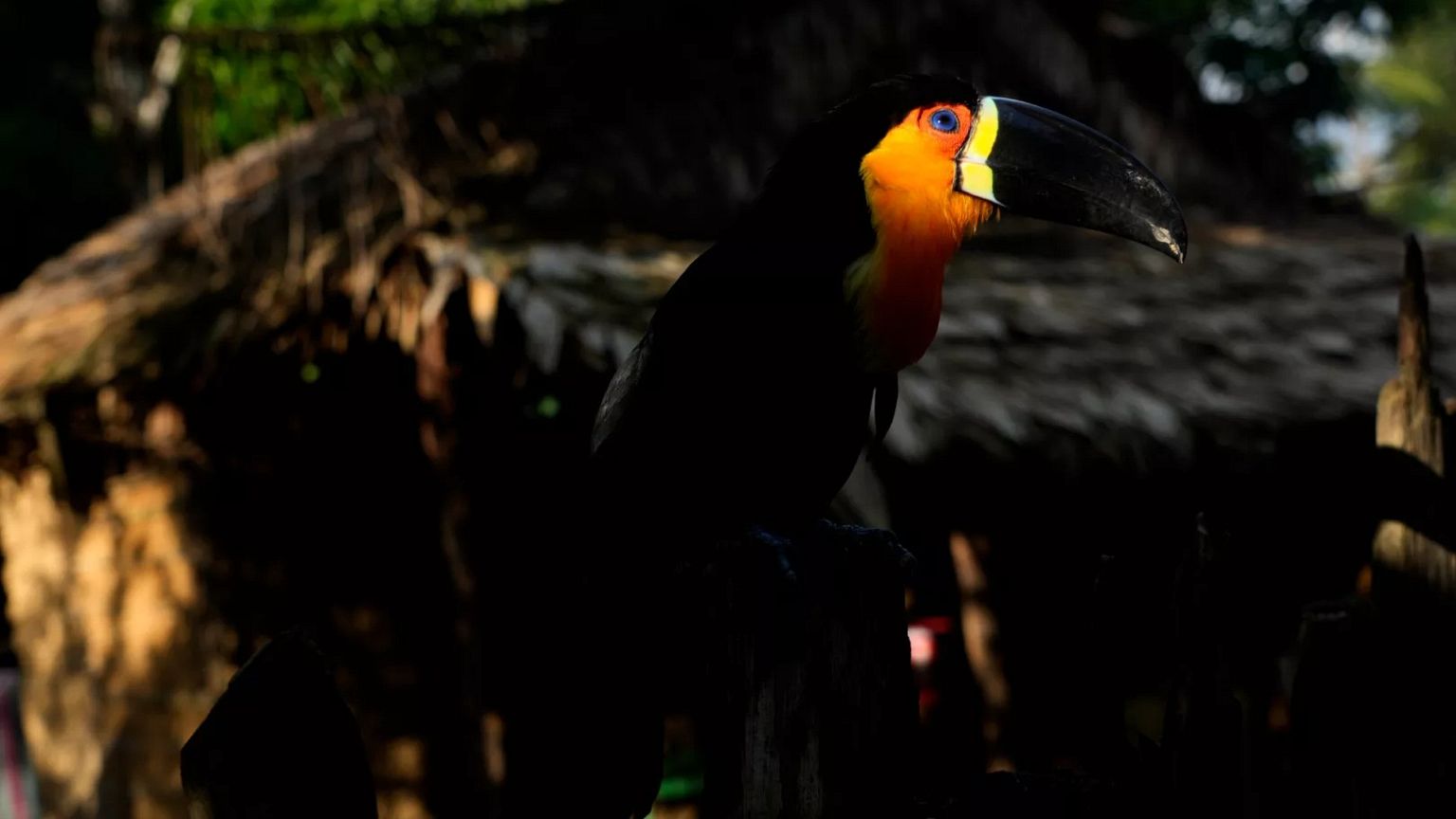
A toucan perches on the fence of a house in the Indigenous community in Brazil.
Copyright AP Photo/Eraldo Peres


By Rosie Frost
Published on 

Using climate attribution science, researchers have linked rising heat to declining bird populations around the world.

Extreme heat driven by climate change has caused tropical bird populations to decline by up to 38 per cent since the 1950s, scientists have warned.

A first-of-its-kind analysis published in the journal Nature Ecology and Evolution has used observed data and models to identify the effects of climate change on bird populations around the world.

Compared to a world without global warming, it found that intensifying heat extremes caused tropical bird populations to decline by 25 to 38 per cent between 1950 and 2020.

It is a “staggering decrease”, according to lead author Maximilian Kotz, a guest researcher at Potsdam Institute for Climate Impact Research (PIK) and researcher at Barcelona Supercomputing Centre (BSC).

Nearly every region reported a decline, but the biggest fall in bird numbers was seen in the tropics.

Extreme heat may explain bird decline in untouched forests

Tropical regions like the Amazon or Panama have seen bird populations plummet even in untouched rainforests. Previous research found that in a “relatively undisturbed” part of the Amazon Rainforest, bird numbers had declined by more than 50 per cent from 2003 to 2022.

Similar drops have also been seen in forests in Panama, but the causes of both were noted as unknown.

This study’s findings suggest that more intense heat extremes are likely to be the main factor behind these disappearing populations. The population declines in both of these tropical regions were of a similar magnitude to the research team’s estimates of the impacts of intensifying extreme heat.

Tropical birds are exposed to ten times the extreme heat conditions today than they were 40 years ago, according to the study, increasing from an average of three days a year to 30.

“Birds are particularly sensitive to dehydration and heat stress,” explains Kotz.

“Extreme heat drives excess mortality, reduced fertility, changing breeding behaviours and reduced offspring survival.”

Kotz adds that rising temperatures are pushing species out of the ranges they’ve naturally adapted to in a very short amount of time.

A first-of-its-kind attribution study

Until now, it has been difficult to distinguish how much climate change impacts biodiversity compared to more direct human impacts like deforestation.

But an emerging scientific field known as climate attribution uses a set of standardised techniques to figure out the exact impact of climate change on different parts of the climate system. It has been used to figure out how much more likely or intense extreme weather events are in a warming world, or even the influence of climate change on specific episodes of extreme ice loss from glaciers.

This research team believe this is the first time it has been used to attribute biodiversity losses to climate change.

Their methods indicate that in lower-latitude tropical regions, intensifying heat extremes are already having a bigger impact on declines in bird populations than deforestation or habitat loss.

“On the conservation side, this work tells us that in addition to protected areas and stopping deforestation, we urgently need to look into strategies for species who are more vulnerable to heat extremes to maximise their adaptation potential,” says Tatsuya Amano from the University of Queensland.

“That might mean ex-situ conservation work – so working with some populations in other locations.”

Fact checking Fox News claims about crime rates and migration in Ireland


By Estelle Nilsson-Julien
Published on 13/08/2025 


Right-wing US news channel Fox News sparked a controversial debate after it aired a TV segment alleging that Dublin is one of the most dangerous cities in Europe, while also implying that crime and migration are linked.

A segment that aired on conservative US news channel Fox News in early August has sparked a controversial debate in Ireland, leading the country's former Prime Minister Leo Varadkar to post on X, directing his followers to a thread fact-checking the broadcaster's claims.

In the TV piece, Fox News alleged that Dublin has gone from being one of the safest cities in Europe in 2003 to one of the most dangerous in 2024.

To support this claim, Fox News showed a screenshot of an article published in 2024 by the Irish newspaper Sunday World titled "Dublin ranks among the top ten most dangerous major cities in Europe, survey claims."

However, when investigating the claim, EuroVerify found that the article uses data sourced from a survey carried out by online betting platform the OLBG (Online Betting Guide)

"The main reason why this research was conducted was to reveal the best cities in Europe for nightlife, and as part of the study, safety scores for each city were analysed", a spokesperson for the OLBG told EuroVerify. 

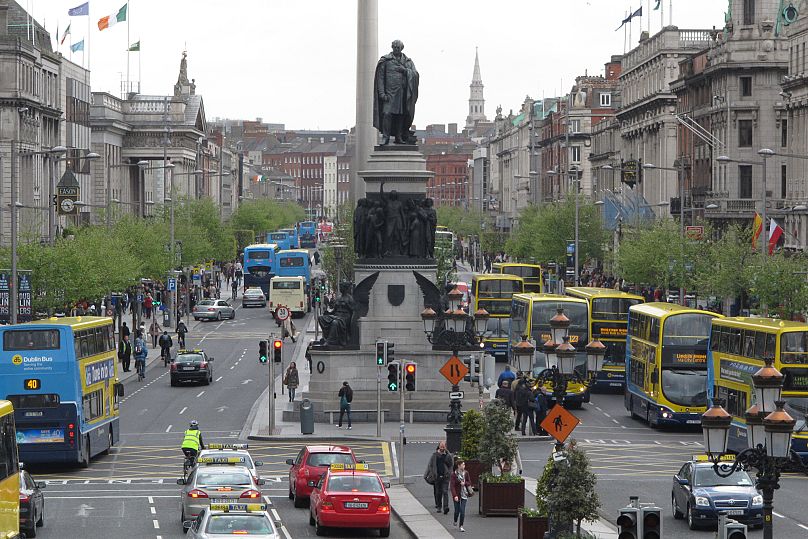
The broadest boulevard of the Irish capital, O'Connell Street, is packed with buses and commuters at evening rush hour in Dublin, 30 April, 2012 AP Photo

The reliability of the survey is questionable given that OLBG sourced its data from Numbeo, a platform which relies on crowd-sourced data and warns there is no "assurance that any statement on the website is correct or precise."

Meanwhile, the Global Peace Index, which is produced by the Australian-based NGO, the Institute for Economics & Peace, has consistently ranked Ireland as one of the safest countries in the world, placing it in second position in 2025.

Rising crime in Ireland

During the piece, the channel aired two graphs side by side on screen — on the left one showing rising immigration in Ireland, while the one on the right displayed figures for rising crime — in turn implying that there is a causal link between migration and crime.

Contacted by EuroVerify, Ireland's Department of Justice said that it was not "aware of any credible evidence that would suggest a causal link between immigration and crime in Ireland."

"Over the past 10 years there has been a large increase in the numbers of non-Irish people employed in Ireland. They bring essential skills and experience that are much needed in the current labour market. There has been no corresponding change in crime levels over this period," the spokesperson added.

Ireland experienced unprecedented levels of immigration in the year leading up to April 2024, with a population increase of 98,700, which amounts to positive net migration of 79,300, meaning that more people have been arriving in Ireland, than those leaving.

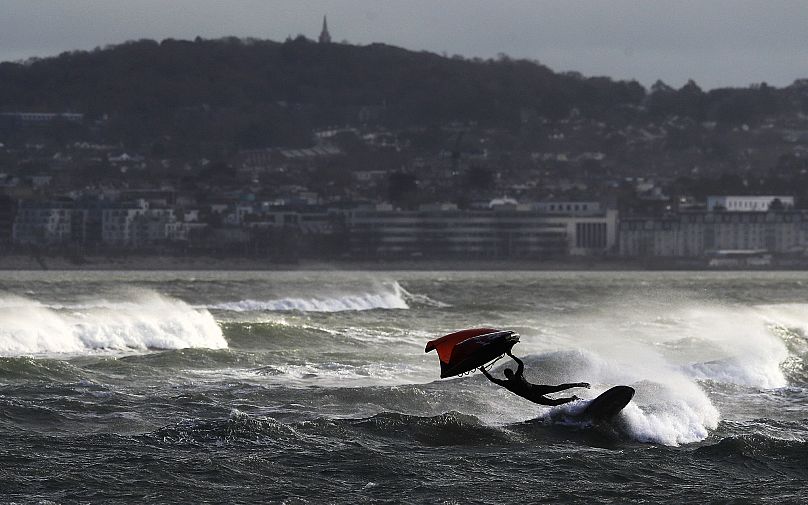
A
 man hydrofoil kiteboarding at Sandymount strand in Dublin, 16 December, 2020 AP Photo


Fox News also stated that robberies had increased by 18% and violent crime by 10%. However, these selected crime and robbery statistics are misleading because the country's statistics office does not classify crimes under the broad labels of "robbery" and "violent crime."

More specifically, the 18% figure cited by Fox News appears to refer to an increase in "robbery, Extortion & Hijacking" from the first quarter of 2023 to the first quarter of 2024, while the 10% figures refer to an increase in crime incidents involving "weapons and explosives offences."

What the segment fails to mention is that other crimes decreased between the first quarter of 2023 and the same period of 2024, with homicide and sexual offences dropping by 8% and 12% respectively. 

How disinformation is fuelling hate crimes in Ireland

Over the course of the summer, a spate of brutal attacks predominantly targeting South Asian migrants occurred in Ireland.

"A series of highly publicised, very violent attacks targeting members of Ireland's Indian community have spread fear. A lot of the attacks were initiated by misinformation and disinformation, for instance through lies spread about crime", Teresa Buczkowska, the CEO of Immigrant Council of Ireland told Euronews.

On 19 July, an Indian man was attacked by a group of men in southwest Dublin, who beat him and accused him of inappropriate behaviour with children.

While Irish authorities stated that the allegations against him were unfounded, footage of the aftermath of the attack spread online according to Irish broadcast RTE, leading the footage to gain traction as anti-immigration accounts reshared it.

Irish Police patrol central Dublin, 24 November, 2023 AP Photo

This led the country's Indian embassy to issue a safety warning to its citizens following what it qualified as "an increase in the instances of physical attacks reported against Indian citizens in Ireland recently."

"Everything changed after the Dublin riot in 2023, when we saw a huge level of violence erupting in Dublin city centre against migrants and that really kind of was the starting point for the physical violence we are seeing today", said Buczkowska.

"The shifting narrative we are hearing in politics and false allegations that migrants are raising crime rates are leaking into everyday conversations and opinions, which is a worrying trend", added Buczkowska.

Flying to Portugal in August? Airport strikes could derail your summer holiday plans


Passengers should brace for disruptions at airports across Portugal.
Copyright Mark Stuckey/Unsplash
By Craig Saueur
Published on 

Spain is also preparing for airport staff strikes until the end of the year.

Travellers heading to Portugal this summer are being warned to expect weekend delays and cancellations as airport staff strike across the country throughout August. 

Aircraft servicing, baggage handling and check-in teams are walking out every weekend this month over low pay, unpaid night shifts and parking disputes following British-owned Menzies Aviation’s takeover of Groundforce operations.

Airports in Lisbon, Faro and Porto, as well as Madeira, Porto Santo and the Azores, are all affected, with disruptions impacting flights during the height of the summer season.

Travellers advised to check before flying

The UK Foreign, Commonwealth & Development Office (FCDO) has cautioned that the collective action over weekends in August could lead to significant delays.

Portugal’s airports managing company ANA has issued similar advice, warning that several airlines – including state-owned carrier TAP – are likely to be affected.

Passengers should be ready for more weekend disruption as soon as tomorrow, with the third of the five planned strikes set to begin:

  • 15 to 18 August

  • 22 to 25 August

  • 29 August to 1 September

Flights have already been delayed and cancelled

The strikes have caused chaos at Portugal’s busiest airports.

On the first weekend, Lisbon’s Humberto Delgado Airport scrapped more than 70 flights. The second wave from 8 to 11 August brought more headaches with eight flights to Lisbon cancelled. Long delays also held up departures. According to union sources cited by Lusa News Agency, around 25 flights left without passengers’ checked bags, too.

The standoff has sparked a bitter public feud between Menzies and the Metallurgical and Related Industries Union (SIMA), which represents the striking employees.

“We were forced into this situation by the intransigence of the current management, represented by its vice-president Rui Gomes, who opted for confrontation instead of dialogue, refusing solutions that respected workers’ rights and the interests of the country,” SIMA leader Carlos Araújo said in a statement earlier in August.

“In the middle of the high tourist season, Menzies and TAP have chosen to turn their backs on their professionals, customers and all those who visit Portugal, with an arrogant, irresponsible and calculated attitude.”

Meanwhile, Menzies said plans were in place to keep operations running and insisted the company respects the law and workers’ rights.

A spokesperson for Menzies told Lusa that the union “[insists] on promoting a distorted narrative based on unfounded allegations.”

Chaos reigns across European airports

Portugal’s strikes are just one part of a summer of disruption across Europe.

Italy endured a four-hour nationwide airport strike on 26 July, after earlier walkouts forced 73 flight cancellations in one day across Milan, Venice and Naples.

Spain has already seen disruption from Volotea’s crew and pilots, who staged a strike on 26 July, affecting flights to more than 100 destinations.

Now, from 15-17 August, airports across Spain expect more delays, as more than 3,000 workers at Azul Handling – part of the Ryanair group – have planned a walk-out at 12 airports. The strikes are expected to continue weekly through December.

But few strikes have had the impact of those in France. Air staff strikes in July forced airlines to cancel thousands of flights, affecting more than 1 million passengers. Ryanair CEO Michael O’Leary slammed the strikes as “holding European families to ransom” and called for EU action to protect travellers.

Holidaymakers heading to Portugal or elsewhere in Europe are advised to leave extra time at airports, monitor announcements from airlines and expect delays at major hubs.

With strikes coinciding with peak-season travel, this summer’s ongoing disruptions serve as a reminder of how quickly holiday plans can be blown off course.