Thursday, August 28, 2025


Is Lithium's Reign as Battery King Coming to an End?

  • Despite lithium-ion batteries powering 70 percent of rechargeable devices, issues with environmentally damaging extraction and China's control over supply chains are pushing for alternatives.

  • Solid-state batteries are a highly anticipated alternative, offering potential benefits in safety, energy density, and charging speed, while also reducing reliance on graphite.
  • Sodium-ion batteries are another promising contender due to sodium's abundance, lower cost, and less water-intensive extraction process, contributing to a more diversified and resilient battery economy.

Lithium-ion batteries power the world around us. Their prevalence in our daily life is growing steadily, to the extent that lithium-ion batteries now power a whopping 70 percent of all rechargeable devices. From electric vehicles to smartphones to utility-scale energy storage, lithium-ion batteries are increasingly forming the building blocks of innumerable sectors. But despite its dominance in battery technologies, there are some serious issues with lithium supply chains that make it a less-than-ideal model upon which to base our world.

Not only is extracting lithium often extremely environmentally damaging, it’s deeply intertwined with geopolitical pressure points. China controls a huge portion of global lithium supply chains, rendering markets highly vulnerable to shocks and the political will of Beijing. China’s control is particularly strong in the case of electric vehicle batteries, thanks to a decade-long strategy to outcompete the globe. 

“For over a decade, China has meticulously orchestrated a strategic ascent in the global electric vehicle (EV) batteries market, culminating in a dominance that now presents a formidable challenge to Western manufacturers,” reports EE Times. The resulting effect functions as “almost a moat” around Chinese battery production, buffering the sector against international competition. 

The multiple downsides and risks associated with lithium and lithium-ion battery sourcing is pushing EV companies to research alternative battery models to power the electric cars of the future. There are a litany of lithium alternatives in research and development phases, including – but not limited to – lead, nickel-cadmium, nickel-metal hydride, sodium nickel chloride, lithium metal polymer, sodium-ion, lithium-sulfur, and solid state batteries. 

Solid state batteries seem to be the biggest industry darling. Solid-state batteries use a solid electrolyte as a barrier and conductor between the cathode and anode. These batteries don’t necessarily do away with lithium, but they can eliminate the need for graphite – another critical mineral under heavy Chinese control. Plus, solid state batteries are purported to be safer, have higher energy density, and recharge faster than lithium-ion batteries. 

While solid-state batteries are still in development, they’re already being tested in some applications by car companies. Mercedes and BMW claim that they are already road-testing vehicles powered by solid-state batteries, but it will likely be years before we see them in any commercial context. Subaru is on the verge of testing solid-state batteries within its vehicles, but is already employing a smaller form of the technology to power robots within its facilities.

However, while solid-state batteries are being hailed as a sort of holy grail for battery tech, some think that the promise – and progress – of solid-state batteries is overblown. “I think there’s a lot of noise in solid state around commercial readiness that’s maybe an exaggeration of reality,” Rivian CEO RJ Scaringe said during an interview on this week’s Plugged-In Podcast.

Sodium ion batteries are also a promising contender to overtake lithium-ion batteries in the EV sector. Sodium is 1,000 times more abundant than lithium. “It’s widely available around the world, meaning it's cheaper to source, and less water-intensive to extract,” stated James Quinn, the CEO of U.K.-based Faradion. “It takes 682 times more water to extract one tonne of lithium versus one tonne of sodium. That is a significant amount.” Bloomberg projections indicate that sodium-ion could displace 272,000 tons of lithium demand as soon as 2035.

But even this does not signal the death of lithium. Lithium is simply too useful in battery-making. It’s energy-dense and performs well in cold weather, making it “indispensable for high-performance applications” according to EV World. “The future isn’t lithium or sodium—it’s both, deployed strategically across sectors…the result is a diversified, resilient battery economy.”

By Haley Zaremba for Oilprice.com


U.S. Oil Powerhouse Chevron Is Back In Iraq, But Will It Be Different This Time?

  • Chevron signed an agreement in principle with Iraq’s Oil Ministry to develop the giant Nasiriyah field and other assets.

  • Chevron's deal is part of a broader Western return that includes TotalEnergies’ $27B and BP’s $25B deals, with ExxonMobil also in talks.

  • The re-entry is driven by Baghdad’s assurances on transparency, contract stability, and security after years of corruption and governance risks that previously pushed majors to exit.

U.S. oil and gas supermajor Chevron signed an agreement in principle last week with Iraq’s Oil Ministry for the development of the huge Nasiriyah oil field, plus other oil producing fields and exploration sites. This is the latest in a recent line of top-tier Western firms that have announced a return to Iraq following a collective exodus from the country beginning around seven years ago with ExxonMobil’s withdrawal from the crucial Common Seawater Supply Project (CSSP). ExxonMobil itself is currently in discussions with Iraq’s authorities for a new opportunity in the oil sector, according to a recent comment from the Oil Ministry, while several other U.S. firms have also signed exploration and development agreements in recent days. Supermajor oil and companies from the U.S.’s key political, economic, and security allies have also secured strategically vital energy deals in Iraq this year, including France’s TotalEnergies US$27 billion four-pronged deal (including the CSSP) and Great Britain’s BP’s US$25 billion five-oilfield deal. So, why have they all decided to return to the country now, and will they stay this time around?

Iraq had just as much oil and gas potential back when these firms left the country as it does now, and it had just as much geopolitical significance then as it does currently, so these are not the key catalysts for the mass re-entry of these Western energy heavyweights to the country. Instead, as seen in the microcosm of the potential return of ExxonMobil, it all comes down to assurances made by the Iraqi authorities that things will be different this time around when it comes to transparency. According to several senior energy, legal, and security sources exclusively spoken to by OilPrice.com in 2018/2019, ExxonMobil walked away first from the CSSP and then from subsequent projects in Iraq because of the threat to its reputation and to that of the U.S. more broadly from continuing to do business in the country was simply too great. Independent non-governmental organisation Transparency International (TI) in its ‘Corruption Perceptions Index’ neatly encapsulated the problem when it described Iraq at that time as: “Among the worst countries on corruption and governance indicators, with corruption risks exacerbated by lack of experience in the public administration, weak capacity to absorb the influx of aid money, sectarian issues and lack of political will for anti-corruption efforts.” TI added: “Massive embezzlement, procurement scams, money laundering, oil smuggling and widespread bureaucratic bribery that have led the country to the bottom of international corruption rankings, fuelled political violence and hampered effective state-building and service delivery.” It concluded: “Political interference in anti-corruption bodies and politicization of corruption issues, weak civil society, insecurity, lack of resources and incomplete legal provisions severely limit the government’s capacity to efficiently curb soaring corruption.”

Related: Saudi, Argentina, and China Push to Tap Giant Shale Reserves

Having reached an impasse on the CSSP, ExxonMobil attempted to redress the key practical issues relating to the risk/reward balance of its other projects in Iraq, which included the supergiant West Qurna 1 oilfield, as analysed in full in my latest book on the new global oil market order. “There were three key elements that formed the basis of these negotiations [between ExxonMobil and Iraq’s Oil Ministry for the U.S.’s continuation in other projects in the country] -- ‘cohesion’, ‘security’ and ‘streamlining’,” said one of the senior energy sources based in Baghdad. Cohesion related to ensuring that building the facilities connected to projects were completed in full and in order. Security related not just to the on-the-ground security of personnel but also to the soundness of the basic business and legal practices involved in the agreement. Streamlining meant that any deal should continue as had been laid out in the agreement, regardless of any future changes to the government of Iraq. According to the source who worked very closely at the time with Iraq’s Oil Ministry, the authorities agreed to these ideas in principle but the practical implementation of them fell short of ExxonMobil’s expectations. Subsequent to this, a senior legal source in Washington exclusively told OilPrice.com that any major agreements signed by big U.S. oil and gas firms in Iraq would have to be agreed in full by U.S. lawyers, all accounts will have to be checked by U.S. accounting firms, working processes will have to be checked by U.S. project consultancy firms, and security issues of any nature will have to be worked through and then monitored on an ongoing basis with U.S. security organisations.

It is difficult to believe that such safeguards will not be in place for any future project in which ExxonMobil becomes involved and equally so for Chevron, because Chevron has also been here before. Back in 2021, the guy and gals from Houston had the distinct misfortune to find themselves dealing directly with the now rightly-buried Iraqi National Oil Company (INOC) -- widely regarded as one of the most corrupt organisations to operate in any field anywhere in the world ever. And the subject of these Stetson-curling negotiations? Exactly the same project as now. Discovered in 1975, the site’s original develop plan was shelved in the lead-up to the Iran-Iraq war that began in 1980 and lasted until 1988. The field eventually came on-stream in 2009 and was listed on the 2009-2010 fast-track development plan, which aimed to raise its output to at least 50,000 barrels per day (bpd) in the first phase. In the first half of 2009, Chevron was one of four international oil companies, along with Italy’s ENI, Japan’s Nippon Oil, and Spain’s Repsol, to be invited to submit bids to develop the field on an engineering procurement construction (EPC) contract basis. The Japanese consortium led by Nippon Oil, and comprising Inpex, and JGC Corporation, then looked set to win the contract before negotiations broke down again.

In 2014, a serious push was made to resuscitate the development of the Nasiriyah field within the broader scope of the ‘Nasiriyah Integrated Project’ (NIP) that also included the development of adjunct lesser oil sites to the main Nasiriyah site and the construction of a 300,000-bpd refinery. Bids for this wider project were encouraged by the government-ordered changes to the original Iraq technical service contract (TSC) that were aimed at addressing the concern of many oil firms that saw the original contract model as falling short of the production sharing contracts model that they preferred. Unlike the previous contracts, the new TSC variant offered investors a share in project revenues, but only when production began, and the Oil Ministry would pay recovery costs from the date of commencement of work. This differed from the previous contract where the costs were only paid when the contractor raised production by 10%. This said, investors would still have to pay 35% taxes on the profit they made from the Nasiriyah project, the same amount as in previous deals. That said, deep concerns among many of the bidders on issues connected to legal, accounting, and financial transparency led to the Nasiriyah project being shelved yet again.

Following China’s relaxing in 2017 of its earlier to all state-owned hydrocarbons companies to cut budgets, Sinopec and PetroChina proposed a deal that would see the NIP being rolled into part of the broader ‘Integrated South Project’ (ISP), later rebranded as the ‘South Iraq Integrated Project’. This aimed to boost output across Iraq’s southern oilfields, and to build out related infrastructure, including pipelines, transport routes, and the construction of the CSSP. In an interesting manifestation of karma, it transpired that even Iraq was surprised by the trickiness of China’s demands to work on the project. One example was that Beijing said it would spend US$9 billion on the NIP-related refinery and the first phase of developing Nassiryah, but that Iraq would have to pay back this cost to the Chinese from the value of oil recovered, the Oil Ministry source told OilPrice.com at the time. It also said that it should be given US$9 billion of Iraq government-backed bonds for the entire amount that could be cashed in if the development did not start to generate large amounts of oil quickly. Iraq’s view was that all this should cost no more than US$4 billion, which was the more accurate figure. China also wanted much more of their upfront costs paid back in a much shorter time than in other similar projects. This effectively meant a per barrel remuneration fee at a 15% premium to the highest maximum fee being paid at that stage to any company in Iraq for a regular crude oil producing field, which was US$6 per barrel to PetroChina for al-Ahdab. Given the alternative on offer for Beijing, then, it may be that this time around Iraq sticks to the more transparent way of doing business that Chevron has no doubt demanded for the Nasiriyah project.

By Simon Watkins for Oilprice.com


Greenland’s Energy Stakes Trigger Denmark-U.S. Diplomatic Clash

Denmark has summoned the U.S. envoy after intelligence reports of suspected influence operations in Greenland, a mineral-rich Arctic territory central to offshore oil prospects and critical minerals, Reuters reported on Wednesday, describing the effort as an attempt to promote secession

The development adds urgency to oversight of exploration and mining policy, with Danish officials saying the case could impact licensing timelines and control of future export routes.

According to media reports, at least three Americans tied to U.S. President Donald Trump engaged with Greenlandic politicians and figures and compiled lists of locals deemed supportive or hostile to U.S. aims. The foreign ministry called the activity unacceptable. The U.S. mission in Copenhagen is led by chargé d’affaires Mark Stroh.

Greenland contains significant deposits of rare earths and uranium alongside prospective offshore hydrocarbons that are undeveloped. Its position near emerging Arctic shipping lanes is elevating its value for energy trade and mineral exports as sea ice thins. The resource profile positions Greenland to supply permanent-magnet materials for wind turbines and EV motors, while uranium lends a dual energy role. Western planners also eye Greenland for catalysts and grid storage feedstocks.

Earlier this year, U.S. officials pressed the Tanbreez project to bypass Chinese buyers, highlighting how competition over critical minerals is shaping Arctic policy and procurement strategies. The island’s proximity to the Arctic makes it a logical focus for President Trump’s transactional approach to securing energy and minerals. Investors note Arctic corridors that could shorten voyages for crude and LNG. Seasonal access windows remain limited but widening.

Local leaders have maintained a cautious posture toward large-scale extraction. Environmental and social concerns have slowed efforts to transform the territory into a mining superpower, even as demand grows for materials used in wind turbines, batteries, and defense systems. Officials in Nuuk and Copenhagen continue to state that the island is not for sale. Greenland’s cabinet continues to weigh environmental baselines, hiring, and revenue-sharing before advancing projects.

By Charles Kennedy for Oilprice.com


German Gas Traders Turn to Canadian LNG for Swap Deals

German energy traders have developed an interest in Canadian liquefied natural gas to boost supply via swap deals, Canada’s natural resources minister said this week.

According to Tim Hodgson, as quoted by CBC, many German companies were interested in trading Canadian LNG on the global market. “They can take advantage of our production on the West Coast to supply German needs in the Atlantic,” by selling the Canadian cargoes on the spot market and buying cheaper LNG to deliver to Germany.

The previous government led by Justin Trudeau had said there was no business case for liquefied natural gas in Canada during a visit of then-Chancellor Olaf Scholz, who had gone to Canada looking for alternatives to Russian pipeline gas.

“The previous government made its decision based on the situation at the time. What we've been elected to do is respond to the realities today, taking into account what Canadians expect of us,” the current natural resources minister said.

Canada only has one operational LNG plant, the LNG Canada facility in Kitimat, British Columbia, which produced its first batch for sale in June. For now, production capacity from the first train of LNG Canada is 5.6 million tons per year, but this should go up to 14 million tons when all planned trains are completed.

Backed by Shell, Petronas, PetroChina, Mitsubishi, and Kogas, LNG Canada will help redirect a portion of Canadian gas exports—currently flowing almost entirely to the U.S.—toward global markets. The price tag of the project is $40 billion. The most logical target market for LNG Canada’s product is Asia because of geography, but with a pretty well-developed global spot market for liquefied gas, bargains could probably be made with German energy buyers as well. No spot-market LNG bargain would be as good as pipeline gas in terms of price, but it may help bring down the exorbitant cost of energy in Europe’s biggest—and struggling—economy.

By Irina Slav for Oilprice.com

Canada and allies to explore funding critical mineral projects, minister says

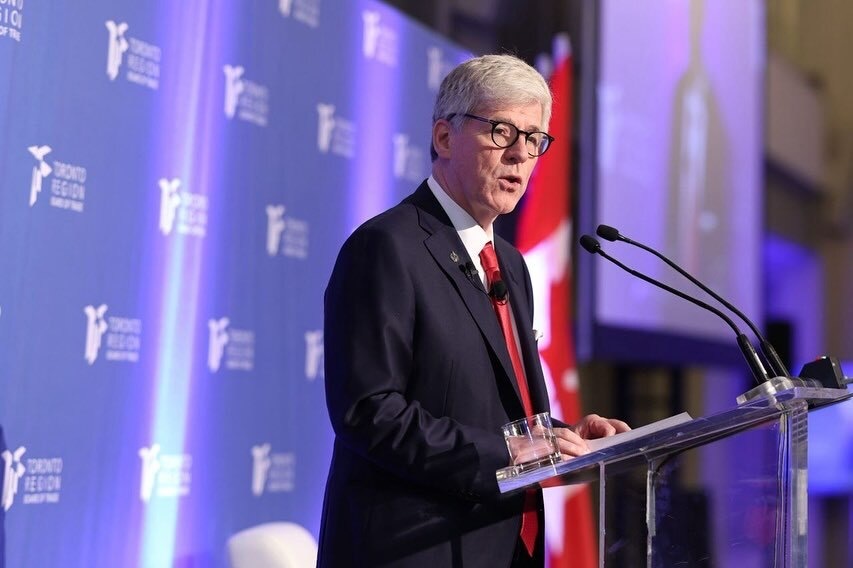
Canada’s Energy and Natural Resources Minister Tim Hodgson. Credit: NRCan

Canada is working with its allies to potentially fund critical mineral transactions, similar to what the US government did with MP Materials to diversify the supply chain from China, Energy and Natural Resources Minister Tim Hodgson told Reuters on Tuesday.

The key target, Hodgson said, would be minerals subject to China’s export restriction, which is challenging the production of important types of mineral products in G7 and NATO countries.

“I think you’ll see us looking at similar types of transactions, working with our allies,” Hodgson said.

“The difference between the MP Materials deal is all of the output goes to the United States there. We are interested in doing these sorts of deals in partnership with our allies to share the output with our allies,” he said.

MP Materials said on July 10 that it had entered into a public-private partnership with the US Department of Defense to build out a domestic rare earth magnet supply chain and reduce foreign dependency.

(By Riham Alkousaa and Divya Rajagopal; Editing by Leslie Adler)

Russia’s Arctic LNG 2 Hits Record Output as Ice Conditions Ease

Russia’s Arctic LNG 2 project lifted production to record levels in late August as summer ice conditions opened the Northern Sea Route, allowing additional cargoes to reach Asia, according to Bloomberg data reported by LiveMint. Output topped 25 million cubic meters on August 25-26, averaging nearly 15 million cubic meters for much of the month. The figures mark the strongest operational run since the facility began trial shipments earlier this year.

The Novatek-led facility, located on the Gydan Peninsula, has faced U.S. and EU sanctions that block Western financing, shipping insurance, and liquefaction technology. Despite these restrictions, Train-1 has ramped up throughput and dispatched multiple cargoes on specialized Arc7 ice-class carriers. Reuters tracking data earlier this month showed the Christophe de Margerie and other sanctioned vessels continuing liftings, demonstrating Russia’s reliance on its limited fleet of Arctic-class tankers.

Arctic LNG 2 is designed for three trains of 6.6 million tons per year each for a total planned capacity of 19.8 million tons annually. Sanctions on Russian shipyards and technology suppliers have delayed deliveries of additional carriers, creating a shortage that caps export flexibility. Analysts note that ship-to-ship transfers near Murmansk are being used to free Arc7 capacity for Arctic liftings. 

The logistics challenge has forced Novatek to expand marketing outreach to Asia. Recent efforts to place cargoes in China and India suggest a pivot away from Europe. Russian officials promote the Northern Sea Route as a strategic corridor capable of cutting sailing times to the Pacific during ice-free months, reinforcing Moscow’s broader LNG export strategy.

August’s higher run rate followed earlier commissioning stages when limited tanker capacity and storage constraints forced temporary cutbacks, with shipments now moving more regularly on Arc7 carriers.

By Charles Kennedy for Oilprice.com

Việt Nam Gov't to eliminate state monopoly on gold production

August 26, 2025 - 


The change aims to foster a more competitive environment and enhance the transparency of gold trading in the country.


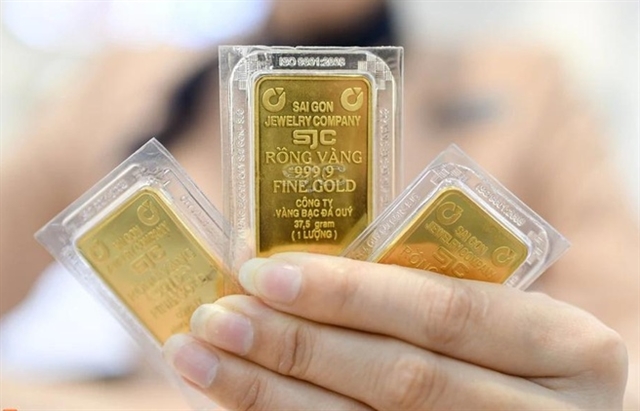
SJC gold bars are trading at a record high. — Photo vietnamplus.vn


HÀ NỘI — Việt Nam has officially removed the state monopoly on gold bullion production, marking a significant shift in the country’s gold market dynamics.

On August 26, the Government issued Decree 232/2025/ND-CP, repealing Clause 3, Article 4 of Decree 24, thereby eliminating the state monopoly on gold bullion production, raw gold exports, and raw gold imports for bullion production.

Accordingly, the decree regulates gold trading activities, including the production and processing of gold jewellery and art, trading of gold jewellery and art, production of gold bullion, trading of gold bullion, export and import of gold, as well as other gold trading activities such as account-based gold trading and gold derivatives.

The decree also revises the definition of gold bullion. Gold bullion is now defined as a gold product stamped into bars, marked with weight and quality, and bearing the trademark of enterprises and commercial banks authorised by the State Bank of Vietnam (SBV) to produce it.

Additionally, the SBV will organise gold bullion production during specific periods.

To align with the operational scope of commercial banks under the Law on Credit Institutions, the term “credit institution” has been replaced with “commercial bank.” This restricts gold bullion production and export/import activities to commercial banks only, excluding other types of credit institutions.

The decree also amends Clause 6, Article 4, stipulating that gold bullion production is a conditional business activity requiring a licence from the SBV. This amendment shifts the framework from a monopoly to a licensing system.

Payment regulations

The decree introduces new rules on payments for gold transactions.

Any gold purchase or sale worth VNĐ20 million (US$758.58) or more per day must be made via the customer’s payment account and the account of the gold trading enterprise at a commercial bank or foreign bank branch.

This provision ensures customer information verification while avoiding additional obligations, as verification is already completed when accounts are opened and used. The regulation aims to enhance transparency in gold trading.

Additionally, Decree 232 sets out the responsibilities of enterprises involved in gold jewellery and art production. When selling raw gold purchased from businesses, commercial banks specified in Article 11a must issue and use electronic invoices as required by law, properly store transaction data for raw gold sales, and connect with the SBV to provide information as requested by the SBV Governor.

These additions underscore the responsibility of enterprises in ensuring transparency and control in raw gold trading.

On the market, SJC gold bars were quoted at VNĐ125.7 million per tael for sellers and VNĐ127.7 million for buyers on August 26 — the highest prices in history. — BIZHUB/VNS


Zijin Mining sees ‘unprecedented’ global risks


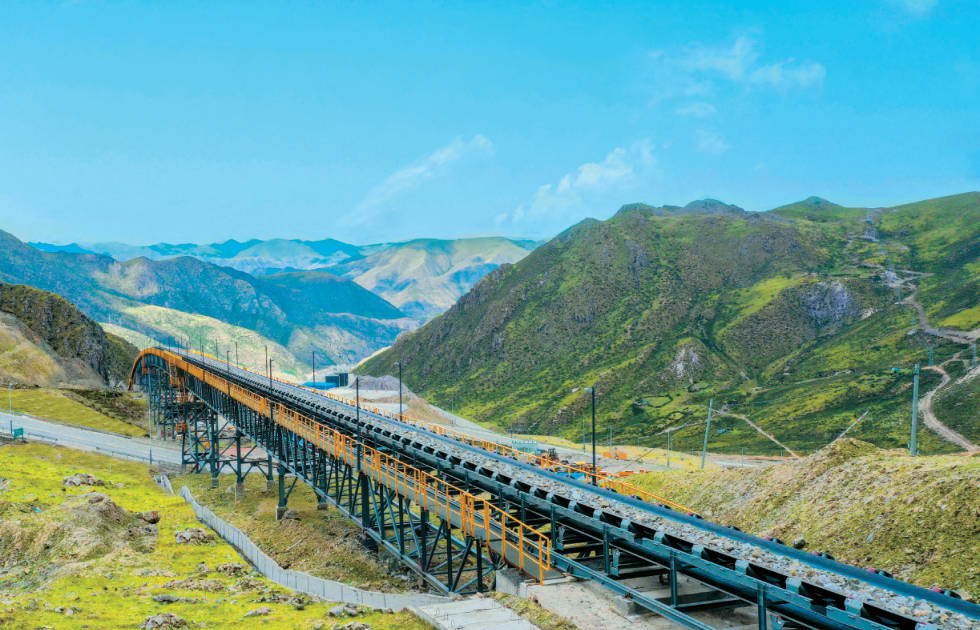
Zijin’s operations in DRC. Credit: Zijin Mining Group

China’s Zijin Mining Group Co., the world’s third-biggest metals miner by market value, said geopolitical confrontation and resource nationalism will pose challenges to its overseas projects.

“Global uncertainties have become unprecedented,” the copper-gold giant said after reporting record quarterly earnings. “The competition for critical minerals among major powers has entered a high-intensity confrontation phase” that could affect the company’s revenue, profits and new overseas projects, it said.

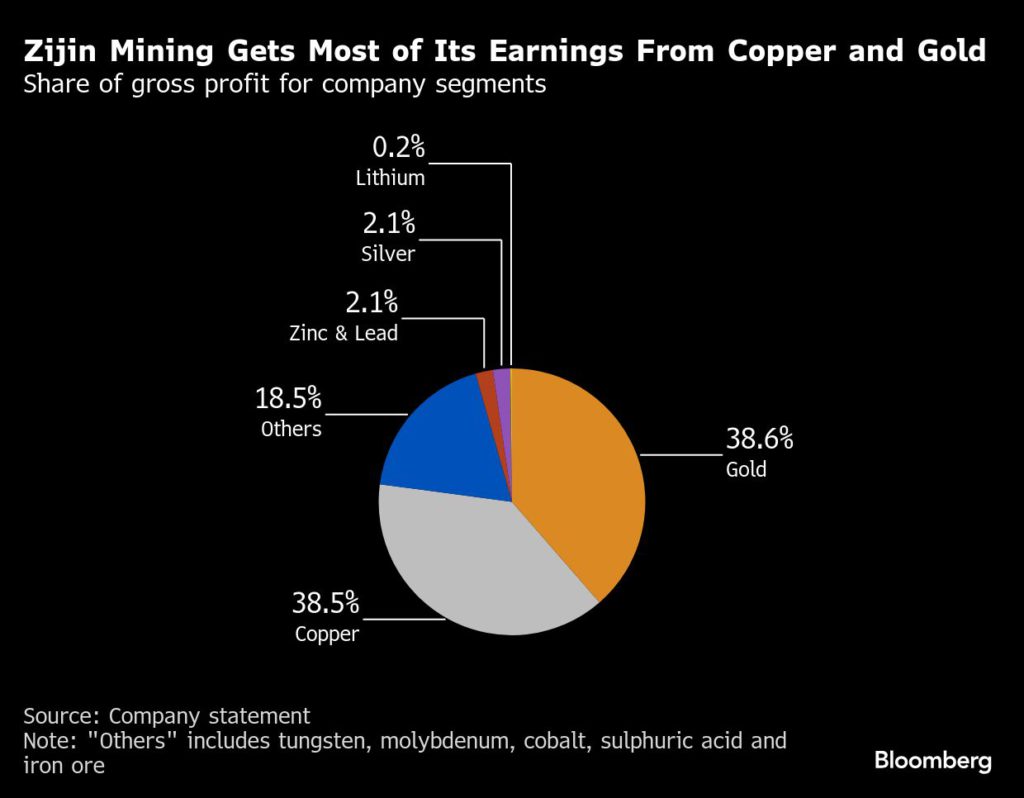
Zijin has become one of the world’s most important mining companies thanks to rapid growth — largely in Africa — and a focus on two lucrative metals, copper and gold. Its first-half net income went up 54% to 23.3 billion yuan ($3.3 billion) thanks to higher output and prices, and its shares rallied to a record in Hong Kong on Wednesday.

The US under President Donald Trump has begun a push to secure American control of resources around the world, with an eye to tackling China’s dominance. For example, a peace deal brokered by Trump between Rwanda and Democratic Republic of Congo was seen as a way to ease US access to the region’s mineral riches.

Critical minerals include a wide range of materials deemed vital to national security because of their important industrial or defense applications. But moves to reshape supply chains risk subjecting prices to volatility and supply disruption, as was the case with Trump’s introduction of copper tariffs earlier this year.

Zijin also highlighted other challenges for the mining industry, from rising costs to trade upheaval and nations seeking to protect their own resources. “Differences in politics, policies and laws among various countries and regions, as well as resource nationalism sentiments, may pose certain challenges to construction and production operations,” Zijin said.

The comments on geopolitics and jurisdictional risks offered a note of caution in an otherwise upbeat earnings report for Zijin, which is now valued at more than $80 billion — behind only Rio Tinto Group and BHP Group in the ranks of global metals miners. Its shares are up more than 75% this year.

On copper, Zijin noted “extremely strong demand resilience” in China, with apparent consumption rising more than 10% in the first half. Demand has been boosted in China by the country’s waves of investments in renewable energy and electrification.

The roll-out of US tariffs on copper, combined with low global inventories, “may trigger market volatility in the short term as trade flows are reshaped,” it said. Copper is up about 12% on the London Metal Exchange this year.

Zijin said its first-half copper output from mines that it owns or part—owns rose 9% from a year earlier to 566,853 tons.

(By Annie Lee)