Friday, August 29, 2025


Technology to grow semiconductor single crystals at temperatures exceeding 2,200°C


Tohoku University
Title picture 

image: 

The actual furnace used for the new method of crystal growth

view more 

Credit: ©Yuui Yokota et al.


The single crystals currently used in semiconductors, electronic devices, and optical devices can't take the heat. This is because the materials typically used to make them - such as Iridium and Platinum - have a melting point below 2,200 °C. Creating single crystals that can withstand these extreme temperatures is a challenge that has been unmet until now.

Associate Professor Yuui Yokota and Professor Akira Yoshikawa (Institute for Materials Research, Tohoku University) have developed a new crystal growth technology using a tungsten (W) crucible that can be used in temperatures over 2,200°C. This crystal growth technology is expected to make significant contributions to the discovery of new materials and the mass-production of oxide single crystals with a higher melting point.

The research was published in Scientific Reports on August 8, 2025.

"The reason tungsten wasn't successful before now is because of its tendency to react with oxide materials," explains Yokota. "It can also get mixed in with the crystal - which contaminates the final product."

The team of researchers developed a new crystal growth technology that suppresses unwanted reactions and contamination. Their research clearly defined the mechanism behind these processes in order to properly put a stop to them. As a result, they have already succeeded in developing high-density single crystals that exceed those of existing scintillators. This finding has significant real world impact that can directly improve the lives of people around the world. For example, these crystals can be applied to a PET device to detect early-stage cancer in a shorter amount of time.

"These are exciting results, because it means we can create a plethora of new materials for a wide range of applications," says Yoshikawa.

This research is expected to help accelerate the development of new functional single crystals that operate above 2,200°C for semiconductors, optical materials, scintillators, and piezoelectric materials. The mass production method is currently under development with the support of The Japan Science and Technology Agency (JST).

Figure 1 

Melting points and band gaps of existing oxide, fluoride, and halide scintillator single crystals. The regions where crystal growth is possible using Ir, Pt-Rh, and Pt crucibles are shown. 

Figure 2 

From left to right: a schematic diagram of the developed new crystal growth technology using W crucible and deoxygenated insulator, and an example of new single crystals. 

Credit

©Yuui Yokota et al.


Exposing the propaganda of the Christchurch terrorist


The Christchurch terrorist masked his real views, study shows


University of Auckland


The Christchurch terrorist’s * so-called manifesto wasn’t an honest account of his motives, but a calculated piece of propaganda designed to mislead the public, manipulate emotions and inspire further violence.

These are the findings of a study by Dr Chris Wilson and Michal Dziwulski from the University of Auckland, published recently in the Journal of Threat Assessment and Management.

The study compares the claims the terrorist made in his 74-page manifesto, as well as to the Royal Commission of Inquiry, with hundreds of his more candid posts on extremist online forums like 4chan.

It finds that his public statements, released at the time of his 2019 terrorist attacks on two Christchurch mosques, were deliberately deceptive.

“He sought to present himself as an ordinary individual driven to violence as a last resort, and having abandoned a peaceful solution because of the existential threat posed by immigration,” says Wilson, a senior lecturer in politics and international relations in the University’s Faculty of Arts and Education.

“He claimed he was reluctantly acting on behalf of the White race, seeking revenge for the death of vulnerable members of the group, and even that his mass killing was inspired by a desire to save the environment.”

The study debunks all these claims, and Wilson says these sorts of manifestos should never be treated as straightforward confessions.

“Terrorists’ statements are not honest explanations of their motives,” he says. “They are propaganda, designed to manipulate emotions, gain legitimacy, and inspire others to act.”

In this case, the authors found the manifesto was deliberately deceptive, and by exposing his lies, they hope to help undermine the myth he’s created in some like-minded circles as a type of ‘reluctant warrior,' thereby reducing the risk of copycat attacks.

The terrorist murdered 51 people and injured dozens more while they were at Friday prayers in two Christchurch mosques on 15 March 2019, a day now widely considered to be one of the country’s darkest.

And at almost the same time, he released a manifesto, live-streamed his killings, and sent multiple emails to politicians and media outlets, including to the office of the then prime minister Jacinda Ardern.

This was part of a broader 'campaign of propaganda' designed to maximise his impact and create a mythology around his actions, according to the study.

t identifies five central claims in the propaganda that don’t match the reality of his private online statements, says Wilson.

“He says he wasn’t a frequent user of extremist websites, but in reality, he posted regularly on far-right forum 4chan over a five-year period, openly endorsing racist violence.”

He also said he first sought peaceful, political solutions to immigration before carrying out the massacres, says Wilson, whereas in fact, he’d celebrated terrorist violence years earlier and fantasised about mass killings well before 2017.

“Another of his claims is he wasn’t racist, rather, simply protective of cultural ‘diversity’, but in fact, online posts reveal him to be virulently racist, antisemitic and with a dehumanising attitude towards multiple groups.”

And they found no evidence at all of his claim to be motivated by environmental concerns, Wilson says.

“He referred to himself as an ‘eco-fascist,’ but we found no genuine environmental interest in his private writings; this claim was purely propaganda to broaden his appeal.”

And finally, he outwardly claimed not to seek fame, and yet he carefully staged his attack to gain maximum notoriety, particularly within his online extremist community, preparing his manifesto, video and social media accounts to ensure he would be remembered.

The study shows that the terrorist’s careful image-building has been brutally successful, inspiring several copycat killers overseas who have cited him as a role model.

But by challenging and dismantling the mythology surrounding him, Wilson and Dziwulski say they hope to reduce his ongoing influence.

“While terrorist manifestos can provide some insight into a perpetrator’s worldview, they should be approached with great caution; uncritically repeating their claims risks amplifying their propaganda.”

They believe investigators, journalists and academics need to remember these documents are crafted as part of a communication strategy, just as important to the terrorist as the attack itself.

“We hope by debunking these lies, we will take away the aura that these individuals try to create around themselves.”

Countering the Propaganda of Terrorists: The Deception of Brenton Tarrant by Chris Wilson and Michal Dziwulski was  published online on 9 June 2025 in the Journal of Threat Assessment and Management.

*Beyond the name of the study itself, the authors have agreed not to name the terrorist in any media about it out of respect for the families affected by 15 March 2019.


Discovery of whale feeding zone triggers call for protection


New Zealand's southern right whales, or tohorā, are keen on a zone south of Australia that needs protecting


University of Auckland


Satellite tracking of New Zealand southern right whales, or tohorā, has revealed a key feeding location about 500kms south of Australia that needs to be protected, University of Auckland scientists say.

Scientists tracked 25 tohorā from the subantarctic Maungahuka/Auckland Islands as the whales travelled through the Southern Ocean in a study published in the journal Global Ecology and Conservation.

“It turned out that one destination was by far the most popular,” says Dr Leena Riekkola, a Rutherford Postdoctoral Fellow in the School of Biological Sciences, who was the lead author of the research paper. “Ninety percent of the whales travelled to a zone south of Australia, rich in prey, where different waters converge.”

Protecting the zone would help to extend that rarest thing: a conservation success story. After dwindling to as few as 400 individuals early last century because of whaling, southern right whales now number around 15,000 globally.

“This work highlights why this region should be a marine protected area under the High Seas Treaty,” says Dr Emma Carroll, the senior author of the study. “Other animals like seabirds, sharks, and seals all rely on it, too.”

The High Seas Treaty – formally known as the Biodiversity Beyond National Jurisdiction Agreement – will let nations propose areas where fishing and other activities are limited. It will come into force once more nations have signed up.

“Once ratified, this treaty could provide a way of protecting these critical feeding areas for whales, but also seabirds, seals, fish and sharks,” says Riekkola.

The area south of Australia stretches over 2,000km in an east-west direction and about 1,000km north-south and key feeding areas are near the Subtropical Front, which is a boundary between warm, salty subtropical waters and cooler Antarctic waters.

The zone is a destination for the whales from October to January, while they winter at the Maungahuka/Auckland Islands.

Fifteen Australian whales tracked in the study had more diverse foraging grounds, leading scientists to ponder whether they will be better at adapting to the inevitable shifts in prey locations because of climate change.

The research was funded by Royal Society Te Apārangi Rutherford Discovery and Postdoctoral Fellowships, Live Ocean, Lou and Iris Fisher Charitable Trust, Joyce Fisher Charitable Trust, Brian Sheth/Sangreal Foundation, UOA Science Faculty Research Development Fund, International Whaling Commission – Southern Ocean Research Partnership, Antarctic and Southern Ocean Coalition, DOC, the Cawthron Institute, Marine Predator Research Group at Macquarie University, and the Rae Family Foundation to UWA.


Probability theorem gets quantum makeover after 250 years


An international team finds a quantum equivalent of Bayes’ rule


National University of Singapore

2025 0829 Probability theorem gets quantum makeover after 250 years 

image: 

What would Thomas Bayes think? In 1763, he proposed a new approach to calculate probabilities. An international team has now updated his ideas to deliver a quantum Bayes' rule.

view more 

Credit: Centre for Quantum Technologies


How likely you think something is to happen depends on what you already believe about the circumstances. That is the simple concept behind Bayes’ rule, an approach to calculating probabilities, first proposed in 1763. Now, an international team of researchers has shown how Bayes’ rule operates in the quantum world. 
 
“I would say it is a breakthrough in mathematical physics,” said Professor Valerio Scarani, Deputy Director and Principal Investigator at the Centre for Quantum Technologies, and member of the team. His co-authors on the work published on 28 August 2025 in Physical Review Letters are Assistant Professor Ge Bai at the Hong Kong University of Science and Technology in China, and Professor Francesco Buscemi at Nagoya University in Japan. 

“Bayes’ rule has been helping us make smarter guesses for 250 years. Now we have taught it some quantum tricks,” said Prof Buscemi.

While researchers before them had proposed quantum analogues for Bayes’ rule, they are the first to derive a quantum Bayes’ rule from a fundamental principle.  

Conditional probability 

Bayes’ rule is named for Thomas Bayes, who first defined his rules for conditional probabilities in ‘An Essay Towards Solving a Problem in the Doctrine of Chances’.  

Consider a case in which a person tests positive for flu. They may have suspected they were sick, but this new information would change how they think about their health. Bayes’ rule provides a method to calculate the probability of flu conditioned not only on the test result and the chances of the test giving a wrong answer, but also on the individual’s initial beliefs. 

Bayes’ rule interprets probabilities as expressing degrees of belief in an event. This has been long debated, since some statisticians think that probabilities should be “objective” and not based on beliefs. However, in situations where beliefs are involved, Bayes’ rule is accepted as a guide for reasoning. This is why it has found widespread use from medical diagnosis and weather prediction to data science and machine learning. 

Principle of minimum change 

When calculating probabilities with Bayes’ rule, the principle of minimum change is obeyed. Mathematically, the principle of minimum change minimises the distance between the joint probability distributions of the initial and updated belief. Intuitively, this is the idea that for any new piece of information, beliefs are updated in the smallest possible way that is compatible with the new facts. In the case of the flu test, for example, a negative test would not imply that the person is healthy, but rather that they are less likely to have the flu. 

In their work, Prof Scarani, who is also from NUS Department of Physics, Asst Prof Bai, and Prof Buscemi began with a quantum analogue to the minimum change principle. They quantified change in terms of quantum fidelity, which is a measure of the closeness between quantum states.  

Researchers always thought a quantum Bayes’ rule should exist because quantum states define probabilities. For example, the quantum state of a particle provides the probability of it being found at different locations. The goal is to determine the whole quantum state, but the particle is only found at one location when a measurement is performed. This new information will then update the belief, boosting the probability around that location.  

The team derived their quantum Bayes’ rule by maximising the fidelity between two objects that represent the forward and the reverse process, in analogy with a classical joint probability distribution. Maximising fidelity is equivalent to minimising change. They found in some cases their equations matched the Petz recovery map, which was proposed by Dénes Petz in the 1980s and was later identified as one of the most likely candidates for the quantum Bayes’ rule based just on its properties.  

“This is the first time we have derived it from a higher principle, which could be a validation for using the Petz map,” said Prof Scarani. The Petz map has potential applications in quantum computing for tasks such as quantum error correction and machine learning. The team plans to explore whether applying the minimum change principle to other quantum measures might reveal other solutions. 

CRIMINAL CAPITALI$M

Corruption scandal threatens Argentina’s right-wing President Milei and his influential sister

E
Protesters pelted Argentina’s President Javier Milei with stones on Wednesday after audio recordings leaked by the press suggest that Milei and his influential sister Karina were involved in embezzling public funds from the National Disability Agency. President Milei denies the accusations.


Issued on: 29/08/2025 -
By: FRANCE 24

Argentina's President Javier Milei speaks in Buenos Aires, Argentina on July 10, 2025. © Mariana Nedelcu, Reuters

On the campaign trail in the suburbs of Buenos Aires, Argentina’s President Javier Milei was pelted with stones, plants and bottles on Wednesday by protesters in the town of Lomas de Zamora, traditionally a Peronist opposition stronghold.

Milei has become embroiled in a corruption scandal since a series of audio recordings were released by the press, which seem to implicate Milei and his sister Karina – who serves as secretary general of the presidency – in an embezzlement scheme.

In the recordings, the former director of Argentina’s National Disability Agency (Andis), Diego Spagnuolo, discusses alleged bribes paid by a pharmaceutical company to members of the president’s administration. Spagnuolo went on to serve as a member of President Milei's legal team.

Karina Milei, nicknamed “the boss” by her brother, is suspected of syphoning off 3 percent of a sum paid by Andis to purchase medicines from a private healthcare group.

The president has denied all wrongdoing. Shortly before arriving in Lomas de Zamora on Wednesday, Milei told reporters: “Everything [Spagnuolo] says is a lie … We are going to bring him to justice and prove he lied.”

But the press revelations have prompted the public prosecutor's office to open an investigation into the allegations.


Allegations of kickbacks

The Argentine press released a series of audio recordings on August 20 featuring a voice believed to be Spagnuolo implicating Eduardo “Lule” Menem, Karina Milei’s undersecretary in her role as secretary general to the president.

Menem is believed to be the lynchpin of the corruption case. He is also the cousin of the current president of the Chamber of Deputies, Martín Menem.

In the recordings, Karina Milei is named as the potential recipient of 3 percent of the sum the state spent to buy medicines for people living with various chronic conditions from Suizo Argentina, a private company.

The voice in the recordings alleges that the president was aware his staff and his sister were asking for kickbacks. “He's not involved, but all his close associates are. They ask people (...) and service providers for money,” it says.

The recorded voice tells the president: “Javi, you know that they steal. You know your sister steals, don't play dumb.”

In another extract, the speaker says he warned the president that the embezzlement scheme was being run by a businesswoman linked to the Menem family who was pocketing millions.

“She pockets half a million dollars per month thanks to the medicines,” he says.

On the same day the recordings were released, a complaint was filed against President Milei, Karina Milei, Eduardo Menem, Diego Spagnuolo and Eduardo Kovalivker, the owner of Suizo Argentina.


The group are accused of participating in a “system of collecting and paying bribes linked to the purchase and supply of medicines, with a direct impact on state funds”.

The lawyer who filed the complaint, Gregorio Dalbón, is one of the former legal representatives of Peronist ex-president Cristina Fernández de Kirchner, who was in power from 2007 to 2015 and is currently under house arrest after being sentenced for corruption.

Prosecutors ordered at least 15 searches in connection with the investigation. On August 22, $266,000 and 7 million Argentine pesos (around $5,000) were seized from businessman Emmanuel Kovalivker – a co-director, along with his father Eduardo, of Suizo Argentina.

Mobile phones belonging to Spagnuolo and the Kovalivkers were also seized by investigators to compare the leaked audio recordings with other conversations.

According to local media, no conversations with Karina or Javier Milei were found on Spagnuolo’s mobile phone during the investigation despite their apparently close relationship.

President Milei on Wednesday told journalists that he would bring Spagnuolo “to justice and prove he lied”, hinting that he might press charges against the former director of Andis.

Karina Milei has so far made no public comment on the charges against her.

Several hours after the scandal broke, Spagnuolo was dismissed from his role as one of the president’s lawyers as a “preventative” measure.

The Argentine presidency also placed Andis under its jurisdiction for 180 days.

Eduardo and Martín Menem on Monday denied the allegations against them, saying they were an attempt at political maneuvering ahead of crucial legislative elections in Argentina in October.

Suizo Argentina denied any irregularities in its activities in a statement shared by President Milei on social media on Tuesday.

Milei’s second corruption scandal


The corruption scandal comes amid broader tensions over disability benefits in Argentina. The executive branch is currently examining Argentina’s disability benefits system due to suspicions over irregularities on the list of beneficiaries.

In early August, Milei vetoed laws approved by Congress aimed at helping the elderly and disabled, sparking angry reactions from lawmakers. Argentina’s Chamber of Deputies later rejected the presidential veto.

This is not the first time that President Milei has been caught up in a corruption scandal. In February 2025, the president promoted the $LIBRA cryptocurrency on the X social network. After Milei's endorsement, the currency soared in value but then plummeted 90 percent within two hours.

Industry experts called the operation a "rug pull" – a scam where developers unveil a crypto token, attract investors, then quickly cash out. The Argentine government created a special investigations unit to investigate any irregularities, but it was disbanded by presidential decree in May.

Milei is about to face his first test at the polls since being elected president in 2023: mid-term elections will go ahead on October 26 to elect around half the seats in the Chamber of Deputies and a third of the seats in the Senate.

The election will also offer some insight into how voters feel about Milei, who has enacted drastic public spending cuts aimed at reining in inflation but which have also plunged Argentina into recession.

This article was adapted from the original in French by Joanna York.
Inside Ghana's last 'witch camps'

REPORTERS © FRANCE 24
Issued on: 29/08/2025 - 

11:43 min
From the show


In northern Ghana, hundreds of women accused of witchcraft are living in open-air prisons. Rejected by their families and communities, these women are forced to seek refuge in "witch camps", where living conditions are extremely difficult. NGOs and politicians are now working to close these inhumane camps and criminalise accusations of witchcraft. FRANCE 24's Julia Guggenheim and Damien Koffi report for Pool Africa.


Several women accused of witchcraft have been brutally murdered in Ghana in recent years. One such incident five years ago caused a national outcry. Since then, a coalition of NGOs and politicians have been working to criminalise accusations of witchcraft and close the "witch camps".


'NASTY MAN'

Trump withdraws Secret Service protection for Kamala Harris

PETTY, VENDICTIVE, DANGEROUS

US President Donald Trump has terminated Secret Service protection for Kamala Harris, the former vice president and his rival in the 2024 election, officials said Friday. The move comes as Harris prepares to go on a book tour this fall to promote her account of her short presidential run against Trump.


Issued on: 29/08/2025 - 
By: FRANCE 24

US former vice president and Democratic presidential candidate Kamala Harris arrives to board Air Force Two as she departs LaGuardia Airport in Queens, New York, September 22, 2024. © Kena Betancur, AFP


US President Donald Trump has canceled former vice president Kamala Harris's Secret Service protection, officials said Friday, in the Republican's most high-profile move of its kind against his political rivals.

The Secret Service customarily protects ex-VPs for six months after they leave office, a period that ended on July 21 for Harris, the defeated Democratic presidential candidate last year.

But then-president Joe Biden approved a year-long extension for Harris in a previously undisclosed order that Trump has now terminated, a senior White House official told AFP on condition of anonymity.

Harris's office also confirmed the move.

"The Vice President is grateful to the United States Secret Service for their professionalism, dedication, and unwavering commitment to safety," Kirsten Harris, a senior advisor to Harris, told AFP.

While Harris has kept a low profile since losing the election, the 60-year-old is scheduled to go on tour this fall to promote a book she has written on her failed presidential bid. The travel will force her to appear often in public.

Harris's inside look at her short presidential run against Trump is titled "107 Days". The memoir, published by Simon & Schuster, will be released on September 23 in the United States.

The first woman to serve as vice president of the United States, Harris became the Democratic nominee after Biden, now 82, withdrew from the race amid concerns about his cognitive health.

Harris said she wrote the book with "candor and reflection" and promised a "behind-the-scenes account" of the campaign.

The move to withdraw her protection comes even though the Trump administration has repeatedly spoken of the need for security for current officials following the assassination attempt that the Republican survived in July 2024 in Butler, Pennsylvania.
Political opponents

Trump sent a signed memo ordering Homeland Security Secretary Kristi Noem to "discontinue any security-related procedures previously authorized by Executive Memorandum, beyond those required by law" for Harris from September 1, said CNN, which first reported the move.

The Secret Service did not immediately respond to a request for comment.

Read moreFederal Reserve Governor Lisa Cook says Trump 'has no authority' to fire her

Since taking office in January, Trump, 79, has taken similar measures against a long list of his perceived enemies and political opponents.

He has stripped other officials and former officials of their security clearances to receive sensitive information – including Joe Biden himself – targeted law firms involved in past cases against him and pulled federal funding from universities.

Biden and his wife Jill get protection for life under federal law as a former president and his spouse, but Trump in March withdrew government bodyguards from Biden's son Hunter and daughter Ashley.

Trump at the time said it was "ridiculous" that Hunter Biden had a security detail of up to 18 people.

Trump has also withdrawn protection for former national security advisor John Bolton, former secretary of state Mike Pompeo and Anthony Fauci, who led the country's fight against Covid-19.

Last week, FBI agents raided the home and office of Bolton, one of Trump's fiercest critics, in an investigation officials said was linked to classified documents.

The White House has justified its decisions on removing security protection and clearances by saying that people are not entitled to them for life and that many are "quite wealthy" and can afford their own bodyguards.

After his first term in office from 2017 to 2021, billionaire Trump issued an order giving a six-month extension of Secret Service protection to all four of his adult children and three senior administration officials.

(FRANCE 24 with AFP)
Trump seeks to scrap $5 billion in foreign aid

US President Donald Trump is seeking to claw back $5 billion in congressionally-approved funding for foreign aid programmes – a move that is likely to spur backlash from Democrats and increase the likelihood of a government shutdown.


Issued on: 29/08/2025 - 
By: FRANCE 24

President Donald Trump speaks during a cabinet meeting at the White House, August 26, 2025, in Washington. © Mark Schiefelbein, AP

US President Donald Trump has moved to cut $5 billion of congressionally-approved foreign aid, the White House said Friday – raising the likelihood of a federal shutdown as Democrats oppose the policy.

The cuts target programmes of the Department of State and the United States Agency for International Development, Trump wrote in a letter to the House of Representatives.

The president "will always put AMERICA FIRST", the White House Office of Management and Budget said on social media, releasing a copy of the letter.

Trump has effectively dismantled USAID, the chief US foreign aid agency, since taking office.


Founded in 1961 as John F. Kennedy sought to leverage aid to win over the developing world in the Cold War, USAID has been incorporated into the State Department after Secretary of State Marco Rubio slashed 85 percent of its programming.

Rubio welcomed Trump's move as part of "rooting out fraud, waste, and abuse from the US government, saving American workers billions of dollars".

He said among the funding included money for global LGBTQ awareness.

Chuck Schumer, who leads the Democratic minority in the US Senate, described Trump's little-known legislative tactic, technically known as a pocket rescission, as illegal.

"It's clear neither Trump nor Congressional Republicans have any plan to avoid a painful and entirely unnecessary shutdown," he said.

Some moderate Republican also expressed their opposition to Trump's effort to stop spending already approved by lawmakers.

Trump, after taking office for the second time in January, launched a sweeping campaign to downsize or dismantle swaths of the US government.

Republicans control both chambers of Congress, but need Democrat support in the Senate to pass new spending laws.

Trump, who is pushing to extend presidential powers, aims to claw back the spending late in the fiscal year so that Congress may not have time to vote before the funding expires next month.

Democrats have warned that any attempt to reverse funding already approved by Congress would doom negotiations to avoid budgetary paralysis, the so-called shutdown, after September 30.

The United States last averted shutdown, with hours to spare, in March.

Shutdowns are rare but disruptive and costly, as everyday functions like food inspections halt, and parks, monuments and federal buildings shut up shop.

Up to 900,000 federal employees can be furloughed, while another million deemed essential – from air traffic controllers to police – work but forego pay until normal service resumes.

(FRANCE 24 with AFP)
GUNBOAT DIPLOMACY 

US warship enters Panama Canal, heading toward Caribbean

Panama City (AFP) – A US guided missile cruiser, USS Lake Erie, was seen crossing the Panama Canal from the Pacific to the Caribbean Friday night, after the Trump administration deployed warships near the coast of Venezuela.


Issued on: 30/08/2025 - FRANCE24

The US Navy warship USS Lake Erie (CG 70) crosses the Pedro Miguel Locks of the Panama Canal © MARTIN BERNETTI / AFP


AFP journalists saw the naval vessel passing through one of the canal's locks at around 9:30 pm (0230 GMT Saturday) and navigating east toward the Atlantic.

The United States has said the deployment of warships to the southern Caribbean, near Venezuela's territorial waters, was an anti-drug trafficking operation.

"I didn't know the ship was going to pass... I was surprised," Alfredo Cedeno, a 32-year-old health technician, who took photos of the cruiser, told AFP.

The Lake Erie had been moored for the past two days at the Port of Rodman, at the canal's Pacific entrance.

Washington has accused Venezuelan President Nicolas Maduro of leading a drug cartel and has doubled the bounty for his capture to $50 million.

The United States has, however, made no public threat to invade Venezuela.

Caracas announced on Monday the deployment of 15,000 security forces to the Colombian border for anti-drug trafficking operations.

A day later, Venezuela announced that it would patrol its territorial waters with drones and navy ships.

Maduro also claimed to have mobilized more than four million militia members in response to US "threats."

The 567-foot-long (173 meters) USS Lake Erie displaces 9,800 tons and is based in the port of San Diego, California.


Indonesia protest blaze kills three as anger erupts over driver death

Makassar (Indonesia) (AFP) – At least three people were killed by a fire started by protesters at a council building in eastern Indonesia's Makassar city, a local official told AFP Saturday, after demonstrations across the country following the death of a motorcycle taxi driver hit by a police vehicle.


Issued on: 30/08/2025 - FRANCE24

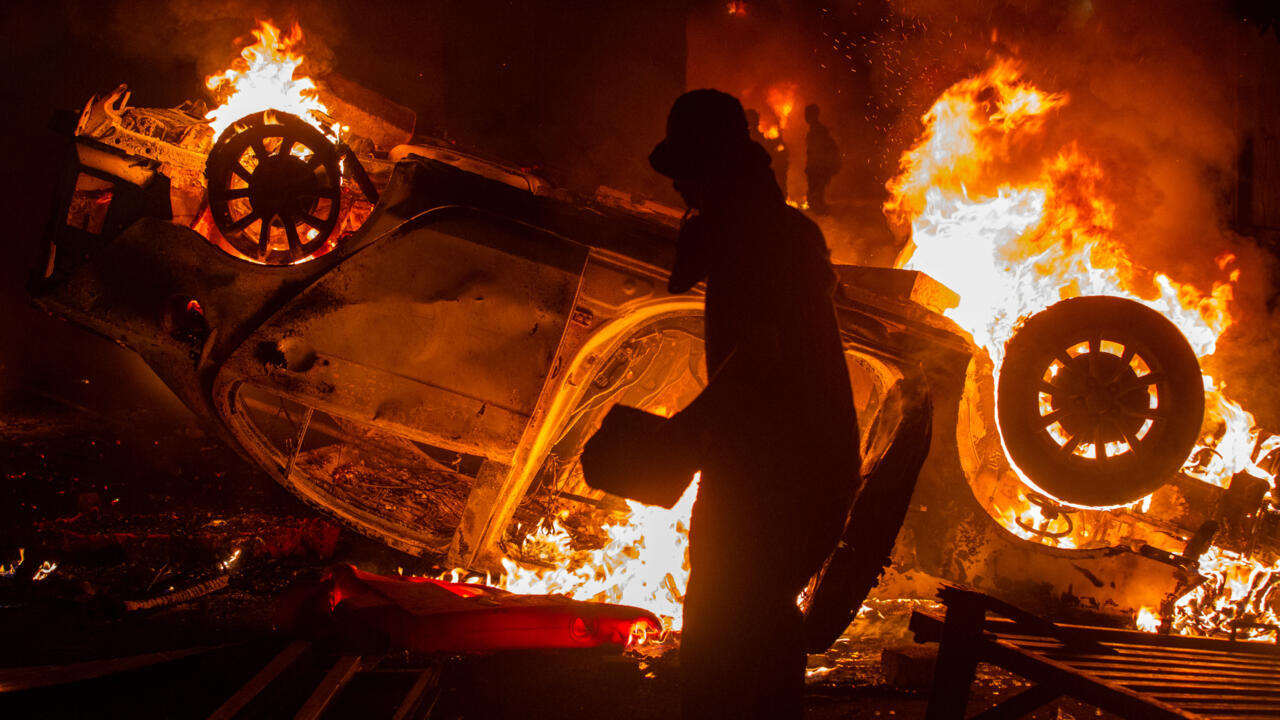
A car is set on fire during a protest in Yogyakarta following the death of a motorcycle taxi driver who was run over by an armoured Brimob vehicle the night before 
© Devi RAHMAN / AFP

The country was rocked by protests in major cities including the capital Jakarta on Friday, after footage spread of a gig motorcycle driver being run over by a police tactical vehicle in earlier rallies over low wages and perceived lavish perks for lawmakers.

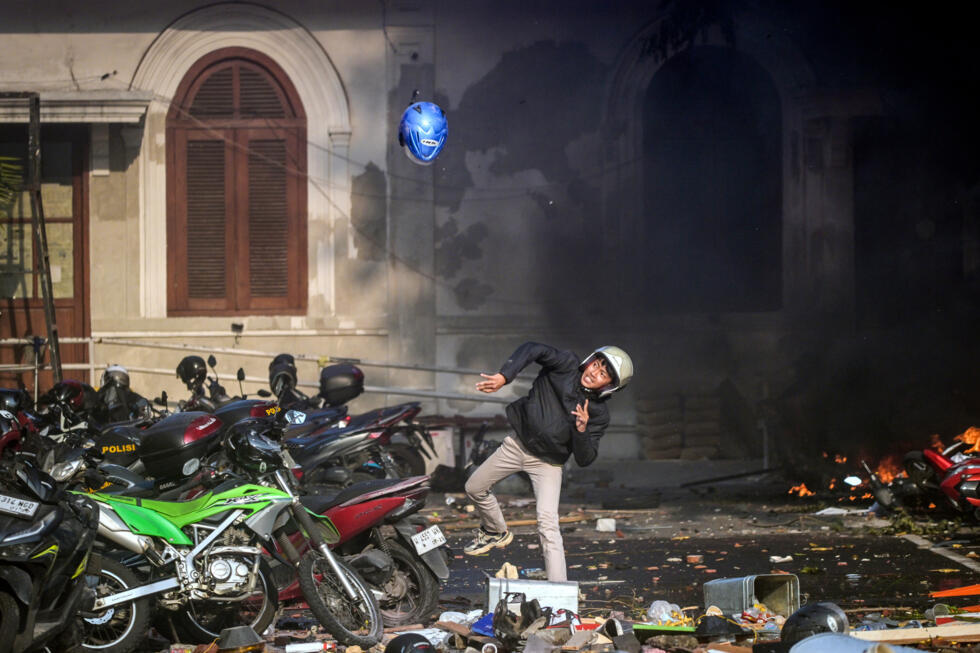
Protests in Makassar, the biggest city on Sulawesi island, descended into chaos outside the provincial and local city council buildings which were both set on fire and vehicles torched as protesters hurled rocks and Molotov cocktails.

Three people were killed as a result of the fire at the Makassar city council building, its secretary Rahmat Mappatoba told AFP.

"They were trapped in the burning building," he said, accusing protesters of storming the office to set it on fire.

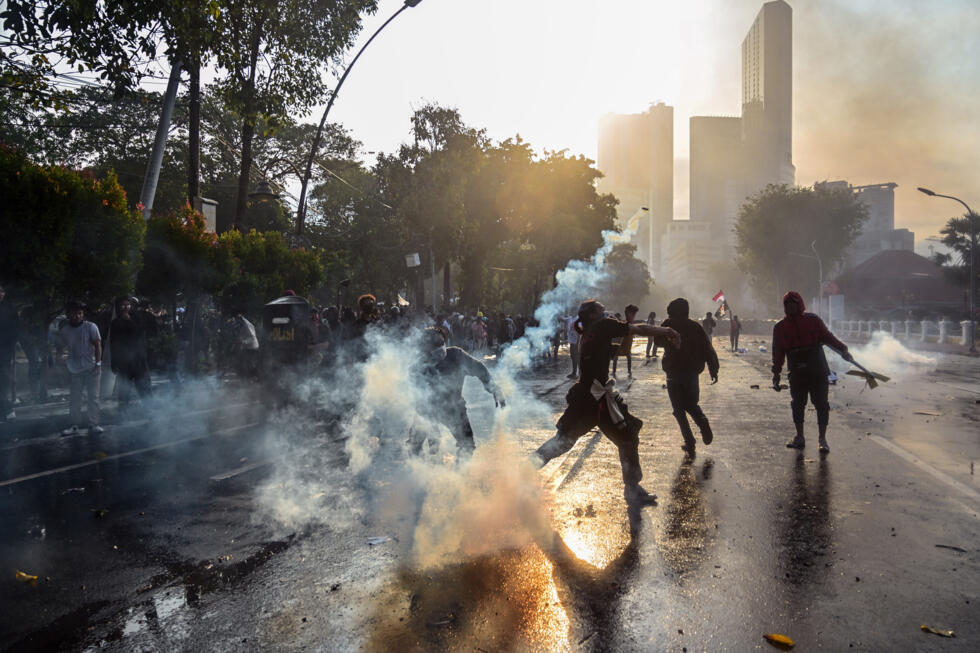
Police fire tear gas to disperse demonstrators during a protest in Surabaya on August 29, 2025 © Juni KRISWANTO / AFP

"This is beyond our prediction, usually during a demonstration, protesters only threw rocks or burn a tyre in front of the office. They never stormed into the building or burned it."

Two of the victims were staff at the local council and another was a civil servant. Two died at the scene while the third died in hospital.

At least four people were injured in the fire and were being treated at hospital, the official said.

The fire has since been extinguished.

Hundreds of people were seen in footage posted by local media cheering and clapping as fire engulfed the building with few security forces in sight.

One man was heard shouting: "there are people upstairs!"

In footage verified by AFP, smouldering debris was seen falling from the roof of the city council building surrounded by palm trees as charred cars flickered with flames.

Images showed the South Sulawesi provincial council building ablaze overnight. Protesters had tried to knock down the gate and storm it.

Makassar and South Sulawesi police did not immediately respond to AFP's requests for comments.

Prabowo test


The protests are the biggest and most violent of Prabowo Subianto's presidency, a key test less than a year into his rule © Juni KRISWANTO / AFP

In Jakarta, hundreds massed outside the headquarters of the elite Mobile Brigade Corp (Brimob) paramilitary police unit they blamed for motorcycle gig driver Affan Kuniawan's death on Thursday, throwing firecrackers as police responded with tear gas.

A group of protesters tried to tear down the gates of the unit, notorious for its heavy-handed tactics, and pulled a sign from the building's facade in chaotic scenes.

Police said they had detained seven officers for questioning in connection with the driver's death.

The protests were the biggest and most violent of Prabowo Subianto's presidency, a key test less than a year into his rule that forced him to quickly urge calm, order an investigation and visit the family of the dead driver.

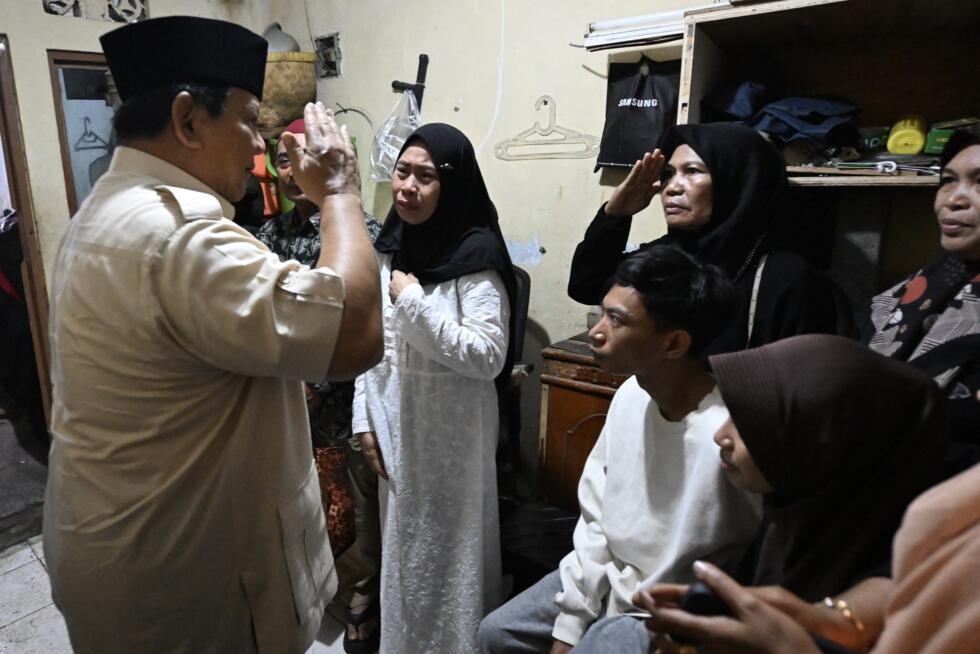
President Prabowo Subianto visited the family of the slain motorcycle gig driver 
© Handout / Indonesia's Presidential Palace/AFP

"I have ordered last night's incident to be thoroughly and transparently investigated, and that the officers involved be held accountable," he said in a statement.

In a message posted on Instagram later Friday, Prabowo said the government was "committed to guaranteeing the livelihood" of the driver's family, posting images with them at their home.

He has pledged fast, state-driven growth but has already faced protests for widespread government budget cuts to fund his populist policies including a billion-dollar free meal programme.

Protests also spread to other major cities, including Yogyakarta, Bandung, Semarang and Surabaya in Java and Medan in North Sumatra province.

© 2025 AFP