Sunday, October 12, 2025

Sheriff says Tennessee explosives factory blast left no survivors

A blast on Friday at the rural Tennessee Accurate Energetic Systems plant, which supplies and researches explosives for the military, left no survivors, authorities said, adding that the 16 people inside the building are presumed to be deceased.


Issued on: 11/10/2025 - 
By: FRANCE 24
Video by: FRANCE 24

A fire truck leaves Accurate Energetic Systems, an explosives plant, after a blast resulted in multiple fatalities and others missing Friday, Oct. 10, 2025, in Bucksnort, Tennessee © John Amis, AP
01:27


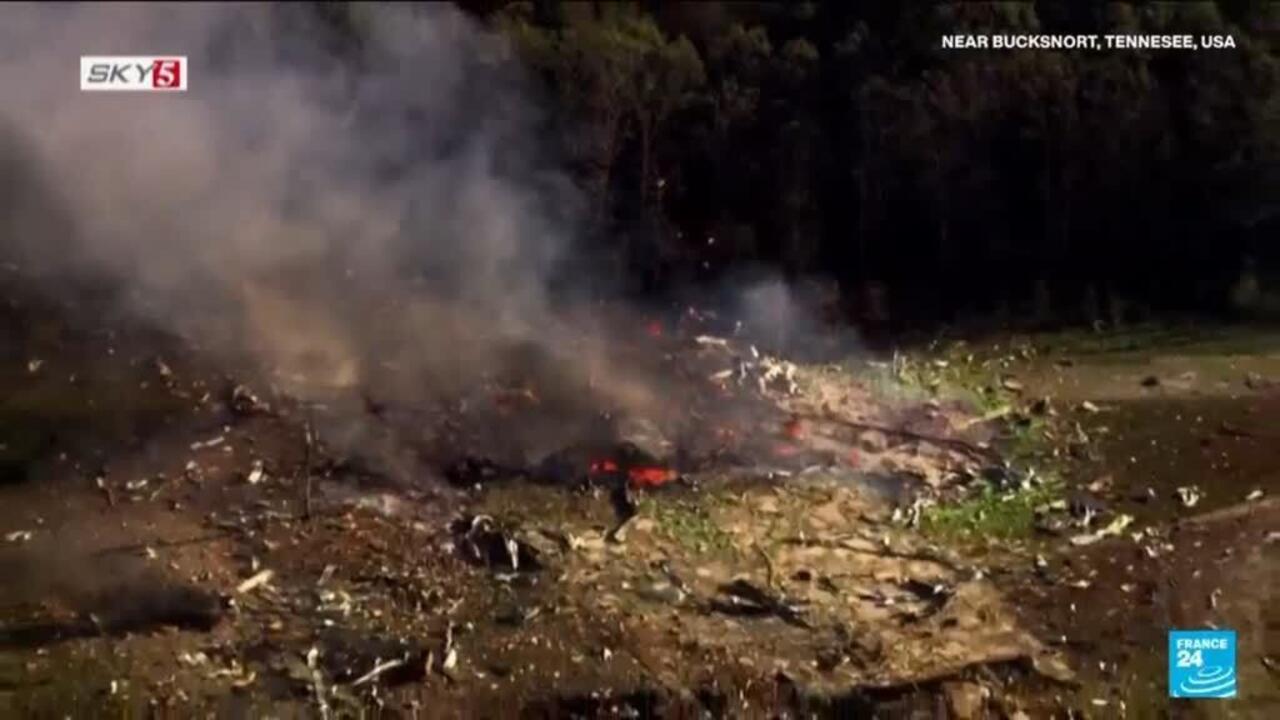
The blast in rural Tennessee that leveled an explosives plant and was felt for miles around left no survivors, authorities said Saturday.

The total number of dead was unclear, as was the cause of the Friday blast. By the weekend the devastation came into focus, with officials saying they'd found no survivors.

“There’s a gauntlet of emotions there,” Humphreys County Sheriff Chris Davis said during a news conference, pausing to clear his throat before he asked for prayers for the families of the victims in a shaky voice.

“We’ve recovered no survivors,” he added.

Officials said Friday 16 people were missing and Saturday said it could be assumed anyone who was inside the building is deceased.

State officials brought in a “rapid DNA” team to help identify the remains of people recovered at the site. The explosion left a smoldering wreck of twisted metal and burned-out vehicles at the Accurate Energetic Systems plant, which supplies and researches explosives for the military.

Davis said about 300 responders are working in a “slow, methodical method” as they deal with explosive material that has been damaged and remains volatile. An ambulance and a helicopter used for air evacuations were brought in, for the safety of first responders.

“It’s not like working an accident. It’s not like working a tornado. We’re dealing with explosions. And I would say at this time, we’re dealing with remains,” he said.

Guy McCormick, a supervisory special agent with the Bureau of Alcohol, Tobacco, Firearms and Explosives said explosive specialists and bomb technicians are trying to make the area safe before national ATF investigators arrive. He said the nature of the scene can change because of the heat and pressure caused by the explosion.

Davis said it could be days, weeks or even months before foul play is ruled out.

The site is located in a heavily wooded area of middle Tennessee, between the economically vital Tennessee River to the west and the bustling metropolis of Nashville to the east. Modest homes dot the wooded landscape, residences belonging to “good old country people,” as local man Terry Bagsby put it.

Bagsby, 68, is retired but he helps out working the register at a gas station near the site. He said people in the close-knit community are “very, very sad.”

He said he knows people who worked at the site and are missing.

“I don’t know how to explain it. … Just a lot of grief.”

The company’s website says it processes explosives and ammunition at an eight-building facility that sprawls across wooded hills in the Bucksnort area, about 60 miles (97 kilometers) southwest of Nashville. It's not immediately known how many people work at the plant or how many were there when the explosion happened.

Accurate Energetic Systems, based in nearby McEwen, said in a post on social media on Friday that their “thoughts and prayers" are with the families and community impacted.

“We extend our gratitude to all first responders who continue to work tirelessly under difficult conditions,” the post said.

The company has been awarded numerous military contracts, largely by the US Army and Navy, to supply different types of munitions and explosives, according to public records. The products range from bulk explosives to landmines and small breaching charges, including C4.

When the explosion occurred, residents in Lobelville, a 20-minute drive from the scene, said they felt their homes shake, and some people captured the loud boom of the explosion on their home cameras.

The blast rattled Gentry Stover from his sleep.

“I thought the house had collapsed with me inside of it,” he told The Associated Press. “I live very close to Accurate and I realized about 30 seconds after I woke up that it had to have been that.”

Tennessee Gov. Bill Lee posted on the social platform X that he is monitoring the situation and asked “Tennesseans to join us in prayer for the families impacted by this tragic incident.”

A small group gathered for a vigil Friday night at a nearby park, clutching candles as they prayed for the missing and their families and sang “Amazing Grace."

The US has a long history of deadly accidents at workplaces, including the Monongah coal mine explosion that killed 362 men and boys in West Virginia in 1907. Several high-profile industrial accidents in the 1960s helped lead President Richard Nixon to sign a law creating the Occupational Safety and Health Administration the next year.

In 2019, Accurate Energetic Systems faced several small fines from the US Department of Labor for violations of policies meant to protect workers from exposure to hazardous chemicals, radiation and other irritants, according to citations from OSHA.

In 2014, an explosion occurred at another ammunition facility in the same small community, killing one person and injuring at least three others.

(FRANCE 24 with AP)

HAPPY BIRTHDAY UNCLE AL


"LIBER L.." Thelema (1909): 1-37.


Saturday, October 11, 2025

The African Growth And Opportunity Act Is No More – Analysis

October 11, 2025

By Published by the Foreign Policy Research Institute

By Charles A. Ray


(FPRI) — In addition to a US Government shutdown at midnight on September 30, 2025, due to failure to pass a spending bill, an event largely ignored by America’s mainstream media was the expiration of the African Growth and Opportunity Act (AGOA).

AGOA was established by US President Bill Clinton in 2000, and gave preferential access to US markets for over thirty African nations for the past twenty-five years. The act allowed eligible606 countries to export goods to the United States duty-free, and supported the growth of industries such as textiles, agriculture, and mining.

In the run-up to September 30, several African governments and American businesses lobbied Congress and the Trump administration for an extension of the act. The administration expressed support for a one-year extension to allow further review and restructuring of the agreement, and according to reports, there was bipartisan support in Congress. Despite this, no legislation has been enacted. Officials from South Africa and Lesotho indicate that discussions with the US government are ongoing but give no signs of possible outcomes.

The end of AGOA has caused immediate trade disruptions across Africa. Countries such as South Africa, Madagascar, Kenya, and Lesotho face higher US tariffs on key exports. Madagascar, for instance, faces rates as high as 47 percent on textile and vanilla exports.

A Bundle of Negatives . . .

According to researchers at the German Institute of Development and Sustainability, some African economies are likely to face “notable adverse effects.” The macroeconomic effects are assumed to be limited, but probably understate the full impact of US tariffs and the indirect effects of things like reduced foreign investment, weakened supply chains, rising poverty, and loss of capacity building. In the AGOA-dependent industries, approximately 1.3 million jobs are at risk in countries where people have limited options in the event of sudden unemployment.

In Kenya, for instance, over 66,000 people, many of them women, are employed in textile and apparel export to the American market. From garment factories and horticultural producers in Kenya to car factories in South Africa, 300,000 direct jobs and 1 million indirect jobs are in jeopardy with the end of AGOA. Protecting these jobs is not just an economic issue. They are critical to halt or limit the relocation of people into countries where migrants often face violent reactions to their presence.


. . . With a Glimmer of Hope

With the current political uncertainty in the United States, realistically, there is little hope of AGOA being on the US government’s agenda in the short term. This, however, offers the opportunity for African countries to reassess their trade strategies. Some have already taken steps in that direction. Kenya, for instance, is in the process of negotiating a free trade agreement with the United States. South Africa is seeking exemptions and quotas to maintain access to the American market for its most vulnerable industries. Zimbabwe, which was not eligible for AGOA, is looking to liberalize its customs regime to expand regional trade.

Continent-wide, there is now increased attention being given to the African Continental Free Trade Area (AfCFTA), which kicked off in 2021. With a market of 1.5 billion people, the AfCFTA offers a long-term means of building sustained, resilient intra-African trade, provided the fifty-four countries that are signatories to the pact take the necessary actions to enhance regional integration, improve infrastructure, and promote value-added production.

The Future of US-Africa Trade

Another response to the end of AGOA, which, unfortunately, does not benefit the United States, is the expansion of African trade ties with China, India, Turkey, and the European Union. China-Africa trade in 2024, which was $295 billion, already dwarfed the $8 billion AGOA-linked trade with the United States. In addition, China has eliminated tariffs on exports from thirty-three African countries, further cementing its role as a key trade partner.

As the African focus shifts from preferential access to long-term competitiveness, regional self-sufficiency, and diversified economic partnerships, Africa’s place in and influence on the global trading system will change. If the United States does not develop a more partner-focused trade relationship with the fifty-four countries of what could become an influential member of that system, it could find itself “late to the table” and having to settle for leftovers.About the author: Charles A. Ray, a member of the Board of Trustees and Chair of the Africa Program at the Foreign Policy Research Institute, served as US Ambassador to the Kingdom of Cambodia and the Republic of Zimbabwe.

Source: This article was published by FPRI

Published by the Foreign Policy Research Institute

Founded in 1955, FPRI (http://www.fpri.org/) is a 501(c)(3) non-profit organization devoted to bringing the insights of scholarship to bear on the development of policies that advance U.S. national interests and seeks to add perspective to events by fitting them into the larger historical and cultural context of international politics.
SPACE/COSMOS

Probing dark matter with lunar radio telescopes


University of Tsukuba
Probing the Nature of Dark Matter from the Moon 

image: 

Simulated distributions of cold and warm dark matter are shown using particles color-coded by temperature, accompanied by an illustration of lunar telescopes.

view more 

Credit: Hyunbae Park, University of Tsukuba


Tsukuba, Japan—The Universe was born 13.8 billion years ago during a rapid expansion known as the Big Bang. Around 400,000 years later, it entered a period known as the "Dark Ages," which lasted for about 0.1 billion years until the first stars and galaxies began emitting light. During this time, hydrogens atoms are thought to have emitted faint radio waves at a wavelength of 21 cm, which likely carry important clues about the beginning of the Universe.

Through numerical simulations, researchers at University of Tsukuba and The University of Tokyo predicted the intensity of the 21-cm radio signal in different models of dark matter, the mysterious invisible substance that comprises around 80% of the matter in the Universe. By reproducing the distribution of gas and dark matter in the early Universe on supercomputers, the team calculated the intensity of the radio waves during the Dark Ages with unprecedented precision.

The results imply that hydrogen gas in the dark ages produced a characteristic signal of about 1 millikelvin (one-thousandth of a degree) in the brightness temperature of sky-averaged radio emission. Crucially, dark matter is expected to produce variations of similar magnitude in this signal. Observing the global signal across a broad frequency band (~45 MHz) could therefore reveal the mass and velocity of dark matter particles.

Several lunar missions, including Japan's Tsukuyomi Project, are now aiming to build radio telescopes on the Moon. If such telescopes can detect this faint signal, they will help unlock the mystery of dark matter.

###
H.P. was supported in part by grant NSF PHY-2309135 to the Kavli Institute for Theoretical Physics (KITP). N.Y. acknowledges financial support from JSPS International Leading Research 23K20035. R.B. and N.Y. acknowledge JSPS Invitational Fellowship S24099.


Original Paper

Title of original paper:
The Signature of Sub-Galactic Dark Matter Clumping in the Global 21-cm Signal of Hydrogen

Journal:
Nature Astronomy

DOI:
10.1038/s41550-025-02637-0

Correspondence

Researcher Hyunbae Park
Center for Computational Sciences, University of Tsukuba

Project Professor YOSHIDA, Naoki
Kavli Institute for the Physics and Mathematics of the Universe (Kavli IPMU, WPI), The University of Tokyo Institute for Advanced Study (UTIAS), The University of Tokyo

Related Link

Center for Computational Sciences


Europe needs reusable rockets to catch Musk’s SpaceX: ESA chief


By AFP
October 9, 2025


The SpaceX Starship rocket launches from Starbase, Texas, as seen from South Padre Island on May 27, 2025 - Copyright AFP/File Sergio FLORES
Olga Nedbaeva and Bénédicte Rey

Europe must quickly get its own reusable rocket launcher to catch up to billionaire Elon Musk’s dominant SpaceX, European Space Agency director Josef Aschbacher told AFP in an interview.

While the US company has an overwhelming lead in the booming space launch industry, a series of setbacks, including Russia’s withdrawal of its rockets, left Europe without an independent way to blast its missions into space.

That year-long hiatus ended with the first launch of Europe’s much-delayed Ariane 6 rocket in July 2024. But the system is not reusable, unlike SpaceX’s Falcon 9 workhorse.

“We have to really catch up and make sure that we come to the market with a reusable launcher relatively fast,” Aschbacher said at AFP’s headquarters in Paris.

“We are on the right path” to getting this done, he added.

– ‘Paradigm shift’ –


European Space Agency director Josef Aschbacher is calling on Europe to pay up to compete in a booming space economy – Copyright AFP JOEL SAGET

The ESA has already announced a shortlist of five European aerospace companies bidding to build the continent’s first reusable rocket launch system.

That number will be narrowed down to two — or even one — at the agency’s ministerial council in the German city of Bremen next month, Aschbacher said.

“Ariane 6 is an excellent rocket — it’s very precise,” Aschbacher said. “We have now had three launches,” with two more expected before the year’s end, he added.

Despite finally getting Ariane 6 and the new, smaller Vega C launcher off the ground, the ESA has decided on a “paradigm shift”, Aschbacher said.

“The next generation of launchers will be very different,” he told AFP.

When Ariane 6 was being planned more than a decade ago, reusability was not considered worth the extra cost and time.

But it has come under criticism when compared to the relatively cheap, reusable Falcon 9, which has completed well over 100 launches this year alone.

So the ESA has decided to emulate NASA, which also used to develop its own rockets but now outsources its launches to private companies such as SpaceX or Jeff Bezos’s Blue Origin.

– A European Starlink? –

Many of the Falcon 9 flights have carried the more than 8,000 satellites that make up Musk’s Starlink internet network into space.

The European Union is planning to create its own internet satellite constellation called IRIS2, scheduled to become operational in 2030.

“Europe needs it absolutely urgently,” Aschbacher said.

“We have to make sure that we have the rockets to bring our satellites to space.”

He stressed that IRIS2 would be “very different” from Starlink, with fewer satellites, while focusing more on “secure communication”.

The constellation will mark a technological leap forward, even though Europe sometimes lags “a few years behind” its competitors, Aschbacher said.

Aschbacher noted that the EU’S navigation satellite system Galileo and Earth observation programme Copernicus started out 10 to 15 years behind US competitors GPS and Landsat.

Now both EU programmes are “the best in the world”, he said.

Aschbacher lamented that European public investment in space is declining, even as the global space economy grows.

He called for “very strong financial engagement” from the ESA’s 23 member states, which includes the United Kingdom, at next month’s ministerial council.

– Impact of Trump cuts? –

In the United States, President Donald Trump’s administration has proposed slashing NASA’s budget, signalling it wants to cancel the joint Mars Sample Return mission with the ESA.

If the cuts go ahead, Aschbacher said, they could also affect shared missions such as the use of the International Space Station and the Artemis programme to put astronauts back on the Moon, he said.

The three ESA missions most likely to be affected are the EnVision mission to Venus, LISA gravitational wave observatory and NewAthena X-ray telescope, Aschbacher said.

However, Europe intends to complete these “flagship missions” even if the United States pulls out — perhaps by bringing in other partners, he added.

Aschbacher also said there had been “interest from our colleagues in the United States” in applying for jobs at the ESA.


NUS-SCELSE researchers uncover hidden plant–microbe strategy that boosts crop growth under nutrient stress


National University of Singapore
NUS-SCELSE researchers uncover hidden plant–microbe strategy that boosts crop growth under nutrient stress 

image: 

The researchers found that soil microbes competing with each other release glutathione which  enhances plant growth under sulphur-deficient conditions.

view more 

Credit: SCELSE


Scientists from SCELSE – a biofilm & microbiome research centre and the National University of Singapore (NUS), have uncovered a surprising strategy plants use to thrive when an essential nutrient — sulphur — is in short supply.

The team discovered that when soil microbes compete with each other in the rhizosphere (the soil surrounding plant roots), they release a well-known compound called glutathione. This compound enhances plant growth under sulphur-deficient conditions. The catch: while plants benefit, some microbes lose out in their own growth.

The researchers call this balancing act a “trans-kingdom fitness trade-off” — where one kingdom of life (microbes) sacrifices part of its growth, while another (plants) gains resilience.

The global problem: declining sulphur in soils

Sulphur (S) is essential for plant growth, just like nitrogen and phosphorus. It supports protein synthesis, vitamin production, and stress resistance.

Historically, sulphur pollution from industrial emissions replenished soils worldwide. But with cleaner energy and stricter air-quality regulations, atmospheric sulphur levels have dropped. While good for air quality and human health, this has unintentionally reduced natural sulphur deposits in agricultural soils.

Over time, crops have drawn down existing soil sulphur, leaving soils deficient. To compensate, farmers increasingly apply synthetic sulphur-based fertilisers. These short-term fixes come with costs: runoff from farmlands contaminates rivers, lakes, and ecosystems, exacerbating environmental degradation.

The new discovery: a microbial boost

The SCELSE-led study, published in Cell Host & Microbe on 26 September 2025, provides a novel mechanistic explanation of how plants and microbes jointly navigate nutrient stress. The researchers found that when soil bacteria compete for nutrients, they release glutathione — a compound that boosts plant growth under sulphur-deficient conditions, even though it reduces bacterial growth.

This improvement in plant fitness came at the cost of bacterial fitness — a biological trade-off across kingdoms of life.

“This work introduces the concept of a trans-kingdom fitness trade-off and provides a mechanistic explanation for it,” said first author Arijit Mukherjee, who was a PhD student at SCELSE and the NUS Department of Biological Sciences when the study was conducted. “Plant fitness isn’t just about the plant itself — it’s about the whole community of microbes around it. Understanding these trade-offs helps us design better microbial solutions for resilient crops.”

Why it matters

Such trade-offs are likely widespread across host–microbe systems, not just in plants, and may represent hidden strategies by which holobionts (hosts and their associated microbes) adapt collectively to environmental cues.

For agriculture, this insight is powerful: instead of relying on chemical fertilisers, researchers can design microbial consortia (or “cocktails”) that naturally boost crop health under nutrient stress. This nature-based solution can reduce fertiliser use, improve soil health, and contribute to global food security.

Assoc Prof Sanjay Swarup, Principal Investigator at SCELSE, explained: “This study provides a blueprint for sustainable agriculture. By tapping into natural plant–microbe partnerships, we can reduce fertiliser use, protect ecosystems, and still secure global food supplies.”

From discovery to application: patent filed

To translate this breakthrough into practice, the team has filed a patent covering applications of this plant–microbe mechanism in agriculture. This will enable the development of bio-based products that support crops in sulphur-deficient soils, reducing reliance on chemical inputs.

“By considering not only microbial functions but also their interactions, we can design more effective microbial consortia for agriculture,” added Assoc Prof Swarup, who is also the Deputy Director for NUS Environmental Research Institute (NERI) and a faculty member of the NUS Department of Biological Sciences. “This is the path toward resilient, climate-ready farming.”