Friday, January 23, 2026

A Dangerous Attack on Free Speech: Matt Taibbi Sues for Defamation
Source: Originally published by Z. Feel free to share widely.

In November of last year, in an egregious abuse of defamation law, former progressive journalist  (and current right wing influencer) Matt Taibbi launched a lawsuit–presently ongoing–claiming to have been defamed by leftist journalist Eoin Higgins (and Higgins’s publisher Hachette Book Group), ludicrously alleging “reputational and financial damages”, according to the official legal complaint, “in excess of $1,000,000.” Taibbi claims that his integrity as a journalist was defamed by Higgins’s book Owned: How Tech Billionaires on the Right Bought the Loudest Voices on the Left. The book–released in February 2025–alleges that Taibbi and another previously progressive journalist, Glenn Greenwald, have moved to the right politically in recent years as a result of developing professional connections with pro-MAGA Silicon Valley billionaires like Elon Musk and David Sacks. 

Taibbi’s lawsuit focuses on the book’s statements that Taibbi was “owned” and “bought” by Elon Musk after he participated in Musk’s Twitter Files campaign of 2022-23– the latter being where Taibbi and half a dozen other journalists received from Musk tens of thousands of internal company documents produced under Twitter’s pre-Musk owners. In their published analysis on Twitter threads, Taibbi and the other journalists handpicked by Musk (like the right wingers Michael Shellenberger and Bari Weiss) offered support for Musk’s contention that the documents proved that pre-Musk Twitter was immensely biased against conservatives and even secretly collaborated with the Biden administration in suppressing pro-Trump voices and anti-vaxxers. Taibbi insists he didn’t receive a dime from Musk for his work.

Taibbi’s Case

In my opinion, Taibbi’s lawsuit against Higgins has the marks of a SLAPP case: an abuse of the legal system by a powerful person or organization in order to silence a critic of much less power and influence. Based on publicly available evidence, it is extremely difficult to accept Taibbi’s claim that Higgins’s book has brought “harm” to his journalistic career and caused him a million dollars in damages.

First of all, there is a vast asymmetry and power and influence between Higgins and Taibbi.  Higgins is a relatively obscure left wing journalist whose work has previously been confined to such outlets as The New RepublicCommon Dreams and Counterpunch;  his book on Taibbi and Greenwald has not received wide discussion in the mainstream media (although it has had some). In contrast, Taibbi, with his move to the right politically, has become a visible presence on widely viewed right wing media and has attracted favorable publicity from some of the most influential right wing personalities in the world; for example, in June (five months after Higgins published his book), Joe Rogan, on his hugely popular podcast, singled out Taibbi and Greenwald as journalists he trusts for “unbiased news.” Taibbi was picked by the world’s richest man, Musk to work on the Twitter Files; and as Higgins notes in his book, in 2022 Taibbi sat on a stage with Greenwald and beamed as he was interviewed in highly friendly fashion by David Sacks, the Silicon Valley billionaire who is now the AI and cryptocurrency czar for the Trump administration. During the interview, Sacks lavished Taibbi and Greenwald with praise as iconoclastic journalists. 

Taibbi has presented no evidence that Higgins’s book has made any appreciable impact on the relations that he as a journalist  has cultivated with influential people like Rogan, Sacks et. al or brought any real damage to his journalistic credibility with the general public.

Second, it is extremely difficult to accept Taibbi’s claim that Higgins’s book comes close to meeting the defamation standard of “actual malice” and “reckless disregard for truth” as described in the US Supreme Court’s 1964 case of New York Times Co. v. Sullivan. 

Taibbi’s defamation claim focuses on Higgins’s assertion of Taibbi being “owned” and “bought” by Elon Musk–and having “cashed in”  on his relationship with the latter. Taibbi’s legal claim notes (accurately) that while uttering these words, Higgins also admitted in the book and in subsequent published interviews that he could not prove the existence of any financial transactions between Musk and Taibbi. He also allowed in the book and in subsequent interviews that Taibbi’s primary motives are probably much less titillating than mere grift: that he has likely sincerely grown more conservative as he has aged. 

At the same, Taibbi’s lawsuit ignores the expansive context in which Higgins uses words like “bought” and “owned,” which he defines more broadly than Taibbi merely receiving financial compensation from Musk. In his book, Higgins uses those words to connote something along the lines of “a journalist being under the disproportionate influence of an immensely wealthy and powerful person.”

Even if Taibbi worked for free on the Twitter Files (as he seems to have), Higgins argues that at the same time, he disregarded basic journalistic ethics and served Elon Musk’s agenda of using the Twitter Files as a “controlled infodump” to provide fodder for right wing culture wars:  for example material on pre-Musk Twitter’s suppression of posts about the New York Post story on the Hunter Biden laptop. 

Musk’s people curated the Files material for Taibbi: he sent “keywords” to them on various topics and they sent him what they chose to. There was no material released, for example, about the scandal of Saudi government agents employed within pre-Musk Twitter using their positions to access data on the accounts of dissidents to spy on them and pinpoint their locations. The Saudis, of course, were major partners of Musk in his 2022 purchase of Twitter.  

 Higgins also attacks Taibbi for refusing to criticize Musk publicly–for example regarding Musk’s collaboration in the censorship of Twitter posts by Narendra Modi’s government in India–at least until Musk directly hit Taibbi’s pocketbook in April 2023 by shadowbanning tweets containing material from Substack, Taibbi’s main writing platform. 

As for the words “cashed in,” Higgins claims in his book that Taibbi’s work on the Twitter Files gained him massive publicity among the conservative Americans he was “desperate to cultivate” and his Substack page Racket News “already incredibly successful–gained thousands of subscriptions.” Taibbi, in contrast, has always implausibly tried to downplay any wealth he has gained from his increased exposure on right wing media. His formal legal complaint against Higgins states, perhaps truthfully, that he actually “lost money for the first time in his career as an independent journalist” while working on the Twitter Files, especially after Musk decided to limit circulation of Substack material on Twitter. .

Whatever the criticism one might legitimately make against Higgins’s critique of Taibbi, it is clear that it is protected speech: Taibbi has no grounds for suing Higgins, much less claiming a million dollars in damages against him. 

Taibbi Wants Leftist Love

Taibbi did his lawsuit no favors with his January 3rd piece in Bari Weiss’s The Free Press entitled “To Protect Free Speech, I’m Suing the Man Who Defamed Me.” In the piece he doesn’t list any tangible harm that Higgins’s book has materially inflicted upon his journalistic career–much less any harm worth a million dollars in damages. Rather, with surprising transparency, he states that he is suing Higgins because progressives–ranging from Democratic congressmembers and former journalistic colleagues to random internet trolls– have been saying very harsh, even slanderous things about him in recent years (long before Higgins published his book). Not without poignancy he writes: “I’m fed up. I’m pissed.” He  reveals a seemingly intense psychological anguish about his lost cachet among progressives and radical leftists. 

It seems odd that Taibbi, a journalist who has moved so palpably to the right in recent years, would be so sensitive about what leftists are saying about him. He is somebody who, for example, last June, described the main features of the anti-ICE protests in Los Angeles as allegedly being violence by protestors and “revolting homages to Marx and socialist revolution” on the part of the protestors. However, he also clearly still feels a few bonds of affinity with leftists and is deeply upset that he has not been reciprocated. 

A major part of his Free Press essay devoted to defending his lawsuit against Higgins features him complaining about how leftists have given him no respect for his Twitter Files work–or for the fact that, during Trump’s first term, he covered in Rolling Stone the suppression by social media companies of posts by left wing figures like Chris Hedges, Paul Jay of the Real News Network, the Democratic Socialists of America (DSA) and the World Socialist Web Site (WSWS) as well as Palestinian voices. He claims that his Twitter Files work showed government officials, in the US and elsewhere, privately pressuring Twitter to suppress tweets by “left-wing voices along with the right, from Truthdig, to Italian left-populists…to the French yellow-vest movement.” 

Taibbi whimpers that in spite of such heroic muckraking journalism on his part, he was smeared by leftists like Higgins and many others as “a paid shill for billionaire scum” for his Twitter Files involvement. Nonsensically trying to add to his arguments for suing Higgins, he also complains that such leftists spread “falsehoods” about him in the wake of Israel’s genocidal war on Gaza. He explains that he believed he “made the ethical decision” not to side with the Palestinians during the (ongoing) Gaza genocide “because I’d never covered the Israel-Palestine conflict” as a journalist and “didn’t want to be wrong about one of the most complex stories ever.” He argues that if he criticized anti-genocide student protestors in 2023-24 for supposedly not knowing anything about the Israeli-Palestinian conflict and for supposedly obstructing the rights of other students in their sit-ins and other civil disobedience, he did so out of sincere conviction and not because, as he claims Higgins implied, he was taking money from right wing billionaires. 

The Bottom Line

It seems to me highly disingenuous on Taibbi’s part to try to prove that he was not under Elon Musk’s ideological influence by implying that in his Twitter Files work he covered suppression of the left by social media companies as much as he did of the right. 

His tidbits for the left in the Twitter Files–one instance of officials in the first Trump administration privately requesting censorship of a tweet or FBI agents pestering Twitter officials about a Truthdig article–were mere drops in a bucket–usually single tweet threads–compared to the lengthy threads that he and his Twitter Files colleagues like Bari Weiss published as right wing fodder for the culture wars. Taibbi and Weiss,for example, focused almost all their attention on Twitter’s suppression of the Hunter Biden laptop story, the shadowbanning of tweets by vaccine sceptics or pre-Musk Twitter’s multiple suspensions of the account of the virulently anti-LGTBQ Libs of TikTok. There was nothing in the Twitter Files about pre-Musk Twitter’s suppression of Palestinian voices. 

Also, Taibbi engages in a bit of obfuscation by defending his Twitter Files work by including his Rolling Stone reporting on the various social media platforms’ suppression of posts by leftists like Chris Hedges, DSA, WSWS, Palestinians, etc. which he did before he made a marked turn to the right politically, developed a relationship with Elon Musk and began work on the Twitter Files. During the launch of the Twitter Files in late 2022, Musk’s Twitter engaged in suppression of radical left voices, but Taibbi made no public comment even as he gave public credence to Musk’s claim to being a free speech devotee. 

In his whining about getting no respect from leftists in recent years–and thereby ludicrously trying to justify his lawsuit against Higgins–Taibbi’s arguments are mostly silly and disingenuous but perhaps he is right in one major way. In spite of major errors in some of his Twitter Files reporting, Taibbi did ultimately valuably reveal that Biden administration officials were improperly seeking to pressure Twitter and other social media platforms to remove posts by private citizens, even if such posts were by anti-vaxxers and other persons who were potentially causing a public nuisance during the height of the Covid pandemic. I don’t think critics like Higgins have given him enough credit for that. That does not mean that Taibbi’s lawsuit against Higgins is anything but an egregious abuse of defamation law. 

MISOGYNY IS FEMICIDE IN DISGUISE

Trump’s MAGA movement ramps up attacks on ‘progressive white women’

By AFP
January 23, 2026


While Trump has won majority support from white women generally in 2016, 2020, and 2024, younger white women have leaned much more Democratic - Copyright AFP/File Patrick T. Fallon

Aurélia END

Progressive white women have been persistent punching bags of President Donald Trump’s MAGA movement, but attacks targeting the demographic group have become particularly vicious in recent weeks.

The death of Renee Good, a 37-year-old American woman killed by a federal agent while protesting Trump’s immigration crackdown in Minnesota, has prompted harsh comments against her by numerous conservative commentators.

Radio host Erick Erickson coined an acronym to describe Good — “AWFUL,” or Affluent White Female Urban Liberal.

“White liberal women are a cancer on the nation. They have no real problems, so they’re bored” and take on other people’s fights, right-wing comedian Vincent Oshana wrote on X.

“They just want to feel important.”

Columnist David Marcus meanwhile derisively referred to women activists, like Good, protesting against Trump’s immigration actions as “organized gangs of wine moms.”

– Women’s suffrage a ‘tragedy’ –


The attacks come amid a dual offensive on the American right — against modern feminism and placing renewed value on masculinity.

Some right-wing players, particularly Christian nationalists, have for years called for a rethink of the role of women in modern society, even demanding the end of the constitutional right to vote.

The 19th Amendment to the US Constitution “has been a moral and political tragedy for America,” firebrand pastor Dale Partridge said in a video last month.

“Why? Women were not made to lead, but to follow and to feel.”

Juliet Williams, a gender studies professor at University of California Los Angeles, said such comments are typical of a patriarchal worldview that requires men to “understand themselves as inherently superior.”

Trump’s administration has meanwhile sought to portray a masculine persona — typified by Pentagon chief Pete Hegseth, who frequently posts videos doing push-ups with soldiers.

Health Secretary Robert F. Kennedy Jr. recently praised Trump’s testosterone levels, saying that another official called them “the highest” he has seen for someone over 70.

In this ideology, Williams said, “hatred of white liberal women is really necessary” because they challenge the ideals of the Christian right.

Women in general favored the Democratic candidate in the 2016, 2020, and 2024 presidential elections — but majorities of white women actually voted for Trump, according to Pew Research polling.

Several studies suggest a growing divergence among younger voters.

Gen Z women largely identify as progressive, while young men — an important demographic in Trump’s latest victory — increasingly lean right.

Williams said attacks on women Democratic voters could be aimed at influencing young women who “are more aware than ever of how closely their social value is indexed on looking a certain way.”


– ‘Just hotter’ –


The women who gravitate around Trump’s White House usually wear stylish clothes, high heels, have long wavy hair, and wear heavy makeup. Botox and filler are not rare.

Katie Miller — a podcaster and wife of Stephen Miller, one of the US president’s most influential advisers — openly mocks what she considers to be the unattractive and unkempt appearance of left-wing women.

“Conservative women are just hotter than Liberal women,” she wrote on X, claiming that was the reason conservative families have more children.

The Millers recently announced they are expecting their fourth child, as did Vice President JD Vance and Second Lady Usha Vance. White House spokeswoman Karoline Leavitt is also pregnant with her second child.


Musk’s Grok created three million sexualized images, research says

By AFP
January 22, 2026


Grok's digital undressing spree sparked global outrage from regulators and victims. -
Copyright AFP Joaquín Sarmiento


Anuj CHOPRA

Elon Musk’s AI chatbot Grok generated an estimated three million sexualized images of women and children in a matter of days, researchers said Thursday, revealing the scale of the explicit content that sparked a global outcry.

The recent rollout of an editing feature on Grok, developed by Musk’s startup xAI and integrated into X, allowed users to alter online images of real people with simple text prompts such as “put her in a bikini” or “remove her clothes.”

A flood of lewd deepfakes exploded online, prompting several countries to ban Grok and drawing outrage from regulators and victims.

“The AI tool Grok is estimated to have generated approximately three million sexualized images, including 23,000 that appear to depict children, after the launch of a new image editing feature powered by the tool on X,” said the Center for Countering Digital Hate (CCDH), a nonprofit watchdog that researches the harmful effects of online disinformation.

CCDH’s report estimated that Grok generated this volume of photorealistic images over an 11-day period — an average rate of 190 per minute.

The report did not say how many images were created without the consent of the people pictured.

It said public figures identified in Grok’s sexualized images included American actress Selena Gomez, singers Taylor Swift and Nicki Minaj as well as politicians such as Swedish Deputy Prime Minister Ebba Busch and former US vice president Kamala Harris.

“The data is clear: Elon Musk’s Grok is a factory for the production of sexual abuse material,” Imran Ahmed, the chief executive of CCDH.

“By deploying AI without safeguards, Musk enabled the creation of an estimated 23,000 sexualized images of children in two weeks, and millions more images of adult women.”

There was no immediate comment about the findings from X. When reached by AFP by email, xAI replied with a terse automated response: “Legacy Media Lies.”

Last week, following the global outrage, X announced that it would “geoblock the ability” of all Grok and X users to create images of people in “bikinis, underwear, and similar attire” in jurisdictions where such actions are illegal.

It was not immediately clear where the tool would be restricted.

The announcement came after California’s attorney general launched an investigation into xAI over the sexually explicit material and several countries opened their own probes.

“Belated fixes cannot undo this harm. We must hold Big Tech accountable for giving abusers the power to victimize women and girls at the click of a button,” Ahmed said.

Grok’s digital undressing spree comes amid growing concerns among tech campaigners over proliferating AI nudification apps.

Last week, the Philippines became the third country to ban Grok, following Southeast Asian neighbors Malaysia and Indonesia, while Britain and France said they would maintain pressure on the company.

On Wednesday, the Philippines’s Cybercrime Investigation and Coordinating Center said it was ending the short-lived ban after xAI agreed to modify the tool for the local market and eliminate its ability to create “pornographic content.”
TikTok establishes joint venture to end US ban threat


By AFP
January 22, 2026


Image: — © AFP Nicolas TUCAT


Alex PIGMAN

TikTok announced Thursday it has established a majority American-owned joint venture to operate its US business, allowing the company to avoid a ban over its Chinese ownership.

The TikTok USDS Joint Venture LLC will serve more than 200 million users and 7.5 million businesses while implementing strict safeguards for data protection, algorithm security and content moderation, the company said.

The new structure responds to a law passed under President Donald Trump’s predecessor, Joe Biden, that forced Chinese-owned ByteDance to sell TikTok’s US operations or face a ban in its biggest market.

ByteDance retains a 19.9 percent stake in the joint venture — keeping its ownership below the 20 percent threshold stipulated by the law.

Three investors — Silver Lake, Oracle and Abu Dhabi-based AI investment fund MGX — each hold 15 percent stakes. Oracle’s executive chairman Larry Ellison is a longtime Trump ally.

Other investors include Dell Family Office, affiliates of Susquehanna International Group and General Atlantic, and several other investment firms.

The joint venture will retain decision-making authority over trust and safety policies and content moderation for US users, while TikTok’s global entities will manage international product integration and commercial activities including e-commerce and advertising.

Under the arrangement, US user data will be stored in Oracle’s secure cloud environment, with cybersecurity audited by third-party experts and adhering to federal standards, TikTok said.

The joint venture will be governed by a seven-member, majority-American board including TikTok CEO Shou Chew and executives from major investment firms.

TikTok executive Adam Presser was appointed CEO of the new entity, with Will Farrell serving as chief security officer.

The 2024 law came as US policymakers, including Trump in his first presidency, warned that China could use TikTok to mine Americans’ data or exert influence through its algorithm.

But Trump, crediting the app for his appeal with young voters, delayed enforcement through successive executive orders, most recently extending the deadline to January 22.

The deal largely confirms an outline announced to staff by Chew last month.

Trump said in September that a new venture had been agreed with China and would meet the law’s requirements.

Trump specifically named Ellison, one of the world’s richest men, as a major player in the arrangement.

Ellison has returned to the spotlight through his dealings with Trump, who has brought his old friend into major AI partnerships with OpenAI.

Ellison has also financed his son David’s recent takeover of Paramount and bidding war with Netflix for Warner Bros.


Snapchat settles to avoid social media addiction trial


By AFP
January 22, 2026


Lawsuits filed against Snap and other social media platforms seek to hold them accountable for mental health ills resulting from algorithms designed to keep people perpetually scrolling - Copyright AFP Ina FASSBENDER

Snapchat on Wednesday confirmed it made a deal to avoid a US civil trial accusing it, along with Meta, TikTok, and YouTube, of addicting young people to social media.

A jury trial is set to begin in Los Angeles next week in what is being called a “bellwether” proceeding because its outcome could set the tone for a tidal wave of similar litigation across the United States.

Many of those cases are being coordinated by the Social Media Victims Law Center, a legal organization dedicated to holding social media companies accountable for harms caused to young people online.

“The parties are pleased to have been able to resolve this matter in an amicable manner,” parent company Snap and the Social Media Victims Law Center said, disclosing no details regarding the settlement in the case playing out in Los Angeles.

Internet titans have argued that they are shielded by US law that frees them of responsibility for what social media users post, but these cases argue they are culpable due to business models designed to hold people’s attention and promote content that winds up harming their mental health.

Social media firms are accused in suits of addicting young users to content that has led to depression, eating disorders, psychiatric hospitalization, and even suicide.

Snap chief executive Evan Spiegel was slated to testify at the trial along with other social media firm executives, including Meta boss Mark Zuckerberg.

“Unfortunately, there are many potential dangers in using online social media, and the owners of these platforms bear responsibility for its proper use,” a law center spokesperson contended in a posted video.

The suit heading for jury trial in Los Angeles accuses social media algorithms of addicting a 19-year-old woman, causing severe mental health problems.

The trial before Judge Carolyn Kuhl in state court is expected to start the first week of February, after a jury is selected.

Lawsuits accusing social media platforms of practices endangering young users are also making their way through federal court in Northern California and state courts across the country.
365 days and counting: How Trump has badly altered the global health agenda

ByDr. Tim Sandle
SCIENCE EDITOR
DIGITAL JOURNAL
January 21, 2026


At least 85,000 people had fled Democratic Republic of Congo in recent weeks to seek refuge in Burundi, officials say - Copyright AFP/File Jospin Mwisha

How are U.S. policies reshaping global health and humanitarian aid, one year into the second presidency of Donald Trump? The answers are not good according to international medical analysis.

Doctors Without Borders/Médecins Sans Frontières (MSF) state they have witnessed the immense toll of these actions.

A new MSF review concludes: “Global health assistance should be guided by public health need, sound medical evidence, and epidemiology — not crude political calculations, economic extraction, or ideological coercion.”

This time last year the second Trump administration issued a series of executive actions that upended global health and humanitarian programs around the world and severely damaged global cooperation across a range of issues.

The report continues: “Clinics shut their doors. Lifesaving medicines were stranded at ports. Health workers lost their jobs. The human costs have been catastrophic.”

Furthermore, MSF is concerned about future consequences: “As we mark this moment and remember those who have been affected, we warn that the harmful consequences of the administration’s drive to reshape US foreign assistance have only just started to unfold.”

According to Mihir Mankad, global health advocacy and policy director at MSF USA: “While the world is still reeling from these cuts to aid, it’s already clear that they were merely the Trump administration’s opening salvo in reshaping global health and humanitarian assistance”.

Mankad adds: “Different administrations have always had varying priorities and agendas when it comes to global health, but what we are seeing now is a startling turn away from the fundamental principle that providing basic humanitarian care, fighting epidemics, malnutrition, and vaccine-preventable diseases, and supporting the world’s most marginalized communities are worthy causes.”
Facing the fallout from 2025

Though MSF does not accept US government funding, over the course of 2025, the medical organisation state they have seen “the devastating impact of the US government’s retreat from the communities we serve.”

As an example, in Somalia, MSF reports on aid disruptions which have brought shipments of therapeutic milk to a halt for months. The number of severely malnourished children admitted to MSF-supported facilities rose from 1,937 in the first nine months of 2024 to 3,355 in the same period in 2025.

At Baidoa Bay Regional Hospital alone, deaths among severely malnourished children increased by 44 percent in the first half of 2025, compared to the same period in 2024, with 47 percent of deaths occurring within two days of a child’s arrival due to the severity of their condition.

At Renk County Hospital in South Sudan, funding cuts abruptly forced an aid organization to stop supporting 54 hospital staff in June, leaving severe gaps in maternity care. The hospital’s MSF-run pediatric ward received more newborns with critically low birthweights and other needs due to a lack of medical care during pregnancy and childbirth. In response, MSF began supporting the maternity ward in September 2025.

In Democratic Republic of Congo (DRC), the dismantling of USAID led to the cancellation of an order for 100,000 post-rape kits, which included medication for preventing HIV and other sexually transmitted infections. MSF teams see extremely high levels of sexual violence in DRC — we provided care to 28,000 survivors in the first half of 2025 alone — and made unplanned purchases of post-exposure prophylaxis (PEP) for HIV in response to supply gaps in North Kivu.
A fundamental shift in the US approach to public health

These examples according to MAF: “signify more than budgetary cuts; they represent a fundamental shift in how the United States engages with and imagines its role in the world.”

Last September, the Trump administration released its America First Global Health Strategy, which positions the US to play a dramatically diminished role in global health. This is set to cause more problems worldwide.
Fear at work is a hidden safety risk — and it helps explain why hazards go unreported


Creating safer workplaces requires cultures where speaking up is not punished, dismissed or ignored. 


Published: January 21, 2026 
THE CONVERSATION

Psychological safety — the belief that it is safe to speak up with concerns, questions or mistakes — is widely recognized as essential for organizational learning, innovation and workplace safety.

Yet its absence — interpersonal fear — is rarely examined in investigations of serious workplace incidents. My new research on workplace fatalities, conducted with several co-researchers, suggests this missing factor may help explain why hazards so often go unidentified or unreported.

We surveyed more than 4,600 workers and analyzed thousands of incident reports across five mine sites and over 100 mining and contractor companies. We asked workers: “Why aren’t hazards identified or reported?”

We found that interpersonal fear — the perception that speaking up or challenging the status quo will lead to humiliation or punishment — was one of the strongest predictors of silence. Workers who were more likely to be fearful were also more likely to withhold information.
A pattern we’ve seen before

Our recent findings echo earlier research I conducted following a fatal mining accident near Fort McMurray, Alta., in 2017, when a Suncor employee fell through ground softened by a leaking tailings pipeline and was unable to free himself.

I led a team analyzing geohazards associated with working around oilsands tailings ponds. During a safety workshop that concluded the two-year investigation, my co-researchers and I asked the attendees to answer the same question — “Why are hazards not identified or reported?”

Our mission is to share knowledge and inform decisions.About us

We expected technical responses, but instead, they focused overwhelmingly on human and organizational factors: lack of training, fear, inappropriate risk tolerances, external pressures, cultural inaction and complacency

.
Responses from 117 mine workers to the question: ‘why aren’t hazards identified or reported?’ (Lianne M. Lefsrud), Author provided (no reuse)

The predominance of fear shocked us. Workers described being more afraid of the social consequences of reporting hazards than of the hazards themselves. As a result, they were putting their own lives at risk.

Our newer, larger study confirms this pattern at scale. Using machine-learning techniques, we were better able to identify where fear was most likely to flourish, its organizational causes and consequences and how it undermines companies.

We found management dismissiveness, a lack of managerial action or follow-up and a lack of training were more likely to cause fear — especially among contractors — and suppress hazard identification and reporting.
Fear isn’t limited to the frontline

Employees lower in company hierarchies tend to experience less psychological safety. But senior leaders are not immune to it either. They can encounter situations where raising concerns feels risky, particularly in executive settings where disagreement can be interpreted as “too political,” disloyal or a sign of weakness.

Leadership scholar Amy Edmondson’s research helps explain this dynamic. Her psychological safety matrix shows that fear flourishes when high performance standards are combined with low psychological safety.

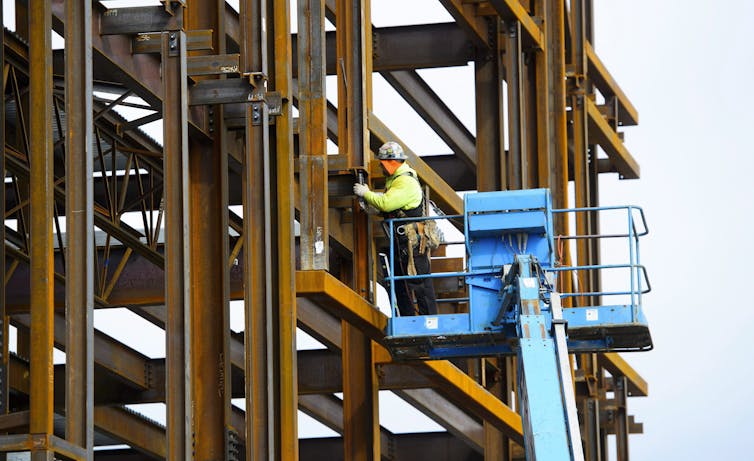
Sites where workers report higher levels of fear had lower hazard reporting rates and higher rates of serious incidents. A steel worker builds a structure in Ottawa in 2018. THE CANADIAN PRESS/Sean Kilpatrick

In teams with high levels of psychological safety and highly challenging tasks and standards, she found employees are curious and engaged problem-solvers. However, when the same high standards exist without psychological safety (where people believe that they might be punished or humiliated for speaking up), anxiety prevails.

The goal is to have your team experience the first scenario. Because psychological safety operates at the team level, organizations can have multiple teams doing similar high-risk work with dramatically different outcomes, depending on whether people feel safe enough to speak up.
Creating safer systems starts with leadership

Since interpersonal fear is shaped by perception, it doesn’t matter whether leaders believe they are approachable; what matters is whether their teams think they are. If employees are spending more time worrying about managing impressions than operations, hazards go unreported and people are unknowingly put at risk.

Creating safer workplaces requires cultures where speaking up is not punished, dismissed or discouraged. Leaders can start by asking themselves questions: who is least likely to challenge me at work? What information might I not be hearing as a result?

Read more: Silence speaks volumes: How mental health influences employee silence at work

Often, the employees with the most job security, such as union reps or those nearing retirement, are the most honest sources of insight. Listening to these voices is often a good place to start.

Research shows that organizations can improve psychological safety through practical leadership changes. Supervisors who listen, seek feedback, share reasoning behind decisions and are team-oriented instead of self-serving are more likely to create and maintain psychological safety.

Leaders should also pay attention to variations across teams. Useful questions to ask include:

Which teams are feeling fearful?

Which teams are feeling curious and engaged?

How can you create more high-performance teams?

Understanding why some teams feel safer than others can reveal opportunities for improvement.

For leaders, the greatest worry should be whether your employees are afraid to speak up. Be suspicious of “good news only” green dashboards, obsequious agreement or stony silences. Do not punish messengers — rather, embrace their candour as a gift and a sign that your organization is preventing harm.

Author
r
Lianne M Lefsrud
Professor 
Risk, Innovation & Sustainability Chair (RISC), University of Alberta
Disclosure statement
Lianne M Lefsrud receives funding from the Natural Science and Engineering Research Council of Canada (NSERC), Alberta Justice, WorkSafeBC, Mitacs, Alberta Innovates, and the Lynch School of Engineering Safety and Risk Management endowed funds.
Partners

AFRICA

Source: Originally published by Z. Feel free to share widely.

Facing the strategic challenges in Algeria’s Southwest — water security, sustainable resource management, territorial stability, and socio-economic development — it is essential to complement major national projects with integrated approaches capable of amplifying their long-term benefits.

This contribution aims to do just that. It offers a complementary perspective on a state-led infrastructure project, exploring how a strategic investment can also become a lever for ecological regeneration, local wealth creation, and the sustainable strengthening of national food security.

In a context marked by heavy dependence on hydrocarbons — and soon, mineral resources — alongside regional water dynamics beyond our control, it is timely to exercise territorial intelligence. Designing resilient ecosystems capable of capturing, retaining, and valorizing water is key to enhancing the productive autonomy of local territories.

The Southwest of Algeria faces a paradox: a land rich in minerals and naturally capable of regeneration, yet increasingly dependent on agricultural imports from the North and extremely vulnerable to climate extremes. Droughts and floods alternate, access to fresh products is limited, and the cost of meat continues to rise. At worst, the country risks selling iron and hydrocarbons to import what this very land could produce locally — through its soil, water, and thousands of hands, especially those of its youth. Reversing this absurd cycle has become a necessity.

This reflection arises from years of observing the mega iron-mining project at Ghar Djebilat and its transport to Béchar, successfully managed by the national company Cosider. It proposes expanding the project’s scope by viewing it as a lever for regenerative development, integrating ecological, economic, and social dimensions.

Water: the true treasure at the heart of everything

The project could be called “The Train of Regeneration for Green Peace in the Sahara.” It is not only about extraction but about giving back. The real treasure lies not beneath the surface, but above it — falling from the sky: water.

We sell non-renewable resources to fund desalination plants, while we could instead capture the rain that currently flows to the sea or evaporates in the desert. We cannot continue to import this vital resource indirectly; we must learn to retain it in our soils with intelligence and humility.

Desertification: reversing the logic with pragmatic solutions

Desertification is not inevitable. It manifests primarily through bare, eroded soils depleted of microbial life. Combating it requires genuine hydration of the land, maintaining soil moisture through simple, proven methods adapted to arid environments.

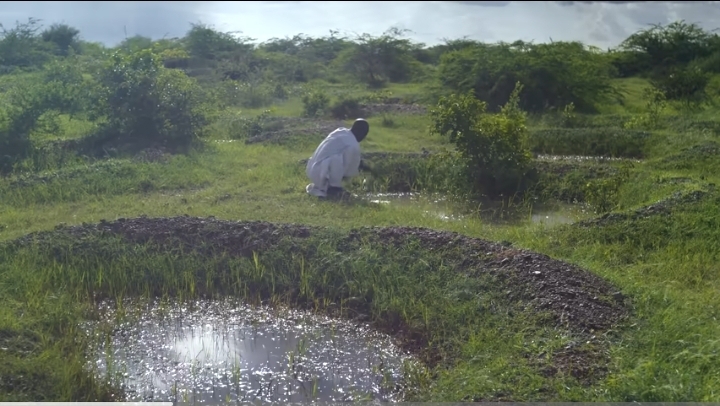
Water-retention half-moons, scientifically validated over thirty years by pioneering hydrologists like Michal Kravčík and successfully implemented by NGOs across Africa, are particularly suitable for this goal.

The operational capacity exists for large-scale deployment. Cosider, leveraging its logistics, machinery, and experience with the railway project, has the workforce, equipment, and field bases needed for excavation and light earthworks over a corridor exceeding 1,000 km. This workload plan could reconcile strategic infrastructure with ecological restoration while showcasing proven national expertise.

Pastures and livestock: towards strengthened food sovereignty

This greening process goes beyond soil stabilization and water-cycle improvement. It also allows for the reconstitution of natural pastures, essential for reviving camel herding and extensive sheep grazing, historically adapted to Saharan and pre-Saharan territories.

Restoring these pastoral areas reconnects livestock to local resources — soil, vegetation, and water — gradually reducing dependence on meat imports. Ultimately, this approach contributes to national food security, even during high-demand periods such as religious festivals, while fostering a sustainable pastoral economy that generates local income.

A concrete plan in two axes: from mining corridor to corridor of life

1. Hydrate the route, regenerate the soil: Excavate millions of half-moons (5 m diameter, 60 cm depth) perpendicular to water flows along the railway corridor. These basins will capture water, protect the track from floods, hydrate the soil, and enable pioneer vegetation to grow. Through evapotranspiration, this vegetation will generate atmospheric moisture, triggering a virtuous cycle of micro-rains.

2. Plant the future: In these water-filled basins, plant trees perfectly suited to arid conditions: argan, tamarisk, acacia, pistachio, fenugreek… These plantations will revive pastoralism, create new economic sectors, and stabilize the soil.

Revitalize the existing: oases as the starting point

Why build a new ecosystem when millennia-old ones are dying from neglect? The real starting point is revitalizing the existing oases along the Oued Saoura, hydro-agricultural masterpieces today threatened by wastewater discharge.

The first step is to reconnect the palmeries via a continuous route and restore their water supply. From Beni Ounif to Gsabi, passing through Taghit and Igli, along Oued Zouzfana and then Oued Saoura, the principle is the same: retain water. The same logic applies to Oued Guir and Daoura, all at risk of drying out.

A network of small perpendicular dams will slow floods, encourage infiltration, and recharge aquifers. This soft-retention approach should also guide protection of urban areas like Béchar against floods, far more efficiently than costly post-disaster repairs.

In complement to the agricultural projects initiated by the State over the past 20 years — where each farm had its well and basin — every farm should now have rainwater retention measures integrated on site.

A civilizational project reconciling time and territory

This plan is more than a technical intervention; it is a civilizational project, harmonizing temporalities and territories:

Short-term economic: The State can invest part of the mine’s revenue into regeneration over its lifetime.

Medium-term social: Thousands of low-skilled jobs are created in excavation, planting, and maintenance.

Long-term ecological and economic: Reduced meat and milk imports, new wealth through medicinal plants, and revived pastoralism.

It is also a matter of reconciliation. This region has endured, even after independence, nuclear and biological testing. Its residents, resilient guardians of desert life, bequeathed oases and traditional knowledge. Each palmerie must become a station on the train of regeneration — connecting communities, reactivating craftsmanship, and offering hope for self-sufficiency.

Choosing territorial intelligence

The overconfidence of modernity has resulted in endless drilling and wastewater discharge into these palmeries. Wisdom today lies in the small and the multiple: tiny dams, small half-moons, simple measures replicated millions of times.

Ignoring this path condemns the Southwest to dependency and costly disasters. Embracing it turns the territory into a living sponge, where every drop counts to make the desert green again.

Green Peace with the Sahara is not a dream. It is a concrete, pragmatic, and profoundly human plan, placing water, life, and territorial intelligence at the center of development. The Train of Regeneration is at the station — it only awaits political will to depart.

Pragmatic vision

Phasing:

Year 1: phase across 50 km of the railway corridor to demonstrate effectiveness, leveraging Cosider’s capabilities.

Years 2–5: Gradual deployment across the corridor’s width.

Years 5–10: Expansion to the entire region, with new economic sectors.

Benefits for all:

State: Protects mining and railway investments, reduces emergency costs (floods, imports), and demonstrates integrated, visionary development.

Population: Immediate local employment, village revitalization, pastoral revival, improved living conditions.

Environment: Concrete fight against desertification, soil restoration, reactivated water cycle, microclimate creation.

Economy: Diversification beyond extractives, export of medicinal plants, reduced food dependency.

A promising future:

Short-term (0–3 years): Jobs in earthworks and planting; first signs of vegetation.

Medium-term (3–10 years): Reduced agricultural imports, emergence of new economic sectors, gradual aquifer recharge.

Long-term (10+ years): Revitalized oases, food autonomy, a green, resilient, prosperous Southwest.

Our message

The Train of Regeneration is not a utopia. It is a realistic, actionable plan funded by local resources and driven by proven national expertise.

The advantages are clear:

  • Logistics already in place
  • Evident needs
  • Proven techniques
  • Available workforce
  • Strategic timing

What remains is political will to launch the first phase.

This project embodies a new approach to development: not “extract and leave,” but “invest and regenerate.” It promises Green Peace in our Sahara, a fertile, prosperous South, and a future for the next generation.Email

El Habib Ben Amara is an urban architect, science communicator committed to regenerating the water cycle, and translator of The New Water Paradigm by Michal Kravčík et al. into French and Arabic.