Wednesday, February 04, 2026

Trump Is Broadening His Use of Economic Warfare


by  | Feb 2, 2026 | ANTIWAR.COM

“Tariffs,” President Donald Trump is fond of reminding us, “is the most beautiful word to me in the dictionary.” It’s the most beautiful word “because tariffs are going to make us rich as hell. It’s going to bring our countries businesses back that left us.”

And that’s how it started. On “Liberation Day,” on April 2, Trump announced a 10% minimum tariff on goods from all countries with some countries being hit with higher “reciprocal tariffs.” “For decades,” he explained, “our country has been looted, pillaged, raped and plundered by nations near and far, both friend and foe alike.”

But Trump’s use of tariffs and sanctions quickly broadened as a versatile tool for much more than returning business to America. First they became a blunt tool for regime change; then they became the go to tool for everything from foreign policy goals to election interference.

Iran and Venezuela have felt it the hardest. The JCPOA nuclear agreement promised Iran an escape from sanctions in return for limiting its civilian nuclear program. Though Iran verifiably kept its promise, the United States did not, and the first Trump administration unilaterally pulled out of the agreement. The result for Iran was the return to crippling sanctions that would grow worse when the United Kingdom, France, and Germany would follow with snapback sanctions. Since then, the list of sanctions on Iran has only grown.

Those sanctions created an economic and cost of living crisis in Iran that drove protestors into the streets. The protestors demanded economic reforms that the Iranian government was powerless to implement as long as they were strangled by U.S. sanctions. But they could not escape the hold of those sanctions without concessions that would be existential for survival of both the country and the government. American sanctions were being used as an economic weapon for regime change.

Ervand Abrahamian, Distinguished Professor of History at City University of New York author of The Coup: 1953, the CIA, and the Roots of Modern U.S.-Iranian Relations, told me that, as demonstrated by their refusal to consider Iranian olive branches, the tearing up of the nuclear agreement and the refusal to ease sanctions, U.S. policy toward Iran has always been about “increasing pressure until the regime collapses.”

And now, along with “decisive” military strikes, included on the menu of regime change tools is even more economic strangulation. One option reportedly under consideration is imposing a naval blockade that would stop Iran from exporting any oil.

A similar strategy was employed in Venezuela with an embargo and the seizing of tankers. In the wake of the military strikes that removed Nicolás Maduro came the economic warfare. On the edge of insolvency, Venezuela’s acting President Delcy Rodriguez was informed that all American demands had to be fully implemented before the United States would allow Venezuela to pump another drop of oil. Economic warfare would be used as a tool for “running” Venezuela and imposing U.S. foreign policy on its agenda.

Tariffs and sanctions have continued to be the tool for which the Trump administration reaches most readily for regime change in recent days. As American attention turns to Cuba, the Trump administration has reportedly set an end of year deadline for regime change.

Trump has roared that “THERE WILL BE NO MORE OIL OR MONEY GOING TO CUBA – ZERO! I strongly suggest they make a deal, BEFORE IT IS TOO LATE.” The U.S. has cut Cuba off from its essential Venezuelan oil supply. It is pushing Mexico, who in 2025 supplied Cuba with more oil than Venezuela did, to further strangle Cuba by cutting it off from its oil too. Last week, Mexico cancelled plans to send a shipment of oil to Cuba; though, Mexican President Claudia Sheinbaum later said that Mexico will continue sending oil to Cuba as humanitarian aid.

Going even further, some members of Trump’s team are pushing for “a total blockade on oil imports” to Cuba to collapse the economy and push out the government.” On January 29, Trump signed an executive order imposing tariffs on any country that sends oil to Cuba. U.S. Charge d’Affairs in the U.S. Embassy in Havan told his staff the same day that “now there is going to be a real blockade. Nothing is getting in. No more oil is coming.” As in Iran and Venezuela, economic warfare is being used as a tool for regime change.

But regime change is not the only job that economic warfare is being used for. It is also being used to influence foreign elections.

As Hondurans headed to the polls, there was a three-way race with no clear winner. That quickly changed when Trump interfered in the election with an economic threat. Trump told Hondurans that if they vote for the wrong candidate, they will face the economic bomb of abandonment. “If Tito Asfura wins for President of Honduras, because the United States has so much confidence in him, his Policies, and what he will do for the Great People of Honduras, we will be very supportive,” Trump said, “If he doesn’t win, the United States will not be throwing good money after bad.”

Trump was no less blunt in his economic interference in Iraq’s recent election. When the election left several parties scrambling to form a coalition, the United States threatened that, if Iran-allied groups are included in the government, the U.S. would target the Iraqi state, including blocking Iraq’s access to its own oil revenue.

But the uses of the economic tool have gone beyond regime choice and regime change. They have become a tool for coercing compliance with American foreign policy. Trump has weaponized the economy to become a key part of the arsenal of hegemony.

Acquiring Greenland has become a key plank in Trump’s foreign policy. He has identified ownership of the island as an “absolute necessity” for “national security.” In defense of the sovereignty of a European nation and horrified by the threat of a NATO ally against the territory of a NATO member, European leaders united in a defensive front for Greenland and Denmark. Trump attacked that defensive front by firing an economic missile. He announced that tariffs would be placed on “Denmark, Norway, Sweden, France, Germany, The United Kingdom, The Netherlands, and Finland…until such time as a Deal is reached for the Complete and Total purchase of Greenland.” Tariffs were being used, not to protect American markets, but to acquire the territory of a European and NATO ally.

But that’s not all. Tariffs have an even greater spectrum of use. As Trump sought to capture even more international influence through his board of peace, several leaders chose either to ignore their invitations or decline. One of the first leaders to decline was France’s Emmanuel Macron. In an attempt to coerce Macron and stanch any possible rebellion, Trump turned to tariffs as a weapon for enforcing U.S. foreign policy. “I’ll put a 200% tariff on his wines and champagnes. And he’ll join,” Trump said. France called the American response the use of tariffs as “threats to influence our foreign policy.”

Trump reached for the same tool against Canada. In an attempt to diversify when its most important trade relationship turned increasingly unreliable and threatening in the face of U.S. tariffs, Canada reached an agreement with China that would allow 49,000 Chinese electric cars into Canada at a reduced tariff of 6.1%. Far from a free trade agreement, the trade won concessions from China for Canadian exports and returned the number of Chinese cars allowed into Canada to pre-Canadian tariff numbers.

In an attempt to coerce Canada into aligning with a U.S. policy of keeping China out and America in, Trump said, “The last thing the World needs is to have China take over Canada. It’s NOT going to happen, or even come close to happening!” He then angrily posted, “If Governor Carney thinks he is going to make Canada a “Drop Off Port” for China to send goods and products into the United States, he is sorely mistaken… If Canada makes a deal with China, it will immediately be hit with a 100% Tariff against all Canadian goods and products coming into the U.S.A.”

Trump said he loved the word tariffs as a way to protect American markets and make the United States rich by bringing business back to the U.S. But they have swollen from an economic tool to an economic weapon that is increasingly being used as an enforcer of U.S. foreign policy and a weapon of regime change.

Ted Snider is a regular columnist on U.S. foreign policy and history at Antiwar.com and  The Libertarian Institute. He is also a frequent contributor to Responsible Statecraft and The American Conservative as well as other outlets. To support his work or for media or virtual presentation requests, contact him at tedsnider@bell.net


Inside Strum: How a Subscription Platform Funds Ukraine’s Neo-Nazi Azov Brigade


by  | Feb 3, 2026 | 

One of the most persistent myths in Western political thought is the idea that the United States and its European allies are principled opponents of fascism and totalitarianism. This doctrine, which many Washington elites believe at an almost religious level, has served as the basis for the ongoing proxy war in Ukraine. Numerous politicians from both sides of the proverbial aisle have accused Russian President Vladimir Putin of being a Nazi or a fascist. However, when the United States allows Neo-Nazi-linked Ukrainian organizations like the Azov Brigade to receive support, this undermines their narrative.

Now, after American and European taxpayers have already paid billions for Ukraine’s war, the Azov Brigade is attempting to extract more money from Westerners via a subscription service called “Strum.” But before discussing Strum, it is important to examine what the Azov Brigade is and why it requires additional funding in the first place.

The Azov Brigade (formerly known as the Azov Battalion and Azov Regiment) has been mired in controversy since its founding. The organization was founded in 2014 by Andrey Biletskyi, a political activist with ties to Neo-Nazi movements. The Azov Brigade began as an amalgamation of radical movements including the Patriot of Ukraine gang which “espoused xenophobic and neo-Nazi ideas, and was engaged in violent attacks against migrants, foreign students in Kharkiv and those opposing its views.” Following the Maidan Revolution, oligarchs and elements of the Ukrainian government backed the organization which was then incorporated into the National Guard of Ukraine. In 2016, the UN alleged that the Azov regiment violated international law due to its documented mass looting of civilian homes, its targeting of civilian areas, and its treatment of prisoners. During the Siege of Mariupol, the group was heavily involved in the fighting on the Ukrainian side though it eventually surrendered to Russia. In 2023, the Azov Regiment was reorganized into the Azov Brigade.

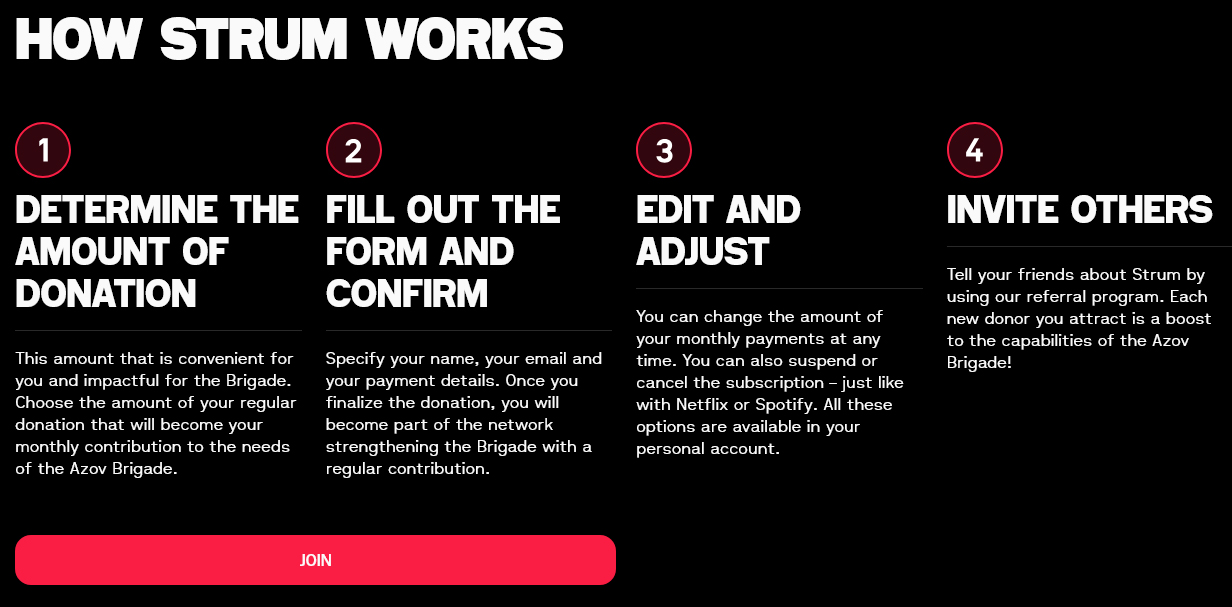
With resources dwindling and rampant foreign military aid corruption, Azov has increasingly relied on donations from individuals and companies. According to reporting from Svidomi, which included interviews with founders and project managers, a new project, Strum, has become the “driving force” behind the Brigade. The platform operates as a subscription service like Netflix or Spotify, but with some substantial differences and additional features.

Donors choose how much they give per month giving the Azov Brigade a consistent “electric current” of funding for vehicles, drones, fuel, and whatever else the Brigade might need. In return, donors get access to a members-only Telegram channel. Additionally, its referral program incentivises donors to spread the word.

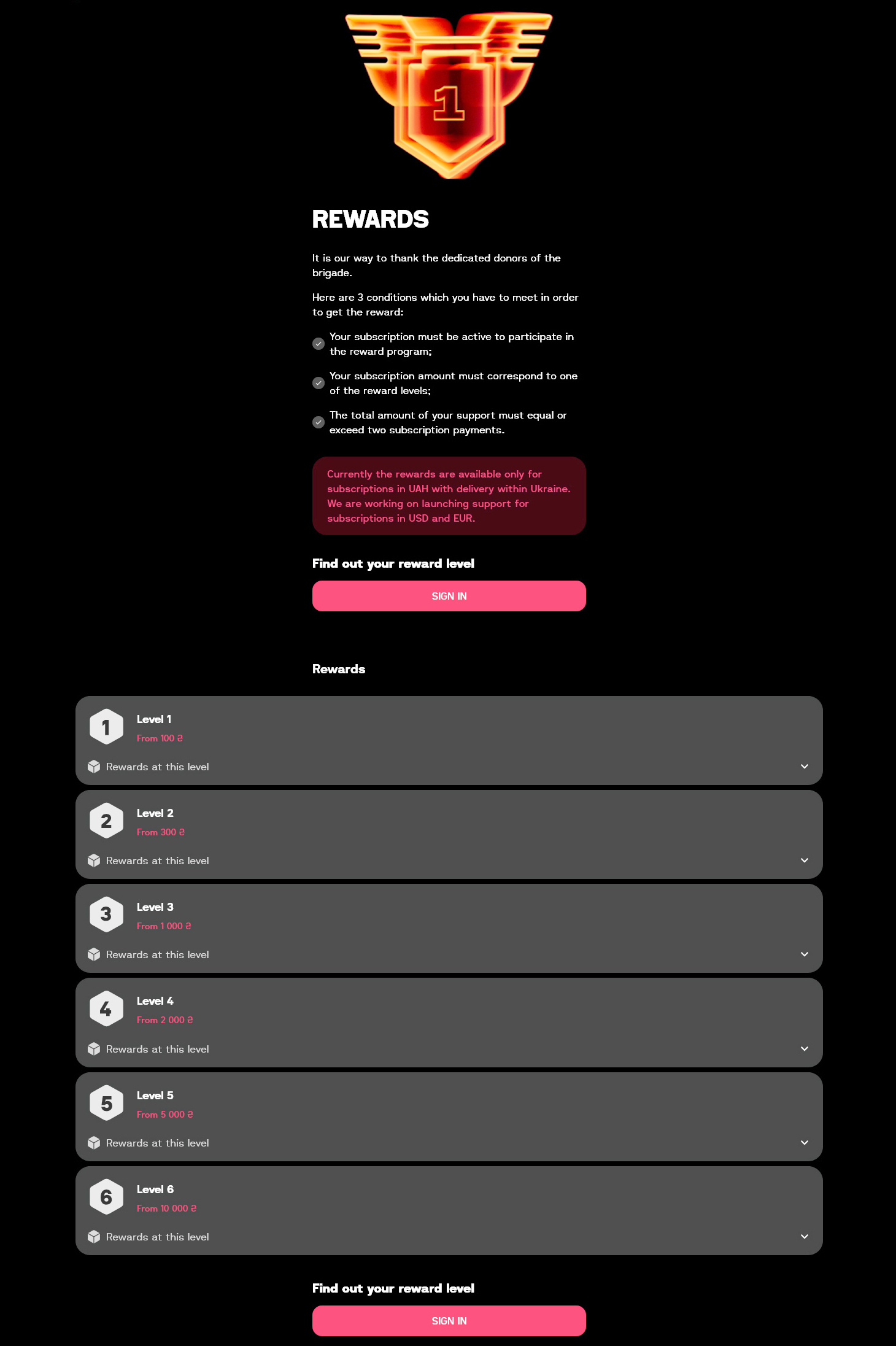
Strum has a rewards program where you can get access to different merchandise and raffles depending on how much you give.

Launched on October 14, 2024, the timing of its founding is not merely an interesting factoid. Indeed, major changes in how the American government views the Azov Brigade occurred mere months prior to its establishment. On June 11, 2024, the US lifted its ban on providing weapons and training to the Azov Brigade. Commentators described this as part of a Western effort to “release the reins” on Ukraine to allow them to attack Russia at maximum capacity.

Strum emerged in the midst of this newly permissible environment, which reduced barriers to Western support. According to Strum’s creator and project manager, Dmytro Horshkov, “The Ukrainian “donation market” is significant but not unlimited. Strum… aims to attract foreign support.” This is why they make use of the Stripe payment platform as it is “very trusted in the West.” Additionally, the company also records some promotional videos in English. However, the project also has significant domestic backers including numerous corporate benefactors.

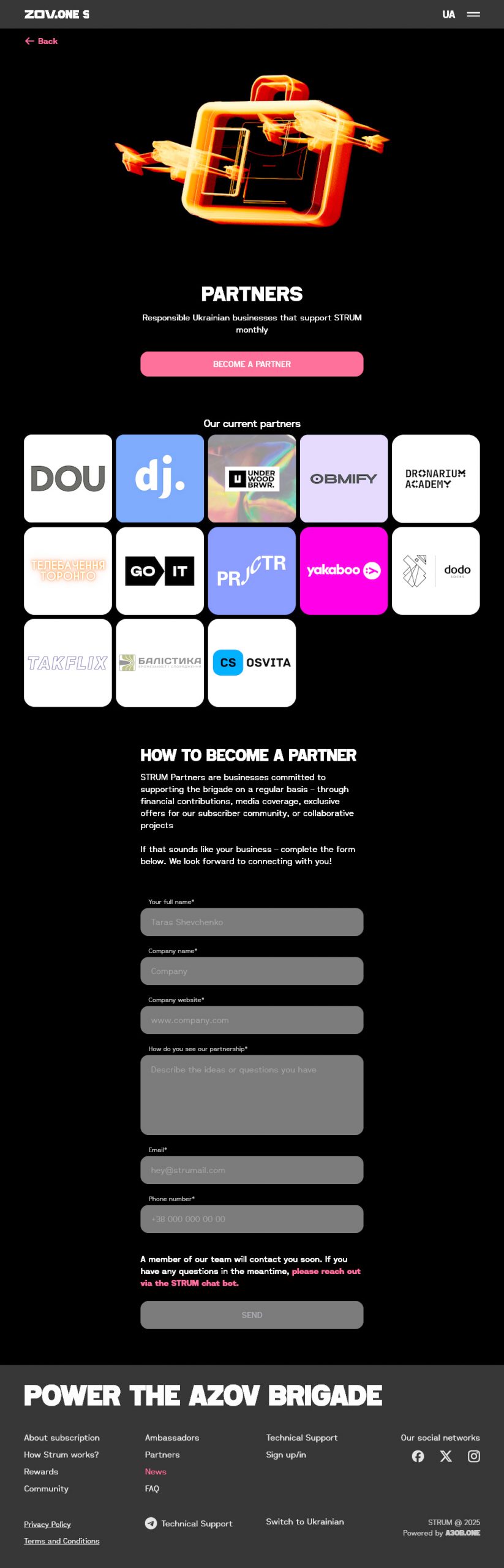
Strum lists numerous Ukrainian companies of varying sizes and industries as backers. Some companies are more related to the defense industry like Balistika, which is a manufacturer of body armor and military equipment, and Dronarium Academy, which has trained over 16,000 Ukrainian drone pilots and develops drone technology for the Ukrainian government. Other companies like Underwood Brewery or Dodo Socks appear to have little to do with technology or defense. DOUDjinniGoITPrjctr, and CS Osvita are all related to IT while Obmify is a cryptocurrency exchange platform. A number of supporters are involved in digital or print media including Yakaboo (book publishing), Toronto Television (satirical news), and Taxflix (Ukrainian movie streaming). Together, these companies form part of the larger Strum donor network which helps the Azov Brigade fund its operations while also normalizing itself amongst the business community and the public at large.

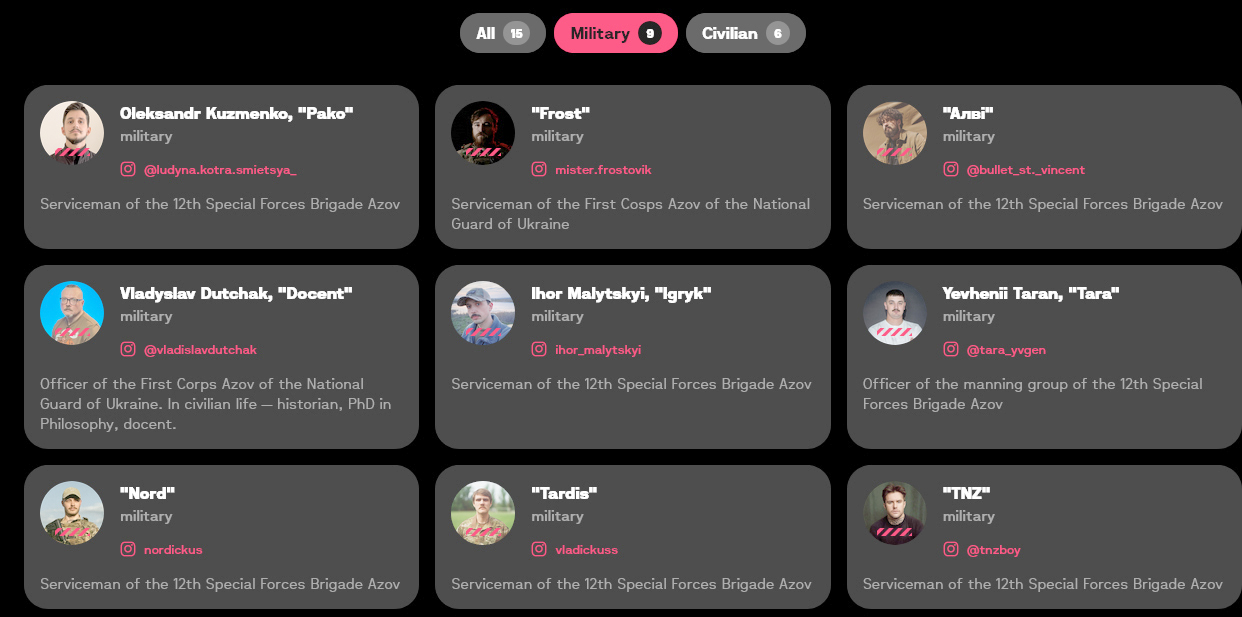
The Azov Brigade’s social media strategy to promote Strum is notably savvy, making use of both military and civilian influencers. As Strum’s lead designer Mykyta Malyshev put it, “On social media, it’s a competition for just three seconds of someone’s attention… The subscription also needed a well-communicated message. Many foundations have similar services, and the Brigade itself had something like a subscription, but it didn’t attract many signups. We need to grab attention and then convey importance.”

Most of their military influencers are from the standard Azov Brigade but some are part of the 1st Corps of the Ukrainian National Guard “Azov,” a special forces battalion within the broader Azov organization. Most of the military influencers have small platforms of five thousand or less followers; however, Mykola Kush and Maksym Yemelyanenko both have noteworthy followings at around 66,000 and 24,000 followers respectively.

Some of Kush’s following can be attributed to his release in a prisoner swap facilitated by Turkey. The swap saw 215 Ukrainian soldiers (108 from the Azov Brigade) exchanged for 55 Russian soldiers and Viktor Medvedchuk. Regardless of follower counts, the purpose of each of the military influencers is clear: to make the Azov Brigade seem “cool.” Posts frequently feature the influencers in their military gear brandishing weapons. Nevertheless, as previously mentioned, civilians also make up a significant portion of their influencers.

Much like the Israel Defense Forces who use attractive women as part of their social media propaganda campaigns, the Azov Brigade employs a similar strategy. Out of the six civilian influencers, five are women, all of whom are conventionally attractive, which helps the Brigade garner more attention. Unlike the military influencers, all of the civilian influencers boast follower counts between 10,000 and 55,000. Four out of six of the influencers are artists with the remaining two being journalists.

Unlike his fellow civilian influencers, Corrie Nieto is a male from America. As stated in his bio, he works for Euromaidan Press, which is funded by the George Soros-backed International Renaissance Foundation. Nieto has covered some globally significant topics including Ryan Wesley Routh’s failed assassination of President Donald Trump. Interestingly, Nieto was able to get an interview with an unnamed source who claims to have known Routh during his time in Ukraine,  illustrating the reach and access of some Azov-associated media figures. Nieto is not the only American who has developed an affinity for the Azov Battalion. As previously mentioned, the US government itself appears to view the Azov Battalion as a legitimate force in Ukraine regardless of the organization’s numerous documented human rights abuses.

At the end of the day, Strum represents far more than just a funding source for one military unit. It represents a new model of grassroots militarism which fuses companies, social media influencers, and foreign citizens into a cash cow for armed, extremist groups. Strum successfully blurs the line between consumer culture in the digital age and warfare. By doing this, it shifts responsibility away from governments and towards the individual. This raises an uncomfortable question: if the Azov Brigade is able to turn war into a participatory, monetized, and international experience, how many other groups might use similar tactics?

J.D. Hester is an independent writer born and raised in Arizona. He has previously written for Antiwar.com, Asia Times, The Libertarian Institute, and other websites. You can send him an email at josephdhester@gmail.com. Follow him on X (@JDH3ster).


UKRAINIAN NATIONALIST ARMY OUN–UPA 

AND THE NAZI GENOCIDE


The Future Looks Dim for Big Oil in the Motor Vehicle Industry


Because 40% of Big Oil’s American sales are to the Big 3 auto companies, its beleaguered executives won’t go down to defeat by EVs without a last-ditch stand, even as carmakers like Ford desert and other factors.


Just as American consumers closed out the horse-and-buggy era at the start of the 1900s with the arrival of gas-run vehicles, carriage makers saw the handwriting on the wall and gradually moved capital, labor, and creative efforts elsewhere. Big Oil’s executives today certainly recognize that the gas-run vehicle era is fast ending once EV prices drop below $30,000 for working-class consumers.

A sign of these possibilities is that China’s BeteTek company is producing a BD-DB small $860 run-about model, for example, with a 53-mile range. The only EV that comes close is the 2026 Nissan Leaf (303 range) at $29,990. But at least it’s an indicator of affordable EVs in the near future for the American general public.

Consider what’s at stake in Big Oil’s view with its 40 percent projected loss of 9.1 million barrels of oil powering today’s motor vehicles. Of course, the industry will use any means to counter the EV interloper in that marketing niche. It certainly couldn’t survive on the 10 percent sold to the plastics industry. Their remaining major sales categories include foreign exports, heating homes and building, the military, utilities, medical goods, and agricultural products and equipment.

Yet environmentalists became Enemy No. 1 to such sales, especially after it was revealed that executives in the oil and gas and automotive industries, such as Exxon Mobil, GM, and Ford, had known since the 1960s about vehicles’ significant carbon dioxide emissions. It’s now recognized as the chief contributor to global air pollution and to the disastrous impacts of global warming on the weather. Nevertheless, environmentalists insist that they prioritize profits over people’s lives.

This highly secret decision by Big Oil and major carmakers was made quickly, as they realized their industries faced cataclysmic ruin if cars were converted from gasoline to other energy sources. Thus began their mutual, costly, long-time public propaganda campaign against the idea that fossil fuels cause climate change and Earth’s eventual death.

Their industries were temporarily protected from such adverse findings until the late 1960s, when environmentalist presidents were in power, namely Richard Nixon (Clean Water Act, Clean Air Act, Environmental Protection Agency, Endangered Species Act) and Jimmy Carter (solar energy, Alaska’s wilderness protection, and wildlife refuges).

For decades, large political donations were made to influence presidents and Congress in exchange for their protection. In the last election, according to Common Dreams’ staffer Brett Wilkins, the desperate “fossil-fuel industry interests spent nearly $450 million during the 2024 election cycle in support of Trump and other greedy Republican candidates and initiatives.” Indeed, the President called a meeting at Mar-a-Lago of their executives to demand $1 billion for his 2024 presidential campaign expenses for post-election needs.

In his first term at the White House, it paid off. The public suddenly heard climate change was a “hoax”  and that Trump would end any federal effort toward its existence, even banning the words  “climate change” and “green” at his Department of Energy. In the second term, among other anti-environmental measures against solar and wind, he allowed the October 1 deadline to expire for Biden’s $7,500 discount for EV cars.

In 2021, Biden secured bipartisan passage of a law allocating $4.4 billion to states for 1,600 EV charging stations every 50 miles on the nation’s highways. Hardly had construction started than Trump “paused” the program for seven months, sufficient time for contractors to withdraw. Lawsuits forced him to resume the program, on which only 2 percent has been spent to date.

But Big Oil couldn’t buy or sway President Joe Biden once he became aware of fossil fuels’ dire physical implications for the world. Nor could heavy pressure from the auto industry. Serving between Trump’s two terms, he put out extraordinary concern for the environment, particularly a major push for EVs: that $7,500 tax credit, tightening pollution standards for vehicles, a ban on new gas-run cars after 2035, and pausing approvals of liquefied natural gas export facilities.

Despite these monumental power plays against the rise of EVs, Big Oil executives were running scared. They knew the clock was ticking for losing 40 percent of their sales to EVs. They were also well aware that the motor industry (especially Ford) would desert them and switch to another (and renewable) energy source. Like battery-powered electricity used in China’s fast-growing car industry, and heavy competition around the globe.  Recently, BYD surpassed Tesla in global sales, becoming the world’s top EV producer in 2025, selling 2.26 million vehicles versus 1.64 million vehicles.

True, China has been communist for 77 years, so most of its cars have been made for the general public, just as Henry Ford’s popular $260 Model T (15 million sold 1908-1927) and Germany’s Volkswagen after WWII. Russian technical aid and vehicles created the start of China’s automotive industry. Its creators adroitly set up joint ventures in 1983 to swap ideas and skills with eight foreign carmakers (American Motors, Volkswagen, Peugeot, Suzuki, etc.) and their factories and sales in China.

These companies learned from each other. Chinese engineers, technical specialists, and designers took it from there. Experimenting with battery-powered EV vehicles began in 2001. Then, China’s government in 2009 began to subsidize and give tax breaks  to a multitude of carmakers to build affordable electric buses, taxis, and cars. Up to 2023, subsidies amounted to $29 billion. Secondarily, it help halt gas and coal emissions then choking urban areas.

By last August, some 6.9 million EVs were on China’s city streets and country roads. They served by a nationwide network of 3.9 million charging stations, the largest number in the world. What is unique is that most stations are paired with convenience stores  open 24/7, and underwritten by the government and the stores. While waiting for a 15-40 minute charge, most drivers and passengers visit the stores for beverages, snacks, and impulse-buying of other items.

Because America’s car companies such as GM and Stellantis (formerly Chrysler) seem perpetually focused on high-end customers, such a profitable partnership probably never occurred to them. If it did, they discarded it as too bothersome. But because charging is essential, most EV drivers’ common fear is of being stranded. They need those frequent charging stations. It’s the same as the early 1900s “horseless carriages” up to 2007  when cautious drivers carried a gas can. Ford EVs today come with a towing information service — and a free home charging unit.

Big Oil and the Big 3 carmakers currently are suffering from hits great and small.

One factor is a two-year slump in industrywide automotive sales, plain to any Sunday car-lot shoppers. They’ve heard about the major producers’ retooling factories to EVs. That they’re willing to wait for a new or used EV may partially explain why major vehicle companies have large backlogs  of unsold gas-run cars.

Carmakers’ usual remedy  to clear those inventories are incentives: “higher cash discounts and more zero-percent financing deals.” Rarely do they lower the “manufacturer’s suggested retail price” (MSRPs). These days it’s obviously not working.

Yet another adverse factor is the recent lawsuit filed by the state of Michigan  charging four of Big Oil companies —BP, Chevron, ExxonMobil, Shell, and its trade association—with conspiring “to forestall meaningful competition from renewable energy and maintain their dominance in the energy market.”

In other words, impeding a transition to clean power and transportation (EVs).

Another factor is emphasizing production of the high-end gas-guzzler instead of an affordable, easy-to-park EV run-about such as that $860 Chinese BD-DB.

Now, legendary carmaker Henry Ford believed that volume-selling to the masses yielded greater profits than those high-priced prestige cars for the rich (Every time I reduce the price of the car by one dollar I get one thousand new buyers). It’s been a winning and profitable sales philosophy then and now, but which most carmaker CEOs and board members deliberately refuse to follow.

About Ford’s constant leading the pack in sales, he also said: “There’s no use trying to pass a Ford because there’s always another one just ahead.” Ford has always refused to be cowed by Big Oil, major carmakers, or pressure by presidents and lawmakers.

And so when American carmakers learned European and Chinese competitors were retooling for EVs—far cheaper to make, easier to sell—they began doing the same by costly retooling and heavy complaints about layoffs. GM spent $15 billion  in 2021, for example.

Whether Big Oil called in its investment in Trump’s compliance may never be known, but he soon began his vendetta against EVs. He certainly indicated the polluting, gas-run vehicles would always be an American staple. GM was prepared evidently to spend another $6 billion on re-re-tooling.

Only Ford balked at the prospect of yet another prohibitively expensive retooling to return to the dead past. It already had six EVs in America’s showrooms: the F-150 Lightning van, Mach-E Mustang, Bronco, Explorer, Maverick, and Expedition. And it just announced 2027 plans  to build “the world’s cheapest EV motors ($30,000) on its truck platform.”

Meantime, Ford officials have been standing up against Trump’s bullying on behalf of Big Oil. In mid-December it issued its declaration of independence for the future:

“By 2030, Ford expects approximately 50% of its global volume will be hybrids, extended-range EVs and fully electric vehicles, up from 17% in 2025. Ford will concentrate its North American electric vehicle development on its new, low-cost, flexible Universal EV Platform. This next-generation architecture is engineered to underpin a high-volume family of smaller, highly efficient and affordable electric vehicles designed to be accessible to millions of customers.”

Such regular effrontery seems to have called for Trump to drop in recently at Ford’s Detroit factory for a little disciplinary chat with its officials—followed by a plant tour. Trump wound up facing cat-calls and jeers, exchanging middle-finger gestures and curses from an assembly line worker (“[he] has stood up to Trump more than any of our elected officials.”). Suspended instantly without pay, the spunky worker was sent $800,000 two days later from 30,000 via the “GoFundMe” online donation platform. In view of the thousands of layoffs from the conversion of vehicles from gas to electricity, Trump was lucky to have escaped this floor-wide response of massive middle fingers and far stronger language.

Henry Ford would have been proud —and delighted.

Barbara G. Ellis, Ph.D, is the principal of a Portland (OR) writing/pr firm, a long-time writer and journalism professor, a Pulitzer nominee, and now an online free-lancer. Read other articles by Barbara.


Is the UN Being Wrecked So Western Leaders Can Escape Justice from the ICC and ICJ?


The UN is already on the verge of financial collapse. And we've just been watching its easy capitulation to lawlessness.


On Thursday UK MPs will debate the motion “That this House has considered the obligation to assess the risk of genocide under international law in relation to the Occupied Palestinian Territories”. This follows an application from SNP MP Brendan O’Hara way back in June last year. As O’Hara said in his request, “it is to allow Members to have a better understanding of the Government’s reasoning and to examine how the Government’s policy impacts the United Kingdom’s legal obligation to continually assess the risk of genocide”.

He claimed there hadn’t been a proper debate on Palestine in the main Chamber since February 2024, and I noticed that the Chair of the Backbench Business Committee is none other than the notorious ‘Friend of Israel’, Bob Blackman, who of course hasn’t seen any need for urgency. The motion’s wording is no doubt chosen to avoid obstruction; however, we are no longer arguing about the “risk” of genocide, it’s a plain fact – as confirmed by the UN itself, the International Association of Genocide Scholars and countless other law experts. The Government and Opposition have never been open about their legal advice.

So I’ve written to my MP as follows.

The definition of genocide is easy enough to understand so it’s pointless denying that is what we have all witnessed for nearly 28 months. Over 71,000 known deaths plus countless thousands more under the rubble. And the public want to know what concrete action UKgov is taking to stop it. But matters have moved on. The genocide, which continues deliberately and with impunity, is now morphing into something even more sinister.

A recent report by the UN’s Special Rapporteur summarised the situation thus:

The ongoing genocide in Gaza is a collective crime, sustained by the complicity of influential Third States that have enabled longstanding systemic violations of international law by Israel…. This live-streamed atrocity has been facilitated through Third States’ direct support, material aid, diplomatic protection and, in some cases, active participation. It has exposed an unprecedented chasm between peoples and their governments, betraying the trust on which global peace and security rest. The world now stands on a knife-edge between the collapse of the international rule of law and hope for renewal. Renewal is only possible if complicity is confronted, responsibilities are met and justice is upheld.

The accusation of complicity is levelled at the UK among others, and justly so.

I would like to know please why Britain, a founding member of the UN, made no objection to Trump’s fake and obviously criminal ‘peace’ plan being put to the Security Council when the UN’s own team of experts had already listed over a dozen serious objections to it. And why the UK and most of the other Security Council then approve it knowing all that.

We are now treated to the bizarre spectacle of the two perpetrators of the genocide – Israel and the US – sidelining the UN, calling the shots and continuing their extermination and land grab with impunity… and with the international community’s ‘approval’.

UKgov, in a press release, said it voted for the SC resolution because it is “a critical means of implementing the Peace Plan for Palestinians, Israelis, and the region – turning the page on two devastating years of conflict, towards a lasting peace”. Charge D’Affairs in New York, James Kariuki, explained that the UK will continue working to build on this momentum so an International Stabilisation Force can be deployed quickly, support the ceasefire and avoid a vacuum being left which Hamas can exploit. He reiterated the importance of implementing the transitional arrangements set out in the resolution in accordance with international law, with respect to Palestinian sovereignty and self-determination, strengthened unity of Gaza and the West Bank, and empowered Palestinian institutions which enable a reformed Palestinian Authority to resume governance in Gaza. But adherence to international law is sadly lacking.

In case UKgov hasn’t been paying attention, the 28 independent human rights experts appointed by the United Nations Human Rights Council warned that any peace plan must absolutely safeguard the human rights of Palestinians and not create further conditions of oppression. They also advise that key elements of Trump’s so-called peace plan are inconsistent with fundamental rules of international law and the 2024 Advisory Opinion of the ICJ which demand that Israel ends its unlawful presence in the Occupied Palestinian Territory. Their warnings include the following:

  •     Any peace plan must respect the ground rules of international law. The future of Palestine must be in the hands of the Palestinian people – not imposed under duress by outsiders.
  •     The ICJ has ruled that fulfilling the right of self-determination cannot be conditional on negotiations. Who governs is a matter for the Palestinians only, without foreign interference.
  •     The ICJ has been crystal clear: Conditions cannot be placed on the Palestinian right of self-determination. The Israeli occupation must end immediately, totally and unconditionally, with due reparation made to the Palestinians.
  •     The United Nations – not Israel or its closest ally – has been identified by the ICJ as the legitimate authority to oversee the end of the occupation and the transition towards a political solution in which the Palestinians’ right of self-determination is fully realised.
  •     The Trump plan does not guarantee the Palestinian right of self-determination as international law requires; and vague pre-conditions put Palestine’s future at the mercy of decisions by outsiders, not in the hands of the Palestinians themselves as international law commands.
  •     The “temporary transitional government” is not representative of Palestinians and even excludes the Palestinian Authority, which further violates self-determination and lacks legitimacy.
  •     The plan does not provide a leading role for the UN General Assembly or Security Council, or for UNRWA which is vital to assisting and protecting Palestinians.
  •     An “International Stabilisation Force”, outside the control of the Palestinian people and the United Nations as a guarantor, would be contrary to Palestinian self-determination.
  •     The plan largely treats Gaza in isolation from the West Bank and East Jerusalem, when these areas must be regarded as a unified Palestinian territory and State.

The full list of objections are on the UN’s website. How can our Parliament be so ignorant as to dismiss them? When, if ever, will we see a UN-generated peace plan rather than a vanity project proposed by, and personally led by the genocidists and their chief enabler whose stated aim is to deny Palestinians their statehood?

Meanwhile suspicions are growing that the recent behaviour of Western powers is designed to undermine and eventually destroy the United Nations and all it stands for so that self-serving leaders can escape justice from UN agencies like the ICC and ICJ. The UN is already on the verge of financial collapse. And we’ve just been watching its moral demise and easy capitulation to lawlessness.

Stuart Littlewood, after working on jet fighters in the RAF, became an industrial marketing specialist. He served as a Cambridgeshire county councillor and a member of the Police Authority, produced two photo-documentary books including Radio Free Palestine (with foreword by Jeff Halper), and has contributed to online news and opinion publications over many years. Read other articles by Stuart, or visit Stuart's website.