Wednesday, March 18, 2026

Setting the Record Straight on Vaccines and Autism


 March 18, 2026

In the aftermath of Health and Human Services Secretary Kennedy’s repeated and dangerous misinformation campaign inaccurately linking vaccines to autism, Sen. Bernie Sanders (I-Vt.), Ranking Member of the Senate Committee on Health, Education, Labor, and Pensions (HELP) today called on Chairman Bill Cassidy (R-La.) to hold a hearing to set the record straight on autism research and clarify that vaccines are safe and effective and do not cause autism.

March 17, 2026

Dear Chairman Cassidy:

As you know, the scientific and medical community has been clear and unambiguous: Vaccines do not cause autism.

Since 1998, more than 40 rigorous scientific studies in seven countries involving over 5.6 million children have found no link between vaccines and autism. Major medical organizations have reached the same conclusion.

The American Academy of Pediatrics, the largest professional association of pediatricians in the United States representing over 65,000 physicians who treat kids every day, states: “There’s no link between vaccines and autism. Anyone repeating this harmful myth is misinformed or intentionally trying to mislead parents.”

The American Medical Association, the largest professional association of physicians in our country representing over 270,000 doctors, has likewise concluded that: “an abundance of evidence from decades of scientific studies shows no link between vaccines and autism.”

You have correctly said: “I’m a doctor who has seen people die from vaccine preventable diseases. What parents need to hear right now is vaccines for measles, polio, hepatitis B and other childhood diseases are safe and effective and will not cause autism. Any statement to the contrary is wrong, irresponsible, and actively makes Americans sicker.”

I could not agree more with that assessment. Unfortunately, Health and Human Services Secretary Kennedy and many others inside the Trump Administration do not. The reality is that since Secretary Kennedy has been in office, he has continued his longstanding crusade against vaccines and his advocacy of conspiracy theories that vaccines cause autism – all of which have been repeatedly rejected by scientists.

In June, Secretary Kennedy replaced the scientific experts on the Advisory Committee on Immunization Practices with vaccine-skeptics, including several who have promoted the debunked claim that vaccines cause autism.

In September, the Trump Administration asserted that acetaminophen use during pregnancy causes autism – a conclusion you and the scientific community correctly challenged based on the evidence.

In November, Secretary Kennedy directed the Centers for Disease Control and Prevention (CDC) to publish false information on its website suggesting vaccines cause autism.

Later in 2025, the Food and Drug Administration removed a webpage that had previously warned consumers about unproven, and often dangerous, autism treatments.

And in January, Secretary Kennedy overhauled the National Institutes of Health (NIH)’s Interagency Autism Coordinating Committee (IACC), appointing 21 new non-federal members. Several of these appointees have publicly advanced false claims linking vaccines and autism.

The IACC is charged with disseminating fact-based information to the public about autism and developing recommendations for autism research. Unfortunately, Secretary Kennedy’s newly appointed members have a history of doing the opposite by promoting and providing controversial, untested and dangerous treatments for autism and pushing discredited claims that vaccines cause autism. As a result, it has become abundantly clear that the American people can no longer trust information from the IACC about autism.

It is our responsibility to make sure that the American people understand the truth about vaccines and autism based on scientific evidence, not conspiracy theories.

Therefore, I would like to work with you to schedule a hearing on this issue as soon as possible.

Such a hearing would provide an opportunity for leading scientists, physicians, and public health experts to review the existing body of research on autism, discuss how federal agencies evaluate scientific evidence, and clarify what is known – and what is still being studied – about autism.

Importantly, it would also allow the Committee to hear from members of the autism community about their priorities for federal research, services, and support.

I look forward to working with you to make this hearing possible.

Sincerely,

Bernard Sanders
Ranking Member
U.S. Senate Committee on Health, Education, Labor, and Pensions

Bernie Sanders is a US Senator, and the ranking member of the Senate budget committee. He represents the state of Vermont, and is the longest-serving independent in the history of Congress.

More ‘Beef’ With Bobby: Meat and Masculinity


In 2026, the federal government is telling us how men should be men, with devastating effects on our health and planet.


Lewis D’Avigdor
Mar 17, 2026
Common Dreams


In January 2026, Secretary of Health and Human Services Robert F. Kennedy Jr. announced the Food and Drug Administration’s new inverted food pyramid to replace the Michelle Obama’s “myplate” visualization. There is some good in the change: promoting whole foods and minimizing processed foods, as I noted in My “Beef” with Bobby. But the science ends here as RFK instead relies on bro-science. Taking his cue from the “manosphere” and MAHA wellness influencers, he emphasizes animal proteins over plant proteins. More on that in a moment.

Just one month after releasing the new food pyramid, RFK released a workout video with Kid Rock where the pair eat steaks, pump iron, and then drink raw milk in a hot tub together. It’s difficult to watch, but even more difficult to describe. Comedian Stephen Colbert called it “senior softcore that feels like dropping acid.”

RFK has long sought to prove his manliness. He has admitted to taking testosterone, while insisting, unconvincingly, that he’s not on steroids. The administration more broadly seems to have an obsessive and desperate need to demonstrate its masculine prowess. In fact, Defense Secretary Pete Hegseth’s warrior mentality may have contributed to the US attacks on Iran. It has certainly contributed to his callous dismissal of human casualties. Both meanwhile defer to President Donald Trump’s allegedly off-the charts levels of testosterone.

These food policies and performative workouts might appear unrelated. But, a closer connection exists between beef, masculinity, and the American nation, one that has, in fact, twined since the country’s earliest days. RFK’s effort to Make American Healthy Again is mere revival of a longstanding American narrative.

For all its chest-thumping certainty, this administration’s relationship to masculinity looks less like confidence than anxiety, much like the frontier myth itself.

The idea that meat is manly can be traced to the cultural founding of the nation on the actual frontier. In 1893, historian Frederick Jackson Turner argued that the struggle to conquer the wilderness had fostered American virtues of independence, self-reliance, and democracy. Proving your manly virtue on the frontier made immigrants into American men as America became a virtuous nation. Declaring the closing of the frontier, Jackson lamented America’s ability to grow and innovate. Men would wither without the opportunity to test their mettle as the nation expanded.

Beef was central to imperial expansion on the frontier. Ranching not only justified the expropriation American Indian land, but beef products supplied to the US Army made expansion possible. By slaughtering to the brink of extinction the 50 million bison that roamed the Great Plains, they settled the “Indian question.” Historian Joshua Specht calls cattle “mobile colonizers.” Culturally, ranchers and cowboys justified the violence against American Indians in the interests of civilization. Central to this myth was the frontier man, bringing civilization to the feminized “vanishing Indian,” a curious paradox, to be sure, where Native Americans could be at once docile and violent.

Today we are left with an embarrassing historical echo. Protein as the final frontier of fitness influencers ironically returns us to the actual frontier in American history. Now we can see why RFK’s two provocations in the culture war of 2026 are related. Food has always been gendered and tied to nothing less than the ideals of the nation and what it means to be an American.

Today we see the same gendering of meat wrapped up with big business. Only un-American soy boys refuse to eat meat. Meat advertisements often demonstrate the masculinity of meat consumption by displaying oversexualized women cooking meat, implying that both women and animals are to be dominated and consumed by men.

There is of course no evidence that soy intake affects male hormones, or that meat consumption is required for elite athletic performance. Arnold Schwarzenegger, whose character once said, “You hit like a vegetarian,“ has more recently called for cutting back on meat, noting that it isn’t necessary for athletes and harms the planet. James Cameron’s documentary The Game Changers challenges the myth that animal protein is needed for physical strength and elite athletic performance. Cameron follows tennis stars, Olympians, and even the ultimate fighter James Wilks to see how plant protein permeates their diets. But the myth lives on, perpetrated by RFK’s shirtless workouts and emphasis on eating meat. And because the old adage ”follow the money“ seems to be guiding light for this administration, it should come as no surprise that the meat industry is also a major donor.

Still, the science on red meat consumption and its effects on our planet and health are clear. Red meat consumption reduces life expectancy by increasing risks of cardiovascular disease, obesity, and cancer. Cattle also consume much of the world’s arable land, leading to deforestation and increased greenhouse gas emissions. While beans and legumes make it into the dietary guidelines, they are entirely absent from the pyramid.

Despite the eagerness of the administration, Kid Rock, and MAHA followers to heed RFK’s food and exercise advice, many of these same figures recoiled when Michelle Obama tried to move toward nutrient-dense fruit and vegetables in school lunches. Republicans accused her of trying to impose a “nanny-state,” and bristled at her impudent attempt to shape what Americans choose to eat. Again, gender is at work in our food policies.

Despite claiming to restore “scientific integrity” and “common sense,” RFK ignores the government’s own “Scientific Report of the 2025 Dietary Guidelines Advisory Committee,” which consistently advocated plant-based sources of protein, especially beans and lentils while reducing the intake of red meat. The committee even suggested moving the “Beans, Peas, and Lentils Subgroup from the Vegetables Food Group to the Protein Foods Group.”

Cultural tropes can be hard to break, but it is time for a new generation of athletes and influencers to confront the wellness-to-fascism pipeline. Our secretary of health should not be making policy decisions on the basis of pseudoscience for the sake of winning a culture war. Nor should his leadership parrot “manosphere” talking points that openly embrace a hostility toward women and decry the feminization of Western society. This is nothing short of what one nutritionist called a “vibes-based policy disaster.” For all its chest-thumping certainty, this administration’s relationship to masculinity looks less like confidence than anxiety, much like the frontier myth itself. Still, these performances should not require the rest of us to pay with our health and our planet for their fragile egos.
This Awful Iran War Belongs to Trump—and It’s Going Horribly


The absence of any US strategy becomes clearer by the day. Trump has thrown everything at the wall in the hope that something will stick. So far, nothing has.


Steven Harper
Mar 18, 2026
Common Dreams


President Donald Trump is a victim of his own success. After a quick strike against Iran’s nuclear facilities last June and the capture of Venezuela’s president and First Lady in January, the US military, the illegality of those operations notwithstanding, made war look easy and Trump feel omnipotent.

Three weeks into a more daunting excursion into Iran, Trump is now a desperate leader.

Trump’s Latest Grudge Match

With Trump, everything is personal. A growing body of evidence suggests that a principal objective in attacking Iran was the assassination of the country’s Supreme Leader, Ayatollah Ali Khamenei. For example:When the CIA learned that the Ayatollah and top Iranian officials would be meeting in a militarily accessible location, a previously planned nighttime strike was moved up to the middle of the day.
On Sunday night, March 1, shortly after reports that the US-Israeli attack had killed the Ayatollah, Trump said, “I got him before he got me.” He was referring to an alleged plot to kill Trump during the 2024 presidential campaign as retribution for the January 2020 US strike that killed Iran’s military leader Qasem Soleimani, the commander of the Quds Force of the Islamic Revolutionary Guards Corps,
The desire to downplay Trump’s desire for vengeance explains why he and his minions have offered more noble—and contradictory—justifications for the war, including:
To help the Iranian people secure their freedom (Trump);
To attack Iran because Israel was going to do it and that would result in Iran’s attack on US assets in the Middle East (Secretary of State Marco Rubio);
To attack Iran first, not because Israel was going to do it anyway, but because Trump had a gut feeling that Iran was going to attack the US (Trump). But Pentagon officials informed Congress that no intelligence supported Trump’s opinion;
To eliminate Iran’s nuclear capability (although Trump claimed to have done that with the June attack).

Mission Accomplished?


Whatever his motivations, deploying the might of the military force was the beginning and the end of Trump’s thinking. He and his advisors are now flailing in the aftermath.

Iran has divided its global adversaries by holding the world’s economy hostage. Closing the Strait of Hormuz to the US and its allies sent world markets reeling as the price of oil increased by 40 percent and the price of gasoline in the US rose by almost $1.00 per gallon. Trump is trying to sell the line that such costs in the short run will pay off in the long run, but few are buying it.

Trump’s Desperate Ploys


The absence of any US strategy becomes clearer by the day. Trump has thrown everything at the wall in the hope that something will stick. So far, nothing has.He floated a $200 million insurance guarantee for ships traveling through the Strait of Hormuz – but not everyone lives in Trump’s world in which everything has a price.
He suggested using US military escorts for the tankers but offered no timeline; the risks to US military personnel and equipment would be enormous.
He tried shaming oil tanker crews to “show some guts” and continue sailing through the Strait – even as tankers burst into flames when trying to do so. Maybe Trump should go first.
He pleaded with world leaders to join his “team” to reopen the Strait for shipping, saying, “Some are very enthusiastic about it, and some aren’t. Some are countries that we’ve helped for many, many years. We’ve protected them from horrible outside sources, and they weren’t that enthusiastic. And the level of enthusiasm matters to me.”
He ridiculed allies refusing his requests to join a war that he started without consulting them: “We have some countries where we have 45,000 soldiers, great soldiers, protecting them from harm’s way, and we have done a great job. And when we want to know, ‘Do you have any mine sweepers?’ ‘Well, would rather not get involved, sir.’”
He made threats that are not-so-veiled: “If there’s no response or if it’s a negative response I think it will be very bad for the future of NATO.”

Attacking the Messenger


In a futile effort at damage control, Trump accused media outlets of dispensing “fake news” about the growing Iran debacle. They “should be brought up on charges of TREASON,” he posted. In the same tirade, he said that he was “thrilled to see Brendan Carr, the Chairman of the Federal Communications Commission (FCC), looking at the licenses of some of these Corrupt and Highly Unpatriotic ‘News’ Organizations.”

Hearing and heeding his master’s voice, Carr shared another Trump post criticizing news coverage of the Iran war and issued this hollow threat: “Broadcasters that are running hoaxes and news distortions - also known as the fake news - have a chance now to correct course before their license renewals come up... Broadcasters must operate in the public interest, and they will lose their licenses if they do not.”

Defense Secretary Pete Hegseth’s lengthy criticism of Iran war coverage included a special message for CNN: “The sooner David Ellison [the son of billionaire Trump supporter Larry Ellison] takes over that network, the better.”

This much is certain: Trump will never take responsibility for any failure of his policies, including the Iran war. When his deportation operation became a scandal and one of his worst political liabilities, Kristi Noem became a casualty. If Trump’s Iran war continues to go badly, he’ll need another scapegoat. Hegseth has been living on borrowed time since the Signalgate scandal. He should have been fired long ago.

But make no mistake. Hegseth is just Trump’s useful idiot. This is and always has been Trump’s war. It began as his personal war of retribution, ignored predictable consequences for the world, and never had an endgame strategy.

And now it has gone terribly wrong.
AI-Powered Robot Dogs Guarding Reviled Data Centers Is Where We Have Arrived

These robots, known as “quadrupeds,” are being used to patrol the sprawling energy-sucking complexes, which are increasingly being met with protest around the country.


A US Secret Service robot dog manufactured by Boston Dynamics patrols the grounds at then President-elect Donald Trump’s Mar-a-Lago resort on November 18, 2024, in Palm Beach, Florida.
(Photo by Scott Olson/Getty Images)


Stephen Prager
Mar 17, 2026
COMMON DREAMS

As Americans grow fed up with the rapid encroachment of artificial intelligence data centers into their communities, tech companies are embracing a novel solution to protect their energy-sucking behemoths from danger: Even more robots... robot dogs, to be exact.

According to a report from Business Insider on Monday:
As companies pour billions into sprawling industrial campuses for cloud and AI computing, some data center operators are experimenting with four-legged bots—about the size of large dogs—that can patrol fences, inspect equipment, and flag any issues before they turn into costly outages.


Bucking ‘Huge Consensus’ at India Summit, Trump Admin Opposes Global AI Guardrails

These robots, known as “quadrupeds,” are being used to patrol the complexes, which can sometimes reach the size of multiple football fields.


According to Fortune, tech companies are already pouring nearly $700 billion into building data centers across the US and are now spending hundreds of thousands of dollars more to enlist mechanical canines as security forces.

One model from Boston Dynamics, known as “Spot,” can cost anywhere from $175,000 to $300,000. And while the technology may seem futuristic, Spot and other quadrupeds like it have already been enlisted in law enforcement and public safety for years.

Another company—Ghost Robotics—advertises its quadrupeds for “reconnaissance, intelligence, and surveillance use by the military.”

With more than 5,000 data centers now in the US and 800-1,000 new ones in the process of being built, Michael Subhan, the chief growth officer for Ghost Robotics, told Business Insider he expects boom times are ahead for his industry.

As data centers expand their reach at breakneck speed, there may be more interlopers for the programmable pooches to sniff out.

Due to skyrocketing energy costs and water shortages in places where large data centers have been built, the sites of proposed projects from Illinois to Minnesota to South Carolina have drawn crowds of dozens and even hundreds of demonstrators in recent weeks.
As Trump Tightens US Chokehold on Cuba’s Economy, Rubio Says Fix Requires ‘New People in Charge’

“Maybe—and stick with me here, Marco—the fact that the United States has had a near-total embargo on Cuba since before the Beatles’ first album might have something to do with its struggling economy?” said one critic.


A woman holds a flashlight while walking with a man on a street during a blackout in Havana on March 16, 2026.
(Photo by Yamil Lage/AFP via Getty Images)

Brett Wilkins
Mar 17, 2026
COMMON DREAMS

As Cuba works to restore electricity to millions of people plunged into darkness across the fuel-starved island, US Secretary of State Marco Rubio on Tuesday blamed Cuba’s socialist government for the nation’s economic crisis—a crisis largely caused by 65 years of US economic embargo and exacerbated by President Donald Trump’s tightened fuel blockade.

“Suffice it to say that the embargo is tied to political change on the island,” Rubio told reporters at the White House. “The law is codified, but the bottom line is, their economy doesn’t work. It’s a nonfunctional economy.”

“That revolution—it’s not even a revolution, that thing they have—has survived on subsidies,” he added. “They don’t get subsidies anymore, so they’re in a lot of trouble, and the people in charge, they don’t know how to fix it, so they have to get new people in charge.”


Rubio—whose parents fled the island during the rule of pro-US dictator Fulgencio Batista—dismissed Cuba’s proposed economic reforms, including opening the country to investment from Cubans living abroad.

“Cuba has an economy that doesn’t work in a political and governmental system that can’t fix it. So they have to change dramatically,” he said. “What they announced yesterday is not dramatic enough. It’s not going to fix it. So they’ve got some big decisions to make over there.”

Rubio added that although the Trump administration is currently focused on its war of choice in Iran—one of 10 countries attacked during the two terms of the self-proclaimed “president of peace”—the US would “be doing something with Cuba very soon.”

The US has been doing something with Cuba since the 19th century, when it invaded and seized the island from Spain. In the 20th century, it supported successive dictatorships and, after the Fidel Castro-led revolution ousted Batista, imposed an economic embargo on the island that has been perennially condemned by an overwhelming majority of United Nations member states for 33 years.

In addition to the embargo—which Cuba’s government says has cost the nation’s economy more than $200 billion in inflation-adjusted losses—the US tried to assassinate Castro many times and supported the militant Cuban exiles who launched the ill-fated Bay of Pigs invasion in 1961. Other Cuban exiles carried out numerous terror attacks targeting Cuba’s economy—and sometimes innocent civilians.

In language reminiscent of the US imperialists who conquered the island in 1898, Trump told reporters Monday, “I do believe... I’ll be having the honor of taking Cuba.”


President Donald Trump's talk of "taking Cuba" harkens back to the most aggressively imperialist period in US history.

This, after Trump said last month ahead of talks with Cuban officials that he might launch what he called a “friendly takeover” of the island. The president has also boasted about the tremendous economic suffering caused by his illegal embargo and fuel blockade, which is widely unpopular and has been called a form of “economic warfare.”

“Officials in the US must be feeling very happy by the harm caused to every Cuban family,” Cuban Deputy Foreign Minister Carlos Fernández de CossĂ­o said Monday.

In Havana, residents hardened by decades of privation carried on the best they could without power. Some struggled in the dark.

“The power outages are driving me crazy,” 48-year-old Dalba Obiedo told The Associated Press. “Last night I fell down a 27-step staircase. Now I have to have surgery on my jaw. I fell because the lights went out.”

Cuban President Miguel DĂ­az-Canel last week acknowledged that high-level talks with US representatives were underway. Recent reporting by Drop Site News cited an unnamed White House official who accused Rubio—a longtime advocate for regime change in Cuba—of trying to sabotage the talks.

Some observers believe that Trump wants DĂ­az-Canel to face a similar fate as Venezuelan President Nicolás Maduro—who was kidnapped in January during a US invasion and is now jailed in the United States—while others warn that the United States cannot be trusted in talks, pointing to recent accusations by Oman’s foreign minister, who said American negotiators duplicitously scuppered an Iran peace deal that “was within our reach.”

However, instead of regime change, Trump may be seeking what some observers are calling regime compliance, which is likely why he did not move to oust Maduro’s subordinates. Unlike Venezuela, Cuba has no oil, but it was once was a magnet for US investment—both legal and otherwise.


Last week, a trio of Democratic US senators introduced a war powers resolution to stop Trump from attacking Cuba without the legally required authorization from Congress. Numerous war powers resolutions concerning Iran, Venezuela, and the dozens of boats Trump claims—without providing evidence—were transporting drugs from South America have all failed to pass the Republican-controlled Congress.

GOP guru says Iran is just the beginning as he predicts Cuba invasion next week


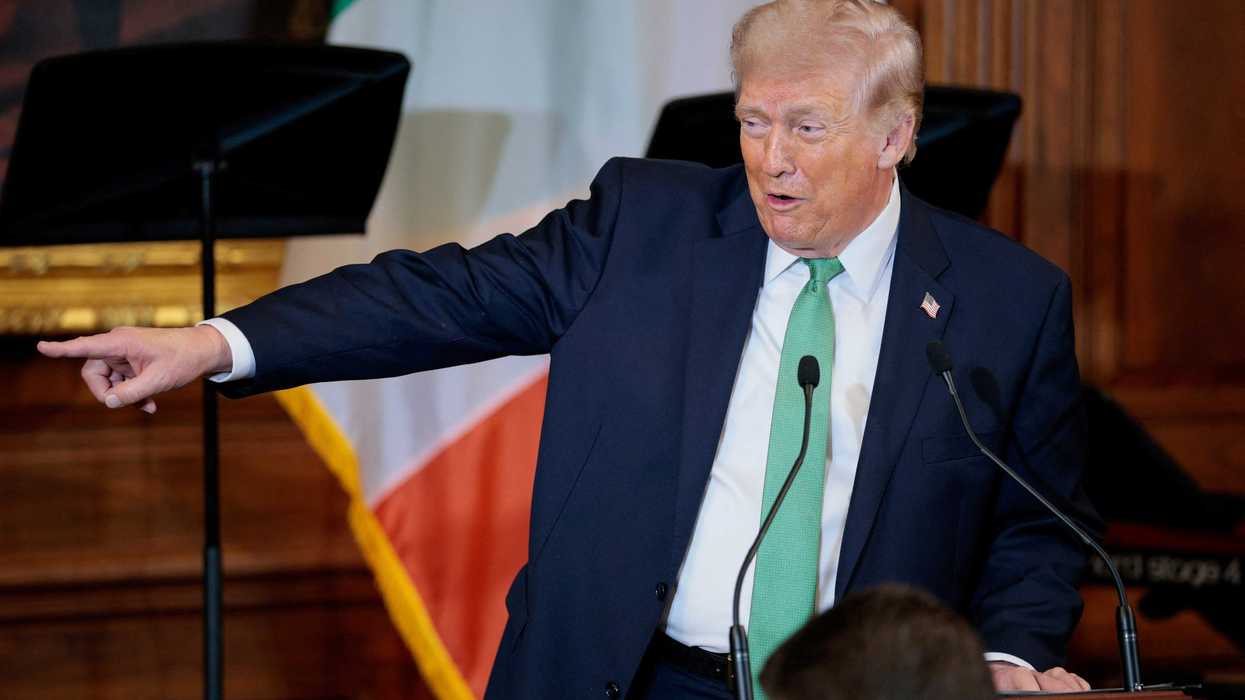
U.S. President Donald Trump gestures as he attends the annual Friends of Ireland Luncheon at the U.S. Capitol in Washington, D.C., U.S., March 17, 2026. REUTERS/Evan Vucci
March 17, 2026 
ALTERNET

President Donald Trump is “crazy” and “enamored with war,” warned a former Republican strategist for President George W. Bush in a Monday Substack post.

“Do you think that Donald Trump is together enough to realize that he's being manipulated by Lindsey Graham?” Schmidt said, referring to the Republican South Carolina senator widely viewed as influencing Trump’s hawkish foreign policies. “This is crazy. But before you watch it, keep your eye not on Lindsey Graham.”

Schmidt went on to predict Trump will soon target Cuba, based both on the president’s rhetoric and on the strong influence of Trump’s equally hawkish Secretary of State, Marco Rubio. From there, he pointed out that America is already stuck in a quagmire in Iran despite Trump’s assurances that the war would end quickly.

“We are but 19 days into the quagmire in Iran,” Schmidt wrote. “The Marines are on the way. There is no plan to end the war — only strategies that will escalate it. The world's flow of oil remains shut down through the Strait of Hormuz. And all of this is because Donald Trump is incapable of listening. All he does is talk. Donald knows he can never be told no. And so now oil is careening ever higher.”

Schmidt also warned about the ominous precedent set by Trump threatening media outlets that do not favorably cover his war against Iran.

“Trump demanding the media comply — not with reality, not with what's actually going on, but with his version of the truth; it's madness, all of it, really,” Schmidt wrote. “Here's Donald, supreme warlord of America in our 250th year. On to Cuba next. And who knows where after that?”

He concluded, “War everywhere — the president of peace, winner of the FIFA Peace Prize, Donald Trump. He's just getting started. It's time to put a check on him. Let's vote all of these people out.”

Schmidt has previously said that Trump’s inability to win the Iran war is “unpardonable” in the context of American politics, and added that it is ironic that Trump once demanded the Nobel Peace Prize.

“He wanted the Peace Prize, and when he couldn’t get it, Trump lost his mind,” Schmidt said. He then quoted a February letter Trump wrote to Norwegian Prime Minister Jonas Gahr Støre in which he raged about not receiving the prize.

“Considering your Country decided not to give me the Nobel Peace Prize for having stopped 8 Wars PLUS, I no longer feel an obligation to think purely of Peace, although it will always be predominant, but can now think about what is good and proper for the United States of America,” Trump told Støre.


Long Iran War Would Hurt Consumers, But That’s the ‘Last of Our Concerns’: Trump Economic Adviser

“Republicans don’t give a damn about the American people and will continue to make your life more expensive,” said House Democratic leader Hakeem Jeffries (D-NY) in response.


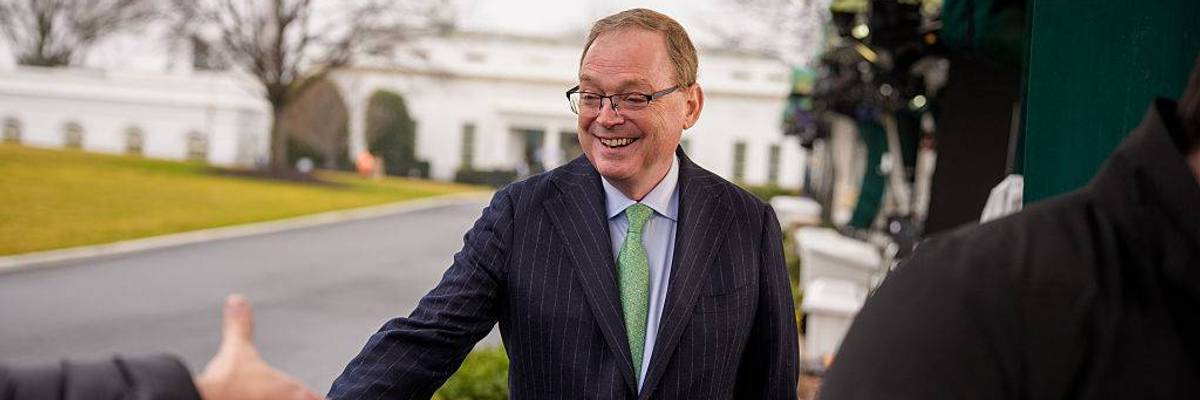
White House National Economic Council Director Kevin Hassett arrives for a video interview outside the White House on March 6, 2026 in Washington, DC.
(Photo by Andrew Harnik/Getty Images)

Brad Reed
Mar 17, 2026
COMMON DREAMS

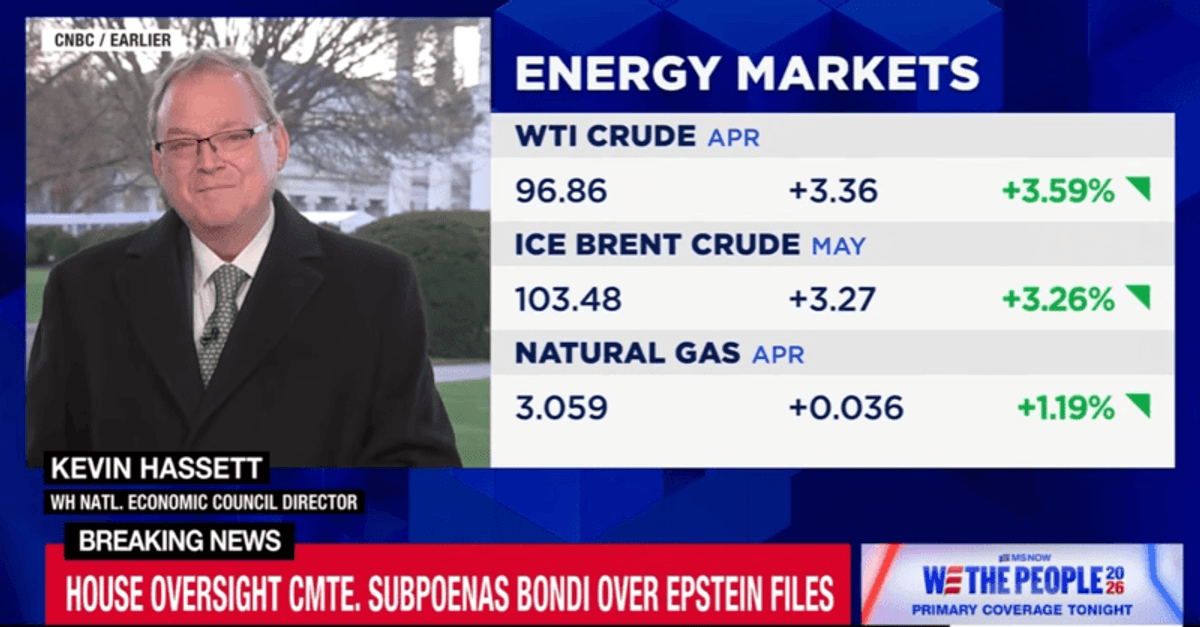
White House National Economic Council Director Kevin Hassett caused a stir on Tuesday when he indicated that the prospect of US consumers getting hurt by a protracted conflict with Iran was not of particular concern to the administration.

During an interview on CNBC, Hassett dismissed concerns about the Iran war, which is now in its third week, dragging on indefinitely.

“The US economy is fundamentally sound,” Hassett claimed. “And if [the war] were to be extended, it wouldn’t really disrupt the US economy much at all. It would hurt consumers, and we’d have to think about, you know, if that continued, what we would have to do about that, but that’s, like, really the last of our concerns right now... because we’re very confident that this thing is going ahead of schedule.”


In fact, US consumers are already hurting financially from the effects of the Iran war, which has caused the price of both oil and gasoline to skyrocket. Petroleum industry analyst Patrick De Haan reported on Tuesday that the average price of gas in the US has reached $3.80 per gallon, while the average price for diesel fuel has reached $5.03 per gallon.

The war’s impact on oil and gas prices has been exacerbated by Iran closing down the Strait of Hormuz to shipping, and so far there is no indication that it will be reopening anytime soon.

Democratic lawmakers quickly pounced on Hassett’s admission that pain for US consumers was “the last of our concerns right now.”

“The Trump administration is saying the quiet part out loud,” said Sen. Elizabeth Warren (D-Mass.), “the higher costs you’re paying are the LAST of their concern.”

“Trump’s team of Epstein class advisors says it out loud more often than you’d think: ‘consumers are the last of our concern right now,’” commented Sen. Chris Murphy (D-Conn.).

“Well I’m not some sort of political expert but this feels like an unhelpful thing to say,” remarked Sen. Brian Schatz (D-Hawaii).

“Trump economic advisor says consumer pain is the last of their concerns,” commented Sen. Ruben Gallego (D-Ariz.). “Tell that to Americans paying almost twice as much for gas as they were a month ago.”

“The Trump administration has once again said the quiet part out loud,” said House Democratic leader Hakeem Jeffries (D-NY). “Republicans don’t give a damn about the American people and will continue to make your life more expensive. You deserve better.”

Trump Adviser Says War-Induced Pain to Consumers Is “the Last of Our Concerns”


“If [the war] were to be extended, it wouldn’t really disrupt the US economy very much at all,” Hassett said.
March 17, 2026

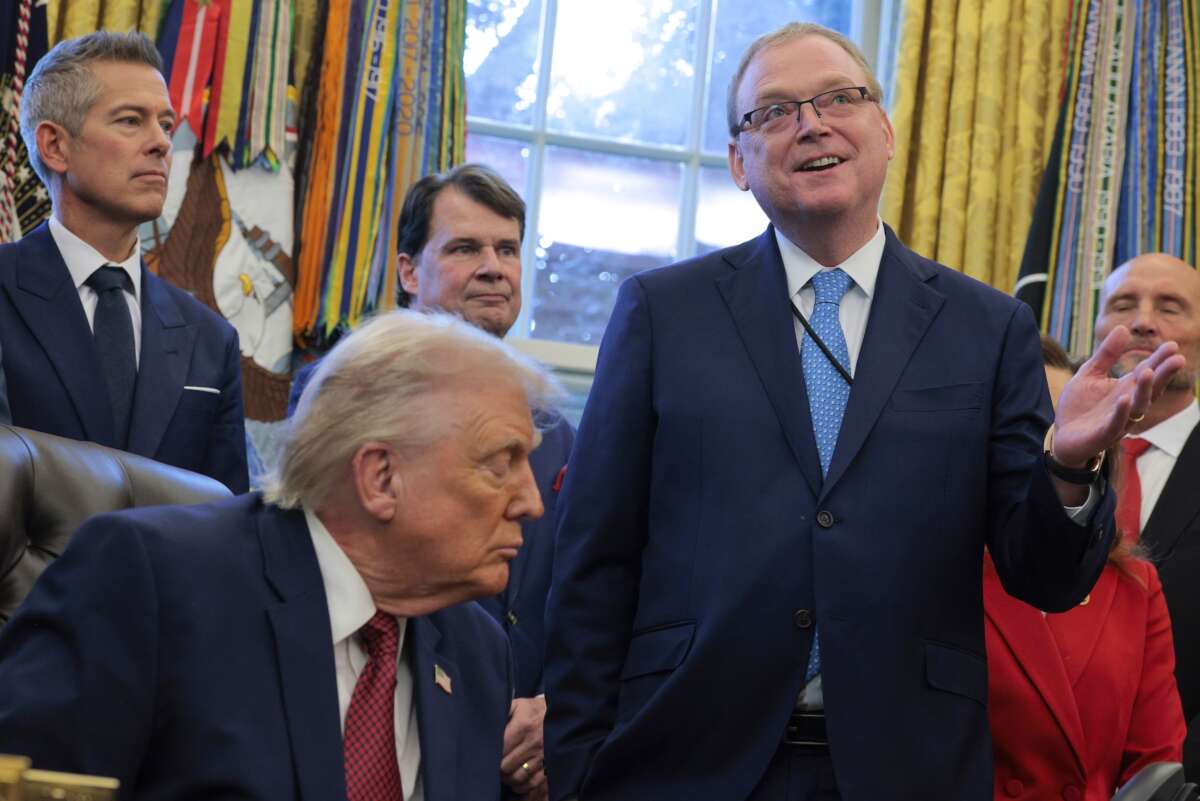
Director of the National Economic Council Kevin Hassett (R) speaks as U.S. President Donald Trump makes an announcement on changes to the country's fuel economy standards in the Oval Office at the White House on December 3, 2025 in Washington, D.C.
Chip Somodevilla / Getty Images

National Economic Council Director Kevin Hassett brushed aside concerns about harm to consumers caused by the U.S. and Israel’s war on Iran on Tuesday, saying that the war would hurt consumers if it continues but that’s “the last of our concerns.”

In an interview with CNBC, the Donald Trump appointee said that he believes the war will be over in a few weeks, and repeated the president’s assertion that the U.S. is “ahead of schedule” in relation to Trump’s four to six week projection for the war.

If the war continues past that, Hassett acknowledged that it would cause prices to rise for consumers — but he waved away concern over the possibility, claiming that the economy is strong.

“If [the war] were to be extended, it wouldn’t really disrupt the U.S. economy very much at all. It would hurt consumers, and we’d have to think about, you know, if that continued, what we would have to do about that,” Hassett said.

“But that’s really the last of our concerns right now. Because we’re very confident that this thing is going ahead of schedule,” he went on.

Hassett’s dismissive comments about the war’s effect on the economy ignore that the war is already causing pain for consumers.

Gas prices have spiked since the U.S. and Israel’s first strikes on February 28, going from a national average to $3.00 per gallon of regular unleaded gas to $3.79 a gallon, as of Tuesday. High oil prices are causing the price of jet fuel to rise, causing flight prices to increase significantly.

Iran’s closure of the Strait of Hormuz in retaliation for strikes may also cause downstream effects on the price of food. The strait is also a crucial choke point for the global fertilizer supply chain, choking supply right as the spring planting season is kicking off. This means that U.S. farmers may have to ration or forgo fertilizer in some areas, experts say, which may cause shortages of key crops that will cause food prices to rise.

These rising costs come as the Trump administration’s economic policies have caused large job losses, a worsening of an affordability crisis, and a record-setting transfer of wealth from the poor to the rich in the form of Republicans’ One Big Beautiful Bill last year.

The war, which is historically unpopular, has also already cost taxpayers $12 billion in its first two weeks, Hassett said on Sunday.

Hassett told CNBC that he believes that the war — now in the middle of its third week — will end in the coming weeks. The administration has refused to give a consistent answer on the expected length of the war, or given conditions on objectives they wish to achieve for it to end. Trump has repeatedly claimed that the U.S. and Israel have already destroyed Iran’s navy and air force, despite Iran still carrying out strikes.

An Israeli military spokesperson said on Sunday that Israel is preparing for three more weeks of war, and that the state has “deeper plans for even three weeks beyond that.” A U.S. Central Command request to the Pentagon sent in the first week of the war suggested that the agency expects the war to last through September.

Though Trump has said that the war is basically over and “way ahead of schedule,” his administration has continued to use escalatory rhetoric. Secretary of State Marco Rubio has reportedly directed diplomats globally to “move expeditiously to diminish the capabilities of Iran and Iran-aligned terrorist groups from attacking our respective nations and citizens” in an internal cable to be sent out by March 20, ABC reported Monday.

Meanwhile, the Pentagon ordered warships carrying about 2,500 Marines to depart to the Middle East on Friday. This could allow the military to launch ground raids against Iranian targets in and on the Strait of Hormuz— which would be a massive escalation.

Hassett’s confidence in the war ending soon comes despite the end of the war seemingly entirely being up to Trump’s whims. Trump has said that the war will end “when I feel it … in my bones” while also saying, on Sunday, that “maybe we shouldn’t even be there at all.”


'Kevin, keep at that!' Trump aide brutally mocked on MS NOW after disastrous gaffe

Daniel Hampton
March 17, 2026 
RAW STORY


(Screengrab via MS NOW)

Rep. Jared Moskowitz (D-FL) lit into Trump economic adviser Kevin Hassett on Tuesday after Hassett suggested that consumer pain from the Iran war was "really the last of our concerns" — a comment that appalled MS NOW.

The broadside came during an appearance on "The Weeknight," where anchor Alicia Menendez played a clip of Hassett dismissing the economic impact of a prolonged Iran conflict during a CNBC appearance earlier in the day.

"If it were to be extended, it wouldn't really disrupt the U.S. economy very much at all," Hassett said. "It would hurt consumers and we'd have to think about, you know, if that continued, what we would have to do about that. But that's like really the last of our concerns right now."

The flippant remark stunned co-host Symone Sanders-Townsend.

"Wait — are consumers not part of the US economy?" she shot back. "Consumers are the last of their concerns right now. It's like - oh this comms job, they don't - oof. It's a tough day at work. Every day."


Moskowitz was also taken aback.

"I mean you're looking at me, these were the people who said affordability was a hoax for a couple of months until someone showed the president the polling on that," he said.

Moskowitz rattled off a list of costs already hitting Americans: gas prices up 70 cents per gallon, airline prices rising 30%, and food costs climbing as fuel expenses get passed down the supply chain.

"I don't know if the administration wants to get back to the talking point that prices don't matter, it's a hoax. You know, everything is going to be fine, pay no attention when you get the bill in the mail," he said.

Moskowitz warned that messaging didn't work for Democrats under the Biden administration, and it won't work this year.

"You can't tell people how to feel when they see they can't afford to live," Moskowitz concluded. "But hey, look, let them try it. Let that be the message all the way to November, okay? Kevin, keep at that!"


Afghanistan War Veteran Dies in ICE Custody One Day After Arrest


Mohommad Nazeer Paktyawal served alongside US troops. He died at 41 after ICE arrested him in front of his children.

March 17, 2026

Texas resident Mohommad Nazeer Paktyawal died in ICE custody on March 14, 2026.
Courtesy #AfghanEvac


On March 13, multiple Immigration and Customs Enforcement (ICE) agents in unmarked vehicles surrounded Mohommad Nazeer Paktyawal in front of his home in Texas as he prepared to drive his children to school. The 41-year-old father of six children, who had served alongside the 3rd Battalion of the U.S. Army Special Forces in Afghanistan, died in ICE custody the next day, leaving his family in shock, and U.S. veterans of prior Middle East wars outraged.

According to a statement issued by ICE, Paktyawal was transported to a hospital on March 13 after complaining of shortness of breath and chest pains. Paktyawal’s wife says she told officers during the arrest that he uses a rescue inhaler for asthma, but his death the following day remains under investigation. Shawn VanDiver, a Navy veteran and founding president of #AfghanEvac, a group that advocates for refugees of the U.S. war on Afghanistan, said Paktyawal was healthy before ICE agents arrested him in front of his children on a school day.

“But one fact is clear: it is not normal for a healthy 41-year-old man to die within a day of being taken into government custody,” VanDiver said in an email to reporters on Monday. “Mr. Paktyawal survived our war in Afghanistan and trusted the United States enough to rebuild his life here.”

According to #AfghanEvac, Paktyawal joined the Afghan special forces in 2005 and fought alongside U.S. Army Special Forces for years in Paktika Province, one of the most dangerous areas of Afghanistan, during the U.S. occupation. When President Joe Biden ordered a chaotic withdrawal of U.S. forces in August 2021, the U.S. evacuated Paktyawal and his family along more than 124,000 Afghans who assisted the U.S. and faced reprisals from the Taliban, the militants who fought the U.S. for years before taking control of the country.

“His family deserves answers,” VanDiver said. “The American public deserves answers. The U.S. service members who fought alongside Afghan partners deserve answers.”

At least 41 people have died in ICE custody since President Donald Trump returned to office and launched a brutal crackdown on refugees and immigrants, and at least 12 have died in ICE custody in 2026 alone. In comparison, about 26 people died in ICE custody during all four years of the Biden administration, which worked to reduce the population of ICE’s detention system during the COVID-19 pandemic.

In contrast, the number of people jailed by ICE while they wait to see an immigration judge has skyrocketed from under 40,000 on any given day to roughly 70,000 under Trump’s policies. Civil rights groups, lawmakers, and families report medical neglect, inedible food, and other abuses inside massive immigration jails and prison camps — and the Trump administration is racing to build more.


Paktyawal’s wife told #AfghanEvac that federal agents refused her attempts to pass along a rescue inhaler that Paktyawal relied on to breathe during emergencies.

In boilerplate language attached to press releases, ICE and its parent agency, the Department of Homeland Security (DHS), claim that immigration detainees are not denied medical care. However, Paktyawal’s wife later told #AfghanEvac that federal agents refused her attempts to pass along a rescue inhaler that Paktyawal relied on to breathe during emergencies.

“His wife says she told officers during the arrest that he needed it,” VanDiver said on social media on March 17. “She says she tried to give them the inhaler. She says they refused.”


Since October, ICE has delayed payments to third-party medical providers such as doctors and dentists within its system of immigration jails for months despite ample funding from Trump and Congress. Multiple immigrants with serious health conditions have filed lawsuits alleging they were denied needed care while imprisoned by ICE.

In this photo provided by grieving family members, Mohommad Nazeer Paktyawal sits holding two of his six children.#AfghanEvac

“The fact that [Paktyawal] survived the Taliban but couldn’t survive ICE paints a dark picture of the morbid effectiveness of institutional violence,” wrote Austin Kocher, an assistant professor and immigration data researcher at Syracuse University, in a March 15 blog post.

According to #AfghanEvac and family members, Paktyawal was arrested on March 13 at 7:00 am and later called his family and reported feeling unwell. In a statement, DHS also said Paktyawal complained of shortness of breath during the intake process at an ICE field office in Dallas. ICE took Paktyawal to the hospital at 11:45 pm, and his family was told he was still alive at 8:00 am the next day. Four hours later, the family learned Paktyawal — a son, husband, brother, and father — had died.

In a statement, Paktyawal’s family said his children watched as he was surrounded by federal agents and taken away, a moment that “will stay with them forever.”


“We still cannot understand how this happened … He was only 41 years old and was a strong and healthy man. His children keep asking when their father will come home.”

“We still cannot understand how this happened,” the family said on March 15. “He was only 41 years old and was a strong and healthy man. His children keep asking when their father will come home.”

DHS said Paktyawal entered the U.S. under the Biden administration’s Operation Allies Refuge, a hasty effort to resettle Afghan war allies in the U.S. that became the largest noncombatant evacuation operation in U.S. military history. The operation suffered from logistical problems from the start and came under fire from Republicans who demanded that refugees be heavily vetted for potential security risks, further complicating the relocation process for tens of thousands of people.

Catholic Charities sponsored Paktyawal’s application for asylum, which was pending at the time of his death. Paktyawal also held a work permit and a Social Security number, according to #AfghanEvac, but he was arrested under Trump’s push for mass deportations. The Trump administration is notorious for blaming its own failures on Biden-era policies. On social media, DHS claimed Paktyawal “provided NO RECORD of military service” and said his “criminal history includes arrests for fraudulent use of food stamps and theft.” VanDiver said both claims are dubious
.
Mohommad Nazeer Paktyawal joined the Afghan special forces in 2005 and fought alongside U.S. Army Special Forces in one of the most dangerous areas of Afghanistan.#AfghanEvac

In the U.S., defendants are considered innocent until proven guilty, and ICE’s statement provides no indication that Paktyawal’s arrests resulted in criminal convictions. Echoing previous statements on individuals who died in custody, ICE appears to be painting Paktyawal as a “criminal alien” based on charges that were likely dropped.

VanDiver said ICE’s claim that Paktyawal provided no record of military service in Afghanistan is also dubious. DHS does not maintain the relevant records, so ICE would have needed to check with other departments to confirm Paktyawal’s service.

“Documentation of Afghan partners typically sits with the Department of Defense, the State Department, and the Special Immigrant Visa and Chief of Mission processes,” VanDiver said. “Claims that there is ‘no record’ often reflect a failure to check those interagency systems.”

Such a failure occurred in the case of Sayed Naser Noori, an Afghan ally who worked as an interpreter for U.S. troops during the war but was arrested by ICE in California during a routine check-in and jailed for months before a judge ordered his release. VanDiver said that at the time, DHS publicly stated there was no record of Noori’s service with the U.S. military, but that claim later proved incorrect after the right documents were identified.

Instead of casting blame on the Biden administration and Paktyawal himself, VanDiver said the government should be explaining how a “41-year-old father of six died less than 24 hours after entering ICE custody.”

“Right now the government appears focused on discrediting a man who cannot defend himself while the central question remains unanswered,” VanDiver said.
Israel Launches “Targeted” Invasions of Lebanon as World Focuses on Iran War

A senior Israeli official told Axios the military is “going to do what we did in Gaza.”
March 16, 2026

An Israeli artillery unit fires towards southern Lebanon as seen from a position on the Israeli side of the border on March 15, 2026.Amir Levy / Getty Images

Israel announced on Monday that it is expanding its ground in southern Lebanon, claiming to target Hezbollah as Israel’s defense minister pledges that “hundreds of thousands” of people already forcibly displaced by Israeli attacks “will not return” for the indefinite future.

In a statement, Israeli forces said that soldiers are carrying out “limited and targeted ground operations” in southern Lebanon. The purpose is to “establish and strengthen a forward defensive posture … to create an additional layer of security for residents of northern Israel,” the statement claims, ignoring that Hezbollah has maintained in previous conflicts that it would not retaliate against Israel if Israeli forces withdrew from southern Lebanon.

Axios reported last week that Israel is planning a massive expansion of its ground invasion of Lebanon with the goal of seizing the entire area south of the Litani River. This area is protected under a UN Security Council resolution as part of a decades-old ceasefire agreement, and makes up about 8 percent of the area of the country.

A senior Israeli official told Axios the military is “going to do what we did in Gaza.”

Israel and Hezbollah reached a ceasefire agreement in late 2024, but Israel violated it over 10,000 times in the first year, UN officials said. Now, Israel has unilaterally ended the ceasefire — though some argue Israel never adhered to it in the first place — and severely escalated bombardments and forced displacement in Lebanon, as the world focuses on Israel and the U.S.’s horrific war on Iran.


Israel Has Dropped 4k Bombs on Iran — Surpassing 12-Day War in Just 4 Days
The death toll has already surpassed that of last year’s war, with Iranian officials reporting 1,230 killed so far.  By Sharon Zhang , Truthout March 5, 2026


In just the past two weeks, Israel has killed over 880 people in Lebanon, including over 100 children and dozens of health care workers, according to the country’s health ministry.

Israel has bombed residences, health care centers, and other civilian infrastructure, including in the capital of Beirut. The attacks have created a “humanitarian catastrophe,” as one UN official warned, forcing thousands to take shelter in makeshift shelters or on the streets. The UN says that Israel has forcibly displaced 800,000 people thus far.

Israeli Defense Minister Israel Katz pledged on Monday to continue Israel’s displacement campaign.

“Hundreds of thousands of Shi’ite residents of southern Lebanon who ​have evacuated or are evacuating their homes in southern Lebanon and Beirut will not return to areas south of the Litani line until the safety of northern residents is ensured,” referring to northern Israel, Katz said in a statement.

Reuters reports that, over the weekend, Israeli forces surrounded the key town of Khiam, in southern Lebanon, close to the border of Israel and Syria’s Israeli-occupied Golan Heights.

The town is on a hilltop that can oversee large swaths of the area, and is situated near the choke point where the demarcation of southern Lebanon by the Litani River and the “Blue Line” that establishes Lebanon’s southern border almost meet. Analysts say that Israel could use the town strategically to advance military occupation, potentially using it to cut off communication between parts of the occupied area.

Some residents of Lebanon, already having faced years of bombardments from Israel, say they fear that Israel will carry out an extended occupation like its 18-year occupation of Lebanon that lasted from 1982 to 2000.

“I feel like this is preparation for an occupation, and I’m afraid history will repeat itself,” said Iman Ibrahim, a resident of Blida, a town in south Lebanon, to The New York Times. “Everything we used to hear from our grandparents about occupation, we’re living it now.”