Saturday, March 21, 2026

How A British Overseas Territory Became The Largest Holder Of U.S. Debt – Analysis


Cayman Islands


The Cayman Islands sits at the heart of a network of British financial jurisdictions. Together, they manage trillions in assets, influencing global capital flows and investment networks.


March 21, 2026 
By John P. Ruehl


China, which was the largest holder of U.S. government debt as recently as 2019, has cut its holdings to the lowest level since 2008, driven by changing trade patterns, geopolitical concerns, and domestic economic pressures.

The Cayman Islands has emerged as an unlikely place to fill the gap. This small British overseas territory held $427 billion in U.S. Treasuries as of November 2025, making it the sixth-largest foreign holder. But a 2025 Federal Reserve analysis revealed that the total figure was actually closer to $1.4 trillion by the end of 2024—with some estimates reaching as high as $1.85 trillion—after nearly 40 percent of new treasury notes and bonds were purchased in the Cayman Islands after 2022.

While these figures suggest that the territory is the largest foreign holder of U.S. debt, the main buyers are not Caymanians or the government, but hedge funds. After the territory passed its Mutual Funds Law in 1993 amid the 1990s hedge fund boom, these vehicles began incorporating in large numbers, drawn by flexible regulation and low taxes. The Cayman Islands today is home to roughly three-quarters of the world’s offshore hedge funds.

Many have used so-called “basis trades,” borrowing heavily to profit from small price gaps between U.S. Treasury bonds and their future equivalents. The strategy has grown so large and opaque that it has triggered a Federal Reserve investigation.

Emergence and Evolution of a Financial Hub

The Cayman Islands has played a major role in global finance since the 1960s, operating as a center for tax evasion and asset parking. Mostly European banks trading in dollars outside the U.S., nicknamed Eurodollars, could lend these dollars beyond the reach of American regulations and capital controls. As the market grew, the Cayman Islands became a central place to store and use these Eurodollars.

Local Cayman lawmakers also passed financial laws to attract international businesses in the 1960s, including having no direct taxes on individuals, corporate profits, or capital gains, which helped cement the islands’ role as an offshore financial center. The legal system, based on English common law, offered clear rules, modern legislation, and independent courts. Packaged into a simple, finance-focused framework, it gave investors confidence and turned the territory into a quiet financial powerhouse.

Despite the Cayman Islands’ own elected government led by a premier, key powers remain with the United Kingdom. Final appeals in major cases are heard in London, while a governor appointed by the British monarch, on the advice of the British government, oversees internal security and coordinates foreign affairs with London. In theory, Britain can also intervene in the territory’s governance, providing a level of political stability valued by outside investors.

The Cayman Islands’ success has come from a “collaborative policymaking process that involved local leaders, expatriate professionals, and British officials,” according to a working paper by the University of Alabama, along with embracing financial trends. Home to more than 120,000 companies as of 2025, including thousands registered at the five-story Ugland House, hedge funds are just one of several recent financial booms. The parent company of Theleme Partners LLP, a hedge fund linked to former UK Prime Minister Rishi Sunak, “lists the notorious Ugland House as its address. The small office is the registered home to approximately 40,000 entities,” stated the Good Law Project.

In 2022, the bankruptcy of cryptocurrency exchange FTX exposed billions in missing customer funds and became one of the largest financial frauds of the decade. Court filings showed that more than a fifth of its registered customer accounts were from the Cayman Islands—greater than any other jurisdiction—highlighting how easily new and risky ventures could be structured.

The territory also plays a central role in shadow banking. After banks pulled back from lending following the 2008 financial crisis, non-bank loans and financing surged, and many such funds have been domiciled in the Cayman Islands, such as Blackstone’s iCapital Offshore Access Fund SPC.

The Cayman Islands were also central to the 2020–2021 boom in special purpose acquisition companies (SPACs), which raised capital through IPOs to merge with private firms and take them public. Of the more than $100 billion raised in 2021, half of the SPACs were Cayman-incorporated. Rising interest rates and increased regulatory scrutiny slowed the expansion, but SPAC activity in Cayman has seen a resurgence since 2024.

It also sits at the center of China–U.S. capital markets. Because Chinese law restricts foreign ownership in certain industries, many Chinese firms list abroad via Cayman holding companies using variable interest entity (VIE) structures. This includes giant Chinese e-commerce company Alibaba, whose ultimate parent company is incorporated in the Cayman Islands.

The scale is remarkable, with Cayman-registered investment funds holding more than $8 trillion in assets by the end of 2023, in a territory with a population of less than 80,000 people.

London and Other Jurisdictions

The Cayman Islands are part of a wider network of British-linked financial jurisdictions. According to Global Financial Integrity, “The UK’s offshore tax havens are estimated to facilitate nearly 40 percent of the tax revenue losses suffered annually by countries around the world.”

This system is closely tied to the City of London, a nearly 2,000-year-oldfinancial district that hosts some of the world’s largest banks, law firms, insurers, and financial services companies. London-based institutions design and manage offshore structures, earning substantial fees while channeling capital through London’s broader financial system, helping the city competewith Wall Street and other global financial centers.

The U.S. largely tolerates this arrangement, since it is operated through a close ally and provides a trusted platform for U.S. investors, ultra-wealthy individuals, and corporations to park and deploy capital. Unlike American territories, which are bound by federal law, British-linked jurisdictions can set their own corporate and tax rules with minimal oversight.

While the Cayman Islands may be Britain’s most prominent offshore jurisdiction, other British territories in the Caribbean also play influential roles. The British Virgin Islands (BVI) has become a major center for company incorporation. Its International Business Companies Act, introduced in 1984, simplified company formation, and the BVI is now the “leading domicile for corporate registrations.” With roughly 400,000 companiesregistered there, many of them simple shell companies with often unknown owners, it surpasses even the Cayman Islands in number.

BVI-registered companies hold around $1.5 trillion in assets, while the territory’s GDP is around $1.7 billion. The 2016 Panama Papers, leaked from law firm Mossack Fonseca, revealed that a massive share of the shell companies used by politicians, oligarchs, celebrities, and criminals to shelter wealth were registered in the BVI. Mossack Fonseca was reportedly unaware of the owners of 75 percent of the offshore entities.

Similarly, the Paradise Papers, leaked from law firm Appleby in the British Overseas Territory of Bermuda, highlighted how corporations and individuals used offshore structures for tax planning and asset protection. Bermuda is also the global “leader in captive reinsurance companies,” hosting many of the world’s largest catastrophe insurers and reinsurers. Investors can hedge or speculate on risks ranging from hurricanes to financial shocks.

In 2023, Vesttoo, a Bermuda-based insurtech company, used fake collateral documents to back reinsurance deals, fabricating billions in financial guarantees, in what a Delaware court filing described as Bermuda’s “largest insurance fraud ever.” In October 2024, the Tax Justice UK ranked the BVI and Cayman Islands as the world’s most damaging tax havens, with Bermuda coming in third place.

While these territories are notorious globally, Britain’s Crown Dependencies—specifically Jersey, Guernsey, and the Isle of Man—serve a more Europe-facing role. More self-governing than the British overseas territories but still closely tied to the City of London, they specialize in wealth management for European and global clients.

Their European focus does not mean all funds are European. These jurisdictions often act as gateways, channeling wealth from around the world into investment vehicles that can then be deployed into Europe. In 2019, Jersey authorities announced the seizure of more than $267 million from people connected to former Nigerian dictator Sani Abacha, found in an account held by shell company Doraville Properties Corporation.

Guernsey and the Isle of Man have also faced headwinds recently. In early 2026, Guernsey regulators fined Utmost International Guernsey a record £1.96 million, or approximately $2.5 million, for failures in establishing anti-money laundering controls after the firm did not properly monitor high-risk clients for over a decade, many having links to South and Central America.

The Isle of Man has, meanwhile, developed one of the world’s largest online gambling licensing regimes, and regulators have signaled concern about its vulnerability to misuse. Authorities flagged online gambling as a money laundering risk in 2026, warning that organized crime groups, particularly from Southeast Asia, were exploiting its platforms.

These jurisdictions are deeply interconnected. Multinational investment firm Brevan Howard is headquartered in Jersey but manages separate Cayman Islands-domiciled hedge funds. BH Macro Limited, based in Guernsey, meanwhile, channels nearly all its investments into the Cayman-domiciled Brevan Howard Master Fund, transporting billions of dollars across global markets.

Regulation Attempts

The activity of these jurisdictions continues to attract international regulatory attention. The Organization for Economic Cooperation and Development (OECD) is currently pushing for greater tax transparency through a variety of initiatives.

Even the UK has taken notice: a 2022 inquiry into corruption in the BVI, led by former Court of Appeal judge Gary Hickinbottom, concluded that “almost everywhere, the principles of good governance, such as openness, transparency and even the rule of law, are ignored,” and recommended that the government be dissolved. Former UK Deputy Foreign Secretary Andrew Mitchell, meanwhile, warned in 2024 that nearly 40 percent of the world’s dirty money flowed through the City of London and British foreign jurisdictions.

U.S. authorities are similarly looking to step in. In 2022, BVI Premier Andrew Fahie was arrested by the Drug Enforcement Administration in Miami on charges of money laundering and conspiring to import cocaine into the U.S. for Mexico’s Sinaloa cartel in exchange for a cut of the profit.

And as tensions with Iran continue to rise, greater attention is likely to focus on how Iranian regime figures and their proxies have used international financial networks to hold and move wealth, including through London properties and UK-registered entities.

Such attention, however, has existed for years. In 2009, former President Barack Obama noted that the Cayman Islands’ Ugland House was either “the largest building in the world or the largest tax scam in the world,” in a critique of offshore registries. In response, former president of the Cayman Islands Financial Services Authority, Anthony Travers, stated thatDelaware’s Corporation Trust Center is the registered office of almost 220,000 companies, highlighting how American jurisdictions also play a similar game.

Despite rivalries, UK and U.S.-linked financial systems are deeply integrated. Institutions like the International Accounting Standards Board are based in the City of London but legally registered in Delaware. While it sets accounting rules, such entities primarily serve to protect the offshore industry and ensure all players stay aligned.

These offshore hubs thrive because elites, companies, and wealthy interests rely on them to move and shelter enormous sums of money. Though only decades old, the British offshore system is continually adapting to changing global economic conditions and financial trends. Given their value to powerful actors and the stakes involved in altering the system, these jurisdictions will resist any significant regulation that threatens the flow of wealth to ensure they remain central players in global finance.


Author Bio: John P. Ruehl is an Australian-American journalist living in Washington, D.C., and a world affairs correspondent for the Independent Media Institute. He is a contributor to several foreign affairs publications, and his book, Budget Superpower: How Russia Challenges the West With an Economy Smaller Than Texas’, was published in December 2022.


Credit Line: This article was produced by Economy for All, a project of the Independent Media Institute.


Rheinmetall CEO Warns Global Air Defence Stockpiles Are Dwindling Due To Iran War

Range of Iran's missiles. Credit: IDF

March 21, 2026 
By Kjeld Neubert


(EurActiv) — Global air defence stockpiles are “empty or nearly empty” due to the US-Israeli war against Iran, the CEO of the German defence giant Rheinmetall said this week.

Following initial strikes by the US and Israel, Iran retaliated by expanding the war to its neighbours, hitting Gulf countries that host US bases. The number of missile barrages quickly raised concerns about how long critical air defence supplies can last.

Rheinmetall CEO Armin Papperger told CNBC that if the war continues for another month, he believes that “we nearly have no missiles available.”

“I think that at the moment, all European, American, and also Middle Eastern stocks are empty or nearly empty,” he assessed.


Iran’s use of both missile barrages and cheap long-range drones forced countries in the region to defend themselves with a huge amount of costly interceptors.

According to the Wall Street Journal, the US approved arms sales, including air defence systems, worth almost €20 billion to United Arab Emirates, Kuwait and Jordan on Thursday.

Ukrainian President Volodymyr Zelenskyy recently noted that the US and its allies had used more Patriot interceptor missiles during the first few days of the war against Iran than during four years of war in Ukraine, and each of those costs several million dollars.

The lesson learned, according to Papperger, are that drones are a new very cheap way to exhaust the opposing side’s air defence systems.

US president Donald Trump said shortly after the war that the US has “virtually unlimited” amounts of missiles. Israeli officials claim that they are also not concerned.

In the meantime, the European Commission is exploring “new policy instruments” to support the European defence industry in expanding its production capacity, including by stockpiling ammunition.
Drugmakers Reassess Europe As Trump Overhauls Drug-Pricing Rules – Analysis

The US president’s Most Favoured Nation drug-pricing policy has triggered an earthquake across Europe as pharmaceutical giants scramble to protect their bottom lines.
 SwissInfo
By Jessica Davis Plüss and Pauline Turuban

As the first anniversary of Donald Trump’s Most Favoured Nation (MFN) drug-pricing executive order approaches, the policy, which is aimed at cutting US healthcare costs, is no longer just a protectionist threat on paper. The order, which effectively forces pharmaceutical companies to charge US consumers the same as in other wealthy countries, has started to gain teeth.

Some 16 drug companies, including Swiss pharma giants Novartis and Roche (through its US subsidiary Genentech), have now signed confidential MFN deals with the US government exempting them from tariffs for three years according to some sources. As part of the deals, companies commit to align prices for new drugs with the lowest prices in a set of reference countries, which includes Switzerland. Some also agreed to boost investment in US research and manufacturing. In the past year, pharma companies have committed to invest in total more than $320 billion (CHF250 billion) in the US.

The Trump administration is also moving beyond voluntary deals to formalise MFN pricing via three models for state-run Medicaid and Medicare insurance schemes, with each using a slightly different set of reference countries. The launch of the prescription drug website TrumpRx.gov in February, which intends to deliver MFN prices directly to US consumers, has also raised the stakes. If companies don’t offer the lowest price, they risk being left off the high-profile platform.


In response, some companies have said they will delay or not launch new drugs at all in European countries, where historically prices have been far lower than in America, preferring to lose an entire market than set a low price that could gut their US revenue. Others have warned they will cut research and development spending in Europe unless governments raise the amount they are willing to pay.
High-stakes battle

Although there are still major uncertainties over how MFN will be implemented, Europe must take the policy seriously, experts say.

“MFN is here for the long-term”, said James Whitehouse, from UK-based consultants Lightning Health. “US politics are now dictating domestic health policy in other countries,” Whitehouse told Europe’s largest gathering of drug-pricing experts, the Evidence, Pricing and Access Congress in Amsterdam, in early March. This will have far-reaching implications for Europe, he told Swissinfo.


The US holds considerable sway over commercial decisions, accounting for at least half the revenue for most large pharmaceutical companies, partly due to high prices which, for branded products, can be four times higher than in other industrialised countries.

Lower prices in the US would significantly cut into revenue and profit, analysts at Swiss bank UBS wrote in a report published in May 2025. They estimated that major pharma firms could suffer an 8% hit to their net profit in 2028 based on the top 50 drugs sold through Medicare in 2024 and on ten new drugs expected to become top-selling drugs by the end of the decade.

Pharmaceutical companies and industry groups are now painting a dire picture of worsening access to medicine and less investment in Europe if drug prices in the region don’t rise to make up for lost revenue from the US.

US-based drug giant Pfizer, among the world’s top three pharma companies by sales, was the first to sign an MFN deal. Its chief executive, Albert Bourla, told the JPMorgan Chase healthcare conference in January that, if given a choice between reducing US prices to France’s level or stop supplying France, “we [will] stop supplying France”.

In contrast to the US where drug prices are largely based on market forces, European governments typically set prices through negotiation with companies. However, these have become more contentious, as companies argue prices aren’t adequately rewarding innovation. This is echoed by Trump who claims Europe is “freeloading” on innovation financed by US patients.

“Even before MFN was announced, the industry had been highly critical of the pricing environment in Europe, arguing it fails to recognise value,” said Neil Grubert, a UK-based global market access consultant. Europe has already seen its share of global R&D investment fall relative to the US and China. “Pressure is now also being exerted on European governments by President Trump.”

The stakes are particularly high for small, wealthy reference countries such as Switzerland and Denmark, whose economies depend heavily on the pharmaceutical sector but have less market leverage.


Last July Roche pulled its cancer drug Lunsumio from Switzerland’s list of reimbursed drugs after talks broke down with the federal public health office over the cost. Patients can still access the drug through a special charity programme, but the withdrawal avoided publishing the price for the drug that could have been used as a reference for the US.

US biotech firm Amgen, one of the companies that signed an MFN deal, recently withdrew its cholesterol-lowering drug Repatha from the Danish market, citing changed “global market dynamics” – although local media speculated the withdrawal was due to MFN pressure. Amgen lowered the drug’s price by 60% in the US in October 2025 to what it said was the lowest among economically developed (G7) countries.

“Some companies are saying the rational thing to do is to not launch an innovative drug in other countries until you have secured a US price to avoid pulling down the US price,” said Elisabeth Brock, a health economist and market access consultant based in Basel. “If you have no price, the US has nothing to compare to.”
Austerity bites

While Trump exerts pressure from across the Atlantic, European governments face domestic constraints that make price increases difficult. Many healthcare authorities, including those in Switzerland and Germany, are trying to rein in costs that have skyrocketed over the past decade.

Spending on medicine by Switzerland’s basic insurance hit a record CHF9.4 billion ($12 billion) in 2024, a 64% jump from 2014, driven by a handful of new, expensive treatments.

Some of these are true, life-changing innovations but not always. Studies have found that for some cancer drugs higher prices don’t necessarily correspond with more clinical benefit to patients.

This has led countries to demand greater justification for prices. Most European countries now require Health Technology Assessments to evaluate a drug’s cost-effectiveness. Some drugs, widely available in the US, have been rejected by some European price regulators because the assessments found the drug’s benefits didn’t justify their costs.

“Pharmaceutical companies say they need higher prices, but in Europe they need to prove that the drug is worth it,” said Brock. This price-setting approach also makes it difficult for European governments to raise prices with the flip of a switch, especially in the face of public pressure.

In November Interior Minister Elisabeth Baume-Schneider told Swiss public television SRF that “people in Switzerland cannot and should not have to pay with their health insurance premiums for prices in the US”.

The UK government last year agreed to pay 25% more for new medicine by 2035 as part of a trade deal with the US to avoid massive import tariffs. But pharma companies say it still isn’t enough to close the gap with US prices.

The European Union has other pressure points. It is implementing new pharmaceutical legislation, agreed last December, that aims, among other things, to improve access to medicine across the 27-member bloc. It requires a company to provide a drug in any member state that asks for it – or face immediate generic or biosimilar competition. It also means that companies could be forced to launch a drug in an MFN reference country if they launch anywhere else in the EU.


The MFN policy could also upend the decades-old strategy used by European governments of negotiating confidential discounts with drugmakers on their list prices, which Grubert says can be as much as 70% higher than the actual price paid, known as the net price. Switzerland recently codified confidential pricing models in law. The US regulations appear to call for net prices to be used as a reference rather than list prices.

“It’s in the interest of those countries to maintain confidentiality so that they can continue to secure what they believe to be among the most generous discounts and rebates,” said Grubert. “That was true before MFN but is an even more pressing issue now.” But it will be harder to keep net prices under wraps if the US demands them.

Ultimately, there is no guarantee that patients will be better off in the US or in Europe under MFN. If companies don’t launch in Europe, it would leave European patients without medicine and US patients bearing an even greater share of the cost of innovation. There’s also no mechanism in MFN to prevent companies from setting even higher prices in the US to compensate for revenue lost in Europe.

If European governments raise prices, it could put health systems, many of which are funded largely by public sources, under greater strain, potentially reducing budget for other services. Patients are likely to pick up the bill with higher out-of-pocket payments.

Many people will no longer be able to afford treatment, wrote Toma Mikalauskaite, policy head at the European Cancer League, in an email. “At a time when patients already face delays and medicine shortages, increasing drug prices would leave some cancer patients without the care they urgently need,” she said.


SwissInfo
swissinfo is an enterprise of the Swiss Broadcasting Corporation (SBC). Its role is to inform Swiss living abroad about events in their homeland and to raise awareness of Switzerland in other countries. swissinfo achieves this through its nine-language internet news and information platform.
Would You Fight For Your Country? 
The Most And Least Willing Among NATO Allies – Analysis

March 21, 2026 
Published by the Foreign Policy Research Institute
By Māris Andžāns


(FPRI) — If a war were to break out, would you be willing to fight for your country? This is a shortened version of the question used in the World Values Survey and the European Values Study since the early 1980s to assess citizens’ willingness to fight.

Over the past few years, the willingness to fight has drawn greater attention, especially since Russia’s full-scale invasion of Ukraine in 2022. This war underscored the importance of citizen morale in resisting an invader. Ukrainians mounted a strong resistance against the invading force. If Ukrainian society had simply accepted Russia’s assault, the war might have ended sooner, with Ukraine losing.

But what about readiness to fight for NATO member states? To find this, the willingness-to-fight question was asked, for the first time, in a single poll across all NATO member states. A poll commissioned by Riga Stradins University, in cooperation with the Center for Geopolitical Studies Riga, was conducted in September and October 2025. With more than 31,000 respondents, the survey was nationally representative in each country.

According to the poll, the five countries with the highest share of citizens willing to fight for their country are Turkey (88 percent), Albania (69 percent), Sweden (66 percent), Finland (64 percent), and Montenegro (63 percent). Completing the top 10 are Greece (also 63 percent), Norway (61 percent), Lithuania (52 percent), Poland, and Slovenia (both 49 percent).


The strong willingness to fight in Turkey and the Nordic states, especially Sweden and Finland, is not surprising—previous studies corroborate this. The Turkish case has been explained by the volatile geopolitical context, and the Nordic case by the desire to preserve their lifestyles, combined with the threats from Russia.

Interestingly, Russia’s belligerence has not affected the will to fight equally among its closest and historically most affected neighbors, the Baltic states. While Lithuania, with 52 percent, ranks among the top 10 in NATO, Estonia and Latvia rank lower with 45 percent and 37 percent respectively. In both cases, views among their Russian-speakers have traditionally lowered the national average willingness to fight.

The only two North American NATO allies are ranked slightly below the midpoint. In Canada, 39 percent of respondents said they were ready to fight for their country, and a similar share in the United States (37 percent) said the same.


The countries with the lowest shares of citizens willing to fight for their country in NATO are Italy, Slovakia (both 25 percent), Germany (27 percent), the Netherlands (30 percent), Hungary, and the Czech Republic (both 33 percent). This is not surprising—these countries face no immediate military threat. Also, previous studies have found that willingness to fight has traditionally been lower in Germany and Italy, owing especially to their World War II experiences and the stigma that has accompanied those wars.

Polls like this do not guarantee that people in crisis would act as they have said they would in a casual public poll. In real life, factors such as the speed and scale of the conflict, the effectiveness of military self-defense, the support of allied countries, and personal and family circumstances can influence judgments and the (un)willingness to fight for one’s own country.

Findings from this poll should remind NATO and its member states that threat perceptions and populations’ readiness to back their countries and armed forces vary significantly. Some allies should learn lessons from others.

This study was supported by the European Union Recovery and Resilience Facility and the Republic of Latvia under the Grant “Why People Would (Not) Fight for Their Own Country in a War? NATO Member States at a Cross-Section” (No. RSU-ZG-2024/1-0001) within the project “RSU Internal and RSU with LASE External Consolidation” (No. 5.2.1.1.i.0/2/24/I/CFLA/005).


Data on super-polluting plumes show Turkmenistan’s joining of Global Methane Pledge has achieved little

Data on super-polluting plumes show Turkmenistan’s joining of Global Methane Pledge has achieved little
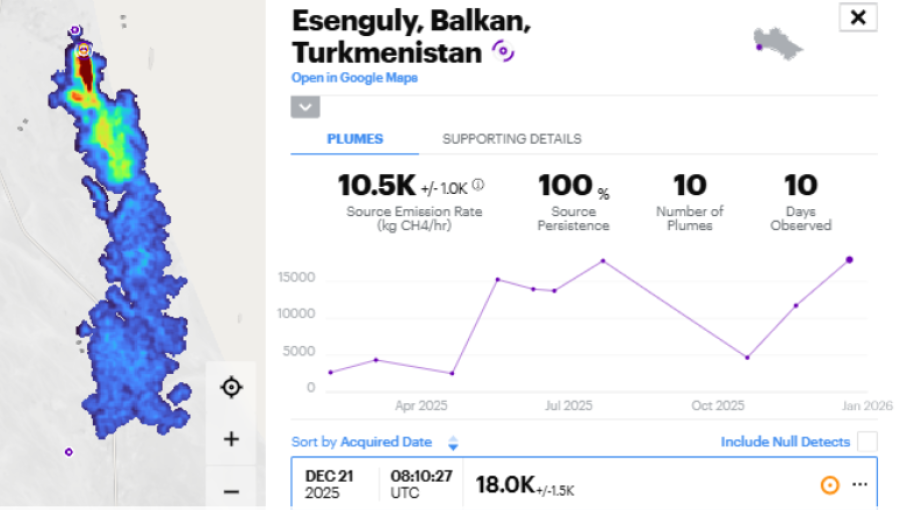
This super-plume in Esenguly, Balkan province, Turkmenistan shot to number one in the UCLA top 25. / Carbonmapper.org
By bne IntelliNews March 18, 2026

Back in December 2023, Turkmenistan proclaimed that it had joined the Global Methane Pledge and was set to tackle its proliferation of super-polluting plumes. Around 28 months later, new analysis has shown that it is still one of the worst countries in the world when it comes to potent methane mega-leaks that contribute hugely to global heating, even though the gas releases are typically simple and cheap to fix.

A top 25 list of such mega-leaks, produced by the Stop Methane Project at the University of California, Los Angeles (UCLA), is dominated by facilities in Turkmenistan. Researchers at the project have called the situation with Turkmenistan and other culprits “maddening”.

As the Guardian reported on March 17, Turkmen officials claimed last October that the gas-rich Central Asian country’s methane mega-leaks had been reduced.

“Management has placed this under special control, and leaks are being repaired locally within two to three days,” state media outlet Turkmenportal quoted Muhammetberdi Byashiev, head of the environmental protection department at state company Turkmengaz, as saying as he pointed to collaboration with the UN, International Energy Agency (IEA) and EU. However, there is no sign of Turkmenistan making meaningful progress in sealing sources of its giant methane plumes.

“It’s clear that Turkmenistan is trying to access the European [gas] market,” Cara Horowitz at UCLA told the Guardian, adding: “European potential buyers should pay attention to our results and think of this as a ‘buyer beware’ moment.”

The EU is bringing in supposedly tight limits on methane leaks linked to imported gas.

“Methane was the stealth pollutant gas for many years: invisible, out of sight and out of mind,” Horowitz was also reported as saying. “But we can now see these tremendously powerful emissions using satellites and use that as a wake-up call for the world,” she added.

The UCLA Stop Methane analysis is based on data from Carbon Mapper. It itemises 4,400 significant plumes recorded in 2025. Each emitted at a rate of more than about 100kg/hour, or the equivalent of running 20,000 SUVs.