Sunday, March 22, 2026

‘One Person Cannot Tear Our Movement Down,’ Farmworkers Say of César Chávez Revelations

“The labor movement was organized not only to protect workers’ paychecks and benefits, but also to ensure they are safe from any form of harassment, inappropriate conduct, or assault.”


Artist MisterAlek replaces a portrait of César Chávez, in a mural that he created in 2021, with a portrait of Delores Huerta, at the Watts/Century Latino Organization in Los Angeles, California on March 20, 2026.

(Photo Christina House/Los Angeles Times via Getty Images)

Jessica Corbett
Mar 21, 2026
COMMON DREAMS

“Our collective power is what defines us and is our movement, and one person cannot tear our movement down,” Alianza Nacional De Campesinas said in the wake of The New York Times reporting Wednesday on multiple sexual abuse allegations against late Mexican-American labor leader César Chávez.

“As a farmworker women’s organization, many of us have experienced or witnessed the sexual abuse and silence women endure in many aspects of our lives,” the group continued, adding that “we are deeply troubled and devastated” to learn about the reporting, and “we stand with Dolores Huerta, Ana Murguía, and Debra Rojas, who have bravely shared their painful stories.”
RECOMMENDED...
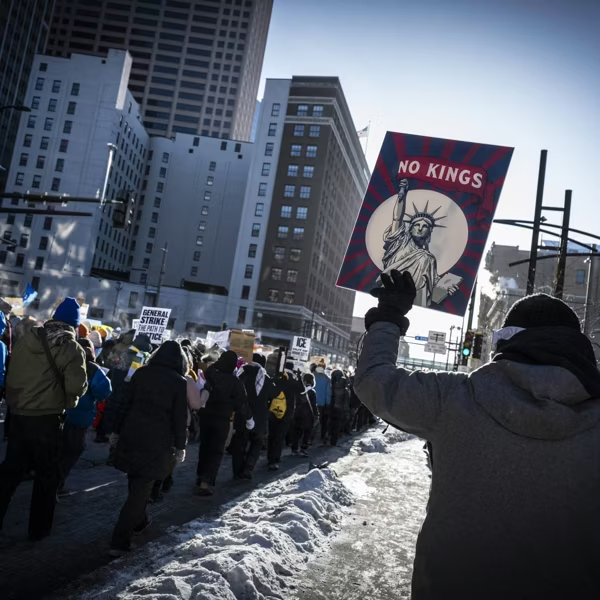

3,000+ No Kings Protests to ‘Reject Corruption, Senseless War, and Division’ on March 28

Huerta, cofounded with Chávez a group that went on to become the labor union United Farm Workers (UFW). In her comments to the Times and a separate statement, the 95-year-old described two separate encounters with Chávez that led to pregnancies: “The first time I was manipulated and pressured into having sex with him... The second time I was forced, against my will, and in an environment where I felt trapped.”


Murguía told the Times that Chávez molested her for four years, beginning when she was 13. Rojas said she was 12 when Chávez first groped her breasts in the same office where abused Murguía. When Rojas was 15, the newspaper reported, “he arranged to have her stay at a motel during a weekslong march through California, she said, and had sexual intercourse with her—rape, under state law, because she was not old enough to consent.”

The reporting has sparked a wave of responses from labor groups, elected officials, and others who have expressed support for survivors and stressed, as Guardian US columnist Moira Donegan wrote Friday, that “the rightness of the movement for the dignity of workers, for the rights and respect of Latinos, and for a future in which there is more freedom and possibility for poor people... cannot be tarnished by Chávez’s behavior.”

UFW Foundation said this week that “as a women-led organization that exists to empower communities, the allegations about abusive behavior by César Chávez go against everything that we stand for.”

Describing the alleged abuse as “shocking, indefensible and something we are taking seriously,” the UFW Foundation also announced that it “has cancelled all César Chávez Day activities this month.”

California lawmakers are planning to rename César Chávez Day, a state holiday celebrated on March 31, Farmworkers Day. Artists and officials have begun removing plaques, murals, and other memorials.


American Federation of Labor and Congress of Industrial Organizations president Liz Shuler and secretary-treasurer Fred Redmond said Wednesday that in light of “these horrific, disturbing allegations,” the AFL-CIO “will not participate or endorse any upcoming activities for César Chávez Day.”

“The AFL-CIO will always stand in solidarity with farmworkers who have fought for and won critical rights over generations through collective action, resilience, and extraordinary determination—a history that cannot be erased by the horrific actions of one person.” said the pair. “The labor movement was organized not only to protect workers’ paychecks and benefits, but also to ensure they are safe from any form of harassment, inappropriate conduct, or assault. Our commitment to safety and justice for farmworkers, immigrant workers, and all in our workplaces will never waver.”

Advocacy and labor leaders also emphasized the importance of ensuring movements are save for their members. GreenLatinos founding president and CEO Mark Magaña told the survivors that “we stand with you and take this opportunity to recommit to our work supporting the farmworker community who toil in dangerous conditions, including extended exposure to extreme heat and deadly pesticides, while women farmworkers also continue to suffer from disturbingly high rates of sexual assault.”

“To our community, the movement for justice and dignity for farmworkers is much bigger than one person,” Magaña continued. “At a time when our communities are under serious attack, GreenLatinos remains committed to that movement. ¡Sí, Se Puede!”


Monica Simpson, executive director of SisterSong: Women of Color Reproductive Justice Collective, said that “Dolores Huerta, Ana Murguía, and Debra Rojas are showing us what real courage looks like. For decades, they kept secret the sexual abuse they experienced because of the power César Chávez held and his legacy within the labor and civil rights movements.”

“That kind of silence doesn’t just come from one person, it comes from systems and people in power who make women feel like speaking out will cost too much or threaten the very movement they helped build,” Simpson argued. “We stand with Dolores Huerta, Ana Murguía, Debra Rojas, and all survivors. We’re committed to building movements where no one has to carry harm or abuse in silence just to keep the work going. Our movements are bigger than one person, they belong to the people who build and sustain them. We have a responsibility to protect each other so everyone can be safe within them. That means choosing people over power and legacy, and creating spaces where safety, care, accountability, and dignity are the foundation of the work.”

The revelations about Chávez come as President Donald Trump’s administration pursues its mass deportation agenda and amid a fight for justice for survivors of Trump’s former friend, convicted sex offender Jeffrey Epstein. Members in Congress continue to call out the US Department of Justice for the Epstein files it has withheld or heavily redacted.


US Sen. Ruben Gallego (D-Ariz.) said that the reports on Chávez “are shocking and disappointing about a leader that I for many years had looked up to, like so many Latinos growing up in the US. But as I have said many times this year—no one, no matter how powerful, is above accountability, especially when it comes to abusing young women.”

“The farmworkers’ movement has always been bigger than any one man,” declared Gallego, who represents the state where Chávez was born. “It belongs to the thousands of hardworking people who have spent decades on the front lines fighting for the dignity of agricultural workers. We have to keep that fight going, especially now, when our community is under constant attack.”

Gallego also recognized “the incredible bravery of the women who came forward,” as did Sen. Alex Padilla (D-Calif.), who asserted that “there must be zero tolerance for abuse, exploitation, and the silencing of victims, no matter who is involved.”

“Confronting painful truths and ensuring accountability is essential to honoring the very values the greater farmworker movement stands for—values rooted in dignity and justice for all,” added Padilla.


Democratic Women’s Caucus Chair Teresa Leger Fernández (D-NM) said that “the farmworker and civil rights movement was built by countless people—especially women and families who sacrificed everything for a better future. That history is bigger than any one person. Honoring that legacy means facing painful truths and continuing the work for justice with honesty and humanity.”

The Congressional Hispanic Caucus said that “while it’s heartbreaking when leaders are exposed as flawed beyond absolution, a just society has a duty to hold abusers accountable without exception.”

“A movement stands on its values, not the misconduct of an individual.The strength of a movement is defined by its constituency, by its achievements and, yes, by its willingness to hold its leaders accountable,” the CHC said. “We will always support the farmworkers who feed this nation, enrich our culture, and elevate our values. We commend the UFW’s courage in standing by its constituency.”

“We stand committed to work toward renaming streets, post offices, vessels, and holidays that bear Chávez’s name to instead honor our community and the farmworkers whose struggle defined the movement,” the caucus added, noting that this March 31, it will “recognize and honor farmworkers and their arduous, essential work, and reaffirm our unequivocal commitment to survivor.”


The US National Domestic Violence Hotline can be reached at 1-800-799-SAFE (7233), by texting “START” to 88788, or through chat at thehotline.org. It offers 24/7, free, and confidential support. DomesticShelters.org has a list of global and national resources.
Labeling All Criticism of Israel as Antisemitism Is Dangerous and Wrong

Weaponizing antisemitism on behalf of Israel does not protect Jewish people. It only makes them more vulnerable to future violence—for their sake, and the sake of Palestinians, Iranians and other victims of Israel’s violence, it must stop.


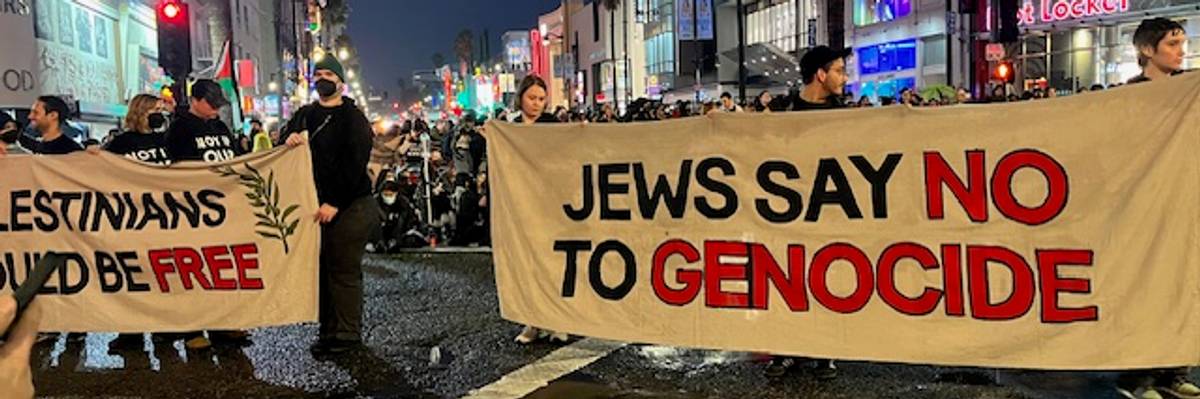
Jewish Voice for Peace shuts down Hollywood Boulevard to protest Israel’s genocide in Gaza on November 15, 2023.

Jordan Liz
Mar 22, 2026

On March 17, Joe Kent, the director of the National Counterterrorism Center and pro-Trump ally, resigned from his position in protest of the war in Iran. In his resignation letter, he remarked, “Iran posed no imminent threat to our nation, and it is clear that we started this war due to pressure from Israel and its powerful American lobby.”

Kent is not alone here. Secretary of State Marco Rubio told reporters, “We knew that there was going to be an Israeli action, we knew that that would precipitate an attack against American forces, and we knew that if we didn’t preemptively go after them before they launched those attacks, we would suffer higher casualties.” Sen. Chris Van Hollen (D-Md.) remarked that “[Israeli Prime Minister Benjamin] Netanyahu just a few weeks ago said he’d been waiting 40 years for an American president to join him in attacking Iran. And in Donald Trump, he finally found somebody stupid enough and reckless enough to actually do it.”

Now, it is worth noting that this is one of several conflicting reasons that have been provided to justify this war. Yet, that is precisely why these allegations should be taken seriously and investigated. As it stands, the US and Israel have launched an illegal, unprovoked war that is indiscriminately killing civilians, including children, while wrecking the global economy. We must know why.

Despite this, these allegations against Israel have been criticized as antisemitic. Anti-Defamation League (ADL) CEO Jonathan Greenblatt condemned those who blamed “the Jews” for inciting this war. “It is a sad irony,” Greenblatt said, “that an operation against the world’s largest sponsor of antisemitism has prompted so much antisemitism.” Zack Beauchamp, writing for Vox, accused Kent of engaging in “antisemitic conspiracism.” He wrote, “Antiwar antisemitism is still antisemitism.”

Conflating criticism of Israel with genuine bigotry only makes it more difficult to assess and address this serious problem.

These responses represent a continuing and troubling trend of conflating criticisms of Israel (and the Israeli government more specifically) with antisemitism.

Let us be clear: Not all criticisms of Israel are rooted in antisemitism. Likewise, not all criticisms of Iran are Islamophobic. The same holds true for individuals: It is not inherently antisemitic to criticize Benjamin Netanyahu.

What matters is the underlying rationale. Are we judging the person or nation based on the actions they have taken, the thoughts they have expressed, or the policies they have implemented? Or are stereotypes, prejudices, and ignorance fueling those claims? Are the accusations of Israel provoking this war based on the best available evidence or antisemitic hallucinations of a “secret Jewish cabal” plotting world domination?

Parsing through these questions requires careful assessment. If the allegations against Israel are grounded in hatred, then we must hold the people spreading those lies accountable. Antisemitism can never be tolerated.

If, however, they are supported by hard evidence, then a commitment to justice, morality, and humanity requires we hold Israel accountable. The same standard applies to all nations and world leaders, regardless of race, ethnicity, religion, or any other characteristic. No one is beyond reproach.

Greenblatt argues that referring to Israel as an “apartheid state,” accusing it of committing a genocide, or starting the war with Iran contribute to the “most concentrated, most dangerous surge of antisemitism in living memory.” What Greenblatt fails to realize is the role of people like him in driving this surge. His rhetoric does not silence opposition. It does not contribute to productive dialogue and understanding. Rather, it creates the false perception that all of Israel’s actions reflect its Jewish identity; that Israel speaks for and represents all Jewish people. That only someone who hates “the Jew” would ever find fault in Israel’s actions. That antisemitism is the only reason why someone would support Palestinians and advocate for their sovereignty.

We must remember that antisemitism and racism, like all forms of prejudice, are acts of depersonalization and dehumanization. The antisemite treats all Jewish people as a homogenous group—they all share the same thoughts, have the same aspirations, engage in the same acts. Here, the diversity of thoughts and opinions is denied. For the bigot, everything the Jewish person does is not a reflection of them as a person, but rather of their “Jewishness.” This flawed logic paves the way for the antisemite to hold all Jewish people accountable for the words and deeds of a few. When people like Greenblatt indiscriminately label any criticism of Israel as antisemitic, he follows this same logic: He treats Israel not as a sovereign nation whose actions reflect its own internal decision-making but as “the Jewish state” whose actions are inseparable from its Jewish identity. It reduces all discussion of Israel to its ethnicity and religion—that is, itself, antisemitic.

Jewish people are neither collectively responsible for Israel’s actions nor do they universally support them. For instance, two prominent Israeli rights groups—B’Tselem and Physicians for Human Rights-Israel—have accused Israel of committing a genocide in Gaza. Jewish Voice for Peace, an anti-Zionist advocacy group, has protested against the US government’s unfettered support for Israel. According to a October 2025 Washington Post poll, 61% of American Jews say Israel has committed war crimes in Gaza, with 39% saying it is committing a genocide. None of this is antisemitism.

The reality is that according to both the Gaza Health Ministry and an Israeli security official over 70,000 Gazans have been killed in Israeli attacks since Oct 7, 2023. The reality is that Israeli officials have repeatedly implied or outright expressed genocidal intent. In 2024, Netanyahu said in a news conference, “In any future arrangement… Israel needs security control over all territory west of the Jordan.” In 2025, he said: “We are going to fulfil our promise that there will be no Palestinian state. This place belongs to us.” More pointedly, Deputy Speaker of the Knesset Nissim Vaturi said, we must “wipe Gaza off the face of the Earth,” while adding “Gaza must be burned.” Those killings happened, those words were said—we must reckon with this reality, not cast it aside as an antisemitic conspiracy.

None of this is to deny that antisemitism is on the rise worldwide. However, conflating criticism of Israel with genuine bigotry only makes it more difficult to assess and address this serious problem. It dilutes the moral weight of accusations of antisemitism and distracts us from the harm suffered by its victims. Ultimately, we cannot seek justice for one group while denying it for another. We must stand with Palestinians who have been terrorized by Israel’s military assaults, as well as the victims of the Bondi Beach shooting, Temple Israel synagogue attack, and other acts of violence. A moral double standard cannot be tolerated.

And yes, it is the case that some anti-Israel critics, like Nick Fuentes, are antisemitic. Similarly, some disparagements of African, Asian, and Latin American countries are racist; and some attacks against Middle Eastern countries are Islamophobic. This possibility, however, does not mean we should treat every criticism as being singularly and inherently hateful. Rather, it must caution us to be more careful and critical with the words we use.

Weaponizing antisemitism on behalf of Israel does not protect Jewish people. It only makes them more vulnerable to future violence—for their sake, and for the sake of Palestinians, Iranians, and other victims of Israel’s violence, it must stop.


Our work is licensed under Creative Commons (CC BY-NC-ND 3.0). Feel free to republish and share widely.


Jordan Liz
Jordan Liz is an Associate Professor of Philosophy at San José State University. He specializes in issues of race, immigration and the politics of belonging.
Full Bio >


The Correct Solution to Antisemitism Is to Call for BDS Against Israel

Ending the notion that all Jews are responsible for and agree with what Israel is doing are necessary to deal with this horrific form of racism.


Demonstrators hold a placard urging the international community to take action against Israel’s settlement policy in the occupied territories as left-wing Israeli and foreign peace activists join Palestinians in a protest in the Arab east Jerusalem neighborhood of Sheikh Jarrah on November 04, 2009.
(Photo: Gali Tibbon/AFP via Getty Images)

Gary Engler
Mar 22, 2026
Common Dreams


There’s been much debate on the left around the world about how best to respond to what appears to be rising antisemitism. What, if anything, is the best response? Some argue, mostly correctly, that raising the subject amidst Israel’s genocide in Gaza, bombing many of its neighbors etc. is an attempt to deflect attention away from that country’s crimes.

However, in so far as there has been a rise in one form of racism, let me suggest one solution:

‘Bone-Chilling’: Gamblers ‘Vowing to Kill’ Journalist Unless He Changes Iran War Report to Help Them Win Polymarket Bet

An effective way for governments around the world to halt the rise in antisemitism would be to apply BDS principles towards Israel. Boycotting, divesting, and sanctioning would last until either a two-state solution was arrived at with Palestinians or all the people living on the land Israel currently occupies were given equal rights and opportunities.

Based on experience with the South African apartheid state, BDS could pressure Israel to end its military-might-makes-right, international law ignoring, colonial, racist, anti-human behavior. That is by far the major source of increasing antisemitism today. This should not be a controversial statement, but it is for those who remain supporters of Israel despite that country becoming a pariah in most of the world. Some people, for religious, political, or pro-U.S. empire reasons justify ongoing ethnic cleansing, apartheid policies, the destruction of Gaza, mass killing of children and women, expansion of illegal settlements and repeated bombings of neighboring countries. They either agree with or excuse Netanyahu’s extreme right, Jewish supremacist government that believes in expansion of a state imposed on the people of southwest Asia by western powers. They attack anyone who criticizes Israel and call them antisemites. They conflate Judaism with the interests of the Israeli state.

These should not be controversial statements. Israel’s current behavior and its conflation of Judaism with that country’s actions is by far the biggest reason for a rise in antisemitism in the last few years. Therefore, ending that behavior and the notion that all Jews are responsible for and agree with what Israel is doing are necessary to deal with this form of racism.

The most effective and quickest way to accomplish these essential tasks is a widespread and complete BDS campaign by most countries in the world. The goals would be to force Israel’s respect for international law and end what the largest Israeli human rights organization calls “a regime of Jewish supremacy from the Jordan River to the Mediterranean Sea”. But instead, most western countries support Israel, empowering and excusing its bad behavior which emboldens existing antisemites and creates more. In other words, supporting and emboldening antisemitism rather than trying to end its current most damaging cause. It seems like those western governments and the pro-Israel organizations that pressure them to continue this madness are fine with the resulting increase in antisemitism. Why? One answer might be to push longstanding Jewish communities around the world to emigrate to Israel. Certainly, the notion of Aliyah is something promoted by Zionism.

But all of us, including millions of Jews, who oppose religious/ethnic nationalism and support progressive secular democracy as the best way to overcome all forms of racism, including antisemitism, must say no to Israel’s horrible behavior and quickly end it. The best non-violent way to do that is supporting BDS.

Massive economic, political and cultural pressures are needed to change Israel’s behavior. The same is true to change the behavior of supporters of Israel in many western countries who enable that bad behavior. For example, in Canada, government subsidies and give tax breaks to Zionist organizations that use this funding to attack anyone who criticizes Israel. More importantly they push the mistakenly dangerous notion that Israel is the state of all Jews, thus convincing people that all Jews are responsible for Israel’s behavior. Rather than give money to organizations that claim to be fighting antisemitism but instead use those funds to defend and promote the interests of a foreign state whose actions are a significant cause of antisemitism, governments must get to the root of the problem. They must engage in real action to stop Israel’s bad behavior. They must end support for organizations that promote the conflation of Judaism with that behavior.

It’s time for the political left and all those who believe in human rights for all to call for BDS as a way to combat antisemitism.


Our work is licensed under Creative Commons (CC BY-NC-ND 3.0). Feel free to republish and share widely.

Gary Engler
Gary Engler is a former Canadian reporter, editor and union activist who is author of "American Spin," "War on Drugs," and "Misogyny," of the FAKE NEWS Mysteries series, exploring journalism, propaganda, politics and murder in the Donald Trump era.
Full Bio >
End Trump’s Chaotic Tariffs and Raise Corporate Tax Rates Instead

Increasing the corporate tax rate would raise significant revenues and have little impact on overall investment, while the costs would be borne predominantly by wealthy shareholders of large corporations.


US President Donald Trump delivers remarks on reciprocal tariffs during an event in the Rose Garden entitled “Make America Wealthy Again” at the White House in Washington, DC, on April 2, 2025.
(Photo by Brendan Smialowski/AFP via Getty Images)


Samantha Jacoby
Mar 22, 2026
CBPP Blog

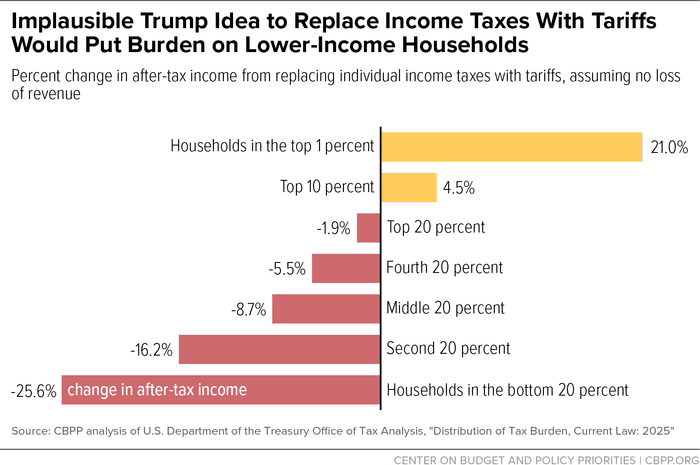
The Trump administration’s sweeping tariffs have harmed the economy by increasing input costs and uncertainty for businesses and raising prices for consumers, placing a particularly heavy burden on people with low and moderate incomes. Now President Donald Trump is floating the idea of replacing income taxes with tariffs—a proposal that could not plausibly make up for lost revenue and would follow the administration’s pattern of showering wealthy households with windfalls at the expense of households with incomes in the bottom half of the income distribution. This plan would raise taxes on people with incomes in the bottom 20% by $4,000 (26% of income) and the middle 20% by $5,300 (8.7% of income), while wealthy households would receive a $337,000 windfall (21% of income), on average.

Instead, policymakers should abandon the administration’s economically harmful and regressive tariffs and pursue more efficient and equitable revenue-raising policies. In particular, raising the corporate tax rate, which mostly taxes profits not inputs, would raise significant revenues and have little impact on overall investment, while the costs would be borne predominantly by wealthy shareholders of large corporations.

The Administration’s Across-the-Board Tariffs Harm the Economy and Burden Households With Low and Moderate Incomes

Beginning in February 2025, the administration announced and implemented sweeping taxes on imported goods, known as tariffs, justifying them in part on the need to raise revenues. The Supreme Court struck down some of these tariffs, but the administration responded by imposing a new set of replacement tariffs under a different authority. These tariffs are still highly significant: as of March 10, the effective tariff rate was 12% compared with 2.6% in early 2025. Underneath this average rate is a complex and highly variable tariff regime that differs considerably by country and type of product and has been subject to frequent changes over the past year.

Tariffs can play a useful role in trade policy as a way to remedy specific trade issues—such as the need to ensure domestic production of goods related to national security—but are highly flawed as a general revenue source because of the economic distortions they create and the burden they place on families with low and moderate incomes. To a much greater extent than other types of taxes, tariffs distort, or alter, households’ and businesses’ decisions about purchasing, investment, and savings in ways that can make them worse off. For example, high tariffs on imported steel encourage US companies to ramp up steel production instead of investing capital and labor into other sectors that might, absent the tariff, generate higher returns.

If tariffs are expanded to replace all or a substantial share of the federal income tax, most households, and especially those with the lowest incomes, would face a massive tax increase, while wealthy households would be substantially better off.

Tariffs can harm the domestic economy in other ways. By raising the price of imported business inputs (that is, goods that are used to make other goods, such as steel used in automobiles and buildings, including apartment buildings), goods manufactured in the US are often more expensive because of tariffs. Even producers of purely domestic goods may increase prices because of reduced competition from tariffed foreign goods. Moreover, the tariffs’ chaotic and haphazard implementation over the past year has created an uncertain environment that is harmful to businesses trying to decide when, whether, or where to invest.

Other countries may also impose their own tariffs on US products (or otherwise retaliate), which can reduce US exports and harm domestic markets, as happened when China paused purchases of US soybeans last year.

Tariffs are regressive because they place a heavier burden on households with low and moderate incomes than on high-income households compared to other taxes. If made permanent, the current tariffs would reduce after-tax incomes of households with incomes in the bottom 10% of the income distribution by about 1.4%, compared with 0.4% for households with incomes in the top 10%, according to Yale Budget Lab. For households struggling to afford to meet their basic needs, this tariff-driven income reduction could have serious consequences: Yale estimates that the administration’s tariffs last year would lead to hundreds of thousands more people living in poverty, with millions more seeing their incomes fall further below the poverty line. Higher tariffs would increase poverty more severely.

Economists generally agree that tariffs are a regressive tax, while federal income taxes are progressive. For example, tariffs are imposed on goods at a flat rate meaning that everyone purchasing those goods pays the same rate regardless of income, instead of a progressive rate structure that ensures high-income households pay higher rates than households with lower incomes.

For this reason, if tariffs are expanded to replace all or a substantial share of the federal income tax, most households, and especially those with the lowest incomes, would face a massive tax increase, while wealthy households would be substantially better off.


Importantly, this calculation ignores the fact that it would be impossible for tariffs to generate enough revenue to replace the income tax: The personal income tax alone generates $2.4 trillion in annual revenue while estimates suggest tariffs could realistically raise a maximum of only about $500 billion.
The Corporate Income Tax Is a Far More Efficient and Progressive Revenue-Raising Option

Increasing revenues by raising the corporate income tax rate would be a far better approach than the president’s harmful tariff scheme. Raising the corporate tax rate—which Republicans slashed in 2017—would raise substantial revenue in a progressive and efficient manner.

While tariffs are a tax on imported goods, including business inputs, the corporate income tax is a tax on corporations’ profits, or their net income after deducting expenses. Notably, a substantial (and growing) share of the corporate tax base consists of so-called “excess profits”—that is, profits above what a firm needs to justify an investment. Taxing those profits is efficient because it would not deter the firm from making break-even investments because they would remain profitable. A study by tax scholar Edward Fox estimated that as much as 96% of the corporate tax fell on excess profits from 1995 to 2013.

More of the corporate tax is falling on excess returns because the amount of those excess profits is rising, in part, due to declining competition and increasing concentration among corporations, which give businesses “market power” that allows them to raise their prices well above their costs. Another reason is that changes in tax policy have effectively exempted more of firms’ normal return on investments from taxation, meaning the corporate tax has applied more to excess profits. For example, the 2017 tax law allowed firms to immediately deduct the full cost of equipment purchases rather than deduct those costs gradually as the value of the investment declines—a change last year’s Republican megabill both made permanent and expanded.

Given the nation’s need for more revenues, policymakers should embrace sound, progressive policies like raising the corporate tax rate.

Some may argue that higher corporate taxes would simply be passed on to consumers through higher prices, but the corporate tax—as a tax on profits—allows businesses to deduct and exempt from taxation key input costs, especially labor. This means that it generally does not have a direct impact on firms’ pricing decisions. The traditional economic concern about raising corporate taxes is not that they raise prices, but that they can reduce investment and thus affect productivity and workers’ wages. Yet, because they often (and increasingly) fall on excess profits, they are less likely to reduce investment and are a relatively efficient source of revenue.

Raising the corporate tax rate would also make the tax system more progressive. Both conventional scoring authorities and outside experts (e.g., the Joint Committee on Taxation, Congressional Budget Office, Department of the Treasury, and the nonpartisan Tax Policy Center) agree that the corporate tax is predominately paid by shareholders and the owners of capital income. The ownership of corporate shares—as with other kinds of wealth—is highly concentrated among households with high net worth; households with net worth in the bottom 50% hold just 1% of equities. Because white households are overrepresented among the wealthy while households of color are overrepresented at the lower end of the wealth distribution due to racial barriers to economic opportunity, raising the corporate tax rate can also help reduce racial wealth inequality.

Evidence from the 2017 tax law supports the view that corporate tax cuts primarily benefit high-income households—and, inversely, that corporate tax increases would fall on those same households. The law cut the corporate tax rate dramatically from 35% to 21%, with people at the top of the income distribution receiving the vast majority of the resulting gain. One study found that people with incomes in the top 10% of the income distribution received 80% of the 2017 law’s corporate tax cuts benefit.

Moreover, raising the corporate tax rate has the potential to raise significant revenues; raising it to 28%—halfway between the current rate and the pre-2017 tax rate—would raise around $1 trillion over 10 years—enough to replace about two-thirds of the current tariffs.

Given the nation’s need for more revenues, policymakers should embrace sound, progressive policies like raising the corporate tax rate, while abandoning harmful tariffs and resoundingly rejecting the president’s disastrous proposal to replace income taxes with massive tariffs.


© 2023 Center on Budget and Policy Priorities


Samantha Jacoby
Samantha Jacoby is a Senior Tax Legal Analyst with the Center on Budget and Policy Priorities Federal Fiscal Policy division. Prior to joining the Center in 2018, she practiced tax law at two international law firms in New York and Washington, D.C. Previously, she worked as a policy and research analyst at the Solar Energy Industries Association, where she focused on the impact of tax incentives on the energy industry.
Full Bio >
IAEA chief calls for ‘restraint’ after reported strike on Iran’s Natanz nuclear facility
Common Dreams
March 21, 2026 


Donald Trump speaks as Benjamin Netanyahu waves at the White House. REUTERS/Kevin Mohatt

The head of the United Nations nuclear watchdog issued a fresh demand for restraint on Saturday after the Atomic Energy Organization of Iran announced that the Shahid Ahmadi-Roshan uranium enrichment complex in Natanz “was subjected to a renewed attack” as the United States and Israel continue to bomb the Middle Eastern country.

The Iranian agency said that “technical assessments indicate that no radioactive material leakage has occurred and there is no danger to residents of the surrounding areas,” but the attack was a “violation of international laws and commitments,” including the Nuclear Nonproliferation Treaty.

The International Atomic Energy Agency “has been informed by Iran that the Natanz nuclear site was attacked today,” the UN watchdog confirmed on social media. “No increase in off-site radiation levels reported. IAEA is looking into the report.”

“IAEA Director General Rafael Grossi reiterates call for military restraint to avoid any risk of a nuclear accident,” the agency added.

The Times of Israel reported that “in response to a query... the Israel Defense Forces said that it did not conduct any strikes in the area and that it could not comment on American activities.”

The Israeli newspaper also noted that “Israel’s Kan news reported that the US had indeed struck the facility, using ‘bunker buster’ bombs to target the site. It cited unspecified sources.”

Later Saturday, The Times of Israel reported that at least 20 people were wounded in an Iranian ballistic missile attack on the Israeli city of Dimona, home to Shimon Peres Negev Nuclear Research Center.

The United States previously bombed Iran’s Natanz facility last June. The Associated Press highlighted Saturday that satellite images also suggest the site was damaged during the first week of the current war, which President Donald Trump and Israeli Prime Minister Benjamin Netanyahu launched on February 28.

Condemning the Saturday strike on Iran’s complex, the Russian Foreign Ministry spokesperson said that “this is a brazen violation of international law, the charters of the UN and the International Atomic Energy Agency, as well as relevant resolutions of the UN Security Council and the agency’s General Conference.”

Russia has notably also generated fears of a nuclear accident with its ongoing invasion of Ukraine, launched in February 2022.

Trump has sent mixed messages about the US-Israeli war on Iran, both sending thousands more troops to the region this week while also saying on his Truth Social platform Friday that “we are getting very close to meeting our objectives as we consider winding down our great Military efforts in the Middle East with respect to the Terrorist Regime of Iran.”

According to the AP: “Iran’s capital saw heavy airstrikes overnight and into the morning, residents said, as thousands of worshippers converged on Tehran’s grand mosque for prayers marking the end of the holy month of Ramadan. Israeli Defense Minister Israel Katz said attacks would ‘increase significantly’ next week.”
Canada grows the food. Why isn’t it building the industry?

By Jennifer Friesen
DIGITAL JOURNAL
March 16, 2026


Photo by JSB Co. on Unsplash

Walk through a Canadian grocery store and you’ll find wheat from Saskatchewan, the canola oil from the Prairies, and potatoes from Alberta or Prince Edward Island.

But the food itself, the packaged product on the shelf, was often processed somewhere else.

Canada has long been a major global food exporter. The country shipped about $101.2 billion in agri-food exports in 2025, reflecting the scale of its agricultural production and global reach.

But much of the infrastructure that turns raw ingredients into finished food sits outside the country.

Global trade made it easy for ingredients to move across borders for processing until pandemic disruptions and geopolitical tensions exposed how dependent those supply chains had become.

A new report from the Canadian Food Innovation Network (CFIN) argues that those disruptions revealed something deeper about Canada’s food system.

Canada grows a lot of the crops. The gap shows up in everything that happens after the harvest.

Processing plants, ingredient manufacturers, logistics networks, packaging suppliers, and equipment providers form the backbone of modern food systems.

That structure affects everything from grocery prices to economic competitiveness.

And according to Alexandra Barlow, VP of programs at the CFIN, the reasons for it aren’t too complicated.

“There are some structural challenges for doing business in Canada that don’t make it the cheapest option,” she says.

Higher wages and operating costs have pushed many companies to locate processing capacity in lower-cost markets.

So if Canada supplies so many of the ingredients, why are other countries doing more of the cooking?
The part of the food system we ignore

Public conversations about agriculture in Canada tend to focus on farms. Policy debates revolve around crop yields, exports, and farm technology.

The industrial side of the system receives much less attention.

Processing plants, ingredient suppliers, packaging manufacturers, transport networks, and distributors do the work of turning crops into the food that appears on grocery shelves. The money in the food business is made along that chain rather than on the farm.

Canada’s food manufacturing sector is larger than many people realize, with about one in nine Canadian jobs depending on the system that moves food from farms to consumers. Within that system, roughly 6,900 food and beverage processing companies employ more than 300,000 people across the country, says Barlow.

Most are small or mid-sized processors.

Those companies often operate with tight margins and aging equipment, which makes large technology upgrades hard to manage.

Barlow notes that over the past 104 quarters, Canadian businesses have consistently chosen to invest in people rather than machinery and equipment, with plans to prioritize machinery over hiring showing up in only about 11 quarters.

That preference for expanding through labour rather than automation has weighed on productivity for years.

The Organisation for Economic Co-operation and Development warned in a 2025 productivity outlook that Canada continues to lag peer economies in business investment in machinery and advanced equipment.

Food manufacturing illustrates how that pattern plays out on the ground.

During the pandemic some Canadian manufacturers struggled to secure packaging materials and specialty ingredients needed to keep production lines running. When those inputs stalled, companies scrambled to find new suppliers or reformulate products to keep food moving through the system.

Supply chain disruptions have not fully eased.

In early 2026, escalating conflict in the Middle East created what shipping analysts described as a “dual chokepoint crisis” affecting both the Strait of Hormuz and the Red Sea, forcing container carriers to divert vessels and suspend routes across parts of the region.

Shipping companies have increasingly rerouted vessels away from those corridors, adding distance, time, and cost to global trade flows.

For Barlow, those episodes expose something the sector has been wrestling with for years. She says the gap appears in the parts of the system that sit between farms and consumers, where food is processed, packaged, and distributed.

“We talk a lot about agriculture in Canada,” she says. “But we don’t talk nearly as much about the manufacturing and processing side of the food system.”
Alexandra Barlow is the VP of programs at the CFIN – Photo by Joanna Wojewoda

Where innovation spreads and where it stalls

Food innovation tends to get talked about as if it happens in labs or startup incubators. Picture giant robotic arms and The Matrix-looking code designed to look swanky in green and black but is just Hollywood magic.

Most technological change in the food industry happens somewhere inside processing plants that upgrade equipment, automate production lines, or adopt new ingredients that change how food is manufactured.

That kind of magic is slower and a lot more expensive than launching software.

Installing a new processing system can require millions of dollars in equipment, months of testing, and major changes to how a factory runs. For companies operating on thin margins, those decisions are often delayed until equipment reaches the end of its life.

Barlow says the pace of adoption often comes down to financing rather than enthusiasm for new technology.

“I wouldn’t say that it’s a cultural thing,” she says. “I would say that it’s a capital availability problem first and foremost.”

It also determines how quickly new ideas leave the startup ecosystem and make their way to real production lines.

Startups are producing a steady stream of technologies aimed at the food system. Some are building digital traceability tools that track ingredients through supply chains, and others are developing automated production systems, robotics, or new food ingredients designed to simplify manufacturing.

But the companies inventing those tools are rarely the ones operating large factories.

The report points to a specific group of companies that may ultimately determine whether these innovations spread through Canada’s food industry.

While Canada has roughly 70 large-scale facilities with over 500 employees that have easier access to capital, the real opportunity for resilience lies in the 573 medium-sized processors. These companies, which employ between 100 and 499 people, generate $18.4 billion in sales and are heavily trade-oriented.

Barlow describes them as the companies most likely to test new technologies inside real production environments. She says these mid-sized players represent a significant opportunity for the sector.

“The mid-size players are quite strong.” she says. “They’ve got an outsized opportunity, through increased modernization and investment in technology, to really increase their output, but also drive at profitability.”

Because they have the necessary volume to supply major Canadian retailers, their success is key to displacing imported products in the “center of store.”

Under CUSMA, tariffs on most processed food products traded between Canada, the U.S., and Mexico have been largely eliminated, which has made it easier for finished goods to move across borders within North America rather than be processed domestically.

Their decisions about when to modernize equipment, automate production lines, or adopt new ingredients could shape how quickly the broader sector evolves.
Why supply chains are now a national conversation

Across much of the last year, conversations about economic sovereignty have largely focused on technology and energy

Governments around the world are debating who controls semiconductor manufacturing, critical minerals, data infrastructure, and the energy systems that power modern economies.

Food rarely appears in the same category.

Yet the systems that move food from farm to table operate through similar global supply chains, and Canadian households have been feeling that reality at the grocery store.

Statistics Canada reported today that grocery prices continue to place pressure on household budgets, with food remaining one of the largest contributors to consumer inflation in recent years.

Those price pressures often trace back to the same global networks that shape other industries. Ingredients, packaging materials, processing equipment, and shipping routes frequently cross multiple borders before food reaches store shelves.

Barlow says those dependencies deserve more attention in national policy discussions.

“Food is not only part of our food sovereignty conversation,” she says. “It should be part of our defense conversations, because we’re not going to be much use to ourselves if we can’t actually feed 40 million Canadians who live here today.”

Other governments have begun approaching supply chains through that lens.

Industrial policy initiatives in the United States and Europe now focus heavily on strengthening domestic manufacturing capacity and reducing reliance on vulnerable global supply chains.

Food systems aren’t always included in those strategies.

But as countries rethink economic resilience in sectors ranging from semiconductors to AI infrastructure, the same questions increasingly apply to the systems that produce and distribute food.
A system Canada is still building

Canada’s food system has evolved around global trade.

Crops grown on Canadian farms move easily across borders, often entering processing systems in other countries before returning to store shelves as finished foods.

For years that arrangement worked efficiently. But rising food prices, geopolitical tensions, and renewed debates about economic sovereignty have pushed governments and industry leaders to examine the industrial infrastructure that sits between farms and consumers.

Today roughly 70% of the food consumed in Canada is produced domestically, according to Barlow. The report suggests there is room to strengthen that number by expanding processing capacity and supply chain infrastructure inside the country.

Barlow says one long-term goal discussed is to move that figure closer to 80% over the next decade, which would mean sustained investment in food manufacturing, automation, and logistics networks.

So we’re talking about capturing more of the value created between the farm and the grocery shelf.

Barlow adds that the conversation around those gaps is beginning to cross between sectors.

“They’re not conversations that are unique to our organization,” she says. “Many groups are having these conversations with government, and that’s really good. We need to all be singing from the same songbook in order to change here.”

Final shots

Canada exports agricultural commodities but much of the processing capacity sits elsewhere.

Business investment patterns have favoured hiring over machinery, slowing automation in sectors like food manufacturing.

Innovation exists in the food sector, but adoption often depends on whether smaller processors can access capital.


Written ByJennifer Friesen
Jennifer Friesen is Digital Journal's associate editor and content manager based in Calgary.
US Fed Chair says ‘no intention’ of leaving board while probe ongoing


By AFP
March 18, 2026


US Federal Reserve Chair Jerome Powell said he would stay in office until his successor is confirmed, even if that occurs after his tenure ends in May - Copyright AFP Brendan SMIALOWSKI

US Federal Reserve Chair Jerome Powell said Wednesday that he did not plan to leave the central bank’s board until a Justice Department probe linked to renovation costs was completed.

President Donald Trump has repeatedly insulted Powell over the central bank’s policies on setting the economy’s key interest rate.

In January, Powell revealed that the Justice Department had launched a probe linked to cost overruns in the Fed’s renovations.

“I have no intention of leaving the board until the investigation is well and truly over, with transparency and finality,” Powell told a press briefing on Wednesday.

He added that he had not decided whether to continue serving as a Fed governor after his term as chair is over in May. His term as a governor ends in 2028.

Last week, a US federal judge quashed subpoenas issued to the Federal Reserve as part of the investigation, with the court saying there was “a mountain of evidence” to suggest the probe was a pressure tactic.

Judge James Boasberg’s order was scathing in its criticism of the Trump-appointed prosecutor’s office.

“The Government has produced essentially zero evidence to suspect Chair Powell of a crime; indeed, its justifications are so thin and unsubstantiated that the Court can only conclude that they are pretextual,” he wrote.

US Attorney Jeanine Pirro has said the Trump administration would appeal the decision.

Trump has been vocal about his preferences for lower interest rates, criticizing Powell and attempting to unseat another Fed Governor, Lisa Cook, over mortgage fraud allegations.

On Wednesday, the Fed’s key rate-setting committee decided to keep rates unchanged, as central bank policymakers digest the economic fallout of Trump’s war on Iran.

Trump has nominated Kevin Warsh to replace Powell as Fed chair, but he is awaiting Senate confirmation.

That confirmation is in doubt, with Republican Thom Tillis of the Senate Banking Committee recently vowing to oppose the nomination of any Fed nominees — including Warsh — until the Justice Department probe into Powell is resolved.

On Wednesday, Powell also said he would stay in office as Fed chair until his successor is confirmed, as has been the practice in the past.
‘War has aged us’: Lebanon’s kids aren’t alright

ByAFP
March 20, 2026


Theatre helps displaced Lebanese children overcome the pain of war - Copyright AFP AHMAD GHARABLI


Nader Durgham

Forced by yet another war in Lebanon to flee his home for the second time in just two years, and mourning lost relatives and friends, Hassan Kiki said he feels much older than 16.

“War has aged us… We have lived through what no one else has,” the tall teen from south Lebanon told AFP in Beirut.

“I miss my school, my friends… I lost two cousins and two friends in a massacre in Shehabiyeh,” he added, referring to a deadly Israeli strike in his town that killed at least seven people on March 11.

Kiki is among more than a million people Lebanese authorities have registered as displaced since the country was drawn into the Middle East war on March 2.

On that day, the Iran-backed militant group Hezbollah launched rockets towards Israel to avenge the killing of supreme leader Ayatollah Ali Khamenei.

Israel, which never stopped bombing Lebanon despite a 2024 truce that sought to end the last war with Hezbollah, responded with widespread strikes, ground operations along the border, and an evacuation warning for swathes of the country.

For many young Lebanese caught in the crossfire, their formative years have been jeopardised by repeated conflicts and crises.

“My childhood is gone,” said Kiki.

“Material losses can be made up for, but people do not come back.”

Since 2019, Lebanese have been battling a financial crisis that has locked them out of their bank deposits, while the Covid pandemic made life even harder for everyone.

Beirut’s port exploded the following year in one of the world’s largest non-nuclear blasts, destroying swathes of the Lebanese capital, and killing more than 220 people.

– ‘Dreams on hold’ –

The first time Zahraa Fares experienced war was in 2024, when she was just 14.

“We were still discovering what we like to do, what activities we enjoy, how we like to spend our days, then we were displaced… and could not do anything”, said the now-16-year-old, who escaped the southern city of Nabatiyeh.

Fares, who said she now feels “mentally crushed”, found relief in an acting workshop in Beirut’s Lebanese National Theatre intended to support war-affected youth like herself.

Wassim al-Halabi, a 20-year-old Syrian who fled the war in his country nine years ago and is still living in Lebanon, has found himself stuck in another conflict.

Working in a restaurant since the 2024 war forced him out of university, Halabi said he was “starting from zero to be able to stand on my two feet again, but war started again”.

“Our dreams are now on hold until the war ends.”

Lebanese authorities on Thursday said Israeli strikes have killed more than 1,000 people since March 2.

The toll includes 118 children.

“Cumulative trauma, cumulative adverse experiences and ongoing instability and unpredictability certainly put these children at higher risk… of developing psychiatric disorders and negative mental health outcomes,” Evelyne Baroud, a child and adolescent psychiatrist told AFP.

“Witnessing violence, physical assaults, killings, forced displacement, losing one’s home, loss of a parent, all of these carry a very high risk of developing post-traumatic stress disorder.”

– Generational trauma –

Lebanon has been mired in conflicts and crises for decades, the worst of which was the 15-year civil war that erupted in 1975 and which divided the country into warring sectarian fiefdoms.

For many years since the end of that war, which killed 150,000 people and left 17,000 more missing, bitter political divisions continued to plague Lebanon.

The war also saw an Israeli invasion and occupation of southern Lebanon until 2000.

While young Lebanese grew up hearing stories of war from their parents, they never expected to have to live through one themselves.

“My mother used to tell us about how they would be displaced, hear airstrikes, but I was not able to properly imagine it,” Fares said.

“I used to ask myself ‘how could they shelter in a school?’ but now I see it with my own eyes.”

At a gathering in Beirut to express solidarity for victims of the war, 18-year-old Laura al-Hajj wondered: “Why do I have so many concerns at my age?”

“We carried burdens that are much bigger than us, and beyond our age… I now just worry about being alive tomorrow.”

Hajj said she feels like “from generation to generation, we are all living through wars”.

“No child should have to go through what we went through.”


South Lebanon’s Christian towns insist they are not part of Israel-Hezbollah war

By AFP
March 16, 2026


Suad Jallad's son Shadi was killed earlier this week by an Israeli airstrike in the southern Lebanese border village of Ain Ebel, and was comforted by the Apostolic Nuncio to Lebanon Paolo Borgia - Copyright AFP Dylan COLLINS


Dylan Collins

In southern Lebanon’s Ain Ebel, close to the border with Israel, Suad Jallad holds a poster of her son, killed by Israel last week, saying she would rather be buried next to him than leave.

Ain Ebel, a village filled with red-riled roofs and surrounded by olive groves, is one of few Christian villages in the Bint Jbeil district whose residents refuse to evacuate, insisting they are not a party to the war between Israel and Hezbollah.

“We live in fear and terror,” the 56-year-old said, indicating the positions from which she says Hezbollah and Israel fire at one another, insisting that “despite this, we stayed in the village”.

Shadi Ammar, Jallad’s 22-year-old son, was killed with two other residents by an Israeli drone strike last week, as they were trying to repair the internet connection on a roof, according to Lebanon’s state-run National News Agency.

“He did not want to leave the town. He stayed, but is now in the cemetery,” she told AFP, sobbing in the church hall.

Lebanon was drawn into the Middle East war on March 2 when Tehran-backed Hezbollah attacked Israel in response to the killing of Iranian supreme leader Ayatollah Ali Khamenei in US-Israeli strikes.

Israel, which never stopped bombing Lebanon despite a 2024 ceasefire, responded with air raids on its northern neighbour and troop incursions into border areas.

“I used to tell him to travel and get his life in order… He’d say, ‘I won’t leave Ain Ebel,'” Jallad said.

The town finds itself surrounded by Israeli strikes respond to rocket fires from Hezbollah in nearby areas.

“We were living in poverty and scarcity, and we used to say, ‘Thank God,'” Jalad said.

“But to betray our children like this and kill them? Why? They had nothing to fight them with… It is a shame that their blood was shed in vain.”


– ‘Bury me next to my son’ –


After participating in a prayer service attended by the Papal Nuncio to Lebanon, Paolo Borgia, who is touring Christian towns near the border, Jallad wept for her young son, holding a photograph of him.

His death reminded her of her mother’s anguish when Jallad’s brother was killed decades earlier.

“I lived through the same experience. I was 14 when my brother died,” she said, adding that “he was in the South Lebanon Army at the time… He died at the age of 21”.

The South Lebanon Army started operating during the 1980s in the border region of southern Lebanon, under Israeli occupation until 2000.

The Christian-majority force consisted of defected Lebanese army officers and soldiers, as well as recruits from the area, and was loyal to Israel.

Israel has fought three major wars with Hezbollah since its occupation ended.

“We did not choose this war, nor do we want it, but we chose to stay,” Ain Ebel mayor Ayoub Khreich said in front of a Papal delegation.

Maroun Nassif, a municipal council member in neighbouring Debl, told AFP “we are paying the price for policies we did not choose”.

“We are forced to sacrifice and risk our very existence in this area so that we do not lose our land, our homes, our villages, and become refugees with nowhere to go.”

“We are forced to stay in our villages so that we can still have a village,” he added, reflecting fears that their homes will be used for Hezbollah’s military operations, making them targets for Israeli raids.

In Rmeish, another town that overlooks Israel, women gathered around an aid convoy from a Catholic organisation.

“Since I was little, the town has been bombed… there has always been war,” Elvira al-Amil, a mother of three, said.

“We grew up with war and said it would end… but now my children are still living through war.”

Residents of the Christian border towns refuse to leave, believing they will remain safe from Israeli fire.

However, residents of Alma al-Shaab, a town in the Tyre district, were forced to evacuate last week under Israeli orders, the reason for which remains unclear.

In Ain Ebel’s cemetery, Jallad caresses her son’s tombstone, surrounded by women trying to comfort her.

“I won’t leave… let them bury me next to my son,” she said.

“Why would we leave? We are not fighting anyone. We are not fighting it (Israel) nor are we fighting them (Hezbollah). They are the ones fighting us.”

Israeli Settlers Step Up Aggressions Against Christians In West Bank, Jerusalem Bishop Says


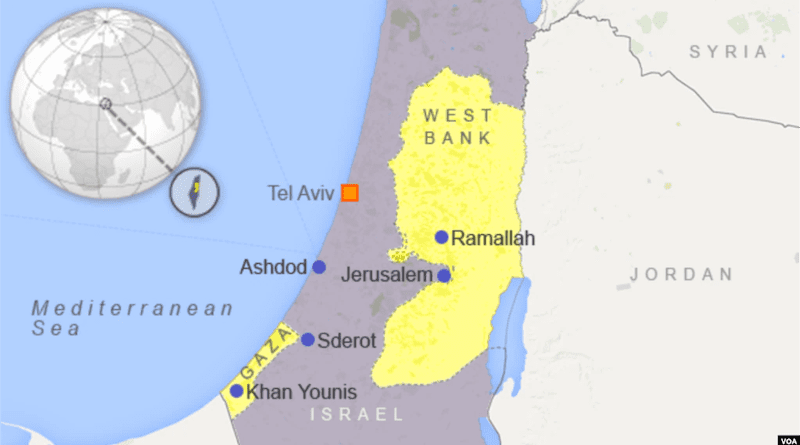
Israel, Gaza and the West Bank. Credit: VOA


March 22, 2026 
EWTN News
By Madalaine Elhabbal


Christians in the West Bank continue to face an onslaught of aggressions by Israeli settlers, threatening their presence in the region, according to Auxiliary Bishop William Shomali of Jerusalem.

“The aggressions against Christians in the West Bank are multiplying,” Shomali said in a March 20 interview with “EWTN News Nightly.”

The situation for Palestinian Christians had been “calm” in the Bethlehem area, he said. “But now, there is more expansion of the settlements and more aggressions from the side of the settlers.”


Shomali said settlers have prevented Palestinian Christians from accessing their land through various threats, physical aggression, and property damage, including burning their cars.

“This happened mainly in the Christian village of Taybeh, and we communicated this news to all the world, even to the American ambassador in Tel Aviv, who came to visit the place, and he promised to do something, but not many things were done,” Shomali said.

In Birzeit, a Palestinian Christian town about six miles north of Ramallah in the West Bank, Shomali said settlers have been coming “almost every day to threaten people in their own homes or in their work.”

“This has become a real threat to Christian families,” he said, “because they lost their livelihood and their source of income.” The Church must intervene and provide aid for them to survive, the bishop said.

Shomali said Israeli settlers have also recently occupied land belonging to a convent of sisters in a village near Bethlehem called Urtas. The sisters “have a hill where they plant and grow olives and other things,” he said. “Settlers came to occupy this hill and to make it theirs, where they think of building a new settlement.”

He also noted a settlement to be built on the Shepherds’ Field of his own village, Beit Sahour, which he said is a piece of land that belongs to Christian families there.

“I heard just today, that a piece of land, one acre, was also entered by settlers who put an Israeli flag to mean that this land now is Israeli, while there is a deed of ownership to a Christian family that I know from Beit Sahour,” he said. “So slowly, slowly, the land of Palestine that Israels call now Judea and Samaria, the biblical name, is becoming less and less Palestinian and more and more settlers’ land.”


EWTN News

EWTN News is the rebranding of the Catholic News Agency (CNA), following the decision by EWTN — which was launched as a Catholic television network in 1981 by Mother Angelica, PCPA — that brings CNA and its affiliated ACI international outlets under a single, unified identity. Previous CNA articles may be found by clicking here.