ByAFP
March 20, 2026

Theatre helps displaced Lebanese children overcome the pain of war - Copyright AFP AHMAD GHARABLI
Nader Durgham
Forced by yet another war in Lebanon to flee his home for the second time in just two years, and mourning lost relatives and friends, Hassan Kiki said he feels much older than 16.
“War has aged us… We have lived through what no one else has,” the tall teen from south Lebanon told AFP in Beirut.
“I miss my school, my friends… I lost two cousins and two friends in a massacre in Shehabiyeh,” he added, referring to a deadly Israeli strike in his town that killed at least seven people on March 11.
Kiki is among more than a million people Lebanese authorities have registered as displaced since the country was drawn into the Middle East war on March 2.
On that day, the Iran-backed militant group Hezbollah launched rockets towards Israel to avenge the killing of supreme leader Ayatollah Ali Khamenei.
Israel, which never stopped bombing Lebanon despite a 2024 truce that sought to end the last war with Hezbollah, responded with widespread strikes, ground operations along the border, and an evacuation warning for swathes of the country.
For many young Lebanese caught in the crossfire, their formative years have been jeopardised by repeated conflicts and crises.
“My childhood is gone,” said Kiki.
“Material losses can be made up for, but people do not come back.”
Since 2019, Lebanese have been battling a financial crisis that has locked them out of their bank deposits, while the Covid pandemic made life even harder for everyone.
Beirut’s port exploded the following year in one of the world’s largest non-nuclear blasts, destroying swathes of the Lebanese capital, and killing more than 220 people.
– ‘Dreams on hold’ –
The first time Zahraa Fares experienced war was in 2024, when she was just 14.
“We were still discovering what we like to do, what activities we enjoy, how we like to spend our days, then we were displaced… and could not do anything”, said the now-16-year-old, who escaped the southern city of Nabatiyeh.
Fares, who said she now feels “mentally crushed”, found relief in an acting workshop in Beirut’s Lebanese National Theatre intended to support war-affected youth like herself.
Wassim al-Halabi, a 20-year-old Syrian who fled the war in his country nine years ago and is still living in Lebanon, has found himself stuck in another conflict.
Working in a restaurant since the 2024 war forced him out of university, Halabi said he was “starting from zero to be able to stand on my two feet again, but war started again”.
“Our dreams are now on hold until the war ends.”
Lebanese authorities on Thursday said Israeli strikes have killed more than 1,000 people since March 2.
The toll includes 118 children.
“Cumulative trauma, cumulative adverse experiences and ongoing instability and unpredictability certainly put these children at higher risk… of developing psychiatric disorders and negative mental health outcomes,” Evelyne Baroud, a child and adolescent psychiatrist told AFP.
“Witnessing violence, physical assaults, killings, forced displacement, losing one’s home, loss of a parent, all of these carry a very high risk of developing post-traumatic stress disorder.”
– Generational trauma –
Lebanon has been mired in conflicts and crises for decades, the worst of which was the 15-year civil war that erupted in 1975 and which divided the country into warring sectarian fiefdoms.
For many years since the end of that war, which killed 150,000 people and left 17,000 more missing, bitter political divisions continued to plague Lebanon.
The war also saw an Israeli invasion and occupation of southern Lebanon until 2000.
While young Lebanese grew up hearing stories of war from their parents, they never expected to have to live through one themselves.
“My mother used to tell us about how they would be displaced, hear airstrikes, but I was not able to properly imagine it,” Fares said.
“I used to ask myself ‘how could they shelter in a school?’ but now I see it with my own eyes.”
At a gathering in Beirut to express solidarity for victims of the war, 18-year-old Laura al-Hajj wondered: “Why do I have so many concerns at my age?”
“We carried burdens that are much bigger than us, and beyond our age… I now just worry about being alive tomorrow.”
Hajj said she feels like “from generation to generation, we are all living through wars”.
“No child should have to go through what we went through.”
South Lebanon’s Christian towns insist they are not part of Israel-Hezbollah war
By AFP
March 16, 2026
Suad Jallad's son Shadi was killed earlier this week by an Israeli airstrike in the southern Lebanese border village of Ain Ebel, and was comforted by the Apostolic Nuncio to Lebanon Paolo Borgia - Copyright AFP Dylan COLLINS
Dylan Collins
In southern Lebanon’s Ain Ebel, close to the border with Israel, Suad Jallad holds a poster of her son, killed by Israel last week, saying she would rather be buried next to him than leave.
Ain Ebel, a village filled with red-riled roofs and surrounded by olive groves, is one of few Christian villages in the Bint Jbeil district whose residents refuse to evacuate, insisting they are not a party to the war between Israel and Hezbollah.
“We live in fear and terror,” the 56-year-old said, indicating the positions from which she says Hezbollah and Israel fire at one another, insisting that “despite this, we stayed in the village”.
Shadi Ammar, Jallad’s 22-year-old son, was killed with two other residents by an Israeli drone strike last week, as they were trying to repair the internet connection on a roof, according to Lebanon’s state-run National News Agency.
“He did not want to leave the town. He stayed, but is now in the cemetery,” she told AFP, sobbing in the church hall.
Lebanon was drawn into the Middle East war on March 2 when Tehran-backed Hezbollah attacked Israel in response to the killing of Iranian supreme leader Ayatollah Ali Khamenei in US-Israeli strikes.
Israel, which never stopped bombing Lebanon despite a 2024 ceasefire, responded with air raids on its northern neighbour and troop incursions into border areas.
“I used to tell him to travel and get his life in order… He’d say, ‘I won’t leave Ain Ebel,'” Jallad said.
The town finds itself surrounded by Israeli strikes respond to rocket fires from Hezbollah in nearby areas.
“We were living in poverty and scarcity, and we used to say, ‘Thank God,'” Jalad said.
“But to betray our children like this and kill them? Why? They had nothing to fight them with… It is a shame that their blood was shed in vain.”
– ‘Bury me next to my son’ –
After participating in a prayer service attended by the Papal Nuncio to Lebanon, Paolo Borgia, who is touring Christian towns near the border, Jallad wept for her young son, holding a photograph of him.
His death reminded her of her mother’s anguish when Jallad’s brother was killed decades earlier.
“I lived through the same experience. I was 14 when my brother died,” she said, adding that “he was in the South Lebanon Army at the time… He died at the age of 21”.
The South Lebanon Army started operating during the 1980s in the border region of southern Lebanon, under Israeli occupation until 2000.
The Christian-majority force consisted of defected Lebanese army officers and soldiers, as well as recruits from the area, and was loyal to Israel.
Israel has fought three major wars with Hezbollah since its occupation ended.
“We did not choose this war, nor do we want it, but we chose to stay,” Ain Ebel mayor Ayoub Khreich said in front of a Papal delegation.
Maroun Nassif, a municipal council member in neighbouring Debl, told AFP “we are paying the price for policies we did not choose”.
“We are forced to sacrifice and risk our very existence in this area so that we do not lose our land, our homes, our villages, and become refugees with nowhere to go.”
“We are forced to stay in our villages so that we can still have a village,” he added, reflecting fears that their homes will be used for Hezbollah’s military operations, making them targets for Israeli raids.
In Rmeish, another town that overlooks Israel, women gathered around an aid convoy from a Catholic organisation.
“Since I was little, the town has been bombed… there has always been war,” Elvira al-Amil, a mother of three, said.
“We grew up with war and said it would end… but now my children are still living through war.”
Residents of the Christian border towns refuse to leave, believing they will remain safe from Israeli fire.
However, residents of Alma al-Shaab, a town in the Tyre district, were forced to evacuate last week under Israeli orders, the reason for which remains unclear.
In Ain Ebel’s cemetery, Jallad caresses her son’s tombstone, surrounded by women trying to comfort her.
“I won’t leave… let them bury me next to my son,” she said.
“Why would we leave? We are not fighting anyone. We are not fighting it (Israel) nor are we fighting them (Hezbollah). They are the ones fighting us.”
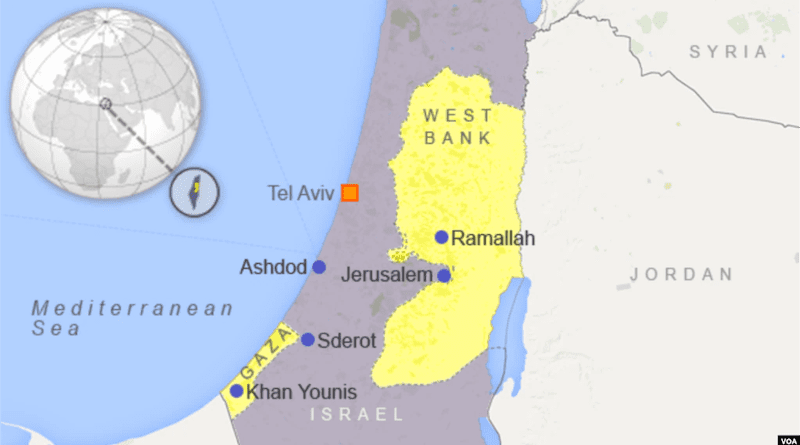
Israel, Gaza and the West Bank. Credit: VOA
March 22, 2026
EWTN News
By Madalaine Elhabbal
Christians in the West Bank continue to face an onslaught of aggressions by Israeli settlers, threatening their presence in the region, according to Auxiliary Bishop William Shomali of Jerusalem.
“The aggressions against Christians in the West Bank are multiplying,” Shomali said in a March 20 interview with “EWTN News Nightly.”
The situation for Palestinian Christians had been “calm” in the Bethlehem area, he said. “But now, there is more expansion of the settlements and more aggressions from the side of the settlers.”
Shomali said settlers have prevented Palestinian Christians from accessing their land through various threats, physical aggression, and property damage, including burning their cars.
“This happened mainly in the Christian village of Taybeh, and we communicated this news to all the world, even to the American ambassador in Tel Aviv, who came to visit the place, and he promised to do something, but not many things were done,” Shomali said.
In Birzeit, a Palestinian Christian town about six miles north of Ramallah in the West Bank, Shomali said settlers have been coming “almost every day to threaten people in their own homes or in their work.”
“This has become a real threat to Christian families,” he said, “because they lost their livelihood and their source of income.” The Church must intervene and provide aid for them to survive, the bishop said.
Shomali said Israeli settlers have also recently occupied land belonging to a convent of sisters in a village near Bethlehem called Urtas. The sisters “have a hill where they plant and grow olives and other things,” he said. “Settlers came to occupy this hill and to make it theirs, where they think of building a new settlement.”
He also noted a settlement to be built on the Shepherds’ Field of his own village, Beit Sahour, which he said is a piece of land that belongs to Christian families there.
“I heard just today, that a piece of land, one acre, was also entered by settlers who put an Israeli flag to mean that this land now is Israeli, while there is a deed of ownership to a Christian family that I know from Beit Sahour,” he said. “So slowly, slowly, the land of Palestine that Israels call now Judea and Samaria, the biblical name, is becoming less and less Palestinian and more and more settlers’ land.”

EWTN News
EWTN News is the rebranding of the Catholic News Agency (CNA), following the decision by EWTN — which was launched as a Catholic television network in 1981 by Mother Angelica, PCPA — that brings CNA and its affiliated ACI international outlets under a single, unified identity. Previous CNA articles may be found by clicking here.
“I heard just today, that a piece of land, one acre, was also entered by settlers who put an Israeli flag to mean that this land now is Israeli, while there is a deed of ownership to a Christian family that I know from Beit Sahour,” he said. “So slowly, slowly, the land of Palestine that Israels call now Judea and Samaria, the biblical name, is becoming less and less Palestinian and more and more settlers’ land.”
EWTN News
EWTN News is the rebranding of the Catholic News Agency (CNA), following the decision by EWTN — which was launched as a Catholic television network in 1981 by Mother Angelica, PCPA — that brings CNA and its affiliated ACI international outlets under a single, unified identity. Previous CNA articles may be found by clicking here.

No comments:
Post a Comment