Tuesday, March 24, 2026


Aid flotilla arrives in Cuba as US oil blockade bites


By AFP
March 24, 2026


Activists chanted 'Cuba yes! Blockade no!' as the aid boat arrived in Havana - Copyright AFP YAMIL LAGE


Elisa Colella aboard the Maguro with Lisandra Cots in Havana and Gerard Martinez in Miami

The first boat of a flotilla carrying medical supplies, food and solar panels reached Cuba on Tuesday to aid the island as a US fuel blockade deepens its energy crisis.

The Maguro shrimp fishing boat docked in Havana three days later than hoped after battling strong winds, currents and a pesky battery during its journey from Mexico.

As they approached Havana’s colonial-era fortification, the international activists stood on the cabin roof of the boat — symbolically renamed “Granma 2.0” as a tribute to the yacht used by Fidel Castro’s guerrilla fighters to launch their revolution in 1956.

They held a sign reading “Let Cuba live” while others waiting for them on the dock chanted “Cuba yes! Blockade no!”

“I wish everyone would unite, even Cubans abroad, and come and do the same because it is the people who are suffering,” said Amado Rodriguez, a 59-year-old driver walking near Havana Bay.

The first shipments arrived by plane from Europe, Latin America and the United States last week as part of an air and sea mission, dubbed Our America Convoy, to bring some 50 tonnes of aid to Cuba.

Two more ships are due to arrive Tuesday or Wednesday.

Activists say the mission, which had the support of the government, aims to bring relief to Cubans amid a de facto US oil blockade that President Donald Trump launched in January.

Critics have slammed the effort as benefiting the communist government more than ordinary people.

Convoy organizer David Adler, a US citizen, told AFP the mission brought urgently needed aid directly to Cubans and showed the world “the human costs of Trump’s siege on Cuba.”

“It demonstrated that international solidarity can triumph over forced isolation,” said Adler, coordinator of global left-wing group Progressive International.

The country has suffered seven nationwide blackouts since 2024 — two of them this past week — due to aging thermoelectric plants and oil shortages.

The situation has deteriorated since Trump ordered a military operation to capture Cuba’s chief regional ally, Venezuelan socialist leader Nicolas Maduro, in January — depriving the island of its main oil supplier.

Trump subsequently threatened to slap tariffs on any country shipping oil to Cuba.


– Trump’s ‘greed’ –


The Maguro left from Mexico’s Yucatan peninsula Friday carrying 32 people, including activists from Australia, Brazil, Ecuador, Italy, Mexico and the United States, and AFP journalists.

As the boat motored across the sea, Brazilian activist Thiago Avila said other nations should come to Cuba’s aid.

“We cannot allow the world and international law to be buried under the greed of Donald Trump,” Avila told AFP.

“That’s why we are here, that’s why people decided to mobilize for this and decided to donate.”

Avila was among the organizers of a flotilla that had tried to bring aid to Gaza last year despite a naval blockade. That effort was intercepted by Israeli forces.

Fellow Brazilian activist Lisi Proenca said the group was applying the experience it gained from the Gaza flotilla to bring aid to Cuba.

“The interesting thing is that we’re able to carry much larger items, like solar panels,” she told AFP.


– ‘Political sideshow’ –


In addition to daily outages, fuel prices have soared, public transport has become rare and trash is piling up as garbage trucks are no longer running.

Cuba has blamed Washington for the country’s hardship, pointing to the fuel blockade and a decades-old trade embargo.

Cuban exiles and other critics, who say the communist government is to blame for the economic crisis, said the convoy is giving political support to Havana.

“All of this is nothing more than a political sideshow,” Luis Zuniga, a former Cuban political prisoner now based in Miami, told AFP.

“The electricity crisis in Cuba does not stem from the oil embargo imposed by (Trump). It dates back to long before that,” Zuniga said.

11,000 Children Among Tens of Thousands ‘Waiting for Surgery’ in Cuba Due to US Blockade


Cuba’s Deputy Foreign Minister Carlos Fernandez de Cossio said he hoped the people of the United States would ask, “Why does our government treat the whole population of Cuba this way?”
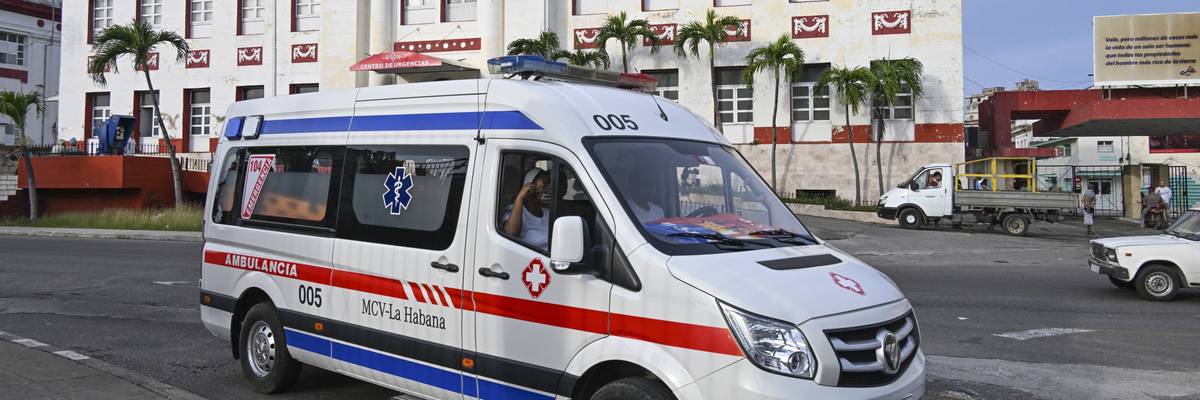

An ambulance passes in front of Calixto García Hospital in Havana on December 18, 2025.
(Photo by Yamil Lage/AFP via Getty Images)

Stephen Prager
Mar 23, 2026
COMMON DREAMS

More than 96,000 Cubans, including 11,000 children, are “waiting for surgery” due to a fuel shortage caused by the American blockade, the country’s deputy foreign minister, Carlos Fernandez de Cossio, said on Sunday.

The numbers cited by the minister on NBC’s “Meet the Press” on Sunday were first reported earlier this month by Cuban Minister of Public Health José Ángel Portal Miranda, who explained that President Donald Trump’s policy of “energy asphyxiation,” using tariffs to threaten countries out of importing fuel to Cuba, has devastated its National Health Service.



International Convoys Deliver Aid to Cuba as Russian Tanker Moves to Defy US Oil Blockade
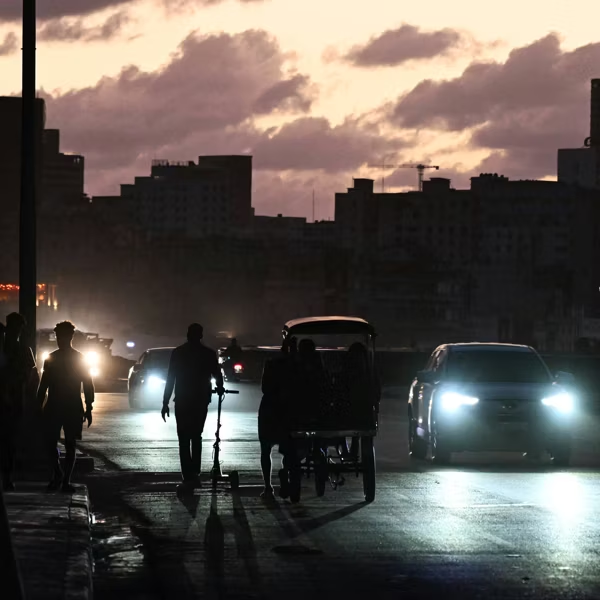


‘US Siege Is Warfare’: Cuba Faces Second Nationwide Blackout in Under a Week

The policy has left Cuba unable to import oil from abroad for more than three months, reducing its fuel supply by about 90% and leading to periodic blackouts and strict energy rationing.

Using the severely limited electricity at its disposal, Cuba’s health system has been forced to prioritize continuing cancer treatments and other lifesaving procedures, putting those awaiting non-urgent surgeries on the sidelines.

Last month, a specialist at a hospital in Holguín told Diario de Cuba that the surgeries canceled included “uncomplicated hernias, cataract surgeries, some non-urgent gynecological procedures, and scheduled orthopedic surgeries.”

Other healthcare professionals said that nobody was being admitted to the hospital for tests and that it was running low on basic supplies like syringes, IV tubing, and antibiotics, which could not be delivered due to fuel shortages. Most of those that have been used had to be donated by family members or purchased for exorbitant prices on the black market.


Jorge Barrera, a reporter for CBC News, spoke with patients and employees at Havana’s National Institute of Cardiology and Cardiovascular Surgery this weekend and found it to be at about half capacity, and that nonessential care has been virtually all suspended.

“Even though the health system is a point of pride for Cuba... something that they export to the rest of the world,” Barrera explained, “because of this crisis, because of the impact it’s had on the skyrocketing prices, it’s just not enough for them to make ends meet. So people are quitting... to find other ways to make money to feed their families.”


Experts with the United Nations have condemned the blockade of Cuba as “a serious violation of international law.” Condemnations have grown louder over the past week as Trump said he believed he’d have “the honor of taking Cuba” after it collapsed.

De Cossio said he hoped the people of the United States would ask “Why does our government treat the whole population of Cuba this way?” and that they’d “understand that it’s not correct to treat another nation the way the US is doing simply to try to achieve political goals.”

The US blockade of Cuba is largely unpopular with the American public. A poll published last week by YouGov found that just 28% of adult US citizens said they approved of the US blocking oil shipments to the country, while 46% said they opposed it.

Asked by anchor Kristen Welker about suggestions from Trump that Cuba would collapse “on its own” without the need for the US to intervene militarily, De Cossio retorted, “What does ‘on its own’ mean when it’s being forced by the United States?”

Prior to Trump’s further measures to isolate Cuba in January, the US had placed Cuba under an economic embargo for more than 60 years, which severely hampered the country’s economic development and has cost Cuba trillions of dollars since it began, according to the UN.

“It’s a very bizarre statement, and it’s claimed by most US politicians repeatedly that Cuba will collapse on its own,” De Cossio said. “Then why does the US government need to employ so many resources, so much political capital, so many human resources to try to destroy the economy of another country? Evidently, it implies that the country does not have the characteristics to collapse on its own.”

Cuba is Trump’s Next Imperial Project

Source: Originally published by Z. Feel free to share widely.

Another Nonexistent Threat

Regime change in Cuba may be the next stop for the Trump war machine. Here’s what he told CNN in an interview March 6: 

“Cuba is gonna fall pretty soon . . . They want to make a deal, and so I’m going to put Marco ]Rubio] over there and we’ll see how that works out. We’re really focused on this one [Iran] right now. We’ve got plenty of time, but Cuba’s ready — after 50 years . . . I’ve been watching it for 50 years, and it’s fallen right into my lap because of me, it’s fallen, but it’s nevertheless fallen right into the lap. And we’re doing very well.” 

The justice department followed up by indicting several Cuban officials and entities for their alleged involvement in drug trafficking—a tactic now also being used to pursue another Trump critic, Colombia’s President Gustavo Petro.

The authority for Trump’s threats to Cuba are contained in an executive order on January 29, 2026. It states that “the policies, practices, and actions of the Government of Cuba constitute an unusual and extraordinary threat” to U.S. national security and foreign policy. The executive order E.O. declared a national emergency under the National Emergencies Act and invoked the International Emergency Economic Powers Act of 1977, which empowers Trump to impose tariffs on foreign countries that “directly or indirectly” supply oil to the Cuban government.

To be clear, Cuba presents no national emergency, nor is there evidence that Cuba constitutes a threat of any kind to US national security—no more so than Iran or Venezuela. The real emergency in Cuba is humanitarian: the needless suffering inflicted on the Cuban people by the US energy blockade, which is preventing necessities such as food, medicine, and medical equipment from reaching them.

Naked Imperialism

In a January 11, 2026, social media post, shortly after US forces seized Venezuela’s leader, Nicolas Maduro, Trump asserted that there would be “NO MORE OIL OR MONEY GOING TO CUBA.” Trump is in the driver’s seat on Cuba: The threat to its oil suppliers of high tariffs, accompanied by a cut-off of Venezuelan oil shipments to Cuba, has left Cuba’s economy without imported oil for three months. Cuba relies on those shipments for around 60 percent of its energy. 

Cuba’s president, Miguel Diaz-Canel, has little choice but to deal with Trump; he’s now in talks with the US. Diaz-Canel says he is insisting that the talks must take place with mutual respect for each other’s political systems, which is about the last thing Trump would agree to. He and Rubio want nothing less than a dismantling of Cuba’s political-economic system. Diaz-Canel seems willing to make economic changes, such as allowing exiles to invest in the island. His government has also released some political prisoners.

Rubio quickly made clear that Diaz-Canel’s proposals were insufficient. “Cuba has an economy that doesn’t work and a political and governmental system that can’t fix it,” Rubio said. “So they have to change dramatically. What they announced … is not dramatic enough. It’s not going to fix it. So they’ve got some big decisions to make over there.” 

What Rubio is really saying is that nothing short of regime change will satisfy the US. Trump has said just that; a week ago he demanded the resignation of Diaz-Canel.  

Bloomberg reports that “People familiar with the matter say Trump . . . wants to use American economic pressure to make the island nation financially dependent on Washington. The US would essentially take the place of its onetime rival, the Soviet Union.” Presumably, Trump will decide who should be president of Cuba. Marco Rubio would then become Cuba’s viceroy, dictating policies designed to keep Cuba firmly under US control.

On March 18 Trump told reporters: “we’ll be doing something with Cuba very soon.” A day earlier, the president floated the idea of “taking Cuba in some form,” after saying last month a “friendly takeover of Cuba” was possible. “Whether I free it, take it, I think I could do anything I want with it,” he told reporters. Spoken like a true imperialist.

Resistance is Promised

US threats have led Diaz-Canel to say Cuba will resist any US attempt to take over the island. “In the face of the worst scenario, Cuba is accompanied by a certainty: any external aggressor will clash with an impregnable resistance,” Diaz-Canel said. 

But when it comes to the capacity to resist, Cuba is far more like Venezuela than like Iran. Gone are the days when Cubans rose up against an invasion. That was in 1961, when the new Kennedy administration suffered its first major foreign policy defeat. He expected Cubans to reject Fidel Castro’s revolution and welcome the overthrow of the government by Cuban exiles who had trained in Guatemala with the full knowledge of the preceding Eisenhower administration. 

Didn’t happen; the exiles’ invasion was easily defeated. Fidel welcomed the Russians instead, and a year later the US-USSR missile crisis resulted. Diaz-Canel isn’t Castro, and it is hard to see how a US show of force could be effectively resisted when the country is on the verge of economic collapse. 

And this time around, Trump has plenty of support in Congress for overthrowing Cuba’s legitimate rulers. Only the war with Iran, he says, affects the timeline for dealing with Cuba. Should Trump fail to achieve any of his objectives in Iran, as now seems likely, he may be more determined than ever to seek a “win” in Cuba.

Mel Gurtov, syndicated by PeaceVoice, is Professor Emeritus of Political Science at Portland State University.

Source: Originally published by Z. Feel free to share widely.

Donald Trump is plotting a “takeover” of Cuba.

Washington’s lethal siege has already brought life on the island to a standstill. Millions have been plunged into darkness amidst rolling blackouts. Public transportation cannot operate without fuel. Shelves are empty of food.

In 1962, the US State Department designed the Cuban embargo to “bring about hunger, desperation and overthrow of government.” Today, the Trump administration’s collective punishment channels the sinister logic of its predecessors.

That is why we are preparing the Nuestra América Convoy to Cuba, mobilising by air, land, and sea in solidarity with the Cuban people.

On Saturday, the 21 March, as our Convoy arrives in Havana, we will celebrate an International Day of Solidarity with Cuba — and call on you to join us.

Wherever you may be in the world, we invite you to get involved with this global day of action, mobilising with your friends, colleagues, and comrades at your local US embassy to make your voice heard.

(Make your own call to action with our design templates here.)

Together, we will demand an end to Washington’s illegal siege and stand up for the cause of Cuban self-determination.

Join your local Cuba solidarity group. Organize an embassy demonstration. Protest Trump’s deadly blockade.

Over more than 60 years, Cuba’s revolutionary internationalism has helped to liberate millions from colonial rule, saved countless lives from the scourge of disease and taught entire generations to read and write.

This unwavering commitment to the cause of humanity has earned the island the eternal hostility of its northern neighbour. According to the UN, the 60-year US embargo has now cost Cuba at least $130 billion in damages.

The Trump administration’s latest escalation has already compromised entire intensive care units and emergency rooms.

On 21 March, join us to resist Washington’s efforts to recolonise the Western hemisphere by taking action outside your local US embassy.

Our message is clear: ¡Cuba sí, bloqueo no!

In solidarity,

The Nuestra América Convoy


NAZI IS AN ANTI-COMMUNIST

New Chile president withdraws support for Bachelet UN chief bid

By AFP
March 24, 2026


Chile President Jose Antonio Kast's leftist predecessor had backed former president Michelle Bachelet (L) to become the first woman to head the United Nations (COMBO) This combination of files pictures created on March 24, 2026 shows Chile's former president (2006-2010 and 2014-2018) Michelle Bachelet speaking to the press after casting her ballot during the presidential runoff election in Santiago on December 14, 2025, and Chile's President-elect Jose Antonio Kast speaking during a press conference for national and international media after a meeting with business leaders from various production sectors at the Swissotel in Quito on December 23, 2025. Chile’s new government under President Jose Antonio Kast withdrew on March 24, 2026, the country’s support for former socialist president Michelle Bachelet’s candidacy for UN secretary-general. - Copyright AFP/File Raul BRAVO, Galo Paguay

Chile’s new hard-right President Jose Antonio Kast on Tuesday withdrew Santiago’s support for former socialist president Michelle Bachelet as candidate for the post of UN secretary general.

Kast’s leftist predecessor Gabriel Boric had in February backed two-term president Bachelet’s attempt to become the first woman to head the United Nations, in a move also supported by leftist-led Brazil and Mexico.

A foreign ministry statement on Tuesday however said Santiago “has decided to withdraw Chile’s backing for ex-president Michelle Bachelet as candidate for the post of secretary general of the United Nations.”

“The fragmentation of candidacies among Latin American states and the differences with some of the key players shaping this process render this candidacy and its eventual success unviable,” the ministry said, while adding it would not back another contender if Bachelet were to seek to stay in the race.

Even without having Chile’s backing, Bachelet, 74, can still proceed with her candidacy, as she retains Brazil’s and Mexico’s backing.

Each potential candidate must be formally nominated by a state or group of states, but not necessarily by their country of origin.

Bachelet, a pediatrician by profession, is the only woman to have served as president of Chile (2006–2010 and 2014–2018), under the Socialist Party’s banner.

She has been hoping to succeed Portugal’s Antonio Guterres, 76, who will conclude his second term at the UN helm on December 31.

As well as president, Bachelet previously served as executive director of UN Women (2010–2013) and later as UN high commissioner for human rights (2018–2022).

To date, no woman has held the post of UN secretary general.

An unwritten rule has it that the top UN post rotates among the world’s main regions, and now it’s the turn of Latin America.

The only previous Latin American UN secretary general was Peruvian diplomat Javier Perez de Cuellar, who served between 1982 and 1991.


NASA to build $20 bn moon base, pause orbital lunar station plans


By AFP
March 24, 2026


NASA Administrator Jared Isaacman's tenure has introduced a raft of changes at the US space agency - Copyright AFP Miguel J. Rodriguez Carrillo

NASA’s chief on Tuesday said the US space agency will invest $20 billion to develop a base on the Moon, while suspending its plans to create the lunar orbital space station known as Gateway.

“The agency intends to pause Gateway in its current form and shift focus to infrastructure that enables sustained surface operations,” Jared Isaacman said in a statement given during a day-long event at NASA headquarters in Washington.

“Despite challenges with some existing hardware, the agency will repurpose applicable equipment and leverage international partner commitments to support these objectives,” he said.

The European Space Agency among other international organizations were partners on the planned Gateway project.

It’s the latest shake-up at NASA in the wake of changes to the Artemis program, which aims to send Americans back to the Moon and establish a long-term presence there, paving the way for eventual missions to Mars.

The Gateway orbital lunar station was meant to serve both as a point of transfer for astronauts headed to the Moon as well as a platform for research.

The suspension of the initiative isn’t entirely surprising: some had criticized it as wasteful or a distraction from other lunar ambitions.

Isaacman said NASA now plans to spend $20 billion over the next seven years to construct the lunar base over dozens of missions, “working together with commercial and international partners towards a deliberate and achievable plan.”

“There will be an evolutionary path to building humanity’s first permanent surface outpost beyond Earth, and we will take the world along with us.”


– Artemis 2 on deck –


Isaacman, who took the helm of NASA late last year, abruptly announced less than a month ago that it was reshuffling its Artemis program that has suffered multiple delays in recent years, as it aims to ensure Americans can return to the Moon’s surface by 2028.

That goal remains unchanged, but the US space agency is shifting its flight lineup to include a test mission before an eventual lunar landing to improve launch “muscle memory,” Isaacman said.

That strategic revision came amid repeated delays to the Artemis 2 mission, which was originally due to take off as early as February, but is now targeting early April. It is meant to see the first flyby of the Moon in more than half a century.

During his first term, President Donald Trump announced he wanted Americans to once again set foot on the lunar surface.

China is forging ahead with plans for its first crewed mission to the Moon by 2030 at the latest.

The US effort depends in part on the progress of NASA’s private partners.

SpaceX and Blue Origin, the respective space companies of dueling billionaires Elon Musk and Jeff Bezos, are contracted to develop lunar landers used in the Artemis program.


NASA Unveils Initiatives To Achieve America’s National Space Policy

Artist's concept of Phase 3 of NASA's Moon Base. Credit: NASA


March 24, 2026 
By Eurasia Review


As part of its “Ignition” event on Tuesday, NASA announced a series of transformative agencywide initiatives designed to achieve President Donald J. Trump’s National Space Policy and advance American leadership in space. These actions reflect the urgency of the moment, but also the tremendous opportunity ahead for world-changing science and discovery.

“NASA is committed to achieving the near‑impossible once again, to return to the Moon before the end of President Trump’s term, build a Moon base, establish an enduring presence, and do the other things needed to ensure American leadership in space. This is why it is essential we leave an event like Ignition with complete alignment on the national imperative that is our collective mission. The clock is running in this great‑power competition, and success or failure will be measured in months, not years,” said NASA Administrator Jared Isaacman. “If we concentrate NASA’s extraordinary resources on the objectives of the National Space Policy, clear away needless obstacles that impede progress, and unleash the workforce and industrial might of our nation and partners, then returning to the Moon and building a base will seem pale in comparison to what we will be capable of accomplishing in the years ahead.”

NASA Associate Administrator Amit Kshatriya said, “Today we are aligning NASA around the mission. On the Moon, we are shifting to a focused, phased architecture that builds capability landing by landing, incrementally, and in alignment with our industrial and international partners. In low Earth orbit (LEO), we are recognizing where the market is and where it isn’t, recognizing the incredible value of the International Space Station, and building a transition that builds a competitive commercial ecosystem rather than forcing a single outcome the market cannot support. In our science missions, we are opening the lunar surface to researchers and students nationwide, and with Space Reactor‑1 Freedom, we are finally putting nuclear propulsion on a trajectory out of the laboratory and into deep space. And this is all possible by investing in our people, bringing critical skills back into the agency, putting our teams where the machines are being built, and creating real pathways for the next generation of NASA leaders. Our workforce is the jewel of NASA, and from their leaders, they need clear mission goals, the tools to execute, and to get out of their way. This is what Ignition is about.”
Going back to the Moon

The announcements build on recent updates to the Artemis program, including standardizing the SLS (Space Launch System) rocket configuration, adding an additional mission in 2027, and undertaking at least one surface landing every year thereafter. Under this previously updated architecture, Artemis III – scheduled for 2027 – will focus on testing integrated systems and operational capabilities in Earth orbit in advance of the Artemis IV lunar landing.

Looking beyond Artemis V, NASA announced March 24 it will begin to incorporate more commercially procured and reusable hardware to undertake frequent and affordable crewed missions to the lunar surface, initially targeting landings every six months, with the potential to increase cadence as capabilities mature.


To achieve an enduring human presence on the Moon, NASA also announced a phased approach to building a lunar base. As part of this strategy, the agency intends to pause Gateway in its current form and shift focus to infrastructure that enables sustained surface operations. Despite challenges with some existing hardware, the agency will repurpose applicable equipment and leverage international partner commitments to support these objectives.

In the coming days, NASA will release Requests for Information (RFIs) and draft Requests for Proposals (RFPs) to ensure continued progress in meeting national objectives.
Building the Moon Base

NASA’s plan for establishing a sustained lunar presence will roll out in three deliberate phases.Phase One: Build, Test, Learn

NASA shifts from bespoke, infrequent missions to a repeatable, modular approach. Through CLPS (Commercial Lunar Payload Services) deliveries and the LTV (Lunar Terrain Vehicle) program, the agency will increase the tempo of lunar activity, sending rovers, instruments, and technology demonstrations that advance mobility, power generation (including radioisotope heater units and radioisotope thermoelectric generators), communications, navigation, surface operations, and a wide range of scientific investigations.

Phase Two: Establish Early Infrastructure

With lessons from early missions in hand, NASA moves toward semi‑habitable infrastructure and regular logistics. This phase supports recurring astronaut operations on the surface and incorporates major international contributions, including JAXA’s (Japan Aerospace Exploration Agency) pressurized rover, and potentially other partner scientific payloads, rovers, and infrastructure/transportation capabilities. Phase Three: Enable Long‑Duration Human Presence

As cargo‑capable human landing systems (HLS) come online, NASA will deliver heavier infrastructure needed for a continuous human foothold on the Moon, marking the transition from periodic expeditions to a permanent lunar base. This will include ASI’s (Italian Space Agency) Multi-purpose Habitats (MPH), CSA’s (Canadian Space Agency) Lunar Utility Vehicle, and opportunities for additional contributions in habitation, surface mobility and logistics.
Ensuring American presence in low Earth orbit

While building a sustainable lunar architecture, NASA is also reaffirming its commitment to low Earth orbit. For more than two decades, the International Space Station has served as a world‑class orbital laboratory, enabling more than 4,000 research investigations, supporting more 5,000 researchers, and hosting visitors from 26 countries. The space station required 37 shuttle flights, 160 spacewalks, two decades, and more than $100 billion to design, develop, and build. The orbital laboratory cannot operate indefinitely. The transition to commercial stations must be thoughtful, deliberate, and structured to support long‑term industry success.


NASA is introducing and seeking industry feedback on an additional LEO strategy that preserves all current pathways while adding a phased, International Space Station‑anchored approach to avoid any gap in U.S. human presence and mature a robust commercial ecosystem. Under this alternative approach, NASA would procure a government‑owned Core Module that attaches to the space station, followed by commercial modules that are validated using International Space Station capabilities and later detach into free flight. After maturing technical and operational capabilities and market demand is realized, the stations would detach and NASA would be one of many customers purchasing commercial services. To stimulate the orbital economy, NASA would expand industry opportunities, including private astronaut missions, commander seat sales, joint missions, multiple module competitions, and prize‑based awards.

An industry RFI opens Wednesday, March 25, to inform partnership structures, financing, and risk mitigation.
 
Advancing world-changing discovery with current, developing science missions

In a Golden Age of exploration and discovery, NASA takes full advantage of every opportunity to get science into space. The James Webb Space Telescope continues to transform our understanding of the early universe, Parker Solar Probe has flown through the atmosphere of the Sun, NASA has shown it can defend the planet by deflecting asteroids, and Earth science data is used extensively by American companies, U.S. agriculture, and disaster relief. On the International Space Station, NASA is conducting groundbreaking experiments in quantum science.

Future opportunities will advance U.S. leadership in space science. The Nancy Grace Space Telescope, launching as early as this fall, will advance our understanding of dark energy, and has created a new standard for the management of large science missions. Dragonfly will launch a nuclear-powered octocopter in 2028, arriving at Saturn’s moon Titan in 2034 to explore its complex, organic-rich environment. In 2028, NASA will launch and deliver ESA’s (European Space Agency) Rosalind Franklin Rover to Mars, with NASA’s contributed mass spectrometer for the Mars Organic Molecule Analyzer (MOMA) instrument, which may result in the most advanced detection and analysis of organic matter ever conducted on Mars. A new Earth science mission launching next year will measure for the first time the evolution of the dynamics within convective storms to improve the prediction of extreme weather events up to six hours before the storm occurs.

The agency detailed how advancements in lunar science also will be afforded by the build out of the Moon Base and underpin future Moon and Mars exploration. With an accelerated CLPS cadence, targeting up to 30 robotic landings starting in 2027, NASA is expediting delivery of science and technology to the lunar surface. There will be many opportunities for payload delivery including rovers, hoppers, and drones with contributions welcomed from industry, academia, and international partners. Near-term payloads include the VIPER rover and the LuSEE‑Night mission. An RFI will be released March 24 that calls for payloads capable of supporting NASA’s science and technology goals for additional 2027 and 2028 flights. It will enable students and researchers across the country to work on scientific instruments for use on the surface of the Moon in the years ahead. This RFI also will solicit payloads incorporated on future missions to Mars including the Mars Telecom Network (MTN) and a nuclear technology demonstration mission.

The agency intends to partner with philanthropic and privately funded research organizations with shared objectives in space science.

Other RFIs released March 24 will strengthen “Science as a Service” partnerships and commercial capabilities, allowing NASA to streamline legacy operations and focus investment on the transformational missions only the agency can lead.

Finally, NASA will unveil a previously unseen pair of images from the James Webb and Hubble Space Telescopes. These images show the planet Saturn in unprecedented detail in both infrared and visible wavelengths.
America underway on nuclear power in space

In addition to these scientific missions, after decades of study and in response to the National Space Policy, NASA announced a major step forward in bringing nuclear power and propulsion from the lab to space.

NASA will launch the Space Reactor‑1 Freedom, the first nuclear powered interplanetary spacecraft, to Mars before the end of 2028, demonstrating advanced nuclear electric propulsion in deep space. Nuclear electric propulsion provides an extraordinary capability for efficient mass transport in deep space and enables high power missions beyond Jupiter where solar arrays are not effective.

When SR-1 Freedom reaches Mars, it will deploy the Skyfall payload of Ingenuity‑class helicopters to continue exploring the Red Planet. SR-1 Freedom will establish flight heritage nuclear hardware, set regulatory and launch precedent, and activate the industrial base for future fission power systems across propulsion, surface, and long‑duration missions. NASA and its U.S. Department of Energy partner will unlock the capabilities required for sustained exploration beyond the Moon and eventual journeys to Mars and the outer solar system.

None of these endeavors can succeed without the NASA workforce. As previously announced, the agency is rebuilding its core competencies, converting thousands of contractor positions to civil service, and restoring the engineering, technical, and operational strengths expected of the world’s premier space organization.

NASA is expanding opportunities for interns and early‑career professionals and, in partnership with the U.S. Office of Personnel Management and NASA Force, is creating new pathways for experienced industry talent to serve through term‑based appointments. The agency also is seeking to open opportunities for NASA employees to gain valuable experience working within the most technologically advanced space industry in history.

The changes announced on March 24 will be implemented during the coming months, with teams agencywide ensuring a smooth transition while advancing key programs and partnerships.

NASA will embed subject‑matter experts across the supply chain – at every major vendor, subcontractor, and critical‑path component – to challenge assumptions, solve problems, accelerate production, and help ensure the right outcomes are achieved.


Through these reforms, NASA said it is strengthening its ability to deliver on the President’s National Space Policy and ensure continued American superiority in space.

PLEASE, DADDY

ConocoPhillips chief seeks extra US protection of Mideast assets


By AFP
March 24, 2026


ConocoPhillips CEO Ryan Lance (C) pictured during a meeting at the White House in January 2026 - Copyright AFP SAUL LOEB

US oil giant ConocoPhillips has been urging President Donald Trump’s administration to provide extra protection around assets in Qatar where the company has invested significantly, its chief executive said Tuesday.

CEO Ryan Lance’s comments at the CERAWeek energy conference in Houston come as war rages on in the Middle East, after US-Israeli strikes on Iran on February 28 triggered Tehran’s retaliation.

In addition to bringing commercial shipping to a virtual halt through the vital Strait of Hormuz, Iran has also attacked energy infrastructure in the region.

“We’re obviously a big investor in Qatar, so a lot of my conversations with the administration is really pleading to try to get extra protection around the US-owned assets in Qatar,” Lance said.

“As they protect naval and air force bases and our servicemen and embassies and US citizens, putting US assets on that list to protect there in Qatar is very important,” he added.

Lance also said that his company had to evacuate a number of staff over the last few weeks, adding that the situation has been difficult to assess.

Oil prices have soared since the war began, with the price of a barrel of international benchmark Brent crude surging by more than 40 percent.

As of Tuesday afternoon, Brent prices hovered above $104.30 per barrel.

Normally, around a fifth of the world’s oil and liquefied natural gas passes through the Strait of Hormuz.
KAKISTOCRACY
Trump has destroyed Venezuela’s socialist ideology: opposition leader


By AFP
March 24, 2026


Venezuelan opposition leader Maria Corina Machado says US President Donald Trump has fatally wounded Venezuela's long-running socialist regime - Copyright AFP RONALDO SCHEMIDT

Venezuelan opposition leader Maria Corina Machado told AFP on Tuesday that her country’s formerly all-powerful socialist ideology has been fatally “wounded” by US President Donald Trump.

The regime known as “Chavismo” that held Venezuela in its grip for quarter of a century under Hugo Chavez and his successor Nicolas Maduro is “wounded irreparably and is being dismantled,” Machado said.

The oil-rich Latin American country was thrown into turmoil this January when US military forces toppled leftist Maduro, who has now been replaced with his former deputy Delcy Rodriguez.

While Rodriguez served under Maduro, she has proved eager to bend to Trump’s demands, including reopening the country to US oil companies. Last week, she ordered a wide-ranging reshuffle of senior military leaders.

“Following President Trump’s instructions, they are dismantling their own repressive and corrupt structures — a crucial step toward the transition,” Machado said during an interview with AFP in Houston, Texas, where she was attending the CERAWeek global energy forum.

Machado, the 2025 Nobel Peace Prize winner, said that when presidential elections are held again in Venezuela, she will participate “in that electoral process.” However, she did not specify whether she would run.

Machado said she believed that “Venezuelans will freely decide who they want” as leader in the next elections.

Machado was banned from running for president in the 2024 election. After Maduro claimed a reelection victory, a wave of repression forced her to remain in hiding for more than a year.

She has remained in the United States for most of her exile.

In January, just two weeks after US forces snatched Maduro and brought him to New York for trial, she met with Trump in the White House and presented him with her Nobel prize.

Trump has said he would like to “get her involved” in Venezuela’s political process. But he has so far sidelined Machado and backed Rodriguez as interim leader.

Maduro is being held in a New York jail while awaiting trial on US drug trafficking charges.


THE WAR TRUMP IS IGNORING

Almost 1,000 drones within 24 hours: Russia launched one of its largest attacks on Ukraine

Fire and smoke rise above the city center following Russia's drone attack in Lviv, Ukraine, Tuesday, March 24, 2026.
Copyright AP Photo


By Sasha Vakulina
Published on 

In one of its largest attacks since the beginning of the all-out war, Russia launched almost 1,000 drones against Ukraine, targeting all regions, including Western Ukraine.

Russia launched almost 1,000 drones against Ukraine within 24 hours between March 23 and 24, making it one of Moscow’s largest aerial attacks since the beginning of the full-scale invasion.

Following a massive barrage of missiles and drones overnight, Russia carried on its attack during Tuesday in a rare daytime wave of over 550 attack drones targeting central and western regions.

At least three people have been killed and over 30 have been injured across Ukraine during the daylight attack, following the overnight missiles and drone assault, killing at least four people and injuring 21, according to regional authorities.

Lviv in Western Ukraine got hit and 17 people were wounded when Russian drones hit civilian areas in the city not far from the border with Poland.

UNESCO listed monastery in Lviv old town hit

Lviv regional Governor Maksym Kozytskyi said an architectural landmark of national significance, the Bernardine Monastery complex, was damaged in the attack.

The Monastery is situated in Lviv’s historic centre, which is listed as a UNESCO World Heritage site.

In his evening address Volodymyr Zelenskyy said the history of this church dates back to the early 17th century.

“Iranian ‘Shahed’ drones, modernised by Russia, are striking a church in Lviv – this is an absolute perversion, and only someone like Putin could find this appealing.”

Moscow strikes also hit critical infrastructure facilities in other districts.

Russia also targeted Ivano-Frankivsk, another regional capital in western Ukraine.

Two people were killed in the attack in the city centre, four others were injured, including a 6-year-old child, regional governor stated.

Authorities also reported damage to maternity hospitals and around 10 residential buildings.

Russia 'changing tactics' and 'trying to find vulnerabilities'

Explosions were reported as well in Khmelnytskyi and Ternopil, in Western Ukraine, as well as in Vinnytsia and Zhytomyr, in the central part of the country.

A 12-year-old girl was injured in a Russian strike on central Zhytomyr and has been hospitalised.

Kyiv and the areas around the capital were also targeted during the daytime attack with Ukraine’s Air Force registering drones flying towards Kyiv from the North.

Ukraine's Defence Ministry advisor Serhii Flash said that Russia is constantly changing its tactics for massive strikes, "trying to find vulnerabilities," and break through Ukraine's air defences.

Zelenskyy said the scale of Russian attack makes it ”abundantly clear that Russia has no intention of actually ending this war.”

“And when you consider that Russia is also helping the Iranian regime to strike across the entire region, the conclusion is quite obvious: without additional and strong pressure on Russia, without tangible Russian losses, those in Moscow will have no desire to step back from the war or to get used to peace again.”


Russia rains drones on Ukraine, killing eight, hitting UNESCO site

By AFP
March 24, 2026


Russia pours 400 drones at western Ukraine in rare daytime attack
 - Copyright TELEGRAM /@andriysadovyi/AFP Handout

Yuriy DYACHYSHYN with Daria ANDRIIEVSKA in Kyiv

Russia fired almost 1,000 drones at Ukraine over the last 24-hours, unleashing one of its largest-ever daytime attacks, killing at least eight people and hitting the UNESCO-protected city centre of Lviv, officials said Tuesday.

Two people were killed and a maternity hospital damaged in a drone strike on the western city of Ivano-Frankivsk, with another person killed in the central Vinnytsia region — part of an assault that followed an overnight barrage on residential buildings in several cities that killed another five people.

In Lviv, a western city far from the front, an AFP reporter saw a column of flames rising from a building next to the 17th-century St. Andrew’s Church and Bernardine Monastery in the city centre, which was struck during evening rush hour.

Firefighters were working to put out the blaze at the apartment building, whose roof had been smashed in and windows blown out.

First responders and locals were seen sheltering inside a church in mid-attack, waiting for the all-clear to go back outside.

A spokesman for Ukraine’s air force told AFP it was one of the biggest-ever daytime attacks on Ukraine.

“On such a large scale, it’s basically the first time. I don’t recall there being such daytime strikes with this number of drones,” said the spokesman, Yuriy Ignat.

Russia fired 550 drones during the day on Tuesday, following 392 overnight, Ukraine’s air force said in a statement.

Moscow has typically fired its barrages overnight in the four-year war, which started with Russia’s full-scale invasion of Ukraine in February 2022 and has killed hundreds of thousands of people.


– ‘More protection needed’: Zelensky –


The daytime strikes on the centre of Ivano-Frankivsk killed two people and wounded four, including a six-year-old child, regional head Svitlana Onyshchuk said on social media.

Around 10 residential buildings and a maternity hospital were damaged, she said.

In the Vinnytsia region, one person was killed and 11 wounded, the regional head said.

In Lviv, at least 13 people were hospitalised.

Unverified video from the city shared widely on social media showed a drone careering down into a building near a church in the city centre, erupting into a ball of flames on impact.

Earlier, in Kyiv, AFP reporters saw locals — including a mother with her toddler — sheltering in the metro at lunchtime during a rare midday air alert.

The attacks came with Ukraine concerned that it could struggle to repel relentless Russian aerial strikes as its supplies of US air defence systems dwindle amid the war in the Middle East.

“These numbers clearly show that more protection is needed to save lives from Russian strikes,” Ukrainian President Volodymyr Zelensky said on social media.

A third round of US-brokered talks between Moscow and Kyiv aimed at ending Russia’s invasion has been derailed by the war in the Middle East.

Ukraine sent a delegation to the United States last weekend in a bid to revive the negotiation process, but the effort yielded no immediate result.

Kyiv has been seeking to trade its anti-drone technology and expertise for conventional air defence missiles, which it urgently needs, and has dispatched around 200 of its military experts to Gulf countries facing Iranian drone attacks.


– Housing, infrastructure hit –


Overnight, Russian missiles and drones rained down on residential areas and transport and energy infrastructure across Ukraine, local authorities said.

Five people were killed and dozens wounded in strikes across the central Poltava region, the eastern city of Kharkiv, and Zaporizhzhia and Kherson in the south.

AFP reporters in Zaporizhzhia — repeatedly battered by Russian attacks — saw a fire raging across multiple floors in a high-rise residential block, windows and balconies blasted out and grey smoke bellowing from the building.

The nighttime attack also cut a key power line connecting neighbouring Moldova to Europe, forcing the country to declare a state of emergency.

Another power line to the southern Zaporizhzhia nuclear power plant was also cut, the International Atomic Energy Agency (IAEA) reported.

Russia has occupied large swathes of eastern and southern Ukraine in a gruelling campaign that has forced millions of people to flee their homes.

In Russia, authorities in the western Kursk region said a Ukrainian strike on a farm had killed one person and wounded 13.

On the battlefield, Russia’s army said it had captured a Ukrainian village in the Kharkiv region.


Ukraine peace talks stall as Russia begins its spring offensive

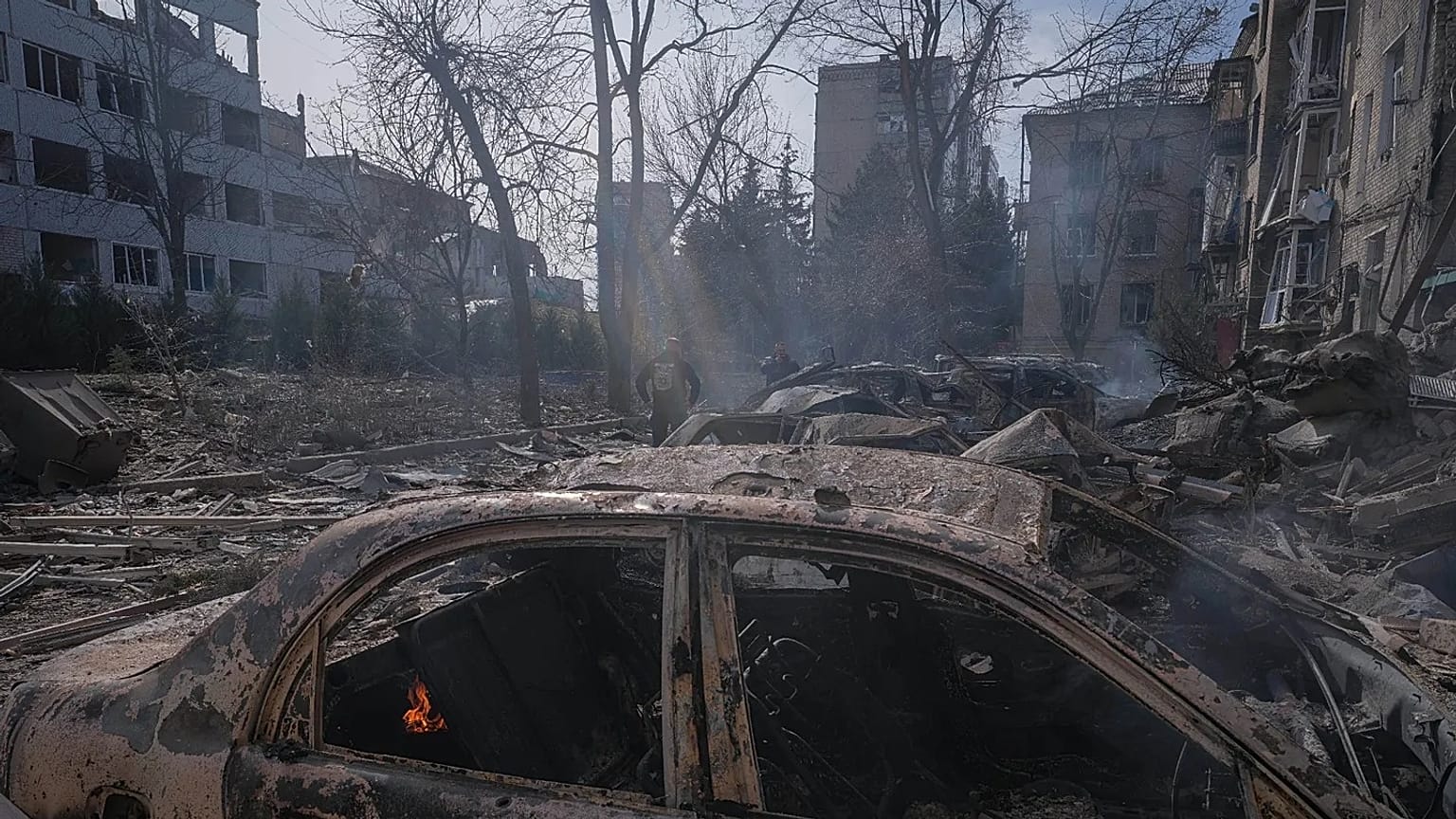
a damaged residential neighbourhood after Russian guided aerial bomb hit the frontline town center, in Druzhkivka, Donetsk region, Ukraine, March 2, 2026
Copyright AP Photo

By Sasha Vakulina
Published on 

The diplomatic process aimed at ending Russia’s war against Ukraine has stalled since the beginning of the Iran war, which Kyiv claims only “bolsters Russia’s confidence”.

After a few rounds of trilateral talks between the US, Ukraine and Russia, the diplomatic process aimed at putting an end to Moscow’s full-scale invasion has largely stalled with no clear progress in sight.

Kyiv’s delegation returned from two days of meetings in Miami with few tangible results, following what Ukrainian President Volodymyr Zelenskyy described as a discussion over “the key points, opportunities and challenges”.

“The most important thing is to work out security guarantees in such a way that they bring us closer to ending the war. Security is the key to peace.”

US Special Envoy to the Middle East Steve Witkoff stated on Sunday that the “constructive” US-Ukrainian talks focused on humanitarian efforts and on establishing a durable and dependable security framework for Ukraine.

In the bigger picture, Kyiv sees it as critically important to continue the dialogue with the US and demonstrate to Washington that it is not Ukraine that is an obstacle to a peace solution.

With the beginning of the Iran war on 28 February, US President Donald Trump’s focus has significantly shifted to the situation in the Middle East.

“The geopolitical situation has become more complicated due to the war against Iran, and this, unfortunately, bolsters Russia’s confidence,” Zelenskyy said on Tuesday, adding that “the fundamental circumstances have not changed”.

“Russia is continuing this war and destabilisation in Europe, supporting the Iranian regime with intelligence data and thereby prolonging the war in that region, as well as preparing for new conflicts in the coming years.”

According to Ukrainian outlets, the US officials are again increasing pressure on Kyiv to withdraw its troops from the Donetsk region as part of a potential settlement.

Washington warned the Ukrainian delegation that it could step back from mediation efforts if no progress is achieved, prioritising military operations against Iran instead, reports claim.

Kyiv insists that the most sensitive issues, including Ukraine’s territories, can only be discussed in a direct meeting between Zelenskyy, Trump and Russian President Vladimir Putin.

“Meetings at the leadership level are needed to truly resolve these issues," Zelenskyy said.

But Moscow is still rejecting this possibility as it continues attacking Ukraine.

Moscow troops intensified ground assaults along the front lines, signalling the start of Russia’s spring offensive. At the same time, Moscow launched yet another massive aerial attack against Ukraine on Tuesday.

According to Ukraine’s Air Force, Russia attacked with 392 drones, mostly Shahed-type, seven Iskander-M/S-400 ballistic missiles, 18 Kh-101 cruise missiles, five Iskander-K cruise missiles, and four X-59/69/31 guided air-to-ground missiles.