Saturday, April 04, 2026

Greek ministers resign over EU farming subsidy scandal

DW with AFP, AP, dpa, Reuters
04.04.2026


A scandal over the misuse of EU subsidies has triggered ministerial resignations in Greece. Beneficiaries allegedly made claims for land and livestock they did not own, waved through by lawmakers seeking votes.

Greek Prime Minister Kyriakos Mitsotakis replaced several officials on Friday after multiple resignations tied to a widening farm payment scandal.

Investigators allege that lawmakers tried to illegally channel subsidies from the European Union to benefit their voter base.

What is the political significance?

Agriculture Minister Kostas Tsiaras and Civil Protection Minister Yiannis Kefalogiannis both stood down, as well as Deputy Health Minister Dimitris Vartzopoulos. All three denied wrongdoing and said their resignations were intended to smooth the path of the investigation.

Their replacements included the appointment of Margaritis Schinas, a former European Commission vice president, as Greece's new agriculture minister.

Opposition parties have rejected the reshuffle and renewed calls for early elections, warning the crisis could undermine political stability ahead of a scheduled election next year.

Mitsotakis, who was not in power when the fraud began, has vowed to imprison the "thieves" responsible and to reclaim money from those who benefited.

The case has been complicated by Greece's legal framework, under which ministers can only be prosecuted if parliament lifts their immunity — a process often blocked by governing majorities.

It is the second wave of resignations connected with the scandal after five senior officials stepped down last year.

What is the Greek farming subsidy scandal?

Investigators have cited alleged offenses including breach of trust, computer fraud, and false declarations to obtain unlawful benefits.

A probe by the European Public Prosecutor's Office (EPPO) has now expanded to at least 20 members of the ruling New Democracy party, including current and former lawmakers.

The EPPO first released details of the scam last May. It accused subsidy beneficiaries of making claims for land that did not belong to them and of exaggerating livestock numbers.

Authorities say the scheme may have involved €23 million (about $26.5 million) in fraudulent payments since about 2018. Among the schemes that have drawn suspicion are banana plantations on Mount Olympus, olive trees in a military airport and pastures on an archeological site.

Most of the fraudulent subsidies were siphoned off to the island of Crete, where the family of Prime Minister Kyriakos Mitsotakis has held political sway for more than a century. Official figures show that roughly 80% of subsidies for pastures granted from 2017 to 2020 went to Crete. While the number of livestock farmers in Greece is waning, Crete saw some 13,000 new farmers registered between 2019 and 2025. The tally of declared sheep and goats doubled in the same time frame.

Past investigations and police actions have already led to arrests and fines tied to subsidy mismanagement.

Edited by: Sean Sinico

Richard Connor Reporting on stories from around the world, with a particular focus on Europe — especially Germany.
Cuba: 2,000 prisoners pardoned in Holy Week gesture

DW with dpa, AP, AFP
04.04.2026

The move, which Cuba has described as a "humanitarian" gesture, comes after the United States allowed a Russian oil tanker to deliver crude to the island. But tensions between Havana and Washington persist.

The Cuban government has announced that 2,010 prisoners have been pardoned in a "humanitarian and sovereign gesture" during Holy Week and amid diplomatic tensions with the United States.

The Easter pardons, which applied to some young people, people over 60, women and foreigners, were the second such move this year after Havana unexpectedly announced the release of 51 prisoners in mid-March.

The March pardons were reportedly a result of diplomatic efforts by the Vatican, which has been showing signs of playing a mediating role between Havana and Washington.

The US has been ramping up the pressure on the island to agree to economic and political changes.

Cuba, the communist-ruled Caribbean nation off the south coast of Florida, has been mired in an economic crisis for years, which has been exacerbated over the past three months by a US oil embargo.

US pressure on Cuba

US President Donald Trump has called for changes to Cuba's system of government and even has mused about "taking" the island — but he did allow a Russian tanker to deliver must-needed crude oil to the fuel-starved country this week.

Whether the temporary lifting of the oil embargo and the pardons were linked was not explicitly clear, but Michael Bustamante, chair of Cuban studies at the University of Miami, told the AFP news agency: "It seems not far-fetched to think that this is a sign that some of the conversation between both governments is advancing. Perhaps slowly, but advancing. To where? Unclear."

He added: "I think we will also have to see who is included in these releases to have a sense of their potential political significance."

Cuba: Who has been released?

The Cuban government said that sex offenders and murderers would not be released, but it remained unclear as to whether any political prisoners were among those pardoned.

President Miguel Diaz-Canel said in a statement that the move was based on the nature of the crimes committed, good behavior in prison, health reasons and time served.

It said the decision was "taking place within the context of the religious observances of Holy Week — a customary practice within our criminal justice system and a reflection of the humanitarian legacy of the Revolution."

According to Cuban government figures, more than 11,000 people have now been freed in five prisoner releases since 2011.

The latest comes months after the US deposed ex-Venezuelan President Nicolas Maduro and pressured Caracas to make radical changes, including releasing prisoners detained for political reasons and passing an amnesty law.

US Secretary of State Marco Rubio, a Cuban-American and vociferous critic of Havana's government, has applied similar pressure to Cuba, telling Fox News on Tuesday that the country needs economic and political reforms.

"You cannot fix their economy if you don't change their system of government," he said. "But they're in a lot of trouble, there's no doubt about it, and we'll have more news on that fairly soon."


Artemis II passes halfway point to Moon, sends Earth photos

Jenipher Camino Gonzalez 
DW with AFP, AP, Reuters
04.04.2026, 

Artemis II is now closer to the Moon than the Earth. The astronauts on board have sent back eye-catching photos of our planet, and fixed a malfunctioning toilet along the way.


Astronauts captured a stunning shot of the globe, with the oceans topped by swirling clouds
Image: Reid Wiseman/NASA/ZUMA/picture alliance


The Artemis II mission successfully continued its lunar flyby path, passing the halfway point between the Earth and the Moon, NASA has said.

Artemis II astronauts are the first to fly towards the moon since Apollo 17 in 1972. They will not land, as their mission is a test of the capsule itself and the first steps of NASA's planned landing in 2028. The agency hopes to eventually establish a base on the moon.

MIssion control in Houston held a call with the four astronauts on board the Orion capsule at around 11:00 pm (4:00 am UTC) on Friday night, and informed them of the significance of their location.

"You are now closer to the moon than you are to us on Earth," said. NASA said they were 219,000 kilometers (136,080 miles) from Earth.

The Orion spacecraft will use the Moon's gravity to slingshot itself back to Earth without propulsionImage: NASA/UPI Photo/Newscom/picture alliance

The milestone comes just two days, five hours and 24 minutes after they took off from Cape Canaveral, Florida.

American astronauts Christina Koch, Victor Glover, Reid Wiseman and Canadian Jeremy Hansen are now on a so-called "free-return" trajectory, which allows Orion to use the Moon's gravity to slingshot around it before heading back towards Earth without propulsion.

"We all ... had a collective, I guess, expression of joy at that... We can see the Moon out of the docking hatch right now; it is a beautiful sight," Koch told mission control during the call.

Stunning photos and a broken toilet

As they swung around Earth, the astronauts took photos of our planet, which NASA has released.

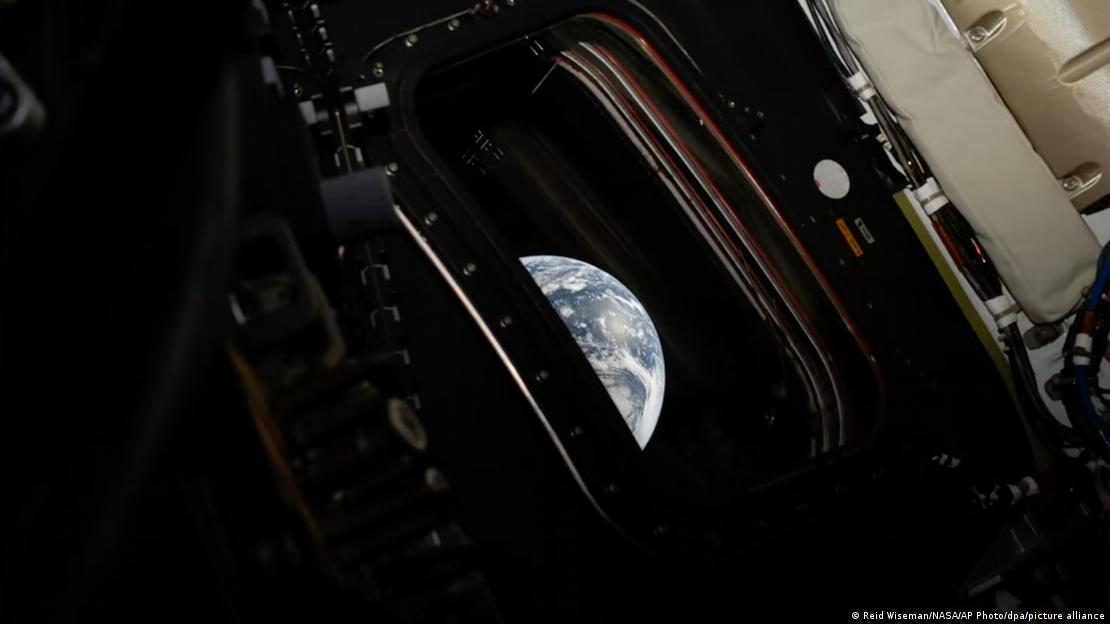
Among the photos taken by Commander Wiseman were a curved slice of Earth in one of the capsule's windows and a shot of the entire globe with the oceans topped by swirling clouds, where even a green aurora could be seen at the North Pole.

"It was the most spectacular moment, and it paused all four of us in our tracks," Wiseman said during a TV interview that the astronauts held.


The Artemis II crew are working to make the spaceship a home during their 10-day missionImage: NASA/AP Photo/picture alliance

As their journey progresses, the astronauts have been settling into their confined space. They reported that it was a little bit cold inside the spacecraft, but that they were still making it a home.

During their first hours aboard Orion, they performed checks and fixed minor problems on the spacecraft, which included a communications issue and, crucially, a malfunctioning toilet.

Artemis II astronauts are the first to fly in the Orion capsule

Koch told the media that she was proud to call herself a space plumber.

"I like to say that it is probably the most important piece of equipment on board," Koch said. "So we were all breathing a sigh of relief when it turned out to be just fine," she added.

The astronauts have also already put in their first workouts, as each must spend 30 minutes a day exercising to offset the muscle and bone loss that occurs in zero gravity.


Artemis II astronauts ignite engines and head for lunar flyby

NASA’s Artemis II astronauts fired their engines and set course for a lunar flyby on Thursday, marking the first human departure from Earth orbit since 1972. The crew of three Americans and one Canadian will break distance records, witness a solar eclipse and pave the way for future lunar missions despite early challenges in orbit.


Issued on: 03/04/2026 
By: FRANCE 24

The Artemis 2 mission rocket was launched from the Kennedy Space Center at Cape Canaveral, Florida, on April 1, 2026. © Jim Watson, AFP

NASA’s Artemis II astronauts fired their engines and blazed toward the moon Thursday night, breaking free of the chains that have trapped humanity in shallow laps around Earth since Apollo.

The so-called translunar ignition came 25 hours after liftoff, putting the three Americans and a Canadian on course for a lunar fly-around early next week. Their Orion capsule bolted out of orbit around Earth right on cue and chased the moon to nearly 250,000 miles (400,000 kilometres) away.

It was the first such engine firing for a space crew since Apollo 17 set out on that era’s final moonshot on 7 December 1972. NASA reported preliminary indications that it went well.

NASA had the Artemis II crew stick close to home for a day to test their capsule’s life-support systems before clearing them for lunar departure.

Now committed to the Moon, the Artemis II test flight is the opening act for NASA’s grand plans for a Moon base and sustained lunar living.

© France 24
14:52


Commander Reid Wiseman, pilot Victor Glover, Christina Koch and Jeremy Hansen will dash past the moon, then hang a U-turn and zip straight home without stopping on land. In the process, they will become the humans travelling the farthest ever from Earth, breaking the Apollo 13 distance record set in 1970. They also may become the fastest during reentry at flight’s end on 10 April.

Glover, Koch and Hansen have already made history as the first Black, the first woman and the first non-US citizen to launch to the moon. Apollo’s 24 lunar travellers were all white men.

READ MORE Artemis II launches historic flyby lunar mission with diverse crew

To set the mood for the day’s main event, Mission Control woke the crew with John Legend’s “Green Light” featuring AndrĂ© 3000 and a medley of NASA teams cheering them.

“We are ready to go,” pilot Victor Glover said.

Artemis II launches historic flyby lunar mission © France 24
00:39


Mission Control gave the final go-ahead minutes before the critical engine firing, telling the astronauts they were embarking on “humanity’s lunar homecoming arc” to bring them back to Earth. Koch replied: “With this burn to the moon, we do not leave Earth. We choose it.”

The next major milestone will be Monday’s lunar flyby.

Orion will zoom 4,000 miles (6,400 kilometres) beyond the moon before turning back, providing unprecedented and illuminated views of the lunar far side, at least for human eyes. The crew will even witness a total solar eclipse as the moon temporarily blocks the sun from their perspective.

While awaiting their orbital departure earlier Thursday, the astronauts savoured views of Earth from tens of thousands of miles high. Koch told Mission Control they could make out entire coastlines and even the South Pole, her old stomping ground.

“It is just absolutely phenomenal,” radioed Koch, who spent a year at an Antarctic research station before joining NASA.

© France 24
01:19


NASA is counting on the test flight to kickstart the Artemis programme and lead to a moon landing by two astronauts in 2028. Orion’s toilet may need some design tweaks before that happens.

The so-called lunar loo malfunctioned as soon as the Artemis crew reached orbit Wednesday evening. Mission Control guided Koch through some plumbing tricks, and she finally got it going, but not before using contingency urine storage bags.

Controllers also managed to bump up the cabin temperature. It was so cold earlier that the astronauts had to dig into their suitcases for long-sleeved clothes.

The contingency urine bags came in handy later. Mission Control ordered the crew to fill a number of empty bags with water from the capsule’s dispenser. A valve issue arose following liftoff, and NASA wanted plenty of drinking water on hand in case the problem worsened. The astronauts used straws and syringes to fill more than 2 gallons (7 litres) before pivoting to the moon.

(FRANCE 24 with AP)

Artemis heads to the Moon as old rivals race to stake their claim

As NASA counts down to sending astronauts back to the Moon under the Artemis programme, countries are racing to secure their place in the lunar future – laying plans to build infrastructure on the surface and exploit its resources. More than 60 years after John F Kennedy called for cooperation in space, competition is once again driving the race to the Moon.


Issued on: 01/04/2026 - RFI

NASA's Artemis II Space Launch System rocket and Orion spacecraft rest on Launch Pad 39B at Kennedy Space Center in Cape Canaveral, Florida, on 31 March 2026, ahead of the crewed lunar mission. AFP - JIM WATSON

Artemis II will carry four astronauts – three Americans and one Canadian – around the Moon, in what will be the first crewed mission of the programme.

The launch is expected at Cape Canaveral, Florida in the United States, drawing attention around the world to a mission seen as a key step in returning humans to the Moon.

According to local Florida newspapers, some 400,000 people are expected to turn up to watch the liftoff, which is currently slated for Wednesday at 6:24 pm local time (22h24 UT)

More than six decades ago, the US was making a very different case for the future of space.

NASA astronauts Reid Wiseman, Artemis II commander, from left, Victor Glover, Artemis II pilot, Christina Koch, Artemis II mission specialist, and CSA (Canadian Space Agency) astronaut Jeremy Hansen, Artemis II mission specialist, right, in a group photograph as they visit NASA's Artemis II SLS (Space Launch System) rocket and Orion spacecraft, Monday, 30 March 2026, at Launch Complex 39B of NASA's Kennedy Space Center, in Cape Canaveral, Florida. AP - Bill Ingalls


A call for cooperation

On 20 September, 1963, President Kennedy stood before the United Nations General Assembly in New York and delivered a message – aimed firmly at Soviet leader Nikita Khrushchev, even if his name wasn't heard.

Kennedy warned against the increase of military power on both sides of the Cold War divide – by both the US and the Soviet Union.

“Too long, we have increased our military budgets, our nuclear arsenals and our capacity to destroy all life on this hemisphere,” Kennedy said.

Calling for disarmament, he welcomed a Soviet proposal to keep weapons of mass destruction out of space.

“Why should man’s first flight to the Moon be a matter of national competition?” he asked.

Kennedy proposed a joint mission and said scientists and astronauts from different countries could work together, sending “not the representatives of a single nation, but the representatives of all of our countries”.


Buzz Aldrin’s bootprint on the Moon in 1969 – one of the first marks left by humans on its surface during the Apollo missions. © NASA

No joint landing


Khrushchev left power in 1964. His son later said the Soviet leader had rejected an earlier offer so as not to reveal the Soviet Union’s technological lag, but might have accepted the second one. Instead, the two powers went their separate ways.

Less than six years after Kennedy’s assassination, the US landed on the Moon alone in 1969. Twelve Americans walked on its surface between 1969 and 1972.

At the same time, countries around the globe began setting rules for space. The 1967 Outer Space Treaty laid out principles for exploring and using space, including the Moon and other celestial bodies.

Further agreements followed – in 1968, rules were set for rescue operations and in 1972, responsibility in case of problems involving artificial satellites was clarified.

This cooperation continued after the fall of the Berlin Wall, first with regard to the Mir space station and later on the International Space Station.

But geopolitical tensions did not disappear with the lifting of the Iron Curtain.

"Fast-forward to today, and the current sharp escalation of security threats in and from outer space requires a legally binding agreement to preserve its peaceful nature," writes the UN on its website.

"However, the most recent attempts in the General Assembly and the Security Council to adopt a document on a weapons-free outer space have failed."

Power play: why NASA is betting on nuclear to outpace rivals on the Moon


Back to the Moon

In 2017, US President Donald Trump announced plans to revive a programme similar to George W Bush’s cancelled Constellation programme, which would have carried astronauts to the ISS, as the successor to the US space shuttle programme, which was shuttered in 2011.

Trump's stated aim was to return to the Moon and stay there – if possible before China. To this end, the Artemis Moon exploration programme was established in 2017, with Artemis II set to be the first mission to carry astronauts.

The Canadian Space Agency is taking part, along with the European Space Agency (ESA) and Japan’s Jaxa, as is the United Arab Emirates through the Mohammed bin Rashid Space Centre. Italy has a separate bilateral agreement linked to the supply of a module for the lunar surface. French companies involved include Airbus, Latelec and ArianeGroup.

NASA’s Space Launch System is the most powerful rocket in history among those certified for crewed flights, but the mission carries risks.

Shortly before the launch of Artemis I in 2021, a liquid hydrogen leak during fuelling forced three members of a “red team” to go on to the launch pad and tighten bolts, in front of hundreds of tonnes of highly explosive liquids.

Russia's first lunar mission in 47 years smashes into the moon in failure


Building a lunar future

Artemis aims to build an overall system on the Moon and test what can be done there – making bricks, producing fuel, installing solar panels, and even a civilian nuclear power plant.

Europe has built the European Service Module, a crucial part of the Orion spacecraft that will carry the first crews around the Moon from Artemis II onwards. Four have been delivered, potentially enough for missions up to Artemis IV.

The astronauts are already training for their mission. In 2024 in Cologne, the ESA opened Luna, a lunar simulation site run jointly with the German Aerospace Centre (DLR), where crews can learn to move across artificial Moon dust.

Private companies too are now central to the programme – especially when it comes to landing systems, in which Blue Origin, the space company founded by Jeff Bezos, and SpaceX, led by Elon Musk, are both involved. While NASA will send the next humans on their journey to the Moon, private firms are expected to be the ones putting them on its surface.
The Moon rises over Dubai in June 2025. The United Arab Emirates is among the partners taking part in NASA’s Artemis programme. AFP - FADEL SENNA


Blue Origin has paused its space tourism flights to focus on its larger New Glenn rocket and its work on the Moon. Its first cargo lander, Blue Moon MK-1, arrived at NASA’s Johnson Space Centre in Houston in early February.

SpaceX, meanwhile, hopes to step up tests of its Starship system. In February, Musk said his company was now refocusing on the Moon, with the goal of building a first “autonomous city”.

“We can potentially achieve this in less than 10 years, whereas Mars would take more than 20 years,” Musk said – adding that launches to the red planet come every 26 months, while “we can do a launch to the Moon every 10 days”.


Risks and rivalries


The Artemis programme should not be confused with the Artemis Accords, which date from 2020. Backed by Washington before the end of Trump’s first term, they created a legal framework around the exploitation of space resources and have now been signed by around 60 countries.

However, Russia was excluded from early talks, while China was not part of the process either. Russia is now working with China on its own lunar plans under the ILRS project and sees the Artemis Accords as centred on US interests.

France did not sign the accords until 2022, after checking they would not conflict with existing treaties, given the 1967 charter states that no state or private company can appropriate anything in space. By creating “safety zones” to protect activities on the ground, the accords raise the question of whether this amounts to taking control of territory on the Moon.

And by allowing private companies to exploit space resources, the Artemis Accords also raise the question of who gets to take possession of those resources.

“These questions will be discussed among those who can be part of the adventure and who will be able to go there. Artemis creates this framework,” said Lionel Suchet, deputy director general of the French National Centre for Space Studies.

Europe's quick-fit spacesuit to be tested aboard ISS by France's Adenot

The accords are also unusual in the way they were drafted and adopted.

“It is the first time we have had this kind of international act,” legal expert Lucien Rapp, scientific director of the Sirius Chair research programme, told RFI.

A text proposed “unilaterally by a space power” is being signed by other states, “but not all together, one by one”, Rapp said.

Trump plans to send humans to the Moon in 2028 if possible, setting out plans to “assert American leadership in space”, lay the foundations for a lunar economy, prepare for missions to Mars and inspire a new generation of explorers in a 2025 executive order.

Different countries may soon be operating side by side near the Moon’s south pole – Americans, Russians, Chinese, Indians and others, each with their own bases and projects – raising the practical question of how those missions will coexist, and whether cooperation will be possible on the ground.

The 1967 Outer Space Treaty says space should be used “for the benefit and in the interests of all countries”. But as new missions take shape, that principle will be tested.

This story was adapted from the original version in French by Igor Gauquelin

German trade union chief calls for scrapping of VAT on food

04.04.2026, DPA


Photo: Bernd von Jutrczenka/dpa

The head of the German Trade Union Confederation (DGB) has called for the reduced rate of value added tax (VAT) on certain goods to be abolished entirely.

"Reducing the reduced VAT rate from 7% to 0% would be a strong signal, especially for low earners," Yasmin Fahimi told Saturday's edition of the Berlin newspaper Tagesspiegel.

A VAT cut for items such as food and energy could help people on lower incomes far more than a cut in income tax, Fahimi said.

Asked how such a move could be financed, Fahimi said: "Germany could introduce a much higher VAT on luxury goods, such as extremely expensive watches, yachts, jewellery or luxury cars." That would only burden those who could easily shoulder it, she said.

"Overall, the mega-rich and billionaires must be made to contribute much more, instead of burdening employees and consumers," the DGB chief said.

At present, a VAT rate of 19% applies to most goods, while a reduced rate of 7% applies to selected food items. According to reports, the government has had the impact of a VAT increase calculated as part of the reform debate.

Conservative Chancellor Friedrich Merz has not ruled out changes to taxation in connection with planned relief for employees and companies. Merz's centre-left coalition partners are looking for ways to finance the desired relief on income tax and social security contributions.


Volunteers aiding humpback whale stranded in Baltic get death threats

03.04.2026, DPA

Photo: Florian Manz/Greenpeace Germany/dpa

Volunteers who have donated their time to help a humpback whale which got turned around off Germany's Baltic coast have received death threats now that it looks like the giant mammal might not survive its ordeal.

“Regrettably, since it became clear that the animal could not be saved, hostility towards those involved in the rescue operation has been on the rise – even to the point of death threats,” said Till Backhaus, environment minister for the north-eastern Mecklenburg-Vorpommern region where the whale is currently stranded, according to a statement.

"Of course, I understand that the situation is very emotional for people," Backhaus continued. "But I do not accept that staff members are being threatened in their private lives."

If statements constituting a criminal offence are made, whether on social media, via notes left in letterboxes or by email, such behaviour will be reported to the police, he added.

The days-long saga to guide the animal back to deeper waters began on March 23, when the whale was first spotted stranded on a sandbank off Germany's Timmendorfer Strand resort.

The 12- to 15-metre animal managed to free itself a few days later after rescuers dug a channel in the surrounding sand using a floating dredger.

But instead of moving west towards the Atlantic, its natural habitat, it was spotted heading east and repeatedly got stuck in shallow waters again.

Meanwhile, according to the state ministry, the whale is being monitored around the clock by the water police and a whale-watching team on land. Fire brigade personnel have been repeatedly spraying the animal with water throughout the day.

“We will continue to look after the animal – right to the end," he added.

Searching for radioactive waste in the depths of the Atlantic


For nearly five decades, more than 200,000 barrels of radioactive waste were dumped in the icy depths of the northeast Atlantic. Today, no one knows precisely where these barrels are located, or what kind of state they are in. On June 15, a French-led team of scientists will set sail from Brittany in a bid to map the barrels and assess their impacts on surrounding marine ecosystems.


FRANCE24
By: Grégoire SAUVAGE

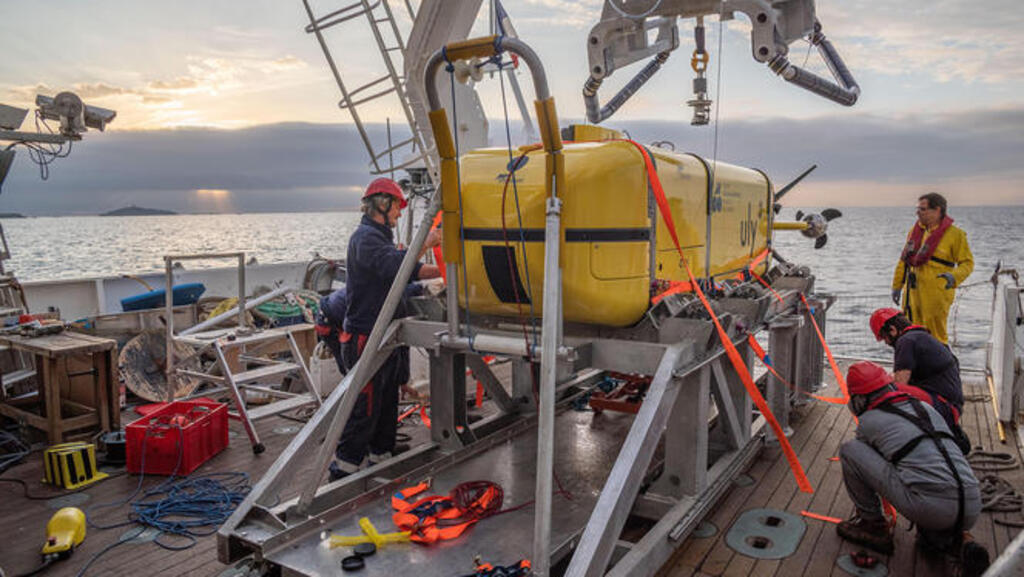
The UlyX underwater robot can reach a depth of 6,000 metres. 
© TimothĂ©e Autin, Ifremer.

It had long been considered a safe way to dispose of radioactive waste. For nearly five decades, tens of thousands of tonnes of waste – sealed in watertight barrels of asphalt and cement – were dumped in international waters.

Although the practice is now banned, between 1946 and 1993, 14 European countries – including France and the UK – carried out dumping operations at more than 80 locations in the Arctic, Atlantic and Pacific.

In the northeast Atlantic, home to the most concentrated stretch of this radioactive marine waste, some 200,000 barrels lie at a depth of 4,000 metres. On June 15, a team of scientists from the CNRS (France’s National Centre for Scientific Research), Ifremer (the French national institute for ocean science and technology) and the French oceanographic fleet, will set sail from the Brittany port of Brest in a bid to locate the barrels.

The team of nuclear physicists, geologists, oceanographers, biologists and marine chemists will be joined by UlyX, a 4.5 metre autonomous underwater robot that will be their eyes and ears during the 26-day expedition

"The robot can dive to a depth of 6,000 metres,” explained geophysicist Javier Escartin, who will co-lead the mission. “It will be able to use sonar-type systems to map large areas and detect where barrels are located. It will also be able to get close to the seabed and take photographs, enabling us to assess the barrels’ condition, establish where they are scattered, and to plan further studies at a later date."

Six barrels were found during a scientific campaign carried out by the CEA and Ifremer in 1984. © Ifremer/Epaulard

A stable environment

The submerged barrels, which have a lifespan of between 20 and 26 years, are now long past their expiry date.

In 2000, the environmental NGO Greenpeace filmed barrels of waste at the site closest to the French coast, the Casquets trench in the English Channel, used to dump waste by Belgium and the UK. Their footage showed the rusting barrels were badly degraded and corroded.

However, the barrels dumped at sea do not contain the most hazardous waste. Most of the waste is classified as very low-, low- and medium-level radioactive waste, according to the available data.

In addition, the radioactivity emitted by radioactive waste gradually diminishes over time. The time it takes for a radioactive substance to decrease by half is called the half-life. However, this half-life period varies greatly – depending on the type of atom or radionuclide. For instance, it is approximately two years for caesium 134, approximately 13 years for plutonium 241, approximately 30 years for caesium 137 and some 4.5 billion years for uranium 238.

The radioactive waste comes in two forms: either solid or liquid. Solid waste is surrounded by a concrete or bitumen matrix before being sealed in a watertight barrel. Only the former USSR and the United States have dumped other types of waste, such as nuclear reactor tanks, some of which still contain fuel, reported the French National Agency for Nuclear Waste Management (Andra).

The total radiological activity of the submerged waste was around 85,000 terabecquerels when it was released into the ocean, Andra added.

In the postwar period, as nuclear technology spread to many sectors of activity, developed countries viewed dumping waste in deep waters as a safe option. The deep ocean is one of the most stable environments on Earth and scientists mistakenly believed it to be deserted and devoid of life.

‘A reflection of a period in history’


The history of these dumping operations remains a grey area and the practice was completely unregulated by international treaties.

It was not until 1975 that the London Convention’s moratorium came into force. And it was only in the early 1990s that the disposal of industrial and radioactive waste at sea was definitively banned.

Precise data on the dumping operations remains patchy, according to the International Atomic Energy Agency (IAEA), “due to the different ways in which records on disposal operations have been kept in different countries”.

“The information on accidents and losses at sea of radioactive material [...] is heterogeneous, the agency said in a 2015 report.

"This is a reflection of a particular period in history. At the time, we were in the midst of the rapid development of the nuclear industry and nuclear weapons. States communicated very little. Even today, we have very little information," said Patrick Chardon, a research engineer at the Clermont Auvergne Physics Laboratory (LPCA) and a specialist in the effects of radioactivity on the environment.

"There have been several campaigns to monitor the dumping zone in the northeast Atlantic, but they didn't have the tools we have now. These will enable us to pinpoint the exact location of the barrels, the discharge areas and the concentrations of radioactivity," Chardon added.

Back in 1980, the Nuclear Energy Agency (NEA) carried out a review of the “continued suitability of the dumping site for radioactive waste in the northeast Atlantic”. As the seawater samples collected showed no increase in radioactivity compared with natural levels, the NEA did not think it necessary to recover the submerged barrels or even to maintain continuous surveillance of the sites.

But this time round, scientists will be able to take much more precise measurements by sampling the water, sediment and living organisms. "Unlike previous research programmes, which were carried out somewhat in the dark, we will now have a picture of where the sampling will be most relevant based on the presence or absence of the barrels. This is a really important point when it comes to assessing the impact of waste," Escartin explained.
A possible impact on living organisms

Scientists currently have no idea how radionuclides behave in the oceans, and even less so in an environment as extreme as the deep ocean, notorious for its intense cold, darkness and phenomenal pressure.

"The mission will enable us to gain a detailed understanding of radionuclides. We will be able to observe the chemical forms in which these elements are present, and establish whether they are mobile or not, immobilised by the sediment or, on the contrary, if they can be assimilated by living organisms," explained Chardon.

"In this respect, strontium-90 is problematic because it is an analogue of calcium. In terms of biological functioning, living organisms confuse strontium with calcium. It can therefore be integrated into the food chain," Chardon continued.


Two missions will be carried out over the submerged areas of the Northeast Atlantic abyssal plain, covering an area of 6,000 square kilometres. © Nodssum project


On their return to dry land, the scientists will spend several months studying the samples taken near the radioactive barrels. A second mission to refine the results will then be scheduled. All the data from both missions will be made available to the public in the interests of transparency.

“This is not a mission to assess whether the releases were well or badly done,” warned Escartin. "It's an opportunity to look at what was done in the past, without passing judgment, to carry out scientific studies. Afterwards, of course, we'll have to conduct a complete inventory, because we need one."

However, during the mission, the scientists will only be able to assess the condition of a small fraction of the 200,000 barrels in the northeast Atlantic. And on each dive, the UlyX autonomous robot will only be able to focus on an area of around 20 square kilometres – a drop in the ocean given that the two research areas where the submerged barrels lie covers more than 6,000 km2.

This article has been translated from the original in French by Charlotte Wilkins.
Myanmar’s parliament elects coup-leading general as civilian president

Myanmar's pro-army parliament on Friday elected Senior General Min Aung Hlaing as president days after he relinquished his top military post, as required by the constitution, and passed it to the country's former spymaster. Min Aung Hlaing, the leader of the 2021 coup, was elected after an electoral process dismissed as civilian window dressing by monitoring groups.


Issued on: 03/04/2026 
By: FRANCE 24

File photo of Myanmar's Senior General Min Aung Hlaing taken at a military parade in Naypyidaw on March 27, 2021. © Stringer, Reuters

Myanmar's parliament elected junta chief Min Aung Hlaing as president on Friday, parliament said, with the ex-military commander set to maintain his rule in a civilian guise after snatching power by force five years ago.

The coup-leading general – who swept aside democracy in 2021, detaining elected figurehead Aung San Suu Kyi and dissolving her party – was anointed by pro-military MPs installed in a recent election overseen by the junta he leads.

The vote on Friday across the upper and lower houses of parliament in the capital Naypyidaw saw Min Aung Hlaing secure a huge margin over the second-place candidate in a three-person race.

"We hereby announce Senior General Min Aung Hlaing as president," parliament speaker Aung Lin Dwe announced from a stage in the parliament meeting hall.

He received 429 votes of 584 cast by MPs, a parliament official said after ballot counting was finished.

While the junta touted parliament's reopening last month as a return of power to the people, analysts describe it as civilian window dressing intended to launder the military's continuing rule.

The pro-military Union Solidarity and Development Party (USDP) won more than 80 percent of parliamentary seats contested in the election which concluded in late January, while serving members of the armed forces occupy unelected seats making up a quarter of the total.

The massively popular Suu Kyi has been detained since the February 2021 coup, criticism or protest over the election was outlawed and voting was blocked in territories controlled by rebels which have risen up to challenge the military takeover in a grinding civil war.

With opposition factions still standing defiant after the poll, the conflict and ensuing humanitarian crisis show no sign of abating.

Tens of thousands have been killed on all sides since the coup.
Civilian leader

Min Aung Hlaing is due to take power as president this month, while his two competitors – current Prime Minister Nyo Saw and Nan Ni Ni Aye, a regional MP from Karen state with the USDP party – will serve under him as vice-presidents.

In a post-coup period of emergency rule, Min Aung Hlaing served as both commander-in-chief of the armed forces and acting president, but to become permanent president he is constitutionally compelled to relinquish his military post.

He handed over the reins of the military to loyalist and former spymaster Ye Win Oo on Monday.

Myanmar's military has ruled the country for most of its post-independence history and presents itself as the only force guarding the restive country from rupture and ruin.

The generals loosened their grip for a decade-long democratic interlude beginning in 2011, allowing Suu Kyi to ascend as civilian leader and steer a spurt of reform as the nation opened up from its hermetic history.

After the Nobel Peace Prize laureate's party trounced the pro-military USDP with a landslide victory in 2020 elections, Min Aung Hlaing snatched back power making allegations of massive voter fraud.

Analysts say the claims were unfounded and he acted out of anxiety about the armed forces' waning influence.

Now that the USDP is entrenched in parliament with back-up from military MPs entitled to unelected seats under the constitution, the new government is expected to march in lockstep with the top brass.

(FRANCE 24 with AFP)


Burmese Military Rebrands, But Never Reforms – OpEd

April 3, 2026 
By Burma Campaign UK

General Min Aung Hlaing, who ran the military regime in Burma yesterday, is running the military regime in Burma today.


The new title of President could be viewed as a story about General Min Aung Hlaing’s personal ambitions. He does like his titles. Military-controlled media have recently been calling him: “Chairman of the State Security and Peace Commission Commander-in-Chief of Defence Services Senior General Thadoe Maha Thray Sithu Thadoe Thiri Thudhamma Min Aung Hlaing.”

In fact, while General Min Aung Hlaing’s personal ambitions obviously play a key role in his decisions, this latest rebranding is all about preserving the rule of the military as an institution. (Note: Min Aung Hlaing retains the title of General even though he has retired as commander in chief).

The Burmese military have ruled Burma for 59 years (from 1962, not including five years of a government led by the National League for Democracy). They have survived this long in part because they are flexible, employing many different forms and systems of military rule.

This includes political party fronts such as the Burmese Socialist Program Party and Union Solidarity and Development Party, and numerous front administrations including the State Law and Order Restoration Council (SLORC), State Peace and Development Council (SPDC), front regimes such as that led by General Thein Sein, State Administration Council (SAC), and State Security and Peace Commission (SSPC).


It does not matter who happens to be head of the Burmese military at any given time, or what name they use for their proxy administration, it is the military as an institution which has ruled Burma for almost 60 years. They will always prioritise their own power and control and pursue their own racist Bamar Buddhist nationalist extremist vision of Burma.

At the same time, the leadership of the Burmese military are always corrupt and nepotistic, enriching themselves and the business cronies they depend on. It is not just a brutal military dictatorship, it is a massive criminal enterprise which has for decades stolen the natural resources of Burma, has been involved in the drugs trade and scam centres, illegal international arms trading, and which has distorted the entire economy of Burma for its own benefit.

The Burmese military will never reform. The only thing that changes are the forms of political system it uses to ensure its survival, and the tactics it uses to try to relieve pressure from the domestic population and international community.

In a great many ways, the military appear to be trying to replicate some of the success they achieved with the sham reform process of 2010-2021. We detailed this in our briefing paper, The Burmese Military’s ‘Elections’: New Date, New Danger, Same Sham, warning of tactics the military is likely to employ. Sure enough, the military is already using some of these tactics, including the mass release of political prisoners. That briefing paper is available here.


Too many times in the past the international community has been unable to distinguish between rebranding and reform. Or if they do, they take a ‘something is better than nothing’ approach even though it’s a something they would never dream of accepting in their own country.

The lack of institutional memory in foreign ministries around the world also benefits the Burmese military. They recycle the same tricks over and over again and diplomats, mostly in post covering Burma for only 2-4 years at a time, think something new is happening.

We tell them it’s groundhog day, old wine in an old bottle, or history repeating itself, but they don’t listen. They deploy the phrases that democracy and human rights activists have been hearing for decades: “We have to wait and see,” “We have to look for any opening and encourage it.”

Burmese activists have compared the Burmese military to a carnivorous plant found in Burma, the pitcher plant (often called the water jug plant in Burma), which has a liquid which smells sweet to insects but digests them when they get too close. In this analogy, United Nations and other envoys are the insects being devoured.

A predication that the Burmese military cannot be defeated and therefore have to be accommodated has underpinned international policy making towards Burma for years. Instead of seeing their role as assisting the people of Burma to remove a corrupt oppressive criminal institution which has undermined the country for decades, they tell the people of Burma they have to have dialogue and compromise with their oppressor, even though their oppressor never compromises themselves.

This is what General Min Aung Hlaing and his fellow generals will be counting on now. That diplomats will accept the superficial rebranding and public relations gestures and wipe the slate clean.

There is a significant change in the playbook though compared to post 2010 efforts. At that time a lot more effort was made to try to persuade the international community that there was significant change coming. More effort with the elections and political party participation, and more effort with international media. And of course, Than Shwe stepping down and being replaced by General Thein Sein, who has a brutal history of human rights abuses and sexual violations by soldiers under his command, but also experience in sweet-talking diplomats.


This time round the same general is in charge. It’s much harder to present yourself as a reforming regime when yesterday’s dictator is today’s dictator.

What does the limited effort in presenting elections as credible, and the continued role of Min Aung Hlaing mean?

Part is of course his ambition, but part must be that the military have calculated they can get away with it. They have the strong backing of China, Russia and India, three regional allies that are much more assertive internationally than they were 16 years ago. The military may feel they don’t need to make as many concessions as they did last time round, as they don’t need western countries.

They may also be calculating that the way in which western countries are no longer prioritising human rights and democracy in Burma means they don’t need to make concessions, western countries will go along with their sham and start normalising relations. The Burmese military have watched how implementation of sanctions slowed to a dribble and then stopped altogether. They are watching European countries close embassies, and how mentions of Burma have fallen off joint statements at international venues like the G7.

It might be that the USA, UK and EU are willing to give the genocide general, as Rohingya activists call Min Aung Hlaing, another chance, but most people in Burma will not. They will keep fighting, keep protesting and keep building new local administrations and institutions in areas freed from Burmese military rule. They will keep building a bottom-up federal democracy.

The Burmese military, with all its different forms, titles and leaders over almost sixty years, and with all the backing from China, Russia, India and others, has never been able to defeat the people of Burma, and it never will.

Burma Campaign UK

Burma Campaign UK is part of a global movement working for the promotion of human rights, democracy and development in Burma. Founded in 1991, Burma Campaign UK is one of the leading Burma campaign organisations in the world. We play a crucial role in coordinating the international campaign for human rights in Burma and work closely with human rights activists in Burma and in exile.


When jail becomes home: Japan's elderly seek refuge behind bars

FRANCE24
Issued on: 03/04/2026 
11:59 min


Japan’s demographic crisis is playing out even behind bars. The number of elderly inmates has quadrupled over the past 20 years. Around a fifth of people over 65 live below the poverty line, struggling to make ends meet. Some go to extraordinary lengths to improve their circumstances, deliberately getting caught shoplifting in the hope of landing in prison. There, they can access a secure place to live, proper meals, and medical care – basic necessities often denied to them outside. A report by Ayana Nishikawa, Alexis Bregere and Justin McCurry.


Iran pushes ahead with solar and wind plants

Iran pushes ahead with solar and wind plants
/ bne IntelliNews
By bnm Tehran bureau April 1, 2026

Iran is building four new solar power plants backed by the National Development Fund alongside a wind farm in Sistan and Baluchestan province, with the first phase expected online by July 2026, ILNA reported on April 1, citing the Ministry of Energy.

Alireza Parandeh-Motlagh, deputy technical director of Iran's Renewable Energy and Energy Efficiency Organisation (SATBA), said the solar plants were under construction and would be brought into service "in the shortest possible time."

The wind farm's first phase will install six turbines with a combined capacity of 15 megawatts. Foundations for four turbines are already being laid, with work on two more due to begin shortly. SATBA plans to expand the site to roughly 100 megawatts in later phases.

The renewable energy push comes as Iran's power infrastructure faces sustained damage from US-Israeli air strikes. Power outages have hit Tehran, the surrounding Alborz province and other regions repeatedly since the war began on February 28, with strikes targeting electricity substations and generation facilities.

State broadcaster IRIB reported on March 31 that power had been restored to parts of eastern Tehran after shrapnel damaged an electrical substation overnight.

Iran's existing grid was already under strain before the war, with summer blackouts a recurring problem driven by rising demand, ageing infrastructure and drought reducing hydroelectric output. The conflict has accelerated the need for distributed generation capacity that is less vulnerable to targeted strikes than centralised thermal plants.

The National Development Fund, Iran's sovereign wealth vehicle fed primarily by oil revenues, is financing the solar projects as part of a broader effort to diversify the country's energy mix under difficult fiscal conditions, with crude exports largely shut off by the Strait of Hormuz closure.

Friday, April 03, 2026

ANALYSIS

'An eye for an eye': Israel’s death penalty law is retaliatory and electorally motivated


The Israeli parliament's adoption of a law establishing "the death penalty for terrorists" – which in practice will only apply to Palestinians – has provoked an international outcry. The reasons for it passing are not just retaliatory, but politically motivated.

2/04/2026 - FRANCE24
By: Marc DAOU

Israel's Minister of National Security, Itamar Ben-Gvir, center, at the Knesset in Jerusalem Monday, March 30, 2026. © Itay Cohen, AP

"This is historic! With God's help, soon we will execute them one by one!"

These were the words spoken by Israel’s far-right Minister of National Security Itamar Ben-Gvir on Monday, March 31, just after a 62–48 vote in the Israeli Knesset that passed a law to apply the death penalty to convicted ‘terrorists’.

Ben-Gvir celebrated the Death Penalty for Terrorists Bill by popping open bottles of champagne and embracing fellow supporters at the Knesset. In the run-up to the vote, he had worn a lapel pin in the shape of a noose, symbolising his support for the legislation.

Limor Son Har Melech, a member of Itamar Ben-Gvir's nationalist party, Otzma Yehudit (Jewish Power), was in tears as she read out the results. Melech had introduced the law along with Nissim Vaturi, Knesset deputy speaker and member of Benjamin Netanyahu's Likud party.

© FRANCE 24
10:32


The law effectively enshrines capital punishment for Palestinians who "intentionally cause the death of a person with the aim of denying the existence of the State of Israel”.

It has sparked fierce criticism in Israel, the Palestinian territories and abroad for its retaliatory nature, de facto targeting of Palestinians and electorally motivated reasoning.
Death by default

The law says that Palestinians in the occupied West Bank – referred to as Judea and Samaria in the text – would face the death penalty by default if the homicide is classified as an act of terrorism by the Israeli military court, barring specific appeals.

The Knesset stated in Hebrew that the bill mandates that a “resident of the area, except for an Israeli citizen or Israel resident, who intentionally caused the death of a person in an act of terrorism, shall be imposed with the death penalty, unless the military court finds that special circumstances exist under which it is appropriate to impose a sentence of life imprisonment”. It remains unclear what the “special circumstances” are.

“Resident of the region”, in this case, refers to anyone registered in the region's population register or who resides in the region, according to the law. It excludes Israeli citizens or residents, which in this case means settlers.

READ MOREBedouins in Israel’s Negev desert face bomb shelter shortage

The law is not retroactive and will only apply to Palestinians arrested after it comes into effect. Death sentence "by hanging" would be carried out within 90 days of the final conviction, with a possible postponement of up to 180 days.

The Gaza Strip is not mentioned in the text, but a separate bill, which is currently being debated in the Knesset, is intended to establish a special court for the prosecution of those who participated in the October 7 massacre. The bill is set to be presented in parliament in the first week of the Knesset summer session, which begins on March 10.

Although the death penalty has been technically legal in limited forms since Israel's founding, the country has only carried out two state-authorised executions. The first took place in 1948, against an army captain wrongly accused of high treason. The second was against Nazi war criminal Adolf Eichmann, who was hanged for genocide and crimes against humanity in 1962.
Condemned at home and abroad

Palestinians were horrified by the law, and shuttered shops and public institutions across the main cities of Hebron, Ramallah, and Nablus in the West Bank on Wednesday. Dozens of citizens – including activists, political factions and civil society groups – also gathered to protest the law on the streets.

Ramallah-based psychologist Raman, 53, told news agency AFP that "there isn't a single person standing here who doesn't have a brother, a husband, a son, or even a neighbour in prison. There is no Palestinian family without a prisoner".
Palestinians demonstrate against the decision by Israel's parliament to approve the death penalty for Palestinians convicted of murdering Israelis in Nablus, West Bank, Tuesday, March 31, 2026. © Majdi Mohammed, AP


Palestinian Authority president Mahmoud Abbas of the Fatah party called for general strikes, while Hamas said the passing of the law "reflected the bloody nature of the occupation and its policy based on killing and terrorism".

Minutes after the adoption of the Death Penalty for Terrorists Bill into law, Israeli human rights organisation Association for Civil Rights in Israel said they had filed an emergency appeal with the Supreme Court.

In a damning post on their website, they described the law as “depressing and infuriating”, condemning the “disgraceful jubilation surrounding such a repugnant law by the racist and extremist Minister of National Security Itamar Ben Gvir and other members of the government”. They had earlier described the law as discriminatory, racist, and unconstitutional.

The Knesset "is not authorised to legislate directly for the West Bank, since the military commander is the legal sovereign in the occupied territory”, they pointed out.


© France 24
09:15


Israeli rabbi and researcher Elhanan Miller shares that view. In an interview with FRANCE 24’s Arabic channel, he said he expected the law to be overturned by Israel’s Supreme Court – “It is illegal to apply Israeli law in the West Bank to Palestinians as it is an occupied territory under military control," he explained.

Several European countries have expressed their concern as well. Spain said the law was "a further step towards apartheid", and the EU urged Israel to “abide by its previous position”, saying that the approval of the Death Penalty Bill “marks a grave regression”, noting its “de facto discriminatory character”.

The Council of Europe has threatened to revoke Israel's observer status, while the United Nations High Commissioner for Human Rights believes that the application of this law would be considered a war crime.

Human rights organisation Amnesty International denounced the law as "carte blanche to execute Palestinians while stripping away the most basic fair-trial safeguards", and pointed out that Israeli military courts had a "conviction rate of over 99% for Palestinian defendants."
A politically motivated law

“This judiciary is a stain on Israel, with its discrimination between Palestinians and Israelis in the West Bank,” said Miller. “It is an unjust law for developed and advanced Western countries, introduced by the extremist minister Itamar Ben-Gvir in an attempt to score points before the elections.” The next parliamentary elections must be held before October 27, 2026.

“Netanyahu is afraid of the coming elections and wants to curry favour with the Israeli ideological right, at the expense of Israel’s image in the world and in the West in particular [where this law is criticized],” Miller added.

Ben-Gvir doesn't deny the political context, gloating on X about fulfilling his election promise, saying in Hebrew, " We promised. We delivered."

Akram Hassoun, an Arab member of the Israeli parliament and member of Benjamin Netanyahu's governing coalition, voted in favour of the bill and acknowledged the political motivations.

READ MORE  Israel's new death penalty law is more of 'an annexation law'

"This law was proposed by the coalition to which I belong," he explained on FRANCE 24's Arabic channel. "If you want this coalition to support you on an issue that concerns Israeli Arabs, you have to support what concerns them."

Lamenting what he considers "a misinterpretation of the text by the media in an electoral context", Hassoun said that, fundamentally, the law targets "terrorists who want to kill innocent people" and "is intended as a deterrent for any citizen who does not believe in the sanctity of life, so that no one is killed, neither Arab nor Jew".

He added: "Anyone who takes another person's life without any reason must be executed. They can be Jewish, Arab, Muslim, Christian, Druze, or of any other faith."

When asked if he supported applying the law to an Israeli settler who killed a Palestinian in the occupied West Bank, he said: "I don't think about that kind of case, but anyone who takes the life of a Palestinian in a terrorist attack will have this law applied to them."

The law, however, explicitly excludes this scenario.

This article has been translated from the original in French.