Several thousand people marched through the streets of Paris' largest suburb on Saturday to denounce racism after the town's newly elected black mayor was subject to disparaging comments on social media and national television shows.
Issued on: 04/04/2026 - RFI

A protester holds a placard reading 'racism, xenophobia, hate get lost' during a rally against racism convened by Saint-Denis Mayor Bally Bagayoko, in Saint-Denis, in the outskirts of Paris, France, on 4 April, 2026.
AFP - THOMAS SAMSON
Bally Bagayoko, 52, of the hard-left France Unbowed (LFI) party, was elected mayor of Saint-Denis in the first round of municipal elections on 15 March.
The Frenchman born to Malian parents and brought up in the neighbourhood was almost immediately targeted by racist disinformation and remarks, some aired on one of the country's most watched news channels.
Demonstrators gathered on the steps of Saint-Denis's town hall, a town of 150,000 is one of France's most diverse, with a large immigrant population. Music bands, trades unions and associations joined the demonstation.
"We come to state firmly and definitively our visceral attachment to the values of the Republic embodied by those who are heirs of immigration," said Bagayoko.
He attacked what he said were "failing, sometimes even complicit institutions".
Also present was LFI leader Jean-Luc Melenchon. He denounced "a sickening wave of racism coming from the political and media elites who, without reservation, without restraint, have displayed their contempt for a part of our people."
Bally Bagayoko, 52, of the hard-left France Unbowed (LFI) party, was elected mayor of Saint-Denis in the first round of municipal elections on 15 March.
The Frenchman born to Malian parents and brought up in the neighbourhood was almost immediately targeted by racist disinformation and remarks, some aired on one of the country's most watched news channels.
Demonstrators gathered on the steps of Saint-Denis's town hall, a town of 150,000 is one of France's most diverse, with a large immigrant population. Music bands, trades unions and associations joined the demonstation.
"We come to state firmly and definitively our visceral attachment to the values of the Republic embodied by those who are heirs of immigration," said Bagayoko.
He attacked what he said were "failing, sometimes even complicit institutions".
Also present was LFI leader Jean-Luc Melenchon. He denounced "a sickening wave of racism coming from the political and media elites who, without reservation, without restraint, have displayed their contempt for a part of our people."

Saint-Denis Mayor Bally Bagayoko, with the founder of French left-wing party La France Insoumise (LFI) Jean-Luc Melenchon and President of Gauche Democrate et Républicaine parliamentary group Stephane Peu, during a rally against racism, in Saint-Denis, in the outskirts of Paris, on 4 April, 2026.
AFP - THOMAS SAMSON
Government minister absent
Aurore Bergé, the government's minister against discrimination did not attend the event.
"If there is one minister who should have been there, it is her," said Bagayoko when he was asked about her absence, but he did thank her for having reached out by telephone to express her solidarity.
Prime Minister Sebastien Lecornu this week also denounced what he described as the "normalisation of evil and racism" following the campaign against Bagayoko.
Government minister absent
Aurore Bergé, the government's minister against discrimination did not attend the event.
"If there is one minister who should have been there, it is her," said Bagayoko when he was asked about her absence, but he did thank her for having reached out by telephone to express her solidarity.
Prime Minister Sebastien Lecornu this week also denounced what he described as the "normalisation of evil and racism" following the campaign against Bagayoko.
Bagayoko has filed a legal complaint against the CNews television channel, often described as France's Fox News, over comments about him made by one guest on the show.
Paris prosecutors announced on Thursday that they had opened an investigation into possible public insults of a racist nature over some of the remarks broadcast on CNews.
A separate investigation had been opened into the racist abuse the mayor received on the X platform, after the comments broadcast on CNews.
(AFP)
How effective is France’s fight against racial discrimination?
Recent comments on a television programme comparing a newly elected black mayor to a monkey and a tribal chief have reignited the debate over what critics call France's failure to tackle mounting racism in the country.
Issued on: 04/04/2026
By: Alison Hird with RFI
Recent comments on a television programme comparing a newly elected black mayor to a monkey and a tribal chief have reignited the debate over what critics call France's failure to tackle mounting racism in the country.
Issued on: 04/04/2026
By: Alison Hird with RFI
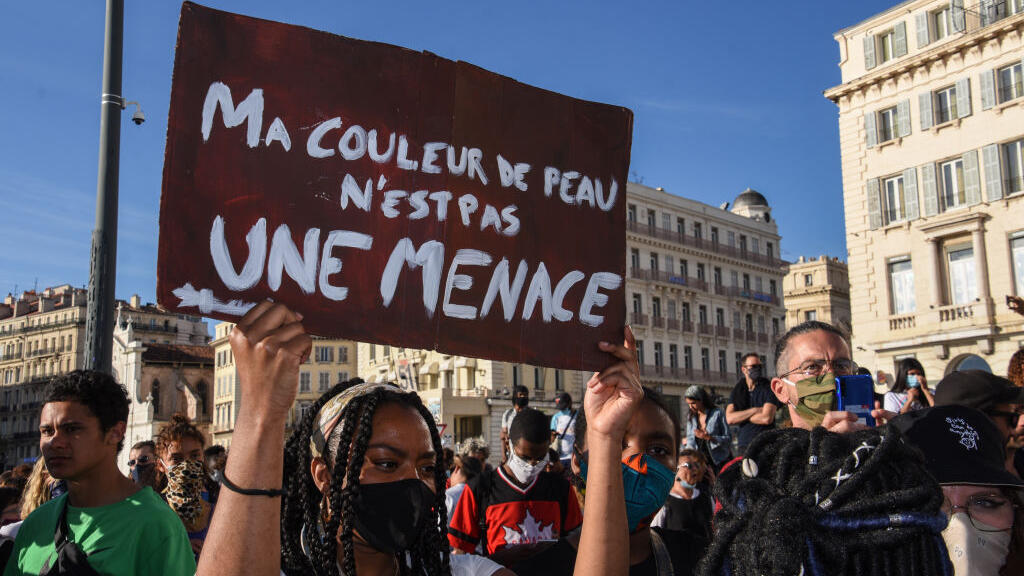
A woman holds up a banner reading "My colour isn't a threat" during an anti-racism demonstration in Marseille.
SOPA Images/LightRocket via Gett - SOPA Images
Bally Bagayoko, of the far-left France Unbowed (LFI) party, has been subjected to racist comments both on and off screen since he was elected mayor of the multi-cultural Paris suburb of Saint-Denis two weeks ago.
The town hall’s switchboard operators say they are receiving five or six calls a day with racist questions such as "is this the town hall for Arabs and blacks?", according to the head of the department Kelly Kidou.
"They’re not necessarily anonymous calls – people feel sufficiently emboldened that they don’t even bother to hide their numbers," she told Franceinfo public radio.
Racist insults targeting public officials, including town hall staff, are punishable under French law by up to five years in prison and a €75,000 fine.
Bagayoko has promised to "create the conditions to be able to bring the perpetrators to justice" – not least because staff at the town hall reflect the area's ethnic diversity.
Born in France to Malian parents, Bagayoko has filed a criminal complaint against the CNews TV channel, after it broadcast interviews in which guests drew analogies involving monkeys, apes and tribal chiefs.
Paris prosecutors too have opened an investigation into "public insults of a racist nature" over some of the remarks, with a separate probe opened into racist abuse the mayor received on social media platform X following the CNews broadcast.
The channel has said the remarks were 'taken out of context" and “deliberately distorted” and the contributor concerned has denied racist intent.
But the Bagayoko case has once again prompted questions about the effectiveness of France’s efforts to combat discrimination.
Official figures show more than 16,400 racist, xenophobic or anti-religious offences were recorded in France in 2025, including 9,700 crimes and misdemeanours – a 5 percent increase on the previous year.
'Old colonial fears'
“We’re seeing the expression of a form of racism that has become increasingly overt in recent months,” says Dominique Sopo, president of anti-racism organisation SOS Racisme, pointing to “levels of expression we thought had almost disappeared”.
Bagayoko has come under attack in large part due to his position as a figure of authority, Sopo says.
"It’s not just someone who happens to be seen as black – he's a black person in a position of power. And that’s what upsets people."
Bagayoko has spoken publicly about discrimination and police violence and plans to gradually disarm the municipal police. This has led to him becoming the focus of a "highly fantasised narrative", according to Sopo.
"He's seen as embodying a threatening 'mass', echoing old colonial fears," he notes, adding that such narratives are no longer confined to the far right but are being "picked up in mainstream media, treated almost as plausible, which reveals a deeply ingrained racist imagination".
The Movement Against Racism and for Friendship Between Peoples (MRAP) has also filed an official complaint against CNews. Its co-president, lawyer Kaltoum Gachi, says the case shows "the normalisation of racist expression" which "no longer has limits".
In addition to the targeting of elected officials, she points to a recent wave of racist abuse directed at a newborn child named Zaïd at the start of the year, who was described in online posts as a "terrorist migrant" and a "delinquent".
"It shows how widespread and unchecked racism has become," said Gachi.

Bally Bagayoko, of the far-left France Unbowed (LFI) party, has been subjected to racist comments both on and off screen since he was elected mayor of the multi-cultural Paris suburb of Saint-Denis two weeks ago.
The town hall’s switchboard operators say they are receiving five or six calls a day with racist questions such as "is this the town hall for Arabs and blacks?", according to the head of the department Kelly Kidou.
"They’re not necessarily anonymous calls – people feel sufficiently emboldened that they don’t even bother to hide their numbers," she told Franceinfo public radio.
Racist insults targeting public officials, including town hall staff, are punishable under French law by up to five years in prison and a €75,000 fine.
Bagayoko has promised to "create the conditions to be able to bring the perpetrators to justice" – not least because staff at the town hall reflect the area's ethnic diversity.
Born in France to Malian parents, Bagayoko has filed a criminal complaint against the CNews TV channel, after it broadcast interviews in which guests drew analogies involving monkeys, apes and tribal chiefs.
Paris prosecutors too have opened an investigation into "public insults of a racist nature" over some of the remarks, with a separate probe opened into racist abuse the mayor received on social media platform X following the CNews broadcast.
The channel has said the remarks were 'taken out of context" and “deliberately distorted” and the contributor concerned has denied racist intent.
But the Bagayoko case has once again prompted questions about the effectiveness of France’s efforts to combat discrimination.
Official figures show more than 16,400 racist, xenophobic or anti-religious offences were recorded in France in 2025, including 9,700 crimes and misdemeanours – a 5 percent increase on the previous year.
'Old colonial fears'
“We’re seeing the expression of a form of racism that has become increasingly overt in recent months,” says Dominique Sopo, president of anti-racism organisation SOS Racisme, pointing to “levels of expression we thought had almost disappeared”.
Bagayoko has come under attack in large part due to his position as a figure of authority, Sopo says.
"It’s not just someone who happens to be seen as black – he's a black person in a position of power. And that’s what upsets people."
Bagayoko has spoken publicly about discrimination and police violence and plans to gradually disarm the municipal police. This has led to him becoming the focus of a "highly fantasised narrative", according to Sopo.
"He's seen as embodying a threatening 'mass', echoing old colonial fears," he notes, adding that such narratives are no longer confined to the far right but are being "picked up in mainstream media, treated almost as plausible, which reveals a deeply ingrained racist imagination".
The Movement Against Racism and for Friendship Between Peoples (MRAP) has also filed an official complaint against CNews. Its co-president, lawyer Kaltoum Gachi, says the case shows "the normalisation of racist expression" which "no longer has limits".
In addition to the targeting of elected officials, she points to a recent wave of racist abuse directed at a newborn child named Zaïd at the start of the year, who was described in online posts as a "terrorist migrant" and a "delinquent".
"It shows how widespread and unchecked racism has become," said Gachi.
Bally Bagayoko is seen as a threat, says Dominique Sopo.
AFP - JULIEN DE ROSA
Broad legislation
France has extensive legislation criminalising racial hatred and discrimination. Victims can pursue cases through both criminal courts and civil proceedings, depending on whether the racial insults were made in public or in private.
Public incitement to racial hatred, racial defamation and racial insult are crimes punishable under a 1972 law by up to a year in prison and a €45,000 fine.
In 2013, Sophie Leclere, a candidate with the far-right National Front (now the National Rally) was convicted of public racial insult and sentenced to nine months in jail, five years ineligibility to run for public office and a €50,000 fine after sh published a Facebook post comparing black MP Christiane Taubira to an ape.
The sentence was reduced on appeal to a €3,000 fine and a suspended sentence. Leclere was sacked from the party.
Protection from racial discrimination in employment, services and housing is enshrined in both the French penal code and European Union directives, by which France is bound.
Meanwhile, the country's broadcasting regulator Arcom has the power to fine broadcasters, suspend programmes or withdraw broadcasting licences altogether.
It has levied fines of up to €75,000 against CNews. Sopo describes the channel – owned by right-wing billionaire Vincent Bolloré – as "structurally and deliberately working to legitimise racism".
Ambition without action
In 2023, France launched a national anti-discrimination plan, targeting racism, anti-Semitism and discrimination linked to a person's origins – the first time racial discrimination was explicitly framed as a priority in public policy.
The plan includes measures centred on training and raising awareness across public and private institutions.
Patrick Simon, a socio-demographer at the National Institute for Demographic Studies, said the 2023 plan "had ambitions", but added that while training and information are important, they "are not actions that directly transform practices".
He notes that the plan lacks tools, such as sanctions, and monitoring mechanisms to give it teeth.
MRAP contributed to the plan, and its co-president Gachi admits that while it "looked ambitious on paper, in practice it delivered very little".
"There's a clear gap between political rhetoric and concrete action, and that raises serious questions about real political will," she said.
Simon points to deeper, longer-standing structural issues too.
"Policies tackling discrimination based on origin have been stagnating for more than 20 years, unlike those addressing gender or disability," he says.
Part of the explanation for this, he says, lies in France's refusal to recognise ethnic minorities as legal groups, in line with its universalist principles – making discrimination tied to those origins harder to measure, let alone address.
"There are between zero and 10 criminal convictions for racial discrimination per year, across all sectors,"says Sopo. "That says it all."
'Racism is not an opinion'
Calling for more decisive intervention within institutions – employers, housing agencies, public services – where racial discrimination occurs, Simon says training initiatives alone are unlikely to tackle racism.
"You have to act on the mechanisms, the decision-making chains. Frankly, I'm not very optimistic."
He also warns that growing numbers of non-white individuals in positions of power is itself generating a backlash that is "likely to intensify".
France has introduced quotas in the workplace regarding gender and disability, but its constitution forbids a quota system for hiring people from ethnic minorities.
Gachi is not convinced quotas are part of the solution. "The priority is to enforce existing laws more effectively," she says. "Racism is not an opinion, it’s a criminal offence. The law must be applied and prosecutors must take up these cases."
This article is based on interviews from RFI's Débat du Jour programme.
Broad legislation
France has extensive legislation criminalising racial hatred and discrimination. Victims can pursue cases through both criminal courts and civil proceedings, depending on whether the racial insults were made in public or in private.
Public incitement to racial hatred, racial defamation and racial insult are crimes punishable under a 1972 law by up to a year in prison and a €45,000 fine.
In 2013, Sophie Leclere, a candidate with the far-right National Front (now the National Rally) was convicted of public racial insult and sentenced to nine months in jail, five years ineligibility to run for public office and a €50,000 fine after sh published a Facebook post comparing black MP Christiane Taubira to an ape.
The sentence was reduced on appeal to a €3,000 fine and a suspended sentence. Leclere was sacked from the party.
Protection from racial discrimination in employment, services and housing is enshrined in both the French penal code and European Union directives, by which France is bound.
Meanwhile, the country's broadcasting regulator Arcom has the power to fine broadcasters, suspend programmes or withdraw broadcasting licences altogether.
It has levied fines of up to €75,000 against CNews. Sopo describes the channel – owned by right-wing billionaire Vincent Bolloré – as "structurally and deliberately working to legitimise racism".
Ambition without action
In 2023, France launched a national anti-discrimination plan, targeting racism, anti-Semitism and discrimination linked to a person's origins – the first time racial discrimination was explicitly framed as a priority in public policy.
The plan includes measures centred on training and raising awareness across public and private institutions.
Patrick Simon, a socio-demographer at the National Institute for Demographic Studies, said the 2023 plan "had ambitions", but added that while training and information are important, they "are not actions that directly transform practices".
He notes that the plan lacks tools, such as sanctions, and monitoring mechanisms to give it teeth.
MRAP contributed to the plan, and its co-president Gachi admits that while it "looked ambitious on paper, in practice it delivered very little".
"There's a clear gap between political rhetoric and concrete action, and that raises serious questions about real political will," she said.
Simon points to deeper, longer-standing structural issues too.
"Policies tackling discrimination based on origin have been stagnating for more than 20 years, unlike those addressing gender or disability," he says.
Part of the explanation for this, he says, lies in France's refusal to recognise ethnic minorities as legal groups, in line with its universalist principles – making discrimination tied to those origins harder to measure, let alone address.
"There are between zero and 10 criminal convictions for racial discrimination per year, across all sectors,"says Sopo. "That says it all."
'Racism is not an opinion'
Calling for more decisive intervention within institutions – employers, housing agencies, public services – where racial discrimination occurs, Simon says training initiatives alone are unlikely to tackle racism.
"You have to act on the mechanisms, the decision-making chains. Frankly, I'm not very optimistic."
He also warns that growing numbers of non-white individuals in positions of power is itself generating a backlash that is "likely to intensify".
France has introduced quotas in the workplace regarding gender and disability, but its constitution forbids a quota system for hiring people from ethnic minorities.
Gachi is not convinced quotas are part of the solution. "The priority is to enforce existing laws more effectively," she says. "Racism is not an opinion, it’s a criminal offence. The law must be applied and prosecutors must take up these cases."
This article is based on interviews from RFI's Débat du Jour programme.