It’s possible that I shall make an ass of myself. But in that case one can always get out of it with a little dialectic. I have, of course, so worded my proposition as to be right either way (K.Marx, Letter to F.Engels on the Indian Mutiny)
Tuesday, April 07, 2026
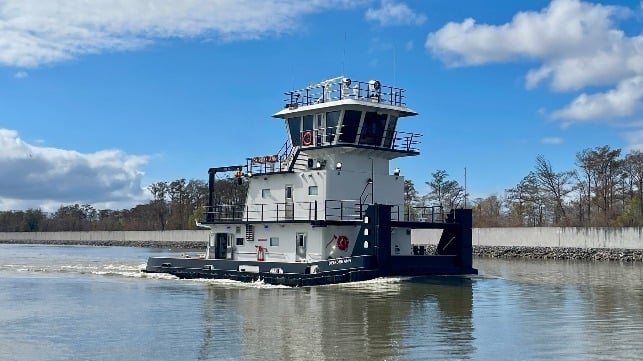
Maritime Partners Puts M/V Deirdre Ann Into Service
Maritime Partners placed the M/V Deirdre Ann into service as a new-construction pushboat built by FMT Shipyard in Harvey, Louisiana. The vessel is powered by two Mitsubishi S6R2 Tier 3 engines, each rated at 803 horsepower at 1400 RPM, with commissioning support from Laborde Products.
The S6R2 platform is designed for consistent power at working speeds, strong low-end torque, and a fuel curve that helps operators manage consumption over long duty cycles. For a vessel expected to stay on the move, the combination of reliable engine performance and Laborde’s regional support network positions the Deirdre Ann for dependable uptime during its first years in service.
Maritime Partners pointed out that the selection of the S6R2 package ties directly to long-term operational needs.
“When one of our vessels goes to work, operators need power they can trust,” said Chris Miller, Director of Newbuild Programs at Maritime Partners. “The S6R2 gives us the performance profile we want, and Laborde gives us the local support that keeps downtime to a minimum. That combination lets our customers take delivery of a boat that is ready to work from day one.” Laborde emphasized the coordination behind the project and the hands-on support provided throughout the build.
“The Mitsubishi S6R2 is well suited for pushboats that need consistent power at working speeds,” said Bradley Matte, Gulf Coast Territory Sales Manager at Laborde Products. “It delivers strong torque, predictable fuel performance, and straightforward maintenance, which helps vessels like the Deirdre Ann stay available and productive over the long term.”
The Deirdre Ann continues Maritime Partners’ investment in modern, efficient pushboats built with attention to both performance and long-term serviceability.
The products and services herein described in this press release are not endorsed by The Maritime Executive
Virgin Voyages Sailing From The Port of Los Angeles for First Time
‘Brilliant Lady’ Launches Cruises along Pacific Coast and Visits to Canadian, Mexican Riviera and Central American Destinations
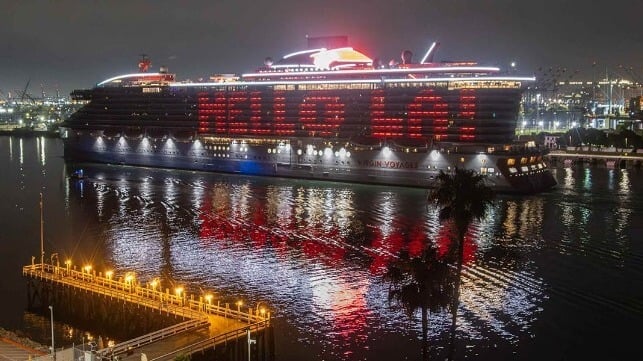
For the first time ever, Virgin Voyages today kicked off a brand-new West Coast itinerary sailing from the Los Angeles Cruise Terminal, with its newest ship, Brilliant Lady, making the Port of Los Angeles its homeport this spring.
This maiden call marks the cruise line’s fresh start on the West Coast, featuring adults-only cruising and unique experiences to iconic destinations.
“Virgin Voyages brings a fresh, contemporary cruise product to Los Angeles, and we’re proud to welcome them as a new homeport partner,” said Port of Los Angeles Executive Director Gene Seroka. “With these well-crafted itineraries, passengers can make the most of their time exploring destinations along the Pacific Coast and beyond.”
Virgin Voyages’ Brilliant Lady began her inaugural tour in September 2025, launching from New York. The 110,000-ton vessel measures 909 feet long and 125 feet wide, specifically designed to pass the Panama Canal. Able to accommodate 2,770 passengers, the ship features 1,408 cabins, more than 20 eateries and unique spaces.
With no children on board and no buffets, Virgin Voyages instead emphasizes premium, all-inclusive dining across 20+ eateries, immersive entertainment and shows, live music and dancing under the stars, detox and retox moments with a variety of fitness spaces aboard Brilliant Lady. Created specifically with the West Coast in mind, Brilliant Lady also introduces new wellness programming designed around movement and recovery, from morning raves to Vibe Rides cycle classes. The ship also features unique offerings such as dedicated solo cabins for passengers traveling alone.
2025 was a record cruise year at the Port of Los Angeles with 241 calls carrying a total of 1.6 million passengers, which generated an estimated $300 million for the local economy. The cruise industry is growing rapidly and the Port is poised to accommodate the needs of both current and future passengers.
The products and services herein described in this press release are not endorsed by The Maritime Executive.
Largest Ship Repair Yard in East Africa Inaugurated in Djibouti
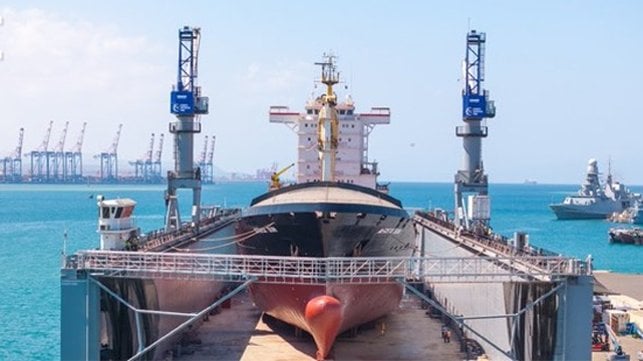
Djibouti Ship Repair Yard handled its first ship late last year and now marked it official inauguration (Djobouti Ports & Free Zones Authority)
Officials in Djibouti officially inaugurated the Djibouti Ship Repair Yard on April 4, marking what they called a milestone in the development of the country’s maritime economy. It becomes the largest ship repair yard in the Red Sea region and East Africa, available to provide critical repair and maintenance work.
“The DSRY project has always been a national priority, given Djibouti’s strategic location at the entrance to the Bab el-Mandeb, one of the world’s busiest maritime routes,” said President Ismaïl Omar Guelleh during the ceremony.
The operation is a decade in the making, with the Djibouti Ports & Free Zones Authority highlighting plans for the facility in December 2016. At the time, it had projected an opening in September 2020.
The project was developed in partnership with Damen Shipyard and an investment from Invest International from the Netherlands, valued at €107.5 million (approximately $124 million).
DSYR is positioned on 80 hectares with more than 800 meters of berth. In February, they repositioned a floating dock measuring 217 meters in length to the yard. It has a lifting capability of 20,100 tonnes. The facility is strategically located on a critical shipping lane.
Work has already begun at the yard, with its first large vessel dry-docking on October 15, 2025. The Africa Sun (13,719 dwt), a Djibouti-flagged containership that operates to the Red Sea and Middle Eastern ports, entered the yard for a month of repairs. Built in 2006, the ship completed hull and underwater inspections, painting, structural and deck repairs, and work on its tanks, piping, and electrical systems.
No timeline was given for when the yard will reach full operational capacity. The officials said they plan to market their capabilities and hope to attract more international business.
Red Cat Plans to Make 3D-Printed Drone Boats for On-Demand Delivery
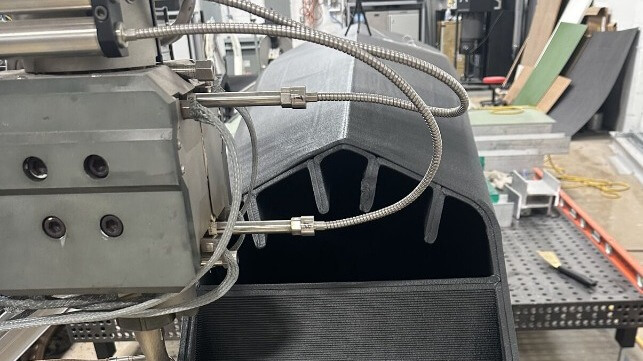
One of Haddy's robots prints out a plastic drone boat prototype for a different unmanned-boat company, 2026 (Haddy)
Red Cat, the drone company bringing Ukraine's famous unmanned boat designs to the U.S. market, has announced a partnership to use large-scale robotic 3D printing during manufacturing. The solution will double the manufacturing capacity of Red Cat's maritime division, Blue Ops.
The firm is focusing its initial efforts on Ukraine's seven-meter drone boat design, with five different configurations for combat or surveillance. The best-known use case of the platform is its capability as a long-range remote-controlled bomb boat, but Blue Ops is also interested in delivering gun-mount, anti-aircraft and UAV-carrying variants - concepts all trialed with success in the Black Sea. With a low center of gravity and a deep-V hull, the design is more capable in higher sea states than an equivalent manned vessel, according to Blue Ops CEO Barry Hinckley.
Going forward, Blue Ops will be working with 3D printing specialist Haddy, which applies AI and robotics to the task of manufacturing large objects in series - not just for prototype designs. The St. Petersburg company is a Siemens- and CEAD Flexbot-equipped printing vendor with a background in printing furniture, architectural elements, casting molds and other items. It launched in 2022, and after a 2025 expansion, it now has one of the largest facilities of its kind in the world. Haddy has previously 3D-printed a semisubmersible prototype hull for a competing U.S. drone-boat company; it says that the 40-foot-long print took nine days.
In its partnership with Blue Ops, Haddy will support the construction of a new, large format 3D-printing shop at Blue Ops’ own manufacturing plant. The idea is to manufacture hulls on demand to meet customer requirements for five- and seven-meter drones. Blue Ops will also be able to order more hulls from Haddy's own shops if more capacity is needed.
"This partnership advances our ability to iterate at the speed of modern conflict," said Barry Hinckley, president of Blue Ops. "This fundamentally changes how quickly we can move from concept to deployment and gives us the ability to meet demand at scale in ways the industry hasn’t seen before."
TRUMP'S
NOAA Reopens Northeast Canyons Nat'l Monument to Commercial Fishing
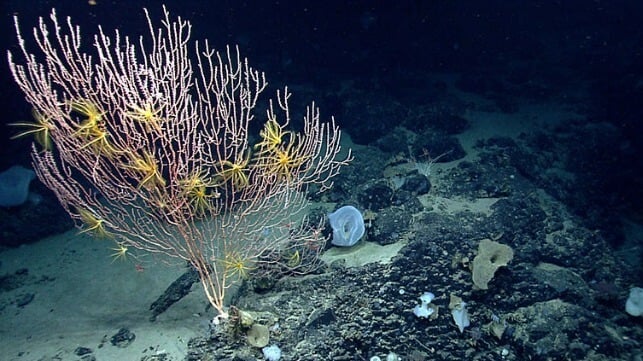
Deep-sea coral at Mytilus Seamount (Courtesy NOAA)
NOAA’s National Marine Fisheries Service has withdrawn a longstanding ban on commercial fishing within the Northeast Canyons and Seamounts Marine National Monument. The action follows through on a proclamation to reopen the area, signed by President Donald Trump in February - but certain gear types are still restricted.
The monument area covers about 4,900 square miles, and it is home to high-value species like red crab, mackerel and swordfish. In a statement, NOAA said that it was following input it had received from fishing companies and acting on a desire to improve economic conditions for fishermen.
"The president delivered on his promise to bolster the American fishing industry and fishing communities," said Commerce Secretary Howard Lutnick in a statement. "Restoring fishing in the Northeast Monument sends a signal that our fishermen are valued in the United States."
NOAA has left in place some of the rules designed to protect deep-sea corals, aligning with the goals of the New England Fishery Management Council’s Deep-Sea Coral Amendment. All trawling, dredging and other bottom-tending gear (save for red crab pots) is banned in a designated coral habitat area around Georges Bank.
It is the second piece of regulatory relief for fishermen in U.S. waters in less than a month. In March, the Western Pacific Regional Fishery Management Council (WESPAC) voted to reopen areas of four vast Pacific Ocean national monuments to commercial fishing. The reopening details vary by gear type and distance from shore for each of the reserve areas.
Barge Catches Fire in Vancouver's Fraser River Port District
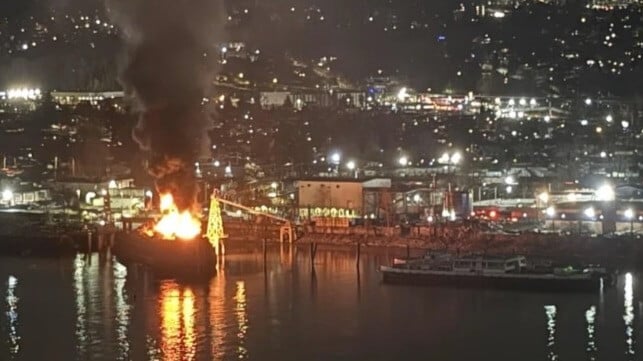
Overnight Thursday, a large fire broke out aboard a deck barge at the port of Surrey, BC, sending a dense plume of smoke into the air and startling residents who thought it was a commercial building fire.
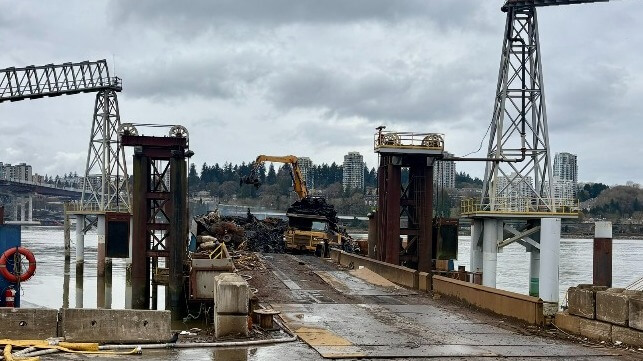
The fire broke out aboard a barge at a scrap metal terminal at Musqueam Drive, on the Surrey side of the Fraser River. The local fire department received a call at about 2300 hours reporting a major fire, and found a burning barge laden with scrap metal. At its peak, the blaze extended the length of the barge and engulfed the pile.
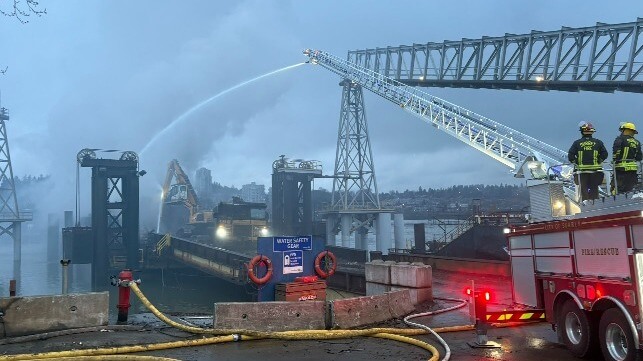
The fire department treated it as a two-alarm fire and kept hoses on it into Friday. Metro Vancouver, the regional authority, said Friday that it was monitoring air quality given the large volume of smoke given off by the smoldering pile.
Courtesy Metro Vancouver
Scrap metal fires are all too common, and are typically ignited by unwanted contaminants - notably lithium-ion batteries, which can burst into flame when damaged. The problem has grown in recent years alongside the expanding use (and discarding) of consumer battery-powered devices. The fires grow and accelerate in the presence of flammable debris within the pile, such as oily wastes and plastics.
Tanker Truck Blast Closes Bridge Over Panama Canal
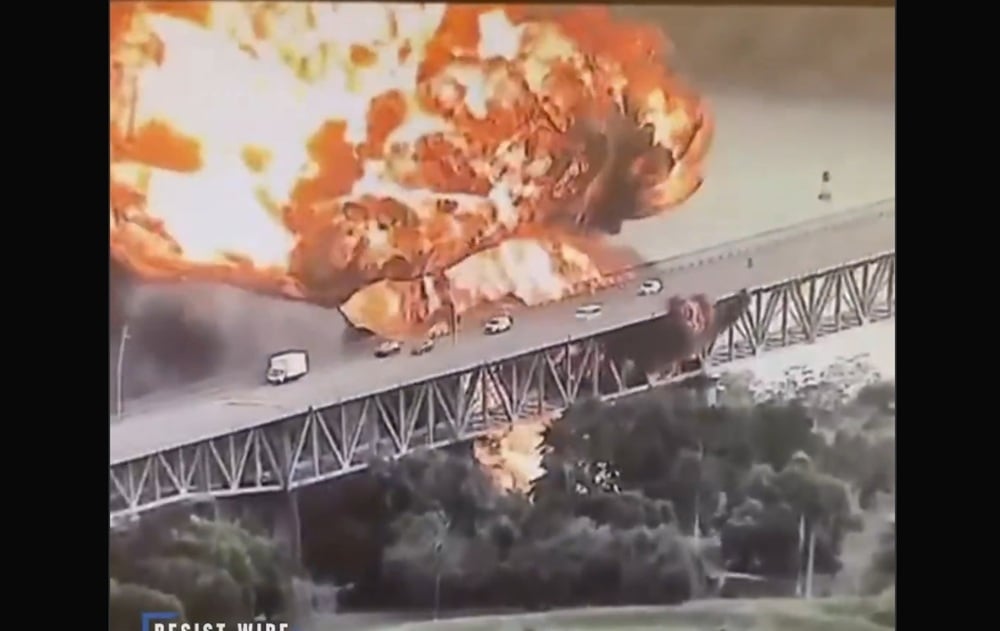
An explosion at a fuel facility next to the Bridge of the Americas has killed one and injured several others, according to the fire department for Panama City, Panama. The fireball from the fuel burn-off made contact with the bridge, which spans the Panama Canal and carries logistics traffic for the port of Balboa.
A large tank farm is located next to and beneath the bridge on the eastern bank, between the International Maritime University of Panama and a luxury hotel. A tanker truck loading fuel near the tank farm exploded Monday, igniting two other nearby trucks and sparking a massive blaze.
One person was killed in the blast, identified by the authorities as a truck driver. Three others were injured, including one survivor with second-degree burns. The accident had potential for far greater harm: traffic was moving on the bridge at the time of the blast, and several vehicles passed right through or next to the fireball - including a bus full of passengers.
Firefighters responded to the scene, and post-casualty video shows efforts under way to extinguish spot fires directly beneath the bridge. The span remained closed to motor traffic on Tuesday while an inspection got under way to evaluate the bridge's condition. The bridge pier and girders in the area of the blast were coated with black soot from the fire.
So far, the canal remains open to traffic, and merchant vessels continued to transit underneath the affected span on Tuesday morning.
The cause of the blast remains under investigation, and has received additional scrutiny because of the sensitive geopolitical moment. The canal is one of the most important maritime choke points, and the most important one for U.S. energy shipping interests; any shutdown of the canal would have strategic implications for the U.S. West Coast and Asia-Pacific petroleum markets, already under significant stress.
Trident Sues Tacoma Fire Dept. for the Loss of the Kodiak Enterprise
The early stages of the Kodiak Enterprise fire (Courtesy Washington Department of Ecology)
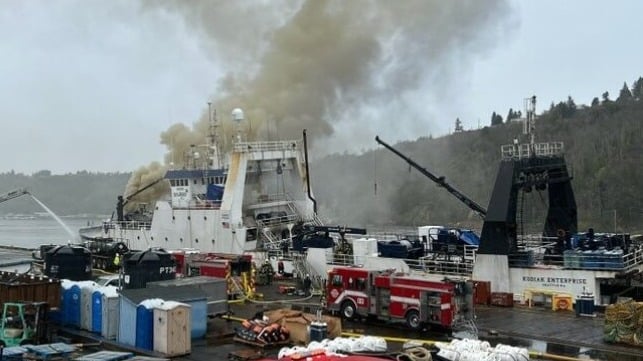
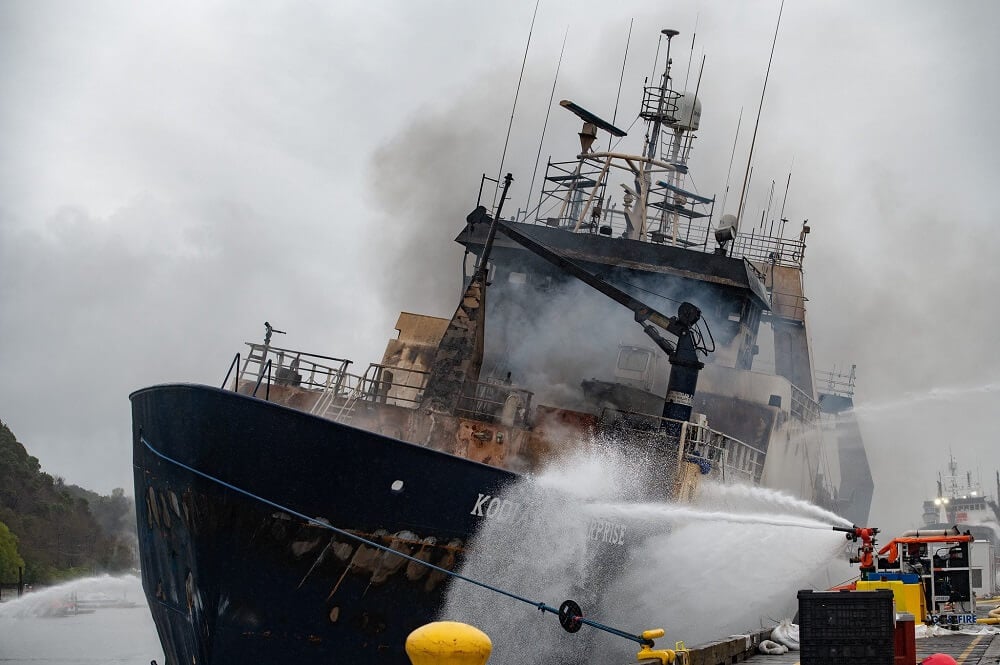
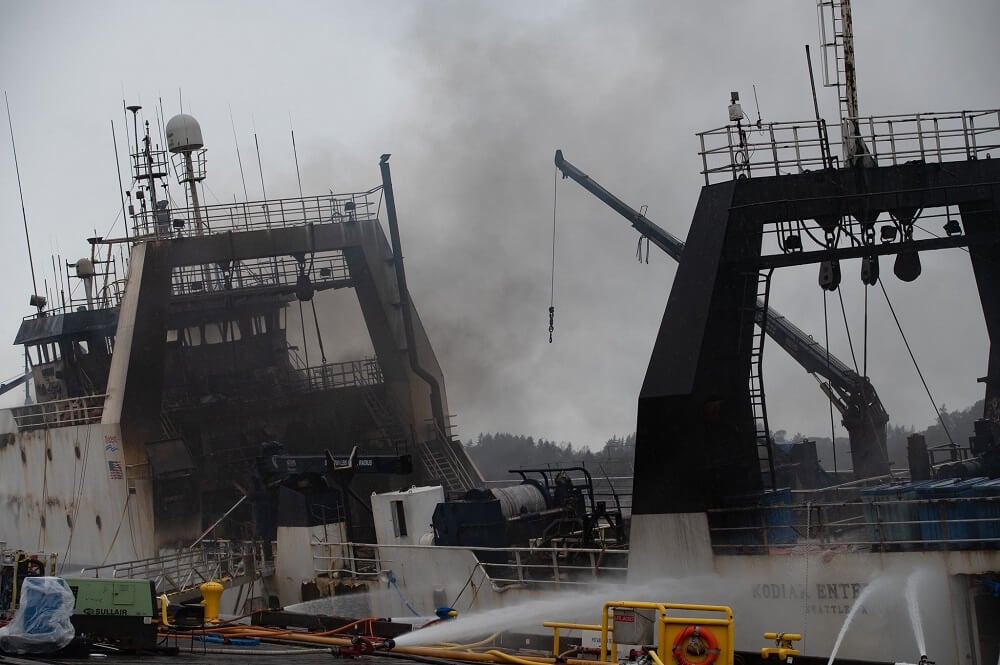
U.S. fishing company Trident Seafoods has filed a rare lawsuit against the city of Tacoma, Washington for alleged mishandling of the fire aboard the fishing vessel Kodiak Enterprise, which was destroyed in a massive blaze three years ago. A lawsuit against an emergency response agency is virtually unheard-of after a marine casualty, but Trident alleges gross negligence on the part of the Tacoma Fire Department.
In the early hours of April 8, 2023, a fire broke out in a compartment towards the bow of the Kodiak Enterprise while the vessel was alongside at the Port of Tacoma. The point of origin was likely in a dry stores space, according to Trident. The crew evacuated onto shore, and Tacoma Fire Department responded to the scene by about 0330 in the morning.
The fire department took command of the response and began its work. Meanwhile, Trident contracted with salvor Resolve Marine for expert marine firefighting services. Resolve has a base located in Tacoma and a strong presence in the Seattle area, and it mobilized a team to the scene beginning at about 0600 that morning. Tacoma Fire retained formal control, and Resolve's personnel acted in an advisory capacity.
A Tacoma Fire battalion chief took over the incident commander role at about 0720 hours, and the fire was substantially under control by 1330 hours, according to Trident. Resolve recommended boundary cooling and isolation (shutting down all ventilation) in order to let the fire burn out in the forward compartments, controlling risk.
Instead, the Tacoma Fire battalion chief insisted upon the opposite strategy, Trident alleges in its suit. Over the objections of Resolve's advisers, the incident commander allegedly ordered Tacoma Fire's responders to bring fans aboard and begin blowing large volumes of air into the space - a strategy called positive pressure ventilation (PPV) - at about 1845 hours.
In a shoreside fire, PPV is typically used after the blaze is knocked down or extinguished in order to clear out smoke and allow fire teams to move into the space, or to decrease the imminent hazards of smoke inhalation and heat for any trapped survivors (not a factor as the space was unoccupied). These use cases make PPV a popular firefighting tool for shoreside fire departments, but the technique is deployed with care: it has the risk of potentially re-igniting smoldering materials, as by the nature of its operation it blows additional oxygen into the fire space. PPV's success depends upon setting up a controlled airflow route between the blower fan at the entryway and a designated exit point for smoke and hot air.
PPV is controversial when applied in marine firefighting, according to the textbook IFSTA Marine Firefighting for Land-Based Firefighters, as ventilation inside a ship is harder to control. "Positive pressure ventilation is ineffective [in shipboard fires], and smoke movement is unpredictable," advised DoD civilian firefighter and consulting fire investigator Nicholas Palumbo in a recent editorial.
When Tacoma Fire's battalion commander ordered his fire teams to use PPV aboard Kodiak Enterprise, Trident asserts, Resolve Marine recommended against it and offered to take over incident command in the morning. The Tacoma Fire battalion commander proceeded anyways, without first arranging for a controlled ventilation pathway for the smoke and hot air to safely exit the space, Trident alleged in its complaint.
Per Trident's timeline, thick black smoke and flame emerged from the ship within a short time after Tacoma Fire commenced PPV in the fire-affected space. At about 2100, roughly 2.25 hours after ventilation began, Tacoma Fire's event chronology noted that the response was "transitioning to defensive." The agency evacuated its fire teams shortly after, and the fire burned through the rest of the ship over the course of the next several days. The Kodiak Enterprise was declared a total loss.
Images courtesy USCG
Trident alleges that the fire would have been contained to the forward compartment if Resolve's advice to isolate it had been followed; the company claims that the rest of the ship would have been unharmed if Tacoma Fire had not initiated positive pressure ventilation.
Trident claims that the value of the vessel was $185 million, and that the damages attributable to Tacoma Fire's decision came to at least $100 million.
Tacoma Fire and Resolve Marine have been contacted for comment.
When Bridge Teams Lose Control Without Realizing It
Too late: By the time the deviation becomes clearly visible, the system may already be operating beyond a recoverable threshold (SCA file image)
Following recent discussions on hydrodynamic instability in confined waters, an important operational question remains: Why do experienced bridge teams sometimes lose control of a vessel — without recognizing it in real time?
In many marine casualties, loss of control is not a sudden event. It develops gradually, often while the vessel still appears manageable.
The Illusion of control
On the bridge, control is typically assessed through heading response; rudder feedback; visual alignment with the channel; and engine response. As long as these indicators appear normal, the situation is perceived as stable.
However, in confined waters, this perception can be misleading. Hydrodynamic forces — especially when combined with environmental factors such as wind and shallow water — may begin to alter vessel behavior before it becomes visibly critical. The vessel is still responding, but it is no longer behaving predictably.
Delayed recognition
One of the most dangerous aspects of confined-water navigation is delayed recognition. The transition from stable control to instability is not always obvious. There is often no single alarm, no immediate failure.
Instead, corrections become slightly less effective; rudder angles increase; and the vessel requires more input to maintain track. These changes can be interpreted as “normal variation” rather than early warning signs.
By the time the deviation becomes clearly visible, the system may already be operating beyond a recoverable threshold.
Nonlinear response
At the core of this issue is a nonlinear relationship between cause and effect. Small increases in speed, small changes in position, or moderate environmental forces can lead to disproportionately large responses in vessel behavior.
This is particularly relevant in shallow and confined waterways, where squat reduces under-keel clearance, rudder efficiency decreases, and bank interaction forces intensify.
As a result, corrective actions may begin to produce unexpected outcomes. More rudder does not always mean more control. In some cases, it produces the opposite.
Cognitive bias under pressure
Bridge teams do not operate in a vacuum. They operate under schedule pressure, pilot expectations, traffic constraints and environmental uncertainty.
Under these conditions, there is a natural tendency to assume that the situation remains controllable — especially if it was under control moments before.
This creates a cognitive bias: “If we are still on track, we are still in control.” In reality, control may already be degrading.
The critical gap
The most dangerous phase is the gap between actual loss of controllability and recognition of that loss.
This gap can be only minutes — but it defines the difference between recovery and casualty.
Once the system crosses a nonlinear threshold, recovery options narrow rapidly.
Closing the gap
Reducing risk in such scenarios does not depend on more technology alone. It depends on operational awareness.
Three practical measures can significantly reduce exposure:
- Recognizing early signs of reduced control effectiveness
- Establishing predefined thresholds for intervention
- Maintaining active bridge team engagement during pilotage
Most importantly, bridge teams must accept that loss of control is not always visible when it begins.
From control to awareness
IRONY
Passengers Abandon Cruise Grounded on Island from 2000 Movie “Cast Away"
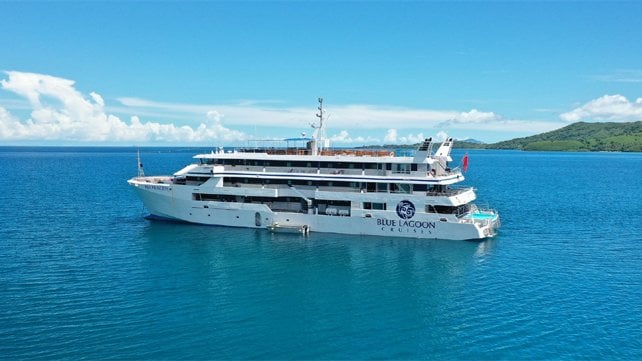
Fiji Princess grounded on a reef off an uninhabited island used to film a 2000 movie about a cast away (Blue Lagoon Cruises file photo)
Passengers aboard the Fiji cruise ship might have thought they were about to relive a scene from the 2000 movie “Cast Away,” in which Tom Hanks becomes stranded for years on an uninhabited island. Their ship, the Fiji Princess, grounded on April 4 on the same island used in the movie.
The 179-foot (55-meter) cruise ship operates cruises up to a week in length around the islands in Fiji. Built in 1998, the ship has 32 passenger cabins with a maximum capacity of 64 passengers, along with 31 crew.
According to the initial reports, the vessel was at anchor in calm waters when it was hit by a severe squall that caused it to drag anchor. It hit a reef and, according to the Maritime Safety Authority of Fiji, suffered serious damage to its port side along the stern. The hull has been damaged and was experiencing an ingress of water in an area near the steering equipment. The ship was sitting on the reef with a strong list to port.
The 30 passengers aboard this cruise were removed from the ship at first light on Sunday along with 17 crewmembers. A ferry transferred them back to Port Denarau. The authorities have not reported injuries among the passengers or crew.
The primary concern, they said, was 20,000 liters of diesel fuel aboard the vessel. There were no signs of a fuel leak or damage to the tanks, but they prepositioned containment equipment as a precaution.
The vessel’s owners, Blue Lagoon Cruises, brought in a salvage team from Australia, which reached the location on Sunday. However, due to rough seas and strong waves, the authorities reported they had been unable to send down divers to survey the underside of the hull.
A strong tropical storm was approaching Fiji, so the remaining crew was moved off the ship overnight for their safety. The plan was to begin removing the fuel as soon as possible while the salvage team surveyed the damage and determined how to remove the vessel.