Friday, April 10, 2026

OECD: Development aid plummets in 2025 amid USAID gutting
DW with AFP, dpa, KNA, Reuters


International development aid spending fell by more than one-fifth in real terms last year, the biggest dip on record. The US slashing its outlay by more than half set the tone, making Germany the largest overall donor.


Expressed as a share of its overall economic clout, the US is now the least generous aid provider in the 34-member Development Assistance Commitee, according to OECD data
Image: Luis Tato/AFP/Getty Images

International development aid fell by 23% in real terms in 2025 to the lowest levels since 2015, the Organization for Economic Cooperation and Development (OECD) said on Thursday.

Preliminary data pointed to the largest dip in donations from members and associates of the Development Assistance Committee (DAC) since records began.

For the first time on record, all five of the top international providers reduced their input.

The reduction was spearheaded by the world's richest country, the US, slashing its official development assistance spending by 56.9%, leaving Germany as the world's largest donor by default, even as it missed its own targets for international aid once again.


US now the least generous donor relative to economic clout

Some of the core statistics on official development aid spending from the 34 DAC members and other major countries were as follows:

Total ODA spending from the 34 members stood at $174.3 billion (roughly €148 billion)
That equates to just 0.26% of these countries' gross national income (GNI)
Only four countries — Denmark, Luxembourg, Norway and Sweden — met the UN target of spending 0.7% of GNI on aid
All five of the top donors — Germany, the US, the UK, Japan and France — reduced their contributions in 2025
Together, these countries accounted for 95.7% of the overall reduction
The US alone drove three-quarters of the overall decline as Donald Trump took a hatchet to USAID on his return to the White House
Washington's 56.9% reduction in aid spending was the largest by any country on record
This makes the US now the least generous donor as a share of the size of its economy in the entire DAC, donating 0.09% of GNI
Average donations across members equated to 0.26% of GNI, barely one-third of the UN target
Other bilateral aid providers outside the DAC — particularly Turkey, the United Arab Emirates and Qatar — are becoming increasingly meaningful donors as European and US input declines


What did the OECD say about the reductions?


"It's deeply concerning to see this huge drop in ODA in 2025, due to dramatic cuts among the very top donors," OECD Secretary-General Mathias Cormann said. "In this challenging environment, the significant decline in official development assistance highlights the need to maximise the impact of available resources, and to use them more effectively to unlock new sources of investment."

Carsten Staur, the chair of the ​OECD assistance committee told a news briefing on Thursday that "the message is extremely sombre."

The organization also forecasts a further, if more modest, decline of 5.8% in real terms in 2026. It said the atmosphere of sharp and continuing declines presented an "enormous shock to the system."


Germany again misses spending target, but nevertheless becomes largest overall donor amid US cuts

Germany's ODA contributions shrank from 0.68% of GNI in 2024 to 0.56%, at a total of $29.09 billion. If you exclude refugee assistance funding spent inside Germany, that figure falls further to 0.46%, based on Development Ministry figures.

Yet still Germany became the largest overall donor in the world for the first time in history as the US, with an economy roughly six times the size of Germany's, slashed its spending.

The US remains the second largest donor in overall terms, with EU institutions next in line and the UK a fairly distant fourth.

Aid organizations criticized the government in Berlin while security expert Philipp Rotmann at the Global Public Policy Institute said the reductions were "not in Germany's security interests" given the "deadly gap" left by the US pullout, from which Russia and China would seek to profit geopolitically.

"The world's on fire and Germany continues to cut," Oxfam Germany chairwoman Charlotte Becker said, saying the reductions had life-threatening consequences.

Church charities like Brot für die Welt, Misereor, Caritas International and Diakonie issued a joint statement decrying a "dangerous downward spiral" in spending.


Ukraine aid rises thanks to EU input, dominates overall outlay

Net bilateral aid to wartorn Ukraine from DAV members fell by 38.2% last year, according to OECD figures. This was driven by a sharp US dip as Trump returned to the White House, even as 23 countries increased bilateral contributions.

However, because of new support via EU institutions in Brussels rather than member states, overall donations to Ukraine totaled $44.9 billion, an 18.7% increase on 2024 that bucked the overall trend and "the largest volume of net ODA to any single recipient in any year on record," the OECD said.

"This amount was larger than DAC members' combined bilateral ODA to all less developed countries ($28.1 billion) and all countries in sub-Saharan Africa ($29.2 billion)," it said.

The reduction in donations was most sharp in bilateral development assistance, falling 26.4%. Multilateral ODA spending levels fell by 12.7%. The volume of bilateral development grants fell much more sharply (down 29.3%) than bilateral spending on loans (down 10.3%).

US: Pentagon must restore journalists' access, judge says


Rana Taha 
DW with AP, Reuters
10/04/2026

A federal judge has said the US Defense Department has not complied with orders to allow journalists access to the Pentagon. New rules have prevented reporters from entering the building without an escort.

The Pentagon is defying a court order that required it to restore access to credentialed reporters, a US judge ruled on Thursday.

US District Judge Paul Friedman said the Pentagon must comply with his order and restore reporters' access to the US Defense Department.

Why are Pentagon reporters denied access?

In October 2025, the Pentagon under Defense Secretary Pete Hegseth said journalists could be deemed security risks and thus have their press badges revoked if they solicited unauthorized military personnel to disclose classified, and in some cases unclassified, information.

Only one of 56 news outlets in the Pentagon Press Association agreed to sign an acknowledgment of the new policy, with the rest having to hand in their press passes and report on the Pentagon from outside the facility.

The New York Times led a lawsuit challenging the new policy, and Friedman ruled in the journalists' favor on March 20, saying the policy violated protections for news gathered and due process in the US Constitution.

He required the immediate restoration of reporters' access.

The Pentagon then released a new "interim" policy that bars reporters with press passes from entering the building without an escort, according to The New York Times. It also governs when reporters can offer anonymity to a source, as well as preserving other rules that the court had rejected.

What did the judge say about the Pentagon's policies?

The Pentagon had denied violating Friedman's prior order in a March court filing, saying it was "careful to address all ​of the legal defects that the court perceived in the prior policy."

Pentagon spokesperson Sean Parnell has said the administration would appeal Friedman's March 20 decision.

Parnell said in a social media post that the department has complied with the judge's orders, reinstating journalists' credentials and issuing "a materially revised policy that addressed every concern" identified by the judge.

But on Thursday, Friedman said that the access the Pentagon made available to permit holders "is not even close to as meaningful as the broad access" they previously had.

"The Department cannot simply reinstate an unlawful policy under the guise of taking 'new' action and expect the Court to look the other way," Friedman wrote in ​his ruling. The judge called the Pentagon's actions a "blatant attempt to circumvent a lawful order of the Court."

He also argued that the US military operations in Venezuela and Iran make the need for public access to information regarding government activities all the more pressing.

Lufthansa cabin crew begin strike, hundreds of flights cancelled

10.04.2026, dpa

Photo: Lando Hass/dpa

By Christian Ebner, dpa

Cabin crew at German airline Lufthansa began a strike at midnight, a spokeswoman for the UFO union has confirmed.

Around 20,000 flight attendants have been called on to stay off work until 10 pm (2000 GMT) on Friday.

The UFO union called the strike in an effort to break deadlocked wage negotiations with Lufthansa's core airline and its regional subsidiary Lufthansa CityLine, which is also affected by the strike.

It marks the third major walkout this year at Germany's largest airline, following two rounds of pilot strikes.

Lufthansa has announced contingency measures but had already cancelled hundreds of flights in advance.

At Frankfurt, the airline's largest hub, around 75% of roughly 350 planned Lufthansa departures were cancelled, according to airport schedules. Landings were similarly affected.

Officially, only departures in Germany are affected, including at the hubs in Munich and Frankfurt and at other airports such as Leipzig/Halle, Berlin and Stuttgart.

However, due to aircraft being out of position at foreign destinations, many return flights for Easter holiday travellers are also expected to be cancelled.

Lufthansa advised passengers to check their flight status before travelling, saying tickets can be rebooked or refunded. In cases of delays of more than three hours, passengers are entitled to compensation. The airline must also provide alternative transport, as well as meals and accommodation where necessary.

The strike follows a warning strike and a union ballot that showed strong support among Lufthansa cabin crew for industrial action. The UFO union said the dispute centres on stalled talks over Lufthansa's collective agreement and the company's refusal to negotiate a social plan for Lufthansa CityLine.


Lufthansa cabin crew begin strike

Rana Taha 
DW with dpa
10/04/2026


Hundreds of flights have been canceled as cabin crew members walk out. This is Lufthansa's third major strike this year.

Cabin crew at German flag carrier Lufthansa walked off of their jobs on Friday, with a strike that began at midnight (2200 Thursday GMT) and that will affect hundreds of flights.

Some 20,000 flight attendants have been called to strike until 10 p.m. on Friday.

The UFO trade union called a one-day strike for its members both with Lufthansa and its Cityline regional subsidiary, as wage negotiations continue to stall.

The walkout is Lufthansa's third major one this year. It follows two rounds of pilot strikes.
How is the strike expected to affect travel?

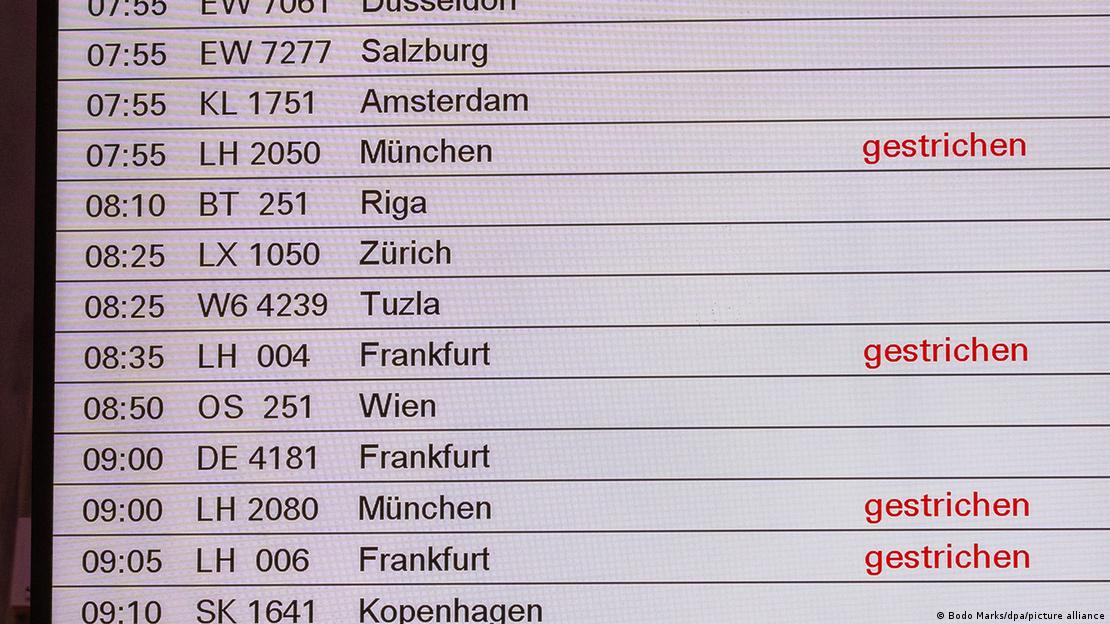
Lufthansa, Germany's largest airline, canceled hundreds of flights in advance of the strike, as it struggles to mitigate the impact of the walkout.

Cancellations are expected to hit the hubs in Munich and Frankfurt, as well as other airports, including Leipzig/Halle, Berlin and Stuttgart.

At its largest hub in Frankfurt, nearly 75% of some 350 scheduled Lufthansa departures were canceled.

Though the strike is only meant to affect departures in Germany, it is expected to lead to the cancellation of several return flights for Easter holiday travelers.

The airline advised its passengers to check the status of their flights before heading to the airport.

Hundreds of flights were canceledImage: Bodo Marks/dpa/picture alliance

Lufthansa is struggling in negotiations not just with the UFO cabin crew union but also the pilots' trade union Vereinigung Cockpit.

The two organizations joined forces in early February in a bid to maximize the impact of their strike, leading to major disruptions. The pilots then went on strike for another two days in mid-March.

Edited by: Sean Sinico

Paving the way: Rome Colosseum renovation reveals structures hidden for centuries

By Tokunbo Salako
Published on 

Visitors to Rome's Colosseum now have a new chance to step back into history thanks to a renovation project that's unearthed several entrance columns that have been buried for hundreds of years.

Italy’s most iconic landmark has been given a remarkable new look.

The Colosseum in Rome has undergone a major restoration, revealing parts of its original structure that have been hidden for centuries.

New travertine marble blocks have been installed outside the arena, marking where grand entrance columns once stood.

The project restores the monument’s perimeter and highlights details long buried underground, including original entrance numbers that guided spectators to their seats.

People walk in the new outdoor space created with travertine marble around the Colosseum during its inauguration in Rome, March 17, 2026 AP Photo/Andrew Medichini

In ancient times, each arch, except those located along the major and minor axes, was marked with a number engraved on top of the arch, just below the first cornice of the façade, to facilitate identification of the entrances.

Stefano Boeri, the architect of the restoration project said the idea from the start was to give visitors a real sense of the monument's proportions: "We have rebuilt the real perimeter, the crepidine (pavement) of the Colosseum, and at the same time the dimension of all the parts of the fornici (arches), which were covered by ground. That had been covered for centuries.”

The work of controlling and restoring the monument’s original levels not only reinstated the legibility of the Flavian Amphitheatre’s footprint and its geometric base, but also offered the opportunity to reconsider the stormwater drainage system.

The result is a public space that is both hydraulically organised and more accessible for visitors with water management also an integral part of the paving design.

The new outdoor space created with travertine marble around the Colosseum during its inauguration in Rome, Tuesday, March 17, 2026 AP Photo/Andrew Medichini


With its past more visible than ever, visitors can experience a clearer picture of life in ancient Rom

“We wanted to restore some of the missing sections of the entry corridors for the public. The two missing sections of the corridors of the Flavian Amphitheater, which collapsed starting in the 6th century AD for various reasons, the main one being that the ground in this area is the most unstable,” explained Alfonsina Russo, archaeologist and representative of the Italian ministry of cultural heritage.

The Colosseum remains Italy’s most popular tourist attraction, drawing millions of visitors every year.

Global Population Logic Undergoes A Cognitive Reversal – Analysis


April 10, 2026 
 Anbound
By Zhao Zhijiang

Over the past few decades, the understanding of global population issues has largely been based on a relatively simple framework: developed countries have lower fertility rates, while developing nations experience rapid population growth; wealthier groups tend to have fewer children, while poorer groups are more likely to have larger families. However, new data emerging over the past decade or so is gradually challenging this conventional view. Low fertility rates are no longer confined to developed economies like those in some European countries, Japan, or South Korea. Instead, they are increasingly spreading to regions such as Latin America, the Middle East, and Southeast Asia. Even more striking is that this shift is not only apparent between countries but is also becoming increasingly evident within countries, reflecting deep transformations in economic structures, social norms, and family values.

In a podcast discussing the economics of the baby bust, Jesús Fernández-Villaverde, Professor of Economics at the University of Pennsylvania, cited a series of surprising examples that directly challenge prevailing assumptions about who tends to have more children and who tends to have fewer.

One particularly striking comparison is between the United States and Mexico. Professor Fernández-Villaverde jokingly remarked in the podcast that if one were to randomly ask ten professors on a U.S. university campus which country has a higher fertility rate, most would likely still answer Mexico. However, the reality is the exact opposite. According to registration data from Mexico’s National Institute of Statistics and Geography (INEGI), the country’s Total Fertility Rate (TFR) in 2023 is approximately 1.60, while the U.S. rate for the same period is about 1.62. This marks the first time that Mexico’s fertility rate has fallen below that of the United States. It is worth noting that due to differences in statistical methods, the World Bank estimates Mexico’s TFR for the same period at 1.91, which is a significant discrepancy. Nevertheless, regardless of the data source, the sharp decline in Mexico’s fertility rate over the past decade has far exceeded most people’s expectations. From around 2.3 to 2.4 in the early 2010s, it has dropped rapidly, driven by a combination of factors such as accelerated urbanization, higher education levels, increased female labor force participation, and economic structural transformation.

Another transformative case comes from Israel. Over the past few decades, the fertility rate of the Muslim population in Israel has consistently been much higher than that of the Jewish population, a gap that has even sparked political discussions about demographic composition. However, this trend quietly reversed around 2015 to 2016, and since then, the gap has continued to widen. Data from the Israeli Central Bureau of Statistics (CBS) clearly illustrates this shift. In 2022, the TFR for Jewish women was approximately 3.03, while for the Muslim population, it had decreased to 2.91. By 2024, in January to October, the Jewish TFR further held steady at 3.07, while the Muslim rate continued to decline to 2.68. This reversal trend is now firmly established and has been strengthening in recent years.


Professor Fernández-Villaverde specifically pointed out that the underlying factors driving this change are complex. The relatively high fertility rate among the Jewish population is largely driven by the ultra-Orthodox Haredi community, whose fertility rate has long remained at a high level of around 6, although there are signs of a gradual decline in recent years. In contrast, the fertility rate among non-Haredi Jewish women, including secular and traditional groups, has remained at a much lower level, around 2.0. Meanwhile, the fertility rate within the Muslim population has seen a significant decline, from over 9 in the 1960s to around 2.75 today. This change has been driven by modernization factors, such as improved female education, increased labor force participation, delayed marriage, accelerated urbanization, and the widespread use of contraception.

This shows how the traditional assumption that “religious societies naturally maintain high fertility rates” is being gradually corrected by reality. The reversal in trends signifies there is a global spread of low fertility rates, that even groups with strong religious or cultural traditions are not immune to the penetrative forces of modernization. What makes Israel unique is that, despite the overall fertility rate of the Jewish population still being among the highest within OECD countries, this is largely due to the contributions of the Haredi community. However, downward pressure on fertility rates is increasingly evident.


Similar changes are accelerating in the Middle East and North Africa. Egypt’s fertility rate, which was previously close to 4, has rapidly decreased in recent years to around 2.3. If the current trend continues, it could fall below the replacement level within just a few years. This would be much sooner than the United Nations’ earlier predictions, which anticipated this would not occur until the end of the century. Similarly, countries like Morocco and Tunisia have already seen their fertility rates drop below the replacement level.

Researchers at ANBOUND have observed that the cases provided by Professor Fernández-Villaverde represent only the tip of the iceberg. More data suggest that population transformation is spreading at an accelerating pace to regions traditionally associated with high fertility rates. For example, Chile’s TFR has recently dropped to around 1.1, putting it on par with countries like Japan, a country typically known for its low fertility rates. Thailand’s fertility rate has also fallen to around 1.0 to 1.2, approaching the range of certain European countries with low fertility. On a regional level, the average fertility rate across Latin America and the Caribbean has dropped to about 1.8, and since 2015, it has consistently remained below the replacement level. When viewed on a more global scale, over half of the world’s countries currently have fertility rates below the replacement level, and this proportion could exceed 90% by the end of this century. The global average fertility rate has dropped from around 5 in the mid-1960s to approximately 2.3 today, a near-halving in just a few decades.

These examples point to a structural shift that is taking place: population transformation is no longer progressing along the traditional linear path of “economic development—gradual fertility decline”. Instead, it is spreading globally at a faster and more concentrated pace.


Professor Fernández-Villaverde argues that the reason why low fertility rates have become a structural issue of concern is not merely because of the decline in population numbers, but because the economic growth, fiscal systems, social security frameworks, and debt repayment capabilities of modern nations are all built upon the foundation of a stable population size and a continuous supply of labor. At the same time, population changes tend to occur unevenly, often exhibiting clear spatial disparities. Core cities continue to attract population, while smaller cities and peripheral regions experience accelerated depopulation. As a result, public services such as schools, hospitals, and commercial facilities shrink, and the operational costs of local communities rise steadily. This spatial imbalance often impacts the daily lives of ordinary people more directly and more quickly than the overall population figures. When a region loses its schools, it means young families are no longer staying. When hospitals close, it forces elderly residents to relocate. The consequences of population decline are never evenly distributed.

All in all, the global population structure is entering a new phase that is fundamentally different from the past. The comparison of fertility rates between Mexico and the United States, the historic reversal of fertility patterns within Israel, and the unexpectedly rapid decline in fertility rates across the Middle East and North Africa, all of these cases point to the fact that traditional frameworks for understanding population trends can no longer fully explain reality. Low fertility rates are shifting from a localized phenomenon to a global structural trend. The pace of transformation in emerging economies may even surpass that of the developed countries of the past, and the eventual stabilization level could be even lower. This shift not only signals a contraction in population size but also points to long-term and profound pressures on labor supply, regional spatial patterns, and social security systems. To truly understand this trend, it is essential to approach it from multiple dimensions, including economic structure, social norms, and family systems, rather than relying on any single explanatory framework.

Final analysis conclusion:

Over the past decade, new data have shown that low fertility rates are no longer a phenomenon confined to developed economies such as those in certain European countries, Japan, or South Korea. Instead, they are rapidly spreading to regions like Latin America, the Middle East, and Southeast Asia. Even more notably, this shift is not only observable between countries but is also becoming increasingly evident within countries, reflecting deeper transformations in economic structures, social norms, and family values.


Zhijiang Zhao is a Research Fellow for Geopolitical Strategy programme at ANBOUND, an independent think tank.

Anbound

Anbound Consulting (Anbound) is an independent Think Tank with the headquarter based in Beijing. Established in 1993, Anbound specializes in public policy research, and enjoys a professional reputation in the areas of strategic forecasting, policy solutions and risk analysis. Anbound's research findings are widely recognized and create a deep interest within public media, academics and experts who are also providing consulting service to the State Council of China.
Latest Mediterranean migrant shipwrecks put 2026 among deadliest years on record

More than 180 people are missing or feared dead after several boats attempting to reach Europe from North Africa got into difficulty. According to the United Nations' migration agency, the most recent shipwrecks have brought the number of deaths reported in the Mediterranean Sea to nearly 1,000 this year.


Issued on: 08/04/2026 - RFI

Survivors on a boat that capsized off Libya with more than 100 people on board, in a picture shared by German rescue organisation Sea-Watch on 5 April, 2026. 
© Fabian MELBER / SEA-WATCH / AFP

At least 990 deaths have been recorded in the Mediterranean since the start of the year, according to figures from the International Organization for Migration (IOM).

It said this represents one of the deadliest starts to a year since its records began in 2014.

In the past two weeks alone, at least 180 people have died or gone missing in five separate shipwrecks.

The latest incident on Sunday left more than 80 people missing when a boat capsized in the Central Mediterranean after departing from Tajoura in Libya with around 120 people on board.

Only 32 survivors have been found so far, while two bodies have been recovered.

World's deadliest route

The Central Mediterranean route from Algeria, Egypt, Libya and Tunisia to Italy and Malta has long been the world's deadliest migration corridor, and the latest data suggests it is becoming ever more dangerous.

Around 765 people have died in the Central Mediterranean this year so far, according to the IOM – more than 460 more than during the same period in 2025.

At the same time, European countries and border enforcement officials are reporting fewer crossing attempts. However, their figures are based on the number of people who arrive and do not include those who die en route.

Experts blame a combination of severe storms, the closure of land routes into Europe, the lack of legal migration options and a crackdown on established crossing routes from Libya and Tunisia.

Spate of shipwrecks

The number of small boats attempting the dangerous crossing typically rises in spring and summer as the weather improves.

In a spate of recent shipwrecks, 19 people were found dead on 1 April aboard a boat that left Zuara in Libya and ran out of fuel, ending up drifting off the Italian island of Lampedusa. Another 58 people were rescued.

On the same day, at least 19 migrants died near Bodrum in Turkey, after a rubber boat capsized on the way to Greece.

On 28 March, at least 22 people died off Crete after departing from eastern Libya, while a 30 March shipwreck near Sfax, Tunisia, left 19 dead and around 20 missing.

The IOM warned that current search and rescue efforts were falling short and called for more legal routes for migrants trying to reach Europe.

The agency's director-general, Amy Pope, said: "Saving lives must come first. But we also need stronger, unified efforts to stop traffickers and smugglers from exploiting vulnerable people, and to expand safe and regular pathways – so no one is ever forced into these deadly journeys."


Tighter EU migration controls fail to curb departures from Africa, report says


By Eleonora Vasques
Published on 

Despite Brussels touting fewer migrant arrivals, tighter asylum rules and African deals have only temporarily diverted irregular routes, with new passages to Europe possible in 2026.

Tighter EU borders and migration deals with African countries have failed to reduce the number of departures from Africa, but merely temporarily diverted irregular routes, according to a report by the International Centre for Migration Policy Development (ICMPD), seen by Euronews.

The ICMPD, an organisation that works for the EU and European governments to develop migration policies, analysed the major mobility trends in Sub-Saharan Africa, revealing that “recent patterns show that intensified controls do not necessarily reduce overall mobility but instead redirect movement towards alternative, often longer and riskier routes”, the report says.

In recent years, the EU has expanded its migration partnerships with African countries such as Tunisia, Egypt, Morocco, Senegal, and Mauritania. These agreements typically involve local authorities strengthening border controls to curb irregular departures toward Europe, while the EU provides financial support and invests in a wide range of development and cooperation projects in return.

At the same time, the EU revised its internal migration management framework through the Asylum and Migration Pact, a package of laws approved during the last mandate that harmonises border procedures and establishes common rules for handling irregular arrivals across member states.

The reforms reduced access to asylum and overall arrivals to Europe. However, the situation could evolve in different ways, including the emergence of new routes — potentially toward Europe.

"Tightening border controls across key migration routes is expected to further reshape routes in 2026, without fundamentally reducing overall mobility levels”, the document says.

New flows to Europe?

On several occasions, the EU has celebrated a reduction in the number of third-country nationals, mainly from Africa, the Middle East, and Central Asia, arriving in Europe via African transit routes.

However, reshaping of mobility could also lead to new irregular flows towards Europe, particularly noting the impact that instability in the Middle East may have on mobility in Africa.

"The impact of these escalations cannot be assessed at the time of writing; however, it cannot be ruled out that migrants from Africa going to the Gulf countries may wish to seek alternative destinations in 2026, including in Europe", the document says.

The irregular route from the Horn of Africa via Somalia and Djibouti to Gulf countries is still one of the most used. Data from the UN agency for migration (IOM) shows that there has been a sharp increase of departures from Sub-Saharan Africa to Gulf countries by 34% between 2024 and 2025.

Root causes and routes diversification

Increasing border controls reshape mobility but do not address migration structural drivers, such as protracted conflicts or insecurity, significant demographic growth, limited labour absorption, climate shocks, as well as drastic recent cuts in humanitarian assistance by the US and European governments, the document says.

But number of arrivals to Europe are temporarily lower. According to the latest data from the EU border agency Frontex, irregular border crossings at the EU’s external border “fell by over one-quarter (26 %) in 2025”.

The sharper decrease occurred alongside the Western African route, that "could be explained by recent partnerships between the EU and key African countries (Morocco, Senegal and Mauritania)", the document says.

But the route from Mauritania to the Canary Islands have been diverted. Departures occurs now from Gambia or Guinea, the document says, making the transit via sea longer and riskier.

Frontex also said that the Eastern Mediterranean migration route towards Europe registered a less pronounced decrease overall, as the corridor connecting Eastern Libya to the island of Crete remained active and even tripled in 2025.


THE GRIFT

EU rejects Trump's 'joint venture'
with Iran to charge ships through Strait of Hormuz


By Jorge Liboreiro
Published on 09/04/2026 - EURONEWS


Donald Trump has floated the idea of a "joint venture" to set up tolls in the Strait of Hormuz. The European Commission says this would be unlawful.

The European Commission has firmly rejected any attempt, by Iran or the United States, to charge vessels for crossing the Strait of Hormuz, while admitting the final decision on whether to pay a fee is entirely at the discretion of affected companies.

"International law provides for the freedom of navigation, which means what? It means no payment or toll whatsoever," a Commission spokesperson said on Thursday afternoon in response to an Euronews question.

"The Strait of Hormuz, like any other maritime lane, is a public good for all humanity, which means navigation must be free. Freedom of navigation must be restored."

The pushback comes a day after US President Donald Trump stirred concern across Europe by suggesting a "joint venture" with Tehran to impose a pay-to-pass system on the waterway, which is vital for the transit of oil, gas and fertiliser supplies.

"It's a way of securing it, also securing it from lots of other people," Trump told ABC News. "It's a beautiful thing."

Karoline Leavitt, the White House press secretary, later said the idea would "continue to be discussed" but stressed the "immediate priority" was reopening the shipping lane "without any limitations, whether in the form of tolls or otherwise".


Hormuz has been under Iran's tight control since the start of the US-Israeli strikes on 28 February, crippling supply chains and sending energy prices soaring worldwide.

According to Trump, the ceasefire deal announced earlier this week would lead to the "safe" reopening of Hormuz. But the narrow passage was closed again on Wednesday after Israel launched massive strikes against Lebanon, which Iran considered to be a violation of its version of the 10-point plan. (The White House has fiercely contested the plan and said Lebanon was excluded from the agreed terms.)

On Thursday, confusion continued to reign over Hormuz, with traffic data showing that only a handful of ships had managed to sail through.

An estimated 2,000 ships and 20,000 seafarers remain trapped in the Persian Gulf.

Iran is reportedly operating a new system that charges each vessel $1 per oil barrel carried on board. The payment can be made either in Chinese yuan or cryptocurrency, two options that bypass Western financial oversight.

For Brussels, neither Trump's "joint venture" nor Iran's $1-per-barrel system is acceptable because they contravene the United Nations Convention on the Law of the Sea (UNCLOS), which strictly forbids charging for simple transit. Fees are only allowed when a specific service, such as port access or maintenance, is provided.

Even though the US and Iran are among the few countries that have not ratified UNCLOS, its rules have become customary law worldwide.

Asked whether European companies should agree to pay or remain stranded in the Persian Gulf, the Commission said the decision should be made by private operators themselves, taking into account their "various interests".

"It is up to the concerned companies and ship-owners to see whether, despite this, they would still want to pay this fee," chief spokesperson Paula Pinho told reporters.

Europeans have been mulling plans to help secure Hormuz, but nothing specific has been put on the table. Tehran considers the shipping lane its greatest leverage and is loath to make any concessions unless Washington reciprocates.

Shipping toll for Hormuz passage sharply divides nations

ByAFP
April 9, 2026


Iran effectively closed the Strait during the war, granting passage to just a handful of vessels - Copyright AFP Giuseppe CACACE


Celia Lebur with Nathalie Alonso

Iran’s imposition of a toll for ships to pass through the Strait of Hormuz looks set to be a key point of contention at talks opening in Pakistan Friday.

When the United States and Israel launched their attack on Iran on February 28, Iran responded by blocking passage through the key Strait to all but a handful of vessels.

While Iran agreed to reopen the thoroughfare during the two-week truce with the United States, it has also spoken of a toll system to fund reconstruction following punishing US-Israeli attacks.

The European Union was quick to denounce the idea Thursday. US President Donald Trump’s position however appears more ambivalent.

The stakes are high, given that a fifth of the world’s oil as well as vast quantities of natural gas and fertiliser pass in peacetime.

Bloomberg News has reported that shipping companies would be expected to pay up to $2 million per vessel.

The Financial Times said the price to pay would be a dollar a barrel of oil, paid in crypto-currency or yuan, China’s currency.


– Iran maintains control –


The temporary reopening of the Strait was announced Tuesday as part of the US-Iran ceasefire deal. Nevertheless, insurance specialists Lloyd’s List noted: “Iran’s approval regime for Hormuz transits remains intact.”

At least some vessels, they added, faced “a slow, opaque verification process and, in many cases, multimillion dollar toll demands”.

One of the points on the 10-point plan for ending the war that Iran sent to Washington was that Tehran would maintain control of the Strait of Hormuz.

An Iranian diplomatic source told journalists “There is a new mechanism according to which there has been and there will be a right of passage” organised with Oman, which also borders the Strait.

Freedom of circulation is a cardinal principle of maritime law. The only points of passage that have tollbooths are the Suez and Panama canals, both of which are artificial constructions that require maintenance.

“Paying a toll legitimises Iran’s coercion and sets a precedent under international law that other regimes may want to pursue,” wrote Guntram Wolff, senior researcher at the Brussels-based Bruegel think tank.

US President Donald Trump has suggested that the United States and Iran could run the system in a “joint venture”.

White House spokeswoman Karoline Leavitt nevertheless cautioned that Washington had not yet taken a definitive position on the matter.

But Trump, she added “wants to see the Strait reopened immediately without limitation, and that’s something we’re going to hold them to”.


– ‘A legitimised tollbooth’ –


For several analysts, the most credible scenario is some kind of partnership between Oman and Iran, the two countries bordering the vital maritime passage.

“If Iran and Oman can come to a solution and create some sort of legitimised toll booth, a structure where ships can come through the Strait, it would give Iran money for reparation,” said Michelle Brouhard, an analyst with global markets specialists Kpler.

JP Morgan bank, working off estimates made by Bloomberg, said the receipts from such a system could bring Iran $70 billion to $90 billion a year.

The Strait of Hormuz has become “more important for Iran than enriched uranium”, Amir Handjari, an analyst with the US Quincy Institute for Responsible Statecraft, told AFP.

“That’s the real security guarantee to prevent Israeli and US attacks in the future,” he argued.

“Oman gets more strategic relevance and a revenue stream they really need,” he added. In a video posted Wednesday, Transport Minister Said bin Hamood bin Said Al Maawali said that international conventions signed by Oman forbade taking tolls for passage, but that talks were ongoing with the foreign ministry.

The video was subsequently deleted.

Oman’s policies towards Iran are not “in sync” with those of the Gulf Cooperation Council (GCC), said the analyst, Handjari. The GCC comprises the United Arab Emirates, Saudi Arabia, Qatar, Kuwait, Bahrain and Oman.

As for the United States, he said, they might agree to tolls provided the payments were made in dollars and not yuan.


– Gulfs states divided –


The other gulf monarchies would take the imposition of a toll badly, said Amena Bakr, another analyst with Kpler.

“When it comes to Hormuz, the position is very clear from the GCC side… They will not accept Iran controlling the flow,” she said.

Nor was it clear how such a toll would be determined, she added.

Sultan Ahmed Al Jaber, head of the United Arab Emirates’s state energy company ADNOC and the UAE Industry Minister, denounced any question of a toll.

“The weaponisation of this vital waterway, in any form, cannot stand,” he insisted Thursday. “The Strait must be open — fully, unconditionally and without restriction.”

The EU took a similar line on Thursday. Freedom of navigation, Commission spokesman Anouar El Anouni told journalists, means “basically no payment or toll whatsoever”.

But for Handjari, at the Quincy Institute: “It really comes down to three parties.

“The United States, Oman and Iran will determine the fate of the Straits of Hormuz. And the US has the weakest hand there.”


Rutte Insists NATO Allies Have Met U.S. Demands


By 

By Pietro Guastamacchia

(EurActiv) — NATO Secretary General Mark Rutte on Thursday sought to once more dispel doubts about the military alliance, saying European allies are delivering on US requests and stepping up their defence commitments.

Speaking at the Ronald Reagan Foundation a day after meeting with Donald Trump, Rutte said he told the US president that “the overwhelming majority of European allies have done what the US has asked” amid tensions over support for Washington’s campaign against Iran.

Trump has railed against European allies for a perceived lack of support after some banned US aircraft heading to the Middle East from either flying over their territory or using some jointly operated bases. The US president has accused the alliance of being a “paper tiger” and suggested he could pull his country out of the alliance altogether.

On Wednesday, after meeting Rutte at the White House, Trump wrote on social media: “NATO WASN’T THERE WHEN WE NEEDED THEM, AND THEY WON’T BE THERE IF WE NEED THEM AGAIN.”

Rutte acknowledged some delays. “I sensed his disappointment that he felt too many allies were not visible enough,” he said. He noted Europeans were also surprised, since “to maintain the element of surprise, President Trump opted not to inform allies about the attack” on Iran.

The NATO chief reiterated that the alliance is entering “a period of profound change,” with Europe taking “a greater and fairer share of defence responsibilities,” shifting “from unhealthy codependence to a transatlantic alliance grounded in partnership.” He pointed to concrete actions, including a UK-led effort to protect shipping routes in the Strait of Hormuz, as “evidence of a shift in mindset”.

Rutte also issued a blunt call to Europe’s defence industry, saying: “Produce now, produce faster, bring in those extra shifts, don’t talk about ten-year plans — the money is there, act now.”

On Ukraine, Rutte praised Trump’s push for a settlement, adding that US negotiators “all understand” that the key to breaking the current deadlock in peace talks is for “NATO membership not being off the table” for Ukraine and that the security guarantees provided are “so strong that they know that Russia will not try to attack again”.

Asked about his now infamous “Daddy” remark, he said it was a lost in translation case: “We had a sort of pre-summit meeting with the President in June in The Hague, and he had been very angry that day with Iran and with Israel,” Rutte recounted. “This was in June last year, and I translated from Dutch something we would say: ‘sometimes Daddy has to be angry.’ I was not calling him my Daddy.”

“But of course, Daddy also has a special connotation, and I now have to live with this forever. I own it. Trump owned it,  he even made a T-shirt out of it. He is funny, and that is why we like him. What can I say… I’m not a native speaker… sorry,” he concluded.


'NATO not obliged to reopen the Strait,' Turkey's trade minister tells Euronews


By Shona Murray
Published on 

US President Trump has issued an ultimatum to NATO countries to find a solution to reopening the Strait of Hormuz within days. Turkey – which has the second-largest army in NATO – says the alliance is not obliged to intervene.

NATO allies are not “obliged” to assist the United States and Israel in the war with Iran, Turkey’s Trade Minister, Ömer Bolat, told Euronews’ Europe Today.

US President Donald Trump has issued an ultimatum to NATO Secretary General Mark Rutte in Washington, DC, urging allies to find a solution to reopening the Strait of Hormuz within days.

Rutte is in Washington for a series of meetings, including a closed-door discussion with the US president, as well as Secretary of State Marco Rubio and Defence Secretary Pete Hegseth.

Only a limited number of vessels have been able to pass through the Strait, despite a tentative ceasefire agreed on Tuesday evening aimed at restoring traffic.

A coalition of around 40 countries — mainly NATO members, alongside Japan, South Korea and Australia — has been working on a strategy to secure the waterway once hostilities have ceased.

However, Trump is pushing for an immediate solution, including the deployment of military assets and naval forces.

“NATO’s presence is primarily as a deterrent force to maintain peace and security on the European continent, but also globally,” Bolat said.

Asked whether NATO countries were within their rights to remind Trump that the alliance is defensive in nature and was not involved in planning the conflict, Bolat replied: “Yes.”

NATO members have rejected initial US calls to support the military campaign in Iran, noting they were not consulted ahead of the strikes.

They also reaffirmed the alliance’s defensive mandate, rejecting claims from the White House that they had a duty to intervene alongside the US.


U.S.-Iran Ceasefire: Assessment, Reactions, And Key Issues – Analysis

April 10, 2026 
By Clayton Thomas, Christopher M. Blanchard, and Jim Zanotti

The Congressional Research Service (CRS) 

On April 7, 2026, the United States and Iran agreed to a two-week ceasefire, which may bring a temporary halt to 40 days of conflict. Attacks on and by Iran on April 8, as well as escalated Israeli strikes in Lebanon as of April 9, underscore the fragile and contested nature of the agreement.

During the conflict, Iran has carried out missile and drone attacks against civilian and military targets in multiple countries. The conflict has disrupted regional energy production and maritime and air transit with global economic impacts. The Pakistan-brokered ceasefire came hours after President Donald Trump wrote on social media that “A whole civilization will die tonight” and hours before his threatened deadline to destroy Iran’s bridges and power plants.

U.S. and Iranian understandings of the nature and content of the ceasefire appear to differ as of April 9, ahead of a tentative April 11 meeting between senior Iranian and U.S. negotiators, including Vice President JD Vance. Congress may consider whether and how to support, reject, or modify Administration approaches to subsequent negotiations and any proposed changes to U.S. military operations, diplomatic agreements, sanctions, or assistance to regional partners.

Assessment


As of April 9, no text reflecting mutual agreement has been publicly released. Rather, the two sides’ public statements on the ceasefire differ and may indicate possible points of tension.

President Trump, in announcing the ceasefire, wrote on social media that the United States had received “a 10 point proposal from Iran” and that it was “a workable basis on which to negotiate.” Iran has reportedly produced at least two versions of a 10-point proposal that may differ from each other, as well as from the version referenced by President Trump. The United States in March reportedly transmitted a 15-point proposal, which Iran rejected.

Issues of potential disagreement or contention include:


Iran’s nuclear program. The U.S. 15-point plan reportedly restated U.S. demands that Iran dismantle its nuclear facilities, abandon its enrichment program, and give up its highly enriched uranium. By contrast, one version of Iran’s 10-point plan reportedly included, per an Iranian source, “acceptance of enrichment.” Previous U.S.-Iran diplomatic engagements during the second Trump Administration (in April-June 2025 and February 2026) stalled over such issues and were followed or interrupted by U.S. and Israeli military action against Iran. A White House spokesperson said on April 8 that “The President’s red lines, namely the end of Iranian enrichment in Iran, have not changed.”

Strait of Hormuz. Iran’s disruption of commercial shipping (via threatened and executed attacks) has reduced transit through the Strait of Hormuz, a crucial conduit for energy resources and related commodities to reach global markets. President Trump, in the week before the ceasefire, expressed ambivalence and strong interest in the status of the Strait. In announcing the ceasefire, he wrote that the cessation of U.S. military action was “subject to … Iran agreeing to the COMPLETE, IMMEDIATE, and SAFE OPENING of the Strait of Hormuz.”

Iran’s Foreign Minister wrote that the ceasefire would entail two weeks of “safe passage” through the Strait “via coordination with Iran’s Armed Forces.” One version of Iran’s 10-point plan, per an Iranian source, reportedly included “Continued Iranian control over the Strait of Hormuz,” which could entail formalizing the tiered system of payments that Iran reportedlyhas charged for vessels from selected countries to transit the Strait during the conflict.

Lebanon. U.S.-Israeli strikes on Iran also reignited major conflict in Lebanon. In early March, Hezbollah started firing into Israel, and Israel subsequently launched major air and ground operations that have reportedly killed more than 1,700 people and displaced up to 1.2 million, or a fifth of the country, as of April 9. In announcing the ceasefire between Iran, the United States, and “their allies,” Pakistani Prime Minister Shehbaz Sharif wrote on social media that it would apply “everywhere including Lebanon.” Israeli Prime Minister Benjamin Netanyahu wrote, “The two-weeks ceasefire does not include Lebanon.” Israeli military operations continued as of April 9. Iran has reportedly conditioned the April 11 meeting on a ceasefire in Lebanon. Vice President Vance described the disconnect as a “legitimate misunderstanding,” echoing other U.S. officials who maintained the ceasefire does not include Lebanon.


Reactions


Oman, Kuwait and Saudi Arabia (all of which have been attacked by Iran) welcomed the ceasefire announcement; the United Arab Emirates, in an April 8 statement, said it was “seeking further clarification of the agreement’s provisions to ensure Iran’s full commitment” to a ceasefire and reopening the Strait. Officials from the European Union, Russia, and China (which reportedly encouraged Iran to agree to the ceasefire) reacted positively.

In Congress, multiple Member statements welcomed the ceasefire: one Senator applauded what he described as President Trump’s “Peace Through Strength leadership,” while another expressed relief at the ceasefire but called for “a real accounting of what President Trump’s war achieved.”

Issues for Congress


Possible issues on which Members of Congress could engage include:

War powers. Some Members in the House and Senate have indicated their intention to introduce measures under the War Powers Resolution (P.L. 93-148) to, as one Member put it, “end this conflict permanently.” Four similar measures were rejected by the House and Senate in March 2026.

Sanctions. President Trump wrote on April 8 that “We are, and will be, talking Tariff and Sanctions relief with Iran.” Members could seek to block or support sanctions relief, including via measures to condition or mandate congressional review of executive branch actions related to sanctions on Iran (H.R. 2012, H.R. 2570).

Supplemental appropriations. Per one April 7 media report, the Administration is reportedly preparing to request from Congress as much as $100 billion in additional funding related to the conflict with Iran.

Oversight. Any agreement “relating to the nuclear program of Iran” would trigger congressional review requirements under the 2015 Iran Nuclear Agreement Review Act (P.L. 114-17). More broadly, Members may engage with the Administration regarding the conduct of the conflict and its ramifications for Iran; for U.S. cooperation with Israel and other Middle East partners; for the U.S. and global economies; and for U.S. military readiness, tactics, and strategies.


About the authors:

Clayton Thomas, Coordinator Specialist in Middle Eastern Affairs
Christopher M. Blanchard, Specialist in Middle Eastern Affairs
Jim Zanotti, Specialist in Middle Eastern Affairs

Source: This article was published by the Congressional Research Service (CRS).

The Congressional Research Service (CRS) works exclusively for the United States Congress, providing policy and legal analysis to committees and Members of both the House and Senate, regardless of party affiliation. As a legislative branch agency within the Library of Congress, CRS has been a valued and respected resource on Capitol Hill for nearly a century.