Saturday, April 11, 2026

A Public Health Emergency: How Abortion Bans Are Fueling Maternal Deaths in America

People living in states that have banned abortion are nearly twice as likely to die during pregnancy, childbirth, or soon after compared with those in states where abortion remains legal and accessible.
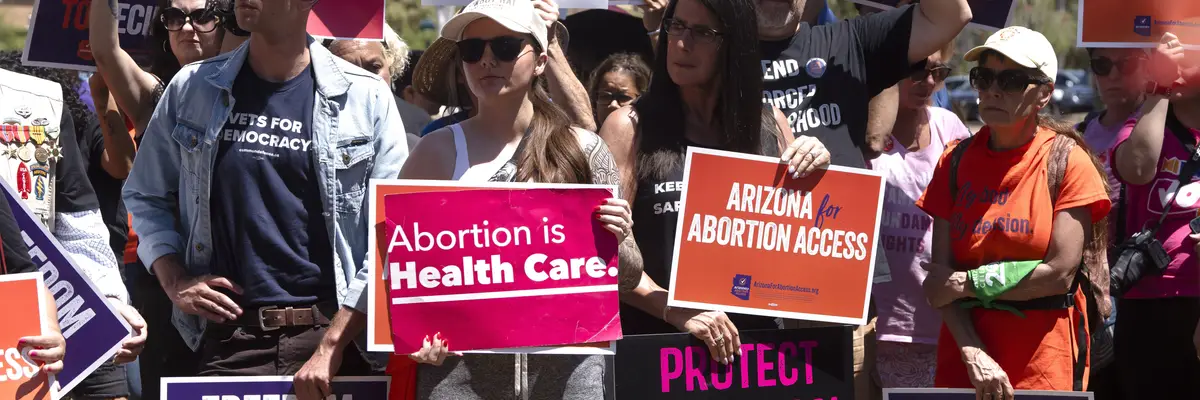

Members of Arizona for Abortion Access, the ballot initiative to enshrine abortion rights in the Arizona State Constitution, hold a press conference and protest condemning Arizona House Republicans and the 1864 abortion ban during a recess from a legislative session at the Arizona House of Representatives on April 17, 2024 in Phoenix, Arizona.
(Photo by Rebecca Noble/Getty Images)

Sylvia Ghazarian
Apr 10, 2026
Common Dreams

The maternal mortality crisis in the United States is a national embarrassment, and it’s unfolding in real time. The US continues to have one of the highest maternal death rates among high-income countries, and the situation is getting worse, not better. Behind this trend is a growing body of research showing that state abortion bans directly contribute to increased maternal mortality, especially in communities already burdened by systemic inequities.

Maternal mortality has traditionally reflected deep structural problems in a healthcare system that fails to serve all people equally. In 2024, the US maternal mortality rate ticked upward again, reversing a brief decline and demonstrating that the crisis is far from over. Experts point to a range of causes, including reduced access to prenatal care, maternity care deserts, and strained hospital systems, all problems intensified in states with abortion restrictions and in states with increased Immigration and Customs Enforcement (ICE) agents.

A comprehensive analysis from the most recent Centers for Disease Control and Prevention (CDC) mortality figures shows that people living in states that have banned abortion are nearly twice as likely to die during pregnancy, childbirth, or soon after compared with those in states where abortion remains legal and accessible. What’s more, in supportive states where abortion has remained legal, maternal mortality has declined by about 21% since 2022, suggesting that access to comprehensive reproductive care saves lives.

Restricting abortion does more than eliminate a medical procedure; it forces people to carry pregnancies that pose very real health risks. Childbirth has inherent dangers from hemorrhage and infection to hypertensive disorders and cardiac events, and the risk of death from pregnancy is at least 44 times higher than from abortion. When abortion is inaccessible, people are compelled to continue unwanted or medically unsafe pregnancies. That dynamic alone drives increased deaths that could otherwise have been prevented.

Bans do not reduce the prevalence of abortion; they reduce its safety, push people into riskier medical scenarios, and leave pregnant people with fewer options even when their health is at stake.

Racial and socioeconomic disparities in maternal mortality did not begin with the reversal of Roe v. Wade. Black birthing people in the US have long faced significantly higher death rates than white birthing people, a symptom of deep structural racism in healthcare, poverty, and chronic stress. But abortion bans have exacerbated these inequities.

In states with abortion bans, Black birthing people are more than three times as likely as white birthing people in those same states to die from pregnancy-related causes. Those figures make crystal clear that when we talk about maternal mortality, we are talking about a crisis of racial inequity, class inequity, and political neglect. States with the worst maternal health outcomes, including Louisiana, Mississippi, and Texas, are predominantly in the South and have enacted some of the most restrictive reproductive laws.

These disparities compound with other conditions such as limited access to early prenatal care—which the CDC reports has declined across the country, with the steepest drops among Black mothers. Delays in early care are associated with worse outcomes for both mother and baby and are worsened by the closure of maternity care facilities in rural and under-resourced areas.

For undocumented and immigrant communities, the maternal mortality crisis is layered with additional barriers. Fear of immigration enforcement, including ICE, deters people from seeking care, even in emergencies. Clinics in border states with large immigrant populations were already medically underserved before Dobbs, and abortion bans have deepened that inaccessibility. Many undocumented people lack insurance, fear reporting, or face economic barriers that make traveling for care impossible. These structural obstacles do not just delay care, they can literally cost lives.

Immigrant and mixed-status families are disproportionately concentrated in states with abortion bans, like Texas, Arizona, and Florida, meaning that people who already face the greatest systemic barriers to healthcare are also the most likely to lack access to safe abortion or comprehensive maternal services. This intersection of racist policy, reproductive restriction, and anti-immigrant enforcement creates a perfect storm that pushes already vulnerable people further to the margins and deeper toward harm.

Critics of abortion argue from moral or ideological positions, but the evidence shows that access to abortion care is fundamentally a matter of public health. Bans do not reduce the prevalence of abortion; they reduce its safety, push people into riskier medical scenarios, and leave pregnant people with fewer options even when their health is at stake.

We are now witnessing a preventable loss of life, and the window to act is closing.

We know how to prevent many maternal deaths: Expand access to comprehensive reproductive care (including abortion), strengthen prenatal and postpartum support, increase Medicaid coverage, invest in maternity care infrastructure, and dismantle the historic and systemic inequities that predict who lives and who dies. We know these interventions work because states that have protected reproductive rights are already seeing declines in maternal mortality.

To ignore this crisis is to ignore evidence, dignity, and the lives of pregnant people, especially those in Black, Indigenous, immigrant, and economically disadvantaged communities.


Our work is licensed under Creative Commons (CC BY-NC-ND 3.0). Feel free to republish and share widely.


Sylvia Ghazarian
Sylvia Ghazarian is executive director of the Women’s Reproductive Rights Assistance Project (WRRAP).
Full Bio >
We Must Fight Fossil Fuel Oligarchs to Save Democracy

It’s no coincidence the fossil fuel industry has lined up behind racist, belligerent, and authoritarian leaders like Trump.


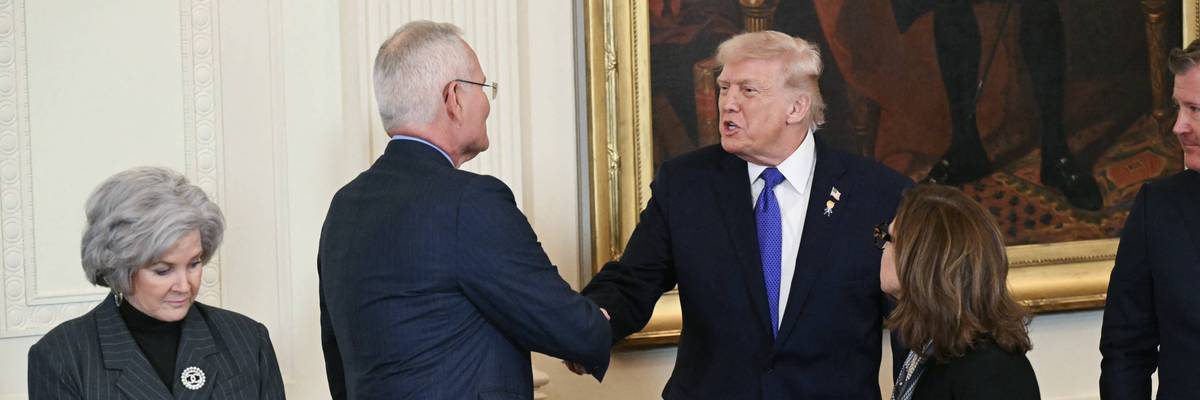
US President Donald Trump shakes hands with ExxonMobil CEO Darren Woods during a meeting with US oil company executives in the East Room of the White House in Washington, DC on January 9, 2026.
(Photo by Saul Loeb / AFP via Getty Images)

Basav Sen
Apr 10, 2026
Common Dreams

The second Trump administration has been an unrelenting assault on democracy.

Basic democratic rights are disappearing. Unarmed people have been executed in the streets and smeared as “terrorists” by the government. Entire families are being kidnapped and denied basic rights in inhumane detention centers. And journalists are being arrested for doing their jobs.

Against this backdrop, working for climate justice might seem like a distraction.

But a clear-headed look at how we ended up in this grim situation in the first place shows that the movement for climate justice, far from being a distraction, is an essential part of the fight to defend and deepen democracy.

We cannot defeat authoritarianism without breaking the stranglehold of the fossil fuel industry on our economy and our political system.

The Trump administration has received major political backing from fossil fuel oligarchs—in response, in fact, to Trump’s open solicitation to trade favors for their support. The government has subsequently followed an energy and environmental policy agenda that benefits the industry.

The administration has expanded the industry’s access to resources at home through leases and permits for drilling in public lands and waters. It has attacked Venezuela, kidnapped its president, and is attempting to open up the country’s oil reserves to US corporations.

And of course it launched an unprovoked war on Iran, sending the price of oil skyrocketing—and leading to genocidal threats from the president against Iran unless the country reopens the Strait of Hormuz, through which Gulf oil passes.

Meanwhile at home, the Trump administration has weakened environmental standards, including mercury pollution standards for power plants. By attacking motor vehicle fuel economy standards, it has effectively grown the captive market for the industry’s products. And it has abused the federal permitting process to try to kill the fossil fuel industry’s main competitors, wind and solar energy.

This is not merely a case of an administration that supports the fossil fuel industry and also happens to be authoritarian. The industry directly supports and benefits from an authoritarian government that curtails democratic rights and silences dissent. It also benefits from a government that upholds white supremacy and enforces racial hierarchy.

Several years ago, a report I worked on for the Institute for Policy Studies documented how the fossil fuel industry has used its money and influence to push for state-level legislation to criminalize protest against fossil fuel infrastructure projects. These so-called “critical infrastructure laws” are now on the books in 19 states. The industry has also used strategic lawsuits against public participation (SLAPPs) to intimidate and silence critics.

This is a predictable response of a powerful, politically connected industry that is under assault on two fronts.

First, competition from cheap, widely available wind and solar energy poses a serious economic threat to the industry. Renewable energy is cheaper than fossil fuels in most of the world, and new generation capacity is dominated by renewables.

Simultaneously, the industry faces serious political and reputational threats. Growing numbers of people worldwide are experiencing extreme heat, wildfires, storms, floods, and toxic air and water pollution attributable to the industry’s activities. Many of them are connecting the dots, and refusing to be passive victims of a powerful industry and its political backers.

Social movements against particular fossil fuel projects, or against the industry more broadly, have multiplied on every continent. What’s more, they are already winning. The industry faces restrictions in several political jurisdictions, and likely recognizes that it could even be expropriated in the not so distant future.

Faced with these twin crises, the fossil fuel industry is increasingly resorting to relying on the repressive apparatus of state violence to crush dissenting voices and maintain its dominance.

The industry has also historically benefited from a racially and economically unequal society. The lack of political power of Indigenous, Black, and other racially marginalized communities, and of poor communities of every race, has enabled the industry to locate polluting infrastructure in these communities, treating them as sacrifice zones. This has let the industry avoid the protracted zoning and legal battles they would have to contend with if they tried to locate their infrastructure in more privileged communities, greatly reducing the cost and lead time for their projects.

In recent years, the growing strength of the environmental justice movement has threatened the ability of the industry to continue to reap the benefits of racial and economic stratification. It is therefore no surprise that the industry is supporting an openly white supremacist political agenda that seeks to bring old racial hierarchies back and eliminate the very concept of environmental justice.

In sum, the far-right agenda in the US is deeply intertwined with the political and economic objectives of the fossil fuel industry that is at the root of climate change. We cannot defeat authoritarianism without breaking the stranglehold of the fossil fuel industry on our economy and our political system.

Finally, it is worth pointing out that these observations are mainly based on US politics, but are applicable to many parts of the world. Fossil fueled fascism has become a global phenomenon, and our resistance to the fossil fuel industry must be similarly global in scale.


Our work is licensed under Creative Commons (CC BY-NC-ND 3.0). Feel free to republish and share widely.


Basav Sen
Basav Sen is the climate justice project director at the Institute for Policy Studies (IPS) and writes on the intersections of climate change and social and economic justice. Prior to joining IPS, Basav worked for 11 years as a campaign researcher for the United Food and Commercial Workers.
Full Bio >
Trump Weighs Ultimate Gift to For-Profit Insurance Industry: Medicare Privatization

“They want to remove the guarantee of Medicare,” one advocate said of the Trump administration’s floated plan to automatically enroll seniors in Medicare Advantage.


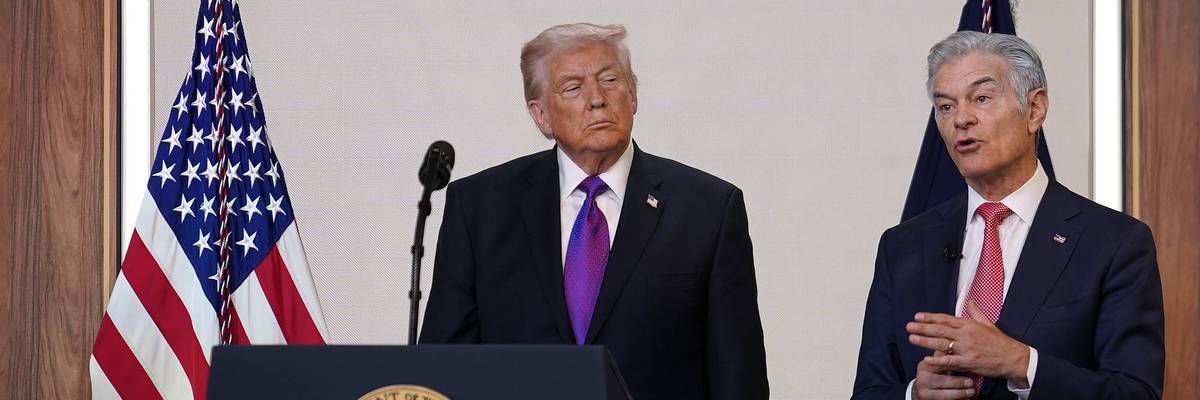
Centers for Medicare and Medicaid Services Administrator Mehmet Oz speaks as President Donald Trump looks on during an event on February 5, 2026.
(Photo by Nathan Howard/Getty Images)

Jake Johnson
Apr 10, 2026
COMMON DREAMS

The Trump administration is considering enacting a policy that would automatically funnel seniors into for-profit Medicare Advantage plans—which critics say would set Medicare on the path to full-scale privatization.

Chris Klomp, the Trump administration’s director of Medicare and deputy administrator of the Centers for Medicare and Medicaid Services (CMS), told STAT last month that enrolling seniors in Medicare Advantage (MA) plans by default “is something that we’re thinking through.” MA plans are funded by the federal government and run by private insurance companies such as UnitedHealthcare and Humana, both of which have been accused of improperly denying necessary care to patients and overcharging taxpayers.

The default enrollment scheme was floated in the far-right Project 2025 agenda that President Donald Trump has repeatedly tried to disavow. Currently, older Americans who have received Social Security benefits for at least four months before they turn 65 are automatically enrolled in traditional Medicare, and they can choose to enroll in an MA plan as an alternative.

“Another bad idea straight from Project 2025,” Rep. Mark Pocan (D-Wis.) said in response to Klomp’s comments on the proposed default enrollment change. “Medicare Advantage is private, for-profit insurance that overcharges American taxpayers by billions every year and regularly denies seniors the care they need.”

“Making Medicare Advantage the default option hurts patients and taxpayers,” Pocan added, “but it will make insurance execs a lot of money.”

“With Mehmet Oz running the agency, they can move incredibly quickly to make that happen, and they are.”

Klomp said no plans have been finalized, but defenders of traditional Medicare warned that CMS—headed by Mehmet Oz, who during his 2022 US Senate run backed a plan entitled “Medicare Advantage for All”—could try to swiftly ram the change through without public input.

“With Mehmet Oz running the agency, they can move incredibly quickly to make that happen, and they are,” Alex Lawson, executive director of the progressive advocacy group Social Security Works, told Common Dreams on Friday. “They will not explain it to the people, because the people hate the idea. Instead, they say ‘change the default option’ and other policy jargon to try and hide the fact of what they are doing, privatizing Medicare.”

“They want to remove the guarantee of Medicare,” warned Lawson, “and replace it with the same private insurance giants that make billions denying healthcare, especially to those who need it the most.”

Experts say making Medicare Advantage plans the default enrollment option for seniors would likely decrease traditional Medicare enrollment dramatically.

Given massive overpayments to Medicare Advantage plans—potentially $1.2 trillion over the next decade, according to one independent estimate—a large increase in MA enrollment would be sure to drive up costs and monthly premiums across the board. A report released last month by the congressional Joint Economic Committee estimated that MA overpayments led to premium hikes of $212 per Medicare Part B enrollee last year.

“Since 2016, MA overpayments have added an estimated $82 billion to Part B premiums,” the congressional report found. “[Traditional Medicare] beneficiaries, who are not enrolled in MA, bore roughly $6 billion of that burden.”

Under one scheme floated last year by Rep. David Schweikert (R-Ariz.), eligible Medicare recipients would be automatically enrolled in the “MA plan with the lowest premium available,” unless they actively decide to opt out. Once enrolled in an MA plan, individuals would be unable to switch plans for three years.

Wendell Potter, a former health insurance executive who now champions Medicare for All, warned Friday that under Schweikert’s plan, “seniors would be locked in a plan that the government chose for them, that has a limited network of doctors and hospitals, that makes them pay the entire bill for services they might receive outside of that network, and that denies coverage for medically necessary care far more than traditional Medicare—for three years.”

In addition to weighing the default enrollment change, the Trump administration has recently delivered smaller-scale but significant victories to MA insurers, including by boosting federal payment rates—bowing to a massive industry lobbying blitz—and easing rules around the marketing of MA plans.

David Lipschutz, co-director of law and policy at the Center for Medicare Advocacy, said Thursday that the latter move represents “a rollback of consumer protections, which gives in to pressures from the insurance industry and those who sell their products.”
DNC Half-Measures Condemning Dark Money Won’t Cut It, Says Sanders as He Demands Total Ban

“Billionaire-funded super PACs—AIPAC, AI, crypto, and others—are spending hundreds of millions to defeat any candidate who crosses them. They should be banned from Democratic primaries. Period.”


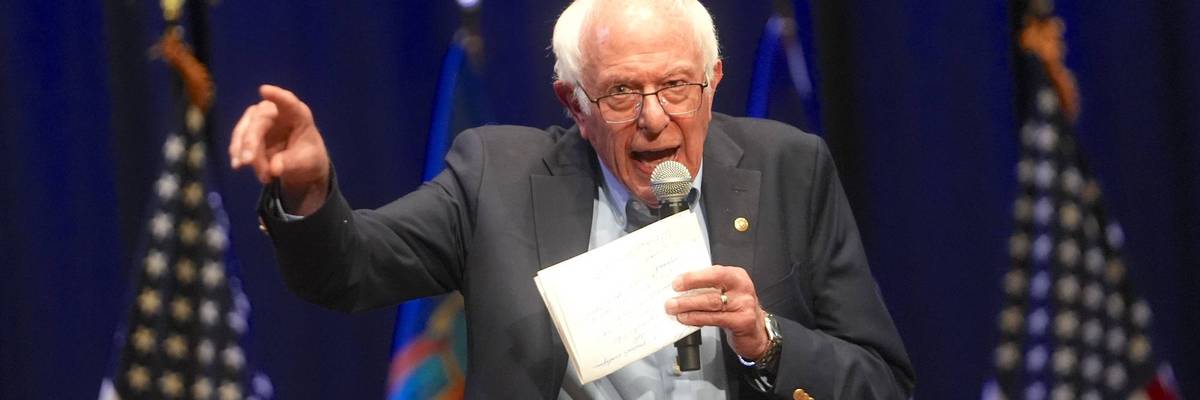
US Sen. Bernie Sanders speaks at Brooklyn College, his alma mater, in New York City on September 6, 2025.
(Photo by Selcuk Acar/Anadolu via Getty Images)


Brett Wilkins
Apr 10, 2026
COMMON DREAMS

Independent Sen. Bernie Sanders on Friday called for a total ban on dark money a day after the Democratic National Committee voted down a resolution that would have condemned the leading US pro-Israel lobby, which has spent nine figures on US elections over the past five years.

The DNC Resolutions Committee rejected the resolution, which condemned “the growing influence” of dark money and corporate-backed outside spending on Democratic races, specifically calling out the American-Israel Public Affairs Committee. United Democracy Project, AIPAC’s dark money arm, unleashed a $100 million blitz targeting progressives during the 2024 election cycle.

When combined with other pro-Israel lobby groups, like GOP megadonor Miriam Adelson’s Preserve America PAC, that figure soars to over $200 million, according to the public interest group AIPAC Tracker.

Instead, the DNC panel opted for a broader resolution decrying the influence of dark money—defined as undisclosed independent campaign contributions—in the 2026 Democratic primaries.

“The DNC just passed a resolution condemning dark money,” Sanders (Vt.) said Friday on X. “That’s a start, but not enough.”

“Billionaire-funded super PACs—AIPAC, AI, crypto, and others—are spending hundreds of millions to defeat any candidate who crosses them,” the senator added. “They should be banned from Democratic primaries. Period.”

Sanders campaigned twice for president, centering his opposition to the Supreme Court’s 2010 Citizens United v. Federal Election Commission ruling, which effectively ushered in the modern era of secret unlimited political spending.

According to the Brennan Center for Justice, dark money spending in federal elections has skyrocketed from negligible amounts before 2010 to over $1.9 billion in the 2024 cycle alone, with over $4 billion in total undisclosed outside financing following the high court’s contentious ruling.

Polling has repeatedly affirmed that support for Israel—which stands accused in the International Court of Justice of committing genocide in Gaza and has already been found by the ICJ to be illegally occupying Palestine under apartheid rule—is detrimental to Democrats.

The DNC’s own suppressed postmortem of the 2024 presidential election also showed that former President Joe Biden and Vice President Kamala Harris’ unconditional support for Israel cost Harris votes.

As AIPAC has grown more toxic to US voters amid a litany of Israeli atrocities in Gaza and the West Bank under the government of Prime Minister Benjamin Netanyahu—who is wanted by the International Criminal Court for alleged crimes against humanity and war crimes in Gaza—a growing number of Democrats, including some who once welcomed the group’s support, are turning their backs on the lobby.

“AIPAC really is not an organization that I think today I would want any part of,” Illinois Gov. JB Pritzker said last month after affiliated groups poured $22 million into House races in his state.

While AIPAC cash was instrumental in unseating congressional progressives including former Reps. Jamaal Bowman (D-NY) and Cori Bush (D-Mo.), its largesse failed to oust others, including Reps. Summer Lee (D-Pa.), Ilhan Omar (D-Minn.), and Rashida Tlaib (D-Mich.).

Sanders wasn’t the only one to criticize the DNC’s rejection of the anti-AIPAC resolution.

“The American people are clear: They want our government to invest in life and stop funding the bombs that are destroying lives in Palestine, Lebanon, and Iran,” Jewish Voice for Peace political director Beth Miller said Friday.

“The DNC‘s failure to pass this simple resolution condemning the outsized spending of an extremist and Republican-funded group like AIPAC in Democratic primaries shows how wildly out of touch the party is with its base,” Miller added.


Democrats Reject Resolution Condemning AIPAC Money in Primaries

“Democrats chose genocide over winning in 2024,” one Palestinian rights advocate said. “When does this stop?”
April 10, 2026

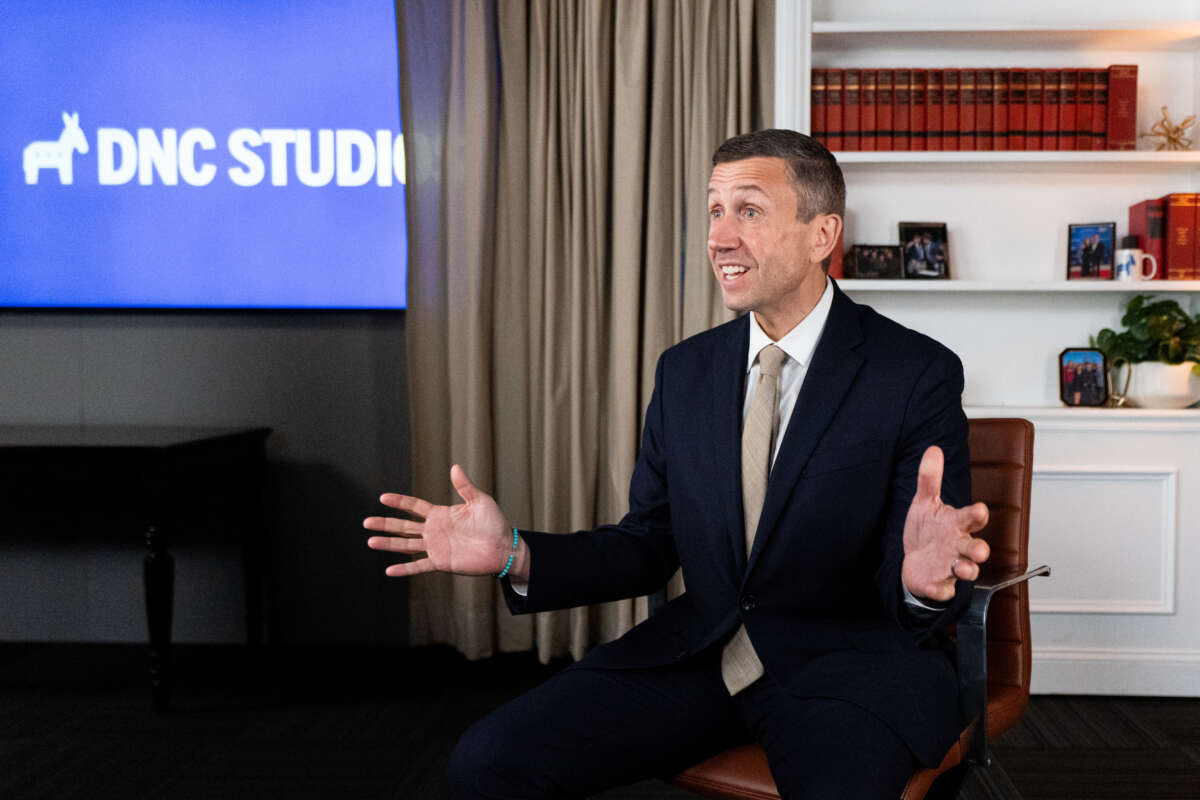
Ken Martin, chair of the Democratic National Committee, speaks during an interview at DNC headquarters in Washington, D.C., on November 2, 2025.Bill Clark / CQ-Roll Call, Inc via Getty Images

Democratic Party leaders had a chance this week to push back against Israel’s violent expansionism and the Israel lobby’s massive political spending in the United States.

Once again, Democrats chose instead to punt the issue despite plummeting public support for Israel, both among their base and the wider U.S. public, ahead of the midterms.

At a meeting in New Orleans on April 9, members of the Democratic National Committee (DNC) voted down a symbolic resolution to limit the “growing influence” of dark money and corporate outside spending on Democratic races, particularly the American Israel Public Affairs Committee (AIPAC), which recently pumped tens of millions of dollars into Democratic primaries in New Jersey and Illinois.

A draft of the resolution stated that “massive outside spending” by groups on candidates based on “positions regarding international conflicts or foreign governments” raises concerns about undue influence on debate and policy making, potentially “constraining elected officials’ ability to represent the views of their constituents.” The resolution specifically called out AIPAC by name.

The DNC Resolutions Committee also tabled a pair of resolutions to recognize a Palestinian state and support restrictions on aid to units in the Israeli military accused of war crimes. Those resolutions were referred to the party’s nascent Middle East Working Group, which was created last year as it became increasingly clear that public opposition to Israel’s genocide in Gaza cost Democrats votes in the 2024 elections.

DNC members also sent to the working group a resolution calling for an end to the U.S.-Israeli war on Iran and pointing to potential war crimes in the suspected U.S. strike on a girls’ school in Minab that killed at least 175 people, most of them children, on February 28.

The Middle East Working Group, which includes members with diverging views on Israel, held its fourth meeting this week but has been slow to agree on an agenda. Hamid Bendaas, communications director at the Institute for Middle East Understanding (IMEU) Policy Project, said the group does not appear on track to accomplish much before voters go to the polls in November.

“The Democratic Party seems asleep at the wheel and is not responding to this very quick and very influential public opinion shift on Israel.”

“The Democratic Party seems asleep at the wheel and is not responding to this very quick and very influential public opinion shift on Israel,” Bendaas told Truthout in an interview.

However, some Democrats know that the party cannot forever avoid either U.S. financial and military support for Israel’s expansionist conquests or the influence of AIPAC. One DNC member speaking on the condition of anonymity said they had received direct calls about the resolutions from “two presidential aspirants who would have to answer for the DNC’s positions on Israel and AIPAC if they run,” according to Politico.

Meanwhile, Israel’s violent apartheid and ethnic cleansing, perpetrated with U.S. weapons and funding, continues unabated, according to the American Friends Service Committee’s Just Peace Global Policy Director Mike Merryman-Lotze.

“The failure of the DNC to take even minimal action in the face of ethnic cleansing and genocide is shameful,” Merryman-Lotze said.

Merryman-Lotze said the DNC’s tabling of the resolutions on a Palestinian state and military support to Israel came as the Israeli government announced 34 new settlements in the occupied West Bank, where extremist settlers are violently forcing Palestinians from their homes with support from the Israeli government and military. The DNC resolutions reaffirm that such settlements are illegal under international law.

“The approval of these new settlements follows a year of extreme violence by the Israeli military and settlers in the West Bank that has killed hundreds of Palestinians and displaced tens of thousands from their homes,” Merryman-Lotze said in an email. “Despite the six-month-old ceasefire, Israel has bombed Gaza on 36 of the last 40 days, killing at least 107 people.”

In a memo urging DNC members to adopt the resolutions on Palestine and AIPAC, IMEU pointed to polls showing the vast majority of Democrats (77 percent in August 2025) agree with leading human rights groups that Israel is committing the crime of genocide in Gaza. Support for providing U.S. military aid to Israel has plummeted across the political spectrum, including among Republicans and especially younger voters.

New polling found notably strong support for Palestinian rights in Texas, a historically red state. According to a poll released on April 6 by the IMEU Policy Project and conducted by Data for Progress, 76 percent of voters in the March 3 Texas Democratic Senate primary agree that Israel is committing genocide, and 80 percent support ending weapons funding to Israel.

Nationwide, a Pew Research survey released on April 7 found that 80 percent of Democrats and Democratic-leaning independents hold unfavorable views of Israel, compared to 69 percent in 2024 and 53 percent in 2022.

Bendaas said IMEU consulted with Democrats on the party’s own autopsy of the 2024 elections. That autopsy concluded that Kamala Harris lost significant support in the presidential race due to the Biden administration’s policy of providing seemingly limitless funding for Israel’s genocide in Gaza.

“We are just not seeing any movement from the Democratic Party leadership to adjust from this reality,” Bendaas said. “There’s no urgency to react to what will clearly be an issue for many of their own voters in the November midterms.”

DNC Chair Ken Martin touted a resolution passed on April 9 that condemns the “corrosive influence” of dark money on Democratic primaries but does not single out AIPAC or any other specific interest group.

“We had various resolutions that focused on different industries and groups, and instead of going one-by-one, we passed a blanket repudiation,” Martin said on social media, adding that he supports an end to dark money in politics.

Brian Romick, president and CEO of Democratic Majority for Israel, applauded the DNC for rejecting a “set of divisive, anti-Israel resolutions.”

“These measures would be a gift to Republicans, would further fracture our party, and do nothing to bring Israelis and Palestinians closer to peace,” Romick said in a statement that did not mention AIPAC by name.

However, Bendaas said that Democrats face intense pressure from powerful lobbyists at AIPAC to take positions that do not align with their own voters. AIPAC is funded by Republican billionaire mega-donors such as Miriam Adelson and Paul Singer, and in 2024 the group was the largest source of GOP donations funneled into in Democratic elections. AIPAC’s $100 million in campaign spending in 2024 exceeded the spending of any organization in a single cycle in U.S. history.

“They are invested in defeating Democrats, and they are also flooding money into Democratic elections to support people who do not have voter support otherwise,” Bendaas said. “And this is an existential risk for Democratic Party if you are being propped up by the opposition.”

Bendaas said there appears to be an intentional strategy among AIPAC and its mega-donors to weaken and hollow out the Democratic Party as its voter base increasingly turns against Israel.

“Democrats chose genocide over winning in 2024,” Bendaas said. “When does this stop?”

Friday, April 10, 2026

Layoffs hit Kennedy Center again amid Trump's MAGA overhaul

Erik De La Garza
April 10, 2026 
RAW STORY


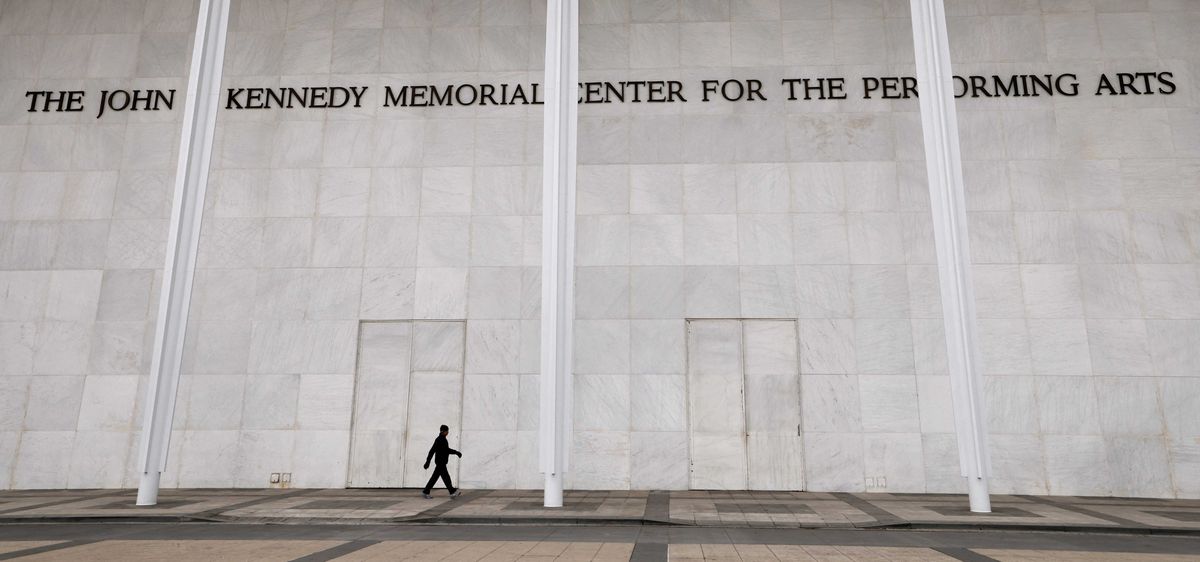
A man walks by the John F. Kennedy Center for the Performing Arts, after White House spokeswoman Karoline Leavitt announced that the Kennedy Center board decided to rename the institution the Trump-Kennedy Center in Washington, D.C., U.S., December 18, 2025. REUTERS/Kevin Lamarque

Layoffs continued Friday at the John F. Kennedy Center for the Performing Arts as the nation’s premier arts institution prepares for a two-year shutdown tied to President Donald Trump’s MAGA-fied overhaul – which included a rebrand as the “Trump-Kennedy Center.

Multiple people familiar with the cuts told the Washington Post that the programming department has been hit especially hard, with staff either terminated or reassigned as the center pivots away from traditional productions.

“Everything is a rental now,” one person with knowledge of the situation told the outlet. “If it’s not making money, we don’t do it.”

Among those laid off were top leaders, including Ryan Hamilton, senior director of broadcast, comedy and special programming, and Sam Miller, senior director of music programming, the Post reported Friday. Both were brought in under former board president Richard Grenell, a Trump ally who previously led efforts to reshape the institution in the MAGA leader’s name before his firing.

The latest cuts follow an earlier round of layoffs that hit the storied arts institution just weeks ago, as leadership prepares for a July 7 closure that will last two years for renovations.

Officials have not disclosed how many employees have been affected, but the Post noted that this round of layoffs is one of several since Trump’s takeover in February 2025. “More than 100 employees have resigned or been laid off since then, including the heads of nearly every department and discipline,” the outlet reported.

In a statement, a Kennedy Center spokesperson said staffing changes are meant to “support the broader move toward a successful closure for renovations.”

And more cuts could still be on the way. In an email last month, Matt Floca, the center’s new president, warned employees of “difficult staffing decisions that support the broader operational changes.”

“Each of you has contributed to the legacy of this institution, and these decisions have not been made lightly,” Floca wrote in the March email. “It is my sincere intention that each personnel action be carried out with consideration and care.”

'Stalin would be proud': Trump's new plans for massive DC arch met with anger

Matthew Chapman
April 10, 2026
RAW STORY 


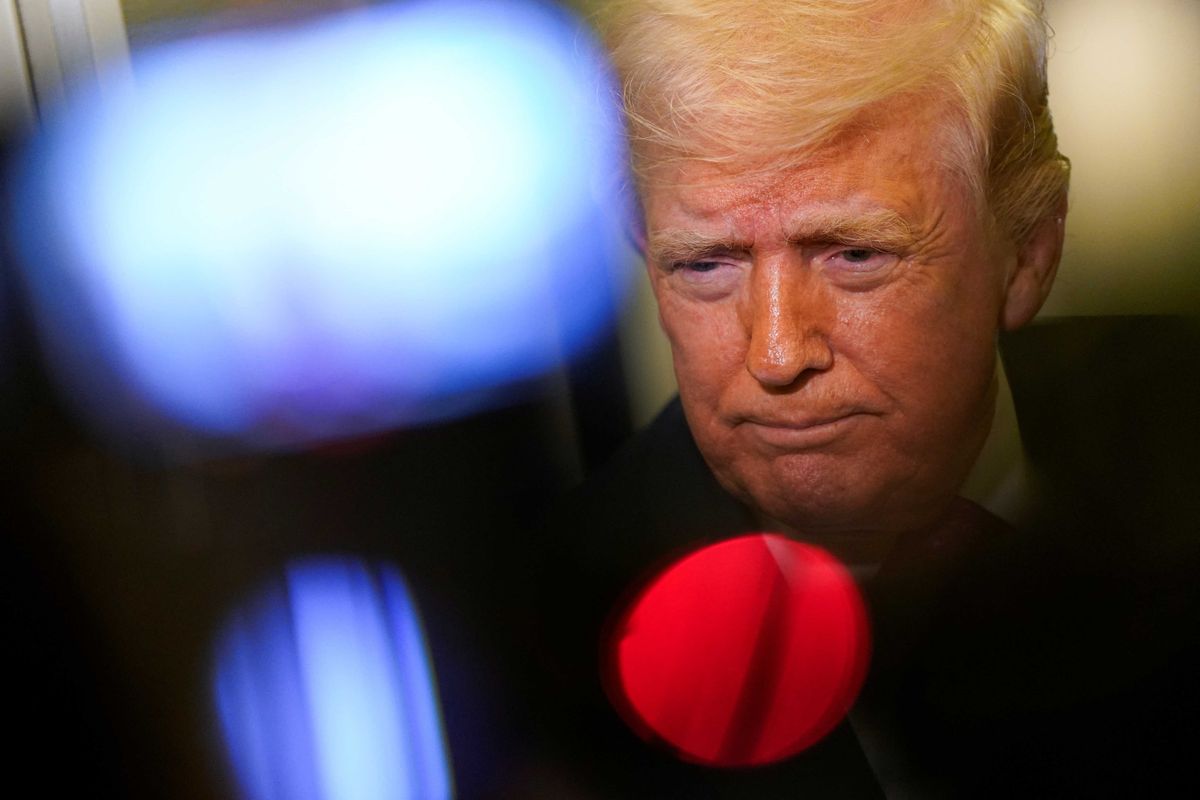
U.S. President Donald Trump looks on as he speaks to members of the media aboard Air Force One en route to Joint Base Andrews, Maryland, U.S., March 29, 2026. REUTERS/Elizabeth Frantz

President Donald Trump unveiled his team's new plan for a 250-foot triumphal arch in Washington, D.C., to be constructed in honor of America's 250th anniversary later this year, on Friday.
Many people on social media, however, reacted to the arch with anger.

Some accused Trump of making the project more a monument to himself than to the country, comparing him to foreign dictators. Anger has swelled over many of Trump's other controversial projects in D.C., including transforming the Kennedy Center and replacing the White House East Wing with a massive, gaudy ballroom.

Others pointed out that building this monument at a moment when America is in geopolitical and economic distress doesn't send a great message, while still others accused the arch of desecrating the hallowed ground of nearby Arlington Cemetery.

"While Americans worry about skyrocketing costs and another endless war, President Trump is focused on a taxpayer-funded vanity project that would choke traffic, block our skyline, and tower over sacred ground where those who served our nation are buried, including my own parents and sister," wrote Rep. Don Beyer (D-VA). "This isn’t about America’s 250th or honoring our veterans. It’s about Donald Trump’s ego — and we're going to stop it."

"Hey but don’t worry about your rising grocery prices," wrote former MS NOW host and Zeteo News chief Mehdi Hasan.

"What a megalomaniac Trump truly is," wrote tennis icon Martina Navratilova.

"Stalin would be proud," wrote political commentator Norm Ornstein.
Trump ordered Pentagon to rewrite report that labeled China a 'security threat': WSJ

Tom Boggioni
April 10, 2026 
RAW STORY


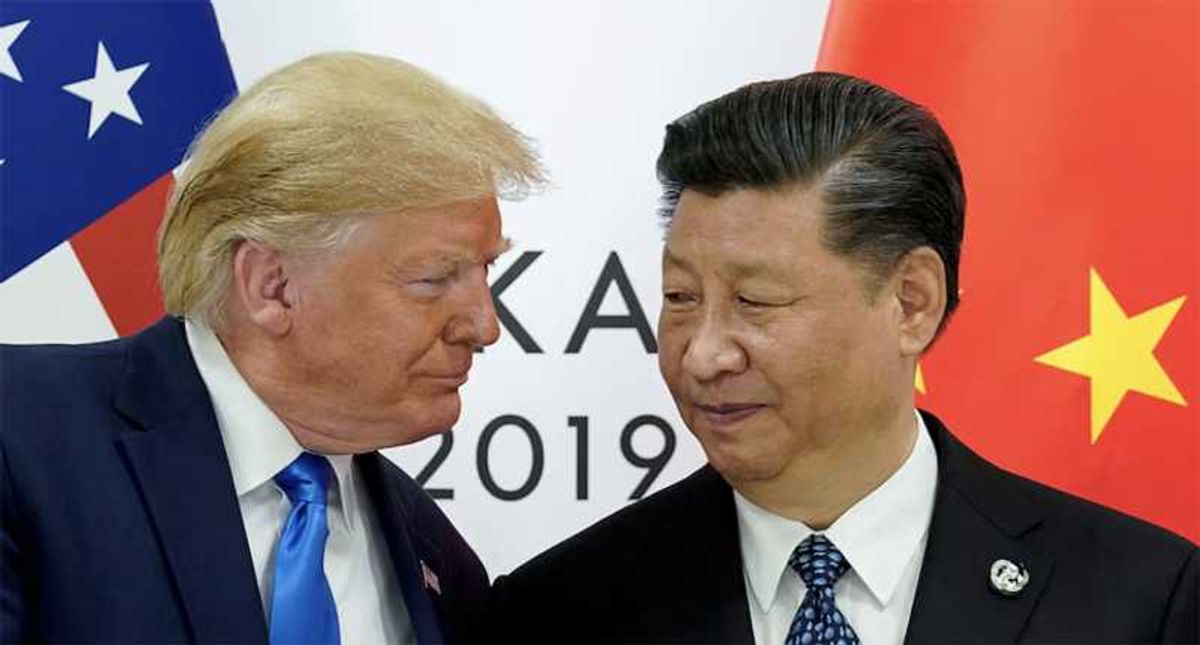
Donald Trump, Chinese President Xi Jinping (Photo by Kevin LaMarque for Reuters)

Donald Trump's public tough-guy posturing on China masks a stunning capitulation to Beijing. When Pentagon officials presented a draft National Defense Strategy last fall that characterized China as the top U.S. security threat — the same assessment his own first administration endorsed — Trump ordered it rewritten in friendlier terms.

According to the Wall Street Journal's Heather Somerville, Alexander Ward, and Gavin Bade, Trump "balked" at the Pentagon assessment and commanded his deputy to soften the language. The revised National Defense Strategy published in January struck an entirely different tone.

"President Trump seeks a stable peace, fair trade, and respectful relations with China," the document now declares — a stunning reversal from the bipartisan consensus that characterized China as the most consequential U.S. adversary.

The shift represents a seismic policy reversal. Trump's own first-term defense strategy took the same hardline approach the Pentagon recommended. Now Trump 2.0 is discarding that bipartisan framework in favor of a new mantra: "Don't rock the boat."

The capitulation goes far deeper than rhetoric. Commerce Secretary Howard Lutnick has imposed a stranglehold on China policy, requiring his personal sign-off for any China-related actions. The result is Kafkaesque: senior Commerce officials sit waiting by Lutnick's office or watch for his car outside the building before pursuing routine China policy actions.

Other agencies have resorted to workarounds, pursuing a ban on a China-linked router maker by strategically avoiding naming either the company or China in the official order — essentially hiding policy from public view.

The reversal has alarmed Trump's own national security aides. China hawks in the administration have adopted gallows humor, calling the shift the "Busan Freeze," referencing the South Korea meeting between Trump and Xi that produced a fragile trade detente.

Treasury Secretary Scott Bessent and other officials appealed to Trump to walk back tariffs and dial down the trade war so minerals could flow from China again — an apparent capitulation to economic pressure over strategic security.

The pivot was deliberate and premeditated. Trump initially asked national security advisers to develop a harder line on China's technological encroachment. But the president later abandoned the restrictions, and in April, Trump fired Douglas Feith and other China hawks from the National Security Council, dismantling the directorate that had coordinated administration actions on tech and China.

Against a president who fancies himself a master dealmaker, China is clearly winning, the Journal is reporting.
Kacey Musgraves says she saw UFOs following her plane — and pilots confirmed it: report

Nicole Charky-Chami
April 10, 2026 
RAW STORY


NEW YORK - JUL 19: Kacey Musgraves performs in concert on NBC's 'TODAY' show on July 19, 2019 at Rockefeller Plaza in New York City.NEW YORK - JUL 19: Kacey Musgraves performs in concert on NBC's 'TODAY' show on July 19, 2019 at Rockefeller Plaza in New York City. (Photo credit: Debby Wong / Shutterstock)

Kacey Musgraves said she saw alleged UFOs following her plane during a flight, TMZ reported on Friday.

The singer and songwriter described on Instagram stories how she saw light orbs that "just didn't look normal" during her trip from Fort Worth, Texas, to Nashville, Tennessee, with her manager Bobby. She also said the pilots on the flight confirmed seeing the suspicious lights — and not just on this flight but "every single night."

She detailed seeing the lights from around 50,000 feet in the sky and how they were "not moving like any craft that we can control," forming triangle patterns that were "extremely bright" and moving around.

Musgraves captured video from the flight, which she admitted was not the best quality, even for an iPhone 17.

"You could have the best, most high-quality footage of something and no one would believe it anyway," she added.


You’re being watched: Japan battles online abuse of athletes


By AFP
April 8, 2026


Japan's authorities have a warning for trolls planning to target competitors at this year's Asian Games: You are being watched. - Copyright AFP/File Yuichi YAMAZAKI


Andrew MCKIRDY

Japan is fighting back against online abuse of athletes and sports authorities have a warning for trolls planning to target competitors at this year’s Asian Games: You are being watched.

Online abuse is felt by athletes all over the world, affecting their performances and mental health, leaving them fearing for their safety and even causing them to quit their sports.

Japan is no exception and efforts are belatedly being made to tackle the problem, from dedicated lawyers to teams monitoring social media for offensive posts.

“Even a single negative comment can cut deeply,” Japanese Olympic Committee (JOC) official Misa Chida told AFP.

“Athletes don’t want to see things like that, so a lot of them choose not to look at social media at all, and that means they miss the 99 percent of messages that are supportive.

“That’s a real shame.”

Chida was part of a dedicated team of JOC officials monitoring social media at the Milan-Cortina Olympics in February.

Six staff members in Milan and 22 in Tokyo checked around the clock for posts abusing Japanese athletes, using both manual and AI searches.

They worked in conjunction with Meta — owner of Instagram, Facebook and WhatsApp — and Japanese company LINE Yahoo.

The team asked social media companies to take down almost 2,000 posts, and succeeded in having nearly 600 removed.

Social media companies have often been accused of not doing enough to crack down on abuse on their platforms.

The JOC said they plan to repeat their monitoring activities at their home Asian Games, which are being held in Nagoya and the wider Aichi area on September 19-October 4.

On top of that, Asian Games organisers told AFP that they will run a wider monitoring programme aimed at protecting athletes from all competing countries.

“We now understand what kinds of comments appear on a daily basis and how they upset athletes,” said JOC official Hirofumi Takeshita.

“We’ve learned how much energy we need to devote to this.”

– ‘Hope your family dies’ –

The JOC is not the first sporting organisation to carry out a social media monitoring programme.

The International Olympic Committee ran one in more than 35 languages at the 2024 Paris Games and there have also been initiatives in football and tennis.

“As awareness of these initiatives grows among athletes, staff and everyone working on the ground, that in itself contributes to a greater sense of psychological safety,” said Chida.

Japan has been relatively late to the party, according to lawyer Shun Takahashi, who leads a seven-strong legal group dedicated to protecting athletes from online abuse.

Takahashi says his group, founded in 2024, is a “safe haven” for athletes, many of whom feel uncomfortable talking about the issue.

“They worry that showing vulnerability might lead a coach to bench them or that others will see them as weak,” he said.

“Many athletes are raised with the idea that they must always be strong and they don’t want to be perceived otherwise.”

Takahashi’s group offered support in the case of Taiki Sekine, a professional baseball player who last year took legal action against online abusers.

Sekine, who received messages such as “I hope your whole family dies in an accident”, has won several settlements and lodged criminal complaints against the worst cases.

The domestic nature of Sekine’s case made it easier to prosecute than social media abuse that crosses international borders.

– Long way to go –

Takahashi says legal action has “a deterrent effect” on online trolls, many of whom he says are in their teens or early 20s.

“It makes them realise the risk involved,” he said.

But while Japan is now taking a proactive approach to online abuse, those involved say there is still a long way to go.

Less than a third of the posts that the JOC’s Olympic monitoring team requested be deleted were actually taken down by social media companies.

Takeshita said the tech firms were “very cooperative” but admitted their view of which posts were offensive did not always match up.

“Yes, there was a gap, but it was a gap that we were able to identify by actually doing this work,” he said.

“That’s better than having an unidentified gap that never gets bridged. Now that we know where the differences lie, we can work to close them.”
EU lawmakers want to tax Big Tech to fund budget

By AFP
April 9, 2026


As they scramble to agree on a 2028-2034 budget, EU lawmakers proposed some funding could come from a 'digital levy' - Copyright AFP Nicolas TUCAT

EU lawmakers on Thursday demanded a European Union-wide tax on the world’s biggest tech companies and online gambling sites to help fund the 27-country bloc’s next seven-year budget.

The EU is facing one of its biggest battles this year over the 2028-2034 budget, which the executive set at two trillion euros ($2.3 trillion).

Fierce negotiations are expected between the European Parliament and member states, especially over where to find extra money that governments are reluctant to chip in.

As they scramble to agree on the budget by the end of year, EU lawmakers proposed that some funding could come from a “digital levy”.

“We believe that technological giants are making a lot of good business in Europe and also significant profits,” said Siegfried Muresan, the EU lawmaker who will lead negotiations on behalf of parliament.

“It is therefore justifiable that they contribute in form of taxation to the budget of the European single market which enables them this business here,” said Muresan, who belongs to the biggest conservative grouping, the EPP.

The parliament’s budget committee is currently negotiating on their position and is expected to vote on the text on April 15 before a vote by all EU lawmakers later this month, Muresan said.

The centre-left socialists and democrats group has called for a tax on online gambling to finance an increase in spending, said socialist lawmaker Carla Tavares, who leads the budget talks with Muresan.

The European Commission wants to increase the budget to two trillion euros from the previous 2021-2027 budget, which was worth around 1.2 trillion euros.

Parliamentarians want more money for critical sectors including agriculture.

But they face a big hurdle since EU countries must approve any such measures unanimously.

The future budget also includes setting aside around 168 billion euros to repay the EU loan taken out during the coronavirus pandemic.